Monday, April 19, 2010
1996-97 Mighty Ducks of Anahem Frank Banham Jersey
On April 13, 1998, Mighty Ducks of Anaheim rookie Frank Banham scored his seventh goal of the season on a tap in at 13:44 of the third period against goalie Patrick Roy to tie their game with the Colorado Avalanche at 2-2. The game would end in a tie.
Frank Banham of the Mighty Ducks
Two days later rookie Matt Cullen opened the scoring of the Mighty Ducks game against the Edmonton Oilers at 17:29 of the first period. Czech rookie Josef Marha scored his eight goal of the season at 11:11 of the second period to extend the Mighty Ducks lead to 2-0 before the Oilers would respond with four straight goals prior to rookie Banham pulling the Mighty Ducks within one at 8:36 of the third period when he scored his eighth goal of the season. The Oilers would seal the game with an empty net goal to win 5-3.
On April 18th, the Mighty Ducks traveled to Los Angeles to face the Kings. Another Czech, rookie Pavel Trnka netted his third goal of the season on the power play at 17:28 of the first period. 83 seconds later rookie Mike Crowley scored his first NHL goal at 18:51 to widen the margin to two goals. A little over halfway through the second period Banham scored a goal in his third consecutive game to give the Mighty Ducks a 3-0 lead. The Kings scored on the power play in the third before rookie Marha's ninth goal of the season accounted for the final 4-1 score.
The final game of the regular season came on this date in 1998 with St. Louis visiting The Pond. Rookie Crowley, from the University of Minnesota, got the Mighty Ducks on the board with his second goal of the year with 2:40 remaining in the first period. It was the ninth consecutive goal scored by Mighty Ducks rookies over a span of four games.
After a St. Louis goal in the second period, Travis Green got the Mighty Ducks veterans on the board to end the rookie scoring streak at 9:27 of the second. Rookie Jeff Nielsen, also from Minnesota, scored the final Anaheim goal of the regular season with his fourth with 2:50 left in the game to make the score 4-3 for St. Louis.
Cullen has now played 12 NHL seasons and is currently with the Ottawa Senators, his fourth NHL club.
Banham played 32 NHL games, 27 with Anaheim and five with the Phoenix Coyotes, scoring nine goals and 11 points. He has played the majority of his career in Europe, spending time in Finland, Russia, Switzerland and primarily the Austrian league where he continues to play today.
Marha originally played for the Colorado Avalanche, the Mighty Ducks and Chicago Blackhawks over six seasons, totaling 159 games and 53 points prior to finding a home with Davos in Switzerland, where he just completed his ninth consecutive season.
Nielsen played two full seasons with Anaheim followed by 59 games with the Minnesota Wild to finish his career with 252 games played.
Trnka played six seasons with the Mighty Ducks before a trade to the Florida Panthers. He returned to his native Czech Republic where he continues to play.
Crowley made it into 67 games with Anaheim over three seasons before his playing days concluded in the 2001-02 season with the Houston Aeros of the AHL.
Today's featured jersey is a Nike 1996-97 Mighty Ducks of Anaheim Frank Banham jersey.
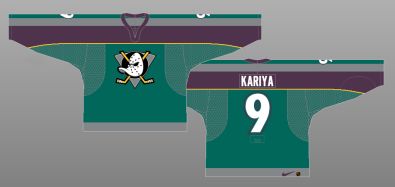
The Mighty Ducks wore four jerseys in 1997-98, their normal home white and road eggplant jerseys. They also re-introduced a third jersey to their set following the disastrous "Wild Wing" jersey of 1995-96. The new alternate jersey used the standard team logo on the front of a white jersey with full length sleeve stripes and a new number font.
Boldly, the Mighty Ducks also produced a fourth jersey, reversing the colors of the third jersey, promoting jade to the primary color. The fourth jersey would see use for two seasons, while the white third jersey would be used for three seasons, the final one seeing a change in manufacturer to Pro Player.
As has happened before, today's video section illustrates how a player who fails to crack an NHL lineup, or is a journeyman at best, can move to Europe and have a long, successful career has a professional hockey player.
Case in point, Frank Banham, whose 32 games make him all but forgotten in NHL terms. Banham, with a total of nine NHL goals and 11 points, is considered to be "a sniper" while with with the Espoo Blues in Finland, where he scored 24 goals in 56 games in 2000-01.
Now playing with the Slovenian club Ljubljana Olimpija HK, which competes in the Austrian Erste Bank Hockey League, he electrifies the crowd with this game winning, spin-o-rama, backhanded goal, captured clearly on the replay.
2004-05 saw Banham play for SaiPa Lapeenranta in Finland, scoring 24 goals and 49 points in 56 games, captured here is this highlight reel.
While with Red Bull Salzberg he was a part of back to back Austrian championships in 2007 and 2008 and inspired a devoted following, as evidenced by this tribute video.
Labels:
Banham Frank,
Mighty Ducks of Anaheim
Sunday, April 18, 2010
1986-87 New York Islanders Pat LaFontaine Jersey
On this date in 1987, the Washington Capitals hosted the New York Islanders in Game 7 of their opening round playoff series.
The game would not end until the early hours of the following day.
The series had opened in Washington with a split, with the Capitals taking Game 1 by a score of 4-3 and the Islanders evening the series by taking Game 2 by a 3-1 margin. Back on Long Island the Capitals took two, with a Game 3 shutout 2-0 and a 4-1 win in Game 4 to take a commanding 3-1 edge in games. The Islanders stayed alive with a 4-2 win back in Washington and forced a deciding Game 7 with a 5-4 win at home.
With viewers across North America tuned in on ESPN and the CBC, the puck dropped at 7:40 PM and the Capitals dominated early but it took nearly the entire period for Mike Gartner to eventually put Washington ahead 1-0 with 48 seconds left in the first.
Pat Flatley evened the score at 11:35 of the middle period before Grant Martin restored Washington's one goal lead at 18:45 by beating the Islanders goaltender Kelly Hrudey. The period ended at 2-1 for Washington, which held a 25-10 margin in shots.
There was no scoring in the third period until Bryan Trottier put a backhander between Captials goalie Bob Mason's legs at 14:37 to tie the game at 2-2. For the remainder of regulation both teams sought an advantage without success, and regulation came to a close without a winner.
In the first twenty minute overtime, the teams both recorded 11 shots on goal and the Capitals Greg Smith nearly won it with a slap shot that beat Hrudey but clanged off the right post with seconds remaining.
Washington did their best to end it in the second overtime by outshooting the Islanders 17-9, but could not solve Hrudey. Perhaps the best chance to end the game in the second OT was when Islander Randy Wood's shot that hit the pipe.
The game then advanced to a third overtime, the first in 16 years, and fatigue really began to take hold as Easter Sunday began. The Islanders got the better of the Capitals during the period, holding an 11-10 edge in shots on goal. Mason denied the Islanders better scoring chances and the second sixty minutes closed scoreless.
For the first time since 1951, a game would enter the fourth overtime and people really started to get punchy, ESPN's Bill Clement in particular, having taken off his shirt and converted his tie into a headband before doing some voice impressions prior to the start of the fourth overtime.
The game started to climb the list of the longest games in NHL history, entering the top five of all time after a 1:10 of play in the fourth overtime period. The Islanders moved ahead in shots four to one when Ken Leiter of the Islanders pinched in the keep the puck in the Washington end. He circled behind the goal and passed to Gord Dineen, whose shot was blocked in front of Mason. The puck deflected back to Pat LaFontaine, who fired a slapshot passed a screened Mason to finally end the game after 128:47 of play, winning not only the game, but eliminating the Capitals as the Islanders won the series 4 games to 3, despite the fact that the Capitals had not trailed in the series or the game until LaFontaine's goal.
LaFontaine's goal came at 1:58 AM, 6 hours and 18 minutes after the opening faceoff. Hrudey was credited with 73 saves, an NHL playoff record, while Mason's total was 54 in the game that would become known as the "Easter Epic".
Today's featured jersey is a 1986-87 New York Islanders Pat LaFontaine jersey. Throughout his career, LaFontaine's name was spelled with a variety of all capital letters of equal size and other times when the "A" was in a smaller size as shown here.
Later LaFontaine Islanders jerseys would have the more traditional all caps of the same size, so it is essential for you to do your research for the exact specification of lettering style used for the particular year of any LaFontaine Islanders jersey you may want to add to your collection.
The smaller "A" can be found on early Islanders, 1996 USA and black Sabres jerseys.
Today's video section features highlights of the Easter Epic, which faced off on this date in 1987. First, from the CBC, featuring a more subdued Don Cherry than the much more voluminous one he has evolved into.
Next, Bill Clement loses his mind on national TV prior to the fourth overtime.
Finally, LaFontaine reflects on his memories of the game and the playoffs in general.
Labels:
Lafontaine Pat,
New York Islanders
Saturday, April 17, 2010
2006 Slovenia National Team Anze Kopitar jersey
While the most important hockey tournament on the planet is underway to determine who will hoist Lord Stanley's Cup, on the other side of the world, tournament time is in full swing.
The IIHF World Under 18 (U18) Championships began in Belarus on April 13th. This tournament was held in Fargo, North Dakota last year and was won convincingly on home ice by the United States. This weekend will conclude the preliminary rounds and determine who will advance to the playoffs. Finland and Sweden currently lead their groups with perfect 3-0 records.
In the U18 Division 1 Group A tournament, Denmark (4-0) currently leads Norway (3-1) with their deciding game scheduled for Sunday Henning, Denmark.
Meanwhile over in the U18 Division I Group B, Germany (4-0) has the better of Poland (3-1) with the final game of their round robin scheduled for later today in Krynica, Poland.
In the senior ranks for players 20 years or older, the bottom of the IIHF ladder is Division III. This level of play features countries you may not even know had hockey teams. Group A in Luxembourg has Greece, Ireland, Luxembourg and The United Arab Emirates playing a round robin schedule which concludes today with Ireland currently atop the standings at 2-0. Greece and Luxembourg are each 1-1 with the deciding games coming later today to determine which country will be promoted to Division II for next year.
Group B finds Mongolia, North Korea, South Africa and Armenia facing off, with Armenia currently on top at 2-0. Play comes to a conclusion on Sunday in this tournament being held in Armenia.
Up in Division II Group A, Australia, Belgium, Bulgaria, Spain, Mexico and Turkey are meeting in Mexico City, Mexico for the right for promotion to Division I. Heading into Friday's games, Spain currently holds the top spot over Belgium and Australia.
Division II Group B concluded yesterday with Estonia pummeling Romania 7-1 in their deciding showdown atop the standings, earning Estonia promotion in front of a delighted home crowd to earn the right to compete at the Division I level next season. Other teams in Group B were China, Iceland, Israel and New Zealand, with Israel being relegated to Division III after going winless in five games.
In Division I Group A, Austria, Japan, Lithuania, the host Netherlands, Serbia and Ukraine begin play on Monday, April 19 for the right to play in the Top Division next year in Slovakia. Games are scheduled to run through Sunday, April 25 when favorites Austria and Ukraine close out play.
Division I Group B kicks off today in Ljubljana, Slovenia as Croatia, Great Britain, Hungary, South Korea, Poland and hosts Slovenia meet in round robin play with the winner also promoted to the Top Division in Slovakia in 2011, while the last place team will be relegated down to Division II for 2011.
This year's 2010 IIHF World Championship, for teams in the Top Division, begins in Germany on May 7, 2010 when host Germany takes on the United States in the Veltins Arena, a soccer stadium with a retractable roof, with an anticipated world record crowd of 76,152.
The field for this years World Championships include Belarus, Kazakhstan, Russia and Slovakia in Group A, Canada, Italy, Latvia and Switzerland in Group B, the Czech Republic, France, Norway and Sweden in Group C and Denmark and Finland joining Germany and the United States in Group D.
With Division I Group B starting today in Slovenia, today's featured jersey is a Nike 2006 Slovenia National Team Anze Kopitar jersey. This jersey is a Nike Swift jersey, which debuted at the 2006 World Under 20 (U20) Junior Championships on the backs of Canada and the United States before being rolled out in force at the subsequent 2006 Olympics in Torino, Italy.
Kopitar, the only Slovenian to ever play in the NHL, began his career in the Slovenian junior leagues and led the Slovenian Hockey League in scoring at the age of 16. He moved to Sodertalje of the Swedish Elitserien at the end of the 2004-05 and was then drafted by the Los Angeles Kings after the conclusion of the season. After another full season of development in Sweden in 2005-06, Kopitar became the first Slovenian to ever play in the NHL on October 6, 2006, and celebrated the occasion with a pair of goals.
He finished his first NHL season third in rookie scoring with 20 goals and 61 points in 72 games. In 2007-08, Kopitar led the Kings in scoring with 77 points from 32 goals and 45 assists as well as playing in his first NHL All-Star Game.
After a 66 point campaign in 2008-09, Kopitar set a new career highs during the just concluded 2009-10 season with 34 goals, 47 assists and 81 points, which included the 100th goal of his career on January 28, 2010.
Our video selection today is the anthem for the 2010 IIHF World Championship Division I Group B held in Slovenia. We don't know exactly who Slovenian sportcaster Goran Obrez is, but we do wish he'd stop shouting over what isn't a bad rockin' tune.
Friday, April 16, 2010
1991-92 Chicago Blackhawks Chris Chelios Jersey
Chris Chelios began his NHL career during President Ronald Regan's first term in office back in 1984 with the Montreal Canadiens, who drafted him 40th overall in the 1981 NHL Entry Draft, with 12 regular season and 15 playoff games following his participation in the 1984 Olympics in Sarajevo, Yugoslavia.
In his first full season in the NHL, he scored 64 points in 74 games and came in second in Rookie of the Year voting behind Mario Lemieux and participated in his first NHL All-Star Game. The next season, Chelios contributed 19 points in 21 games as the Canadiens won the Stanley Cup.
After two more solid seasons, which included point totals of 44 and 61, plus another 28 playoff games combined, Chelios would capture the Norris Trophy for the 1988-89 season in which he would set a career high with 73 points as Montreal returned to the Stanley Cup Finals.
The following season saw Chelios limited to 53 games and Montreal ousted in the first round of the playoffs. During the offseason, Chelios was traded, along with a second round draft pick to the Chicago Blackhawks in exchange for future Hall of Famer Denis Savard. ending his time in Montreal after seven seasons.
The return to his native Chicago agreed with Chelios, as he earned a place in his third NHL All-Star Game and began a long streak of durability that would last eight seasons. Aside from the strike shortened season of 1994-95 in which he played all 48 games, Chelios would play no less than 72 games a season, topping 80 four times.
The 1991-92 season saw the Blackhawks return to the Stanley Cup Finals for the first time since 1973, as Chelios scored 21 points and earn a +19 rating in 18 games. The following season Chelios equalled his career high of 73 points while playing in all 84 games.
1995-96 saw Chelios named captain of the Blackhawks and play in his sixth consecutive NHL All-Star Game as well as topping 70 points for the third time in his NHL career. Following that season Chelios' offensive production would decline, as he would never score as many as 50 points in a season again, but he would continue his rugged, minutes eating playing style.
The 1997-98 season saw Chelios play in his 1,000th NHL game on this date, now during the second term of Bill Clinton's Presidency.
Chelios would spend one more season in Chicago before, at age 37, he would be traded to the Detroit Red Wings for Anders Eriksson and a pair of first round draft picks, ending a nine year run in Chicago.
Today's featured jersey is a 1991-92 Chicago Blackhawks Chris Chelios jersey, as worn by Chelios during their appearance in the 1992 Stanley Cup Finals.
The Stanley Cup Finals patch was introduced in 1989 and has continued to be worn by both finalists each season since. It has undergone several style changes over that time and this patch is from the first era.
Our first video today is not the usual hockey highlights, but a look instead at Cheli's Chili Bar, Chelios' restaurant in Detroit, Michigan.
Here, Chelios accepts his 1993 Norris Trophy, the second of three in his career, with unexpected results and candor.
Of course, any mention of Chelios, allows us the opportunity to once more share our favorite hockey video ever - the Inglewood Jack.
Labels:
Chelios,
Chicago Blackhawks
Thursday, April 15, 2010
1951-52 Detroit Red Wings Terry Sawchuk Jersey
On this date in 1952, Metro Prystai scored two goals and an assist, while Terry Sawchuk held the Montreal Canadiens scoreless as the Detroit Red Wings captured the Stanley Cup, becoming the first team to ever go undefeated in the playoffs.
But more significant than being awarded a silver chalice as a trinket to note one's success, on this date in 1952 the tradition of hurling a celebratory cephalopod was born in The Motor City.
The brainchild of Pete and Jerry Cusimano, owners of a fish market in Detroit's Eastern Market, the brothers had the bright idea to hurl an octopus onto the ice during the series clinching game to symbolize the eight wins needed to achieve the Stanley Cup during the days of the Original Six - the same number of tentacles possessed by an octopus, making for the perfect synergy in seafood.
"It was a good luck omen," said Cusimano. "The octopus has eight legs and we were going for eight straight."
The bizarre ritual caught on, and Sports Illustrated reported in 1978 when writing about the Red Wings playoff series versus the Atlanta Flames,
"Making their first cup appearance in eight seasons, the Red Wings won their best-of-three preliminary series in two straight games over the favored Atlanta Flames. And as Detroit clinched the upset with a 3-2 victory Thursday night before a record Olympia throng of 16,671, fans hurled no fewer than a dozen live octopuses onto the ice.
As a result, maintenance crews kept scurrying around the rink with pails and shovels and more mannerly fans began to wonder whether there might not be a more seemly way of saluting Detroit's hockey revival.
When the teams moved to Detroit for Thursday's game, the passions of Motown hockey fans were at fever pitch. Scalpers commanded $60 for a pair of $11 tickets, and parking spaces near the Olympia were going for $8. Inside the building, fans bombarded the ice with all those octopuses, as well as two dead chickens, scores of apples and other comestibles. There were moments when the inside of the Olympia was almost as littered as the mean streets outside."
The tradition continues to this day and has made a celebrity of sorts out of Al Sobotka, the Zamboni driver at Joe Louis Arena and the man responsible for retrieving the hurled octopi, which he does with aplomb, twirling the projectile from the depths over his head, winding up the faithful in the process.
During the 1995 playoffs, three dozen octopi were flung onto the ice during the playoffs and the record for a single octopus belongs to Bob Dubisky and Larry Shotwell, who topped their record 38 pounder a year later with a 50 pound monster, which Sobotka proudly displayed on the hood of his Zamboni.
With Detroit's first home game in their quest for the cup scheduled for Sunday, here is a primer on how to get your shot at gooey glory.
After purchasing your Octopus, preferably at the Eastern Market, boil it for 20 minutes on high heat with a little lemon juice and white wine to mask the odor. Not only will this hide the stench of the creature, a boiled octopus will bounce and roll when it hits the ice, rather than landing with a sticky splat that will leave an inky stain on the ice, making for more work for the ice crew.
Another key is the purchase of a desirable aisle seat, allowing a quick response and plenty of elbow room immediately following a goal.
Speaking of a goal, one must know when it is appropriate to toss your octopus. Acceptable opportunities are following the national anthem, following a Red Wings goal or a final game victory, and for heaven's sake, don't aim for anything other than open ice. You don't want to hit any of the game's participants with a disgusting sea creature, or worse, actually hurt them with a launched projectile of between five and thirty pounds.
Cusimano's insights on the proper form for throwing your octopus recommends holding it around the middle of the tentacles with the head hanging down by your knees and then, while keeping your arm straight, swinging it over your head as if throwing a grenade. "That's the only way you're going to get any leverage. You try to throw it like a baseball and you're going to throw your shoulder out," he relates.
Don't grasp it too far down the tentacles however, as they will likely break off in your hand, causing the bulk of the creature to end up randomly deposited on an unsuspecting fan nearby.
Keep in mind, it is against the law to throw anything on the ice during a game, and while no octopus hurler has ever been prosecuted, the Red Wings do try to discourage fans from bringing them into the game. With that in mind, all manner of smuggling techniques have been developed by would-be hurlers. After encapsulating the creature in a zip-lock bag, it can be stuffed stuffed down your shirt or pants, wrapped to your body with plastic wrap or hidden under a hat if size allows.
Once the beast has been launched, getting the stench off your hands with wet-wipes and a slice of lemon will do the trick if gloves weren't worn to begin with.
The Red Wings organization has embraced the tradition, including creating a 35-foot-wide purple octopus which they hang from the rafters of Joe Louis Arena named Al the Octopus, in honor of Sobotka, the Zamboni driver and octopus retriever.
Today's featured jersey is a 1951-52 Detroit Red Wings Terry Sawchuk jersey. The Red Wings jerseys from 1948 to 1961 were essentially the same as today's pattern, but lacked names on the back or numbers on the sleeves.
In his Stanley Cup Finals debut, Sawchuk won four straight games, including a pair of shutouts in Games 3 and 4 to clinch the cup, bookending the pair of shutouts he had to open the tournament against the Toronto Maple Leafs on his way to an 8-0 record in that year's playoffs.
Today's first video is Al the Octopus being moved into Joe Louis Arena in anticipation of the Stanley Cup Playoffs.
Here is a look at the Octopus tradition and what it means to Red Wings fans.
In this brief clip, Cody MeLeod of the Colorado Avalanche returns the octopus into the stands!
Finally, another look at the Octopus tradition through the lens of ESPN.
Labels:
Detroit Red Wings,
humor,
Octopus,
odd stories,
Sawchuk Terry
Wednesday, April 14, 2010
1927-28 New York Rangers Lester Patrick Jersey
On this date in 1928, in only their second year of existence, the New York Rangers won the Stanley Cup with a 2-1 defeat of the Montreal Maroons, becoming the first NHL franchise based in the United States to win the cup, and only the second American club to win the cup after the 1916-17 Seattle Metropolitans.
After the success of the New York Americans, who were founded in 1925, Madison Square Garden president Tex Rickard wanted a team of his own. He was granted a franchise for the 1926-27 season, which was named the Rangers. He originally hired Conn Smythe to run the team, but after Smythe had a falling out with John S. Hammond, who ran the team for Rickard, Lester Patrick was hired to be both the coach and general manager.
The Rangers won the American Division during their first season, but were defeated by the Boston Bruins in the semifinals 3 goals to 1 in their two-game, total-goal series.
While the Rangers finished second in the American Division in 1927-28, they first knocked out the Pittsburgh Pirates 6 goals to 4 and then got their revenge on the Bruins 5 goals to 2 to advance to face the winner of the Canadian Division playoffs, the Montreal Maroons, in a best-of-five series.
The Rangers were led by Frank Boucher, who was third in league scoring with 23 goals and 35 points, Bun Cook (28 points) and his brother Bill Cook (24 points) and Lorne Chabot in goal.
The Rangers were unable to host the series however, due to the circus being booked into Madison Square Garden. As a result, all games were played in the Montreal Forum.
Game One went to the Maroons by a score of 2-0, with Clint Benedict of the Maroons earning the shutout.
Game Two provided one of the most unusual events in NHL history, when Nels Stewart of the Maroons fired a hard shot that struck Rangers goalie Chabot in the eye, knocking him out of the game. Maroons coach Eddie Gerard refused to let the Rangers use either Ottawa Senators goalie Alex Connell or minor leaguer Hugh McCormick, both of whom were in attendance watching the contest, forcing the Rangers coach Patrick to put the pads on and take over in goal after a 40 minute delay - at age 44.
He told his squad, "Boys, don't let an old man down" and proceeded to hold the Maroons to a single goal as the Rangers came through for their boss, checking the Maroons like mad, doing everything in their power to keep them as far away from their goaltender as possible. Bill Cook put the Rangers up 1-0 just 30 seconds into the third period before Stewart tied it with a goal for Montreal with a long shot that made in between Patrick's pads with less than six minutes remaining. Boucher then scored the game winning goal in overtime to give New York a 2-1 win to even the series at a game apiece as the Rangers carried a tearful Patrick off the ice on their shoulders in celebration. Patrick's appearance set a record for the oldest person to play in the Stanley Cup Finals at 44 years, 3 months and 10 days, a record which still stands today.
The Maroons went back on top with another 2-0 win in Game 3 and the Rangers fought back in Game 4 with a 1-0 squeaker to force a fifth and deciding game on this date in 1928.
The Rangers prevailed in the low scoring series with another nail-biter, this time by a 2-1 score to win the franchise's first Stanley Cup.
Today's featured jersey is a 1927-28 New York Rangers Lester Patrick jersey. The Rangers began their first season with blue sweaters with white letters and changed to red lettering for their second, Stanley Cup winning season.
The following year they outlined the red letters with white, setting the standard that would remain in effect to this day.
The Rangers would win the Stanley Cup again in 1933, and here Canadian broadcasting legend Foster Hewitt interviews members of the Rangers, including Lester Patrick.
Labels:
New York Rangers,
Patrick Lester
Tuesday, April 13, 2010
1992-93 Hartford Whalers Michael Nylander Jersey
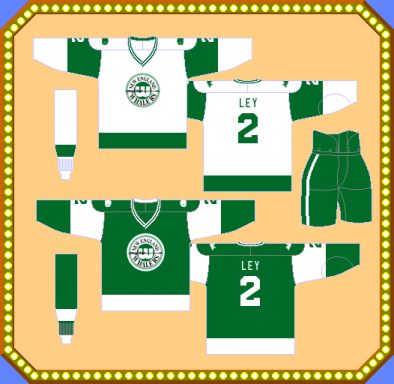
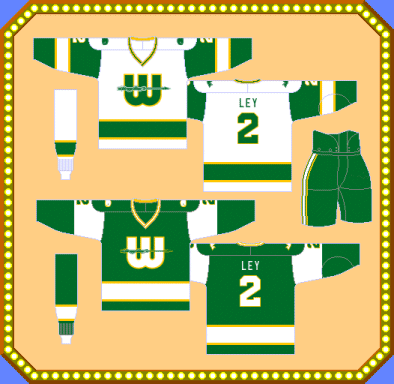
A charter member of the World Hockey Association in the 1972-73 season, the New England Whalers actually started out life in Boston, Massachusetts in the backyard of the mighty Boston Bruins, who were fresh off a Stanley Cup winning season.
The Whalers gave it their best shot and not only finished with the best record in the new WHA with a 46-30-2 record that year, but also captured the inagural Avco World Trophy by winning three rounds of the playoffs by identical 4 games to 1 totals.
The Whalers lasted 2 1/2 seasons in Boston, but sagging attendance led the owners to relocate the team to Hartford - in mid season! The Whalers were successful in Hartford, still playing as the "New England" Whalers, never missing the playoffs in it's seven years in the WHA.
Easily the most recognizable names to play for the New England Whalers in their WHA days were hockey legend Gordie Howe and his sons Mark Howe and Marty Howe.
With the "merger" of the WHA and NHL, the Whalers were one of the four teams to survive the end of the WHA, but because of lobbying by the Boston Bruins, one of the conditions of the Whalers being allowed into the NHL was the dropping of "New England" from the team's name.
The move to the NHL was a rough one for the Whalers and they only had three winning seasons for their eighteen years in the NHL. While they did manage to qualify for the playoffs eight times, including seven in a row from 1986 to 1992, they only won a single playoff series in their NHL history, knocking out fellow WHA refugee the Quebec Nordiques in an opening round best-of-five three games to none in 1986.
One reason for the Whalers failure to improve was a history of horrible trades, including Mike Rogers (5th in NHL scoring in 1980 and 7th in 1981), Mark Howe, Gordie Roberts, Chris Pronger, Brendan Shanahan, Paul Coffey and worst of all, fan favorite Ron Francis.
Following their run of playoff appearances, they sunk back down in the standings and missed the playoffs for their final five seasons in Hartford.
The demise of the Whalers in Hartford began in 1994 when the club was purchased by Peter Karmanos, who quickly grew frustrated by the corporate support in Hartford and mediocre attendance. Karmanos began to make demands, including the sale of 11,000 season tickets and the desire for a new arena.
The negotiations for a new arena disintegrated when Karmanos demanded that the state of Connecticut reimburse the Whalers for up to $45 million in losses during the three years the new arena would be under construction. When the team gave up on getting a new arena, they announced on March 26, 1997 that they would be moving but had yet to pick a destination!
The Whalers final game was played on this date in 1997, a 2-1 victory over the Tampa Bay Lightning, with Kevin Dineen scoring the final goal in Whalers history.
Many factors worked against the team in Hartford, including Hartford being the smallest market in the NHL, it's arena having the smallest capacity in the league and few private suites, and being located in between long time hockey cities of Boston (102 miles) and New York (122 miles).
The Whalers statistical leaders for their time in the NHL include Francis, who holds the record for Most Games (714), Goals (264), Assists (557) and Points (821) and goaltenders Sean Burke, who has the most Games Played (256), and Mike Liut, who holds the marks for Most Wins (115) and Shutouts (13).
Today's featured jersey is a CCM 1992-93 Hartford Whalers Michael Nylander jersey. This is the final style of jersey worn by the Whalers franchise. Their original green road and white home 1972-73 WHA jerseys featured a "W" with a harpoon in a circle, which was simplified to just a larger "W" and harpoon, with the addition of gold trim to their green and white colors, for 1973-74. Those jerseys survived relatively unchanged for the remainder of their days in the WHA.
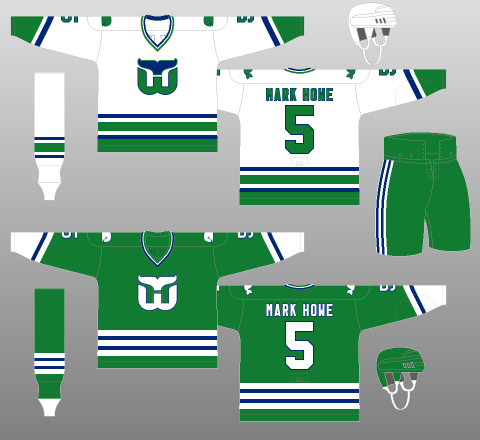
Upon entering the NHL, and undergoing their name change from "New England" to "Hartford" they club also modernized their jerseys, debuting a clever new logo of a "W" topped off by a whale tail, with the negative space creating a subtle "H" for those clever enough to study it long enough. The addition of blue trim made for an attractive set of jerseys, still topped off by the "Pucky the Whale" shoulder patches, worn since day one in the WHA.
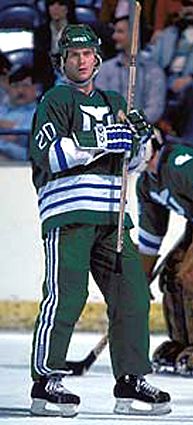
Those jerseys underwent some minor changes in striping, plus an experiment with the controversial Cooperalls in 1982-83 and the elimination of "Pucky the Whale" in 1983-84, but remained essentially the same basic jersey until the 1992-93 season, when a radical redesign saw the dark road jerseys no longer green for the first time in club history, as blue was the new main color. Additionally, silver trim was introduced as an accent color which reduced the amount of green on the jerseys to a much more diminished role, now confined to just part of the logo, three stripes and number outlines.
It was another successful modernization of the Whalers look and would serve them well for the remainder of their time in the NHL.
Our jersey features the Stanley Cup Centennial patch, worn during this jersey's first season of 1992-93, the only patch worn on this final set of Whalers jerseys.
Today's video section begins with the final goal in Whalers history, scored in this date in 1997 by Whalers captain Kevin Dineen.
Here is a report showing the end of that final Whalers game, although it is in French, the images capture the moment and there is also some good historical footage and photos of the Whalers.
No post about the Hartford Whalers would be complete without a mention of the Whalers theme song, "Brass Bonanza", also known as the "Whalers Victory March". Adopted by the Whalers as their theme song during their days in the WHA, it remained so through their years in the NHL. Gordie Howe was once quoted as saying that he loved to hear it as a visiting player for the Houston Aeros, but hearing it every night with the Whalers "began to drive me nuts."
Labels:
Hartford Whalers
Subscribe to:
Posts (Atom)