Saturday, July 4, 2009
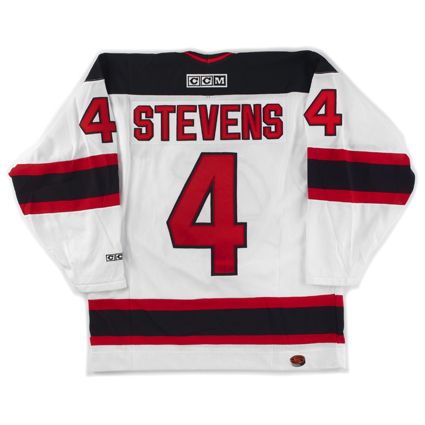
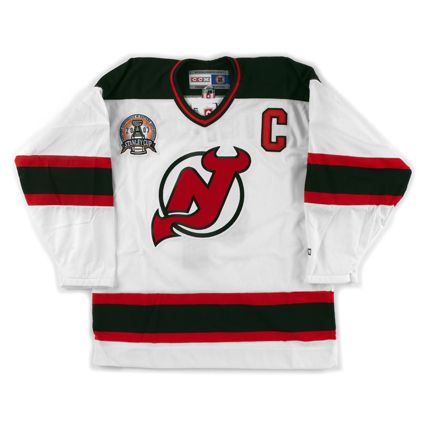
2002-03 New Jersey Devils Scott Stevens Jersey
July by the Numbers celebrates the 4th of July with jersey #4 from Scott Stevens of the New Jersey Devils.
Stevens, drafted 5th overall by the Washington Capitals in 1982, never played a game in the minor leagues and scored on his first ever shot in his first game. After eight seasons with the Capitals, he signed as a restricted free agent with the St. Louis Blues, costing them five first-round draft picks!
St. Louis named Stevens captain and made the Campbell Conference All-Star team in 1991. However, after the 1990-91 season St. Louis would again sign another restricted free agent, Brendan Shanahan of the New Jersey Devils. The Devils were now entitled to compensation and the case eventually went to arbitration, with Stevens being awarded to New Jersey.
In his second season with the Devils, Stevens would again be named team captain and would remain the Devils captain until his retirement 12 seasons later. He would lead the Devils in scoring in 1993-94 with 78 points and was also a league high +53 for the year.
In 1995, the Devils made it to the Stanley Cup Finals, where they swept the Detroit Red Wings in four straight to claim the first of three Stanley Cups. The Devils second Stanley Cup victory in 2000 would see Stevens be named the winner of the Conn Smythe Trophy.
After topping 1,500 games in the 2001-02 season, Stevens and the Devils would once again rise to the top and take their third Stanley Cup by defeating the Mighty Ducks of Anaheim in the 2003 Stanley Cup Finals.
Stevens would end his career with 1,635 games played, 196 goals and 712 assists for 908 points, finishing his career at a +393 with 13 NHL All-Star Game appearances. His #4 would be retired by the Devils on February 3, 2006.
Internationally, Stevens would appear in the World Championships for Canada four times, the 1991 Canada Cup where he would help Canada win the tournament, the 1996 World Cup and the 1998 Olympics.
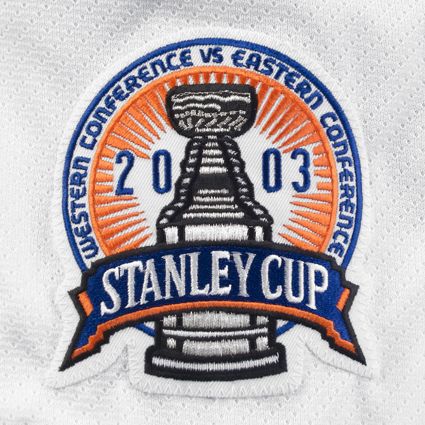
The featured jersey today is a CCM 2002-03 New Jersey Devils Scott Stevens jersey with the 2003 Stanley Cup Finals patch as worn when the Devils defeated the Mighty Ducks in seven games.
While I have made mention of Stevens Stanley Cup victories and point totals above, Stevens is probably best remembered for his hard hitting reputation, having made numerous memorable thundering checks throughout his 22 NHL seasons.
Labels:
New Jersey Devils,
Stevens Scott
Friday, July 3, 2009
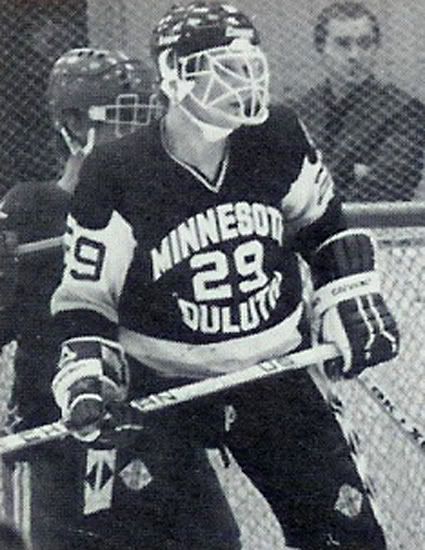
1980's University of Minnesota Duluth Jersey
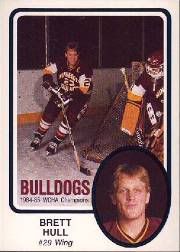
July by the Numbers continues with a #3 game worn University of Minnesota Duluth Bulldogs road jersey from the 1980's. This jersey style was used during the heights of the program when future NHL star Brett Hull skated for the Bulldogs and they were WCHA regular season and conference tournament champions and reached the NCAA Frozen Four in both 1984 and 1985, losing in the championship final in an agonizing four overtimes in 1984 and again three overtimes in the semi-finals the following year.
Both Tom Kurvers and Bill Watson wore this style jersey when they were winners of the Hobey Baker Award in 1984 and 1985
Later versions of this jersey had the word "Duluth" straight across the bottom, rather than the radially arch style you see on mine. In some of the earliest years this style was worn it did not have the skating bulldog shoulder patches.
I suspect my particular jersey may have been used for more than one season, and possibly by more than one player, due to the amount of wear on the jersey and the fact that the Bulldogs did not use names on the back at that time.
At the time of purchase, I was told the "UMD Bulldogs Russia 1984" patch was worn on the jersey when the Bulldogs visited Moscow and Leningrad (now St. Petersburg) in 1984 and I had it reattached. Recently, subsequent research has indicated the likelihood that the patch was worn on the left shoulder with the style of jersey that did not yet have the bulldog shoulder patches, as (barely) shown in this photo.
If anyone reading this has any further information about this style Duluth jersey, especially the precise years this style with the bulldog shoulder patches and arched "Duluth" lettering was worn, especially numerical rosters, please don't hesitate to contact me at the email address in my "wantlist" section to the right or by leaving a comment below.
Labels:
Hull Brett,
University of Minnesota Duluth,
WCHA
Thursday, July 2, 2009
2001-02 New York Rangers Alternate Brian Leetch Jersey
July by the Numbers continues on July 2nd with jersey #2.
Brian Leetch, picked 9th overall by the New York Rangers, won the Calder Trophy as a rookie in 1988 after first playing in the Olympic Games in Calgary. He played for Team USA in the 1991 Canada Cup, quickly followed by his best personal NHL season in 1991-92 when he totaled 102 points, including a Rangers record 80 assists and captured the Norris Trophy.
1993-94 would see Leetch hoist the Stanley Cup as well as the Conn Smythe Trophy, the first and only American-born player to do so. 1996-97 would go onto see him win his second Norris Trophy.
After captaining the United States to victory in the 1996 World Cup of Hockey, Leetch would be named captain of the Rangers in 1997 and play in his second Olympics in 1998 in Nagano, Japan, followed by his third, earning a silver medal in Salt Lake City in 2002.
Leetch would play in the 2004 World Cup of Hockey and then score his 1000th career point in the 2005-06 season while playing for the Boston Bruins. He would finish his NHL career with 247 goals, 781 assists and 1028 points.
He was one of 12 players voted to the All-Time USA Hockey Team in 1997 and then have his number 2 retried by the Rangers on January 24, 2008 and was been inducted into the United States Hockey Hall of Fame in October of the same year. Just ten days ago it was announced that Leetch will be inducted in the Hockey Hall of Fame in November of this year.
The featured jersey today is the very attractive Starter 2001-02 New York Rangers Alternate Brian Leetch jersey with the 9/11 Memorial Ribbon patch.
This jersey is perhaps the most successful third jersey in the history of the NHL in my book. The darker shade of blue gives it a richer, more elegant look compared to the blue of the Rangers road jerseys of the time. The updating of the Rangers shield crest for the shoulders is a more modern and exciting version than the original, but the real triumph is the Liberty Head main logo crest, also created especially for this jersey. It's bold, unyielding stare announces the presence of the Rangers as force than cannot be ignored, nor easily overcome.
I'm torn about the lack of any waist stripes, but have to give the Rangers credit for breaking out of the mold of every jersey having waist stripes, as was the norm in 1996-97 when this alternate style first appeared. There were two previous alternates without waist stripes, but both of those had bold striping across the center of the jersey, in the case of the Penguins 95-96 Alt with it's wild, color-changing aysemetrical central stripe, and the Canucks alt from the same season with it's top red half and bottom black half, but the Rangers stands alone as the first solid color body free of any stripes, creating a look that certainly made the players appear larger and more intimidating.
Unfortunately, Starter wasn't the best at customizing their own jerseys, as the red sections of the numbers are much too thin compared to the authentic jerseys.
Labels:
Leetch Brian,
New York Rangers
Wednesday, July 1, 2009
1991-92 Kansas City Blades Arturs Irbe Jersey
With the lack of significant historical events in hockey history in July, especially those that relate directly to jerseys in the Third String Goalie collection, we have decided to take a little different approach to the heart of summer.
Every day in July we am going to feature a jersey whose number on the back matches the current date.
Simple, eh?
It's a chance for us to showcase some jerseys that frankly aren't related to a Stanley Cup victory, milestone goal or even a national holiday. We're going to call it "July by the Numbers".
So, for July 1st, we begin at the beginning and kick things off with a jersey that carries the #1, and you just knew it was going to be a goaltender, didn't you?
Arturs Irbe, a Latvian, was drafted by the Minnesota North Stars in the 10th round of the 1989 NHL Entry Draft, perhaps based on his performance against the North Stars during a North American tour by his Latvian club team, Dynamo Riga.
Remember these 1990-91 O-Pee-Chee Dynamo Riga cards?
Check out those tell-tale green, gold and white seats in the background from the North Stars former home, Met Center. Irbe's performance in that exhibition game in Bloomington, MN might very well have led to his being drafted by the North Stars.
As part of a complicated deal, the North Stars owners, the Gund brothers, were awarded an expansion franchise that would become the San Jose Sharks and begin play in the 1991-92 season. As part of the agreement, the Sharks were awarded some North Stars players and draft picks, one of which was Irbe.
Having come over to the United States for the 1991-92 season, Irbe found himself playing in the International Hockey League for the Sharks minor league team, the Kansas City Blades. In 32 games for the Blades, he had 24 wins, 7 losses and a tie and a goals against average of 2.46.
After spending some time at the NHL level playing for the Sharks (13 games with a 2-6-2 record), Irbe would return to Kansas City in time for the IHL playoffs where he would post a 12-3 record and lead Kansas City to the Turner Cup championship, including a sweep of Muskegon in the finals. He would also earn a share the James Norris Memorial Trophy with Wade Flaherty as the team whose goaltenders allowed the fewest goals in the regular season.
Today's featured jersey is a Bauer 1991-92 Kansas City Blades Arturs Irbe home jersey. It features the correct font used by the Blades for their player names in their championship season, photographic evidence which proved very difficult to find.
Labels:
IHL,
Irbe Arturs,
Kansas City Blades
Tuesday, June 30, 2009
1991-92 New Jersey Devils Martin Brodeur Jersey
It was on this date in 1982 that the New Jersey franchise was officially named "Devils" in fan balloting. The unimaginative "Blades", retro "Americans" and the incredibly horrid "Meadowlanders" were runners-up in the contest.
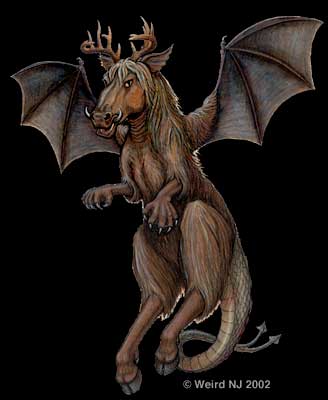
The Jersey Devil - an ominous crytptozoological (and just how many blogs will be using that word today?) creature with a horse-like head, hooves, bat-like wings, a forked tail and oversized claws - was said to terrorize locals in the New Jersey town of Pine Barrens in the 18th century. Legend varies to wether the child, the 13th one born into the Leeds family in 1735, was considered cursed and turned into the Jersey Devil or was born that way after the mother predicted after her 12th child that if she had another, it would be the Devil.
Still, on occasion there are complaints about the name Devils from those who think it refers to the Satanic Devil, rather than the mythical Jersey Devil.
The club was originally founded as the Kansas City Scouts in 1974. A little known fact is that the Scouts were originally going to be called "Mohawks", but the Chicago Blackhawks objected to the name. The Scouts then moved to Denver, Colorado and became the Rockies in 1976 and then relocated to New Jersey in 1982, this time adopting brand new colors and yet another new name. The team made the playoffs once in it's first 13 seasons,
The low point came in 1983-84 season when, at 2-17-0, the travelled to face the powerhouse Edmonton Oliers and were blown out by a score of 13-4. Wayne Gretzky, upset that former teammate Ron Low played for such an inferior team was quoted as saying "Well, it's time they got their act together, folks. They're ruining the whole league. They had better stop running a Mickey Mouse organization and put somebody on ice." The Devils fans reacted and when the Oilers visited two months later, the building was full of signs and fans wearing mouse ears.
Four seasons later the Devils made the playoffs, beginning a run of qualifying for the postseason in 19 of the last 21 years, including each of the last 12 in a row, having won the Stanley Cup in 1995, 2000 and 2003.
Today's featured jersey is a CCM 1991-92 New Jersey Devils Martin Brodeur jersey as worn when Brodeur made his NHL debut, wearing the unfamiliar #29, after an emergency call up, not from the minors but from Canadian Junior Hockey(!), when both Chris Terreri and Craig Billington were injured. He appeared in four regular season games, winning in his debut 4-2 vs. Boston, and one playoff game.
This jersey is in the original Devils colors of red and green, naturally earning the comparison to Christmas, which were worn through the 1991-92 season, thus making these five games the only time Brodeur would sport this style Devils jersey, as he would spend the next season in the minors playing for the Utica Devils and by the time he returned to New Jersey for the 1993-94 season, the Devils had introduced their now customary red and black jersey set.
This jersey has a pair of patches to point out, the first being the obvious NHL 75th Anniversary logo on the upper right chest and then a small, conservative Devils 10th Anniversary patch tucked away on the back side down by the CCM logo on the hem, certainly one of the more subtle patch placements in NHL history. This is another of my custom made patches we printed ourselves, as they had not yet been reproduced at the time we had this jersey customized.
Today's video section begins with a look at The Jersey Devil followed by the 1996-97 home opener which features highlights from earlier seasons, including today's featured jersey worn by Martin Brodeur during his first NHL action.
Labels:
Brodeur Martin,
New Jersey Devils
Monday, June 29, 2009
1998-99 University of Minnesota Golden Gophers Alternate John Pohl Jersey
I'm surprised it took this long, but regular readers of Third String Goalie will quickly learn that I am located in the hockey hotbed that is Minnesota, and as such, with the passing of time you will undoubtedly be subjected to a disproportionately large number of University of Minnesota Golden Gophers jerseys. I can promise you that they will possess quite a wide ranging variety of styles and eras, but if you do happen to be a die-hard University of North Dakota or University of Wisconsin fan, I won't apologize, but I will ask for your patience.
Minnesota's 1998 "Mr. Hockey", John Pohl was born on this date in 1979 and until recently held the Minnesota State High School career scoring record, with 378 points. In the world of career 1000 point scorers in the NHL, 378 points doesn't exactly sound like a big deal, but when you factor in a high school career is only four years long and just a mere 28 games season, suddenly averaging 95 points per year makes you sit up and take notice. Pohl's best season was his junior year when he racked up 111 points in 28 games for an average of 3.96 points per game. For comparison, fully admitting it really is apples and oranges, Wayne Gretzky averaged 1.92 points per game during his NHL career.
Pohl went onto play four years at the University of Minnesota, cumulating in a national championship for the Golden Gophers in 2001-02, a season when he was one of the team leaders and an assistant captain. He had his best collegiate season with 27 goals and 52 assists for 79 points and was named a First Team All-American in 2001-02, earning himself a spot on one of the murals at the Gopher's home rink, Mariucci Arena.
Pohl was drafted in 1998 by the St. Louis Blues, but only made one appearance for St. Louis in the NHL before being traded to the Toronto Maple Leafs. He would play 114 games over three seasons for Toronto, scoring 17 goals and 21 assists for 38 points. For the 2008-09 season, Pohl would continue his professional career first in Swizterland for HC Lugano, and most recently Frölunda HC of the Swedish Elite League.
The jersey I am featuring today is a Gemini 1998-99 University of Minnesota Alternate John Pohl jersey. This controversial jersey was worn for a limited number of games, as the players complained that the jersey was too hot to play comfortably in.
At the time this jersey was worn, the head coach of the Gophers, Doug Woog in his final season, had a policy of only recruiting players from the state of Minnesota. Each players jersey was decorated with a diamond shaped patch on the back of the jersey with a silhouette of Minnesota and the players home town embroidered in it. My jersey is from a batch not used by the team with a generic "Gophers" in place of "Red Wing" that would have been worn on Pohl's game worn example.
The unconventional, decidedly "Star Trek" font chosen for the numbers and vertically arched name with continuous black outline was a dramatic departure for the Gophers, as well as the woven pinstripe effect dazzle cloth material. Gemini has an "interesting" aesthetic approach to jerseys at times, favoring the dazzle cloth in particular like no others. Not surprisingly, this jersey was only used for one season.
Labels:
Pohl,
University of Minnesota,
WCHA
Sunday, June 28, 2009
2006-07 Toronto Maple Leafs Mats Sundin Jersey
It was on this day in 1994 that the Toronto Maple Leafs traded Wendel Clark, Sylvain Lefebvre, Landon Wilson and a first round draft pick to the Quebec Nordiques for Mats Sundin, Garth Butcher, Todd Warriner and a first round draft pick.
Sundin would go onto become the Leafs captain after Doug Gilmour left the Maple Leafs during the 1996-97 season. Sundin thus became the first European to be named captain of the Maple Leafs. He would also lead the Maple Leafs in scoring for eight consecutive seasons and for 12 out of his 13 seasons with the Leafs, finishing second to Alexander Mogilny in the remaining one.
In 2002-03, he became the first Swedish born player to reach 1,000 points in the NHL and currently leads all Swedish players in goals (564), assists (785) and points (1,349), as well as the Maple Leafs in all-time goals (420) and points (987).
Today's featured jersey is a 2006-07 Toronto Maple Leafs Mats Sundin jersey. If you compare this jersey to the Maple Leafs Sundin jersey featured earlier here at Third String Goalie, you can see the evolution over the lifetime of this basic jersey style.
While they both have the twin white stripes around the arms and waist and matching Maple Leafs crest, the current one has replaced the retro maple leaf secondary logo on the shoulders with the modern "TML" logo on the shoulders and the numbers have evolved from the classic one color white to the again more modern three color numbers, white trimmed in blue and outlined in silver, the first time the Maple Leafs have ever used any other color except blue and white for their basic jersey set.
This jersey also features the Teammates for Kids patch, worn by Mats Sundin and the Maple Leafs on January 6th, 2007. As part of the program, each player on every team would play one game with the patch on their jerseys, which would then be auctioned off for chairity to raise money for the Garth Brooks Teammates for Kids Foundation. This would result in over 600 game worn jerseys entering the market in a single go.
Here is Sundin showing off some of the skills that would make him so popular in Toronto.
Labels:
Sundin,
Toronto Maple Leafs
Saturday, June 27, 2009
1998-99 Tampa Bay Lightning Alternate Vincent Lecavalier Jersey
Vincent Lecavalier was selected first overall on this date by the Tampa Bay Lightning in the 1998 NHL Entry Draft.
In his two seasons in the Quebec Major Junior Hockey League, Lecavalier had 86 goals and 131 assists for 217 points in 122 games. He was only the fifth player from the QMJHL to be picked first overall after Guy LaFleur, Mario Lemieux, Pierre Turgeon and Alexandre Daigle.
In March of 2000, he was made the youngest captain in NHL history at 19 years and 11 months old, surpassing the old record of 21 years, 5 months held by Steve Yzerman.
In 2003-04 the Lighting won the Southeast Division, distancing themselves from the rest of the teams by 28 points, the total of all the other division winners margins combined. In the playoffs, they defeated the New York Islanders 4 games to 1 and then swept the Montreal Canadiens 4-0.
The Philadelphia Flyers proved a much tougher foe, with the series going the full seven games before Tampa prevailed by the closest of margins, 2-1, at home to move onto face the Calgary Flames in the finals, which would also go seven games and again Tampa would prevail by a 2-1 score in the deciding Game 7 to win the Stanley Cup, with Lecavalier getting the assist on the game winning goal.
Lecavalier was then a late addition to Team Canada for the 2004 World Cup of Hockey and would go onto be named the tournament MVP after scoring seven points in six games, including the game winning goal in overtime versus the Czech Republic in the semi-finals.
His whirlwind year would not stop there however. Immediately after the World Cup, the NHL owners would lockout the players in a labor dispute and Lecavalier would travel to Russia to play for Ak Bars Kazan in the Russian Superleague along with 11 other NHLers.
Lecavalier would score his 500th career point and capture the Maurice Richard Trophy while achieving a career high 52 goal, 108 point season in 2006-07.
The jersey I am featuring today is a CCM 1998-99 Tampa Bay Lightning Alternate Vincent Lecavlaier jersey as worn by Lecavalier during the first two months of his rookie season. This rare third jersey, which depicts a dramatic storm at sea, with pelting rain and crashing waves, along with jagged lightning bolts running down each arm, has the 1999 NHL All-Star Game patch as worn in Lecavalier's rookie season and also sports the #8 he started his career with before changing to his customary #4 the next season.
The Lightning, for some unknown reason, started off the 98-99 season using their usual home and road jersey paintbrush font, "Reporter", for the numbers on the alternate jersey instead of the more fitting "electric" numbers originally used in the 96-97 and 97-98 seasons with the alternate jersey, only to switch back to the more fitting "electric" numbers at some point after mid-November.
Even after the welcome change in font for the numbers, there is photographic evidence of the captain's C and assistant captain's A's still remaining in the now mismatched paintbrush font. We are uncertain if they ever reverted to the "electric" font for the C's and A's at any point in the 98-99 season, the last for this alternate style.
While many people lump this alternate jersey in with some of the other hideous third jerseys of the mid-90's, we actually like this one very much. Perhaps the lightning bolts on the arms are a bit over done, but we love the body of the jersey with the rain, waves and and the bold, vertically arched font for the name, especially when properly mated with the original electric number font.
Labels:
Lecavalier,
Tampa Bay Lightning
Friday, June 26, 2009
1984-85 Pittsburgh Penguins Mario Lemieux Jersey
Today is the 2009 NHL Entry Draft, being held in Montreal as part of the Montreal Canadiens centennial celebrations. It can be seen live on Versus in the USA and TSN in Canada starting at 7 PM Eastern time.
The NHL draft began in 1963 and was instituted by NHL President Clarence Campbell in an attempt to give all the teams a fighting chance to acquire star players by replacing the old system, where teams would scout and then "sponsor" young players, locking in those players and denying the other clubs any chance of acquiring them, such as the case with Bobby Orr who was signed by the Boston Bruins at age 14.
Under the rules of the new draft system, only players age 16 were eligible and teams were not allowed to even talk to their drafted players about turning professional until they turned 18. In 1969 the rules were changed so that any player under the age of 20 could be drafted, which resulted in more than four times the average number of players being picked than the previous six drafts.
The name of the draft was changed to the "NHL Entry Draft" in 1979 to coincide with a rule change that allowed players who had previously played professionally to be drafted, which gave teams the chance to pick players who had been part of the defunct World Hockey Association. The next season, without competition from the WHA, the rules were amended so that any player between the ages of 18 and 20 could be drafted and any non-North American player over the age of 20 was now eligible.
In 2003, the Florida Panthers attempted to circumvent the rules and draft Alexander Ovechkin, even though his birthday was two days after the cut-off date for eligibility for that year's draft. Then Panthers General Manager Rick Dudley, claiming that with the extra addition of leap days since Ovechkin was born made him eligible to be drafted.
The jersey I am featuring today is a CCM 1984-85 Pittsburgh Penguins Mario Lemieux Sunday Alternate jersey, worn by Lemieux during his rookie season after being the first overall player taken in the 1984 NHL Entry Draft.
The older Penguins jerseys have some detail changes when compared to the jerseys worn during their Stanley Cup winning seasons. First, the numbers are located up on the shoulders in the yellow area, rather than down lower on the arms in the black area where they would be relocated in 1988. The other notable differences to the early examples of this style jersey are the serif font used for the names on the back, the slightly thinner font used for the back numbers and taller font used for the numbers on the arms.
Lemieux would kick off his career in grand style, scoring a goal on his first ever shot on goal in the first shift of his first game. He would go on to win the Calder Memorial Trophy the year he wore this style yellow jersey as well as his first All-Star Game MVP award, the first ever rookie to do so.
Labels:
Lemieux,
Pittsburgh Penguins
Thursday, June 25, 2009
2000-01 Columbus Blue Jackets Lyle Odelein Jersey
It was on this date in 1997 that the NHL officially approved expansion to a 30-team league by the year 2000. In an unusual plan, the Nashville Predators began play in 1998-99 and the Atlanta Thrashers started life the following season in 1999-2000. Then, the Minnesota Wild and Columbus Blue Jackets completed the exten by joining the league for the 2000-01 season, nearly three and a half years after being granted franchises.
The Columbus franchise selected the name "Blue Jackets", a nickname for the Union soldiers in the Civil War, to honor the contributions made by the state of Ohio during the Civil War, including the fact that Ohio contributed more of it's population to the Union Army than any other state and that many of the Union uniforms were also manufactured in Columbus.
Columbus started out life in the NHL with a rough go, finishing last in the Central Division in each of it's first three seasons and averaging only 69 points in it's first seven, missing the playoffs each time out.
Things finally look to be improving for the Blue Jackets however. This past season they made the playoffs for the first time after a 92 point season, the last of the current teams to qualify for the postseason.
They are led by the franchise's all-time leading scorer Rick Nash, who arrived in time for the 2002-03 season after being drafted #1 overall in the 2002 Entry Draft. Nash tied for the league lead in goals with 41 during the 2003-04 season, earning a share of the Rocket Richard Trophy in just his second season in the league. Goaltender Steve Mason adds to the brighter outlook for the Blue Jackets, earning the Calder Memorial Trophy for his stellar debut season in 2008-09.
Today's featured jersey is a 2000-01 Columbus Blue Jackets Lyle Odelein jersey. It features the Blue Jackets Inaugural Season patch, as well as one of our custom made Hockey Fights Cancer patches. Odelein was selected by the Blue Jackets in the 2000 expansion draft and later named the first captain of the franchise.
The Hockey Fights Cancer patch was first worn by the captain of each team for one game only in January of 2001. The patches from 2001 do not carry the date, as they did in the subsequent three years of the program. Each specially patched game worn jersey would then be auctioned off for charity as part of the festivities at that year's NHL All-Star Game to raise money for cancer research.
Dasherboard: When the Nashville Predators joined the league in 98-99, a major realignment of the divisions took place, expanding from two six and two seven team divisions, to six divisions, some with as few as four teams. The Predators came out fine in this plan, being grouped in with established nearby clubs in Detroit, Chicago and St. Louis.
Atlanta was added to the Southeast Division, centrally located between Washington and Carolina to the north and the two Florida clubs, Tampa Bay and Florida, who played in the Miami area, to the south.
Columbus fit in naturally with Nashville in the Central Division when they joined the league, but due to the increased number of teams in the east, Minnesota was slotted in with the teams in the Northwest Division - Colorado, Edmonton, Calgary and Vancouver - none of whom are even in their time zone and most of which aren't even in the same country!
The other victim of the realignment was the Dallas Stars, who were inexplicably placed in the Pacific Division - 885 miles from their nearest division neighbor and over 1900 miles from said Pacific Ocean after which their division was named...
Labels:
Columbus Blue Jackets,
Odelein Lyle
Wednesday, June 24, 2009
La Fête Nationale du Québec
La Fête nationale du Québec, the national holiday of the Canadian province of Quebec is celebrated annually on June 24th, St. John the Baptist Day.
The feast day of St. John the Baptist, celebrating the birth of Jesus' cousin, was a very popular event in France from the 14th to 18th centruries and migrated to Canada with the first French colonists as far back as 1636.
Inspired by the 1834 St. Patrick's Day celebrations in Montreal, the publisher of the newspaper La Minerve, Ludger Duvernay got the idea to organize a similar event for French Canadians. In addition to the traditional bonfires of St. John the Baptist Eve, parades were eventually organized and became part of the tradition as well.

In 1843, Duvernay established the St. John the Baptist Society to promote French-Canadian interests within Canada and preserve the French language and culture and Roman Catholic religion. In 1880 the society organized a gathering of all French communities across North America, the National Congress of French Canadians. It was at this gathering that "O Canada" was first performed. Based on a poem by Adolphe-Basile Routhier, the song was commissioned by Théodore Robitaille. An English translation did not appear until 1906 and it was not until 1908 that Robert Stanley Weir wrote an English version, which was not a translation of the French lyrics.

"O Canada" would not officially become Canada's national anthem until 1980.
In 1908, Pope Pius X designated St. John the Baptist as the patron saint of French Canadians and in 1925, June 24th became a legal holiday in Quebec for all it's citizens, not just those of French Canadian or Catholic origins.
Just in case you were interested, here is the translation of the French lyrics of "O Canada";
O Canada!
Land of our forefathers
Thy brow is wreathed with a glorious garland of flowers.
As is they arm ready to wield the sword,
So also is it ready to carry the cross.
They history is an epic of the most brilliant exploits.
They valour steeped in faith
Will protect our homes and our rights
Will protect our homes and our rights.
Our featured jersey today is a CCM 1992-93 Quebec Nordiques Joe Sakic jersey from the CCM Vintage Collection Throwback Series. Seeing how much collectors were spending for original Nordiques and Minnesota North Stars jerseys, CCM knew there was an opportunity to make some money by capitalizing on the obvious demand for throwbacks, first introduced during the NHL's 75th Anniversary season of 1991-92 when the Original Six teams all wore throwback jerseys.
Much better quality than the original, undersized and lightweight (to the point of being see-through) replica jerseys of the 80's, many retired styles were remade with the current-for-the-time 550 Series replica model, which provided fans with a very high quality replica for the price.
The Nordiques jersey is by far and away the one NHL jersey from that time period that most represented the flag of the state or province the team played in, and for that reason has always been one of my favorite jerseys.
This jersey also features the rare French version of the Stanley Cup Centennial patch, worn only the the Nordiques and their Quebec neighbors, the Montreal Canadiens, which reads "Coupe Stanley". If you look very closely at the shield on the players chest, you can also see that it reads "LNH" for "Ligue Nationale de Hockey", French, of course, for "NHL".
Sakic was originally chosen 15th overall by the Nordiques at the 1987 draft. He originally wore #88 because his preferred #19 was already taken by Alain Côté, who retired after Sakic's rookie season, allowing Joe to reclaim it in time for his second year. He was first named co-captain in 1990-91, along with Steve Finn, for home games only while Finn was captain on the road. He became the team's sole captain for the 1992-93 season and has remained so ever since.
After finishing last in the entire league for three straight seasons from 1988-89 to 1990-91, Sakic led the improved Nordiques, thanks in no small part to the Eric Lindros trade which brought in Swede Peter Forsberg among others, to the Adams Division title in the 1994-95 season, the team's last in Quebec City.
Yes, that was a quite young Avril Lavigne.
Dasherboard: Congratulations to Steve Yzerman, Brett Hull, Luc Robitaille and Brian Leetch for being named to the Hockey Hall of Fame.
Labels:
Quebec Nordiques,
Sakic
Tuesday, June 23, 2009
2000-01 Spartak Moscow Ilya Kovalchuk Jersey
It was on this date that the Atlanta Thrashers selected Ilya Kovalchuk with the first pick of the 2001 NHL Entry Draft, making him the first Russian ever chosen first overall.
The first Russian ever drafted by an NHL team was Viktor Khatulev, who was drafted by the Philadelphia Flyers in the ninth round, 160th overall, of the 1976 NHL Amateur Draft. He never even learned he was drafted until 1978 and never had the chance to play in North America. He was eventually banned for life from the Soviet hockey league in 1981 for hitting a referee during a fight with another player.
The first Russain in to play in the NHL was Sergei Priakin, the first Soviet player granted permission to do so. Priakin, already a nine year veteran in the Soviet League, lined up for two games for the Calgary Flames at the end of the 1988-89 season after the conclusion of Soviet League season. He was carefully chosen by the Soviet authorities at the time. He was good enough to play in the NHL, but not so good that they could not afford to lose him from the national team. He would represent Soviet hockey and at the same time be used to dangle the carrot of possibly being allowed to play in the NHL in front of the other Soviet players back home. Priakin would play an additional 44 games over the next two seasons for the Flames, before moving back to Europe where he would continue to play another nine seasons in the Swiss, Russain, Finnish and even the Japanese leagues.
Other early Soviet players in the NHL included Viacheslav Fetisov, Igor Larionov and Valdimir Krutov, the first true Soviet stars to fight for the opportunity to play in the NHL. While Krutov did not pan out as an NHLer, Fetisov and Larionov would go onto win the Stanley Cup five times between the two of them, all with the Detroit Red Wings.
Sergei Makarov would also compete in the NHL, and well enough to inspire a rule change. He was named the Calder Trophy winner, given "to the player selected as the most proficient in his first year of competition in the NHL" at the age of 31. The rules for eligibility were were changed so that only players 26 or younger now qualify for the award.
While Fetisov, Larionov and Krutov would be granted permission to play in the NHL, others would take a different route. Both Alexander Mogilny and Sergei Fedorov would defect in order to play in North America. Both chose the year of their escape from the Soviet Union as their jersey numbers, with Mogilny taking #89 and Fedorov #91.
Mogilny would become the first Russian to lead the NHL in goals and reach the 100 point plateau in 1992-93, the year of his amazing 76 goal season, which still stands as the record for most goals in a single season by a Russian player. He would later become not only the first Russian, but the first European of any nationality, to captain an NHL team in 1993-94 with the Buffalo Sabres.
Fedorov would become the first Russian to capture the Hart Trophy, the Selke Trophy and the Pearson Award. He is currently the all-time leading Russian scorer in NHL history with 1179 points.
Prior to Kovalchuk being selected first overall, the three highest drafted Russians were Alexi Yashin, selected by the Ottawa Senators (1992), Oleg Tverdovsky by the Mighty Ducks of Anaheim (1994) and Andrei Zyuzin by the San Jose Sharks (1996), all of whom were selected with the #2 pick overall.
A significant event in the acceptance of Russian players by the North American hockey community was the 1989 election to the Hockey Hall of Fame of long-time Soviet National Team goaltender Vladislav Tretiak, the first European born player without any NHL experience and the first Russian player ever elected to the Hall.
When the New York Rangers won the Stanley Cup in 1994, Sergei Nemchinov, Alexander Karpovtsev, Alexi Kovalev (the first Russian taken in the first round of the draft at #15 overall) and Sergei Zubov became the first Russians to have their names engraved on the Stanley Cup.
Just this year Evgeni Malkin became the first Russian to win the Conn Smythe Trophy.
Today's featured jersey is a Lutch 2000-01 Spartak Moscow Ilya Kovalchuk jersey. Spartak was the team Kovalchuk last played for in Russia before being drafted first overall. The team name across the waist is in Cyrillic as is the city name and Kovalchuk's name on the back. The jersey is dye-sublimated, as are most good quality authentic Russian jerseys.
It's been explained to me that Spartak (named for "Spartacus" the gladiator) was very popular with the Soviet citizens due to the fact that the Spartak hockey and soccer teams were part of the Spartak Moscow sports society, a physical culture and sports society of the workers, compared to rivals Dynamo Moscow, the sporting arm of the Soviet secret police, the KGB, and Central Red Army, the sports club of the Soviet Army. This made Spartak "the people's club" and cheering for them at games was the one chance Soviet fans had to cheer openly against the government in public without fear of reprisals.
Labels:
Kovalchuk,
Russia,
Soviet Union,
Spartak Moscow
Subscribe to:
Posts (Atom)