Monday, May 16, 2016
1980-81 Philadelphia Flyers Reggie Leach Jersey
After a prolific junior career with the Flin Flon Bombers, which included being the WCJHL Goal Scoring Leader in 1968 with 87 goals in only 59 games, and the Goal Scoring Leader, Leading Scorer and Player of the Year in 1970 after a season in which he scored 65 goals and 111 points, Reggie Leach was drafted 3rd overall by the Boston Bruins in the 1970 NHL Amateur Draft.
Still in need of seasoning, as well as facing the task of trying to crack the deep lineup of the defending Stanley Cup champion Bruins, Leach split time in the 1970-71 season between the Oklahoma City Blazers of the CHL, scoring 42 points in 41 games, and the Bruins, with whom he played 23 games, scoring just 2 goals, giving little clue as to what would follow.
He would make the Bruins lineup out of training camp and see action in 56 games before a trade to the perpetually struggling California Golden Seals, missing out on the Bruins eventual Stanley Cup later that year.
With the Seals, Leach played a larger role, evidenced by nearly equalling his 7 goals with the Bruins when he scored 6 in just 17 games. He would play two more seasons with the Seals, recording 20 goal seasons in 1972-73 and 1973-74 with 23 followed by 22.
Leach, wearing the notorious white skates of the Golden Seals
Leach was then traded once again, this time to the Philadelphia Flyers, who paid a steep price, two players and their first round draft pick for just Leach. While Philadelphia was the defending Stanley Cup champions themselves in 1974-75, Leach had no issues trying to crack their lineup as he had with Boston four years earlier. He would play all 80 games for the Flyers, doubling his 22 goals to 45 and raising his 46 points to 78 for third in Flyers scoring behind Bobby Clarke (116 points) and Rick MacLeish, one ahead with 79.
Philadelphia would then sweep the Toronto Maple Leafs, outlast the New York Islanders in seven and defeat the Buffalo Sabres 4 games to 2 to defend their championship.
Leach raised his game to a new level in 1975-76 when he led the entire NHL in goals with 61, beating runner up Guy Lafleur by 5. He added 30 assists to give him a career high 91 points that season. Trying for their third consecutive Stanley Cup, the Flyers again ousted the Maple Leafs, this time in seven, and eliminated the Bruins in five to return to the finals once again. The contrast in styles between the rough and rugged Flyers and the slick and smooth skating Montreal Canadiens could not have been greater, and the Canadiens prevailed after winning four straight games.
Leach had produced a masterful, dominating individual performance though, leading all scorers with 19 goals and 5 assists in 16 games for a total of 24 points. No one was even in the same league as Leach, as his 19 goals led the second leading goal scorer, the Bruins Jean Ratelle, by 11 goals! His 10 game goal scoring streak and 19 playoff goals in one season set NHL records which still stand today.
In one memorable Semifinal game, Leach single handedly eliminated the Bruins in Game 5 with an NHL playoff record five goal performance in a 6-3 win. Despite the Stanley Cup loss, Leach was named the winner of the Conn Smythe Trophy on this date in 1976, only the third player since 1965 to be awarded the trophy from a losing team, and 35 years later, still the only non-goaltender from a losing team to win the award.
Prior to the start of the following NHL season, Leach had the honor of playing for Team Canada during the inaugural Canada Cup tournament in September of 1976.
He would play six more seasons with the Flyers, which included a 50 goal season in 1979-80, seventh in the league and just 6 back of the league leaders Blaine Stoughton and Danny Gare's 56. His goal scoring was a contributing factor in the Flyers 35 game unbeaten streak that season. Philadelphia again returned to the Stanley Cup Finals as Leach chipped in 9 goals and 16 points in 19 games.
After his eight total seasons with Philadelphia, never scoring less than 24 goals, Leach's career would wind down with one season as a free agent signing with the Detroit Red Wings and a season with the Montana Magic of the CHL.
In all, Leach would play 934 NHL games while scoring 381 goals and 666 point, two NHL All-Star Games in 1976 and again as the game's MVP in 1980, as well as his name on the Stanley Cup and his remarkable Conn Smythe Trophy. He was inducted into the Philadelphia Flyers Hall of Fame in 1992.
Today's featured jersey is a 1980-81 Philadelphia Flyers Reggie Leach jersey. This basic Flyers jersey with it's full-length sleeve stripes which then wrap around the arms down by the wrists has been in use throughout Flyers history since the very first day. Bold, black trim was added to the jersey in the early 1980's, but when this orange style was brought back as an alternate jersey in 2008, complete with the contrasting nameplate look of the early 1970's, the clock was reset, as the black trim was no longer there.
Bonus jersey: Today's bonus jersey is a 1981-82 Philadelphia Flyers Reggie Leach jersey from the following season. Note the absence of the white waist stripe, which was eliminated to create a longer, taller look when the sweater was paired with the new full length pants, commonly referred to as "Cooperalls" (despite being a similar CCM product), which had a vertical stripe which ran down the entire leg in 1981-82.
Today's video segment begins with Leach scoring his record setting five goals in one playoff game against the Bruins, which paved the way for his winning the Conn Smythe Trophy later that season.
Next, here is Leach sharing his excitement about playing in the 2012 Winter Classic Alumni Game.
Labels:
Leach Reggie,
Philadelphia Flyers
Saturday, May 14, 2016
The Finest Season in NHL History - 1976-77 Montreal Canadiens Jacques Lemaire Jersey
On this date in 1977 the Montreal Canadiens successfully completed the finest season in NHL history when Jacques Lemaire scored his second goal of the game at 4:32 of overtime to give the Canadiens a 2-1 win in Game 4 of the Stanley Cup Finals, sweeping the Boston Bruins to capture their 20th Stanley Cup championship.
During the regular season, Montreal scored 387 goals while allowing just 171, outscoring their opponents by 216 goals, an average margin of victory of 2.7 goals per game. They shutout their opponents 14 times and scored seven or more goals 18 times, including a high of 11 twice, with a 11-0 win over the Capitals providing their largest margin of victory.
Here are brief highlights of Game 4 of the 1977 Stanley Cup Finals, followed by an extended version which shows much of the overtime as well as the presentation of the Stanley Cup to Canadiens Captain Serge Savard.
The Canadiens season began on October 7, 1976 with a 10-1 win over the Pittsburgh Penguins, setting the tone for what would become the most dominant season in NHL history. Another win was followed by their first loss at Buffalo. Three more wins and a loss at Boston were followed by four wins and a tie to put Montreal at 9-2-1 after 12 games. A loss to Boston, their only home loss of the season, was followed by a seven game unbeaten streak, putting the Canadiens at 14-3-3 at the quarter mark of the season.
A 1-0 loss to the Toronto Maple Leafs was followed by five wins as part of a ten game unbeaten streak. After losing to the New York Rangers they went on a new 11 game unbeaten streak to reach 32-5-6.
A loss to the St. Louis Blues, a win at the Los Angeles Kings and another loss to Boston on January 17th, their third loss of the season to the Bruins, sent Montreal on an amazing run to finish out the regular season.
Over the next 34 games, from January 18th to April 3rd, Montreal would lose just once more. A 21 game unbeaten streak (17 wins, including a season high eight game winning streak, and four ties) was stopped by a loss at Buffalo. A tie with Toronto preceded another eight game winning streak as part of a 12 game unbeaten streak to close out the season and finish at 60-8-12, setting an NHL record with 132 points which still stands today.
Steve Shutt led the team, and the league, in goals with 60, while Guy Lafleur was second on the team and in the league with 56. Additionally, Lafleur led the league in assists with 80 and points with 136 to win the scoring title by 14 points over Marcel Dionne. Shutt came in third with 105 points, the only other player to top 100.
In all, eight Canadiens scored more than 20 goals each and another six had more than a dozen.
Once in the playoffs, Montreal swept St. Louis in four, outscoring the Blues 19-4, beat the up and coming New York Islanders four games to two and then beat Boston in the finals 7-3 and 3-0 at Montreal before winning in Boston 4-2 and 2-1 in overtime to complete their finest season in the history of the franchise, dating back to 1909.
The Stanley Cup was not only the 20th for the franchise, but the second of four consecutive from 1976 to 1979.
to complete the Canadiens record setting season
The Stanley Cup was not only the 20th for the franchise, but the second of four consecutive from 1976 to 1979.
The club also dominated the post-season awards, with Dryden and Larocque sharing the Vezina Trophy, Larry Robinson taking the Norris Trophy and Lafleur having a season for the ages, as he took home the Art Ross Trophy, the Conn Smythe Trophy, the Hart Trophy, the Pearson Award and even the Lou Marsh Trophy as Canada's Top Athlete, with coach Scotty Bowman the recipient of the Jack Adams Award.
Dryden, Lafleur, Robinson and Shutt were all named to four of the six spots on the NHL First All-Star Team while Guy Lapointe was named to the NHL Second All-Star Team.
To date, nine members of the 1977 Stanley Cup champions have been inducted into the Hockey Hall of Fame, including Lafleur, Shutt, Robinson, Lapointe, Lemaire, Yvan Cournoyer, Serge Savard, Bob Gainey and Dryden.
Today's featured jersey is a 1976-77 Montreal Canadiens Jacques Lemaire jersey as worn during the Canadiens record setting season in which Lemaire scored both Canadiens goals in a 2-1 overtime win to capture the Stanley Cup and complete the most dominant season in NHL history.
Montreal first introduced a white jersey for the 1935-36 season, having previously on worn only red for all games home or road as a member of the NHL. The white jersey evolved over its early years until the shoulders became red for the 1941-42 season. Aside from wearing a white version of their red jerseys, complete with a blue chest stripe for three seasons from 1944-47, the Canadiens white jersey has remained in use ever since with only minor variations over time to details such as the style and color of the collar, the evolution from one to two to three color numbers and the addition of names on the back in the late 1970's.
Lemaire would play his entire 12 year NHL career with Montreal, winning eight Stanley Cups, including scoring the cup winning goal in 1977 and 1979, one of only six players to have done so twice. He scored at least 20 goals in every one of his NHL seasons.
Following his playing career he began a coaching career, including being head coach of the Canadiens, New Jersey Devils and Minnesota Wild, which included a Stanley Cup championship with the Devils in 1995, being named the winner of the Jack Adams award in 1994 and 2003 as well as being on the staff of the gold medal winning Canadian team at the 2010 Olympic Games.
Bonus jersey: Today's bonus jersey is a 1976-77 Montreal Canadiens Ken Dryden jersey as worn during the Canadiens record setting season in which Dryden earned the third Vezina Trophy of his career with Larocque following his 41 win season. Dryden would go on to win five Vezina trophies, six Stanley Cups and pulled off the unusual feat of winning the Conn Smythe Trophy as playoff MVP before winning the Calder Trophy as Rookie of the Year the following season!
Labels:
Lemaire Jacques,
Montreal Canadiens
Friday, May 13, 2016
1969 Czechoslovakia Josef Černý Jersey
Josef Černý, the only boy in his family's nine children, began his top level playing career in 1957-58 at age 18 with HC Plzen in Czechoslovakia. He would see action in 15 games, which included scoring his first 4 goals in a career which would eventually see him become the first player in the Czechoslovak league to score 400 goals, an impressive number keeping in mind the much shorter European regular season, as Černý would never play more than 46 games in a season.
The left winger's stay would be short lived, as he would join Rudá Hvēzda (Red Star) Brno the following season for a run that would last the next 20 seasons. Černý would score 13 goals his first season with Brno and then upping that to 16 in 1959-60, which also saw Brno and Černý capture the first seven consecutive Czechoslovakian championships. Three seasons later, by which time the team had changed it's name to ZKL (meaning "Ball Bearing Factory") Brno in recognition of it's change away from being an army hockey club, Černý's career highs would creep up to 18 goals and 28 points before simply erupting for a stunning 44 goals and 56 points in only 32 games in 1963-64! His linemates during this time period were center Frantisek Vanek and right winger Rudolf Scheuer.
It would be the first of eight consecutive seasons with 20 goals or more, which included seasons of 34 in 1965-66, 30 in 1968-69 and 32 in 1969-70. The 1965-66 season also saw Černý and Brno capture not only the seventh Czechoslovakian championship of his career, but the first of three consecutive European Cups, which went to the top club team in Europe beginning in 1966 which included defeats of EV Füssen of Germany in 1966, Ilves Tampere of Finland in 1967 and fellow Czechoslovakians Dukla Jihlava in 1968.
Černý was named an assistant captain of HC Kometa in 1967-68 and succeeded veteran and linemate Vanek as team captain two seasons later in 1969, a position he would hold for four seasons. 1973-74 saw Černý achieve his final 20 goal season with 23, his ninth overall and his milestone 400th goal would arrive in 1976-77, a year after the team name again was changed, now to Zetor Brno. Černý would play one final season with HC Kometa Brno in 1977-78 and his 22 year career would come to a close with one final season with ATSE Graz in the Austrian league in 1978-79.
Černý's international career was typical of a top-flight European star of the era, as his domestic season would end early enough in the spring to make him available on an annual basis for the World Championships.
His first World Championship action came in 1959 on home ice at the age of just 19 in Prague and Bratislava, which netted him a bronze medal. 1961 resulted in a silver medal and a second bronze in 1963. Consecutive silver medals arrived in 1965 and 1966. Czechoslovakia took home a bronze in 1969 before Černý was named captain of the Czechoslovakian National Team in 1970, which saw Černý earn his fourth bronze medal. His final World Championships in 1971 brought him another silver, his fourth.
Černý's first Olympic Games came in 1960 and his first Olympic medal was a bronze in 1964, which was followed by a sliver medal in 1968.
The final chapter of his international career came at the 1972 Olympics where Černý was rewarded with another bronze medal, the 11 medal of his career out of 13 opportunities.
Following his playing career, Černý would go into head coaching, first in Austria and later in Czechoslovakia and the Czech Republic, including coaching the Czech U18 National Team from 2006 to 2010.
Černý's career was recognized with his induction into the IIHF Hall of Fame in 2007.
Today's featured jersey is a 1969 Czechoslovakia National Team Josef Černý jersey as worn in the emotionally charged 1969 World Championships when Czechoslovakia defeated the Soviet Union twice, thrilling the Czechs back at home who were still under occupation by the Soviets.
The left winger's stay would be short lived, as he would join Rudá Hvēzda (Red Star) Brno the following season for a run that would last the next 20 seasons. Černý would score 13 goals his first season with Brno and then upping that to 16 in 1959-60, which also saw Brno and Černý capture the first seven consecutive Czechoslovakian championships. Three seasons later, by which time the team had changed it's name to ZKL (meaning "Ball Bearing Factory") Brno in recognition of it's change away from being an army hockey club, Černý's career highs would creep up to 18 goals and 28 points before simply erupting for a stunning 44 goals and 56 points in only 32 games in 1963-64! His linemates during this time period were center Frantisek Vanek and right winger Rudolf Scheuer.
Černý early in his career with ZKL
It would be the first of eight consecutive seasons with 20 goals or more, which included seasons of 34 in 1965-66, 30 in 1968-69 and 32 in 1969-70. The 1965-66 season also saw Černý and Brno capture not only the seventh Czechoslovakian championship of his career, but the first of three consecutive European Cups, which went to the top club team in Europe beginning in 1966 which included defeats of EV Füssen of Germany in 1966, Ilves Tampere of Finland in 1967 and fellow Czechoslovakians Dukla Jihlava in 1968.
Černý was named an assistant captain of HC Kometa in 1967-68 and succeeded veteran and linemate Vanek as team captain two seasons later in 1969, a position he would hold for four seasons. 1973-74 saw Černý achieve his final 20 goal season with 23, his ninth overall and his milestone 400th goal would arrive in 1976-77, a year after the team name again was changed, now to Zetor Brno. Černý would play one final season with HC Kometa Brno in 1977-78 and his 22 year career would come to a close with one final season with ATSE Graz in the Austrian league in 1978-79.
Černý's international career was typical of a top-flight European star of the era, as his domestic season would end early enough in the spring to make him available on an annual basis for the World Championships.
Josef Černý
His first World Championship action came in 1959 on home ice at the age of just 19 in Prague and Bratislava, which netted him a bronze medal. 1961 resulted in a silver medal and a second bronze in 1963. Consecutive silver medals arrived in 1965 and 1966. Czechoslovakia took home a bronze in 1969 before Černý was named captain of the Czechoslovakian National Team in 1970, which saw Černý earn his fourth bronze medal. His final World Championships in 1971 brought him another silver, his fourth.
Černý's first Olympic Games came in 1960 and his first Olympic medal was a bronze in 1964, which was followed by a sliver medal in 1968.
The 1960 Czechoslovakia Olympic team
The final chapter of his international career came at the 1972 Olympics where Černý was rewarded with another bronze medal, the 11 medal of his career out of 13 opportunities.
Černý and the 1972 Czechoslovakia Olympic team
Following his playing career, Černý would go into head coaching, first in Austria and later in Czechoslovakia and the Czech Republic, including coaching the Czech U18 National Team from 2006 to 2010.
Černý's career was recognized with his induction into the IIHF Hall of Fame in 2007.
Černý, with pucks representing his many international goals,
which is probably easy to score when you are playing with three sticks
Today's featured jersey is a 1969 Czechoslovakia National Team Josef Černý jersey as worn in the emotionally charged 1969 World Championships when Czechoslovakia defeated the Soviet Union twice, thrilling the Czechs back at home who were still under occupation by the Soviets.
While many would expect Czechoslovakia to wear red, they have in fact, worn blue off an on during their history, including periods of use in the 1930's, 40's and 50's as well as from 1965 to 1974 before a permanent change to red jerseys in 1975.
This striking jersey is an all-time classic, with the simplicity of the striping, lace up collar, heraldic main crest as well as the unique font for the numbers, which are then drop shadowed and outlined, a treatment which is also carried over to the CSSR lettering on the back, which is then radially arched, an early precursor to player names on the back, which did not become a regular part of NHL jerseys until the mid 1970's.
photo courtesy of Classic Auctions
Here is a special treat, footage of Czechoslovakia beating the Soviet Union at the 1969 World Championships, showing footage from the game as well as the heroes welcome the received when they returned home.
Labels:
Černý Josef,
Czechoslovakia,
ZKL Brno
Thursday, May 12, 2016
1991-92 Kansas City Blades Arturs Irbe Jersey
The Kansas City Blades were formed when the dormant Toledo Goaldiggers International Hockey League (IHL) franchise was purchased and moved to Kansas City for the 1990-91 season. A "name the team" contest was held, but the most popular entry "Jazz" was passed over because the name was already in use by the Utah Jazz of the NBA. The owners instead went with the fans second choice, the Blades.
For their first season, Ron Handy was the team's leading scorer with 42 goals and 81 points, 13 more than his next closest teammate. Their number one goaltender was Wade Flaherty, who played in 56 games with a 16-31-4 record as the Blades had a rough go of it on the ice, as they missed the playoffs and finished last in the West Division of the IHL.
For the 1991-92 season, the Blades signed an agreement to become the primary affiliate of the San Jose Sharks of the NHL, which meant the struggles of being an independent team and having to find their own players was now behind them. Gary Emmons became the team's scoring leader with 29 goals and 83 points - a whopping 25 more than Peter Lappin. Jeff Madill led the club in goals with 32, one of four players with 28 or more. Also of note was Latvian defenseman Sandis Ozolinsh, who came over from Europe midway through the schedule for his first of many North American seasons of play. Goaltending was a strong point for the Blades, as they boasted four goalies who would all spend time in the NHL, Brian Hayward (2 games), Jarmo Myllys (5), Flaherty (43) and another Latvian, Arturs Irbe (32), who would play in all 15 of the Blades playoff games.
After finishing first in the West with a 56-22-2-2 record, during the postseason, the Blades would beat the Salt Lake Golden Eagles in five games, winning their four games by an average of over 3 goals per game. They would then eliminate the Peoria Rivermen in six games to advance to the Finals, where they would defeat the Muskegon Lumberjacks in four straight to claim the Turner Cup in only their second season with the final 5-3 victory on the road coming on this date in 1992.
Emmons would again lead the Blades in scoring in 1992-93, this time with a team leading 37 goals and 81 points, followed by Russian Mikhail Kravets' 68. In only his second season of professional play, Ray Whitney was one of four 20 goal scorers for Kansas City and would go on to play 23 NHL seasons while scoring over 1,000 points. With Irbe gone to the Sharks, Flaherty took the reigns in goal with 61 games played. The Blades went 46-26-5-5 that season to finish in the upper half of the league but, after defeating the favored Milwaukee Admirals in six games, they unfortunately drew the #1 seed San Diego Gulls, who finished 30 points better in the standings than Kansas City and were 21 points better than the next closest team.
For the 1993-94 season, Emmons would finish second in scoring with 69 point to Kip Miller's new team record of 92 from 38 goals (also a new team record) and 54 assists. Flaherty was again the main goaltender, once more playing 60 or more games with 60 on his way to a 32-19-9 record. Unfortunately, the remainder of the goaltending staff was 8-13-1 and the Blades missed the playoffs by 3 points as only 8 of the IHL's 13 teams qualified for the postseason.
The IHL expanded by four teams for 1994-95, the league's 50th Anniversary season, and now 16 of the 17 teams made the playoffs! The Blades were led in scoring by Czech Jan Caloun with a modest 34 goals and 73 points with Emmons second with 60. Russian Viktor Kozlov appeared in 4 games for Kansas City after coming over from Dynamo Moscow during the season, while Trevor Robins led the six goalies used that season with 39 appearances followed by Larry Dyck's 21.
Despite missing the playoffs the previous season with 90 points, the greatly expanded field in 1994-95 allowed the Blades in with just 76 points, just 4 ahead of the Indianapolis Ice, the only team to miss the playoffs that season. The Blades then made the most of their opportunity, as they beat the Detroit Vipers in five game best-of-five despite the Vipers finishing 26 points ahead of Kansas City.
The 113 point Rivermen were the next to fall in five games, followed by the 100 point Kalamazoo Wings in seven games, which advanced Kansas City to the Turner Cup Finals for the second time in four seasons. The Blades magic ran out though, as he first year Denver Grizzlies, who led the league with 120 points, 339 goals for and only 235 against, swept the series in four straight. Emmons led the post season scoring for Kansas City with 28 points while Caloun was tops with 13 goals.
The next season of 1995-96 saw the Blades finish near .500 at 39-38-0-5 and exit the playoffs in the first round. Caloun again led the team in scoring in 1995-96 with 68 points followed by Emmons' 63. Geoff Sargeant (41 games) split time in goal with Dyck (39) and Turner Cup hero Irbe returned for 4 games.
Over the summer of 1996, San Jose ended their affiliation with Kansas City and they returned to being an independent team, a trend that was on the rise in the IHL. Without the Sharks feeding Kansas City players, a new face led the team in scoring in 1996-97, as John Purves 72 points topped the team, followed by David Bruce, who led the team with a record 45 goals on his way to 69 points. Returnee Dyck led all goaltenders with 58 games played. The club improved to 38-29-0-15 but were swept in three games of the opening round of the playoffs. This season also marked the last of his career for Emmons, who finished with 45 points, good for fifth on the team.
Emmons came to Kansas City during the Blades second season and their first as a Sharks affiliate. Despite leading the Blades in all-time franchise scoring with 401 points in 444 games, 115 more than the second place Bruce, Emmons was only called up by the San Jose for a mere three games in 1993-94, the only NHL games of his career.
The 1997-98 season saw an improvement in the standings, as the Blades posted a 41-29-12 record for 94 points. With just 50 points, Iain Fraser narrowly edged J. F. Quintin (59) and Claudio Scremin (58). In the post season, he Blades advanced past the first round for the first time in three seasons when they defeated the now Utah Grizzlies 4 games to 1, but then lost in overtime of Game 7 to the Long Beach Ice Dogs in the second round.
David Ling led the club in points with 72 in 1998-99 while Jason Cirone was first in goals with 42. Patrick Lalime (66 games) handled the bulk of the goaltending duties along with Jean-Sebastien Aubin (13), both future Pittsburgh Penguins goaltenders. The season ended quickly following a 2-1 series loss in a best-of-three series with Long Beach.
The Blades completed the 1999-00 season with a 36-37-0-9 record, their first losing record in five seasons. Ling again led the team in scoring with 83 points, 13 more than Dave Chyzowski who led the club with 37 goals and 70 points. Former long time Washington Capitals center Michal Pivonka was fourth in points during his final season before retiring, playing in 52 games, scoring 50 points. Bruce Racine (33 games) and Tyler Moss (36) shared the goaltending duties with Moss posting a winning 18-12-5 record. The Blades were the first team to miss the playoffs with 81 points in the now 13 team IHL, down from a high of 19 three seasons earlier.
For the 2000-01 season, the IHL was now down to 11 teams. Kansas City again finished with a losing record at 37-42-3 and missed the playoffs for a second year in a row. Russian Vadim Sharifijanov scored 63 points to lead the club while Josh Holden's 27 goals just edged Pat Kavanagh's 26. Corey Schwab played in 50 games in goal while Alfie Michaud saw time in goal 32 times. The final game for the franchise came on April 15, 2001, a 5-4 win over the Grand Rapids Griffins.
The IHL had been moving into major markets, including those which already had NHL teams, such as Chicago, Detroit and Long Beach, near Los Angeles. In response, many NHL teams switched their affiliations to teams in the American Hockey League, reducing the number of affiliated IHL teams to just four in 1997-98. The loss of subsidized player salaries, high expansion costs and greatly increased travel costs were too much for the IHL, which ceased operations after the 2000-01 season.
Six teams, the Chicago Wolves, Grand Rapids, Houston Aeros, Grizzlies, Admirals and Manitoba Moose were granted admittance into the AHL, while the Cincinnati Cyclones joined the ECHL. Unfortunately for the fans in Kansas City, owner Rich DeVos owned three clubs, the Orlando Solar Bears, the Blades and the Griffins and the AHL rules would only allow DeVos to own one AHL club, which was Grand Rapids. In addition to the Solar Bears and the Blades, the Cleveland Lumberjacks and Detroit also ceased operations when the IHL folded.
In addition to Emmons leading the franchise in all-time points, Bruce led the club in goals with 170 and Claudio Scremin holds the record for most games played with 550 ahead of Emmons' 444. Dody Wood was the all-time penalty minute leader with 1,695, more than double Quintin's 778. Flaherty's 221 games led all the goaltenders, ahead of Dyck's 118.
Today's featured jersey is a 1991-92 Kansas City Blades Arturs Irbe jersey. The Blades wore this same style for their first eight seasons until a new logo and jerseys were used for the team's final three seasons.
Bonus jersey: Today's bonus jersey is a 1995-96 Kansas City Blades Jeff Madill jersey. The Blades changed to two color names for the 1992-93 season and continued to use them for the remainder of their original jerseys lifespan through 1997-98.
Extra bonus jersey: Today's extra bonus jersey is a 1999-00 Kansas City Blades Eric Schneider jersey. The Blades identity underwent a change for the 1998-99 season which resulted in these highly attractive jerseys for their final three seasons. For 1999-00 they wore a 10th Anniversary patch on the upper left chest.
Today's video section is minor league hockey in the 1990's - a compilation of the Blades fights from their Turner Cup championship winning season.
For their first season, Ron Handy was the team's leading scorer with 42 goals and 81 points, 13 more than his next closest teammate. Their number one goaltender was Wade Flaherty, who played in 56 games with a 16-31-4 record as the Blades had a rough go of it on the ice, as they missed the playoffs and finished last in the West Division of the IHL.
Wade Flaherty
For the 1991-92 season, the Blades signed an agreement to become the primary affiliate of the San Jose Sharks of the NHL, which meant the struggles of being an independent team and having to find their own players was now behind them. Gary Emmons became the team's scoring leader with 29 goals and 83 points - a whopping 25 more than Peter Lappin. Jeff Madill led the club in goals with 32, one of four players with 28 or more. Also of note was Latvian defenseman Sandis Ozolinsh, who came over from Europe midway through the schedule for his first of many North American seasons of play. Goaltending was a strong point for the Blades, as they boasted four goalies who would all spend time in the NHL, Brian Hayward (2 games), Jarmo Myllys (5), Flaherty (43) and another Latvian, Arturs Irbe (32), who would play in all 15 of the Blades playoff games.
to the 1992 Turner Cup championship
After finishing first in the West with a 56-22-2-2 record, during the postseason, the Blades would beat the Salt Lake Golden Eagles in five games, winning their four games by an average of over 3 goals per game. They would then eliminate the Peoria Rivermen in six games to advance to the Finals, where they would defeat the Muskegon Lumberjacks in four straight to claim the Turner Cup in only their second season with the final 5-3 victory on the road coming on this date in 1992.
A KC Blades championship ring
Emmons would again lead the Blades in scoring in 1992-93, this time with a team leading 37 goals and 81 points, followed by Russian Mikhail Kravets' 68. In only his second season of professional play, Ray Whitney was one of four 20 goal scorers for Kansas City and would go on to play 23 NHL seasons while scoring over 1,000 points. With Irbe gone to the Sharks, Flaherty took the reigns in goal with 61 games played. The Blades went 46-26-5-5 that season to finish in the upper half of the league but, after defeating the favored Milwaukee Admirals in six games, they unfortunately drew the #1 seed San Diego Gulls, who finished 30 points better in the standings than Kansas City and were 21 points better than the next closest team.
For the 1993-94 season, Emmons would finish second in scoring with 69 point to Kip Miller's new team record of 92 from 38 goals (also a new team record) and 54 assists. Flaherty was again the main goaltender, once more playing 60 or more games with 60 on his way to a 32-19-9 record. Unfortunately, the remainder of the goaltending staff was 8-13-1 and the Blades missed the playoffs by 3 points as only 8 of the IHL's 13 teams qualified for the postseason.
The IHL expanded by four teams for 1994-95, the league's 50th Anniversary season, and now 16 of the 17 teams made the playoffs! The Blades were led in scoring by Czech Jan Caloun with a modest 34 goals and 73 points with Emmons second with 60. Russian Viktor Kozlov appeared in 4 games for Kansas City after coming over from Dynamo Moscow during the season, while Trevor Robins led the six goalies used that season with 39 appearances followed by Larry Dyck's 21.
Czech Jan Caloun led the team in scoring in 1995
Despite missing the playoffs the previous season with 90 points, the greatly expanded field in 1994-95 allowed the Blades in with just 76 points, just 4 ahead of the Indianapolis Ice, the only team to miss the playoffs that season. The Blades then made the most of their opportunity, as they beat the Detroit Vipers in five game best-of-five despite the Vipers finishing 26 points ahead of Kansas City.
The 113 point Rivermen were the next to fall in five games, followed by the 100 point Kalamazoo Wings in seven games, which advanced Kansas City to the Turner Cup Finals for the second time in four seasons. The Blades magic ran out though, as he first year Denver Grizzlies, who led the league with 120 points, 339 goals for and only 235 against, swept the series in four straight. Emmons led the post season scoring for Kansas City with 28 points while Caloun was tops with 13 goals.
The next season of 1995-96 saw the Blades finish near .500 at 39-38-0-5 and exit the playoffs in the first round. Caloun again led the team in scoring in 1995-96 with 68 points followed by Emmons' 63. Geoff Sargeant (41 games) split time in goal with Dyck (39) and Turner Cup hero Irbe returned for 4 games.
Larry Dyck
Over the summer of 1996, San Jose ended their affiliation with Kansas City and they returned to being an independent team, a trend that was on the rise in the IHL. Without the Sharks feeding Kansas City players, a new face led the team in scoring in 1996-97, as John Purves 72 points topped the team, followed by David Bruce, who led the team with a record 45 goals on his way to 69 points. Returnee Dyck led all goaltenders with 58 games played. The club improved to 38-29-0-15 but were swept in three games of the opening round of the playoffs. This season also marked the last of his career for Emmons, who finished with 45 points, good for fifth on the team.
Emmons came to Kansas City during the Blades second season and their first as a Sharks affiliate. Despite leading the Blades in all-time franchise scoring with 401 points in 444 games, 115 more than the second place Bruce, Emmons was only called up by the San Jose for a mere three games in 1993-94, the only NHL games of his career.
The 1997-98 season saw an improvement in the standings, as the Blades posted a 41-29-12 record for 94 points. With just 50 points, Iain Fraser narrowly edged J. F. Quintin (59) and Claudio Scremin (58). In the post season, he Blades advanced past the first round for the first time in three seasons when they defeated the now Utah Grizzlies 4 games to 1, but then lost in overtime of Game 7 to the Long Beach Ice Dogs in the second round.
David Ling led the club in points with 72 in 1998-99 while Jason Cirone was first in goals with 42. Patrick Lalime (66 games) handled the bulk of the goaltending duties along with Jean-Sebastien Aubin (13), both future Pittsburgh Penguins goaltenders. The season ended quickly following a 2-1 series loss in a best-of-three series with Long Beach.
The Blades completed the 1999-00 season with a 36-37-0-9 record, their first losing record in five seasons. Ling again led the team in scoring with 83 points, 13 more than Dave Chyzowski who led the club with 37 goals and 70 points. Former long time Washington Capitals center Michal Pivonka was fourth in points during his final season before retiring, playing in 52 games, scoring 50 points. Bruce Racine (33 games) and Tyler Moss (36) shared the goaltending duties with Moss posting a winning 18-12-5 record. The Blades were the first team to miss the playoffs with 81 points in the now 13 team IHL, down from a high of 19 three seasons earlier.
For the 2000-01 season, the IHL was now down to 11 teams. Kansas City again finished with a losing record at 37-42-3 and missed the playoffs for a second year in a row. Russian Vadim Sharifijanov scored 63 points to lead the club while Josh Holden's 27 goals just edged Pat Kavanagh's 26. Corey Schwab played in 50 games in goal while Alfie Michaud saw time in goal 32 times. The final game for the franchise came on April 15, 2001, a 5-4 win over the Grand Rapids Griffins.
The IHL had been moving into major markets, including those which already had NHL teams, such as Chicago, Detroit and Long Beach, near Los Angeles. In response, many NHL teams switched their affiliations to teams in the American Hockey League, reducing the number of affiliated IHL teams to just four in 1997-98. The loss of subsidized player salaries, high expansion costs and greatly increased travel costs were too much for the IHL, which ceased operations after the 2000-01 season.
Six teams, the Chicago Wolves, Grand Rapids, Houston Aeros, Grizzlies, Admirals and Manitoba Moose were granted admittance into the AHL, while the Cincinnati Cyclones joined the ECHL. Unfortunately for the fans in Kansas City, owner Rich DeVos owned three clubs, the Orlando Solar Bears, the Blades and the Griffins and the AHL rules would only allow DeVos to own one AHL club, which was Grand Rapids. In addition to the Solar Bears and the Blades, the Cleveland Lumberjacks and Detroit also ceased operations when the IHL folded.
In addition to Emmons leading the franchise in all-time points, Bruce led the club in goals with 170 and Claudio Scremin holds the record for most games played with 550 ahead of Emmons' 444. Dody Wood was the all-time penalty minute leader with 1,695, more than double Quintin's 778. Flaherty's 221 games led all the goaltenders, ahead of Dyck's 118.
Today's featured jersey is a 1991-92 Kansas City Blades Arturs Irbe jersey. The Blades wore this same style for their first eight seasons until a new logo and jerseys were used for the team's final three seasons.
Bonus jersey: Today's bonus jersey is a 1995-96 Kansas City Blades Jeff Madill jersey. The Blades changed to two color names for the 1992-93 season and continued to use them for the remainder of their original jerseys lifespan through 1997-98.
Extra bonus jersey: Today's extra bonus jersey is a 1999-00 Kansas City Blades Eric Schneider jersey. The Blades identity underwent a change for the 1998-99 season which resulted in these highly attractive jerseys for their final three seasons. For 1999-00 they wore a 10th Anniversary patch on the upper left chest.
Today's video section is minor league hockey in the 1990's - a compilation of the Blades fights from their Turner Cup championship winning season.
Labels:
IHL,
Irbe Arturs,
Kansas City Blades
Wednesday, May 11, 2016
1981 Sweden National Team Ulf Nilsson Jersey
Part of the first ground breaking group of European players to compete in North America, Ulf Nilsson, born on this date in 1950, first began his career with AIK in Stockholm, Sweden in the 1967-68 season. He would play seven seasons with AIK through the 1973-74 season. During that period of time Nilsson would make his international debut for Sweden, first at the 1972 Izvestia Cup in Moscow and later the 1973 World Championships, where he impressed with 5 goals and 8 points in 10 games and his way to a silver medal.
After his final season with AIK, he again participated in the 1974 World Championships, this time earning a bronze.
Elsewhere in the world of hockey, big changes were happening. The 12 team NHL had grown to 14 in 1970 and then the World Hockey Association came into being, competing directly with the NHL with 12 teams of their own, all looking to stock their rosters with talent.
The war between the established, if not staid, National Hockey League and the upstart WHA was fully engaged when the WHA, looking to make a splash, did so in 1972 by singing Chicago Black Hawks star Bobby Hull for $1 million to play for the Winnipeg Jets, an astronomical amount in those days.
For the 1974-75 season, the WHA added two more clubs, while the NHL felt compelled to expand with two additional teams of their own in an attempt to occupy markets deemed strategically attractive to the WHA. The net result was professional hockey in North America expanding from just 12 teams in 1969-70 to 32 in a mere five years, a more than 250% increase, creating the need for roughly 400 more players.
While many, many career minor leaguers got opportunities to get off the buses and fly on the airplanes of the major leagues, other teams were more daring and creative in their methods of stocking their rosters, such as looking to American colleges for players.
As the expansion of both leagues continued, teams now began to look beyond the borders of North America for really the first time. There had been the odd cases of players born in Europe who migrated to Canada in their youth, and even some Europeans who had brief stays in the NHL, but Europeans were generally regarded as inferior players who were not tough enough to survive in the NHL.
That stereotype began to fade in 1973 with the arrival in Toronto of left wing Inge Hammarstrom and even more so defenseman Borje Salming, who would go on to play 17 seasons in the NHL. Hammarstrom would play in six NHL seasons and score a high of 24 goals and 43 points, but did not set the world on fire.
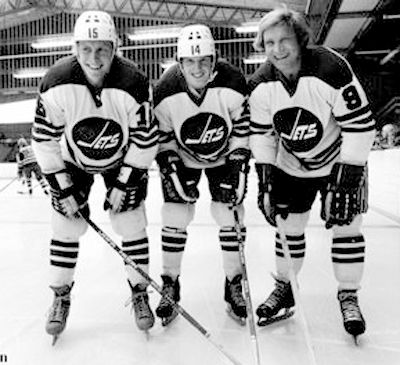
With Europe becoming a new source for talent, the idea was embraced by the Winnipeg Jets of the WHA, who signed both Nilsson and fellow Swede Anders Hedberg for the 1974-75 season. Teamed with star Hull, their impact was immediate and the result was simply the most dynamic line in the history of the WHA.

Anders Heberg, Ulf Nilsson and Bobby Hull set the hockey world on fire
The trio would light up scoreboards all over the league, with each player reaching 100 points. Hull would finish second in WHA scoring with an electrifying 142 points, which included a league leading 77 goals, while Nilsson would finish fourth (26 G, 94 A, 120 P) while Hedberg was seventh with 100 points, ahead of the likes of established veterans Gordie Howe and defending scoring champion Mike Walton.
For the 1975-76 season, Hull, Nilsson and Hedberg would finish an identical 2nd, 4th and 7th with Nilsson raising his goal total up to 38. Once in the post season, the Jets were an unstoppable force, sweeping the Edmonton Oilers before taking down the Calgary Cowboys 4 games to 1 before crushing the Houston Aeros in a four game sweep, giving the Jets the Avco World Trophy thanks to a 12-1 playoff record, as the line combined for 32 goals and 65 points in 13 games with Nilsson begin named as the Playoff MVP .
A rare shot of Nilsson without Hedberg
Nilsson was again chosen as a member of the Swedish National Team, this time for the inaugural Canada Cup in the fall of 1976, scoring 2 points in 5 games.
Hull would miss extended time in 1976-77 with an injury, but Nilsson and Hedberg would not be derailed, as they would finish second and third in scoring, with Hedberg leading Nilsson 131 to 124. Hull would return in time for the playoffs, and the Jets would advance all the way to the finals, but fall short in a seventh game in their attempt to defend their championship.
It was Nilsson's turn to lead the trio in scoring for 1977-78 when he set a career high with 126 points, thanks to a league leading 89 assists and he, Hedberg and Hull finished 3rd, 4th and 5th in league scoring. By then the WHA was shrinking in size, and the Jets only required two playoff rounds to knock out the Birmingham Bulls 4 games to 1 before sweeping the New England Whalers in 4 straight games to once again become the champions of the WHA.
Hull, Hedberg and Nilsson celebrating their second championship
With their contracts having expired and the WHA on the ropes, down to just seven teams from 14 three seasons earlier, Hedberg and Nilsson signed with the New York Rangers of the considerably more stable NHL for the 1978-79 season.
Nilsson would never reach the scoring heights he achieved with Winnipeg, as he was hit with a series of injuries, particularly one caused by a hit from the New York Islanders Denis Povtin, which became the source of the "Potvin sucks!" chants which continue in Manhattan to this day after a hit which ended Nilsson season while leading the Rangers in scoring at the time.
Nilsson was limited him to no more than 59 games during his four seasons with the Rangers, but when healthy, he did average more than a point per game in his first two seasons, scoring 66 points in 59 games in 1978-79 and 58 points in the 50 games he played in 1979-80.
Nilsson as a "blueshirt" while with the Rangers
Note the "New York" cresting worn from 1978-1987
He also was a member of the NHL All-Star Team in the 1979 Challenge Cup against the Soviet National Team, played in the Rangers home of Madison Square Garden in place of the traditional NHL All-Star Game.
His offense began to decline in 1980-81 with 39 points in 51 game, but he had a fine postseason, scoring 8 goals and 16 points in 14 games.
Nilsson spent four seasons with the Rangers
While his obligations to the Jets and Rangers during the spring playoff season prevented him from ever taking part in the World Championships after coming to play in North America, Nilsson was able to get one final chance to play for Sweden in the 1981 Canada Cup, which was held in the fall prior to the start of the NHL season. In his final international appearance, he scored 3 points in 4 games.
That would unfortunately be the final highlight of his career, as the subsequent 1981-82 season consisted of just a pair of games with the Springfield Indians of the AHL due to his injury situation and his 1982-93 season saw his career wind down with 3 games with the CHL's Tulsa Oilers and a final 10 games with the Rangers, which showed one final flash of his abilities with 6 points.
Nilsson would finish his career in North America with a combined 470 WHA and NHL games played, 197 goals and 456 assists for 655 points, most of which came during his electrifying and unforgettable run in Winnipeg, which paved the way for the large influx of Europeans to follow.
Today's featured jersey is a 1981 Sweden National Team Ulf Nilsson jersey as worn during the 1981 Canada Cup tournament during the time period where Sweden temporarily lost it's way and stopped using the timeless "The Kronor" (Three Crowns) cresting in favor of a graphic which looked far too much like a paid sponsorship logo.
The rest of the jersey is pure Sweden however, with it's vibrant yellow body and blue trim. The somewhat busy numbers on the back are typical of the period, with the numbers being not only three color (blue, yellow, blue), but then given a three dimensional effect as well.
In today's video section, "The Hot Line" of Hull, Hedberg and Nilsson are reunited on the occasion of their introduction into the WHA Hall of Fame.
Next, Nilsson being interviewed soon after becoming a New York Ranger.
Here is Nilsson being hit by Potvin, an injury which would be the beginning of the end of his career.
Labels:
Nilsson Ulf,
Sweden,
Winnipeg Jets
Tuesday, May 10, 2016
1980 United States National Team Tim Harrer Jersey
Tim Harrer, born on this date in 1957, played high school hockey at Bloomington Lincoln High School in Minnesota and was named an All-State player as a junior. That attracted the attention of the coach of the University of Minnesota, Herb Brooks, who offered Harrer a scholarship for the 1976-77 season to join the defending national champion Golden Gophers.
"Our practices lated forever. The more you practice and the more you play with better players, the quicker you improve," Harrer recalled. "If you're not competitive, you just get weeded out."
He earned the Gophers Rookie of the Year award after playing in 38 games and scoring 14 goals and 23 points as a freshman. His potential did not go unnoticed and Harrer was drafted by the Atlanta Flames in the 1977 NHL Amateru Draft, as well as being selected by the Calgary Cowboys in the 1977 WHA Amateur Draft.
He returned to Minnesota for a second season, nearly doubling his point total with 22 goals and 43 points in 1977-78, good for second on the team. The following season Harrer took another leap forward with 28 goals and 53 points, a season capped off with a 4-3 win over North Dakota in the NCAA National Championship Final, giving Minnesota the championship in Brooks final game as their head coach.
While Brooks was off to lead the United States Olympic team for the upcoming Winter Olympics in Lake Placid, Harrer was now a senior at Minnesota.
For the 1979-80 season, he absolutely caught fire, setting a team record which still stands today, 32 years later, when he scored 53 goals in 41 games. Additionally, he added 29 assists for 82 points to lead Minnesota in scoring. His 53 goals ranks as the fifth highest in NCAA history and earned him the WCHA's Most Valuable Player Award and All-America First Team recognition, which earned him a place on one of the Gophers' Mariucci Arena murals.
Also during 1979, Harrer was famously brought in by Brooks to compete with the United States Olympic Team during the latter stages of their preparation for the Games, either to replace a struggling Mike Eruzione or perhaps just to light a fire under his team. Wither way, the move had a desirable effect, as it brought the players who had gone through all of Brooks' intense training and practices closer together, and Eruzione stayed at Harrer's expense after his four games with the Olympic team, which included a goal and 4 points.
From the book The Boys of Winter: The Untold Story of a Coach, a Dream, and the 1980 U.S. Olympic Hockey Team:
Brooks kept searching, and when Eruzione hit his drought, he found a willing pair of freshman forwards: Tim Harrer and Aaron Broten from the U. Brooks had recruited both of them, and both were players with speed and skill and explosive scoring ability. Brooks's plan was to tell the press that Eruzione had injured his back, then make his erstwhile captain an assistant coach; that way he could still be in Lake Placid and contribute to the team. When the coach laid out this scenario to Eruzione, the captain was aghast. Making the Olympic team meant everything to him. In the fall, he had fractured his wrist one day in a collision with Eric Strobel, then fainted in the van as trainer Gary Smith drove him to the hospital for X-rays, not so much from the pain of the fracture as from the prospect of it costing him his roster spot. Now he was on the brink again, and for once this was no Brooksian mind game. In a hotel lobby in St. Paul, before a team dinner in late January, Brooks had a private conversation with Gus Hendrickson, his friend and the coach of Minnesota-Duluth."I'm going to cut Eruzione. He's just not very good," Brooks said. "I think I'm going to go with Tim Harrer.""But Eruzione's your leader. You need a leader," Hendrickson said. "Herbie, don't start screwing things up now." It was exactly the sentiment of the team. They'd been through Brooks's boot-camp grind for six months. Eruzione had become a widely admired captain, an emotional linchpin."If he cuts Eruzione, we're not going to go," John Harrington told Hendrickson, his former coach.The players on the team were furious when Harrer and Broten arrived -- even the Gopher guys who knew and liked them. "Great to see you, Tim," [Steve] Janaszak said to Harrer. "When's your flight back?" Not even three weeks before Opening Ceremonies, the team confronted Brooks about his revolving door and had a four-letter suggestion for him: stop. It wasn't fair to bring in guys so late, to send guys packing who had been making sacrifices for months. Of course the imports might stand out during their audition; they hadn't spent months getting beaten up by Central Hockey League thugs looking to make a name for themselves by working over an Olympic kid. Led by Eruzione and O'Callahan, the players told Brooks that they were a family and that the team needed to come from the guys in the room right there. Brooks for once backed off.
“I think Herb just made a decision that it wasn’t right [to keep me]. He just wanted to keep the team together. It wasn’t really fair to all of a sudden bring me in out of the blue and send somebody home that’s been with the team all year,” Harrer said.
Following the completion of his college career, Harrer joined the Birmingham Bulls of the Central Hockey League for 2 regular season games as well as 4 playoff games.
For the 1980-81 season, Harrer split time between Birmingham (28 games) and the Hershey Bears of the AHL (39 games). He next joined the Oklahoma City Stars of the CHL for the 1981-82 season, netting 29 goals and 56 points for third on the club.
His next stop was with the Colorado Flames of the CHL, where he impressed with 33 goals and 62 points, which earned him a call up by the Calgary Flames of the NHL, who had relocated from Atlanta in 1980. His time with Calgary was brief, just three games without a point before being returned to Colorado.
Harrer had his finest season as a professional in 1983-84 when he skated for the Salt Lake Golden Eagles, also of the CHL. There, he scored 42 goals, one off the team lead, and 27 assists for 69 points in 66 games.
His final season as a professional saw Harrer play 7 games for the Nova Scotia Oilers of the AHL, 28 games for the IHL's Toledo Goaldiggers and 4 games for ATSE Graz in Austria, scoring three goals.
In 2001, Harrer was named one of the 50 greatest players in University of Minnesota hockey history.
Today's featured jersey is a 1980 United States Olympic Team Tim Harrer jersey as worn by Harrer during his brief stint with the Olympic Team during their pre-Olympic schedule of games. While Harrer was not named to the final Olympic Team roster, his time with the club was well documented in the feature film "Miracle" as the point when the team bonded together as one.
This jersey is one of the final set of jerseys made of use in the Olympics, as the pre-Olympic jerseys had USA diagonally down the front rather than arched across the chest like today's featured jersey.
Bonus jersey: Today's Bonus jersey is a 1982-83 Calgary Flames Tim Harrer jersey, worn during his brief stint in the NHL with the Flames. The Flames kept the same sweater style used in Atlanta, only with the "A" crest changed to a "C". These jerseys would remain in use from 1980-81 to 1994-95.
Note how the 1 appears to be a different size than the 2 on the back, suggesting this jersey was recycled from a previous number worn by a different player.
Photos courtesy of Classic Auctions
Here is the scene from "Miracle" where the players confront Brooks about bringing in Harrer late in the process, which would be at the expense of one of the existing team members who has gone through the rigors of training under Brooks for months, at the risk of upsetting team chemistry.
Labels:
Calgary Flames,
Harrer Tim,
USA
Subscribe to:
Posts (Atom)