Wednesday, September 16, 2015
2004-05 Dynamo Moscow Alexander Ovechkin Jersey
The next entry in "The Lockout Collection" features another jersey from the Russian Superleague.
Alexander Ovechkin, born on this date in 1985, would have most certainly been in the NHL during the 2004-05 season, having been drafted first overall by the Washington Capitals earlier in the year, but with the NHL season cancelled, Ovechkin would return home to Russia to play one final season for Dynamo Moscow.
Ovechkin began playing for Dynamo at the age of just 16 in the 2001-02 season and in 21 games, he scored just 2 goals and 2 assists. The next season would see him play in 40 games, with 8 goals and 7 assists for 15 points, while in 2003-04, Ovechkin would finish third in scoring for Dynamo, with 23 points in 53 games.
He would make his North American debut in the 2003 World Juniors in Canada, as Russia would defeat Canada on their home soil. He would return for the 2004 World Cup of Hockey and then again to compete in the 2005 World Junior Championships in Grand Forks, North Dakota, but would suffer a shoulder injury in the gold medal game that would force him to miss nearly two months of the Russian Superleague season. Despite the missed time, he would finish 5th in team scoring with 27 points from 37 games and would return in time for the playoffs, despite the shorter 60 game RSL schedule.
Dynamo had their share of NHL talent that season due to the lockout, and would finish first overall during the regular season with 126 points from 60 games, eight clear of second place Lada Togliatti. Notable NHL players for Dynamo that season included Pavel Datsyuk, Maxim Afinogenov, Andrei Markov, Alexander Frolov and ten games from Martin Havlat at one point in the regular season.
With eight of 16 teams qualifying for the playoffs, first seeded Dynamo would draw Nizhnekamsk Neftkhimik, who would fall in three quick games by scores of 2-0, 4-2 and 2-1.
Next up for Dynamo was Avangard Omsk, who upset 3rd ranked Metallurg Magnitogorsk in the opening round, and were led by RSL leading scorer Maxim Shushinsky and Jaromir Jagr. Dynamo would drop the first game by a 3-2 score, but would heed the wake up call and punish Omsk 11-0 in Game 2. Game 3 would be a tight 1-0 victory for Dynamo and they would advance to the finals with a 3-1 win in Game 4.
Waiting for Dynamo was second seeded Lada Togliatti. Dynamo would take Game 1 by a 3-1 score, go up 2 games to none with a 2-0 shutout and capture the title with a 2-1 win in Game 3 for a sweep of the best-of-five series.
Today's featured jersey is a Lutch 2004-05 Dynamo Moscow Alexander Ovechkin jersey as worn in his final season in Russia before coming over to play in the NHL. The front features the logo of team sponsor Rosgosstrakh, the Russian National Insurance Company with Ochakovo Lager in red below, with the iconic Dynamo "D" logo on the upper left chest.
The back features Ovechkin's name in Cyrillic and the #32 he wore for Dynamo over a simplified Rosgosstrakh wordmark in red. The jersey is all dye-sublimated, as evidenced by the fading of the blue areas of the sleeves and the subtle radial fading of the numbers, as they are lighter in the center and get darker toward the outer edges.
Lutch jerseys such as today's featured jerseys are easily obtained from ProRussianJerseys.com in a variety of teams and players. Quality-wise, they are very nice jerseys, equal to the Tackla jerseys worn by international teams in the early 90's. The printing quality is first rate and the jerseys are quite durable and make a fine, and unique, addition to any jersey collection sure to elicit comments whenever you wear one.
Here is a profile of Ovechkin, made before he was even drafted by the NHL.
Excuse the "Tom Waits of Russia" soundtrack on this collection of Ovechkin highlights from 2003 while playing for Dynamo.
Labels:
Dynamo Moscow,
Lockout 2004,
Ovechkin Alexander
Tuesday, September 15, 2015
2004-05 Ak Bars Kazan Ilya Kovalchuk Jersey
The first jersey to be featured in "The Lockout Collection" is a gorgeous jersey from the Russian Superleague.
With no NHL season to compete in because of the 2004-05 lockout, many NHL players looked to Europe for competition and paychecks, and no team came close to doling out the cash like Ak Bars Kazan of the Russian Superleague.
Ak Bars, which means "Snow Leopards" and is taken from the Tartarstan coat of arms, signed 11 NHL players, including Russians Alexi Kovalev, Ilya Kovalchuk, Darius Kasparitits, Nikolai Khabibulin, Alexi Morozov and Alexei Zhitnik, plus Canadians Vincent Lecavalier, Brad Richards, both fresh off of winning the Stanley Cup with the Tampa Bay Lightning and the World Cup of Hockey with Canada, Dany Heatley and goaltender Fred Brathwaite in an attempt to win the championship to celebrate the city of Kazan's 1000th anniversary.
We highly recommend reading both of the following articles about Lecavalier and his adjustment to life in Russia during the lockout. The first is from the St. Petersburg Times titled "Rough Translation" and the second from Sports Illustrated called "Tampa Bay to Tatarstan".
Ak Bars would post a 37-17-5 record, good for fourth place in the Superleague, one point behind Metallurg Magnitogorsk who fielded a team that included future NHL star Evgeni Malkin and current NHLers Peter Sykora, Sergei Gonchar, Patrik Elias and goaltender Evgeni Nabokov.
With the top eight clubs making the playoffs, Kazan drew fifth seeded Lokomotiv Yaroslavl, who had finished nine points behind them in the regular season. The best-of-five series was decided in four games, as Lokomotiv took the first two games 2-1 and 4-3. Ak Bars won the third 1-0 before falling 2-1 in Game 4, ending the hopes of bringing the championship to Kazan during it's anniversary celebration.
Today's featured jersey is a 2004-05 Ak Bars Kazan Ilya Kovalchuk jersey, complete with Kovalchuk's name on the back in Cyrillic. The jersey is beautiful example of the state of the art dye-sublimation, accented with a equally beautiful embroidered main crest. This jersey features the #71 that Kovalchuk commonly uses while playing for the Russian National Team, as well as during his time with Spartak Moscow prior to coming over to play in the NHL, as Kovalchuk's more familiar #17 is retired by the Russian National Team in honor of Soviet legend Valeri Kharlamov.
This is one of our favorite jerseys in the Third String Goalie collection with it's vibrant colors and bold striping along with the Cyrillic lettering, which never fails to attract attention.
Lutch jerseys such as today's featured jersey are easily obtained from ProRussianJerseys.com in a variety of teams and players. Quality-wise, they are very nice jerseys, equal to the Tackla jerseys worn by international teams in the early 90's. The printing quality is first rate and the jerseys are quite durable and make a fine, and unique, addition to any jersey collection sure to elicit comments whenever you wear one.
Here are some video clips of Ak Bars Kazan from the lockout season. The first one features Kovalchuk, while the second has both Kovalchuk and Lecavalier.
This next clip shows an outstanding tic-tac-toe passing play that is a joy to watch unfold.
This final one features just Lecavalier in a variety of action while playing for Ak Bars.
Labels:
Ak Bars Kazan,
Kovalchuk,
Lockout 2004
Monday, September 14, 2015
The 2004-05 NHL Lockout
When the 2004 World Cup of Hockey concluded on September 14th, 2004, it was the last hockey at the top professional level that would be played in North America for over a year.
While Canada was still celebrating it's World Cup championship, the collective bargaining agreement (CBA) between the NHL and the NHL Players Association expired on this date in 2004, prompting the owners to lock out the players until a new CBA that addressed the owners financial concerns. The owners were spending 76% of their revenues on player salaries at the time and, as a group, lost $273 million during the 2002-03 season.
The start of the season was lost as the two sides failed to reach an agreement. The two sides continued to negotiate with some progress made, but eventually on February 16th, 2005 the league canceled the remainder of the season, ensuring the Stanley Cup would not be awarded for the only time since 1919. It was the first time a major professional sports league would cancel an entire season because of a labor dispute.
Progress was finally made in late March when an upper and lower limit on team payrolls was proposed by the NHLPA, which the NHL found to be a workable idea, which was finally hammered out on July 13th of 2005 and approved by the players on July 21st, with 87% of the vote, and unanimously by the owners the following day, officially ending the lockout.
The final agreement guaranteed the players 54% of total NHL revenues in salary and a $39 million salary cap, with a minimum of approximately $23 million, for the first year of the new agreement. In addition, all current contracts were rolled back 24%, no single player could earn more than 20% of his team's total payroll, a revenue sharing plan were the top ten clubs would contribute to a pool split among the bottom ten clubs, unrestricted free agency eventually being reduced to age 27 rather than the prior age of 31, a cap on the size of entry level contracts and a much higher minimum salary than before.
While the game was getting revamped financially, the rules were also given serious scrutiny, and two days of meetings led by Brendan Shanahan, "The Shanahan Summit" resulted in ten recommendations to the NHL and NHLPA that led to several major rules changes when the game returned from the lockout.
Tie games were gone, now replaced by a shootout. Zero tolerance for hooking, holding, tripping, slashing, cross-checking and interference was now the norm. The center red line was done away with concerning two-line passes, goaltender equipment was made smaller and the area where goaltenders could play the puck behind the goal line was reduced. The offensive zones were made slightly larger by moving the blue lines closer together, the tag-up offside rule as reinstated and anyone shooting the puck over the glass in their defensive zone would receive a delay of game penalty. Finally, any player who instigates a fight in the last five minutes of a game would face a game misconduct and a one-game suspension, which would double with each additional incident, as well as a fine for their coach.
There was also talk in Canada about what to do with the Stanley Cup that season, with many off-the-wall proposals, but some ideas that honored the original spirit of the cup to be awarded to "the leading hockey club in Canada" and featuring either a playoff with the championship winning clubs from various leagues at various levels or a knockout competition, similar to the FA Cup in England, open to any and all who could field a team.
While the NHL season was lost due to the labor dispute, that did not stop the players from playing, as many younger players were either assigned to or remained at the American Hockey League affiliate of their NHL clubs, while quite a number of NHLer's found work in Europe, playing in leagues from Great Britain to Russia and from Norway to Italy.
For the next week, we will revisit the lockout of 2004 and tell the story of some of those players.
A total of 388 members of the NHLPA played in Europe during the 2004-05 season in a variety of leagues and countries. 43 union members chose Switzerland for the season, including Martin St. Louis, Daniel Briere, David Aebischer, Jose Theodore and Alex Tanguay, while Joe Thornton, Niklas Hagman and Rick Nash helped HC Davos to the Swiss Championship.
Hagman, Nash and Thornton celebrating
their Swiss championship title
In Slovakia, the late Pavol Demitra won the scoring title for Dukla Trencin and Miroslav Satan was the playoff MVP, leading Slovan Bratislava to the title. Michal Handzus, Vladimir Orzagh and Richard Zednik also played in Slovakia on the same forward line for Zvolen.
Pavol Demitra leaving others in his wake after returning home to compete for Dukla Trencin
Daniel Alfredsson, P. J. Axelsson, Sami Salo, Sami Pahlsson and Christian Backman helped the Frolunda Indians to the Swedish Championship while Henrik Zetterberg won the scoring title for Timra IK. Peter Forsberg, Markus Naslund, Adrian Aucoin, Daniel Sedin and Henrik Sedin all skated for MODO, while Mike Knuble, Brendan Morrison and Kristian Huselius played in Linkoping and Zdeno Chara joined Färjestads BK. In all, 75 NHL players skated for clubs in Sweden that season.
Daniel Alfredsson met up with a familiar NHL foe, Zdeno Chara in Sweden's Elitserien
Ales Hemsky helped Pardubice win the championship, while Milan Hejduk and Jan Bulis finished second and third in the scoring race among the 51 players who spent time in the Czech league. Other notable players were Martin Straka and Martin Rucinsky.
Ales Hemsky battles for HC Pardubice
Moscow Dynamo won the Russian championship with Maxim Afinogenov, Artem Chubarov, Pavel Datsyuk, Andrei Markov and Sergei Samsonov on the roster. Meanwhile, the owners of Ak Bars Kazan tried to win the Russian championship in honor of Kazan's 1000th anniversary and took the unique opportunity to sign numerous NHL players, including Dany Heatley, Darius Kasparitits, Nikolai Khabibulin, Ilya Kovalchuk, Alexi Kovalev, Slava Kozlov, Vincent Lecavalier, Michael Nylander and Brad Richards, only to be eliminated in the first round of the playoffs. Jaromir Jagr found a home with Avangard Omsk, helping them to the European Champions Cup. In all, 78 NHL players skated in Russia that season.
2004-05 Russian champions, Dynamo Moscow
The 45 NHL players who competed in Finland were not the key to success, as Sami Kapanen, Olli Jokinen, Vesa Toskala, Tomas Vokoun, Kimmo Timonen, Miikka Kiprusoff, Duane Roloson and Saku Koivu all played in Finland, but Karpat Oulu won the championship after a dominant season with only one NHLer, Janne Niinimaa, on the roster.
Janne Niinimaa while with Finnish title winners Karpat
The German DEL hosted Eirk Cole, Nathan Dempsey, Mike York, Nick Schultz and Doug Weight among 22 players from the NHL.
Doug Weight suited up for the Frankfurt Lions
Other countries that had NHL talent for the season were Italy (Steve Rucchin and Stephane Quintal), Latvia, (Karlis Skrastins, Sergei Zholtok and Darby Hendrickson), France (Steve Reinprecht), Great Britian (Eric Cairns and Nick Boynton), Hungary (Rob Niedermayer), Denmark (Todd Simpson) and Norway (Scott Hartnell and Mark Bell).
Former Minnesota Wild teammates, Darby Hendrickson and Sergei Zholtok prior to Zholtok sadly passing away during a game in Belarus
The phenomenon of NHL players finding homes in the various European leagues resulted in a recommended book on the subject, "Away Games: The Ultimate Hockey Road Trip through Europe with the NHL's Best" by Laura Sullivan.
Other NHL veterans chose to play in the minor leagues in North America, such as the UHL and ECHL, while many younger players spent the season in the American Hockey League playing for their parent club's top minor league affiliate, such as AHL leading scorer and MVP Jason Spezza.
In addition to the many NHL players finding places to play all season long, the 2005 World Junior Championship provided a stellar field of teams, bolstered by top young players, several of whom would have normally been active in the NHL at the time. Future NHL regulars Sidney Crosby, Jeff Carter, Shea Weber, Mike Richards, Ryan Getzlaf, Dion Phaneuf, Alexander Ovechkin, Evgeni Malkin, Alexander Radulov, Sergei and Andrei Kotsitsyn, David Krejci, Andrej Mezaros, Jaroslav Halak, Nicklas Grossmann, Loui Ericksson, Cory Schneider, Ryan Suter, Drew Stafford, Ryan Callahan and Phil Kessel all played in Grand Forks, North Dakota that year in what is regarded as the best collection of talent the World Juniors has ever seen.
Sidney Crosby squaring off against Alexander Ovechkin at the 2005 World Junior Tournament
The net effect of this worldwide shuffling of the deck of players gave rise to several opportunities for the hockey jersey collector. With the anger over the lost season and resulting decrease of interest in hockey, prices were down and several opportunities presented themselves to pick up sweaters at quite low prices.
With many name players skating for European or minor league clubs, new opportunities to add colorful and unusual jerseys to ones collection like never before suddenly became available. We here at Third String Goalie will spend the rest of the week sharing our "Lockout Collection" of jerseys from the 2004-05 season. Look for jerseys from Russia, Sweden, the AHL and the 2005 World Juniors.
Today's video section features videos from from Molson Beer, ESPN and some seriously depressed Canadians.

Labels:
Lockout 2004
Friday, September 11, 2015
2000-01 FDNY Hockey Team Ray Downey Jersey
Ray Downey was the Fire Department of New York's Chief of Special Operations and a passionate New York Rangers fan and founding member of the FDNY Hockey Team.
He served with the United States Marine Corps and then became a member of the Fire Department of New York (FDNY) on April 7, 1962, beginning a 39-year career. In August of 2001, Chief Downey was put in charge of Special Operations Command, a team of specialists who aid regular firefighters with unique or highly critical situations, which include Hazardous Materials, Marine Units, Rescue Companies (experienced units with specialized tools and equipment) and Squads, often regarded as mini Rescue Companies who also have specialized tools and equipment. Downey was also promoted to Deputy Chief at the time.
His career was built on numerous successful rescues which made him the most decorated man in the history of the FDNY. He received five medals for valor and 16 unit citations as well as the 1995 Administration Medal.
Additionally, Chief Downey was a task force leader for the New York City Urban Search and Rescue Team as well as the National Disasters Team, who responded to both the Oklahoma City and Atlanta Olympics bombings. He was also a team leader in response to Hurricanes Hugo, Andres, Fran, Marilyn and Opal, Chief of Rescue Operations at the World Trade Center bombing in 1993, all of which contributed to his being called "a charismatic national legend in rescue circles" and he was credited with creating the modern search-and-rescue system adopted by FEMA and fire departments worldwide while pioneering a national network of eight search and rescue teams under FEMA.
He also made frequent trips to Washington D.C. while serving on a congressional panel on domestic terrorism and it's prevention.
All of this led to Downey commanding rescue operations at the World Trade Center on September 11, 2001 following the terrorist attacks earlier that morning when hijacked jetliners were crashed into each of the twin towers.
His unit was called in immediately after the first impact at #2 World Trade Center and he was leading the rescue operations which helped save thousands of lives when the second of the towers collapsed, costing him his life.
He left behind his wife Rosalie and five children, two of whom, Joe and Chuck, are now firemen.
It would take eight months after 9/11 for his remains to be identified through DNA testing before Chief Downey was then laid to rest on May 20, 2002.
When once asked asked why he searched so long for remains of those presumed dead, he cited the families of those left behind. "The only way you can relieve some of their sorrow," he said, "is to successfully recover the bodies of the people they loved."
Of the 343 firefighters lost on 9/11, Special Operations Command lost a total of 95 men with 1,600 years of experience that day.
Ray Downey's life and career are commemorated with The Ray Downey Courage & Valor Award, which is presented each year to an extraordinarily courageous American firefighter.
Following the terrorist attacks in September, 2001 the New York Rangers and Buffalo Sabres faced off in the Rangers first home game of the season on October 7th. Both the Rangers and Sabres wore special jerseys with "New York" diagonally across the front. Following the game won by the Rangers 5-4 in overtime, both sets of jerseys were auctioned off to raise money for the Twin Towers Fund.
Prior to the game the NYPD and FDNY hockey teams lined up on the ice and the Rangers skated between them during their introductions. FDNY team member Larry McGee had brought Ray Downey's firefighters helmet with him with a picture of Downey tucked into the brim of the helmet. He noticed that of all the players, only Rangers captain Mark Messier had not worn his hockey helmet during the pre-game ceremonies.
As the Rangers were lined up at the blueline, McGee sensed the moment was right and skated over to Messier with the helmet and told him it would be an honor if he would wear it. Messier responded, "Sure, whatever you need" and donned the helmet of the still missing Downey as the Madison Square Garden crowd roared it's approval.
Mark Messier wearing Chief Downey's helmet prior to the Rangers first home game following the 9/11 terrorist attacks. Note the special "New York" jersey worn only for that game.
"For me, personally, it was very emotional for a lot of reasons," said Messier, "Obviously, with all the people being honored - the firefighters, the police, the rescue workers, the volunteers, the entire city - and all our fans. All on a day when we started fighting back as a country."
At the end of that same season, Messier presented his #11 jersey to the family of Ray Downey during the Rangers annual Blueshirts off our Backs night on April 10, 2002.
The FDNY Hockey Team was first formed back in 1968 and played it's first game against the New York Police Department in 1974 and the FDNY Hockey Team now competes in charity events and tournaments from Alaska to Sweden as well as hosting the FDNY "King of the Ice" Firehouse Tournament, where for over 15 years nearly 100 different firehouses compete for the championship in the largest tournament of it's kind.
The main event on the FDNY Hockey Team calendar is always their annual faceoff against the New York Police Department (NYPD) game as the FDNY Bravest take on the NYPD Finest in "The Battle of the Badges". To date, 42 games have been played with the FDNY holding a 23-17-2 lead in the series.
Today's featured jersey is a 2000-01 Fire Department of New York Hockey Team Ray Downey jersey. This jersey takes the classic simplicity of a jersey very similar to the New Jersey Devils and combines it with the timeless look of the drop shadowed New York Rangers cresting and numbers to create as perfect a hockey jersey as you will ever see.
Of note, none of the players wore their individual names on the back of their jerseys, and instead they all had their team nickname "Bravest" on the back in place of their names, similar to Team Canada in the 1972 Summit Series when they all had "Canada" on the back.
Chief Downey's jersey #9 was retired by the FDNY Hockey Team during a pre-game tribute at the March 2, 2002 FDNY vs. NYPD hockey game.
Rosalie Downey receives Chief Downey's retired
jersey before the FDNY vs. NYPD game in 2002
While this style jersey has been retired, you can get the current FDNY Hockey Team jersey, based on the 2000-2007 Calgary Flames jerseys, through the above link or at the official store for FDNY gear - The Fire Zone at Rockefeller Center at 34 W 51st St. in New York, New York.
Please take a moment to visit the Deputy Chief Raymond Downey Scholarship Charity Fund, at ChiefRaymondDowney.com, which holds the annual Forever Running Memorial 5K Run/Walk each Father's Day to benefit the organizations he supported, and consider making a donation to the fund. Information on how to contribute can be found by clicking the banner below.
The Rescue Company, written by Chief Ray Downey, a how-to manual on rescue operations for firefighters in both paperback and hardcover, as well as his instructional video on collapse rescues are available below.
The Last Men Out, written by Ray Downey's nephew Tom Downey, is about Rescue 2, the firehouse Ray Downey commanded for fourteen years. Rescue 2 doesn't leave a fire until everybody's safe - they're the last men out.
Labels:
9/11,
Downey Ray,
FDNY Hockey Team,
Messier Mark,
New York Rangers
Tuesday, September 1, 2015
1909-10 Montreal Canadiens Didier Pitre Jersey
With the formation of the Montreal Canadiens of the National Hockey Association on December 4, 1909, player-coach Jack Laviolette was put in charge of assembling a roster of French-Canadian players.
Today's featured jersey is a 1909-10 Montreal Canadiens Didier Pitre jersey. This blue jersey with a white horizontal chest stripe and large "C" on the chest was worn by Les Canadiens during their first ever season while members of the NHA.
This jersey style lasted only a single season, as was the norm for the Canadiens during their formative years. In their first 16 seasons, Montreal would use 11 different jersey styles, including five in their first four seasons, in stark contrast to their tradition of keeping their same iconic style with only minor detail alterations since 1925.
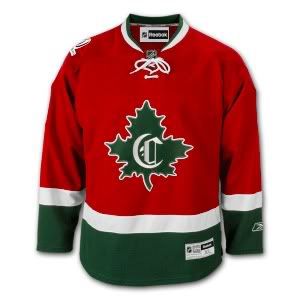
Bonus Jersey: The Canadiens revived their original 1909-10 jerseys as part of their centennial celebrations during the 2008-09 and 2009-10 seasons. This was one of six different styles worn as part of the centennial jersey program.
The first man he signed was former teammate Didier Pitre, with whom he had played on the American Soo Indians of the original International (Professional) Hockey League in Michigan from 1904 to 1907.
Renowned as a great skater and possessing the hardest shot in hockey, Pitre was an important acquisition for Laviolette and the upstart Les Canadiens as they sought to establish themselves as the team for the French speaking population of Montreal while in the same league with the Montreal Shamrocks and the Montreal Wanderers.
Laviolette paired himself and Pitre with Newsy Lalonde to form a line known as "The Flying Frenchmen" for 7 of the next 9 seasons. While the Canadiens finished last in their first season with a 2-10 record, Pitre managed to average just under a goal per game, with 11 in 12 contests. Pitre exceeded a goal per game average for the next three seasons with Montreal, who changed their name to the "Montreal Canadiens" for their third season, as he first put up 19 goals in 16 games to tie Lalonde for the team lead in scoring as the Canadiens finished second with an 8-8 record. Pitre then an impressive 27 goals in 18 contests, good for second place in the NHA, followed by 24 markers in the 17 games of the 1912-13 campaign to finish one behind Lalonde on the Canadiens and sixth overall.
Following the 1912-13 season, Pitre moved to the west for the 1913-14 season with the Vancouver Millionaires of the Pacific Coast Hockey League, where he scored 14 goals and 2 assists in 16 games in his only season with the Millionaires to tie for seventh in scoring.
Pitre returned to the Canadiens for the 1914-15 season in time to post the finest offensive season of his career when he scored 30 goals, plus 4 assists, in 20 games after moving from defense up to forward.
After scoring 24 goals in 24 games during the 1915-16 NHA season, fourth in the NHA, Pitre led the league champion Canadiens by contributing 4 more goals in 5 playoff games against the Portland Rosebuds as Montreal won the first Stanley Cup in franchise history. Pitre's share for winning the only Stanley Cup of his career amounted to $238.
Montreal again finished atop the NHA the following season to return to the Stanley Cup playoffs for the second consecutive year after Pitre recorded his fifth consecutive 20 goal season in the NHA. His 21 goals in 20 games placed him sixth in the final season of the NHA.
For the 1917-18 season, the Canadiens became charter members of the brand new National Hockey League and Pitre would continue to play with Montreal for six more seasons, averaging 15 goals a season for the first four years while in the NHL.
The Canadiens would return to the Stanley Cup Finals one more time during Pitre's career in 1919, but the series was cancelled after five games had been played with Pitre leading all playoff scorers at the time due to the flu epidemic which would claim the life of Pitre's teammate Joe Hall.
For the final two seasons of Pitre's career, he would move back to play defense in the spot vacated by the passing of Hall.
Pitre would eventually play 20 seasons of hockey, 13 of those with the Canadiens with whom he would score 220 goals and 59 assists for 279 points in 255 games and was elected to the Hockey Hall of Fame in 1962.
Today's featured jersey is a 1909-10 Montreal Canadiens Didier Pitre jersey. This blue jersey with a white horizontal chest stripe and large "C" on the chest was worn by Les Canadiens during their first ever season while members of the NHA.
This jersey style lasted only a single season, as was the norm for the Canadiens during their formative years. In their first 16 seasons, Montreal would use 11 different jersey styles, including five in their first four seasons, in stark contrast to their tradition of keeping their same iconic style with only minor detail alterations since 1925.
Bonus Jersey: The Canadiens revived their original 1909-10 jerseys as part of their centennial celebrations during the 2008-09 and 2009-10 seasons. This was one of six different styles worn as part of the centennial jersey program.
This particular style was worn on November 21, 2009 in a 3-2 shootout loss to the Detroit Red Wings. Mike Cammalleri scored both Canadiens goals during the game.
This jersey was scheduled to be worn one additional time on February 13, 2010, but the centennial jersey program was discontinued by the Canadiens new ownership with two games left on the schedule, with the other being on January 23, 2010 when their red and green 1910-11 jerseys were to have been worn, making these two styles the only ones to have been worn just once.
Our video selection today takes a look back at the formation of Les Canadiens in 1909.
Labels:
Montreal Canadiens,
Pitre Didier
Saturday, August 29, 2015
1933-34 Montreal Canadiens Aurèle Joliat Jersey
Born on this date in 1901, Aurèle Joliat began playing organized hockey in 1916 in his native Ottawa, Ontario with the Ottawa New Edinburghs. The following season of 1917-18 saw him suit up for the Ottawa Aberdeens prior to a return to the New Edinburghs for the 1918-19 season, scoring 5 goals in 8 games. The left winger showed a glimpse of what was to come with 12 goals in 7 games of the 1919-20 season to lead the league in scoring.
He played for the Iroquois Falls Papermakers and Iroquois Falls Flyers over the course of the next two seasons, including once accepting $500 from gamblers to throw the championship game of the 1920-21 Northern Ontario Hockey Association season before proceeding to score six goals in the game to lead Iroquois Falls to title.
He escaped town before the unhappy gamblers could exact their revenge for being double-crossed and made his way out west to Saskatchewan to play for the Sheiks of the Western Hockey League, but that plan was foiled when Joliat was suspended by the NOHA, which the WHL honored, forcing him to sit out the 1921-22 season.
Before he could ever suit up for the Saskatoon, his career path was changed forever by a seemingly unrelated transaction, as the Sheiks had signed away Montreal Canadiens 12 year veteran and star Newsy Lalonde.
Joliat was subsequently awarded to the Canadiens as compensation for losing Lalonde, a move initially unpopular with the fans in Montreal, who viewed the unknown Joliat as little solace for having lost the best player in hockey.
Aurèle Joliat
Joliat made the fans take notice however, when he finished third in scoring for the Canadiens in 1922-23 with 22 points, as his 13 goals alone equalled the departed Lalonde's entire point total from the previous season.
The following season he raised his goal total to 15 while playing on a line with Billy Boucher and new arrival Howie Morenz, who would go on to become a Canadiens legend in his own right.
Morenz and Joliat
The club won the O'Brien Cup as NHL champions after defeating the Ottawa Senators 1-0 and 4-2. They then advanced to the Stanley Cup playoffs, where they swept four games while eliminating first the Vancouver Maroons of the Pacific Coast Hockey League 3-2 and 2-1, and then the Calgary Tigers in dominant fashion 6-1 and 3-0 to claim the first cup of Joliat's career and only the second in Canadiens franchise history.
He cemented his place as a fan favorite during the 1924-25 season by leading the Canadiens with career highs in goals, with 29, and points, with 40. Aside from finishing second in the NHL in goals, third in points and fourth in assists, he also was sent off for 85 penalty minutes in just 24 games. While the 5' 7" and 136 pound Joliat was one of the smallest players in the game, he soon developed a reputation around the league for toughness and never backing down when challenged or intimidated, which earned him one of his nicknames, "The Little Giant."
Joliat wearing the 1924-25 Canadiens World Champions sweater
The 1927-28 season saw Joliat record 28 goals, the second best total of his carer, which came during a four year streak of finishing second in team scoring to Morenz from 1926 to 1929.
Montreal would climb to the top once again following the 1929-30 season by winning the Stanley Cup as NHL champions, as the PCHA and WCHL had ceased to exist by now. With the NHL expansion to 10 teams (up from only four the last time the Canadiens won the cup), Montreal needed to defeat the Chicago Black Hawks, the New York Rangers and the Boston Bruins, going undefeated by winning five games and tying one.
The 1928-30 Montreal Canadiens
Joliat's third Stanley Cup arrived the following season as Montreal successfully defended their title with wins over the Bruins and Black Hawks.
The 1932-33 season saw "The Mighty Atom" lead the Canadiens in scoring for the second time with 18 goals and 39 points before repeating the feat in 1933-34 with 22 goals and 37 points, the third and final 20 goal season of his career. Following the season his skill and hard work were recognized when he was named the winner of the Hart Trophy as the NHL MVP.
He would play four more seasons with the Canadiens, finishing with 16 seasons to his credit during which he scored 270 goals and 460 points in 655 games played, with his 270 goals being the third most in league history at the time of his retirement. Additionally, he added 14 goals and 33 points in 54 playoff games, as he participated in the post season during 13 of his 16 seasons. He still remains the second leading goal scorer among left wings in Canadiens history despite playing when seasons were no longer than 48 games.
Joliat was inducted into the Hockey Hall of Fame in 1947 and the Canadiens retired the #4 in his honor in 1984, a number also retired in honor of Canadiens legend Jean Beliveau.
Today's featured jersey is a 1933-34 Montreal Canadiens Aurèle Joliat jersey. After some early variations, the famous Montreal red sweaters settled into the "C" on the front becoming red with a white outline in 1925-26. In 1935-36 the team logo would disappear from the arm and the crest on the front would gain a blue outline, a look that has remained essentially unchanged ever since.
Today's jersey still sports the now smaller version of the logo on the arm and the blue outline has yet to appear on the main crest, dating this variation from between 1932-33 and 1934-35, which includes Joliat's final 20 goal season in 1933-34.
Labels:
Joliat Aurele,
Montreal Canadiens
Subscribe to:
Posts (Atom)