History of Jersey 83-93 Banner sm photo History of Jersey 83-93 Banner sm.jpg

Tuesday, October 2, 2012

Minnesota Wild Best Jersey in Minnesota Tournament - Round 1

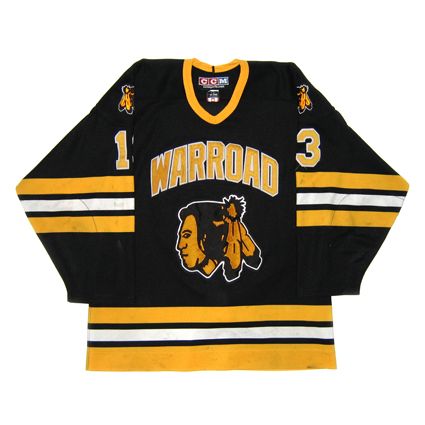
Thanks to your help, our nomination of the Warroad Warriors black jersey has made it past the preliminary phase and into the Round of 32 of the Minnesota Wild's Best Jersey in Minnesota Contest, and as a #1 seed no less!

Warroad Warriors 2001-2008 jersey photo WarroadWarriors2001-2008F.jpg

Again, we could use your help going forward. Not only do we believe that this is the classic hockey sweater with it's striking and intimidating colors, but the stylish vertically arched lettering and iconic Indian head logo, designed and approved by the local Ojibwe tribe, only add to this timeless look. Plus, a vote for Warroad, just five miles from the Canadian border on the shore of Lake of the Woods, is a vote for old-time, play-all-day-until-mom-calls-you-home-for-dinner pond hockey with your buddies.

To vote for the Warroad black jersey (not the white one), please go to the voting page on Wild.com and scroll down to see the parings for voting where you will have another opportunity to help us get Warroad into the next round, which will be announced tomorrow, so we need your vote today.

We're paired with the hideous and garish International Falls Broncos, a jersey we wouldn't wish on our worst enemy, so do the right thing, and send Warroad's classic black and gold indian head logo on to the second round!


Wild Best Jersey Contest, Wild Best Jersey Contest

Monday, October 1, 2012

1995-96 Colorado Avalanche Joe Sakic Jersey

On this date in 2009, the Colorado Avalanche retired the #19 of long time captain Joe Sakic.

A little known fact is that Sakic's parents were Croatian immigrants and he grew up speaking Croatian before attending elementary school. He would be named Rookie of the Year in the Western Hockey League of Canadian Juniors in 1987 after scoring 133 points. He also survived a horrific bus crash involving his club, the Swift Current Broncos, in which four of his teammates were killed. Sakic was then drafted by the Quebec Nordiques 15th overall in the 1987 NHL Entry Draft.

The following year Sakic was named WHL Most Valuable Player and Canadian Major Junior Player of the Year after scoring 160 points.

Sakic Swift Current Broncos, Sakic Swift Current Broncos
Sakic during his days with Swift Current

He scored an assist on his NHL debut on October 6, 1988 versus the Hartford Whalers and originally wore sweater #88 because Alain Cote was wearing his preferred #19. He finished with 62 points in 70 games as a rookie.

Sakic Rookie, Sakic Rookie
Sakic wearing #88 as a rookie

With Cote now retired, Sakic claimed his #19 for 1989-90 and scored 102 points. 1990-91 saw Sakic score 109 points, sixth overall in the league, and be named co-captain of the Nordiques (for home games).

Sakic would miss 11 games in 1991-92, which would hurt him in his chances to repeat another 100 point season, and he would conclude the year with 94 points. During this time period. the Nordiques regularly finished in last place, which allowed them to load up on high draft choices and put them in position to acquire a number of talented players, highlighted by their trade of holdout Eric Lindros.

Now named full time team captain of the newly reconfigured Nordiques, Sakic would respond in 1992-93 with 105 points and lead the Nordiques out of the wilderness and into the playoffs for the first time in his career on the heels of a staggering 52 point improvement, double their total of the year prior. Without any previous playoff experience, the Nordiques would be eliminated in the first round by arch-rivals the Montreal Canadiens.

Sakic Nordiques Captain, Sakic Nordiques Captain
Sakic as captain of the Nordiques

1993-94 was a slight step back for Sakic, as he would fall short of the 100 point barrier with 92, but the Nordiques would take a large step back, dropping 28 points in the standings and miss the playoffs yet again.

The Nordiques final season of in Quebec saw Sakic finish fourth in scoring during the lockout shortened 1994-95 season and the Nordiques would capture the division title, only to be eliminated in six games by the New York Rangers, ending their time in Canada.

Relocated to Denver, the Colorado Avalanche took to the ice in the 1995-96 season hoping to continue the improvement shown during Sakic's seven seasons in Quebec. Little did anyone anticipate the events that would unfold that season.

After having a major falling out with the Montreal Canadiens, superstar goaltender Patrick Roy was traded to the Canadiens former arch-rivals, now located in Colorado, a trade which would have never, ever happened had the club remained in Quebec, and the Avalanche were now on their way to glory.

Sakic topped 50 goals for the first time with 51, adding 69 assists for a career high 120 points for third in the league. The Avalanche would storm the playoffs, defeating first the Vancouver Canucks, followed by the Chicago Blackhawks by identical 4 games to 2 margins. Next up was a hard fought series with the Detroit Red Wings, upsetting the team that finished 27 points ahead of them in the standings 4-2 for the right to face the upstart Florida Panthers, whom they easily dismissed in four straight games for the the franchises first Stanley Cup Championship in their first season out of Quebec. Sakic would lead the playoffs in scoring that season and be named the winner of the Conn Smythe Trophy.

It had been a long journey for Sakic, who, along with Curtis Leschyshyn, were the only two Nordiques players from the 1988-89 season to suffer through the years of last place finishes to eventually raise the Stanley Cup.

Sakic 1996 Stanley Cup, Sakic 1996 Stanley Cup
Sakic raises the 1996 Stanley Cup after many years of toil with the franchise

Sakic would eventually play 13 seasons in Colorado, scoring 100 points twice more in his career, eventually surpassing the 600 goal, 1,000 assist and 1,600 point marks. The Avalanche were regular fixtures in the playoffs, and contenders for the Stanley Cup for seven straight seasons, reaching the conference finals in six of those seven seasons, including winning the Stanley Cup again in 2001, the same season he won the Hart Trophy as league MVP, the Pearson Award and the Lady Byng Trophy.

Sakic 2001 Stanley Cup, Sakic 2001 Stanley Cup
Sakic again raised the Stanley Cup in 2001

Today's featured jersey is a 1995-96 Colorado Avalanche Joe Sakic jersey and features the 1996 Stanley Cup Finals patch. This jersey stands apart with it's "mountain range" striping on the waist and arms, unlike any other jersey of it's day. Combined with it's unique color palette, custom number font, memorable secondary shoulder logos and the club's success on the ice, this style Colorado Avalanche jersey is a true icon of it's era and only the change to the templated Reebok Edge jerseys killed off what would have likely been one of those jerseys that lived on unchanged for years.

The white names and numbers on this jersey have a textured herringbone pattern pattern to them, which is called "Glacier Twill". In addition to that detail, the silver outline around all the numbers is a metallic silver material, which is often done as a flat grey material on Avalanche jerseys. The lettering for the name is also tall and narrow, as shown by the shape of the "C", which is also often found as a nearly perfect circle shape with rounded, instead of flat sides like shown here.

Colorado Avalanche 95-96 jersey photo Colorado Avalanche 95-96 F.jpg
Colorado Avalanche 95-96 jersey photo Colorado Avalanche 95-96 B.jpg

Bonus jersey: Today's bonus jersey is a 1989-90 Quebec Nordiques Joe Sakic jersey. This jersey was worn on the road when Sakic was still an assistant captain of the club, as he would not become a co-captain until the following season, and then only for home games, raising questions about just when and why Sakic was wearing the "C" on the road in 1989-90, perhaps due to an injury to their then Captain Peter Stastny. Close inspection will reveal clear remnants of an "A", replaced by a somewhat crudely fashioned "C" over the top of the "A".

Quebec Nordiques 89-90 jersey, Quebec Nordiques 89-90 jersey

Our first video today are the Top 10 Joe Sakic Moments from his throughout his career.


Our second video is a tribute video dedicated to his entire career on the occasion of his retirement.

Sunday, September 30, 2012

2012 Minnesota Hockey Collectors Expo

One week from today, Sunday, October 7th, is one of the highlights of the jersey collecting calendar, the 11th Annual Minnesota Hockey Collectors Expo. Anyone who can make it to the Twin Cities of Minneapolis and St. Paul should stop by Tom Reid's Hockey City Pub near the Xcel Energy Center from 11 AM to 6 PM.


It's the largest gathering of game worn jerseys in Minnesota each year and you can count on seeing some amazing and varied collections in a great hockey environment. This event is free and features collectors bringing favorites from their personal collection for some good old show and tell, with an emphasis on jerseys related to the Minnesota Wild, Minnesota North Stars and Minnesota Gophers, as well as many other interesting jerseys from throughout the hockey world. It's great opportunity to see some great game worn jerseys up close, meet some new people and perhaps add a new jersey to your collection.

To further entice you to attend, here are some photos from last year's event.

Photobucket

Above is Scott Janvrin's impressive Ben Clymer collection. Collecting one player, such as Clymer can be a challenge when they make multiple stops in the NHL and the AHL, but that challenge increases exponentially when a player extends his career by playing in Europe, so this collection was all the more impressive with the addition of game worn jerseys from the German DEL.


Photobucket

Photobucket

Kyle Oen brought his amazing game worn Minnesota high school jersey collection that rivals the one on display at the Xcel Energy Center. He also has other Minnesota based teams in his collection, such as the Minnesota Moose and Minnesota Gophers. Kyle's love of all things Minnesota hockey related is expressed in his website, VintageMinnesotaHockey.com.

Photobucket

Above is John Lindberg's take on a Minnesota theme. Where Kyle collects teams from Minnesota, John is more about former Gophers NHL jerseys as well as Minnesota Wild prospects jerseys before they reach the NHL.

Photobucket

Can't make it to the Hockey Hall of Fame in Toronto? Then having the opportunity to see Jon Bakke's collection of vintage jerseys can save you the trip. This year Jon went with a theme, bringing all his old Quebec Nordiques jerseys, the centerpiece of which are his Stastny brothers!

Photobucket

Jon can be easily spotted at Minnesota Wild games wearing his rotating collection of gamers, as he doesn't just hang them in a closet, he wears his regularly to Wild games.

Photobucket

Here is Jon sharing his collection with former North Star Maxwell, who probably had a few intense battles with the Nordiques before becoming one himself at one point in his career.

Photobucket

Speaking of Hall of Fame worthy collections, Dan Erspamer's Minnesota North Stars collection is highlighted with not only a first year North Stars jersey, but one belonging to the tragic Bill Masterton - a true gem of the expo. If you'd like to talk jerseys with Dan, he's an expert and can be found working at The Hockey Lodge store at Minnesota Wild home games, which take place just up the road from Reid's at the Xcel Energy Center.

Photobucket

Chris Groth (right) has his own hall of fame collection underway and goes for whatever catches his eye. He brought some real gems, including game worn jerseys from Luc RobitailleJoe Sakic and Theo Fleury, but his Alexander Ovechkin game worn jersey was certainly an Expo highlight.

Photobucket

Eric Bodamer, who designed all the jerseys Nike supplied for the 1998 Olympic hockey tournament in Nagano, Japan, brought with his collection of game worn jerseys from his hometown Buffalo Sabres.

Photobucket

This collection with a Minnesota and Minnesota Wild theme was really impressive, particularly the Mikael Granlund jersey from HIFK Helsinki. Just how do people track these things down?! You have to appreciate dealing with the differences in time zone, language and currency when it comes to obtaining European jerseys!

Photobucket

Yes, you are seeing that right, it's a Milwaukee Admirals "Bob Uecker Night" jersey modeled after Uecker's infamous plaid sport coats! That jersey, and the rest of the collection on the table belong to Chris Jerina. The Uecker jersey, along with the Masterton jersey, was easily our favorite of the event.

Photobucket

Here was our contribution to the proceedings, our history of patches worn by the Minnesota Wild in their 10 years of play. We also brought our collection of game worn German National Team jerseys, which date from 1989 to 2009.

Photobucket

Another great person to meet was certainly Dan Schafer, who was the former equipment manager for the Minnesota Moose of the IHL. His Nordiques jersey from the late Stephane Morin was one of our personal highlights.

Photobucket

The walls of Tom Reid's are just dripping with hockey memorabilia and create the perfect environment to hold such an event.

Photobucket

Who says the event is just for guys?

Photobucket

Finally, the collection of event organizer Frechette, without whom the Expo would not exist. Dave's collection focuses primarily on Minnesota Wild players jerseys, only before they joined the Wild. Examples in his collection are Wild prospects jerseys from their college and junior team as well as European born players jerseys from their European club teams. He is shown with his new pride and joy, Dany Heatley's Ak Bars Kazan game worn jersey from Heatley's time in Russia during the lost NHL season of 2004-05.

How he is consistently able to track down jerseys from such a wide variety of sources is one of the more impressive things to take in at the Expo and his appreciation of hockey history is evidenced by the rare and wonderful Minnesota Fighting Saints WHA jersey seen here as well as his North Stars game worn jersey on display behind him.

This year's Minnesota Hockey Collectors Expo will feature a raffle for the first time, with some great prizes up for grabs from the collections of many of those in attendance in an effort to raise money for the Minnesota NHL Alumni Association, who will receive 100% of the proceeds from the raffle.

For details of the the 11th annual expo, including notable players who plan on attending, check out the event's facebook page. It's a can't miss event, and remember, Chicks Dig the Game Worn Jerseys!

Photobucket

We certainly hope those of you who can, will take the time to attend this can't miss event!

Saturday, September 29, 2012

2012 IIHF Publications

With the NHL mired in it's current state of inactivity due to the current impasse in it's labor situation, international hockey looks to be one of the hockey fan's best bets for entertainment this season. There will be several competitions to determine which three additional countries will qualify for the 2014 Winter Olympics, plus all the Men's and Women's World Championships taking place at various age levels, U18, U20 and Senior, in 6 different Divisions within in each age group on the men's side, for a total of 18 champions plus another five up for grabs on the women's side.

To get you up to speed on what is happening this season, any fan of international hockey needs to be aware of the publications offered by the International Ice Hockey Federation, an fantastic array of materials which compliment each other perfectly.

First up is IceTimes, the official newsletter of the IIHF, published every other month with news, features, stats, photos and results from the broad array of tournaments organized by the IIHF.

IceTimes is available for free on the IIHF website, or media members can be added to the mailing list to receive a free printed copy by sending a request to media@iihf.com.


IceTimes, IceTimes

Next on the list is the IIHF Annual Report. a 116 page complete recap of the previous season. It features several sections, including results and standings for all the IIHF World Championship events, over 70 photographs, information on all the IIHF member national associations as well as various reports from important international hockey topics.


Last year's version can be downloaded for free and the 2012 version is due to be available very soon. The reports are also available as printed copies directly from the IIHF, but be aware that the shipping charges from Switzerland do add up to a final price of roughly $38 USD. Package deals of the 2010, 2011 and 2012 reports are available as well.

IIHF Annual Report, IIHF Annual Report

The third level of publication offered is the IIHF Guide and Record Book, which continues to grow each year and covers every tournament from every year, from the Olympics down through Division V. Additionally, it includes not only every active player stats, but every retired player to ever appear in even just a single game back to 1920 - over 12,000 players in all!

Beyond the World Championships, the book covers the U20 World Juniors and U18 World Championships for both men and women, the 1972 Summit Series, the history of the Canada Cup and World Cup of Hockey.

There is no free version of this encyclopedia of world hockey, but it can easily purchased online. The IIHF sells the book directly as a printed version ($67) or a less expensive DVD ($22) shipped from Switzerland, but we were able to find the 2012 edition on Amazon.com for as little as $18.39 plus $3.99 shipping from within the United States. Unlike the Annual Report, which contains unique content every season, the Guide and Record book is the type of thing one only would want to get perhaps once after each Olympics due the vast majority of the information being repeated each year.

IIHF Record Book, IIHF Record Book

While there are other IIHF related publications on Amazon, such as the excellent "World of Hockey: Celebrating a Century of the IIHF", priced from $21.32, there are any number of what we call "fake books" listed on Amazon. They are not traditional books created by a reputable publisher, but are merely overpriced collections of relevant and tangental Wikipedia articles collected together in book form. 

While some topics might be somewhat worthwhile to have bounded together in printed form, we find the creation of these "fake books" to be deceiving in nature. Consider if the ice hockey book you are interested in has a picture of wild flowers, zoomy screen saver light patterns or field hockey on the cover, not much care or thought has likely gone into creating the product, the contents of which is all available to you for free on Wikipedia, which is how the "publisher" got it all to begin with. Buyer beware!

Fake Book, Fake Book
Seriously? Field hockey on the cover of a book on
the 2006 Ice Hockey World Championships?

Friday, September 28, 2012

1972 Team Canada Paul Henderson Jersey

"Here's a shot. Henderson makes a wild stab for it and falls. Here's another shot. Right in front. They score! Henderson scores for Canada!"


The most famous goal in Canadian hockey history occurred on this date in 1972, as
Paul Henderson scored with 34 seconds remaining in Game 8 of the 1972 Summit Series between Canada and the Soviet Union.

The Summit Series was a groundbreaking event in not only hockey history, but international politics as well. The series would be the first time that the Canadians were able to take on the Soviets with a full squad of professional players head to head against the best that the Soviets had to offer. Most in Canada fully expected an easy time of it for Team Canada, with some even predicting an eight-game sweep.

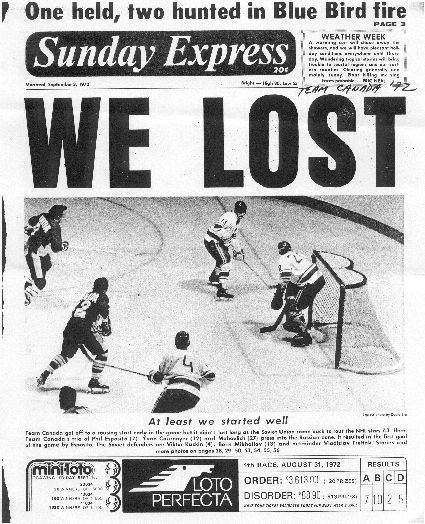
That was not to be, however, as all of Canada was stunned when the Soviets came back from an early 2-0 deficit in Game 1 to win 7-3 in Montreal.

1972 Summit Series Game 1 headline photo 1972 Summit Series Game 1 headline.jpg
The stunned reaction in Canada to their Game 1 defeat

Canada would win Game 2 in Toronto by a score of 2-1 with the Soviets coming from behind by two goals in Winnipeg to earn a tie in Game 3.

Game 4 would see the Soviets up 4-1 after two periods, with the final score being 5-3, earning Team Canada a shower of boos from the Canadian crowd, earning them a tounge-lashing from a frustrated Phil Esposito as the series was about to head off to Moscow for the final four games.


Things did not start off any better for the Canadians in Moscow either, as Team Canada led 4-1 only to have the Soviets come back to win the game 5-4, putting them ahead three games to one, along with a tie and three home games remaining.

Game 6 went better for Team Canada, despite having 31 penalty minutes called against them versus only 4 assessed to the Soviets, Canada would win 3-2 in a game that would feature a pivotal moment in the series, as Bobby Clarke would fracture the Soviet's best forward Valeri Kharlamov's ankle with a deliberate slash.

Canada would even the series at three games each by winning Game 7 by a score of 4-3, with  Henderson scoring the winning goal with a shade over two minutes remaining, setting up a decisive Game 8.


While the series was supposed to be a "friendly" series of exhibition games with no overall winner, the Game 3 tie in Winnipeg left an odd amount of games to divide between the two sides, and when hen the Soviets proclaimed that even if Game 8 ended in a tie, they would be the winners on the basis of scoring one more goal than the Canadians during the series.

In an effort to ensure the best possible chance for a Soviet victory, they orchestrated a change in officials the night before the decisive game, choosing to replace the previously selected Swede and Czech referees with the same East German pair Josef Kompalla and Franz Baader
that were responsible for the great discrepancy of 27 penalty minutes in Game 6, so much so that the Canadians nicknamed the pair "Baader and Worse".

Canada threatened to leave Moscow without even playing Game 8 if that were the case and a compromise was reached where the the Soviets hand picked their favorite East German, while the Canadians got to choose the Czech ref Rudi Bata, who Canadian organizer Alan Eagleson figured didn't like the Soviets any more than he did!

Sure enough, just three minutes into the game Canada was two men short and gave up a power play goal. At 4:10, J. P. Parise was given yet another minor and his threatening reaction earned him a ten-minute misconduct. Now enraged, Parise's threatening outburst got him thrown out of the game as a game misconduct was added on.


Parise stick swing 1972 photo Parisestickswing1972.jpg

Phil Esposito would score once the hockey resumed to tie the game at 6:45 and then the teams would trade goals by Vladimir Lutchenko and Brad Park to finish out the first period tied at 2-2.

The Soviets would use a little home ice advantage to score in the first minute of the second, as the puck was fired over the goal, only to take a large rebound off the mesh netting that topped the boards rather than the plexiglass of North American arenas. Vladimir Shadrin would put the puck behind Ken Dryden after it landed back into the area in front of the Canadian goal.

Bill White would score for Canada halfway through the period, only to have the Soviets score just over a minute later to regain the lead again and then once more on the power play at 16:44 to take a 5-3 lead into the third period.

Phil Esposito would ignite the Canadians with a goal at 2:27 of the third to pull Canada back within one. Esposito again charged the net and Yvan Cournoyer was able to put the rebound past Vladislav Tretiak at 12:56, only to have the Soviet goal judge fail to turn on the goal light, but the goal did count to tie the game. Again, a tie would allow the Soviets to claim a series victory, so the Canadians were still desperate to score another.

With the game now winding down in the last minute of play, Cournoyer intercepted a Soviet clearing attempt and passed to Henderson. The pass was behind him and he was tripped on the play as well, which sent him crashing into the end boards to the side of the Soviet goal.

At that point, Esposito, who was following the play, put the puck softly in front of the goal where Henderson, now back on his skates and, returning to play from behind the net, was able to jump on the loose puck and swat it towards Tretiak, who blocked with his leg. The puck bounced off his pads, allowing Henderson a second shot at glory, which he put over the sprawled Soviet goaltender to give Canada the series victory with only 34 seconds remaining in the contest.

Photobucket
Cournoyer hugs a jubilant Henderson seconds after he
cemented his place in hockey immortality

The success of the 1972 Summit Series led to an attempt at a repeat in 1974, only this time with a team made up of players from the World Hockey Association, which was one sided in favor of the Soviets and failed to capture the public's imagination despite the inclusion of both Gordie Howe and Bobby Hull, who were both absent in 1972.

The concept of the Summit Series eventually evolved into the Canada Cup tournament, which featured an expanded field of six teams, which in turn led to the current World Cup of Hockey.

The 1972 Summit Series also influenced many aspects of how the game was approached and played in North America, with off-season training now becoming important, as well as various strategy differences in puck possession and player positioning.

Today's featured jersey is a 1972 Team Canada Paul Henderson jersey as worn during the four games played in Moscow.

This jersey came up for public sale for the first time ever at auction in June of 2010 on ClassicAuctions.net, a leading online auction website based in Quebec, Canada. Fears immediately were voiced from many corners of the hockey world that this historic jersey would fall into the wrong hands - such as those of a trading card company like Be A Player or Upper Deck, who have made a business out of cutting up historical sports artifacts into hundreds of small pieces in order to create collectible trading cards.

Notable previous losses of significant items include the only set of goalie pads worn by Georges Vezina and a 1925 New York Yankees Babe Ruth jersey among the dozens of items that have been desecrated for the sake of short term profits by card companies.

The concern and publicity over the possible threat to "the most significant artifact in the history of the game of hockey" eventually saw the jersey sell for a record shattering $1,275,707, far outstripping the reported $250,000 paid for a Wayne Gretzky game worn jersey and the $191,000 for a Bobby Orr rookie jersey.

The winning bidder, Canadian real estate developer Mitchell Goldhar, not only preserved the jersey from possible destruction, but returned it to Canada from where it had been located in the United States, but took the iconic Canadian sweater on a tour of the country in an effort to share it with the citizens of the nation where everyone remembers where they were when Henderson score his dramatic goal. One of the highlights of the return of the jersey to Canada was having Henderson don the jersey once again.

Canada 1972 Henderson jersey
photo courtesy of Classic Auctions


There is much more than can be written and examined about this series, it's significance and it's impact, and in fact many have done just so, as there are a number of books available on the subject as well as DVD sets of the games.

Finally, here is Henderson himself, telling the story from his unique point of view of the series and his famous goal.

Monday, September 24, 2012

2009-10 Croatia National Team Igor Lazic Jersey

While the 2014 Winter Olympics in Sochi, Russia are still 17 months away, the competition has already begun!

Surprisingly enough, the Olympic Preliminary Qualification Phase for the Games, to be held in February of 2014, began a week ago with Group K qualification play in Zagreb, Croatia.

33 teams have applied for the 12 spots in the Olympics, with 9 of those places being already guaranteed to the nations ranked 1-9 following the World Championships earlier this year, meaning the remaining 24 must participate in a qualification process to determine which fortunate three others will have the thrill of participating in the actual Olympic Games.

Hosts Croatia (currently ranked 30th in the IIHF World Rankings), Serbia (31), Mexico (34) and Israel (40) participated in a round robin schedule to determine which of the four nations would advance to play in Group G of the Olympic Pre-Qualification tournaments in two months time from November 8th to 11th.

Serbia Israel 2012, Serbia Israel 2012
Serbia and Israel began the road to Sochi in the opening game of the Preliminary Qualification Phase

Croatia prevailed with three easy wins, 9-2 over Mexico, a 15-2 blowout over Israel and secured their place in the next phase with a 6-2 win over Serbia (their closest rival but a country with only three indoor rinks) to make their final goal totals 30 for and just 6 against.

Croatia Mexico 2012, Croatia Mexico 2012
Croatia opened their qualification efforts with a 9-2 win over Mexico

Group G will now consist of host Hungary (ranked 19th), the Netherlands (24), Lithuania (25) plus Croatia, who currently compete in Division IIA, one level below the Netherlands and Lithuania and two below Division IA Hungary in the IIHF World Championships ladder system.

“It will be a lot different from this tournament because here we were the best team and in Budapest we will have stronger opponents,” Croatian forward Petar Trstenjak said, “but I hope we will have a bigger roster and that we won’t lose by high scores.” in a quote which illustrates the enormous task and long odds of Croatia even advancing past the next phase, much less making the actual Olympics.

At the same time as play in Group G, Groups H and J will be competing, with Group H being hosts Ukraine (20), Poland (23), Estonia (26) and Spain (29), while Group J, appropriately held in Japan, consists of Great Britain (21), Japan (22), Romania (27) and South Korea (28).

The winners of Groups G, H and J will not be advancing to the Olympics just yet, however, as they must participate in another phase of the competition, the Final Olympic Qualification, which will take place from February 7th to 10th in 2013.

Things get much tougher for those teams advancing from the Pre-Qualification Round Groups G, H and J, as they are slotted into Groups D, E and F, where teams ranked 10-18 await.

Group D is being hosted by Germany (10) and will consist of Austria (15) and Italy (16) plus the addition of a winner from the previous round, to be determined by their ranking.

Group E sees Latvia (11) hosting France (14) and Kazakhstan (17) plus a qualifier while Group F will take place in Denmark (12) with Belarus (13) and Slovenia (18) waiting the final qualifier.

Only then will the winners of those three groups gain an entry into the actual 2014 Winter Olympic hockey tournament in Sochi a year later where Russia (1), Slovakia (6) and the United States (7) in Group A, Finland (2), Canada (5) and Norway (8) in Group B and the Czech Republic (3), Sweden (4) and Switzerland (9) in Group C await the final three survivors of the three step qualification process which began last week in Croatia.

While little publicized and virtually unknown in North America, the Olympic qualification tournament can provide some some of the most dramatic moments, particularly in Groups D, E and F with an actual berth in the Olympics on the line, as making it to the games in as good as a gold medal for the participants of the lower ranked nations and is a source of tremendous pride for all involved to compete at the highest level on sport's biggest stage against the world's best.

The most memorable game in Olympic qualification history took place in January of 2005 to decide who would advance to Torino, Italy in 2006. Group B held in Riga, Latvia saw Belarus gain two points in the standings by defeating Poland, while Latvia knocked off Slovenia 2-1. Belarus took care of Slovenia the next day 7-2 while Latvia kept pace by beating Poland 3-1, setting up the final winner-take-all game against Belarus.

Belarus opened the scoring of the deciding game at 5:16 of the first and stretched their lead to two at 12:06 before Latvia answered at 18:33. The second period was played even, with each team scoring one with Belarus going back up by two at 1:49 before former Boston Bruin Grigori Panteleev scored 18 seconds later to return the margin to one in favor of Belarus.

Belarus put themselves in a good position to win the group and advance with a goal at 9:11 of the third to make the score 4-2 for Belarus.

Now in desperation mode, Latvia pulled goalie Edgars Masalskis during a Latvian powerplay with just six minutes remaining in the game and down by 2 goals. The gamble paid off as Latvia scored at the 15:11 mark to reduce the margin again to 1.

1:47 later the Latvians thrilled the home crowd by getting the equalizer at even strength, leaving just three minutes to decide who would claim the final remaining spot in the Olympics. Alexsandrs Semjonovs then sent the home fans into rapture by finishing the comeback and punching Latvia's ticket to Italy just 33 seconds later to complete the three goal outburst in two minutes and twenty seconds in what would become known as "The Miracle in Riga", considered by some the greatest achievement in Latvian sports since they regained their independence in 1991.

Today's featured jersey is a 2009-10 Croatia National Team Igor Lazic jersey as worn during the IIHF Under 18 World Championships Division II. The red and white checkered pattern of the Croatian coat of arms makes for a unique element regularly incorporated into the design of their national team jerseys, which are often quite striking.

The Croatian National Team first participated in the World Championships in 1993 in Pool C play. They made steady progress as they established their program, rising from an initial ranking of 31st in 1994 to 24th in 2001, which included winning Pool D in 1997.

With the new organization of the World Championship structure, Croatia began in Division I in 2001 and has spent seven years in Division I (with a best finish of 4th) and five years in Division II, which they have won twice (in 2005 and 2007) and where they have resided for the last two years.

Croatia 09-10 jersey, Croatia 09-10 jersey

This particular jersey is from our friends at WorldHockeyJerseys.com, the number one source of game-worn jerseys from national teams of the International Ice Hockey Federation. Nick and Mike have supplied us at Third String Goalie with a number of our jerseys, including those from Estoina, Great Britain, Hungary, Iceland, Poland, the Netherlands and Spain. To view all their current auctions, please click here.

Today's video is the magnificent Latvian comeback that would become known as "The Miracle in Riga" which would propel them into the 2006 Winter Olympic hockey tournament.


At the 2006 Olympics in Torino, Latvia was placed in Group B with Slovakia, Russia, Sweden, the United States and fellow qualifier Kaszakhstan. Goaltender Arturs Irbe played brilliantly and held the United States to a 3-3 tie in their opening game, but they were then defeated four straight times to finish last in their group. They ended the tournament classified 12th out of 12 teams, but nothing could erase the excitement of "The Miracle in Riga" and no one, and we mean no one, has a better time at the games than the fans from Latvia, who were only there thanks to a miracle.


Sunday, September 23, 2012

2004-05 Warroad Warriors Zach Larson Jersey

The Minnesota Wild is conducting a vote on their facebook page to determine what is the best jersey in the state of Minnesota.

Wild Best Jersey Contest, Wild Best Jersey Contest

The 45 nominees range from the professional ranks, which would include the Minnesota Wild, Minnesota North Stars and the Minnesota Fighting Saints of the WHA and numerous college choices in not only Division 1, the University of Minnesota, Minnesota Duluth, Minnesota State, Bemidji State and St. Cloud State, but from the lower NCAA divisions as well.

Then there are the many high schools who field both boys and girls teams represented and even youth hockey jerseys as well as some rec hockey beer league or pond hockey teams nominated.

The submission phase has now ended and the contest has entered the voting phase, and this is where we need your help to get our nomination through to the next round.

We chose a classic old-school jersey from the legendary Warroad Warriors high school program. Warroad, hailing from northern Minnesota on the shore of Lake of the Woods just six miles from the Canadian border, is a regular participant in the annual Minnesota State High School hockey tournament, having made 21 state tournament appearances, dating back to 1948, with four championships won, those coming in Class A in 1994, 1996, 2003 and 2005.


To view and vote for our entry, simply click here.


The particular jersey we nominated was worn from 2001 through the midway point of the 2008-09 season, which included the 2005 championship season when the Warriors went undefeated with a 29-0-2 record.

Current St. Louis Blues forward T. J. Oshie is the all-time leading scorer in Warroad history with 104 goals and 137 assists for 241 points in just 93 games. Oshie led the entire state of Minnesota in 2004-05 with 37 goals and 100 points.

Warroad Warrior T. J. Oshie

Other notable hockey players to come from Warroad include Dave Christian, a member of the Miracle on Ice 1980 gold medal winning USA Olympic team, who would go on to play 15 NHL seasons with Winnipeg, Washington, Boston, St. Louis and Chicago, Dave's father Bill Christian and uncle Roger Christian, who won gold medals in the 1960 Olympics, and Henry Boucha, a 1972 silver Olympic medalist, who would play for Detroit, Minnesota, Kansas City and the Colorado Rockies of the NHL.

This is a classic looking jersey in the style and colors of the old Boston Bruins jerseys of the mid 70's to the mid 90's and is one of the few remaining schools to use a Native American nickname and imagery, while others such as Grand Rapids, Minneapolis Southwest and Burnsville have discontinued their use. The use of the Warriors name by Warroad High School is approved by the local Ojibwe band of Chippewa Indians who designed the logo used on the Warriors jerseys which has allowed it's continued use.


Warroad Warriors 2001-2008 jersey photo WarroadWarriors2001-2008F.jpg
Warroad Warriors 2001-2008 jersey photo WarroadWarriors2001-2008B.jpg

You have until September 30th to support our choice by simply clicking this link to vote for the Warroad Warriors and their gorgeous jersey in the style of the old Boston Bruins jerseys from 1974-1995 paired with the striking vertically arched lettering and classic Indian head logo. Yes, there are some other fine jerseys to choose from, but we'd really appreciate your support for our nomination for what we feel is a jersey that has it all, classic colors, striping lettering and logo - the best jersey ever worn in the State of Hockey.


hit counter for blogger