Thursday, May 24, 2012
1925-26 Pittsburgh Pirates Lionel Conacher Jersey
Pull up a chair and settle in, as today we have the story of a life less ordinary, for on this date in 1902, Lionel Conacher came into this world. Nicknamed "The Big Train", he quit school after the eighth grade to help support his nine younger siblings. While in school, he quickly discovered that he was among the better players in any of the many sports he tried. He eventually won 11 championships with the 14 different teams he played for as a teenager.
At the age of 16 he won an Ontario wrestling championship and at 20 won a Canadian amateur boxing championship. In one memorable day, he hit a triple to help his team win the Toronto city baseball championship before rushing across town to find his lacrosse team losing by a score of 3-0 in the Ontario provincial final. He donned his gear, joined the fray and proceeded to score four goals and an assist to lead his team to victory for his second championship in a matter of a few hours!
He was an accomplished football player, winning city and provincial championships as a teenager before moving up to the senior level, where he led the league in scoring in 1921 while leading his team to not only the league championship, but also the Grey Cup as Canadian champions.
The cost of hockey kept him from taking up the game until he was 16, but by 1920, he had added a Memorial Cup championship to his ever growing trophy case. NHL teams had begun to take notice of Conacher's prodigious abilities and the Toronto St. Patricks offered him $3,000 a season, while the Montreal Canadiens came in with an offer of $5,000, well above the current average of $1,000 a year. They were both rebuffed, as Conacher was not ready to give up his amateur status.
He accepted an offer to play for the Pittsburgh Yellow Jackets of the United States Amateur Hockey Association, an arrangement which included a job and paid university tuition, first at Bellefonte Academy and then Duquesne University. Ever the prolific athlete, Conacher played football for both schools in the fall before serving as captain for the Yellow Jackets over the winter, winning championships in 1924 and 1925. His summers were spent back home in Toronto, where he continued to purse baseball and lacrosse.
For the 1925-26 season, the Yellow Jackets turned professional, changed their name to the Pittsburgh Pirates and gained entry into the National Hockey League. Conacher surprised many in Toronto when he elected to remain with the club, which would mean an end to his football playing days, his acknowledged favorite sport.
The 1925-26 Pittsburgh Pirates
Conacher would score the first goal in Pirates history on his way to a total of 9 in 33 games. He returned to Toronto in the summer to play baseball professionally for a team named the Toronto Maple Leafs, who would win the International League championship followed by the Little World Series, the championship of minor league baseball in North America.
He returned to the Pirates for the 1926-27 season, only to be traded after ten games to the New York Americans. His second season with the Americans saw him set a career high of 11 goals. He would play two further seasons with the Americans, but having a bootlegger for a team owner led to his heavy drinking, which would take it's toll on Conacher's performance and health.
Finally in the offseason of 1930, he would quit drinking when his first child was born and his rights would be sold to the Montreal Maroons.
After his first season of play for the Maroons, the owners of the Canadian NHL franchises launched a plan to fill their arenas during the summer months by developing the indoor version of lacrosse. Playiing for the Maroons entry in the International Professional Lacrosse League, Conacher led the league in scoring, nearly doubling the point total of the next highest scorer, including scoring ten goals in a single game.
His first season with Montreal would start with Conacher, a defenseman, scoring 7 points, but he more than doubled that to 16 in 1931-32.
Following the season, he declined to return to the lacrosse league, choosing instead to wrestle professionally in the off season, eventually finishing his career undefeated at 27-0.
When the hockey season resumed, he showed no ill effects of his seemingly constant participation in sports by setting career high with 28 points for the Maroons in 1932-33.
That fall he was part of an effort to organize a new, professional football league. While the league did not get off the ground, he was able to filed a team of other former amateur players who had given up football by turning professional in other sports. The team played a series of exhibition games over the course of the next two falls, but the now 34 year old was beginning to feel his age and the team did not return for a third season.
The Maroons would then trade Conacher to the Chicago Black Hawks for the 1933-34 season, where he scored 23 points and double digit goals for one of only two times in his career with 10. He added two more goals in the playoffs as Chicago won the first Stanley Cup in franchise history and Conacher was named a First Team All-Star for the season.
Just prior to the following season, Conacher was traded to the Montreal Canadiens with two other players for package that included the legendary Howie Morenz, goaltender Lorne Chabot and on other player. That was not the end of the wheeling and dealing, however, as the Canadiens then sent Conacher back to the Maroons in another trade.
The Maroons would go on to defeat the defending champion Black Hawks and then outlast the New York Rangers to earn a place in the finals, where they swept the Toronto Maple Leafs three games to none, giving Conacher back to back Stanley Cups, only with two different clubs.
He would play to more seasons for the Maroons, during which his point total rose from 8 to 14 to 25, the second highest of his career, which came in his final season in the NHL.
Following his athletic career, Conacher went into politics, becoming a member of the Ontario provincial parliament from 1937 to 1943. From 1949 he won a seat in the Canadian House of Commons, serving until 1954 when he died of a heart attack after hitting a triple during the annual softball game between the Members of Parliament and the press.
Concacher's long and successful sporting career was recognized in many ways, as he was named Canada's Greatest Male Athlete of the Half-Century in 1950, having won the Little World Series, a Memorial Cup, a Grey Cup and two Stanley Cups!
Following his passing, he was inducted into the Canadian Sports Hall of Fame (1955), the Canadian Football Hall of Fame (1963), the Canadian Lacrosse Hall of Fame (1966) and the Hockey Hall of Fame (1994). Additionally, the annual award by the Canadian Press for Male Athlete of the Year is named the Lionel Conacher Award.
In addition to Lionel's exploits, his brothers Charlie Conacher and Roy Conacher also played in the NHL and were inducted into the Hockey Hall of Fame, while his son Brian Conacher played in the 1964 Olympics for Canada and won a Stanley Cup in 1967 while with the Toronto Maple Leafs.
Today's featured jersey is a 1925-26 Pittsburgh Pirates Lionel Conacher jersey from Conacher's first NHL season. The Pirates chose black and gold based on the colors of the City of Pittsburgh flag, and were the first team from the city to adopt those colors, as the Pirates baseball club was still wearing red, white and blue and would not change to black and gold until 1948 and the Pittsburgh entry of the National Football League would not arrive on the scene until 1933.
Labels:
Conacher Lionel,
Pittsburgh Pirates
Wednesday, May 23, 2012
1976 United States National Team Pete LoPresti Jersey
Born into a hockey family, Pete LoPresti was the son of former NHL goaltender Sam LoPresti. Pete attended the University of Denver in 1972-73, getting into four games before becoming their starter in 1973-74 when his workload increased to 38 games, winning 22.
He turned pro the following season with the New Haven Nighthawks of the AHL, playing in 11 games prior to making his NHL debut with the Minnesota North Stars, where he split time with incumbent Cesare Maniago. It was a baptism by fire, as the North Stars were at a low point in their history, finishing below 70 points for the second of six consecutive seasons, all while trying to fend off competition from the cross-town WHA Minnesota Fighting Saints. LoPresti ended his rookie season with a 9-20-3 record in 35 games, essentially the same as veteran Maniago.
His second season with the North Stars was equally as trying, as he finished 7-22-1. With Minnesota failing to qualify for the playoffs, LoPresti was tabbed to join the United States for the 1976 World Championships in Poland. There, the US finished 3-3-1 in the First Round, thanks to wins over Sweden, Poland and West Germany and a tie with Finland. That was good enough for fourth place out of eight and a spot in the Final Round, eventually finishing fourth.
Before the next NHL season could begin, a new competition made it's debut and LoPresti was again called upon by the United States, along side fellow Minnesotan Mike Curran, to take part in the 1976 Canada Cup, which hoped to capitalize on the success of the 1972 Summit Series.
For the 1976-77 season, Maniago was gone, and in his place arrived new goaltending partner Gary Smith. The North Stars improved from 47 to 64 points in the standings, which allowed LoPresti to set a career high with 13 wins in 44 games. The North Stars qualified for the playoffs for the only time during his tenure with the team, but were quickly ousted in two games.
He would attain clear #1 status for the 1977-78 season, playing in 53 games with now Paul Harrison backing him up, but the unsettled North Stars would go through a series of three head coaches while stumbling to a last place finish as LoPresti won 12 times.
With the North Stars again missing out on the playoffs, he was off to Czechoslovakia for the 1978 World Championships. LoPresti started nine of ten games for the Americans, including wins over East Germany and Finland.
Huge changes were in store for the North Stars in 1978-79, who had now added several top draft picks as well as the unprecedented merger with the Cleveland Barons, which saw the arrival of established number one goaltender Gilles Meloche and his Barons backup and 10-year veteran Gary Edwards, which not only limited LoPresti to just 7 starts, but also relegated him to the minors with the Oklahoma City Stars for the bulk of the season, where his winning record of 16-15 was his first since college.
He was drafted by the Edmonton Oilers in the 1979 Expansion Draft, but when he failed to make the Oilers roster following training camp, he retired but returned for the 1980-81 season, playing in 2 games for the Oilers as part of their revolving door in goal, which saw Andy Moog (7 games), former North Stars teammate Edwards (15), Ron Low (24) and Eddie Mio (43) all see time goal.
The majority of his season was spent playing 36 games for the Wichita Wind in the Central Hockey League before retiring for good after a career unfortunately saddled with bad luck, including once having an easy save bust through his goalie stick and into the net for the game winning goal, and bad timing, having been on some very dismal teams during his six years in the NHL and failing to stick with the Oilers, who were on the verge of a dynasty.
Today's featured jersey is a 1976 United States National Team Pete LoPresti jersey as created for the 1976 Canada Cup. This amazing jersey with it's fully chain stitched crest and sewn on names, numbers and shoulder stars was actually only used in the pre-tournament games by the Americans, as the players complaints about the weight of he heavy dureen fabric and how hot the sweaters were, especially in the late summer heat of late August, led to the USA wearing mesh jerseys with screened on graphics for the actual tournament games, a far cry from the outstanding workmanship which went into today's featured jersey.
This would be the only appearance of this style jersey, as the Americans reverted back to their standard jerseys for the 1977 World Championships.
Bonus jersey: Today's bonus jersey is a 1976 United States National Team Pete LoPresti jersey as worn during the 1976 World Championships in the spring prior to the 1976 Canada Cup. This style was a carry over in look of the United States jerseys which date back to the late 1960's, illustrating what a radical design today's featured 1976 Canada Cup jersey was, obviously inspired by the nation's Bicentennial celebrations, which had occupied the minds of all Americans that year.
Photo courtesy of Classic Auctions
Today's video selection is the United States taking on Canada in the 1976 Canada Cup with LoPresti in goal while wearing today's featured style jersey.
Labels:
LoPresti Pete,
Minnesota North Stars,
USA
Tuesday, May 22, 2012
2001-02 Edmonton Oilers Janne Niinimaa Jersey
Born on this date in 1975, Janne Niinimaa played junior hockey in the Kärpät Oulu system in Finland from 1990 to 1993, which included games with the their junior club as well as their senior club, which was playing in the second division of Finnish hockey at the time. He also participated internationally at the 1992 World Junior Tournament and European Junior Tournament, where he was particularly effective offensively, scoring 4 goals and 7 points in 6 games as a defenseman at just 16 years of age. He would also return to the European Juniors for a second time in 1993.
Following the 1992-93 season, he was drafted by the Philadelphia Flyers in the 1993 NHL Entry Draft, but remained in Finland for several more seasons, only now having moved to the famed Jokerit Helsinki organization. He again divided his time between the junior and senior clubs, playing 10 games with the juniors and 45 games with the senior team, only this time in the top level SM-liiga where Jokerit would go on to win the league championship.
Jokerit would finish with the best regular season record in 1994-95, but wind up as runner's up in the playoffs before once again taking the playoff championship in 1996, a season in which Niinimaa would score a new personal best of 20 points in 49 games.
During his three seasons with Jokerit, Niinimaa would also compete in his second and third World Junior Tournaments in 1994 and 1995. He would also make his World Championships debut later in 1995, taking part in a memorable first world title for the Finns, who defeated rivals Sweden in Sweden to claim the title and set off a wild celebration back at home.
In 1996, he would again skate in the World Championships and was also a member of the Finnish team at the inaugural World Cup of Hockey in the fall of 1996, just prior to making his NHL debut with the Flyers.
His first season in Philadelphia would see him contribute solid offensive numbers, registering 40 assists and 44 points in 77 games while posting a +12 rating. He would immediately get a healthy dose of playoff experience, as the Flyers would make it all the way to the Stanley Cup Finals in his rookie season in the NHL, as he continued to impress with 13 points in 19 games.
He played a second season with the Flyers, appearing in 66 games until being dealt at the trade deadline to the Edmonton Oilers late in the 1997-98 season. He would eclipse his 44 points from the year before with a combined 45 points between the two clubs. Also during the season, his international resume would grow with his first Olympic experience, skating for the Finns in Nagano, Japan, the first Olympics to feature a full slate of NHL players, where Finland returned home with the bronze medal.
Niinimaa would play five more seasons for the Oilers, which included two additional 40 point seasons, setting a career high with 46 in 2000-01, third on the club and aided by the only double-digit goal total of his career with 12. His season would be rewarded by being named to the NHL All-Star Game.
His time with the Oilers also included three additional international appearances, the 2000 World Championships followed by a second Olympics as well as his fourth World Championships, both in 2002.
Late in the 2002-03 season, Niinimaa was dealt by the Oilers to the New York Islanders for the final 13 games of the season. With the Islanders a quick exit from the playoffs, Niinimaa was available for duty at the World Championships once more.
Back on Long Island, Niinimaa played in all 82 games for the Islanders, who once again made an early playoff exit, allowing Niinimaa to appear in his third consecutive World Championships.
Prior to the start of the 2004-05 season, he once more competed in the World Cup of Hockey for Finland.
At the conclusion of the tournament, the NHL lockout began, which cost the NHL a full season of play. Like many other NHLers, Niinimaa looked to Europe to continue stay active. He divided his season with 10 games with the Malmo Redhawks in Sweden's Elitserien and 26 games back where he began with Kärpät Oulu, who would capture the SM-liiga championship, the third of Niinimaa's career.
With the NHL labor issues resolved, he returned to the Islanders for the start of the 2005-06 season, but halfway through the year he was traded to the Dallas Stars, with whom he played 22 games. Prior to the beginning of the 2006-07 season, Dallas sent Niinimaa across the border once again, this time to the Montreal Canadiens, where he would finish his NHL career with 41 games.
He opted to continue his career in Europe from 2007-08, first with HC Davos in Switzerland, where he showed his talent with 37 points in 48 games. 2008-09 it was on to the SCL Tigers in Langnau, also in Switzerland. Following the season he played in his first World Championships for Finland in four years.
He then returned to Sweden playing with HV 71 in 2009-10, winning another championship.
He then joined Luleå HF in 2010-11 prior to returning to Switzerland this past season, when he joined the Rapperswil-Jona Lakers for the 2011-12 season.
Niinimaa's career NHL totals were 741 games played with 54 goals and 265 assists for 319 points while posting a +43 rating. He has also played 162 top level games in Finland, 101 in Sweden and an additional 68 in Switzerland to date.
Today's featured jersey is a 2001-02 Edmonton Oilers Janne Niinimaa jersey. This Oilers third jersey was designed by team part owner Todd McFarlane, who created a new logo full of symbolism, such as the five rivets in the gear representing the five Stanley Cups won by the Oilers, while the ten cogs in the gear representing the team's captains.
Unusual aspects of the jersey included the lack of any copper or red from the then current team's color palette, making for a very colorless design, the futuristic (and not overly legible) "Star Trek" font for the names on the back and matching numbers. Also odd was the choice of a throwback style lace-up collar with an other wise futuristic design.
A polarizing design among fans, this style was used from 2001-02 through 2006-07 until being a victim of the arrival of the new Reebok Edge jerseys, which forced teams to choose only two jerseys going forward.
Bonus jersey: Today's bonus jersey is a 1996 Finland National Team Janne Niinimaa jersey. From a high point in international jersey design, a few of the "waving flag" styles were introduced in time for the 1996 World Championships and were then rolled out for all teams for the 1996 World Cup of Hockey. They continued to be worn during the 1997 World Championships before being phased out for the 1998 Olympic Games.
Photos courtesy of Classic Auctions
Additional repulsive jersey: Today's additional repulsive jersey is a 2005-06 Dallas Stars Janne Niinimaa jersey. While the Oilers jersey was loved by some and disked by others, the Dallas Stars "Mooterus" jersey was derided nearly universally by everyone, including Stars team owner Tom Hicks, who rejoiced on the occasion of the jerseys final game, claiming "Good riddance. The funny thing is that you can't find anyone around here who will take credit for designing it. Nobody's left."
Aside from the unexplainable appearance of red in the jerseys, which was in no way a Dallas Stars color at any time in their history, the overly busy main crest, which was supposed to convey a bull's head as mapped out by a constellation with the addition of a shooting star, instead resembled the female reproductive system, leading to it's derisive nickname.
The jersey was worn for the absolute minimum of 23 league mandated games over the course of it's two seasons of use (15 in 2003-04 and 8 in 2005-06) and discontinued when the Stars would not commit to the minimum of eight games for what would have been it's third season.
Um, someone's not a fan of Niinimaa, and went to a lot of trouble to collect his "career highlights" in this video.
Labels:
Dallas Stars,
Edmonton Oilers,
Finland,
Niinimaa Janne
Monday, May 21, 2012
1987 West German National Team Udo Kiessling Jersey
Born on this day in 1955, one of the finest players in German hockey history, Udo Kiessling was a rugged defenseman who began his career with SC Riessersee in the 1972-73 season. He also made his international debut with West Germany at the 1973 World Championships where he appeared in 10 games. Unfortunately, the Germans were outclassed by the competition and were relegated to Group B.
Kiessling moved to Augsburger EV for the 1973-74 season where he began to find his offensive game, doubling his goal total from the previous season to 16 in 36 games. He would again appear in the World Championships for West Germany.
The rise in the offensive side of his game continued in 1974-75 for SB Rosenheim with 20 goals and 38 points in 34 games. That year's World Championship Group B saw West Germany finish tied atop the standings with East Germany, both with a 6-1 record. However, for 1976 the top level would expand from 6 teams to 8, offering up two promotion spots, meaning no tiebreakers would be needed as both nations were elevated to Group A.
Kiessling's father Gerhard Kiessling was actually at one point the East German National Team coach, but thefamily to snuck into West Germany when Udo was young, and Gerhard later coached the West German National Team from 1966 to 1973, just as Udo's international career was beginning.
A second season with Rosenheim saw Keissling excel with 30 goals and 52 points in 34 games. During the season he also made his Olympic debut, where West Germany needed to advance out of the First Round, where they defeated Switzerland 5-1 to move into the Final Round of play. There, they defeated Poland 7-4 before losing to Finland 5-3, the Soviet Union 7-3 and Czechoslovakia 7-4.
On the final day of play, the Finns defeated Poland, setting up the final game between the United States and West Germany. If the Germans could defeat the United States, it would leave Finland, the United States and Germany each with a 2-3 record and 1-1 amongst themselves, making goal differential in their games as the deciding factor for the bronze medal. With West Germany ahead 3-1, they had accomplished their first goal of winning the game, but needed one final goal to drop the United States to even in goals and surpass the Finns, who were at +1. That goal did arrive thanks to Ernst Koepf , giving West Germany their first medal in any international competition since 1953 and equalling their Olympic bronze won back in 1932 - when the tournament consisted of just four teams.
Kiessling later competed the World Championships, were West Germany avoided relegation with a 6th place finish, ahead of both Finland and East Germany.
Kiessling in 1976 against the Soviet Union's Vitali Petrov
1976-77 saw him move to another new club, the Kölner Haie (Cologne Sharks). For the next three seasons he would play for Cologne, scoring 34 points in 1977 and 1978 before setting a new career high with 60 points in 40 games from 28 goals and 32 assists in 1978-79 and having been named the German Player of the Year in 1977. Additionally, his international resume continued to grow, as he made his customary appearance at the World Championships each year, with West Germany defending it's place in the top division each time.
The 1979-80 season broke the pattern, as Kiessling moved to Dusselforfer EG, where he impressed his new bosses with a career best 39 goals, 44 assists and 83 points, coming in only 48 games. Kiessling was also a member of the West German 1980 Olympic hockey team, scoring 2 goals and 4 points in 5 games.
He would remain with Dusseldorf for two additional seasons, 1980-81 and 1981-82. Once Dusseldorf was eliminated from the postseason, Kiessling came to North America on a tryout contract with the Minnesota North Stars, enticed by Lou Nanne, who was impressed with Kiessling's play back in the 1977 World Championships. He saw action in one game with Minnesota, who want to sign him to a contract, but Kiessling declined because he wanted to play for West Germany in the World Championships, ending his all-to-brief flirtation with the NHL after becoming the first German to ever play in the NHL.
His 1982-83 season began with EV Fussen in the second division, but after 21 games, Kiessling made a move to rejoin the Cologne Sharks, with whom he would remain for the next ten seasons, with his best coming in 1985-86 when he scored 18 goals and 45 points, a total he nearly equalled the following season with 44. He would also win his second Player of the Year award in 1984, a season which also saw him participate in his third Olympics.
Kiessling (right) with Hardy Nilsson (center) and Helmut Steger after winning the German championship in 1987
From 1983 to 1990, Kiessling would compete in the World Championships every year, with a best finish being a fifth place in 1983, which equalled his career best in 1978. He also competed in the 1984 Canada Cup, the only time West Germany would participate in the Canada Cup tournament. 1986 saw his third German Player of the Year award while 1988 saw him skate for West Germany once more in the Olympics, his fourth, where he set a personal Olympic best with 6 points.
Kiessling battling with Canada's Steve Tambellini in 1988
East and West Germany were reunited in December of 1989, and following Cologne's regular season in 1990-91, Kiessling made his 15th World Championship appearance, but his only one for the reunited Germany at the Worlds. During that tournament, he would play with Koepf's 23-year-old son, Ernst Jr. "I saw 'Koepf' on the back of the jersey and tried to make myself play like I was 21 again, but I couldn't," Kiessling joked.
Kiessling had one final international participation remaining in his career, that coming in his then record setting fifth Olympics in 1992, again, his only one for the reunified Germany.
Kiessling in Albertville, France in his record setting fifth Olympics
His German domestic career would conclude with four seasons with EV Landshut from 1992-93 to 1995-96, the final one coming as Kiessling was now 40 years old and only ending at that point due to a severe injury due to taking a puck to the face which broke 15 fractures and a month in the hospital.
Kiessling with his final club, the unusually named Landshut Cannibals
His final career totals are 1,065 games played with 334 goals and 520 assists for 854 points. He would also amass 1,561 penalty minutes and was a 15 time German league all-star and three-time German Player of the Year, winning four Defenseman of the Year awards and six national titles, with those coming in 1977, 1979, 1984, 1986, 1987 and 1988. His 320 international appearance is still the all-time record for Germany and was the best ever at the time of his retirement, still ranking second on the all-time list.
Following his career, he was named the Best German Defenseman of all time and inducted into the German Hockey Hall of Fame as well as the IIHF Hall of Fame in 2000.
Today's featured jersey is a 1987 West German National Team Udo Kiessling jersey. This style was worn by West Germany during the final year of Adidas supplying jerseys for the World Championships and was Kiessling's 12th World Championships, during which he set personal bests with 5 goals and 8 points as West Germany finished 5th, including wins over Finland, Canada and Switzerland.
Bonus jersey: Today's bonus jersey is a 1994-95 Landshut Cannibals Udo Kiessling jersey. This utterly bizarre jersey is quite unlike any we have featured previously on Third String Goalie, with it's repeating, wild cartoon character logo and minimalist design. One can only imagine what names they passed on before choosing "Cannibals" and the response was from Fujitsu upon seeing their logo on this jersey for the first time!
Of note, the character "ß" in Kiessling's name on this jersey in German is pronounced as "sz" and written as either SZ or SS despite it's similarity in appearance to an English capital B.
Perhaps this was a case of "there is no such thing as bad publicity" in action. Either way, once you've seen a Landshut Cannibals jersey, you won't soon forget it.
Extra bonus jersey: Today's extra bonus jersey is a 1992 West Germany Udo Kiessling jersey as worn in the 1992 World Championships, differentiated from the Olympic jerseys by the sponsorship patches on the arms.
This jersey is a prime example of the graphic design excesses of the early 1990's, with it's wild diagonal striping and torn paper edges. Note how busy the lower half of the jersey is and just how spartan the upper half is, with only it's discreet German Hockey Federation logo adding any sort of design element to the standard Tackla template of contrasting shoulders and chest logo shared by all teams. Show someone separate photos of the top and bottom half, and we doubt anyone would ever guess they were from the same jersey!
In today's video section, a look at some historical footage of Kölner Haie, which shows Kiessling scoring one of his many goals from the blueline.
Labels:
Germany,
IIHF,
Keissling Udo
Sunday, May 20, 2012
Reader Submission - 2006-07 Montreal Canadiens Andrei Markov Jersey
Our latest reader submitted jersey comes from Michael Engle, and it's a classic Montreal Canadiens red jersey, which he purchased blank and had customized after doing his homework and making some personal connections with his choices to create a very special jersey.
Here is Mike's story about his awesome jersey, made to commemorate a special night:
The story of this jersey takes place in the summer of 2010, when I was enrolled in summer courses at McGill University. The Montreal Canadiens had just completed an improbable playoff run, riding young goalie Jaroslav Halak and special call-up defenseman P.K. Subban to the Eastern Conference finals despite an 8th-seeded ranking. After the season, I was lucky enough to visit the Habs' gift shop during their traditional post-season sale. There, I was able to purchase this authentic jersey (it was blank at the time) at a price below retail EDGE replicas!
Not only is this jersey actually my size (48), but it is relatively rare on a retail level. As any connoisseur can tell you, this was strictly a two-year style: from 2005 to 2007, jerseys bore the Reebok vector logo while maintaining the shape and tailoring of traditional sweaters. (Reebok debuted as the NHL's jersey maker in 2005, replacing CCM and Koho. Reebok has had the sponsorship ever since, going through the 2007 league-wide shift to the EDGE template.) More specifically, a sticker on the "cleaning instructions" label implies that this jersey was made on August 25, 2006, suggesting that my jersey helped mark the beginning of the end of pre-EDGE Habs jerseys.
After storing my new, but still blank, authentic in my closet for days while deciding what to do with it, I decided to pay tribute to my favorite historical Hab: Ken Dryden. Though I never saw him play (I was only born in 1989!), he was always a role model of mine for his goaltending excellence, his status as a Cornell University alumnus (as is my mother), and his post-NHL endeavors (including being a practicing attorney, member of Canadian Parliament, the acclaimed author of The Game, and Al Michaels' broadcast partner for the Miracle on Ice!). As luck would have it, Dryden had his number retired in the 06-07 season. This allowed me to make a perfectly backdated throwback jersey to one particular night from over three years ago with a days-old purchase!
After buying the Ken Dryden patch on eBay, all I had to do was pick my player. I decided that because all after-the-fact customizations are equally expensive, I might as well pick a current Hab who was in that particular game on January 29th, 2007. My only two choices were Tomas Plekanec (who wore #35 for two seasons while Radek Bonk occupied #14) and Andrei Markov. Assuming I'd grow annoyed of people pointing out my "wrong" number, I opted for Markov. Further research affirmed that the hockey gods approved of my choice: Markov hails from Voskresensk, USSR, as does former Colorado Avalanche Valery Kamensky. My first NHL jersey was a gift from my father, and it was a Kamensky jersey. Furthermore, the Habs defeated the Ottawa Senators on Ken Dryden Night by a score of 3-1, and Markov assisted on the game-winning goal while logging 20+ minutes of ice time.
This show-and-tell article would not be complete without thanking IceJerseys. Not only is IJ a TSG-trusted name in customization, they are located in Ville-St.-Laurent, a Montreal suburb that is relatively accessible via public transit. They took my jersey, gave it the customization treatment, and sewed the Dryden patch on too. They even double-checked that I actually meant to refuse the 'A' on my Markov jersey. (When healthy, Markov is currently an alternate captain for the Habs, but on Dryden Night, the assistants to Saku Koivu were actually Craig Rivet and Sheldon Souray.)
Right away, you can see Markov with the patch on the right, but without a letter on the left. And for a bonus YouTube finding, thanks to hockey blogger Dmitry Chesnokov's Twitter feed, here is a clip of Markov scoring the longest non-empty net goal you've ever seen:
Many thanks to Mike for taking the time to photograph his jersey, research the videos and write his detailed story. We really appreciate the efforts involved with sharing our reader's jerseys andit's always fun to hear about the decisions that go into people's choices when customizing their jerseys, especially when each aspect of his jersey has a personal connection.
If you have a jersey in your collection that you'd like to share with us and your fellow readers, please submit your pictures and a story to go with it, no matter how brief or detailed, to spyboy1@gmail.com and we look forward to seeing your favorites.
Saturday, May 19, 2012
2012 World Championships Update
While some NHL-centric hockey fans deride the World Championships for it's often early lopsided scores and the fact many star players are still busy with their NHL seasons, the tournament inevitably provides some amazing games, with Thursday's 2012 World Championships Quarterfinals being exhibit #1.
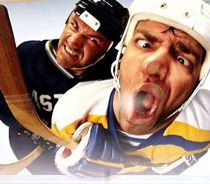
Why is this bird so angry? He's at a hockey game!
The day started out bright and early in North America with Canada and Slovakia facing off at 6 AM eastern time. Canada, considered a clear favorite based on it's higher ranking internationally, having already defeated Slovakia 3-2 in their opening game of the tournament, and having won Group H.
That assumption was called into question when Slovakia opened the scoring when Tomas Kopecky converted at 5:57 of the opening period and captain Miroslav Satan stomped that notion into dust with the second Slovak goal before the period was even half over. Canada recovered with an Evander Kane goal at 16:14 from Ryan Getzlaf at 16:14.
Canada looked to be back in control with second period goals from Jeff Skinner and Alex Burrows to give the Canadians confidence heading into the third period of their elimination game.
If Canada thought they were going to shut down Slovakia, that plan went awry when Milan Bartovic evened the game, setting up a dramatic rest of the period. Canada outshot Slovakia 13-11, but the game turned when Getzlaf was whistled for a major penalty for kneeing Juraj Mikus at 57:28 as well as being ejected from the game.
With the extra man, Slovakia wasted no time in scoring when Michal Handzus fired one by Cam Ward just four seconds after the penalty call to put his team up 4-3 with only 2:28 remaining, but Slovakia remaining on the power play following Getzlaf's major for the rest of the game. Canada pulled Ward for a chance at 5-on-5 play, but, despite some real effort and pressure, could not get the equalizer and Slovakia held on to win and advance to today's Semifinals in Helsinki.
Following that dramatic turn of events, heavily favored Russia took to the ice against this year's darlings of the tournament, Norway, who came into the game with a four game winning streak. If anyone expected Russia to steamroll the Norwegians, they too were in for a surprise, as the first Russian goal from Alexander Ovechkin was answered by Per-Åge Skrøder for Norway.
While the period ended 2-1 in favor of Russia, following a goal by Alexander Popov at 14:09, the Norwegians let it be known they were not going to be taken lightly when the tournament's leading scorer Patrick Thoresen netted his 7th goal and 18th point just 28 seconds into the second period on a power play which had carried over from the first.
Despite being outshot 29-13 up to this point, the second intermission arrived with the game still tied at 2-2, giving the Russians a reason for concern.
The depth of the Russians prevailed in the third period, beginning with a goal by Alexei Yemelin just under a minute into the third. Nikoali Zherdev tilted the ice even more in favor of the Russians to make it 4-2 at 10:43 and a power play goal by Ilya Nikulin sealed the fate of Norway at 14:52, but the fans in Stockholm certainly knew they were there. Despite being eliminated, Norway's good show of form elevated them into a guaranteed spot for the 2014 Olympic hockey tournament as they rose into the top nine.
The afternoon game was a rematch of the United States 5-0 pasting of Finland just days earlier, but this was a different affair, as the first period ended scoreless despite the USA outshooting Finland 10-7.
The Finns scored first 3:27 into the second in their tight battle with the Americans. The US responded just 21 seconds later when Kyle Palmieri scored to tie the game once again.
The US went ahead at 1:39 of the third on Bobby Ryan's goal, but no one thought that would be the final goal of the contest. While it would take until 13:02 for the next goal to arrive, it did arrive for Finland when Mikko Koivu, Finland's captain, got one past Jimmy Howard while Jack Johnson was trying to defend him without a stick.
Just as the game looked to be going to overtime, Petri Kontiola centered the puck from behind the American goal to Jesse Joensuu, who buried the puck with only nine seconds remaining in the game to send the home fans into a frenzy and win the game for Finland, keeping them on track to become the first host to win the World Championship since the Soviet Union back in 1986.
After three great games, we were due for a letdown in the night's final game between favored Sweden (6-0-1) and the Czech Republic, who had lost two games, including a 4-1 loss earlier to Sweden.
Sweden got the game off to the expected start with a Loui Eriksson goal at 7:10, only to have the Czechs respond with a goal by Petr Nedved, playing in his first World Championships at the age of 40! Then, Jan Novotny's goal at 16:56 put the Czechs ahead and put Sweden on notice they were in for a game.
The second period made it just past the half way point when Martin Erat put the Czechs up by two at 10:27. That lead lasted nearly through the end of the period when Henrik Zetterberg's great individual effort pulled Sweden back to within one with just 45 seconds remaining.
Jonathan Ericsson wasted little time evening the score 45 seconds into the third period (effectively giving Sweden two goals in a minute and a half) setting up yet another tight run to the finish line for the third time on the day. It was an evenly played period, with the shots favoring Sweden 10-9. Sweden killed off the only penalty of the period and again, the game looked to be headed for an overtime until Milan Michaek took the game into his own hands, fighting off Niklas Persson in the corner with one arm and reaching up to poke the puck away from Niklas Kronwall with the other. He then broke free, skated in on goaltender Viktor Fasth and put a tight shot up and over Fasth's shoulder and into the roof of the net with just 29 seconds left in the game to put the Czech Republic into the Semifinals in dramatic fashion, capping an amazing day of close games and surprising finishes.
The Semifinals are being held today, with first Russia facing off against the host Finland followed by the Czech Republic taking on their rivals from Slovakia in the second game with the losers of today's games meeting on Sunday for the bronze medal followed by the winners in the gold medal game later on.
In Canada, TSN will have the first Semifinal live at 7:15 AM eastern, followed by the second at 11:15 AM. Sunday they will have the Bronze Medal Game at 8:45 AM and the Gold Medal Game at 1:15 PM.
The United States will only get one of the semifinals, which will be shown on NBC Sports on a tape delay at 9 PM eastern time and the Gold Medal Final airing Sunday night, also at 9 PM. Die-hard fans in the US who wish to watch the games live can always try to find them shown online.
Labels:
2012 World Championships
Subscribe to:
Posts (Atom)