For the first time in 23 years, the 1969-70 MontrealCanadiens missed out on the playoffs, despite a 38-22-16 record for 92 points. They finished with an identical record to the New York Rangers, but lost out on the final day of the season when the second tiebreaker, after number of wins, total goals scored, went to the Rangers 246-244 when the Rangers outscored Montreal 9-2 on the final day of the season.
So dominant was the East Division, which was comprised of the Original 6 teams, over the West Division's 1967 expansion clubs, that fifth place Montreal's 92 points were 6 more than the West Division winning St. Louis Blues 86 and 28 more than the second place Pittsburgh Penguins.
Changes were made for the 1970-71 season when the Buffalo Sabres and Vancouver Canucks were added to the league and placed in the East Division, while the Chicago Black Hawks were moved to the West.
Montreal started their campaign with 4 wins and 8 of their first 12. By the end of December they were 16-11-8, having lost just once in their last 10. After an indifferent January, where the Canadiens were 6-5-3, Montreal found their game in February, finishing the month 10-1-1.
The Canadiens cooled off a bit the rest of the way, which saw the quiet debut of a rookie goaltender named KenDryden on March 14th.
Dryden, an unusual case, having been drafted back in 1964, had elected to attend Cornell University in the United States rather than immediately devote himself full time to hockey. After having won 76 of 81 starts, including an NCAA national championship in 1967 at Cornell, Dryden had been playing for the Montreal Voyageurs of the AHL that season while working toward his law degree from McGill University by day.
He won his first game over the Pittsburgh Penguins, allowing just one goal and making 35 saves. PhilMyre would start the next game, allowing 6 goals in a loss to St. Louis. Dryden got the next stars, defeating the rival Toronto Maple Leafs after holding them to just one goal on March 18th.
March 20th saw history made, as RogieVachon started the game for Montreal, but was inured during the second period and replaced by Dryden. Once he entered the game, Punch Imlauch of the Buffalo Sabres, with a sense of history, inserted Ken's brother Dave Dryden into the Sabres lineup, the first time two brothers had faced each other in goal during an NHL game. Ken was the eventual winner among the four goalies who saw the ice that night, despite the two brothers having an identical 12 saves on 15 shots!
Ken and Dave meet at center ice following a game where
they faced each other, as was their custom
Dryden then defeated the Rangers the following day 6-2. Vachon got the win on March 24th followed by Myre winning on the 27th. Dryden's turn came next on the 28th and he out dueled the Chicago Black Hawks Tony Esposito 2-1. March 31st saw the Bruins shell Vachon for 6 goals in a loss prior to Dryden winning 7-2 against the Rangers on April 3rd before it was Myre's turn to get hammered by the Bruins, 7-2 on the final day of the season.
After going 10-6-1 to finish the season, the Canadiens final record of 42-23-13 gave them 97 points in the standings (fourth overall) and returned the Canadiens to their familiar place in the playoffs, but it left Montreal coach AlMacNeil with a decision to make, as the rookie Dryden clearly had the hot hand, going 6-0-0 with a 1.65 goals against average entering the playoffs after just having watched their first round opponent Boston tear apart his two veterans.
Dryden lost Game 1 by a score of 3-1, and gave up 5 in Game 2, only Montreal scored 7 of their own to even the series. Back in Montreal for Game 3, Dryden held the Bruins to just 1 for the win. Boston again came back strong to win Game 4 by a score of 5-2. The Bruins were even strong back in Boston for Game 5, a dominant 7-3 win. Still, MacNeil stuck with Dryden for Game 6 back at home, where 8 goals by the Canadiens were more than enough to stay alive for a Game 7 back in Boston. Dryden responded to the pressure like an established veteran, not a rookie playing in only his 13th game, as he made 46 saves to out duel Gerry Cheevers 4-2 and eliminate the first overall Bruins in a seventh game on the road.
Dryden, still wearing his "pretzel style" mask early in his career
After eliminating the Minnesota North Stars in six games, including two wins on the road, Montreal advanced to the Stanley Cup Finals to take on the West Division winning Chicago Black Hawks, who finished 10 points ahead of the Canadiens in the regular season standings.
Montreal versus Minnesota in the second round
Game 1 of the finals in Chicago went to overtime tied at 1-1 before Chicago won a minute into the second overtime. The Black Hawks won Game 2 at home 5-3 but Dryden held Chicago to 2 goals in Games 3 and 4 as Montreal evened the series 2-2.
Esposito shut out the Canadiens back in Chicago to put Montreal on the brink. A dramatic Game 6 saw the Canadiens trailing 3-2 when FrankMahovlich tied the game at 5:10 from captain JeanBéliveau and PeterMahovlich saved the day with a shorthanded game winner from brother Frank at 8:55. Dryden made 27 saves on 30 shots while Esposito only faced 16 shots from Montreal.
Once again, the rookie Dryden was facing a Game 7 on the road against a higher seeded team, only now in a winner-take-all 60 minutes with the Stanley Cup going to the survivor on this date in 1971. Dennis Hull scored a power play with 48 seconds remaining in the first period from his brother BobbyHull and CliffKoroll. Chicago's lead was extended to two with DannyO'Shea's goal from Pit Martin at 7:33 of the second.
JacquesLemaire got Montreal on the board at 14:18 from JacquesLaperrière followed by HenriRichard tying the game at 18:20 from Lemaire, sending the game into it's final 20 minutes even.
At 2:34 of the third period, Richard put Montreal ahead for the first time in the game with an even strength goal from RéjeanHoule and GuyLapointe. Dryden would hold Chicago off the board for the entire second half of the game, making 31 saves in all to lead Montreal to the Stanley Cup championship despite only having six regular season games of experience.
The win for Montreal on the road was the only game in the series not won by the home team.
It was quite a turnaround for Montreal, who had failed to even qualify for the playoffs the previous season and even more of a surprise considering their unsettled goaltending situation heading into the playoffs. Also of note, winning the championship was a fine way to go out in style for the Canadiens captain Béliveau, who had just played in the final game of his career, going out as a champion with the Stanley Cup in his arms, the 10th of his career.
Béliveau accepts the 1971 Stanley Cup following the final game of his career
The 23-year-old rookie Dryden would be named the winner of the Conn Smythe Trophy as the most valuable player in the playoffs. He played all 20 of Montreal's postseason games, finishing with a 12-8 record and a 3.00 goals against average, with five of those wins coming on the road and two of those being in Game 7's.
Remarkably, Dryden would go on to win the Calder Trophy the following season as Rookie of the Year, despite already having won the Conn Smythe Trophy and a Stanley Cup, something no player had ever done before or since.
Today's featured jersey is a 1970-71 Montreal Canadiens Ken Dryden jerseyfrom the season in which the Canadiens would capture their 17th Stanley Cup championship during Dryden's first season with the club and Béliveau's 20th and last.
This style jersey dates back to 1941 and, aside from a version with a blue stripe around the chest for three years in the late 40's, has remained essentially unchanged ever since.
Today's video section starts with highlights of Game 7 of the Canadiens first round series against Boston. Two pad stack!
Next, the 1971 Stanley Cup Finals, scored with the always funky 1970's background music. Be sure to note the old Chicago Stadium scoreboard with it's clock dials!
Here is fellow goaltender JohnDavidson narrating a look at the career of Dryden, highlighting the incredible beginning of Dryden's career before summarizing the remainder of his career.
Here is Dryden, telling about his career from his point of view, as part of the Legend of Hockey series.
Norwegian Constitution Day, commonly known as Syttende Mai, which translates to "17th of May", is a celebration of the 1814 signing of Norway's constitution in the town of Eidsvoil, declaring Norway as an independent nation.
While it was celebrated to a certain degree in it's early days, Norway was actually still a part of the Kingdom of Sweden and the celebrations were not encouraged and were actually forbidden for a time in the 1820's. A protest incident in 1829 led to the celebration being tolerated.
It would take until 1864 for Syttende Mai to become more established, which included a children's parade, which is now a vital part of modern celebrations, with the largest being in Oslo, where 100,000 people turn out to take part in the festivities, which see approximately 100 schools and marching bands pass by the Royal Palace where the Royal Family observes from their balcony as the children march by and sing when they are not blowing whistles and rattling noise makers.
Additionally, the children are frequently wearing traditional costumes or ribbons in the colors of the flag, as well as carrying Norwegian flags.
There are also varying traditions of the public joining in behind the children's parade or a separate public parade either before or after the children's parade. Following the parades, there are games for the children as well as hot dogs, ice cream, pop and candy.
Norway has been a member of the IIHF since 1935 and currently participates at the top level of the World Championships, and have done so since being promoted by winning Division 1 in 1995 with their best finish being a 4th place in 1951, which included defeats of Great Britain and the United States.
They participated in their first Olympics in 1952, but not again until 1964. Since then, have have participated in seven more Olympics, including five in a row from 1980 to 1994. They did not qualify from 1998 to 2006, but once again returned in 2010, the highlight of which was taking Switzerland to overtime before coming up short.
After their 4th place finish in the 1951 World Championships, they sank to the B Pool for one season in 1956. They would bounce back and forth between the Top Division and the B Pool until 1965 when they dropped down to the B Pool for the next 20 years, with the occasional, brief drop down to the C Pool.
They would win the C Pool in 1986 and the B Pool in 1989 to return to the Top Division for the first time since 1965. They would spend 10 of the next 12 years in the Top Division prior to slipping back to Division I (formerly the B Pool) from 2002 to 2005, when they won Division I Group A to earn a return to the Top Division for 2006, where they have remained since.
Norway celebrates their win over Denmark in 2006
2011 would see Norway defeat Sweden for the first time ever and shut out Austria to advance to the Qualifying Round, where they would defeat both Switzerland and France to advance again, this time to the Playoff Round. Despite their defeat by eventual champions Finland, they were credited with a 6th place finish, their highest ranking since 1962.
This year, Norway was placed in Group S in Stockholm, where in seven games in the Preliminary Round, Norway lost their first three games, including taking the Czech Republic to a shootout, before reeling off wins by defeating Italy 6-2, shutting out Latvia 3-0, destroying Germany12-4 and downing Denmark 6-2 to gain an automatic berth in the 2014 Olympics and advance to the Quarterfinals against Russia in a game played today, where they hope to provide all of Norway with a memorable Syttende Mai. Currently PatrickThoresen, who once played for the Edmonton Oilers and Philadelphia Flyers, leads all tournament scorers with 16 points heading into today's game.
Perhaps the most familiar name to North American fans is Espen Knutsen, a veteran of 5 NHL seasons and the only Norwegian to have played in the NHL All-Star Game.
2002 NHL All-Star Espen Knutsen
Currently there is only one Norwegian in the NHL, left winger MatsZuccarello of the New York Rangers.
Today's featured jersey is a 1999 Norway National Team Per-Åge Skrøder jersey. Skrøder began his professional hockey career in Norway in 1994 with Sparta Sarpsborg and Lillehammer before moving to the Swedish Elitserien in 1998. He has played for Frölunda, Linköping, HV 71, where he won a championship in 2004 and Södertälje before moving to MoDo in 2006 where he won a championship in 2007 and the league scoring title in 2009.
He has been named as the Norway Player of the Year twice, with those coming in 2002 and 2009.
Additionally, Skrøder has competed for Norway in the European Junior Championships in 1995, the World Junior Championships in 1997, the World Championships at both the Top Division and Division I 11 times and the Olympics in 2010.
During this year's World Championships, Skrøder is second in scoring for Norway with 11 points from 4 goals and 7 assists for 5th overall to date.
Today's video section is highlights of Norway's shootout win over Sweden at the 2011 IIHF World Championships, their first ever win against Sweden in 61 years of trying.
As for the following video featuring the 1989 Norway National Team, you just can't make this stuff up.
After a prolific junior career with the Flin Flon Bombers, which included being the WCJHL Goal Scoring Leader in 1968 with 87 goals in only 59 games, and the Goal Scoring Leader, Leading Scorer and Player of the Year in 1970 after a season in which he scored 65 goals and 111 points, ReggieLeach was drafted 3rd overall by the Boston Bruins in the 1970 NHL Amateur Draft.
Still in need of seasoning, as well as facing the task of trying to crack the deep lineup of the defending Stanley Cup champion Bruins, Leach split time in the 1970-71 season between the Oklahoma City Blazers of the CHL, scoring 42 points in 41 games, and the Bruins, with whom he played 23 games, scoring just 2 goals, giving little clue as to what would follow.
He would make the Bruins lineup out of training camp and see action in 56 games before a trade to the perpetually struggling California Golden Seals, missing out on the Bruins eventual Stanley Cup later that year.
With the Seals, Leach played a larger role, evidenced by nearly equalling his 7 goals with the Bruins when he scored 6 in just 17 games. He would play two more seasons with the Seals, recording 20 goal seasons in 1972-73 and 1973-74 with 23 followed by 22.
Leach, wearing the notorious white skates of the Golden Seals
Leach was then traded once again, this time to the Philadelphia Flyers, who paid a steep price, two players and their first round draft pick for just Leach. While Philadelphia was the defending Stanley Cup champions themselves in 1974-75, Leach had no issues trying to crack their lineup as he had with Boston four years earlier. He would play all 80 games for the Flyers, doubling his 22 goals to 45 and raising his 46 points to 78 for third in Flyers scoring behind Bobby Clarke (116 points) and Rick MacLeish, one ahead with 79.
Philadelphia would then sweep the Toronto Maple Leafs, outlast the New York Islanders in seven and defeat the Buffalo Sabres 4 games to 2 to defend their championship.
Leach raised his game to a new level in 1975-76 when he led the entire NHL in goals with 61, beating runner up GuyLafleur by 5. He added 30 assists to give him a career high 91 points that season. Trying for their third consecutive Stanley Cup, the Flyers again ousted the Maple Leafs, this time in seven, and eliminated the Bruins in five to return to the finals once again. The contrast in styles between the rough and rugged Flyers and the slick and smooth skating Montreal Canadiens could not have been greater, and the Canadiens prevailed after winning four straight games.
Leach had produced a masterful, dominating individual performance though, leading all scorers with 19 goals and 5 assists in 16 games for a total of 24 points. No one was even in the same league as Leach, as his 19 goals led the second leading goal scorer, the Bruins Jean Ratelle, by 11 goals! His 10 game goal scoring streak and 19 playoff goals in one season set NHL records which still stand today.
In one memorable Semifinal game, Leach single handedly eliminated the Bruins in Game 5 with an NHL playoff record five goal performance in a 6-3 win. Despite the Stanley Cup loss, Leach was named the winner of the Conn Smythe Trophy on this date in 1976, only the third player since 1965 to be awarded the trophy from a losing team, and 35 years later, still the only non-goaltender from a losing team to win the award.
Prior to the start of the following NHL season, Leach had the honor of playing for Team Canada during the inaugural Canada Cup tournament in September of 1976.
He would play six more seasons with the Flyers, which included a 50 goal season in 1979-80, seventh in the league and just 6 back of the league leaders BlaineStoughton and Danny Gare's 56. His goal scoring was a contributing factor in the Flyers 35 game unbeaten streak that season. Philadelphia again returned to the Stanley Cup Finals as Leach chipped in 9 goals and 16 points in 19 games.
After his eight total seasons with Philadelphia, never scoring less than 24 goals, Leach's career would wind down with one season as a free agent signing with the Detroit Red Wings and a season with the Montana Magic of the CHL.
In all, Leach would play 934 NHL games while scoring 381 goals and 666 point, two NHL All-Star Games in 1976 and again as the game's MVP in 1980, as well as his name on the Stanley Cup and his remarkable Conn Smythe Trophy. He was inducted into the Philadelphia Flyers Hall of Fame in 1992.
Today's featured jersey is a 1980-81 Philadelphia Flyers Reggie Leach jersey. This basic Flyers jersey with it's full-length sleeve stripes which then wrap around the arms down by the wrists has been in use throughout Flyers history since the very first day. Bold, black trim was added to the jersey in the early 1980's, but when this orange style was brought back as an alternate jersey in 2008, complete with the contrasting nameplate look of the early 1970's, the clock was reset, as the black trim was no longer there.
Bonus jersey: Today's bonus jersey is a 1981-82 Philadelphia Flyers Reggie Leach jersey from the following season. Note the absence of the white waist stripe, which was eliminated to create a longer, taller look when the sweater was paired with the new full length pants, commonly referred to as "Cooperalls" (despite being a similar CCM product), which had a vertical stripe which ran down the entire leg in 1981-82.
Today's video segment begins with Leach scoring his record setting five goals in one playoff game against the Bruins, which paved the way for his winning the Conn Smythe Trophy later that season.
Next, here is Leach sharing his excitement about playing in the 2012 Winter Classic Alumni Game.
Born in St. Paul, Minnesota, right winger PaulHolmgren played junior hockey for the St. Paul Vulcans in 1973-74, scoring 22 goals and 81 points while amassing 183 penalty minutes in 55 games. That same season he also skated for the United States at the World Junior Tournament in January as was later drafted by the Edmonton Oilers of the WHA.
He next attended the University of Minnesota for the 1974-75 season under head coach HerbBrooks and continued his rugged ways with 108 penalty minutes in 37 games while scoring 31 points.
Following the season he would be drafted again, this time by the Philadelphia Flyers of the NHL as well as having Edmonton trade his WHA rights to the Minnesota Fighting Saints.
He chose to forego any of his remaining college eligibility and turn professional while staying close to home with the Fighting Saints, doing his best to live up to the "fighting" part of the team's name with 121 penalty minutes in 51 games, which made him even more popular with the hometown fans. Unfortunately the Fighting Saints were also failing in their attempts to fight off their creditors, and Holmgren left the struggling team three days prior to the franchise folding.
He sought refuge with the Flyers organization and finished his season with 6 games with the Richmond Robins of the AHL and made his NHL debut with one game in Philadelphia. His fractured season also included 6 games with the Fighting Saints minor league affiliate, the Johnstown Jets, with whom he racked up an impressive 15 points - an average of 2.5 per game! His season was cut short with a scratched cornea, which sent him to the hospital where he had an allergic reaction to the anesthetic, which nearly killed him.
He recovered during the off season and was able to spend the entire 1976-77 season with the Flyers, seeing action in 59 games, where he amassed 201 penalty minutes, but proved he was not one-dimensional with 14 goals and 26 points. The Flyers two Stanley Cups my have been in the rearview mirror at this point in time, but they were still a force to be reckoned with, and Holmgren appeared in an additional 10 playoff games that season.
In 1977-78 his games played rose slightly to 62, but his point total rose nicely to 34, but the rugged play certainly remained, as his was whistled for 190 more penalty minutes. The postseason saw Holmgren play an additional 12 playoff games.
He would see the ice in 57 games in 1978-79 and raise his goal total to 19. Eight playoff games would follow, and Holmgren would score one goal for the third postseason in a row.
Holmgren followed with a career year in 1979-80, setting new personal bests in games played, with 74, assists with 35, and penalty minutes, with 267 as well as establishing career highs with 30 goals and 65 points. He would then cut loose in the playoffs, scoring 10 goals in 18 games, including becoming the first American-born player to score a hat trick in the Stanley Cup Finals, which occurred on this date in 1980 in a 8-3 win over the New York Islanders in Game 2 of the finals.
He would nearly duplicate his fine regular season in 1980-81 with 59 points in 77 games while setting career highs with 37 assists and surpassing 300 penalty minutes for the only time in his career with 306. He would again shine in the playoffs with 5 goals and 14 points in 12 games despite serving another 49 minutes in penalties. He made his only NHL All-Star Game appearance that year.
He was limited to 41 games in 1981-82 due to a separated shoulder in August of 1981 in preparation for a place on Team USA for the 1981 Canada Cup tournament, which he was forced to miss, but rebounded with 77 games the following season, just missing out on a 20 goal season with 19.
After 52 games of the 1983-84 season, Holmgren once again returned home when he was traded to the Minnesota North Stars as the Flyers all-time penalty minute leader, no mean feat considering the lineup of tough guys who came before him on the Broad Street Bullies of the mid-1970's.
His time in Minnesota was relatively brief however, as he only played in 11 games at the end of the season and 12 more in the playoffs, followed by just 16 games in 1984-85 before retiring as a player.
He became an assistant coach upon his retirement, eventually moving into head coaching followed by becoming a General Manager, first for the Hartford Whalers and later the Flyers.
His final career totals are 527 games played, 144 goals and 179 assists for 323 points and 1,684 penalty minutes. He also added another 51 points in 82 playoff games.
Today's featured jersey is a 1982-83 Philadelphia Flyers Paul Holmgren jersey. This was the first season for the newly updated Flyers jersey, which now had the bold, black trim which separated the orange arms of the jersey from the white body.
This jersey also had the distinction of being worn during the second (and final) season the Flyers wore the CCM full length pants, popularly known as "Cooperalls".
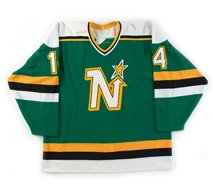
Bonus jersey: Today's bonus jersey is a 1984-85 Minnesota North Stars Paul Holmgren jersey worn during his final season of play. The North Stars adopted this style in 1978-79 and, despite updating the white home jerseys with intimidating black trim in 1981-82, continued to wear their road green jerseys without the addition of the black until 1988-89, a span of seven seasons!
This was an odd case of non-uniformity to their uniforms we have never understood, as one would think a team would want their jerseys to have a consistent look and would want to appear more intimidating on the road perhaps even more, or at least as much, as at home.
It's Old Time Hockey with Holmgren and the New York Rangers NickFotiu! Sometimes you have to take a few to give a few.
Here's some real nastiness, as Holmgren headbutts the Atlanta Flames tough guy Willi Plett, who doesn't hesitate to let Holmgren have one in return! How many games do you think they'd be suspended today?
As a rookie in junior hockey during the 1975-76 season, SteveTambellini loudly announced his presence with 38 goals and 97 points in 72 games with the Lethbridge Broncos, earning WCHL Rookie of the Year honors. He reaffirmed his talent by raising his goal total the following season to 42, despite playing in 17 less games!
In his final season of junior hockey, Tambellini, born on this date in 1958, finished third in the league in scoring with a team leading 155 points from 75 goals and 80 assists in 66 games. During the season, he would make his international debut for Canada with 2 goals and 2 assists on his way to earning a bronze medal at the 1978 World Junior Tournament. Following the season, Tambellini was drafted in the first round by the New York Islanders in the 1978 NHL Entry Draft.
He would spend the following season with the Fort Worth Texans of the CHL, notching 25 goals and 52 points. He also made his NHL debut with a single game with the Islanders.
In 1978-80, Tambellini spent the entire season with the Islanders, but saw the ice in only 45 games in a limited role, but was able to score his first 5 NHL goals as well as 8 assists. While he did not play in any games in the playoffs, the powerful Islanders would go on to win their first Stanley Cup, and Tambellini's name was engraved on the cup based on his regular season contributions.
After playing 61 games with the Islanders in 1980-81, Tambellini, deemed expendable due to the incredible depth and scoring ability of the Islanders roster in the early stages of it's Stanley Cup dynasty, was sent westward, along with goaltender ChicoResch, to the Colorado Rockies, where he added 6 goals to his season total to record his first 20 goal season with 25 in all. After scoring 18 points in 13 games with Colorado, Tambellini joined Team Canada for the 1981 World Championships.
Playing a much larger role with the offensively challenged Rockies, Tambellini scored 29 goals and 59 points, good for second place on the club while playing on a line with veteran Lanny McDonald and PaulGagne.
Tambellini was headed back east for the 1982-83 season when the Rockies franchise relocated to New Jersey, where they were renamed the Devils. There, the center registered his third consecutive season of at least 25 goals and his second consecutive season of leading the club in goals.
During the off season, it was once more back west, as Tambellini was involved in a deal which sent him to the Calgary Flames. After his first season of 73 games, he would be limited to just 47 games the second season.
He then moved even further west, signing a free agent contract with the Vancouver Canucks for the 1985-86 season, but was limited to 48 games with a knee injury and later a broken thumb. He bounced back with 72 games in 1986-87.
His final NHL season saw him still with the Canucks, but he also took the uncommon for then step of playing for Canada during the 1988 Olympics, which were held in Canada while the NHL regular season was still in progress, scoring a goal and three assists.
Not quite done with playing hockey, Tambellini played 10 games in Switzerland for Zurcher SC in Swiss second division in 1988-89 and a full season with EC Villacher SV in Austria, where he went out in style, scoring 44 goals and 81 points in 38 games to close out his playing career.
In all, he scored 160 NHL goals and 310 points in 553 games.
He has since remained in the game as a member of first the Canucks front office, rising to the level of Assistant General Manager. He would also serve as Director of Player Personnel for Team Canada at the 2002 Olympics, the 2003 World Juniors and 2004 World Cup of Hockey and has since been named General Manager for the Edmonton Oilers.
Today's featured jersey is a 1982-83 New Jersey Devils Steve Tambellini jersey from the Devils first season after relocating from Colorado when Tambellini led the club in goals. The Devils would wear these red and green jerseys for their first 10 seasons before changing their colors to red and black, finally escaping the endless comparisons to having "Christmas colors".
The only two patches ever worn on this style came in the jerseys final season of 1991-92 when they wore the NHL 75th Anniversary patch on their left chest and a discreet Devils 10th Anniversary patch on the rear hem of their jerseys next to the CCM branding, perhaps the smallest patch ever worn on an NHL jersey.
Bonus jersey: Today's bonus jersey is a 1988 Team Canada Steve Tambellini jersey as worn during the 1988 Olympics held in Calgary. While all the teams were contractually obligated to wear Tackla jerseys for the Olympics, Canada chose to wear their Canadian manufactured CCM jerseys for the Games, which resulted in them receiving a $100,000 fine despite covering up the CCM logo on the rear hem with a piece of twill.
It was another memorable day at the 2012 World Championships in Helsinki and Stockholm. The first game of the day saw the United States regroup after their disappointing overtime win over last place Kazakhstan and shock the home fans with a 5-0 blanking of Finland. The United States opened the scoring at 16:19 of the first period and extend their lead to 3-0 after two, but ever mindful of the comebacks by Canada and Russia on Friday, no one thought this one was in the bank for the Americans until they extended their lead to 5-0 by the fifth minute of the third period. For the game, the US outshot Finland 31-18 in a dominating performance which lifts them into second place behind Canada's 16 points with 13.
Finland and Slovakia are now at 12 following Slovakia's tight 1-0 win over Switzerland later in the day. All four teams have played the number of games with 6, and all look to be moving on to the playoffs, as it would take a virtual miracle for France to defeat both Belarus and Slovakia to just draw even with Slovakia on points.
In Group S, Russia continued to play stellar defense in a 2-0 shutout over the Czech Republic. To date, Russia has only allowed 8 goals in 6 games, the lowest in the tournament.
The late game in Stockholm was a critical battle for the fourth an final transfer spot to the playoffs and mighty, mighty Norway steamrolled Germany 12-4. Yes, 12-4. Christoph Schubert summed it up thusly, "It was probably one of the worst days in German hockey history."
PatrickThoresen scored twice in the first minute and half for a quick 2-0 lead. They would add a third goal before the first period had ended and pumped in six straight in the second before Germany managed their first. The teams then traded goals throughout the third period for the final score as Thoresen finished with 3 goals and 6 points, MadsHansen had 5, MortenAsk 4, Per-Age Skrøder 3 and five others had 2 each for the victors. The Norwegian outburst was all the more impressive when you consider their first three goals chased German goaltender Dennis Endras, the 2010 World Championships MVP, from the net, and he returned for the third period only to give up three more.
Norway now looks to be in the diver's seat for fourth place with 10 points, as Latvia, with a game in hand, is 4 points back, with Germany now eliminated. Latvia must now win both of their remaining games against Denmark and Sweden to gain a minimum of 5 points to surpass Norway, who now are a +12 over Latvia in goal differential and have a final game against winless Denmark remaining on their schedule.
Tomorrow's schedule has must-win games for France against Belarus and Latvia against Denmark. Finland looks to right their ship against Kazakhstan and Russia meets Italy in what should be an easy one for the Group S leaders.
Today, in honor of Mother's Day, a true Canadian classic from 1960, "The Sweater".
In this animated short, RochCarrier recounts the most mortifying moment of his childhood. At a time when all his friends worshipped Maurice "Rocket" Richard and wore his number 9 Canadiens hockey jersey, the boy was mistakenly sent a Toronto Maple Leafs jersey from Eaton's. Unable to convince his mother to send it back, he must face his friends wearing the colours of the opposing team. This short film, based on the book The Hockey Sweater, is a classic that appeals to hockey lovers of all ages.
It's been quite an exciting 48 hours at the 2012 IIHF World Championships. First, the United States threw away a point by allowing winless Kazakhstan to take them to overtime on Friday morning. Fortunately for the Americans and their fans, they managed to score the game winner with less than 30 seconds remaining in overtime and avoid the unpredictable shootout.
Meanwhile, the Czech Republic was defeating overmatched Italy at the same time by a score of 6-0 in Group S play.
After a break, the evening games got underway, featuring two fine matchups that frankly should have been slotted in for the final day of group play based on the pre-tournament rankings.
In their game with Canada, Finland led 2-0 after one period and 3-1 at the halfway point of the game. Canada then got goals from JohnTavares and JeffSkinner to even the game by the second intermission.
After trailing for over a half an hour, Canada finally had their first lead at the 6:04 mark of the third and added an empty net goal in the final 30 seconds to ruin the host Finland's perfect record and take first place in the group.
Meanwhile in Stockholm, Sweden scored first in their game with Russia at 5:57 before AlexanderPopov tied it at at 10:27. Sweden's HenrikZetterberg (at 14:33 of the first) and his Detroit Red Wings teammate JohanFranzen (at 9:36 of the second) pushed Sweden out to a 3-1 lead, but the second half of the game was a disaster for Sweden, as EvgenyMalkin's goal at he sixteen minute mark was followed by AlexiYemelin's equalizer at 18:27, just like Canada's comeback in Helsinki.
It would take Russia only 15 seconds of the third period to surge ahead, a lead added to by Malkin at 2:40. He completed his hat trick at 11:08 and another goal just after the expiration of a power play with just under a minute to go make the final score 7-2 as the home team fell with a mighty thud for the second time after leading by two at the half way point of the game.
Today's first game had favored Slovakia defeat Belarus 5-1 followed by a surprise, as Norway had three even strength goals in support of goalkeeper LarsHaugen, who shut out Latvia 3-0 to leapfrog them for the final playoff spot in Group S.
Perhaps the biggest upset of the tournament to date came next, as the French got out to a 2-0 lead before Switzerland tied the game with a pair of goals by DamienBrunner in under two minutes. The turning point came early in the third period, as GoranBezina was sent off for checking to the head, giving France a power play, during which they scored twice in 44 seconds to give them all the margin they would need as they turned the game over to NHL veteran ChristobalHuet who made 41 saves for the win.
Germany fell behind 1-0 to Denmark but came back to win 2-1 in their Group S game to keep Denmark winless and give each team 5 games played up to this point.
The two late games were one sided affairs, as Canada avoided the same effort which cost the United States as they romped to an 8-0 win over Kazakhstan and Sweden downed Italy 4-0 to rebound from their second half collapse against Russia.
Group H sees Canada (with an extra game played) atop the group with 16 points, followed by Finland at 12. The United States has 10 points and is trailed bySlovakia at 9 in the final playoff position. France and Switzerland are tied at 6 points, both with a 2-3 record, but both with games against Slovakia still remaining as a key opportunity to claim the final playoff spot.
Belarus has 3 points from their win over Kazakhstan, who look to have relegation in their future, as they have just 1 point and only a final game against Finland remaining which they must win in regulation to have any hope of survival.
The Group S standings favor Russia, who has 15 points and a win and a game in hand over Sweden, also at 15. The Czech Republic are looking very secure with 11 points in third, but Norway is engaged in a real battle for the all-important fourth position.
Norway has 7 points, closely followed by Latvia and Germany with 6. A key games for those three include Norway and Germany facing off on Sunday.
In the relegation struggle, Italy holds the edge with 2 points over Denmark's 1. The Danes have chances to add points with games remaining with Latvia and Norway, while Italy has a lone game remaining with powerhouse Russia. Assuming Italy falls in regulation, just getting to overtime twice would allow Denmark to remain in the top division for 2013.
The third season of play in the World Hockey Association in 1974-75 saw the league still in a period of growth, as the league added both the Indianapolis Racers and the Phoenix Roadrunners, brining the number of clubs up to 14 from it's original 12.
While the league was not without it's issues that season, mainly the failure of the Michigan Stags, who were 18-40-3 in Detroit before folding in January and resurfacing a week later as the league-owned Baltimore Blades to complete the season with a dismal 3-13-1 run, there were many bright spots at the time.
Franchises in Quebec, Winnipeg, Edmonton, New England, Cleveland, Houston and Minnesota were all enjoying competitive play and healthy attendance at the time.
League scoring leader AndreLacroix was the star attraction in San Diego, while the line of BobbyHull and Swedish imports UlfNilsson and AndersHedberg were generating excitement not only in Winnipeg, but in the world of hockey as a whole. GordieHowe was grabbing headlines in the world of sports playing his second season with his son's Mark and Marty in Houston.
The Howe Family, Gordie, Mark and Marty
With the addition of the two new clubs, the league expanded from two divisions to three, with the Canadian, Eastern and Western Divisions. The playoff format called for the top two teams in each division, regardless of record, to qualify for the playoffs, along with the best two clubs of the remaining eight.
Advancing from the Canadian Division were both the Quebec Nordiques (who had a second overall 92 points) and the Toronto Toros (88 points). The weak Eastern Division supplied the formidable New England Whalers (91 points) and the sub-.500 Cleveland Crusaders, who had only 73 points, who benefitted from the top two in each division rule, as they actually had less points than Winnipeg (81), Vancouver (76) and Edmonton (76), all of whom failed to qualify for the postseason!
The strongest division was definitely the Western Division, which sent the HoustonAeros (with a best overall 106 points), San Diego (90) and at-large qualifiers, the Minnesota Fighting Saints (87) and first year Phoenix Roadrunners (86).
The inaugural 1974-75 Phoenix Roadrunners
The Quarterfinals saw the Aeros open their playoffs with an opening game loss to Cleveland, but then win four in a row to advance past the lowest seeded Crusaders 4 games to 1 to set up a meeting with the Mariners, who ousted the Toros 4-2.
The Whalers were upset by Minnesota 4-2 and their reward was to face the Nordiques after they defeated the Roadrunners 4-1.
In the semifinals, Houston cruised past the Mariners in four straight, which included two lopsided shutouts 4-0 and 6-0, to earn their place in the finals and the opportunity to defend their championship won the previous season.
The other Semifinal was a bit unusual, as the the teams alternated clear cut wins over the course of the first five games, with every game being decided by at least two goals or more. Finally, Quebec put Minnesota away with a Game 6 win on the road by a score of 4-2, their second win on the road in three tries during the series.
The Aeros and Nordiques began their battle for the Avco World Trophy on May 3, 1975, with went the way of the Aeros 6-2 in Houston. Game 2 was the final Aeros game at the Sam Houston Coliseum, and they sent their first home out in style with a 5-3 victory as the series moved to Canada.
Goaltender RonGrahame, who led the WHA in wins, shutouts and goals against average, shut out leading scorer SergeBernier and the Nordiques 2-0 in Quebec to take a commanding 3 games to none lead.
Ron Grahame
Game 4, played on this date in 1975, was all Aeros, as they broke loose for a dominating 7-2 win to win their 12th straight playoff game and second consecutive championship.
Gordie Howe opened the scoring with his 7th playoff goal at 2:41 with the Aeros up a man. Quebec countered with a power play goal at 6:01. Mark Howe's power play goal at 12:18 put Houston back on top to stay and a GordLabossiere goal with just seven seconds remaining in the first Houston into the locker room with a now two goal margin.
Gordie Howe's second of the game arrived midway through the second. RejeanHoule's second goal for Quebec gave them a glimmer of hope at 14:51 only to have FrankHughes counter at 16:52 for a 5-2 Aeros lead after two despite begin outshot 30-23.
With Grahame holding the Nordiques at bay, goals by LarryLund at 14:06 and Hughes on the power play at 18:30 sealed the victory and the championship for the Aeros.
Mark Howe led the Aeros in playoff scoring with 10 goals and 22 points in the Aeros 13 games, followed by father Gordie's 20 points. Regular season leading scorer Lund came next with 18. Grahame finished with a stellar 12-1 record, which included 3 shutouts, with a .941 save percentage and a goals against average of exactly 2.00 and even picking up an assist along the way.
Grahame would win the WHA Playoff MVP Award as well as the Ben Hatskin Trophy as the Best Goaltender for the 1974-75 season (his first of two, the other coming in 1977) in addition to being named the league's First Team All-Star Goaltender.
"All I wanted to do was repay the organization more than anything," Grahame said. "The best way to do that was to put the Aeros name back on the Avco Trophy. I've never played this many games together and won like this. With the defense we have, it's no secret why we won. LarryHale, JohnSchella and PoulPopiel block shots or force play wide, resulting in long shots from the side. If I can't stop those shots, I shouldn't be playing."
He would be joined on the first team by Gordie Howe at right wing and defenseman Popiel on the Second Team.
Today's featured jersey is a 1976-77 Houston Aeros Ron Grahame jersey. This jersey, with it's single color, non-serifed font for the name on the back identifies at as being from either the 1975-76 or 1976-77 seasons, the latter of which saw Grahame win this second WHA Best Goaltender award. For their back-to-back championship seasons of 1974 and 1975, the names on the back of the Aeros jerseys used a thicker, serifed font for the names.
Today's video section is the Aeros from 1975-76, taking on the Winnipeg Jets, and staging an unreal comeback to win the game. And there was much rejoicing, which included something we've never seen before, a football style spike of the puck!
Third String Goalie - The Hockey Jersey of the Day Blog
"Sweater" for all my Canadian friends!
Welcome!
Welcome to our end of the rink.
Bienvenue sur notre bout de la patinoire.
So why "Third String Goalie"?
It's defined as "A fan who sits in the stands wearing a jersey."
If that's not us, we don't know what is...
Our aim is to feature a different jersey each day from a historical perspective. Stay tuned and hopefully you'll see some jerseys of interest or perhaps some that you haven't seen before and learn a bit of hockey history along the way.
In addition to our articles, be sure to scroll down this column and explore the other fun and informative features of this blog.
If you have any suggestions or comments, feel free to contact us at:
Looking to reach our loyal readers with your hockey related product or service? Of our hundreds of readers each day, 60% are located in the United States and 30% come from Canada. Our audience is your audience and you can target them now with our reasonable ad rates.
We've been linked to by SI.com, ESPN.com, Uni-Watch.com, NBCSports.com and the Yahoo! Sports Puck Daddy blog among others.
There is no limitation to what kind of hockey jersey it can be - replica, authentic or game worn jersey from the NHL, a national team, the minors, juniors, college, high school or even your pond hockey jersey.
Feel free to write a paragraph or two about the jersey telling us why you like the jersey, how you got it, what makes it special to you or even a full-blownThird String Goalie-style history lesson - whatever you feel like sharing.
Visting from outside North America? Just select your preferred language and Third String Goalie will be instantly converted to your language of choice!