History of Jersey 83-93 Banner sm photo History of Jersey 83-93 Banner sm.jpg

Wednesday, July 6, 2011

1970-71 Providence Reds Garry MacMillan Jersey

July by the Numbers returns once again to Rhode Island for jersey #6.

The Providence Reds were formed in 1926 and were member of the Canadian-American Hockey League. The Can-Am League lasted ten seasons with the Reds winning championships in 1930, 1932 and 1934.

1929-30 Providence Reds
The 1929-30 Providence Reds, the Reds first championship season

When the league shrank to just four teams, it merged with the International Hockey League to form the International-American Hockey League in 1936 and shortened it's name to the American Hockey League in 1940.

The Reds won it's first Calder Cup as champions of the AHL in 1938 and repeated the feat two seasons later in 1940. A third title arrived in 1949 following a stellar 44-18-6 regular season before the Reds won their fourth and final championship in 1956 in a terrific turn of fortune, coming after three losing seasons during which they failed to even qualify for the playoffs.

1948-49 Providence Reds
The 1948-49 Calder Cup champion Providence Reds

After winning four Calder Cups in the space of 19 seasons, the Reds next 11 seasons saw them either eliminated in the first round of the playoffs six time or completely out of the postseason five times.

Despite a losing record in 1970-71, when they posted a 28-31-13 record, the Reds made their first return to the finals since 1956. The Reds Best season since their 1956 title winning season came in 1973-74 when they went 38-26-12 and made another trip to the finals. They not only improved on their record again the very next season, but established a club record with 98 points following a 43-21-12 march through their schedule, only to go down to defeat in Round 1 of the playoffs in six games to the Springfield Indians.

1970-71 Providence Reds
The 1970-71 Providence Reds

Following the 1977-78 season, the franchise would relocate to Binghamton, New York, where it would play under a series of names for 20 years until relocating once again to Hartford, Connecticut where it was known as the Hartford Wolf Pack for 13 seasons before a change in ownership resulted in yet another name change, this time to it's current name, the Connecticut Whale. It would not be until 1992 that hockey would return to Providence in the form of the Providence Bruins.

Zellio Toppazzini
Zellio Toppazzini

Notable players over the long history of the Reds include Johnny Bower, Ed Giacomin, Ed Johnstone, Rick Middleton, Bill Mosienko, Ron Stackhouse and franchise all-time leading scorer Zellio Toppazzini who played for the Reds from 1951 to 1964.

Today's featured jersey is a 1970-71 Providence Reds Garry MacMillan jersey which features vertical striping where the arms meet the body, which is a style more closely associated with football jerseys.

The crest of the jersey is a cartoon of a rooster (since a "Rhode Island Red" is a breed of chicken) in full windup for a slapshot.

Providence Reds 70-71 jersey

Today's video highlight is Zellio Tooazzini receiving an award from the owner of the Reds back in the early 1960's, followed by some action highlights.


Tuesday, July 5, 2011

1990-91 Sault Ste. Marie Greyhounds Adam Foote Jersey

July by the Numbers crosses back into Canada for jersey #5.

The Sault Ste. Marie Greyhounds of the Ontario Hockey League are a junior team which began play in 1962 in the Northern Ontario Hockey Association (NOJHA), but the name Greyhounds has been used by teams in "The Soo" as far back as 1919, as is often the case with traditional team names in Canadian Juniors.

1924 SSM Greyhounds
The 1924 Sault Ste. Marie Greyhounds

The name Greyhounds was originally suggested back in 1919 as a jab at the rival Sudbury Wolves, with the thinking that a greyhound is much faster than a wolf.

The current team was formed in 1962 as a Junior A team and did not have a losing season while in the NOJHA, which included winning the championship in 1967, 1970 and 1972. While the league was originally six clubs, two eventually folded, which caused the league itself to disband, sending the Sault Ste. Marie and Sudbury to seek entrance into the Ontario Hockey League for the 1972-73 season.

Their first season in the OHA was a rough one, going just 11-42-10. They managed, barely, their first winning season in 1975-76 with a 27-26-13 mark. It was in 1977 that the Greyhounds put themselves on the map when they drafted a 16 year old, 5' 8", 155 pound Wayne Gretzky in the Ontario Midget Draft.

Gretzky originally requested to wear sweater #9, but Brian Gualazzi was already wearing it. After wearing #19 for a few games, Greyhounds coach Muzz MacPherson suggested two nines would be better than one, and thus Gretzky's iconic #99 came into being.

Gretzky Greyhounds

Gretzky only played for the Greyhounds for one season before turing pro as an underage player with the Indianapolis Racers of the WHA, but while with the Soo, he led the club in scoring with 70 goals and 112 assists for 182 points in just 64 games, a 2.84 points per game average! Amazingly, he did not lead the league in goals, assists or points, finishing second in goals to Dino Ciccarelli's 72 and second in assists and points to Bobby Smith's 123 and 192, respectively.

The Greyhounds would win the league, by now renamed the Ontario Hockey League, playoff title in 1985 following a stellar 54-11-1 regular season record to advance to the Memorial Cup tournament for the first time. They returned to the Memorial Cup by winning the OHL playoffs again in 1991, 1992, this time making it to the championship final, and again in 1993, this time as the host team, while becoming one of only three teams to make three consecutive Memorial Cup appearances.

The finished the round robin portion of the competition with a 2-1 record to advance to the finals, where they delighted the home fans by capturing their first national championship with a 4-2 win over the Peterborough Petes.

Greyhounds 1993 Memorial Cup
The 1993 Memorial Cup champion Sault Ste. Marie Greyhounds

In 1997, the first Greyhound ever was selected first overall in the NHL Entry Draft when the Boston Bruins chose Joe Thornton with the first pick.

Thornton Greyhounds
Joe Thornton

To date, the Greyhounds have won nine division titles, three league championships and one Memorial Cup. Additionally, they have retired four numbers, #1 for goaltender JohnVanbiesbrouck, #4 for defenseman Craig Hartsburg (both of whom later returned to coach the Greyhounds), #10 for Ron Francis and #99 for Wayne Gretzky.

Since 1962 a long and impressive list of notable players to have played for the Greyhounds, including Tony Esposito, Ivan Boldirev, Jerry Korab, Jeff Bukeboom, Jeff Carter, Paul Coffey, Adam Foote, Derek King, Bob Probert, Charlie Simmer, Steve Sullivanand Rick Tocchet in addition to those who have had their numbers retired.

Today's featured jersey is a 1990-91 Sault Ste. Marie Greyhounds Adam Foote jersey. The Greyhounds have used their classic profile of a running greyhound for every one of their years of existence but four, when a new cartoonish logo was introduced for a brief period before fan backlash sent the club back to their original logo.

Sault Ste Marie Greyhounds 90-91 jersey

Today's video segment begins with the 1993 playoff game between the Greyhounds and Petes which determined that Sault Ste. Marie would host the 1993 Memorial Cup, which they would go on to win in front of their home fans.


This next video is a reunion of that same 1993 club with interviews with several of the players.


Monday, July 4, 2011

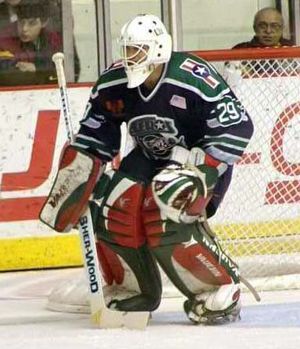
2002-03 Rochester Americans Rory Fitzpatrick Jersey

July by the Numbers reaches #4 with the most appropriate jersey possible on America's birthday.

The patriotically named Rochester Americans were founded in 1956, making them the second oldest franchise in the American Hockey League by far, with the third oldest still active team having been founded in 1992.

The Americans have made it to the Calder Cup Finals 16 times, having won the championship six times, first in a run of success that encompassed 1965, 1966 and 1968 as well as an appearance in the finals in 1967, the only team to reach the finals in four consecutive seasons. Other championship titles came in 1983, 1987 and most recently in 1996.

Rochester Americans 1995-96
The Calder Cup champion 1995-96 Rochester Americans

Well known players from the early days of the Rochester franchise include goalie Gerry Cheevers, future Islanders coach Al Arbour, future Bruins coach and TV commentator Don Cherry, Jim Pappin and Mike Walton.

Cherry Americans
Rochester American Don Cherry

After a down period in the late 1960's under the ownership of the Vancouver Canucks, when the team finished last for four straight seasons, local owners purchased the club and installed the dynamic Cherry as coach and general manager which paid dividends as the Americans finished with the best regular season record in 1973-74.

The Americans were later purchased by the owners of the Buffalo Sabres, which naturally led to their becoming the Sabres AHL affiliate, a partnership which lasted from 1979 to 2008, the longest such partnership in AHL history at 29 years which included three championships. Following three seasons apart, circumstances changed which brought the two clubs back together again when new Sabres owner Terry Pegula purchased the Americans in time for the 2011-12 season.

Two numbers have been retired by the team in honor of three players, the #6 for Red Armstrong and #9 for both Dick Gamble and Jody Gage, who broke Gamble's team scoring records.

Gage Americans
Jody Gage

Recognizable names to have played for the Americans include Maxim Afingenov, Donald Audette, Martin Biron, Brian Campell, Randy Cunneyworth, Benoit Houge, Ales Kotalik, Uwe Krupp, Mike Milbury, Ryan Miller, Jason Pominville, Darren Puppa, Thomas Vanek and even Grant Fuhr.

Vanek Americans
Thomas Vanek in the Americans flashy alternate stars and stripes sweater

Today's featured jersey is a 2002-03 Rochester Americans Rory Fitzpatrick jersey. With it's red, white and blue color scheme, patriotic sheild logo and #4, we couldn't think of a more appropriate jersey for the Fourth of July, as it even features sponsorship from a local Chevrolet dealer. All you need while wearing this one would be for your mom to serve you some apple pie!

With it's shield crest, classic Northwestern striping pattern and shoulders decorated with basic stars, this jersey's understated elegance creates a timeless look often left behind in this modern age of excessive piping and gimmicky fonts. A true classic jersey in every sense.

Rochester Americans jersey

Today's video section begins with Gage scoring his 14th goal of the playoffs in Game 7 of the 1987 Calder Cup Finals, leading to the Americans to their fifth Calder Cup championship.


Here is a further look at Jody Gage, an AHL MVP and member of the AHL Hall of Fame.


Sunday, July 3, 2011

1955 Team Canada George McAvoy Jersey

July by the Numbers continues with jersey #3, a vintage Canadian National Team jersey.

From 1920 until 1952 Canada was used to having it's way at the World Championships, having won 15 titles in 18 tries, with the other three being silver medals, split between the World Championships and the Olympics, which counted as that year's World Championships during the years it was played.

Canada skipped the 1953 tournament but was back for the 1954 edition in the form of the East York Lyndhursts of Toronto. Waiting for them was a newcomer to the World Championships in the form of the Soviet Union, who had only been competing in international hockey since 1951. Both Canada and the Soviet Union had strong tournaments and entered the final game undefeated, with Canada sitting at 6-0 and the Soviets at 6-0-1, the only blemish being a 1-1 tie against Sweden.

The Soviets shocked the Canadians with a 7-2 pounding to take the World Championship in their first try.

Back in Canada, the Penticton Vees had captured the Allan Cup as the National Senior Champions of Canada, earning the right to represent Canada at the 1955 World Championships in Krefeld, West Germany, as the Canadians did not assemble a national team made up of players from all across the country, but sent the national senior championship club to represent the nation internationally at the time.

1955 world champions
The 1955 Canadian World Championship Team

The tournament began on February 25th, and both the Canadians and Soviets won easily to open their schedules, with Canada winning 12-1 over the United States while the Soviet Union won 10-2 over Finland.

Tougher competition awaited both teams the next day, but they both prevailed as the Soviets won 2-1 over Sweden while Canada defeated Czechoslovakia 5-3.

Both teams posted shutouts the next day, Canada 8-0 over Poland and the Czechs fell to their rival Soviets 4-0.

Unbelievable by today's standards, both teams played their fourth game in four days on the 28th, as the Soviet Union cruised to an 8-2 win over Poland and Canada demolished Finland 12-0 to maintain both team's perfect marks.

Following a well earned day off, both clubs hit the ice on March 2nd, Canada again winning by double digits, 11-1 over Switzerland while the Soviets shut out the Americans 3-0. March 3rd saw Canada get by the Swedes 3-0 and the Soviet Union kept pace with their 5-1 win over the host West Germans.

They swapped opponents the next day, with Canada dominating West Germany 10-1 and the Swiss falling 7-2 to the Soviets, setting up their final match for the title on March 6th with both clubs sporting perfect 7-0 records.

Canada led 1-0 after one period on a goal by Mike Shabaga before adding a pair of goals in the second by Bill Warwick on a deflection off of a stick and another goal from Shabaga.

1955 world championships

Still leery of a Soviet comeback, Canada added two more goals in the third when Warwick got his second before team captain and defenseman George McAvoy blasted one from the point to finish off the scoring to wrap up a 5-0 shutout victory by goaltender Ivan McLelland to reclaim hockey supremacy for the nation of Canada.

McAvoy handshake
Bunny Ahearne, IIHF president, congratulates the captains of both clubs, Vsevolod Bobrov of the Soviet Union and George McAvoy of the victorious Canadians following the game

Today's featured jersey is a 1955 Team Canada George McAvoy jersey as worn in the 1955 World Championships when Canada, in the form of the Penticton Vees, reclaimed Canada's status as champions of the world.

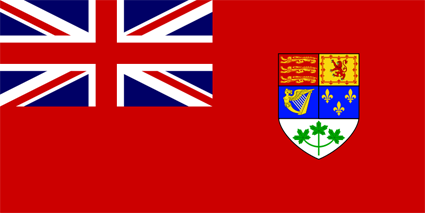
This jersey features an unusual amount of blue when compared to a modern Canadian jersey, but Canada's flag prior to 1965 did contain a Union Jack and coat of arms which did contain a fair amount of blue.

Canada 1955 jersey

Here is brief footage of a monument to the Penticton Vees featuring a quote from goaltender McLelland.


Here is action from the final game of the 1955 World Championships when Canada defeated the Soviet Union 5-0 to avenge Canada's surprising loss to the Soviets the previous year.


Saturday, July 2, 2011

1989 Soviet Union Izvestia Trophy Alexander Gusev Jersey

July by the Numbers continues with jersey #2, a 1989 Soviet Union jersey worn during the annual Izvestia Trophy tournament, which was originally sponsored by the Izvestia daily newspaper.

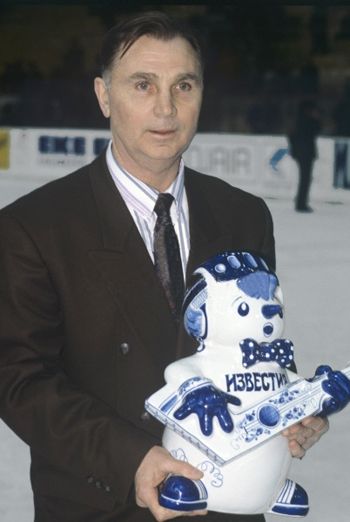
Izvestia snowman
The Izvestia Snowman, the traditional tournament mascot

The tournament began in 1967 in Moscow and has traditionally been played in December each year with few exceptions between the top national teams of Europe. In the 1970's and 80's it was referred to as "The Little World Championship" or a winter rehearsal for the World Championships held each spring.

The first tournament held in 1967 carried the heavy-handed title of "Tournament for the Celebration of the 50th Anniversary of the Great October Socialist Revolution", which probably hampered merchandise sales to no end!

The pendulum swung back way too far in the other direction for 1968 when the competition was entitled the overly generic "International Tournament". The Izvestia sponsorship arrived on the scene in 1969 and lasted through 1996, giving the tournament both increased exposure and it's identity.

Since the end of the Izvestia sponsorship, the tournament has been through a series of name changes, first being known as the Baltica Brewery Cup from 1997 to 2002, the Moscow International Tournament in 2003, the Rosno Cup in 2004 and 2005 and is currently known as the Channel One Cup since 2006.

The tournament has consisted mainly of national teams from Finland, Czechoslovakia/Czech Republic, the Soviet Union/Russia and Sweden with other countires fielding a teams on occasion.

Izvestia snowman

Over it's history, the Soviet Union/Russia has won the tournament 31 times, Czechoslovakia/Czech Republic seven, Sweden and Finland two each and Canada once.

Izvestia snowman
The Soviet team captain hoists the Snowman trophy

Other countries to have participated include Poland in 1967, East Germany in 1969, the Winnipeg Jets in 1976, and the Quebec Nordiques in 1977, both of the WHA representing Canada, and West Germany on a few occasions prior to reunification. There were later Canadian teams on occasion as well as two teams from the Soviet Union and Czechoslovakia in the early days as well.

Currently, the tournament is a part of a larger competition known as the Euro Hockey Tour, which consists of the Channel One Cup in Russia, the Czech Hockey Games, the Karjala Tournament in Finland and the LG Hockey Games in Sweden. Once all four of these competitions are completed, the teams are seeded based on combined points for all four tournaments to determine the overall winner, with additional playoff games having been added from 2004 to 2007 to determine the medal placings.

Most teams currently use the tournament as an opportunity to give younger players a chance to gain international experience in advance of World Championships or Olympics.

Today's featured jersey is a 1989 Soviet Union Izvestia Trophy Alexander Gusev jersey, which has the unusual color combination of red and yellow, opposed to the Soviet National Team's traditional red and white.

It has the unusual crest of a hockey playing snowman, which depicts the "Wooden Snowman" trophy awarded to the winner of the tournament during this era.

With the word on the chest of the snowman reading "veteran", we suspect this jersey may have been part of an old-timers game in conjunction with the main tournament rather than an actual Soviet National Team jersey.

We are also unsure of the exact year, but conclude that the mesh material and heavy screen printing of the yellow colors is consistent with that of a very late 1980's or early to mid 1990's Russian jersey, but the use of "CCCP" on the crest suggests it's prior to the breakup of the Soviet Union in 1991. It could possibly be from later with the "CCCP" indicating Gusev was a veteran of the Soviet era, but we currently have no way of knowing for certain.

1980's Soviet Union Izvestia jersey

Here is action from the 1986 tournament, only the second time Finland had ever defeated the Soviet Union in international competition.


Friday, July 1, 2011

2001-02 Providence Bruins Andrew Raycroft Jersey

With the lack of significant historical events in hockey history in the month of July it's time to reprise a different approach to the heart of summer. For the third year in a row, every day in July we are going to feature a jersey with a number on the back matches the current date, from 1 to 31.

It's a chance for us to showcase some jerseys that frankly aren't related to a Stanley Cup victory, milestone goal or even a player's birthday. We call it "July by the Numbers".

So, for July 1st, we kick things off with a jersey that carries the #1, and you just knew it was going to be a goaltender, didn't you?

After the Providence Reds left town after 51 years of play, the city would have to wait 15 years for the arrival of it's next club, the Providence Bruins, who were previously known as the Maine Mariners from 1987 to 1992.

The Bruins won their division during their first season in Providence in 1992-93 with a 46-32-2 record and were led in scoring by future Boston Bruin Tim Sweeney, whose 41 goals and 96 points placed him 8th in the AHL scoring race.

It would take until 1998-99 for Providence to win another division championship, which they did in style with a league best 56-16-4 mark (after winning only 19 games the previous season!) and were led in scoring by Randy Robitaille's 102 points, only two shy of the league leader. John Grahame (37-9-1) and Jim Carey (17-8-3) split the goaltending duties and the Bruins cruised through the playoffs with a 15-4 record to win the Calder Cup as AHL champions.

While Providence has had four deep playoff runs to the third round since then, they have yet to repeat as league champions. By far their second best season was in 2007-08 when the Bruins again finished with the best regular season record, earning 117 points with a 55-18-3-4 mark and were led in goal by future Boston Bruin Tukka Rask with 27 wins.

Throughout the history of the franchise, Sweeney's 41 goals and Robitaille's 74 assists and 102 points still stand as team records. In goal, Tim Thomas holds the marks for both Goals Against Average of 1.84 and Save Percentage at .941 set in 2003-04.

Andy Hilbert's three strong seasons, which included leading the team in scoring twice, place him first overall in career scoring with the Bruins in goals (101), assists (109) and points (210) while Grahame hold the career mark for wins by a goaltender with 67.

Notable players over the history of the club include goaltenders Grahame, Rask and Thomas and skaters Patrice Bergeron, David Krejci, Glen Murray, Josef Stumpel and the late Sergei Zholtok, who ranks second in Providence career scoring with83 goals and 186 points.

Today's featured jersey is a 2001-02 Providence Bruins Andrew Raycroft jersey. This jersey is emblematic of the Providence Bruins tradition of duplicating their parent club's jerseys with the "spoked B" replaced by a "spoked P" logo. With the change to the Reebok Edge jerseys, Providence no longer matches the style of Boston jerseys as closely, but there is no mistaking the connection between the clubs.

Providence Bruins 01-02 jersey

Today's video segment is highlights of the Providence Bruins winning the Calder Cup in 1999.


Thursday, June 30, 2011

1993-94 New York Islanders Jamie McLennan Jersey

No other path through a hockey career can match that of goaltender Jamie McLennan, born on this date in 1971, who made stops in Canada, the United States, England, Russia and Japan with a stop at death's door for good measure!

His journey though the world of hockey began in 1988-89 with first the Spokane Chiefs followed by a move to the Lethbridge Hurricanes of the WHL. He returned to Lethbridge the following season and posted a stellar 20-4-2 record. He became the #1 goaltender for the Hurricanes in 1990-91, going 32-18-4 which led to his being taken 48th overall by the New York Islanders at the 1991 NHL Entry Draft, the second goaltender selected in the draft.

He began his climb to the NHL with the Richmond Renegades of the East Coast Hockey League in 1991-92 before a promotion to to the Capital District Islanders of the American Hockey League. After spending a second season with Capital District in eastern New York in 1992-93, McLennan trekked west to compete for the Salt Lake Golden Eagles of the International Hockey League before making his NHL debut with a 6-2 win over the Calgary Flames on January 7, 1994. By playing in the NHL, McLennan had now competed in five different leagues in four seasons.

McLennan spent the next season divided between the Islanders and their top AHL affiliate, which was the Denver Grizzlies in 1994-95. In 1995-96, he tended goal for a trio of clubs, the Islanders of the NHL for 13 games, the Grizzlies, who had relocated to Salt Lake City and were now known as the Utah Grizzlies for 14 games as well as playing the majority of his season with the Worcester Ice Cats of the AHL in 22 games, making in three different leagues in one season for the hockey vagabond.

McLennan Islanders
McLennan had the misfortune of having to wear
the "fisherman" jersey while on Long Island

At the conclusion of the season, McLennan drove from Salt Lake City to Lethbridge, Alberta on his way home to Edmonton. While in Lethbridge visiting relatives, he became ill with what he believed was the flu. After feeling ill for some time and his symptoms becoming worse, he went to a hospital now believing he was suffering from food poisoning after a night of fever and vomiting.

Once at the hospital he was diagnosed with bacterial meningitis and went into a coma, but not until a doctor noticed the black spots on his arms and legs and declared "We better call your parents. You might not make it." Luckily enough, he had arrived at the hospital early enough to receive proper treatment, but not before spending the next five days in a delirious state due to the inflammation of the membrane around his brain and spinal cord.

He still required three weeks in intensive care, ended up losing 30 pounds and needed to learn how to walk again following the ordeal.

Due to his medical setback, McLennan spent the entire 1996-97 season with the Ice Cats returning to form as a professional hockey player after signing a contract with the St. Louis Blues organization.

McLennan returned to the NHL with the Blues for the 1997-98 season, playing in 30 games and finishing with a 16-8-2 mark.

McLennan Blues

His brush with death and subsequent return to the NHL earned McLennan the 1998 Masterton Trophy for perseverance and dedication to hockey.

McLennan Masterton

He played two more seasons with St. Louis, but saw his number of games decline from 30 and 33 down to 19 which made him available in the 2000 Expansion Draft where he was selected by the new Minnesota Wild, where he saw plenty of ice time, but dreadful goal support whenever he started, far less than teammate Manny Fernandez, doomed him to a 5-23-9 record despite a 2.64 goals against average.

McLennan Wild

After the Wild signed Dwayne Roloson for 2001-02, McLennan was relegated to the Houston Aeros of the AHL for the entire season.


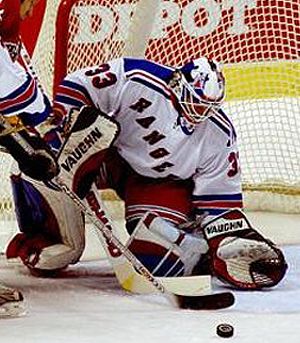
At the following NHL Draft, McLennan was dealt to the Calgary Flames as a backup to Roman Turek for 2002-03 and found himself a part of a crowded crease in 2003-04 with the arrival of Miikka Kiprusoff before being dealt late in the season to the New York Rangers with whom he played just four games during the final month of the season.


During the summer of 2004, McLennan was signed by the Florida Panthers as a free agent, but remained mostly inactive during the NHL lockout of 2004-05, he signed with the Guildford Flames of the British second division for three regular season games and seven playoff contests.

With the labor issues now settled, he made his Panthers debut during the 2005-06 season, but was limited to just 17 games behind workhorse Roberto Luongo.

McLennan Panthers

With his contract now expired, McLennan returned to Calgary for the 2006-07 season to again back up Kiprusoff, now himself an entrenched #1 as well as another workhorse, which saw McLennan limited to a mere nine games. He did make one infamous playoff appearance, during which he came into the game in relief of Kiprusoff, and lasted a mere 18 seconds before slashing Detroit forward Johan Franzen, which earned him a game misconduct and a match penalty and a later five game suspension.

McLennan Flames

To start the 2007-08 season, McLennan played five weeks for Metallurg Magnitogorsk of the Russian Superleague.

McLennan Metallurg
McLennan while with Metallurg Magnitogorsk - note the Calgary Flames mask

McLennan later signed in late November with the Japanese Nippon Paper Cranes of the Asia Hockey League, his seventh different league as a professional, after he and former Blues teammate Tyson Nash were recruited by a friend already on the roster, giving them a unique opportunity to continue playing hockey and experiencing the Japanese culture for an extended period of time. To read more about McLennan's experiences in Japan, check out his blog at The Hockey News here.

McLennan & Nash in Japan
Jamie McLennan and Tyson Nash experiencing Japan

It was to be his final season as a professional, as he announced his retirement following the season, bringing to an end a career which saw him play in 254 NHL games and finishing with a record of 80-109-36 along with a career goals against average of 2.68.

Today's featured jersey is a 1993-94 New York Islanders Jamie McLennan jersey worn during McLennan's rookie season. While the basic basic blue Islanders jersey underwent some detail changes since it's introduction in 1972 up until it was first discontinued in 1995 in favor of the controversial "Fisherman" style, the fans demanded it's return, which came in an updated version of the original in 1998 which used a considerably darker shade of blue.

With the introduction of the Reebok Edge jerseys in 2007, the Islanders began to stray too far from the originals once more, which resulted in a new lighter blue alternate jersey being introduced in 2008 which replicated their 1973 jersey as much as possible with the Reebok Edge cut. It was so well received that it became the primary home jersey just two years later and a new white version was created to complete the set.

New York Islanders 93-94 jersey

Bonus Jersey: Today's bonus jersey is a 2002-03 Calgary Flames Jamie McLennan jersey. This alternate debuted in 1998 and featured a flaming horse head logo in honor of the famous Calgary Stampede rodeo. After two seasons of use this style was promoted to being the Flames primary road jersey.

Unusually, when the NHL declared that dark jerseys would now be the primary home jerseys beginning in 2003, the Flames introduced a new red primary home red, yet the black jersey survived by once again returning to alternate status for three additional seasons. There has never been another instance of an alternate jersey being promoted to primary status and then returned to duty as an alternate once again, as they are generally retired when replaced by a brand new style.

Calgary Flames 02-03 jersey

For a looking into the wacky personality of the man called "Noodles", check out this funny video poking fun at his lack of playing time while backing up Luongo while with the Panthers.


Here is McLennan is interviewed in two parts, which includes him talking about his battle with meningitis.


Wednesday, June 29, 2011

A Tribute to Mike Sillinger and His Many Jerseys

Mike Sillinger, born on this date in 1971, played for a record 12 teams during his 17 seasons, scoring 240 goals and 308 assists for 548 points in 1,049 games.

There must be a future for Sillinger as a relator after what must have been a nearly full-time job buying and selling homes with all the relocating he had to do throughout his career.

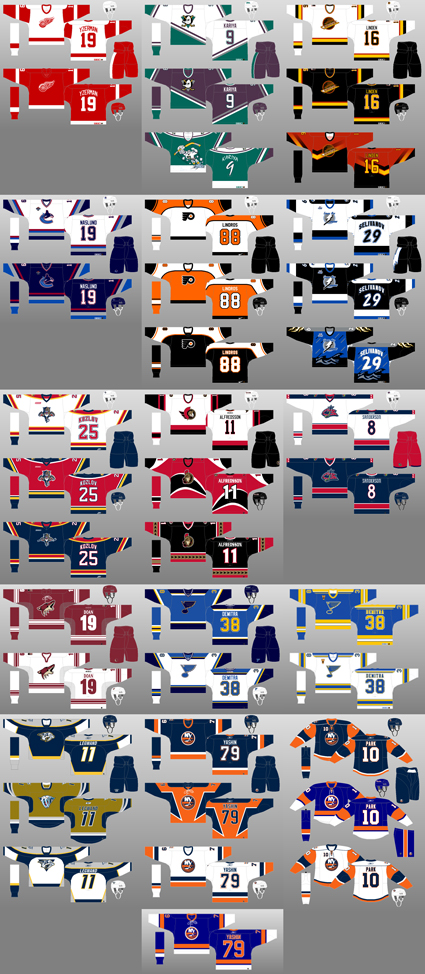
We can only hope that he was able to keep his jerseys from the record 12 teams he was on. The clubs he played for, with the number of seasons in parenthesis, were the Detroit Red Wings (4), Mighty Ducks of Anahiem (2), Vancouver Canucks (3), Philadelphia Flyers (2), Tampa Bay Lightning (2), Florida Panthers (2), Ottawa Senators (1), Columbus Blue Jackets (2), Phoenix Coyotes (1), St. Louis Blues (2), Nashville Predators (1) and New York Islanders (3). During eight of his 17 seasons Sillinger would play for more than one NHL franchise, 13 seasons if you factor in junior and minor league hockey clubs. Only five times after reaching the NHL did he finish a season where he started, something that certainly must have been difficult for his family.

Here is what Mike's closet would look like had he just one of each jersey style he wore, 40 in all, spanning the classic era of 1990-91, the crazy alternates of the mid to late 90's, a return to the throwbacks in the early 2000's to the change to the Reebok Edge jerseys in the mid 2000's. They include 14 different home jerseys, 14 road styles, 9 alternates and 3 throwbacks. I'm uncertain if any player has ever worn as many different jerseys in his NHL career, so until we're shown to be wrong, we are going to declare Mike Sillinger's career total of 40 different jerseys in a career The Official World Record as recognized by Third String Goalie until proven otherwise.

Sillinger 6

Monday, June 27, 2011

The 2011 NHL Draft Project

We at Third String Goalie were in attendance at this weekend's 2011 NHL Entry Draft at the Xcel Energy Center in St. Paul, Minnesota. While there, we attempted to document jerseys from every different team we could possibly find, eventually numbering 47 different teams ranging from 29 different NHL Clubs, including a few defunct ones, as well as teams from the AHL, Canadian Juniors, Russia, national teams, Finland, the WCHA, WHA and, as always, the enduring movie Slap Shot.

It was a fun and fantastic project as we got to meet dozens of people from all over the country, everyone united in their love of hockey and spirit of fun. A big thanks to all of you who took the time to pose and chat!


Aside from the draft itself, there were other events over the course of the two days to keep the fans entertained, starting with Friday's NHL Fan Fest, which provided interactive games, such as the puck shooting accuracy area, and autograph opportunities at three different locations, each with a different focus.

The NHL Alumni booth had a lineup of former Minnesota North Stars throughout the day including Gordie Roberts, J. P. Parise, Tim Young and Steve Payne among others, while the Minnesota Wild booth with Brad Staubitz, Clayton Stoner and fan favorite Cal Clutterbuck as well as last year's #1 pick Mikael Granlund of Finland. The USA Hockey/Minnesota Hockey featured a lineup which included Minnesota natives Phil Housley, David Backes and 1980 Olympians John Harrington and Rob McClanahan.

There were also six roundtable discussions in two sessions, the first of which included "Minnesota Wild Year 3 - The Road to the Western Conference Finals" with Wes Walz, Darby Hendrickson, Brad Brown and Antti Laaksonen, "Coaching Legends" with Scotty Bowman and Minnesota legends Doug Woog and Willard Ikola, and the one we chose to attend, "The State of the NHL" with NHL commissioner Gary Bettman, which was a fun, informative and entertaining hour hosted by the NHL Network's E. J. Hradek.

Gary Bettman
NHL commissioner Gary Bettman

The second sessions to choose from were "The Houston Aeros - The Road to the Calder Cup Finals" with Colton Gilles, Marco Scandella and Jared Spurgeon, "WCHA Greats" with Mark Parrish, Shjon Podein, Reed Larson and Ryan Carter, while the third one, and the one we were in attendance for, "The Class of '67 - Minnesota's First NHL Team" with Lou Nanne, Jack Carlson, Tim Young, Brad Maxwell and J. P. Parise, all veterans of the Minnesota North Stars.

There were also other booths from the US Hockey Hall of Fame, Fox Sports, where you could do your own sportscast, the Hobey Baker Award, a silent auction for signed NHL jerseys and a live broadcast from KFAN radio among the others with displays.

Auction jerseys
Jerseys available for bidding in the Fan Fest auction

Additionally, there was also a theater set up in of the hotel's other conference rooms, which screened the film "Pond Hockey" and later "The Code - The Unwritten Rules of Fighting and Retaliation in the NHL", which we would have like to have seen, only the films conflicted with the discussion panels in an unfortunate scheduling choice.

Following the Fan Fest, it was time to make our way to the Xcel Energy Center in anticipation of the draft itself. With roughly two hours to go before the first pick, we took in the exhibits inside "The X", which consisted of a sports card and memorabilia show sponsored by Panini and Upper Deck. While the opportunity to have your own trading card created by Upper Deck was good fun and worth the time.

2011 Draft Hockey Cards
Being immortalized on cardboard courtesy of Upper Deck

The rest of the show paled terribly in comparison to the Fan Fest put on back in 2004 in conjunction with the NHL All-Star Game. If you are a card collector, there were some chances to purchase packs of cards and receive special six card sets commemorating past drafts, but the number of dealers was quite small and all local, selling the same limited selection we've seen many times over. It's a shame no dealers from Chicago, Detroit or even Toronto could have been attracted to attend, as we would have loved an opportunity to complete a set of 1974-75 Topps hockey cards we began in our youth.

Panini was there promoting their NHL hockey sticker collection and Adrenaline hockey card game products with free samples, which is never a bad thing.

The highlight of the pre-draft activities was the availability of the Stanley Cup, and while the wait was making us skittish about remaining seats would be available for the draft with our general admission ticket, it was worth the wait to have our picture taken with the cup and have a few moments to introduce ourselves to the Keeper of the Cup, Phil Pritchard.

Me with the Stanley Cup
Posing with the Stanley Cup

Me and Phil Pritchard
Having our picture taken with Phil Pritchard, Keeper of the Cup

Despite reports that there were no more tickets available for Friday's first round draft session, seating was not an issue in either the upper or lower bowl of the arena after the first sections of seating set aside for the players and their families. We began our evening in the first row of the upper deck.

2011 NHL Draft
The setting for the 2011 NHL Entry Draft

Following the seventh pick when Winnipeg made their low-key announcement of the choice of the name "Jets" and the subsequent joyous celebration, we made our way down to the lower bowl for the remainder of the evening, which included not only the host Wild's first pick, but their big trade announcement later in the evening, as they acquired Devin Setoguchi from the San Jose Sharks in exchange for Minnesota fan favorite Brent Burns, which added some spark to the latter half of the night.

Winnipeg Draft table
Winnipeg's draft table gave no clue to the return of the name "Jets"

One of the most memorable moments was when the classy New York Rangers had Aaron Boogaard, brother of the late Derek Boogaard, formerly of the Minnesota Wild, read the name of the first Rangers pick of the draft following an extended standing ovation in memory of Derek.

The remainder of the evening was spent spotting hockey dignitaries on the draft floor, being amused by everyone who made the drive down from Winnipeg and booing every move by Colorado. And Calgary. And Edmonton. And Anaheim.

And especially Vancouver.

Day Two consisted of rounds 2 through 7 and moved very quickly.

2011 NHL Draft
The NHL Draft Day 2

The bulk of our day was spent adding to our jersey photography project, cheering the Wild's trade which allowed them to select the first Minnesotan taken in the draft in the form of Mario Lucia, son of the University of Minnesota Golden Gophers coach Don Lucia, cheering any subsequent Minnesotans selected, getting our business card for Third String Goalie into the hands of as many people as possible and again booing every move by Vancouver, who seemed to take it all in good fun by taking the time to thank us all for our hospitality prior to the next to last pick in the entire draft, which was greeted by a round of applause, along with some more boos by those who apparently felt patronized.

It was great fun to have Winnipeg back in the NHL thanks to their legions of enthusiastic, well lubricated fans and we were surprised to see a number of Canucks fans who not only made bail, but were allowed to cross the border into the United States.

In conclusion, we had a great time at the draft, even if we had hardly heard of any of the players taken outside of the top 10 of the first round, and loved the relatively low-key nature of the event which gave us the chance to either have a genuine conversation with, or at least give a business card to no less than E. J. Hradek (who could not have been nicer to us over the course of the weekend), Pierre McGwire and Bob McKenzie (who were both very sincere and gracious with their time after a very long day on the set), Craig Button, Phil Housley, Steve Payne, Joe Nieuwendyk, Bill Guerin, Tim Young, Scotty Bowman, NHL commissioner Gary Bettman and hockey God Steve Yzerman (whose birthday marks the yearly anniversary of this very website), who certainly had better things to do with his time in the middle of the draft than chat briefly with us but did so anyway, for which we will be forever grateful. And thrilled.

Today's video segment begins with the Edmonton Oilers selecting Ryan Nugent-Hopkins with the first overall pick in the 2011 NHL draft.


Our next video is Aaron Boogaard announcing the first choice of the New York Rangers in a very classy move by New York.


Next is pick #7, the first official announcement of the choice of the name Winnipeg Jets.


The host Minnesota Wild pick Jonas Brodin with the #10 pick in this next clip.


Click below for a selection of Official Draft Day Caps given to all draft picks at the 2011 NHL Entry Draft!



hit counter for blogger