Tuesday, March 22, 2011
1992 Czechoslovakia Jan Caloun Jersey
Jan Caloun was an offensive talent from Czechoslovakia who first made a name for himself at the European Junior Championships in 1990 with 7 points in 6 games. He then graduated from the HC Litvinov junior team to the senior club, which participated in the Czech Extraliga.
As a 19 year old, Caloun he impressed with 28 goals and 47 points in 50 games. The next season he was limited to 37 games, but averaged a point per game with 32 goals and 37 assists. During the postseason, he contributed 13 points in 9 games. He was also a member of the Czechoslovakia National Team at the 1992 World Junior Tournament where he scored 8 of the Czech's 28 goals in 7 games to lead the tournament in goals.
Following the season, Caloun was selected 75th overall by the San Jose Sharks in the 1992 NHL Entry Draft.
He remained with HC Litvinov for two more seasons, scoring 44 goals and 67 points in 47 games in 1992-93 to lead the team in scoring and the league in goals at the age of 21. He also made his debut at the World Championships that year, earning a bronze medal playing for the newly formed Czech Republic, which had separated itself from Slovakia on January 1st of 1993.
After one final season with Litvinov, still averaging more than a point per game with 42 in 38 games, Caloun came to North America and was assigned to the Kansas City Blades of the IHL. There he picked right up where he left off in Europe, scoring 34 goals and 39 assists for 73 points in 76 games to lead the Blades in scoring as a rookie.
Bizarrely, despite finishing 16th out of 17 IHL clubs, the Blades qualified for the playoffs with 76 points, 44 points behind the league leading Denver Grizzlies, with only the Indianapolis Ice with 72 points failing to qualify for the postseason.
The Blades opened the playoffs against the 4th place Detroit Vipers and stunned them with a 4-3 win in Detroit during the decisive Game 5 of their opening round series. Next up for the Blades was the 3rd place Peoria Rivermen, whom they dispatched in 5 games.
The 4th place Kalamazoo Wings were up next, and once more the feisty Blades eliminated a club who finished much higher than them in the standings, this time with an easy 7-3 win in Game 7 on the road once more to advance to the Turner Cup Finals where their Cinderella run finally came to and end to the 1st place Denver Grizzlies. During their 21 playoff games, Caloun came second in team scoring with 13 goals and 23 points.
He returned to Kansas City for another season in 1995-96 and topped his goal total from the year before, with 38 goals in 15 less games, as Caloun was called up by the Sharks on March 18th for their game against the Boston Bruins. It was a memorable debut for Caloun that evening, as he scored on his first shot on goal in the NHL with an important goal, on the power play no less. The goal was the Sharks second of the game after spotting the Bruins a 3-0 lead before coming back to eventually tie the game 3-3.
Two nights later the dream start to Caloun's career continued when he scored his second NHL goal at 2:11 of the second period in his first shot of the game to give the Sharks a 3-0 lead over the Winnipeg Jets. At exactly the same 2:11 mark of the third period, Caloun remarkably scored on his next shot of the game, giving him 3 goals on 3 shots since being called up. The Sharks eventually won the game 7-1 over the Jets.
The Sharks next game came on this date in 1996 versus the Calgary Flames on the road. After the Flames scored first, Caloun's remarkable start continued, when the NHL rookie scored 7:23 remaining in the third period on a one-timer to tie the game on Caloun's first shot of the game, giving him an incredible 4 goals on the first 4 shots of his NHL career! The streak would later end, as his second shot on goal of the game was saved by Calgary's Rick Tabaracci. The Sharks eventually won the game in overtime thanks to Caloun's equalizer.
Caloun would eventually score a noteworthy 8 goals in 11 games for the Sharks that season. Despite that initial promise, Caloun was assigned to the Kentucky Thorougblades of the AHL for 1996-97 and led the club with 86 points in 66 games, 26 more than his next closest teammate. Caloun was also called up for a pair of games with the Sharks that season but could not duplicate his amazing offensive production of the year prior.
With the handwriting on the wall concerning his future with the Sharks, Caloun signed to play with HIFK Helsinki of the Finnish SM-Liiga for 1997-98 where he led the club in scoring with 48 points, good for third overall in the league. He would go on to lead the league in playoff scoring with 17 points in nine games as HIFK captured the league playoff championship.
In February, Caloun was a member of the Czech Republic Olympic Team which captured the gold medal in Nagano, Japan, the first Olympics which featured NHL players.
Caloun, simply tore up the SM-Liiga following season, amassing 81 points in just 51 games to lead the league in scoring by a full 23 points over his next closest challenger. He repeated as the top scorer in the playoffs as HIFK again returned to the finals.
Following the Finnish season, Caloun participated in his second World Championships and contributed 4 goals in 6 games as the Czechs captured the gold medal as tournament champions.
In 1999-00 Caloun led HIFK in scoring for the third consecutive season. His 72 points in 44 games placed him second in the league scoring race.
He returned to North America at the start of 2000-01, where he joined the expansion Columbus Blue Jackets of the newly expanded NHL, which created roughly 50 new jobs for players with the addition of Columbus and Minnesota. In 11 games, Caloun scored three assists before securing his release, which allowed him to rejoin HIFK in time to play 24 games that season.
For 2001-02, he joined the Espoo Blues for the next three seasons, leading the Blues in scoring all three seasons and the entire league in 2002-03 for his second SM-Liiga scoring title.
His 2004-05 season was an unsettled one, as he competed for four different clubs, Severstal Cherepovets (5 games) and Sibir Nobosibirsk (1 game) of the Russian Hockey League and a return to familiar territory with HC Litvinov (24 games and 39 points) and Slovan HC of the Czech second division for a pair of games. His next home was HC Pardubice of the Czech Extraliga. In 2005-06 he led Pardubice in scoring with 39 points in 48 games.
After one more season with Pardubice he rejoined Slovan HC for the next two seasons, the first of which was in the Extraliga and the second one down in the second level after being relegated.
For 2009-10, Caloun remained in the Czech second division with HC Vrchlabi and scored 13 goals and 27 points before he retired as a player after 19 seasons, 940 games, 515 goals and 499 assists for 1,014 points at all levels combined.
Today's featured jersey is a 1992 Czechoslovakia National Team Jan Caloun jersey from the final year of participation by Czechoslovakia in international hockey prior to dividing into the Czech Republic and Slovakia with the start of 1993.
This jersey is made by Tackla and features the familiar Tackla diamond shapes on the shoulders. Tackla a made jerseys for the member clubs of the IIHF in international tournaments from 1988 through 1995, although the final two years they were branded with large Reebok logos on the shoulders.
Today's video section begins with Caloun's return to HIFK after leaving the Blue Jackets and returning to Finland.
This next interview with Caloun, a Czech being interviewed by a Finn, is conducted conveniently in English.
Labels:
Caloun Jan,
Czechoslovakia
Monday, March 21, 2011
1993-94 Washington Capitals Al Iafrate Jersey
Known for his powerful slapshot, Al Iafrate was born on this date in 1966 in Michigan. During the 1983-84 season, Iafrate played 61 games for the United States National Team, which included competing at the 1984 Olympics in Sarajevo, Yugoslavia. Following the Olympics, Iafrate finished the season with the Belleville Bulls of the OHL prior to being drafted 4th overall by the Toronto Maple Leafs that spring., making him the first US born player ever selected by the Maple Leafs in the first round.
Iafrate made the Maple Leafs roster that fall, and completed his 12 year NHL career without ever having played a single game in the minor leagues, not even on a rehab assignment despite the many injuries that would plague the later stages of his career.
During his first three seasons with the Maple Leafs, Iafrate scored 21, 33 and then 30 points prior to taking his offensive game to a new level with 52 points in 1987-88 when his powerful slapshot found the back of the net on 22 occasions, up from a previous high of 9. After dropping back to 33 points in 1988-89, he set a new career best with 21 goals and 63 points in 1989-90. Also in 1990 he gained recognition by winning the Hardest Shot competition at the SuperSkills event as part of the NHL All-Star weekend with a shot clocked at 96 mph.
After 42 games of the following season, Iafrate was traded to the Washington Capitals. He was a vital member of the Capitals power play, which resulted in a jump in points to 51, up from 32 the year prior. During the 1992-93 season, he would set a career highs with 25 goals and 66 points. His year would also include winning the Hardest Shot contest at the NHL All-Star Game SuperSkills event once again with a blast of 105.2 miles per hour, a mark that would remain the standard for 16 years!
After scoring 45 points in 67 games for the Capitals in 1993-94, Iafrate was on his way to join the Boston Bruins for the final 12 games of the regular season and a run at the playoffs, which saw him play and additional 13 games for Boston. During that season's All-Star weekend, he would win his third Hardest Shot competition with a drive clocked at 102.7 mph.
Iafrate would miss the entire 1994-95 and 1995-96 seasons while recovering from knee surgery. He was traded to the San Jose Sharks at the 1996 NHL Entry Draft before he could resume playing for the Bruins, but his playing time as again limited due to injuries. Iafrate would play 59 games for the Sharks over two seasons.
At the conclusion of the 1997-98 season, he would compete for the United States at the World Championships for the only time in his career. He then announced his retirement from the game in September of that year.
Iafrate would total 799 NHL games, 152 goals and 311 assists for 463 points. Additionally, he would be whistled for 1,301 penalty minutes.
Today's featured jersey is a 1993-94 Washington Capitals Al Iafrate jersey which features the Capitals 20th Anniversary patch, barely able to fit on the front due to the number of stars filling the front of the Capitals jerseys like no other.
The Capitals wore their star-spangled jerseys from the time of their NHL debut in 1974 through the 1994-95 season when they stopped wearing their classic red, white and blue jerseys and changed to a new blue and black color scheme.
Bonus Jersey: Today's bonus jersey is a 1986-87 Toronto Maple Leafs Al Iafrate jersey. This jersey features the King Clancy Memorial patch on the upper left arm.
The Maple Leafs adopted this style in 1970 and wore it through the 1991-92 season until adopting a new style based on the jerseys they originally wore from the 1930's to the 1960's.
Today's video segment is a compilation of goals scored by Iafrate with his powerful slapshot, as well as setting his long standing record in the hardest shot competition through the power of the mullet.
Labels:
Iafrate Al,
Washington Capitals
Sunday, March 20, 2011
The Creation of the Minnesota Wild's Third Jersey
Today we are pleased to bring you an interview with John Maher of the Minnesota Wild, who was kind enough to take a few moments out of his busy schedule to talk to us at Third String Goalie.
TSG: John, thank you for taking the time to speak with us. What is your position with the Minnesota Wild?
JM: My current position is Vice President of Brand Marketing.
TSG: And who have you worked for previously?
JM: Before joining the Wild in 2000, I freelanced for a while during the 90's. I worked for the Minnesota Vikings doing their game and event presentation and I also did some event presentation for some other teams in town and then from 1985 to 1993 I worked for the North Stars at Met Center.
TSG: What I wanted to focus on today was the Wild's current alternate third jersey. Going back to the year 2007, the Wild needed to drop one of their three jerseys with the switch to the Reebok Edge jerseys, and since you needed to keep the white jersey, what was the thinking behind dropping the green jersey rather than the red jersey?
JM: It was a pretty easy call at that time as our red jersey was by far our most popular jersey with the fans. Since we could only keep one dark jersey, that was an easy one.
TSG: When did the process to create the current third jersey start?
JM: We actually started working on a third jersey with the intent of introducing it for the 2008-09 season and the process with the National Hockey League and with Reebok pretty much requires a full year prior to the introduction of the jersey that you have the design finished, so that puts us into the 07-08 season, when we were working on a design, and frankly when we did the first set of alternate jersey designs that first year, we never got to one that we really liked when we were working during the summer of 2007.
We had some designs we put in front of the fans. Another big part of the process is doing photography and video testing with the new jerseys to see what it will look like it will look like on television, what it will look like in photography. Once we had prototypes in 2007, and did the photo and video testing, we didn't like them, and so we just decided we're not going to do one yet because we're not ready yet, so that was another full year in front of when we did introduce our alternate jersey, so it really was a two year process of designing, putting paper designs in front of fans to get feedback, taking that feedback and turning it into a prototype that Reebok would make for us once we had agreed on that and doing photography and video testing with the prototypes. All that stuff happens before you can finalize it and say to the league and to Reebok "This is our new jersey."
TSG: Who designed the jersey?
JM: We work with a design and marketing firm SME out of New York City. They have actually designed all of our jerseys all the way back to the very first one that we started wearing in 2000, so they have been a partner of ours throughout, and they've also worked with many other clubs on jersey designs. There is some examples of that on their website. If you go to SME's website you can see a lot of work that they have done for other teams and other brands.
TSG: Did they also design the team's current 10th Anniversary patch?
JM: They did also work with us on our 10th Anniversary patch, yes.
TSG: What were the influences of the design for the current alternate jersey?
JM: When we started out we knew that we wanted to have a jersey that would reflect the throwback or vintage look. The Wild brand has evolved from initially being based on the wilderness. That's where the Wild name came from, that Minnesota wilderness aspect part of the primary logo, but it's evolved from that into a traditional hockey brand, I would say. Based on that we wanted to have a new design that would have more of a vintage or throwback feel to harken back to some of the well known jerseys that Minnesota hockey fans would connect to, all the way back to high school jerseys.
TSG: I seem to recall there were some influences in the logo, the cresting, from the old St. Paul Saints and Minneapolis Millers?
JM: It's a classic sports style of the script to be sure, and the letter "M" does have an influence from an old Minneapolis Millers logo.
The St. Paul Saints of 1961-62 with their classic script logo
1946-47 Minneapolis Millers jersey showing the
inspiration for the "M" on the Wild's third jersey
TSG: Why was there so little red used in the alternate jersey?
JM: We felt that a classic design meant a more solid color jersey. If you look at the Detroit Red Wings as an example, we felt that classic design and a solid color base went together. But we also wanted to have the red be in there because we felt that the combination was important for our brand, so there are little hints of red in there, but we definitely felt like it should be a one color jersey, and we felt like since we had taken our original green jersey out of the mix, that we felt the green should be the base color.
TSG: Were there any public focus groups or feedback before finalizing the design?
JM: Yes. During the summer we have a lot of events with our fans, including our Road Tour, our Summer Bash, Select-A-Seat for our season ticket holders, so we put designs in front of those groups at events like that to get feedback on the "on paper" design before we went to the prototype stage.
TSG: Are they shown one design or a group to pick from?
JM: We always show multiple designs because we want to test them. We have our opinions about which we think is our favorite, but we have definitely been in situations in the past where we have put our favorite in front of fans and they have selected something different, so we always put multiple designs in front of the fans to make sure we are not just going with our own opinion. We want to hear from the fans and make sure they are influencing the design.
TSG: Now that's it been in use for a season, how has it sold compared to the other two jerseys, the white and the red?
JM: It was our best seller last year, but that was partially because it was a brand new one, obviously, and people didn't have one yet. We definitely feel we hit the mark and the fans would say that they agree that we hit the mark on the classic sports look, so I think it will continue to be a popular jersey for us.
TSG: How often is it scheduled to be worn this season and is there a minimum and maximum number of times the league will let you wear it?
JM: The league has a schedule for the alternate jerseys of up to 15 games per club, so we get to select those games in advance ad we base those on mixing them up throughout our schedule and mixing them up throughout our different opponents and also getting them seen by different audiences. For example, we have Montreal and Toronto at home and we haven't had them at home before since we've had the green, so we put both of those games on the green jersey schedule.
TSG: Are you going for the 15 game maximum this year?
JM: We did. We actually got an extra game this year just because of the way the schedule fell, but typically it's a 15 game maximum.
TSG: In the past, in 2003-04 and 2005-06, the team specifically chose to not put the All-Star Game and Year Five patches on the red alternate jersey, but the 10th Anniversary patch is being worn on the green alternate jersey this year. Where did the change in thinking come about leaving the patch off of the alternate jersey?
JM: We felt like we had so much of our season messaging this year was around our 10th anniversary we were going to wear our alternate jersey 15 times at home we felt like we should wear it on every jersey. The only nights we didn't have [the 10th anniversary patch] this year were the two games in Finland, and that was because we had the NHL Premiere logo as part of those games.
TSG: Do you have any thing else jersey related in the works, such as a possible jersey for use in a future Winter Classic?
JM: We would love to be part of the Winter Classic and have communicated that to the league. We think we are a great market for that based on the history of hockey here, so we are talking to the league about that as frequently as we can to express our interest. It's similar to other events like the NHL Draft, the NHL All-Star Game, etc. that many teams lobby for to get to their market, so we definitely hope to host a Winter Classic at some point.
TSG: But no jersey designs in the works for any reason right now?
JM: No. That would be something that would be initiated by the granting of that game to the market.
TSG: Why was the particular number font chosen to be used on the red and green jerseys? Was their any consideration for a more retro looking font to go with the retro theme of the red and green jerseys?
JM: We definitely did that. It was definitely part of the thinking for the red jerseys that we would use a more traditional looking "sports font", so that's the font that was chosen for the red jerseys back in 2003 and we decided to carry it over to the green jerseys.
TSG: Thank you very much for your time today.
JM: You bet.
Again, we cannot thank John enough for taking the time out of his busy schedule to speak with us today about the process of how an NHL team goes about the business of creating a new jersey.
As John mentioned during the interview, the Wild are scheduled to wear their green alternate jerseys this evening against the Montreal Canadiens and again on Tuesday night March 22nd versus the Toronto Maple Leafs. Additionally the Wild will wear their alternates one final time this season against the Tampa Bay Lightning on Saturday, April 2nd.
Here are photos taken from the official unveiling of the third jersey at the Minnesota State Fair back on August 30, 2009 being modeled by Derek Boogaard.
Here are a pair of videos from the unveiling, the first of which features today's interview guest John Maher explaining a little about the process, when they were going to debut and how to get one when they were first released.
The second video is Boogaard modeling the jersey for the public for the very first time.
Labels:
Minnesota Wild
Friday, March 18, 2011
1943-44 Montreal Canadiens Maurice Richard Jersey
The 1943-44 Montreal Canadiens opened their season with a 2-2 tie against the Boston Bruins at home on October 30, 1943. Three nights later they secured their first win of the season, also at home when they beat the New York Rangers 2-1. Following a win in Chicago against the Black Hawks, Montreal returned to The Forum and beat Chicago once again. Six days later the Detroit Red Wings fell to the Habs 4-1.
A two game road trip saw the Canadiens beat Detroit and tie Boston once again. They faced their rivals, the Toronto Maple Leafs, whom they defeated 5-2 at home and then again 7-2 in Toronto. Following two ties against Boston, the Canadiens showed their superiority with a dominating 13-4 win over the Bruins.
The Rangers then fell 6-3 in Montreal prior to gaining a tie back in New York the next night. Back at the Forum, Montreal stretched their unbeaten streak to 11-0-3 with consecutive wins over Chicago and Detroit on December 2nd and 4th.
The Canadiens then suffered their first loss of the season, a close 5-4 loss to the Bruins in Boston. Six days later, the Canadiens extended their losing "streak" to two games following a 4-2 setback to the Maple Leafs in Toronto. It would be the only time all season that the Canadiens would lost back to back games.
Motivated to avenge their back to back losses, Montreal ripped off nine consecutive victories, five of them at home against each of the other five members of the Original 6 to give Montreal 20 wins agains two losses and three ties.
Montreal then lost 5-0 at Toronto on January 11, 1943 to end their winning streak. A tie back at the Forum against Detroit preceded a second consecutive tie, this one at Chicago. They then beat Boston in a home and home series before a tie at home against Toronto.
A win over the Rangers at Madison Square Garden proceeded a win over the Black Hawks at home by a convincing 6-1 score. The Canadiens were then blanked for the second and final time that season versus the Bruins in Boston 3-0.
The Canadiens then beat Toronto on the road and followed that with a tie against Chicago, 2-2. Montreal then reeled off ten consecutive wins from February 17th to March 11th, five of which came at home, to push their undefeated streak to 12.
The Bruins then dealt the Canadiens their fifth and final loss of the season, a 6-5 defeat in Boston.
Chicago fell 3-2 in Montreal before the Canadiens then demolished the Rangers 11-2 at the Forum on this date in 1944. Thanks to Phil Watson's four assists against New York, the Canadiens concluded the regular season with a 22-0-3 record at the Forum to become the first team to ever go undefeated for an entire season at home.
They concluded their regular season schedule with a 6-1 win over the Rangers in New York to finish first overall in the NHL with a 38-5-7 mark for 83 points, 25 more than the next best club.
They were led in scoring by Elmer Lach's 72 points, followed by Toe Blake's 59. Maurice "Rocket" Richard led the club in goals with 32 as part of his 54 points. Goaltender Bill Durnan played every minute of every game and led the league with a 2.18 goals against average, the only goaltender in the league with an average below 3.00.
Montreal went on to capture the Stanley Cup by winning eight of nine games, including sweeping Chicago in four straight in the finals, with their only loss coming in their opening game of their series against Toronto - at home in the Forum! After dropping Game 1 by a score of 2-1, the Canadiens outscored the Maple Leafs 22-3 over the next four games.
The championship for Montreal ended a 12 season Stanley Cup drought, the second longest in club history.
Today's featured jersey is a 1943-44 Montreal Canadiens Maurice "Rocket" Richard jersey. The white Canadiens jersey, long overshadowed by the iconic red jersey with it's blue chest stripe, was first introduced in 1935 for games against the Detroit Red Wings, who also wore red jerseys. In 1941 the red shoulder yoke and lace up collar was first added, creating the jersey that has remained essentially the same ever since, except for a brief three year period in the 1940's when the white jerseys had a blue chest stripe like the red jerseys, before changing back to the style that remains in use today.
From the time Montreal first wore a white jersey in 1935, the center of the logo was filled in with blue. This lasted until 1947-48 when the blue chest stripe was discontinued after just three seasons and the subsequent jersey no longer had the center of the crest filled in with blue. The lace up collar would last all the way until 1975 before being replaced by a v-neck collar.
Today's video section is a look at Maurice "Rocket" Richard, which includes both still photos and video footage of the legendary Canadien.
Labels:
Montreal Canadiens,
Richard Maurice
Thursday, March 17, 2011
1934 Toronto Maple Leafs St. Patrick's Day King Clancy Jersey
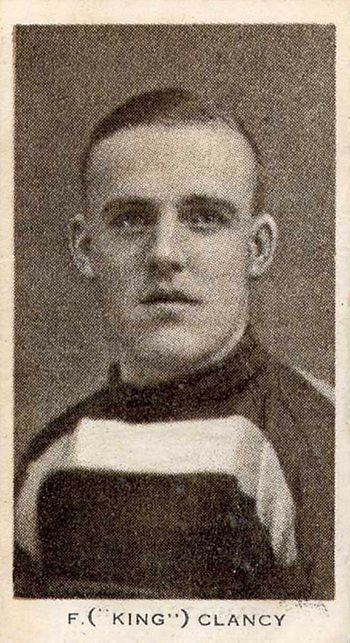
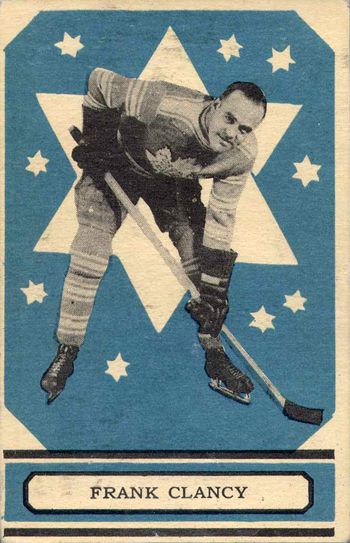
Francis Michael "King" Clancy was born in 1903 and played 16 seasons in the NHL from 1921 to 1937.
Clancy entered the NHL in 1921 playing for his hometown Ottawa Senators. His rugged style would earn him a reputation for heart and effort despite his small stature, as he was five feet seven inches and just 155 pounds. His outgoing personality off the ice combined to make him a fan favorite.

In only his second season, the Senators would win the NHL championship and face off against first the Pacific Coast Hockey Association champions the Vancouver Maroons, who they defeated 3 games to 1 to advance to face the Edmonton Eskimos, champions of the West Coast Hockey League. Game 1 would go to Ottawa 2-1 before the teams would meet again on March 31, 1923. Clancy, normally a defenseman, would set a record by by playing each position on the ice, including two minutes in goal when the regular Senators goaltender Clint Benedict served a penalty! It remains the only time that a player has played in all six positions in a Stanley Cup Final game. The Senators would go on to win the game 1-0 and capture the cup that day.
Four years later the Senators would capture the second cup of Clancy's career when they defeated the Boston Bruins 2 games to none, although there were a pair of ties between the clubs as well.
For the first eight seasons of Clancy's career, he would average 14 points a season with a high of 21, but in 1929-30, Clancy would rack up 17 goals and 23 assists for 40 points in 44 games, by far the most productive offensive season of his career, as he would never even reach 30 in any other season.
Before the following season, Clancy was dealt to the Toronto Maple Leafs for $35,000 and two players. Once in Toronto, Clancy would endear himself to the fans in Toronto with his enthusiasm, effort and out going personality.

He would capture the third and final Stanley Cup of his playing career when the Maple Leafs defeated the New York Rangers 3 games to none, with Game 1 in New York and Game 2 moved to Boston due to the circus being in town! Game 3 was played in Toronto where the Maple Leafs wrapped up the series at home.
Clancy's playing career would last five more seasons before he retired just six games into the start of a sixth. His final NHL totals would be 136 goals and 147 assists for 283 points and 914 penalty minutes.
After his second career as a referee, he began the third phase of his hockey life, moving into coaching in 1949 until 1956, including winning the Calder Cup when with the Pittsburgh Hornets of the American Hockey League. After moving into the front office following his coaching career, Clancy would eventually be named vice-president of the Maple Leafs.
Clancy was inducted into the Hockey Hall of Fame in 1958 and the King Clancy Memorial Trophy was named in his honor in 1987 to award the player who demonstrates leadership qualities on and off the ice and who has made exceptional humanitarian contributions in the community.
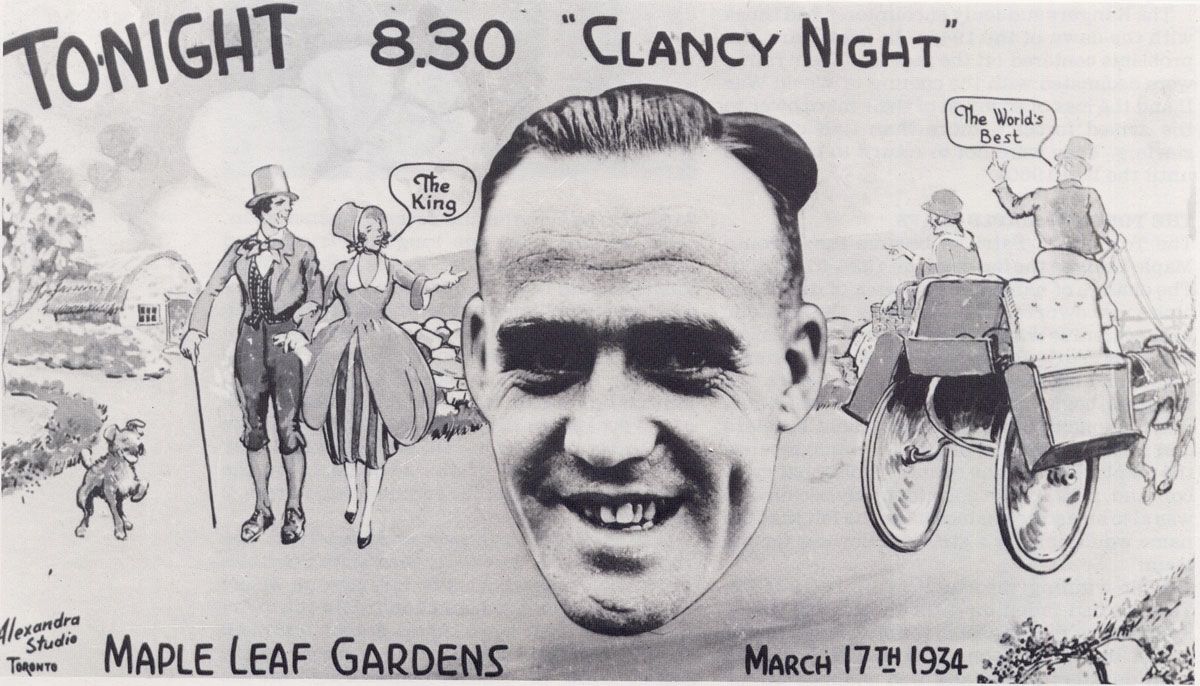
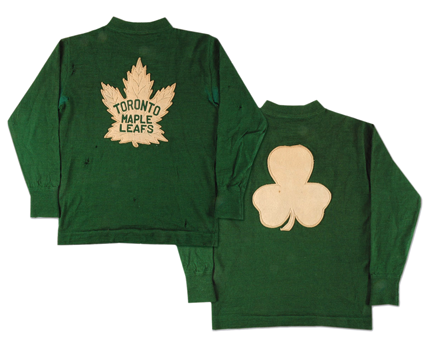
Today's featured jersey is perhaps the most unique one ever on Third String Goalie, a 1934 Toronto Maple Leafs St. Patrick's Day King Clancy jersey. Clancy was given this unique jersey to wear on "Clancy Night" on this day, St. Patrick's Day, in 1934 to celebrate his contributions to the Maple Leafs.

Uniquely, Clancy was the only player to wear this style jersey in the game while the rest of the Maple Leafs wore their traditional blue jerseys!
Clancy himself recalls the game and his unique sweater, "It was March 17, 1934, and it was King Clancy Night in Maple Leaf Gardens and they had me all dressed in green. Stockings, boots, uniform, stick, everything. It was Conn Smythe's idea, and I was a real sickly sight. We were playing the Rangers, and the first time he saw me when I came past the New York bench, Lester Patrick said, "My God, Clancy, what's this?" I think it was the only time I'd ever heard Lester utter a profanity. The effect of my outfit on the Rangers was amazing. They just sort looked at me and gagged, and for the entire first period not one of them came near me.
"I was having a field day on defense, and when the period was over Lester came to me and whispered, "King, what are you doing to me? My boys won't go anywhere near you, and you've got the whole building upset. You look awful. Come on now, King, how about taking that ridiculous uniform of so we can play hockey?"
"I just grinned and nodded, but to tell you the truth I did feel a little embarrassed, so I changed between periods. But really I changed out of respect for Lester. We won the game anyway."
This special green jersey features a shamrock on the back in place of Clancy's usual #7 and was worn during the first period of the game that night before protests by the New York Rangers apparently humorless Lester Patrick forced Clancy back into his more familiar blue and white Maple Leafs jersey for the remainder of the game, which was won by Toronto 3-2 in front of 11,000 adoring Clancy fans.

There is sadly little video online about King Clancy, but here is a look at the 1931-32 Stanley Cup Champion Toronto Maple Leafs that Clancy was a member of. Notice the diminutive size of the cup at the time.
Today we're all Irish.
Labels:
Clancy King,
Toronto Maple Leafs
Wednesday, March 16, 2011
1946-47 Detroit Red Wings Billy Taylor Jersey
While playing for the Oshawa Generals of the Ontario Hockey League, Billy Taylor began his junior career with 19 goals in 12 games during the 1937-38 season. During the Generals run to the Memorial Cup Finals, Taylor scorched the ice with 17 goals and 19 assists for 36 points in just 13 playoff games, a 2.77 points per game average as a rookie.
He picked up where he left off during the following season, scoring 22 goals and 53 points in 14 games. He helped lead Oshawa to their first Memorial Cup championship with 11 goals and 28 points in nine games, topping the 3 point per game average this time out.
Taylor competed for the Pittsburgh Hornets of the International-American Hockey League prior to making his NHL debut with 29 games with the Toronto Maple Leafs during the 1939-40 season. Over the course of the next three seasons, Taylor's scoring totals continued to rise, going from 35 to 38 in 1941-42, a season during which he won the Stanley Cup, and then finally 60 points from 18 goals and 42 assists during the 1942-43 season, good for sixth in the NHL scoring race.
His NHL career was interrupted by performing military service from 1943 to 1945, although he found the time to play for the Newmarket Army team as well as the Toronto Army Shamrocks in 1944-45, with his NHL quality talent scoring 29 points in 8 regular season games and topping that with 32 points in 8 playoff contests, a four point per game average.
Back in the NHL in 1945, Taylor did not miss a beat, as he set a career high in goals with 23 on his way to 41 points in 48 games.
Just prior to the start of the 1946-47 season, he was traded to the Detroit Red Wings where he immediately led the team in scoring with a career best 63 points from 17 goals and league leading 46 assists, which included an NHL record seven assists in a 10-6 Detroit win against Chicago on this date in 1947, a record which still endures today,
Despite leading the Red Wings in scoring, Detroit traded Taylor to the Boston Bruins for the 1947-48 season. He skated for the Bruins for 39 games until being traded to the New York Rangers on February 6th of that season. Taylor would only play two games for New York until being suspended for life by NHL President Clarence Campbell for violating the league's rules on gambling. Taylor's suspension was eventually lifted on August 25, 1970.
His career concluded with 323 games played, 87 goals and 180 assists for 267 points during a career interrupted by World War II and cut short by his suspension.
Today's featured jersey is a 1946-47 Detroit Red Wings Billy Taylor jersey as worn during his only season with the Red Wings. Detroit first wore their classic red jersey in 1932 when the club's name was changed from the Falcons to the Red Wings.
The jerseys were originally worn with red numbers trimmed in white for the first four seasons prior to changing to single color white numbers, which remain in use nearly 75 years later.
Of note, is the unusual treatment of the assistant captain's "A", which is contained in a diamond shape, something the Red Wings reprized in 1991-92 with their Turn Back the Clock jerseys worn during the NHL's 75th anniversary season.
Labels:
Detroit Red Wings,
Taylor Billy
Tuesday, March 15, 2011
1996-97 New Jersey Devils Dave Andreychuk Jersey
Drafted 16th overall in the 1982 NHL Entry Draft after playing his junior hockey with the Oshawa Generals, Dave Andreychuk began his NHL career with the Buffalo Sabres, where he would play for the first 11 years of his carer. While with the Sabres, he was a steady, reliable goal scorer.
During his first abbreviated season of 43 games, he would score 14 goals, but from then on tally a minimum of 25 goals with a high of 41 in 1991-92 while with Buffalo. During the 1992-93 season, he was traded to the Toronto Maple Leafs.
He completed the season with Toronto without missing a beat, totaling a career high 54 goals divided between the two clubs and followed that with 53 goals the following season. Two seasons later Andreychuk would be traded to the New Jersey Devils at the trade deadline.
Now a veteran of 14 NHL seasons, his goal scoring pace was no longer what it had once been in the high scoring 1980's and early 90's with a change in the role he was asked to play, but he continued to score at a steady pace near the 20 goal mark for the remainder of his career.
During his first full season with the Devils, Andreychuk would score his 500th NHL goal on this date in 1997 in a 3-2 win over the Washington Capitals, becoming the 26th player to reach that important milestone.
After two more seasons with the Devils, Andreychuk would sign with the Boston Bruins as a free agent for the 1999-00 season, only to be traded late in the season along with Ray Bourque to the Colorado Avalanche. After finishing the year with Colorado, Andreychuk would return to Buffalo as a free agent for the 2000-01 season.
His second stay in Buffalo would be considerably shorter than his first, as he played for the Sabres just one season before moving on to the Tampa Bay Lightning for 2001-02 as a free agent to provide the club with some needed veteran leadership. Steady and reliable as always, Andreychuk would play 82 games that season, followed by 72 and again 82, while scoring 20 or more all three seasons.
While never a threat to win the Stanley Cup with the Sabres, Andreychuk made it as far as the conference finals with Toronto twice (1993 & 1994) and again with Colorado in 2000, but came up short of the finals all three times. Finally, while with Tampa Bay, Andreychuk had his chance in 2004. Coming from behind 3 games to 2, Tampa Bay rallied with a double overtime win on the road in Game 6 and captured the Stanley Cup 2-1 at home in Game 7. As the team captain, Andreychuk had the honor of accepting the cup on behalf of the team, to the delight of many around the league, happy to see the veteran finally reach the pinnacle of the sport after 22 seasons before a championship, tying a league record.
He would play one more partial season in 2005-06 prior to retiring with 1,639 games played (5th all-time), 640 goals, one of 18 players with 600 or more goals and still 13th on the all-time list, 698 assists and 1,338 points, currently 27th all-time. He also holds the career record for Most Power Play Goals with 274.
Today's featured jersey is a 1996-97 New Jersey Devils Dave Andreychuk jersey as worn while he scored his 500th NHL goal on this date in 1997.
Club president and general manager Lou Lamoriello has steadfastly refused to change the now classic Devils jersey. Lamoriello joined the Devils in 1987, inheriting their red and green jerseys in the process. For the 1992-93 season the team changed their color scheme by changing the green to black and simplifying their jerseys striping pattern and have stuck with with look ever since, including the name and number fonts.
They have also refused to introduce any sort of alternate third jersey and were able to maintain their traditional sweaters even through the transition to the new Reebok jerseys introduced in 2007.
Today's video segment begins with Andreychuk scoring his 500th NHL goal on this date in 1997.
Our next video is Andreychuk finally being able to lift the Stanley Cup after 22 seasons of trying.
Labels:
Andreychuk Dave,
New Jersey Devils
Subscribe to:
Posts (Atom)