History of Jersey 83-93 Banner sm photo History of Jersey 83-93 Banner sm.jpg

Wednesday, March 8, 2017

The GAG Line - Rod Gilbert, Jean Ratelle and Vic Hadfield

The formation of the New York Rangers famous GAG Line actually dates back to 1950 in the suburbs of Montreal when Rod Gilbert and Jean Ratelle were just 10 years old. Gilbert lived next to the Brothers of Sacred Heart School where Ratelle was a student. The both played pickup hockey on the school grounds and became good friends. Gilbert recalls, when I first saw him on the ice, I said, "You play with me all the time, okay?" Two years later the duo even played at the Montreal Forum in the finals of a peewee tournament.

When he was just 14, Gilbert was signed to play junior hockey by Yvon Prud'homme, who worked for the New York Rangers. Gilbert told Prud'homme, "I have a friend I've been playing with since I was a kid and he's better than me. Sign him up and we'll play together." Prud'homme took the teenage Gilbert's scouting advice and signed Ratelle without ever seeing him play.

The pair played together for the Guelph Biltmore Mad Hatters, renamed the Guelph Royals in 1960, junior hockey from 1958-59 through 1960-61. Right wing Gilbert led the team in scoring in 1959-60 with 39 goals and 91 points while center Ratelle was right with him, scoring an equal 39 goals on his way to 86 points as the duo finished second and third in the Ontario Hockey Association.
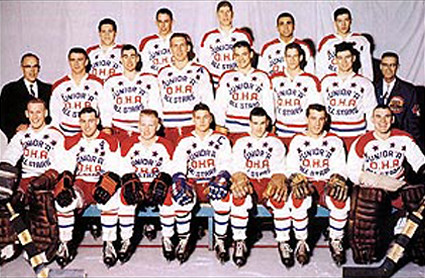
1959-60 OHA All-Stars
Gilbert and Ratelle were on the 1959-60 OHA All-Star Team

The following season Gilbert again led the team with 54 goals and 103 points with Ratelle again second with 40 goals and 101 points for the Royals as the pair finished 1-2 in OHA scoring, 14 points clear of their nearest pursuer. Both players also made their NHL debuts that season, with Ratelle playing 3 games, scoring twice, while Gilbert played for the Rangers once.
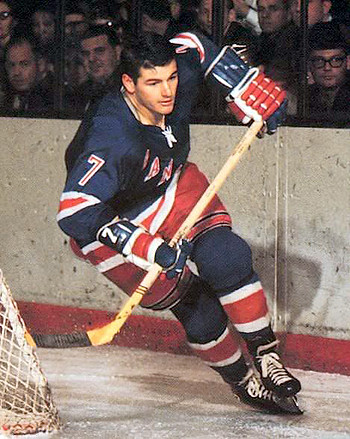
Gilbert Rangers 2
Gilbert debuted with one game in 1960-61

Meanwhile, Vic Hadfield was playing his way toward the NHL via a different route, playing junior hockey for the St. Catharines Teepees of the OHA and the Buffalo Bisons of the AHL. Hadfield, claimed by New York from the Chicago Black Hawks in the 1961 Intra-League Draft, made his Rangers debut in 1961-62, seeing action in 44 games, but only scoring 3 goals and 1 assist, giving little clues as to what was to come.

In 1964, Gilbert and Ratelle's junior hockey coach Emile Francis became the Rangers General Manager and the following season, their Head Coach. One of his first moves was to put the large and rugged Hadfield on a line with Gilbert and Ratelle for the 1965-66 season. Up to that point, the Rangers had missed the playoffs seven out of the last eight seasons, a difficult feat in an era where four of the six NHL teams made the playoffs.

After missing the playoffs his first season as head coach when Francis took over 20 games into the schedule, the Rangers would make the playoffs in nine consecutive seasons.

Up to this point, Gilbert had had some success at the NHL level, scoring 24 goals and 64 points in 1963-64 and 25 goals a year later. Hadfield's best season to date was 18 goals and 38 points in 1964-65 while Ratelle had only managed a high of 14 goals and 35 points.

Rod Gilbert Rangers photo RodGilbertRangersyoung.jpg
Rod Gilbert

It took the newly created line some time to find their game as Gilbert only played in 34 games in 1965-66 and the lowly Rangers finished in the basement with just 18 wins in 70 games, 27 points out of a playoff spot.

For the 1966-67 season, Ratelle was the one who had to deal with an injury, as he only saw time in 41 games, scoring a dismal 11 points. Meanwhile, Gilbert returned to health and set a new career best with 28 goals. The rest of the Rangers roster was on the upswing was well, as Francis added key pieces such as goaltender Ed Giacomin, and the club improved to a winning 30-28-12 record for a 25 point increase and their first spot in the playoffs since 1962.
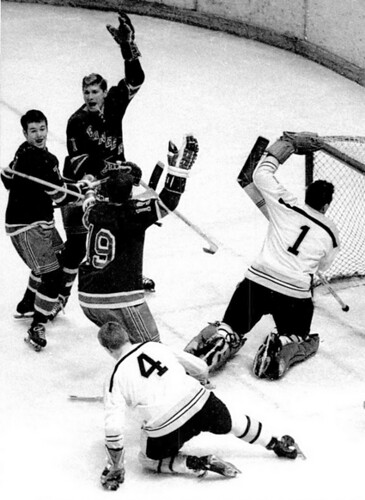
GAG Line celebratesjpg
Gilbert, Hadfield and Ratelle celebrate a goal against the rival Bruins

The hockey landscape was forever changed with the 1967-68 season when the NHL expanded by six teams, doubling the size of the league. This played into the hands of the established Original 6 clubs, as the newcomers were soundly defeated by the established teams on a regular basis, as many players not nearly good enough to play in the previous version of the six team NHL were now regular competition for the veteran clubs. While it was Hadfield's turn to have a limited season, playing in 59 of the Rangers 74 games, it was enough for him to score 20 goals, while Gilbert hit new highs with 29 goals and 77 points while Ratelle led the team in scoring with 32 goals and 78 points as he and Gilbert finished fourth and fifth in the NHL scoring race behind the likes of Stan Mikita (87), Phil Esposito (84) and Gordie Howe (82) and ahead of Bobby Hull (75), putting them among the league's elite.
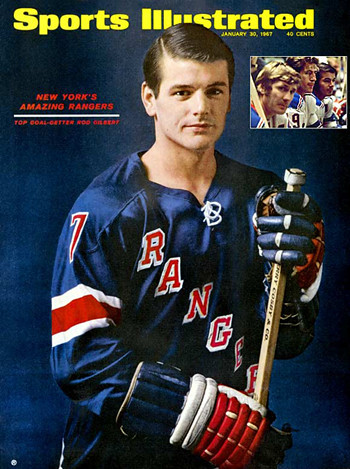
rod-gilbert 1967 SI
Rod Gilbert on the cover of Sports Illustrated in 1967

As the Hadfield-Ratelle-Gilbert line totaled 81 goals in 74 games, the New York sportswriters dubbed the line the GAG Line, which stood for Goal-A-Game.

"Jean and I knew each other's moves so well, we didn't even have to look," said Gilbert. "We needed someone who could do some of the dirty work in the corners and position himself in front of the net without being pushed around. Vic Hadfield was the perfect compliment for us."

"I was aggressive, and being aggressive for so long, I had more space on the ice because people stayed away from me. You have to stick with what go you there," said Hadfield scouting his own style of play.
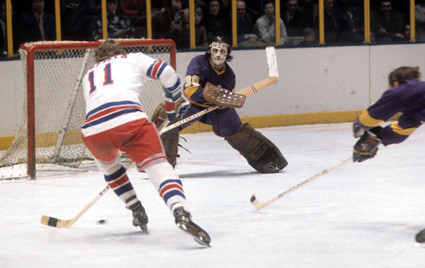
BBS_Archives2853.jpg
Vic Hadfield attacking the Kings goal

In 1968-69, the line lived up to their nickname, scoring a combined 86 goals as they finished one, two, three in Rangers scoring, led by Ratelle's 32 goals and 78 points. Once again, Gilbert was a single point back with 77 while Hadfield had 26 goals and 66 points, a leap forward for him, having never scored even 40 previously.
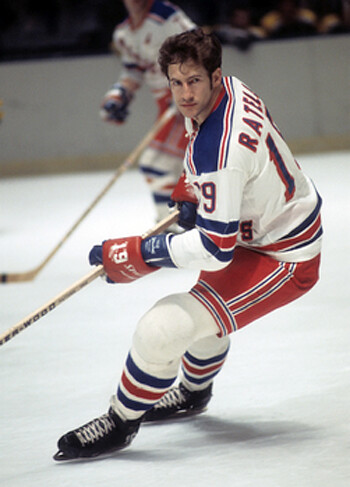
Ratelle Rangers 2
Ratelle led New York in scoring in 1969

While Ratelle had 32 goals and 74 points in 1969-70, Walt Tkaczuk led the Rangers with 77 as they were fifth and sixth in the NHL. Hadfield managed 20 goals and 54 points, while Gilbert had a down year with 16 goals and 53 points in 72 games.

For the 1970-71 campaign, Tkaczuk edged Ratelle 75 points to 72 while Gilbert returned to form with a 30 goal, 61 point season for third on the team. Hadfield meanwhile, had his fourth consecutive 20 goal season with 22.
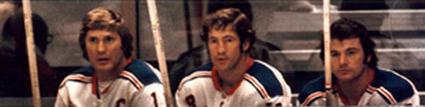
GAG Line Rangers Pictures, Images and Photos
The GAG Line, Hadfield, Ratelle and Gilbert

It all finally came good for the GAG Line in 1971-72 when everything turned to gold. On February 17th at the Los Angeles Kings, Ratelle scored his 40th goal of the season from Gilbert and defenseman Brad Park.

On February 23rd, Hadfield, who had been named the Rangers team captain that season, hit 40 at home in Madison Square Garden with assists from Gilbert and Ratelle.

Then, on this date in 1972, five games later, Gilbert scored his 40th goal of the season from Jim Neilson and Bobby Rousseau to make the GAG Line the first line in NHL history with three 40 goal scorers during a 3-3 tie against Chicago.

Over the Rangers final dozen games, the trio did not slow down, as they completed their dream season as Ratelle finished with 46 goals and 63 assists for 109 points. Hadfield remarkably finished with 50 goals and 56 assists for 106 points, never having more than 31 goals in any other season in his 16 year NHL career. Hadfield was also the first Rangers player to ever score 50 goals in a season.
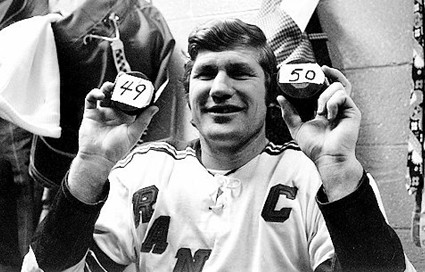
Hadfield Rangers 4
Hadfield celebrates becoming the first Ranger
to score 50 goals in a season

Gilbert was third on the club with 43 goals and 54 assists for 97 points. All three players set career highs in goals, assists and points, save Gilbert who had 61 assists three seasons later. It was the only 100 point season for Ratelle and Hadfield.

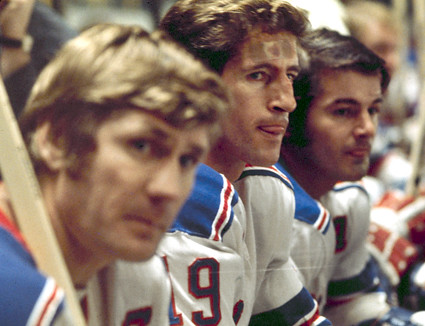
Overall, Ratelle was third, Hadfield fourth and Gilbert fifth in league scoring and in goals, Hadfield (2nd), Ratelle (5th) and Gilbert (7th), and in assists, Ratelle (3rd), Hadfield (4th) and Gilbert (6th) were all on the league leader board. Impressively, Ratelle's team leading 109 points came from just 63 games, as he was leading Esposito in the scoring race when he broke his ankle and missed a month of the season.
T1527403_15
Hadfield, Ratelle and Gilbert

In the playoffs, the Rangers defeated the defending champion Montreal Canadiens in six games and the previous season's other finalist, the Black Hawks, in four straight to reach the Stanley Cup Finals for the only time in the history of the line, only to run into the Esposito and Bobby Orr led Boston Bruins at their peak, who denied the Rangers the cup in six games, thanks in part to the injury to Ratelle, who was limited to just six ineffective playoff games, scoring just one assist.
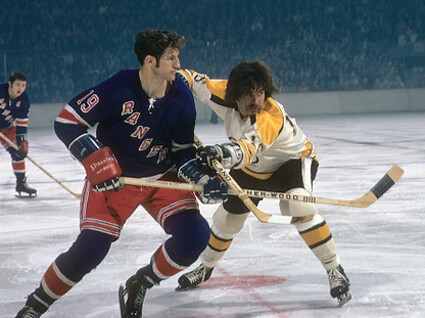
Ratelle Sanderson
Ratelle battling the Bruins Derek Sanderson

The line would play two more seasons together with Ratelle leading the team in scoring again in 1972-73 with 41 goals and 94 points (sixth overall) and Gilbert second with 25 goals and 84 points while Hadfield had 28 goals. During their final season together, the GAG Line lived up to their name yet again, combining for 91 goals in 78 games, as Gilbert was second behind Park's 82 points with 36 goals and 77 points as Ratelle had 28 goals and 67 points while Hadfield had 27 goals and 55 points, his seventh consecutive season of 20 goals or more for New York.

The line was broken up on May 27, 1974 when Rangers captain Hadfield was traded to the Pittsburgh Penguins in a cost saving move. He would have a pair of 30 goal seasons for the Penguins until a knee injury early in the 1976-77 season ended his career. His final career totals were 1,002 games played with 323 goals and 389 assists for 712 points.
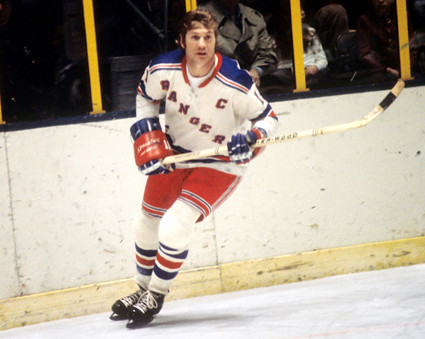
BBS_Archives4130.jpg
Rangers captain Hadfield

Ratelle was the next to leave, dealt to the Bruins in a blockbuster deal that saw himself, Park and Joe Zanussi in exchange for Esposito and Carol Vadnais after 13 games of the 1975-76 season. He continued to excel with the Bruins, scoring 30 goals twice and 25 or more three additional times. His career was the longest of the three, with his last season being 1980-81, his sixth with the Bruins. Ratelle would lead the Rangers in scoring four times and the Bruins twice. He would finish his career with 1,281 games played with 491 goals and 776 assists for 1,267 points and was inducted into the Hockey Hall of Fame in 1985. Individually, he won the Bill Masterton Trophy in 1971 and the Lady Byng Trophy in both 1972 and 1976. The Rangers have announced that they will retire Ratelle's jersey #19 during the 2017-18 season.
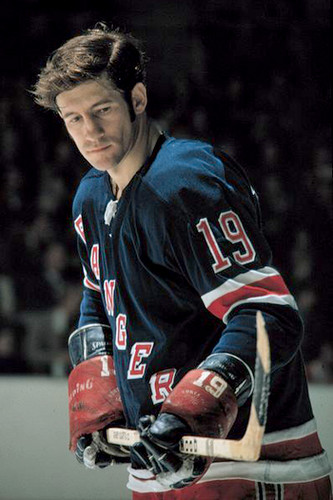
Ratelle Rangers 1
Jean Ratelle led the Rangers in scoring four times

Gilbert would play four more seasons for the Rangers, including equaling his stellar 1971-72 point total in 1974-75 when he had 36 goals and a career high 61 assists for 97 points to lead the Rangers for the second of three times. He again had 36 goals in 1975-76, his fifth season of 30 goals or more. Gilbert's final totals were 1,065 games played, all with the Rangers, 406 goals and 615 assists for 1,021 points. He won the Masterton Trophy in 1976 and the Lester Patrick Trophy in 1991. His #7 was retired in 1979, the first number retired in the 54 year history of the Rangers. He was inducted into the Hockey Hall of Fame in 1982.
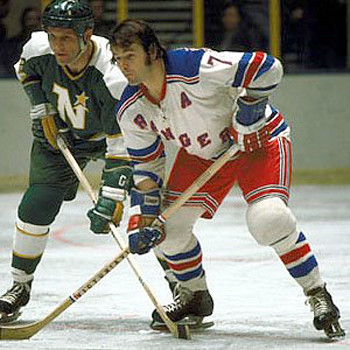
Gilbert Rangers
Gilbert played 18 seasons with the Rangers

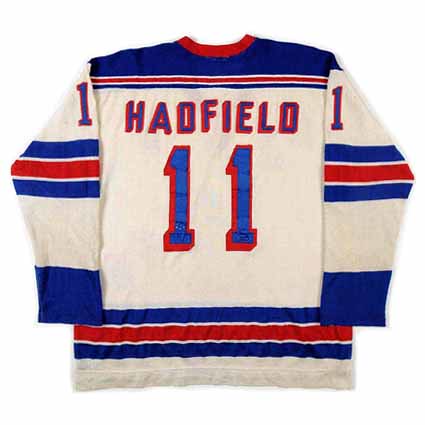
Today's first featured jersey is a 1971-72 New York Rangers Vic Hadfield jersey. The Rangers wore only blue jerseys for their first 25 seasons, finally adding a white jersey in 1951-52. Other than detail changes, such as the addition of sleeve numbers in 1963 and names on the back in 1970, which then became vertically arched in 1990, the Rangers white jerseys are unchanged since their introduction over 65 years ago, making them a true classic in the history of the NHL.
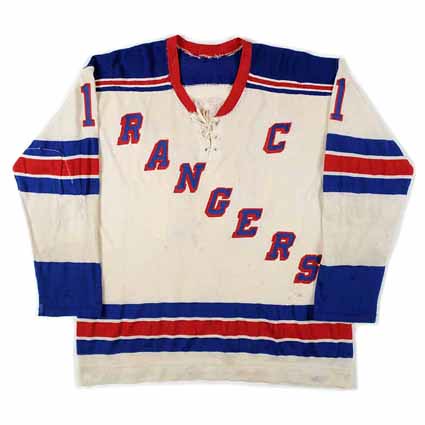
New York Rangers 1972-73 F jersey
New York Rangers 1972-73 B jersey

Today's second featured jersey is a 1971-72 New York Rangers Jean Ratelle jersey. The Rangers debuted in 1926 wearing jerseys not too dissimilar to the one worn by Ratelle in 1971-72. The original white lettering changed to red for their second season of play. The font still used for the cresting arrived in 1941 and the drop shadow on both the crest and the numbers came a year later. In 1951 the laces were added to the collar and they arrived at today's style when the sleeve numbers arrived in 1963.

This jersey would be used through 1975-76 before a new, modern jersey was worn for two seasons with the Rangers shield as the main crest. In 1978-79, this style returned, only with Rangers replaced by "New York" on the front until reverting back to "Rangers" in 1987.

 photo New York Rangers 1971-72 F jersey.jpg
 photo New York Rangers 1971-72 B jersey.jpg

Today's third featured jersey is a 1971-72 New York Rangers Rod Gilbert jersey as worn during the GAG Line's record setting season when all three members became the first line in which each member scored 40 goals.

Gilbert wore #7 for a combination of reasons, first being the #9 he wore in juniors was in use by Rangers star Andy Bathgate, #7 was popular in New York due to Mickey Mantle and there were seven members of Gilbert's family, counting his parents and four siblings.
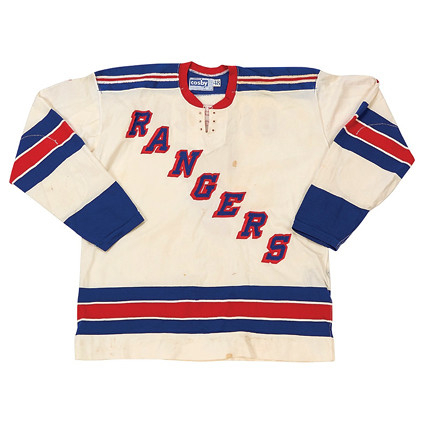
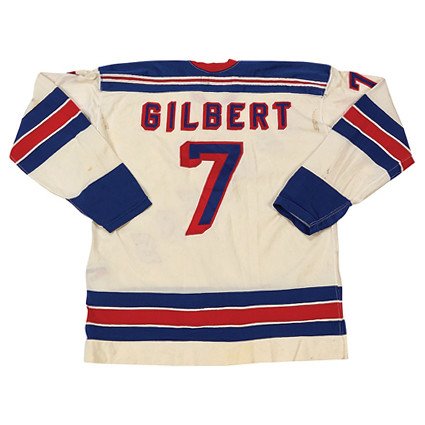
New York Rangers 1971-72 F jersey
New York Rangers 1971-72 B jersey

Bonus jersey: Today's bonus jersey is a 1977-78 New York Rangers Rod Gilbert jersey from his final season in the NHL after the departure of both Hadfield and Ratelle, making him the only one of the three to wear this style, which was first introduced by then General Manager John Ferguson Sr. in the 1976-77 season and was the first departure in club history from the iconic diagonal "RANGERS" cresting.
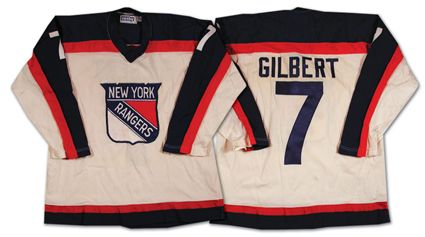
photo courtesy of Classic Auctions

After proving unpopular with the tradition bound Rangers fans, this style was only used for two seasons, the first without names on the back of the road jerseys and, thanks to a new NHL rule requiring them, with them on the back for the 1977-78 season. Names were always worn on the home white jerseys.

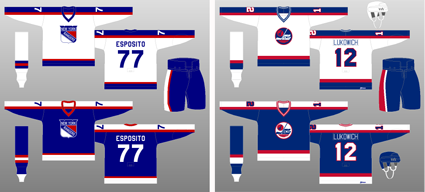
After being let go by the Rangers in 1978, Ferguson became the general manager of the Winnipeg Jets and reprized the exact same jersey template for the Jets beginning with their inaugural NHL season in 1979, with the only differences being the font for the name and numbers and, naturally, the team logo. The Jets would use this style all throughout the 1980's.

In today's video section, the excellent Legends of Hockey profile on Gilbert.


Next, ten minutes of footage of the Rangers and the GAG Line taking on the Maple Leafs from the 1970-71 season.

Tuesday, March 7, 2017

1974-75 Montreal Canadiens Guy Lafleur Jersey

The Montreal Canadiens were founded in 1909 as members of the brand new National Hockey Association in order to provide the French fans of Montreal a team to rival the Anglophone Montreal Wanderers.

The first player to ever score a goal for the Canadiens was future Hall of Famer Newsy Lalonde, who would lead the club with 16 goals despite only appearing in 6 games before being traded to the Renfrew Creamery Kings (also known as the Millionaires). Lalonde would add another 22 goals for Renfrew in just five games to lead the NHA in scoring with 38 goals, as assists were not awarded back then. Lalonde would return to Montreal for the 1910-11 season and again led the club with 19 goals in 16 games.

Newsy Lalonde photo Newsy Lalonde 1909-10.png
The first goal scorer in Canadiens history, Newsy Lalonde,
picture here in the first ever Canadiens sweater

With Lalonde lured out west by the Vancouver Millionaires for the 1911-12 season, Didier Pitre became the first Canadiens player to reach the 20 point mark when he finished as the runner up in the NHA scoring race with 27 goals in an 18 game schedule.

In 1914-15, Pitre became the first Canadiens player to reach the 30 point mark when he totaled 34 points from 30 goals and 4 assists, which were now credited as of 1913-14. Pitre barely missed out being the first 40 point scorer in 1915-16 when his 24 goals and 15 assists, but his 39 points made him the first Canadien to lead the league in scoring.

Didier Pitre photo Didier Pitre.jpg
Pitre was the first Canadiens player with both 20 and 30 points

For the 1917-18 season, the NHA was disbanded and a new league rose to take it's place, the National Hockey League, of which the Canadiens were charter members. The brand new NHL was led in scoring by Joe Malone, who was on loan from the dormant Quebec Bulldogs. Malone was teamed with Lalonde and Pitre and the trio put on a scoring display unlike any ever seen before, as Malone became the first Canadiens player to top 40 points when he blitzed the league for 44 goals and 4 assists for 48 points in just 20 games. Malone's 44 goals in 1917-18 would stand as the league record for 46 years until 1943-44!

Joe Malone photo Joe Malone Montreal.jpg
Joe Malone's 44 goals stood as the NHL record for 46 years

Such was the dominance of Malone's season, it would take until the 1927-28 season for Howie Morenz to become the first for Montreal to reach the 50 point barrier when his 33 goals and 16 assists game him 51 points to not only lead the club, but the entire NHL.

Howie Morenz photo Howie Morenz Canadiens.jpg
Howie Morenz was the first to 50 points

While Toe Blake came oh-so-close to hitting 60 points in 1942-43 with 59, the honors went to teammate Elmer Lach the following season when he vaulted past the 60 point barrier on his way to 72! While it took 16 years for Lach to hit both 60 points and 70 for the first time in team history, it took him just 12 months to become the first member of the Canadiens with 80 when he scored 26 goals and 54 points for exactly 80 in 1944-45, leading a 1-2-3 Canadiens sweep of the NHL scoring race, as Lach's 80 led Maurice Richard's 73 and Blake with 67.

Elmer Lach photo Elmer Lach.jpg
Lach rewrote the Montreal record book in the 1940's,
as he was the first to 60, 70 and 80 points in two seasons

While Jean Beliveau came close with 88 points in 1955-59, it would be left winger Dickie Moore to first reach the 90 point plateau with 41 goals and 55 assists for 96 points, with Beliveau close behind at 91 to finish 1-2 in the league.

Dickie Moore photo Dickie Moore Canadiens.jpg
Dickie Moore pushed the mark to 90 points

While both Frank Mahovlich (96 in 1972) and Jacques Lemaire (95 in 1973) would take runs to become the first to reach the century mark, it would be Guy Lafleur who would take the honors as the first Canadien in the then 58 year history of the club to ever reach 100 points in a single season when he scored twice and added two assists on this date in 1975 in an 8-4 Montreal win over the Washington Capitals in Montreal.

Lafleur would go on to surpass 110 points later that season as he finished with 53 goals and 66 assists for a total of 119 points.

Just one season later, Lafleur eclipsed the 120 point mark with 125 from 56 goals and 69 points to win the NHL scoring race, a feat he repeated the very next season of 1976-77 as he amassed 136 points from 56 goals and 80 assists to set a team record which still stands to this day.

Guy Lafleur photo Guy Lafleur Canadiens.jpg
Guy Lafleur was the first to 100, as well as 110, 120 and
130 points in the span of just three seasons during the 1970's

To put Lafleur's 136 point season into perspective, Max Pacioretty led Montreal in scoring in the 2013-14 season with 60 points, less than half of Lafleur's record setting total.

Today's featured jersey is a 1974-75 Montreal Canadiens Guy Lafleur jersey as worn during the season Lafleur became the first player in franchise history to score 100 points in a single season.
While the first red Canadiens sweater with a blue band across the chest can be traced back to the 1912-13 season, it underwent a period of evolution, which included a "CA" crest before adopting to the "CH" logo in 1916, until arriving at the today's featured jersey for the 1966-67 season when the sleeve numbers were relocated inside the arm stripes. The 1974-75 season would be the final one for this variation with the lace up collar, which arrived back in 1941, as it would be replaced by a modern v-neck for 1975-76.

Montreal Canadiens 1974-75 jersey photo Montreal Canadiens 1974-75 jersey copy.jpg
photo courtesy of Classic Auctions

Today's video section is a career retrospective of Lafleur in his native French.

Monday, March 6, 2017

1985-86 Philadelphia Flyers Mark Howe Jersey

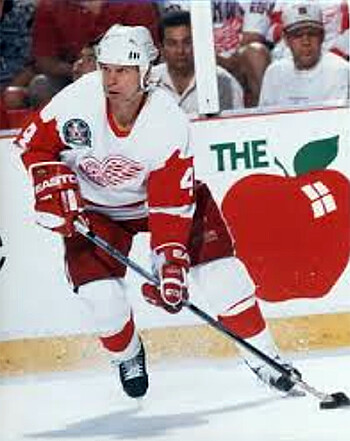
Mark Howe first gained recognition as a surprising addition as member of the 1972 United States Olympic Team that won a remarkable silver medal in Sapporo, Japan. At just 16 years old, and still only a high school junior who had just recently gotten his driver's license and playing on a team with Vietnam War veterans, he remains the youngest member of a US Olympic Hockey Team ever.

1972 USA Olympic team
1972 United States Olympic Team - Mark Howe, back row first on left

"We picked Mark up, and he played some exhibition games with us. We needed a left winger. He was on our list for skill and attitude. The maturity level of this kid was overwhelming. He was a big part of the team. He was tougher than hell. Vlclav Nedomansky of Czechoslovakia nailed him in a preseason game, and he didn't know where he was, but it didn't bother him at all. I used him as a forward, and he became a Hall of Fame defenseman."
Howe recalls,
"The whole thing was just a great, great learning experience. The way I looked at it for my career, it was a huge stepping-stone. I learned more in the six weeks I was gone than I learned in the years and years of going to school. I mean, just about life in general - and just seeing the talent of the players from overseas, watching the Soviets play was a whole new level. Coach Williamson pushed me hard. I was a scorer. But when I went to that team, I wasn't. I was the guy who provided energy. I had to fit into a role, and so for me, it was a completely different experience - a tremendous learning experience."
During the medal ceremony as Howe stood with a silver medal around his neck, it finally struck him that this was a moment to savor.
"I remember looking up at the flag, and that's when I realized what an honor it was the play and represent your country. No matter what I did, I always gave the best I could. Seeing the flag of your country being raised - even though there was one a little higher than ours - was my fondest moment."
He then added to his resume by winning a Memorial Cup in 1973 as a member of the Toronto Marlboros of the Ontario Hockey League and was named the tournament's Most Valuable Player in the process.

At a time when the NHL had an minimum age limit of 20 for it's players, the 18 year old Howe turned professional during the NHL/WHA rivalry in a headline-grabbing signing to play for the Houston Aeros of the WHA along side his brother Marty Howe and his legendary father Gordie, who was lured out of retirement for the opportunity to play with his sons.

Mark,Gordie and Marty Howe
Marty, Gordie and Mark Howe

Mark scored his first goal 27 years to the day after his father scored for the first time for the Detroit Red Wings. His trophy cabinet continued to grow, as Mark was awarded the Lou Kaplan Award as WHA Rookie of the Year and the Aeros won the Avco World Trophy in 1974. In 1975 the Aeros repeated as champions of the WHA and Howe was the leading playoff scorer with 22 points in 13 games. He was also named to Team Canada for the 1974 Summit Series against the Soviet Union.

Mark and Gordie Howe 1974 Summit Series
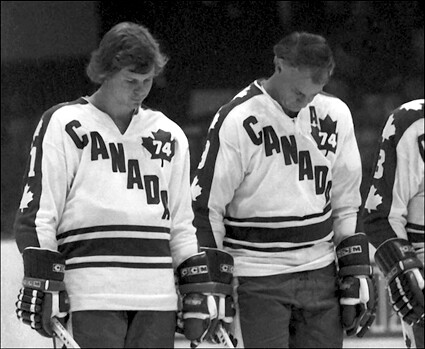
Mark and Gordie Howe suited up for Canada at the 1974 Summit Series

Howe, who began his career as a wing, had moved back to defense by 1976-77 and the trio of Howes signed with the New England Whalers for the 1977-78 season. They continued to play together through the 1979-80 season when the Whalers became members of the NHL. While he regularly scored in the mid-70's points-wise in Houston, his offensive game came alive in New England, first with 91 points in 1977-78 which was followed by 107 points in the final WHA season of 1978-79 before scoring 80 in his first NHL season.
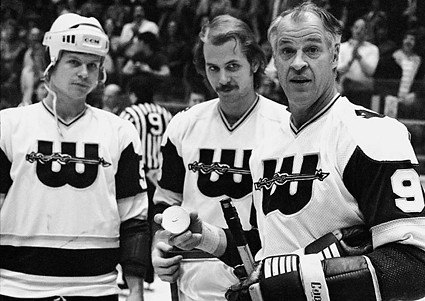
Mark, Marty and Gordie Howe Whalers
The Howe trio moved to Hartford for 1977-78

After Gordie retired following the 1979-80 season, Mark no longer had to play in his father's shadow and was named to his first NHL All-Star Game in 1981 and was later played for the United States in the 1981 Canada Cup.

After one more season in Hartford, Howe was traded to the Philadelphia Flyers at the 1983 draft following concerns after a grisly injury in which he was impaled in the thigh by the pointed center of a goal. His recovery required a liquid diet for a period of time that resulted in him losing 24 pounds. His injury resulted in a redesign for goal frames and the way they were held in place on the ice.

Mark Howe Flyers Cooperalls 1981-82
Howe was present in Philadelphia during
the brief "Cooperalls" era

He rebounded from his injury and excelled as a member of some great defensive teams of the era. Howe played in his second All-Star Game and was a finalist for the Norris Trophy in 1983 and played in the Stanley Cup Finals in 1985.

He had perhaps the best season of his career in 1985-86, setting NHL career highs with 24 goals, 58 assists and 82 points, made his third All-Star Game, was the NHL plus/minus leader at +85 and came in second in voting for the Norris Trophy.

Perhaps the highlight of his season came on this date in 1986 when the Flyers hosted the Toronto Maple Leafs. The first period had ended with the Flyers trailing 2-1, but Howe tied the game with his 22nd goal of the season with assists from twin brothers Rich Sutter and Ron Sutter at 2:47 of the second on a power play.


Five minutes later, Howe struck again, this time from Pelle Eklund and Ilkka Sinisalo even strength at 9:35 for a 3-2 Philadelphia lead. Toronto tied the game a little over five minutes later, but with just four seconds remaining in the second, Tim Kerr scored his 45th goal from Brad McCrimmon and Howe to restore the Flyers one goal advantage going into the third period.

It only took the Maple Leafs a minute and a half to tie the game at 4-4, but then the same combo that was responsible for the second Flyers goal struck again, this time Ron Sutter scoring from Rich Sutter and Howe for a 5-4 lead for Philadelphia.

The game remained close until, with just 1:08 to play, Lindsay Carson beat Toronto's Don Edwards from Howe to give the Flyers a two goal cushion. With Edwards now pulled, Sinisalo scored his 29th goal of the year into an empty net, with assists going to Howe and Murray Craven. It was Howe's fourth consecutive assist and followed his back-to-back goals, giving him six points on the night and on six consecutive Flyers goals.

In addition, his six points set new Philadelphia team records for goals, assists and points in a season by a Flyers defenseman.

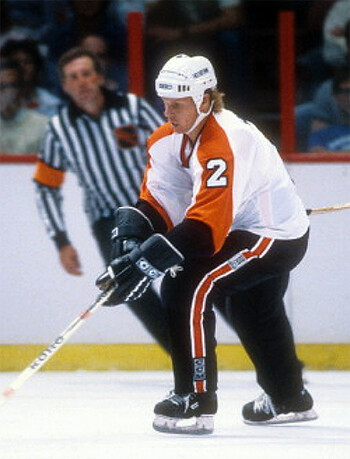
Mark Howe Flyers
Howe rewarded the Flyers faith with a ten year run for the club

In 1986-87 Howe helped lead the Flyers to the 1987 Stanley Cup Finals while contributing 12 points in 26 games from the blueline and was a Norris finalist for the third time.

After playing 75 games in 1987-88 and his fourth All-Star Game, back and knee injuries would limit him to no more than 60 games for the remaining seven seasons of his career. 

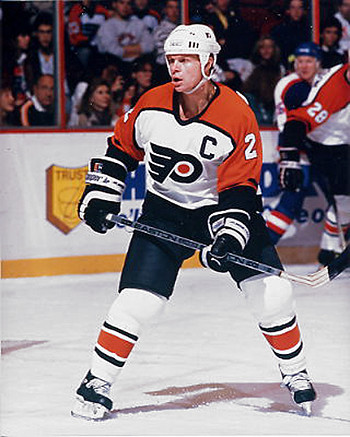
 Mark Howe Flyers captain
The respected Howe served as the Flyers captain at times

After four more seasons with the Flyers, Howe signed as a free agent with the Detroit Red Wings, the club his father gained most of his fame with.

While healthy, Howe provided veteran leadership to the Red Wings defensive corps, which included a young Nicklas Lidstrom. The Red Wings began a transformation in 1993-94 with the arrival of Scotty Bowman as coach and made the Stanley Cup Finals in 1995, their first finals appearance since 1966.

Mark Howe Red Wings
Howe finished his long career with Detroit

After one more season, in which he was limited to just 18 games, Howe retired with 929 NHL games and 426 in the WHA for a combined 405 goals and 841 assists for 1246 points. He won an Olympic silver medal in 1972, was WHA Rookie of the Year in 1974 and won the WHA Avco World Cup in 1974 and 1975. He was the 1986 NHL Plus/Minus Award winner and a four time NHL All-Star.

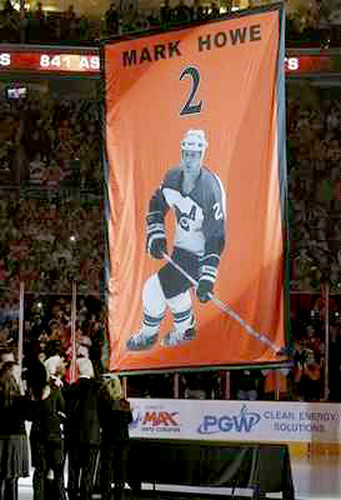
He was elected to the United States Hockey Hall of Fame in 2003 and was inducted into the Hockey Hall of Fame in 2011. Also on this date in 2012, the Flyers retired Howe's #2, making him only the fifth Flyer to ever be so honored.

Mark Howe jersey retirement 
Howe had his number 2 retired on this date in 2012

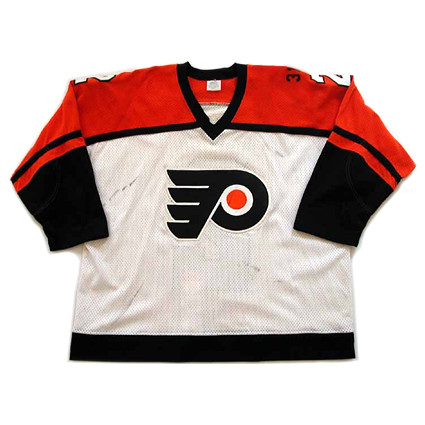
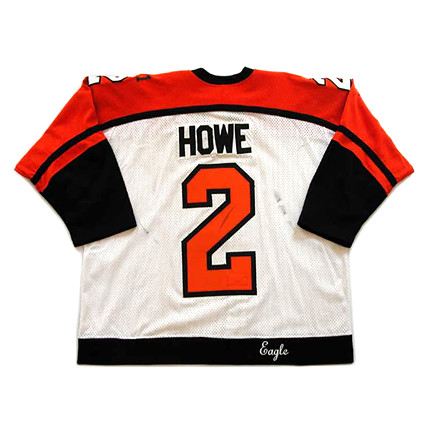
Today's featured jersey is a 1985-86 Philadelphia Flyers Mark Howe jersey, the season he set Flyers single season records for goals, points and assists by a defenseman and both his goals and points records still stand today.

The Flyers jerseys remained relatively unchanged from their introduction in 1967 with only gradual detail changes such as the addition of black outlines separating the sleeve and body colors in 1982 and tweaks to the names and numbering style.

Philadelphia wore the #31 on the left shoulder above their sleeve numbers in memory of goaltender Pelle Lindbergh, who was killed in a car accident.

Philadelphia Flyers 1985-86 F jersey
Philadelphia Flyers 1985-86 B jersey

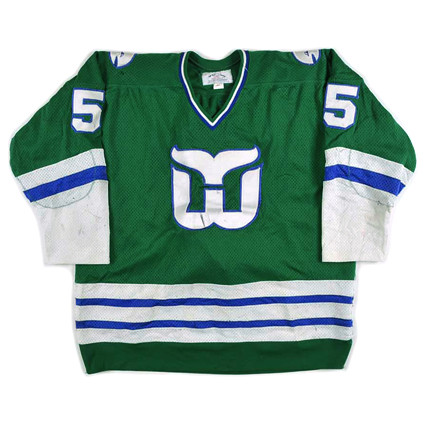
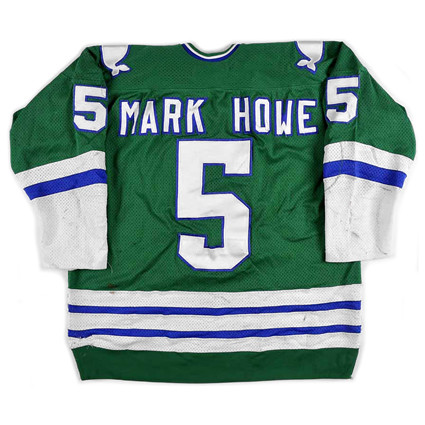
Bonus jersey: Today's bonus jersey is a 1980-81 New England Whalers Mark Howe jersey. From the beginning part of Mark's career when he played with both his father Gordie and his brother Marty, Howe wore his first name on his jerseys from his pro debut with the Houston Aeros in 1973 through his final season with the Whalers of 1981-82.

The Whalers wore this style of jersey beginning with their entry into the NHL in 1979-80. One of the terms of their acceptance into the NHL was to change their name from the New England Whalers, used  for seven years while members of the WHA, to the Hartford Whalers at the insistence of the Boston Bruins, who apparently thought of themselves as New England's team. The name change necessitated a new logo, the ever-popular whale tail logo with the hidden H in the negative space.

This jersey remained in use through the 1984-85 season, including one year being paired with the "Cooperalls" long pants, one of only two teams to use the short lived trousers. The jersey saw the unfortunate removal of the Pucky the Whale shoulder logos in 1985-86 but continued to be worn through the 1991-92 season, although with the angled sleeve stripes straightened in 1989-90, until a new set of jerseys debuted in 1992-93 with blue replacing green as the primary team color.

Hartford Whalers 198-81 F jersey
Hartford Whalers 198-81 B jersey


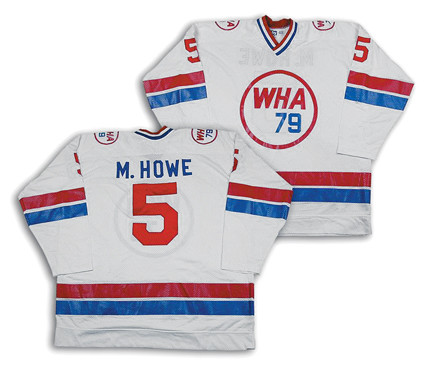
Extra bonus jersey: Today's extra bonus jersey is a 1979 WHA All-Star Mark Howe jersey. With the WHA down to just six teams during its dying days, a single team of WHA All-Stars was selected and faced off in a three game series against Dynamo Moscow of the Soviet Union. With father Gordie on the team, who famously played on a line with Wayne Gretzky, Mark's jersey has his first initial "M" in front of his last name

The three game series, played entirely in Edmonton, saw the WHA All-Stars win all three games, the first two by identical 4-2 scores and the final one  4-3.

WHA All-Star 1979 jersey 
photo courtesy of Classic Auctions

Today's video segment begins with a little fatherly advice from Gordie to Mark about making the move to the WHA.


Next, a look at Howe's career, as presented during his induction into the Hockey Hall of Fame in 2001.


Finally, here is Howe's memorable speech during his Hockey Hall of Fame induction.

Sunday, March 5, 2017

1991-92 Quebec Nordiques Mats Sundin Jersey

The 1991-92 Quebec Nordiques were looking to improve on their previous season in which they finished last overall in the NHL with a 16-50-14 record. Their 46 points were 11 less than the nest worst team, the 20th place Toronto Maple Leafs.

To that end, they selected Eric Lindros first overall in the 1991 NHL Entry Draft, despite repeated warnings from the Lindros' camp that he would refuse to play for the Nordiques due to several factors, including lack of marketing potential and having to learn to speak French if he were to play in Quebec. Standing their ground in the face of the threats from Lindros, the Nordiques chose him first overall and, as promised, he refused to report to Quebec and played for both the Oshawa Generals of the OHL and the Canadian National Team while holding out.

With their second pick, 24th overall, the Nordiques chose left wing Rene Corbet, who would play 17 total games over two seasons with Quebec, scoring just 5 total points. Round 3 saw the Nordiques select Rich Brennan, who would never wear a Nordiques sweater during his career.

With the much publicized hold out of Lindros, and the lack of any other impact players from the draft, the Nordiques were going to be hard pressed to improve in 1991-92. The most notable additions to their roster consisted of the likes of Greg Paslawski and Russian defenseman Mikhail Tatarinov.

Still, with a top three of Joe Sakic and second year players Mats Sundin and Owen Nolan, there was some hope for increased competitiveness, but the roster had little to offer beyond those three with the exception of Russian Valeri Kamensky.

Photobucket
The 1991-92 Quebec Nordiques

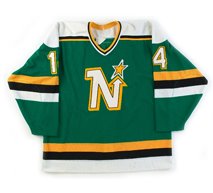
Things got off to a deceptively bright start when the Nordiques won their opening game at home against the Hartford Whalers by a score of 4-2. They then traveled to New Jersey for their first road game of the season. Although they scored a more than respectable 5 goals, they were defeated 6-5. Two nights later they traveled to Minnesota where they lost 3-2 to the North Stars.
After a pair of home games, they lost 5-3 in Philadelphia. An overtime loss in Montreal came after a loss at home to Detroit.

Following their second win of the season at home over Winnipeg, another road loss to the Rangers followed, again by a goal. Their next three road games were all losses, at Chicago, Hartford and Boston, which came as part of a six game losing streak.

The losing streak ended with a win at home over Montreal, only to have the road losing streak extended in Montreal two nights later. After a home win over Hartford, the Nordiques earned their first point on the road in ten tries with a 4-4 tie in Buffalo. After a loss in St. Louis, their best run of form all season included two wins at home and a tie in Boston followed by another pair of wins at home for five games without a loss.

Still, their winless streak on the road continued with losses at Detroit and Washington, a tie in Calgary, a loss in San Jose and a tie at Vancouver. Two wins at home proceeded their worst run of form, with eight consecutive losses in regulation, including four in a row on the road. A win at home only momentarily broke up the losing, as their next nine games consisted of two losses, a tie and then six more losses. From January 2, 1992 and February 13th, the Nordiques would go 1-16-1, including nine more road losses and a tie to remain winless on the road since the start of the season.

Their next three games they managed a tie in Montreal, a win at home over Minnesota and another tie in Pittsburgh to begin a five game road trip. Four games later, a loss in Hartford, a tie in Montreal and losses at San Jose and Los Angeles, left them with 2 points out of a possible 10.

A tie at home against Buffalo preceded their game at Hartford against the Whalers on this date in 1992, with the Nordiques now standing 0-25-8 on the road for the season to date.

The teams ended the first period even at 3 apiece before the Nordiques erupted for five consecutive goals, which included a hat trick by Sundin. The third period saw the Nordiques again outscore Hartford 2-1 to make the final margin 10-4. It was the first win on the road for Quebec all season and their first since March 10, 1991, six days short of a year, which also came at the expense of the Whalers.

Sundin was the star of the night for the Nordiques with 5 goals and 2 assists for 7 points, becoming the 38th player in the 75 year history of the NHL to score 5 or more goals in a single game and just the third player from Sweden to accomplish the feat. His five goals alone were enough to outscore Hartford for the game.

Sundin's linemate Nolan finished the night with a goal of his own as well as 5 assists while the third member of the line, Kamensky had 2 goals and 3 assists for 5 points to give the trio 18 points during the game, including 8 of Quebec's 10 goals.

Peter Sidorkiewicz gave up the first 6 goals in 27:11 before being replaced by Kay Whitmore, who fared little better, giving up 4 goals in 32:49.

"It's a big relief," said Sundin, whose five goals broke a Quebec record held by Peter Stastny and Michel Goulet.

The Nordiques would go 6-7-2 the rest of the way, winning both ends of a home and home against Buffalo to end the season 20-48-12 with a road record of 2-30-9.

Sakic would lead the club in scoring with 94 points, followed by Sundin's 76. Nolan led the team in goals with 42 on his way to third in scoring with 73 to distance the top three from the rest of the squad, with no one else scoring more than 45.

The Nordiques fortunes would begin to turn around in the off-season when Lindros was finally traded to the Philadelphia Flyers in exchange for six players, a pair of first round draft picks and $15 million, which led to the Nordiques making the playoffs in 1992-93 and beginning the franchise's rise to prominence, albeit in Denver, Colorado as the Avalanche.

Sundin would play one more season for the Nordiques, his fourth, before being traded to the Toronto Maple Leafs during the summer of 1994.

Today's featured jersey is a 1991-92 Quebec Nordiques Mats Sundin jersey. The Nordiques were the last team to use heat sealed names and numbers on their jerseys prior to switching to sewn on twill numbers for the 1991-92 season, which included a switch to two color numbers, white with red trim, for the first time in their history.

This jersey features the NHL 75th Anniversary patch worn by all players in the NHL to commemorate the league's anniversary.

Quebec Nordiques 91-92 jersey

Today's video highlight are the Quebec Nordiques selecting Mats Sundin first overall in the 1989 NHL Entry Draft, the first European ever drafted first overall.

Saturday, March 4, 2017

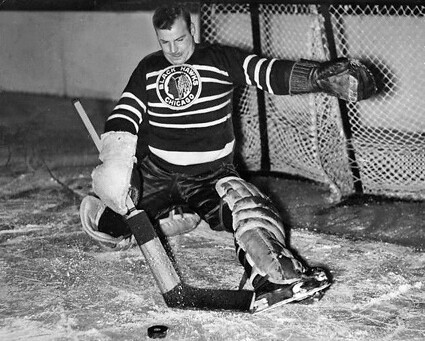
The NHL Record for Most Saves in a Regulation Game - 1940-41 Chicago Black Hawks Sam LoPresti Jersey

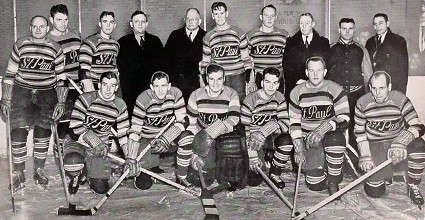
Sam LoPresti, a native of Eveleth, Minnesota, first played in the American Hockey Association for the St. Paul Saints in the 1937-38 season, suffering through a 10-36-2 record with a 3.62 goals against average, but with 2 shutouts.

His second year with the Saints saw him manage to post a winning record, having improved by 13 wins to 23-21 while lowering his goals against average to 2.73.

1938-39 St. Paul Saints team
The 1938-39 St. Paul Saints

LoPresti improved by another 6 games in 1939-40 with a noteworthy 29-18 record while lowering his goals against average yet again to 2.55, thanks in part to 4 shutouts. He then went on to post a 6-1 record in the AHA playoffs with a 1.29 goals against average as St. Paul defeated the Omaha Knights to win the league championship.

1939-40 St Paul Saints team
The 1939-40 AHA champion St. Paul Saints
with LoPresti front and center

During the season, LoPresti caught the attention of Chicago Black Hawks president Bill Tobin and head coach Paul Thompson during an exhibition game between the two clubs. He was signed by Chicago for the 1940-41 season and assigned to the Kansas City Americans, also of the AHA.

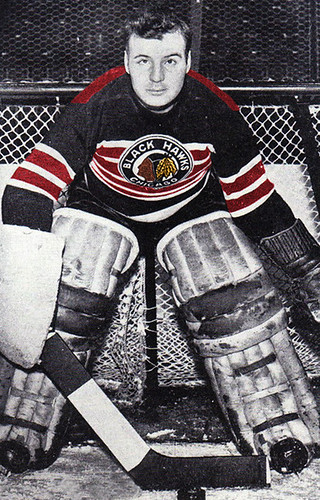
After 18 games with Kansas City, LoPresti was recalled by Chicago when goaltender Paul Goodman retired in mid-season. LoPresti made his NHL debut on January 5, 1941 and went unbeaten in his first four starts, a 2-2- tie against the Boston Bruins in his debut followed by wins over the New York Rangers, Montreal and Detroit. After a defeat by Montreal, the Black Hawks tied Boston again and then defeated the New York Americans and the Rangers, making LoPresti an impressive 5-1-2 in his first seven games and having taken the Black Hawks from a losing 7-10-4 to now a winning 12-11-6.
It couldn't last though, as Chicago had the second worst offense and third worst defense in the then seven team NHL and they proceeded to lose seven of their next eight with only back-to-back wins over the moribund Americans providing some eventual relief.

After losses at Montreal and the Rangers, LoPresti earned his first NHL shutout when he blanked the Red Wings 1-0 on February 27th.

Then came a home and home series with the Bruins. The first game in Chicago on March 2nd was a close game, but the Bruins prevailed 4-3.

The clubs reconvened on this date in 1941 in Boston. LoPresti was immediately under siege from the powerful Bruins, who were on their way to a first-place finish. The Bruins pelted the rookie goaltender with shot after shot, only to see him turn away one after another. LoPresti made 27 saves in the first period alone.


He faced an even greater onslaught in the second period when the Bruins pressured him with 31 more shots, but still LoPresti held off the attack as best he could. Roy Conacher finally beat him for the first Bruins goal on Boston's 42nd shot.

Lopresti blackahwksS

With the game tied at 2-2 late in the third period, the Bruins Eddie Wiseman scored for Boston, and despite facing another 22 shots, Chicago fell 3-2 despite LoPresti making an NHL record which still stands to this day of 80 saves in a regulation 60 minute game. LoPresti's effort was not lost on the Bruins crowd, who gave him an ovation for his stellar effort despite the loss.

Of note, the Bruins winning goaltender was Frank Brimsek, not only a fellow American in an age when players from the United States were a rarity, but one who also hailed from tiny Eveleth, Minnesota. Brimsek made 18 saves on 20 Chicago shots, less than a quarter of what LoPresti faced.

"The Bruins didn't get the winning goal until the end of the game, " LoPresti recalled later on. "Wiseman got it on a rebound. But we couldn't do anything right from the opening faceoff. Just couldn't move the pick out of our zone. They were shooting from every angle and I didn't see half the shots. They were bouncing off my pads, chest protector, my arms, my shoulders. I didn't even know where they were coming from. I lost between eight and ten pounds that night."

No NHL goaltender since that night has faced more than 73 shots.

Chicago would finish the season with a tie against the Americans followed by three consecutive losses to finish with 39 points from a 16-25-7 record, good for fifth in the league. Despite their losing record, the format that season called for six of the seven teams to make the playoffs. In the Quarterfinal round, Chicago defeated the Canadiens 2 games to 1, with each game being a close, one goal margin. Detroit then eliminated the Black Hawks in two straight.

LoPresti returned to Chicago for the 1941-42 season and put together a record of 21-23-3 with a 3.19 goals against average with 3 shutouts while playing in 47 of the Black Hawks 48 games. Chicago finished mid-pack and were paired with the Bruins in the playoffs, who defeated them 2 games to 1, with the Black Hawks win being a shutout for LoPresti.

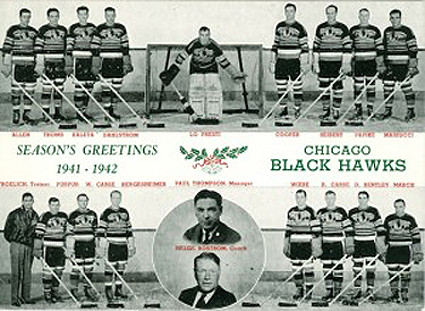
1941-42 Chicago Blackhawks team
The 1941-42 Chicago Black Hawks

He then enlisted in the United States Navy during World War II and was assigned to the SS Roger B. Taney, which protected ships as they crossed the Atlantic. The Taney was torpedoed and sunk in February of 1943 and LoPresti was listed as missing in action, thought to be a casualty.

However, as the Taney sank, LoPresti and 25 other men abandoned the ship and sought safety on rafts. The next morning, those on the rafts were picked up by the #4 lifeboat, but with minimal food or water. The lifeboat then made an incredible, nearly 2,500 mile voyage to the South American coast. LoPresti in particular was credited with saving the men's lives by fashioning a weapon by lashing a knife to a boat hook. He then dove into the water and was able to catch a 35 pound dolphin, which provided blood to drink and meat, which they cooked in a metal bucket with a fire made of rags and kerosene. The men were finally rescued off of the coast of Brazil 42 days after their ship sank. LoPresti had lost 55 pounds during the time he was lost at sea.

After he returned from the war, LoPresti played. for the San Diego Skyhawks of the Pacific Coast Hockey League in 1943-44 and 1944-45. He then returned to Minnesota and continued to play senior hockey with the Duluth Coolerators, Duluth Steelers and finally two seasons with the Eveleth Rangers, where he was named the North American Hockey League MVP in 1950. LoPresti was a charter member of the United States Hockey Hall of Fame in 1973.

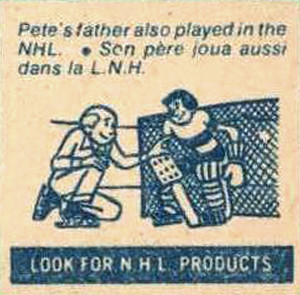
His son Peter LoPresti also played in the NHL for the Minnesota North Stars from 1974-75 through 1978-79.

Pete-LoPresti card fact
Sam and Peter LoPresti were the first father/son goaltending combo
in NHL history and the first pair to also record an NHL shutout

Today's featured jersey is a 1940-41 Chicago Black Hawks Sam LoPresti jersey as worn during the season he set the NHL record for Most Saves in a Regulation Game with 80 on this date in 1941.

Chicago introduced their red and black barberpole jerseys for the 1937-38 season and wore them all the way through the 1954-55 season, wearing them exclusively for all games home and road until the 1939-40 season.

Chicago Blackhawks 1940-41 jersey

In today's video section, Ron Tugnutt takes a run at LoPresti's record of 80 saves, but comes up short after making 70 while facing 73 shots.


hit counter for blogger