History of Jersey 83-93 Banner sm photo History of Jersey 83-93 Banner sm.jpg

Friday, March 3, 2017

1991-92 New York Rangers Brian Leetch Jersey

Although he was born in Texas on this date in 1968, defenseman Brian Leetch and his family moved to Connecticut when he was just three months old. He began to develop his hockey skills at the ice rink managed by his father Jack Leetch. Leetch, a multi-sport athlete in high school played both hockey and baseball, which included winning a state championship as a pitcher. His hockey prowess was also clearly evident when, in 1983-84, he scored 52 goals and 101 points in just 28 games for Cheshire High School. He next played for Avon Old Farms School, totaling 70 goals and 90 assists for 160 points in 54 games over two seasons.

His performance for Avon Old Farms led to his being named to the United States roster at the 1985 World Junior Championships, the first of a number of appearances for the US in international hockey. He returned to the World Juniors in 1986, scoring a goal and 4 assists in 7 games as the Americans won a bronze medal. Following his 84 point season for Avon in 1985-86, Leetch was selected by the New York Rangers in the 1986 NHL Entry Draft as the ninth overall pick in the first round.

Leetch played his only season of college hockey, scoring 9 goals and 47 points in 37 games for the Boston College Eagles in 1986-87, earning NCAA First Team All-American honors, was named both Hockey East Rookie of the Year and Player of the Year, was Hockey East Tournament MVP and was named a finalist for the Hobey Baker Award as the best college hockey player of the year.
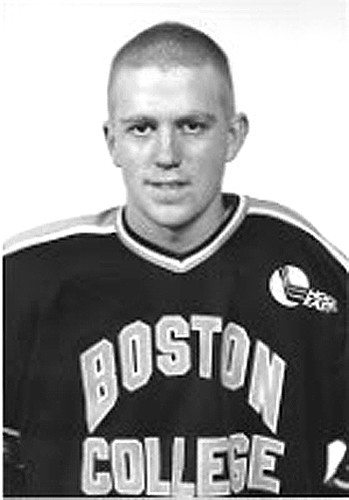
Leetch Boston College
Leetch had a stellar season for Boston College

During that season he played in his third consecutive World Juniors, where he was named to the tournament All-Star Team, and then after the conclusion of his college season, played for the United States again, only this time at the senior level World Championships, scoring 3 goals and 7 points as a 19 year old.

For the 1987-88 season, Leetch joined the United States National Team in preparation for the upcoming Olympics in Calgary, Alberta. During the Games, he scored a goal and 5 assists for 6 points in 6 games.

After the conclusion of the Olympics, Leetch made his NHL debut, playing in the remaining 17 games on the Rangers schedule in the spring of 1988, scoring 14 points.

The following season he became a full time NHL professional, seeing action in 68 games, making his presence known around the league by setting a rookie defenseman scoring record with 23 goals on his way to averaging more than a point per game with 71 (good for second in team scoring), all of which earned him the Calder Trophy as the NHL Rookie of the Year. After the conclusion of the season, Leetch appeared in his second and final World Championships for the US, scoring 7 points in 10 games, with 3 of those being goals.
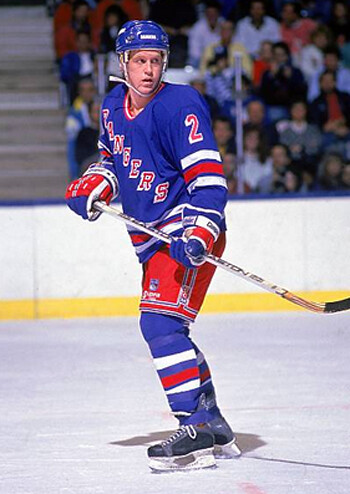
Leetch Young
Leetch won the Calder Trophy as the NHL's best rookie

He would play in his first of ten NHL All-Star Game in 1990 and then raised his personal best to a team leading 88 points in 1990-91 with 16 goals and 72 assists, five points better than forward Bernie Nicholls. That fall, Leetch would once again suit up for the United States, this time during the 1991 Canada Cup tournament.
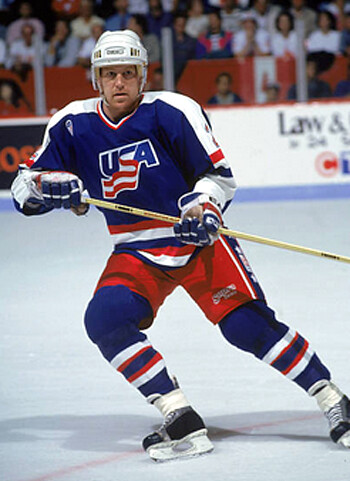
Leetch 1991 CC
Leetch during the 1991 Canada Cup

Leetch then set a career high in 1991-92 with 102 points from 22 goals and 80 assists, good for second on the Rangers, just five behind new arrival Mark Messier. His 100 point season was the first by an American defenseman and also the last 100 point season by a defenseman. His outstanding season was recognized when he was named the winner of the Norris Trophy as the league's Best Defenseman.
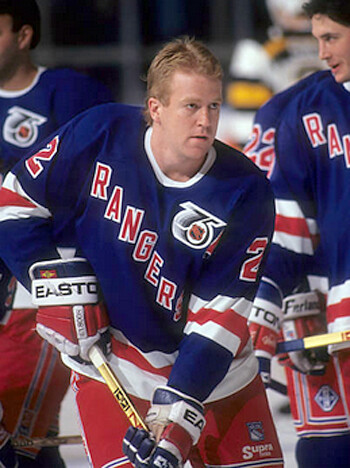
Leetch 1991-92 TBTC
Leetch wearing the Rangers 1991-92 Turn Back the Clock jersey

He was named an assistant captain for New York for the 1992-93 season, but was limited to just 36 games that season.
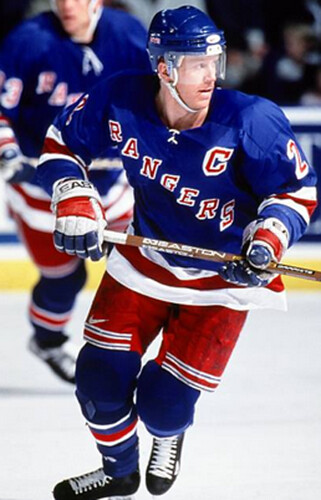
Leetch captaiin
Leetch wearing the captain's "C"

For the 1993-94 season, he returned to full health and played in all 84 of the Rangers games, which included equaling his career high with 23 goals on his way to 79 points. In the playoffs, the Rangers swept the New York Islanders in four, eliminated the Washington Capitals in five, outlasted the New Jersey Devils in a dramatic seven game series, which included three double overtime games. In Game 7, the Devils scored with just 7.7 seconds left to send the game to overtime before Stephane Matteau scored a memorable series winning goal after 84 minutes of play to send the Rangers to the Stanley Cup Finals.

The Rangers opponent was the Vancouver Canucks, who won Game 1 in overtime in New York. The Rangers then won the next three games, including two wins on the road in Vancouver. The Canucks rallied with a Game 5 win in New York and forced a Game 7 with a win back at home. Leetch opened the scoring at 11:02 of the first period followed by a goal from Adam Graves for a 2-0 New York lead after one. The teams traded goals in the second period and the Rangers held on for the final 15:10 after Trevor Linden's second goal for the Canucks made it 3-2.

The championship for New York was their first Stanley Cup since 1940, a span of 54 years. Leetch was named the winner of the Conn Smythe Trophy as the playoff MVP, thanks to his defensive skills as well as being the playoff's leading scorer with 11 goals and 34 points in 23 games.
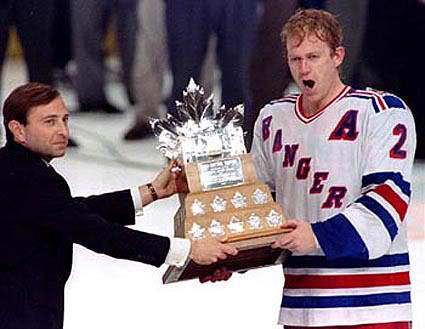
Leetch Smythe
Leetch accepts the Conn Smythe Trophy in 1994

With the NHL season shortened in 1994-95 by a labor dispute, Leetch was limited to 48 games, during which he scored 41 points. He averaged more than a point per game in 1995-96 with 85 points while playing in all 82 of the Rangers games.

Leetch was named as the captain of the United States team for the inaugural World Cup of Hockey in the fall of 1996. The US made their intentions clear during their opening game, a 5-3 win over Canada. They then defeated Russia 5-2 on familiar ice in New York and won the North American Pool with a 9-3 thumping of Slovakia to earn a bye into the Semifinals, where they again defeated Russia by the same 5-2 score to advance to a best of three final against Canada.

Game 1 in Philadelphia went to Canada 4-3 in overtime before the Americans fought back with a 5-2 win in Montreal to even the series followed by another 5-2, again in Montreal, to capture the first World Cup and the United States most significant victory since 1980. Leetch was fourth on the team and sixth in tournament scoring with 7 assists in 7 games played.
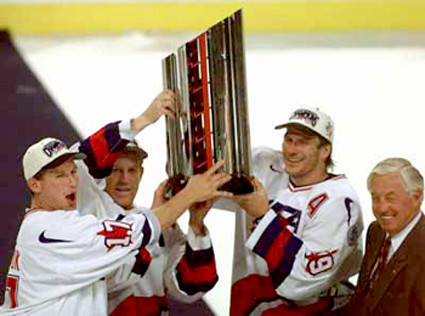
SPORT HOCKEY
Keith Tkachuk, Leetch and Joel Otto are presented
the World Cup by legend Jean Beliveau

The 1996-97 season saw Leetch score 78 points for the Rangers on his way to a second Norris Trophy after finishing the season a +31. The 1997-98 season saw Leetch named the Rangers team captain, a position he would hold for three seasons. During that season, the NHL would take the first break from its schedule to allow its players to participate in the Olympics, Leetch's second Games. As an assistant captain for the US, he would score a goal and 2 points in 4 games.
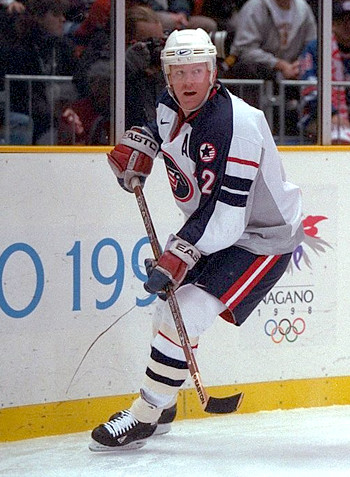
Leetch 1998
Leetch during the 1998 Olympics

Leetch would play six more seasons for New York, highlighted by a 21 goal, 79 point season in 2000-01, the season during which he also played in the 1,000th game of his career. Also during this time period, he would play in his third Olympics in 2002, earning a silver medal, again as an assistant captain, while contributing 5 assists in 6 games.
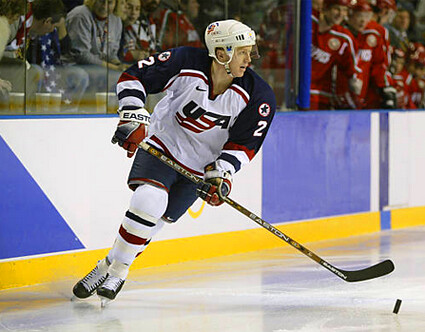
Leetch 2002
Leetch won an Olympic silver medal in 2002

With the Rangers having missed the playoffs for the previous six seasons and on their way to a 13th place finish in the Eastern Conference out of 15 teams in 2003-04, they began rebuilding by trading away veteran players, which saw Leetch dealt to the Toronto Maple Leafs for two prospects and a first and second round draft picks.
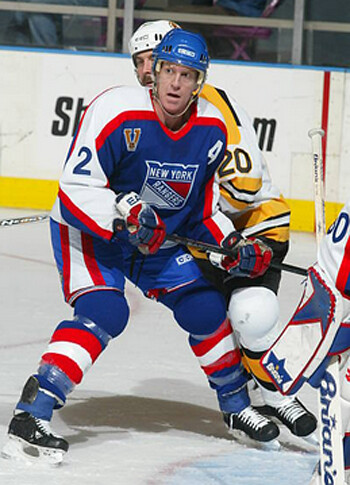
Leetch Vintage
Leetch wearing a 1970s Rangers vintage jersey
during his final season with the Rangers

He would eventually play just 15 games for Toronto plus 13 playoff games. In the fall of that year, Leetch played for the final time for the United States in the 2004 World Cup of Hockey. It would be his last hockey for a calendar year, as the upcoming season of 2004-05 was cancelled due to labor issues.
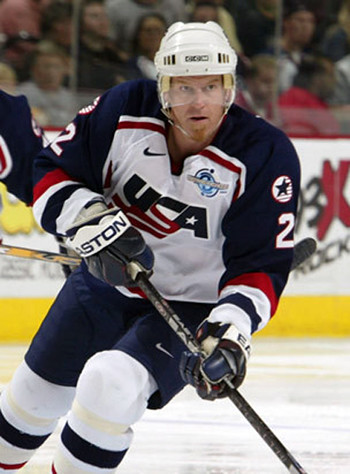
Leetch 2004 WCOH
His last of 11 appearances for the United States came in 2004

For the 2005-06 season, Leetch, now a free agent, signed with the Boston Bruins, for what proved to be the final season of his career. He played in 61 games that season, which included 5 goals and 27 assists for 32 points, which included the 1,000th point of his career on October 18, 2005.
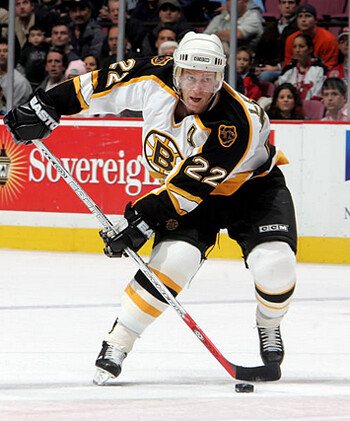
Leetch Bruins
Leetch finished his career with the Boston Bruins

His final totals were 1,205 games played, 247 goals and 781 assists fr 1,028 points. He won a Stanley Cup in 1994, the 1989 Calder Trophy, the Norris Trophy in 1992 and 1997, the 1994 Conn Smythe Trophy and played in ten NHL All-Star Games.
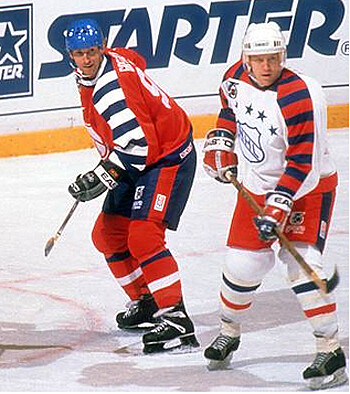
Gretzky Leetch 1992
Leetch guards Wayne Gretzky during the 1992 NHL All-Star Game

Internationally, he won a bronze medal at the 1986 World Juniors, a silver medal at the 2002 Olympics and the 1996 World Cup as team captain.

His jersey #2 retired by New York on February 24, 2008 and he was inducted into the United States Hockey Hall of Fame in 2008 and the Hockey Hall of Fame in 2009.
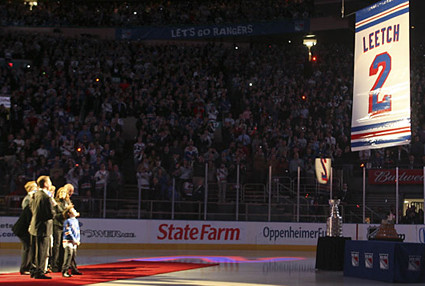
Leetch jersey retirement
Leetch's #2 raised to the rafters at Madison Square Garden

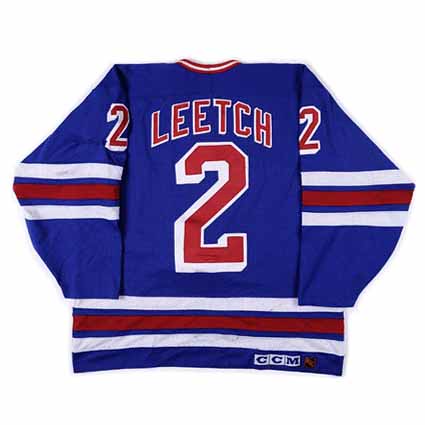
Today's featured jersey is a 1991-92 New York Rangers Brian Leetch jersey from his 102 point season, the first 100 point season ever by an American defenseman and the season he won his first Norris Trophy.

The Rangers have worn blue jerseys with RANGERS diagonally across the front of their jerseys since their inaugural season of 1926-27 with very few exceptions. They wore modernized jerseys with their shield crest for two seasons in the latter half of the 1970s and when the returned to their classic jersey styles for home and road, they wore NEW YORK on the front of the blue road jerseys from 1978-79 to 1986-87.

They reverted to having RANGERS on the front of their blue jerseys again for Leetch's rookie season of 1987-88 with the names straight across the back. The names became the classy vertically arched letters in 1990-91 and only a change to a lace up collar and a change to the waist striping in 1997-98 happening during his lengthy New York career.
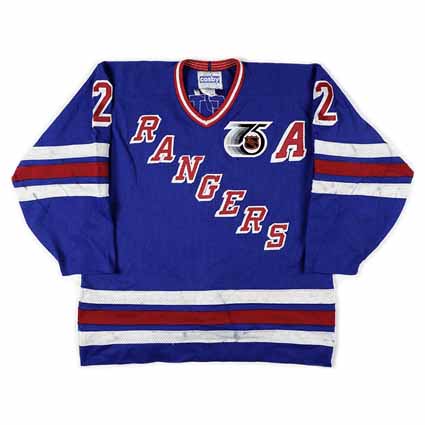
New York Rangers 1991-92 F jersey
New York Rangers 1991-92 B jersey

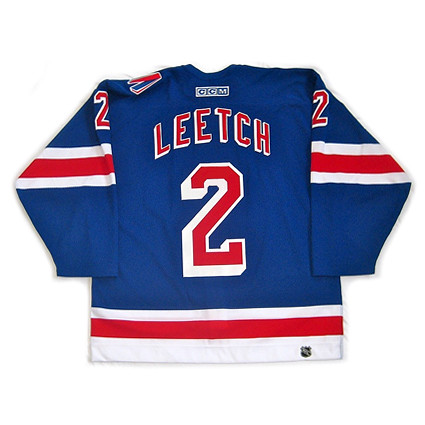
Bonus jersey: Today's bonus jersey is a 2001-02 New York Rangers Brian Leetch jersey worn only on October 7, 2001 against the Buffalo Sabres, who also wore special jerseys crested with "New York" diagonally across the front in the Rangers first home game following the terrorist attacks on September 11, 2001 in New York.
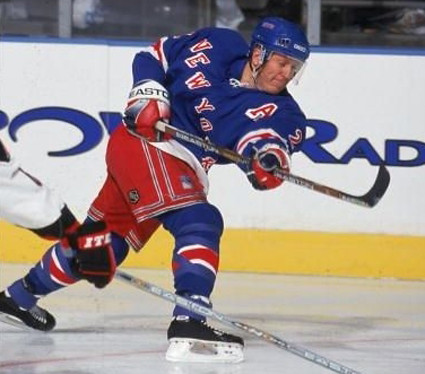
Leetch 911 jersey
Leetch in the one game only 9/11 Tribute jersey

The jerseys were then auctioned off to raise money for the Twin Towers Fund, with the jerseys of Leetch and goaltender Mike Richter raising $15,010, second only to team captain Messier's $20,010.
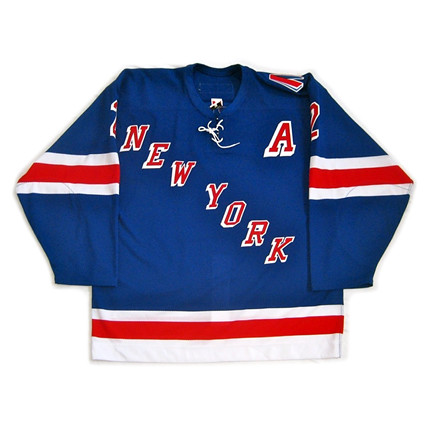
New York Rangers 2001-02 9-11 F jersey
New York Rangers 2001-02 9-11 B jersey

Extra bonus jersey: Today's extra bonus jersey is a 2003-04 New York Rangers Brian Leetch jersey. This highly attractive alternate jersey was worn by the Rangers from 1996-97 to 1997-98 and again from 1999-00 to 2006-07. The Rangers made a white version of this "Liberty" jersey, which replaced the navy blue version for only the 1998-99 season until bringing back the navy version for its second seven season run, which only came to an end when Reebok introduced their Edge jerseys in 2007-08 and all third jerseys were eliminated for that season.
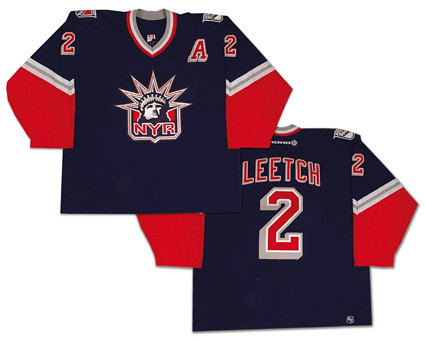
New York Rangers 2003-04 alt jersey
photo courtesy of Classic Auctions

Extra extra bonus jersey: Today's extra extra bonus jersey is a 1996 United States National Team Brian Leetch jersey as worn by the American captain.

Retail versions of his highly collectable style were sold only in the home white style in numbered sizes, such as 48 and 52, with sewn on USA cresting and customized with Leetch, Richter and Jeremy Roenick, who actually did not participate in the 1996 World Cup due to being between NHL contracts at the time and therefore not having insurance in case of a major injury, and did not have the World Cup tournament logo patch.

In addition to the retail jerseys not being sold with the World Cup patch, the Leetch jerseys did not come with the captain's "C" either. Both would need to be added separately for proper authenticity as is the case with today's extra extra bonus jersey.

Also of note, some uncustomized white jerseys were produced for retail sale and can be recognized by their letter sizing, such as L and XL, and sublimated USA cresting as opposed to the customized jerseys, which had sewn on twill logos and numbered sizing.

Blue road jerseys are even more scarce, having only been produced for use by the United States national teams in 1996 and 1997, and since they were intended to be worn by players, come in larger sizes such as 54, 56 and 60.

USA 1996 WCOH jersey photo USA 1996 WCOH 2 F.jpg
USA 1996 WCOH jersey photo USA 1996 WCOH 2 B.jpg 

In today's vdieo section, Leetch is welcomed back to Madison Square Garden for the first time, now as a member of the Bruins.


 Next, Leetch scores the first Rangers goal in Game 7 of the 1994 Stanley Cup Finals.


Next, a pair of tributes to Leetch, the first one on the occasion of his #2 being retired by the Rangers and the second after being named as one of the best 100 players in the first 100 years of the NHL.


Thursday, March 2, 2017

2001-02 Toronto St. Patricks Mats Sundin Jersey

The Toronto Arenas had won the Stanley Cup in 1918 but quickly ran into financial difficulties and were sold by their owners, The Toronto Arena Company, who owned the Arena Gardens rink where the team played, to new owners for $5,000.

 photo Mutual_Street_Arena_interior.jpg
The Arena Gardens, later changed to the Mutual Street Arena

The new owners were Charile Querrie, the General Manager of the Toronto Arenas, and the owners of an amateur hockey club called the St. Patricks. The new ownership group then changed the NHL club's name to the Toronto St. Patricks and their sweaters from blue to now green.

Rebounding from a chaotic 5-13 season resulting from the sale or defection of their best players due to the financial problems of the previous ownership, the St. Patricks were essentially starting over from scratch for the 1919-20 season.

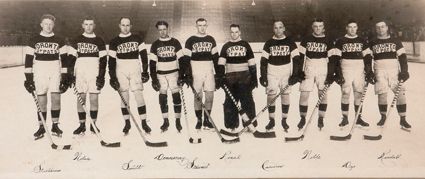
1919-20 Toronto St Patricks team photo 1919-20 Toronto St Patricks team.jpg
1919-20 Toronto St Patricks

While they did not qualify for the playoffs, the St. Patricks did improve their season record to 12-12 and were led in points by Corb Denneny, a holdover from the Toronto Arenas, who had 24 goals and 36 points in 24 games, good for fourth in the league.

Future Hall of Famer Babe Dye led the club with 33 goals and 38 points in 23 games in 1920-21, and the team would finish first in the second half standings, but lost in the NHL finals to the Ottawa Senators.

Babe Dye during the 1920-21 season

1921-22 again saw the St. Patricks led by Dye's 31 goals and 38 points in 24 games, as Toronto would defeat the Senators 5-4 in a two-game, total goals series to capture the O'Brien Trophy and earn the right to play for the Stanley Cup against the Vancouver Millionaires, champions of the Pacific Coast Hockey League.

The series was a best-of-five and all games were played in Toronto. The Millionaires won Game 1 and Dye scored in overtime to even the series at 1 game apiece. Vancouver shut out Toronto 3-0 in Game 3, only to have the St. Patricks return the favor 6-0 in Game 4. Dye took control of the deciding Game 5, scoring four goals to lead the St. Patricks to a 5-1 victory and the Stanley Cup.

1921-22 Stanley Cup Champion Toronto St. Patricks

The next two seasons Toronto would finish in third place, and miss out on the playoffs both times. Dye again led the team in scoring both seasons, with 37 points in 1922-23 and just 19 in 1923-24, but still enough to lead the club.

1923-24 Toronto St Patricks team photo 1923-24 Toronto St Patricks team.jpg
The 1923-24 Toronto St Patricks

Dye rebounded with 38 goals and 46 points in 1924-25 to lead the team for the fifth season in a row and Toronto again returned to the playoffs, only to lose out to the Montreal Canadiens 5 goals to 2.

Another Hall of Famer, Jack Adams, would finally unseat Dye as the club's leading scorer, as he managed 21 goals and 26 points to Dye's 23 points in 1925-26, but Toronto would fail to reach the playoffs.

St. Pats Owner Querrie lost a lawsuit to the notorious Eddie Livingstone, the one time owner of the franchise when they were known as the Toronto Blueshirts and played in the National Hockey Association, and decided to put the team up for sale. The club was purchased by Conn Smythe for $160,000 and took control of the team on February 14, 1927 and immediately changed the club's name to the Toronto Maple Leafs.

On this date in 2002, the Toronto Maple Leafs wore the green jerseys of the St. Patricks, along with brown pants and helmets, to celebrate the 75th anniversary of the franchise changing their name to the Maple Leafs in a 3-3 tie against the Buffalo Sabres, led by captain Mats Sundin's two goals.

Sundin Maple Leafs St Patricks photo SundinStPats.jpg

Today's featured jersey is a 2001-02 Toronto St. Patricks Mats Sundin jersey as worn once on March 2, 2002 to mark the 75th Anniversary of the change in the club's name from the St. Patricks to the Maple Leafs following their purchase by Conn Smythe.

The original 1919-20 St. Pats jerseys were alternating green a white hoops on the body, while the sleeves were green with a single white band and white cuffs. For 1920-21, the sweaters were solid green with white cuffs, collar and waist stripe. They reverted to their original horizontally striped sweaters for 1921-22.

For 1922-23, the location of the sweater's colors were reversed, with the result being a predominately white look now that the arms were white with a green band and cuffs. This style was worn for three seasons through 1924-25. It was back to an all-green look for 1925-26, including the collar and cuffs, with the only white being three narrow stripes along the waist.

Finally, for the team's final season as the St. Patricks, they added a white chest band trimmed with narrow white stripes and reduced the three narrow waist stripes to two. With the sale of the club to Smythe, this jersey would not finish out the season, as it was immediately replaced by a solid white sweater with a green maple leaf crest, with the team colors permanently changing to blue and white for the 1927-28 season.

It would be the St. Patricks final green jersey with the white chest band of 1926-27 which would become the basis for the modern day Maple Leafs throwback jersey featured today.

Toronto St Pats 99-00 jersey photo TorontoStPats99-00F.png
Toronto St Pats 99-00 jersey photo TorontoStPats99-00B.png

Wednesday, March 1, 2017

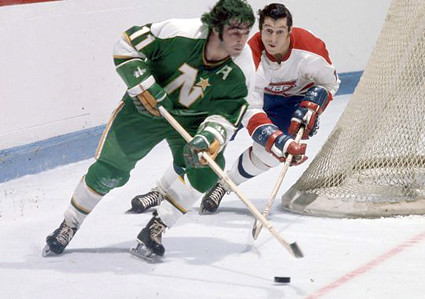
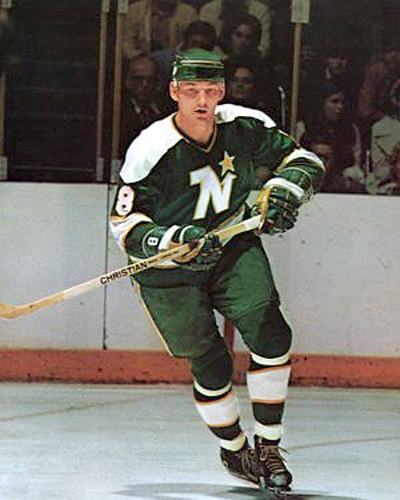
1972-73 Minnesota North Stars Charlie Burns jersey

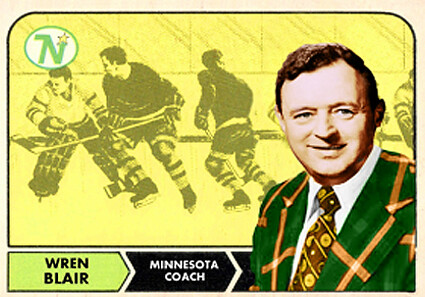
The 1969-70 season was the third for the Minnesota North Stars. They were coached by Wren Blair, who was also the club's General Manager.

Blair North Stars 1

They began the season with a win on October 11, 1969 with a 4-0 blanking of the Philadelphia Flyers with Cesare Maniago in goal getting the shutout. The team alternated wins and losses for their first six games until back to back losses to the Boston Bruins and Pittsburgh Penguins at home. Minnesota then earned only their second ever win over the Montreal Canadiens 4-1 to close out October at 4-4 after going 1-7-2 against Montreal their first two seasons. November was more challenging for Minnesota, going 3-6-4, which included a tie versus the Canadiens.

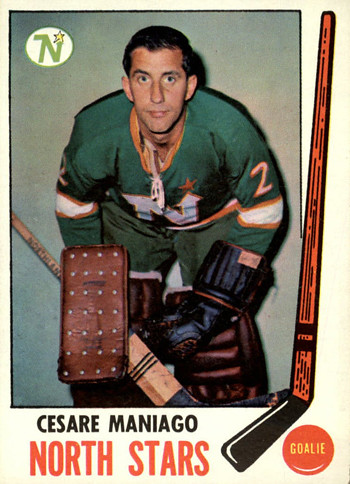
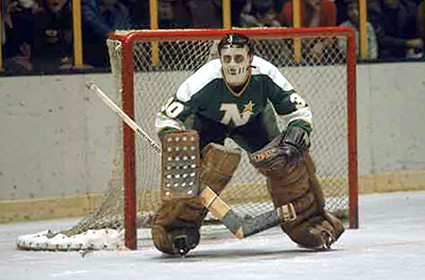
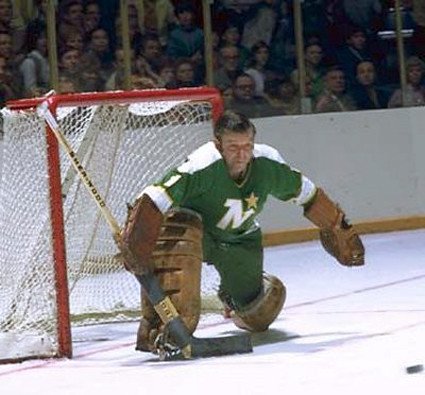
Maniago North Stars

December was remarkable for the North Stars, as the team set the tone for the month with a 5-5 tie against the Toronto Maple Leafs on December 3rd. Remarkably, they once again beat the Canadiens on December 6th, which was followed by a tie at Boston. They returned home and defeated the Chicago Black Hawks 8-5 for their final win of the month. Having already alternated ties and wins for their first four games of the month, the North Stars then proceeded to alternate ties and losses for their remaining nine games in December. They finished with a 2-4-6 record in their 12 games that month, with every other game resulting in a tie.

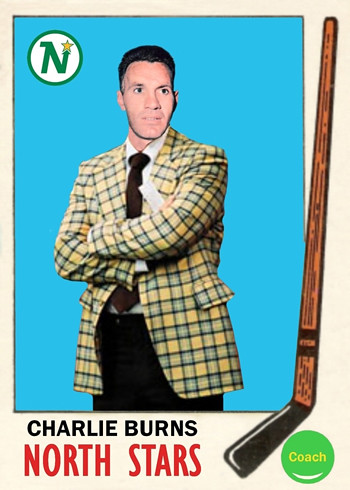
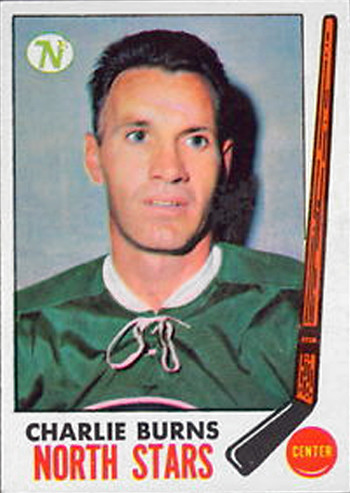
With their record at 9-13-10 following their loss on December 27th, Blair stepped aside from his head coaching duties and installed North Stars player Charlie Burns as the North Stars new head coach, who gave up playing when he assumed his new duties.

Burns North Stars 2

After his debut on December 30th, a scoreless tie against the Los Angeles Kings, Burns picked up where Blair left off, alternating ties and losses over his first four games. Burns finally got his first win on January 14th, a 5-2 win over the St. Louis Blues.

And then it began...

A 1-1 tie against the Oakland Seals came on the road the next night in California. That was followed by a nine game losing streak, the first four coming at home at the Met Center in Bloomington, Minnesota. The club hit the road for games in Montreal and Boston, and while they acquitted themselves well losing by only one goal both nights, they were still losses. The losing streak eventually ran out to nine games with defeats at home to Toronto 4-2, in Chicago 7-4 and back at home to Pittsburgh 7-5. The loss to Toronto left Minnesota with a 1-9-2 record for January.

The losing streak ended on February 7th when they outshot Montreal 35-28, but were trailing 1-0 with 3:06 to play when J. P. Parise scored his 14th goal of the season against Phil Myre to salvage a 1-1 tie.

Parise North Stars
J. P. Parise versus Montreal

The Penguins extended their record against the North Stars to 5-0-1 on the year when they beat Minnesota 6-3 at home. This was followed by losses at Oakland and home against Chicago, their 12th loss in 13 games.

The North Stars again salvaged a tie late in the game on February 15th when Danny Lawson scored his fourth of the year with 2:08 remaining against the Blues Jacques Plante. Minnesota then held on for a 1-1 tie on February 18th against the Detroit Red Wings despite being outshot 46-26.

Maniago North Stars 4
Maniago was the North Stars number one goaltender in 1969-70

Chicago extended the North Stars misery with a 3-2 win on February 19th followed by another loss, this one to the Bruins two nights later at home. The North Stars led after two periods on February 25th at home to the Kings, but eventually settled for yet another tie.

The winless streak reached 20 games on February 28th when they were hammered by the Philadelphia Flyers 6-2 to close out February with a 0-7-4 record, leaving them 10-30-18 for the season to date.

On this date in 1970, Burns, with a horrid 1-17-8 record as head coach, took matters into his own hands, inserting himself into the lineup against Toronto, making him the last player/coach in NHL history.

Burns North Stars 3
Charlie Burns wearing his distinctive padded helmet

The game, played in Minnesota, Bill Collins got Minnesota on the board at 8:12 of the first period from Parise and Danny O'Shea for the only goal of the first period as the North Stars out shot the Maple Leafs 18-14.

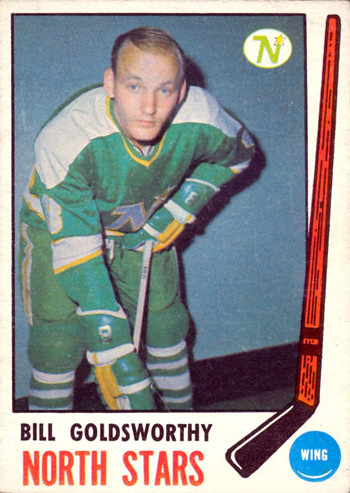
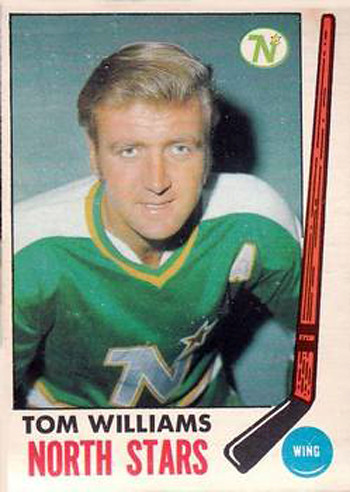
Bill Goldsworthy scored his 27th goal of the season just 55 seconds into the second period with assists from Minnesota native Tommy Williams and Parise for a 2-0 North Stars lead. The trio struck again at 14:42 when Parise's 19th came from Goldsworthy and Williams followed by an unassisted goal by Goldsworthy just 1:58 later at 16:40 to extend the Minnesota lead to 4-0 after two.

Goldsworthy North Stars 2

Collins scored his second of the game from Danny Grant at the 59 second mark of the third period and then the trio of Parise, Goldsworthy and Williams did it again when Parise scored his second of the night and 20th of the season at 7:33 for a 6-0 North Stars advantage.

Williams North Stars

At the 9:49 mark, hostilities broke out when Toronto's Terry Clancy and Jim Dorey and Minnesota's Barry Gibbs, Claude Larose and Goldsworthy all got fighting majors, with Goldsworthy's completing his Gordie Howe Hat Trick on the night. The three North Stars also all got misconduct penalties, while Dorey was whistled for a misconduct and a game misconduct.

Goldsworthy North Stars
Goldsworthy had a busy night, with 2 goals, 2 assists and 21 penalty minutes

At 10:50, Collins completed his hat trick with an unassisted goal against Maple Leafs goaltender Bruce Gamble and Lawson finished the scoring with his 6th goal of the season from Ray Cullen and Leo Boivin at 13:12 for a final score of 8-0 to end the North Stars record winless streak at 20 games.

Despite the lopsided score, Toronto actually out shot Minnesota 41-40 with Maniago getting the shutout for the North Stars.

The North Stars finished the rest of the schedule 8-5-4 once their record 20 game winless streak ended with Burns now acting as a player/coach for the remainder of the schedule. Despite their dismal January and February, the North Stars actually qualified for the playoffs, assisted by the fact the NHL placed all six of the new expansion teams into their own West Division when the league expanded in 1967-68.

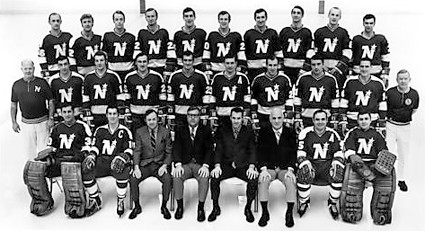
1969-70 Minnesota North Stars team
The 1969-70 Minnesota North Stars

St. Louis had a fine 37-27-12 record for 86 points to win in a romp, while Pittsburgh finished with a 26-38-12 record for 64 points followed by the North Stars at 19-35-22 for 60 points, while Oakland at 58 points won a tiebreaker with Philadelphia for the final playoff spot thanks to 22 wins versus the Flyers 17 with the Kings in last at a lowly 38 points.

Such was the difference in experience and talent in the established East Division that all four teams that made the playoffs had over 90 points, Chicago (99), Boston (99), Detroit (95) and the New York Rangers (92), from pummeling the expansion teams in the West. Of the teams in the East that missed the playoffs, Montreal would have won the West Division(!) with 92 points, while Toronto's 71 would have been good for second behind St. Louis, the only Original 6 team with less points than a Second 6 team.

The North Stars were paired with the Blues in the first round of the playoffs and each team won two games at home before the Blues closed out Minnesota with wins in St. Louis (6-3) and back in Bloomington (4-2).

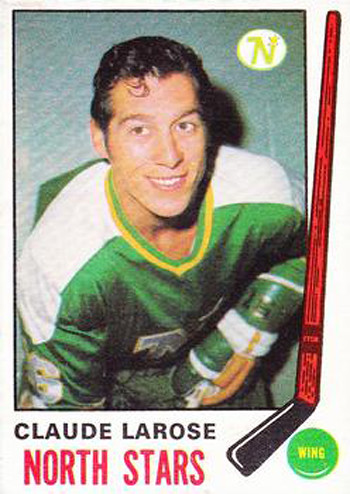
Minnesota was led in scoring that season by Parise with 24 goals and 48 assist for 72 points, followed by Williams (15G, 52A) at 67 and Goldsworthy's team leading 36 goals and 29 assists for 65 points. Other 20 goal scorers for Minnesota that season were Collins and Grant with 29 and Larose with 24.

Larose North Stars

Maniago did the bulk of the work in goal for the North Stars, playing in 50 games, with Fern Rivard (14 games), Gump Worsley (8), Ken Broderick (7) and Gilles Gilbert (1) all seeing time in goal.

Worsley North Stars
Goaltender Gump Worsley played without a mask

Burns, a center, would play 11 NHL seasons for Detroit, Boston, Oakland, Pittsburgh and Minnesota and was known as an excellent skater and playmaker who was defensively responsible. After his time in Boston, he would play four seasons in the minor Western Hockey League before returning to the NHL when the league expanded in 1967, doubling the amount of available jobs overnight. His final NHL totals were 749 games played with 106 goals and 198 assists for 304 points.

Burns North Stars

Burns did not return to the bench for the North Stars 1970-71 season, as the team hired Jack Gordon as their next head coach. Burns would play three more seasons for Minnesota and one final one for the New Haven Nighthawks of the AHL, again while acting as a player/coach.

The following season, now fully retired as a player, he would return to the North Stars as head coach again when he replaced Gordon (who then concentrated solely on his General Manger duties) for the final 42 games of the season, finishing with a 12-28-2 record. Gordon then hired Ted Harris  as head coach for the 1975-76 season. Burns had one final season of coaching, leading the Sioux City Musketeers of the junior USHL in 1977-78.

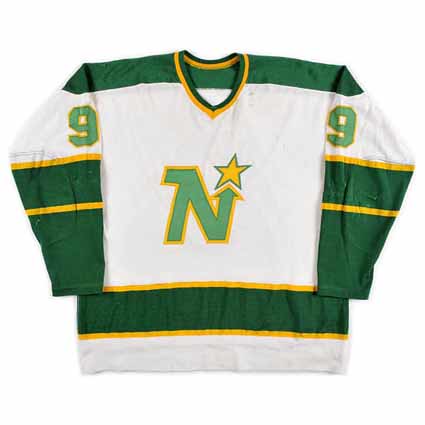
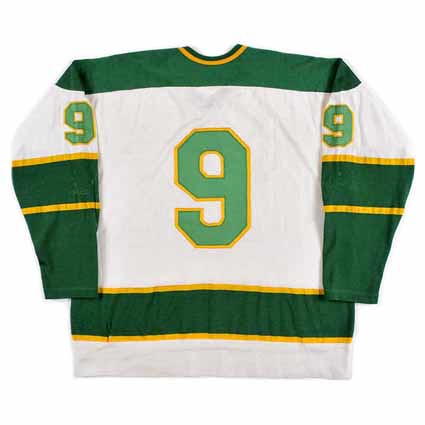
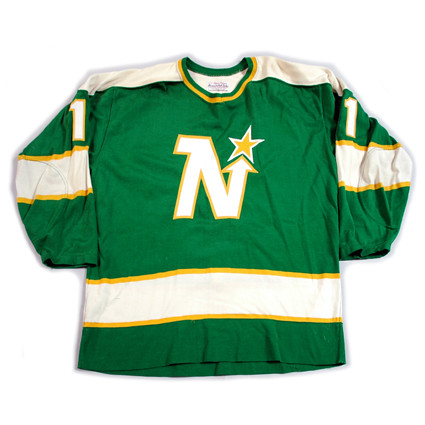
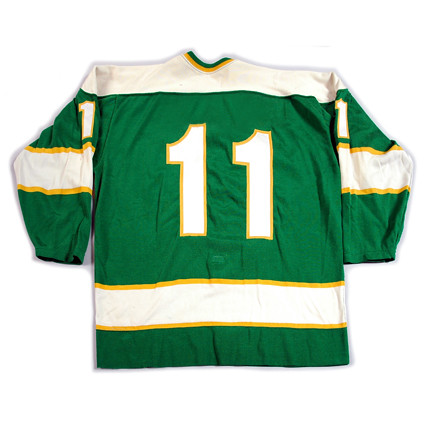
Today's featured jersey is a 1972-73 Minnesota North Stars Charlie Burns jersey as worn by Burns during his final NHL season.

The North Stars wore this style of home jersey for their inaugural season of 1967-68 and again in 1968-69. They then for Burns' first three seasons with Minnesota, the club did away with the green sleeve ends. The green sleeves then returned for three seasons, starting with Burns' final season in the NHL. The team then changed their jerseys to a new template starting in 1975-76, ending this style's run after eight seasons.

Minnesota North Stars 1971-72 F jersey
Minnesota North Stars 1971-72 B jersey

Today's featured jersey is a 1969-70 Minnesota North Stars J. P. Parise jersey as worn by Parise the season he led the North Stars in scoring. The North Stars debuted in 1967-68 with similar jerseys, only without white shoulders. The white shoulder yoke was added for their second season of 1968-69 and was used through the 1974-75 season.

Minnesota North Stars 1972-73 F jersey
Minnesota North Stars 1972-73 B jersey

Tuesday, February 28, 2017

1982-83 New York Rangers Mark Pavelich Jersey

Hailing from the Iron Range in northern Minnesota, Mark Pavelich, born on this date in 1958, attended the University of Minnesota Duluth beginning in 1977-78. His progress was pronounced, as he scored 12 goals and 19 points his first season, 14 goals and 44 points his second (third on the club) and leapt up to 31 goals and 79 points to lead the team in 1978-79.

Pavelich UMD, Pavelich UMD
Pavelich while with Minnesota Duluth

His creative "rink rat" style of play caught the eye of head coach Herb Brooks who who named Pavelich to the 1980 United States Olympic Team, where he teamed with UMD Bulldogs teammate John Harrington and fellow northern Minnesota native Buzz Schneider in a line that became known as the "Coneheads".

"It was kind of unique, obviously, growing up playing hockey in Eveleth," Pavelich recalled. "I was fortunate enough to have the rink just a couple of blocks say, It was just nonstop hockey. I was always down at the rink."

During the 53 games leading up to the Olympics, Pavelich scored 45 points and during the seven games of the Olympic tournament, he averaged a point per game, with one goal and six assists, including his assist on the opening United States goal scored by Schneider and the critical first assist, earned by sending the puck into the slot despite facing and moving the opposite direction while falling backwards, where it was gathered by Mike Eruzione, who then scored the game winning goal in the "Miracle on Ice" upset over the Soviet Union, later named the top story in the IIHF's first 100 years.

Pavelich USA, Pavelich USA

Undrafted by any NHL club, certainly in part due to his 5' 8" size, Pavelich took his game to HC Lugano in Switzerland, where he racked up 73 points in 60 games before once again putting on the red, white and blue of the United States at the 1981 World Championships.

Meanwhile, back in the United States the pairing of his Olympic coach Brooks and his assistant Craig Patrick, was reunited when Patrick hired Brooks to be the head coach of the New York Rangers. They brought Pavelich back to the United States and reunited him with not only Brooks, but also former US teammate Dave Silk and later Rob McClanahan.

Pavelich Rangers, Pavelich Rangers

Pavelich took to the NHL right off the bat, finishing third in team scoring with 33 goals and tying for second in points with Ron Dugay at 76. The following season Pavelich rose to second in team scoring with a nearly identical 75 points while raising his goal total to a team leading 37, which included a record setting game against the Hartford Whalers in 1983.

Pavelich Rangers, Pavelich Rangers

In that game, Pavelich opened the scoring with a power play goal just 1:17 into the contest. Vaclav Nedomansky banked another power play goal for the Rangers less than a minute later at 2:15. After the teams traded goals two minutes apart later in the period, the Rangers began to pull away with goals by Swede Kent-Erik Andersson at 18:36 and Pavelich's second goal, again on the power play with just ten seconds remaining in the period to give New York a commanding 5-1 lead after the first period.

Barry Beck stunned the Whalers just nine seconds into the second period before Pavelich completed his second career hat trick at the 9:06 mark. Mike Rogers made it 8-1 Rangers two minutes later. Pavelich's former 1980 teammate Mark Johnson stemmed the tide with a goal for the Whalers at 12:52 before Ed Johnstone's goal for the Rangers and Michel Galarneau's for Hartford made it 9-3 for home team after two.

But there was still more yet to come, and in surprising, record setting fashion, for at 8:40 of the third period Pavelich scored his fourth goal of the night, from Tom Laidlaw and McClanahan, followed by his fifth goal of the game from Laidlaw just 11 seconds later, making Pavelich the first American-born player in the 66 year history of the NHL to score five goals in a game. His feat also equaled the Rangers team record set by Don Murdoch in 1976-77.

"As a pro, this is my most memorable game," he said afterwards.

Pavelich Rangers, Pavelich Rangers
Pavelich shows his five goal pucks to the media
following his record setting performance

In 9 playoff games that season, "Pav" set a career best with 4 goals and 9 points in 9 games.

While his goal total dropped from 37 to 29 the following season, he set a career high with 82 points thanks to his 53 assists in 1983-84.

Pavelich Rangers, Pavelich Rangers

1984-85 was a season of change, as Brooks was fired as the Rangers coach after 45 games and Pavelich himself was limited to just 48 games himself, although he still maintained a nearly a point per game average with 45.

With Brooks gone, Pavelich's days in New York were numbered, as he was uncomfortable and unaccustomed to playing the traditional NHL "dump and chase" style of new Rangers coach Ted Sator and retired at the end of the season after playing 59 games, scoring 20 goals and 40 points.

He was happy to return home to the simple life of hunting and fishing, only to be called on by Brooks once more, who had now taken over as the head coach of the Minnesota North Stars. It was a short-lived reunion however, as Pavelich would only play a dozen games for the North Stars in 1986-87, although they were productive ones, with 4 goals and 10 points. The record shows that later that season he suited up for the Dundee Rockets in the British Hockey League for a single game, being credited with a pair of assists.

While now done with the NHL, he was not quite finished with hockey just yet, finding a home with HC Bolzano in Italy beginning with the 1987-88 season, where he teamed with former North Stars teammate, Swede Kent Nilsson. There, Pavelich scored nearly a goal per game, with 31 goals in 36 games on his way to 73 points, more than two points per game. That was not all, as Bolzano went on to win the league championship that season, which included Pavelich's 9 goals and 20 points in just 8 playoff games.

He returned to Bolzano for another season in 1988-89, adding 23 goals and 57 points in 44 games before he retired once again.

But not for good.

With the league expanding in 1991, Pavelich was lured out of Minnesota one final time by the expansion San Jose Sharks, where he recorded an assist on the Sharks first ever goal on October 4, 1991. His return was very brief however, as he would only play two games before retiring, this time for good.

His final NHL totals were 355 games played, 137 goals and 192 assists for 329 points , with another 7 goals and 24 points in 23 playoff games.

Pavelich remains to this day a unique individual, who shuns the spot light of fame accorded to the 1980 Olympic Team, rarely leaving the comfort of home in the woods of Minnesota for reunions, interviews or personal appearances, unlike the always available Eruzione, who is often kidded that he has made a career out of one goal and has never met a microphone he didn't like. "The past is the past," Pavelich has been quoted as saying.

It would take 22 years before Pavelich joined his 19 teammates for a reunion, this coming at the the 2002 NHL All-Star Weekend. "It was just that time," Pavelich said when asked why he had chosen that weekend to rejoin his teammates.

His wife Kara said of his reputation, "I know Mark is often said to be reclusive, but that's overdone. He has a very large circle of friends." when Mark was inducted into the Duluth Entertainment and Convention Center Athletic Hall of Fame (the former home of the UMD Bulldogs) in 2006.

Today's featured jersey is a 1982-83 New York Rangers Mark Pavelich jersey from the season during which he became the first American-born player in NHL history to score five goals in one game.

The Rangers had worn a variation of their traditional blue sweaters with "Rangers" diagonally since their inception in 1926 almost without exception until a change to a new modern style in 1976-77, which lasted only one more season until they went back to their traditional look in 1978-79, only with one major difference, as "New York" had now replaced "Rangers" across the front of their classic blue jerseys for the first time ever.

This style would last for Pavelich's entire stay in New York, lasting through the 1986-87 season until a return to "Rangers", which remains through today.

New York Rangers 82-83 jersey, New York Rangers 82-83 jersey
photo courtesy of Classic Auctions

Bonus jersey: Today's bonus jersey is a 1986-87 Minnesota North Stars Mark Pavelich jersey as worn during his brief stay with his home state North Stars, where he was reunited with coach Brooks for the third time in his career.

Minnesota North Stars 86-87 jersey, Minnesota North Stars 86-87 jersey
photo courtesy of Classic Auctions

Extra bonus jersey: Today's extra bonus jersey is a 1980 United States Mark Pavelich jersey. This style, with "USA" diagonally across the front was worn during the 1980 Olympic Team's pre-Olympic schedule of games played against an assortment of minor league, college and other national teams in preparation for their participation in the Olympics. During the Games, they wore a new set of jerseys with the "USA" cresting now arched across the front.

This jersey was auctioned off by Lelands.com in December of 2004 and sold for $4,969.87.

 photo 1325798b-6646-4038-ace4-ca7a577709c1.jpg

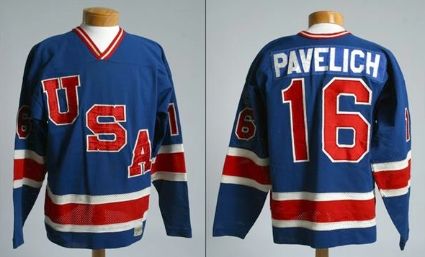
Extra extra bonus jersey: Today's extra extra bonus jersey is a 1980 United States Olympic Team Mark Pavelich jersey. After 32 years with only Mark Wells' blue and white Miracle on Ice jerseys becoming available to collectors of game worn jerseys, 2012 saw Ken Morrow auction off his Miracle jersey for $104,328 and 2013 had Eruzione parting with both is blue ($286,800) and white jersey, which sold for $657,250, considerably less than it's $1,000,000 pre-sale estimate.

Pavelich's white jersey, worn when he assisted on Eruzione's game winning goal against the Soviet Union, was also put up for auction at the same time as Eruzione's jerseys. The final highest bid for the Pavelich jersey was $116,203, and with the 19.5% buyer's premium added on, the final selling price rose to $138,863. That exceeds the final price of Ken Morrow's Miracle on Ice jersey, which sold for $104,328, by $34,534.

 photo USA1980Pavelichjersey.jpg
photo courtesy of Classic Auctions

Today's video is Pavelich setting up Eruzione's game winning goal in the Miracle on Ice.

Monday, February 27, 2017

1994 Sweden National Team Peter Forsberg Jersey

The 1994 Winter Olympic hockey tournament, held in Lillehammer, Norway will always be remembered for one defining moment, Peter Forsberg's memorable gold medal winning shoot out goal.

1994 Lillehammer Olympics photo 1994_Lillehammer_Winter_Olympics_logo.png

Forsberg had debuted with the Modo Hockey junior team in his hometown of Örnsköldsvik in 1989-90 and made one appearance with the senior club later that same season. The following year he split time between the junior club and the senior club, getting into 23 games and scoring his first goal in the Elitserien. He was also drafted 6th overall by the Philadelphia Flyers during the NHL Entry Draft that year, although he would remain in Sweden for an additional three seasons, in part to play in the 1994 Olympics, at a time when he felt it would be his only Olympic opportunity prior to the NHL suspending it's season to allow it's players to participate in the games, something that wouldn't begin until 1998.


Forsberg Modo photo ForsbergModo.jpg
Forsberg while with Modo

Forsberg moved up to the senior club full time the following year, scoring 28 points in 39 games. As his experience and confidence grew, so did his point totals, and in 1992-93, Forsberg averaged more than a point per game for the first time, with 47 points in 39 games and was named as both the the MVP of the Elitserien as well as the Swedish hockey Player of the Year.

He would win both awards again the next season after 44 points in 39 games.

Internationally, Forsberg first appeared for Sweden in the 1991 European Junior Championships, followed by both the World Junior Championship and World Championship in both 1992 and 1993.


Forsberg Sweden WJC photo PeterForsbergWJC1.jpg
Forsberg at the 1992 World Juniors

Already considered by that point to be the best player in the World not in the NHL, Forsberg would make himself known to hockey fans all across North America with the events on this day in the 1994 Olympic gold medal final.

Sweden was placed in Group B for the Preliminary Round with Canada, France, Italy, Slovakia and the United States and tied in their first game 4-4 with Slovakia, making their first ever Olympic appearance. They easily handled Italy 4-1 and France 7-1 before defeating the United States 6-4 before losing to Canada 3-2 to finish their group in third place behind Slovakia and Canada.

As a result of their third place finish, they drew Germany (second place in Group A) in the first round of the Medal Round playoffs and easily eliminated them 3-0. Next up was the surprisingly down Russians, who were feeling the effects of the breakup of the Soviet Union in 1991 and the resulting turmoil in their hockey program. Having lost to the Finns 5-0 and the Germans 4-2 in Group A, Sweden ended their tournament 4-3 to advance to the Gold Medal Final against Canada, who knocked out the Czech Republic 3-2 and Finland 5-3 for their shot at gold.

The scoring was opened by Sweden at 6:10 of the first period on the power play on a goal by Kenny Jonsson from Hakan Loob and Peter Forsberg. There was no additional scoring until Canada got on the board with a goal by Paul Kariya from Chris Kontos and Greg Johnson at 9:08 of the third.

Canada went up by one when defesman Derek Mayer scored an unassisted goal at 11:43. Canada was able to keep their lead until Brad Werenka was called for a penalty at 17:50 and Sweden made them pay the price when Magnus Svensson scored on a shot from the point with assists from Forsberg and Jonsson at 18:11 on the resulting power play.

The game would finish deadlocked at 2-2 and the following ten minute overtime failed to settle the score, moving the game to a deciding shootout.

Petr Nedved opened the shootout with a goal for Canada, while Loob missed for Sweden. Kariya then converted for Canada and Svensson matched that with a goal of his own to keep Sweden within one.

Dwayne Norris was stopped by Swedish goaltender Tommy Salo and Mats Nasulnd was kept off the scoreboard by Canadian Corey Hirsch. Unlike today's three round shootouts, this one was scheduled to go five rounds.

Greg Parks missed for Canada and Forsberg evened the shootout at 2-2 for Sweden. After Johnson missed for Canada, Roger Hansson failed to win it for Sweden and the shootout moved into sudden death.

With players now allowed to shoot again, Svensson missed for Sweden before Nedved had Salo beaten but put the puck wide during his chance to win gold.

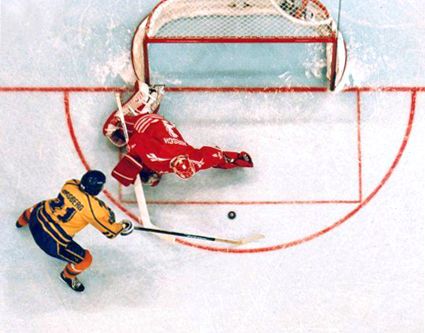
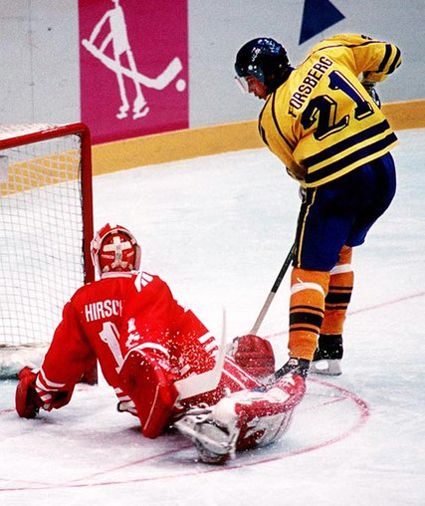
The 13th shooter would see the 20-year-old Forsberg take his second attempt with the weight of the world on his shoulders, and using a move that would be immortalized on a Swedish postage stamp, faked to his forehand (having gone to the right on his first shootout goal) before nearly skating past the net on his left, drawing Hirsch to the side of the crease, as Forsberg fully extended his right arm and gently tucked the puck into the center of the net on his backhand around the outstretched Hirsch.


Forsberg's famous Golden Goal

It was a shot Forsberg had recalled seeing when he was 15 while watching Kent Nilsson on a breakaway during the 1989 World Championships against American John Vanbiesbrouck.

"I liked it right away," Forsberg recalled. "The goalie ended up in the stands."

 photo 1994ForsbergGoldenGoal.jpg
Another angle of Forsberg's spectacular shootout goal

When Salo laid himself out in the crease and blocked Kariya's final attempt, Sweden had captured the gold medal.

 photo KariyaSalo1994Olympicshootout.jpg
Salo stops Karyia to seal the gold medal

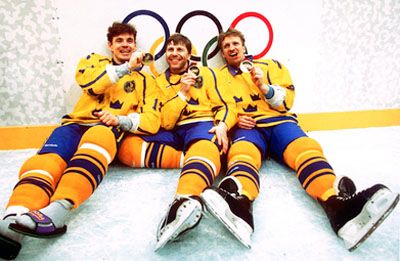
With the gold medal victory, Loob, Naslund and Tomas Jonsson became the first players to win the World Championship, the Stanley Cup and the Gold Medal, an accomplishment that would become known as the Triple Gold Club. Forsberg would eventually join the exclusive club in 1996, which currently consists of just 22 players in the history of the sport.


The inaugural class of the Triple Gold Club

Today's featured jersey is a 1994 Sweden Peter Forsberg Jersey. These jerseys are very similar to the Tackla branded jerseys used in 1992, including the same distinctive block numbers with the 3-D geometric "drop shadow" effect for the numbers, with the obvious addition of the overly large Reebok logos on the shoulders and additional piping that runs down the arms. These jerseys are a medium weight mesh and all the graphics dye-sublimated.

For collectors  the 1994 Reebok jerseys are much scarcer than the Tackla jerseys from 1988 to 1993, which can be found as game worn, some replicas with names and blank jerseys, which were apparently made available for purchase by fans, while the Reebok jerseys appear to never have been made for retail sale, as we have only seen game worn examples on the market and in photos, generally with sponsor patches from the World Championships, as evidenced by our inability to find standard collector photos of the front and back of any 1994 Reebok Sweden Olympic jersey to illustrate today's post.

Sweden 1994 jersey photo Sweden1994jersey.jpg


Here is the complete Gold Medal Final shootout, in two parts.


Here is Nilsson's original goal which inspired the young Forsberg in 1989.


hit counter for blogger