History of Jersey 83-93 Banner sm photo History of Jersey 83-93 Banner sm.jpg

Thursday, November 24, 2016

1902-03 Rat Portage Thistles Tom Hooper Jersey

Born on this date in 1883 in Rat Portage, Ontario, Tom Hooper, known as a formidable checker and clever stickhandler, joined the Rat Portage Thistles of the Manitoba Senior Hockey League at the age of 18. The Thistles won the league championship in 1903, and emboldened by their local success, travelled east to challenge the Ottawa Silver Seven for their grip on the Stanley Cup in March of 1903.

Thistles 1902-03
1902-03 Rat Portage Thistles

Their series was a two-game, total-goal contest in which the Silver Seven took a dominant 6-2 win in Game 1, leaving Rat Portage a task they could not overcome. Game 2 also went the way of the Silver Seven 4-2, allowing them to retain their hold on the trophy.

Two seasons later following a 7-1 regular season record in which he scored a career high 9 goals, Hooper and the Thistles, now older and wiser than the teenagers of 1903, once more challenged mighty Ottawa for the rights to the Stanley Cup. This time around, the contest was a best-of-three format and the Thistles broke out on top with a 9-3 win in Game 1, which certainly must have had the Thistles faithful pining for a return to the two-game, total-goals format. The Senators welcomed back center Frank McGee for Game 2, and Ottawa responded with a 4-2 win to even the series. The decisive Game 3 once again went the way of Ottawa in a nail biting 5-4 win for the home Senators, sending the Thistles back to Rat Portage empty handed. Hooper finished the series with a pair of goals this time out.

Thistles 1904-05
The MAHA league champions and Stanley Cup
challenging 1904-05 Rat Portage Thistles

In 1905 the town renamed itself Kenora while the hockey club continued to be known as the Thistles. The Thistles won the MAHA title in 1906, but circumstances out east did not allow time for an immediate challenge, so one was scheduled during the following 1906-07 season.

Thistles 1905-06
The 1905-06 Kenora Thistles pose with their
impressive Manitoba league championship trophy

In January of 1907, the time arrived for the Thistles challenge for the Stanley Cup and they traveled east once more, this time to face the Montreal Wanderers, who had wrestled away control of the cup from Ottawa during their league playoffs.

The Thistles, with future hall of famers Joe Hall, Tommy Phillips, Art Ross, Billy McGimsie, Roxy Beaudro and Hooper, defeated Montreal 4-2 in Game 1 on January 17 and won the coveted Stanley Cup on four days later with an 8-6 triumph to win the two-game, total goal series 12-8, with Hooper contributing 3 goals in the second game , making Kenora, population 4000, the smallest town to have ever won a major sports championship in North America.

Thistles 1907 Stanley Cup holders
The 1907 Stanley Cup holders the Kenora Thistles

Following the Thistles' Manitoba Professional Hockey League season, they defeated Brandon Wheat City 8-6 and 4-1 to win the league's playoff championship, which also allowed them to retain possession of the Stanley Cup. Five days later, on March 23, the Thistles took to the ice to defend their cup against the Wanderers, this time in Winnipeg but without Hooper who had fractured his collarbone. Montreal took Game 1 by a score of 7-2, and although Kenora won the second game 6-5, it was not enough to overcome Montreal's 5 goal margin from the first game, and the cup was again headed back east, ending tiny Kenora's reign as champions of all of Canada after just two months.

Gutted by player defections to professional clubs, the Thistles folded after just one game of the 1907-08 season and Hooper moved east to play one game with the Pembroke Lumber Kings prior to joining the Wanderers for two regular season games, as well as their defense of the Stanley Cup they had claimed back from Kenora a year earlier. The Wanderers easily fended off the challenge from the Ottawa Victorias 9-3 and 13-1 with Hooper having moved back to a defensive role with the Wanderers.

1908 Montreal Wanderers
1908 Stanley Cup holders the Montreal Wanderers

Hooper then joined the Montreal Amateur Athletic Association club for the remaining seven games of the season in which he scored 9 goals and subsequently retired as a player, having played for seven seasons in 65 games and scoring 48 goals as well as winning the Stanley Cup twice. He was later elected to the Hockey Hall of Fame in 1962.

Today's featured jersey is a 1902-03 Rat Portage Thistles Tom Hooper jersey. The Thistles name was selected from a local name the team contest, with the winner, a local Scottish carpenter named Bill Dunsmore, who not only submitting the name "Thistles", but a drawing for the logo that would adorn the team's sweaters as well.

Thistles 1903-04

Most often the Thistles logo would appear centered on the teams sweaters, but as seen in the above team photo from the 1903-04 season, there was some inconsistency in 1902-03 and 1903-04 where some sweaters had what would become the standard centered logo, some had the logo over the left breast and some had no logo whatsoever.

Rat Portage Kenora Thistles 1902-03

Today's video segment is a look at the Kenora Thistles. While the original Thistle club disbanded in 1908, subsequent clubs in Kenora have adopted the Thistle name, which was the case for the club that interview subject Louis McKay played on in 1934.

Wednesday, November 23, 2016

The NHL Record for Most Fights in a Single Game - 1929-30 Boston Bruins Eddie Shore Jersey

On this date in 1929, the Boston Bruins traveled across the border into Canada to take on the Montreal Maroons. It was to be Boston's fourth game of the season and they were riding a three game winning streak, having already defeated the Detroit Cougars, Toronto Maple Leafs and New York Rangers.

The Bruins lineup was loaded with star players, such as Hall of Famers Dit Clapper, Cooney Weiland, Mickey MacKay, Marty Barry, goaltender Tiny Thompson and the legendary Eddie Shore as well as Lionel Hitchman.

1929-30 Boston Bruins team photo 1929-30BostonBruinsteam.jpg
The 1929-30 Boston Bruins

The Maroons were no pushovers either, as their roster also featured Hall of Famers goalie Clint Benedict, Georges Boucher, Red Dutton, Nels Stewart, Hooley Smith and Babe Siebert for no less than 12 future Hall of Famers taking part.

 photo 1929-30 Montreal Maroons team.jpg
The 1929-30 Montreal Maroons

While the host Maroons entered the game at 2-2, Montreal would go on to win the Canadian Division of the NHL with a 2316-5 record for 51 points (out of a then possible 88 from the current 44 game schedule), second best in the league and behind only the Bruins, who would win the American Division with a league best 77 points from a stellar 38-5-1 record.

The Maroons would draw first blood when Dave Trottier beat Thompson from Bill Phillips at the 9:30 mark of the first period. Weiland responded for Boston with just ten seconds remaining in the first with an assist from Shore as the period ended in a 1-1 tie.

Shore Bruins photo ShoreBoston.jpg
Boston's legendary and controversial Eddie Shore

Montreal retook the lead at the 4:30 mark of the second period when Smith scored from Stewart to put the Maroons back up 2-1.

Shore then got into a fight with the rugged Boucher of the Maroons, who finished his long NHL career with 838 penalty minutes in 449 games.

 photo Boucher Maroons.jpg
Georges Boucher

At the conclusion of the fight, the violent tone for the rest of the evening was fully established when Shore spotted Trottier as the nearest Maroon, and got into it with him so viciously that Shore collapsed one of Trottier's lungs and sent him to the hospital.

 photo Trottier Maroons.jpg
Dave Trottier, who suffered a collapsed lung at the hands of Shore

Shore was now a marked man, as for the rest of the night the Maroons sought out Shore for revenge. Smith, who had fought Shore on many occasions was the first to confront the hated Bruin for Shore's third fight of the evening, leaving him looking somewhat battered.

 photo Smith Maroons.png
Hooley Smith

In between all the fisticuffs, there was still some hockey to be played, and Boston scored twice in 50 seconds just after the midway point of the second period, as Bill Carson tied the game at 10:30 from Art Gagne followed by Weiland's second goal of the game at 11:20 from no less than Shore to give Boston a 3-2 lead.

Clapper then scored his fifth goal of the young season with 1:30 left in the second period from Dutch Gainor to extend the Bruins advantage to 4-2 after the second period.

Stewart pulled Montreal to within one at the 3 minute mark with an assist from Boucher to make the score 4-3, but the Maroons were still furious with Shore, and continued to pound him at every opportunity, but he was no stranger to that kind of treatment and continued to press on despite his ever increasing ragged appearance.

Dutton was the next Maroon to attempt to knock Shore out of the game, as the previous season's penalty minute leader exchanged blows with Shore in his fourth fight of the game. Similar to Boucher, Dutton would complete his NHL career with 871 penalty minutes in 449 games played.

 photo Dutton Maroons.jpg
Red Dutton

The final bout on Shore's fight card came after Siebert was knocked down behind the net. He was in the process of rising to his skates when Shore slugged the vulnerable Maroon. Enraged, Siebert charged at Shore with his stick raised and cross checked him in the head, setting off Shore's fifth brawl of the game. The two went at it so violently, that when the battle was over, beleaguered referees George Mallinson and Lou Hefferman called a halt to the game while the blood was cleaned off the ice.

Babe Siebert photo BabeSiebertsm.jpg
Babe Siebert

The game ended without any further scoring for a 4-3 win for the Bruins and an NHL record five fights for the hated Shore, a record which still stands to this day and will remain unbroken, as the rules now call for a game misconduct for any player accumulating three fights in a game.

Speaking to the toughness of the combatants, that night, Shore of Boston and Dutton, Siebert and Smith would all finish in the top ten in league penalty minutes for the season.

In addition to Trottier, Siebert suffered so much at the hands of Shore that he also was hospitalized that night while Shore finished the night with a trip to the hospital were he was diagnosed with a broken nose, two black eyes, a gashed cheekbone, cuts over both eyes, a mild concussion and four missing teeth!

Shore missed the Bruins next game, perhaps fortunately, as it was rematch against the very same Maroons in Boston just three days later, but returned to the ice for Boston's next game one week after the bloodbath, scoring a goal against the Pittsburgh Pirates.

Bruins owner Charles Adams was incensed and protested the actions of the Maroons, complaining to NHL president Frank Calder that "the hockey displayed by the Maroons was a crime. It was brutal. Eddie Shore was knocked out four times." When Calder did nothing in response, Adams caused quite a stir at the league offices when he presented Shore with a check for $500 before the Bruins next home game on December 3rd, explaining that the reward represented $100 for each scar Shore received against the Maroons and the "game way he took his punishment". Shore, though, insisted that the money be shared equally with the rest of his teammates.

Shore Bruins photo ShoreSportKings.jpg
Shore from the 1933 Sport Kings trading card set,
one of only three hockey players in the 48 card set

The two teams would meet again that season in the playoffs, as the second and third place teams from each division would face off in the Quarterfinals, with the winners advancing to the Semifinals against each other for a spot in the Stanley Cup Finals. Meanwhile, as division winners the Bruins and Maroons advanced directly to the Semifinals for a place in the finals. Boston took Game 1 in overtime 2-1 and won Game 2 by a score of 4-2 on the road. Montreal stayed alive with a tight 1-0 win in Boston, but the Bruins closed out the Maroons with a 5-1 win in Game 4. Boston then lost in the best-of-three final to the Montreal Canadiens in two straight.

Today's featured jersey is a 1929-30 Boston Bruins Eddie Shore jersey as worn the night Shore set a record for Most Fights in a Single Game with five.

The Bruins were formed in 1924 and originally wore brown and gold uniforms, which were taken from owner Adams' First National Stores. After changing to a new style for their second season, today's featured jersey style arrived for their third season of 1926-27 and was worn for six seasons, which included their first Stanley Cup in 1929.

Sharp eyed readers will notice a Boston Cubs patch on the left sleeve, as this particular sweater was worn by Shore for two seasons until being handed down to the Bruins minor league team, the Cubs and worn by player Byron Johnson, whose family retained possession of the jersey until recently, when it was auctioned off for $119,500.

 photo Boston Bruins 1929-30 F jersey.jpg
 photo Boston Bruins 1929-30 B jersey.jpg
photos courtesy of Heritage Auctions

Today's video is a 15 minute film on the career of Shore, a rich topic worthy of much more than we can provide here.


Tuesday, November 22, 2016

1962-63 Montreal Canadiens Jacques Laperriere Jersey

Born on this date in 1941, defenseman Jacques Laperriere spent his apprenticeship in the Montreal Canadiens system, playing for both the Jr. Canadiens and senior level Canadiens farm teams, which often carried the same team name at both the junior and senior levels of play. His first season in the Montreal system was in 1958-59 with the Hull-Ottawa Canadiens and his most notable season prior to the NHL was spent with the Montreal Jr. Canadiens in 1961-62 when he scored 20 goals and 57 points from the blueline in only 48 game.

 photo Laperriere Montreal 1.jpg
Jacques Laperriere

In 1962-63, Laperriere made his NHL debut with the Montreal Canadiens. scoring 2 assists in 6 games. He also played in 5 playoff games that season, but spent the majority of his time with the Hull-Ottawa Canadiens of the Eastern Professional Hockey League, seeing action in 40 games, scoring 8 goals and 27 points.

The following season he became a full time NHLer, playing 65 games with Montreal, scoring his first 2 NHL goals on his way to 30 points and a career high 102 penalty minutes. His defensive play as a rookie was quite impressive, as he made few mistakes game after game, which led to him winning the Calder Trophy as the NHL Rookie of the Year as well as being named to the NHL Second All-Star Team at the conclusion of the season.

 photo Jacques Laperriere 1963-64.jpg
Laperriere won the Calder Trophy in 1964

Just prior to the start of the 1964-65 season, Laperriere played in the 1964 NHL All-Star Game, which at the time was held before the regular season, rather than the current mid-season location on the schedule.

The 1964-65 season saw Laperriere post similar offensive numbers with 5 goals at 27 points as well as 92 penalty minutes. During the playoffs, Laperriere played in 6 of Montreal's 13 playoff games as they defeated the Toronto Maple Leafs 4 games to 2 in the Semifinals before defeating the Chicago Black Hawks in a series that went the full seven games before the Canadiens won the deciding game 4-0 to get Laperriere's name engraved on the Stanley Cup for the first time of his career.

Tall for his day at 6' 2", the smooth skating Laperriere used his long reach to stymie his opponents on a consistent basis while is steady offensive contributions continued for the 1965-66 season with 6 goals and 31 points. His fine play that season was recognized when he was named the winner of the Norris Trophy as the NHL's Best Defenseman for 1966 despite only playing in 57 games. Although he missed the playoffs, a controversial Game 7 overtime goal by Henri Richard won the Stanley Cup for the Canadiens, earning Laperriere his name on the Stanley Cup for the second time.

 photo Laperriere Montreal 3.jpg
Laperriere won the 1966 Norris Trophy as the NHL's Best Defenseman

While Laperriere did not score a goal during the 1966-67 season, he contributed his customary 20 assists. While Montreal made it to the Stanley Cup Finals once again, the came up short against Toronto 4 games to 2.

The 1967-68 season saw Laperriere score 4 goals and 25 points during the season the NHL expanded from six teams to twelve. The great expansion led to the addition of another round of the playoffs, and Montreal demonstrate their utter dominance by sweeping the Boston Bruins in four before eliminating the Black Hawks 4 games to 1 to advance to the Finals, where they swept the expansion St. Louis Blues to win Laperriere's third Stanley Cup.

1968-69 was a virtual repeat of the previous season, as Laperriere scored 5 goals and matched his career high with 31 points. The Canadiens again had an easy time of it in the Eastern Division playoffs, which was comprised of all of the established, much stronger Original 6 teams, as they swept the New York Rangers in four and eliminated the Bruins in six to advance to the finals, where they once again faced off against St. Louis. Montreal had finished the season with a league best 103 points, 15 points better than the Blues 88. The might of the Canadiens was too great for St. Louis, as Montreal won in four straight for the second year in a row, outscoring the Blues 12-3 in the series, thanks in no small part to Laperriere's strong defensive play

 photo Laperriere Montreal 1968.jpg
Laperriere won his fourth Stanley Cup in 1969

Laperriere set a career high in 1969-70 with 37 points from 6 goals and 31 assists, his seventh consecutive season of 20 points or more. Shockingly, Montreal missed the playoffs, losing a tie breaker to the Rangers for the fourth and final East Division playoff spot, despite their 92 points being more points than the West Division winning Blues 86 points!

The Canadiens regrouped in 1970-71, and solidly qualified for the playoffs. Laperriere's season was limited by injuries to 49 games and just 16 assists, he was recovered in time for the postseason, where he went on a tear, scoring 4 goals and 13 points in 20 games while controlling the play every time he was on the ice. The new playoff format saw the Canadiens defeat the rival Bruins in 7 games before defeating the Minnesota North Stars in six to advance to the Finals against the Chicago Black Hawks. The series went the full seven games and Laperriere was on the ice at the end, trusted by head coach Al MacNeil to protect the Canadiens 3-2 lead and he was the first player to hug the Canadiens young phenomenon in goal, Ken Dryden. Montreal was the last team to win

 photo Laperriere Montreal 1970-71.jpg
Laperriere's fifth Stanley Cup came in 1971

Laperriere rebounded with a 73 game season in 1971-72, scoring 28 points. He was again slowed by injuries in 1972-73, but still managed his customary 23 points in only 57 games during the regular season. Healthy enough to play in 10 of Montreal's 17 playoff games, the Canadiens defeated the Buffalo Sabres in 6, the Philadelphia Flyers in 5 and earned Laperriere his sixth Stanley Cup after they beat the Black Hawks in six games. That season, Laperriere also led the NHL with a +78 rating, becoming the only player other than Bobby Orr to lead the league between 1969 and 1975.

 photo 46457289-1cda-4984-8424-aca56d4f6990.png
Laperriere excelled despite having to contend
with stars such as Buffalo's Gilbert Perreault

His final NHL season of 1973-74 was cut short after 42 games when Laperriere suffered a knee injury that ended his career after 691 games played with 40 goals and 242 assists for 282 points and a +241 rating, a Calder Trophy, a Norris Trophy and six Stanley Cups. Additionally, Laperriere played in five NHL All-Star Games (1964, 1965, 1967, 1968 and 1970) and was inducted into the Hockey Hall of Fame in 1987.

 photo Laperriere Montreal 1973-74.jpg
Laperriere played 13 seasons, all with the Canadiens

Following his playing career, Laperriere would become an assistant coach to the Canadiens for 16 seasons, which included winning two more Stanley Cups in 1986 and 1993. He later would be on the coaching staff of the Bruins, New York Islanders and New Jersey Devils.

Today's featured jersey is a 1962-63 Montreal Canadiens Jacques Laperriere jersey as worn during his rookie season in the NHL. This style jersey dates back to 1941 and, aside from a version with a blue stripe around the chest for three years in the late 40's, has remained essentially unchanged ever since.

 photo Montreal Canadiens 1962-63 jersey.jpeg
photo courtesy of Classic Auctions

Bonus jersey: Today's bonus jersey is a 1967-68 Montreal Canadiens Jacques Laperriere jersey as worn during the season the Canadiens won the fifth of six Stanley Cups Laperriere would win during his 12 year career with Montreal.

The Canadiens red sweaters with the blue band around the chest date back to before the formation of the NHL in 1917 and this exact variation with the lace up collar and numbers inside the arms stripes dates back to 1966-67 and remained in use through 1974-75 when it was replaced by a new v-neck collar.

 photo Montreal Canadiens 1967-68 F jersey.jpeg
 photo Montreal Canadiens 1967-68 B jersey.jpeg
photos courtesy of Classic Auctions

Extra bonus jersey: Today's extra bonus jersey is a 1973-74 Montreal Canadiens Jacques Laperriere jersey as worn during the final season of his NHL career.

 photo Montreal Canadiens 1973-74 F jersey.jpeg
 photo Montreal Canadiens 1973-74 B jersey.jpeg
photos courtesy of Classic Auctions

Monday, November 21, 2016

1971-72 New York Rangers Jean Ratelle Jersey

On this date in 1971, the California Golden Seals traveled to Madison Square Garden to take on the New York Rangers in front of 17,250 fans.

Rookie goaltender Gilles Meloche got the start for the Golden Seals, while veteran Gilles Villemure got the call for New York.

Villemure Rangers photo VillemureRangers.jpg
Rangers starting goaltender Villemure

The Golden Seals came into the game with a 6-11-3 record and had lost five of their previous six games. Meanwhile the host Rangers were 13-2-4 and had just lost their previous game 4-1 the day before in Minnesota, snapping a a 6 game winning streak and a 14 game unbeaten streak.

Jean Ratelle opened the scoring for the Rangers 4:11 into the contest with assists from Rod Gilbert and defenseman Dale Rolfe with his 11th goal of the season. Vic Hadfield's 14th goal of the season at 14:59 from Brad Park and Gilbert made it 2-0 for the Rangers after the first period.

 photo Ratelle Rangers.jpg
Jean Ratelle

The Rangers extended their lead to 3-0 at 4:06 when left winger Ted Irvine scored his third goal of the season from Rod Seiling and new arrival Gene Carr, who had just recently arrived from the St. Louis Blues. Ratelle then scored his second goal of the night at 13:42 from Hadfield and Jim Neilson to extend the Rangers advantage to 4-0 before the Golden Seals showed some signs of life when right winger Norm Ferguson got California on the board when he beat Villemure at 17:53 from future Ranger Carol Vadnais and Gary Jarrett to make the score 4-1 for New York at the end of the second.

Ratelle completed his hat trick just 41 seconds into the third period, again from Gilbert and Rolfe. A little over a minute later Irvine had his second goal of the night when he beat Meloche at 1:56 from Bruce MacGregor and Carr.

Less than two minutes later, Ratelle had his fourth goal of the game and 14th of the season from Hadfield and Gilbert as all three members of the GAG line combined for the seventh Rangers goal at 3:40. Team captain Hadfield, center Ratelle and right wing Gilbert were known as the GAG line, which was an acronym for Goal-A-Game, and no doubt combining for five goals on the night certainly helped maintain their average for the season!

GAG Line Rangers Pictures, Images and Photos
The GAG Line, Hadfield, Ratelle and Gilbert

Carr, already with two assists, scored at 6:44 from Seiling and Neilson for the fourth Rangers goal of the period as the rout was well and truly on as New York now led 8-1.

The next to join the fun for the Rangers was rookie Pierre Jarry, who scored the first goal of his career at 11:03 from Walt Tkaczuk and Neilson. They stayed out on the ice for the subsequent faceoff, which was won by Tkaczuk, who got the puck to Jarry. He crossed the Golden Seals blueline and fired a shot past Meloche for the second goal of his career - just a mere five seconds after his first one! With the Rangers now leading 10-1, California head coach Vic Stasiuk mercifully, and finally, pulled Meloche, who had given up 10 goals on 40 shots against.

 photo Meloche Seals.jpg
Gilles Meloche was finally pulled after giving up ten Rangers goals

Lyle Carter was the unfortunate backup goaltender who had to come in and face the red hot New York onslaught with just under 9 minutes remaining. At 12:27, just 1:19 after coming into the game, Carter gave up the 11th Rangers goal when Carr scored his second of the period from MacGregor and Park with Vadnais in the penalty box for the Golden Seals - remarkably the first power play goal of the game out of the dozen combined goals scored up to that point.

The final nail in the Golden Seals coffin arrived with just 36 seconds left in the game when Bill Fairbairn scored the eighth Rangers goal of the period from Seiling and Tkaczuk at 19:24 for a final score of 12-1 for New York.

 photo Tkaczuk Rangers.png
Walt Tkaczuk had three assists in the third period,
two of them on Jarry's goals five seconds apart

Villemure got the easy win for the Rangers after making 15 saves on 16 shots, while Carter made 10 saves on 12 shots. Combined with the 40 Meloche endured, New York peppered the Golden Seals net with a total of 52 shots for the game.

Villemure Rangers photo 1972-73NewYorkRangersjersey.png
Gilles Villemure

Ratelle was the star of the night with his four goals, while Carr had 2 goals and 2 assists for 4 points of his own. Hadfield (1 goal and 2 assists), Gilbert (3A), Seiling (3A), Neilson (3A) and Tkaczuk (3A) all had three points on the night, while five others had 2 points among the 13 Rangers who registered a point on the night, with special mention going to the rookie Jarry's first two career goals scored just five seconds apart.

As bad as the night was for California, they would rebound with a 6-1 win in their next game against the Detroit Red Wings and avoid any extended losing streaks, save for dropping their final six games of the season, finishing with a 21-39-18 record, good for 6th place in the 7 team West Division with 60 points, just 7 back of third place St. Louis.

Meanwhile, the Rangers went 48-17-13 for 109 points, second best in the league behind only the Boston Bruins 119.

The playoff format of the day saw the teams cross-over from East and West Divisions in the Semifinals, which was done in order to create a more competitive Stanley Cup Final, as the previous format had led to three straight blowouts from 1968 to 1970.

In 1972, the Rangers defeated the Montreal Canadiens 4 games to 2 and then swept the Chicago Black Hawks in 4 straight to advance to the Finals against the Bruins, who defeated the Rangers in six games.

Ratelle (109 points), Hadfield (106) and Gilbert (97), would finish 3-4-5 in league scoring that season, while Villemure's 2.09 goals against average was second in the NHL that season.

Today's featured jersey is a 1971-72 New York Rangers Jean Ratelle jersey. The Rangers debuted in 1926 wearing jerseys not too dissimilar to the one worn by Ratelle in 1971-72. The original white lettering changed to red for their second season of play. The font still used for the cresting arrived in 1941 and the drop shadow on both the crest and the numbers came a year later. In 1951 the laces were added to the collar and they arrived at today's featured style when the sleeve numbers arrived in 1963.

This style would be used through 1975-76 before a new, modern jersey was worn for two seasons with the Rangers shield as the main crest In 1978-79, this style returned, only with Rangers replaced by "New York" on the front until reverting back to "Rangers" in 1987.

 photo New York Rangers 1971-72 F jersey.jpg
 photo New York Rangers 1971-72 B jersey.jpg

Extra bonus jersey: Today's extra extra bonus jersey is a 1971-72 California Golden Seals Gilles Meloche jersey as worn during the Golden Seals game in Madison Square Garden on this date in 1971 when the rookie Meloche was shelled for ten goals by Ratelle and the Rangers.

The Seals debuted with jerseys that were green and blue with white trim from 1967-68 to 1969-70. For the 1970-71 season, new owner Charlie O. Finley changed the team colors to green and gold to match his Oakland Athletics of Major League Baseball, including having his team wear white skates at first to match the white shoes worn by the A's.


This style would remain in use for four seasons under Finley's ownership until the colors were once again changed from kelly green to teal and yellow for the team's final two seasons in Oakland.


 photo California Golden Seals 1971-72 jersey.jpg
photo courtesy of Classic Auctions

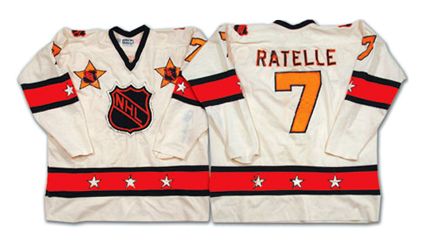
Extra extra bonus jersey: Today's extra extra bonus jersey is a 1980 NHL All-Star Game Jean Ratelle jersey as worn in the game played in Detroit. It was the fifth and final All-Star Game of Ratelle's career. Ratelle had an assist in the game on a goal by Craig Hartsburg in a 6-3 winning effort by the Wales Conference.

photo courtesy of Classic Auctions

First in today's video segment, linemates Hadfield and Gilbert discuss the GAG line they were on with Ratelle.


Next, some classic footage and a look at the history of the Golden Seals.

Sunday, November 20, 2016

1960-61 Toronto Maple Leafs Dave Keon Jersey

On this date in 1974, Dave Keon of the Toronto Maple Leafs played in his 1,000th career game, and celebrated the occasion in style by scoring a hat trick, the fifth of his career.

 photo KeonMapleLeafs.jpg
Dave Keon played in his 1,000th NHL game on this date in 1974

Keon joined the Maple Leafs for the 1960-61 season and won the Calder Trophy following a 20 goal, 45 point campaign. He would go to have five more consecutive 20-goals seasons.

Keon Maple Leafs photo Keonearly.jpg
Keon won the Calder Trophy as Rookie of the Year

During Keon's second season in the NHL, in which the Maple Leafs would capture the Stanley Cup, Keon would add the Lady Byng Memorial Trophy to his already growing trophy case after a season in which he drew but a single minor penalty in 64 games played.

He was one of the fastest skaters in the NHL and one of the best defensive forwards as well, often being matched up against the opposition's top centers.

More Stanley Cups would follow in 1963, as well as a second Lady Byng Trophy, and again in 1964, a season in which Keon would lead the Maple Leafs in scoring for the first time.

After Keon led the Maple Leafs in scoring again in 1966-67, the Maple Leafs would win the 1967 Stanley Cup and Keon was named the Conn Smythe Trophy winner, the only Maple Leaf to ever win the trophy named for the former owner of the club.

Keon Smythe photo KeonConnSmythe.jpg
Keon poses with the Conn Smythe Trophy

Keon was named captain of the Maple Leafs in 1969-70 and led the team in scoring yet again before setting a then NHL record in 1970-71 with eight shorthanded goals.

Keon Captain photo KeonCaptainMapleLeafs.jpg
Keon has the captain's "C" sewn on to his jersey by
Maple Leafs trainer Joe Sgro, while still wearing his jersey!

After coming to an agreement to join the Ottawa Nationals of the fledgling WHA in 1972, the deal fell apart and Keon signed a three year contract to remain in Toronto and led the team in goal scoring in 1972-73, which included his 297th goal as a Maple Leaf, passing George Armstrong and Frank Mahavolich as the franchise's all-time leading goal scorer.

Having fallen out of favor with Maple Leaf's owner Harold Ballard by the end of his contract, Keon jumped to the rival WHA and signed with the Minnesota Fighting Saints for the 1975-76 season. When the Fighting Saints folded in February of 1976, Keon was unable to return to the NHL because the Maple Leafs still held his NHL rights and owner Ballard wanted too steep a price from any NHL club who wanted to sign him, effectively locking Keon out of the NHL.

Keon Saints photo KeonFightingSaints.jpg
Keon now with the Fighting Saints of the WHA

With staying in the WHA as his only option, Keon signed with the Indianapolis Racers for the remainder of the season. He was traded to the new incarnation of the Minnesota Fighting Saints for the 1976-77 season, only to see that version of the franchise again fold in January of 1977 before the completion of the season.

Keon Racers photo KeonRacers.jpg
Indianapolis Racer Dave Keon

Keon found some stability when he joined the WHA's New England Whalers after the Fighting Saints folded, and would play with the Whalers for the remainder of his career, three seasons in the WHA and three more finally back in the NHL following the demise of the WHA in 1979 when the Whalers were one of four WHA clubs to be allowed to join the NHL.

It was during the 1979-80 season that Keon, then 40 years old, was occasionally on a line with both Gordie Howe (age 50) and Bobby Hull (age 41). When both Howe and Hull retired, Keon was the oldest player in the NHL for his final two seasons before retiring after the 1981-82 season at age 42.

 photo KeonWhalers.jpg
Keon now back in the NHL and it's oldest active player as well

Keon's final totals were 396 goals and 590 assists for 986 NHL points and another 102 goals and 189 assists for 291 points in the WHA, the Calder Trophy, two Lady Byng Trophies, a Conn Smythe Trophy, eight NHL All-Star Game appearances and four Stanley Cups as well as being inducted into the Hockey Hall of Fame in 1986.

Earlier this year Keon was given the tremendous honor of being named The Greatest Maple Leaf in the team's 100 year history.

Today's featured jersey is a 1960-61 Toronto Maple Leafs Dave Keon jersey as worn during his rookie season in the NHL. This style of Maple Leafs jersey dates back to 1934-35, with a few crest variations along the way. This exact crest was introduced in 1938 and had red lettering for three seasons, from 1945-46 through 1947-48. The lace up collar was introduced for the 1958-59 season to arrive at the style Keon wore as a rookie.

Numbers were added to the sleeves in 1962-63 and a white outline was added to the crest the following season and the jersey remained in use through the 1966-67 season until a redesign for the 1967-68 season.

 photo Toronto Maple Leafs 1960-61 F jersey.jpeg
 photo Toronto Maple Leafs 1960-61 B jersey.jpeg
photos courtesy of Classic Auctions

Bonus jersey: Today's bonus jersey is a 1966-67 Toronto Maple Leafs Dave Keon jersey as worn during the fourth Stanley Cup season of Keon's career. This style would be worn for three seasons through 1969-70.

There is a great story about Maple Leafs owner Ballard that recalls when the league made it mandatory in 1978 to put players names on the backs of their home and away jerseys, the notoriously cantankerous Ballard refused to do so. Claiming sales of programs would be reduced - and probably in part because Ballard never liked being told what to do by the league, and then NHL President John Ziegler in particular. When finally forced to comply by the league to put names on the jerseys after being fined, Ballard fought back on February 26, 1978 by putting the names on the back of their blue road jerseys for a game in Chicago in the same blue color as the jersey, making them impossible to read!

 photo Toronto Maple Leafs 1966-67 jersey.jpeg
photo courtesy of Classic Auctions

Extra bonus jerseys: Today's bonus jerseys are 1975-76 Minnesota Fighting Saints Dave Keon jerseys as worn during the Fighting Saints final season of their original incarnation. The Fighting Saints were one of the original WHA franchises formed for the 1972-73 season. They originally wore jerseys with the "S" logo but introduced a new set with the Little Saint logo later during their debut season. The jerseys would remain unchanged until the franchise folded in February of 1976.

Minnesota Fighting Saints 75-76 jersey, Minnesota Fighting Saints 75-76 jersey
 photo Minnesota Fighting Saints 1975-76 road jersey.jpg
photos courtesy of Classic Auctions
 
Extra extra bonus jersey: Today's extra extra bonus jerseys is a 1976-77 New England Whalers Dave Keon jersey as worn while the Whalers were still members of the WHA.

After their inaugural season, the Whalers simplified their logo to just the W bisected with a harpoon and their jerseys would then remain unchanged through the remainder of their time in the WHA, which came  to an end after the 1978-79 season.

 photo Hartford Whalers 1976-77 jersey.jpg
photo courtesy of Classic Auctions

Extra extra extra bonus jersey: Today's extra extra extra bonus jerseys is a 1980-81 Hartford Whalers Dave Keon jersey as worn after the Whalers joined the NHL for the 1979-80 season. The Whalers were required to change their name from New England to Hartford due to a demand by the Boston Bruins as a part of their admission into the NHL.

Along with the new name came a new logo, which featured a bold whale tail and the letter H in the negative space above a bold W. This style underwent a few variations, such as the angled sleeve stripes being straightened, going back to aangled and then straight once again. Additionally, the popular Pucky the Whale shoulder patches would be inexcusably dropped for the 1983-84 season. Of note, this style was also worn with the long Cooperall pants for the 1982-83 season. This jersey would be worn for 13 seasons through the 1991-92 season before the team updated their look, which included promoting blue to their new main color.

 photo Hartford Whalers 1980-81 F jersey.jpg
 photo Hartford Whalers 1980-81 B jersey.jpg

Today's first video is Dave Keon's "Legends of Hockey" biography.


This video is from the 1970-71 season, the Maple Leafs first with their new jerseys and new, modern logo, which is still in use today. Keon scores early in the video on a really nice deke against the Detroit Red Wings. After Keon's goal, the Maple Leafs start picking off fans in the stands with flying pucks, as they nail two in a row!


Here are the final minutes of the Maple Leafs last Stanley Cup championship, won while wearing today's featured jersey.


This piece of sheer brilliance was too good to pass up, the Maple Leafs Top Ten Highest Scorers Named Dave!


Finally, a tour of the Dave Keon Arena in Rouyn Noranda, Quebec.


hit counter for blogger