History of Jersey 83-93 Banner sm photo History of Jersey 83-93 Banner sm.jpg

Thursday, October 20, 2016

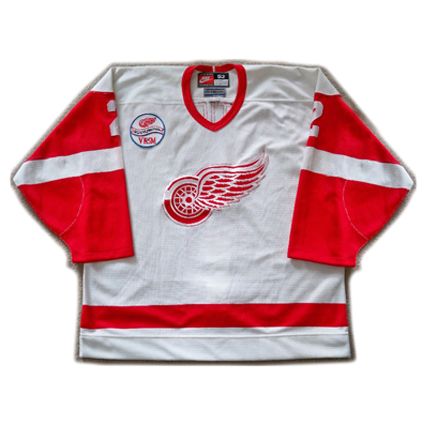
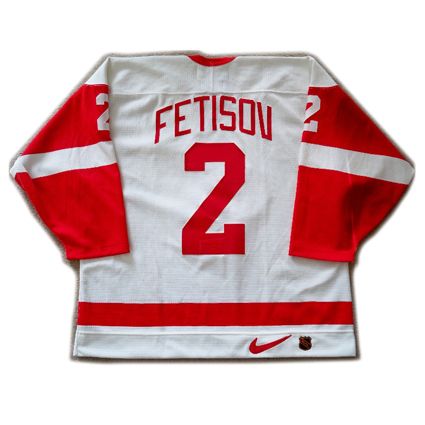
1997-98 Detroit Red Wings Slava Fetisov Jersey

By the time he completed the 1988-89 season in the Soviet Championship league, Viacheslav Fetisov had won 11 Soviet Championships, a pair of Player of the Year awards, two European Junior golds, three World Junior golds, six golds, one silver and one bronze medal at the World Championships, a Canada Cup championship and two Olympic gold medals plus one silver, but there was one championship trophy he was not eligible to compete for - the Stanley Cup.

Slava Fetisov 1986 World Championship
Fetisov enjoyed unprecedented success in the Soviet Union
domestically and internationally

Around the time of the 1989 World Championships, Sergei Priakin, considered expendable by the Soviet National Team, was allowed by Soviet authorities to play for the Calgary Flames in the NHL. Looking to escape the rigid Soviet system and the iron hand of coach Viktor Tikhonov, whose 11 month a year training schedule had grown more than tiresome, the now 31 year old Fetisov also requested to be allowed a move to the NHL.

He met with great resistance at first, but with a new policy of openness now taking hold in the Soviet Union, as well as the Soviet officials desire for an influx of cash, Fetisov, along with seven other players, were allowed to leave for North America, with the stipulation that they continued to compete internationally for the Soviet Union.

Originally drafted by the Montreal Canadiens in 1978, Fetisov's name was put back into the draft in 1983 when he was selected by the New Jersey Devils. The new Soviet players had an immediate impact on the NHL, even as they dealt with various instances of culture shock and a less than warm welcome by Canadians who felt their jobs were being taken.

"For the first 25 games or so, my partners didn't understand my style and I didn't understand the style of the NHL, but we all learned a lot and I thought I had a very good second half," said Fetisov. "It was tough to get out of the country, to fight against a Communist system. And it was tough when I got here (the NHL) for a couple years," Slava admitted. "Many times I would think, 'Why am I here; why did I do it?' I was a big player in Europe and people knew me. Here, all of a sudden, I had to struggle. But I keep telling myself I have to fight through this stuff."

Fetisov Devils photo FetisovDevils.jpg
Fetisov broke into the NHL with the New Jersey Devils

Fetisov scored a career high 42 points during his first North American season, while compatriot Sergei Makarov was named the recipient of the Calder Trophy.

The move to North America had great meaning to Fetisov, beyond just the opportunity to earn a larger paycheck. "It was a victory against a whole system," Fetisov said. "It was not easy. You always have to fight for everything and I fought for everything I have in hockey. I also won the biggest fight away from hockey. That was the fight against communism, the fight for freedom of choices."

In keeping with the agreement, following the Devils elimination from the Stanley Cup playoffs, Fetisov won his seventh and final gold medal at the 1990 World Championships.

1990 Soviet Union WC gold team photo 1990SovietUnionWCgoldteam.jpg
The gold medal winning 1990 Soviet Union National Team,
the seventh World Championship gold of Fetisov's career
He would play four additional seasons for New Jersey, as well as his final appearance for the Soviet Union in 1991 World Championships, where he would the second bronze medal of his career, prior to a move to the Detroit Red Wings during the 1994-95 season.

Once in Detroit, the Red Wings advanced to the Stanley Cup Finals, only to lose to Fetisov's former club, the Devils. In 69 games with Detroit the following season, Fetisov would equal his NHL career high with 42 points. Additionally, the Red Wings would again make a strong playoff push, eventually losing in the Conference Finals to the eventual champion Colorado Avalanche. Prior to the start of the following NHL season, Fetisov would conclude his international career by playing for Russia for the first and only time at the 1996 World Cup of Hockey.

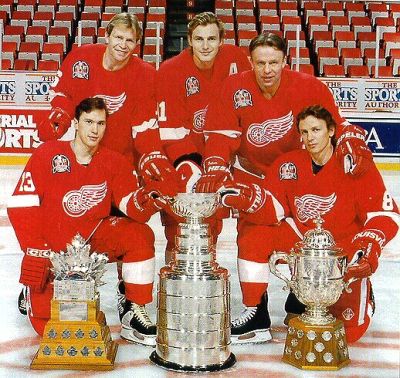
It all came together for the Red Wings in 1997, as Fetisov, as part of the famed "Russian Five", won the 1997 Stanley Cup with a four game sweep of the Philadelphia Flyers.

Russian Five
The Russian Five posing with their spoils of success

The victory made Fetisov and long-time teammate Igor Larionov the only men to have ever won the Stanley Cup, the World Championship, an Olympic gold medal, the World Junior Championship and the Canada Cup. The Canada Cup evolved into the World Cup of Hockey, and Joe Sakic and Scott Niedermayer joined the two Russians as winners of the five most important championships in the world of hockey.

Following the Stanley Cup victory celebrations in 1997, Fetisov was involved in a limousine crash which ended the career of teammate Vladimir Konstantinov and quite nearly cost him his life. Fetisov escaped with relatively minor injuries and was able to continue his playing career.

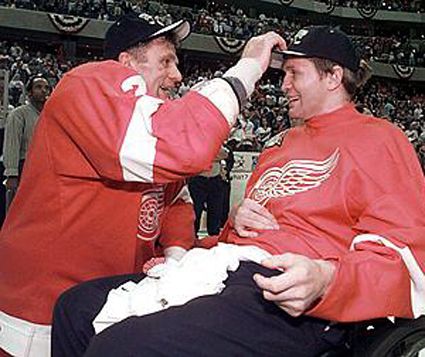
Shortly after the following season began, Fetisov competed in his 500th NHL game, a 3-3 tie against the St. Louis Blues on this date in 1997. It would prove to be another successful season for Detroit, which concluded with an emotional repeat championship for the Red Wings which ended in a memorable scene on the ice as a wheelchair bound Konstantinov was included in the Stanley Cup presentation following the Red Wings victory. It would be the final game of Fetisov's NHL career.


Fetisov Konstantinov 1998 photo FetisovKonstantinov1998.jpg
Fetisov sharing the Red Wings Stanley Cup victory with Konstantinov
following what would be the final game of his career

He would retire with 367 games played in the Soviet Union, scoring 339 points, and 546 games in the NHL, mainly due to the much longer NHL schedule despite playing two seasons more in the Soviet Union, in which Fetisov scored 228 points.

Fetisov has won numerous awards in his home country, including the Order of Lenin in 1988 and even had an asteroid named for him. In the world of hockey, Fetisov was inducted into the Hockey Hall of Fame in 2001. "I just couldn't believe it when they called me," said Viacheslav. "It's a great honour. You play all your life to get the recognition and it feels great, especially being a Russian-born hockey player and spending most of the best years back in Europe. It's a great honour to be in same category as other legends. I have achieved everything I dreamed of in my childhood," said Fetisov.

In 2008, Fetisov was named to the IIHF's International Centennial All-Star Team, which named but five players to create the finest starting lineup of the century, with Fetisov receiving 54 of a possible 56 votes, with no other player earning more than 38.

Today's featured jersey is a 1997-98 Detroit Red Wings Viacheslav Fetisov jersey as worn during his 500th NHL contest. This jersey is highlighted by the "Believe" patch worn in support of Konstantinov and team masseur Sergei Mnatsakanov in it's regular season location of the upper right chest. This patch is better known for it's location on the left sleeve, where it was moved to make way for the 1998 Stanley Cup Finals patch.

Detroit Red Wings 97-98 jersey

Bonus jersey: Today's bonus jersey is a 1991-92 New Jersey Devils Viacheslav Fetisov jersey as worn following Fetisov's being granted permission by the Soviet authorities to become one of the earliest Soviet players to compete in the NHL. The Devils wore red and green jerseys for their first 11 seasons in New Jersey until changing to red and black jerseys beginning the following season, which would be Fetisov's  fourth with the Devils.

The 1991-92 Devils jerseys can be instantly recognized by the NHL 75th Anniversary patch worn on the all the players jerseys that season.

 photo NewJerseyDevils91-92jersey.jpg
photo courtesy of Classic Auctions

Today's video segment contains footage from the Slava Fetisov Farewell Hockey Game which took place in Russia. See if you can recognize any NHL stars in the footage.


In this brief highlight, Fetisov slices and dices Team Canada and scores easily after a coast to coast rush.


We conclude today with a tribute video to Fetisov, which includes some amazing footage of his time in the Soviet Union, much of which we have never seen before as well as some of the original red and green New Jersey Devils jerseys. Highly recommended, but perhaps with the sound off...

Wednesday, October 19, 2016

1966-67 Boston Bruins Bobby Orr Jersey

On this date in 1966 Bobby Orr played in his first NHL game, scoring his first point with an assist as the Boston Bruins defeated the Detroit Red Wings 6-2 in Boston.

Orr, a defenseman and considered by many to be the greatest player in the history of the NHL, was signed by the Bruins at the age of 14. League rules at the time dictated that Orr could not play in the NHL until turning 18. Orr bided his time playing for the Oshawa Generals of the Ontario Hockey League and, in his final season in junior hockey, scored 94 points in 47 games, an average of two points per game, an unheard of average for a defenseman.

Bobby Orr Rookie camp
Orr, wearing #27 during his first NHL training camp

He would win the
Calder Trophy during his first season with the Bruins after scoring 41 points in 61 games. He would miss nine games late in the season with a knee injury, foreshadowing the injury problems that would plague his career. Prior to Orr's arrival, the Bruins had missed the playoffs for seven consecutive seasons and, while they would not make the post-season during Orr's rookie season, they would make the playoffs in every subsequent season of Orr's career in Boston.

Bobby Orr Rookie
Bobby Orr during the 1966-67 season

Despite only playing in 46 games of the 1967-68 season, Orr would win the first of eight consecutive
Norris Trophies. Back on track in 1968-69, he would play in 67 games and top 20 goals for the first time with 21 and total 64 points.

Orr would explode the following season, scoring 33 goals and adding a whopping 87 assists to total 120 points, six short of the league record and become the first and only defenseman to lead the NHL in scoring, which would net him the
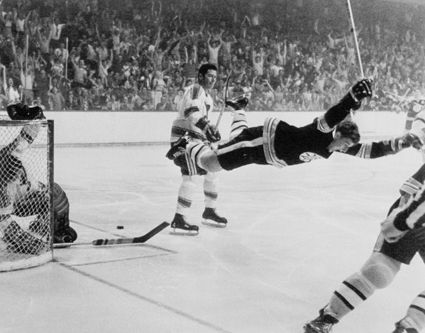
Art Ross Trophy. Additionally, he was named the winner of the Hart Trophy as league MVP. The Bruins would advance through the playoffs, eventually winning the Stanley Cup in overtime of Game 4, a goal captured in an iconic photograph of Orr flying through the air in celebration. Following the playoffs, he would be named the recipient of the Conn Smythe Trophy, making him the first player to win four major NHL awards in the same season.


Orr would top his league leading point total from the previous season with 139 points in 1970-71, including a league leading 102 assists, 26 more than the next closest player, and place second in the scoring race behind Bruin's teammate Phil Esposito while winning the Hart Trophy for the second time. Orr would record a plus-minus rating of +124 that season, an NHL record that still stands today.

1971-72 would see Orr play in 76 games and equal his 37 goals from the previous season while totaling 117 points. Orr and the Bruins would capture their second Stanley Cup and Orr would win his fifth consecutive Norris Trophy, his third consecutive Hart Trophy and his second Conn Smythe Trophy.

1972-73 saw another 100 point season after returning from knee surgery following the Stanley Cup, which forced Orr to miss the 1972 Summit Series against the Soviet Union after being named to Team Canada.

The Bruins would return to the finals in 1973-74 following a regular season in which Orr would score 32 goals and 90 assists for 122 points followed by another 18 points in 16 playoff games.

Orr would once again win the NHL scoring race in 1974-75, capturing the Art Ross Trophy for the second time after a career high 46 goals, becoming the first defenseman to ever score 40 goals, combined with 89 assists for 135 points. He would be named to the NHL First All-Star Team for the eighth consecutive season, win his eighth consecutive Norris Trophy, play in his seventh NHL All-Star Game and win his first Lester B. Pearson Award.

His multiple knee surgeries would catch up to him, limiting him to only 10 games of the 1975-76 season. While essentially playing on one knee, Orr would compete for Team Canada in the 1976 Canada Cup, earning rave reviews and being named tournament MVP in the last hurrah of his storied career.

A move to the Chicago Black Hawks followed for the next two seasons but he totaled just 26 games and 27 points in 1976-77 and 1978-79.

His final career totals are 657 games played, 270 goals and 645 assists for 915 points after ten seasons in Boston and the two in Chicago. At the time of his retirement, Orr was the leading defenseman in NHL history in goals, assists and points. The only players who have averaged more points per game than Orr are Wayne Gretzky, Mario Lemieux and Mike Bossy - all forwards.

Orr's speed, acceleration and creative offensive ability, combined with his toughness and defensive skills revolutionized the position of defense and changed the game forever. He also moved beyond the world of hockey, becoming a mainstream celebrity in the United States.

While we have given you a brief overview of the game-changing career of Bobby Orr, entire books are devoted to his career and the impact he had on the NHL, and we here at Third String Goalie recommend Searching for Bobby Orr.

Today's featured jersey is a 1966-67 Boston Bruins Bobby Orr jersey as worn during Orr's rookie season. This particular jersey recently sold at auction for $191,200, clearly putting it in the upper echelon of historic hockey jerseys, as the sale price currently ranks third behind only the $1.27 million for Paul Henderson's 1972 Team Canada jersey and $250,000 for a Wayne Gretzky jersey. A 1974-75 Orr jersey is the only other jersey to ever sell for over $100,000 when it sold for $115,000, giving Orr two of the top four places.

When purchasing a Bobby Orr Bruins jersey, please be aware that Orr did not wear his name on the back of any Boston Bruins jersey during his career, with the only exception being when they were temporarily added for national TV games, as was the practice back then. Quite often Orr jerseys are sold on ebay or other online stores with Orr's name incorrectly on the back of the jersey, as if his iconic #4 wasn't enough.

Even during Orr's first season in Chicago no names were used on the back, making just the final six games of his career with the Black Hawks in 1978-79, a sad and unfortunate end to a great career and not exactly worthy of recreating for your collection, and the 1976 Canada Cup the few times Orr regularly wore his name on the back of a jersey outside of the NHL All-Star Game.

Boston Bruins 67-68 jersey

Today's video selections is the surprising find of the 1979 Bobby Orr Jersey Retirement Ceremony, somewhat oddly scheduled for the night of an exhibition game against the Soviet Wings. We can't recall any other jersey retirement scheduled for an exhibition game before. One would think that in 1979 any Soviet team on it's own would be enough of a draw to fill the building.


Tuesday, October 18, 2016

1986-87 Vancouver Canucks Doug Lidster Jersey

Born on this date in 1960, Doug Lidster played four seasons at Colorado College and made mark right off the bat with 18 goals and 43 points as a freshman, which led to his being drafted by the Vancouver Canucks in the 1980 NHL Entry Draft. Three more consistent seasons followed capped off in 1982-83 with 56 points in 34 games.

The following year Lidster became a member of the Canadian National Team, which led to his participation in the 1984 Olympics in Sarajevo, Yugoslavia. At the conclusion of the Games, Lidster made his NHL debut by playing in 8 games with the Canucks.

Lidster Canada
Lidster and Mario Gosselin at the 1984 Olympics for Canada

Lidster would then begin a run of nine years of consistency and durability patrolling the blueline for the Canucks, as he would play a minimum of 63 games and have five seasons of over 70 games. Additionally, his point production was between 22 and 38 points every one of those nine years, save the 1986-87 season when he set a career highs with 12 goals and 51 assists for 63 points, 25 points more than any other season of his career.

Lidster Canucks
Lidster was one of three Canucks tri-captains in 1990-91

Lidster was then dealt by the Canucks to the New York Rangers for the magical 193-94 season, during which the Rangers not only won the Stanley Cup, but did so by defeating the very same Canucks who had dealt Lidster away. Thanks to the extensive travel the Canucks endured as a west coast team and the low playing time he had gotten with the Rangers, Lidster described winning the cup against the Canucks as "bittersweet". "Once we won and we were shaking hands, I realized that I knew the Canucks players better than my own teammates."

Lidster Rangers

For the 1994-95 season, Lidster was once again on the move, this time to the St. Louis Blues. For the second season in a row, Lidster was limited to under 40 games, which had the expected result on his scoring numbers.

Lidster Blues photo Lidster Blues.jpg
Lidster's term with the Blues was brief

St. Louis then traded Lidster back to the Rangers for a second term. Now playing a more defensive role, his number of games played diminished over the next three seasons from 59 to 48 and then 36.

He would then sign with the Dallas Stars late in the 1998-99 season as a free agent after spending the majority of his season with the Canadian National Team, and while he was limited to just 17 regular season games, he did participate in 4 playoff contests as Dallas would go on to win the Stanley Cup that year.

Lidster's final NHL totals are 75 goals and 268 assists for 343 points in 897 games.

During his career he also participated in the World Championships on three occasions, first in 1985 winning a silver medal, and again in 1990 and then again in 1991, earning him a second silver medal.

Today's featured jersey is a 1986-87 Vancouver Canucks Doug Lidster jersey. This style jersey came immediately following the highly controversial "flying V" style worn from 1978 to 1985. After that unconventional style ran it's course, the Canucks logo was promoted from the sleeves to the main crest in a more traditional manner, but still sporting the aggressive colors of the "flying V'. The V shape still appeared on the shoulders and pants, but in a manner certainly less "in your face" as the previous style.

This new version would last four seasons until and even more traditional jersey would be adopted, which included reverting to a white home jersey rather than gold, as was the case for for the previous 11 seasons.

Vancouver Canucks 86-87 jersey
photo courtesy of Classic Auctions

Bonus jersey: Today's bonus jersey is a 1996-97 New York Rangers Doug Lidster jersey. This alternate style was first introduced for the 1996-97 season and worn for two seasons until being replaced by a white version of the same jersey for 1998-99. The team went back to the original blue version for the 1999-00 season and it remained in use until the 2006-07 season until all alternate jerseys were discontinued for the 2007-08 season when the new Reebok Edge jerseys were introduced.

New York Rangers 1996-97 jersey photo New York Rangers 1996-97 F jersey.jpg
New York Rangers 1996-97 jersey photo New York Rangers 1996-97 B jersey.jpg 

Today's video section begins with Lidster showing off his offensive skills as he beats the Edmonton Oilers Grant Fuhr.


Next, Lidster battles Rick Tocchet of the Philadelphia Flyers.

Monday, October 17, 2016

1989-90 Calgary Flames Doug Gilmour Jersey

On this date in 1989, the Calgary Flames traveled to Le Colisée to take on the Quebec Nordiques.

1989-90 Calgary Flames team photo 1989-90CalgaryFlamesteam.jpg
The 1989-90 Calgary Flames

Rick Wamsely got the start in goal for the Flames while Stephane Fiset was the starter for the home team.

Fiset Nordiques photo FisetNordiques2.jpg
Stephane Fiset got the start in goal for Quebec

The Nordiques opened the scoring at 4:26 with a goal from Darin Kimble, his first of the still early season from Claude Loiselle and Greg Adams. Just over three minutes later, Curtis Leschyshyn made it 2-0 for the Nordiques  from Marc Fortier and Daniel Dore at 7:31 on a power play. Less than one minute later Wamsley's night was over when he was pulled after Michel Goulet converted another power play opportunity from Joe Sakic and Mario Marios at 8:29. Mike Vernon then came on in relief of Wamsley, who had given up 3 goals and 6 shots.

Vernon Flames photo VernonFlames.jpg
Mike Vernon entered the game in relief

Gary Suter stopped the bleeding for Calgary at 9:44 from Joe Mullen and Doug Gilmour at even strength. Peter Stastny restored the Nordiques three goal lead when he beat Vernon at 15:03 from Michel Petit and Finland's Iiro Jarvi, also at even strength to close out a great first period for the host Nordiques, who led 4-1 at the break.

Calgary wasted little time in the second period letting the Nordiques they would not be going away quietly when Joel Otto scored after just 37 seconds from Suter and  Mullen. Joe Nieuwendyk then pulled the Flames within a goal when he beat Fiset at 6:13 from Al MacInnis and Soviet Sergei Makarov at even strength.

The Nordiques then capitalized on a five minute major and game misconduct to the Flames Theo Fleury for drawing blood while highsticking. First, Guy Lafleur scored at 14:31 from Jeff Brown and Joe Cirella followed by Stastny restoring the three goal lead for Quebec from Brown and Dore just 28 seconds later. The final five minutes passed with no additional goals, leaving the Nordiques ahead 6-3 after two.

At 7:35 of the third, Cirella put the Nordiques up by 4 before Brown made it a 5 goal lead at 11:27, with both goals being assisted by Stastny and Jarvi.

Now leading 8-3 with seven minutes remaining, things were looking good for Quebec, so there was likely little concern when Gary Roberts scored an even strength goal for the Fames from Makarov and Rick Nattress at 13:27 to cut the lead to 8-4. Eyebrows might have been raised when Roberts scored again 16 seconds later from Makarov and Nieuwendyk but when Jim Peplinski beat Fiset for the Flames third goal in just 27 seconds (from Paul Ranheim and MacInnis) to close the gap to 2, the Nordiques knew they once again had a game on their hands.

Roberts Flames photo RobertsFlames.jpg
Roberts scored twice in 16 seconds

When Cirella was whistled for a penalty for Quebec at 15:07, tensions must have risen among the home 15,391 fans, but throats must have really tightened when Marois was sent off while helping kill Cirella's penalty at 16:55, creating a brief two-man advantage for Calgary. Tables then turned when MacInnis found himself in the box for the Flames just as Cirella's penalty was set to expire, negating the Calgary advantage from Marios' penalty.

As time was winding down, the Flames hopes were dealt a severe blow when Roberts was given a double minor and a game misconduct at 19:41 while the Nordiques' Cirella received a single minor for his part in the fracas - leaving Calgary shorthanded for the final 19 seconds of the game and still trailing by 2.

Right off the ensuing faceoff and with Vernon having been pulled for an extra attacker, Gilmour lit the lamp from Otto and MacInnis at 19:45 - shorthanded - to reduce the once 5 goal advantage to 1 with 15 seconds to play.

Gilmour Flames photo GilmourFlames.jpg
Gilmour scored shorthanded for Calgary

Then, from a center ice faceoff, somehow, Gilmour won the draw and got the puck to Ranheim who beat Fiset with a wrist shot from the top of the slot - with the Flames still shorthanded -  for the fifth time in 2:22 just four seconds after Gilmour's goal to complete the amazing Flames comeback. The two goals four seconds apart not surprisingly set an NHL record for the Fastest Two Shorthanded Goals in league history.

Ranheim Flames photo RanheimFlames.jpg
Ranheim's goal tied the game and set an NHL record

The overtime passed without any additional scoring, leaving each team with a point from the unfathomable 8-8 draw, which no one saw coming with the road team down by 5 with under seven minutes to play.

None of the goalies acquitted themselves very well, with Vernon finishing with 17 saves on 22 shots in 56:24 and Fiset, who somehow managed to stay in the game after giving up three in 27 seconds, made 27 saves on 35 shots.

The Flames would go on to win the Smythe division with a 42-23-15 record but were bounced in the first round of the playoffs, while the Nordiques had a dismal season at 12-61-7 for 31 points, making them the doormat of the league, finishing a full 33 points back of the second worst team.

Today's featured jersey is a 1989-90 Calgary Flames Doug Gilmour jersey. That season was the Flames 10th season in Calgary and they marked the occasion by wearing a patch on their upper left arm.

The Flames moved to Calgary from Atlanta back in 1980. They simply retained the same jerseys worn in Atlanta, only with the logo changed from a flaming A to a flaming C. This style would remain unchanged through the 1993-94 season before being replaced with a new style after a long 14 year run.

This style was then revived by the club as a throwback jersey in 2009-10 for their 30th anniversary season a pleasing and well received return tat prompted the team to make it their alternate through the 2012-13 season.


Calgary Flames 1989-90 jersey photo CalgaryFlames1989-90jersey.jpg
Flames 10th Anniversary patch photo Flames10thpatch.jpg
photos courtesy of Classic Auctions

Today's video selection is a look back at the career of Gilmour.


Saturday, October 15, 2016

1944-45 Detroit Red Wings Ted Lindsay Jersey

After growing up the son of a goaltender who once played for the storied, turn of the century Renfrew Millionaires, Ted Lindsay played junior hockey for the St. Michael's Majors before joining the Oshawa Generals in time to win the 1944 Memorial Cup.

Oshawa Generals Memorial Cup
Ted Lindsay and the 1944 Memorial Cup champion Oshawa Generals

Lindsay joined the Detroit Red Wings for 1944-45 and had a couple of average seasons to begin his career, 23 points and then just 17 in 1945-46, but then the following year Lindsay was put on a line with veteran Sid Abel and a rookie named Gordie Howe and his career shifted into high gear.

Lindsay Howe Abel Production Line
Lindsay, How and Abel, the Production Line

The line was dubbed "The Production Line" based on their offensive output, which saw Lindsay's point totals jump from 17 to 42 and then continue to rise to 52 to lead the Red Wings in scoring and the entire league in goals with 33.

Lindsay 1948 All-Star
Lindsay being named a first team All-Star in 1948

His point total rose to 54 in 1948-49 before a quantum leap to 78 points in 1949-50 to win the Art Ross Trophy for leading the entire NHL in scoring as Howe and Abel came in second and third, giving the line a 1-2-3 standing in the scoring race. "Terrible Ted" also was third in the league with 141 penalty minutes, just three back of the league leader.

Lindsay Red Wings A
Note the unusual treatment of the assistant captain's "A" contained in the diamond shape

In the playoffs, the Red Wings outlasted the Toronto Maple Leafs in seven games and then duplicated the feat against the New York Rangers to win the first Stanley Cup of Lindsay's career. In both series Detroit won Game 7 in overtime.

Lindsay Stanley Cup
Lindsay celebrates with the Stanley Cup

The Red Wings would again capture the Stanley Cup two seasons later in 1951-52 after Lindsay had the second 30 goal season of his career. In 1952-53, he would again top 30 goals with 32 and 70 points for the second time with 71. After the departure of Abel, Lindsay was named captain of the Red Wings, a position he would hold until 1956. It was during this time period that Lindsay began the tradition of the captain of the winning team lifting the Stanley Cup and skating it around the ice in celebration, a scene now repeated every year.

Lindsay 1954 Stanley Cup
Captain Lindsay with the 1954 Stanley Cup

The 19954-55 Red Wings would finished first overall in the league for the seventh consecutive season and go on to take the fourth Stanley Cup of Lindsay's career. While he was limited to just 49 games of the regular season in 1954-55, snapping his 20 goals/40 points streak at 8 seasons, he was healthy in time for the playoffs where his stellar 19 points in 11 games contributed greatly to Detroit winning the second of back-to-back championships.

The time he missed also interrupted his consecutive streak of 100 penalty minutes or more streak, the only one of ten seasons he was under the century mark. So rough was Lindsay's style of play that penalties had to be created for elbowing and kneeing! He also acquired more than 400 stitches during his career before losing track.

in 1956-57, Lindsay had the greatest offensive season of his career with 85 points, this coming from 30 goals and a league leading 55 assists, which earned him a Sports Illustrated cover.

Lindsay and Howe SI cover 1957
Lindsay and Howe on the Cover of SI in the spring of 1957

He was also busy that season off the ice, organizing the NHL Players' Association. Already not on good terms with Detroit general manager Jack Adams, Lindsay's union organizing efforts saw him stripped of his captaincy and later earned him a trip out of town, as he was banished to the lowly Chicago Black Hawks, who had missed the playoffs 12 times in the previous 14 seasons, in a six team league no less! Lindsay was the NHL's third leading all-time goal scorer at the time of the trade.

While the Black Hawks would miss the playoffs in 1957-58, Lindsay would have by far his best of three seasons in Chicago in 1958-59 with 22 goals and 58 points as well as a career high of 184 penalty minutes as the Black Hawks returned to the playoffs for the first time in six seasons. He would retire after one more season with Chicago with 999 games played.

Lindsay Black Hawks
Lindsay while with the Black Hawks

After four seasons away from the ice, Adams replacement and old line mate Abel coaxed Lindsay out of retirement for the 1964-65 season. He returned to the ice on this date in 1964 for his 1,000th NHL game, becoming only the fourth player in league history at the time to have reached 1,000 games after linemate Howe, Bill Gadsby and Red Kelly. Lindsay added a final 14 goals and 28 points to his career totals as the Red Wings finished with the best regular season record in the league for the first time since his departure.

His final career totals are 379 goals and 472 assists for 851 points in 1,068 games played along with 1,808 penalty minutes. He also competed in 133 playoff games (in an era when the maximum number of games was just 14) scoring 47 goals and 49 assists for 96 points. At the time of his retirement, Lindsay was the highest scoring left winger in league history.

He played in 11 NHL All-Star Games and won four Stanley Cups and was inducted into the Hockey Hall of Fame in 1966, but declined to attend the ceremony since it was for men only, and he wanted his wife and family to attend, a rule which was changed for the following year.

In 1991, the Detroit Red Wings held a pregame ceremony where they retired Lindsay's #7 sweater as well as the #10 of Alex Delvecchio.

Red_Wings_retired_numbers
Lindsay's #7 hangs in the rafters of Joe Louis Arena with the other Red Wings honored greats

In 2010 the NHL Players Association renamed the award the players vote on for their annual MVP from the Lester Pearson Award to the Ted Lindsay Award in honor of his pioneering work in forming the player's association.

Today's featured jersey is a 1944-45 Detroit Red Wings Ted Lindsay jersey. While the Red Wings jerseys have remained essential unchanged since the dawn of time, this particular one stands out for the patches worn on the sleeves during Lindsay's rookie season in the NHL.

The patch on Lindsay's left sleeve is a "V" for victory, with three dots on the left of the patch and a dash on the right (Morse code for "v") was first worn during the 1941-42 season. It remained for four seasons through 1944-45.

On Lindsay's right sleeve is a patch promoting the purchase of war bonds. First worn in 1942-43, this patch was used for three seasons through 1944-45.

Detroit War Bonds patch

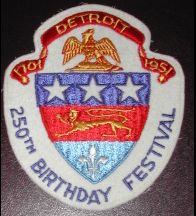
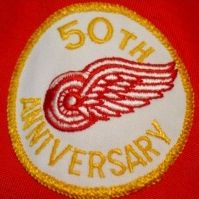
After wearing a patch during 1951 to promote the 250th anniversary of the City of Detroit, the Red Wings would not wear another patch until 1975 for the franchise's 50th Anniversary.

Detroit Red Wings 44-45 jersey

Bonus Jersey: Today's bonus jersey is a 1958-59 Chicago Black Hawks Ted Lindsay jersey. While very similar to today's Blackhawks jerseys, note the location of the crossed tomahawks inside the sleeve stripes rather than the now traditional placement on the shoulders.

This beautiful old sweater shows just why the Black Hawks jerseys frequently finish at the top of lists of best jerseys and was worn by Lindsay during the 1959 playoffs.

Chicago Black Hawks 58-59 jersey

Today's video section begins with Ted Lindsay's biography from the Legends of Hockey series.


In this next clip, a look back at Ted Lindsay's career first broadcast in 1978 when Lindsay was the general manager of the Red Wings.

Friday, October 14, 2016

1991-92 New York Rangers Mike Gartner Jersey

Mike Gartner started his pro career with the Cincinnati Stingers of the World Hockey Association, having just turned 19 years old, below the NHL minimum age of 20 at the time.

Gartner Stingers

His 27 goals and 52 points that season for the Stingers got the attention of the general mangers in the NHL, and Gartner was drafted 4th overall by the Washington Captials in the summer of 1979 following the demise of the Stingers as well as the WHA.

As a rookie with the Capitals, Gartner scored 36 goals, beginning a streak of 30 goals or more seasons that would eventually reach into the mid 90's.

Gartner Capitals

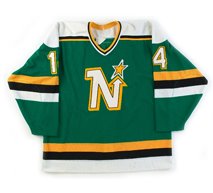
In ten seasons with the Capitals, Gartner would average 39.7 goals per season and never less than 35 until the 1988-89 season when he was traded to the Minnesota North Stars 56 games into the season while currently at 26 goals. He would, however, score an additional seven goals in Minnesota to keep his streak going at ten seasons.

Gartner North Stars

After enjoying so much stability in Washington, Gartner's time in Minnesota would be brief, as he was dealt to the New York Rangers after 67 games in 1989-90, but not before scoring 34 goals with the North Stars. After joining the Rangers, he would add 11 more to his season total which allowed him to reach the 40 goal mark for the sixth time.

Gartner Rangers

Three consecutive 40 goal seasons in Manhattan followed, which included scoring his 500th NHL goal on this date in 1991. He would later surpass the 600 goal barrier as well as 1,000 points, prior to Gartner once more being on the move, this time to his hometown Toronto Maple Leafs. His 28 goals in 71 games in New York and the six he scored in 10 games with the Maple Leafs pushed his 30 goal streak to an NHL record 15 consecutive seasons.

Gartner Maple Leafs

The strike shortened season of 1994-95 only allowed Gartner to play in 38 games, limiting him to just 12 goals and unfairly ending his streak of 30 goal seasons at 15.

Back to a full season schedule in 1995-96, Gartner would run his 30 goal season total up to 16 with 35 goals. The Maple Leafs would trade Gartner to the Phoenix Coyotes in time for their first season in the desert, having just relocated from Winnipeg. There, Gartner would achieve his 17th season of 30 goals or more in his career, also a league record, when he scored twice on this date in 1997 in a 5-0 win over the Tampa Bay Lightning. His second goal of the night was also the 1,300th point in his NHL career.

Gartner Coyotes

Gartner would play one final season in the NHL with Phoenix. He would play in 60 games and score 12 goals, which included his 700th career goal, only the fifth player to ever reach that mark.

His final career totals are 708 goals, good for sixth all time, and 627 assists for 1,335 points.

While Gartner set records for his consistent goal scoring, he was probably better known for his speed, winning the always popular and high profile "Fastest Skater Competition" at the NHL All-Star Game each of the three times he entered, including 1993 when he scored four goals and was named the MVP of the All-Star Game.

During his career he would play in seven NHL All-Star Games and following his career he was inducted into the Hockey Hall of Fame in 2001 and his #11 was retired by the Capitals in 2008.

Today's featured jersey is a 1991-92 New York Rangers Mike Gartner jersey which features NHL 75th Anniversary patch on the upper left chest, while every other club, save the Philadelphia Flyers, wore the patch on their upper right chest. Having a unique patch placement when compared to other clubs is a common occurrence for the Rangers, due to the "R" of the diagonal Rangers cresting on their jerseys occupying the traditional location for patches. In general, the Rangers place additional patches on their right shoulder, but have used the left shoulder on occasion as well, as was the case with the 9/11 memorial ribbon patch.

Patches worn on the right shoulder include the Stanley Cup 100th Anniversary, the 1994 NHL All-Star Game, 1994 Stanley Cup Finals, the Rangers 75th and 85th Anniversary patches.

The only time the Rangers were able to join the flock was in 1999-00 when the NHL 2000 patch was a horizontal design, short enough to fit above the "R" in the space remaining.

New York Rangers 91-92 jersey

Here is a great career retrospective of Mike Gartner's career on the occasion of his induction into the Hockey Hall of Fame, followed by his speech. The audio is a tad bit distorted, but still listenable.


hit counter for blogger