History of Jersey 83-93 Banner sm photo History of Jersey 83-93 Banner sm.jpg

Thursday, April 23, 2015

1973-74 Chicago Black Hawks Tony Esposito Jersey

While not as numerous as the Sutters or Plagers, as flashy as the Bures, identical as the Sedins, offensively gifted as as a pair as the Richards, as highly paid as the Staals or as clandestine as the Stastnys, no other pair of brothers are as accomplished as the Esposito brothers.

Phil and Tony Esposito photo phil-esposito-tony-esposito.jpg
Phil and Tony Esposito

Phil, the older by two years was a two time Stanley Cup champion, five time Art Ross Trophy, two time Hart Trophy, two time Lester Pearson Trophy and Lester Patrick Trophy winner. He was a 10 time NHL All-Star, had his #7 retired by the Boston Bruins and was inducted into the Hockey Hall of Fame in 1984. Phil retired as the second leading scorer in NHL history and holder of the single season goal scoring record with 76.

Phil Esposito Stanley Cup photo PhilEsposito1970StanleyCup.png
Phil poses with the Stanley Cup in 1970

Tony Esposito, born on this date in 1943, was two years younger than Phil, played college hockey for Michigan Tech University where he was a three time All-American and backstopped the Huskies to the 1965 NCAA championship.

Esposito Michigan Tech photo EspositoMichiganTech.jpg
Tony with the MacNaughton Cup

He first played in the NHL with the Montreal Canadiens when both Gump Worsely and Rogie Vachon were injured and saw action in 13 games, including giving up a pair of goals to his brother Phil during his very first game!

Esposito Canadiens photo Tony_EspositoCanadiens.jpg
Tony during his early days trying to crack the Canadiens linuep

After being returned to the minors, he was called up during the playoffs when Worsley was again hurt and was part of the Canadiens Stanley Cup winning team.

Tony_EspositoCanadiens2 photo Tony_EspositoCanadiens2-1.jpg

The Canadiens, deep in goaltending, left Esposito unprotected in the waiver draft, where he was claimed by the Chicago Black Hawks, where he immediately set a modern NHL record with 15 shutouts, still and NHL rookie record, and a career high 38 wins on the way to being named the winner of the Calder Trophy as well as his first Vezina Trophy.

During his second season, he would guide the Black Hawks to the Stanley Cup Finals. The following season of 1971-72 saw Esposito earn his second Vezina Trophy on the basis of nine shutouts and a goals against average (GAA) of 1.77.

Prior to the start of the 1972-73 season, Esposito was named to Team Canada and was the first goalie to defeat the Soviet Union. He finished the Summit Series with a win in Game 2, a tie in Game 3, a loss in Game 5 and a victory in Game 7, as Team Canada, led offensively and emotionally by his brother Phil came back to defeat the Soviets 4-3-1 in the dramatic Game 8.

Esposito 1972 Canada photo Esposito1972Canada.jpg
Esposito defending Canada's goal against Valeri Kharlamov

The Black Hawks, despite the departure of Bobby Hull to the WHA, returned to the Stanley Cup Finals in 1972 as Tony posted a 32-17-7 record, one of eight seasons with 30 wins or more.

1973-74 saw "Tony O" hit double digits in shutouts for the second time in his career with ten on his way to a 2.04 GAA and another Vezina Trophy, one of just eight goalies to win the Vezina catching right-handed.

Over the course of the next seven seasons, Esposito would continue his consistent play, appearing in between 66 and 69 games and winning between 24 and 31 times, as the Black Hawks won several division titles but failed to find playoff success.

In 1981, he became a naturalized American citizen and competed in goal for the United States in the 1981 Canada Cup.

Tony Esposito USA 1981 CC photo TonyEspositoUSA1991CC.jpg

The final three seasons of his career saw his number of games played decline from 52 to 39 to 18 in his final season of 1983-84, but he would record his sixth playoff shutout on this date, his birthday, in 1982 with a 2-0 win over rivals the St. Louis Blues.

Esposito, who originally wore #29 with Montreal, was the first NHL goalie to officially wear the #35, which was assigned to him in training camp due to the traditional goalie numbers 1 and 30 already being assigned. Following a shutout in his first ever exhibition game, he stuck with 35, making it an iconic number for goaltenders for decades to come.

Aside from becoming known for his #35, Esposito is also instantly recognized for his immediately recognizable goalie mask and stance. His mask would later have the addition of protective bars on the front, a precursor to today's hybrid mask worn by nearly all goaltenders at all levels.

Photobucket

Esposito retired in 1985 and was elected to the Hockey Hall of Fame in 1988 and saw his #35 retired by the Blackhawks on this date later that same year, November 20, 1988.

Today's featured jersey is a 1973-74 Chicago Black Hawks Tony Esposito jersey as worn the year in which he won his second Vezina Trophy. This jersey sports the now iconic #35, pioneered by Esposito and adopted by goaltenders all throughout the 1970's, 80's and 90's such as Tom Barasso, John Sebastian-Giguere, Nikolai Khabibulin (who originally wore #53 when he joined the Blackhawks), Henrik Lundqvist, Andy Moog, Evgeni Nabokov, Mike Richter, Tommy Salo, Tim Thomas and Marty Turco among many others.

This was the first season for the numbers to have red trim. Names would not arrive on the backs of the jerseys until 1977-78.

 photo ChicagoBlackhawks1973-74jersey.jpg
photo courtesy of Classic Auctions

Bonus jersey: Today's bonus jersey is a Team Canada 1972 Tony
Esposito jersey as worn during the Summit Series, an eight game exhibition series which featured the best Canadian professionals against the best of the
Soviet Union for the first time, as prior to the Summit Series, the best Canadians were not allowed to compete in the amateur only Olympics or World
Championships.

These heavily patriotic jerseys for were only worn for the Summit Series with
their overszed maple leaf design covering the lower portion of the jersey, while the later Canada Cup jerseys, first worn in 1976, had a similar but different
diagonally bisected maple leaf design.

Player names were not worn on the back, and in their place all members of the roster had "CANADA" emblazoned across their backs just in case the Soviets
forgot who they were up against!


Canada 1972 Esposito jersey photo Canada1972Espositojersey.jpg
photo courtesy of Classic Auctions

Extra bonus jersey: Today's extra bonus jersey is a 1974 NHL All-Star Game Tony Esposito jersey from the fifth of five consecutive and six total All-Star Games Esposito would play in, which was played in Chicago in front of Esposito's home fans.

This was the first year for this new style which would remain in use through 1981, but was replaced by a more simple style in 1979 for the two game Challenge Cup Series against the Soviet Union.


NHL All-Star 1974  jersey photo NHLAll-Star1974Fjersey.jpg
 photo NHLAll-Star1974Bjersey.jpg

Today's video section begins with a tribute to Tony Esposito by the Chicago Black Hawks from "Tony Esposito Night" in Chicago on March 19, 2008 as the Blackhawks honored Tony and welcomed him back into the Black Hawks family.


Here is the ceremony, in two parts, to honor Esposito on "Tony Esposito Night".


Wednesday, April 22, 2015

The Top Twenty Names in Hockey History

Here is the Top Twenty Names in Hockey History, as chosen by the staff of Third String Goalie.

Don't agree? Send us your favorites in the comments below!
Top Twenty Names in Hockey History

20. Lou Franceschetti
19. Chico Maki
18. Branko Radivojevic
17. Lucien DeBlois (DEB Low Wah)
16. Maxim Afinogenov
15. Ilkka Sinisalo
14. Tony Twist
13. Pekka Rinne
12. Frank St. Marseille
11. Peter Sidorkiewicz
10. Kari Takko
9. Bubba Berenzweig
8. Sheldon Kannegiesser
7. Radek Bonk
6. Ron Tugnutt
5. Parris Duffus
4. Valeri Zelepukin
3. Per Djoos (pron: Pear Juice)
2. Hakan Loob
And, without a doubt, the greatest name in hockey history, Zarley Zalapski, was born on this date in 1968.

Following two seasons of junior hockey Zalapski played three seasons for the Canadian National Team, then a season long proposition which many players used as a stepping stone to the NHL.

Zalapski Canada, Zalapski Canada
1986-87 Canadian National Team

He was drafted fourth overall by the Pittsburgh Penguins in the 1986 NHL Entry Draft and made his NHL debut following the 1988 Olympics in Calgary, Alberta. He would play four seasons for the Penguins, playing a high of 66 games before being traded near the end of the 1990-91 season and just missing out on the Penguins run to the Stanley Cup.

Photobucket
1987-88 Pittsburgh Penguins

Photobucket
1988-89 Pittsburgh Penguins

Notice the changes in the customization in the Penguins jerseys from Zalapski's rookie year to his sophomore season. The name on the back is thinner and without serifs, the number changes font and the sleeve numbers move from the shoulders down to the arms.

The Penguins dealt Zalapski to the Hartford Whalers as part of the Ron Francis trade, a move that saw Zalapski see an increase in playing time and career highs in points as a result. The defenseman's only 20 goal season of his career came in 1991-92 followed by a 65 point campaign the following season while wearing the Whalers green jerseys.

Photobucket
1990-91 Hartford Whalers

Prior to Zalapski's final season in Hartford, they would change to their new modernized jerseys, which featured blue road jerseys rather than the traditional green.

Photobucket
1993-94 Hartford Whalers jersey

Traded once more, Zalapski was on the move, this time north of the border to Calgary to join the Flames. Once in Calgary, he would find his customary #3 already in use by Frantisek Musil and adopt the #33 while skating for the Flames. He would play in five seasons with the Flames, although he would miss all but two games of the 1996-97 season with a knee injury suffered in practice.

Photobucket
1993-94 Calgary Flames

Zalapski played a more defensive role in Calgary, as he would never again approach the offensive numbers he achieved while in Pittsburgh and especially Hartford. Zalapski also was present for yet another uniform change, as the Flames finally moved away from their traditional jerseys, which remained unchanged, save for the crest, even after their relocation from Atlanta.

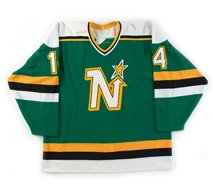
The bold new sweaters featured the addition of a shot of black, reminiscent of the change the Minnesota North Stars made in 1981, where the restrained use of black added to the jersey, rather than taking over, such as what the North Stars succumed to in 1991. The main feature of the new design was the arresting diagonal multi-stripe on the front of the jerseys, which originated just below the main crest and shot off in the direction of the right hip. These bold jerseys would remain in use for three seasons before becoming dated.

Photobucket
1994-95 Calgary Flames

After five seasons in Calgary, Zalapski was dealt to the Montreal Canadiens in a deal which brought Valeri Bure to Calgary. His stay in Montreal was brief, playing there for only the second half of the 1997-98 season. Now back in his customary #3 Zalapski would have the honor of wearing the classic "bleu, blanc et rouge" sweater of the storied Canadiens.

Photobucket
1997-98 Montreal Canadiens

The 1998-99 season would see Zalapski's first foray into European hockey with an abbreviated season of just 11 games with the ZSC Lions in Zurich, Switzerland. He returned to North America for the 1999-00 season, which included time with the Long Beach Ice Dogs of the IHL for seven games before spending the majority of the season with the Utah Grizzlies, also of the IHL and a return to the NHL with the Philadelphia Flyers for 12 games.

Photobucket
1999-00 Philadelphia Flyers

His time in Philadelphia would be the conclusion of Zalapski's NHL career, which would finish with 637 games played with five teams, 99 goals and 285 assists for 384 points and one All-Star Game appearance in 1993.

He would begin the 2000-01 season with the Houston Aeros of the IHL for nine games before returning to Europe, this time with the Munich Barons of the German DEL.

Photobucket
2000-01 Munich Barons

A new season meant another new country, as the former NHL All-Star found himself with HC Merano of the Italian league for 26 games. Zalapski began to apparently "dabble" in hockey at this point, playing seven games with IF Bjorkloeven Umea in the Swedish second division in 2002-03, no hockey at all in 2003-04 and 11 games with the Kalamazoo Wings in the UHL in 2004-05.

The 2005-06 season saw a total of just 16 split between three clubs, EHC Visp in the Swiss second division, Innsbrucker EV in Austria and SC Rapperswill-Jona Lakers in the Swiss top division. He suited up for just five games in all of 2006-07 with EHC Chur in the Swiss second division leaving behind a trail of lightly used game worn jerseys in his wake!

2007-08 saw a more serious effort with 33 games for EHC Biel-Bienne, still in the Swiss second division and a move to EHC Olten for a 34 game season and one of the more unique team logos in the world of hockey.

Photobucket
2008-09 EHC Olten
photos courtesy of Classic Auctions

Zalapski continues to play 22 years after his NHL debut, proving once more that there is life beyond the NHL, having moved to Lausanne HC in the Swiss second division and are currently involved in a playoff to determine promotion to the Swiss National League A, the top division of Swiss hockey for 2010-11. Lausanne currently leads Bienne three games to two in their best of seven series with Game 6 scheduled for today and Game 7 if needed on Saturday.

Today's video section begins with Zalapski scoring his first NHL goal on March 19, 1988 on a beautiful feed from Mario Lemieux.

Tuesday, April 21, 2015

2015 IIHF World Championships Update

As we previewed last week, the annual IIHF World Championship season has begun. Already completed at the time of our report was the Division III World Championships, which were held in Turkey, where Bosnia and Herzegovina (currently unranked by the IIHF) made their IIHF World Championship debut, competing against Georgia (ranked 47th), Hong Kong (48), Luxembourg (42), North Korea (43), Turkey (41) and the United Arab Emirates (45).

North Korea and Turkey were tied atop the standings with perfect 5-0 records, setting up a winner take all final. Turkey tied the game with 2:15 remaining in regulation, sending the game into overtime.

At 4:22, Yusuf Halil was called for tripping, setting up a power play for the North Koreans. It would only take 27 seconds for assistant captain Chun Rim Hong to score his second goal of the game to give the North Koreans the win, the gold medal and a promotion to the IIHF Division II Group B tournament for 2016 despite Turkey outshooting them 41-28.

North Korea finished with 5 wins and an overtime win for 17 points (the IIHF awards 3 points for a regulation win), Turkey was next with 5 wins and an overtime loss for 16, Luxembourg went 4-2 for 12 points, Hong Kong 3-3 for 9, Georgia had 1 win, 1 OT win and 4 losses for 5 points, the United Arab Emirates were 1 win, 1 OT loss and 4 losses for 4 points while Bosnia and Herzegovina was 0-6 and are still looking for their first World Championship victory.

 photo DIIGB.png

Division II Group B was held in Cape Town, South Africa and saw a wonderful collection of far-flung nations. from Bulgaria (39), China (38), Israel (32), Mexico (33), New Zealand (37) and the host South Africa (40).

The tournament went the way of the Chinese, as they cruised to a undefeated record of 4 regulation wins and an overtime win against Israel for a total of 14 points. New Zealand and Mexico were next at 9 points with 3-2 records. Bulgaria at 2-3 for 6 points, Israel (1 win, 1 overtime loss and 3 regulation losses) at 4 points were all trailed by the hosts South Africa, who went 1-4, with their only win coming against New Zealand, were relegated to Division III for 2016, while China moves up to Division II Group A next year.

 photo DIIGA.png

Division II Group A took place over 7,000 miles to the north in Reykjavik, Iceland with Australia (34), Belgium (36), Spain (30), host Iceland (35), Romania (27) and Serbia (31) competing.

This tournament could not have been scripted any better in favor of Romania, who, like the Chinese won 4 and needed an overtime to beat the hosts Iceland in the tournament's final game after they had already clinched the gold medal and a promotion to Division I Group B for 2016.

No other team won more than two games in regulation, with Belgium's 8 points coming closest to Romania's 14. Serbia, Spain and Iceland all had 7 points and Australia's 9,500 mile trip must taken the wind out of their sails after managing a lone shootout win for 2 points, which sees them relegated to Division II Group B for 2016.

DI Group B logo photo DIGB.jpg

Also taking place last week in Eindhoven in the Netherlands was Division II Group B. The participating clubs were Croatia (28), Estonia (29), Great Britain (22), Lithuania (26), host Netherlands (25) and the lone Asian entry, South Korea (23).

We advised that the South Koreans in particular were worth tracking, as they controversially have been guaranteed a place in the 2018 Winter Olympic hockey tournament, which they will be hosting. They are under pressure to increase the competitiveness of their program in time for The Games, where they will be competing in a 12 team tournament against the heavy hitters of international hockey despite their current world ranking of just 23rd.

Great Britain opened with a 3-2 overtime win over Croatia, while the South Koreans thumped Estonia 7-3. Lithuania made a first period goal stand up as they won 1-0 over the Netherlands. The British then won 2-1 vs Estonia and the South Koreans again won big, 7-1 over the Netherlands while Lithuania failed to keep pace, losing 4-1 to Croatia.

Day 3 saw a vital matchup, which went the way of Great Britain, 3-2 over South Korea in regulation for the full 3 points after the Koreans once led 2-0. Before you dismiss these lower division players skill level, have a look at this stunning, cheeky and highly skilled penalty shot since from defenseman Ben O'Connor with the score tied at 2-2!


Lithuania beat Estonia 6-1 and Croatia lost their second 5-2 to the Netherlands to fall out of the promotion picture.

Saturday's games saw the South Koreans rebound with a 5-0 blanking of Lithuania while Great Britain kept the top spot with a narrow 3-2 win over the Netherlands. With one game left to play, the British stood at 11 points and held the tiebreaker over the South Koreans (at 9 points) due to their head-to-head win, meaning the Brits only needed to get to overtime against Lithuania to secure a point in the standings and promotion.

In the first game of the day, the South Koreans took care of business with a 9-4 win over Croatia thanks to a 5 goal second period. All they could do now was watch the game between Great Britain and Lithuania and hope for a regulation win by the Lithuanians. The British led 1-0 after one, but a pair of second period goals by Lithuania gave the South Koreans hope. Their hopes took a blow however, when Great Britain scored the equalizer just 3:25 into the third period.

The British killed off a penalty at 10:49, but just 3 seconds later, they were called for a delay of game penalty, and this time it took Lithuania a mere nine seconds to convert for a 3-2 lead. Donatas Kumeliauskas of Lithuania was then called for a five minute major for head butting at 56:02, putting Great Britain on the power play for the rest of regulation and needing a precious goal to get to overtime for the lone point they needed to clinch the championship.

With only 30 seconds remaining the Brits pulled their goalie for a 6-on-4 advantage, but just seven seconds later where whistled for holding. While they did get their goalie out with 16 seconds remaining, they could not convert and their 3-2 regulation loss gave the happy South Koreans the gold medal and the promotion to Division I Group A for 2016, where they will face the next level of competition as they seek to improve to the next level on their path to the 2018 Olympics.

As happened to the South Africans, the host Netherlands ended up finishing last thanks to their final day 3-1 loss to Estonia and will compete in Division II Group A in 2016.

DI Group A logo photo DIBA.png

Meanwhile, action in Division I Group A in Krakow, Poland got underway on Sunday. The field of teams ranked in the IIHF Top 25 include Hungary (19), Italy (18), Japan (21), Kazakhstan (17), host Poland (24) and Ukraine (20). 

Kazakhstan currently sits atop the standings with 6 points thanks to their opening day 5-2 win over Ukraine followed by a 5-0 blanking of Hungary. The Italians are next with a pair of narrow 2-1 wins over Poland and Ukraine, with the second requiring overtime, leaving Italy one point back of the Kazakhs with 5 points. Those two have separated themselves from the pack, as Poland and Hungary are both 1-1 for 3 points, while Ukraine has but a single point from their OT loss to Italy and Japan is last with two losses to Hungary and Poland and look to be headed for relegation unless they can right their ship quickly, as both Kazakhstan and Italy still loom ahead on their schedule.

Teams have today off, but then play back-to-back on Wednesday and Thursday before the tournament wraps up on Saturday with the key game that day looking to be the matchup of the two leaders Kazakhstan and Italy. Still in with a shot are Hungary and Poland, but with one loss each, they must hope the leaders falter while they cannot afford another loss, particularly in regulation.

Top Division 2015 logo photo WM.jpg

Six days after the conclusion of the Division I Group A tournament, the 2015 IIHF World Championship will get underway on Friday, May 1 in Prague and Ostrava in the Czech Republic. Play will conclude when the new world champion is crowned on Sunday, May 17th from the survivor of a 16 team field which consists of Austria (16), Denmark (15), Slovenia (14), Germany (13), France (12), Belarus (11), Norway (10), Latvia (9), Slovakia (8), Switzerland (7), the United States (6), the Czech Republic (5), Canada (4), Russia (3), Finland (2) and Sweden (1).


Monday, April 20, 2015

Patriots' Day - 2012-13 Boston Bruins Patrice Bergeron Jersey

Patriots' Day is a civic holiday in Massachusetts that commemorates the anniversary of the first battles of the Revolutionary War, the Battles of Lexington and Concord on April 19, 1775. It is observed on the third Monday in April each year when re-enactments of the battles occur at Lexington Green in Lexington and The Old North Bridge in Concord, which includes Paul Revere and William Dawes midnight rides of warning.

 photo PatriotsDaysoldiers.jpg

With the day being a holiday for schools, colleges and universities, there are sports related traditions surrounding Patriots' Day. The Boston Red Sox baseball club have been playing a home day game at Fenway Park every year since 1959.

 photo PatriotsDayFenwayPark.png
Fenway Park on Patriots' Day

Also a tradition is the famous Boston Marathon, which has been held annually on Patriots' Day since 1897, making it the oldest continuously running marathon in North America. Originally a local event, the stature of the race has grown over time and it now attracts runners from all over the globe.

Boston Marahton photo BostonMarathon2.jpg
The start of the Boston Marathon

There have been a few notorious incidents in connection with the race, such as Katherine Switzer becoming the first woman to run and finish the race as a registered entrant in 1967, despite women not being allowed to enter the race until 1972. Switzer had deceptively registered for the race as "K. V. Switzer" and had to persevere despite race official Jock Semple trying to rip off her number and eject her from the race when she was recognized as a woman, something which seems so incredibly archaic now that female participation in the race has surpassed the 40% mark. She and Semple would go on to become friends and she would later become a leader in getting the women's marathon into the Olympic Games.

 photo KathrineSwitzerBostonMarathon.jpg
Katherine Switzer's boyfriend fending off Jock Semple

The other famous scandal concerned Rosie Ruiz, who appeared out of the crowd a half a mile from the finish and ran to "victory" in the female division. Shet was quickly exposed as a fraud due to suspicions about her lack of appearance of exertion, her lack of elite physical fitness, her lack of accurate details about key parts of the race and a lack of evidence of her even being on the course during the majority of the race as well as her highly suspicious 25 minute improvement over her reported time in the New York City Marathon just six months earlier. Ruiz was confirmed as a fraud within eight days, as was her qualifying performance in New York, and Jacqueline Gareau was awarded her rightful victory.

 photo RosieRuiz1980.jpg
Rosie Ruiz looking exhausted after her duplicitous run of less than a mile

Those incidents now pale in wake of what happened during the 2013 edition of the Marathon on Patriots' Day two years ago, for that was the day of the Boston Marathon Bombings. The race began at 9:00 AM on April 15th with entrants in the Mobility Impaired Program and continued with the Elite Women beginning at 9:32 AM with the Elite Men at 10 AM. The field consisted of 23,336 competitors from all 50 states and 92 countries.

The women's winner, Rita Jeptoo of Kenya ran a 2:26:25, crossing the finish line at 11:58 AM while the winning male, Lelisa Desisa of Ethiopia ran a 2:10:22 race to finish at ten minutes past noon.

 photo JeptooampDesisa2013.jpg
The forgotten 2013 winners Jeptoo and Desisa hours before the bombings

Then at 2:50 PM, two explosions of shrapnel filled pressure cookers concealed in backpacks took place near the finish line on Boylston Street 12 seconds and 210 yards apart, killing three spectators, 29 year old restaurant manager Krystle Campbell, young Boston Bruins fan Martin Richard, age 8, and 23 year old Boston University student Lu Lingzi of China and injuring 264 others, with 14 of those requiring amputations of their shattered limbs in addition to those who lost limbs in the explosions.

Boston Marahton Bomb photo BostonMarahtonBomb.jpg

The race was halted with 5,000 runners still on the course as the graphic scene unfolded at the finish line, where many became heroes as they rushed to the aid of those hurt in the blasts, many of whom were in critical condition.

 photo carlosarredondoaidsjeffbauman.jpg
Carlos Arredondo aids the seriously wounded Jeff Bauman

The response to the bombings from the people of Boston was as predictable as it was quick - unified and defiant.

 photo BostonStrongRibbon.gif

The Boston Bruins game that night against the Ottawa Senators was postponed and the Boston Celtics basketball game the following night was cancelled. The Bruins did play their scheduled home game against the Buffalo Sabres on Wednesday, April 17th, which featured an especially emotional rendition of the national anthem.


Three days after the bombing, April 18th, the FBI released photos and videos of two suspects, who were quickly identified as brothers. By the time the day had ended, the pair had killed Massachusetts Institute of Technology police officer Sean Collier in an unsuccessful effort to steal Collier's gun. Shorty thereafter, the brothers hijacked an SUV before engaging the police in a ferocious gun battle in the suburb of Watertown. There, the older of the two brothers was shot several times and subsequently run over and dragged by his escaping younger brother in the SUV. The older of the two was pronounced dead at the scene just after midnight on the 19th.

A massive manhunt ensued for the younger of the two, who had abandoned the SUV and escaped on foot. Residents were told to stay indoors while the police conducted a door to door search, as many schools and businesses remained closed, as well as Boston's public transit network.

With the manhunt for the second suspect underway, both the Red Sox and Bruins games on the 19th, as well as the circus, were all postponed as the citizens were encouraged to stay indoors.

On the evening of the 19th after the orders to stay indoors was recinded, a resident of Watertown noticed the cover on his boat was loose and peered inside. There, he saw a body lying in a pool of blood. He immediately called the police, who quickly surrounded the boat and captured the suspect a short time later, setting off a celebration among the relieved public.

 photo Arrestcelebration.jpg
The spontaneous celebration after the arrest of
the remaining bombing suspect

The Bruins next scheduled game took place on Saturday the 20th versus the Pittsburgh Penguins. Both teams wore special patches of unity and support, the Bruins with a Boston Strong ribbon in the blue and yellow colors of the Boston Marathon, and the Penguins wearing a "617" patch (Boston's area code). Both sets of jerseys were then auctioned off to raise money to support the victims of the bombings.

 photo Marchand42013.jpg
Brad Marchand during the pregame warmups wearing a first responders cap

The Boston Strong patch was worn again the very next day when the Bruins hosted the Florida Panthers, only this time on their regular home jerseys with the iconic spoked B logo.

Chris Kelly Boston Strong patch 4/21/13 photo Chris Kelly 23.jpg
Chris Kelly wearing the Boston Strong patch on April 21, 2013
on the Bruins regular spoked B home jersey

That was not the final appearance for the Boston Strong patch though, as the Philadelphia Flyers wore the Boston Strong patch on April 23, 2013 when they hosted the Bruins later that week in a show of support for their rivals from Boston. They not only auctioned off their game worn, patched jerseys, but also held a 50/50 raffle with the proceeds going to the One Fund Boston charity.

The version of the patch the Flyers wore was slightly different than the Bruins version, as it did not have the white border around it like the ones worn twice in Boston.

Boston Strong Daniel Briere photo DanielBriere.jpg
Daniel Briere of the Flyers wearing the Boston Strong patch

Today's featured jersey is a 2012-13 Boston Bruins Patrice Bergeron jersey which features the Boston Strong ribbon worn on April 20, 2013 in a show of unity and support for the citizens of Boston.

The alternate jersey worn by the Bruins that night is a prime example of what a third jersey can be. It's modern take on the Bruins original 1920's logo is paired with classic Bruins striping from the Stanley Cup era of the early 1970's finished off with a classic. but slightly modernized font. This highly attractive style jersey has been in used by Boston since the 2008-09 season.

Boston Bruins 2012-13 Alt jersey photo BostonBruins2012-13AltF-1.jpg
 photo BostonBruins2012-13AltB.jpg
 photo BostonBruins2012-13AltP1.jpg

Bonus jersey: Today's bonus jersey is a 2012-13 Pittsburgh Penguins Chris Kunitz jersey which features the special "617" patch worn in support of their fellow Americans in Boston. This Penguins jersey was first introduced in 2007-08 and remains in use today, one of the more attractive of the new Reebok Edge jersey templates first worn that season.

 photo PittsburghPenguins2012-13Boston617Fjersey.jpg
Pittsburgh Penguins 2012-13 Boston 617 B jersey photo PittsburghPenguins2012-13Boston617Bjersey.jpg
Penguins Boston 617 patch 4/20/15 photo Penguins Boston 617 patch 42015.jpg

Today's first video is the pregame ceremony from the April 20th game when the Bruins hosted the Penguins.


Next up are highlights of the Flyers hosting the Bruins while showing incredible class to wear the Boston Strong patch in support of their rival team and city.


Here is an interview with Arrodondo following his helping the severly wounded Bauman who lost both legs in the blast.


Later, the two men are reunited at Game 6 of the Stanley Cup Finals later that season as part of the Bruins choosing fans to wave the "Boston Strong" flag prior to the Bruins playoff games that season. It was Arrodondo and Bauman's second appearance at a Bruins game, the first coming earlier while Bauman was still in a wheel chair prior to being fitted with new legs.


To help the people most affected by the tragic events in Boston on April, 15, please click here.

The One Fund Boston photo OneFundFlag-sm.jpg

Sunday, April 19, 2015

1979-80 Pittsburgh Penguins Randy Carlyle Jersey

Born on this date in 1956, Randy Carlyle played his junior hockey for the Sudbury Wolves in 11974-75 and 1975-76, where he scored 79 points in 60 games as a defenseman which led to him being drafted by the Toronto Maple Leafs 30th overall in the 1976 NHL Amateur Draft. Carlyle was also taken 7th overall by the Cincinnati Stingers in the 1976 WHA Amateur Draft.

In a messy legal affair, the Stingers claimed to have signed Carlyle before he signed with the Maple Leafs, which Carlyle denied having done. The Stingers took the matter to court, and when all was settled, Carlyle became property of the Maple Leafs and divided his 1976-77 season between the Dallas Black Hawks of the CHL (26 games) and Toronto (45 games).

Carlyle Maple Leafs

The next season was a virtual repeat, as he played 21 games in Dallas and 49 games with the Maple Leafs, which included scoring his first NHL goal. After two seasons with the Maple Leafs, in which he played in 94 games and scored 18 points, Carlyle was traded to the Pittsburgh Penguins, who proved to be a great fit for him, where he immediately found plenty of playing time (70 games), which allowed him to score 13 goals and 78 points during his first season with the Penguins.

Carlyle Penguins

Two seasons later in 1980-81, Carlyle would set career highs with 16 goals, 67 assists and 83 points. He also nearly doubled his previous high in penalty minutes with 136. His play that season would be recognized by being named the recipient of the 1981 Norris Trophy as the league's best defenseman.

He would be rewarded by being named team captain and backed up his previous season's scoring totals with 75 points and 131 penalty minutes. Carlyle would play two more seasons with the Penguins until being traded to the Winnipeg Jets for a 1st round draft pick late in the 1983-84 season.

Carlyle Jets

He settled in with the Jets in 1984-85 with 71 games and 51 points and would maintain a steady presence on the Jets blueline for the next four seasons, playing between 68 and 78 games, scoring between 42 and 59 points. His role would change beginning with the 1989-90 season for the final four seasons of his NHL career, as his game was now focused much more on defense as his powerplay time dwindled, causing a resultant drop in his offensive numbers.

Carlyle Jets

All told, Carlyle would play ten seasons for the Jets, which included being named a team captain for 1989-90 and 1990-91. Over the course of his 17 season NHL career, he would play in 1,055 games while scoring 148 goals and 499 assists for 647 points while amassing 1,400 penalty minutes.

Since retiring as a player, he moved into team management and coaching, including winning a Stanley Cup in 2007 as head coach of the Anaheim Ducks.

Today's featured jersey is a 1979-80 Pittsburgh Penguins Randy Carlye jersey worn only for the first half of the season. The Penguins wore decidedly old-fashioned jerseys through the 1973-74 season before changing to their first modern jerseys in 1974-75, nearly identical to today's featured jersey only with the shades of blue basically reversed.

For some reason the white home jersey then reverted to the old fashioned look after just one season while the light blue road jersey was retained. Then in 1977-78, today's featured style arrived with the primary color now the dark navy blue with the light blue accents. Additionally, a new white home jersey was introduced to match the new, darker more aggressive road jersey, once more creating a matched pair. Still, there was the oddity of the team's crest of yellow and black not being reflected in their jersey colors of navy and columbia blue.

This jersey was a short-lived style, only worn for two and a half seasons by the Penguins, as in January of 1980, the Penguins changed their club colors to black and yellow to align themselves with the successful Pittsburgh Pirates baseball and Pittsburgh Steelers football clubs, as the Pirates had won the World Series in 1979 while the Steelers were Super Bowl champions in 1974, 1975, 1978 and 1979, both while wearing the black and gold colors of the flag of the city of Pittsburgh.

Pittsburgh Penguins 1979-80 jersey photo Pittsburg Penguins 1979-80 F jersey.jpg
Pittsburgh Penguins 1979-80 jersey photo Pittsburg Penguins 1979-80 B jersey.jpg

Bonus Jersey: Today's Bonus Jersey is a 1980-81 Pittsburgh Penguins Randy Carlyle jersey as worn during Carlyle's Norris Trophy winning season.

Halfway through the previous season the Penguins changed from their previous navy and columbia blue jerseys to new black and gold jerseys, adopting the colors of the flag of the city of Pittsburgh, as worn by the championship winning Pirates and Steelers.

The Penguins would go on to wear these jerseys for the next decade, which included winning two Stanley Cups in 1991 and 1992. After being dropped following the 1992 championship, this jersey would return as a retro third jersey for the 2014-15 season.

Pittsburgh Penguins 80-81 jersey

Extra bonus jersey: Today's extra bonus jersey is a 1991-92 Winnipeg Jets Randy Carlyle jersey. While Carlyle only played for three different teams, his longevity resulted in him wearing a number of different sweaters during his career, as he was present in Pittsburgh during the change from their navy blue jerseys to their adaptation of their black and gold jerseys and later their gold alternate jerseys.

Then while in Winnipeg, the club changed from their NHL debut style jerseys with the full length arm striping to their final design with it's modernized logo for their final six seasons.

It was Carlyle's wearing of Teemu Selanne's preferred #8 which resulted in Selanne wearing the #13 for his record setting, 76 goal rookie season. Selanne would claim the #8 once the veteran Carlyle retired following the 1992-93 season.

Winnipeg Jets 1991-92 jersey photo Winnipeg Jets 1991-92 F jersey.jpg
Winnipeg Jets 1991-92 jersey photo Winnipeg Jets 1991-92 B jersey.jpg

Today's video section begins with an interview with Carlyle from 1980.


Next, a more recent profile of Carlyle while coach of the Anaheim Ducks.


hit counter for blogger