History of Jersey 83-93 Banner sm photo History of Jersey 83-93 Banner sm.jpg

Friday, January 9, 2015

1972-73 Minnesota North Stars J. P. Parise Jersey

The hockey world lost Jean-Paul "J. P." Parise Wednesday night at the age of 73.

Parise was singed by the Boston Bruins at the age of 21 and assigned to the Niagara Falls Flyers of the Ontario Hockey Association for the 1961-62 season. He also skated in a single game for the Kingston Frontenacs of the Eastern Professional Hockey League, foreshadowing a full season with Kingston for the 1962-63 season.

The next step up the ladder for Parise again foreshadowed the future, as he spent the two seasons with the Minneapolis Bruins of the Central Professional Hockey League. With Minneapolis, his offensive game took a stride forward, as he scored first 27 goals and 63 points in 1963-64, followed by 73 points in in 70 games of the 1964-65 season.

Parise Minneapolis Bruins photo PariseMinneapolisBruins.jpg
Parise with the Minneapolis Bruins in 1964

For the 1965-66 season, Parise was now with the Oklahoma City Blazers, also in the CPHL, where  he proved he could also play a rugged style of play when he set a career high with 137 penalty minutes while still scoring 49 points in 69 games. That season also saw Parise make his NHL debut with the Bruins, seeing action in 3 games.

While he played 18 games with the Bruins in 1966-67, which included scoring his first NHL goal, Parise spent the majority of his season with the Blazers, scoring 33 points and 98 penalty minutes in 42 games.

The landscape of hockey would change forever following that season with the expansion of the NHL from six teams to 12. One of the effects of that shifting was Parise was selected by the Oakland Seals in June of 1967 in the NHL Expansion Draft. He would never play for Oakland however, as on October 12th he was traded to the Toronto Maple Leafs for two players. He was assigned to the Rochester Americans of the American Hockey League, but after just 3 games for the Americans and one lone game with the Maple Leafs, Parise was again traded on December 23rd to another expansion club, the Minnesota North Stars along with one other player for five players and the loan of a goaltender to Toronto.

Parise scored 11 goals in 43 games during the North Stars inaugural season and contributed 7 more points in 14 playoff games. He had his first 20 goal season in 1968-69 with 22 goals and 49 points before leading Minnesota in scoring with 72 points from 24 goals and 48 assists in 1969-70. His fine season was recognized when Parise was selected to play in the 1970 NHL All-Star Game.

 photo PariseNorthStars1.jpg
Parise became popular with the North Stars fans

After two more seasons with the North Stars, Parise was chosen to be a member of Team Canada for the 1972 Summit Series against the Soviet Union. With a Canadian lineup stacked with star players, Parise saw action in 6 of the 8 games, scoring 2 goals and 4 points, but was easily best remembered for an incident with East German referee Josef Kompalla.

Parise Team Canada photo PariseTeamCanada.jpg
Parise was named to Team Canada in 1972

Kompalla had outraged the Canadians, who suspected him of bias when he and fellow countryman Franz Baader called Canada for 31 penalty minutes in Game Six versus just 4 for the Soviets. The Canadians had even nicknamed the pair "Badder and Worse".

Czech referee Rudy Bata and Swede Ove Dahlberg officiated Game 7 and it was announced that the East German pair had been sent home and the same referees from Game 7 would handle the final Game 8. The Soviets then wanted to include the East German pair originally scheduled for Game 8, but the Canadians threatened to pull out of the game. Eventually a compromise was agreed to, and Kompalla would return, but teamed with Bata instead of Baader.

The game saw the Soviets take a 1-0 lead with two Canadians in the penalty box. Then the game was delayed when Parise was called for interference despite checking a player who was carrying the puck. When he complained, he was immediately given a 10 minute misconduct and responded in anger by banging his stick on the ice and skating circles in a rage. His anger then boiled over and he finally rushed Kompalla with his stick raised, feinting as if he were about to split Kompalla's head open, as the controversial referee flinched in fear. Parise was then thrown out of the game for his actions and at one point, Team Canada head coach Harry Sinden threw a chair on the ice!

Parise stick swing 1972 photo Parisestickswing1972.jpg
His infamous stick wielding threat to Josef Kompalla

For an entertaining look into the spirit and humor of the man, we highly recommend this interview with Parise on the 40th anniversary of the 1972 Summit Series.

The following NHL season was Parise's best, with him setting career highs with 27 goals and 75 points, good for second on the team, as well as 96 penalty minutes. He again was recognized with a second NHL All-Star game in 1973.

Parise woud play another season and a half with Minnesota until being traded half way through the 1974-75 season to the New York Islanders. He would help lead the Islanders to their first playoff appearance in the young franchise's history. As the Islanders reached the Semifinals, Parise would finish second to former North Stars teammate and linemate Jude Drouin, with 16 points in 17 games.

 photo PariseIslanders.jpg
Parise was traded to the New York Islanders in 1975

Parise played two and a half seasons for the Islanders, scoring 57 and 56 points, including a 25 goal season in 1976-77, the second best of his career. Halfway through the 1977-78 season, Parise was traded to the Cleveland Barons, with whom he would play in 40 games.

Parise Barons photo PariseBarons.jpg
Parise during his only season with Cleveland

In an unprecedented and fitting move, the Barons franchise was merged with the North Stars organization, which saw Parise return to Minnesota for the final season of his career, where he served as team captain for the newly merged roster.

 photo PariseNorthStarsCaptain.jpg
Parise as captain of the North Stars during the final NL season of his career

His final career totals were 890 games played with 238 goals and 594 points. At the time of his retirement, Parise was third in North Stars history in goals, second in points and their all-time leader in assists.

Following his retirement, Parise became an assistant coach with the North Stars between 1980 and 1988, except for 1983-84 when he was head coach for Minnesota's top minor league affiliate, the Salt Lake Golden Eagles. He then began a new phase of his career when he became the hockey director and coach at Minnesota prep school Shattuck-St. Mary's, where players such as Sidney Crosby, Jack Johnson, Jonathan Toews and his own son, Zach Parise all played on their way to NHL stardom.

 photo JPandZachPariseSSM.jpg
J. P. coached son Zach and other future NHLers at Shattuck-St. Mary's

Parise found great enjoyment and a return to the spotlight in Minnesota when Zach signed to play for the Minnesota Wild in 2012.

Zach and JP Parise photo ZachandJPParise.jpg
Zach Parise poses with his proud father Jean-Paul while displaying the goal puck which allowed him to surpass his father on the NHL goal scoring list

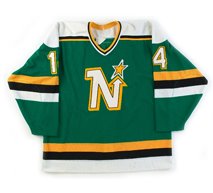
Today's featured jersey is a 1972-73 Minnesota North Stars J. P. Parise jersey. Parise had his finest season in the NHL that season when he set career highs in goals and points.

The North Stars wore very similar jerseys during their inaugural 1967-68 season, only without the white shoulders. Those arrived for their second season of 1968-69 and remained unchanged through 1974-75.

Minnesota North Stars 1972-73 jersey photo MinnesotaNorthStars1972-73Fjersey.jpg
Minnesota North Stars 1972-73 jersey photo MinnesotaNorthStars1972-73Bjersey.jpg

In today's video section, the incident where Parise was thrown out of the historic Game 8 versus the Soviet Union during the 1972 Summit Series.


Here is the tribute video shown by the Wild before their game last night honoring the life of J. P. Parise.

Thursday, January 8, 2015

1983-84 Washington Capitals Bengt-Åke Gustafsson Jersey

Bengt-Åke Gustafsson began his hockey career in the second division of Swedish hockey with IF Karlskoga/Bofors, playing in 8 games of the 1973-74 season. After three more seasons with Karlskoga, including scoring 32 goals and 50 points in 1976-77, the center moved to Färjestads BK of the top level of Swedish hockey, the Elitserien.

During his first season with Färjestads, Gustafsson scored 25 points in 32 games, which was enough to garner the attention of the Washington Capitals, who drafted him in the 1978 NHL Entry Draft. He would play the 1978-79 season with Färjestads, including three playoff games before he signed, after that year's World Championships, with the WHA's Edmonton Oilers in time to play two games of the Avco Cup Finals, scoring a goal and two assists in what would prove to be the last games in the history of the league.

With four WHA clubs, including Edmonton, joining the NHL for the 1979-80 season, a somewhat complicated Expansion Draft took place. The Oilers made goaltenders Dave Dryden and Eddie Mio plus Wayne Gretzky and Gustafsson as their choices of which players to protect, as the NHL clubs were now free to reclaim players whose rights they still held. The Capitals challenged the Oilers right to protect Gustafsson, and it would take three months for then NHL President John Zigler to side with the Capitals on the basis that Edmonton had originally broken WHA rules to sign Gustafsson in the first place.

With that ruling, Gustafsson became a Washington Capital and made his NHL debut on October 11, 1979 against the Buffalo Sabres, registering his first point with an assist. He would go on to have a 22 goal season and score 60 points, setting a Capitals rookie record, which was third on the club behind team leader Mike Gartner, who had also been reclaimed by the Capitals after playing the previous season in the WHA.

Showing amazing consistency, Gustafsson would reel off five seasons with the Capitals with 60, 55, 60, 64 and 75 points while playing a minimum of 67 games, which included a career high 32 goals in 1983-84, aided in part by his five goal performance on this date in 1984.

Gustafsson Capitals, Gustafsson Capitals

The game was played in Philadelphia against the Flyers at The Spectrum and saw the Flyers get the first goal of the game at 5:20. Gustafsson tied the game at 6:19 on the power play with assists from Finn Timo Blomqvist and Gartner. Gartner again set up Gustafsson at 11:15 of the first period with the first assist going to Dave Christian, who scored the third Capitals goal of the period at 13:56 while with a man advantage.

Gustafsson completed the second hat trick of his career with his 20th goal of the season at 11:41 of the second period when he beat Flyers goaltender Pelle Lindbergh, again on the power play from Alan Haworth and defenseman Larry Murphy. It was Gustafsson's third shot of the game - all of which had found the back of the net.

Doug Jarvis extended the Capitals lead with a shorthanded goal at 3:42 of the third, followed by Gustafsson's fourth of the game on his fourth shot a minute and a half later from Gartner and captain Rod Langway. Again on the power play, Gustafsson completed the 7-1 rout as well as his magical evening with his fifth goal of the game on just his fifth shot at 10:11. Bobby Carpenter and Langway got the assists on Gustafsson's third power play goal of the game to go with his two at even strength to become the first Capitals player to ever score five goals in a single game.

Gustafsson Capitals, Gustafsson Capitals

Limited to 51 games in 1984-85 due to a pulled hamstring, he rebounded in 1985-86 to equal his career high of 75 points scored in 1983-84. A broken leg at the end of the 1985-86 season saw him return to the lower levels of Swedish hockey to regain his form during the 1986-87 season. Back with the Capitals for 1987-88 after an impressive showing at the World Championships, he played in 78 games, scoring 54 points. After one final season in North America, Gustafsson scored 69 points.

He returned to Sweden to continue his career, rejoining Färjestads for four seasons and then extending his career with VEU Feldkirch in the Austrian Hockey League, where he averaged 1.34 points per game over five seasons until retiring as a player in 1998 at the age of 39.

Gustafsson VEU Feldkrich, Gustafsson VEU Feldkrich
Gustafsson was the star of VEU Feldkirch, who sensationally won the 1998 Euopean Hockey League

During his lengthy career, Gustafsson totaled 196 goals and 555 points while in the NHL, as well as another 183 goals and 500 points in other leagues for a career total of 1,055 points.

Internationally, Gustafsson competed in the World Junior Championships in 1978, coming away with a silver medal.

Gustafsson Sweden, Gustafsson Sweden
Gustafsson in 1978

He then played for Sweden at the World Championships in 1979 (earning a bronze medal), 1981 (silver), 1983, 1987 (gold, Sweden's first in 25 years) and 1991 (gold).

Gustafsson Sweden, Gustafsson Sweden
Gustafsson at the 1987 World Championships

He also played in the 1984 and 1987 Canada Cup tournaments as well as the 1992 Olympics in Albertville, France. His international playing career was recognized with his induction into the International Ice Hockey Federation Hall of Fame in 2003.

Gustafsson Canada Cup, Gustafsson Canada Cup
Gustafsson against the Soviet Union in the Canada Cup

He then went onto a lengthy coaching career, including stops with club teams in Austria, Switzerland, Sweden and Russia. Additionally, Gustafsson was also the head coach of the Sweden National Team, which included his remarkable success in 2006 when Sweden first won gold at the Olympics in Turin, Italy followed by winning gold at the World Championships three months later, which made him the first coach to win both the Olympics and World Championships in the same year.

Today's featured jersey is a 1983-84 Washington Capitals Bengt-Åke Gustafsson jersey as worn during Gustafsson's spectacular five goal performance on this date in 1984. The Capitals adopted this style jersey for their first season of 1974-75. For the 1983-84 season, the Capitals had just four stars on the sleeves for the first time, rather than the customary five, which they went back to after two seasons.

This style jersey would remain in use through the 1995 season.

Washington Capitals 83-84  jersey, Washington Capitals 83-84  jersey

Today's video section begins with highlights of Gustafsson coaching Sweden to the 2006 Olympic gold medal. Utterly depressing and bizarre choice of music for such a happy occasion, but the images still tell the story.


Next up, a news report following the 2006 World Championships gold medal for Gustafsson and Sweden.


Wednesday, January 7, 2015

1999-00 Los Angeles Kings Luc Robitaille Jersey

Luc Robitaille was not drafted by the Los Angeles Kings until the ninth round, 171st overall in 1984, five rounds and 102 picks after the Kings drafted eventual baseball Hall of Famer Tom Glavine, mainly due to concerns about Robitaille's skating ability.

Still, Robitaille dominated in junior hockey while playing for the Hull Olympiques, scoring 149 points in 64 games in 1984-85 and was then named Canadian Hockey League Player of the Year following the 1985-86 season in which he scored 68 goals and 123 assists for 191 points in just 63 games, an average of over three points per game!

Robitaille Hull photo RobitailleHull.jpg
Robitaille with the Hull Olympiques

He was impressive in his rookie season in Los Angeles in the 1986-87 season, averaging over a point per game with 84 points from 45 goals and 39 assists in 79 games. His accomplishments were recognized when he was named the winner of the Calder Trophy. The following season he would reach the 50 goal plateau for the first time, with 53, and surpass 100 points as well, finishing with 111.

Robitaille Kings rookie photo RobitailleKingsrookie.jpg
Robitalle won the Calder Trophy as NHL Rookie of the Year in 1987

After four more very consistent seasons with at least 44 goals and 91 points, he would have his career best season in 1992-93 with 63 goals and 125 points, as well as his only 100 penalty minute season as the Kings would reach the Stanley Cup Finals for the first time in franchise history. During the playoffs, Robitaille would add 22 more points in 24 games.

Robitaille Kings 92-93 photo RobitailleKings92-93.jpg
Robitallie had a career high of 125 points in 1992-93

After one more season with the Kings, Robitaille was traded to the Pittsburgh Penguins for the strike shortened 1994-95 season. His stay in Pittsburgh was brief, and he was moved to the New York Rangers where he would play for the following two seasons.

Robitaille Rangers photo RobitailleRangers.jpg
Robitalle spent time with both Pittsburgh and the Rangers

Another trade saw Robitaille back with the Kings for the second time. Injuries would limit Robitaille in the 1997-98 season but he would return to play a full season of 82 games in 1998-99, which included scoring his 500th goal on this date in 1999. The return to familiar surroundings in Los Angeles would see a resurgence in his scoring, as he would put up consecutive season's of 74, 74 and 88 points, his highest totals since 1994 which included his 500th goal while a member of the Kings in 2000-01.

Robitaille Kings 99-00 photo RobitailleKings99-00.jpg
Robitaille during the 1999-00 season when
he scored his 500th goal

 photo Robitaille500thgoalpuck.jpg
The puck Robitaille used to score his 500th goal
Photo courtesy of Classic Auctions

He would sign a two-year free agent contract with the Detroit Red Wings for the 2001-02 season at a lower amount than he could have made elsewhere, but calculated that Detroit offered him the best chance to finally win the Stanley Cup, which in fact happened at the end of his first season with the Red Wings in which he contributed 30 goals and 50 points.

Robitaille Stanley Cup photo RobitailleStanleyCup.jpg
Robitaille hoisting the Stanley Cup in 2002

After his second season in Detroit, Robitaille would once again return to the Kings to close out his career. In 2003-04 he would play in his 1000th game in a King's uniform. During his final season of 2005-06 he would score a hat trick on January 19th to pass Marcel Dionne's franchise record as the leading goal scorer with 550.

Robitaille wore many different Kings jerseys, the purple and gold jerseys of his rookie season, the black, white and silver jerseys adopted upon Wayne Gretzky's arrival in 1988, which were worn until his return to the Kings in 1997-98. The Kings adopted their newest look in 1998-99 with black, white and purple jerseys with metallic silver with a purple alternated arriving in 1999-00. By the time he returned to Los Angeles for the third time, the Kings had swapped colors and logos on primary and alternate jerseys, giving Robitaille a final total of ten different Kings jerseys. He would be the only Kings player to have worn both the original purple and gold colors and the new purple and black jerseys.

Robitaille would conclude his career with 668 goals, an NHL record for left wings, 726 assists and 1394 points, only the second player in NHL history to record 1,000 points after being drafted as low as the ninth round.

His number 20 was retired by the Kings in 2007 and he was inducted into the Hockey Hall of Fame in 2009.

Robitaille Stanley Cup 2014 photo RobitailleStanleyCup2014.jpg
Robitaille has been able to lift the cup in 2012 and 2014
as a member of Kings management

Today's featured jersey is a 1999-00 Los Angeles Kings Luc Robitaille jersey as worn during the season in which he scored his 500th NHL goal as evidenced by the NHL 2000 patch worn by all the players during that season.

The Kings adopted this new set of jerseys during the 1998-99 season, adding a purple alternate to the set the following year, which featured their secondary crown logo as the main crest.

 photo LosAngelesKings1999-00jersey.jpg
Photo courtesy of Classic Auctions

Bonus jersey: Today's bonus jersey is a 2003-04 Los Angeles Kings Luc Robitaille jersey as worn during his third stint with the Kings. By the time Robitaille returned to the Kings in 2003, a major revision had taken place with their jersey set, with all the logos being flipped, making the crown the main logo on the black home and white road jerseys, while the purple alternate now featured the coat of arms with corresponding changes to the secondary logos.

Los Angeles Kings 2003-04 jersey photo LosAngelesKings2003-04jersey.jpg
Photo courtesy of Classic Auctions

Plenty of video options today. Too many perhaps. Here's the best of the bunch.

First up, Robitaille recalls his 500th goal.


Next up is a tribute video and interview with Robitaille on the occasion of his final game.


Here is Robitaille's acting skills are on display in this TV commercial from 2003 when he was with Detroit.


Finally, Robitaille's Hockey Hall of Fame induction speech from 2009.

Tuesday, January 6, 2015

1979-80 Philadelphia Flyers Ken Linseman Jersey

After the Philadelphia Flyers opened the 1979-80 season with a 5-2 win at home against the New York Islanders, they traveled to Georgia to face the Atlanta Flames at The Omni, where the Flames lit up the Flyers with seven consecutive goals en route to a 9-2 win on October 13th.

Back in Philadelphia the very next day, the Flyers scored three times in the first 16 minutes on their way to a 4-3 win. They next got a measure of revenge on the Flames with a 6-2 win, followed by a 7-3 victory in Detroit over the Red Wings on October 20th.

Back in Philadelphia to face Montreal the next night, the Flyers let one get away when they had leads of 4-0 and 6-2 with under 28 minutes to play, but the Canadiens struck back for 2 goals in the second and 2 more in the third to gain a tie.

Highly motivated by letting a win against Montreal get away from them, the Flyers went on a tear, beating the New York Rangers 5-2 before closing out October by beating Detroit 5-4 with Reggie Leach scoring with just one minute to play.

Leach Flyers photo ReggieLeachFlyers.jpg
Reggie Leach

November began with a 4-1 win at home over the St. Louis Blues, a satisfying 5-3 win in Montreal, a 3-1 defeat of the Buffalo Sabres followed by a 4-3 decision over the Quebec Nordiques during their first season in the NH after the demise of the World Hockey Association.  Before they returned home, the New York Islanders would fall 5-2. Back home at The Spectrum on November 11th, they would defeat the Vancouver Canucks 5-4 before running their winning streak to nine with a 5-3 win over the Edmonton Oilers, who were also new to the NHL.

Pete Peeters Flyers photo PetePeeters.jpg
One of the Flyers goaltenders in 1979-80, Pete Peeters

The winning streak came to an end in St. Louis on November 17th. The Blues scored two power play goals in the first period, and after a scoreless second, the Flyers got three goals in less than 8 minutes to take a 3-2 lead, only to have St. Louis tie the game with 2:32 remaining for a 3-3 final, but by this time the hockey world had begun to take notice of what was happening and the pressure and attention began to mount.

A three game western road trip saw the Kings fall 6-4 prior to a 5-2 defeat of Vancouver. Edmonton managed to come from two goals down earn a tie before the team flew home for a 6-2 win over the Hartford Whalers followed by a 6-4 win over the Minnesota North Stars.

Phil Myre Flyers photo PhilMyre.jpg
Phil Myre shared the net with Peeters

The undefeated streak hit 20 as the Flyers traveled to face the Toronto Maple Leafs on December 1st. Philadelphia led 3-2 after one and the teams traded goals in the second, but Toronto got the equalizer at the halfway point of the third for an eventual 3-3 tie despite outshooting Philadelphia 40-25.

The Flyers then began a six game home stand on December 2nd with ties against the Red Wings (4-4) and the Boston Bruins (2-2). This was followed by a 9-4 drubbing of Los Angeles and another tie, this one coming against the Chicago Black Hawks, who got the equalizer with under a minute to play.

Their undefeated run now reached two months when they again beat the Nordiques 6-4 after a wild eight goal third period. Philadelphia closed out their run at The Spectrum with a 3-2 victory over the Sabres.

The Flyers and Rangers traded first period goals in a 1-1 tie at Madison Square Garden before the Penguins came to Philadelphia for a suspenseful 1-1 tie, with the Flyers not responding to Pittsburgh's first period goal until there were less than five minutes remaining in the game.

Bridgman Flyers photo BridgmanFlyers.jpg
Mel Bridgman captained the Flyers during the 1979-80 season

December 22nd saw Philadelphia back in the win column 5-2 over the Bruins to surpass the Canadiens previous record unbeaten streak of 28 games. This was followed by their undefeated streak reaching 30 games with a 4-2 win over the Whalers the next night back in front of the home fans, who roared their approval with the milestone win.

Following a couple of days off for Christmas, the head coach Pat Quinn took  the Flyers on the road for the next six games with the pressure and attention due to their streak increasing daily. A return match with Hartford resulted in a 4-4 tie before a trip to another former WHA city for a game against the Winnipeg Jets which saw Philadelphia victorious by a score of 5-3. The team was in Denver the very next day for a 3-2 win over the Colorado Rockies to close out 1979 with a 24-1-10 record.

Pat Quinn Flyers photo PatQuinnFlyerscoach.jpg
Flyers head coach Pat Quinn

The team had five days off before their next game back east in New York vs. the Rangers on January 4 to break up the road games, and they came out energized with a 5-3 win, which now set the record for longest undefeated streak by a pro sports team, surpassing the NBA's Los Angeles Lakers 33 game streak.

Then, on this date in 1980, The Flyers traveled to Buffalo to take on the Sabres for the third time. The teams swapped goals in both the first and second periods, but then Philadelphia pulled away in the third with Bill Barber's 20th goal of the season with Rick MacLeish's 22nd coming as insurance with 5:13 to play to extend their unbeaten streak to 35 games.

The record setting streak would end the next night in Minnesota, the longest unbeaten streak in North American sports history, which spanned from October 14, 1979 to January 6, 1980. During that run, the team won 25 games with 10 ties. Of those draws, there were no last second heroics needed to salvage the streak along the way and the Flyers had the last goal in only two of them, as they were most often playing with a lead. Additionally, the Flyers did not shut out any opponents during the streak.

During the streak they played every team in the league, save the Washington Capitals.

For the rest of the season, Philadelphia would go 22-11-10 and wrap up the Patrick Division title with 14 games to play.

1979-80 Philadelphia Flyers photo 1979-80PhiladelpiaFlyersteam.jpg
The 1979-80 Philadelphia Flyers

Today's featured jersey is a 1979-80 Philadelphia Flyers Ken Linseman jersey as worn the season the Flyers went on their 35 game unbeaten rampage through the NHL. The Flyers inaugural 1967-68 jerseys only had one color numbers and very small sleeve numbers. The back numbers were given black outlines in 1970. Names arrived on the home jerseys in 1972 and on the roads in 1977.

For 1978-79, the profile of the coloring that ran down the length of the arms was widened so the sleeve numbers now fit entirely within the arm striping, where previously it overlapped into the main body color areas.

Linseman led the Flyers in scoring during their record setting season of 1979-80 with 22 goals and 79 points, trailed closely by Leach with 76 and Brian Propp at 75. Linseman originally wore #26 with the Flyers before changing to #14. He would play four seasons for the Flyers before two with Edmonton and six with the Bruins before returning to Philadelphia in 1989-90 when he wore #18, his third number as a Flyer.

 photo PhiladelphiaFlyers1979-80Fjersey.jpg
 photo PhiladelphiaFlyers1979-80Bjersey.jpg

Today's video section is a look at the Flyer's 35 game unbeaten streak.

Monday, January 5, 2015

The Punch-up in Piestany - The 1987 World Junior Championships

In anticipation of tonight's 2015 World Junior Championship Gold Medal Game between host Canada and Russia, the 8th Gold Medal Final between the two nations since the adaptation of the playoff format in 1996, we take a look back at perhaps the most famous, and notorious, moment in World Juniors history, for on this date in 1987, "The Punch-up in Piestany" took place.

 photo PunchupinPiestany2.jpg

The scene was the final game of the 1987 World Junior Tournament in Piestany, Czechoslovakia. At the time the tournament used a simple round-robin format, with the final standings determining the medalists, unlike today's knockout playoff system.

Canada brought a 4-1-1 record into the final game, while their arch-rivals the Soviet Union were out of medal contention at 2-3-1 and could only hope to spoil Canada's chance at the title.

To capture the gold over Finland, the Canadians needed to beat the Soviets by five goals to equal Finland's record of 5-1-1 and surpass them on the goal differential first tie-breaker. Had Canada won by less than five, silver would have been theirs and even a loss would have seen them still take home bronze.

Going into the game, the Canadians were worried about the choice of the inexperienced Hans Ronning as the referee, and sought to have the assignment changed due to an earlier incident in the tournament which involved a pre-game fight between the Canadians and Americans, in which Canadian team captain Steve Chaisson was ejected by Ronning, despite Ronning not even present on the ice at the time. Thanks to his ejection, Chaisson was not only disqualified from the game versus the United States, but their following game against Sweden as well.

The opening faceoff of the game between Canada and the Soviets was met with elbows and a retaliatory cross-check, neither of which were penalized and set the tone for the escalation of hostilities that were to follow.

Five minutes into the game, Theo Fleury scored for Canada and celebrated by sliding across center ice on his knees, using his stick as a machine gun, "firing" at the Soviet bench. The first period would conclude with Canada ahead 3-1, with slashes going uncalled and tempers on both sides getting short.

By the halfway point of the second period each team had another goal, making the score 4-2 in favor of Canada. With two players in the penalty box for each team following a scuffle, Canadian Everett Sanipass and Sergei Shesterikov of the Soviet Union collided after a faceoff, and a fight broke out between the two of them. Things got worse when Pavel Kostichkin hit Fleury with a two-handed slash, which lead to a second fight breaking out. The situation then escalated to the point that all the players on the ice were brawling before the situation spiraled completely out of control when Evgeny Davydov left the Soviet bench to come to the aid of a teammate.

Punchup in Piestany photo PunchupinPiestany1.jpg

This opened the floodgates, as nearly all the players from both benches spilled onto the ice, and a dozen separate fights broke out. Greg Hagwood's nose was broken by a head-butt and Stephane Roy was beaten by two Soviet players. This was in part due to two Canadians, Jimmy Waite and Pierre Turgeon remaining on the bench, resulting in a numbers advantage for the Soviets on the ice.

Punchup in Piestany photo PunchupinPiestany3.jpg

Overmatched and unable to control the situation, Ronning and his linesmen then shockingly left the ice and tournament officials famously turned off the arena lights in a desperate attempt to end the brawl!


Eventually the combatants tired themselves out and the fighting ceased, but by that time the IIHF ordered the game suspended and then held an emergency meeting, with the nine delegates voting 8-1 to expel both teams from the tournament, costing Canada a medal of any sort.

Punchup in Piestany photo PunchupinPiestany4.jpg

With the expulsion of Canada and the Soviet Union, Finland took home the gold, with Czechoslovakia and Sweden being awarded the silver and bronze.

The Canadians were extended an invitation to join the tournament banquet and medal ceremony, but stated they were not interested. Officials responded by ordering Canada out of the arena within a half-hour and they were subsequently escorted out of Czechoslovakia by armed soldiers!

Charges flew in the aftermath, as Alan Eagleson claimed the voting would have been different if the Soviets were in line for a medal as well, while Don Cherry suggested the brawl was a deliberate Soviet conspiracy to get Canada disqualified.

The event spawned our all-time favorite hockey quote ever:

"You don't like to see 20 kids punching 20 other kids.
It's not a disgrace. It's hockey." - Michael Farber

The events of that day have been chronicled in the book, When the Lights Went Out: How One Brawl Ended Hockey's Cold War and Changed the Game.


Today's featured jersey is a 1990-91 Soviet Red Army Pavel Kostichkin jersey from his days in the Soviet Hockey League. Kostichkin was eventually drafted in the tenth round by the Winnipeg Jets in 1988, but spent his career in Europe outside of a season with the Moncton Hawks of the AHL. He would eventually play in leagues in Russia, Denmark, Finland and Belarus before retiring in 2005.


With it's bright colors, hammer and sickle logos and name on the back in Cyrillic, it's a prime example of what a hockey jersey should look like and represents the most powerful club in hockey outside of North America.

Russia Moscow Red Army 1989-90 jersey photo RussiaMoscowRedArmy1989-90F.jpg
Russia Moscow Red Army 1989-90 jersey photo RussiaMoscowRedArmy1989-90B.jpg

Bonus Jersey: Todays bonus jersey is a 1996 Canada National Team Theo Fleury jersey as worn during the 1996 World Cup of Hockey. Fleury played internationally for Canada on eight occasions, the first being the notorious 1987 World Juniors. He skated in a second World Juniors in 1988, winning a  gold medal. He made his World Championship debut in 1990 and took home a silver on his second try in 1991, the same year he won a gold medal at the 1991 Canada Cup later in the year.

He was a member of the inaugural Canadian World Cup of Hockey roster in 1996 and then made his Olympic debut in 1998, the first year the NHL took a mid-season break to allow it's players the chance to participate. He concluded his international career on a high note, winning a gold medal at the 2002 Olympics in Salt Lake City.

Canada 1996 WCOH jersey photo Canada1996WCOHjersey.jpg
photo courtesy of Classic Auctions

Extra bonus jersey: Today's extra bonus jersey is a 1987 Canada National Team World Juniors jersey of the same style worn by Canada during the "Punch-up in Piestany". The junior teams wore the  "three maple leaf and hockey stick" crest during this era rather than the "leaf within a leaf" crest worn by the senior team. There was no player assigned #28 for the 1987 World Juniors, so this jersey was either worn by an unknown player during exhibition games or simply an extra jersey on hand in case of a later roster addition or other need for an emergency spare.

 photo Canada1987juniorsjersey.jpg
photo courtesy of Classic Auctions

Our video selection today features footage of the brawl between Canada and the Soviet Union, followed by Cherry's postgame comments and then the debate between Cherry and Farber which spawned our favorite quote.


Sunday, January 4, 2015

1989 Czechoslovakia National Team Jerguš Bača Jersey

Get your passports ready, as today we take a journey through the world of hockey with Jerguš Bača, a Czechoslovakian defenseman who was born on this date in 1965.

Bača began his career with HC Kosice in 1987-88 in the Czechoslovak hockey league, after which Kosice won the league championship and he was named the Rookie of the Year.

After his second season with Kosice, he made his international debut at the 1989 World Championships skating for Czechoslovakia. After his third season with Kosice, during which he scored more points than his previous two seasons combined when he netted 9 goals and 15 assists for 24 points after seasons of 10 and 13 points, he returned to the World Championships for a second consecutive season.

He impressed the scouts with his solid defensive play and increased offensive output so much that he was drafted 141st overall by the Hartford Whalers, 15 spots ahead of his HC Kosice teammate Peter Bondra.

He was assigned to the Springfield Indians for the 1990-91 season to acclimate to North America and it's style of hockey. He would play 57 games for the Indians, scoring 6 goals and 23 assists. Additionally, Bača was recalled by the parent club, the Whalers along the way, where he competed in 9 games, scoring a pair of assists. By the end of the season he was jergus bacback in Springfield, where he was a solid contributor to the Indians playoff drive, scoring 3 goals and 16 points in 18 games, good for fifth on the team as Springfield would win the Calder Cup as champions of the American Hockey League.

Baca Whalers photo BacaWhalers1.jpg
Bača while with the Hartford Whalers

Bača would return to the international stage when he suited up for Czechoslovakia at the 1991 Canada Cup tournament, scoring 3 points in 5 games.

Baca Czechoslovakia photo BacaCzechoslovakia.jpg
Bača wearing the red of Czechoslovakia

The vast majority of his 1991-92 season was again spent with Springfield, with a virtually identical 6 goals and 26 points. He would play a lone game with the Whalers in the NHL, but was again back with the Indians come playoff time.

Baca Whalers photo BacaWhalers2.jpg
Bača played a single game with Hartford in 1991-92

For 1992-93 Bača moved to the Milwaukee Admirals of the International Hockey League, where he had his finest two offensive seasons of his career, scoring 9 goals and 38 points during his first year and followed that with a 35 point campaign in 1993-94.

During early 1994, Bača made his Olympic debut, only now skating for Slovakia, as the Velvet Divorce had occurred in Czechoslovakia at the end of 1992 while Bača was playing his first season in Milwaukee. He played in 8 games, scoring a goal and 2 assists in Lillehammer, Norway.

It was back across the Atlantic Ocean for the 1994-95 season, as Bača signed with Leksands IF in Sweden. For 1995-96, he returned to North America for a second stint with Milwaukee, playing in 74 games while scoring 15 points and setting a career high with 130 penalty minutes.

Slovakia called upon him once again, this time at the 1996 World Cup of Hockey, where he contributed a goal in three games played.

It was back to Europe once more for the 1996-97 season when he joined HC Olomouc in the Czech Republic for one season. He rejoined his original club, HC Kosice in neighboring Slovakia for that year's playoffs.

Following the season Bača made his debut at the 1997 World Championships for Slovakia, who by now had reached the "A" Pool after having to start life as an independent nation at the bottom of the IIHF ladder system while the Czech Republic was allowed to retain Czechoslovakia's place at the top level.

He would remain with HC Kosice for the 1997-98 season, which included making it to the Slovak Extraliga playoff final, a hard fought series which included three overtime games out of the five game series, including the decisive Game 5. Bača again skated for Slovakia at the 1998 World Championships after the conclusion of the playoffs.

Baca Slovakia photo BacaSlovakia.jpg
Bača played for Slovakia following the breakup of Czechoslovakia

Another season with Kosice paid off for Bača as the team again returned to the league playoff final. After a second consecutive second place regular season finish behind HC Slovan Bratislava, the two teams would meet again in the finals, only this time Kosice would turn the tables and prevail as league champions by winning the final three games after dropping Game 1 to upset the high powered Slovan club, who had 245 regular season goals on their way to outscoring their opposition by a margin of 143 goals, versus Kosice's 135 goals and +17 goal difference.

A new season found Bača in yet another new country, as he joined Frankfurt Lions of the German DEL for the next three seasons, highlighted with 10 goals in 1999-00, his only double digit goal total in any league at any level.

Following his final season with the Lions in 2001-02, Bača made the final international appearance of his career when he played in 9 games of the 2002 World Championships as Slovakia made it through to the Final Round knockout playoffs and first defeated Canada 3-2 before ousting Sweden by the same score before sending the entire nation into rapture when they defeated Russia 4-3 to win the gold medal as world champions.

Slovakia 2002 World Champions photo 2002SlovakiaWorldChampions.jpg
Slovakia celebrates it's World Championship in 2002

Bača would return to Slovakia to close out his career, playing first for MHK 32 Liptovsky Mikulas for 46 games before moving to Dukla Trencin for the final 6 games of the regular season before a few rounds of the playoffs.

For 2003-04, he returned to MHK 32 Liptovsky Mikulas and played two final seasons before retiring as an active player.

While his NHL career consisted of just ten games, Bača played for 18 seasons in six different countries and won a Calder Cup, a Slovak league championship and a dramatic and memorable World Championship gold medal to end his international career with an exclamation point.

Today's featured jersey is a 1989 Czechoslovakia National Team Jerguš Bača jersey as worn during the 1989 season during which he would make his international debut.

This style was only used for one season with the heraldic lion crest before a change to a vertical Czechoslovakian flag in 1990 and finally a Czech and Slovak Hockey Federation logo for the 1992 World Championships before the end of Czechoslovakia.

Czechoslovakia 1989 jersey photo Czechoslovakia1989RF.jpg
Czechoslovakia 1989 jersey photo Czechoslovakia1989RB.jpg

Bonus jersey: Today's bonus jersey is a 1996 Slovakia National Team Jerguš Bača jersey as worn during the 1996 World Cup of Hockey. This was the first of the Nike jerseys worn by the Slovaks after their initial jerseys worn following their independence were made by Tackla from 1993 through 1995, with the last two years branded as Reebok.

The jerseys were initially crested with "Slovakia" on the front, which was then somewhat crudely covered by a white patch (instead of blue) with "Slovensko" screened on it. This style was used by Slovakia at the 1996 World Championships in the spring, the 1996 World Cup that fall and through the 1997 Worlds until replaced by a new style for the 1998 season.

Slovakia 1996 jersey photo Slovakia1996Fjersey.jpg
Slovakia 1996 jersey photo Slovakia1996Bjersey.jpg
photos courtesy of Classic Auctions

In today's video section, highlights of Slovakia winning the 2002 World Championship.


Next, Bača is stopped on a great save while he was playing for the Springfield Indians during the 1991 Calder Cup Finals.


Here is Bača, now an assistant coach with Slovakia, being interviewed at the 2012 World Championships after Slovakia's 5-4 win over France to secure their place in the Playoff Round.


Finally, Bonda and Ziggy Palffy discuss Bača in 2002, which includes some brief footage of him in action for Slovakia.


hit counter for blogger