History of Jersey 83-93 Banner sm photo History of Jersey 83-93 Banner sm.jpg

Wednesday, January 29, 2014

2001-02 Carolina Hurricanes Ron Francis Jersey

After a junior hockey career with the Sault Ste. Marie Greyhounds, Ron Francis joined the Hartford Whalers, who drafted him fourth overall in the 1981 NHL Entry Draft.

His offensive production was immediate, as in 59 games of the 1981-82 season he tallied 25 goals and 68 points as a rookie. The following season Francis led the Whalers in scoring after raising his goals to 31 and his points to 90 while being named to his first NHL All-Star Game in 1983. After scoring 83 points in 1983-84, Francis again led Hartford in scoring with 81 points and being named to his second all-star game. After 77 points in 1985-86 as well as being named team captain at the age of just 22, Francis led the Whalers in scoring for the third time in six seasons with a new career high of 93 points while hitting 30 goals for the second time.

Francis Whalers, Francis Whalers
Francis while wearing long pants while with the Whalers

A drop back to 75 points in 1987-88 was still enough to lead the Whalers in scoring once again, followed by 77 points the following season. His finest season in Hartford came during the 1989-90 campaign with a career high 32 goals as well as 69 assists for 101 points which earned him a third all-star appearance. His 69 assists were 7th in the league that season.

Francis Whalers, Francis Whalers
Francis now as the Whalers captain

After 67 games of the 1990-91 season, Francis stood at 76 points but was then involved in a blockbuster trade, which sent him, Ulf Samuelsson and Grant Jennings to the Pittsburgh Penguins for Jeff Parker, Zarley Zalapski and John Cullen. Centering the Penguins second line, Francis added another 11 regular season points plus 17 playoff points in 24 games as the Penguins captured the Stanley Cup over the Minnesota North Stars.

Francis Stanley Cup, Francis Stanley Cup
Francis celebrates the Penguins Stanley Cup championship

Missing ten games of the 1991-92 season was partly responsible for a decline in his scoring, as the finished the season with a career low 54 points, but kept intact his streak of scoring at least 50 points for the 11th consecutive season. Francis stepped upon the postseason though, scoring 27 points in 21 games, ably leading the team while team captain Mario Lemieux missed six games due to injury as the Penguins swept their final two series to capture their second consecutive Stanley Cup.

Francis reached the 100 point mark for the second time in 1992-93 with 24 goals and 76 assists which included his 1,000th career point. He followed that up with another 93 points the following season.

Francis 1000 points, Francis 1000 points
Francis with the puck from his 1,000th NHL point

His streak of consecutive 50 point seasons was put in jeopardy by the abbreviated 48 game 1994-95 season, of which Francis only skated in 44 games. Still, he netted 11 goals and 48 assists to comfortably keep his streak intact with 59 points as well as being named team captain during Lemieux's absence due to injury. In addition to his offensive streak, Francis valuable two-way play was rewarded with his being named the winner of the Selke Trophy as the as the league's best defensive forward and his style of play earned him a second award that season, the first of three Lady Byng Trophies for gentlemanly play.

Francis Byng, Francis Byng
Francis with the Lady Byng Trophy

The return of Lemieux from missing the previous season shifted the Penguins offense into a higher gear in 1995-96, with Francis racking up 92 assists to tie Lemieux for the league lead and a career high 119 points for fourth overall in the NHL scoring race despite coming in third on his own team! His efforts were recognized with his fourth NHL All-Star appearance.

His final two seasons with Pittsburgh saw Francis once again named team captain following the retirement of Lemieux as he would score 90 points in 1996-97 season and then 87 points in 1997-98, which included Francis scoring the 1,400th point of his career on this date in 1998 in a 4-2 win over the Boston Bruins (just the 11th player in NHL history to reach 1,400 points) as he wrapped up 8 seasons with the Penguins by being named the recipient of his second Lady Byng Trophy in 1998.

For the 1998-99 season, Francis signed as a free agent with the Carolina Hurricanes, who were the original Hartford Whalers franchise, now relocated to North Carolina. Naturally, his offensive production took a hit moving away from the prolific Penguins, and his 52 points were a career low up to that point, but his 50 point streak remained in effect, now at 18 seasons and counting. Francis was also installed as captain of the Hurricanes immediately upon his arrival.

Francis Hurricanes, Francis Hurricanes

Anyone who thought Francis career was in decline was sorely mistaken, as he rebounded with 73 points to lead the club in scoring. During the 2000-01 season, Francis registered three assists on this date to become just the 5th player in NHL history to score 1,600 career points in a 5-2 win over the Tampa Bay Lightning. Francis would finish the season with a total of 65 points.

Francis Hurricanes, Francis Hurricanes
Francis wearing the Hockey Fights Cancer patch worn by only each club's captain

The 2001-02 season saw Francis score 77 points thanks to his third consecutive season with exactly 50 assists. He also joined the exclusive ranks of 500 goal scorers, just the 29th player to reach that plateau, as well as becoming only the second player in NHL history to score 50 points 21 times in a career with an assist in a 2-2 tie against the Buffalo Sabres, again on this date in 2002. The Hurricanes would go on the best playoff run of the franchise's time in the NHL, reaching the Stanley Cup Finals for the first time thanks in part to Francis' team leading 16 playoff points in 23 games.

Francis Wales, Francis Wales
Francis with the Prince of Wales Trophy as Eastern Conference champions

He equalled Howe's streak of 50 point seasons in 2002-03 with 57 points, his 22nd consecutive season with 50 points or more.

His final NHL season saw him play 68 games with Carolina before a late season trade to the Toronto Maple Leafs, where he played 12 regular season games and an additional 12 playoff games as Toronto was eliminated in the second round. That final season, between the two clubs combined, Francis scored 13 goals and 27 assists for 40 points, bringing to an end his 50 point streak, as well as his career, as he retired following the season, but not before winning his third Lady Byng Trophy as well as the King Clancy Memorial Trophy in recognition of his leadership on and off the ice.

Francis Maple Leafs, Francis Maple Leafs
Francis during his brief time in Toronto

His final career totals are 1,731 games played (third in NHL history), 549 goals scored (26th all-time) and 1,249 assists (2nd only behind Wayne Gretzky) for 1,798 points (4th all-time behind only Gretzky, Mark Messier and Howe).

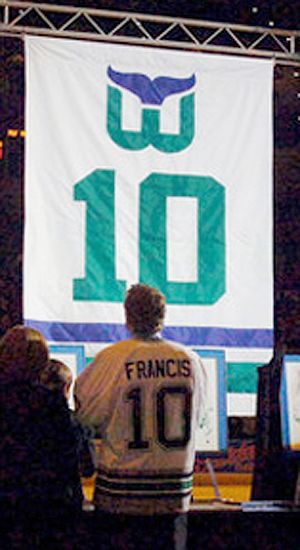
Francis was honored by having his #10 raised to the rafters at the Hartford Civic Center, being named to the Penguins Ring of Honor and having his #10 formally retired by the Carolina Hurricanes in 2007.

Francis Hurricanes Banner, Francis Hurricanes Banner

Today's featured jersey is a 2001-02 Carolina Hurricanes Ron Francis jersey as worn the season Francis extended his 50 point streak to 21 seasons, only the second player to accomplish that level of productive longevity.

The Hurricanes adopted this jersey style for their very first season in North Carolina of 1997-98, the best feature of which is the clever hurricane warning flags repeated as the waist stripe. They added a black outline to their one color names after three seasons, but other than that minor tweak to the customizing, the jerseys remained unchanged until the introduction of the new Reebok Edge jerseys in 2007-08. The design remained as true to the original as possible, with really only white piping around the shoulders worth noting.

Carolina Hurricanes 00-01 jersey, Carolina Hurricanes 00-01 jersey

Bonus jersey: Today's bonus jersey is a 1989-90 Hartford Whalers Ron Francis jersey. Francis best season in Hartford was the 1989-90 season during which he had the first 100 point season of his career.

The Whalers adopted their new jerseys on the occasion of entering the NHL in 1979-80 following the demise of the WHA, their original home. At the time of the Whalers entering the NHL, they changed their color scheme from green and gold to green and blue, as well as changing their name from the New England Whalers to the Hartford Whalers on the insistence of the Boston Bruins.

The W-tail logo was a clever piece of graphic design creating the "H" out of the negative space between the "W" and the tail. This jersey was worn with the controversial long pants during only the 1982-83 season, and one of only two teams to ever sport the long pants look in the NHL.

There were some minor changes to this style over it's lifespan through 1991-92, including the bottom hem below the stripes changing from green to white and the stripes on the arms changing from angled to straight and back again, only to become straight once more. The most unfortunate change in style though, was the elimination of the Pucky the Whale shoulder patches in 1985-86.

Hartford Whalers 89-90 jersey, Hartford Whalers 89-90 jersey

Francis Today's featured video is a tribute to Francis and his long and productive career.


Here is an interview with Francis during which he looks back on his career.


Finally, here is Francis speech on the occasion of being inducted into the Hockey Hall of Fame.


Tuesday, January 28, 2014

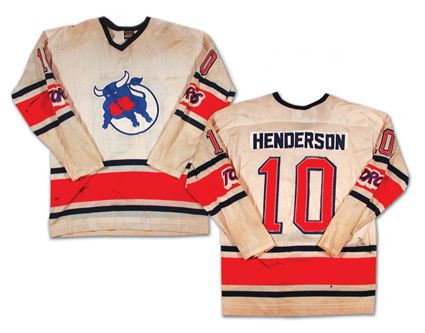
1974-75 Toronto Toros Paul Henderson Jersey

Born on this date in 1943, Paul Henderson is best known for scoring the deciding goal in the 1972 Summit Series.

 photo Hendersonscores.jpg
"Henderson scores for Canada!"

By 1972, Henderson was already a ten year NHL veteran, having started out his career with the Detroit Red Wings before being sent to the Toronto Maple Leafs in a blockbuster trade that also sent Norm Ullman and Floyd Smith, along with Doug Barrie to Toronto in exchange for Frank Mahovlich, Garry Unger, Pete Stemkowski and the rights to Carl Brewer.

Henderson Maple Leafs photo HendersonMapleLeafs2.jpg

In the season prior to the Summit Series, Henderson achieved his career high with 38 goals and came close to equalling his NHL high in points of 60 from the 1970-71 season.

Henderson Maple Leafs photo HendersonMapleLeafscard.jpg

After the Summit Series, which made him a household name in Canada, Henderson played just two more seasons with the Maple Leafs before signing with Toronto's WHA franchise, the Toros.

While with the Toros, Henderson would see a continuation of his offensive output, with seasons of 63 and 55 points before the club relocated, as was often happened with WHA clubs. This time though was one of the most unusual, as they team found itself in the deep south of the United States in Birmingham, Alabama! It was there that Henderson would set a career high with 66 points from 37 goals and 29 assists in 1977-78.

 photo HendersonToros2.png

The Bulls owner John Bassett would help lead the charge of the WHA signing underage players in order to lock up the best young talent before the NHL could get players under contract due to league rules at the time prohibiting players under the age of 20 from playing in the NHL. The Bulls would sign so many youngsters that they were dubbed the "Baby Bulls".

Henderson Toros photo HendersonToros1.jpg

Henderson would return to the NHL for one final season in 1979-80 with the Atlanta Flames.

After having reached the Stanley Cup Finals twice early in his career with Detroit, in 1964 and 1966, it must have come as a disappointment for Henderson to only qualify for the playoffs four times with Toronto, which all resulted in first round exits, none of which even reached seven games. Things were even worse in the WHA, as the Toros did not make the playoffs with Henderson while the renamed Bulls managed but one first round exit in three seasons.
While Henderson never got to raise the Stanley Cup, he will always be remembered as a winner for his exploits in the 1972 Summit Series, where he not only scored the famous decisive Game 8 goal, but also totaled seven goals in the eight game series.

Henderson Canada photo henderson72canadacard.jpg

Henderson's final professional record shows 1067 games played, 376 goals and 384 assists for 760 points combined between both the NHL and the WHA.

Today's featured jersey is a 1974-75 Toronto Toros Paul Henderson jersey from Henderson's first season in the World Hockey Association. WHA jerseys are very desirable among collectors and many did not survive the policies of their often cash-strapped organizations, with many being recycled from season to season until wearing out, having names stripped off and used as training camp jerseys, being handed down to minor league teams or even given to local high schools who shared the same color scheme on occasion.

The Toros used the same jersey style for each of their three seasons in Toronto.


We naturally start with Henderson's famous goal in Game 8 of the 1972 Summit Series.


Here, Henderson's recalls his experiences in the 1972 Summit Series and what led up to his famous goal.


Finally, a bit of the Birmingham Bulls in action against the Houston Aeros from the 1977-78 season.


Monday, January 27, 2014

1964-65 New York Rangers Ulf Sterner Jersey

Ulf Sterner played in a mere four NHL games during his career, but in the process, became a hockey pioneer, as his debut for the New York Rangers in 1965 made him the first European to play in the NHL.

Sterner played for Sweden in the 1960 Olympics at age 18 and won a gold medal at the 1962 World Championships, followed by a silver medal in 1963, the same year he was named Sweden's Player of the Year. He then led all scorers at the 1964 Olympics in Austria with 11 points in seven games.


He came to the Rangers training camp in 1964 and began the year with the St. Paul Rangers of the Central Hockey League with 12 goals and 21 points in 16 games.


Once adjusted more to the North American style of play, Sterner was promoted to the Baltimore Clippers of the American Hockey League. With bodychecking not allowed in the offensive zone in international hockey, the heavy hitting all over the ice was not something Sterner was accustomed to.

Still, he played well, earning himself a call-up by the Rangers, making his NHL debut on this date in 1965, becoming the first European-trained player to do so. After four games, it became clear that the physical play employed in the NHL was not something Sterner was comfortable with and was not going to sufficiently adapt to and he was returned to Baltimore, where his undeniable offensive skills allowed him to finish with 44 points in 52 games.

Back in Sweden the following season, Sterner would go on to play another 13 seasons, which included being named the Best Forward at the 1969 World Championships. In all, he would play in nine World Championships, earning a gold medal, five silvers an a bronze. He would also compete in two Olympics, earning silver in 1964 and was inducted into the IIHF Hall of Fame in 2001.

In 1969, the IIHF amended it's rules to allow body checking everywhere, and having been trained under those rules, a better prepared Borje Salming became a regular member of the Toronto Maple Leafs in 1973 and went on to have a 17 year NHL career. Once Salming showed a European was capable of competing in the NHL, more players began to arrive from primarily Sweden and Czechoslovakia at first, accelerated by the arrival of the WHA and the need for even more players.

Today's featured jersey is a 1964-65 New York Rangers Ulf Sterner jersey. The Rangers first adopted the font still in use for their main logo in 1941 and added the drop shadow the following season. The tie-neck collar arrived in 1951, bringing us to the style worn by Sterner in 1965. This style remained in use through 1976, but returned again in 1987, with the tie-neck collar reappearing in 1997.


Today's first video highlight is Ulf Sterner scoring Sweden's third goal as the Tre Kroner won the gold medal at the 1962 World Championships.


Next, we advance to 1970, as Sweden, with team captain Sterner wearing #14, defeats the Soviet Union for the first time in seven years 4-1 in a game where Vladisalv Tretiak coincidentally makes his NHL debut as an injury replacement. The video continues with the Soviets winning Game 2 by a score of 3-1 to win the World Championship.

Friday, January 24, 2014

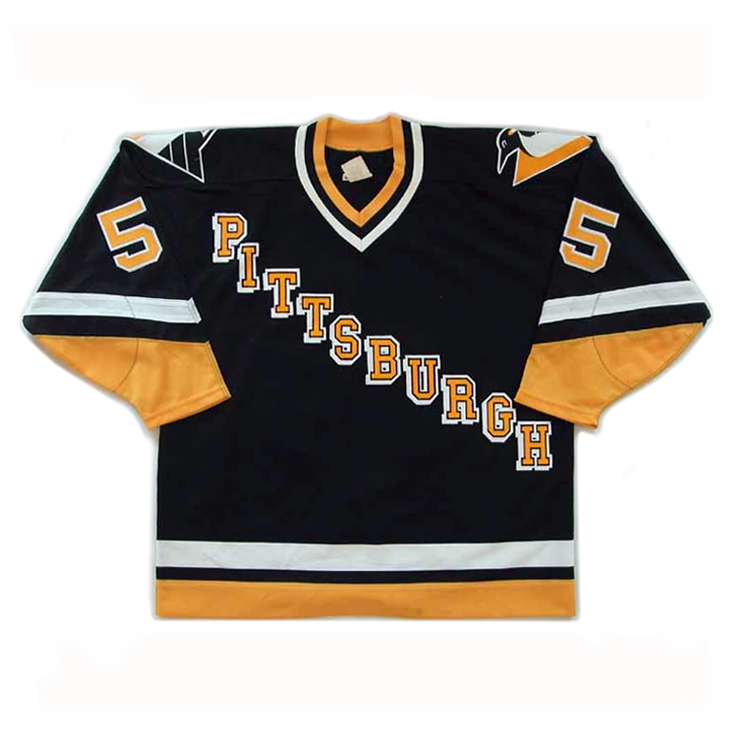
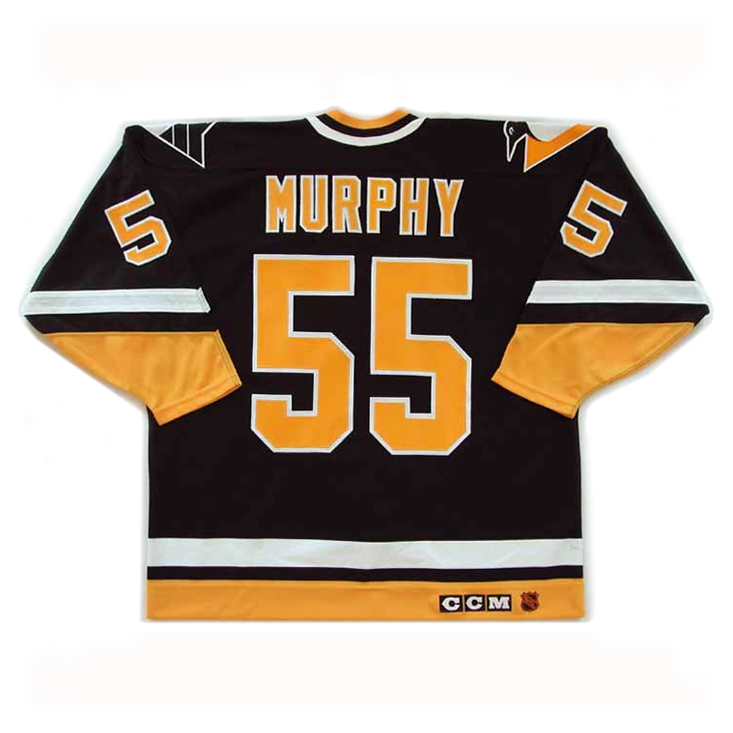
1994-95 Pittsburgh Penguins Larry Murphy Jersey

On this date in 2001, Larry Murphy, then of the Detroit Red Wings, played in his 1,600th game, becoming only the second player in history after Gordie Howe to reach that level.

After being drafted fourth overall in 1980, Murphy began his career with the Los Angeles Kings in 1980-81 scoring 16 goals and set NHL records with 60 assists and 76 points for a rookie defenseman.

Murphy Kings photo MurphyKings.jpg

After posting 66 and 62 point seasons in Los Angeles, Murphy would be traded early in the 1983-84 season to the Washington Capitals where he would continue to put up strong numbers, the best of which was in 1986-87 when he set a career high with 23 goals plus 58 assists for 81 points.

Murphy was dealt to the Minnesota North Stars along with Mike Gartner in a blockbuster deal for Dino Ciccarelli and Bob Rouse in March of 1989 after six seasons with the Capitals. After finishing up the 1988-89 season with Minnesota, he would play one full season with the North Stars, scoring 68 points, and then a half a season in 1990-91 before once more being traded, this time to the Pittsburgh Penguins.

The move to Pittsburgh would allow Murphy the opportunity for something he had yet to experience in his ten previous seasons, a deep run into the playoffs, never having made it past the second round before. As the Penguins progressed through the 1991 playoffs, they first defeated the New Jersey Devils in seven games, the Capitals in five and Boston Bruins in six, when Murphy got the chance to skate for the Stanley Cup against his former club, the North Stars. The Penguins dispatched Minnesota in six games, giving Murphy the first Stanley Cup of his career as he contributed 23 points in 23 games.

Murphy Penguins photo MurphyPenguins.jpg

In his first full season in Pittsburgh, Murphy scored 77 points in 77 games, thanks in part to the fourth 20 goal season of his career. He would add another 16 points in 21 playoff games as the Penguins would capture their second consecutive Stanley Cup.

The following season Murphy had his career best season offensively with 85 points and another 20 goal season with 22. After two more seasons with the Penguins, Murphy was dealt to the Toronto Maple Leafs. His stay was not a long one however, as he was shipped to the Detroit Red Wings at the trading deadline during only his second season of 1996-97 with Toronto.

Murphy ended up playing more playoff games with Detroit than regular season games as the Red Wings charged through the playoffs that season and defeated the Philadelphia Flyers for the Stanley Cup, the third of Murphy's career.

The Red Wings followed up that success with another championship the following season, giving Murphy four Stanley Cup championships, and making him the only player to win four Stanley Cups in the decade of the 1990's.

Murphy Red Wings photo MurphyRedWings.jpg

He would close out his career with three additional seasons with the Red Wings, which included playing 57 games in his final season of 2000-01, one of which was the 1,600th game of his 21-year career, only the second player to reach that mark. His final total of 1,615 games was an NHL record for defensemen at the time. He would complete his career with 287 goals and 929 assists for 1,216 points, which was third all time for defensemen at the time of his retirement behind only Ray Bourque and Paul Coffey.

In addition to his four Stanley Cup titles, Murphy also won a Memorial Cup in Canadian junior hockey with the Peterborough Petes.

Internationally, Murphy played for Canada in the 1980 World Junior Tournament and the 1985, 1987 and 2000 World Championships, earning a silver medal in 1985.

Murphy scored a goal and two assists in the final game of the 1987 Canada Cup as Canada took the championship. He was also a member of the championship winning Team Canada squad in the 1991 Canada Cup as well.

Today's featured jersey is a 1994-95 Pittsburgh Penguins Larry Murphy jersey. The Penguins switched to this style of jersey in 1992-93 after winning back to back Stanley Cups in 1991 and 1992.

This has always been one of our favorite jersey styles here at Third String Goalie. We really like how the Penguins revived their original cresting of the diagonal "PITTSBURGH" from their first set of jerseys used back in 1967-68, yet combined it with their current colors of black and yellow and the new modern Penguins logo which was used as the secondary shoulder logo. A very nice combination of melding the retro look of the past with their new, modern jerseys.

This jersey was used from 1992-93 until 1996-97 when it was replaced by the horrid third jersey first introduced in 1995, which was promoted to the full time road jersey in 1997-98, killing off today's gorgeous featured jersey.


Today's first video is a nice find, showing Larry Murphy scoring his 1,000th point with a goal while with the Maple Leafs.


Next, Murphy teaches you how to properly kill a penalty in a session of "Lessons with Larry".


Thursday, January 23, 2014

2001-02 Detroit Red Wings Brendan Shanahan Jersey

Born on this date in 1969, Brendan Shanahan played his junior hockey with the London Knights of the OHL in 1985-85 and 1986-87 prior to being drafted second overall by the New Jersey Devils in the 1987 NHL Entry Draft.

Shanahan Knights
Shanahan while captain of the London Knights in 1986-87. Note the Cooperalls!

He scored 7 goals during his first season and more than tripled that to 22 during his second. 1989-90 saw him reach the 30 goal mark for the first time, as well as recording 42 assists for 72 points in 73 games. During his final season with the Devils, Shanahan just missed the 30 goal mark with 29.


Shanahan Devils

He signed with the St. Louis Blues for the 1991-92 season as a free agent and once more reached the 30 goal mark with 33. Following the conclusion of his fifth season in the NHL, Shanahan was averaging 24 goals, 32 assists and 139 penalty minutes a season, making him a threat for a Gordie Howe Hat Trick each and every night with his goal scoring capabilities, playmaking skills and tough and rugged style.

His offensive game would reach another level during the 1992-93 season when Shanahan would become the 69th player in NHL history to record a 50 goal season when he totaled 51 goals. His 43 assists gave him a then career high of 94 points, all while topping his highest penalty minute total with 174.

Shanahan Blues

Shanahan would set career highs across the board in 1993-94 when he scored 52 goals and 50 assists for his only 100 point season with 102 to lead the Blues in scoring, which did not happen often with sniper Brett Hull on the roster. Additionally, he topped 200 penalty minutes in the process with 211 for the season, also a career high.

After briefly playing in Germany during the NHL lockout of 1994, Shanahan returned to St. Louis to score 41 points in 45 games to close out his time in St. Louis.

Shanahan was then dealt to the Hartford Whalers for the 1995-96 season, where he led the club in goals with 44 and points with 78 while serving as the team captain.

Shanahan Whalers

Unhappy with the situation in Hartford, Shanahan asked to be traded, a request which was granted two games into the 1996-97 season, which sent him to the Detroit Red Wings, a move which would pay immediate dividends.

The Red Wings had been a team on the rise with the arrival of head coach Scotty Bowman in 1993. The Red Wings kept adding vital pieces and solid role players and reached the Stanley Cup Finals first in 1995. After losing in the conference finals in 1996, Shananan's arrival early in the 1996-97 season had an immediate impact on the team, as he led the club in scoring with 46 goals and 87 points and provided another gritty player to a lineup filled with rough, hard hitting players. After besting rivals the Colorado Avalanche in the conference finals, the Red Wings easily swept the Philadelphia Flyers in four straight for Shanahan's first Stanley Cup championship as well as the Red Wings first since 1955.

Shanahan's point total decreased by 30 points the following season as the NHL entered a new, more defensive era, leaving the days of 150 point scorers in the rear view mirror. For the remainder of his career, Shanahan would only top 80 points once more and never again reach the 46 goals he scored in 1996-97. Still, he remained a consistent, tough as nails two way player who remained in the top for in scoring annually for Detroit.

Shanahan Red Wings

After scoring 28 goals in 1997-98, as the Red Wings repeated as Stanley Cup champions, Shanahan reeled of five consecutive 30 goal seasons, including a high of 41 in 1999-00. He led the Red Wings in scoring for the 2000-01 season and again in 2001-02, which included scoring his 500th career goal, making him the 30th player in the history of the NHL to achieve that lofty status, which he did with the game winning goal in a 2-0 win over heated rivals the Avalanche and Hall of Fame Goaltender Patrick Roy in his 1,100th game.

Additionally, Shanahan also recored his 1,000th career point that season and Detroit capped off what was already a memorable season for Shanahan by winning their third Stanley Cup championship in six seasons when they defeated the Carolina Hurricanes in five games.

Shanahan Red Wings

Following that championship, the third of Shanahan's career, he would play three more seasons with Detroit, including a 40 goal, 81 point 2005-06 season, his final year in Detroit, prior to moving on to the New York Rangers as a free agent for two seasons.

Shanahan Rangers

He returned to where it all started when he signed with New Jersey for the second half of the 2008-09 season after sitting out the first three months of the season. During the second half of the season, he would play the final 34 games of his career before retiring just prior to the 2009-10 season.

His final career NHL totals are 1,524 games played with 656 goals and 698 assists for 1,354 points and 2,489 penalty minutes, three Stanley Cups and what is believed to be a record 17 "Gordie Howe Hat Tricks", which consist of a goal, an assist and a fight all during the same game.
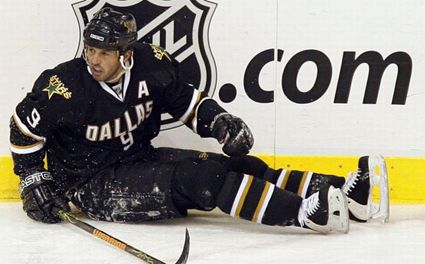
Today's featured jersey is a 2001-02 Detroit Red Wings Brendan Shanahan jersey as worn during the season Shanahan would score his 500th career goal, his 1,00th career point as well as winning his third Stanley Cup.

The Red Wings franchise changed their name from the "Falcons" following the 1931-32 season to the "Red Wings". With the new name came the famous winged wheel logo, which they placed on a red sweater with only simple white arm and waist bands for the 1932-33 season onwards. It remains essentially the same today, with only minor tweaks along the way, with the most "major" change being the addition of names on the back in 1977-78, four years after names were added to their white jerseys.

 photo DetroitRedWings2001-02jersey.jpg

Bonus jersey: Today's bonus jersey is a Team Canada 2002 Brendan Shanahan jersey. This alternate jersey was introduced by Team Canada for the 2002 Olympics in Salt Lake City, Utah and revived the crest from the Canada National Team sweaters of 1924.

Canada opened play at the 2002 Olympics with a 5-2 loss to Sweden while wearing these heritage inspired red jerseys on February 15, 2002, and due to the loss, these beautiful jerseys were immediately branded as "bad luck" by the over-reacting Canadians and were never worn again, not even in a subsequent World Championships, a true shame to write off such an attractive jersey so quickly.

Following the opening game loss, Canada would squeak by a decidedly weaker German team 3-2 and then finish a poor third in Group C after a 1-1 draw with the Czech Republic, which had the entire nation up in arms.

Still, it was enough to advance to the single-elimination Final Round, where Canada outlasted Finland 2-1 and were handed a ticket to the gold medal game by drawing hockey minnows Belarus in the Semifinals following their version of the "Miracle on Ice" when they defeated Sweden 4-3 thanks to a goal from center ice that bounced in off the Swedish goaltender's head!

After dispatching Belarus 7-1, the now confident Canadians defeated the United States 5-2 to capture the gold medal in another highlight to Shanahan's storybook 2002, which later saw him hoist his third Stanley Cup.

Shanahan's international career began with the 1987 World Juniors, where Canada was infamously disqualified for their lengthy brawl with the Soviet Union. He then was a member of the championship winning 1991 Canada Cup team and found success again at the 1994 World Championships with a gold medal.

He also was a member of the 1996 World Cup of Hockey team which placed second, as well as the 1998 Winter Olympic squad, the first to feature NHL players. After winning the gold medal at the 2002 Olympics, which made him a member of the Triple Gold Club (World Championship gold, Olympic gold and Stanley Cup championship), he concluded his international career at the 2006 World Championships, an event he was only able to participate in twice due to his frequent appearances in the Stanley Cup playoffs with the Red Wings each spring.

 photo Canada2002ThrowbackOlympicjersey.jpg

Today's video section begins with a well done tribute to Shanahan, which highlights various eras and aspects of his game.


While he was a fearsome competitor on the ice, he had a great sense of humor off the ice, evidenced by the following.


Fast forward to goal #500, scored during his magical 2002.


For more on Shanahan, we recommend the following profile on Shananan from the MSG Network in four parts.


Wednesday, January 22, 2014

2002-03 Dallas Stars Mike Modano Jersey

Opting to forego the American college hockey option, Michigan native Mike Modano chose to play Canadian junior hockey with the Prince Albert Raiders of the Western Hockey League beginning in the 1986-87 season. His impact was immediate, as he scored 32 goals and 62 points in 70 games. After following that up with a 47 goal, 127 point season in 1987-88, Modano became only the second American to be selected first overall in the NHL Entry Draft by the Minnesota North Stars, who were the club who made Brian Lawton the first American to be chosen #1 in 1983.

Modano Drafted North Stars

Modano played one more season with Prince Albert, scoring 105 points, before joining the North Stars for the 1989-90 season during which he made a virtually seamless transition to the NHL with 75 points in 80 games, instantly becoming a fan favorite in Minnesota.

Modano North Stars

During his second season in Minnesota, the team went on a miraculous run through the playoffs, reaching the Stanley Cup Finals despite a 27-39-14 regular season record. Modano contributed 20 points in 23 playoff games for fifth on the team in playoff scoring.

Modano North Stars 2

After two seasons of knocking on the door, Modano had his first 30 goal season in 1991-92 with 33. He repeated his 33 goal total in 1992-93, while his 60 assists propelled him to a career high 93 points.

The North Stars franchise was moved to Dallas for the following season where Modano repeated his 93 points, only this time thanks to a career high 50 goals which no doubt helped sell the game of hockey to the fans in Texas thanks to his speed and flair.

Starting in 1995-96, Modano began a period of being a regular 30 goal scorer, hitting that mark in six of the next seven seasons and scoring in the 80's six of the next eight, a streak that coincided with him becoming an alternate team captain.

The Stars went a long playoff run in 1998 which served as a precursor for the 1998-99 season when the franchise won it's first Stanley Cup in over 30 years of trying. Modano contributed 23 points in 23 games to lead the team in playoff scoring.

Modano Stanley Cup

The Stars again returned to the finals the following season as Modano again tallied 23 points in 23 playoff games, one behind the team lead.

The 2000-01 season saw him score his 1,000th NHL point and he surpassed the 1,000 game mark in 2002-03, the same season he tied Neal Broten's franchise record for most games played with 992 on this date in 2003. Later in the same game he broke Broten's record for most assists in franchise history with the 594th of his career in a 4-2 Dallas win over the Columbus Blue Jackets.

Modano was named team captain for the 2003-04 and 2005-06 seasons, with the 2004-05 season being lost to the NHL lockout.

Modano Stars C

He would play four more seasons in Dallas which included scoring his 500th NHL goal on March 13, 2007 and his 503rd goal to pass Joe Mullen for the record for most goals by an American-born player just four days later.

Modano 500
Modano celebrates his 500th NHL goal

Early in the following season Modano broke the record for most points by an American-born player when he passed Phil Housley with a shorthanded goal on November 7, 2007 for his 1,233rd point, a feat which was recognized by a phone call from the president!

At the conclusion of the 2009-10 season his 20 seasons with the Stars organization came to an end when it was announced he would not be re-signed. After much speculation concerning his possible retirement, Modano opted to sign with the Detroit Red Wings for the 2010-11 season but a deep cut from a skate severed a tendon in his hand, limiting him to just 40 games although he did return in time to participate in the playoffs to bring an end to his stellar career.

Modano holds records for the Most Goals by an American-born player (561), Most Points by an American-born player (1,374), Most Playoff Points by an American-born player (145) and Most Games Played by an American-born player (1,499) as well as Dallas franchise regular season and playoff records for games, goals, assists and points.

Today's featured jersey is a 2002-03 Dallas Stars Mike Modano jersey as worn during the season Modano reached 1,000 career games and set Stars franchise records for games played and assists.

This Dallas Stars first wore the green version of this jersey as an alternate during the 1997-98 season, mimicking the style worn in the 1994-1997 NHL All-Star Games. Even though it was an alternate jersey, Dallas opted to wear it during the playoffs and won the Stanley Cup while wearing it.

Following their Stanley Cup championship, the Stars promoted the striking jersey to their primary road jersey and created this white version to be worn at home. This style remained in use through the 2005-06 season until being replaced by the new Reebok Edge jerseys. As great as this jersey was, the ones that replaced it were among some of the worst of the new styles by far.

Minnesota North Stars 2002-03 jersey photo MinnesotaNorthStars2002-03jersey.jpg
photo courtesy of Classic Auctions

Our video section begins with a look at the career of Modano with plenty of goals and commentary on his impact on hockey in the south and comments from Modano himself.


Here, Modano becomes the leading American scorer in the history of the NHL.


Tuesday, January 21, 2014

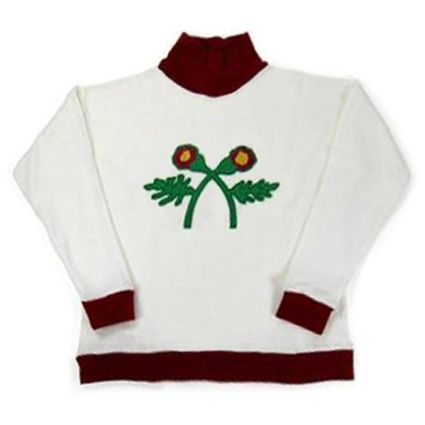
1907 Kenora Thistles Art Ross Jersey

When the Stanley Cup was first offered in 1892 as the prize for the best team in among Canada's amateur ranks, it was called the "Dominion Hockey Challenge Cup".


The cup was donated, at the urging of his two sons Arthur and Algernon, by Lord Stanley of Preston, then the Governor General of Canada, with the intent of creating a way to recognize which club was the current champion.

There was no single league across the whole of Canada at the time, so the format of awarding the cup was based on a challenge format, where the champion of one of the various amateur senior hockey associations could issue a challenge to the holders of the cup. This meant that challenge games could happen at any time during the season as challenges were approved, or ordered, by the cup's trustees. For example, the Ottawa Hockey Club faced four separate challenges for the cup, defended successfully each time, between January and March of 1904 from the Winnipeg Rowing Club, the Toronto Marlboros, the Montreal Wanderers and Brandon Wheat Cities, the latter two taking place just one week apart.

The challenge system was in effect until 1914, with the challenges varying from single-elimination games to best of three or two games, total goals series throughout the challenge era, when the trustees of the cup agreed that it would now be awarded to the winner of a playoff series each season between the champions of the professional National Hockey Association (NHA) and the Pacific Coast Hockey Association (PCHA) leagues.

It was on this date in 1907 that the Kenora Thistles captured the Stanley Cup as they successfully completed a two-game total-goal series against the current cup holders, the Montreal Wanderers, by a score of 12-8.

The Wanderers had held the cup since March of 1906 and had defended the cup once in December of 1906 before the Thistles issued their challenge based on being the champions of the Manitoba Professional Hockey League (MPHL).

Kenora Thistles in action photo KenoraThistlesinaction.png
The Kenora Thistles in action

The Thistles won the first game at the Montreal Arena on January 17, 1907 4-2 and captured the cup four days later by outlasting the Wanderers 8-6. Members of the Thistles included future Hockey Hall of Famers Joe Hall, Tom Hooper, captain Tommy Phillips and Art Ross.

Thistles headline photo Thistlesheadline.jpg

Kenora would retain the cup two months later on March 16 and 18, 1907 by winning the MPHL playoffs against the Brandon Wheat Cities club in a best-of-three series 2 games to none by scores of 8-6 and 4-1.

Just five days after defending the cup, Kenora faced another challenge, this time from the same Montreal Wanderers whom they had taken the cup from exactly two months earlier. The Wanderers took game one in the two-game total-goals series by a commanding 7-2 margin. The Thistles preserved some pride by winning Game 2 by a score of 6-5, but it was not enough to overcome the five goal advantage the Wanderers took into the contest, as they regained the rights to the cup by a final margin of 12 goals to 8, ending the Thistles reign as cup holders at a mere 62 days, the shortest reign in Stanley Cup history.

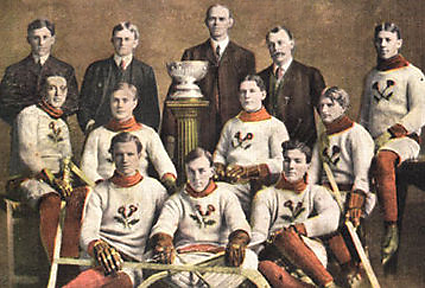
The 1907 Stanley Cup champion Rat Portage Thistles luckily
took time to pose with their trophy during the brief two months they held it

Of note, while each previous cup champion had the right to engrave the name of their club onto the cup, it was the Wanderers who were the first to include the names of each individual player on the championship team, a practice which became an annual tradition in 1924 and set the cup on it's journey from 7 inch bowl to the three foot tall trophy it is today.

Kenora, originally called "Rat Portage", then with a population of just 4,000 holds the record as the smallest city to ever hold the Stanley Cup. It is located 2oo kilometers east of Winnipeg, directly above Minnesota, in far western Ontario.

 photo RatPortage1880.jpg
Rat Portage in 1880

The Rat Portage Thistles were founded in 1896 and unsuccessfully challenged for the cup twice before in 1903 and 1905 when they were turned back by the Ottawa Silver Seven. It was later in the summer of 1905 that Rat Portage changed it's name to Kenora. The Thistles hockey club would fold during the 1907-08 MPHL season.

Rat Portage Thistles photo RatPortageThistles1890s.jpg
The 1897 Rat Portage Thistles

Today's featured jersey is a 1907 Kenora Thistles Art Ross jersey. The Thistles name was chosen in a contest and the winner was a local Scottish carpenter named Bill Dunsmore who not only submitted the name in reference to the region's Scottish heritage, but a drawing of a thistle for the team's logo.

This jersey is the style worn by the Stanley Cup champion Thistles club, which included Ross, who would go on to be not only a player, but a general manager and coach in the NHL and have the trophy for the NHL's annual trophy for the league's leading scorer, the Art Ross Trophy, named after him.

These jerseys were reproduced by the CBC in connection with their "Hockey: A People's History" documentary, and are sadly no longer available on demand.


In another one of those amazing youtube moments, here is a video on the Kenora Thistles. While the original Thistle club disbanded in 1908, subsequent clubs in Kenora have adopted the Thistle name, which was the case for the club that Louis McKay played on in 1934.


Monday, January 20, 2014

1924-25 Montreal Maroons Clint Benedict Jersey

Clint Benedict of the Montreal Maroons became the first goaltender in the NHL to reach 20 career shutouts on this date in 1925 with a 2-0 shutout over the Boston Bruins.

While Benedict reached 20 NHL shutouts in 1925, he actually had 23 career shutouts at that point, as the NHL had only been formed in 1917, and Benedict's professional career dated back to the 1912-13 season when he joined the Ottawa Senators of the National Hockey Association.

He would back up future Hall of Famer Percy LeSueur for two seasons until taking over as the starter in 1914, leading the NHA in Goals Against Average for three consecutive seasons and recording four shutouts in five seasons.

The 1914-15 Ottawa Senators with Benedict is in the middle row on the right

Following the 1916-17 season, the NHA would disband and the Senators would join the newly formed National Hockey League. As part of the NHL, the Senators would win the Stanley Cup in 1920, 1921 and 1923 with Benedict as their goaltender. He would also lead the NHL in wins for six of his seven seasons with the Senators after joining the new league.

The relationship between Benedict and the Senators would sour over the matter of Benedict's drinking, which included the Senators withholding some of his salary as a result. When Benedict sued the club, they countersued and Benedict's problems were revealed and the relationship damaged beyond repair.

As a result, Benedict was traded to the Montreal Maroons in time for their inaugural season in 1924-25 with his NHL career shutout total standing at 18. After a previous shutout, Benedict would get his 20th NHL shutout on this date in 1925, the first goaltender in the NHL to reach that milestone.

1924-25 Montreal Maroons

The following season of 1925-26 saw Benedict add six more shutouts to his career total during the regular season. He would then lead the Maroons to their first Stanley Cup championship while recording three more shutouts in four Stanley Cup Finals games against the Victoria Cougars.

The Stanley Cup Champion 1925-26 Montreal Maroons photo 1925-26MontealMaroonsteam.jpg
The Stanley Cup Champion 1925-26 Montreal Maroons

The next season Benedict would record 13 shutouts in 43 games and two seasons later add 11 more to his tally as scoring in the NHL reached an all-time low, as Toronto's Ace Bailey led the league with 22 goals and 32 points.

To open up the game, the rules were changed which now allowed forward passing in the attacking zone beginning with the 1929-30 NHL season. The changes were immediate and dramatic, as Cooney Weiland led the league with 43 goals and 73 points, 41 points more than Bailey's league leading total the previous season. Shutouts by goaltenders were obviously negatively affected, and Benedict's in particular, as his total went from 11 to zero in his final NHL season.

Benedict earned his place in hockey lore in 1930 when, following being hit in the face by a shot from the Montreal Canadiens Howie Morenz on January 5th, which broke his nose and fractured his cheek, he returned to the ice six weeks later on February 20th against the New York Americans, now wearing a protective facemask based on one used by boxing sparring partners. His use of the mask was short-lived. Varying accounts claim he wore it for one, two or even as many as five games, modifying the mask and even trying different styles, before giving up on the idea of wearing a mask due to them restricting his vision.

"The nosepiece protruded too far and obscured my vision on low shots," Benedict said. After losing 2-0 to Chicago on February 25th wearing it, "I threw the darn thing away. I blamed it for the loss and that was that." He then tried a wire cage-style protector, like a baseball catcher's mask, "but the wires distracted me. That's when I gave up."

Clint Benedict mask, Clint Benedict mask

He was again injured on March 4th in a game against Ottawa when he got hit in the face during a goalmouth scramble, which proved to be his final NHL game as well as his reported final (of five) games wearing a mask.

If the reports of Benedict wearing the mask for five games is accurate, he would have tied the Americans in the first game, defeated the Pittsburgh Pirates 5-4 in the second, lost to Chicago 2-0 in the final game for the leather mask, again defeated the Maroons 5-1 on March 1st before leaving the game on March 4th, a 6-2 defeat by the Senators for a record of 2-2-1 in the five games while wearing a wire mask of some style.

He played one final season for the Windsor Bulldogs of the IHL before retiring as a player.

Benedict finished his NHL career with 190 wins and 28 ties, along with 57 shutouts in 362 games, holds numerous Maroons goaltending records, including most wins, shutouts and lowest goals against average, and won four Stanley Cups. He was inducted into the Hockey Hall of Fame in 1965.

Today's featured jersey is a 1924-25 Montreal Maroons Clint Benedict jersey from the Maroons first season, and the one in which Benedict would become the first to reach the 20 shutout mark in NHL history.

The Maroons sweaters in their inaugural season read "MONTREAL" across the front, rather than the more familiar "M" logo that they would adopt for their second season and continue to wear for the remainder of the franchise's remaining 13 seasons.


Our video selection today is a trip through time and a look at the Evolution of the Goalie Mask. Hopefully you will see some forgotten favorites from the days of the early paint jobs on the full face mask.


hit counter for blogger