History of Jersey 83-93 Banner sm photo History of Jersey 83-93 Banner sm.jpg

Monday, February 4, 2013

2012-13 University of Minnesota Noora Räty Jersey

On Friday evening we had the pleasure of attending the top ranked NCAA women's team, the University of Minnesota Golden Gophers hosting the #10 University of Minnesota Duluth Bulldogs at Ridder Arena.

Ridder Arena, Ridder Arena

Ridder Arena, unlike the Gopher men's rink next door and it's international sized 200' x 100' sheet of ice, has a NHL sized 200' x 85' sheet and seats 3,400 fans. It's the first, and was for ten years the only, arena built specifically for a women's program in the United States. It will be host to not only the WCHA playoffs this season, but the women's Frozen Four national championships as well, having hosted the finals twice before. One unique feature is that Ridder and Mariucci are connected by an underground tunnel, allowing the two arenas to share such things as a Zamboni! Their proximity and differing ice sheets allow teams to have the option of which size rink to practice on based on their particular opponent that week.

Ridder opened in 2002 and has hosted seven WCHA conference championships, the Minnesota State High School Girls Hockey Tournament as well as pre-tournament games for the men's 2009 IIHF Under-18 World Championships held in Fargo, North Dakota.

It's a very attractive arena, with an increasing number of displays, including carrying over the Mariucci Arena tradition of adding the players named to the national All-American Team to a mural in the arena.

Ridder Mural AA, Ridder Mural AA

For jersey fans, there is a timeline of jerseys, although incomplete, the grace the walls of Ridder Arena. 

Ridder Jerseys, Ridder Jerseys

The Golden Gopher women's hockey team first took to the ice in 1997-98 and has won six regular season championships, four WCHA tournament titles and four national championships.

Ridder Banners, Ridder Banners

The Gophers have also had seven members of their program take part in the Olympics, six for the United States and one for Finland, who are commemorated on another wall of the arena.

Ridder Mural Olympics, Ridder Mural Olympics

Additionally, many Gophers players have skated in other international competitions for not only the USA and Finland, but also Canada, with those players highlighted with yet more jerseys on the wall.

This season, there is something special happening in Minneapolis, as heading into their game on Friday night, the Gopher women's team was undefeated at a stellar 27-0, also in the midst of a record setting streak of 34 wins dating back to February 18, 2012.

Duluth, meanwhile, came into Friday's game with a ten game unbeaten streak, having won six games in a row. The Gophers would open the scoring when Becky Kortum came off the bench and took a pass behind the UMD defense, broke in shorthanded on Bulldogs goaltender Kyla Black and pulled off a move worthy of any NHL shootout when she slammed on the brakes, snowed the goalie, who had gone down in anticipation, and simply reached around Black and put the puck into the wide open net on the right side for her 12th goal of the season. The period ended 1-0 in favor of the Golden Gophers, yet Duluth led in shots on goal 9-8.

Amanda Kessel, brother of former Gopher and current Toronto Maple Leaf Phil Kessel, extended the Minnesota lead to 2-0 with her 35th goal of the season at 8:04 after a slick behind the back pass from Hannah Brandt.

UM v UMD 2/1/13, UM v UMD 2/1/13
The Gophers celebrate Kessel's first goal of the night

Meanwhile, the Gopher defense kept the Bulldogs from getting any great scoring chances as the score remained 2-0 after 40 minutes.


UM v UMD 2/1/13, UM v UMD 2/1/13

Sarah Davis added to the Minnesota lead 2:10 into the third. Just 15 seconds after Kessel returned to the ice after a tripping penalty, she added her second goal of the game and 36th of the season a little over four minutes later as the Gophers began to pull away. The penalty to Kessel was the fourth Minnesota had successfully killed off during the game.

UM v UMD 2/1/13, UM v UMD 2/1/13
Despite no checking, who says women's hockey is not rough?

While Duluth outshot Minnesota 9-7 for the period and 24-22 for the game, the majority of the shots were from long range or without much force on them, as the Minnesota defense, led by captain Megan Bozek, prevented the Bulldogs from generating any sustained pressure or many close in scoring chances.

Bozek, Bozek
Captain Megan Bozak

Millica McMillen closed out the scoring with her 8th goal of the season with assist from Kessel and Davis to make the final score 5-0.

UM v UMD 2/1/13, UM v UMD 2/1/13
The Gophers celebrate clinching the league championship

Finnish Olympian Noora Räty (pronounced RAH-too) got the shutout in goal for the Gophers, who clinched the WCHA regular season title with the victory. Räty's 37th career shutout game her 101 career wins for sole possession of the NCAA record and leaves her two shy of the shutout mark.

UM v UMD 2/1/13, UM v UMD 2/1/13
Noora Räty blanked UMD on Friday

On Saturday afternoon, the Gophers won again, this time 6-2 after Duluth led 1-0 after the first period, only the third time Minnesota has trailed all season. Brandt and McMillen gave the Gophers a 2-1 lead after two, but Jenna McParland scored the first shorthanded goal Minnesota has given up all season to tie the score at 5:39 of third period.

Kessel then scored the game winner for Minnesota with her 37th of the year at 12:15 before the Gophers hit their stride with two more goals in a span of 1:45 and one more late one to seal their 36th consecutive victory and push their record to 28-0 for the season. Kessel leads the nation in scoring with 37 goals and 82 points, while teammate Brandt is second with 67.

With the victory, Minnesota clinched the WCHA regular season title, their seventh, and were awarded the league championship trophy following the game.

Captains Trophy, Captains Trophy
Team captains Megan Bozek and Bethany Brausen hoist the WCHA trophy

Team photo trophy, Team photo trophy
The Gophers celebrate clinching the WCHA regular season championship


We find going to women's games very entertaining, as the skill level is impressive and the prices were very affordable, as an adult general admission ticket was $8 and our youth another $5. Ridder Arena is a very attractive venue and the sight lines were great with every seat close to the ice. Compare the $13 we spent to the $70 it would cost for two people to see a Gopher men's game next door, and the value is obvious.

The atmosphere is good too, as both nights there were over 3,000 in attendance, nearly filling the 3,500 seat arena, and the band was there to create the true college experience.

Ridder Band, Ridder Band

While Minnesota is running away with the race in the west, the next six teams in the national rankings are eastern clubs, Boston College, Boston University, Harvard, Cornell, Clarkson and Mercyhurst. The rest of the Top Ten are Wisconsin, North Dakota and Duluth, so regardless of where you are located, there should be a team near you worth checking out.

The one thing we would recommend though, is buying a program (we paid just $1 for a fact filled lineup card) to assist in identifying the players for reasons that became quite clear as the game progressed!

Pony Tails, Pony Tails
Perhaps the names on the back should go under the numbers in the style of some European leagues!

Today's featured jersey is a 2012-13 University of Minnesota Golden Gophers Noora Räty jersey. The women's programs in NCAA hockey allow designers the opportunity to have some fun, creating new and different styles from those worn by the men's programs, often with very successful results not so tightly bound by the tradition of the men's programs.

This particular style is a good example of that, retaining the tradition of the University's hockey tradition with the block "M" logo on the front and a similar to the men's, but different, treatment for the stripes on the shoulders, while adding a secondary "skating Goldy" logo to the shoulders that the men's program has never used. Overall, it creates a fun, unique jersey for the women's team, while maintaining the tradition of the hockey program as a whole.

In addition to now holding the NCAA record for wins and closing in on the shutout mark, Räty has quite a resume, having been named Finland's Rookie of the Year in 2006, Best Goaltender in both 2006 and 2007 as well as Finland's Best Women's Hockey Player in 2007 and 2008.

Internationally, she won bronze medals at the 2010 Olympics, the 2008, 2009 and 2011 World Championships, where she was named Best Goaltender at all three tournaments as well as the 2008 tournament MVP.

While with Minnesota, he has been named a Patty Kazmaier Award Finalist in both 2010 and 2011 and a 2010 All-American. She was named the 2010 WCHA Goaltending Champion and earned 2010 WCHA All-Rookie Team and 2010 and 2011 WCHA First Team honors.

Minnesota Gophers 12-13 jersey, Minnesota Gophers 12-13 jersey

Today's video segment is "Get to Know Your Gophers" with Noora Räty and captain Megan Bozak.


While we enjoyed the skill level of the players, the arena, it's atmosphere and the team's home white and road maroon jerseys, we cannot conclude this article without calling out Nike and the university for the women's gold third jerseys, which are garish, hideous eye sores and quite likely the worst jerseys we have ever seen in person.

Gold jerseys, Gold jerseys

Taking all the worst design elements possible and combining them into one jersey will hopefully allow Nike to get it out of their system all at once so they won't have an excuse to repeat any of it's many mistakes again.

We detest the, the tacky lower arch treatment of the GOPHERS word mark on the front that looks like generic clip art, it's single, connected outline, the overly thick triple stripes down the arms  (wondering why Nike would copy a style so closely associated with Adidas!), and the bizarre maroon wrist cuffs, which travel pointedly up the back of the arms.

Gold front, Gold front

Then there are the chevron stripes along the sides, which really should match the arm stripes by being parallel for design consistency, and the utter lack of any white on the jersey, which should have been used instead of more gold to outline both the name on the front and numbers on the back, and probably in between the arm and hip stripes as well. It's as if one of the coach's kids were given just two crayons and told to design a jersey.

Gold back, Gold back

It's not that we dislike gold jerseys as a rule, as we think the one pictured above with GOPHERS diagonally across the front is especially nice, but this particular one seems to have grouped all the design elements we hated about the original Nike Swift jerseys from 2006, such as the stripes on the arms that start and stop for no reason rather than running the full length of the arms, and then added in even more bad design ideas combined with poor color choices to create a really, really bad jersey not worthy of a team playing so well.

Sunday, February 3, 2013

1997-98 New Orleans Brass Olie Sundström Jersey

With the National Football League holding the 47th Super Bowl in New Orleans, Louisiana, we thought it would be an opportune time to take a look at hockey in New Orleans.

Not too surprisingly, The Big Easy does not have a long and rich hockey tradition, but has been home to a professional hockey club, the New Orleans Brass of the East Coast Hockey League.

New Orleans Brass logo, New Orleans Brass logo

The club was founded in 1997 and originally played it's home games at the 7,800 seat New Orleans Municipal Auditorium for it's first two seasons.

The team was a member of the Southeast Division along with clubs located in Baton Rouge and Lafayette, Louisiana Birmingham and Mobile, Alabama, Biloxi, Mississippi and Pensacola, Florida. The Brass were led by former New York Rangers and Buffalo Sabres head coach Ted Sator and faired well for an expansion club, finishing fourth in their seven team division with a 36-24-10 record, which was good enough to qualify for the playoffs.

Former Boston Bruin and and Ottawa Senator Jeff Lazaro led the club in scoring with 37 goals and 101 points in 70 games. While Martin Villenuve was unquestionably the number one goaltender, with 54 games played and a fine 26-17-7 record, no less than six other goaltenders saw time in the crease for the Brass!

Lazaro Brass, Lazaro Brass
Jeff Lazaro

Lazaro returned for the 1998-99 season, but finished second in scoring to Darryl LaFrance, who had 39 goals and 39 assists for 78 points in 55 games. Villenuve again was the #1 in goal, but the situation was much, much more settled, with Chris Wickenheiser playing in 35 games with only one other goalie appearing in a single game for just 11 minutes. Another winning record, 30-27-13, saw the Brass made the playoffs again, where they had their best postseason, sweeping Jacksonville in Round 1, ousting Louisiana in Round 2 before losing to the Pee Dee Pride in the third round.

For the 1999-00 season, the club moved to the 16,500 capacity New Orleans Arena, which was to prove a fateful decision for the franchise. Lazaro again led the club in scoring with 80 points and was one of six players with 20 goals or more, but none with more than 26 for an extremely balanced offense. Another winning record saw the Brass qualify for the playoffs yet again.

For the 2000-01 season, Adam Edinger was the leading scorer with 31 goals and 76 points and the Brass kept their playoff streak intact, this time advancing to the second round after defeating the Augusta Lynx following a 35-25-12 mark.

In 2001-02, the Brass, still under the reins of head coach Sator since the beginning, extended their impressive record of never having a losing season when they finished at 36-32-4 to also qualify for the playoffs for the fifth consecutive season. They were led in scoring by George Awada's 59 points.

Awada Brass, Awada Brass
George Awada

The NBA's Charlotte Hornets relocated to New Orleans, taking up residence at the New Orleans Arena, which led to the state of Louisiana trying to require the Brass to pay for the expense of converting the basketball floor back into the hockey configuration as a condition of remaining at the arena. Being more than ownership was willing to pay, the club hoped to return to their original home, the Municipal Auditorium, only to discover that the floor had recently been replaced, and in the process the ice making capabilities had been removed. Now without a place to play, ownership was left with no alternative but to sadly fold the franchise, bringing to and end the brief era of professional hockey in New Orleans.

New Orleans Brass logo, New Orleans Brass logo

Lazaro finished as the franchise's all-time leading scorer by far, with his 307 points far outdistancing LaFrance's 175, thanks to being on the roster for every season of the Brass existence. Also of note was defenseman Steve Cheredaryk, the only other player on the roster for all five seasons. He ranks fourth in points with 111, first among defensemen, as well as first in games played and  penalty minutes at 978, nearly 200 a season.

Cheredaryk Brass, Cheredaryk Brass
Cheredaryk in the process of earning his franchise leading penalty minutes

Today's featured jersey is a 1997-98 New Orleans Brass Olie Sundström jersey from the Brass inaugural season in the ECHL. This jersey was clearly influenced by the St. Louis Blues jersey of the era with it's multiple stripes suggesting a musical staff, only executed in the expected Mardi Gras colors.

Sundström was one of no less than seven goaltenders for the Brass during their first season. After playing four seasons in his native Sweden for Leksands IF, he came to North America, where he played for 13 different teams over the course of ten seasons, stretching from Anchorage, Alaska in the west and north to New Orleans in the south and Providence, Rhode Island in the east! 

New Orleans Brass 97-98 jersey, New Orleans Brass 97-98 jersey

Bonus jersey: Today's bonus jersey is a 2000-01 New Orleans Brass Kevin Colley jersey. Less successful than their original jerseys, the 2000-01 version takes the striping pattern from the Anaheim Ducks and uses a more muted color scheme, dropping the bright gold color of the earlier jersey in favor of a much darker secondary color. Additionally, the primarily black color of the jersey is not separated from the dark purple shade by the bright colors which divided the two dark shades in the original jerseys, which makes for a rather moody look this time out.

Add in the darker overall logo the club had adopted by then, combined with the rather creepy jester secondary shoulder logo, we much prefer the more vibrant jersey with it's dynamic lines from 1997-98.

Colley persevered in the minors from 1999-00 to 2005-06 before finally getting a chance to play in the NHL, when he saw action in 16 games for the New York Islanders before fracturing his neck in a game against the Washington Capitals, which forced his early retirement.

New Orleans Brass 00-01 jersey, New Orleans Brass 00-01 jersey

Today's video section is of course, a fight. The Brass, in white, are facing off against their rivals, the Louisiana Ice Gators with the expected minor league mayhem.


Here is a genuine New Orleans brass band playing in the city's French Quarter.


Saturday, February 2, 2013

Ebay Jersey of the Week - 1996 Austria Nike Jersey

From time to time we find a jersey that really catches our attention because we know just how long it took us to get one like it for our collection and can't believe that someone hasn't jumped on the "Buy it Now" option or bid it up to a higher price yet.

This week's Third String Goalie Ebay Jersey of the Week is a 1996 Nike Austria National Team jersey. This style was worn during the 1996 IIHF World Ice Hockey Championships in a tournament hosted by the Austrians in Vienna.

This particular one looks to be in really good shape, especially for a jersey now 17 years old, and is blank on the back so you still have the option of adding a name and number on the back. It's also a listed as a size XL, which is a big plus, as auctions for older ones are seem to always be for a size small or medium, and also because older ones run smaller than current ones.

This particular style jersey does have a screened on crest, which is the way Nike made them back then. It's priced at $50 in a Buy it Now format, which is a good price for something this old.

Here is a link to the road version of this jersey in action at the 1996 World Championships, as worn by team captain Manfred Mühr as he wildly celebrates a goal for Austria. While you are watching as the video continues, be sure to take note of one Teemu Selanne wearing #88!

Since we like to add C's or A's to our jerseys, Mühr seems to be a great choice for customizing this jersey, as he wore the "C" and was a player of note for Austria, having played in the World Championships six times and the Olympics twice - 1988 and 1994.

Another options for customizing this jersey would be goaltender Reinhard Divis, who played 28 games for the St. Louis Blues between 2001 and 2006, Herbert Hohenberger or Dieter Kalt, both long-time veterans of the Austrian National Team.

Austria Nike 1996, Austria Nike 1996

In summary, if we didn't have a 1997 Austria jersey in our collection already, we'd be thrilled to acquire this rare 1996 one. We like the fact it's blank and an XL and know it's not and easily found style in this size, let alone this condition. Additionally, this seller has 383 positive feedbacks in the last year for a 100% rating and we have bought from this seller before and feel very comfortable pointing you in his direction.

Friday, February 1, 2013

Third String Goalie on The Hockey Show

Thursday night Third String Goalie was a guest on The Hockey Show, hosted by Teebz and Beans. Teebz is the author of the highly recommended Hockey Blog in Canada.

The Hockey Show Logo, The Hockey Show Logo

We answered all manner of questions on a variety of topics, including our memories of going to both Minnesota Fighting Saints as well as Minnesota North Stars games and their subsequent move to Dallas and the eventual arrival of the Minnesota Wild.

There was some Minnesota Golden Gopher talk as well as the expected hockey jersey discussion as well, during which we talk about how we were able to acquire our first game worn Soviet jerseys before we get riled up over the Mighty Ducks Wild Wing jersey.

To listening to the show, just click on the embedded player below.

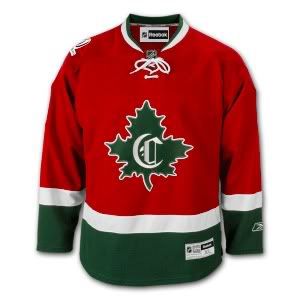
2008-09 Montreal Canadiens 1912-13 Centennial Saku Koivu Jersey

Today marks the anniversary of the debut of one of the most controversial jerseys in recent NHL history.

As part of their centennial celebrations, the Montreal Canadiens brought back six vintage jerseys from their illustrious past, scheduled to we worn at various times throughout the 2008-09 and 2009-10 seasons.

They began, somewhat slowly, with their "1970-71" jerseys, which were actually no different than their current home jerseys. They even wore their "100 Seasons" patch on them, rather than the "Centennial" patch used on all the other jerseys in the centennial jersey program.

Things improved on November 15, 2008 when they brought back their gorgeous 1945-46 jerseys, which had also been used as their third jerseys as recently as 2006-07, this time properly adorned with their Centennial patch as part of the throwback program.

The next ones to hit the ice were their 1915-16 jerseys, as worn when the Canadiens captured their first Stanley Cup. These jerseys featured a much darker shade of red than their current red jerseys and the "CA" logo on both the chest and sleeve with the familiar blue stripe across the chest first seen in the 1912-13 season.

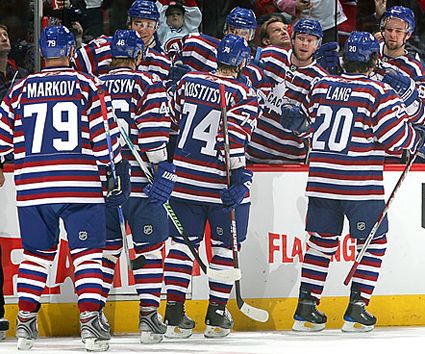
What really got people talking was the debut of today's featured jersey, the 2008-09 Montreal Canadiens 1912-13 Centennial Saku Koivu jersey.

Montreal Canadiens 08-09 12-13 jersey, Montreal Canadiens 08-09 12-13 jersey

The "Barberpole" jerseys were worn in a 3-1 loss to the Canadiens rivals the Boston Bruins, and were ridiculed by Bruins TV announcer Jack Edwards as "prison uniforms" during the contest, perhaps due to being paired with equally busy striped socks. Aside from losing the game, the Canadiens also lost Guillaume Latendresse to a shoulder injury and Robert Lang for the season due to a cut Achilles tendon, casting more dispersions on the multi-striped sweaters as being not only difficult to look at, but bad luck as well.

The Bruins Shawn Thornton was quoted as saying about the jerseys "I was really concerned about it in warmup. When there were 23 guys skating around, I was dizzy and I didn't know if I got enough sleep or what. It wasn't as bad once there were five guys out there."


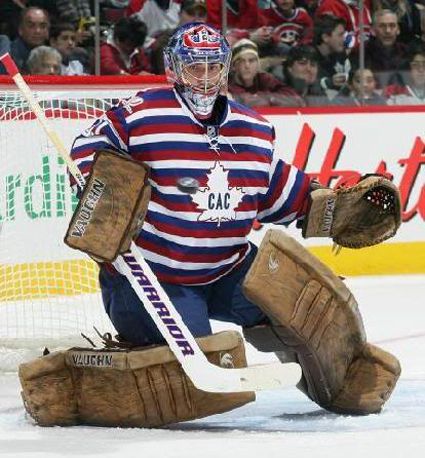
Full credit goes to Canadiens netminder Carey Price, who wore a set of throwback pads and gloves for the occasion.


The jerseys featured a white maple leaf with the letters "CAC" in the center, which stands for "Club Athlétique Canadien", and were due to be worn again later that season on March 31, 2009, but Canadiens then head coach Bob Gainey passed on the jerseys for their second and final scheduled wearing, calling them "a distraction", and opting for the more traditional looking 1915-16 jerseys instead.

For reasons unknown, perhaps pressure from the marketing department or the retailers who invested in inventories of the barberpole jerseys, the sweaters made an unexpected return, appropriately some would say, on Halloween Night during the 2009-10 season in a game versus the Toronto Maple Leafs, making for the unusual sight of every player on the ice being decked out with a maple leaf on their chest!


The original jerseys were not worn in the National Hockey League (NHL) but in the NHL's predecessor the National Hockey Association (NHA). The Canadiens who would have worn the barberpole jersey in 1912-13 included future Hall of Famers Georges Vezina, Jack Laviolette and Didier Pitre.


Sadly, it was then announced that the Canadiens decided to end the wearing of the throwback jerseys as of the date of their actual centennial anniversary back on December 4, 2009, curiously a game in which they did not wear a throwback jersey!

This affected the scheduled wearing of their beautiful red and green 1910-11 jerseys on January 23, 2010 against the New York Rangers and the the blue 1909-10 jerseys from their inaugural season, which were to have been worn on February 13, 2010 against the Philadelphia Flyers, meaning both of those jerseys ended up being the only ones of the six in the program to be worn just once.


Here, with less than four minutes remaining in the game, the Canadiens fans begin to sing goodbye to the Maple Leafs while up 4-2 just a bit too soon during the 1912-13 Centennial jersey game on October 31, 2009…


For die-hards, full extended highlights can be found here.

No mention of the Montreal Canadiens would be complete at Third String Goalie without a visit from our personal favorite Marie-Pier, who gives the Canadiens a run for their money in the stripe department as she reviews the Canadiens game versus the Maple Leafs from October 31, 2009.

The Habs shootout victory seems to have left her even more perky than usual and we actually were able to understand "Travis Moen" this time.


Thursday, January 31, 2013

1950's McGill University Redmen Jersey

In March of 1876, the first organized indoor hockey game took place at Montreal's Victoria Skating Rink by James Creighton and several students from McGill University. Several of those students, Richard F. Smith, W. F. Robertson and W. L. Murray, helped refine seven rules of the game as well as introducing the puck, which was carved from a rubber lacrosse ball.

A little less than two year later, on this date in 1877, the world's first organized hockey club, the McGill University Hockey Club, played their first game at the same Victoria Rink against a team called the "Victorias" which was comprised of members of Montreal's Victoria Skating Rink with the addition of players from both the Montreal Lacrosse Club and the Montreal Football Club. The game ended with a 2-1 victory for McGill.

Members of the first organized McGill club included Archibald D. Taylor (president), Henry "Harry" Abbott (captain), Robert J.B. Howard, Frederick W. Torrance, Lorne Campbell (goaltender) William W. Redpath, George R. Caverhill and Rankine Dawson. Those pioneers are now the first in a long line of lineage of the oldest ice hockey club in the world, which is still playing today.

1881 McGill University team, 1881 McGill University team
Hockey's first known team photo with hockey jerseys, the 1881 McGill University Hockey Club

By 1929 the club had adopted the nickname the Red Men, in deference to the red uniforms the team wore. Over time, the name evolved to Redmen.

McGill's first Queen's Cup championship (the second oldest hockey trophy still being awarded after the Stanley Cup) arrived in 1993, followed by titles in 1903 and 1905 with more championships arriving in 1912, 1918 and 1921

1910 McGill University team, 1910 McGill University team
The 1910 McGill University Hockey Club

A period of dominance saw them take the title in 1930 and 1931 before seven consecutive championships spanning 1933 to 1939 before the final one of the era arrived in 1946.

1937 McGill University team, 1937 McGill University team
The 1937 McGill University Hockey Club

McGill would have to wait until 2006 for their next title, a span of sixty years since their last championship. They would not have to wait long, as their next title arrived in 2008, which sent them on a new run of domination, as they have now reeled off five consecutive titles in 2008, 2009, 2010, 2011 and most recently in 2012, when they not only won the Queen's Cup as Ontario University Athletics championship, but also went on to win their first Canadian Interuniversity Sport University Cup championship, which dates back to 1963.

2012 McGill University team, 2012 McGill University team
2012 McGill University Hockey Club

Additionally, the university's women's team, known as the Martlets, has now won seven titles of their own, with the first coming in 1985. After winning again in 2003, the gave McGill both the men's and women's titles in 2006. After a second consecutive championship in 2007, they again duplicated the men's team's titles in 2008, 2009 and 2010.

2008 McGill University women's team, 2008 McGill University women's team
The 2008 McGill University women's championship team

Of note, Kin St-Pierre become the first woman in CIS history to win a men's regular season game when she was in goal on November 15, 2003 in a 5+2 win over Ryerson University.

St-Pierre McGill, St-Pierre McGill
Kim St-Pierre

Today's featured jersey is a 1950's McGill University Redmen jersey. This classic sweater, made of wool, features a tie-neck collar and an embroidered felt McGill coat of arms crest. It's a beautiful example of a vintage sweater from the days when identifying your teammates on the ice was the main function of a sweater, rather than providing the club with income from merchandise sales.

McGill University 1950's jersey, McGill University 1950's jersey
photo courtesy of Classic Auctions

Today's video segment is a look at some of the hockey research being conducted at McGill University.


Wednesday, January 30, 2013

1908-09 Toronto Marlboros Bruce Ridpath Jersey

After playing junior hockey in 1904, Bruce Ridpath joined the Toronto Marlboros of the Ontario Hockey Association in 1905 as an amateur, turing professional with the Marlboros in 1906, playing in eight games and scoring 17 times.

1905 toronto marlboros, 1905 toronto marlboros
The 1905 OHA champion Toronto Marlboros

He helped lead the Marlboros to the league championship in 1908, which led to the Marlboros facing the Montreal Wanderers in a one game challenge for the Stanley Cup. While Toronto would lose the game 6-4, Ridpath did score a goal during the contest.

On this date in 1909, Ridpath had his finest night on the ice, when he scored seven times in a 15-10 Toronto win over Brantford. Later that same season, Ridpath played with the Cobalt Silver Kings, who would be one of the founding members of the National Hockey Association the following season.

Ridpath did not return to Cobalt for the 1909-10 season, as he signed with the Ottawa Senators, who were also members in the new NHA along with the Haileybury Comets, Renfrew Creamery Kings, Montreal Shamrocks, Montreal Wanderers and a brand new club, the Montreal Canadiens.

The Senators were the holders of the Stanley Cup at the time Ridpath joined the club, and as such endured a pair of challenges for the cup while also playing their NHA regular season schedule. The first challenge was from Edmonton of the Alberta Amateur Hockey Association, who they turned back in Game 1 by a score of 8-4 with Ridpath contributing a goal. The second match two days later saw Ottawa rack up 13 goals to Edmonton's 7, with Ridpath netting three goals in the Senators successful defense.

Ridpath Senators 1910-11 jersey, Ridpath Senators 1910-11 jersey
Ridpath in the unusual vertically striped Senators jersey of 1909-10

The Senators lost control of the cup when they had to relinquish it to the league champion Wanderers, but Ridpath did finish second in the league in scoring with 15 goals in 12 games, second on the Senators to teammate Marty Walsh.

Ottawa rebounded in 1910-11 by taking the NHA championship, thanks to a 13-3 record and scoring a league best 122 goals, 31 more than the next closest team - quite a margin in a 16 game season! Ridpath came in third in scoring for the Senators and fourth in the league with 22 goals in those 16 games.

Ridpath Senators, Ridpath Senators
Ottawa would return to their customary horizontal stripes in 1910-11

Once more in control of the Stanley Cup as league champions, Ottawa fended off two challenges for the cup, first a 7-4 owner Galt, with Ridpath scoring two, and a 13-4 drubbing of Port Arthur, during which Ridpath again contributing two to the cause.

1910-11 Ottawa Senators team, 1910-11 Ottawa Senators team
Ridpath, front row second from the left, and the 1910-11 Ottawa Senators with the diminutive Stanley Cup

Ridpath missed the entire 1911-12 season after suffering a fractured skull when hit by a car in downtown Toronto in November of 1911. He survived his life-threatening injuries and the Toronto Blueshirts wanted Ridpath to suit up for them, but his vision never sufficiently recovered enough for him to return to the ice. Benefit games were held in his honor to help him pay his medical bills in both Ottawa and Toronto due to his popularity.

While he played right wing, Ridpath designed a popular style of early shin pads for goalkeepers that were widely worn in the early days of professional hockey.

Lesueur shin pads, Lesueur shin pads
Senators teammate Percey Lesueur wearing an early style of goalkeeper shin pads designed by Ridpath

Beyond his hockey career, Ridpath was also a member of the Toronto Canoe Club and was known as a canoe racer and stunt paddler, who performed shows around the globe!

Ridpath suffered a stroke in 1925 and died at the too young age of 40.

Today's featured jersey is a 1908-09 Toronto Marlboros Bruce Ridpath jersey. The Toronto Marlborough Athletic Club was founded in 1903 and operated several clubs - minor, junior and senior teams. The junior club won seven Memorial Cups and sent over 180 played to the NHL as an affiliate of the Toronto Maple Leafs, including six Hall of Famers. The senior team competed for the Stanley Cup in 1904 and won the Allan Cup in 1950 as the senior champions of Canada.

Toronto Marlboros 1908-09, Toronto Marlboros 1908-09

Tuesday, January 29, 2013

1976-77 Buffalo Sabres Gerry Desjardins Jersey

The snow started to fall early in the morning of Friday, January 28th and the winds began to blow at 29 miles and hour with gusts up to 49 mph as the Buffalo Sabres practiced before a scheduled flight to Montreal later that afternoon.

As the cold front reached Buffalo at 11:35 AM, the temperature fell 26 degrees, reaching zero within four hours and the winds now averaged 46 mph with gusts up to 69 mph, creating wind chills of -60º to -70º.

Thousands were stranded in offices, schools and factories as roads became impassable when as much as eight inches of snow fell or was blown off the frozen Lake Erie, on top of the 33 inches that had already choked Buffalo that winter. An estimated 13,000 people were stranded in downtown Buffalo alone, along with an estimated 8,000 cars clogging the roads of the city, many of which ended up completely buried. Some Sabres employees were forced to sleep overnight in the Sabres home rink "The Aud", among the 300 people who took shelter there.

Abandoned cars, Abandoned cars

Six homes were completely destroyed on one block as fire trucks were unable to get through the drifts to reach the fire. A state of emergency was declared in Erie County were Buffalo is located, as well as Niagara, Orleans and Genesee counties as drifts reached 15 feet high by nightfall as the high winds combined with the unusual weather conditions earlier that winter left Lake Erie covered with ice and a layer of snow that was easily picked up by the winds and deposited on shore in Buffalo. In a typical winter, the snow on the lake went through a thaw and freeze cycle that would leave it with a hard crust on top, preventing the wind from carrying the snow into the city in such massive amounts.


Driving home from practice, Sabres winger Jim Lorentz had to abandon his car and walk the last mile as the snow was now "bumper-high". He did not find his car until three days later.

Gary McAdam had five separate accidents in his new Thunderbird in his attempt to return home. At the scene of the fifth accident, while examining his battered car, another vehicle came sliding toward his, causing McAdam to jump onto the trunk of his car as the sliding vehicle came to a halt against his bumper.

It took Lee Fogolin and Brian Spencer an incredible four hours to make the five-minute drive to their condominium. They were not seen again for three days.

Sabres coach Floyd Smith postponed the team's planned departure from Friday to Saturday, but the blizzard conditions remained as the wind continued to howl, clocked at speeds up to 51 mph, blowing even more snow into Buffalo from Lake Erie.

Buried School Bus, Buried School Bus

Saturday, for the first time in 143 years the Buffalo Courier Express could not publish it's morning newspaper.

Coach Smith was able to make it to the airport by following snow plows, but it stretched his usual 20 minute drive to two hours. Defenseman Jerry Korab couldn't even open the door of his house, so he called winger Rene Robert and told him, "If you want me to protect you tonight, come dig me out." Robert arrived with his four-wheel-drive truck, dug Korab out and headed off for the airport with three additional teammates along for the ride.


By 3 PM, only 10 players had arrived. As Smith as about to phone Montreal to cancel the game, Jocelyn Guevremont, who had gotten to his four-wheel-drive vehicle by jumping out of a window and shoveling his way to his garage, arrived with four other players, giving Buffalo enough bodies to make the trip.

"On the plane, the stewardesses were hollering at the pilots that we couldn't take off," recalled Don Luce. "I think they tried to turn it around, but all the plane did was blow sideways. Somehow they got it in the air."

Sabres Hall of Fame announcer Ted Darling was unable to make the flight to Montreal and was forced to call the game over the phone from his apartment while watching the game on television.

Once the game got underway, not surprisingly, the Canadiens broke out on top with a goal from Serge Savard at 17:23 to take a 1-0 lead into the first intermission. It would take Montreal just 35 seconds to extend their lead to 2-0 thanks to a goal by Steve Shutt.

Buffalo would dig in and convert a power play opportunity for their first goal, which came at 6:47 from  Andre Savard from team captain Gilbert Perreault and Robert.

Montreal reasserted their expected dominance over the undermanned Sabres with Yvon Lambert's goal at 14:47. Still, Buffalo fought back and Luce kept the Sabres in touch with his 14th goal of the season at 15:55 from McAdam and Craig Ramsay. The period would finish that way, with Montreal leading 3-2 despite being outshot by Buffalo 20-14.

For the remainder of the contest, the Sabres and goaltender Gerry Desjardins would keep Montreal's high powered offense at bay. Eventually, defenseman Jim Schoenfeld would solve Michel Larocque at 8:25 to even the score at 3-3.

Gerry Desjardins, Gerry Desjardins
Gerry Desjardins

Schoenfeld's goal would hold up, as the Sabres rallied to limit the Canadiens to just five shots for the third period, to earn the plucky and shorthanded Sabres an unexpected, if not unbelievable, 3-3 tie on this date in 1977 against the defending (and eventual) Stanley Cup champions, outshooting them by a final margin of 27-19.

The blizzard forced the Sabres to cancel the following night's game in Buffalo against the Los Angeles Kings, a day when the winds continued to howl with gusts up to 52 mph.

White Buffalo, White Buffalo
Snow covered Buffalo, with it's highways abandoned and covered in white

Monday, the Sabres boarded a bus for what turned out to be a 10-hour trip across New York State for a game against the Islanders to start a three game road trip as the storm raged in Buffalo until Tuesday. While only 12 inches of new snow fell, the wind created drifts that finally topped out at 30 feet. Some areas even banned snowmobiles, as one rider was injured in a collision with a chimney on top of a house and the high drifts caused low clearance issues with power lines! Some towns even resorted to using metal detectors to locate buried cars before plowing the roads.


The Sabres next scheduled home game against the Toronto Maple Leafs was also postponed while the city was still recovering from the paralyzing drifts, meaning the Sabres went two weeks without a home game. Additionally, the Buffalo Braves of the NBA postponed four of their scheduled home games.

In all, there were 29 storm related deaths in Western New York, 11 of those in the City of Buffalo. Nine of those unfortunate people were found buried in their cars.

Several books have been written about the Blizzard of '77, which are available here.


There was even a Blizzard of '77 board game created in the aftermath, in which, once the blizzard hits, you flip the board over and now all the spaces become hazards of one sort or another, making any movement difficult at best!

Blizzard Game, Blizzard Game

Today's featured jersey is a 1976-77 Buffalo Sabres Buffalo Sabres Gerry Desjardins jersey, the style worn in Montreal the night 15 intrepid Buffalo Sabres managed to escape storm ravaged Buffalo to take on the defending Stanley Cup champion Montreal Canadiens and hold them to a 3-3 tie.

At the time the Sabres were only in their sixth season and this was still their original jersey style with the tie-neck collar, no logos on the shoulders and without names on the back, which were added the following season. The Sabres jerseys retained their lace up collars until 1978-79 when they were replaced by v-neck sweaters.

Desjardins began his NHL career with the Los Angeles Kings in 1968-69 and was later involved in a trade which sent him to the Chicago Black Hawks in 1969-70. Chicago actually traded him to the California Seals on September 9th, 1971, only to be sent back to Chicago in another trade five weeks later before ever playing a game for California!

The New York Islanders claimed him in the 1972 expansion draft from Chicago. He suffered through two losing seasons as the Islanders found their feet in the NHL. Desjardins sought greener pastures in the WHA, but signed for the 1974-75 season with the unstable Michigan Stags franchise, which became the Baltimore Blades mid-season, a move which triggered an escape clause in his contract, allowing him to sign with the Buffalo Sabres in time to appear in nine regular season games as well as the teams playoff run all the way to the Stanley Cup Finals.

With Buffalo, he found not only stability, but success as well, easily setting career highs with 29 and then 31 wins as the Sabres number one goaltender before being forced to retire after being struck in the eye by a puck after playing just three games of the 1977-78 season.

Buffalo Sabres 76-77 jersey

Today's first video is an amazing look at the Blizzard of 1977 and it's effects on Buffalo.


Here is a pair of videos showing how a wall of snow coming off of Lake Erie can turn an ordinary day into a white out in a matter of minutes.


hit counter for blogger