History of Jersey 83-93 Banner sm photo History of Jersey 83-93 Banner sm.jpg

Friday, June 8, 2012

1991-92 Winnipeg Jets Thomas Steen Jersey

Born on this date in 1960 in Sweden, Thomas Steen began his career with Grums IK in 1975-76 and moved over to the Leksands IF junior team in 1976-77, the year he made is debut for the Sweden National Team at the European Junior Championships where he scored 8 points in 6 games as Sweden took home the gold medal.

After a move up to the Elitserien in 1977-78, Steen would play three seasons with Leksands IF. He would also participate for Sweden in the World Junior Tournament in 1978 (silver), 1979 (bronze) and 1980 (bronze). Following the 1978-79 season, Steen was drafted 103rd overall by the Winnipeg Jets.

He moved to Farjestads BK for 1980-81 and more than doubled his previous season high in points when he scored 16 goals and 23 assists for 39 points in 32 games on his way to being named 1981 Elitserien Player of the Year as Farjestads won the Swedish Championship.

Now playing at the senior level, Steen participated in both the World Championships, earning a sliver medal, and also skated in the 1981 Canada Cup.

Having reached the top of Swedish hockey, Steen moved to North America for the 1981-82 season and made his NHL debut with the Winnipeg Jets.

Thomas Steen Jets

His first four seasons saw him adapt quite well to the North American game and his point totals improved each season, from 44 as a rookie, to 59, then 65 and then setting a career high with 30 goals on his way to 84 points in 1984-85. Prior to that season Steen also competed in his second Canada Cup, the 1984 edition in which he led the tournament in goal scoring with 7 goals in 8 games.

After three more steady seasons, which included Steen scoring 11 points in 8 games for Sweden at the 1986 World Championships, helping Sweden to bring home the silver medal, he would set a career high with 88 points from 27 goals and 61 assists in 1988-89 and follow that with his final appearance at the World Championships in 1989.

Health issues began to affect Steen, as he only played in 53 games in 1989-90, his first season under 73 games in his nine years in the NHL, due to a back injury. Those 53 games were very productive however, as Steen totaled 66 points for 1.25 points per game, the highest average of his career. He was also named as one of the team captains for 1989-90 and 1990-91.

The following season was a carbon copy of the previous one, with 67 points in just 58 games played, this time due to a broken ankle. Prior to the start of the 1991-92 season, Steen played for the Sweden National Team for the final time when he played in the 1991 Canada Cup, his third.

Another short season of 38 games in 1991-92 due to both ankle and back issues was followed by a return to health, with 80 games and 72 points in 1992-93 and 76 games and 51 points in 1993-94.

His final NHL season of 1994-95 saw him play in 31 games during the strike-shortened season and finish his 14 year NHL career, spent entirely in Winnipeg, with 950 games played, 264 goals and 553 assists for 817 points. Steen remains the second leading scorer in franchise history, including their over ten years in Phoenix as the Coyotes.

At the conclusion of his career, Winnipeg retired Steen's #25 on May 6, 1995, one of only two numbers ever retired by the Jets and the very first European player to have his number retired by an NHL club.

Steen would come out of retirement in 1996 to play with the Frankfurt Lions of the German DEL in 4 regular season and 3 playoff contests. He would continue playing the following season, joining the Berlin Polar Bears, for whom he would play for three seasons before retiring again in 1999.

Today's featured jersey is a 1991-92 Winnipeg Jets Thomas Steen jersey. This jersey has the "Goals for Kids" patch on the left sleeve and features the NHL 75th Anniversary patch on the right chest as worn by all players in the NHL that season.

After Winnipeg adopted a new set of jerseys for their entry into the NHL in 1979, this was their second and final NHL jersey, which served them well from 1990 to 1996.

Winnipeg Jets 91-92 jersey

Bonus Jersey: Today's bonus jersey is a 1996-97 Eisbaren Berlin "Berlin Polar Bears" Thomas Steen jersey as worn during the final few seasons of Steen's career after he came out of retirement from the NHL. Steen scored 33 points in 49 games.

This jersey has the typical European flair with it's sublimated graphics, multiple, if not excessive, sponsorship logos and even sports a collar, something more common in the Scandinavian leagues. It also has the European-standard player name located below the number on the back, giving the more prominent location above the number to yet another sponsor logo.

Berlin Polar Bears 96-97 jersey

Our video segment begins with Thomas Steen scoring with just seven seconds left in regulation to fuel a late Winnipeg comeback versus the Chicago Blackhawks from 1991-92. Note that the Blackhawks are wearing their Turn Back the Clock jerseys, worn only during the NHL's 75th Anniversary season.


Next is the retirement ceremony in Winnipeg for Thomas Steen's sweater #25.


Thursday, June 7, 2012

1987 Soviet Union Vladimir Krutov Jersey

One of the all-time great Soviet hockey players, Vladimir Krutov, died yesterday at the age of 52.

"Volodya was such a dependable and steadfast man that I would have gone anywhere with him - to war, to espionage, into peril. There are fewer and fewer guys like him in every generation of hockey players," former Soviet goaltender Vladislav Tretiak told the Sport-Express newspaper.

Krutov was a member of the famed KLM line along with Igor Larionov and Sergei Makarov which dominated Soviet and international hockey the 1980's.

KLM Line
The KLM Line

Krutov, a left winger, played for CSKA Moscow (better known in North America as Central Red Army) beginning with one game in 1977-78 and a half season of 24 games the following year,including scoring his first goal, before becoming a full time member of the Red Army squad in 1979. That season, in 40 games, he would average more than a point per game with 30 goals and 12 assists for 42 points.

1981-82 would see Krutov set a personal high with 37 goals and 66 points in 46 games and was Red Army's leading scorer with 53 points in 1982-83. CSKA would win the Soviet League championship in each and every of Krutov's 12 season's with the club. Additionally, he led the league in goals in 1984 (37 goals), 1986 (31) and 1987 (26) and was named to the USSR All-Star Team every year from 1982 to 1988 and was the Soviet Player of the Year in 1987. His final career totals with CSKA were 438 games played with 288 goals and 215 assist for 503 points, which still ranks him 5th in team scoring, 7th in goals and 4th in assists over 20 years later.

In addition to his 12 Soviet League championships, Krutov and CSKA would win the Soviet Cup twice, in 1979 and 1988, and the European Cup in each of his 12 seasons.

While with CSKA, Krutov also toured North America as part of the Super Series, a series of exhibition games between Red Army and other Soviet club teams taking on various NHL teams. He participated in the Super Series three times, in 1982-83, 1985-86 and one last time in 1988-89, playing a total of 17 games, scoring 10 goals and 21 points.

His Soviet League success was duplicated in international play as well, beginning with a silver medal in his international debut at the 1978 European Junior Championships and a pair of gold medals in the World Junior Tournament in 1979 and 1980 while leading the World Juniors in scoring both years with 14 points in 6 games in 1979 and 11 points in 5 games in 1980 while being name Best Forward both times as well.

Krutov's senior international career began with a silver medal at the 1980 Olympic Games (he scored the first goal of the "Miracle on Ice" game and later added an assist to give the Soviets a 3-2 lead) prior to a run of five consecutive gold medals at the 1981 World Championships, the 1981 Canada Cup, the 1982 and 1983 World Championships and the 1984 Olympics.

Soviet Union 1984 Olympics
1984 Olympic Champions

A third place finish in the 1984 Canada Cup and a bronze medal in the 1985 World Championships followed. The Soviet Union would rebound with another gold medal at the 1986 World Championships, where Krutov was named Best Forward.

Soviet Union 1988 Olympics
1986 World Champions

In 1987, Krutov scored two goals in the 5-3 Soviet win in game two of Rendez-vous '87 against the NHL All-Stars before earning a silver medal at the 1987 Worlds, were Krutov led the tournament in goals and points and was named Best Forward for the second consecutive year. Later that year, he participated in the 1987 Canada Cup where he was named to the All-Star Team as the Soviets finished second.

Krutov Canada Cup, Krutov Canada Cup
Krutov playing in the Canada Cup tournament

The 1988 Olympics concluded with another gold medal after finishing the tournament at the leading scorer and Krutov finished his international career in style with his fifth World Championship gold in 1989.

Krutov 1988 Olympics, Krutov 1988 Olympics
Krutov on his way to leading the 1988 Olympics in scoring

Krutov's final medal count shows nine gold medals, three silver and two bronze, which included at least one gold at each of the World Juniors (2), World Championships (5) and the Olympics (2) as well as winning a Canada Cup.

Kutov was one of the first wave of Soviet players allowed to join the NHL, playing for the Vancouver Canucks, who had drafted him in 1986 in hopes that he would some day be allowed to leave the Soviet Union.

He played just one NHL season, 1989-90, scoring 11 goals and 34 points in 61 games while faced with the challenges of being a veteran trying to adjust to the change to a new language and culture while being viewed by some as taking a job away from a Canadian, plus the sudden riches combined with the freedom he was afforded in North America after an entire career in which he was required to train 10 months out of the year. It was unfortunate that Krutov's attempt to play in the NHL was viewed as unsuccessful since it tainted many North American opinions of Krutov based on just a single season late in his otherwise stellar career in the Soviet Union.

Krutov Canucks, Krutov Canucks
"The Tank" unleashes a shot while with Vancouver

He played very little hockey in 1990-91, just one regular season game and three playoff games with the ZSC Lions in Switzerland. After another season with ZSC where he scored 32 points in 28 games, he moved to Östersund IK in the third division of Swedish hockey, helping them earn promotion to the second division on his first try, scoring a dominant 25 goals and 49 points in just 19 games. He would play two more seasons for Östersund and wrapped up his career with Brunflo IK before retiring.

Krutov was named to the Soviet Hockey Hall of Fame in 1981 and the International Ice Hockey Federation Hall of Fame in 2010.

Today's featured jersey is a 1987 Soviet Union National Team Vladimir Krutov jersey as worn by Krutov during Rendez-vous '87, a two-game series held in Quebec City on February 11 and 13, 1987 which replaced that season's NHL All-Star Game which featured a team of NHL All-Stars against the Soviet National Team.

Game 1 went to the NHL All-Stars 4-3 and the Soviets came back to win Game 2 by a core of 5-3 in which Krutov scored a pair of goals, including the game winner at 9:19 of the third period.

Krutov Rendez-vous '87

This jersey is typical of the Soviet style, with a minimum of adornments and simple one color names and numbers, made to look even more spartan when compared to the flashy NHL All-Star jerseys it competed against.

Vladimir Krutov 1987 Soviet National Team jersey
photo courtesy of Classic Auctions

Today's video section begins with Krutov scoring against the Montreal Canadiens on December 31, 1982 in an exhibition game.


Here Krutov scores for the Soviets in Rendez-vous '87 to put the Soviets ahead 2-0 followed by his game winning goal to make it 4-2 on the Soviets way to a 5-3 win.


In some truly rare footage, Krutov scores on a penalty shot for the ZSC Lions, quite possibly the slowest approach in the history of hockey.


Wednesday, June 6, 2012

1980-81 St. Louis Blues Wayne Babych Jersey

Born on this date in 1958, an Edmonton, Alberta native, Wayne Babych played for his hometown Edmonton Mets of the Alberta Junior Hockey League in 1973-74, where the right wing put up a respectable 20 goals and 38 points in 56 games.

Staying close to home, Babych moved up to the Edmonton Oil Kings of the Western Canadian Junior Hockey League for the 1974-75 season, where he scored 19 goals and 36 points. He more than doubled his point total for the following season, thanks to an increase to 32 goals as well as 46 assists for 78 points.

Babych stayed with the franchise when it relocated in 1976-77, becoming the Portland Winter Hawks, with whom he impressed with back to back 50 goal seasons. In 1977, he added 62 assists for 112 points, and topped that with 71 in 1978 for 121 points, leading the team in scoring by 32 points.

Following the season, Babych was selected third overall by the St. Louis Blues in the NHL Amateur Draft. He made the Blues roster straight away, playing 67 games his rookie season, scoring 27 goals and 63 points in 67 games. He backed that up with 61 points in 1979-80 in only 59 games.

Babych Blues, Babych Blues

Seemingly shot out of a cannon, Babych scored more goals than he previous two seasons combined when he finished in sixth in the league with 54 goals, just one back of Wayne Gretzky at 55 to become the first 50 goal scorer in Blues history while playing on a line with Blake Dunlop and Jorgen Pettersson. His 54 goals, 42 assists and 96 points were far and away his career best in all three categories, as were his 93 penalty minutes.

Babych Blues, Babych Blues

He would play three more seasons with St. Louis, never scoring more than 44 points or reaching 20 goals thanks to a torn rotator cuff which suffered in a fight during a preseason game in 1981.

His time in St. Louis had run it's course, and Babych was claimed by the Pittsburgh Penguins in the 1984 waiver draft, where his first season went well, as he did manage 20 goals and 54 points.

Thinking he was going to be back with Pittsburgh the following season, fate had surprises in store for Babych, as he was dealt to the Quebec Nordiques after playing in just two games. Things went well in Quebec, having gotten off to a nice start with 11 points in 15 games, only to be sent back across the border when the Nordiques dealt Babych to the Hartford Whalers for the remainder of the season, where he joined his brother Dave Babych and scored 28 points in 37 games.

Babych Nordiques Penguins, Babych Nordiques Penguins
The hockey card makers had trouble keeping up with
all the movement Babych endured in 1985-86

His final season was an abbreviated one, having suffered a horribly broken leg in the preseason. Told he might never play again, he would spend nearly the entire season recovering in time to play six rehab games with the Binghamton Whalers in the AHL, the only minor league games of his career, before playing in Hartford's final four games of the season. Giving it a try in training camp the following season, pain and fear of further injury were too much, and Babych called it a career.

Babych Whalers, Babych Whalers

His final totals were 519 games, 192 goals and 246 assists for 438 points, and one magical 50 goal season.

Today's featured jersey is a 1980-81 St. Louis Blues Wayne Babych jersey as worn during his career year when he scored a career high 54 goals and 96 points.

St. Louis joined the NHL in 1967 with jerseys that had the colors reversed on their striping. They swapped to today's featured jersey's configuration in 1973-74 and gained names on the back in 1977-78 before the attractive shoulder striping (added to match the white home jersey) was added in 1979-80. This classic Blues style would remain in use until being replaced in 1984-85.

St Louis Blues 80-81 jersey, St Louis Blues 80-81 jersey

In today's video section, Babych looks back on his time in St. Louis with the Blues.


Next is an interview with Babych on the occasion of a rough night, where he suffered a broken cheekbone from an elbow and a broken nose in the subsequent fight!


Tuesday, June 5, 2012

1970-71 Philadelphia Flyers Andre Lacroix Jersey

Born on this date in 1945, Andre Lacroix, the youngest of 14 children, was a multi-skilled center who played for clubs in both the NHL and WHA during his 13 year professional career.

Lacroix, was clearly a man born at exactly the right time and was able to benefit perhaps more than any other player from the dramatic upheaval in professional hockey during the fifteen year span from 1966 to 1980. While other players were able to benefit better financially, Lacroix was rescued first from the minor leagues when the NHL expanded in 1967 and then liberated from his own personal hockey purgatory with the arrival of the WHA to record one of the greatest offensive careers of his generation.

Lacroix set prolific scoring marks in Canadian junior hockey starting in the 1964-65 season with the Peterborough Petes of the OHA by scoring 119 points in 49 games. He showed his goal scoring ability with 45 tallies and highlighted his remarkable playmaking skills with 74 assists. He was also very adept at winning faceoffs and penalty killing as well. He followed that season with a 120 point campaign in the 1965-66 season to lead the league in points.

Following the Petes regular season, Lacroix played a pair of games with the Quebec Aces of the American Hockey League, scoring 4 points. 1966-67 saw Lacroix adapt to the game at the minor league level with a 25 goal, 24 assist season for 49 points.

He elevated his game to the next level in 1967-68 and was sitting at 41 goals and 87 points in 54 games before being recalled by the expansion Philadelphia Flyers, as this was the season that the NHL expanded from it's traditional six clubs to 12, creating approximately 130 new jobs that never existed before, which Lacroix was more than happy to benefit from. In 18 regular season games with Philadelphia, he scored 6 goals and 14 points, including scoring in his NHL debut against the Pittsburgh Penguins on February 21st, and added 5 more points in 7 playoff games.

Photobucket

Building on the confidence of his successful first season in the league, Lacroix led the Flyers in scoring the next two seasons with 56 and 58 points, respectable totals for a member of one of the new expansion clubs who generally scored 50-75 goals less than the established teams.

After one more season in Philadelphia, Lacroix was traded to the Chicago Black Hawks, which did nothing for Lacroix's game. The Black Hawks were loaded with established offensive talent, the likes of Bobby Hull, Pit Martin, Dennis Hull and Stan Mikita, who all had been playing together on the Original Six club for years. This left very little opportunity for Lacroix to fit in and gain valuable ice time or any confidence, limiting him to only 11 points in 51 games.

Fortune smiled on Lacroix once more, as the following season saw the debut of the World Hockey Association, which was eager to establish itself while in competition with it's established rival, the NHL. The new league was eagerly looking for players with a level of offensive ability, and given the opportunity to return to Philadelphia, Lacroix wasted no time in leaving the bad experience in Chicago behind him and signed with the WHA's Philadelphia Blazers for the 1972-73 season.

Life in the freewheeling, better paying WHA agreed with his game and he immediately set a career best with 50 goals and added 74 assists for 124 points to win the inaugrual league scoring championship.

Andre Lacroix Blazers
1972-73 WHA scoring champion Andre Lacroix

While some players were fortunate to find themselves with stable franchises, such as those in Quebec, Winnipeg, Houston, Edmonton and New England (and even they relocated from Boston to Hartford), many more players had to endure the frequent upheavals associated with life in the WHA. Lacroix was forced to live through many of the growing pains, perhaps more than his fair share, and was destined to only play one season in Philadelphia - one way or the other.

The Blazers relocated to Vancouver for the 1973-74 season, but before he could lace up the skates out west, Lacroix was traded to the highly unstable New York Raiders. The franchise was so erratic that they were taken over by the league when the original owners defaulted in year one and sold to a new owner for the second WHA season, who immediately changed the name to the New York Golden Blades. Again, the league ended up taking over the franchise after only 24 games, and moved them out of their money-losing situation as tenants of Madison Square Garden to Cherry Hill, New Jersey for the remainder of the season in a rink so inadequate the visiting teams had to leave the arena in their still wet gear to change into their clothes back at their hotel because of the inadequate situation with the locker rooms there. Worse, the ice surface sloped uphill toward one end!

Rumor has it that the franchise was named the "Knights" because that was the only jersey style a local sporting good store had enough of in stock to be purchased at the last minute following the team's relocation from Manhattan. Ah, life in the WHA.

Andre Lacroix Knights
Lacroix in a seldom seen Knights jersey

Still, throughout all the upheaval and inadequate facilities, Lacroix managed to score 31 goals and lead the league with 80 assists for 111 points, good for second in the league and ahead of the likes of Gordie Howe and Bobby Hull, now in the WHA with Winnipeg.

Clearly the situation in New Jersey was unacceptable and the New York market was now lost to the WHA as the club was sold to a new California-based owner who relocated the team as far from New York as possible to San Diego, California - over 2400 miles away - where they were christened the Mariners.

With the team's situation settled for the time being, Lacroix got back to work and again won the league scoring title, this time with a career high 147 points from 41 goals and a whopping 106 assists, a new professional record at the time and all the more impressive when you consider the Mariners second leading scorer, Wayne Rivers, had 107 total points.

Lacroix Mariners photo LacroixMariners.png

Lacroix again topped 100 points in 1975-76 with 101 and again in 1976-77 with 114 to lead the franchise for the fourth consecutive season. Three seasons of stability was perhaps more than anyone playing in the WHA in the United States was entitled to however, as the Mariners folded after the conclusion of the season.

With his services now available, Lacroix signed with the Houston Aeros as a free agent to replace the scoring of the recently departed Gordie Howe. As was his custom, Lacroix led the Aeros in scoring by a wide margin, with 36 goals and 77 assists for 113 points, 38 more than any other member of the Aeros. But before Lacroix could get truly comfortable, he was on the move once more as the Aeros, one of the strongest and most stable clubs in the WHA up this point, ceased operations when they were left out of any plans to merge with the NHL.

Lacroix signed with the Winnipeg Jets in July of 1978, only to be traded to the New England Whalers in August before even having the chance to report to the Jets training camp! The Whalers were a fairly average team with balanced scoring in 1978-79 and as a result, Lacroix's streak of six consecutive 100 point seasons came to an end with 88 total points that year. Only six other professional players have duplicated Lacroix's 100 points in six consecutive seasons.

In a new twist to the unstable path Lacroix's career had taken, he remained with the Whalers for the 1979-80 season, but the club itself changed leagues, as well as it's name to "Hartford", as the WHA ceased to exist and the Whalers joined the NHL.

Lacroix played in 29 games, scoring 3 goals and 17 points for the Whalers in his final season before retiring.

Lacroix's offensive skills and consistency made him the WHA's all time leader in assists with 547, points with 798 and in games played, totaling 551. Additionally, he ranked fourth in goals scored at 251. All told, Lacroix played in 551 out of a possible 555 games during the seven seasons of the WHA, including not missing a game during the first five seasons of the league.

He was also a member of Team Canada for the 1974 Summit Series against the Soviet Union where he was second on the team with 7 points in 8 games.

Today's featured jersey is a 1974-75 Philadelphia Flyers Andre Lacroix jersey. The Flyers joined the NHL in 1967-68 with identical jerseys, save for the use of simple, one color numbers. The first change to their look came in 1970-71 when the numbers gained a black outline for his final season in Philadelphia.

While the Flyers jersey would continue to evolve over time in small ways, the team would revert back to this look in 2008-09 when they were in need of a new alternate jersey, which then took over as the team's current primary jersey in 2010-11.

Philadelphia Flyers 70-71 jersey, Philadelphia Flyers 70-71 jersey

Today's video section is a look at highlights from Lacroix from WHAHockey.tv. It includes rare footage of the WHA as well as the 1974 Summit Series where the WHA's finest took on the Soviet Union.


Monday, June 4, 2012

1981 Soviet Union National Team Sergei Makarov Jersey

One of hockey history's most successful, respected and feared coaches was born on this date in 1930. Viktor Tikhonov's own playing career began in 1949 with VVS Moscow, the hockey club of the Soviet Air Force, under the guidance of Soviet hockey innovator Anatoli Tarasov. He later moved to Dynamo Moscow in 1953-54, where he played for ten seasons, eventually finishing his career with 35 goals in 296 games played, four consecutive Soviet League championships (3 with VVS 1951-1953 and 1 with Dynamo in 1954) and a USSR Cup in 1952 with VVS.

After the end of his playing days, he became an assistant coach with Dynamo Moscow in 1964 and later became a head coach with Dynamo Riga. He was later named head coach of the powerful CSKA Moscow (Central Red Army) in 1977. Along with those duties also came the position as head coach of the Soviet National Team, as the vast majority of the national team was made up of players from CSKA.

Tikhonov Dynamo Riga, Tikhonov Dynamo Riga
Dynamo Riga and young head coach Viktor Tikhonov

His success was immediate, as he led CSKA to a Soviet Championship League title in his first season. Following the domestic championship, Tikhonov guided the Soviet Union to the 1978 World Championship, setting the tone for what would become a historical run of success unequalled by any coach in hockey history.

With CSKA's unparalleled ability to choose nearly at will any player it desired from other clubs, by "drafting" them into military service and then assigning them to report to duty with the army' s hockey club, CSKA was essentially a perpetual Soviet National All-Star Team competing in a domestic league. This obvious advantage led to CSKA winning 12 consecutive Soviet Championship League titles under Tikhonov's reign. Additionally, CSKA would win the Soviet Cup in 1977, 1979 and 1988, the European Cup 14 times in 1976 and 1978-1990 and the Spengler Cup in 1991.

Tikhonov, Tikhonov

Additionally, the World Championship gold medal was nearly an annual right, as the Soviets were successful in 1978 and 1979, 1981-1983, 1986, 1989 and 1990 - 8 out of a possible 10 times, with a silver medal in 1987 and a bronze in 1985, making for 12 out of 12 placings in the medals.

During that period of time, the World Championships were not held during Olympic years, and the Soviet Union came home with a sliver medal in 1980, followed by gold medals in both 1984 and 1988. In 1984, the Soviet Union went undefeated in seven games with 48 goals for an 5 against, while 1988 saw them finish 7-1 with 45 goals for and 13 against.

Soviet Union 1984 Olympics, Soviet Union 1984 Olympics
The undefeated 1984 Olympic gold medal winning Soviet National Team

Other international success included soundly defeating the NHL All-Stars in the 1979 Challenge Cup and capturing the 1981 Canada Cup tournament, the only nation to defeat the Canadians in five tries.

CCCP 1981 Canada Cup, CCCP 1981 Canada Cup
Viktor Zhluktov celebrates after the Soviet Union’s shocking 8-1 win in the 1981 Canada Cup final

Despite the success of his teams, he was an unpopular figure with his players, as he was an absolute iron-fisted dictator, controlling not only the player's on the ice, but their personal lives as well, confining them to barracks away from their wives and families for intensive training 10 or 11 months out of the year.

This eventually led to friction followed by an open revolt by stars Igor Larionov and Viacheslav Fetisov in 1991, as they desired more personal freedom and the opportunity to sign a contract to play in the NHL in particular. Eventually the political and economic changes in the Soviet Union resulted in the national federation allowing players to leave for the NHL, with their incentive being a portion of the proceeds from the player's contracts proving too lucrative to pass up, despite Tikhonov's desire to keep the national team intact.

Tikhonov, Tikhonov

"In the past, players stuck it out with the national team for 10 years," Tikhonov told the Toronto Sun in September 1991. "I will have to replace the departed players with juniors and they'll stay with me until they are 23 or 24, before they leave. I'm trying my best to keep the 18- and 19-year-olds from jumping to Scandinavia, Central Europe, or North America. I don't want the drain on our talent to continue, because we won't have a national team at all."

Once players began to receive permission to leave for North America, Tikhonov's obvious advantage in compiling the CSKA roster deteriorated and no more domestic titles would be forthcoming in his remaining years as CSKA coach through 1996. The strength of the National Team had also diminished, as players such as Alexander Mogilny had been lost to defection and Tikhonov did not allow players drafted by NHL clubs, such as Pavel Bure, Valeri Zelepukin, Evgeny Davydov and Vladimir Konstantinov to compete in the 1991 Canada Cup for fear of them defecting to the west as well, which led to a dismal 1-3-1 record to close out the history of the Soviet Union National Team on a down note.

Following the breakup of the Soviet Union in December of 1991, Tikhonov guided the Unified Team to gold at the 1992 Olympics, the final great triumph of his long and successful career.

Unified Team celebrates, Unified Team celebrates

"This is the kind of joy I haven't experienced in a long time." He explained that he had mellowed, recognizing the need for a new approach to lure NHL and European stars to play for the Unified Team. "We had a lot of new players and we didn't know them very well," Tikhonov said after the Games. "We lost a lot of good players. In order to get fresh players, the coaches had to review our approach."

Tikhonov would return for the 1994 Olympics after relinquishing his duties as coach at the World Championships, guiding Russia to the Final Round playoffs and an eventual 4th place finish.

In addition to the many, many honors and awards he would receive in the Soviet Union and later Russia, including the prestigious Order of Lenin, Tikhonov would be inducted into the International Ice Hockey Hall of Fame in 1998. Later, when the IIHF named it's Centennial All-Star Team, four the six players named, Vladislav Tretiak, Fetisov, Valeri Kharlamov and Makarov, all had played for CSKA and the Soviet Union under Tikhonov during their careers.

Tikhonov, Tikhonov
Tikhonov receiving the Order of Friendship in 2010

Today's featured jersey is a 1981 Soviet Union National Team Sergei Makarov jersey as worn during the 1981 Canada Cup. While the Soviet Union was used to having it's way at the World Championships and the Olympics, the Canada Cup was the one time where each country could send it's best players regardless of their amateur or professional status, which benefitted Canada more than any other country.

The Soviet Union had opened it's tournament with a 1-1 tie against their rivals from Czechoslovakia and received a sound 7-3 thumping at the hands of Canada in the Round Robin portion of the tournament, knowing that both countries had already qualified for the playoffs. The Soviets then downed the Czechs 4-1 in the Semifinals and stunned Canada 8-1 in the finals, scoring the last seven goals of the contest after the game was tied at 1-1 eight minutes into the second period.

Soviet Union 1981 jersey, Soviet Union 1981 jersey

Bonus jersey: Today's bonus jersey is a 1992 Unified Team Andrei Kovalenko jersey as used in the 1992 Winter Olympics in Albertville, France, Tikhonov's final great success of his coaching career.

With the upheaval of the political situation in the Soviet Union in 1991, there was little time to sort out what kind of identity the brand new team made up of six of the 15 former Soviet republics would compete with. Mind you, the Unified Team was not the Commonwealth of Independent States (CIS) Team, which was comprised 12 of the 15 Soviet republics and acted more like an association similar to the European Union, rather than a country, such as the Soviet Union had.

The Unified Team competed under the Olympic flag, and with just five weeks before the games were to commence, the jersey supplier to all the Olympic teams, Tackla of Finland, made up a set of the usual Soviet Union jerseys, only without the "CCCP" lettering across the chest. Note they did not even continue or even alter the chest stripes, which were still notched on the left hand side for the curvature of the "P"!

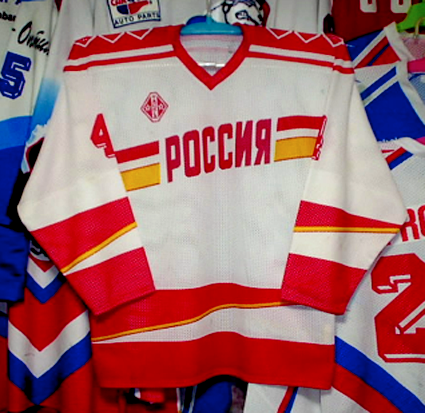
This was the one and only appearance for these stop-gap jerseys, as Russia competed in a new set of jerseys in time for the 1992 World Championships two months later in April with"Россия" now across the front in rushed, simple one color block letters rather than the fancier two color, drop shadowed letters used during the 1991 season prior to the fall of the Soviet Union.

Russia 1992 Olympics Unified Team
Photos courtesy of Classic Auctions

Extra bonus jersey: Today's extra bonus jersey is a 1988-89 CSKA Moscow Alexander Mogilny jersey from Red Army's 13th consecutive Soviet Championship League title under Tikhonov just weeks prior to Mogilny defecting to the west. Mogilny's departure in early May after that year's World Championships in Sweden, effectively marked the end of an era for Tikhnov and the supremacy of CSKA, as prior to the following season Fetisov, Larionov and Vladimir Krutov left the Soviet Union with permission of the authorities to play in the NHL, brining to a close their unparalleled streak of championship dominance.

CSKA Red Army 88-89 jersey, CSKA Red Army 88-89 jersey

Today's video section begins with highlights of the final game of the 1981 Canada Cup tournament.


Our next video selection is the gold medal game from the 1992 Olympics, as the Unified Team, wearing their jerseys without any national identity, captures the gold medal against Canada, followed by a brief clip of the medal ceremony.


For those of you with the time, here is a half hour interview with Tikhonov on the occasion of the Russian's first World Championship victory in 15 years in 2008, which features his long standing view on team play over individual talent and his thoughts on many other topics.

It requires some concentration to listen to the translator over the original Russian language in the background, but is a rare chance for North Americans to hear his experience come through in his own words.


Saturday, June 2, 2012

1939-40 New York Rangers Ott Heller Jersey

After playing two seasons with the Springfield Indians in the Canadian-American Hockey League, Ott Heller, born on this date in 1910, became a member of the New York Rangers in the 1931-32 season, when he split his time between the Rangers and Indians, playing 21 games with each club.

Heller, a defenseman, played full time for the Rangers in 1932-33, a season which concluded with New York winning its second Stanley Cup as Heller contributed 3 goals in 8 games after scoring 5 in 40 regular season games.

Heller Rangers, Heller Rangers

His career would come to be known for his skating ability, strong defensive play and his durability, as he would play nine seasons of 40 games or more from 1932-33 through 1940-41, with a high in points of 23, all assists, in 1938-39.

The following season would see the Rangers capture the Stanley Cup once again, as Heller's longevity would make him the only member of both the 1933 and 1940 championships teams.

1939-40 New York Rangers team, 1939-40 New York Rangers team
The 1939-40 Stanley Cup champion New York Rangers

In 1942-43, he was named captain of the Rangers, just the third one in team history. The next season Heller would set an NHL career best in points with 35, 12 more than in 1938-39, his only other season with 20 points.

During his 15th season with the Rangers, rarely ever missing a game, Heller was sent down to the St. Paul Saints of the USHL as New York was on it's way to it's fourth consecutive last place finish, necessitating a youth movement.

Despite no longer being in the NHL, Heller's career was by no means finished, as he would continue playing ten more seasons, starting in the American Hockey League in 1946-47 with the New Haven Ramblers, where he scored a career high 36 points.

After a second season with the Ramblers, he found a home with the Indianapolis Capitols for four seasons as a player/coach.

Heller Capitols, Heller Capitols

Heller would guide the Capitols to win the Calder Cup in 1950 before returning to New Haven, only thing time with the New Haven Nutmegs of the Eastern Amateur Hockey League in the final season of the team and league.

1949-50 Indianapolis Capitols team, 1949-50 Indianapolis Capitols team
The Calder Cup winning 1949-50 Indianapolis Capitols

He played senior hockey with his hometown Kitchener Dutchmen in 1952-53 and lend his services to the Cleveland Barons for the AHL playoffs. Still not ready to hang up his skates, he played for the Marion Barons of the International Hockey League in 1953-54.

His carer would finally wind down with 18 games with the Valleyfield Braves and 6 games back with the Cleveland Barons in 1954-55 and 7 games of senior hockey with the Chatham Maroons in the Ontario Hockey Association in 1955-56 at 45 years of age.

Today's featured jersey is a 1939-40 New York Rangers Ott Heller jersey. The Rangers would introduce their diagonally lettered sweaters right off the bat in 1926-27 for their first season, changing the lettering from white to red in 1927 and adding the white outlines in 1928. The sweaters would then remain unchanged through the 1940-41 season, after which today's familiar serifed font would be introduced.

New York Rangers 39-40 jersey, New York Rangers 39-40 jersey

Friday, June 1, 2012

2008-09 Detroit Red Wings Nicklas Lidström Jersey

One of the best defensemen in NHL history, Nicklas Lidström announced his retirement yesterday after a 20 year NHL career. Lidström had a brief hockey resume when he was drafted by the Detroit Red Wings in 1989, having only played one season for Västerås IK in Sweden and in one European Junior Championship.

Lidström was the 19th defenseman taken during that draft when he was selected 53rd overall. In fact, he wasn't even the first defenseman taken by the Red Wings, who had previously selected Bob Boughner 32nd overall with their second pick.

He would remain in Sweden for two more seasons, which included appearing in a World Junior Championship, a second European Junior Championship, making his senior international debut at the 1991 World Championships, where he won a gold medal, and in the 1991 Canada Cup before joining the Red Wings in 1991-92, impressing with 60 points as a rookie.

Lidstrom Rookie, Lidstrom Rookie
Lidstrom in the Red Wings Turn Back the Clock jersey
worn during his rookie season

After three seasons with the Red Wings, Lidström would return to the World Championships in the spring of 1994. Later that year he would play 13 games for Västerås while waiting for the NHL season to begin due to it's labor issues which delayed the start of the season until January of 1995. Back with the improving Red Wings, Lidström and his teammates were gaining more playoff experience each season, making the finals for the first time in 1995 and making it back to the conference finals in 1996.

Lidström was again chosen to represent Sweden in the 1996 World Cup of Hockey prior to the start of the 1996-97 NHL season, which would conclude with the Lidström winning the first Stanley Cup of his career.

For the 1997-98 season, Lidström was made an assistant captain for the Red Wings. Motivated by the accident in which teammate Vladimir Konstantinov was seriously injured, Detroit repeated as Stanley Cup champions again in 1998 as Lidström contributed 19 points in 22 games. Also during the 1997-98 season, Lidström would make his Olympic debut, as the NHL would suspend it's season, allowing it's best players to compete for the first time.

Lidstrom Konstantinov, Lidstrom Konstantinov
Lidstrom posing with Konstantinov in happier times

After three more seasons with Detroit, Lidström would be named the winner of the Norris Trophy for the first time in 2001, the first European so named.

Lidstrom Norris Trophy, Lidstrom Norris Trophy

The following season of 2001-02 would be a memorable one for Lidström, as he would win his second consecutive Norris Trophy, compete in his second Olympic Games, and win not only his third Stanley Cup, but become the first European to win the Conn Smythe Trophy in the process, as he chipped in 16 points in 23 games.

Lidstrom Conn Smythe, Lidstrom Conn Smythe

After two more seasons of play with Detroit, which included winning his third consecutive Norris Trophy, the first since Bobby Orr to win three in a row, Lidström would appear in his 1,000th NHL game, having missed only 17 games in 12 1/2 seasons. After the Red Wings were ousted from the playoffs, he would make an appearance in his first World Championship since 1994. Later that fall he would skate in his second World Cup of Hockey, the final hockey he would play for over a year, as the NHL season would be cancelled due to the lockout. While many players returned to Europe to compete, Lidström, now 34 years old, chose to take the season off.

His decision recharged his batteries, as when NHL play resumed in 2005-06, Lidström set a career high with 80 points, topping his previous best of 73 in 2000, and earning him his fourth Norris Trophy. He would also set a more dubious career high with 50 penalty minutes, thanks to a change in rules enforcement coming out of the lockout. During that season he would join a prestigious few, as he would score 6 points in 8 games as Sweden would capture the gold medal at the 2006 Olympics as Lidström scored the game winning goal in the final, making him a member of the Triple Gold Club, for winners of the World Championships, Stanley Cup and Olympics, one of only 18 men to have competed the trio of championships at the time.

Lidstrom gold medal, Lidstrom gold medal

He became the first European in franchise history to be named team captain in 2006-07 and would later be named the winner of the Norris Trophy once again. The 2007-08 season was another great season for Lidström, as he would reach 70 points for only the fourth time in his career, win his third consecutive and sixth Norris Trophy before the Red Wings would bring home the fourth Stanley Cup of Lidström's career in the span of 11 years, the first European born and trained player to captain any team to the Stanley Cup.

Lidstrom Stanley Cup, Lidstrom Stanley Cup

In 2009-10, Lidström became only the fourth Red Wing and eighth defenseman in NHL history to score 1,000 points. He would also compete in his fourth Olympics that season and was named team captain for Sweden.

Lidström would finish 2010-11 with a negative plus/minus rating (-2) for the first and only time in his career, but such was the respect for his ability to control a game and always make the ideal play, that he was recognized with his seventh Norris Trophy, the oldest player to ever win one, equalling the great Doug Harvey and pulling to within one of Orr's record of eight. Also that season, he scored the first hat trick of his now 19 year career at the age of 40, the oldest player to ever score a hat trick for the first time.

He would play one final season in 2011-12, after which Detroit would qualify for the playoffs for the 20th consecutive time in Lidström's career, which allowed him to finish second in NHL history in games played in the postseason with 263, just 6 back of former teammate Chris Chelios.

His final career totals are 1,564 games played, the most ever by a Red Wing or a European, 264 goals and 878 assists for 1,142 points, second all-time among Swedish-born players. Keeping in mind Lidström was a defenseman whose career high was 80 points, it's a testament to his longevity and incredible durability, as he never played less than 70 games a season and suited up 80 or more times 14 times. In all, he missed only 40 possible games in his 20 year career.

Lidstrom, Lidstrom

Today's featured jersey is a 2008-09 Detroit Red Wings Nicklas Lidström jersey as worn during the 2009 NHL Winter Classic. This jersey was based on the style first worn by the Detroit franchise back in 1926-27 when the club was original known as the Cougars, so named since their roster of players came from the now defunct Victoria Cougars of the old Pacific Coast Hockey League.

Detroit Red Wings 2008-09 Winter Classic jersey photo DetroitRedWings2008-09WClassicF.jpg
Detroit Red Wings 2008-09 Winter Classic jersey photo DetroitRedWings2008-09WClassicB.jpg

Bonus jersey: Today's bonus jersey is a 2006-07 Detroit Red Wings Nicklas Lidström jersey as worn on January 2, 2007, when the Red Wings honored their previous captain Steve Yzerman, by retiring his #19, an event commemorated on the player's jerseys with a special patch.

Detroit Red Wings 2006-07 jersey photo Detroit Red Wings 2006-07 F.jpg
Detroit Red Wings 2006-07 jersey photo Detroit Red Wings 2006-07 B.jpg

Today's video section begins with a news report about Lidström announcing his retirement.


Next, Lidström scores the game winning goal against Finland in the 2010 Winter Olympics.


Finally, an excellent highlight package from his entire 20 year NHL career.


hit counter for blogger