Monday, January 16, 2012
1905 Ottawa Silver Seven Frank McGee Jersey
Born in 1882, Frank McGee excelled at sports, rowing, playing lacrosse and rugby, which included winning a Canadian championship in 1898. But what McGee is best remembered for was his goal scoring prowess at hockey.
In 1900, at the age of 17, while playing in a charity exhibition game with a local Canadian Pacific Railway team, McGee permanently lost the sight in one eye when hit with a high stick. He quit playing to become a referee, but quickly returned to playing despite the risk of losing the vision in his remaining good eye.
After playing junior and intermediate level hockey in his native Ottawa, he joined the Ottawa Hockey Club for the 1903 season. He appeared in six of the club's eight games and immediately showed his offensive skills with 14 goals to place second overall in the Canadian Amateur Hockey League.
In the CAHL playoffs, McGee and Ottawa faced off against the Montreal Victorias in a two-game total-goal series for the rights to the Stanley Cup. Game 1 finished tied at 1-1, with McGee held scoreless. Ottawa roared to life in Game 2, however, as McGee led the Ottawa onslaught with a hat trick as they overpowered the Victorias 8-0. As a result of their 9-1 triumph, Ottawa became league champions were declared holders of the cup for the first time in club history.
Two days later the new champions were challenged for their new trophy by the Rat Portage Thistles in a best-of-three series. Game 1 went to Ottawa 6-2, with McGee scoring twice. Two days later, Ottawa successfully defended their trophy with a 4-2 win, with McGee scoring twice more, including the cup winning goal at 8:20 of the first half, as the game had yet to be divided into three periods. As a reward for their victory, each member of the squad would receive a silver nugget, which gave birth to the team's new nickname, The Silver Seven.
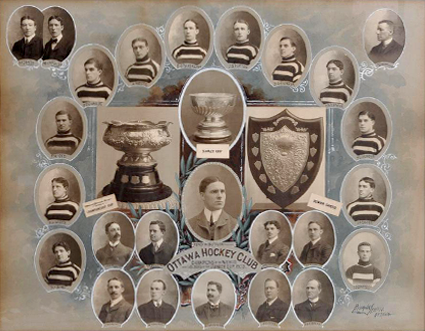
The Stanley Cup champion 1903 Ottawa Hockey Club
Before the 1904 CAHL season began, Ottawa faced another challenge for the Stanley Cup, this from the Winnipeg Rowing Club. A best-of-three series, play began on December 30th, 1903. When the series concluded on January 4, 1904, the Silver Seven prevailed after a 9-1 win, a 6-2 loss and a 2-0 shutout in Game 3.
Ottawa had a tumultuous 1904 season, as they withdrew from the CAHL after only four games and joined the new Federal Amateur Hockey League, but did not participate in any of the FAHL regular season games. In the four CAHL games Ottawa did compete in, McGee scored 12 times, which was still good enough to place him fifth in the final scoring totals.
After leaving the CAHL, the Silver Seven would face a cup challenge from the Toronto Marlboros, whom they would turn away 2 games to none in their best-of-three challenge in late February of 1904.
Once the FAHL regular season was concluded, it's regular season champions, the Montreal Wanderers met the Silver Seven to compete in a two-game, total-goal series for the FAHL championship and the rights to the Stanley Cup that went with it. At least that was the plan. The first game ended in a 5-5 tie when the Wanderers refused to play overtime with the same referee in charge and then had the temerity to demand the series begin anew as a best-of-three! When the trustees of the cup ordered the series to continue as planned, the Wanderers abandoned their challenge, leaving the Silver Seven as FAHL champions despite their having played but a single tie game in league competition! During the tie game, McGee added another goal to his career total.
A final challenge to Ottawa was arranged for one week later, this from Brandon Wheat Cities in another best-of-three format, which the Silver Seven turned away with a pair of victories. While McGee had only played in four regular season games during the 1904 season, he skated in eight cup challenge games, scoring 21 times as the Silver Seven turned away no less than four separate challengers.
In their first full season of FAHL competition in 1905, Ottawa came first with a 7-1 record as McGee would tie for the league lead with 17 goals, but he would score his while playing in two less games than Jack Marshall. The highlight of McGee's regular season would be a five goal performance on February 4th.
During the season, the Dawson City Nuggets would travel 4,000 miles from the Yukon to challenge Ottawa. Their trip would take a month to complete and include traveling on foot, by sled dog, automobile, ship and train. Game 1 of the best-of-three would go to Ottawa by a score of 9-2, with McGee scoring once. Game 2 on this date in 1905 would be one for the ages, as Ottawa continued to pile up goals at a furious pace, eventually winning by an unfathomable 23-2 final score with McGee setting a record which still stands today, as he scored an incredible 14 times! Eight of McGee's goals were consecutive and came in under nine minutes of playing time.
As league champions, Ottawa retained the cup and was challenged once again by the Rat Portage Thistles. McGee did not play in Game 1, which was won by the Thistles 9-3. McGee returned for Games 2 and 3, which were won by Ottawa 4-2 and 5-4 with McGee scoring three times.
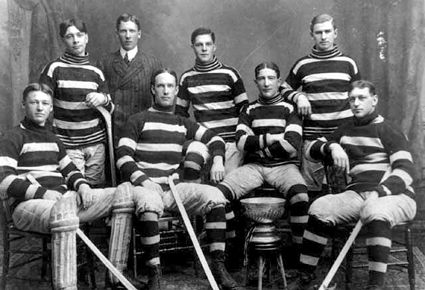
The Stanley Cup champion 1905 Ottawa Silver Seven
For the 1906 season, the Silver Seven moved to the new Eastern Canada Amateur Hockey Association. They tied for the best record at 9-1. McGee was third in league scoring with 28 goals in seven games, which included an eight goal performance on March 3rd.
Ottawa would face two challenges during the regular season, first from Queen's University in a best-of-three. After Game 1 went the way of the Silver Seven 16-7, there was little doubt that the cup would change hands, which was confirmed by a 12-7 score in Game 2. McGee scored four times in Game 1.
Just prior to the end of the regular season, Ottawa again had to face a cup challenge, this from Smiths Falls in another best-of-three series. Ottawa had little trouble defending it's now three year grip on the Stanley Cup, as they won two straight by scores of 6-5 and 8-2. In all, McGee scored 15 times in the four cup challenge games that season.
The final two games of McGee's career came in the ECAHA playoffs on March 14th and 17th, 1906. The series was a two-game, total-goal affair. The Montreal Wanderers put in an early claim on the cup with a resounding 9-1 win in the first game.
Ottawa was down, but not out, as they entered Game 2, but 12 minutes in, Montreal scored again to increase their lead to nine goals. McGee got Ottawa on the board in the first half and again before the half ended to help cut the margin to 10-4. The Silver Seven would come out flying in the second half, and score six consecutive goals to even the series at 10-10! In the final seven minutes of the contest, Lester Patrick would score to put Montreal in front and then end the three year reign of the Silver Seven with an empty net goal in the final seconds.
It would be McGee's final game as a hockey player in a career which spanned four seasons, divided between 23 regular season games in which he scored 71 goals, an average of more than three per game. Mc Gee would also participate in 22 playoff and Stanley Cup challenge games during which he would score 63 times, including his record 14 in one game in 1905, all while only having vision in one eye.
Frank Patrick was quoted as saying about McGee, "He was even better than they say he was. He had everything - speed, stick handling, scoring ability and was a punishing checker. He was strongly built but beautifully proportioned and he had an almost animal rhythm."
Following his retirement as a player at just 23 years of age, said to be because his government job would not allow him to travel. Despite having vision in only one eye, he somehow was accepted into the military at age 32. His certificate of examination noted that McGee could "see the required distance with either eye" after he apparently tricked the doctor by covering his bad eye with first one hand and then the other during his exam.
He began to serve in May of 1915 before suffering a knee injury when his vehicle was hit by a shell. While out of action he was given the opportunity to take a non-combat posting in the northwest of France far from the battle, but chose instead to return to the front in August only to be killed in action on September 16, 1916. His body was never recovered.
Lieutenant Frank McGee
McGee was later elected to the first class to be inducted into the Hockey Hall of Fame in 1945.
Today's featured jersey is a 1905 Ottawa Silver Seven Frank McGee jersey as worn during his record setting 14 goal game against Dawson City. The Senators trademark red, black and white horizontal "barberpole" stripes were first adopted in 1903, and except for one season with vertical stripes in 1910-11, remained in use through the original Senators final season in Ottawa of 1933-34, with the addition of the letter "O" crest from 1929-30 on.
Labels:
McGee Frank,
Ottawa Senators,
Ottawa Silver Seven
Sunday, January 15, 2012
Reader Submission - 2011-12 Washington Capitals Troy Brouwer Jersey
Our latest reader submitted jersey comes from Steve Beck, and it's truly a special jersey we are very pleased he chose to share with the rest of us.
Here is Steve's story about his wonderful jersey:
Thanks to Steve for taking the time to shoot the photos and send in his story about his jersey. Having traded for some Soviet and Russian jerseys during our time, we can certainly relate to the unmistakable funk of an unwashed game worn jersey.This jersey was worn on October 13, 2011, against the Pittsburgh Penguins at the CONSOL Energy Center in Pittsburgh. Commemorative patches were worn in honor of the Lokomotiv Yaroslavl team of the KHL, who died in a plane crash on September 7, 2011.
I purchased this jersey off of NHL Auctions after the game. I am from Chicago and my family has had season tickets for around 25 years. I moved to Washington five years ago and the Capitals are my adopted team, I have season tickets and the only team I would root for against them is the Hawks.I really wanted the Brouwer jersey as he was on the Hawks when they won the Stanley Cup in 2010. Each player signed their jersey in the locker room immediately after the game. Unlike the Winter Classic, in which a jersey is worn for each period, for these one jersey was worn the entire game. Since they signed it right after MeiGray did not wash them and it stunk like hell when I got it.
This jersey certainly has got special meaning for Steve, especially with Brouwer's connection to his hometown Blackhawks and their recent Stanley Cup championship. We also admire the Lokomotiv Yaroslavl patch worn for just the one game. The Washington Capitals and Penguins wore the patched jerseys in an effort to raise funds for the families left behind by the disaster, an idea which began with Evgeni Malkin of Pittsburgh.
Russian stars Alexander Ovechkin and Malkin, who both personally knew many of those who died, took part in a ceremonial opening face-off conducted by Penguins owner Mario Lemieux.
"I think it's America showing respect, respecting the memories of the guys who were in the plane crash and for the Russians." Ovechkin said. "It means a lot. It's nice of both organizations and the NHL to do that."
If you have a jersey in your collection that you'd like to share with us and your fellow readers, please submit your pictures and a story to go with it, no matter how brief or detailed, to spyboy1@gmail.com and we look forward to seeing your favorites.
Labels:
Reader Submissions,
Washington Capitals
Saturday, January 14, 2012
1923-24 Montreal Canadiens Sprague Cleghorn Jersey
Brothers Odie Cleghorn and Sprague Cleghorn got their start in hockey playing in the Montreal City Hockey League in the 1908-09 season and then the pair joined the New York Wanderers of the United States Amateur Hockey Association the following season. Their performances, particularly that of Odie, who scored 15 goals in 8 games while Sprague had 7, drew the attention of a certain J. Ambrose O'Brien, who was bound and determined to win himself a Stanley Cup, and did so by hiring the very best that money could buy, dramatically overpaying a roster of players which became known as the Renfrew Millionaires.
The Cleghorn's were members of Renfrew for their second and final season of 1910-11, with Odie leading the way with 20 goals in 18 games while the rugged Sprague contributed 5 while anchoring the club's defense.
Sprague and Odie Cleghorn of the Renfrew Millionaires
With the Millionaires disbanded due to the realities of their untenable financial situation, the brothers returned home to Montreal to join the powerful Wanderers hockey club. The pair skated for the Wanderers for six seasons, from 1911-12 to 1916-17. Odie would score 115 goals in 103 games, with a high of 28 in just 18 games of the 1916-17 season, while Sprague was able to play enough at forward during his time with the Wanderers to score 79 goals, including a best of 21 in 1914-15, tying Odie for the year.
After missing the 1917-18 season due to World War I, a season which saw the Wanderers disband following the fire which burned their arena to the ground, the pair went their separate ways for 1918-19, with right winger Odie staying in Montreal, only now with the Canadiens, while his bodyguard Sprague joined the Ottawa Senators.
Sprague in the Senators barberpole sweater
Sprague played two seasons in Ottawa, racking up 16 goals in 21 games in 1919-20, as well as 85 penalty minutes in 21 games, a testament to his rough, if not downright dirty play. The Senators won the 1920 Stanley Cup by defeating the Seattle Metropolitans for the first championship for either brother. Sprague played the 1920-21 season with the Toronto St. Patricks, but After the St. Pats were eliminated from the playoffs, Sprague rejoined the Senators as a ringer for their five game series against the Vancouver Millionaires for the Stanley Cup, won by the Senators three games to two before he finally rejoined Odie with the Canadiens for the 1921-22 season.
Sprague while with the Toronto St. Patricks
Meanwhile, Odie had an excellent season in 1918-19 with 29 points (second in the NHL) and avoided tragedy while in Seattle for the 1919 Stanley Cup playoff against the Metropolitans when the series was permanently suspended due to an outbreak of the Influenza Epidemic, which claimed the life of teammate Bad Joe Hall.
Sprague rejoined his brother for the 1921-22 season when he returned to Montreal, now as a member of the Canadiens as well. Energized by his brother's return, Odie saw his goal total rise to 21, after being limited to just 5 the prior year. Sprague was also returned to playing forward after being a defenseman with the St. Pats, which saw his goal scoring rise to 17 from just 3 the previous season. As his brother's protector, Sprague saw his penalty minute total rise from 31 to 80 to lead the NHL for the season, far ahead of Corbett Denneny of Toronto's mere 28!
In the second period, Sprague took just 40 seconds to get his second of the game and completed his hat trick less than five minutes later to make the score 5-2 for Montreal. Odie's second arrived at the 13 minute mark and the teams again traded goals to finish out the period, with the Canadiens holding a commanding 7-3 lead.
The third period was more of the same, as Sprague once again came out flying, netting his fourth of the night at just 30 seconds. At 7 minutes, Odie's hat trick was now complete with a an assist from Sprauge once again. Joe Malone got his second of the game for the Tigers before Odie put the brothers into the record books with his fourth to match Sprague's total at 9:05, the first time two brothers had scored four goals each while members of the same team. Hamilton added two quick goals to make the final score 10-6 in favor of the Montreal and the Cleghorn's, led by Sprague's 4 goals and 6 points and Odie's 4 goals.
Two seasons later, Montreal would defeat the Senators for the NHL championship, then dispatched the Vancouver Maroons in two straight before sweeping the Calgary Tigers for the 1924 Stanley Cup championship, the only time the brothers would win one together. It was Sprague's third and Odie's first.
The 1924 World Champion Montreal Canadiens
They would play one more season together with Montreal before Oide finished his career by becoming coach of the Pittsburgh Pirates, which included occasionally playing in parts of three more seasons, while Sprague took his defensive abilities and rough play to the Boston Bruins for three seasons to end his NHL career.
Odie and Sprague during their final season in Montreal wearing their 1924-25 World's Champions sweaters
Odie played 17 NHA & NHL seasons, scoring 230 goals and 282 points in 300 games, winning one Stanley Cup. Meanwhile, Sprague, who also played 17 NHA & NHL seasons, scored 167 goals and 255 points in 374 games.
Sadly, Sprague was hit by a car in 1956 and died of his injuries on July 12th at the age of 66. Just hours before Sprague's funeral two days later on the 14th, Odie was found dead in his bed from heart failure at the age of 64.
Sprague was elected to the Hockey Hall of Fame in 1958.
Today's featured jersey is a 1923-24 Montreal Canadiens Sprague Cleghorn jersey. This sweater with the white "C" and red "H" was a short-lived variation, used only two seasons in 1922-23 and their Stanley Cup winning season of 1923-24. It was replaced by their commemorative World's Champions sweaters with the globe logo pictured above, while retaining the white "C" logo on the left arm for one season. In 1925-26 the "C" became red with a white outline and white "H", and with the addition of a second outline in blue in 1935, has remained unchanged ever since.
Today's video is a tribute to the 24 Stanley Cups won by le Club de hockey Canadien, the second of which included the brothers Cleghorn.
Labels:
Cleghorn Odie,
Cleghorn Sprague,
Montreal Canadiens
Friday, January 13, 2012
1998-99 Daniel Meier EV Zug Jersey
Born on this date in 1972 in Hundwil, Switzerland, forward Daniel Meier joined EV Zug of the Swiss Nationalliga A for the 1990-91 season at the age of 18. During the season he also participated in the World Junior Tournament held in Saskatchewan, Canada.
The following season he continued to play for EV Zug as well as making his second trip to the World Juniors, this time in Germany. He continued to play for Zug for three additional seasons, with a best of 14 goals in 1993-94.
He moved to championship finalists HC Fribourg-Gotteron for the 1995-96 season, which led to a career best 20 goals and 36 points in 45 games in 1996-97.
He returned to Zug for the 1997-98 season, scoring 9 goals and 20 points, as Zug not only finished first overall in the league with a 24-10-6 record, but went on to win the only championship in club history as Meier contributed 6 goals and 9 points in 18 playoff games while teamed with NHL veteran Wes Walz.
After three additional seasons with Zug, Meier became a member of SC Rapperswil-Jona for the 2001-02 season during which he scored 14 goals and 29 points, placing third in team scoring behind a pair of Canadian-born players.
Geneve Servette was his next stop, where he played for three seasons, including his 13 goal, 30 point season in 2003-04, only the second 30 point season of his career.
Meier was once more on the move, this time with the highly popular Swiss club SC Bern, whose 17,000 seat PostFinance Arena is more than double the capacity of every other arena in the country save the 10,700 seater which is home to the ZSC Lions.
PostFinance Arena
While with Bern, Meier's role was more focused on his defensive, checking abilities and his point production, never really among the team leaders during his career, averaged 9 per season after averaging 18 for his career up to that point. Eventually, Meier would play five seasons for Bern before moving to SC Langenthal of the National League B to finish out the 2009-10 season with career totals of 803 games played, 163 goals and 181 assists for 344 points, all in the Swiss National League A, save the 9 games 2 goals and 4 points with Langenthal in the National League B late in the 2009-10 season.
#19 Meier with SC Bern
Today's featured jersey is a 1998-99 EV Zug Daniel Meier jersey. Perhaps the worst hockey jersey ever on planet Earth, EV Zug apparently purchased their jerseys on clearance from the circus clown supply store. It looks like a minor league New Year's Eve special occasion jersey or some sort of European version of Mardi Gras done in a very 1990's style when torn paper edges and paintbrush strokes were all the rage in graphic design.
We're not certain how the jersey's four sponsors must have felt about having their logos lost in the clutter of the busiest jerseys we've ever seen. It would be interesting to hear the players perspective on what it was like to play in these jerseys, as they could either make their teammates highly visible on the ice, or have the opposite effect of making them blend into the multicolored background of the spectators.
Today's featured jersey shows EV Zug and their crazy jerseys in action from their 1998 Swiss championship. And there was much rejoicing.
Thursday, January 12, 2012
1989-90 Boston Bruins Cam Neely Jersey
Cam Neely played his junior hockey for the Portland Winter Hawks of the Western Hockey League. He gained recognition for his 56 goal, 120 point season in 1982-83 when he led the Winter Hawks to the Memorial Cup championship with 20 points in 14 playoff games, which earned him a 9th overall selection by the Vancouver Canucks in the 1983 NHL Entry Draft.
1983 Memorial Cup champion Cam Neely
He began the next season with Portland, but after 19 games he made the jump to the NHL with the Canucks, scoring 31 points in 56 games, as well as gaining his first NHL playoff experience with four games in which he scored a pair of goals.
Cam Neely in the Canucks "Flying V" jersey
The next two seasons with Vancouver saw Neely play over 70 games and score 39 and 34 points, Additionally, he showed his rugged side with 137 and 126 penalty minutes. He was however, playing behind veterans Stan Smyl and Tony Tanti and Canucks coach Tom Watt was not a fan of Neely's defensive game, which combined to make Neely expendable in the eyes of the Canucks, who dealt him to the Boston Bruins along with their first pick in the 1987 draft, for former 100 point scorer Barry Pederson.
The change in scenery saw an immediate rise in Neely's production and he scored more goals in his first season with Boston than he did points the previous season in Vancouver, more than doubling his point total from 34 to 72, as the Bruins coaching staff gave him more playing time which led to more confidence.
The 1987-88 season saw a rise in goals to 42 and the first deep playoff run of Neely's career as the Bruins made it all the way to the Stanley Cup Finals, a run that saw Neely contribute 17 points in 23 games. After a then career best 75 points in 1988-89 before exploding with 55 goals and 92 points in 1989-90 prior to the Bruins making a return to the Stanley Cup Finals later that season. Neely had an excellent playoff season, with 28 points in 21 games.
Proving his 55 goal season was no fluke, Neely lit the lamp 51 times in 1990-91 and registered a second consecutive 90 point season with 91. A knee injury suffered during the conference finals that year would change the course of Neely's career and limit him to just 22 games over the next two seasons combined.
Cam Neely in the 1991-92 Bruins throwback jersey
He rebounded in 1993-94 with 50 goals in his 44th game of the season, a mark only Wayne Gretzky has surpassed. Still suffering from injury problems, Neely was limited to just 49 games that year, leaving many to wonder what his goal total could have reached had he played a full season that year. His ability to return to such a high level of play after essentially missing the previous two seasons earned Neely the Masteron Trophy for 1994.
After two more seasons limited to 42 and 49 games, along with a drop in production to point levels in the 40's, led Neely to call it a career due to a degenerative hip condition.
Neely's #8 was retired by the Bruins on this date in 2004 and he was inducted into the Hockey Hall of Fame in 2005.
Today's featured jersey is a 1989-90 Boston Bruins Cam Neely jersey as worn during Neely's finest season in which he set personal highs with 55 goals and 92 points.
This particular jersey was worn during the finals and features the 1990 Stanley Cup patch, only the second season that the cup final patch was worn and the first that it was worn on the chest, having been worn on the left arm the previous season when it was introduced.
This long-serving Bruins jersey style was first used back in 1974 and quickly gained secondary shoulder logos and names on the back by 1977 and then remain essentially unchanged through it's retirement at the end of the 1994-95 season.
Our first video is a very well done look at highlights of the career of Cam Neely.
Here is a unique look at Cam Neely's 50 goals in 44 games - all 50! - in the 1993-94 season.
Finally, Cam Neely shares his favorite work out routine and then expresses his feelings in no uncertain terms regarding the debut of ESPNews.
Labels:
Boston Bruins,
Neely Cam
Wednesday, January 11, 2012
1977-78 Roseau Rams Bryan "Butsy" Erickson Jersey
Raised ten miles for the Canadian border in Roseau, Minnesota, where hockey is a way of life, Bryan "Butsy" Erickson played his high school hockey for the Roseau Rams on a line with his neighbors and future NHLers, Neal and Aaron Broten. So successful were the trio, with an undefeated 23-0 regular season record, that they were featured in Sports Illustrated's "Faces in the Crowd" section.
Erickson with Roseau teammate Neal Broten
"It was really surreal," said Erickson. "I didn't really know we were doing anything special. We just played because it was fun."
So good was the high schooler, that he was selected to play for the United States at the 1979 World Junior Tournament along with the Broten brothers, where Erickson would score 2 goals and 3 points in 5 games on his international debut.
The fun continued as the trio took their show on the road down to the Twin Cities where they joined the University of Minnesota Golden Gophers hockey program, Neal in 1978-79 and Bryan and Aaron in 1979-80 while Neal was away with the United States Olympic Team. Bryan's freshman season saw him play in 23 games, scoring 10 goals and 15 assists for 25 points. Byran also was selected for his second World Junior Tournament in 1980, where he scored 4 points in 4 games for the United States.
With the line now reunited for 1980-81 with the return of Neal, the trio lit up scoreboards wherever they played, as Neal scored 17 goals and 71 points, Erickson 39 goals and 86 points, while Aaron led the league in goals (47), assists (59) and points, with 106, as Aaron, Steve Ulseth (93 points) and Erickson (86) led a Gophers 1-2-3 finish in the scoring race, with Neal 5th.
Erickson left his opponents in his wake during his time with the Golden Gophers
While Neal and Aaron moved on to the NHL following the Gophers season, Erickson returned to Minnesota for his junior season in 1981-82, with the assistant captain scoring 25 goals and 45 points. While his totals were down considerably from the previous year, they were enough to lead the Gophers in scoring and earn a nomination as a Hobey Baker Award finalist as the best college hockey player in the United States.
Following the season, he would make his World Championships debut, scoring a goal and an assist for the Americans in 1982.
Back with Minnesota for his senior season, Erickson, now team captain, regained his scoring touch from two seasons earlier, netting 35 goals and 47 assists for 82 points, which earned him All-WCHA honors and a second Hobey Baker nomination. He would finish his college career as the second all-time leading scorer in Minnesota history with 238 points, which 28 years later still ranks fourth.
Minnesota Senior captain Erickson
Undrafted, Erickson signed with the Washington Capitals organization and then played one regular season game with the Hershey Bears of the AHL and three playoff games, where he scored three goals.
in 1983-84, he played 31 games with the Bears and then made his NHL debut with the Capitals, where he saw action in 45 games, scoring 12 times and adding 17 assists, which included scoring his first NHL goal on this date in 1984 in a 4-2 Capitals win over the Los Angeles Kings. He also added a pair of goals and 3 assists in 8 playoff games.
His international career reached a high point when he was named to the US team for the 1984 Canada Cup tournament, which took place prior to the start of the NHL regular season and featured the best players from each of the participating countries. In 6 games, Erickson scored 2 goals and 2 assists, including a goal against Sweden assisted by Neal Broten and a goal in a 4-4 tie against Canada assisted by Aaron Broten, while his two assists were both on goals by Neal.
"Playing in the Canada Cup was a huge thrill for me. Five years earlier I didn't even know if I was going to play hockey after high school. I ended up going to Minnesota, and I graduated in '83 and the next year I'm playing with the best players in the world," he recalled.
Erickson's 1984-85 season was split between the Capitals, where he played 57 games, scoring 15 goals, and the Binghamton Whalers, where he played 13 games. After starting the following season with Binghamton, Erickson was traded late in October to Los Angeles.
Now with the Kings organization, Erickson spent 14 games with the New Haven Nighthawks and the majority of his season with Los Angeles, where in 55 games he had his first 20 goal season on his way to 43 points. With the Kings not qualifying for the playoffs, Erickson was free to join the United States for the 1986 World Championships, where he had a fine tournament with 8 goals in 10 games.
He hit exactly 20 goals again in 1986-87 for the Kings and completed his season with 30 assists for a career best 50 points. Following Los Angeles early playoff exit, Erickson was back to Europe for the 1987 World Championships, scoring 8 points in 10 games.
Erickson's 1987-88 season saw him play 42 games with the Kings and 3 with New Haven prior to a trade which sent him to the Pittsburgh Penguins in early February. He would play 11 games in Pittsburgh, which brought to a close the first phase of his NHL career.
The following season saw Erickson take his game to Italy with HC Merano where he showed his NHL caliber talent with 38 goals and 94 points in just 38 games.
His 1989-90 season was an abbreviated one, with just 13 games with the Moncton Hawks of the AHL. 1990-91 saw Erickson back with Moncton, playing in 36 games, scoring 32 points which included 18 goals. He would also make his return to the NHL with 6 games with the Winnipeg Jets.
Abdominal surgery would shorten his 1991-92 season, which was limited to just 10 games with the Jets. He would return for the 1992-93 season, seeing the ice 41 times for Winnipeg. Injuries once again spoiled his final season, as groin problems limited Erickson to 3 games with Moncton and just 16 games with the Jets, brining to an end his 11 year career, with 351 games, 80 goals and 205 points to his credit.
Today's featured jersey is a 1977-78 Roseau Rams Bryan "Butsy" Erickson jersey. This classic jersey with it's diagonal team name and simple dual white stripes was worn by not only Erickson, but also linemates and future NHLers Neal and Aaron Broten.
The Rams hockey tradition dates back to 1908 and has won seven Minnesota state hockey championships in 33 state appearances since 1945. Originally known as the Green Wave, they won their first championship in 1946 before they changed their name to the Rams in the 1950's, winning three titles in four years in 1958, 1959 and 1961.
In addition to Erickson and the two older Broten brothers, Neal and Aaron, their younger brother Paul Broten also played for the Rams and went onto a career in the NHL.
Additional state titles arrived in 1990, 1999 and 2007.
During their long and storied history, Roseau, the tiny community near the Canadian border has sent nine players onto the NHL, including current Winnipeg Jet Dustin Byfuglien, and seven Rams players have competed for the United States in the Olympics. In addition to Neal and Aaron Broten, longtime coach Oscar Almquist all have been inducted into the United States Hockey Hall of Fame.
Despite it's enrollment of just 393 students, Roseau has opted to play in Class AA for the larger schools in a continuing effort to be the giant killers and overall state champions, going up against competition from large Twin Cities metro area powerhouses, who have enrollments between 1,300 to 3,100 students to draw players from. The next smallest AA schools are private schools with enrollments of 800 and the next largest public AA school has an enrollment of 978, making Roseau by far the smallest school in the "large" class.
To purchase a Roseau Rams jersey for yourself, please see our friends at VintageMinnesotaHockey.com.
As usual, if you go looking for video of an older hockey player, goals and nearly impossible to find, but the fights are plentiful.
Here is a look at hockey in tiny Roseau, which includes an appearance by Erickson.
Labels:
Broten Neal,
Erickson Bryan,
Roseau Rams
Tuesday, January 10, 2012
1980-81 Chicoutimi Sagueneens Normand Leveille Jersey
Born on this date in 1963 in Montreal, Quebec, Normand Leveille played his junior hockey for the Chicoutimi Sagueneens beginning with the 1979-80 season. There, the left winger scored 24 goals and 12 assists for 36 points during his rookie Quebec Major Junior Hockey League season.
During his second season, armed with more confidence and experience, Leveille made a big step forward with 55 goals and 46 assists for 101 points, good for third on the club while his 55 goals were 7th in the league. Once in the postseason, Leveille led the "Sags" in scoring with 11 goals as well as 15 assists in 12 games for 26 total points.
This performance led to his being drafted in the first round, 14th overall in the 1981 NHL Entry Draft by the Boston Bruins, ahead of future NHL talents as Al MacInnis and Chris Chelios.
The 5' 10", 175 lbs winger made the Bruins roster out of his first training camp and made his NHL debut on October 8, 1981 as the Bruins hosted the Quebec Nordiques.
Leveille scored his first NHL goal, as well as his first point, during his fourth game on October 14th just 36 seconds into the Bruins game at Chicago against the Black Hawks, igniting a 8-5 Bruins victory.
He would miss several games after straining his MCL in his left knee on November 1st, but return in time to play in 66 of the Bruins 60 games, during which he scored 14 goals and 19 assists for 33 points. He also racked up 49 penalty minutes and finished the season at a +16.
His second season started out promising, as Leveille scored 3 goals and 6 assists for 9 points in his first 9 games, but tragedy struck on October 23, 1982 when he suffered an aneurysm between the first and second periods of the Bruins game in Vancouver against the Canucks.
The 19-year-old Leveille was taken immediately to Vancouver General Hospital, where neurosurgeons performed surgery for seven hours to save his life. Doctors determined that his hemorrhage was a congenital issue caused by a defective blood vessel in his brain rather than being due to any hockey related injury.
Although he had complained of shoulder pain and a headache prior to the game, Leveille had scored twice during the first period and had been checked once, but showed no ill effects following the hit.
It was during the first intermission that Leveille told assistant Bruins coach Jean Ratelle that he felt dizzy. Fearing Leveille had suffered a concussion, Ratelle escorted Leveille to the Bruins trainer Jimmy Kausek. There, he began to lose consciousness. The Vancouver team doctor Ross Davidson came in to see Leveille and ordered that he be rushed to the hospital immediately.
Following the operation, Leveille was in coma for three weeks and remained hospitalized for several weeks after regaining consciousness. Having lost a degree of motor skills and control over his speech, his hockey career was over just as it was about to begin.
He returned to Boston Garden for the first time 16 months later on February 11, 1984, where he, able to walk on his own but with difficulty, stepped onto the ice wearing his #19 jersey to a standing ovation from the Bruins fans.
Leveille returned to the Boston Garden one final time 11 years later on September 28, 1995 for the Garden's closing ceremonies. Aided by former teammate Ray Bourque and his Bruins coach Terry O'Reilly, Leveille skated on the Boston Garden ice for one final time in a moving moment that no one in attendance will soon forget.
He has since become an advocate and fund raiser for the disabled and founded the Centre Normand Leveille, a 200-acre recreational camp for the disabled in Quebec.
Today's featured jersey is a 1980-81 Chicoutimi Sagueneens Normand Leveille jersey from happier times, when Leveille, full of youth and promise, scored 101 points in 72 games prior to leading the Sagueneens in playoff scoring.
The franchise was founded in 1973 and has won the President's Cup as QMJHL champions in 1991 and 1994. The most notable Sags to have gone onto the NHL are Guy Carbonneau, Alain Cote, Felix Potvin, Stephane Richer and current Minnesota Wild forward Pierre-Marc Bouchard.
Chicoutimi has since retired Leveille's #16.
Bonus Jersey: Today's bonus jersey is a 1982-83 Boston Bruins Normand Leveille jersey worn during his abbreviated second season with Boston and once again in February 1984 when he made his emotional return to the Boston Garden following his recovery from his aneurysm.
Our video selection today is the One Last Skate around the rink at Boston Garden, with such icons as Bobby Orr, Milt Schmidt, Phil Esposito, Cam Neely and Johnny Bucyk, as well as Leveille being helped around the ice by Bourque and O'Reilly.
Monday, January 9, 2012
1982-83 Verdun Juniors Pat LaFontaine Jersey
John LaFontaine was a Canadian from Tecumseh, Ontario who worked for Chrysler, who transferred him to St. Louis, Missouri where his son Pat LaFontaine was born in 1965.
It was in St. Louis where LaFontaine first learned to skate. His father was transferred once again, this time to Waterford, Michigan, just 33 miles from Detroit when Pat was seven. He was able to get in plenty of ice time as the LaFontaine's lived on Williams Lake. He also played on his older brother's team, with kids that were a year or two older than he was, which pushed him to improve his game to keep up with the older boys.
With the end goal of American kids being to play college hockey in those days, the thought of turing pro hadn't even occurred to Pat until he was fifteen, following the success of the 1980 "Miracle on Ice" United States Olympic team's gold medal performance, as well as that of American Bobby Carpenter of Massachusetts, who turned pro with the Washington Capitals in 1981.
LaFontaine was clearly no ordinary talent, as while Carpenter was just turning pro in 1981-82, LaFontaine scored an Earth-shattering 175 goals and 149 assists for a stunning 324 points in a 79 game season with Detroit Compuware of the midget AAA Michigan National Hockey League. Yes, three hundred and twenty-four points, an average of over four points per game!
No doubt influenced by his father's Canadian roots, the decision was made that the best place for Pat to continue to progress was Canadian junior hockey rather than an American college. With that, LaFontaine left home at age 17 and moved to the Montreal suburb of Verdun to play for the Verdun Juniors of the Quebec Major Junior Hockey League for the 1982-83 season.
"Our coach, Pierre Cramer, put me together with Jean-Maurice Cool and we traded for Gerard Gallant. We gelled together," LaFontaine recalled.
LaFontaine began the season with a goal and two assists at Chicoutimi. He duplicated that in his second game at home to Saint Jean. His first hat trick came four games later to extend his point scoring streak to six. Eight games later LaFontaine had his second hat trick as well as four assists for a seven point night.
November 1st saw the streak reach 20 games at Laval with a pair of assists. Four games later Hull was victimized by LaFontaine's fourth hat trick and second seven point game.
He reached the 30 game mark November 26th with a goal and three assists against Drummondville. He surpassed 100 points on December 3rd in his 32nd game of the season and Game 35 of the consecutive point streak on December 10th was an impressive showing, as LaFontaine raised his season high with an eight point night courtesy of a two goal, six assist performance.
Game 40 was achieved December 21st with a goal. After a two week break for the World Junior Tournament, Verdun returned to the ice on January 5th and LaFontaine picked up where he left off with back to back hat tricks (numbers 6 and 7 of the season) on the 5th and the 7th. The point scoring streak now reached 43 games, as well as a total of 142 points, on this date in 1983 when LaFontaine had a pair of goals and an assist versus Chicoutimi.
For the first time all season, LaFontaine was held scoreless at Shawinigan on January 12th, but began another scoring streak of 26 games that would carry through to the end of the season.
He set a season high with four goals on the 18th, only to raise that to five on the 28th of January. LaFontaine reached the 200 point barrier on the 23rd and equalled a season high with eight points on February 25th, which included his 11 hat trick. LaFontaine finished the regular season strongly with a hat trick and three assists for six points on March 11th and then repeated those totals the very next game on March 13th.
He then put an exclamation point on his amazing season when he pumped in five goals as well as three assists for his third eight point night of the season to score 20 points in his final three games, giving LaFontaine points in 69 of the Juniors 70 games that season as well as 15 hat tricks.
In addition to his three eight point games, he had three seven point games, four with six and five games of five points apiece. His final totals were 104 goals and 130 assists for 234 points to lead the league in scoring and earn the Jean Beliveau Trophy with the second highest total in league history at the time. He had 15 more assists than his next closest competitor, Claude Verret, whom he beat by 46 points in the scoring race. LaFontaine also won the goal scoring crown by a full 20 goals over future NHL superstar Mario Lemeiux, who came third in the points race a full 50 points back of LaFontaine.
LaFontaine's remarkable season sees him still third on the single season goal scoring list as well as third on the single season point scoring record more than 25 years later.
Once the playoffs began, LaFontaine kicked off the postseason with four assists as Verdun swept Trois-Rivieres on the strength of LaFontaine's ten points. Shawingan fell in six after shutting out LaFontaine in Game 1 although he came back to score 12 points in the final five games. Verdun then won the President's Cup and qualified for the Memorial Cup by defeating Longueuil four games to one thanks to 13 points from LaFontaine, which earned him the Michel Briere Memorial Trophy as QMJHL playoff MVP after leading the playoffs in scoring with 35 points in 15 games, which added the Guy Lafleur Trophy to his ever growing hardware collection.
Additionally, LaFontaine collected the Mike Bossy Trophy as Best Pro Prospect of the Year, the Michel Bergeron Trophy as Offensive Rookie of the Year and the Frank J. Selke Memorial Trophy as Most Sportsmanlike Player thanks to his total of just 10 penalty minutes for the entire regular season.
One more award came LaFontaine's way, as he was named the Canadian Hockey League's Player of the Year for 1983.
Despite being named the Best Pro Prospect in the QMJHL, LaFontaine was drafted third overall that season behind the Minnesota North Stars first overall selection of Brian Lawton and the Hartford Whalers choice of Sylvain Turgeon second before the New York Islanders grabbed LaFontaine.
LaFontaine would only play for Verdun for a single season, one in which he dominated and proved he was ready to move up to play against a higher level of competition, which he did by spending a season with the United States National Team in preparation for the 1984 Olympic Games.
Once the Olympics were concluded, LaFontaine then joined the Islanders for the final 15 games of the 1983-84 season, which included scoring a hat trick and two assists in only his second game. He also gained valuable experience in 16 playoff games as the Islanders made it all the way to the Stanley Cup Finals, only to see their dynasty end as the Edmonton Oilers began theirs.
He would go on to prove the North Stars and Whalers wrong by having an NHL career which would eventually see LaFontaine inducted into the Hockey Hall of Fame in 2003.
Today's featured jersey is a 1982-83 Verdun Juniors Pat LaFontaine jersey. The Verdun Juniors franchise can be traced back to 1933 when they began life as the Montreal Junior Canadiens, a name they retained until 1972. Name changes then ensued, going from the Montreal Bleu Blanc Rouge to the Montreal Juniors, the Verdun Juniors, and the Verdun Junior Canadiens, all of which explains why their jerseys copied the Montreal Canadiens template so directly.
Eventually the club relocated 35 miles east to Saint-Hyacinthe where they became knows as the Saint-Hyacinthe Laser in 1989 where the Canadiens look was continued. They remained there until 1996 when they moved once more, this time 421 miles northwest to Rouyn-Noranda where they became known as the Huskies and continue to play there to this day but finally broke their ties to the Canadiens jersey template.
While today's post focused on LaFontaine's junior hockey dominance, video of that era was impossible to find, so we present to you Pat LaFontaine's top ten goals.
Labels:
Lafontaine Pat,
Verdun Juniors
Sunday, January 8, 2012
The Top 20 NHL Player Jersey Sales For November 2011
Despite having played in only 10 games in 2011 after suffering a concussion in the Penguins game on January 5th, Sidney Crosby led all players in NHL jersey sales in November 2011.
Labels:
Sales Report
Friday, January 6, 2012
2006-07 Toronto Maple Leafs Mats Sundin Jersey
On this date in 2007, the Toronto Maple Leafs participated in the Teammates for Kids patch program, during which every player in the NHL wore a Teammates for Kids patch on their jersey for one home game between January 4th and January 13th.
"This league-wide jersey auction highlights the level of commitment that the players, the NHLPA, the NHL and its Member Clubs have towards improving the lives of children," Garth Brooks said. "I'm very grateful to the fans who have supported this auction and children's charities."
All of the approximately 650 jerseys were then auctioned off for charity, with the patched Pittsburgh Penguins jersey worn by Sidney Crosby on January 7, 2007 selling for $12,131. In all, the auctions raised $385,730 with Sundin's jersey receiving the highest bids among the Maple Leafs at $1,608.
The Teammates for Kids Foundation was founded by country music star Garth Brooks in 1999 to contribute to nonprofit organizations that serve and benefit children. The concept has pro athletes contribute based on performances in games, such as $500 for each goal scored, which the foundation then triples. To date over $80 million has been distributed.
This was the third such program where NHL jerseys carried an additional patch for the purpose of being auctioned later on to raise funds for charity, following the Hockey Fights Cancer patches worn by only the team captains in January of 2001 and the NHL Cares patch worn at the start of the 2005-06 season to aid the victims of Hurricane Katrina which devastated New Orleans, Louisiana two months earlier.
Today's featured jersey is a 2006-07 Toronto Maple Leafs Mats Sundin jersey with the addition of the Garth Brooks Teammates for Kids Foundation patch as worn on January 6, 2007 in a 4-3 loss to the Buffalo Sabres.
The Maple Leafs changed to this jersey template of twin white stripes on the arms and waist back in 1992-93 following the positive reception of their Turn Back the Clock jersey worn during the NHL's 75th Anniversary season in 1991-92.
The 1992-93 jersey incorporated a vintage, multi-pointed maple leaf as the secondary shoulder patches. A new modern font for the name and numbers was first employed in 1997-98 and in 2000-01, the shoulder patches changed to a "TML" monogram became the secondary logo, as well as a change to a three color block font for the numbers, while the modern font for the names was retained.
The three color monogram and numbers saw the introduction of a third color to the Maple Leafs jerseys, a subtle silver outline. This was the first time since 1948 that a Maple Leafs jersey was anything other than blue and white, as the name "Toronto Maple Leafs" was executed in red on the main crest for three seasons in the late 1940's.
Today's first video is a look at the Teammates for Kids Foundation.
Apparently not everyone is a fan of Sundin.
Labels:
Sundin Mats,
Toronto Maple Leafs
Subscribe to:
Posts (Atom)