History of Jersey 83-93 Banner sm photo History of Jersey 83-93 Banner sm.jpg

Friday, December 23, 2011

1991-92 Czechoslovakia National Team Richard Král Jersey

Lost in the news this week was the passing of playwright and former president of Czechoslovakia and the Czech Republic, Vaclav Havel.

Vaclav Havel, Vaclav Havel

While much of the attention this week was focused on the death of a different world leader, whose notoriety was based more on his tyranny, ego maniacal behavior and oppression of his own people plus his desire to rattle the cage of and poke sticks at the United States. As the decades pass his place, as well as his claimed and remarkable ability to master the game of golf in such a brief amount of time, will fade from memory as the sum of his accomplishments add up to very little beyond initiating his country's nuclear weapons program, leaving him nothing more than a mere pimple on the butt of history. Yet it was his passing that garnered all the page 1 headlines.

Havel, meanwhile, is assured of his rightful place in history as a man who changed the world, and did so in a manner very few before him have managed despite being pushed off the front page by the misfortune of poor timing. Born in Prague in 1936. After serving in the military he began to work in the theatre and soon was writing plays, which were ultimately banned by the communist Czech government in 1968 following the suppression of the Prague Spring uprising. Unfortunately for those who banned his works, now no longer able to freely pursue his passion for the theater, Havel became more active in the realm of politics, helping create Charter 77, which called for the Communist Government to adhere to international standards for human rights, in January of 1977.

He continued to write however, with his works critical of the government now being distributed via underground channels across Czechoslovakia, and his reputation as a leading voice among dissident revolutionaries was now on the rise. He was the bold and brave enough to co-found the Committee for the Defense of the Unjustly Prosecuted in 1979, which led to constant government surveillance of Havel, questioning and multiple incarcerations. His longest stay in prison was from June of 1979 to January of 1984, 4 years and 7 months, which as a writer he naturally documented as a book of letters he wrote to his wife, "Letters to Olga".

In 1989, Havel, a passionate supporter of non-violent resistance, was a leading figure in the Velvet Revolution which occurred from November 17th to December 29, 1989, during which student and citizen demonstrations against the ruling Communist Party took place, first in Prague and then all across Czechoslovakia.

On November 17th, International Students Day, a peaceful demonstration of 15,000 students chanting anti-communist slogans was suppressed by riot police, spawning false rumors that one student had been killed. Students and theater employees and actors went on strike in protest of the violence, as posters were used to spread the word since the government controlled media would suppress any such stories.

Velvet Revolution, Velvet Revolution

The inaccurate reports of a student death having occurring on the 17th added to the unrest among the general population and the strike began to spread to other cities beyond Prague. Havel and other leaders of opposition groups established the Civic Forum on the 19th to unify the protestors and went on to call for the dismissal of those responsible for the violence of the 17th as well as the release of all political prisoners.

On the 20th, the Civic Forum added the abolition of the guarantee that the Communist Party would hold the ruling position of the nation from the constitution. At the same time, non-communist newspapers began publishing information which differed from that of the government controlled newspapers and the first mass demonstration, attended by 200,000 people, occurred in Prague, while other demonstrations began in Bratislava.

Velvet Revolution, Velvet Revolution

On the following day, November 21st, the Prime Minister had his first official meeting with the Civic Forum and personally guaranteed no violence would be used against the demonstrators, which had now swollen to 500,000, but he went on to assure the group that he would also protect socialism without debate. Organizers of the protests began to spread the word to factories to attract even more participants as the mass demonstrations, which were now becoming a daily occurrence in not only Prague, but in other cities as well. Calls for a nationwide, two-hour general strike were being called for on November 27th, as was the demand for the release of political prisoner Ján Čarnogurský. That night, hard line government officials called in a 4,000 member paramilitary organization to crush the protests, but called them off at the last moment, likely losing their last, best opportunity to remain in power.

The daily protests continued, now aided by increasing media coverage of the events which depicted the government in a bad light. On the 23rd Čarnogurský was released and he would later go on to become the Prime Minister of Slovakia. Also on that same day, the Minister of Defense issued a statement in which he said the army would never undertake action against the Czechoslovak people, despite the military informing the communist leaders of it's readiness to do just that.

Policemen_and_flowers, Policemen_and_flowers
Demontrators giving policemen flowers as the protests stayed non-violent

On the 24th the entire executive committee of the government resigned with a more moderate communist named the new General Secretary. Meanwhile, Havel appeared on television for the first time, addressing details of the planned general strike, which was now to be joined by Czechoslovak TV and Radio, which led to the editorial staff of various newspapers now joining the movement.

The 25th saw 800,000 protestors and the 26th saw the first meeting between the Prime Minister Ladislav Adamec and Havel, as the demonstrations continued to swell.

Velvet Revolution, Velvet Revolution
The anti-government protesters in Wenceslas Square

The planned two-hour general strike was supported by 75% of the population, which solidified the Civic Forum as the representative of the people in it's dealings with the government. Also on the 27th, the Ministry of Culture released anti-Communist literature in libraries, effectively ending government censorship.

Two days later on the 29th, the demand for the removal of the declaration of the Communist Party's leading role from the constitution was met when the Federal Assembly abolished that particular constitutional article.

On December 10th, President Gustáv Husák swore in a new government, the first in 41 years not dominated by the Communist Party. 19 days later Havel was elected as the new president of Czechoslovakia in a unanimous vote of the Federal Assembly, bringing to an end the bloodless downfall of the Communist Party in Czechoslovakia. It was a role he insisted was more duty than aspiration.

Havel elected, Havel elected
Havel greeting the masses following his election in 1989

Havel's presidency was confirmed in a free election by the people in 1990 and one of his first acts was to grant a wide ranging amnesty which set many political prisoners free.

Havel and his supporters had peacefully brought to an end over four decades of communism in Czechoslovakia in a matter of a couple of weeks, but still had decades of communist rule to un-weave from the fabric of the country, as they converted the country into a free market society and integrated Czechoslovakia into the European and world community from which that had been so isolated.

In 1992, forces in the Slovak parliament adopted a Declaration of Independence of the Slovak nation, which would lead to the dissolution of Czechoslovakia, which Havel opposed. This opposition led to his resignation on July 20, 1992, as he did not want to preside over the breakup of his country. The separation into two distinct nations occurred on January 1, 1993, giving birth to new nations of the Czech Republic and Slovakia.

25 days later Havel was elected as the first president of the Czech Republic, a post he would hold until early 2003 after serving two terms in office, during which his health began to be an issue, having had two bouts with lung cancer in the late 1990's.

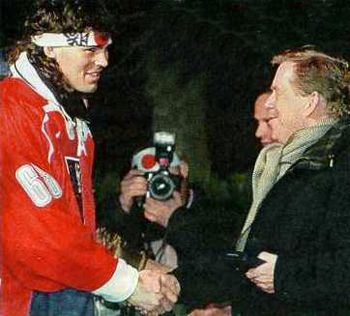
In 1998, the Czech Republic emerged victorious from the first Olympic Games to feature the stars of the NHL all competing for their home countries, following their 1-0 win over Russia on a lone goal by Petr Svoboda. Following the gold medal game, Havel, in attendance in Japan, visited the locker room of the victorious team to invite them all to his home for a party in celebration. "He was there and after the game, we all flew to his house," Jaromir Jagr recalled. "He wanted all the team there. It was fun. Big house."

Jagr and Havel, Jagr and Havel
Jagr is congratulated by Havel following the 1998 Olympic victory

"If you look at the big picture, he was the main guy. Without him, nobody would play in row NHL from the Czech unless you defect. After the revolution, which he started, the borders were open and there was freedom. You could go anywhere you want." Jagr said.

Jagr had been to the White House with Havel on three occasions, including the time Havel was honored with the Presidential Medal of Freedom in 2003.

Havel, Clinton and Jagr, Havel, Clinton and Jagr
Havel, President Clinton and Jagr at the White House

After leaving the presidency, Havel continued his humanitarian works as well as staying active in the theater, which included the first complete festival of his plays, held in New York City, in celebration of his 70th birthday. He also wrote his first new play in 18 years, "Leaving", which was published in November of 2007, later directing a film version of it which premiered in March of 2011.

Havel passed away on December 18, 2011, which elicited numerous tributes from leaders all over the globe.

His funeral will be held today.

Vaclav Havel, Vaclav Havel

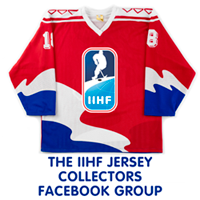
Today's featured jersey is a 1991-92 Czechoslovakia National Team Richard Král jersey. This jersey was obtained by us from team trainers following an exhibition game between the University of Minnesota Golden Gophers and a touring Czechoslovakian National Team, which won 5-1 on December 27, 1992.

Tackla was the sole supplier of jerseys to IIHF tournaments in the late 1980's and early 1990's. Their dye-sublimation process allowed for bright colors and bold designs not seen before. This is a surprisingly vibrant a flashy design, particularly for a staid communist country generally known for it's spartan and utilitarian designs. This waving flag effect was a foreshadowing of the bold Nike jerseys later worn at the 1996 World Cup of Hockey.

Five days after obtaining this jersey, Czechoslovakia ceased to exist.

Czechoslovakia was founded at the conclusion of World War I and was divided up during World War II essentially between Germany and Hungary. The country was re-established at the conclusion of World War II and in February of 1948, power was seized by the Communists. During a brief period of liberalization in 1968 known as the Prague Spring, five countries, led by the Soviet Union, invaded Czechoslovakia to restore and maintain the Communist system and ideals. It is because of this invasion in 1968, also the year in which his grandfather died in prison, that Jaromir Jagr wears #68.

Czechoslovakia played their first game of international hockey at the 1920 Winter Olympics in Antwerp, Belgium, a 15-0 loss to Canada. The program would improve quickly, as they would record their largest margin of victory ever by 1939 in a 24-0 defeat of Yugoslavia, later matched several times in a 24-0 win over Belgium in 1947, a 27-3 drubbing of East Germany in 1951 and a 25-1 win over Japan in 1957.

Czechoslovakia would win the Olympic silver medal four times, in 1948, with gold going to Canada, and then again in 1968, 1976 and 1984, each time as runner up to the powerful Soviet Union. When they weren't winning silver, they were generally in contention, with bronze medals in 1920, 1964, 1972 and 1992.

They would also participate in five Canada Cups, with their best showing being second in the inaugural 1976 tournament.

They also had a long and successful history of competing at the World Championships, dating back to 1930, with six gold medals to their credit, which they won in 1947, 1949, 1972, 1976, 1977 and 1985 with 10 silver and 14 bronze to go along with their championships. They were the only country to break the stranglehold of the Soviet Union during the 24 years from 1963 to 1986, taking great delight at defeating their main rivals four times during the main era of Soviet dominance.

Czechoslovakia 1991-1992 jersey photo Czechoslovakia1991-1992F.jpg
Czechoslovakia 1991-1992 jersey photo Czechoslovakia1991-1992B.jpg

Today's video section begins with Amnesty International's Steve Crenshaw paying tribute to Havel.


Next are news reports aired during the Velvet Revolution.

Thursday, December 22, 2011

1920-21 Hamilton Tigers Joe Malone Jersey

After their peak in 1912 and 1913 when they were the holders of the Stanley Cup, the Quebec Bulldogs of the National Hockey Association ran into hard times. While posting winning records in 1914 and 1915, they failed to qualify for the playoffs both seasons. A losing record of 10-12 in 1916 foreshadowed the downfall that await the club. A dismal first half in 1916-17 saw the Bulldogs at 2-8, only to reverse their fortunes in the second half of the season at 8-2, yet fail to make the postseason once more.

The Quebec Bulldogs in brighter days with the Stanley Cup

After the conclusion of the 1916-17 schedule, the NHA disbanded, only to be reborn as the new National Hockey League, with the Bulldogs as one of the charter members, only with the stress of being the smallest city in the league and the troubled economic times of the World War I, Quebec chose to suspend operations for the inaugural NHL season of 1917-18.

Their situation did not improve in time for the 1918-19 season when the 1918 Spanish flu pandemic erupted, causing the Bulldogs to once again take a pass on the season.

New ownership allowed the club to return to on ice competition for the 1919-20 season. High scoring star player Joe Malone was recalled from the Montreal Canadiens and proceeded to lead not only the team, but the league in scoring with 39 goals and 49 points in 24 games. That, however, would prove to be the only highlight of the season for the team, as their defense would prove to be nothing short of hideous, giving up a total of 177 goals in 24 games, an average of 7.4 goals per game. That total was so putrid, it was greater than the Ottawa Senators and Toronto St. Patrick's combined total of 170.

The Bulldogs finished 2-10 in the first half, and there would be no rebound in the second half as another 2-10 record awaited them. Prior to the start of the 1920-21 season, the NHL would take back the franchise and sold it to interests in Hamilton, Ontario.

The club would be christened the Hamilton Tigers and six Quebec players, including Malone, would carry over to the Tigers first roster who would play their first ever game on this date in 1920, a 5-0 shutout of the Montreal Canadiens.

1920-21 Hamilton Tigers team, 1920-21 Hamilton Tigers team
The 1920-21 Hamilton Tigers

The Tigers were led in scoring that night by future Hockey Hall of Famer Babe Dye, who scored the first goal in Tigers history at 12:30 of the first period to give Hamilton a 1-0 lead. Exactly five minutes later he would score his second of the period, both assisted by Joe Matte.

George Carey extended the Tigers lead to three at the four minute mark of the second, assisted by Moylan McDonnell, the only assist of the defenseman's 20 games that season. Matte made it three points on the night with his goal at the 16 minute mark of the period before Goldie Prodgers closed out the scoring at three minutes of the third period.

Howard Lockhart got the unlikely shutout in goal for Hamilton, considering that his only appearance for Quebec the previous season saw him let in no less than 11 goals. Lockhart would eventually play 59 NHL games over six seasons and record exactly one career shutout.

Lockhart Tigers, Lockhart Tigers
Howard Lockhart

The Tigers opening night shutout remains the one and only time a club has blanked an opponent during it's NHL debut and was arguably the high point in the history of the franchise. Of note, it would be the one and only game opening night star Dye would ever play in a Tigers sweater, as he was recalled from his loan by the Toronto St. Patricks due to an injury suffered by another player on the St. Patricks roster.

The Tigers would miss Dye dearly, as he would go on to lead the NHL in goal scoring that season with 35 total goals in 24 games after netting 33 in 23 games following his recall by Toronto. In the absence of Dye, Malone would lead Hamilton with 28 goals and 37 points in 20 games after missing the first four games of the season due to a contract dispute.

Hamilton would go 2-2 before the return of Malone, but his arrival would do little to change the fortunes of the club, as they completed the first half of the season in last place at 3-7 and closed out the second half of the split season in last place with a record of 3-11.

Additional last place finishes followed the next three seasons thanks to records of 7-17, 6-18 and 9-15. Malone would lead the club in scoring again during 1921-22 and Mickey Roach took top honors in 1922-23 before Billy Burch did the same in 1923-24.

Then the unexpected happened, the lowly Tigers rose to the top of the standings with a 19-10-1 record as Burch again led the team with 20 goals and 24 points. Their scoreless tie with Ottawa during mid-December provided the difference over the second place St. Patricks who finished at 19-11-0.

1924-25 Hamilton Tigers team, 1924-25 Hamilton Tigers team
The 1924-25 Hamilton Tigers

The excitement of their first place finish was quickly dashed in the most complete and utter way, as the entire roster of the Tigers went to their general manager on the train ride home following their final regular season game on March 9, 1925 and demanded the princely sum of $200 each for the six additional games the regular season had been extended that season due to the additions of new clubs, the Boston Bruins and Montreal Maroons. Management responded with the argument that the player's contacts were based on playing from December 1st to March 30th, without regard to the number of games played.

The players held firm in their demands and refused to participate in the postseason. The situation remained unresolved while the St. Patricks and Canadiens met in the semifinals. Once the Canadiens prevailed on March 13, league president Frank Calder met with Tigers management, who refused to change their position, and subsequently declared the Canadiens league champions, suspended the entire Tigers roster indefinitely and fined them $200 each, ending not only their season, but as it turns out the franchise itself.

Prior to the following NHL season, New York bootlegger Big Bill Dwyer purchased the Tigers roster for $75,000 to stock his expansion club, the New York Americans. It was a move the players did not mind, as they all received a pay increase, with some earning twice as much as before. The league officially revoked the Hamilton franchise on September 22, 1925, formally bringing to a close the story of not only the Hamilton Tigers, but NHL hockey in Hamilton, as the league has never returned.

Today's featured jersey is a 1920-21 Hamilton Tigers Joe Malone jersey. Their original jerseys feature vertical striping and the bold tiger head on a square patch. This style lasted but one season and was replaced by a new sweater which was adorned with a full-bodied walking tiger and horizontal striping.

The Hamilton Tigers jersey has taken on a legendary status since Sports Illustrated named the Hamilton Tigers jersey as one of "25 Lost Treasures of Sports", as no known surviving examples exist of any of the four different styles that were worn during their five seasons, despite reports that one was sold for $500 in the early 1990's in Hamilton to an unknown American collector and has never been seen since.

There was a documentary about a search for any Tigers sweater called "Hunting the Last Hamilton Tiger" in 2009, but frustratingly, we were unable to find any clips of it online, youtube or otherwise, despite it having been shown on the CBC. If anyone has any links to video of this documentary, please share them in the comments or email us at Spyboy1@gmail.com.

Hamilton Tigers 20-21 Jersey, Hamilton Tigers 20-21 Jersey


Wednesday, December 21, 2011

1972-73 Boston Bruins Bobby Orr Jersey

Bobby Orr, a defneseman and considered by many to be the greatest player in the history of the NHL, was signed by the Boston Bruins at the age of 14. League rules at the time dictated that Orr could not play in the NHL until turning 18. Orr bided his time playing for the Oshawa Generals of the Ontario Hockey League and, in his final season in junior hockey, scored 94 points in 47 games,an average of two points per game, an unheard of average for a defenseman.

Bobby Orr Rookie camp
Orr, wearing #27 during his first NHL training camp

Orr had first came up to the Bruins in 1966, and simply revolutionized the position of defense with his end to end rushes and attacks, previously unheard of by players of his position. He benefitted from playing in Boston Garden, where the rink was 9 feet shorter than a standard rink, getting him from one end of the ice to the other that much faster.

He would win the Calder Trophy during his first season with the Bruins after scoring 41 points in 61 games. He would miss nine games late in the season with a knee injury, foreshadowing the injury problems that would plague his career. Prior to Orr's arrival, the Bruins had missed the playoffs for seven consecutive seasons and, while they would not make the post-season during Orr's rookie season, they would make the playoffs in every subsequent season of Orr's career in Boston.

Bobby Orr Rookie
Bobby Orr during the 1966-67 season

Despite only playing in 46 games of the 1967-68 season, Orr would win the first of eight consecutive Norris Trophies. Back on track in 1968-69, he would play in 67 games and top 20 goals for the first time with 21 and total 64 points.

Orr would explode the following season, scoring 33 goals and adding a whopping 87 assists to total 120 points, six short of the league record and become the first and only defenseman to lead the NHL in scoring, which would net him the Art Ross Trophy. Additionally, he was named the winner of the Hart Trophy as league MVP. The Bruins would advance through the playoffs, eventually winning the Stanley Cup in overtime of Game 4, a goal captured in an iconic photograph of Orr flying through the air like a superhero in celebration. Following the playoffs, he would be named the recipient of the Conn Smythe Trophy, making him the first player to win four major NHL awards in the same season.

Orr SI cover, Orr SI cover

He would top that mark in 1970-71 with an astounding 139 points, still the all-time record for a defenseman nearly 40 years later. In comparison, the first modern offensive defenseman Doug Harvey's top offensive season was in 1956-57 when he scored 50 points on 6 goals and 44 assists and his highest ever goal total was merely 9 in 1957-58 in comparison to Orr's top season of 46 and five separate seasons of more than 30.

His 139 points included a league leading 102 assists, 26 more than the next closest player, and earned him a second place finish in the scoring race behind Bruin's teammate Phil Esposito while winning the Hart Trophy for the second time. Orr would record a plus-minus rating of +124 that season, an NHL record that still stands today.

After the Bruins Stanley Cup triumph at the conclusion of the 1971-72 season, Orr underwent knee surgery on June 6, removing several bits of cartilage and some bone spurs, causing him to miss the Summit Series with the Soviet Union in September. Once healed from the surgery, Orr was healthy enough to play in 63 games of the 1972-73 season, which included setting a new NHL record for career points by a defenseman on this date in 1972 with an assist in an 8-1 win over the Detroit Red Wings to give him 541 points in 423 games, passing Harvey's 540 points in 1,113 games.

Orr went on to surpass the 100 point mark for the fourth of six consecutive seasons with 29 goals and 72 assists for 101 points, finishing second in team scoring to Esposito. Orr would play in the NHL All-Star Game and would win the Norris Trophy for the sixth of eight times.

The Bruins would return to the finals in 1973-74 following a regular season in which Orr would score 32 goals and 90 assists for 122 points followed by another 18 points in 16 playoff games.

Orr Bruins 73-74, Orr Bruins 73-74
Orr in 1973-74

Orr would once again win the NHL scoring race in 1974-75, capturing the Ross Trophy for the second time after a career high 46 goals, becoming the first defenseman to ever score 40 goals, combined with 89 assists for 135 points. He would be named to the NHL First All-Star Team for the eighth consecutive season, win his eighth consecutive Norris Trophy, play in his seventh NHL All-Star Game and win his first Lester B. Pearson Award.

His multiple knee surgeries would catch up to him, limiting him to only 10 games of the 1975-76 season. While essentially playing on one knee, Orr would compete for Team Canada in the 1976 Canada Cup, earning rave reviews and being named tournament MVP in the last hurrah of his storied career.

A move to the Chicago Black Hawks followed for the next two seasons but he totaled just 26 games and 27 points in 1976-77 and 1978-79.

His final career totals are 657 games played, 270 goals and 645 assists for 915 points after ten seasons in Boston and the two in Chicago. At the time of his retirement, Orr was the leading defenseman in NHL history in goals, assists and points. The only players who have averaged more points per game than Orr are Wayne Gretzky, Mario Lemieux and Mike Bossy - all forwards.

Orr's speed, acceleration and creative offensive ability, combined with his toughness and defensive skills revolutionized the position of defense and changed the game forever. He also moved beyond the world of hockey, becoming a mainstream celebrity in the United States.

Orr advertisement, Orr advertisement

While we have given you a brief overview of the game-changing career of Bobby Orr, entire books are devoted to his career and the impact he had on the NHL, and we here at Third String Goalie recommend Searching for Bobby Orr.

Today's jersey is a 1972-73 Boston Bruins Bobby Orr jersey. This style Bruins jersey was first used by the Bruins for the 1967-68 season. It was the first black Bruins jersey worn by the team since 1965, as they had previously worn gold jerseys at home since 1957. 1972-73 would be the final season for this exact variety of jersey, as the following season it would change to a v-neck style without the lace up collar for one season followed by a brand new look for 1974-75.

Boston Bruins 72-73 jersey, Boston Bruins 72-73 jersey

While we could post 100 videos of Orr in action, but believe this one captures the dominance of Orr's game. Simply amazing what a complete player he was.


Tuesday, December 20, 2011

1982-83 Winnipeg Jets Doug Smail Jersey

On this date in 1981, the Winnipeg Jets faced off against the St. Louis Blues. Just after the opening face-off and before the fans could even settle into their seats, Winnipeg's Doug Smail scored just five seconds into the game to set a new NHL record for the fastest goal at the start of a game to break the eight year old record of six seconds set in 1973 by Henry Boucha of the Detroit Red Wings against the Montreal Canadiens.

Doug Smail, Doug Smail

Boucha's record was equalled by the Pittsburgh Penguins Jean Pronovost in 1976, also against the Blues.

Paul McLean added to the Jets lead two minutes later, but the Blues came back with three consecutive goals by the half way point of the game to overcome the early Jets lead. As the third period began, the Jets reasserted themselves with three goals of their own within the first 11 minutes of the third period on scores by Bengt Lundholm, Smail again and Willy Lindstrom.

When Perry Turnbull added a meaningless goal with 9 seconds remaining in the game, Smail also then received credit for the game winning goal to go along with his new record.

Bryan Trottier of the New York Islanders later equalled Smail's record on March 22, 1984 in a 3-3 draw against the Boston Bruins.

Trottier Islanders, Trottier Islanders
Bryan Trottier

Buffalo's Alexander Mogilny joined the group on ten years and a day after Smail's goal when he intercepted a cross ice passing attempt by Michel Petit, skated in and fired a shot past goalie Jeff Reese to begin a 4-1 Sabres victory over the Toronto Maple Leafs.

Mogilny Sabres, Mogilny Sabres
Alexander Mogilny

Smail played at the University of North Dakota, which included winning an NCAA championship in 1980 and earning tournament MVP honors. The ultra quick winger played 13 NHL seasons, ten of those with the Winnipeg Jets before a trade to the Minnesota North Stars for one season. He would also play single seasons with the Quebec Nordiques and Ottawa Senators before finishing out his career with three year stint in Great Britain.

Smail Jets, Smail Jets
Doug Smail

His NHL high of 66 points came in 1984-85 with his only 30 goal season, with 31 goals, and a career high 35 assists. He was primarily a penalty killer and defensive forward in the high flying 1980's. He did have three additional 20 goal seasons for the Jets, but never reached even 50 points in the NHL again. Of note however, was his first season with the Fife Flyers in Great Britain, where in 53 games, and free of his NHL defensive responsibilities, Smail cut loose with 74 goals and 139 points! Oddly, he also racked up 114 penalty minutes, nearly three times his NHL average of 46, which came in a considerably longer 80 game season.

Today's featured jersey is a 1982-83 Winnipeg Jets Doug Smail jersey. To celebrate their move to the NHL from the WHA, the Jets took the opportunity to revamp their jerseys, introducing an entirely new (to them) style which featured full length sleeve striping, a pattern formerly used by the New York Rangers while under the control of general manager John Ferguson, who now held the reins in Winnipeg. One unique feature of the jersey was the extremely thin font used for the names on the back. This style would serve the Jets well through 11 seasons until 1989-90.

Winnipeg Jets 82-83 jersey, Winnipeg Jets 82-83 jersey

Sadly, we were unable to locate video of Smail's goal but were able to find a clip of Trottier's rapid goal followed by Mogilny's.


Recently Alexander Radulov of Salavat Yulaev Ufa took a run at Smail's record when he set the Russian and Kontinental Hockey League record at six seconds, besting Andrei Pchelykaov's Russian Super League goal at seven seconds.


Monday, December 19, 2011

1981-82 Philadelphia Flyers Behn Wilson Jersey

At the age of 17, Behn Wilson, born on this date in 1958, showed his unquestioned toughness with 131 penalty minutes in 63 games for the 1975-76 Ottawa 67's of the QMJHL. He played a half a season with the 67's in 1976-77 before moving to the Windsor Spitfires. His combined points that season while playing defense was an impressive 57 in 48 games. He also made his professional hockey debut with the Kalamazoo Wings of the IHL where he scored 9 points in 13 games and racked up 40 penalty minutes in just 13 games as the 18 year old was tested by the older players in the IHL.

It was back to junior hockey for Wilson in 1977-78 with the Kingston Canadiens where he finished second on the club in scoring with 18 goals and 76 points plus 186 penalty minutes in 52 games. That caught the attention of the Philadelphia Flyers, who were always on the lookout for toughness and grit, especia , lly from someone who could contribute offensively. Following the season the Flyers made Wilson the #6 overall pick in the 1978 NHL Amateur Draft.

He stepped straight into the Flyers lineup in 1978-79, leading all Flyers defensemen in scoring with 49 points (10 more than any other) as well as leading the team in penalty minutes, no easy task for a rookie on a club with noted tough guys Mel Bridgeman and Paul Holmgren!

Wilson Flyers, Wilson Flyers

Wilson would top 200 penalty minutes for the first time the following season with 212. The Flyers finished first overall in the league with 116 points and advanced through the playoffs to reach the Stanley Cup Finals. Back then, all 16 playoff qualifiers were seeded 1 to 16 without regard for divisions or even conferences, which allowed Philadelphia, the winners of the Patrick Division to face geographic neighbors and fellow Patrick Division rivals the New York Islanders, who prevailed in six games to begin their Stanley Cup dynasty.

Wilson set career highs in 1980-81 with 47 assists and 63 points as well as 237 penalty minutes. He also was a +39 for the year and earned a spot in the 1981 NHL All-Star Game.

Wilson played two more injury shortened seasons with the Flyers, thanks in part to his rugged, all out style, before being traded to the Chicago Black Hawks for the 1983-84 season. He played three seasons for the Black Hawks, with a high of 185 penalty minutes in 1984-85 and 50 points in 1985-86 before being forced to miss the entire 1986-87 season with a back injury.

Wilson Flyers, Wilson Flyers
Wilson in 1980-81 while wearing the Flyers infamous long pants

He would return to Chicago in 1987-88 and score 29 points in 58 games and record 166 penalty minutes. He would be claimed by the Vancouver Canucks in the 1988 Waiver Draft, but a reoccurrence of his back problems prevented him from ever playing again and he would formally retire after the 1988-89 season at the age of 29 with career totals of 601 games played, 98 goals and 260 assists for 358 points as well as his 1,480 penalty minutes, which included leading the Black Hawks in 1984.

Wilson Blackhawks, Wilson Blackhawks
Wilson following a scrap while with the Black Hawks

Today's featured jersey is a 1981-82 Philadelphia Flyers Behn Wilson jersey. This jersey is notably short in length, perhaps due in part to being worn with the CCM Pro Guard full-length hockey pants, more commonly referred to as "Cooperalls", despite not being the Cooper version of the long pants.

This jersey is from the third generation of Flyers jerseys, nearly identical to their original 1967-68 sweaters, only with the addition of wider arm striping which allowed the sleeve numbers to be contained entirely within the colored area, unlike the narrower first version which saw the sleeve numbers break out of the stripe.

What differentiates this third generation of jersey from the second is the absence of any waist striping which came with the adaptation of the "Cooperalls". This was the only season for this particular style jersey, as it was replaced by a modernized version of the jersey the following year.

Philadelphia Flyers 81-82 jersey, Philadelphia Flyers 81-82 jersey

Bonus Jersey: Today's bonus jersey is a 1983-84 Philadelphia Flyers Behn Wilson jersey which illustrates the evolution in style of the Flyers jersey. This is the second season for the new, modernized jersey which saw the addition of black trim which separated the body color from the sleeve color as the Flyers had now reverted back to the standard, short hockey pants. Additionally there was now trim above the black sleeve cuffs.

This second season is distinguished from the 1982-83 season by the straight section of of the shoulder yoke above the name on the back, where the previous season's jersey saw the sleeve striping on the back start at the collar and arch continuously downward. This long-lived style remained in use until 2007 with the arrival of the Reebok Edge jerseys.

Philadelphia Flyers 83-84 jersey, Philadelphia Flyers 83-84 jersey

Today's extra bonus jersey is a 1983-84 Chicago Black Hawks Behn Wilson jersey. This classic Black Hawks jersey has Wilson's first initial "B" on the back as Behn was teammates with long time Black Hawk Doug Wilson, necessitating the first initials to differentiate the two, something that is falling by the wayside as the different numbers worn by the players are now often considered sufficient.

Behn went with #23 while with the Black Hawks as his previous #3 worn in Philadelphia was already in use by Dave Feamster upon his arrival in Chicago.

Chicago Blackhawks 83-84 jersey, Chicago Blackhawks 83-84 jersey

Today's video section begins with Wilson having a furious battle with the New York Islanders Clark Gilles. followed by another with John Wensink of the Boston Bruins.


Sunday, December 18, 2011

Reader Submission - 2002-03 Miami Manatees Jersey

Our eighth reader submitted jersey comes from Lady Byng's Love Child, who writes the blog Swamp Hockey about the ECHL's Florida Everblades and the Florida Jr. Blades of the EJHL.
When I saw your post requesting jerseys this jersey immediately sprang to mind. It's my favorite jersey in my (pretty eclectic) collection. It's from the very short lived WHA2 Miami Manatees. It's really hard to name just one thing I love about this jersey, but one of my favorites my favorite has to be the tough manatee. The stitches and snarl are absolutely hilarious on an animal well know for being slow and docile.
Photobucket
Photobucket
This jersey has been worn at two professional hockey games, and oddly enough, has brought some really weird luck for the teams playing. The first game it went to, an ECHL game between my local team, the Everblades and their divisional rivals, a huge line brawl broke out right in front of me and a friend. Eventually, it devolved into the goalie fight that was up on Puck Daddy in December.

The second game it was worn to, a game between the Penguins and Lightning. I wore my customized Kennedy Pens jersey and my friend opted to represent tough manatees everywhere. During the game Tyler Kennedy tried to fight Victor Hedman right in front of us. I really can't wait to wear it next season to see what kind of chaos it instigates next season.
Photobucket
Photobucket

Chaos in the ECHL? Oh, no we just couldn't imagine that happening...


Thanks to Lady Byng's Love Child for taking the time to take the photos and send in their story about their jersey. We agree that whomever designed an angry looking manatee, complete with stitch marks, was a bold and genius designer. It's certainly not an easy task to make perhaps the most docile creature on Earth look at all intimidating.

However, we must take umbrage at the suggestion that Evelyn Byng, Viscountess Byng of Vimy, was anything less than a lady of the highest moral convictions and fidelity. To propose otherwise is as abhorrent a suggestion which has ever been put forth. She in fact, had no children, even by her husband Lord Byng.

Evelyn Byng, Viscountess Byng of Vimy, Evelyn Byng, Viscountess Byng of Vimy

If you have a jersey in your collection that you'd like to share with us and your fellow readers, please submit your pictures and a story to go with it, no matter how brief or detailed, to spyboy1@gmail.com and we look forward to seeing your favorites, even if you are the bastard love child of a revered member of the Canadian aristocracy.

Saturday, December 17, 2011

1987-88 Minnesota North Stars Frantisek Musil Jersey

Born on this date in 1964 in Pardubice, Czechoslovakia, Frantisek Musil was drafted 38th overall by the Minnesota North Stars in the 1983 NHL Entry Draft. He could have been drafted earlier, but there was uncertainty at the time if he would be able to leave Czechoslovakia due to the political climate in the early 1980's.

He would continue to play in Czechoslovakia before coming to North America in 1986 after completing his mandatory military service time. It was then that he obtained a holiday visa to travel to Yugoslavia. There, he met with North Stars general manager Lou Nanne and agent Ritch Winter who brought him back to Minnesota.

In 1983 I drafted Czech defenseman Frantisek Musil in the second round. I had watched him play in the World Championships, and he looked like a terrific young player. The Quebec Nordiques at that time has the Stastny brothers, who had defected from Czechoslovakia, and they were tearing up the NHL.

I drafted Frantisek, went to the World Championships in Munich, and talked to him about defecting. I said, "After the last game of tournament, I'll have a police escort get up to the airport and take you back." He says, "Let me think about it, and I'll talk to you later in the week." They always had security watching the Czech team. He didn't come with us in '83. THen in 1984, the third Canada Cup came along, and Musil was playing on the Czech team and I was managing the U. S. team. I'd call him every day and try to encourage him to defect at the end of the tournament. Again, it didn't happen.

Finally, I went to Toronto and hired the same Czech contact who had helped get the Stastnys out of Czechoslovakia. He said if he personally go Musil out, it would cost $250,000, with $25,000 up front for expenses.

That had been his price to get the Stastnys out, too. I said, "OK." Back then, you didn't have to pay the defectors a signing bonus, so it was almost like a wash. I gave him the $25,000, and for the next two years, he'd fly over to Europe and watch them play in different championships, and he'd say, "He's coming, he's coming."

In 1986, I got a call from Rich Winter in Edmonton, and Rich says, "Louis, I'm the agent for Frantisek Musil." Winter had convinced him to defect.

He says, "Musil's going to be vacationing in Umag, Yugoslavia, starting tomorrow." I said, "I'll fly over and meet him in Zagreb at the American Consulate, and I'll get him out from there." He says: "OK, I'm coming, too, but you'll have to give me a little time. We'll meet there in two days." I made airline reservations to fly to Trieste, Italy, which is right on the Yugoslavian border. Bob Bruce, from KSTP, was around the office while all this was going on, and he says, "Louie, do you mind if I come with a cameraman?"

I said, "What are you going to do?" He says; "I'd just like to film it. I won't say anything, won't do anything - I'll stay out of the way." I said, "You better, because I'm not looking after you." He says, "Just tell me what flight you're on."

So we ended up in Trieste, and I rented a car. I said to Bruce and his cameraman,"I'm going to make a dry run to Umag tonight to see what I have to do to drive through the border, so see if I'm going to have to put him in the trunk to sneak him out tomorrow."

We drove to Umag, couldn't find him, and drove back. As we're coming back across the border, I see the Yugoslav guards all have guns and that they stop you and check the car. I see the Italian gate - just a wooden gate - 100 yards farther down, and I figure I can drive slowly and then just gun it and go right through the wooden arm and be on the other side, if that's what I gotta do.

So the next day we drive down to Zagreb. We get to the American Consulate, and I go up to the door, and there's a Marine sitting behind a bulletproof window. I said to him: "My name's Lou Nanne. I'm supposed to meet Frantisek Musil here." He says, "We don't know any Frantisek Musil." I said, "He's a Czech guy who wants to defect, and he should be here with Rich Winter."

He says, "We don't have anybody here." I said, "Would you let me talk to the consulate? "So he rings upstairs, gives me the phone, and I ask the guy if a Frantisek Musil has come here with Rich Winter. "Yeah," he says, "but I sent them to Belgrade."

I said: "Belgrade? What did you do that for?" He says, "Well, that's where they process people who want to defect."

I said: "You've gotta help me. This guy who wants to defect is a hockey player." He says, "Sorry, I can't help you."

Fortunately for me, I had Bruce and his cameraman there. I said; "Would you come down here for a minute? I've got a person from ABC here with a camerman, and if you don't come down we're going to do a story on how you won't give any help to an American citizen who needs it here in Zagreb."

He comes down and I said, "Do you want to go on camera and say you won't help me?"

He says; "No, I'll help. What do you want me to do?" I said: "Make a call, stop them from being processed there, and tell them to drive back here. Otherwise it will take two years to get him out of that holding area."

So he did that.

I said: "I'll tell you what. I want to take you and your whole staff out to dinner. Pick the best restaurant in Zagreb."

They said great. So there's six of us, and we're eating and drinking wine, and we're having a real good time. All of a sudden I get tapped on the shoulder, and there's a guy dressed like a maitre d' in a black suit and tie. I tried to order cheesecake from him.

Finally, the consulate says: "Louis, that's the Secret Police. They want to see your passport." Then the consulate pulls out his green passport and says: "Diplomatic group here. They're with me."

I ask: "How do I get this guy out? I'm willing to put him in the trunk and drive through the border." He says: "No, you don't have to do that. Just get him a visa. If you can get a visa for him immediately, we can just put you on a plane. Tomorrow morning you call back to the States and get an OK for an immedate H-1 visa, then you take him to get a passport picture."

I said, "Let's get on the phone right now, and I'll call Senator Dave Durenberger." I called and said, "Senator, this guy is going to tell you what I need," and then he told the senator what I had to do. I called my secretary, Sue Thomas, and said: "Go down to Immigration right now, get this kind of visa, Write up a contract for Musil with these figures on it, so they know he's got a job and he's got money. Fax everything back to this guy's office so we have it in the morning."

Which they did. Musil got in at midnight. The consulate said, "There's a 1:30 flight out of here tomorrow to London," and we decided to try for it, and then get a ticket in London to Minnesota.

The first thing in the morning, Musil and I went to get his passport picture. I walked in and said to the guy, "I need a passport picture." He says, "Come back at four." I said, "No, no, I need it right now." He says, "I can't do it." So I pull out my wallet, give him $20, and he says. "I'll have them in five minutes."

The next sticking point was the Ford Taurus, my rental car from Italy. I didn't know what to do with it, so I drove over with Musil to Hertz. I said to the guy, "Can you drop off cars?" and he says, "Yes." I said, "Here's my car," and I gave him the keys. He walks outside with me and says, "I can't take that - it's from Italy, we're in Yugoslavia." I said, "I don't care if I end up owning it." A Taurus was only worth $4,200 or $5,200 in the States at that time, and I've got a player I'm saving $250,000 on. I gave him $20 and the keys.

When I got the drop-off charges, the bill was only $427.

We went straight to the airport, got on the plane, and sat there waiting nervously with Rich Winter, Bob Bruce and the cameraman, In a communist country, there are police all over the airport, all around the airstrip, and I'm wondering if anybody will notice that he's leaving for London. Finally, the plane takes off, and we open a bottle of wine to celebrate.

We get to London, we're going through British immigration, and we discover Musil hasn't got the visa he needs - he's got one for the States but not for England.

I said, "This kid's defecting, and he's going to be a professional hockey player back in Minnesota, we're taking him there." They guy was sympathetic, and he says: "Listen, we'll hold him right here. You got get two tickets on the next flight out of England to the United States, and we'll let him go."

I went upstairs and the next flight was on the Concorde to Canada, so I got two tickets on the Concorde. Our other three traveling companions got tickets on the same flight, and we all left. In the air, the pilot announced we had a guy defecting from Czechoslovakia, a hockey player, and they made a big thing out of it - they were toasting Musil and taking us for a tour of the cockpit.

When we landed, we were met by immigration officials, and they just whisked us through Customs and out to a waiting car. They drove us to La Guardia in New York City and got us to Minnesota.

Oddly enough, about half a year later, my son Marty made the U. S. A. World Juniors team, and the World Championships were in Pistany and Trencin in Czechoslovakia. My wife and I wanted to go see our son play, and I wanted to scout the tournament, so we went.

When we got there I knew we might have a little trouble, because some people were very upset, so as soon as we landed we went right to the rink where the U. S. was ready to play. I went right up into the director's office, because I know the Czech officials from World hockey. And I'll never forget, I walk in, and Miro Schubert, the top Czech hockey official, looks at me and says, "Oh Louie, how could you come back here after what you did to us?" I said, "I didn't do anything to you." He says, "You stole our player." I said: "No, your player just wanted to defect and play hockey. In America, we have freedom of choice. He made the choice. He just happens to play for me." So they were kind to me and everything was OK.

Then a few months later, in June, I drafted two guys for the following year, Dusan Pasek and Igor Liba, By the following July, an agreement was in place between the NHL and Czechoslovakia, and you could buy a player's rights to get him out of the country.
Musil is escorted through the Minneapolis airport on
his arrival from Czechoslovakia

A defensive defenseman, Musil played for the North Stars for four seasons before being traded to the Calgary Flames early in a fifth season. He would play for the Flames for five seasons. Another trade saw him join the Ottawa Senators in 1995 for two seasons. His final NHL stop was with the Edmonton Oilers, were he played for two seasons before missing the 1999-00 season and the beginning of the 2000-01 season while recovering from a spinal cord injury suffered during training camp. Once back, he would suffer a neck injury which would limit his final NHL season to just 13 games. He would wrap up his career with HC Dukla Jihlava in the second division of the Czech League.

His final NHL totals show 797 games played with 34 goals and 106 assists for 140 points and a +91 rating.

Internationally, Musil played for the Czechoslovakia National Team in the European Junior Championships twice, the World Junior Championships three times, the World Championships five times, winning silver in 1983 and gold in 1985 plus a bronze in 1992. He also participated for Czechoslovakia in the Canada Cup twice, in 1985 and 1992. He also represented the Czech Republic at the World Championships in 1994.

Today's featured jersey is a 1987-88 Minnesota North Stars Frantisek Musil jersey. This jersey features the "JM" patch worn in honor of John Mariucci, "The Godfather of American Hockey". Mariucci played at the University of Minnesota and five seasons for the Chicago Blackhawks when American players in the NHL was a rarity, and then spent four more seasons playing in the various minor leagues of the day before retiring and entering the world of coaching.

Mariucci coached the University of Minnesota for 12 seasons with another spent as the coach of the US Olympic team, earning a silver medal in 1956. He would also coach Team USA at the 1976 and 1977 World Championships. The home of the Minnesota Golden Gophers, Mariucci Arena, is named for John and he is a member of the United States Hockey Hall of Fame and the Hockey Hall of Fame.

North Stars Musil 87-88 jersey, North Stars Musil 87-88 jersey

Here is a scrap between Musil and Trevor Linden, who gets quite bloodied, either by a stick before the fight or in the exchange of haymakers they both throw. Either way, it's evidence of Musil's ruggedness that allowed him to make a career in the NHL at a time when Europeans were often tested for their toughness.


Friday, December 16, 2011

1975-76 Minnesota Fighting Saints Wayne Connelly Jersey

Right winger Wayne Connelly, born on this date in 1939, began his junior hockey career with the Kitchener Canucks of the Ontario Hockey Association, seeing action in 9 games. The Following season the Canucks relocated to Peterboro where they became the Toronto-Peterboro Transport Petes, later simplified to the Peterboro Petes. Connelly spent four seasons with the Petes, with his best season coming in 1958-59 when he scored 36 goals and 90 points. The following season he bettered his goal scoring mark with 48 in 47 games as he was named the recipient of the Red Tilson Award as the OHA's Most Valuable Player.

At the conclusion of the Pete's 1959-60 season, Connelly joined the Montreal Royals for the Eastern Professional Hockey League playoffs. He returned to the Royals for the following season, scoring 28 goals and 49 points in 64 games. He also made his NHL debut with a brief 3 game appearance with the Montreal Canadiens without scoring a point.

He was then traded to the Boston Bruins after starting the season with the Hull-Ottawa Canadiens in the EPHL in 1961-62. He stepped into the Bruins lineup right away, scoring his first NHL points with 8 goals and 12 assists in 61 games. Connelly was unable to stick with the Bruins full-time and split the 1962-63 season between the Bruins (18 games) and the Kingston Frontenacs (34 games).

Connelly Bruins, Connelly Bruins

After 26 games with Boston to begin the 1963-64 season, Connelly was sold to the San Francisco Seals of the Western Hockey League. He performed well for the Seals over the next two and half seasons, scoring 188 points in 175 games, including a 45 goal season in 1965-66.

Connelly was back in the NHL with Boston for the 1966-67 season and had a solid season with 30 points but then life changed for Connelly, as well as many other players having trouble sticking in the NHL, for that was the final season of the Original 6. For the 1967-68 season the NHL expanded to twice it's previous size, creating at least 120 new jobs for players at the top level. Connelly suddenly went from a fringe player with 172 games of experience to being considered a desirable NHL veteran.

He was selected by the Minnesota North Stars in the 1967 NHL Expansion Draft and instantly became a team leader in the locker room and on the ice, leading the club in scoring with 35 goal and 56 points. Following the season Connelly was named The Hockey News West Player of the Year.

Connelly North Stars, Connelly North Stars

During his second season with Minnesota, he was traded to the Detroit Red Wings, the club which with he set an NHL career high with 59 points in 1969-70. During his third season with the Red Wings, Connelly was again moved, this time to the St. Louis Blues as part of a large trade which brought Gary Unger to St. Louis for Red Berenson and Tim Ecclestone.

Connelly's time in St. Louis was brief, as he was only there for the final 28 games of 1970-71 and the first 15 games of the following season before being to the New York Rangers, who then sent him to the Vancouver Canucks the very next day. He had a fine season with Vancouver once the dust had settled, scoring 34 points in 53 games in 1971-72.

Now and NHL regular, but having an unstable career, five different clubs in six seasons, fate smiled on Connelly once more when the hockey world underwent a seismic change with the arrival of the World Hockey Association. 240 more jobs were created, and at a much higher rate of pay, as the WHA sought to buy the best talent available in an effort to compete head to head with the NHL from day one.

Connelly signed a lucrative, guaranteed three year contract with the Minnesota Fighting Saints. Life back in Minnesota agreed with Connelly, as he immediately went out and scored 40 goals and 70 points to lead the team in scoring. Playing with new arrival, the high scoring Mike Walton, who led the WHA in scoring that season, Connelly's totals took another leap upward. He matched his goal output with 42, but his assists took off, rising from 30 to 53 for a 95 point season. He then added another 13 points in 11 playoff games.

Connelly Fighting Saints, Connelly Fighting Saints

Connelly's third season in St. Paul finished with 38 goals and 71 points as well as another 12 in 12 playoff games. The Fighting Saints financial situation was an unsettled one, and when it all came to an end during Connelly's fourth season with the club, through 59 games he stood at 24 goals and 47 points. When the Fighting Saints folded in mid-season, Connelly signed on with the Cleveland Crusaders to finish out the season.

He would play one more season of pro hockey, but first his rights were traded by Cleveland to the New England Whalers during the off season, yet before the schedule could begin, the Calgary Cowboys acquired his rights. After 25 games with the Cowboys, Connelly was again traded for the third time seven months, this time to the Edmonton Oilers to finish out his career.

His final NHL totals were 543 games, 133 goals and 307 points, while his WHA points closed out at 366 games, 167 goals and 329 points, a third of a point per game higher average in the wide open WHA. Combined, Connelly scored exactly 300 professional goals and another 93 in the WHL prior to the NHL expansion. While Connelly benefited from both the expansion of the NHL in the late 1960's and the creation of the WHA in the early 1970's, had he scored 400 goals all in today's expanded NHL, his career reputation would be at a much higher profile than his fractured career history divided among three leagues.

Today's featured jersey is a 1975-76 Minnesota Fighting Saints Wayne Connelly jersey. After starting their first season with a large "S" logo and the occasional appearance of a gold jersey, the team introduced the "little saint" crested set of jerseys midway through their first season.

This style of sweater would remain the only style they would wear for the remaining 2 1/2 seasons of play. It was revived in a manner when the Cleveland Crusaders relocated to St. Paul and adopted the Fighting Saints identity, only in red and yellow instead of the original franchise's blue and yellow. That franchise would last less than one season before also folding midseason.

Minnesota Fighting Saints 75-76 jersey, Minnesota Fighting Saints 75-76 jersey

Today's video selection is Connelly, while with the North Stars, shattering the glass behind the Chicago Black Hawks goal with a powerful slap shot. Note just how much shorter the glass was back then, even behind the goals.


hit counter for blogger