History of Jersey 83-93 Banner sm photo History of Jersey 83-93 Banner sm.jpg

Wednesday, October 21, 2009

1979-80 New York Rangers Phil Esposito Jersey

On this date in 1979, Phil Esposito, then with the New York Rangers, scored a power play goal against the Pittsburgh Penguins for his 1500th NHL point, only the second player in NHL history after Gordie Howe to do so.

 photo EspositoRangers.jpg
Esposito scored his 1,600th point as a Ranger

After eight and a half seasons in Boston, which included winning the Stanley Cup twice, winning the Art Ross Trophy as the league's leading scorer five times and the Hart Trophy as league MVP twice, Esposito was traded to the Rangers along with Carol Vadnais for Brad Park, Joe Zanussi and Jean Ratelle.

Excerpted from Phil Esposito's book "Thunder and Lightning" (available used on Amazon.com in hardcover for less than a dollar!)

I was traded to the New York Rangers on November 7, 1975, in my mind a day that lives in infamy.
[Phil has just been offered a million dollar signing bonus and six-year contract at four hundred thousand dollars per season to join the Vancouver Blazers of the WHA]
[Bruins General Manager] Harry [Sinden] and I had been talking contract and he hadn't offered me very much. I went back to see him. I didn't have an agent. I never brought up he Vancouver offer. I didn't want to use that. I just told him "I don't want to leave Boston. Come on, let's have something here." He offered me a six-year deal at four hundred thousand dollars a year. I felt it was fair, considering what I had done.
"You want a no-trade clause, Phil?" he asked me.
"Harry," I said, "you and I have been through so much together, I don't need a no-trade clause. If you tell me you're not going to trade me, that's good enough for me.
As we shook hands he said, "Phil, you will be here as long as I'm here."
That was in October, just before the 1975-76 season began on the fourth, and I was happier than a pig in [slop].
We were on the road, and I was playing well even though I didn't particularly like Don Cherry's coaching style.
[At this point Esposito runs into Jim Pattinson who tells him he should have taken his offer to join the Blazers because Boston is going to trade him]
The next morning the phone rang, and [my roomate] Hank picked it up. Hank said, "Phil, it's Grapes." "Grapes" was out nickname for Don Cherry. I wondered, it's seven-thirty in the morning. We don't play until tomorrow. Why is he waking me up?
Hank handed me the phone.
Cherry said, "I've got to talk to you." I thought to myself, Oh, Jesus. I said, "If you want to talk to me, you're going to have to come up and see me." I hung up on him.
Hank said, "What's up?"
I said, "I think I've been traded."
There was a knock on the door, and in came Don Cherry and Bobby Orr. Don was wearing the ugliest pajamas I ever saw in my life. Don made a lot of money in Canada by wearing really ugly clothes. Bobby Orr was in a T-shirt and a pair of slacks.
I was sitting at the end of my bed in my underwear, hungover, and I had my head in my hands.
"What the [frick] is going on, Grapes?"
He said, "Phil, I ... well, I ..."
"Come on. Tell me. I've been traded, haven't I?"
He said, "Yeah."
[Frick] me," I said. "For who? And where?" He looked at me, and looked at Bobby, who was standing by the window. I said, "If you tell me New York, I'm going to jump out that window."
The New York Rangers were our arch-rivals. I hated New York. Whenever we went to play at Madison Square Garden, all we got to see was the dingy block between 7th and 8th Avenues and 33rd and 34th Streets. We never saw the hot spots. We would fly in on Eastern Airlines the day of the game, play, stay in the Statler Hilton, a rundown hotel right across the street, and fly out the next day. New York was filthy. It was the last place I wanted to go.
"Bobby, open the window," Grapes said.
That's how I learned I was going to New York.

On arrival in New York, Esposito found his familiar #7 taken by 16 year Rangers veteran Rod Gilbert and chose to simply double his customary #7 to the unusually high sweater number for the time of #77.

His first season of adjustment in New York would see Esposito play in 62 games and score 29 goals and 38 assists for 67 points to go along with his 16 points in the first 12 games of the season he played in Boston. While not able to reach the lofty league-leading point totals of 125-150 points as he had done with Boston, while being the first player to ever score 100 points in a season, Esposito still averaged 35 goals a season while in New York and 80 points over the final five full seasons of his career and led the Rangers in scoring three times.

On November 4, 1977 Esposito would score his 600th NHL goal versus the Vancouver Canucks, becoming the first Ranger to reach that milestone and would then go onto to notch his 1500th point early in the 1979 season against the Pittsburgh Penguins.

When he retired in 1981, he was second to Howe in all-time league scoring with 1282 games played, 717 goals and 873 assists for 1590 points for an average of 1.24 points per game over 18 NHL seasons.

Esposito was elected to the Hockey Hall of Fame in 1984 and had his original #7 famously retired by the Boston Bruins in 1987 when Ray Bourque, the current wearer of #7 for Boston, pulled of his jersey to reveal a permanent change to #77 in Phil's honor.

Bourque Esposito photo BourqueEsposito.jpg
Ray Bourque surrenders his #7 to Phil Esposito

Today's featured jersey is a game worn 1979-80 New York Rangers Phil Esposito jersey. This jersey was auctioned off by Leland's in December of 2004 and sold for a high bid of $8,559.34, with the final sale price with fees added on topping $10,000.

This style Rangers jersey was first introduced in 1978 after the Rangers brief switch to a much more modern look worn for two seasons in 1976-77 and 1977-78. It was also the first Rangers jersey to ever have "New York" diagonally across the front in the history of the franchise. This style lasted nine seasons before the club permanently reverted back to having "Rangers" diagonally across the front of their road jerseys once more in time for the 1987-88 season.

hockey jersey
hockey jersey

First up todays is the "Legends of Hockey" biography on Phil Esposito.


Next up is the jersey retirement ceremony when the Bruins retired Esposito's #7 and Ray Bourque famously shocks Phil and the stadium by giving up his number #7 to Esposito.


Here is Esposito, along with Ron Dugay, Dave Maloney and Anders Hedberg in a moment we suspect they'd all like to forget ever happened.


Unfortunately, it gets worse, as Esposito, Maloney, Hedberg and Ron Greschner take part in a sequel of even more embarrassing proportions.


We're not really sure what's happening here since this post was originally intended to be a tribute to the greatness of Phil Esposito's scoring abilities, but here's another skeleton from Phil's closet we just cannot keep to ourselves. His cohorts are Gil Gerard, Alan Thicke and The Unknown Comic. Why Phil is wearing a #14 jersey, we have no idea...

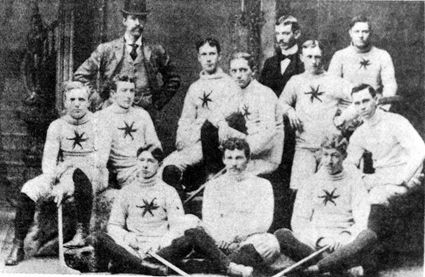
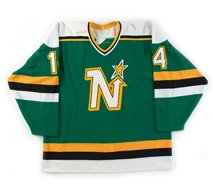
Dasherboard: Tonight is the debut of the new Minnesota Wild third jersey against the red hot Colorado Avalanche. The script crest on the front of the jersey borrows elements from the old Minneapolis Millers and St. Paul Saints minor league teams of the past and adds in the shooting star from the current Wild primary logo to tie the old and new together. The jerseys will also be worn on Saturday versus the Carolina Hurricanes.
Tuesday, October 20, 2009

1978-79 Indianapolis Racers Wayne Gretzky Jersey

Back in 1978 the NHL was embroiled in a feud with the World Hockey Association, which included fierce competition for signing players. The WHA had already lured away many established NHL stars, such as Bobby Hull and Gerry Cheevers, with offers of big money deals. Even Gordie Howe was lured out of retirement for a chance to play with his sons Mark and Marty.

The next tactic that the WHA employed was to look to Europe for players, which led to Swedes Anders Hedberg and Ulf Nilsson joining the Winnipeg Jets and Vaclav Nedomansky defecting from Czechoslovakia and playing for the Toronto Toros.

The third area the WHA would exploit to the fullest was flaunting the NHL rule which did not allow the signing of players under the age of 20. The Birmingham Bulls owner John Bassett signed as many young and talented players as he could, such as Rick Vaive, Michel Goulet, Rob Ramage, Craig Hartsburg, Gaston Gingras, Pat Riggin and Keith Crowder. It was a very good year to have been born in 1959, as all of the "Baby Bulls" were, except Goulet, who was the youngest of the lot, born in 1960, making him just 18 at the time.

Despite all the signings by the Bulls, the star prize in the race to sign underage players went to Nelson Skalbania, who snared a seventeen-year-old Wayne Gretzky for his Indianapolis Racers franchise. Gretzky wanted to play in the NHL, but was stymied by the 20 year old minimum age limit and did not think that another three years in junior hockey were necessary.

Gretzky THN Racers, Gretzky THN Racers

Other youngsters snapped up by the WHA included future stars Ken Linseman, Mike Gartner and Mark Messier, who also had a cup of coffee with the Racers (5 games and no points) before joining the Cincinnati Stingers and again showing little signs of the success that would follow when he scored but one goal and ten assists in 47 games.

It was on this date that Gretzky would score his first two goals as a professional, and two out of the three he would score in just the eight games he would play as a Racer. The first goal came against Dave Dryden of the Edmonton Oilers and would be followed by the second of his career - just moments later.

Today's featured jersey is a 1978-79 Indianapolis Racers Wayne Gretzky jersey. K1 makes some rare and unusual jerseys that are nice teams to be able to obtain, such as their many WHA jerseys, however, they do have the annoying habit of making their jerseys "to be worn with pads", meaning they consistently run a size larger than just about every other manufacturer under the sun and a family of four could comfortably live in the large, billowy arms of their jerseys. We generally make a habit of taking any K1 jersey our local tailor shop and have the width of the arms reduced to a more human proportion.

We at Third String Goalie prefer a size large in CCM, Starter or ProPlayer and can live with an extra large quite well, but when it comes to K1 jerseys, a medium is our first choice. A large is passable if the extra yard of material is removed from the arms, but an extra large is more suited for use as a circus tent.

hockey jersey

hockey jersey

In a frankly shocking and unexpected discover today, we found video of Wayne Gretzky scoring his first two goals as a professional for the Indianapolis Racers. It was a rare occurrence for any WHA games to be shown on TV in the Minneapolis/St. Paul area during our youth, and no one had a VCR in their home at the time, so to find video of a Racers game that has been posted on youtube was certainly a welcome and surprising treat.

I'm not sure how much hype there would have been for Gretzky to have joined the Racers in Indianapolis in 1978, but we were also frankly shocked at the size of the crowd at the game and their thunderous enthusiasm.


Here is another video, profiling Gretzky's career during his transition from junior hockey to the WHA with the Racers and his quick move to the Edmonton Oilers.


Monday, October 19, 2009

1996-97 Quebec Nordiques Peter Stastny Jersey

It was on this date in 1989 that Peter Statsny scored his 1000th NHL point with a goal against the Chicago Blackhawks in what would turn out to be his final season in Quebec.

Stastny joined the Nordiques, along with his brother Anton, after defecting from his native Czechoslovakia. They were joined the following year by their brother Marian, Making them the third trio of brothers to play on the same NHL team, following the Bentley brothers, Doug, Max and Reg, of the 1940's Blackhawks and the Plager brothers of the 1970's St. Louis Blues.

Peter would become the first rookie to ever score over 100 points in his first season when he netted 39 goals and accumulated 70 assists, also a rookie record, for 109 points in 1980-81, all while adapting to life in the West, including living in French-speaking Canada. He would be awarded the Calder Trophy for his efforts.

Stastny would extend his streak of 100 or more points to six consecutive seasons, one of only seven players to ever do so, averaging 119 points during that time period, topped by his 139 points during the 1981-82 season. He would be named team captain in 1985 and remain so until being traded to the New Jersey Devils in 1990.

When he scored his 1000th point, he became the first European-trained player to ever reach that milestone.

After his trade to the New Jersey Devils late in the 1989-90 season he would go on to play three full seasons with the Devils before signing with the St. Louis Blues as a free agent for the final two abbreviated seasons of his career, as he would only skate for the Blues for a total of 23 games.

His final career totals are 450 goals and 789 assists for 1239 points in 977 games, a 1.27 points per game average over his entire NHL career. He still currently ranks second in all-time franchise scoring, behind only Joe Sakic. In addition, he would score 33 goals and 72 assists for 105 points in 93 playoff games, unfortunately never reaching the Stanley Cup Finals in 15 seasons.

He would appear in six NHL All-Star Games in 1981, 1982, 1983, 1984, 1986 and 1988.

Internationally, he would play for Czechoslovakia in the World Championships in 1976, 1977, 1978 and 1979, a streak obviously stopped by his defection. Additionally, he would also compete in the 1976 Canada Cup and 1980 Winter Olympics for Czechoslovakia.

In an unusual twist, he would also participate in the 1984 Canada Cup, only this time for Canada, having become a Canadian citizen by then.

Later in his career, he would play in the 1995 World Championships, where he was named Best Forward, and the 1994 Winter Olympics, only now for the newly created country of Slovakia.

He was inducted into the Hockey Hall of Fame in 1998, the International Ice Hockey Federation Hall of Fame in 2000 and the Slovak Hall of Fame in 2002. In addition, his #26 was retired by the Quebec Nordiques. While all the numbers retired by the Nordiques were put back into circulation after the team relocated to Denver, Colorado and became the Avalanche, Peter's #26 is now fittingly being worn by his son Paul.

Today's featured jersey is a 1996-97 Quebec Nordiques Peter Stastny jersey which features the Rendez-vous 87 patch on the right sleeve.

Rendez-vous 87 was a two game series held in Quebec City that pitted a team of NHL All-Stars against the Soviet National Team rather than the traditional NHL All-Star Game that season.

This jersey is customized with the bold, single color white numbers used by the Nordiques from the time they adopted this jersey style in 1975, while then members of the World Hockey Association, until the conclusion of the 1990-91 season before going to two color numbers, white trimmed in red, for the 1991-92 season.

Quebec Nordiques 96-97 F
Quebec Nordiques 96-97 B
Quebec Nordiques 96-97 P

First up for today's videos, another of the excellent "Legends of Hockey" biographies on Stastny.


Check out this find, a 21 year old Peter Stastny playing for HC Kladno of Czechoslovakia scoring two goals against the Toronto Maple Leafs in Maple Leaf Gardens, more than three years before he would defect and join the NHL. Cool Stuff! The quality is amazing for how old the footage is.


Finally, no mention of the Nordiques would be complete without mentioning their famed rivalry with their Quebec neighbors the Montreal Canadiens, and here is Stastny scoring a dramatic goal in overtime of Game 7 to eliminate the Canadiens from the 1985 Stanley Cup Playoffs.


Sunday, October 18, 2009

1969-70 University of Minnesota Golden Gophers Mike Antonovich Jersey

Born on this date in 1951, Mike Antonovich is a legend in Minnesota High School Hockey, being named to the All-Tournament team three years in a row, from 1967 to 1969, as well as the tournament's leading scorer in both 1968 and 1969 for Greenway of Coleraine as he led Greenway to a pair of state championship titles. He once scored over 50 goals in a 20 game season. He was also recently named to the All-Time All-Tournament First Team along with the likes of Neal Broten, John Mayasich, Henry Boucha and Phil Housley.

Antonovich Greenway, Antonovich Greenway
Greeway of Coleraine's Mike Antonovich

Antonovich spent three seasons at the University of Minnesota, starting in 1969-70 when he burst onto the scene with 23 goals and 20 assists for 43 points in just 32 games, leading the Gophers in scoring by ten points and a to a league title. The following season he would score 32 points in 32 games, but compete in only 13 games in 1971-72, but manage 10 points to maintain his more than point a game average for his college career.

Antonovich Gophers, Antonovich Gophers
Antonovich during his Gopher days

He was drafted by the Minnesota North Stars 113th overall, but would elect to play for his former college coach Glen Sonmor with the Minnesota Fighting Saints of the World Hockey Association beginning in the 1972-73 season.

Antonovich Fighting Saints, Antonovich Fighting Saints
Antonovich early in the Fighting Saints first season
wearing the "S" logo jersey

During this time he was even featured in an article about the rise of US hockey players in Sports Illustrated. He would play four seasons for the Fighting Saints before they folded, scoring at least twenty goals in every season. Following the demise of the Fighting Saints, Antonovich would finish the season with the Minnesota North Stars and then competing for the United States at the 1976 World Championships.

Antonovich Fighting Saints, Antonovich Fighting Saints
Antonovich certainly embraced the longer hair styles of the early 1970's!

The following season would see Antonovich shuffle between the reborn Fighting Saints, the Edmonton Oilers and finally the New England Whalers of the WHA, totaling 40 goals along the way and then finishing the season by playing in the 1977 World Championships. The following two years with New England would see his 20 goal streak stretch to seven seasons.

Antonovich Whalers, Antonovich Whalers
Antonovich while with the Whalers in the WHA
as evidenced by the "harpoon W" logo

From that point he would play for the Whalers in their first NHL season for five games before spending the next three seasons in the minors, plus another appearance for the USA at the World Championships in 1982 before getting in 68 games with the New Jersey Devils in 1982-83 and 1983-84.

His final NHL totals show 10 goals, 15 assists and 25 points in 87 games to go along with his WHA career totals of 182 goals and 188 assists for 370 points in 486 games.

Today's featured jersey is a 1969-70 University of Minnesota Golden Gophers Mike Anotonovich jersey. This is a very rare jersey, as it was purchased as part of a custom group order for members of the Golden Gophers online forum and was never available through any online or retail stores until being made available by Vintage Minnesota Hockey.com. This style was used from 1969-70 to 1971-72.

Minnesota Gophers 69-72 jersey, Minnesota Gophers 69-72 jersey

Here is Antonovich scoring a goal for the New England Whalers in 1979.


This next video is a look at the upcoming second season of the Fighting Saints, which features a few appearances by Anotonovich. Be certain to notice the clear boards they used to have at the St. Paul Civic Center, a unique and distinctive feature of the Civic Center before age and dasherboard advertising made them obsolete.


Saturday, October 17, 2009

1983-84 Buffalo Sabres Gilbert Perreault Jersey

After seventeen seasons with the Buffalo Sabres, Gilbert Perreault had his #11 retired on this date in 1990, the only Sabre to ever wear #11.

The first ever draft pick for the fledgling Sabre organization, Perreault was drafted first overall in the 197o NHL Amateur Draft after the Sabres won a spin of a wheel to determine if they or the Vancouver Canucks would pick first. Sabres general manager Punch Imlach chose his favorite number 11, which proved lucky for the Sabres, and is why Perreault was assigned sweater #11.

Perreault scored a goal in the Sabres first ever game on October 10, 1970 and went on to lead the Sabres in scoring with 72 points in 78 games and win the Calder Trophy. He was also the first Sabre to record a power play goal and a hat trick.

Joined by wingers and fellow French-Canadians Rene Robert and Richard Martin during the Sabres second season, they formed "The French Connection" line which would excel for the seven seasons the trio played together, including all three being named to the same NHL All-Star Team on two occasions.

Perreault would lead the Sabres in scoring during 11 of his 17 seasons, including five in a row from 1975-76 to 1979-80. The Sabres would also qualify for the playoffs 11 consecutive seasons, including making it to the Stanley Cup Finals in 1975.

He would be named team captain in 1982, a position he would hold until his retirement in November 1986 and amass 512 goals and 814 assists for 1,326 points in his career in 1191 games - all Sabres franchise records which still stand to this day. He also holds Sabres career records for game winning goals, shots on goal and points in a game with seven.

He would also have the distinction of scoring the game winning goal in overtime of the 1978 NHL All-Star Game played in Buffalo at the Memorial Auditorium, one of nine NHL All-Star games he would appear in during his career.

In addition to his success with the Sabres, Perreault would also play for Team Canada during the 1972 Summit Series and the 1976 Canada Cup.

When he retired, he was the sixth leading scorer in NHL history and was subsequently inducted to the Hockey Hall of Fame in 1990.

Today's featured jersey is a 1983-84 Buffalo Sabres Gilbert Perreault jersey from the CCM vintage line. The Sabres played with essentially the same jerseys from 1970 to 1996 with only slight variations such as eliminating the original tie-neck collars in 1978, the same year they added shoulder logos, and minor changes to the arm and waist stripes in 1983.

This jersey proved so popular with the Sabres fans that it was brought back as a third jersey in 2006-07 and was modernized for a new third jersey again in 2008.

hockey jersey
hockey jersey

First, a real treat, footage from the first ever Buffalo Sabres game and Perreault's first ever NHL goal against Pittsburgh.


Here is the Legends of Hockey biography of Gilbert Perreault.


Next up is a great compilation of Perreault action highlights.


Finally a musical tribute to "The French Connection" line, featuring Gilbert Perreault.


Friday, October 16, 2009

1990-91 Dynamo Moscow Darius Kasparaitis Jersey

Born in Lithuania on this date in 1972, Darius Kasparaitis first played for Dynamo Moscow at the age of 16 during the 1988-89 season, the first Lithuanian to play in the Soviet Hockey League, and won the Soviet League Championship with Dynamo in 1992.

After his fourth season with Dyanmo, he was drafted by the New York Islanders with the 5th overall pick in the 1992 NHL Entry Draft. He jumped straight into the NHL later that year, playing in 79 games with the Islanders and announced his presence as a tough, physical player immediately as he led the team in hits, as well as scoring a career high 21 points on four goals and 17 assists.

After four seasons with the Islanders, he was traded to the Pittsburgh Penguins during the 1998-97 season where he would play six seasons, during which he would score one of the most notable goals in his career, a Game 7 overtime versus the Buffalo Sabres in the 2001 playoffs.

A late season trade in 2002 would see him play 11 games for the Colorado Avalanche and then sign the following season with the New York Rangers, where he would play parts of four seasons.

During the lockout year of 2004-05 he would join many other NHL players on Ak Bars Kazan of the Russian Super League.

2006-07 would see him return to Europe to play for SKA St. Petersburg on loan from the Rangers.

In international play, Kasparaitis has played for the Soviet Union in the 1990 European Junior Championships and the 1991 World Juniors, earning silver both times. 1992 would see him earn gold medals for the CIS/Unified Team in both the World Juniors, where he was named best defenseman, and Winter Olympics in Albertville, France.

With the political situation in Russia now resolved, Kasparaitis would now play for Russia in the 1992 and 1996 World Championships, the 1996 and 2004 World Cup of Hockey and the 1998, 2002 and 2006 Olympics, earning a bronze in 2002 and a silver in 1998.

Today's featured jersey is a 1990-91 Dynamo Moscow Darius Kasparaitis jersey. It's very typical of Soviet jerseys of the time period in that it is a light weight mesh with all the graphics silk screened onto the jersey with the name on the back being a classic example of Cyrillic lettering. The jersey shows good game use with several black stick marks on the arms and body.

Moscow Dynamo 91-92 F jersey, Moscow Dynamo 91-92 F jersey
Moscow Dynamo 91-92 B jersey, Moscow Dynamo 91-92 B jersey

Elvis has left the building as Kasparaitis scores his Game 7 overtime versus the Buffalo Sabres in the 2001 playoffs.


Here is an interview with Kasparaitis and his hair before the 2006 Olympic Games.


Finally a compliation of hits by Kasparaitis from the 1993-94 season.


Thursday, October 15, 2009

1934-35 St. Louis Eagles Frank Finnigan Jersey

The original Ottawa Senators were founded back in 1883 as an amateur club and later became a professional team. In the early years of hockey they moved from league to league as the organization of early hockey was still finding it's feet. Aside from the changes in leagues, the club also took some time to settle on a permanent nickname as well. Known as the Generals in the 1890's, the club was known as the Silver Seven from 1903 to 1907 before adopting the name Senators starting in 1912.


1985 ottawa hockey club photo: 1985 Ottawa Hockey Club 1985OttawaHockeyClub.jpg
The 1885 Ottawa Hockey Club

One of the most successful teams in the early days of hockey, the club won the Stanley Cup in 1903, 1904, 1905, 1906, 1909, 1910 and again in 1911 during the cup's "challenge era".


1911 Ottawa Senators photo OttawaSenatorsSTC1911.jpg
The 1911 Ottawa Senators posing with their Stanley Cup

By then the team had joined the National Hockey Association, which lasted from 1910 to 1917. After the NHA dissolved, the Ottawa Senators joined the brand new National Hockey League as a charter member in 1917 and soon rose to prominence, capturing four more Stanley Cups in 1920, 1921, 1923 and 1927.


Ottawa Senators 1920 photo OttawaSenators1920.jpg
The 1919-20 Ottawa Senators

After winning the championship in 1927, the Senators began a decline in fortunes, primarily due to the small size of Ottawa when compared to the other cities in the league at the time. Ottawa's population in 1931 was 110,000, one-fifth the size of Toronto, which was the second smallest NHL city at the time. They began to sell off their best players, suffered from low attendance at home against new expansion teams, such as the Boston Bruins, Chicago Blackhawks, Detroit Cougars, New York Americans, New York Rangers and Pittsburgh Pirates, and the higher travel costs to play those same teams in the United States.

The Great Depression also affected the team and caused the sale of even more players, including King Clancy to Toronto. The team suspended operations for the 1931-32 season and returned to finish with the worst record in the league two years in a row. Finally the owners of the franchise announced that it would not return to Ottawa for the 1934-35 season due to losses of over $60,000 since resuming play and would relocate the team.

The franchise then moved to St. Louis, the seventh largest city in the US at the time, for the 1934-35 season and was named the Eagles after the Anheuser-Busch beer logo. While attendance was good, the team fared little better financially in St. Louis however, with long, expensive train trips to New York and Boston as well as a large number of games against Montreal and Toronto, as the poor Eagles were forced to take Ottawa's place in the Canadian Division of the NHL despite being located much closer to Chicago and Detroit of the American Division.

 photo 1934-35StLouisEaglesteam.jpg
The 1934-35 St. Louis Eagles

The club finished with a dismal record of 11-31-6 for last in the league, while they again were forced to sell players, including team captain Syd Howe who lead the team in goals despite being traded to Detroit late in the season to help meet expenses. Finally on October 15th, 1935 the owners of the franchise sold the club back to the NHL for $40,000 and the players were then sold off to the remaining eight clubs in the league.

It would be 32 years before the NHL would return to St. Louis when the Blues joined the league in 1967.

Today's featured jersey is a 1934-35 St. Louis Eagles Frank Finnigan jersey worn by Finnigan during the St. Louis Eagles only season.

Finnigan was born in 1900 and played in the NHL from 1923 to 1937 for Ottawa, Toronto and St. Louis and was nicknamed the "Shawville Express".

Photobucket

He would win a Stanley Cup with Ottawa in 1927 and was team captain from 1930 to 1933, scoring a career high of 21 goals and 36 points in the 1929-30 season during 43 games played. He played in Toronto the season Ottawa suspended play, winning his second Stanley Cup with the Maple Leafs, and returned to Toronto after being one of the players sold by St. Louis in 1935. He also held the distinction of having played in the first NHL All-Star Game in 1934, which was held as a benefit for Toronto player Ace Bailey.

In 1989 Finnigan was part of the effort to bring back NHL hockey to Ottawa and made public appearances on behalf of the effort and was part of the presentation to the NHL expansion committee at the age of 90. He was scheduled to drop the puck at the first new Senators game in October of 1992, but passed away the previous December at the age of 91, the last surviving member of the 1927 Stanley Cup champions. Finnigan's son, Frank Jr., was chosen to drop the ceremonial first puck in his place.

On the night of the first game new Senators game, Finnigan's number 8 was retired by the club, still the only number retired by the team other than the league-wide retirement of Wayne Gretzky's #99.

Photobucket

In addition to having his jersey number retired, the street in front of the Senators arena, Scotiabank Place, was named Frank Finnigan Way in his honor.

Photobucket

Here is video from the first game of the new Ottawa Senators on October 8, 1992, including the opening of Hockey Night in Canada on that day and the first Senators goal of the new era.


Here is a brief recap of the original Senators history and how it influenced the branding of the newly reborn Senators.


Wednesday, October 14, 2009

2006-07 Toronto Maple Leafs Mats Sundin Jersey

On this date in 2006, the Calgary Flames traveled to Toronto to take on the Maple Leafs. Darcy Tucker opened the scoring at 8:09 of the first period with assists from Kyle Wellwood and Mats Sundin on a power play to give Toronto a 1-0 lead. Sundin extended the Toronto lead to 2-0 at 15:28 from a beautiful cross-ice pass from Brian McCabe with a second assist going to Jeff O'Neill.

The second period saw the Flames roar back with three goals in less than 12 minutes, as Mark Giordano scored at 4:52 followed by a shorthanded goal by Matthew Lombardi at 7:53 followed by Giordano's second of the period at 11:26 to give Calgary a 3-2 lead.

Alex Steen tied the game for Toronto at 17:38 from Matt Stajan and Chad Kilger. Sundin then restored the lead for the Maple Leafs lead for the second time with a goal at 18:48 from Tucker and Ian White after a drop pass from Tucker, which Sundin gathered up and quickly fired a laser shot over Miikka Kiprusoff's left shoulder and into the upper corner of the net.

The Maple Leafs lead would not hold up however, as Calgary's Daymond Lankow tied the game once more with a goal at 7;15 of the third period. The remainder of regulation passed with plenty of chances, as the Flames took 15 shots in the period while Toronto had 13 of their own, but
Kiprusoff and Toronto's Andrew Raycroft held firm and regulation ended in a 4-4 tie, but not before Tucker took a hooking penalty with just eight seconds remaining in the period.

Overtime then began with Toronto a man down, but a turnover by Alex Tanguay led to a rush by Mats Sundin, who skated down the left hand side and, once over the blueline, fired a shot from a long way out, which eluded Kiprusoff to not only win the game for the Maple Leafs, but also made Sundin the first Swedish player, and 35th of all time, to score 500 goals in the NHL, and in style too, as his milestone 500th goal came not only both shorthanded and unassisted, but also completed a hat trick in front of the delirious home fans at the Air Canada Centre!

Sundin 500 goals photo Sundin 500-1.jpg

"It's a special way to get it. I'll remember this day throughout my whole life," Sundin said following the game.

Sundin 500 goals photo Sundin 500-2.jpg
Combined with his assist on the first Toronto goal, his hat trick gave him four points on the memorable night. The winning goal was his 15th overtime goal of his career, the most in NHL history at the time.

Even Flames captain Jarome Iginla had to admire Sundin on the night. "He was really going tonight. It was an amazing shot on that last goal. Not many people would have stopped that. He got a screen and he got it all. You don't want to call it a nice goal, but it was impressive," said Iginla.

Today's featured jersey is a 2006-07 Toronto Maple Leafs Mats Sundin jersey, from the season he scored his 500th career goal and 900th point as a Maple Leaf.

This particular jersey features the Teammates for Kids patch, as worn by Sundin and his Maple Leafs teammates on January 6th, 2007.

Sundin Teammates for Kids patch photo Sundin TFK patch.jpg

As part of the program, each player on every team would play one game with the patch on their jerseys, which would then be auctioned off for chairity to raise money for the Garth Brooks Teammates for Kids Foundation. This would result in over 600 game worn jerseys entering the market in a single go.

Toronto Maple Leafs 06-07 jersey photo Toronto Maple Leafs 06-07 F.jpg
Toronto Maple Leafs 06-07 jersey photo Toronto Maple Leafs 06-07 B.jpg
Toronto Maple Leafs 06-07 jersey photo Toronto Maple Leafs 06-07 P.jpg

Today's featured video is Sundin scoring four points in the game on October 14th, 2006, concluding with him scoring his milestone 500th career goal shorthanded in overtime to complete his hat trick and defeat the Calgary Flames 5-4, sending the home crowd into euphoria.

Tuesday, October 13, 2009

2004-05 Colorado College Tigers Marty Sertich Jersey

Born on this date in 1982, Colorado College's Marty Sertich was named the winner of the annual Hobey Baker Award in 2005 following a season in which he had a collegiate career highs in goals (27), assists (37) and points (64) and was the leading scorer in all of NCAA hockey, edging out teammate Brett Sterling by a single point while leading the Tigers to the NCAA Frozen Four for the first time in eight seasons. He was also named a First-team All-American, WCHA Player of the Year and USA Hockey's College Player of the Year.

Sertich Hobey Baker photo Sertich Hobey Baker.jpg
Marty Sertich poses with his Hobey Baker Award

He joined 2003 winner and former St. Louis Blues player Peter Senja as the only other Hobey Baker winner from Colorado College.

The following season Sertich was once more named a finalist for the Hobey Baker Award while serving as team captain.

Mike and Marty Sertich photo Sertich Brothers.jpg
Brothers Mike and Marty Sertich played together for the Tigers

Following the conclusion of his college career, in which he never missed a game, Sertich signed a contract with the Dallas Stars and spent two years in Des Moines playing for the Iowa Stars of the AHL, scoring 27 goals and 25 assists for 52 points in 2007-08 and leading the Stars in goals and power play goals. During the offseason in 2008, he was traded to the Colorado Avalanche and spent the season in Cleveland with the Lake Erie Monsters, also of the AHL as he continues to work toward making his NHL debut.

Beginning in 1938, the Colorado College Tigers hockey program has made the NCAA Tournament 18 times, taking the national championship in 1950 and 1957 and finishing as runner up in 1952, 1955 and 1996. Former Pittsburgh Penguins head coach Bob Johnson coached the Tigers from 1963 to 1966. They have won the WCHA league title nine times since the formation of the conference in 1959. Arguably, the best known Colorado College player in the NHL is former Vancouver Canuck and New York Ranger Doug Lidster, who played 897 NHL games over 16 seasons.

Today's featured jersey is a 2004-05 Colorado College Tigers Marty Sertich jersey as worn during his Hobey Baker winning season. This jersey has it all going for it. The sharp logo, classic center stripe, three color numbers, vertically arched name, classic interlocking letters of the shoulder logos and a tie-neck collar. 

The modern, graphic Tiger head logo has always been a favorite with us, and, in combination with the retro feeling of the center "Canadiens" stripe around the body of the jersey really makes for an attractive combination. We're surprised more teams don't use the central stripe as a design element.

 photo Colorado College Tigers 2004-05 F.jpg
 photo Colorado College Tigers 2004-05 B.jpg

Here is a small collection of Sertich and Colorado College videos that highlight the history of the program.


hit counter for blogger