History of Jersey 83-93 Banner sm photo History of Jersey 83-93 Banner sm.jpg

Thursday, October 15, 2009

1934-35 St. Louis Eagles Frank Finnigan Jersey

The original Ottawa Senators were founded back in 1883 as an amateur club and later became a professional team. In the early years of hockey they moved from league to league as the organization of early hockey was still finding it's feet. Aside from the changes in leagues, the club also took some time to settle on a permanent nickname as well. Known as the Generals in the 1890's, the club was known as the Silver Seven from 1903 to 1907 before adopting the name Senators starting in 1912.


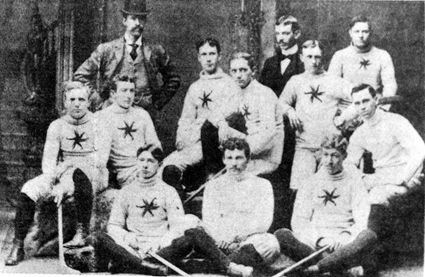
1985 ottawa hockey club photo: 1985 Ottawa Hockey Club 1985OttawaHockeyClub.jpg
The 1885 Ottawa Hockey Club

One of the most successful teams in the early days of hockey, the club won the Stanley Cup in 1903, 1904, 1905, 1906, 1909, 1910 and again in 1911 during the cup's "challenge era".


1911 Ottawa Senators photo OttawaSenatorsSTC1911.jpg
The 1911 Ottawa Senators posing with their Stanley Cup

By then the team had joined the National Hockey Association, which lasted from 1910 to 1917. After the NHA dissolved, the Ottawa Senators joined the brand new National Hockey League as a charter member in 1917 and soon rose to prominence, capturing four more Stanley Cups in 1920, 1921, 1923 and 1927.


Ottawa Senators 1920 photo OttawaSenators1920.jpg
The 1919-20 Ottawa Senators

After winning the championship in 1927, the Senators began a decline in fortunes, primarily due to the small size of Ottawa when compared to the other cities in the league at the time. Ottawa's population in 1931 was 110,000, one-fifth the size of Toronto, which was the second smallest NHL city at the time. They began to sell off their best players, suffered from low attendance at home against new expansion teams, such as the Boston Bruins, Chicago Blackhawks, Detroit Cougars, New York Americans, New York Rangers and Pittsburgh Pirates, and the higher travel costs to play those same teams in the United States.

The Great Depression also affected the team and caused the sale of even more players, including King Clancy to Toronto. The team suspended operations for the 1931-32 season and returned to finish with the worst record in the league two years in a row. Finally the owners of the franchise announced that it would not return to Ottawa for the 1934-35 season due to losses of over $60,000 since resuming play and would relocate the team.

The franchise then moved to St. Louis, the seventh largest city in the US at the time, for the 1934-35 season and was named the Eagles after the Anheuser-Busch beer logo. While attendance was good, the team fared little better financially in St. Louis however, with long, expensive train trips to New York and Boston as well as a large number of games against Montreal and Toronto, as the poor Eagles were forced to take Ottawa's place in the Canadian Division of the NHL despite being located much closer to Chicago and Detroit of the American Division.

 photo 1934-35StLouisEaglesteam.jpg
The 1934-35 St. Louis Eagles

The club finished with a dismal record of 11-31-6 for last in the league, while they again were forced to sell players, including team captain Syd Howe who lead the team in goals despite being traded to Detroit late in the season to help meet expenses. Finally on October 15th, 1935 the owners of the franchise sold the club back to the NHL for $40,000 and the players were then sold off to the remaining eight clubs in the league.

It would be 32 years before the NHL would return to St. Louis when the Blues joined the league in 1967.

Today's featured jersey is a 1934-35 St. Louis Eagles Frank Finnigan jersey worn by Finnigan during the St. Louis Eagles only season.

Finnigan was born in 1900 and played in the NHL from 1923 to 1937 for Ottawa, Toronto and St. Louis and was nicknamed the "Shawville Express".

Photobucket

He would win a Stanley Cup with Ottawa in 1927 and was team captain from 1930 to 1933, scoring a career high of 21 goals and 36 points in the 1929-30 season during 43 games played. He played in Toronto the season Ottawa suspended play, winning his second Stanley Cup with the Maple Leafs, and returned to Toronto after being one of the players sold by St. Louis in 1935. He also held the distinction of having played in the first NHL All-Star Game in 1934, which was held as a benefit for Toronto player Ace Bailey.

In 1989 Finnigan was part of the effort to bring back NHL hockey to Ottawa and made public appearances on behalf of the effort and was part of the presentation to the NHL expansion committee at the age of 90. He was scheduled to drop the puck at the first new Senators game in October of 1992, but passed away the previous December at the age of 91, the last surviving member of the 1927 Stanley Cup champions. Finnigan's son, Frank Jr., was chosen to drop the ceremonial first puck in his place.

On the night of the first game new Senators game, Finnigan's number 8 was retired by the club, still the only number retired by the team other than the league-wide retirement of Wayne Gretzky's #99.

Photobucket

In addition to having his jersey number retired, the street in front of the Senators arena, Scotiabank Place, was named Frank Finnigan Way in his honor.

Photobucket

Here is video from the first game of the new Ottawa Senators on October 8, 1992, including the opening of Hockey Night in Canada on that day and the first Senators goal of the new era.


Here is a brief recap of the original Senators history and how it influenced the branding of the newly reborn Senators.


Wednesday, October 14, 2009

2006-07 Toronto Maple Leafs Mats Sundin Jersey

On this date in 2006, the Calgary Flames traveled to Toronto to take on the Maple Leafs. Darcy Tucker opened the scoring at 8:09 of the first period with assists from Kyle Wellwood and Mats Sundin on a power play to give Toronto a 1-0 lead. Sundin extended the Toronto lead to 2-0 at 15:28 from a beautiful cross-ice pass from Brian McCabe with a second assist going to Jeff O'Neill.


The second period saw the Flames roar back with three goals in less than 12 minutes, as Mark Giordano scored at 4:52 followed by a shorthanded goal by Matthew Lombardi at 7:53 followed by Giordano's second of the period at 11:26 to give Calgary a 3-2 lead.

Alex Steen tied the game for Toronto at 17:38 from Matt Stajan and Chad Kilger. Sundin then restored the lead for the Maple Leafs lead for the second time with a goal at 18:48 from Tucker and Ian White after a drop pass from Tucker, which Sundin gathered up and quickly fired a laser shot over Miikka Kiprusoff's left shoulder and into the upper corner of the net.

The Maple Leafs lead would not hold up however, as Calgary's Daymond Lankow tied the game once more with a goal at 7;15 of the third period. The remainder of regulation passed with plenty of chances, as the Flames took 15 shots in the period while Toronto had 13 of their own, but
Kiprusoff and Toronto's Andrew Raycroft held firm and regulation ended in a 4-4 tie, but not before Tucker took a hooking penalty with just eight seconds remaining in the period.

Overtime then began with Toronto a man down, but a turnover by Alex Tanguay led to a rush by Mats Sundin, who skated down the left hand side and, once over the blueline, fired a shot from a long way out, which eluded Kiprusoff to not only win the game for the Maple Leafs, but also made Sundin the first Swedish player, and 35th of all time, to score 500 goals in the NHL, and in style too, as his milestone 500th goal came not only both shorthanded and unassisted, but also completed a hat trick in front of the delirious home fans at the Air Canada Centre!

Sundin 500 goals photo Sundin 500-1.jpg

"It's a special way to get it. I'll remember this day throughout my whole life," Sundin said following the game.

Sundin 500 goals photo Sundin 500-2.jpg
Combined with his assist on the first Toronto goal, his hat trick gave him four points on the memorable night. The winning goal was his 15th overtime goal of his career, the most in NHL history at the time.

Even Flames captain Jarome Iginla had to admire Sundin on the night. "He was really going tonight. It was an amazing shot on that last goal. Not many people would have stopped that. He got a screen and he got it all. You don't want to call it a nice goal, but it was impressive," said Iginla.

Today's featured jersey is a 2006-07 Toronto Maple Leafs Mats Sundin jersey, from the season he scored his 500th career goal and 900th point as a Maple Leaf.

This particular jersey features the Teammates for Kids patch, as worn by Sundin and his Maple Leafs teammates on January 6th, 2007.

Sundin Teammates for Kids patch photo Sundin TFK patch.jpg

As part of the program, each player on every team would play one game with the patch on their jerseys, which would then be auctioned off for chairity to raise money for the Garth Brooks Teammates for Kids Foundation. This would result in over 600 game worn jerseys entering the market in a single go.

Toronto Maple Leafs 06-07 jersey photo Toronto Maple Leafs 06-07 F.jpg
Toronto Maple Leafs 06-07 jersey photo Toronto Maple Leafs 06-07 B.jpg
Toronto Maple Leafs 06-07 jersey photo Toronto Maple Leafs 06-07 P.jpg

Today's featured video is Sundin scoring four points in the game on October 14th, 2006, concluding with him scoring his milestone 500th career goal shorthanded in overtime to complete his hat trick and defeat the Calgary Flames 5-4, sending the home crowd into euphoria.

Tuesday, October 13, 2009

2004-05 Colorado College Tigers Marty Sertich Jersey

Born on this date in 1982, Colorado College's Marty Sertich was named the winner of the annual Hobey Baker Award in 2005 following a season in which he had a collegiate career highs in goals (27), assists (37) and points (64) and was the leading scorer in all of NCAA hockey, edging out teammate Brett Sterling by a single point while leading the Tigers to the NCAA Frozen Four for the first time in eight seasons. He was also named a First-team All-American, WCHA Player of the Year and USA Hockey's College Player of the Year.

Sertich Hobey Baker photo Sertich Hobey Baker.jpg
Marty Sertich poses with his Hobey Baker Award

He joined 2003 winner and former St. Louis Blues player Peter Senja as the only other Hobey Baker winner from Colorado College.

The following season Sertich was once more named a finalist for the Hobey Baker Award while serving as team captain.

Mike and Marty Sertich photo Sertich Brothers.jpg
Brothers Mike and Marty Sertich played together for the Tigers

Following the conclusion of his college career, in which he never missed a game, Sertich signed a contract with the Dallas Stars and spent two years in Des Moines playing for the Iowa Stars of the AHL, scoring 27 goals and 25 assists for 52 points in 2007-08 and leading the Stars in goals and power play goals. During the offseason in 2008, he was traded to the Colorado Avalanche and spent the season in Cleveland with the Lake Erie Monsters, also of the AHL as he continues to work toward making his NHL debut.

Beginning in 1938, the Colorado College Tigers hockey program has made the NCAA Tournament 18 times, taking the national championship in 1950 and 1957 and finishing as runner up in 1952, 1955 and 1996. Former Pittsburgh Penguins head coach Bob Johnson coached the Tigers from 1963 to 1966. They have won the WCHA league title nine times since the formation of the conference in 1959. Arguably, the best known Colorado College player in the NHL is former Vancouver Canuck and New York Ranger Doug Lidster, who played 897 NHL games over 16 seasons.

Today's featured jersey is a 2004-05 Colorado College Tigers Marty Sertich jersey as worn during his Hobey Baker winning season. This jersey has it all going for it. The sharp logo, classic center stripe, three color numbers, vertically arched name, classic interlocking letters of the shoulder logos and a tie-neck collar. 

The modern, graphic Tiger head logo has always been a favorite with us, and, in combination with the retro feeling of the center "Canadiens" stripe around the body of the jersey really makes for an attractive combination. We're surprised more teams don't use the central stripe as a design element.

 photo Colorado College Tigers 2004-05 F.jpg
 photo Colorado College Tigers 2004-05 B.jpg

Here is a small collection of Sertich and Colorado College videos that highlight the history of the program.


Monday, October 12, 2009

1997 Austria National Team Christoph Brandner Jersey

On this date in 2003, Christoph Brandner of the Minnesota Wild became the first Austrian player to score a goal in the NHL.

Brandner, a native of Bruck an der Mur, Austria began his playing career for Kapfenberg of the Austrian League in 1994 before moving on to Klangenfurt AC, where he would play for three seasons. The 2000-01 season would see Brander move to Krefeld Penguine (Penguins) of the German DEL. While playing in Krefeld, he would be drafted in the 8th round of the 2002 NHL Entry Draft by the Minnesota Wild. He would remain in Germany for one more season before coming over to North America and making the Wild roster out of training camp.

After becoming the first Austrian to play in the NHL during the Wild's season opener on October 8th, he would become the first Austrian to score a goal (and point) in the NHL when he beat the San Jose Sharks Vesa Toskala at 6:24 of the first period.

Brandner would play 35 games for the Wild, scoring 4 goals and 5 assists for 9 points before being assigned to Houston of the AHL for the remainder of the season, unfortunately ending his NHL career. He would return to Houston again the following year before heading back to Europe in 2005-06, first in the Swedish Elitserien with Södertälje SK before moving back to the DEL with the Hamburg Freezers for two seasons. 2008-09 would see him return to his native Austria and be reunited with Klagenfurt AC.

His best professional season was in 2002-03 with Krefeld of the DEL when he would lead the league in goals, be named the Best Winger as well as League MVP and help Krefeld win the 2003 DEL Championship with 18 points in 14 playoff games in addition to his 45 points in 49 regular season games.

Brandner has also suited up for the Austrian National Team on 11 occasions, the first of which was the 1993 World Junior Championships "B" pool. He would eventually play in three World Juniors and one European Junior Championship.

1997 would see him make his World Championship debut, again in the "B" pool. With Austria now promoted to the Top Division of the World Championships and Brander would compete for Austria at the World Championships again in 2000, 2001, 2002, 2003 and help them win Division 1 Group A in 2008 to return to the Top Division with 4 goals and 5 points in 5 games.

He would also play for Austria in the 2002 Winter Olympics in Salt Lake City. His international record currently shows 68 games played, 29 goals and 17 assists for 46 points.

Brander would be followed in the NHL by Austrians Reinhard Divis, a goaltender for the St. Louis Blues for 28 games over four seasons, Andreas Nödl of the Philadelphia Flyers, Thomas Pöck of the New York Rangers and later the New York Islanders and the most successful Austrian to date, NHL All-Star Thomas Vanek of the Buffalo Sabres, now in his fifth NHL season with 260 points to his credit through the 2008-09 season.

Today's featured jersey is a 1997 Austrian National Team Christoph Brandner jersey as worn in the 1997 World Championships "B" pool. The "waving flag" style of international jerseys were introduced in 1996 and are best known for being used in the 1996 World Cup of Hockey. They were also used in the various World Championships in 1997 before a new style was debuted for the 1998 Winter Olympic Games in Japan.

Brandner scored a goal and two assists in seven game for Austria at the 1997 World Championships.

Austria 1997 jersey photo Austria 1997 F.jpg
Austria 1997 jersey photo Austria 1997 B.jpg

Today's first video highlight is Brandner scoring his first goal, the first by an Austrian in NHL history.


Next up is Brandner scoring for Austria in the 2008 World Championships versus the Netherlands.

Sunday, October 11, 2009

2000-01 Minnesota Wild Cam Stewart Jersey

On this date in 2000 the Minnesota Wild made their home debut at the Xcel Energy Center in St. Paul, Minnesota.

The first ever Wild game came on the road in Anaheim against the Mighty Ducks in a 3-1 loss on October 6th, followed the next night by a 4-1 defeat in Phoenix versus the Coyotes.

Four days later the team would begin a new era of NHL hockey in Minnesota as they would host the Philadelphia Flyers in their brand new arena.

Following the retirement of jersey #1 in honor of the fans, NHL hockey faced off for the first time in Minnesota in seven seasons following the departure of the Minnesota North Stars for Dallas, Texas.

Peter White of the Flyers opened the scoring at 13:41 of the first period, beating Wild goaltender Manny Fernandez. It would take less than four minutes for Minnesota native Darby Hendrickson to score the first Wild goal at home in franchise history at 17:19 with an assist from the enigmatic Maxim Shushinski, who would last just 30 games in the NHL before returning home to Russia.

Both teams would be held off the scoreboard for the majority of the second period until the Wild's first ever draft pick Marian Gaborik would score a power play goal, the first in Wild history, during the last minute of the second, at 19:05, giving the Wild a 2-1 lead after two despite being outshot 10-3 in the period.

White would get his second of the game at 5:43 of the third to pull the Flyers back into a tie before the hard working Wes Walz, back in the NHL after four seasons in Switzerland, would shock the Flyers with a shorthanded goal at 9:12. Eric Desjardins would even the score at 3-3 with a goal just over a minute later at 10:37. Each team would survive a power play chance for the other club before regulation time would expire with the teams deadlocked at 3.

Overtime would see the Wild kill off another penalty as the Flyers would outshoot the Wild 7-2 in the extra period but the game would end still tied.

Fernandez would make 36 saves against 19 for the Flyers Brian Boucher in front of a sell-out crowd of 18,827.

NHL Commissioner Gary Bettman was in attendance and was quoted as saying "Minnesota and hockey is a no-brainer." as well as "I'm sorry we left. Bringing pro hockey back here was by far the right thing to do."

The Wild would finish their first season 25-39-13-5 for 68 points, last in the Northwest Division. They would be led in scoring by Scott Pellerin with 39 points in 58 games before trading him, along with several other veteran players at the trade deadline. Gaborik, Walz and Hendrickson would lead the team in goals with 18 apiece.

Today's featured jersey is a game worn CCM 2000-01 Minnesota Wild Cam Stewart jersey. This jersey is a "set one" jersey, meaning it was worn in the Wild's home debut at the Xcel Energy Center, the first time the team would wear their white jerseys in a regular season contest.

Stewart, started his NHL career with the Boston Bruins after being drafted in the third round out of the University of Michigan, playing 83 games over four seasons, before playing two seasons for the Houston Aeros of the IHL, helping them win the Turner Cup in 1999.

1999-00 would see Stewart play 65 games with the Florida Panthers before being claimed by the Wild in the 2000 Expansion Draft. He would play 54 games for Minnesota in 2000-01 but would have his playing career cut short by a concussion in training camp before the following season, which would cause him to miss the entire year before announcing his retirement in June of 2002. His final NHL totals would show 202 games played, 16 goals and 23 assists for 39 points as well as an additional 13 playoff games with a goal and three assists.

2001-02 Game Worn NHL Minnesota Wild Cam Stewart jersey

Our first video today is the introductory video played before each Wild home game at "The X", featuring scenes of hockey from around the state throughout history.


This next one is a version of the Minnesota Wild anthem, this time featuring the lyrics to the song, along with more footage of hockey from around the state which includes Darby Hendrickson's first ever home goal for the Wild versus Philadelphia.


Following the opening video, each game is started with an honorary "Let's Play Hockey" chant. The first example is Natalie Darwitz showing how it's done, followed by the Minnesota Vikings Adrian Peterson with his own, uh, creative interpretation of the three word chant.


Last up is "A Day in the Life" with Hendrickson, filmed during the Wild's first season on the date of the Dallas Stars first game back in Minnesota since the franchise relocated to Texas, a stunning 6-0 thrashing of the Stars by the expansion Wild.


Saturday, October 10, 2009

2006-07 Phoenix Coyotes Shane Doan Jersey

Born on this date in 1976, Shane Doan was originally drafted by the franchise in the 1995 NHL Entry Draft with the seventh overall pick when they were still the Winnipeg Jets and he is the last remaining Coyote to have played for the Jets.

Doan Jets, Doan Jets
Doan entered the NHL with the Winnipeg Jets

After relocating to Phoenix in time for the 1996-97 season, Doan worked to establish a regular spot in the lineup and, after a stint in the minors in 1997-98, has spent the remainder of his career exclusively with Phoenix in the NHL.

Doan Coyotes, Doan Coyotes
Doan wearing the Coyotes highly unusual green alternate jersey

Offensively he has become a steady goal producer, having scored at least 20 goals for nine consecutive seasons, with his highest season total being 31, just last year. 2007-08 saw him reach his highest point total with 78 on 28 goals and a career high 50 assists.

Doan was named captain of the Coyotes in 2003-04 and later that season made his first NHL All-Star Game appearance. His second All-Star appearance came in 2009 which was followed by his being named the winner the King Clancy Memorial Trophy in 2010 and the Mark Messier Leadership Award in 2012. Doan is still currently the captain for the now renamed Arizona Coyotes, where he holds the franchise record for games played and is second in all-time scoring behind Dale Hawerchuk.

Doan Coyotes C, Doan Coyotes C
Doan as captain of the Coyotes

In addition to his play for the Coyotes, Doan has also made a number of appearances for Team Canada, beginning with the 1999 World Championships. Since then he has won three World Championship silver medals in 2005, 2008  and 2009 and a pair of golds in 2003 and then again in 2007 while he was team captain. During the 2007 tournament he would register a hat trick against Belarus in just 6 minutes and 25 seconds.

Doan 2007 Canada gold, Doan 2007 Canada gold
Doan captained Canada to gold at the 2007 World Championships

Doan also was a member of Team Canada in the 2004 World Cup of Hockey and has the distinction of scoring the game winning goal versus Finland in the gold medal game.

Today's featured jersey is a 2006-07 Phoenix Coyotes Shane Doan jersey that features the "Decade in the Desert" patch worn to celebrate the Coyotes 10th season in Phoenix after relocating from Winnipeg.

The jerseys are much more simplified than their predecessors and have been said to have drawn their inspiration from the old Soviet National Team jerseys of 1972.

Phoenix Coyotes 06-07 jersey photo PhoenixCoyotes06-07F.jpg
Phoenix Coyotes 06-07 jersey photo PhoenixCoyotes06-07B.jpg
Phoenix Coyotes 06-07 jersey photo PhoenixCoyotes06-07P.jpg

Bonus jersey: Today's bonus jersey is a 2002-03 Phoenix Coyotes Shane Doan jersey. This jersey was worn during the Los Angeles season opener on October 9, 2002 when the Kings retired Wayne Gretzky's #99 as evidenced by the #99 patch on the upper right chest worn to commemorate the occasion.

This style jersey was worn by the Coyotes beginning with their first season in Phoenix in 1996-97 through 2002-03 and was a polarizing design, as many fans and collectors either embraced the unusual cubist logo, southwestern inspired striping and unique color palette or were as equally repulsed by those same qualities.

Phoenix Coytoes 2002-03 jersey, Phoenix Coytoes 2002-03 jersey

Plenty of video today. First up is a nice tribute to Shane Doan with a lot of goals and some of the rough stuff followed by another very well done tribute which covers more of his international career.


Next is a recent interview with Shane Doan from this summer covering several current topics, including the Coyotes current relocation situation and steroids.


Here is a crazy situation where the Flames have a possible goal scored, but play continues nearly two full minutes until Doan scores for Phoenix, causing the officials to have to go back and check the closest replay call we've ever seen to determine if Calgary's possible goal would negate Doan's! You won't believe how close the call is on the Calgary goal.


Last up today is the announcement of Doan being named the Coyotes captain in 2003 followed by an interview with him after being named captain of Team Canada for the 2007 World Championships.


Ok, ok. One more just because it's his birthday, a humorous TV commercial for a bank featuring Shane.


Friday, October 9, 2009

1998-99 Calgary Flames Theo Fleury Jersey

Following the success of Game ONe Japan '97, when the Vancouver Canucks and Mighty Ducks of Anaheim opened the 1997-98 NHL season with a pair of sold out games in Japan, the NHL returned to kick off the following season with Game ONe Japan '98, this time featuring the Calgary Flames facing off against the San Jose Sharks.

Once again the games were held in the Yoyogi Arena and were part of nearly a week's worth of events which led up to the games, designed to raise the Japanese public's awareness of hockey.

Attendance for the first game of the pair is listed as 8,400 and saw the Sharks strike first on the power play at 16:16 on a goal by Joe Murphy. Jason Wiemer evened the score less than 30 seconds later at 16:42.

Valeri Bure scored the only goal of the second unassisted at 7:03.

A back and forth third period saw Mike Rathje, also unassisted, tie the game a 2-2 with a goal at 6:14. Andrew Cassels put Calgary in front, with assists from Theo Fleury and Phil Housley at 9:44. Calgary would hold the lead for nearly eight minutes, but Mike Ricci would tie the game once more at 17:42 with a wrist shot over the shoulder of the Flames Ken Wregget. The Sharks Mike Vernon would preserve the tie for the Sharks with a sprawling save with 1.4 seconds remaining in regulation.

Regulation play would end at 3-3 followed by a scoreless overtime with Calgary outshooting the Sharks 4-1 in the extra session. Vernon for the Sharks would register 27 saves and of the Flames Wregget would be credited with 22.

Calgary, being considered the home team for the first game wore today's featured jersey, their home whites, while the Sharks wore their new teal road jerseys, which were the previous seasons alternates.

Today's featured jersey is a CCM 1998-99 Calgary Flames Theo Fleury jersey as worn on October 9, 1998. This jersey features the NHL Game ONe '98 patch, worn by both the Calgary Flames and San Jose Sharks for their two-game series in Tokyo, Japan to open the 1998-99 NHL season.

In addition to the NHL Game ONe '98 patch, this jersey has the unique twist of the captain's "C" being the club's primary "flaming C" logo. The Flames also cleverly used the club's original "flaming A" logo from their days in Atlanta, Georgia as the assistant captain's "A". The use of the "flaming C" was discontinued after a few seasons, as they changed the "C" to the same font as the names on the back of the jerseys, while the use of the assistant's Atlanta Flames version has continued.

The 1998-99 season would be Fleury's last in Calgary, as he would be traded late in the season to the Colorado Avalanche for the final 15 games of the schedule less than ten days after setting the Flames franchise record for most points in a career with 823.

He would then move onto the New York Rangers for three seasons before finishing his NHL career with the Chicago Blackhawks in 2002-03. He attempted a comeback with the Flames during training camp of the 2009-10 season, but would not make the club's opening day roster after six seasons away from the NHL. His final NHL totals stand at 455 goals and 633 assists for 1088 points, the 61st player to reach the 1000 point mark, something many thought a player of his size (5 ft. 6 in.) would never accomplish.

He would win a Stanley Cup with Calgary in 1989 and his best season in the NHL was 1990-91 when he scored 51 goals (one of three with 40 goals or more) and 53 assists for 104 points.

In addition to his Stanley Cup, he would also earn gold medals with Team Canada at the 1988 World Juniors, the 1991 Canada Cup and the 2002 Olympics as well as silver medals in the 1991 World Championships and the 1996 World Cup of Hockey during his international career.

Calgary Flames 98-99 F
Calgary Flames 98-99 B
Calgary Flames 98-99 P Calgary Flames 98-99 C

Here is a tribute video by the New York Rangers on the occasion of Fleury's 1000 career point.


Next is Fleury's famous goal celebration after beating the Edmonton Oilers in overtime in Game 6 of the Stanley Cup Playoffs.


Next is a candid interview with Theo on the day of his final retirement in 2009.

Thursday, October 8, 2009

2005-06 Pittsburgh Penguins Mario Lemieux Jersey

On this date in 2005, Mario Lemieux suited up for the final home opener of his NHL career.

Being a part owner of the Penguins as of September 1, 1999 Lemieux realized that the Penguins greatest asset was - himself. He returned to the ice on December 27, 2000 and proceeded to score a goal and a pair of assists in his first game back. During the 43 games he played during the remainder of the 2000-01 season, Lemieux scored 76 points, the highest points-per-game average of any player that season, and led the Penguins to the conference finals.

The 2001-02 season saw Lemieux appear in only 24 games after his season was cut short due to chronic hip injuries aggravated while captaining Canada to the gold medal in the Olympics held in Salt Lake City. He would play in just a single game following the Olympics.

The following season would see Lemieux manage to play in 67 games and total 91 points, leading the scoring race for much of the year before missing most of the games near the end of the schedule and the Penguins would miss the playoffs for the second year in a row.

He would only play but ten NHL games in 2003-04, with just a single goal to his credit. That fall he would make his final appearances for Team Canada, captaining the squad that captured the championship in the 2004 World Cup of Hockey. He would score a goal and four assists in six games played.

After the lockout season of 2004-05, he would return to the ice for the start of the 2005-06 season and skate along side Sidney Crosby for 26 games at age 40, before finally calling it a career on January 24, 2006. He would score 22 points in 26 games that season, but felt he could no longer compete at the level he was accustomed to in the past.

Today's featured jersey is a 2005-06 Pittsburgh Penguins Mario Lemeiux jersey as worn in the home opener of his final season as an NHL player. The jersey features the NHL Cares/Katrina Relief Fund patch worn during the first period of each NHL team's first home game of the season.

The patched jerseys were then auctioned off to raise money to aid the victims of Hurricane Katrina, which devastated New Orleans, Louisiana in August of 2005. Lemeiux's game worn jersey generated the third highest final price league-wide with a final bid of $6,710 behind rookies Crosby ($21,010) and Alexander Ovechkin ($7,929). Overall the auction of 600 jerseys raised over a half a million dollars, which was then matched by the Garth Brooks' Teammates for Kids Foundation.

Pittsburgh Penguins 2005-06 #66 jersey photo PittsburghPenguins2005-0666F.jpg
Pittsburgh Penguins 2005-06 #66 jersey photo PittsburghPenguins2005-0666B.jpg
Pittsburgh Penguins 2005-06 #66 jersey photo PittsburghPenguins2005-0666P.jpg

Here is the beginning of Lemieux's second return from retirement on December 27, 2000 after becoming owner of the Penguins.


This video shows Mario Lemieux's final goal of his career after being high sticked earlier in the video along with a rare Ziggy Palffy sighting in a Penguins jersey, as he would retire mid-season along with Lemieux.


Wednesday, October 7, 2009

2001-02 Buffalo Sabres "New York" Stu Barnes Jersey

On this date in 2001, the Buffalo Sabres travelled to Manhattan to take on the New York Rangers in their season opener at Madison Square Garden, the first Rangers home game following the terrorist attacks on the World Trade Center less than a month earlier. Further making this game unique was that both the Sabres and Rangers wore special jerseys that evening with the regular team cresting replaced with "NEW YORK" diagonally across the chest.

Sabres 9/11 New York Jersey,hockey jersey

The special jerseys were worn for just that one contest and auctioned off afterwards to raise money for The Twin Towers Fund to aid victims of the terrorist attacks.

The game was played after a moving pre-game ceremony that honored the men and women in uniform who died trying to save lives in the World Trade Center attack.

Eric Lindros opened the scoring at 8:13 of the first period on the power play in his first game at Madison Square Garden and J. P. Dumont evened the score a little over a minute later at 9:38.

Stu Barnes was credited with the Sabres second goal at just 1:59 of the second and Vaclav Varada stretched the Sabres lead to 3-1 at 14:46. The Rangers struck back late in the second with a pair of goals in the final minute to send the game into the third period even at 3-3 when Michal Grosek put one in at 19:12 and Andreas Johansson got the Rangers third with just a tick of the clock remaining at 19:59.

The Rangers too their first lead of the night at 3:11 of the third when Radek Dvorak beat the Sabres Bob Essensa on a breakaway but Slava Kozlov tied the game once more at 4:58 when he beat Rangers goalie Mike Richter.

Brian Leetch would win the game for the Rangers with a slapshot with 2:15 remaining in the overtime to give the Rangers a come-from-behind win in their home opener on a dramatic evening.

Today's featured jersey is a 2001-02 Buffalo Sabres "New York" Stu Barnes jersey. This jersey features Barnes' captain's "C" as well as the special "New York" cresting, which replaced the normal Sabres logo for this one game only.

The highest bids were $20,010 for Mark Messier's Rangers jersey, $15,010 each for Richter and Leetch of the Rangers, $9030 for Theo Fleury's Rangers jersey and $8030 for Lindros of the Rangers with the highest Sabres jersey being Barnes at $5885. In total, 44 jerseys were auctioned off and over $215,000 was raised.

This is one of the more unique jerseys in the ThirdStringGoalie collection. A blank Sabres CCM was first purchased. After locating the proper Sabres shoulder patches on ebay, the jersey was then sent in for customizing, with not only Barnes name and number, but the "New York" cresting recreated in the same font at the Sabres names on the back.

 photo BuffaloSabres01-029-11F.jpg
 photo BuffaloSabres01-029-11B.jpg

Here is a brawl from the October 7th, 2001 game when the Sabres and Rangers wore their special "New York" jerseys. You can see the Sabres jersey at the start before the players tie up. The 9/11 memorial ribbon patch can clearly be seen on the Rangers player's shoulder during the fight and you do get a clear look at both fighters jerseys at the end of the video when the fight is broken up and they are leaving the ice.

Plus, any day we get to post a video featuring Sabres announcer Rick Jeanneret is a good day.


Just because we can, some more Rick Jeanneret excitedly calling a few goals by Stu Barnes.


hit counter for blogger