Wednesday, July 27, 2011
2002-03 Plymouth Whalers Gary Klapkowski Jersey
July by the Numbers crosses to the other side of Michigan for jersey #27.
The Detroit Compuware Ambassadors were formed as an expansion team in the Ontario Hockey League for the 1990-91 season and would finish dead last with just 11 wins. After one more season they were renamed the Detroit Junior Red Wings and their fortunes improved from 27 wins to 37 to 42 and then 44 as the club won two division titles as well as the 1995 OHL playoffs to advance to their first Memorial Cup, making it all the way to the championship final and setting attendance records during the NHL lockout of 1995 in the process.
Club owner Peter Karmanos had been unsuccessful in his attempt to buy the NHL's Detroit Red Wings and instead purchased the Hartford Whalers in 1994, which led to the OHL club being renamed the Detroit Whalers. As a result of friction between the owner of the Detroit Red Wings and Karmanos following the failed deal to purchase the Detroit Red Wings, the Whalers moved out of Joe Louis Arena and up to the Palace of Auburn Hills for 1995-96. For the following season, Karmanos built his team a new home in Plymouth Township in time for the 1996-97 season.
For the 1997-98 season, the team was once again renamed, this time to the Plymouth Whalers. The Whalers then rose to new heights beginning with the 19998-99 season when they finished first overall in the OHL with 108 points and repeated the feat in 1999-00 with a league best 95 points. A second overall finish in 2000-01 gave the Whalers their third consecutive division title and they returned to the top of the heap once again in 2001-02 with 92 points. The Whalers kept their foot on the gas for their record tying fifth consecutive division title in 2002-03 with a 97 point season, their fifth over 90 points.
After winning another division title in a decidedly weak West Division in 2005-06 with just 75 points, the Whalers reloaded for the 2006-07 season. Led by Evan Brophey's 107 points and the goaltending duo of Michal Neuvirth (26 wins) and Jeremy Smith (23), the Whalers once again won the West Division with 103 points, one back of the league leading London Knights.
In the OHL playoffs, London and Plymouth advanced to the Western Conference Finals as expected and Plymouth dominated with a 4 games to 1 win before downing the Sudbury Wolves 4-2 to win the Robertson Cup and claim their place in the Memorial Cup for the second time in franchise history where they placed third.
Several Whalers have been drafted high in the NHL Entry Draft, with Bryan Berard taken first overall in 1995 when the club was known as the Jr. Red Wings leading the list.
Bryan Berard
David Legwand (1998) and Tyler Seguin (2010) were both selected second overall and Stephen Weiss at fourth overall in 2001 completing the list of top four picks from the Whalers. Seguin became the first Whaler to lead the OHL in scoring with his 106 points in 2009-10, which which was equalled by Taylor Hall of the rival Windsor Spitfires for the top spot.
Tyler Seguin
Other notable franchise alumni include Fred Brathwaite, Eric Cairns, Paul Mara, James Neal, Justin Williams and James Wisniewski, while Pat Peake is the only player in franchise history to have his number retired by the team.
Today's featured jersey is a 2002-03 Plymouth Whalers Gary Klapkowski jersey from the Whalers record season during which they won their fifth consecutive division title.
Being a part of the Hartford Whalers family, since they share the same owner, the Plymouth Whalers used the Hartford Whalers jersey template years after Hartford relocated to North Carolina to become the Hurricanes.
Today's video feature is highlights from the Plymouth Whalers taking on their rivals the Windsor Spitfires in a exciting OHL contest featuring lots of goals and fists. The two club's rinks are located just 30 miles apart and Windsor, Ontario is actually the only Canadian city located directly south of an American city.
Here is a profile on the Whalers Tyler Seguin, the second pick in the 2010 NHL Entry Draft.
Labels:
Plymouth Whalers
Tuesday, July 26, 2011
1989-90 Kalamazoo Wings Kevin Schamehorn Jersey
July by the Numbers travels to the Great Lakes area for jersey #26.
Founded for the International Hockey League's 1974-75 season, the Kalamazoo Wings rose from 10th out of 11 teams in their first win to second out of nine by year three thanks in no small part to having the top two and three of the top five leaders in penalty minutes.
After two semifinal losses in 1976-77 and 1977-78, the Wings had a solid season with a 40-28-12 record for the fourth best record in the IHL. The Wings then went on a roll, sweeping their first two playoff series to advance to the finals, where they alternated wins at home with the Grand Rapids Owls until taking Game 7 on the road 5-2 to claim their first Turner Cup championship. Tom Ross led the team in scoring with 116 points which was second overall in IHL scoring.
Carrying the confidence of their championship into the 1979-80 season, Kalamazoo finished first overall in the IHL that season with a 45-26-9 record, led in scoring this time by Tom Milani at 49 goals and 111 points with Ross second at 103. The Wings repeated as Turner Cup champions after defeating the Fort Wayne Komets in six games in the finals.
The Wings simply blitzed the league in 1980-81 with a 52-20-10 record for a franchise best 114 points, but their bid for a hat trick of titles fell short with a loss in the finals.
Brent Jarrett became the first Wing to win the scoring title when he totaled 124 points in 1981-82 and Dave Michayluk led "the I" in goals with 66 in 1984-85.
After having been affiliated with the Detroit Red Wings since the beginning, and wearing red, white and blue, a new affiliation with the Minnesota North Stars saw the club change to the North Stars colors of green, gold and black. Their arrangement with the North Stars brought little in the way of notoriety however, although they did manage to make the playoffs in all but one season, including two seasons with over 100 points.
They retained their affiliation with the Stars organization when Minnesota relocated to Dallas for the 1993-94 season and immediately Rob Brown simply ran away and hid in the scoring race, amassing 155 points, 39 points clear of his next closest pursuer - and exactly one game with the Stars that season.
After one more season as the Kalamazoo Wings, the club changed it's name to the Michigan K-Wings for the 1995-96 season hoping to draw a wider audience to the club. That season saw Jamie Langenbrunner spend the season with the K-Wings and finish second in team scoring before beginning his long NHL career.
The 1998-99 season saw the arrival of goaltender Marty Turco from the University of Michigan, who immediately became the team's starter and seeing action in 54 games his first season and 60 his second, which would prove to be the final season for the franchise, as Dallas ended their affiliation agreement and the franchise requested inactive status from the IHL, a league that would only last one additional season itself.
Marty Turco
There is a franchise which currently uses the name Kalamazoo Wings as members of the ECHL, which began life in Madison, Wisconsin in the United Hockey League before relocating to Kalamazoo and obtaining the rights to use the name and logo of the original Wings.
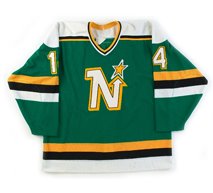
Today's featured jersey is a 1989-90 Kalamazoo Wings Kevin Schamehorn jersey from their days as a Minnesota North Stars affiliate when the club wore the green and gold of the North Stars.
Schamehorn had a long history with the Kalamazoo Wings, playing for the club during eight different seasons spread out over 14 years. After being drafted by the Red Wings in 1976, he played three seasons in Kalamazoo before moving on to other clubs and organizations. He returned to Kalamazoo in 1981 for four seasons prior to the change in affiliation to Minnesota. Again, Schamehorn moved on to other teams for four seasons, which included a year in France, before returning to Kalamazoo for his final season as a pro. During his absence, the Wings changed their affiliation from Detroit to Minnesota, which resulted in the change in team colors, allowing us to accurately date this green and gold Wings jersey to 1989-90.
This example illustrates the detective work involved in dating jerseys we enjoy so much when researching various jerseys, particularly minor league jerseys which lack comprehensive online visual databases that document each and every NHL jersey style and years worn.
Also of note, Kalamazoo's Wings Stadium is the 200th different place we have marked on our Third String Goalie map of jersey locations.
Labels:
IHL,
Kalamazoo Wings
Monday, July 25, 2011
1993-94 Portland Pirates Enrico Ciccone Jersey
July by the Numbers travels to the northeastern United States for jersey #25.
The Erie Golden Blades were created in 1978 as members of the short-lived Eastern Hockey League and won all three championships before the league folded and the team was admitted to the American Hockey League for the 1981-82 season. After one AHL season, the franchise merged with the Baltimore Skipjacks of the Atlantic Coast Hockey League and the new organization played as the Skipjacks in the AHL for 11 seasons before relocating to Portland, Maine for the 1993-94 season.
The relocated franchise was named the Portland Pirates and were affiliated with the Washington Capitals for 12 seasons. The club introduced themselves to the fans in Maine in fine style by winning the Calder Cup as league champions following a 43-27-10 regular season record. Jeff Nelson led the club with 107 points which was fourth overall in the league while the goaltending duo of Olaf Kolzig and Byron Dafoe led the team in goal.
Olaf Kolzig
Byron Dafoe
The Pirates second season saw then finish with 104 points as Nelson again led the team in scoring with three more points than future NHLer Andrew Brunette. Jim Carey took over the bulk of the goaltending duties in year two and posted a 30-14-11 record.
Andrew Brunette
Jim Carey
The club took a step back in the standings with a losing record (32-34-10-4), but weaved it's way through the playoffs, defeating Worcester, Springfield and Saint John to reach the finals for the second time in three seasons only to lose 2-1 in the decisive Game 7. Brunette led the club in scoring with 94 points in 69 games played.
For the remainder of their affiliation with the Capitals the team qualified for the playoffs six out of nine seasons, but won only one playoff series in 1998. They did post a 103 point season in 1999-00, but lost in the first round of the playoffs. Players to skate for the Pirates during this time period included Anson Carter, Richard Zednik, J. P. Dumont, Glen Metropolit, Rob Zettler, Brooks Laich and Tomas Fleischmann.
For the next three seasons the Pirates became the top affiliate of the Anaheim Ducks and the infusion of new players sent the Pirates rocketing up the standings with a 53-19-0-5 record for 114 points and the second best record in the AHL by a single point. After defeating Providence and Hartford, the Pirates lost to eventual champions Hershey in overtime of Game 7 in their semifinal matchup. Ryan Shannon led the club in points with 86 as part of a roster which included at times Dustin Penner, Corey Perry and Ryan Getzlaf.
Corey Perry
The Buffalo Sabres changed their affiliation to Portland for the 2008-09 season, an arrangement that brought Nathan Gerbe and Tyler Ennis to Portland as well as a pair of 100 point seasons.
For the upcoming 2011-12 season the Pirates will be aligned with the Phoenix Coyotes in the first year of a five year contract.
Today's featured jersey is a 1993-94 Portland Pirates Enrico Ciccone jersey from the Pirates successful first season in Maine during which they won their only AHL championship to date.
This jersey is in the classic hockey style of a colored shoulder yoke with matching arm and waist stripes. The thin, serifed font for the names on the back is out of the ordinary, but fits well with the pirate theme.
We must admit we are not fans of the numbers encroaching into the waist and sleeve stripes and would prefer the stripes to be a bit narrower and lower as to leave more room for the digits so they would remain only in the white areas of the jersey in the traditional manner.
The last thing to mention is the odd "Portland" bumper sticker on the left lower front of the jersey. We're not sure where it came from, why they felt it was necessary or how come it was offset to the left, but we're glad it was an idea that didn't catch on.
For today's video section, all we can say is: just what in the hell is this?
Wasn't it nice to see a 20 year old Suzy Kolber dressed for an apparent audition to join the cast of "Friends"? Plus, we always love seeing the original ESPN2 graphics with the black paintbrush look. Those don't look dated at all, do they?
Up next, some of the finest acting in a commercial featuring hockey players ever, ever, ever. Dude, Brian is a natural.
Finally, some actual game footage in this TV commercial for the club. Just how many mascots can one team have anyway? We saw a pirate, a parrot and we are pretty certain the bearded guy on the ATV was William Shakespeare.
Labels:
Portland Pirates
Sunday, July 24, 2011
1999-00 Rockford IceHogs Sean McEachran Jersey
July by the Numbers stops in Northern Illinois for jersey #24.
A member of the United Hockey League, the Rockford IceHogs came into being when the Thunder Bay Thunder Cats were sold and relocated to Rockford for the 1999-00 season after eight years and three championships (as wellas three different names!) in Canada.
The name "IceHogs" was chosen after a "name the team" contest. Jason Firth led the team in scoring with 110 points and the club was a first round exit from the playoffs in year one. The IceHogs failed to make the playoffs in both 2000-01 and 2001-02 but a winning record in 2002-03 returned them to the playoffs but another first round exit awaited them.
A large step back in 2003-04 saw them drop 16 points in the standings and once again fail to qualify for the postseason. The IceHogs began to climb up the standings in 2004-05 when they were led in scoring by Jean-Francois Dufour's 79 points in 77 games. Rockford finished in second place in the Western Division with a 46-25-9 record for 101 points and followed that success by winning their first ever playoff series in Illinois with a 4 games to 2 win over the Kalamazoo Wings before falling to the Fort Wayne Komets in overtime of Game 7 in Round 2.
2005-06 saw the IceHogs improve to a 48-19-9 mark for 105 points and the Western Division title. Rockford bounced For Wayne in Round 1 in five games but were swept by Kalamazoo in the second round.
The IceHogs had another strong regular season in 2006-07, again reaching 48 wins on the way to 103 points and second place in the west. Rockford had an easy time ousting the Quad City Mallards in five games prior to doing the same to Fort Wayne in the second to advance to the finals.
The IceHogs opponents in the finals Kalamazoo required a full seven games in the previous round to advance, giving the IceHogs and additional four days rest, which may have paid off when Game 1 in Rockford required overtime before the IceHogs won 3-2. They cruised to an easy 6-1 win, also at home, in Game 2.
The Wings won games 3 and 4 on home ice 3-0 and 6-5 to send the series back to Rockford for Game 5, where Rockford again won by a score of 6-1 to reach the brink of a championship. Kalamazoo held serve at home in Game 6 with a 6-2 victory to set up a decisive Game 7 back in Rockford.
Rockford made it a clean sweep for the home teams when they captured the Colonial Cup with a 3-1 win in Game 7, which would prove to be the final game in franchise history.
Off the ice, the team's arena authority, who controls the Rockford MetroCentre, purchased both the dormant Cincinnati Mighty Ducks franchise of the American Hockey League, as well as the rights to the UHL's IceHogs identity as part of a 23 million dollar plan to extensively renovate the arena, brining to an end the seven year history of the UHL IceHogs.
The new version of the IceHogs would sign a 10 year agreement with the Chicago Blackhawks of the NHL and compete in the AHL as Chicago's top minor league affiliate, two levels higher up the minor league ladder than the UHL was considered, and take to the ice with the same logo and colors as their predecessors.
Today's featured jersey is a 1999-00 Rockford IceHogs Sean McEachran jersey from the IceHogs debut season in the UHL. Free of the pressures to create a jersey which must generate millions of dollars of income in merchandise sales at the NHL level, minor league jersey designers have the opportunity to take more risks when outfitting their teams.
While some may take the approach of simply putting their logo on the same template as their parent club, especially higher up in the minors when teams have an affiliation with specific NHL clubs, the IceHogs had the freedom to create an attractive new design with bold arm striping, bold numbers and an unusual choice of font for the names on the back, one seldom seen on a hockey jersey.
While the IceHogs logo is very cartoonish, as can often be the case in the low minors, the rest of the jersey is an effective and attractive package overall, and benefits from the solid black and red color combination, avoiding trendy colors which can quickly look dated as tastes change.
Today's video selection is the final two minutes of the UHL's IceHogs as they win the Colonial Cup on home ice.
Labels:
Rockford IceHogs
Saturday, July 23, 2011
1969-70 Salt Lake Golden Eagles Art Quoquochi Jersey
July by the Numbers makes it's way to the Western United States for jersey #23.
While the Salt Lake Golden Eagles franchise had a stable run which spanned parts of four decades, the leagues the team was a member of changed with periodic regularity. The team was founded in 1969 as a member of the Western Hockey League. Two rough seasons as an expansion team followed with less than 20 wins. Still, their win totals increased every year for their first four seasons as members of the WHL.
For the 1974-75 season, the 22 year run of the WHL came to an end and the Golden Eagles joined the Central Hockey League and immediately finished first overall with a 43-24-11 record and won the Adams Cup by defeating the Dallas Black Hawks in overtime of Game 7 of the finals.
The Golden Eagles Doug Palazzari led the CHL in scoring in 1977-78 when he racked up 101 points in 70 games. The following season Salt Lake would finish first overall with a 47-22-7 mark and reach the finals once more.
In 1979-80 Salt Lake would again finish atop the league with 105 points after a 49-24-7 record with Palazzri having a career year after leading the CHL in goals (48), assists (61) and points with 109, 26 clear of his next closest competition. The Golden Eagles would capture their second Adams Cup by edging out the Fort Worth Texans 2-1 in Game 7 of the finals.
The Golden Eagles would win back-to-back titles following their success in 1980-81. Future NHL 500 goal scorer Joe Mullen led the league with 117 points that season and Salt Lake downed the Wichita Wind with the final series once again going the full seven games to determine the champion.
Joe Mullen accepts the CHL Rookie of the Year Award
After three more seasons without a losing record, the Golden Eagles once again outlived their league, as the CHL called it a day following the 1983-84 season. The Golden Eagles, along with the Indianapolis Checkers, chose to press on and found a home in the International Hockey League, a step up the ladder from the CHL.
While the team finished a few games under .500, Scott MacLeod led the IHL with 139 points in 82 games. The prolific MacLeod once again took the league scoring title in 1985-86, this time with 134 points.
Despite finishing with the fifth best record in the league in 1986-87, the Golden Eagles ousted the Milwaukee Admirals in Round 1 of the playoffs in six games and then knocked off the Fort Wayne Komets in five to reach the finals. There, they defeated the Muskegon Lumberjacks in six to capture the IHL's Turner Cup as Mike Rucinski's 27 playoff points in 17 games led the way.
The 1987-88 season was a virtual repeat of the previous season as the Golden Eagles finished with the sixth overall record but marched through three rounds of the playoffs, taking advantage of the top two favorites being upset in the opening round, to win their second consecutive Turner Cup in only their fourth season in the IHL.
The Golden Eagles reached the finals for the third consecutive season in 1988-89 following a franchise record, regardless of league, 116 point season after a 56-22-4 record.
Two seasons later Salt Lake again had a 50 win season in 1990-91 and were led in scoring by Rich Chenomaz for the third time in four years on his way to becoming the franchise's leading scorer during it's time in the IHL, as his 501 points easily lead MacLeod's 273.
Chenomaz, flanked by Palazzari and Lyle Bradley after Chenomaz set the all-time Golden Eagles scoring mark
The Golden Eagles fortunes took a downward turn, finishing with losing records the next three seasons, including missing the playoffs for the final two. Following their last place finish in 1993-94 after only 24 wins, the franchise was sold to interests from Detroit, who moved the team to Michigan and renamed it the Detroit Vipers for the 1994-95 season, bringing an end to the Golden Eagles after 25 seasons and five championships.
Notable players for the Golden Eagles throughout their history include Ernie Hicke and Wayne Rutledge from the WHL era, Jim Craig, Dirk Graham, Walt McKechnie, Mullen, Barclay Plager and Charlie Simmer from the CHL days and Derek Armstrong, Marc Bureau, Shane Churla, Theo Fleury, Stu Grimson, Trevor Kidd, Stephane Matteau, Jamie McLennan and Ziggy Palffy from the IHL days.
Future NHL enforcer Stu Grimson while with Salt Lake
Today's featured jersey is a 1969-70 Salt Lake Golden Eagles Art Quoquochi jersey from the very first season in franchise history. This jersey has several unique design elements, some of which were ahead of their time. While the twin stripes running down the arms are uncommon, the large blue cuffs are rather unique.
Other features that were ahead of it's time were the gold squares across the bottom rather than a single, solid stripe, and the vertical stripes up the sides would come into vogue in 2006 with the introduction of the Nike Swift jerseys as well as the Reebok Edge jerseys when they debuted in 2007.
All in all, a jersey that stands apart from the pack and holds up rather well over time.
Today's video highlight is some rare 8mm movie footage of the Golden Eagles taking on the San Diego Gulls from back in 1972.
Labels:
Salt Lake Golden Eagles
Friday, July 22, 2011
1993-94 Sparta Prague Petr Hrbek Jersey
July by the Numbers jersey #22 takes us to the capital city of Prague.
Founded before even the creation of Czechoslovakia, Sparta Praha (Sparta Prague) was originally formed back in 1893 as an athletic association and they first started playing bandy in 1903.
The Sparta Prague bandy team in 1907
They next ventured into forming an ice hockey team in 1909, making them as old as the Montreal Canadiens and older than every other team in NHL. Sparta eventually joined the First Czechoslovak League on it's creation in 1930.
The Sparta Prague hockey team in 1934 with some sort of unfortunate mascot
The team would capture their first championship in 1953 and immediately follow that up with a second consecutive title in 1954. Their next successes came outside of Czechoslovakia when they won the Spengler Cup in Switzerland in both 1962 and 1963.
It would take Sparta Prague until 1990 to win their third title, led by Jiri Dolezal team leading 58 points. Three seasons later, in 1993, Sparta would become the final champions of the First Czechoslovak League as Czechoslovakia then divided into the Czech Republic and Slovakia.
Jiri Dolezal
Following the split, Sparta would become members of the new Czech Extraliga and would be led to their first title in 1999-00 by team leading scorer David Vyborny, whose 63 points were second overall in the league.
David Vyborny
Two seasons later a 32-9-8 regular season record foretold of another playoff championship in 2002, led this time by Jaroslav Hlinka.
Jaroslav Hlinka
Their next title would arrive in 2006, which was a unexpected triumph considering their mid-pack regular season placing, sixth out of 14. Jan Marek led the Extraliga in scoring for Sparta with 54 points and Hlinka came through in the playoffs with 10 goals and 16 points in 17 games.
Sparta repeated their playoff success in 2006-07, once again led by Hlinka's league leading 57 points. Petr Ton tied Hlinka with 16 playoff points while leading the club with 11 goals in 16 games.
The club will once more be in the spotlight of the hockey world this fall when the host the New York Rangers on September 29, 2011 as part of the NHL Premier Challenge.
Today's featured jersey is a 1993-94 Sparta Prague Petr Hrbek jersey. This jersey was worn during the first season of the Czech Extraliga and features Sparta Prauge's iconic "S" logo on the chest, which is still free and clear of the coming wave of sponsorship that is soon to arrive in European hockey.
Unusually, it also has both the player name and the team name above the numbers on the back, with the team name radially arched, crowding the player name just that much more.
Today's video section features a quite dramatic promo video for Sparta Prague.
Labels:
Sparta Prague
Thursday, July 21, 2011
1997-98 Regina Pats Josh Holden Jersey
July by the Numbers jersey #21 takes us to Saskatchewan for the first time ever.
The oldest major junior team in the world, the Regina Pats were formed in 1917 and t heir original name was the Regina Patricia, after the military unit, Princess Patricia's Canadian Light Infantry, which was named after Princess Patricia of Connaught, granddaughter of Queen Victoria, and whose regimental crest is still worn on the shoulder of the club's jerseys.
The Patricias competed for the very first Memorial Cup in 1919 and again in 1922. In 1923 the team named was shortened to the Pats and two seasons later they won their first championship in 1925 with a 2 games to none win over Toronto Aura Lee. The club won their second title in 1928 when they were briefly known as the Regina Monarchs after merging with the Regina Falcons, with a 2 games to 1 win over the Ottawa Gunners.
1927-28 Memorial Cup champion Regina Monarchs
Their third title in six seasons came in 1930, after having to returned to being called the Pats, with a two game sweep of the West Toronto Nationals. The club made one more trip to the finals in 1933 prior to folding following the 1934-35 season.
1929-30 Memorial Cup champion Regina Pats
It would not be until 1946 that the Regina Pats would be resurrected when two junior teams, the Abbotts and Commandos merged to form a new organization, which became a farm team of the Montreal Canadiens and members of the newly created Saskatchewan Junior Hockey League, as the provence's hockey leagues had previously been divided into separate northern and southern leagues.
Only two seasons later, the Pats would join the Western Canada Junior Hockey League. It would not take the club long to attain success in the WCJHL, as they made their first appearance in the Memorial Cup final in 1950 and again in 1952, 1955 and 1956 after dominating the WCJHL, but agonizingly coming up short each time for the national title.
The club would rejoin the SJHL for 1957-58 and immediately return to the Memorial Cup Final, only to once again come up short. A new WCJHL was formed in 1966 and once again the Pats were on the move to a new league, which then changed it's name to the Western Canada Hockey League. Then, following a dispute over the upper age limit for junior players, the Pats left the WCHL for the SJHL for two seasons before the disputes were resolved and the Pats returned to the WCHL in 1970-71, but not before the Pats made the Memorial Cup in 1969.
The Pats captured the WCHL title in 1973-74, led in scoring by Dennis Sobchuk's 146 points in 66 games, followed by Clark Gilles 112 on their way to a 43-14-11 record. They finished the Round Robin portion of the schedule with a 1-1 record and advanced to the final thanks to their superior goal differential and then defeated the Quebec Remparts 7-4 to capture the first Memorial Cup since the team's rebirth 28 years earlier.
1973-74 Memorial Cup champion Regina Pats
The Pats have again made the Memorial Cup as the now renamed Western Hockey League champions in 1980 behind Doug Wickenheiser's league leading 89 goals and 170 points in 72 games.
The Pats most recent Memorial Cup appearance came in 2001 as hosts, where they fell in overtime of the semifinals.
Since the inception of the NHL Draft in 1963, Larry Wright became the first Pats player selected in the first round, when he was taken 8th overall by the Philadelphia Flyers in 1971. In 1974, Greg Joly became the first Pat ever taken first overall when he was selected by the Washington Capitals followed by Gilles 4th overall. Wickenheiser was the next Regina player taken #1 by Montreal in 1980.
Other first round players selected after playing for the Pats have been Garth Butcher (1981-10th), Mike Sillinger (1989 - 11th overall), Jason Smith (1992-18th), Jeff Friesen (1998-11th), Derek Morris (1996-13th), Brad Stuart (1998-3rd), and Calder Cup winner Barret Jackman (1999-17th). Other notable Pats have included Dirk Graham and Stu Grimson.
The Pats have retired seven numbers in honor of eight players, #1 for goaltender Ed Staniowski, #8 for Brad Hornung, #9 for Gilles, #12 for Wickenheiser, #14 for Sobchuk, #16 for the franchise's all-time leading scorer Dale Derkatch and Sillinger and #17 for Bill Hicke.
Today's featured jersey is a 1997-98 Regina Pats Josh Holden jersey. After a long history of classic jerseys, this style, made by Starter, suffers from the design excesses of the era, making for a loud and garish jersey, which thankfully did not last very long until a return to a more traditional style.
For a very in depth look at the history of the Regina Pats, please visit ReginaPatsHistory.com.
Labels:
Regina Pats
Subscribe to:
Posts (Atom)