Wednesday, July 20, 2011
1975-76 Tesla Pardubice Jiří Novák Jersey
July by the Numbers returns to Eastern Europe for jersey #20.
HC Pardubice was formed in 1923 in Czechoslovakia. The club began to play a regular schedule of games in the early 1930's and at the end of World War II a new open air stadium with artificial ice arrived.
Shortly thereafter, the club won a second division title in 1949-50, earning promotion to the top level of Czech hockey, the Czechoslovak First Ice Hockey League. Since their promotion in 1950, they have remained without interruption at the top level of Czech hockey, a remarkable record of over 60 years of consistency and competitiveness.
On the occasion of their promotion in 1950-51, the club adopted a new name, Slavia Pardubice, which was then changed to Dynamo Pardubice for the 1953-54 campaign. The club set a new high water mark with a third place finish in 1959-60, the same season a roof was added to the stadium for the first time!
The club changed names once again due to a corporate sponsorship arrangement with Tesla, the government-owned electronics conglomerate, and thus became knows as Tesla Pardubice beginning in 1960-61.
In 1964-65, Zdeněk Špaček of Pardubice led the league in scoring with 33 goals. The club received an influx of talent from the 1967 Czechoslovak junior champions when Bohuslav Šťastný, Jiří Novák and Vladimír Martinec all joined the squad which paid off with their first ever league championship in 1972-73 following a first place regular season finish, coming from a 24-9-3 record, and a 4 games to 2 end the domination of six time defending champions Dukla Jihlava. Martinec was awarded the Golden Hockey Stick as the league MVP following the season, the first of four he would win over the next seven seasons.
Vladimír Martinec
That championship earned Pardubice a place in the following season's European Champions Cup, outlasting 15 other clubs to reach the final against the dominant Central Red Army Club of Moscow, Soviet Union, who had won the last five cups in a row. Pardubice defeated Red Army in Game 1 by a score of 3-2 at home, but fell in the second game 6-1 in Moscow for an 8-4 aggregate score for the Soviets.
In December of 1977, Pardubice came to North America and played four exhibition games against clubs from the NHL, losing 6-1 to the Philadelphia Flyers , defeating the Minnesota North Stars 4-2 and then losing to the Detroit Red Wings 5-4 and the New York Islanders 8-3.
In 1978-79, Martinec won his third MVP award, following previous ones in 1975 and 1976, when he led the league with 42 goals.
Two seasons later saw the arrival of Czech hockey legend and Pardubice native, goalkeeper Domink Hašek, who later became the club's number one netminder in 1982-83.
Hašek guided Tesla to the league championship in 1986-87 and 1988-89, winning the Golden Hockey Stick on both occasions. Also winning an award for Best Coach, was former star player Martinec.
1986-87 league champions Tesla Pardubice
With the many political changes in the world in the early 1990's, including the overthrow of the communist government in 1989, the club acquired a new name for the 1991-92 season when they became known as HC Pardubice.
Pardubice became members of the Czech Extraliga following the division of Czechoslovakia into the Czech Republic and Slovakia in 1993. The club has changed names several times since 1995 through a series of sponsorships.
The club rose to the top again, reaching the final in 2003-04 and winning their fourth championship in 2004-05, taking advantage of the opportunity to employ Jan Bulis, Milan Hejduk and playoff MVP Ales Hemsky during the NHL lockout.
Milan Hejduk
2004-05 champions HC Pardubice
Following his retirement from the NHL in 2008, Hašek returned to his roots and signed a one year contract with Pardubice for the 2009-10 season, going 23-10 on his way to leading the club to it's fifth and most recent championship at the age of 44.
Domink Hašek celebrates another championship on his return to him hometown of Pardubice
Today's featured jersey is a 1975-76 Tesla Pardubice Jiří Novák jersey. The front is dominated by the Tesla electronics company logo which makes for a striking jersey unlike any other. The jersey is customized in the classic Czech style of of the era with a small drop shadow and even smaller outline on both the letters, numbers and sponsorship logos.
Novák played for Pardubice from 1967 to 1970 and again from 1972 to 1981. His #20 has since been retired by the club, one of nine such honored sweaters in team history.
Today's video segment is Pardubice winning their most recent championship in 2010.
This next video is a slide show highlighting the fans of Pardubice, showing their passion for the club.
Labels:
Tesla Pardubice
Tuesday, July 19, 2011
1997-98 Brandon Wheat Kings Ryan Robson Jersey
July by the Numbers returns to Canada for jersey #19.
Founded in 1936 as a member of the Manitoba Junior Hockey League, the Brandon Wheat Kings competed in the MJHL for two seasons prior to changing their name to the Brandon Elks for two seasons, which included winning the MJHL championship and the Turnbull Cup in 1938-39.
Following a five year hiatus for World War II, the club returned to the ice for the 1945-46 season as well as returning to the name Wheat Kings to reflect the agricultural nature of their surrounding community in western Manitoba. The club quickly found their stride, winning championships in 1947, 1949 and 1950. They also went on to capture the 1949 Abbott Cup as champions of all of western Canada after defeating the Calgary Buffaloes.
After competing for four more seasons through 1953-54, the club once again went dormant for four seasons from 1954-55 to 1957-58.
The 1953-54 Brandon Wheat Kings
Similar to their previous break during World War II, the Wheat Kings returned with a vengeance. After a third place finish in 1958-59, Brandon reeled off five consecutive first place finishes and converted that dominance into four league playoff victories in five tires, winning titles in 1960, 1962, 1963 and 1964, after a regular season record of 27-1-2! During their five year period of MJHL dominance, the Wheat Kings posted a combined record of 132-34-7.
After three more seasons in the MJHL, the Wheat Kings joined the Western Hockey League for the 1967-68 season where they found life a lot harder going, as it was not until ten seasons for them to achieve a first place regular season finish, all without any playoff success.
The 1976-77 club was led by the trio of Bill Derlago (a WHL record 96 goals and 178 points), Ray Allison (137 points) and Brian Propp (135 points) who took the top three places in the WHL scoring race. They repeated their first place finish in 1977-78 with Propp taking the scoring title with 182 points, but it all really came together in 1978-79 when the Wheat Kings set not only a WHL record, but a Canadian Hockey League (encompassing both the Ontario Hockey League and Quebec Major Junior Hockey League as well) with a stellar 58-5-9 record for 125 points. Propp set the all-time franchise record, as well as setting a new WHL single season scoring record, with 194 points to take his second straight scoring title, 39 points clear of second place teammates Allison (153 points) and Laurie Boschman (149 points).
The 1978-79 Brandon Wheat Kings
Brandon went on to capture the Ed Chynoweth Cup as WHL playoff champions, which earned them a place in the Memorial Cup. While the Wheat Kings finished first in the round robin portion, they lost in the final 2-1 in overtime.
The Wheat Kings fell into a down period with 13 seasons with only one finish above 5th and eight seasons out of the playoffs. The highlight of this era was the 1983-84 season when Ray Ferarro set a WHL record with 108 goals on his way to a league scoring title with 192 points. Cam Plante also set an all-time league record with 140 points for a defenseman that same season.
Beginning in 1992-93, the Wheat Kings rebounded with back-to-back second place finishes before a trio of first place finishes from 1995 to 1997 and another Memorial Cup appearance in 1995 and a playoff championship and subsequent Memorial Cup appearance in 1996.
Five seasons later they were back on top once again for three of the next four seasons (2002, 2003 and 2005), but playoff success eluded them each time. In 2004-05 a trio of Wheat Kings again led the WHL in scoring - Eric Fehr (111 points), Ryan Stone (99 points) and Tim Konsorada (87 points).
Since then the Wheat Kings have managed a pair of first place finishes in 2006-07 and 2009-10, a season during which they also hosted the Memorial Cup and were able to reach the final.
Other notable players for Brandon include Ron Hextall, Brian McCabe, Brad McCrimmon, Jeff Odgers, Chris Osgood, Wade Redden, Jordin Tootoo and Oleg Tverdovsky.
Today's featured jersey is a 1997-98 Brandon Wheat Kings Ryan Robson jersey. This jersey uses the template of the Philadelphia Flyers traditional jersey where the stripe down the arm wraps around the wrists, a look that was much more popular back in the 1980's when it was also used by the Los Angeles Kings.
Labels:
Brandon Wheat Kings
Monday, July 18, 2011
1972-73 Chicago Cougars Ron Anderson Jersey
July by the Numbers visits the Windy City for jersey #18.
One of the founding member clubs of the World Hockey Association, the Chicago Cougars had a tremendous challenge ahead of them as they took on the established Chicago Black Hawks of the NHL on their own turf.
Unlike other WHA clubs who took on NHL teams by playing as tenants in the NHL's home arenas, such as the New York Raiders and Toronto Toros, the Cougars made the ancient International Amphitheater, built in 1934, their "temporary" home, with the hopes of relocating to the Rosemont Horizon when it was completed.
The Cougars opening game was a memorable affair, as the club hosted former Black Hawks standout Bobby Hull and the Winnipeg Jets, who Chicago defeated by a score of 3-1. The remainder of the season proved to be tough going, as the club finished dead last in the WHA with a 26-50-2 record and just 54 points in the standings, 14 behind the Raiders. The team was led in scoring by Bob Sicinski with 88 points and Rosarie Paiement's team leading 33 goals.
Bob Sicinski
With changes obviously needed, veteran leadership was provided by long time Montreal Canadien Ralph Backstrom who was lured away from the Black Hawks along with Pat Stapleton. Backstrom led the Cougars offensively with 33 goals, 50 assists and 83 points and Paiement also reached 30 goals once again while Stapleton had 52 assists from the blueline to lead the team in that category.
The signing of Ralph Backstrom
While the club improved in the standings to 81 points, it was only good for fourth in the Eastern Division, one point ahead of the Quebec Nordiques for the final playoff spot. Once in the playoffs, the Cougars upset the top seeded and defending champions the New England Whalers in seven games, including the final game on the road in Boston.
In one of the typically odd stories surrounding the WHA, the Cougars were unable to play their second round home playoff games against the Toronto Toros in the International Amphitheater due to a traveling production of "Peter Pan" with former Olympic gymnast Cathy Rigby in the title role having been booked into the arena.
An unsuccessful attempt was made to move the games to Chicago Stadium, home of the Black Hawks and the team settled on the undignified solution of playing it's games at a suburban shopping center in Randhurst, where they was a public skating rink called the Randhurst Twin Ice Arena which could hold only 2000 spectators!
The Cougars managed survive this indignity to win two of their three games in Randhurst and play well enough on the road to force a Game 7, which they won on the road to make a surprising appearance in the Avco Cup Finals.
With the Peter Pan show having concluded, the team expected to return to their home rink for the finals, only to find out they arena staff had melted the ice surface and the pipes used to chill the ice were being dismantled for the offseason! Apparently the arena and it's staff were not fans of the team and hadn't been following the Cougars progress against the Toros...
Forced to return to Randhurst, they were swept by Gordie Howe and the Houston Aeros in four straight where the Aeros took the title in the tiny arena next to the shopping mall. The bad publicity from the arena situation caused a sportswriter to come up with one of the all-time classic quotes, "The Cougars were beaten by the greatest lightweight of them all - Peter Pan."
Rookie Gary MacGregor led the 1974-75 Cougars with 42 goals and 76 points, two ahead of Paiement's 74. Dave Dryden came over from the NHL to tend goal. Things were not going well at the box office though, and the team was facing a major financial crisis which threatened to put the team out of business during the 1974-75 season, but the team's three major players, Backstrom, Stapleton and Dryden, purchased the team to keep it going through the end of the season in which the Cougars dropped to 12th place overall out of the 14 teams and failed to qualify for the playoffs.
Dave Dryden
Unfortunately, the reality of the financial situation set in and the club folded following the season, ending their challenge to the superiority of the NHL's Black Hawks, as did every other WHA team who took on an NHL club in the same city, a scene repeated in Boston, Philadelphia, New York, Los Angeles, Minnesota, Toronto, Vancouver and Detroit, giving the NHL a perfect 9-0 record and causing the WHA to retreat to outposts such as Cincinnati, Birmingham, Indianapolis, Phoenix, Calgary and San Diego.
Incidentally, construction of the Rosemont Horizon would not begin until 1977, two years after the demise of the Cougars. It was eventually be completed in 1980 - after the WHA itself had ceased to exist - and has been home to the Chicago Wolves of the AHL since 1994.
Today's featured jersey is a 1972-73 Chicago Cougars Ron Anderson jersey as worn during the club's first season. It features the Cougars prowling cat logo contained in a rink shaped "C", somewhat reminiscent of the Vancouver Canucks original "stick in rink" logo. Additionally, the jerseys featured the player's number on the chest, predating the Buffalo Sabres use of chest numbers, which were hailed as "innovative", by a full 34 years!
The Cougars attractive multi-striped jerseys would remain unchanged through their three years of existence.
Our video section today features the 1973-74 Chicago Cougars in three parts in that classic 1970's style, which of course includes the soundtrack. Lots and lots of game action footage in this treasure trove of WHA video.
Don't miss the use of early rollerblades, or "street skates" in part two!
Labels:
Chicago Cougars,
WHA
Sunday, July 17, 2011
1957-58 Vancouver Canucks Alf Cleary Jersey
July by the Numbers travels to the Pacific Northwest for jersey #17.
As was often the case in the past, when a new franchise arrived in a city it often took the name of a past franchise of the same name. Examples of this can be found especially in baseball and hockey, exemplified by the name "Baltimore Orioles", a name used by five separate clubs dating back to 1882. The most recent example is the return of the Winnipeg Jets name to the NHL.
Often, many casual fans are only aware of the modern incarnation of a team's name, unaware of the long history of the club(s) who pioneered the name previously.
Once such case is that of the Vancouver Canucks of the NHL. The Canucks arrived on the scene in 1970 and have just recently concluded their 40th anniversary season with a run to the Stanley Cup Finals. Prior to the expansion club entering the NHL, there was a previous Vancouver Canucks, which began play back in 1945 in the Pacific Coast Hockey League.
The original Canucks came storming out of the gate, winning the championship in their very first season following a league best 37-27-0 record, led by Andy Clovechok's 56 goals and 103 points in 54 games to lead the league in both categories, while the assist leader was Bernie Bathgate, also of the Canucks.
Two seasons later in 1947-48 the Canucks again came through in the playoffs, capturing their second PCHL title. After four more seasons in the PCHL, the league merged with the Western Canada Senior Hockey League in 1952 and the Canucks became members of the new Western Hockey League for the remainder of their existence.
Their first season in the WHL of 1952-53 ushered in a new era for the Canucks, as future Hockey Hall of Famer Andy Bathgate joined the club and goaltender Emile Francis was named the league MVP.
The very next season future Hockey Hall of Famer Lorne "Gump" Worsley duplicated the feat when he became the WHL's MVP during his first season tending goal for the Canucks as the team finished with the best record in the WHL. Yet another future Hockey Hall of Famer defenseman Allan Stanley also became a Canuck for a period of time in 1953-54.
The parade of stellar goaltending continued in 1954-55 when another future Hockey Hall of Famer Johnny Bower joined the squad. The following season Phil Maloney made it three MVP's in four season when he won the first of his two MVP awards on his way to the league scoring title with 95 points in 70 games, 30 more than any of his teammates.
Phil Maloney
The Canucks won their first WHL championship in 1957-58 after a league best 44 wins and 83 points. Two seasons later, the Canucks once again had the league's highest point total with 94 on their way to a second WHL championship and a fourth President's Cup, as the trophy carried over to the WHL from the PCHL. Goalie Hank Bassen was awarded the league's MVP trophy that same year.
The hardware continued to be awarded to Canuck's players as Maloney won his second MVP in 1963 and winger Billy McNeill won back-to-back MVP's in 1965 and 1966.
Another future Hockey Hall of Famer Tony Esposito played for the Canucks in 1967-68 a year before the Canucks won the league title for the fifth time and captured the now renamed Lester Patrick Cup.
1968-69 WHL champion Vancouver Canucks
In 1969-70, Bathgate returned to the Canucks following a long NHL career. Proving he still had good hockey left in him, Bathgate won the eighth Canuck's league MVP award as he led the Canucks to the best record in the league as well as in franchise history, as the team went 47-17-8 for 102 points on their way to their second consecutive, and sixth league championship in the final game in team history.
Andy Bathgate and the Canucks celebrate after the final game in team history
While Vancouver was unexpectedly passed over during the NHL expansion in 1967, and a deal was stopped to move the Oakland Seals to Vancouver in 1968, the city was finally granted an NHL team for the 1970-71 season, bringing to an end to the WHL franchise after 25 years and six championships.
Today's featured jersey is a 1957-58 Vancouver Canucks Alf Cleary jersey. This striking jersey is in the WHL Canucks blue, red and white colors, as opposed to the NHL's Canucks more familiar choice of blue, green and white.
The Canucks looked to the WHL Canucks for inspiration for their current jerseys, including the arched team name at the top of their jerseys and the revival of the "Johnny Canuck" logo, originally used by the WHL Canucks.
Labels:
Vancouver Canucks (WHL)
Saturday, July 16, 2011
2000-01 Red Deer Rebels Derek Endicott Jersey
July by the Numbers travels to western Canada for jersey #16.
Members of the Western Hockey League since their founding in 1992, the Red Deer Rebels took five seasons to achieve their first winning record in the 1996-97 season when they finished at 43-26-3. After a step back the following season, Red Deer (which is located midway between Edmonton and Calgary) began a run of seven consecutive winning records in 1998-99.
They admittedly started slowly with two seasons barely above .500, but stormed through the league in 2000-01 with a league best 54-12-3 record, led by WHL scoring champion Justin Mapletoft's 43 goal, 120 point season, while teammate Kyle Wanvig was sixth in the WHL with 101 points.
Red Deer cruised to the WHL title with a 16-6 playoff record to earn a place in the 2001 Memorial Cup. They opened with a 5-4 overtime win over Val D'Or and downed Ottawa 4-2 before dropping a game to Regina 5-2. Still, their place in the final was set, and they defeated Val D'Or once again in a 6-5 overtime thriller to win the first Memorial Cup in franchise history.
The 2001 Memorial Cup champion Red Deer Rebels
Two more strong seasons followed, including once again having the league's best record in 2001-02 at 46-18-7 and another 50 win season in 2002-03, but were unable to repeat as WHL playoff champions.
Starting in 2005-06 the Rebels would miss the playoffs three out of four seasons, but they would rebound in 2010-11 with their third Central Division title after being led in scoring by Ryan Nugent-Hopkins, who went on to become the first player from Red Deer ever taken first overall in the NHL Draft.
Nugent-Hopkins joins a list of Rebels taken in the first round of the NHL Draft along with Colby Armstrong, Boyd Gordon, Dion Phaneuf, Brandon Sutter, Cam Ward and Jeff Woywitka. Other recognizeable Rebels to have played in the NHL include Martin Erat, Colin Fraser, Darren Van Impe and Kris Versteeg.
The Rebels are currently owned by Alberta native and former NHLer Brent Sutter, who also spent seven seasons as the club's head coach and general manager, including their Memorial Cup winning season of 2000-01.
Today's featured jersey is a 2000-01 Red Deer Rebels Derek Endicott jersey. This jersey has a classic look, with a basic template quite similar to the Chicago Black Hawks white jerseys thanks to it's three equal width stripes on the arms and waist. Paired with the spooky main crest which features a steer skull logo, which was adopted in 1997, the overall package makes for an excellent look.
Today's video is about Nugent-Hopkins prior to the 2011 NHL Draft showing him in a variety of Red Deer Rebels jerseys.
Labels:
Red Deer Rebels
Friday, July 15, 2011
1975-76 Team USA WHA All Star Game Wayne Carleton Jersey
July by the Numbers returns to North America for jersey #15.
When the World Hockey Association held it's first three All-Star games in the early 1970's they held to the traditional East vs. West format, but for the 1976 game, a change was made on the occasion of the bicentennial of the United States.
The format for the 1976 WHA All-Star Game pitted the All-Stars from the teams based in the US against the All-Stars from the franchises located in Canada. This was not the same as the "World vs. North America" format first used for the 1997 NHL All-Star format where the players were divided based on the location of each players nationality, but the location of the franchise for which they played.
1976 WHA All-Star Game Program
A quick glance at the WHA standings would suggest that the United States team would have a distinct advantage since there were nine US based teams from which to draw players, while the Canadian based teams numbered just five.
The division of players by club location certainly made for a mixed, if not confusing and absurd pair of rosters, as Canadians Gerry Cheevers, Paul Shmyr, Pat Stapleton, Kevin Morrison, John Schella, Rick Ley, Andre Lacroix, Gene Peacosh, Gordie Howe, Dave Keon, Claude Larose, Mike Walton, Wayne Carleton, Ralph Backstrom, Tom Webster and Don Borgeson and Swede Christer Abrahamsson made up Team USA along with just three actual Americans, Marty Howe, Mark Howe (who were born in Michigan while their Canadian father Gordie played for the Detroit Red Wings) and Massachusetts native Robbie Ftorek.
Meanwhile, Team Canada consisted of 14 Canadians as well as Swedes Lars-Erik Sjoberg, Thommie Bergman, Anders Hedberg, Ulf Nilsson and Czechoslovak Vaclav Nedomansky!
The contest was played in Cleveland, Ohio, home of the Cleveland Crusaders and was witnessed by a healthy crowd of 15,491. Despite the perceived advantage of having a larger talent pool to pick from, the "Americans" fell to Team Canada by a lopsided 6-1 score. Team Canada MVP was Canadian Real Cloutier following his hat trick, while Team USA MVP was Crusader (and Canadian) Shmyr.
1976 WHA All-Star Game Ticket
Today's featured jersey is a 1975-76 Team USA WHA All-Star Game Wayne Carleton jersey. This lightweight mesh jersey has the WHA logo on the upper left chest and the American Bicentennial logo on both shoulders and the lower right front of the jersey.
It's actual decoration in minimal, with four narrow sleeve stripes and a trio of stars down each arm. The simplistic block USA on the front and the lack of waist stripes gives the jersey a stark appearance, not unlike that of a modern practice jersey.
Bonus Jersey: Today's bonus jersey is a 1975-76 Team Canada WHA All-Star Game Vaclav Nedomansky jersey. This red mesh jersey is more successful in appearance than the USA version, with it's Canadian flags on the shoulders, diagonal "Canada" across the front, adorned with balanced WHA and a maple leaf logos on either side, as well as maple leafs running down each arm and a pair of waist stripes. While it scores no points for originality, as it is essentially a copy of the 1974 Summit Series jersey with some detail differences, such as two waist stripes rather than three, it is still a pleasing effort all around.
Labels:
WHA
Thursday, July 14, 2011
1969 Czechoslovakia Vaclav Nedomansky Jersey
July by the Numbers travels behind the Iron Curtain for jersey #14.
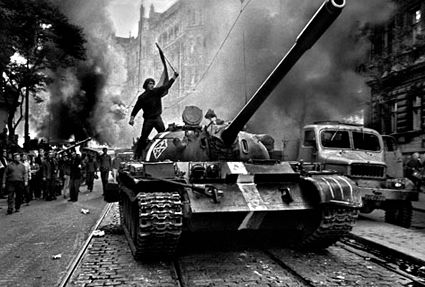
The Prague Spring began in early January of 1968 when Alexander Dubček came to power in communist Czechoslovakia, beginning in a period of liberalization in which Dubček attempted to grant greater freedom by loosening restrictions on the media, art, speech and travel. These reforms did not go over well with the Soviets, who eventually invaded Czechoslovakia and it's capital of Prague with approximately 750,000 troops from the Warsaw Pact (the Soviet Union, Bulgaria, East Germany, Hungary and Poland) on August 20, 1968 which resulted in 108 Czech and Slovak deaths and 500 injuries to primarily civilians. Despite being arrested and taken to Moscow, Dubček was allowed to remain in office and was returned to Prague a week later.
Dubček remained in his position until April of 1969 when he was forced to resign following the Czechoslovak Hockey Riots, which took place in response to the 1969 World Hockey Championships.
Originally scheduled to be held in Prauge, the 1969 World Championships were moved to Stockholm, Sweden due to the invasion and began on March 15th, when the Czechs defeated Canada by a resounding 6-1 score. Sweden beat Finland 6-3 and the Soviet Union destroyed the United States with a 17-2 pummeling also on day one which would prove vital later in the tourament. Entering the tournament the Soviet Union had won the last six World Championships as well as the last three out of four Olympic Games.
On March 21st, the Czechs and Soviets met in day six of the tournament with the Soviets at 4-0 with a 34-6 edge in goals scored up to that point, while the Czechoslovakians were 3-1 following a 2-0 loss to Sweden.
To the Soviet team this was just another hockey game, but not to the Czechs. With 70,000 Red Army soldiers still occupying their country, it was about much more than just hockey.
“We said to ourselves, even if we have to die on the ice, we have to beat them,” said team captain Jozef Golonka many years later. “We received hundreds of telegrams from fans back home when we arrived in Stockholm. Almost all of them said: ‘Beat the Soviets. You don’t have to beat anyone else. Just beat the Soviets.’”
Following a scoreless first period, defenseman Jan Suchý scored his fifth goal of the competition at the 13 minute mark of period two to put the Czechs on top. Josef Černý added a second goal at the seven minute mark of the third period while legendary goalkeeper Vladimir Dzurilla held the Soviets at bay for a 2-0 shutout, sending thousands of Czechoslovakians into the streets back in Prague in celebration.
The Czechs then wrapped up three more wins until they were matched up against the Soviets for the second time, as the tournament format was for each of the six teams to face the other five two times each. The Soviet Union meanwhile marched through their three subsequent games as expected, setting up the rematch with both teams now at 7-1.
Jiří Holík opened the scoring at 15 minutes to put the Czechs ahead 1-0 after one. Vaclav Nedomanský gave the Czechs a 2-0 lead in the first minute of the second, but Valeri Kharlamov responded for the Soviet Union two minutes later and Anatoli Firsov tied the game at the 13 minute mark.
Josef Horešovský delighted the Czech fans with a go-ahead goal at the nine minute mark of the third period before Jaroslav Holík sent them into rapture with another Czech score just two minutes later. Alexander Ragulin got one back for the Soviets with less than two minutes to play, but it was not enough as Czechoslovakia held on for a 4-3 win, becoming the first team to ever defeat the Soviet Union twice in a single IIHF tournament.
Once again, a reported half a million Czechoslovakians took to the streets across the country in what was first a celebration of their hockey team's victory, but, particularly in Prague, evolved into a protest against the Soviet military which had continued their occupation of Czechoslovakia since the previous August.
From Time Magazine April 11, 1969:
Overcome by a vicarious sense of triumph, a huge and excited crowd swarmed into Prague’s Wenceslas Square. One happy hockey fan carried a poster that read BREZHNEV 3, DUBČEK 4. The crowd chanted, “We’ve beaten you this time!” Someone shouted, “The Russian coach will go to Siberia!”
Those particular protests turned violent when not only Soviet military units were attacked and their vehicles burned, but the offices of the Soviet airline Aeroflot were ransacked.
The uprising was suppressed by the Czech military, which was now under control of hardliners from the Communist Party, and the events were used as a pretext to oust the remaining leaders of the Prague Spring from power, Dubček in particular.
Heading into the final two days of the tournament, Czechoslovakia led with an 8-1 record, while the Soviet Union, thanks to their two losses to the Czechs were 7-2 and Sweden was 6-2 after a pair of losses to the Soviet Union. Sweden climbed into a tie with the Soviets thanks to taking their turn pounding the winless United States 10-4.
On March 30th, the Czechs let the gold medal slip from their grasp following a 1-0 loss to Sweden while the Soviet Union made it a three way tie atop the standings at 8-2 thanks to their 4-2 win over Canada. Since the Czechs beat the Soviets twice who beat the Swedes twice who beat the Czechs twice, the medal placings were decided by goal differential, giving the Soviet Union the gold with a +36, the Swedes silver at +26 and the Czechs bronze at +20, which mattered little to the fans back at home following their joy at beating the country of their occupying forces not once, but twice. ”You sent us tanks, we send you goals” was the celebratory cry.
The events of the Prague Spring and subsequent invasion, as well as the fact his grandfather died in prison that year, are preserved by Jaromir Jagr's choice of #68 in remembrance.
Today's featured jersey is a 1969 Czechoslovakia Vaclav Nedomansky jersey as worn in the emotionally charged 1969 World Championships when Czechoslovakia defeated the Soviet Union twice, thrilling the Czechs back at home who were still under occupation.
While many would expect Czechoslovakia to wear red, they have in fact, worn blue off an on during their history, including periods of use in the 1930's, 40's and 50's as well as from 1965 to 1974 before a permanent change to red jerseys in 1975.
This striking jersey is an all-time classic, with the simplicity of the striping, lace up collar, heraldic main crest as well as the unique font for the numbers, which are then drop shadowed and outlined, a treatment which is also carried over to the CSSR lettering on the back, which is then radially arched, an early precursor to player names on the back, which did not become a regular part of NHL jerseys until the mid 1970's.
Bonus Jersey: Today's bonus jersey is a 1995-96 Pittsburgh Penguins Jaromir Jagr jersey which features Jagr's instantly recognizable #68 in memory of the Prague Spring.
In today's video section, scenes from the Warsaw Pact invasion of Czechoslovakia in August of 1968.
Here is a special treat, footage of Czechoslovakia beating the Soviet Union at the 1969 World Championships, showing footage from the game as well as the heroes welcome they received when they returned home.
Labels:
Czechoslovakia,
Jagr Jaromir,
Nedomanský Václav
Subscribe to:
Comments (Atom)