History of Jersey 83-93 Banner sm photo History of Jersey 83-93 Banner sm.jpg

Monday, December 19, 2016

2000-01 Pittsburgh Penguins Robert Lang Jersey

Born in Czechoslovakia on this date in 1970, Center Robert Lang began his professional career with CHZ Litvinov in the Czechoslovak First Ice Hockey League with 3 goals and 5 points in 7 games. He played three more seasons for Litvinov with his best season being 1990-91 when he scored 26 goals and 52 points in 56 games. After the 1989-90 season, Lang was drafted by the Los Angeles Kings in the 1990 NHL Entry Draft.

During his final season with Litvinov, Lang made his international debut at the very top, competing in the 1992 Olympics in Albertville, France. Czechoslovakia earned a bronze medal as Lang contributed 5 goals and 8 assists in 8 games.

Later that spring, Lang made his World Championship debut with 2 goals and 4 points in 8 games as the Czechs earned another bronze medal.

After four seasons with Litvinov, Lang made the leap to North America, first getting used to the style of play with 38 games in the International Hockey League with the Phoenix Roadrunners. He scored 9 goals and 30 points in 38 games, which earned him a call up to the NHL. With the Kings that season, Lang would play in 11 games, registering 5 assists.

 photo Lang Kings 2.jpg
Lang made his NHL debut with the Kings

The following season saw him split time between the Roadrunners (35 points in 44 games) and the Kings, playing in 39 games and scoring his first 9 goals in the NHL. With the start of the 1994-95 NHL season delayed by labor issues, Lang returned to HC Litvinov for 16 games until the NHL season began in January. Once back in the NHL, Lang scored 12 points in 36 games.

He would finally play a full season with Los Angeles in 1995-96, seeing action in 68 games, scoring 6 goals and a new career best of 22 points.

 photo Lang Kings.jpg
Lang wearing the infamous "Burger King" jersey

Following the season, Lang would play in his second World Championships, only this time for the Czech Republic, as Czechoslovakia had separated at the end of 1992 into the Czech Republic and Slovakia. Lang had 5 goals and 9 points in 8 games as the Czechs won Group 2 with 4 wins and a tie before defeating Germany 6-1 and the United States 5-0 before winning their first World Championship as the Czech Republic when they beat Canada 4-2 in the gold medal final, with Lang scoring the first two Czech goals.

 photo Czech Republic 1998.jpg
The gold medal winning 1998 Czech Olympic Team

Later that fall, Lang again suited up for the Czech Republic, this time in the inaugural World Cup of Hockey. The results were quite different, as the current world champions were eliminated after losing all three of their games in pool play.

For the 1996-97 season, Lang returned to the Czech Republic and spent a season playing for Sparta Prague, scoring 14 goals and 41 points in 41 games. With the shorter European season, Lang was again free to play for the Czech Republic at the 1997 World Championships. The Czechs went 4-1 to win Group 1, but found the going tougher in the Second Round, losing to the United States and Sweden. The did defeat Canada and finished in fourth place. That set up a game against third place Russia for the bronze medal, which the Czechs won 4-3 to claim Lang's second World Championship bronze.

He returned to the NHL for the 1997-98 when he was signed as a free agent by the Pittsburgh Penguins on September 2nd. He was claimed by the Boston Bruins 26 days later during the Waiver Draft. After three scoreless games, Lang was waived by the Bruins and reclaimed by the Penguins on October 25th. He played in 9 games with the Houston Aeros in the IHL, but spent the majority of the season with Pittsburgh, scoring 9 goals and 22 points.

 photo Lang Penguins 2.jpg
Lang returned to the NHL with Pittsburgh

During the 1997-98 NHL season, the league took a break from their schedule to allow their pros to compete in the Olympics for the first time. Lang played in 8 games, contributing 3 assists as the Czechs took second behind Russia in Group D before eliminating the United States 4-1 in the Quarterfinals. They then beat Canada 2-1 in a shootout to advance to the final, where they turned the tables on Russia 1-0 to claim the gold medal.

His career changed with the 1998-99 season, as he Penguins style of play suited his game and in 72 games, Lang scored 21 goals, far surpassing his previous high of 9, on his way to 44 points, double his previous best.

In 1999-00, Lang increased his career bests to 23 goals and 65 points before his career season of 2000-01 when he had his first 30 goal season with 32 on his way to an 80 point season, good for fourth on the Penguins behind Jaromir Jagr, Alexei Kovalev and Martin Straka.

 photo Lang Penguins 1.jpg
Lang while with Pittsburgh

Lang would play one more season with Pittsburgh, but was limited to 62 games and 50 points, but was able to compete in his third Olympics in 2002 in Salt Lake City. Lang scored a goal and 2 assists in the four games played by the Czechs before they were eliminated in the Quarterfinals by Russia 1-0.

He was signed by the Washington Capitals as a free agent for the 2002-03 season and scored 22 goals and 69 points in 82 games. He had scored 29 goals and 74 points in 63 games of the 2003-04 season before a trade to the Detroit Red Wings in February for Thomas Fleischmann, a 2004 1st Round draft choice and a 2006 4th Round draft choice. In six games with the Red Wings, he scored 1 goa and 5 points, which game him his second 30 goal season and fell just one point shy of his career best of 80 points, although in just 69 combined games. His effort was recognized when he was named the recipient of the Golden Hockey Stick as the Top Czech Hockey Player of the Year.

 photo Lang Capitals.jpg
Lang won the Golden Stick for his 2003-04 season with the Capitals

With the 2004-05 NHL season cancelled due to labor problems, Lang did not return to Europe like many others chose to do. When the NHL resumed play in 2005-06, he scored 20 goals and 62 points for the Red Wings. He returned for another season with Detroit, scoring 19 goals and 52 points in 81 games. He also participated in his fourth Olympic games that season in Torino, Italy, scoring 4 assists in 8 games. The Czechs had a poor Preliminary Round, finishing fourth in Group A with a 2-3 record, but upset Group B winners Slovakia 3-1 in the Quarterfinals. The lost in the Semifinals 7-3 to eventual gold medalists Sweden, but shut out Russia 3-0 to claim the bronze medal.

 photo Lang Czech 2006.jpg
Lang won a bronze medal while captain
of the 2006 Czech Olympic Team

For the 2007-08 season, Lang singed a two year contract with the Chicago Blackhawks. He contributed 21 goals and 54 points in 76 games, but was then traded to the Montreal Canadiens for the 2008-09 season.

 photo lang Blackhawks.jpg
Lang during his only season with Chicago

With the Canadiens, Lang only saw action in 50 games, but scored 18 goals and 39 points. His season came to a premature end that season when he suffered a season ending cut Achilles tendon while wearing Montreal's controversial 1912-13 throwback barber pole jersey in a 3-1 loss to the rival Boston Bruins, a game which also saw Montreal lose Guillaume Latendresse to a shoulder injury.
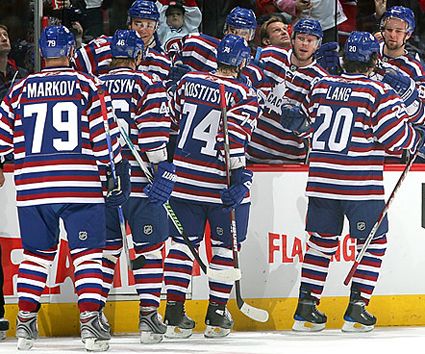
Lang, #20, would not finish the game while wearing Montreal's controversial
throwback barber pole jersey during the 2008-09 season

He was signed by the Phoenix Coyotes for the final season of his career. In 64 games, he scored 9 goals and 29 points. His final NHL career totals were 989 games played, 261 goals and 442 assists for 703 points. He played in an additional 91 playoff games, primarily with Pittsburgh and Detroit, scoring 18 goals and 46 points.

 photo Lang Coyotes.jpg
Lang celebrates a goal while with Phoenix

Internationally, Lang played in 16 games for Czechoslovakia and 45 games for the Czech Republic, scoring a combined 14 goals and 24 assists for 38 points. He won a gold and two bronze medals at the World Championships and a gold and two bronze at the Olympic Games.

Today's featured jersey is a 2000-01 Pittsburgh Penguins Robert Lang jersey from the season Lang set career highs in goals (32), assists (48) and points (80). This jersey featured the Game ONe 2000 patch from the Penguins opening two game series played in Tokyo, Japan against the Nashville Predators.

The Penguins adopted this style jersey for the 1992-93 season after winning two consecutive Stanley Cups. This style was dubbed the "Robo Penguin" and was used for ten seasons through 2001-02.

 photo Pittsburgh Penguins 2000-01 F Japan jersey.jpg
 photo Pittsburgh Penguins 2000-01 B jersey.jpg

Bonus jersey: Today's bonus jersey is a 2006-07 Detroit Red Wings Robert Lang jersey as worn on January 2, 2007, the night the Red Wings retired Steve Yzerman's #19, as commemorated with the #19 patch on the upper right chest.

This simple, yet iconic style was first worn by Detroit in 1932-33, the season they changed their name from Falcons to Red Wings. Aside from changing the original red numbers outlined in white to one color white in 1937 and adding sleeve numbers and names on the back, this jersey remains unchanged for over 80 years and looks to remain the same for another 80 years.

 photo Detroit Red Wings 2006-07 19 RET jersey.jpg
Photo courtesy of Classic Auctions

Extra bonus jersey: Today's extra bonus jersey is a 1996 Czech Republic National Team Robert Lang jersey as worn in the inaugural 1996 World Cup of Hockey. This jersey saw limited use, as the Czechs wore a different style earlier that season when they won the World Championship and adopted a new style for the 1998 Olympics, leaving the 1997 World Championships as the only other time this style would have been worn.

 photo Czech Republic 1996 jersey.jpeg
Photo courtesy of Classic Auctions

Today's video section begins with highlights of two goals by Lang during the 2004 playoffs while with Detroit.


Next, some more amazing stickhandling from the magic hands of Lang.

Sunday, December 18, 2016

1983-84 Edmonton Oilers Wayne Gretzky Jersey

The Edmonton Oilers began their 1983-84 season on October the 5th by hosting the Toronto Maple Leafs. At the 14:25 mark of the second period Wayne Gretzky fed Glenn Anderson, who converted the pass on the power play to tie the game at 2-2 for Gretzky's first point of the season. He would later score his first goal of the season with a shorthanded tally at 2:33 of the third period to give the Oilers a 4-2 lead on their way to an eventual 5-4 win.

 photo Gretzky 83-84 card.jpg

In the second period of the Oilers next game at Winnipeg, Gretzky had an assist at the 53 second mark and then scored two goals, the first one shorthanded, as part of the Oilers 8-6 win.

Gretzky had three more points in the Oilers 4-3 overtime win against the Minnesota North Stars on October 9th, scoring a goal with one second left in the first period and then assisting on a pair of Jari Kurri goals, the second being the overtime game winner.

The Detroit Red Wings were the next to visit the Northlands Coliseum and Gretzky burned them for five points, the opening goal at 10:06 of the first period followed by a pair of assists to give the Oilers a 3-0 lead after one. He extended the lead to 4-0 with a goal from Anderson and Mark Messier just 27 seconds into the second period. Detroit rallied for 3 goals later in the second period to draw to within 1, but the Oilers pulled away with 4 third period goals, with Gretzky getting an assist on last one to make the final 8-3 for Edmonton.

On October 15th, Edmonton traveled to Calgary to take on the Flames. The Oilers prevailed with Gretzky assisting Kurri on the first goal and scoring his 7th of the season 1:06 into the third period, which proved to be the game winner as the Oilers won 4-3.
The Flames and Oilers then reconvened the next night in Edmonton for the second half of their home and home series. The Oilers had an easier time of it at home, winning 5-1 with Gretzky registering 2 assists and the final goal of the game for a 3 point night.

Gretzky Oilers photo GretzkyOilers2.jpg

On the 19th, the Oilers and Vancouver Canucks teamed up for a high scoring track meet in Vancouver. Vancouver led 6-3 after two periods, but that was soon to change. The Oilers and Canucks traded goals in the first two minutes for a 7-4 lead for the Canucks, but then Edmonton reeled off six consecutive goals in 13:04, which began with a goal by Gretzky from Messier and Paul Coffey. Gretzky also scored the final goal into an empty net for his 10th goal and 20th point of the season after just seven games as the Oilers won 10-7 after trailing by 4 with five minutes left in the second period.

Gretzky then scored a goal on the road against the Los Angeles Kings followed by 3 assists back home against the Canucks in a 5-5 tie. He added a goal in an 8-3 loss in Toronto followed by an assist in a 3-1 win in Montreal against the Canadiens. Their road trip concluded with a 5-4 win in Madison Square Garden against the New York Rangers with Gretzky contributing one goal to close out the first month of the season with 13 goals and 14 assist for 2 points.

November began with an 11-3 pounding of the Washington Capitals back in Edmonton. Gretzky oopened the scoring with a goal at 8:31 of the first period and finished the night with 2 goals and 3 assists. Next to visit was the Pittsburgh Penguins, who the Oilers dispatched 7-3 with Gretzky contributing 3 assists.

The fans in Winnipeg were treated to a display of Gretzy's dominance on November 6th when after being held scoreless in the first period, he scored 2 goals and an assist in the second period and then completed his first hat trick of the season at 12:39 of the third. After registering assists on the next 2 Oilers goals, he scored his 4th goal and 7th point of the night with just 7 seconds remaining in Edmonton's 8-5 win. The 7 points put him over the 40 mark with 42 in his only 15th game of the season.

Gretzky Oilers photo GretzkyOilers1.jpg

Next to face the Oilers juggernaut was the Quebec Nordiques, who went down 7-4 as Gretzky had a second period assist on a goal by Kurri and then scored his 20th goal of the season in his 16th game.

The following night in Washtington D. C., Gretzky scored a goal in the first period, was held off the scoresheet in the second and then assisted on another Kurri goal to open the third period. After 2 Captials goals to make the score 4-4, the Oilers put their foot to the floor and reeled off 3 goals over the game's final seven minutes with Gretzky getting the first assist on all three for a 7-4 win and a 5 point night for Gretzky.

Edmonton's road trip then moved to Detroit as Gretzky had 2 goals and 2 assists in the first period and fnished the scoring with his 24th goal of the season to complete his second hat trick of the season and register his second consecutive 5 point game in a 7-3 win, the Oilers eighth consecutive victory, the first of three times that season they would win eight in a row.

The Oilers five game road trip came to a conclusion in Chicago against the Black Hawks. Their winning streak also came to a conclusion with a 5-3 loss, but Gretzky once more assisted on a goal by Kurri.

Back at home, the Oilers blanked the Buffalo Sabres 7-0 as Gretzky was credited with 3 assists, 2 on goals by Kurri. The New Jersey Devils were the next to try their luck at the Northlands Coliseum. After deceiving themselves by scoring the first 2 goals of the game, Gretzky got the Edmonton Express rolling with his 25th goal of the season at 5:43 of the first period. His assist on a goal by Kurri at 15:18 gave Edmonton a lead they would never relinquish. Gretzky added a goal and two assists in the second period and followed that with 2 assists and completed the scoring with a shorthanded goal, this third of the game and third hat trick of the year at 18:05 for a final score of 13-4.

Gretzky's 8 points were a career high and a feat he would repeat only on more time during his stellar career. His 8 points would also put him over the 60 mark, with now 66, in just his 21st game of the season.

 photo Gretzky SI cover.jpg

Another high scoring game against the Jets was up next, as Gretzky scored once in a 7-6 Oilers come from behind win with two goals in the last 13 minutes.

In a 7-3 win over the Kings in Los Angeles, Gretzky waited until the mid point of the third period to assist on the Oilers final two goals. At Minnesota, Gretzky scored a goal at 11:55 of the first period in a 2-2 tie, which raised Edmonton's record to 19-3-2.

While the Blues handed the Oilers their second loss of the month 8-6, Gretzky assisted on 5 of the Oilers 6 goals. Edmonton then closed out November with a 3-3 tie at home to the Philadelphia Flyers, with Gretzky registering a goal and an assist. The goal was his 17th of the month and 30th of the season. The assist was his 33rd of November, giving him 50 points for November and 77 overall in just 26 games played through the first two months of the season.

December began with the Oilers defeating the Kings 7-3 at home with Gretzky earning 3 assists for his 80th point of the season in 27 games. Gretzky had a first period assist in a 4-2 loss to the New York Islanders at home on December 4th and their four game home stand concluded with a stunning 5-4 Oilers win after falling behind 4-0 before the game was even half over. Messier scored from Gretzky to start the comeback at 15:21 of the second before 4 third period goals, one of which was assisted by Gretzky, to give Edmonton the comeback win, highlighted by the winning goal just 26 seconds after the tying goal.

Three days later the two teams met again in Vancouver, with the Canucks turning the tables with a 3-2 win, with Gretzky assisting on the second Oilers goal. From there, it was a cross-continent trip to Long Island to take on the defending Stanley Cup champion Islanders, who roared out to a 5-1 lead after the first period, but Gretzky still managed 2 points from an assist and a goal in the third period, his first goal in five games and the 300th of his career. Additionally, his assist extended his consecutive game point scoring streak to 31, breaking his own previous record of 30.

 photo Gretzky 30 scoring streak.jpg

The Oilers then invaded Madision Square Garden the next night to face the Rangers. Gretzky opened the scoring with a goal just 8 seconds into the game. After adding an assist in the second period, he completed his fourth hat trick of the season with 2 third period goals followed by another assist as Edmonton won 9-4 thanks to Gretzky's 5 point night, which included his 800th career point.

Back in Edmonton on December 17th, the Oilers hosted the Nordiques. Gretzky assisted on both of the Oilers first period goals and then two of the three second period goals. Edmonton kept on coming, scoring three goals in the third period, with Gretzky getting his fifth assist on the 7th Oilers goal and then scoring the 8th an final goal in a 8-1 win for a 6 point game.


Then on this date in 1983, the Oilers traveled to Winnipeg to face the Jets. Gretzky assisted on Messier's power play goal at 7:43 of the first period. He then scored his 36th goal of the season at 10:21 from Coffey on a power play. Edmonton made it 3-0 at 11:01 and the Jets scored their first goal at 17:40, also on a power play. With the Oilers down a man with Coffey in the penalty box, Ken Linseman scored from Messier and Gretzky shorthanded at 18:33.

The assist was Gretzky's 64th of the season to go with his 36 goals, giving him 100 points for the season in his 34th game, setting an NHL record for the fastest 100 points in league history. Gretzky then scored his 37th goal unassisted at 4:12 of the second period for a 4 point game.

The win against the Rangers started a 13 game unbeaten streak for the Oilers, with only a tie on December 23rd versus Calgary being the only slight blemish on a 12-0-1 run which concluded with an eight game winning streak equaling their best of the season.

Gretzky would also keep his scoring streak alive, and would eventually reach 51 consecutive games, scoring 61 goals and 92 assists for 153 points during the streak, which included a second 8 point night on January 4, 1984 when he scored 4 goals and 4 assists. 

 photo Gretzky scoring streak.jpg

On January 7th, Gretzky would score his 50th goal of the season in his 42nd game, doing it in style with a hat trick. It would be the second of three times Gretzky would score 50 goals in 50 games or less. Eventually, he was held off the scoreboard by goaltender Markus Mattson and the Kings on January 28, 1984.

A five game losing streak in early February, with both Gretzky and Kurri out with injuries, was answered with another eight game winning streak once the injured duo returned. Edmonton would go on to finish first in the Smythe Division with a 57-18-5 record for 119 points, good for the President's Trophy as the team with the most regular season points, 15 ahead of the Islanders and Boston Bruins. The 57 wins and 119 points were both new club records.

Gretzky would finish with 87 goals and 118 assists for 205 points to win his fourth consecutive Art Ross Trophy as the NHL's leading scorer. It was his second 200 point season to date. He would eventually win the Art Ross Trophy seven consecutive times and ten overall. He woud score ten hat tricks that season, including four times scoring 4 goals in a game. He would also set a new league record with 12 shorthanded goals in a single season.

 photo Gretzky Ross.jpg

Gretzky would also win his fifth straight Hart Trophy as the league MVP and Lester B. Pearson Award as Outstanding Player.


 photo Gretzky Hart.jpg

In the playoffs, the Oilers swept the Jets in three games, outlasted the Flames in seven, swept the North Stars in four and then defeated the Islanders in five games, ending the New York dynasty at four Stanley Cups and beginning one of their own. Gretzky led the league in playoff scoring with 13 goals and 22 assists for 35 points, seven better than Kurri for the Oilers.

 photo Oilers 1984 Stanley Cup.jpg

Today's featured jersey is a 1983-84 Edmonton Oilers Wayne Gretzky jersey. The Oilers would go on to win the Stanley Cup at the conclusion of the season, and interestingly, each of the four times the Oilers would win the cup with Gretzky as captain, it would be at home in their white jerseys

When Edmonton first entered the NHL in 1979 following the demise of the WHA, they changed the colors of crest of their jerseys but, aside from minor detail changes to fonts for names and numbers and some tweaking of shades of color, they kept the same style for 17 seasons through the 1995-96 season.

Edmonton Oilers 1983-84 jersey photo Edmonton Oilers 1983-84 jersey.jpg
Photo courtesy of Classic Auctions

Bonus jersey: Today's bonus jersey is a 1984 NHL All-Star Game Wayne Gretzky jersey worn the season of his 51 game scoring streak when he set the record for the Fastest 100 Points. 


This style was worn by the NHL All-Stars for three years starting in 1984. Gretzky would wear it in both 1984 and 1986 when the Campbell Conference was considered the road team and wore the dark version. He wore the white home version in 1985.

During the 1984 game, Gretzky scored a goal in a 7-6 loss by the Campbell Conference.

NHL All Star 84 & 86 F
NHL All Star 84 & 86 B

Today's video section begins with highlights of Gretzky's 8 point night against the Devils.


Next, Gretzky breaks his own 30 game scoring streak record when he scores in his 31st consecutive game on December 13, 1983.


Finally, Gretzky's streak hits 51 straight games on January 27, 1984.

Saturday, December 17, 2016

1921-22 Ottawa Senators Frank "King" Clancy Jersey

After playing junior hockey in his native Ottawa, Frank "King" Clancy garnered the attention of the local professional club, the Ottawa Senators, who just happened to be the current World Champions.

After a tryout with the Senators, he was signed to a three year contract for $800 a year. When his current, amateur club, the St. Brigid's Athletic Club heard Clancy was planning to leave their team, they attempted to get him to reconsider, talking about the merits of amateurism and how money can often taint a sport and take the joy out of it for the athlete. When they could see that their star player was unconvinced, St. Brigid's make a counteroffer...

Seven dollars and fifty cents - for the entire season!

They explained that was all the money they had left in their treasury and Clancy could have it all if he'd stay!

Needless to say, Clancy became a member of the Senators for the 1921-22 season and played the first game of his NHL career on this date in 1921.

Clancy Rookie Card, Clancy Rookie Card

Clancy relates the story of his first NHL game in the 1968 book "Clancy: The King's Story as Told to Brian MacFarlane";
My first game as pro! I can remember it like it was last night. We were scheduled to play in Hamilton, and they had players on their roster like Goldie Prodgers and Ken Randall and the two Mummery boys [Harry and Walter]. They were all big men, powerful men. The night before I left home for that encounter, my poor dad came down to the station in Ottawa and gave me the kind of advice that any father would give a boy going off to play his first professional game. He took me aside, told me not to worry, to do my best and a lot of other things. Then he shook my hand and wished me luck as I got on the train. 
Now we're on the train and on our way, and I thought everything was just great. Every once in a while some passenger would come down the aisle and I could see he'd recognize some of the players. Now and again one the boys would be asked for his autograph. Nobody recognized me, of course, but I was tickled pink to be among the famous Ottawa Senators. 
We stayed at the Royal Connaught Hotel in Hamilton and that was great too. The next morning going into breakfast, I learned something else. At home my breakfast usually meant a plate of porridge, a piece of toast and maybe a glass of milk. But these guys! They polished off everything! Double orders of bacon and eggs, flapjacks, sausages, toast, rolls, and gallons of milk. I'd never seen fellows eat like that in all my life! It was a revelation to see a bunch of hungry hockey players tie on the feedbag. 
That night we headed out to the Barton Street Arena, the same arena that's used for hockey in Hamilton today. And if I thought I was going to get in a lot of ice time in my first game as a pro, I soon had another thing coming. 
Frankie Boucher and I sat on the bench right though the sixty minutes of game time. We got a chance to warm up before the game and we took a whirl around the ice between periods, but during the actual play we didn't get a smell of the ice. Boucher didn't get the call; I didn't get the call. We're sitting there like a couple of dummies. Now we come to the end of regulation time and the game is tied 2-2. This mean we have to play overtime. The coach, Petey Green, taps me on the shoulder and says, "You go out there in place of [Eddie] Gerard on the defence." Then he turns to Boucher and says, "You go out there in place of [Frank] Nighbor at centre ice." Now this was sudden-death overtime and no time to be making mistakes, and here's the coach throwing two bushers out there in place of two of the greatest players in the game. 
We just begin the overtime, when I get the luckiest break in the world. I remember getting the puck. It came back to me off the draw, and it looked like a big watermelon rolling my way. I slapped at it with my stick and stumbled on ahead with it before I let fly a pass across to Punch Broadbent. I kept going up the ice because I didn't have sense enough to stay back on defense where I belonged. Then, whoops-a-daisy, I get the puck right back again, but I was off at a poor angle and on the wrong side of the net when I took this pass. There wasn't much I could to but wing a shot at the net. I let go a backhander and, lo and behold, I look up and see the goal judge waving his handkerchief and wave it in the air. To me, this handkerchief looked at big as a bed sheet. 
I had scored on my first shot as a professional in the National Hockey League, and it was a winning goal in sudden-death overtime. Naturally I was robbed by my teammates and it then dawned on me that I should keep the puck as a souvenir. When I went after it, the Hamilton goalkeeper, a fellow by the name of [Howie] Lockhart, just glared at me. I never did know why, until a couple of years later when I met him outside the rink one day and asked him why he would do such a thing. He said it was because the puck went though a hole in the netting at the side of the goal! It hadn't gone in the front at all and so it shouldn't have counted! 
But my first goal did count and we beat Hamilton 3-2 on that shot of mine. To this day I'm not sure whether to be proud of it or embarrassed by it. But scoring that goal on my first shot in the big leagues did one thing for me. It gave me a little confidence. My teammates hadn't see how the puck went in and they couldn't care less. In the shower after the game, Gerard, whose place I'd taken, came over to me and said, "Frankie, that was a terrific shot!:" I thought it was too - until this fellow Lockhart told me what he thought about it some time later.
The "goal" would be one of just four Clancy would score as an NHL rookie in 24 games that season. Clancy would play nine seasons with the Senators, winning Stanley Cups in 1923 and 1927 and being named their captain in 1928, before moving on to the Toronto Maple Leafs in 1930 in exchange for $35,000 and two players as the struggling Senators began to sell of their most valuable assets in an effort to stay in business.

Clancy Sold, Clancy Sold

Clancy would play for the Maple Leafs for seven seasons, winning another Stanley Cup in 1932, where his charismatic personality, combined with his small size and extra large toughness, would make him a beloved icon in Toronto.

1923-24 Ottawa Senators team, 1923-24 Ottawa Senators team
The 5' 7" Clancy (back row, far right)  is dwarfed by his much larger
Senators teammates in this 1923-24 team photo

Clancy was said, according to McFarlane, to have started a thousand fights and never won any of them. At the time of his retirement in 1937, Clancy was the highest scoring defenseman in NHL history with 136 goals in 592 games, with his best season coming in 1930 with 17.

Clancy Maple Leafs, Clancy Maple Leafs

Following his playing days, Clancy became an NHL referee for 11 years before he went into coaching, first in the American Hockey League, which included a Calder Cup championship with Pittsburgh in 1952.

Doug Bentley and King Clancy Referee, Doug Bentley and King Clancy Referee
Doug Bentley politely conversing with referee Clancy

He was promoted to coach of the Maple Leafs in 1953 and, after three seasons, became assistant general manager until 1969 when he was made vice-president of the club, a position he held until he passed away at the age of 83 in 1986, the last surviving member of the 1923 Stanley Cup champions.

Clancy Coach, Clancy Coach

Clancy was inducted into the Hockey Hall of Fame in 1958 and the Canada Sports Hall of Fame in 1975. In 1998, he was ranked #52 on The Hockey News list of the 100 Greatest Hockey Players.

One further tribute was bestowed on the legendary Clancy when the King Clancy Memorial Trophy was named in his honor and is awarded annually since 1987 to the NHL player who demonstrates leadership qualities on and off the ice and who has made exceptional humanitarian contributions on the community.

Clancy Autograph, Clancy Autograph

Today's featured jersey is a 1922-23 Ottawa Senators King Clancy jersey. The Senators wore their barber pole jerseys for each of their 14 seasons in the NHL, a style which actually dates back to the turn of the century years prior to the formation of the NHL.

The Senators occasionally wore a special patch commemorating their standing as league champions and in 1929 an "O" crest arrived, but the black, red and white stripes were a constant, both at home and on the road, as the first road jersey did not arrive until the 1927-28 season when the newly renamed Maple Leafs introduced a white jersey to be worn for games against the New York Rangers, who also wore blue sweaters.

Ottawa Senators 1922-23 jersey, Ottawa Senators 1922-23 jersey

Bonus jersey: Today's bonus jersey is a 1931-32 Toronto Maple Leafs King Clancy jersey. This white jersey was the first road jersey in NHL history, necessitated by the green-clad Toronto St. Patricks being sold and changing their name to the Toronto Maple Leafs during the 1926-27 season.

When the Maple Leafs introduced a new blue jersey for the 1927-28, the New York Rangers were already wearing blue, which, for the first time in league history, necessitated a special jersey to avoid the confusion of both teams wearing blue sweaters. It would not be until six seasons later in 1933-34 that the New York Americans would become the second team to wear two different sweaters during a season.

Toronto Maple Leafs 1931-32 jersey, Toronto Maple Leafs 1931-32 jersey

In today's video  section, a look at the versatility of Clancy.


Friday, December 16, 2016

Kazakhstan Independence Day

Kazakhstan had been a part of the Soviet Union since 1920 and between 1926 and 1939, it lost 22% of it's population to starvation, violence and mass emigration. Many Kazakh writers, poets, politicians and historians were killed on orders from Joseph Stalin as part of plans to suppress Kazakh identity and culture. During the 1930s and 1940s millions of people exiled from other parts of the Soviet Union were relocated to Kazakhstan, in many cases to large labor camps. By 1959, Kazakhs were a minority in their own country, accounting for only 30% of the population, while 43% were now Russians.

One of the most controversial elements of Soviet control over Kazakhstan was the Soviet leadership's decision to use lands in Kazakhstan for testing of nuclear weapons starting in 1949, causing catastrophic ecological and biological effects felt generations later, causing even greater anger toward the Soviet system when the long term effects of nuclear activity became known.

 photo Soviet Nuclear Test.jpg
A Soviet Nuclear test in Kazakhstan

Growing tensions within the Soviet Union led to a demand for political and economic reform in the 1980s, and came to a head in the early 1990s. When the Soviet Union dissolved, Kazakhstan declared it's independence on this date in 1991, the last Soviet republic to do so in part because of Kazakhstan's leadership feeling that the various republics of the Soviet Union were too interdependent economically to survive separation from each other.

Kazakhstan's Independence Day is normally celebrated for two days, December 16th and 17th. Speeches, songs and performances, dressing in traditional clothing are all a part of the traditional festivities.

 photo Kazakhcostume2.jpg
Three women in traditional Kazakh clothing

Many villages will set up a yurt, a large tent used in the past by nomad Kazakhs, where local delicacies are served are traditional parts of the celebrations.

 photo f5402721-2c9b-4683-8a2d-ccac7c631aca.jpg
The interior of a Kazakh yurt

Visits to friends and relatives are made, with gifts of flowers or candies given. Tournaments with traditional games and races are held, and accompanied by other activities such as parades and fireworks.

kazakhstan flag photo kazakhstan-flag.png

Kazakhstan is the ninth-largest country in the world and the largest landlocked one. It is located primarily in Asia. It's population mix has swung back toward Kazakhs, who now make up 67% of the population, with Russians at 21%.

In hockey, the Kazakhstan National Team made their World Championships debut in 1993 in "Pool C", the third level at the time, finishing 3rd. They have made a steady climb from their early days, and in 1996 they won "Pool C", earning promotion to the "Pool B". Seven years later, Kazakhstan won the Division 1, Group A (the equivalent to the old "Pool B") in 2003, earning a place in the Top Level for 2004.

After two years of avoiding relegation, they were relegated in 2006 back to Division 1, and finished first in Division 1, Group A early in 2009, earning a promotion back to the Top Level for 2010 beginning a cycle of promotion and relegation which saw them demoted in 2010, promoted in 2011, demoted again in 2012, promoted back to the Top Division in 2013, relegated in 2014, promoted in 2015 and once again relegated in 2016.

Kazakhstan has competed at the 1998 and 2006 Winter Olympics, finishing in 8th place in 1998. They did not qualify in 1994, 2002, 2010, fell short by a single point in 2014 and were unsuccessful most recently for 2018.

Nikolai Antropov became the first ever Kazakh player drafted by the NHL when he was picked in the first round by the Toronto Maple Leafs in 1998. Antropov, a right winger, would play nine years with the Maple Leafs, two seasons with the Atlanta Thrashers and two more with the Winnipeg Jets after the franchise relocated. His final NHL totals were 788 games played, 193 goals and 272 assists for 465 points with his best season being 2009-10 with Atlanta when he scored 24 goals and 67 points.

He finished his playing career with two seasons back in Kazakhstan with Barys Astana. Antropov also played for Kazakhstan at the World Junior Championships in 1997, 1998 and 1999, the World Championships in 1998 and 2014 and the 2006 Olympics.

Antropov Maple Leafs photo AntropovMapleLeafs.jpg
Nik Antropov

The other notable Kazakh to have played in the NHL include goaltender Evgeni Nabokov, although he is a Russian citizen and chose to play for Russia in international competitions, he did play for Kazakhstan in the 1994 World Championships.

Only four other Kazakhs have played in the NHL, wingers Konstantin Pushkarev (17 games with the Los Angeles Kings in 2006-07) and Konstantin Shafranov (5 games with the St. Louis Blues in 1996-97) and goaltenders Vitaly Kolesnik (8 games with the Colorado Avalanche in 2005-06) and Vitali Yeremeyev (4 games with the New York Rangers in 2000-01).


 photo Pushkarev Kings.png
Konstantin Pushkarev

The best known club hockey team of the seven in Kazakhstan is Barys Astana, which competes in the primarily Russian Kontinential Hockey League (KHL). The club was founded in 1999 and played in the Kazakhstan Hockey Championship until 2004 when they joined the Russian hockey system, starting out in the third level. They won the Ural-Western Sibera Zone in 2007 and were promoted to the second level, spending the 2007-08 season in the Vysshaya Liga prior to gaining acceptance into the new Kontinental Hockey League for its inaugural 2008-09 season. In parallel with its KHL schedule, Barys has also won Kazakhstan championships in 2008 and 2009. The popularity of the club can be illustrated by the club's move from the 4,070 seat Kazakhstan Sports Palace to the brand new Barys Arena, which has a capacity of 12,000 fans.

NHL veterans Antropov and Yeremeyev both have played for the club, whose roster is dominated by Kazakhs, as 28 of 32 of their players are homegrown talent.

 photo BarysAstanateam.jpg
Barys Astana

Today's featured jersey is a 2004 Kazakhstan National Team Roman Kozlov jersey as worn in the 2004 World Championships featuring a pair of our custom made Zepter sponsorship patches on the sleeves. Kazakhstan did end up in the relegation round after three preliminary round losses, but successfully defended their place by winning the group with victories over France and Japan along with tying Ukraine.

This style was worn from 1998 to 2004 with some variations along the way, such as the addition of the name Kazakhstan below the crest in 2003 and the side panels being white in 2001 and 2002.

This well traveled jersey was purchased on ebay from a seller in Australia of all places. It arrived already customized, but given the choice, we would have opted for one of the much longer names frequently found on the Kazakh national team roster, with names of 10-14 letters long being common.

Kozlov has competed for Kazakhstan on seven different occasions, including the European Junior Championships in 1999, the World Juniors in 2001 and the World Championships every year from 2001 to 2005 with a record of 27 games, 3 goals and 6 assists for 9 points and has spent his professional career in the Vysshaya Liga, the second level of Russian hockey.

 photo Kazakhstan2004F.jpg
Kazakhstan 2004 jersey photo Kazakhstan2004B.jpg

Bonus jersey: Today's bonus jersey is a Toronto Maple Leafs Nikolai Antropov jersey as worn by the most accomplished NHL player from Kazakhstan.

After wearing it as a throwback jersey for the closing of Maple Leaf Gardens in 1999, the Maple Leafs brought it back as an alternate jersey for the 2000-01 season. The club wore this style through the 2006-07 season when all third jerseys were dropped for the 2007-08 season with the change to the new Reebok Edge jerseys. An Edge version of this jersey was then reinstated for the 2008-09 season and worn through the 2010-11 season.

 photo Toronto Maple Leafs 2008-09 F jersey.jpg
 photo Toronto Maple Leafs 2008-09 B jersey.jpg

This brief video shows Kazakhstan qualifying for the 2006 Winter Olympics in Torino, Italy.

Thursday, December 15, 2016

The Halifax Explosion - 1917-18 Montreal Wanderers Harry Hyland Jersey

The morning of December 6, 1917 was like any other day in Halifax, Nova Scotia. Halifax had been founded by the British military as a fortress to protect their interests against the French back in the late 1700s thanks to its large and deep natural harbor as well as its strategic location.

Halifax Before, Halifax Before
Early 20th Century Halifax

With World War I raging in Europe, the factories, foundries and mills in both Halifax and nearby Dartmouth were working at full capacity, keeping the harbor busy with with shipping convoys taking goods and supplies across the Atlantic, destined for the war effort in Europe.

Ferries to and from Dartmouth, located on the opposite side of the harbor, civilian shipping, as well as fishing boats and pleasure craft all competed for space with the military shipping traffic on the harbor adding to the congestion.

Meanwhile, the French vessel the Mont-Blanc was loaded with 228,000 kilos of TNT, 2.1 million kilos of wet and dry picric acid, a toxic substance used in the making of munitions and explosives, 223,000 kilos of Benzol, a highly flammable liquid similar to gasoline, and "guncotton", a highly flammable substance used in firearms, all of which made the Mont-Blanc a floating bomb of the highest order.

The Mont Blanc, The Mont Blanc
The Mont-Blanc

Unable to cross the Atlantic solo due to the risk of a German u-boat attack, the Mont-Blanc sailed out of New York for Halifax in order to join a convoy of other ships congregating in Halifax Harbour in the interests of safety. While the ship arrived in late afternoon on December 5th, it was too late in the day to enter the harbor, as the anti-submarine nets had been closed for the night, forcing the Mont-Blanc to spend the night outside the harbor.

Meanwhile inside the harbor, the Belgian relief ship Imo was forced to delay its scheduled departure that day due to the supply of coal for its boilers arriving too late for it to leave for New York in order to collect emergency supplies for civilians in war ravaged Belgium prior to the harbor gates being closed.

At 7:30 in the morning on December 6th the navy opened the gate in the nets, allowing the Mont-Blanc to head into the harbor, traveling at a speed of four knots, under the limit of five knots. At the same time, the Imo headed toward the Narrows to begin its voyage south. As the Imo increased its speed to seven knots, it encountered the first ship entering the harbor. That incoming ship went against the usual rules of passing on the left. The two ships exchanged horn blasts to signal their intent, which resulted in the Imo passing the other ship on the right, putting the Imo on the wrong side of the harbor in the Dartmouth channel.

Once past the first ship, the Imo continued to steam along on the wrong side of the channel, allowing it to avoid a tug boat towing a pair of barges which had just pulled away from the Halifax shore on the right of the Imo.

The Mont-Blanc and the Imo were now in the same channel as they continued to travel toward each other. The Mont-Blanc blew its whistle first to signify that it had the right of way and would be maintaining course, implying the Imo would have to move to the right to clear the way. The captain of the Imo however, had other thoughts, and blew his whistle twice to signify his intent to hold his course. The Mont-Blanc then moved slightly to its right closer to the Dartmouth shore to give the Imo additional room for clearance, hoping the Imo would respond in kind by moving to its right in order to give the two ships adequate distance between them for safe passage. When the Mont-Blanc again blew its whistle once, the Imo responded with two blasts of his horn, indicating it would not be changing course.

The sailors who knew what the repeated signals meant realized trouble was brewing and gathered to watch the two ships. Finally, as the Mont-Blanc and the Imo were bearing down on each other, the Mont-Blanc turned hard left into the center of the channel to avoid a collision with the Imo, as it could not move any further toward shore for fear of running aground while loaded with such dangerous cargo.

Unfortunately for all concerned, the Imo now finally chose to change course by reversing engines, which swung the ship to its right - and into the path of the Mont-Blanc. If only one of the ships had made its evasive maneuver, nothing more than a close call would have been the result. However, they both were now aimed for the same spot and the resulting collision caused the Imo to penetrate nine feet into the hull of the Mont-Blanc at 8:45 AM. The Imo then pulled away to extricate itself from the Mont-Blanc, causing enough sparks to ignite the lethal combination of picric acid and vapors from the ruptured drums of benzol, producing an uncontrollable fire at the forward end of the damaged Mont-Blanc.

Fearing an immediate explosion, the captain of the Mont-Blanc ordered the crew to abandon the ship, which was spewing a large column of oily, black smoke. As the public gathered on the streets or stood at the windows of their homes to watch the spectacular fire and exploding barrels of benzol rocketing into the air.

The rescuers, as well as those on the shore, had no idea of the danger contained inside the Mont-Blanc, as any outward warnings of the dangerous cargo in the form of red flags were not displayed on the Mont-Blanc for fear of drawing unwanted attention from the Germans while at sea. As boats rushed to their assistance, the crew of the Mont-Blanc attempted to warn them off as they rowed furiously ashore in their lifeboats, but they were unable to be understood, as the crew spoke only French as they reached the Dartmouth side and ran for the woods and to safety.

The hastily abandoned ship was now not only ablaze, but also adrift and moving toward Halifax's Richmond neighborhood and into Pier 6, which then caught fire as well. The boat was then met by the Halifax Fire Department, with its one motorized truck and a dozen horse-drawn wagons, who were all unaware of the ship's highly dangerous contents.

And then it happened.

The Mont-Blanc erupted with a force stronger than any man-made explosion in world history prior to the atomic age. The ship shattered and was blown sky-high, 980 feet into the air. White hot pieces of its hull came falling back to Earth as lethal shrapnel rained down all over Halifax and Dartmouth. A 1,140 pound piece of the ship's anchor landed 2 1/2 miles away while the Mont-Blanc's gun barrel flew over three miles, landing clear across the harbor in Dartmouth.

Halifax Explosion, Halifax Explosion
This photo was taken just seconds after the explosion of the Mont-Blanc

The fireball rose over 6,200 feet over the harbor, symbolizing the hell that had just descended on the area. The smoke from the fire reached 20,000 feet while buildings shook and items fell off of shelves as far as 80 miles away with the shock wave being felt 200 miles away as 400 acres in the immediate vicinity were completely destroyed by the blast.

Halifax damage map, Halifax damage map
Halifax damage map

Homes, apartments, business and the sugar refinery were all destroyed in an instant. Every building within a 10 mile radius, 12,000 in all, were badly damaged, if not destroyed.


Richmond School, Richmond School

Additionally, the water immediately surrounding the ship was evaporated by the intense heat of the explosion, which momentarily exposed the harbor floor! The shockwave from the blast sent water rushing violently outwards, creating a wave that spread toward both shores, rising as high as 60 feet. The wave carried the Imo onto the shore on the Dartmouth side of the harbor as the tidal wave washed up three blocks into the city.

The Imo, The Imo
The Imo, washed ashore on the opposite side of the harbor

Over 1,500 people died instantly, while 9,000 were injured by not only the blast, but falling debris from the shattered ship, collapsing buildings and shards of flying glass, which blinded 38 people with roughly 600 more suffering eye injuries while standing at their windows watching the initial blaze.

Many of those who survived the initial blast now had to hang on for their lives as the water rushed up onto the shore where they had gathered, claiming more victims who were in shock or injured and unable to withstand the surging waters. Miraculously, all but one of the crew of the Mont-Blanc survived the disaster.

Since it was wintertime, fires broke out all over as stoves, lamps and furnaces throughout the area were toppled, igniting blazes fueled by the debris, which claimed even more victims throughout the region, in part due to the majority of the firefighters having died in the initial blast, as well as the lack of standardized equipment from town to town which hampered the efforts when fire hoses could not be coupled together.

Halifax Explosion, Halifax Explosion
The damaged Halifax Exhibition Building

More fatalities occurred the following day when a blizzard dumped 16 inches of snow on the region, which included those still trapped in the rubble of collapsed buildings, those not yet tended to and those susceptible to the cold, as homes no longer had glass in the windows to contain any heat. In the days that followed, people moved into churches, temporary shelters and even railroad boxcars - anywhere warm and dry.

Halifax After, Halifax After
Halifax after the snowfall

The final death toll was 1,950 with 1,630 homes destroyed in the explosion and fires. 6,000 people were rendered homeless and 25,000 lacked adequate housing. Industry was essentially gone, as was the workforce.

Halfiax Herald Headline, Halfiax Herald Headline

In 1994 a study was conducted comparing 130 major, artificial, non-nuclear explosions by a team of scientists and historians and they concluded that "Halifax Harbour remains unchallenged in overall magnitude as long as five criteria are considered together: number of casualties, force of blast, radius of devastation, quantity of explosive material and total value of property destroyed."

Mont Blanc anchor, Mont Blanc anchor
The piece of the Mont-Blanc anchor, which was hurled over 2 miles by the blast

Nine days after the disaster, the first exhibition game in NHL history was contested between the Montreal Canadiens and the Montreal Wanderers played a benefit game for the victims of the explosion at Halifax Harbour.

The first NHL season was only four days away, as the league had only just been formed the previous month when the owners of the Canadiens, Wanderers, Ottawa Senators, Toronto Arenas and Quebec Bulldogs, in an effort to rid themselves of contentious, difficult and abrasive fellow National Hockey Association owner Eddie Livingstone.

Livingstone, who owned both the Toronto Shamrocks and Toronto Blueshirts, had multiple disagreements with the NHA and his fellow owners over many matters, including his ownership of two clubs, which gave him two votes in league matters. He feuded with the Wanderers owner Sam Lichtenhein in particular, and at one point Lichtenhein offered Livingstone $3,000 to simply close up shop and walk away from the NHA, while Livingstone countered with a $5,000 offer if Lichtenhien would do the same!

Today's featured jersey is a 1917-18 Montreal Wanderers Harry Hyland jersey. At their November, 1917 annual meeting, the NHA voted to suspend operations, supposedly "due to the difficulty in running a five team league", only to meet again in a weeks time, only this time without Livingstone, to form a new five team league, the National Hockey League, which was the NHA minus Livingstone but with the Toronto franchise in new hands.

The Wanderers, who had been formed back in 1903, had first taken possession of the Stanley Cup in 1906 by winning the ECAHA playoffs and won seven cup challenges and four league titles over the next five seasons. They then fell on hard times after entering the NHA, losing the only playoff series they contested over the next eight seasons. Their final three NHA seasons saw a string of fourth and fifth place finishes, thanks in part to the loss of players off to serve in World War I, putting the team in a fragile financial position as interest in the club among the anglophones waned.

Once the inaugural NHL season began, the Wanderers, the team of Montreal's minority English speaking population, defeated Toronto in a thrilling 10-9 opening night contest attended by just 700 fans despite the offer of free admission for military personnel and their families. They were then manhandled by the Canadiens 11-2. Ottawa then took two games in a home and home set by scores of 6-3 and 9-2, with the second game begin played on December 29, 1917.

1917-18 Montreal Wanderers team, 1917-18 Montreal Wanderers team
The 1917-18 Montreal Wanderers

Four days later on January 2, 1918, the Wanderers were scheduled to play the Canadiens again, but a fire that began in the Montreal Arena's ice making plant, spread and burned the arena down to the ground. Team owner Lichtenhein had already made a request from the other clubs to loan the Wanderers better players to field a more competitive team in hopes of attracting more fans, but when the plan was rejected by his fellow owners following the fire, and with his club dealing with the loss of their home arena, Lichtenhein disbanded the club on January 4, ending the Wanderers fourteen year history.

Montreal Arena fire, Montreal Arena fire
The aftermath of the Montreal Arena fire

Harry Hyland was leading the Wanderers in scoring in 1917 when the club folded. He had a ten year career in hockey, playing first for the Montreal Shamrocks in 1908. He joined the Wanderers for two seasons, including as a Stanley Cup champion in 1910, before spending the 1911-12 season with the New Westminster Royals.

He returned to the Wanderers in 1912-13 and played six more seasons with the club with whom he averaged over a goal per game, scoring 158 goals in 134 games with a high of 30 in 18 games in 1914. His greatest single game came in 1912-13 when he scored 8 goals against Quebec.

Following the demise of the Wanderers, he joined the Ottawa Senators as a playing coach to finish the season and his career. He was inducted into the Hockey Hall of Fame in 1962.

Today's featured jersey is a 1917-18 Montreal Wanderers Harry Hyland jersey worn by the Wanderers for their brief time in the brand new National Hockey League. The Wanderers debuted white sweaters with the red stripe around the center adorned with a shield containing a white "W" for the 1905 season and it would remain their only sweater throughout the rest of their days.

Had the Wanderers survived, it is hard to imagine they would have ever changed their style in a manner similar to the Canadiens or Detroit Red Wings. So closely was their distinctive sweater associated with the club, that the team was often referred to as "the Redbands".

Montreal Wanderers 17-18 jersey, Montreal Wanderers 17-18 jersey

Today's first video is a reenactment of the Halifax Explosion, which illustrates the incredible devastation of the largest man made detonation on Earth prior to the atomic age.


Today's second video is actual newsreel footage of the devastation and rescue work immediately following the disaster.


hit counter for blogger