History of Jersey 83-93 Banner sm photo History of Jersey 83-93 Banner sm.jpg
Showing posts with label Soviet Union. Show all posts

Sunday, February 23, 2020

"Miracle" Movie Jersey Collection

Released in 2004, "Miracle" chronicles the story of Herb Brooks and the 1980 United States Olympic Hockey Team from Brooks' hiring to his formation of his squad followed by his rigorous training methods and efforts to instill in his players an unfamiliar style of play in an effort to combat the dominant team from the Soviet Union, a team made up of battle hardened veterans who had already proven capable of defeating the best the National Hockey League had to offer just one year earlier and who through any route to a gold medal would inevitably have to pass through.

 photo Miracle poster.jpg

Brooks, played by veteran actor Kurt Russell, has to overcome resistance to his methods by his bosses and the division amongst his team, who carry their East vs. West rivalries from their college teams into their training camp. Brooks, a master psychologist, presents himself as disciplinarian and taskmaster in order to unite his players against a common foe - himself as indicated by the lines "I'll be your coach. I won't be your friend."

 photo Brooks Russell.jpg
Herb Brooks (left) and Kurt Russell (right)

Still upset with one of his new teammates over a past incident during the college hockey playoffs, Jack O'Callahan from Boston University instigates a fight during practice with Rob McClanahan from the University of Minnesota. Following the fight, Brooks tells the players his team is all about "flow and creativity, not old rivalries", and has each player introduce themselves. They all respond with their name and what school they played for.

Later, in one of the movie's defining scenes, the distracted team sleepwalks through a 3-3 tie against Norway, which incenses Brooks, who famously punishes his team with an exhausting workout following the game, as he skates his players to exhaustion, even after the arena staff has turned out the lights in the rink, commanding his team to over and over skate "Again!" to the point of vomiting.

Finally, when team captain Mike Eruzione states his name and that the team he plays for is not Boston University, but The United States of America, Brooks has driven home his point of the required hard work and team unity he demands from his team, and the practice mercifully ends.


The team suffers an embarrassing and eye opening 10-3 loss to the Soviets in an exhibition game just prior to the Olympics, followed by an opening game tie against Sweden, where the Americans are saved by a final minute goal by Bill Baker following a trademark Brooks motivational tactic to fire his players up.


The team then goes on a roll, defeating the favored Czechoslovakians 7-3 and then posting wins over Norway, Romania and West Germany to earn a spot in the medal round and their date with destiny against the Soviets.

During their showdown, the Americans fall behind no less than three times, but keep fighting back to tie the game. Finally, Eruzione scores to give the US a 4-3 lead, but with ten agonizing minutes left to play. The US holds on thanks to the goaltending of Jim Craig, setting off an emotional celebration.

Despite the win against the heavily favored Soviets, the United States still has not even assured themselves the gold medal, as they must defeat Finland in their final game. As they have many times in the tournament, the Americans must come from behind to win, and Brooks warns the team that they will take a failure "to their graves" if they lose. Properly motivated once again by their coach, the team comes out flying to win the game 4-2 and secure the gold medal, setting off another round of celebrations.

With so many hockey scenes needing to be shot, the filmmakers needed an enormous amount of wardrobe for the movie and contacted AIS to produce all the jerseys used in the making of the film. All told, they made 11 different team uniform sets, plus additional items such as practice jerseys for the tryout scenes and team jackets.

The most interesting thing to note about the jerseys used in the filming of the movie was the choice of colors for the jerseys used in the pre-Miracle on Ice scenes, as all the colors for the jerseys are three shades darker than than they were originally, such as the use of navy blue rather than royal blue or brick red instead of a vibrant primary red. This is particularly noticeable when looking at anything that was originally white, as it was all now rendered in a grey/silver tone.

It took us a decade of patience and searching, but we were finally able to complete an entire set of each team used in the filming of the movie, and we now present them in the order they appear in the film.

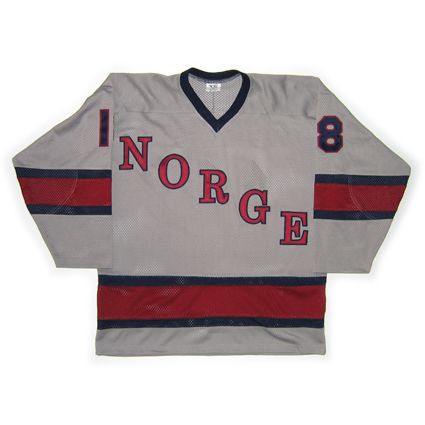
The first appearance of any to the team jerseys is in the first half of the film during the exhibition game held in Norway, which earns the team the full brunt of Brooks' wrath in the "Again!" scene has the team is forced to do repeated "Herbies" (an exhausting skate from the end goal line to the near blue line, back to the end line, to the center red line, back to the end line, to the far blue line, back to the end line, then to the far end line and finally back to the end line) and immediately illustrates the use of the altered colors for the jerseys that appear in the early part of the film as evidenced by the "white" Norway home jerseys.

1980 Norway National Team Jersey1980 Norway Home photo Norway 1980 H F.jpg
1980 Norway Home photo Norway 1980 H B.jpg

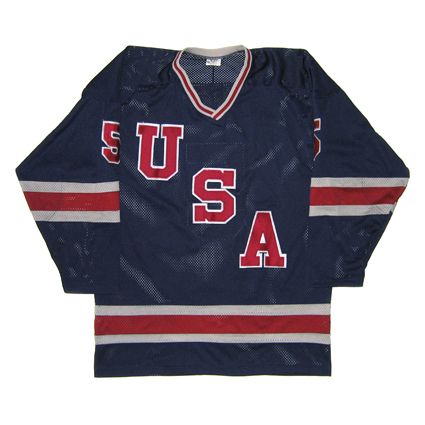
Next from that scene is the first appearance of the jerseys worn by the United States in the pre-Olympic scenes, which has "USA" diagonally across the front rather than arched, as it would later appear in the Olympic Games. Again, this jersey is made from a muted Navy Blue, Brick Red and Grey color palette.

1980 United States National Team Jersey
1980 USA photo USA 1980 Pre-Olympic F.jpg
1980 USA photo USA 1980 Pre-Olympic 5 B.jpg

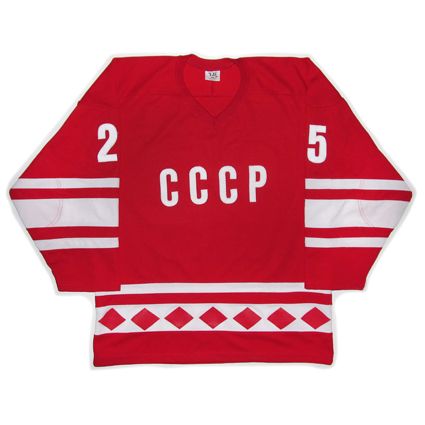
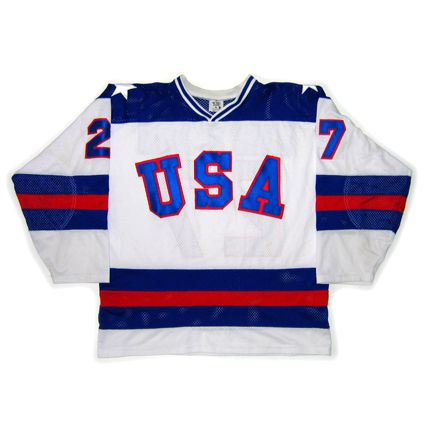
After the navy blue jerseys appear again in a game versus the IHL All-Stars, the next jerseys to appear in the movie are the brightly colored jerseys of the United States and the Soviet Union during their exhibition game at Madison Square Garden just three days prior to the Olympics. The Soviet blood red jerseys and the Americans snow white jerseys give the game the desired visual excitement the filmmakers were looking for.

1980 Soviet Union National Team Jersey1980 Soviet Union photo Soviet Union 1980 25 F.jpg
1980 Soviet Union photo Soviet Union 1980 25 B.jpg

1980 United States National Team Jersey
1980 USA photo USA 1980 27 H F.jpg
1980 USA photo USA 1980 27 H B.jpg

With that thrashing of the United States over with, the scenes featuring the actual Olympics then dominate the second half of the movie with the first American game being against Sweden, where Baker saves the day with his last minute goal with goaltender Craig pulled to spare the United States an opening game defeat. Being a non-Soviet opponent, the filmmakers are back to using the muted colors for the Swedish jerseys, although the yellow still appears relatively vibrant on screen. This is also the first use of the royal blue Olympic jerseys for the United States, giving the game the desired visual excitement.

1980 Sweden National Team
1980 Sweden photo Sweden 1980 F.jpg
1980 Sweden photo Sweden 1980 B.jpg

1980 United States National Team
1980 USA photo USA 1980 5 R F.jpg
1980 USA photo USA 1980 5 R B.jpg

The next opponent for the United States was favored Czechoslovakia, who appeared in their brick red jerseys during the movie for all of ten seconds.

1980 Czechoslovakia National Team
 1980 Czechoslovakia photo Czechoslovakia 1980 F.jpg
1980 Czechoslovakia photo Czechoslovakia 1980 B.jpg

The scene following the USA versus Czechoslovakia game sees Brooks walking on the streets of Lake Placid with Walter Bush. Team jackets are seen from East Germany (DDR) and Italy before they encounter the Soviets, led by head coach Viktor Tikhonov, who is followed by several team members wearing CCCP jackets to keep them warm against the snow flurries.

1980 Soviet Union National Team Winter Jacket
1980 Soviet Union jacket photo Soviet Union 1980 winter jacket XL F.jpg
1980 Soviet Union jacket photo Soviet Union 1980 winter jacket XL B.jpg

Norway appears as the next US opponent, only this time wearing their red road jerseys against the Americans. The Norwegians are dispatched in a mere 13 seconds of screen time.

1980 Norway National Team
1980 Norway Road photo Norway 1980 R F.jpg
1980 Norway Road photo Norway 1980 R B.jpg

The next game is against Romania, who are wearing yellow jerseys similar to Sweden. The shade of yellow used by the Romanian jerseys is slightly darker than Sweden's and again has the muted navy blue and brick red secondary colors. Of all of our "lesser" country jerseys, the #15 of Alexandru Halauca appears on screen the longest while he breaks down the ice as part of the Romanian attack.

Unusually, we also acquired another Romania jersey, this one with a lace-up collar, rather than the v-neck of the Halauca jersey, a style which does not appear on screen during the movie. It has been suggested to us that this may have been a goaltender jersey, but in reality, Sandor Gal (spelled with just one "L") was a defenseman. This jersey arrived without laces.

1980 Romania National Team
1980 Romania #1 photo Romania 1980 V F.jpg
1980 Romania #1 photo Romania 1980 V B.jpg

1980 Romania #2 photo Romania 1980 L F.jpg
1980 Romania #2 photo Romania 1980 L B.jpg

West Germany received a generous 35 seconds of screen time and was the last and most difficult jersey for us to obtain to complete our collection. Having passed on an easy opportunity to get one when they first appeared on ebay when the jerseys first began to be made available to the public prior to setting our sights on having a complete set, it would take another ten years for one to resurface after their initial availability.

While the jerseys for the United States and Soviet Union were made in multiple sets in case of physical damage due to their amount of use in the filming, jerseys from the remaining nations were only made in a single set and can be much harder to obtain due to their limited numbers.

Unlike the other jerseys, the West Germany jerseys use an elastic material for the waist stripes, which results in it's clinched appearance at the bottom. Again, note the use of the brick red and grey for the West German jersey.

1980 West Germany National Team
1980 West Germany photo Germany 1980 F.jpg
1980 West Germany photo Germany 1980 B.jpg

We finally arrive at the Miracle on Ice game between the United States and the Soviet Union for which the entire movie has been building up to. Both teams are outfitted with their brightly colored jerseys, which virtually leap off the screen compared to the muted colors of the other nations' jerseys, especially under the bright lighting of those scenes. The game takes 30 minutes of screen time to complete.

1980 Soviet Union National Team
1980 Soviet Union photo Soviet Union 1980 12 F.jpg
1980 Soviet Union photo Soviet Union 1980 12 B.jpg

1980 United States National Team Jersey
1980 USA photo USA 1980 27 H F.jpg
1980 USA photo USA 1980 27 H B.jpg

There is still one more game left to play however, that being the United States versus Finland, which the US must win to cement the gold medal. Finland, wearing "white" is back to being depicted in the muted color palette. The game action is all of three seconds, as the producers chose not to dramatize the come from behind American victory to clinch the gold, with the majority of the scene being the post-game US celebration in their blue jerseys.

1980 Finland National Team
1980 Finland photo Finland 1980 H F.jpg
1980 Finland photo Finland 1980 H B.jpg

1980 United States National Team
1980 USA photo USA 1980 23 R F.jpg
1980 USA photo USA 1980 23 R B.jpg

Following the Finland game, the movie concludes with the medal ceremony, during which the Soviets are seen wearing track suits, while the Swedes are still wearing their yellow game jerseys.

1980 Soviet National Team Track Jacket
1980 Soviet Union track jacket photo Soviet Union 1980 track jacket F.jpg
1980 Soviet Union track jacket photo Soviet Union 1980 track jacket B.jpg

We also have one particularly special jersey from the filming of the movie "Miracle" in our collection, that worn in the pre-Olympic scenes by actor Eddie Cahill, who played starring goaltender Craig. After obtaining the jersey we had the opportunity to have the jersey signed by Craig in person with the inscription "Jim Craig #30 - 1980 Gold Medal".

1980 United States National Team
1980 USA photo USA 1980 30 FB.jpg
1980 USA photo USA 1980 30 B.jpg

 photo Jim Craig Miracle Jersey Autograph.jpg

The movie ranks as one of the best hockey movies ever made and gave new life to many great lines, particularly those of head coach Brooks, whose players actually kept a diary of his most memorable "Brooksisms". His speech to his team prior to the Miracle on Ice game is one of the most memorable scenes of the film and is often quoted today.


Sunday, January 14, 2018

1972 Soviet Union National Team Valeri Kharlamov Jersey

Considered to be one of the greatest players the game has ever seen, Valeri Kharlamov of the Soviet Union was born on this date in 1948. He joined the Central Red Army club in the Soviet Elite League in 1967-68 and scored two goals in 15 games as a rookie.

Valeri Kharlamov
Soviet hockey legend Valeri Kharlamov

Having got his feet wet the season before, Kharlamov made no secret of his prodigious talent the following season when he increased his goal scoring to 37 goals in 42 games of the shorter Soviet League season. Following the season he would make the first of his 11 consecutive World Championship appearances and contributed 13 points in ten games on his way to the first gold medal of his illustrious international career.

In the 1969-70 season Kharlamov averaged a goal per game while playing in 33 contests for Central Red Army in a season which concluded with the first of four consecutive Soviet League championships. He followed that with ten points in nine games on his way to another World Championship gold medal.

Kharlamov won the Soviet League goal scoring title in 1970-71 with a career highs with 40 goals and 52 points in 34 games. He earned his first World Championship All-Star selection when he tallied 17 points in ten games as he was awarded his third consecutive World Championship gold medal, the dominant Soviet Union's 9th in a row.

He one-upped himself by capturing the Soviet League points scoring title in 1971-72, albeit with a lower personal point total that the previous season, with 40 points and was named the Soviet League MVP for the first time. That was not the highlight of Kharlamov's season however, as he introduced himself to the world as he led the Soviet Union to the gold medal at the 1972 Olympic Games in Sapporo, Japan where his 15 points in just five games led all scorers by six points as the world got their first real glimpse of his superior skating and playmaking abilities. Later that spring he was again named to the World Championship All-Star team, but had to settle for the silver medal for the first time.

In case anyone missed his performance in the Olympics, Kharlamov became a true star of international hockey with his performance in the fabled 1972 Summit Series when the best that the Soviet Union had to offer took on an All-Star team of Canadian professionals for the first time ever. While many in Canada assumed that their professional players would easily win all eight games of the series, Kharlamov led the Soviets with two goals in their stunning Game 1 upset of Team Canada on home ice in Montreal. While Canada led by two six minutes in, the Soviets quickly turned the tide, evening the score before the period ended and began to pull away with Kharlamov's two goals in the second on their way to a 7-3 win.

Mikhailov Petrov Kharlamov
First teamed together in 1968, the line of Boris Mikhailov, Vladimir Petrov and Valeri Kharlamov, dominated international hockey throughout the 1970's

After losing Game 2, Kharlamov contributed another goal in their 4-4 tie in Game 3. After the Soviets 5-3 win in Game 4 in Canada, the series shifted to Moscow in the Soviet Union. When the Soviets came from behind 4-1 to win Game 5, Bobby Clarke of Canada deliberately broke Kharlamov's ankle in Game 6 which enabled the Canadians to stage a comeback and eventually win the series in a dramatic Game 8.

A fourth Soviet League title came in 1972-73 as he scored 32 points in 27 games after recovering from his broken ankle. A return to World Championship gold was powered by an on-from Kharlamov as he racked up 23 points in ten games for the host Soviet Union.

The consecutive championship streak ended in the Soviet League in 1973-74 but the World Championship success continued with another gold in 1974.

Prior to the start of the next season, Kharlamov again participated for the Soviet Union in the 1974 Summit Series, where they took on a team of mainly Canadian professionals from the World Hockey Association, which the Soviets won with a 4-1-3 record. Kharlamov contributed seven points in the eight games.

The Soviet League title returned to Central Red Army in 1974-75 as Kharlamov had a great season with 39 points in 31 games and yet another World Championship gold on the heels of 16 points in 9 games.

Valeri Kharlamov
Kharlamov on the attack

While his personal scoring level continued unchanged in 1975-76, Kharlamov had to unusually settle for silver in both the Soviet League and the World Championships. All was not lost however, as the Soviet Union dominated the 1976 Olympic Games in Innsbruck, Austria to win the second gold medal of Kharlamov's career. He would be one of four Soviet players to tie for the tournament scoring lead with ten points in five games, including his game winning goal in their final game against Czechoslovakia.

Of interest, it was during the Soviet League season that the Central Red Army club took a break from domestic competition and participated in the first Super Series of exhibition games in North America against teams from the NHL which included a win over the New York Rangers, the enthralling tie against Montreal on New Year's Eve, called by many the greatest game of hockey ever played, another win, this time over the Boston Bruins and the notorious game against the Philadelphia Flyers when Kharlamov was targeted with an elbow to the head from the blind side which caused the Soviet coach to pull his team off the ice when to penalty was called.

That spring he was seriously injured in a car accident, which put his hockey career in jeopardy and cost him a chance to compete in the 1976 Canada Cup.

While Kharlamov was limited to 21 games because of recovery time from his injuries, the 1976-77 saw Central Red Army begin an era of dominance unlike any ever seen before with the first of 13 consecutive titles but the national team would fall to third place and the bronze medal at the World Championships.

Kharlamov would have one of his best offensive seasons when he totaled 42 points in only 29 games during the 1977-78 domestic season and a new run of gold medals would begin at the 1978 World Championships, the first of five in a row for the Soviet Union.

He was in peak form in 1978-79, scoring 22 goals and 48 points in the Soviet League, his greatest number of points since 1971. He had another impressive tournament at the World Championships with 14 points in eight games as the Soviet Union won gold on home ice in Moscow. He also participated in the 1979 Challenge Cup for the Soviet Union in a three game series against a team of NHL All-Stars which took the place of the normal NHL All-Star Game that season, which the Soviets won two games to one with a decisive 6-0 victory on Game 3.

1979-80 was a memorable campaign for Kharlamov as he added 38 points in 42 games and another Soviet League title. In February of 1980, his chance at his third consecutive Olympic gold medal was derailed by the "Miracle on Ice" during which the Soviet Union was upset by the United States in an upset so great that the loss was ranked the #1 story of the century by the International Ice Hockey Federation (IIHF). The Soviet Union eventually was awarded the silver medal with a 7-1 record. Of note, there were no World Championships held in 1980 due to the Olympic games.

A final Soviet League title for Kharlamov came in 1980-81 when he scored 25 points in 30 games. During his Soviet League career, Kharlamov scored 293 goals and 214 assists for 504 points in 436 games.

Sadly, on August 17, 1981, Kharlamov was killed at the age of 33 due to injuries suffered in a car accident which also claimed the life of his wife Irina.

In 1998, Kharlamov was inducted into the IIHF Hall of Fame. 2005 saw him become only the second non-NHL player to be inducted into the Hockey Hall of Fame, joining fellow Soviet player and teammate, goaltender Vladislav Tretiak. In 2008 he was selected as just one of six players to be named to the IIHF Centennial All-Star Team, honoring the best players in the 100 year history of the IIHF.

IIHF All Century Team
The IIHF Centennial All-Star Team announcement honoring Kharlamov, Tretiak, Slava Fetisov, Borje Salming, Wayne Gretzky and Sergei Makarov.

Other tributes to Kharlamov include a division of the top Russian professional hockey league, the KHL, being named after him, the the award for the top Russian player in the NHL each season being named the Kharlamov Trophy and the championship team in the junior league in Russia for players aged 17-21, the Minor Hockey League, is awarded the Kharlamov Cup.

Additionally, Kharlamov's #17 has been retired by both the Central Red Army club and the Russia National Team.

Kharlamov #17
Kharlamov looking to score against Sweden

In total, Kharlamov won 11 Soviet League titles, eight World Championship Gold medals and two Olympic gold medals as well as one Soviet League scoring title, seven Soviet League All-Star awards and two Soviet League MVP awards and is the all-time leading scorer in the Olympics for the Soviet Union with 35 points in 17 games.

Today's featured jersey is a 1972 Soviet Union National Team Valeri Kharlamov jersey as worn in the 1972 Summit Series between the Soviet Union and Team Canada in which Kharlamov suffered a broken ankle after a deliberate slash in an effort to neutralize him.

Soviet National Team jerseys were generally quite spartan in appearance, using simple red jerseys with generally minimal striping and one color white names and numbers.

There were occasional dashes of flair, such as 1956's chevron striping, their first use of red and white after debuting in blue and white(!) in 1954, 1987's dual triangle look and the diamond trim used on their jerseys in the late 70's and early 80's, such as those worn during the "Miracle on Ice". Just the addition of yellow trim in the late 1980's was a radical departure after 30 years of only red and white sweaters.

Soviet Union 1972 jersey

Bonus jersey: Today's bonus jersey is a 1976 Soviet Union National Team Valeri Kharlamov jersey. This simple jersey style severed the Soviets well for over a decade, having used it as far back as the 1964 Olympics, wearing it through the 1976 World Championships. By 1976 the numbers used on the back were quite bold and much more professionally executed than the thin, seemingly hand cut numbers in the quirky font used in the 1972 Summit Series.

Soviet Union 1976 jersey photo Russia CCCP 1976 17 F.jpg
Soviet Union 1976 jersey photo Russia CCCP 1976 17 B.jpg

Bonus jacket: Today's bonus jacket is a 1970's Soviet National Team Valeri Kharlamov jacket as worn during the 1970's. Unusually, Kharlamov's name appears above the CCCP, which seems odd considering the entire philosophy of the team above the individual of the Soviet hockey system. Still, the arched name over his number 17 and the CCCP makes for a striking look for this great piece of seldom seen team gear.

 1970s Kharlamov jacket photo Kharlamov jacket F.jpg
1970s Kharlamov jacket photo Kharlamov jacket B.jpg

Today's video segment begins with this tribute to Kharlamov.


This next video is about the dedication of a monument to Kharlamov in Moscow and includes several interviews with former teammates who speak about their recollections of playing with him.


Here is one more very well put together tribute video to Kharlamov, followed by his induction into the Hockey Hall of Fame in 2005.


hit counter for blogger