Showing posts with label Czech Republic. Show all posts
Tuesday, May 30, 2017
2000-01 Pittsburgh Penguins Jiří Šlégr Jersey
Defenseman Jiří Šlégr, born on this date in 1971 began his career with CHZ Litvinov in 1987-88 and eventually played five seasons with the club before coming to North America to play in 1991-92 in the wake of the fall of Communism across Europe, which gave players the freedom to leave for the first time.
Prior to coming to the NHL, Šlégr had played for Czechoslovakia on five occasions, including the European Junior Championships in 1989, winning bronze medals at the World Junior Championships in both 1990 and 1991, which would prove to be a busy year for the young Šlégr, as he would also play in the 1991 World Championships as well as the 1991 Canada Cup. During his final Czechoslovak domestic season, Šlégr would also make his Olympic debut in his final appearance for Czechoslovakia in the 1992 Olympics in Albertville, France where he earned a bronze medal.
Šlégr joined the Vancouver Canucks organization, who had selected him with the second pick of the second round of the 1990 NHL Draft. His first season saw him divide his time between the Hamilton Canucks of the AHL (21 games) and make his NHL debut with Vancouver, playing in 41 games, scoring an impressive 26 points in exactly half a season of play while posting a +16 rating. He would also get his first taste of the NHL playoffs, seeing action in 5 games.
Given more important minutes based on his successful rookie season, Šlégr set a career high with 38 points from 5 goals and 33 assists in 78 games.
He would spend the early part of the 1994-95 season back with Litvinov, in what was by now the Czech Republic, due to the labor stoppage delaying the start of the NHL season until January. Once the NHL resumed, play, Šlégr would play 19 games with the Canucks before being traded in early April to the Edmonton Oilers.
He was limited to 57 games with the Oilers in 1995-96 and went on to make his debut for the Czech Republic at the 1996 World Cup of Hockey prior to the start of the 1996-97 season, which Šlégr spent back in Europe, appearing in one game with Litvinov, but primarily with Sodertalje SK in Sweden. He also played for the Czech Republic at the 1997 World Championships in the spring, earning another bronze medal.
In August of that year, Šlégr was traded to the Pittsburgh Penguins, with whom he spent the next four seasons, including setting an NHL career best 11 goals in 1999-00.
During his first season with the Penguins, the NHL would take a break from it's schedule to allow players to compete in the 1998 Olympics in Nagano, Japan, which Šlégr and his Czech teammates would take full advantage of, winning the gold medal in unexpected fashion. He was back on the international scene once again, earning another bronze at the 1998 World Championships.
Half way through the 2000-01 season, Šlégr was sent by the Penguins to the Atlanta Thrashers, where he would play 33 games to end the season.
He was with the Thrasher for 38 more games in the first half of the 2001-02 season before another trade, which sent him to the Detroit Red Wings. While he would only play 8 regular season games and 1 playoff game with Detroit, the Red Wings would go on to capture the Stanley Cup at the conclusion of the playoffs.
2002-03 was a lost season for Šlégr, as he would only play 10 games for Litvinov in the Czech Republic and 6 regular season and 9 playoff games for Avangard Omsk in the Russian Super League.
He returned to the NHL by signing a free agent contract with the Vancouver Canucks for 2003-04, but would end up spending the majority of his season with the Boston Bruins following a trade in January.
Following the season, Šlégr would return to the World Championships for the first time in six years. His second World Cup of Hockey came in September of that year. With the NHL season cancelled due to a lockout, Šlégr once again returned to where it began, suiting up for a full season with HC Litvinov, with whom he had his best offensive season in five years with 29 points.
With the Czech domestic season now over, Šlégr joined the national team for his fourth World Championshps for the Czech Republic, which they won with an 8-1 overall record, which included shutting out Canada 3-0 in the final, earning Šlégr a World Championship gold to go with his Olympic gold in 1998 and his Stanley Cup in 2002, making him a member of the prestigious Triple Gold Club, one of only 16 men at the time to have done so, and to date one of only two Czechs to have earned the honor, along with Jaromir Jagr.
Šlégr with the World Championship trophy,
which completed his membership in the Triple Gold Club
When the NHL resumed play in 2005-06, Šlégr was back with the Bruins, for whom he played 32 games.
Following that season, he returned to Litvinov for the sixth time! He would play four seasons there, retiring from hockey in 2010 before beginning his second career in politics, having been elected to Chamber of Deputies.
Šlégr with HC Litvinov
Šlégr's final NHL career totals are 622 games, 56 goals and 193 assists for 249 points.
Today's featured jersey is a 2000-01 Pittsburgh Penguins Jiří Šlégr jersey as worn during one of the Penguins opening pair of games in Japan against the Nashville Predators to open the NHL season. This was the third and final time the NHL season would get under way in Tokyo.
This style Penguins jersey was introduced in 1992-93 following their second Stanley Cup championship. The modernized Penguins logo was dubbed the "robo-Penguin" and remained in use through the 2001-02 season before a full-time return of the original skating penguin logo.
Bonus jersey: Today's bonus jersey is a 1996 Czech Republic Jiří Šlégr jersey as worn the first time Šlégr played for the Czech Republic following the breakup of Czechoslovakia in 1993.
This jersey was made by Bauer, and as such, the Czechs wore the larger 4" World Cup patch on the shoulder. Sweden and Canada also wore Bauer jerseys paired with the larger version of the patch, unlike the Nike teams, which wore the smaller 3" version of the tournament patch.
In today's video segment, Šlégr scores against Canada in the 1998 Olympics, much to the delight of the announcer.
Labels:
Czech Republic,
Pittsburgh Penguins,
Slegr Jiri
Wednesday, February 22, 2017
1998 Czech Republic National Team Dominik Hasek Jersey
The Olympic hockey tournament changed like never before in 1998 when the the National Hockey League players were allowed to compete for the first time. Prior to the 1998 Winter Olympics in Nagano, Japan, professional players were allowed to participate, but with the Games taking place in February, the highest caliber players obligated to their ongoing NHL seasons, preventing them from even dreaming of taking part in the Olympics.
Our first video today are quick highlights from the Czech Republic's gold medal performance at the 1998 Olympics in Nagano. Gooooooaaaaaaallllllll!!!!
Up next is the tense shootout between Canada and the Czech Republic in the semifinals, highlighting the sprawling, twisting, unorthodox style used by Hasek to full effect.
Starting in 1920, the Olympic gold medal was essentially the property of Canada, winning 6 out of 7 possible gold medals through 1952. With the arrival of the Soviet Union on the scene in 1956, the balance of power was radically changed. Through 1992, when the Soviet trained players skated together one final time as the Unified Team, the Soviets won 8 to of 10 golds, with only the Americans winning twice at home preventing a clean sweep over the course of 4 decades by the Soviets.
Sweden took the gold in 1994 over Canada, but the form charts needed to be thrown away with the sudden availability of the stars of the NHL, who were now going to be on hand for the first time since their formative years, if not the first time ever for some, most notably Wayne Gretzky of Canada. With the NHL season on hold, interest in the tournament was tremendous.
The tournament began with Kazakhstan winning Group A and Belarus taking Group B, with the two former Soviet states advancing to the First Round at the expense of Slovakia, Italy, Austria, Germany, France and Japan, whose tournaments were now over after just three games of the Preliminary Round.
The tournament format now called for two groups of four teams to play a round robin schedule to determine their seeings when they all would advance to face an opponent from the opposite group in the single elimination Final Round playoffs.
Kazakhstan was placed in Group D along with the Czech Republic, Finland and Russia, who were all placed into the First Round directly based on their IIHF world ranking prior to the tournament, the same as Canada, Sweden and the United States in Group C, who were joined by Belarus.
In Group C, Canada finished first with a perfect 3-0 record to give them hope of returning to the top place on the medal stand for the first time since 1952 now that the controversy between their best amateurs versus the Soviet "amateurs" had now been finally removed, leveling the playing field on the Olympic stage for the first time in decades.
Canada's opponent as the first seed in Group C was the fourth place finisher in Group D, Kazakhstan. Sweden finished second thanks to a 4-2 win over the Americans, which paired them with Finland in the quarterfinals.
Group D winning Russia drew overmatched Belarus from Group C, while the Czech Republic's second place in Group D saw it facing the United States.
Group winners Canada and Russia held serve with a pair of easy 4-1 wins over Kazakhstan and Belarus as expected. The under achieving United States ran afoul of the Czech Republic, also by a 4-1 score. The only upset in terms of seeding came with Finland's exciting 2-1 defeat of Nordic rivals Sweden in a tense game that was scoreless after two periods.
The parings for the semifinals saw Canada drawing the Czech Republic. The Canadians were armed with some of the finest firepower in all of the world, including forwards Wayne Gretzky, Theo Fleury, Paul Kariya, Eric Lindros, Joe Nieuwendyk, Joe Sakic, Brendan Shanahan and Steve Yzerman, boasted a defensive hall of fame with Rob Blake, Ray Bourque, Al MacInnis, Chris Pronger and Scott Stevens, with the legendary Patrick Roy in goal. Amazingly, the Canadian team General Manager Bobby Clarke chose Rob Zamuner to be on the Canadian roster over Mark Messier and Lindros as captain rather than Gretzky, Bourque or Yzerman!
Going into their game against Canada, the Czechs had won three and lost one, but goaltender Dominik Hasek was in top form, having surrendered only 5 goals in 4 games, with their only loss being a 2-1 decision to Russia in the First Round.
The Czech Republic losing to Russia 2-1 in Group D play
The first two periods passed without a goal by either side, as Roy and Hasek traded saves. Finally halfway through the third period, Jiri Slegr beat Roy with an assist from the veteran Pavel Patera. The Canadians pressed hard for the equalizer, but the Czech defensive system stood tall and Hasek took care of the rest as time would down. Finally with just 1:03 remaining in the game, Trevor Linden solved Hasek with an assist from Lindros.
Following a scoreless overtime, the game went to a shootout to determine who would advance to the gold medal final. Fleury, Bourque, Nieuwendyk, Lindros and Shanahan were all stopped by the on-form Hasek, while Robert Reichel's opening goal in off the pipe proved to be enough to win the game for the Czechs.
Hasek stops Shanahan to seal the victory for the Czech Republic
Russia advanced to face their long-time rivals with a dominant 7-4 win over Finland, setting up a rematch of their earlier First Round game, which was won by the Russians 2-1.
The championship final, held on this date in 1998, was a predictably low scoring affair, as each team looked to exploit any mistakes by their opponent, while both teams kept their game simple and looked to avoid any unnecessary mistakes. Just like in their first meeting, the opening period passed with no scoring and moved on to the second.
Action from the second meeting between Russia and
the Czech Republic, only this time for the gold medal
Again, Hasek in goal for the Czechs and Mikhail Stalenkov stood tall in goal for the Russians as both teams failed to solve the other. As the game approached the midway point of the third period, a faceoff took place in the Russian zone to the right of Stalenkov. Martin Prochazka won the draw back to his winger Patera, who simply slid the puck back to Petr Svoboda on the point, who teed up the puck and fired it on goal. It passed through a tangle of traffic still hooked up following the faceoff and flew past Stalenkov and into the net for a 1-0 Czech Republic lead with 11:52 still remaining.
Hasek holding off the Russian attack
The goal was enough for Hasek however, as he and his teammates finished off the shutout to capture the first gold medal of the full participation Olympic hockey tournament, making Hasek a household name around the world and Svoboda an instant and unlikely hero, as in 1,028 NHL games, the defensive defenseman had only scored 58 goals, less than 3 1/2 per season, with a career high of 8.
Jagr's gold medal earned him a meeting with Czech President Vaclav Havel
Today's featured jersey is a 1998 Czech Republic National Team Dominik Hasek jersey as
worn when the Czech Republic captured the Olympic gold medal in Nagano,
Japan. This bold style of jersey was first worn in the 1998 Olympics
and is associated with a golden era of Czech hockey, having been worn
not only for the Olympic gold in 1998, but also for three consecutive
World Championship gold medals in 1999, 2000 and 2001.
Extra bonus jersey: Today's extra bonus jersey is a 1998 Czech Republic Jaromir Jagr jersey as worn during the Olympics in Nagano, Japan. This style of jersey was first introduced for the 1998 Olympics by Nike, who produced new uniforms for each of the participating teams in that year's Games.
The Czech Republic jerseys, while somewhat similar to Canada and Belarus, with it's arched striping from the collar to the armpits, employed a unique font for the numbers as well as the bold color blocks inspired by the flag of the Czech Republic to set it apart from the others, but left no doubt as to who it belonged to with the ultra bold CZECH emblazoned across the lower back.
Up next is the tense shootout between Canada and the Czech Republic in the semifinals, highlighting the sprawling, twisting, unorthodox style used by Hasek to full effect.
This next video contains highlights from the goal medal final, won by the Czech Repbulic 1-0 over Russia, focusing on Svoboda's goal.
Labels:
Czech Republic,
Hasek Dominik,
Jagr Jaromir
Monday, December 19, 2016
2000-01 Pittsburgh Penguins Robert Lang Jersey
Born in Czechoslovakia on this date in 1970, Center Robert Lang began his professional career with CHZ Litvinov in the Czechoslovak First Ice Hockey League with 3 goals and 5 points in 7 games. He played three more seasons for Litvinov with his best season being 1990-91 when he scored 26 goals and 52 points in 56 games. After the 1989-90 season, Lang was drafted by the Los Angeles Kings in the 1990 NHL Entry Draft.
During his final season with Litvinov, Lang made his international debut at the very top, competing in the 1992 Olympics in Albertville, France. Czechoslovakia earned a bronze medal as Lang contributed 5 goals and 8 assists in 8 games.
Later that spring, Lang made his World Championship debut with 2 goals and 4 points in 8 games as the Czechs earned another bronze medal.
After four seasons with Litvinov, Lang made the leap to North America, first getting used to the style of play with 38 games in the International Hockey League with the Phoenix Roadrunners. He scored 9 goals and 30 points in 38 games, which earned him a call up to the NHL. With the Kings that season, Lang would play in 11 games, registering 5 assists.
The following season saw him split time between the Roadrunners (35 points in 44 games) and the Kings, playing in 39 games and scoring his first 9 goals in the NHL. With the start of the 1994-95 NHL season delayed by labor issues, Lang returned to HC Litvinov for 16 games until the NHL season began in January. Once back in the NHL, Lang scored 12 points in 36 games.
He would finally play a full season with Los Angeles in 1995-96, seeing action in 68 games, scoring 6 goals and a new career best of 22 points.
Following the season, Lang would play in his second World Championships, only this time for the Czech Republic, as Czechoslovakia had separated at the end of 1992 into the Czech Republic and Slovakia. Lang had 5 goals and 9 points in 8 games as the Czechs won Group 2 with 4 wins and a tie before defeating Germany 6-1 and the United States 5-0 before winning their first World Championship as the Czech Republic when they beat Canada 4-2 in the gold medal final, with Lang scoring the first two Czech goals.
Later that fall, Lang again suited up for the Czech Republic, this time in the inaugural World Cup of Hockey. The results were quite different, as the current world champions were eliminated after losing all three of their games in pool play.
For the 1996-97 season, Lang returned to the Czech Republic and spent a season playing for Sparta Prague, scoring 14 goals and 41 points in 41 games. With the shorter European season, Lang was again free to play for the Czech Republic at the 1997 World Championships. The Czechs went 4-1 to win Group 1, but found the going tougher in the Second Round, losing to the United States and Sweden. The did defeat Canada and finished in fourth place. That set up a game against third place Russia for the bronze medal, which the Czechs won 4-3 to claim Lang's second World Championship bronze.
He returned to the NHL for the 1997-98 when he was signed as a free agent by the Pittsburgh Penguins on September 2nd. He was claimed by the Boston Bruins 26 days later during the Waiver Draft. After three scoreless games, Lang was waived by the Bruins and reclaimed by the Penguins on October 25th. He played in 9 games with the Houston Aeros in the IHL, but spent the majority of the season with Pittsburgh, scoring 9 goals and 22 points.
During the 1997-98 NHL season, the league took a break from their schedule to allow their pros to compete in the Olympics for the first time. Lang played in 8 games, contributing 3 assists as the Czechs took second behind Russia in Group D before eliminating the United States 4-1 in the Quarterfinals. They then beat Canada 2-1 in a shootout to advance to the final, where they turned the tables on Russia 1-0 to claim the gold medal.
His career changed with the 1998-99 season, as he Penguins style of play suited his game and in 72 games, Lang scored 21 goals, far surpassing his previous high of 9, on his way to 44 points, double his previous best.
In 1999-00, Lang increased his career bests to 23 goals and 65 points before his career season of 2000-01 when he had his first 30 goal season with 32 on his way to an 80 point season, good for fourth on the Penguins behind Jaromir Jagr, Alexei Kovalev and Martin Straka.
Lang would play one more season with Pittsburgh, but was limited to 62 games and 50 points, but was able to compete in his third Olympics in 2002 in Salt Lake City. Lang scored a goal and 2 assists in the four games played by the Czechs before they were eliminated in the Quarterfinals by Russia 1-0.
He was signed by the Washington Capitals as a free agent for the 2002-03 season and scored 22 goals and 69 points in 82 games. He had scored 29 goals and 74 points in 63 games of the 2003-04 season before a trade to the Detroit Red Wings in February for Thomas Fleischmann, a 2004 1st Round draft choice and a 2006 4th Round draft choice. In six games with the Red Wings, he scored 1 goa and 5 points, which game him his second 30 goal season and fell just one point shy of his career best of 80 points, although in just 69 combined games. His effort was recognized when he was named the recipient of the Golden Hockey Stick as the Top Czech Hockey Player of the Year.
With the 2004-05 NHL season cancelled due to labor problems, Lang did not return to Europe like many others chose to do. When the NHL resumed play in 2005-06, he scored 20 goals and 62 points for the Red Wings. He returned for another season with Detroit, scoring 19 goals and 52 points in 81 games. He also participated in his fourth Olympic games that season in Torino, Italy, scoring 4 assists in 8 games. The Czechs had a poor Preliminary Round, finishing fourth in Group A with a 2-3 record, but upset Group B winners Slovakia 3-1 in the Quarterfinals. The lost in the Semifinals 7-3 to eventual gold medalists Sweden, but shut out Russia 3-0 to claim the bronze medal.
For the 2007-08 season, Lang singed a two year contract with the Chicago Blackhawks. He contributed 21 goals and 54 points in 76 games, but was then traded to the Montreal Canadiens for the 2008-09 season.
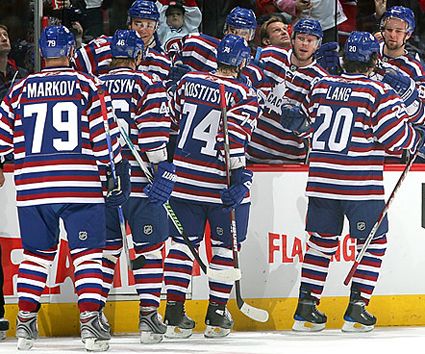
With the Canadiens, Lang only saw action in 50 games, but scored 18 goals and 39 points. His season came to a premature end that season when he suffered a season ending cut Achilles tendon while wearing Montreal's controversial 1912-13 throwback barber pole jersey in a 3-1 loss to the rival Boston Bruins, a game which also saw Montreal lose Guillaume Latendresse to a shoulder injury.
He was signed by the Phoenix Coyotes for the final season of his career. In 64 games, he scored 9 goals and 29 points. His final NHL career totals were 989 games played, 261 goals and 442 assists for 703 points. He played in an additional 91 playoff games, primarily with Pittsburgh and Detroit, scoring 18 goals and 46 points.
Internationally, Lang played in 16 games for Czechoslovakia and 45 games for the Czech Republic, scoring a combined 14 goals and 24 assists for 38 points. He won a gold and two bronze medals at the World Championships and a gold and two bronze at the Olympic Games.
Today's featured jersey is a 2000-01 Pittsburgh Penguins Robert Lang jersey from the season Lang set career highs in goals (32), assists (48) and points (80). This jersey featured the Game ONe 2000 patch from the Penguins opening two game series played in Tokyo, Japan against the Nashville Predators.
The Penguins adopted this style jersey for the 1992-93 season after winning two consecutive Stanley Cups. This style was dubbed the "Robo Penguin" and was used for ten seasons through 2001-02.
Bonus jersey: Today's bonus jersey is a 2006-07 Detroit Red Wings Robert Lang jersey as worn on January 2, 2007, the night the Red Wings retired Steve Yzerman's #19, as commemorated with the #19 patch on the upper right chest.
This simple, yet iconic style was first worn by Detroit in 1932-33, the season they changed their name from Falcons to Red Wings. Aside from changing the original red numbers outlined in white to one color white in 1937 and adding sleeve numbers and names on the back, this jersey remains unchanged for over 80 years and looks to remain the same for another 80 years.
Extra bonus jersey: Today's extra bonus jersey is a 1996 Czech Republic National Team Robert Lang jersey as worn in the inaugural 1996 World Cup of Hockey. This jersey saw limited use, as the Czechs wore a different style earlier that season when they won the World Championship and adopted a new style for the 1998 Olympics, leaving the 1997 World Championships as the only other time this style would have been worn.
Today's video section begins with highlights of two goals by Lang during the 2004 playoffs while with Detroit.
Next, some more amazing stickhandling from the magic hands of Lang.
During his final season with Litvinov, Lang made his international debut at the very top, competing in the 1992 Olympics in Albertville, France. Czechoslovakia earned a bronze medal as Lang contributed 5 goals and 8 assists in 8 games.
Later that spring, Lang made his World Championship debut with 2 goals and 4 points in 8 games as the Czechs earned another bronze medal.
After four seasons with Litvinov, Lang made the leap to North America, first getting used to the style of play with 38 games in the International Hockey League with the Phoenix Roadrunners. He scored 9 goals and 30 points in 38 games, which earned him a call up to the NHL. With the Kings that season, Lang would play in 11 games, registering 5 assists.
The following season saw him split time between the Roadrunners (35 points in 44 games) and the Kings, playing in 39 games and scoring his first 9 goals in the NHL. With the start of the 1994-95 NHL season delayed by labor issues, Lang returned to HC Litvinov for 16 games until the NHL season began in January. Once back in the NHL, Lang scored 12 points in 36 games.
He would finally play a full season with Los Angeles in 1995-96, seeing action in 68 games, scoring 6 goals and a new career best of 22 points.
Lang wearing the infamous "Burger King" jersey
Following the season, Lang would play in his second World Championships, only this time for the Czech Republic, as Czechoslovakia had separated at the end of 1992 into the Czech Republic and Slovakia. Lang had 5 goals and 9 points in 8 games as the Czechs won Group 2 with 4 wins and a tie before defeating Germany 6-1 and the United States 5-0 before winning their first World Championship as the Czech Republic when they beat Canada 4-2 in the gold medal final, with Lang scoring the first two Czech goals.
Later that fall, Lang again suited up for the Czech Republic, this time in the inaugural World Cup of Hockey. The results were quite different, as the current world champions were eliminated after losing all three of their games in pool play.
For the 1996-97 season, Lang returned to the Czech Republic and spent a season playing for Sparta Prague, scoring 14 goals and 41 points in 41 games. With the shorter European season, Lang was again free to play for the Czech Republic at the 1997 World Championships. The Czechs went 4-1 to win Group 1, but found the going tougher in the Second Round, losing to the United States and Sweden. The did defeat Canada and finished in fourth place. That set up a game against third place Russia for the bronze medal, which the Czechs won 4-3 to claim Lang's second World Championship bronze.
He returned to the NHL for the 1997-98 when he was signed as a free agent by the Pittsburgh Penguins on September 2nd. He was claimed by the Boston Bruins 26 days later during the Waiver Draft. After three scoreless games, Lang was waived by the Bruins and reclaimed by the Penguins on October 25th. He played in 9 games with the Houston Aeros in the IHL, but spent the majority of the season with Pittsburgh, scoring 9 goals and 22 points.
Lang returned to the NHL with Pittsburgh
During the 1997-98 NHL season, the league took a break from their schedule to allow their pros to compete in the Olympics for the first time. Lang played in 8 games, contributing 3 assists as the Czechs took second behind Russia in Group D before eliminating the United States 4-1 in the Quarterfinals. They then beat Canada 2-1 in a shootout to advance to the final, where they turned the tables on Russia 1-0 to claim the gold medal.
His career changed with the 1998-99 season, as he Penguins style of play suited his game and in 72 games, Lang scored 21 goals, far surpassing his previous high of 9, on his way to 44 points, double his previous best.
In 1999-00, Lang increased his career bests to 23 goals and 65 points before his career season of 2000-01 when he had his first 30 goal season with 32 on his way to an 80 point season, good for fourth on the Penguins behind Jaromir Jagr, Alexei Kovalev and Martin Straka.
Lang while with Pittsburgh
Lang would play one more season with Pittsburgh, but was limited to 62 games and 50 points, but was able to compete in his third Olympics in 2002 in Salt Lake City. Lang scored a goal and 2 assists in the four games played by the Czechs before they were eliminated in the Quarterfinals by Russia 1-0.
He was signed by the Washington Capitals as a free agent for the 2002-03 season and scored 22 goals and 69 points in 82 games. He had scored 29 goals and 74 points in 63 games of the 2003-04 season before a trade to the Detroit Red Wings in February for Thomas Fleischmann, a 2004 1st Round draft choice and a 2006 4th Round draft choice. In six games with the Red Wings, he scored 1 goa and 5 points, which game him his second 30 goal season and fell just one point shy of his career best of 80 points, although in just 69 combined games. His effort was recognized when he was named the recipient of the Golden Hockey Stick as the Top Czech Hockey Player of the Year.
Lang won the Golden Stick for his 2003-04 season with the Capitals
With the 2004-05 NHL season cancelled due to labor problems, Lang did not return to Europe like many others chose to do. When the NHL resumed play in 2005-06, he scored 20 goals and 62 points for the Red Wings. He returned for another season with Detroit, scoring 19 goals and 52 points in 81 games. He also participated in his fourth Olympic games that season in Torino, Italy, scoring 4 assists in 8 games. The Czechs had a poor Preliminary Round, finishing fourth in Group A with a 2-3 record, but upset Group B winners Slovakia 3-1 in the Quarterfinals. The lost in the Semifinals 7-3 to eventual gold medalists Sweden, but shut out Russia 3-0 to claim the bronze medal.
Lang won a bronze medal while captain
of the 2006 Czech Olympic Team
For the 2007-08 season, Lang singed a two year contract with the Chicago Blackhawks. He contributed 21 goals and 54 points in 76 games, but was then traded to the Montreal Canadiens for the 2008-09 season.
With the Canadiens, Lang only saw action in 50 games, but scored 18 goals and 39 points. His season came to a premature end that season when he suffered a season ending cut Achilles tendon while wearing Montreal's controversial 1912-13 throwback barber pole jersey in a 3-1 loss to the rival Boston Bruins, a game which also saw Montreal lose Guillaume Latendresse to a shoulder injury.

Lang, #20, would not finish the game while wearing Montreal's controversial
throwback barber pole jersey during the 2008-09 season
He was signed by the Phoenix Coyotes for the final season of his career. In 64 games, he scored 9 goals and 29 points. His final NHL career totals were 989 games played, 261 goals and 442 assists for 703 points. He played in an additional 91 playoff games, primarily with Pittsburgh and Detroit, scoring 18 goals and 46 points.
Lang celebrates a goal while with Phoenix
Internationally, Lang played in 16 games for Czechoslovakia and 45 games for the Czech Republic, scoring a combined 14 goals and 24 assists for 38 points. He won a gold and two bronze medals at the World Championships and a gold and two bronze at the Olympic Games.
Today's featured jersey is a 2000-01 Pittsburgh Penguins Robert Lang jersey from the season Lang set career highs in goals (32), assists (48) and points (80). This jersey featured the Game ONe 2000 patch from the Penguins opening two game series played in Tokyo, Japan against the Nashville Predators.
The Penguins adopted this style jersey for the 1992-93 season after winning two consecutive Stanley Cups. This style was dubbed the "Robo Penguin" and was used for ten seasons through 2001-02.
Bonus jersey: Today's bonus jersey is a 2006-07 Detroit Red Wings Robert Lang jersey as worn on January 2, 2007, the night the Red Wings retired Steve Yzerman's #19, as commemorated with the #19 patch on the upper right chest.
This simple, yet iconic style was first worn by Detroit in 1932-33, the season they changed their name from Falcons to Red Wings. Aside from changing the original red numbers outlined in white to one color white in 1937 and adding sleeve numbers and names on the back, this jersey remains unchanged for over 80 years and looks to remain the same for another 80 years.
Photo courtesy of Classic Auctions
Extra bonus jersey: Today's extra bonus jersey is a 1996 Czech Republic National Team Robert Lang jersey as worn in the inaugural 1996 World Cup of Hockey. This jersey saw limited use, as the Czechs wore a different style earlier that season when they won the World Championship and adopted a new style for the 1998 Olympics, leaving the 1997 World Championships as the only other time this style would have been worn.
Photo courtesy of Classic Auctions
Today's video section begins with highlights of two goals by Lang during the 2004 playoffs while with Detroit.
Next, some more amazing stickhandling from the magic hands of Lang.
Wednesday, October 5, 2016
Vaclav Havel and the Velvet Revolution
Born in Prague in 1936, after serving in the military, Vaclav Havel began to work in the theater and soon was writing plays, which were ultimately banned by the communist Czechoslovakian government in 1968 following the suppression of the Prague Spring uprising. Unfortunately for those in power who banned his works, now no longer able to freely pursue his passion for the theater, Havel became more active in the realm of politics, helping create Charter 77 in January of 1977, which called for the Communist Government to adhere to international standards for human rights.
Vaclav Havel
Havel continued to write however, with his works critical of the government now being distributed via underground channels across Czechoslovakia, and his reputation as a leading voice among dissident revolutionaries was now on the rise. He was the bold and brave enough to co-found the Committee for the Defense of the Unjustly Prosecuted in 1979, which led to constant government surveillance, questioning, arrests and multiple incarcerations. His longest stay in prison was from June of 1979 to January of 1984, 4 years and 7 months. As a writer, he naturally documented his confinement as a book of letters he wrote to his wife, "Letters to Olga".
In 1989, Havel, a passionate supporter of non-violent resistance, was a leading figure in the Velvet Revolution, which occurred from November 17th to December 29, 1989, during which student and citizen demonstrations against the ruling Communist Party took place, first in Prague and then later all across Czechoslovakia.
On November 17th, International Students Day, a peaceful demonstration of 15,000 students chanting anti-communist slogans was suppressed by riot police, spawning false rumors that one student had been killed. Students and theater employees and actors went on strike in protest of the violence, as posters were used to spread the word since the government controlled media would suppress any such stories.
Student demonstrators on International Students Day
The inaccurate reports of a student death having occurring on the 17th added to the unrest among the general population and the strike began to spread to other cities beyond Prague. Havel and other leaders of opposition groups established the Civic Forum on the 19th to unify the protestors and then call for the dismissal of those responsible for the violence of the 17th as well as the release of all political prisoners.
On the 20th, the Civic Forum added the abolition of the guarantee that the Communist Party would hold the ruling position of Czechoslovakia from the nation's constitution. At the same time, non-communist newspapers began publishing information which differed from that of the government controlled newspapers and the first mass demonstration, attended by 200,000 people, occurred in Prague, while other demonstrations began in Bratislava.
The first mass demonstration of the growing Velvet Revolution
On the following day, November 21st, the Prime Minister had his first official meeting with the Civic Forum and personally guaranteed no violence would be used against the demonstrators, which had now swollen to 500,000, but he went on to assure the group that he would also protect socialism without debate.
Organizers of the protests began to spread the word to factories to attract even more participants as the mass demonstrations, which were now becoming a daily occurrence in not only Prague, but in other cities as well. Calls for a nationwide, two-hour general strike were being called for on November 27th, as was the demand for the release of political prisoner Ján Čarnogurský. That night, hard line government officials called in a 4,000 member paramilitary organization to crush the protests, but called them off at the last moment, likely losing their last, best opportunity to remain in power.
The daily protests continued, now aided by increasing media coverage of the events which depicted the government in an unfavorable light. On the 23rd Čarnogurský was released and he would later go on to become the Prime Minister of Slovakia. Also on that same day, the Minister of Defense issued a statement in which he stated that the army would never undertake action against the Czechoslovak people, despite the military informing the communist leaders of it's readiness to do just that.
Demonstrators giving policemen flowers as the protests stayed non-violent
On the 24th the entire executive committee of the government resigned with a more moderate communist named the new General Secretary. Meanwhile, Havel appeared on television for the first time, addressing details of the planned general strike, which was now to be joined by Czechoslovak TV and Radio, which led to the editorial staff of various newspapers now joining the growing movement.
The 25th saw 800,000 protestors and the 26th saw the first meeting between the Prime Minister Ladislav Adamec and Havel, as the demonstrations continued to swell.
The anti-government protesters in Wenceslas Square
The planned two-hour general strike was supported by 75% of the population, which solidified the Civic Forum as the representative of the people in its dealings with the government. Also on the 27th, the Ministry of Culture released anti-Communist literature in libraries, effectively ending government censorship.
Two days later on the 29th, the demand for the removal of the declaration of the Communist Party's leading role from the constitution was met when the Federal Assembly abolished that particular constitutional article.
On December 10th, President Gustáv Husák swore in a new government, the first in 41 years not dominated by the Communist Party. 19 days later Havel was elected as the new president of Czechoslovakia in a unanimous vote of the Federal Assembly, bringing to an end the bloodless downfall of the Communist Party in Czechoslovakia. It was a role he insisted was more duty than aspiration.
Havel greeting the masses following his election in 1989
Havel's presidency was confirmed in a free election by the people in 1990 and one of his first acts was to grant a wide ranging amnesty which set many political prisoners free.
Havel and his supporters had peacefully brought to an end over four decades of communism in Czechoslovakia in a matter of a couple of weeks, but still had decades of communist rule to un-weave from the fabric of the country, as they converted the country into a free market society and integrated Czechoslovakia into the European and world community from which that had been so isolated.
In 1992, forces in the Slovak parliament adopted a Declaration of Independence of the Slovak nation, which would lead to the dissolution of Czechoslovakia, which Havel opposed. This opposition led to his resignation on July 20, 1992, as he did not want to preside over the breakup of his country. The peaceful separation into two distinct nations, known as the Velvet Divorce, occurred on January 1, 1993, giving birth to the new nations of the Czech Republic and Slovakia.
25 days later Havel was elected as the first president of the Czech Republic, a post he would hold until early 2003 after serving two terms in office, during which his health began to be an issue, having previously had two bouts with lung cancer in the late 1990's.
In 1998, the Czech Republic, following their 1-0 win over Russia on a lone goal by Petr Svoboda, emerged victorious from the first Olympic Games to feature the stars of the NHL competing for their home countries.
Following the gold medal game, Havel, in attendance in Japan, visited the locker room of the victorious team to invite them all to his home for a party in celebration.
"He was there and after the game, we all flew to his house," Jaromir Jagr recalled. "He wanted all the team there. It was fun. Big house."
Dominik Hasek stole the show in Nagano
Following the gold medal game, Havel, in attendance in Japan, visited the locker room of the victorious team to invite them all to his home for a party in celebration.
"He was there and after the game, we all flew to his house," Jaromir Jagr recalled. "He wanted all the team there. It was fun. Big house."
Jagr is congratulated by Havel following the 1998 Olympic victory
"If you look at the big picture, he was the main guy. Without him, nobody would play in the NHL from the Czech unless you defect. After the revolution, which he started, the borders were open and there was freedom. You could go anywhere you want." Jagr said.
Jagr had been to the White House with Havel on three occasions, including the time Havel was honored with the Presidential Medal of Freedom in 2003.
Havel, President Bill Clinton and Jagr at the White House
After leaving the presidency, Havel continued his humanitarian works as well as staying active in the theater, which included the first complete festival of his plays, which was held in New York City in celebration of his 70th birthday. He also wrote his first new play in 18 years, "Leaving", which was published in November of 2007, later directing a film version of it which premiered in March of 2011.
Havel passed away on December 18, 2011, which elicited numerous tributes from leaders all over the globe.
Today's featured jersey is a 1991-92 Czechoslovakia National Team Richard Král jersey. Tackla was the sole supplier of jerseys to IIHF tournaments in the late 1980's and early 1990's. Their dye-sublimation process allowed for bright colors and bold designs not seen before. This is a surprisingly vibrant a flashy design, particularly for a staid communist country generally known for it's spartan and utilitarian designs. This waving flag effect was a foreshadowing of the bold Nike jerseys later worn at the 1996 World Cup of Hockey.
This was the final style of jersey worn by Czechoslovakia before the the division of the country into the Czech Republic and Slovakia. For the 1993 international season, the Czechs wore an identical jersey, only now with the main crest replaced by the Czech coat of Arms.
Czechoslovakia was founded at the conclusion of World War I and was divided up during World War II essentially between Germany and Hungary. The country was re-established at the conclusion of World War II and in February of 1948, power was seized by the Communists. During a brief period of liberalization in 1968 known as the Prague Spring, five countries, led by the Soviet Union, invaded Czechoslovakia to restore and maintain the Communist system and ideals. It is because of this invasion in 1968, also the year in which his grandfather died in prison, that Jagr wears #68.
Czechoslovakia played their first game of international hockey at the 1920 Winter Olympics in Antwerp, Belgium, a 15-0 loss to Canada. The program would improve quickly, as they would record their largest margin of victory ever by 1939 in a 24-0 defeat of Yugoslavia, later matched several times in a 24-0 win over Belgium in 1947, a 27-3 drubbing of East Germany in 1951 and a 25-1 win over Japan in 1957.
Czechoslovakia would win the Olympic silver medal four times, in 1948, with gold going to Canada, and then again in 1968, 1976 and 1984, each time as runner up to the powerful Soviet Union. When they weren't winning silver, they were generally in contention, with bronze medals in 1920, 1964, 1972 and 1992.
They would also participate in five Canada Cups, with their best showing being second in the inaugural 1976 tournament.
They also had a long and successful history of competing at the World Championships, dating back to 1930, with six gold medals to their credit, which they won in 1947, 1949, 1972, 1976, 1977 and 1985 with 10 silver and 14 bronze to go along with their championships. They were the only country to break the stranglehold of the Soviet Union during the 24 years from 1963 to 1986, taking great delight at defeating their main rivals four times during the main era of Soviet dominance.
Bonus jersey: Today's bonus jersey is a 1996 Czech Republic National Team Robert Reichel jersey as
worn when the Czech Republic captured their first gold medal as an
independent nation in 1996, in only their fourth year of play.

The Czechs
won Group 2 with a 4-0-1 record, defeating Sweden and Finland in the
process. They defeated Germany in the Quarterfinals 6-1
before dominating the United States 5-0 in the Semifinals. They drew
Canada in the final and a dramatic goal by Martin Prochazka with 19
seconds remaining gave them a 3-2 lead before an empty net goal made for
a 4-2 final score and their first World Championship as the Czech
Republic.
This classically styled jersey was worn only once by the Czech Republic and resulted in a World Championship, making it a great combination of being both rare and historically desirable. Following the World Championships, the Czechs changed to the new "waving flag" style for the 1996 World Cup of Hockey later that fall.
Extra bonus jersey: Today's extra bonus jersey is a 1998 Czech Republic National Team Dominik Hasek jersey as
worn when the Czech Republic captured the Olympic gold medal in Nagano,
Japan. This bold style of jersey was first worn in the 1998 Olympics
and is associated with a golden era of Czech hockey, having been worn
not only for the Olympic gold in 1998, but also for three consecutive
World Championship gold medals in 1999, 2000 and 2001.
Today's video section begins with Amnesty International's Steve Crenshaw paying tribute to Havel.
The
Olympics in 1998 were the first with the full participation of NHL
players, as the league suspended it's regular season schedule for the
occasion, but the
Czechs had the fewest NHL players on it's roster among the top six
nations with 11.
They got off to a good start by shutting out Finland 3-0 in their first game before demolishing Kazakhstan 8-2. They lost to Russia 2-1 in group play, but then bounced back with an easy 4-1 win to eliminate the Americans.
The semi-finals saw them matched up against Canada, a hard fought game that ended with a memorable shootout, as Hasek stonewalled all five Canadian shooters to advance to the gold medal game and a rematch against Russia.
Defenseman Svoboda scored the only goal of the contest at 8:08 of the third period as Hasek shut out the Russians to conclude the tournament with an amazing 6 goals allowed in 6 games against the top professionals from Finland, the United States, Canada and Russia - twice - to finish with a goals against average of 0.97.
They got off to a good start by shutting out Finland 3-0 in their first game before demolishing Kazakhstan 8-2. They lost to Russia 2-1 in group play, but then bounced back with an easy 4-1 win to eliminate the Americans.
The semi-finals saw them matched up against Canada, a hard fought game that ended with a memorable shootout, as Hasek stonewalled all five Canadian shooters to advance to the gold medal game and a rematch against Russia.
Defenseman Svoboda scored the only goal of the contest at 8:08 of the third period as Hasek shut out the Russians to conclude the tournament with an amazing 6 goals allowed in 6 games against the top professionals from Finland, the United States, Canada and Russia - twice - to finish with a goals against average of 0.97.
After
the medal ceremony, Hasek said, "When I saw the flag go up, I saw my
whole career flash before my eyes from the first time my parents took me
to a hockey game until now."
Next are news reports aired during the Velvet Revolution.
Subscribe to:
Posts (Atom)