History of Jersey 83-93 Banner sm photo History of Jersey 83-93 Banner sm.jpg
Showing posts with label Sawchuk Terry. Show all posts

Wednesday, January 18, 2017

1963-64 Detroit Red Wings Terry Sawchuk Jersey

Terry Sawchuk idolized his older brother Mitch, who wanted to be a goaltender. Sadly, at just seventeen years of age, Mitch died of a heart attack. After inheriting his older brother's goalie equipment Terry began playing hockey in a local league and began to excel to the point that at age 14 a local scout for the Detroit Red Wings had Sawchuk work out for him and later signed Terry to an amateur contract to play for their junior team.

Sawchuk turned pro with Detroit in 1950, filling in for the injured Harry Lumley, who would return in time to lead the Red Wings to the 1950 Stanley Cup championship. Despite winning the championship, Lumley was traded to the Chicago Black Hawks, promoting Sawchuk to the Red Wings goaltending job in time for the 1950-51 season even though he only had seven games of NHL experience.
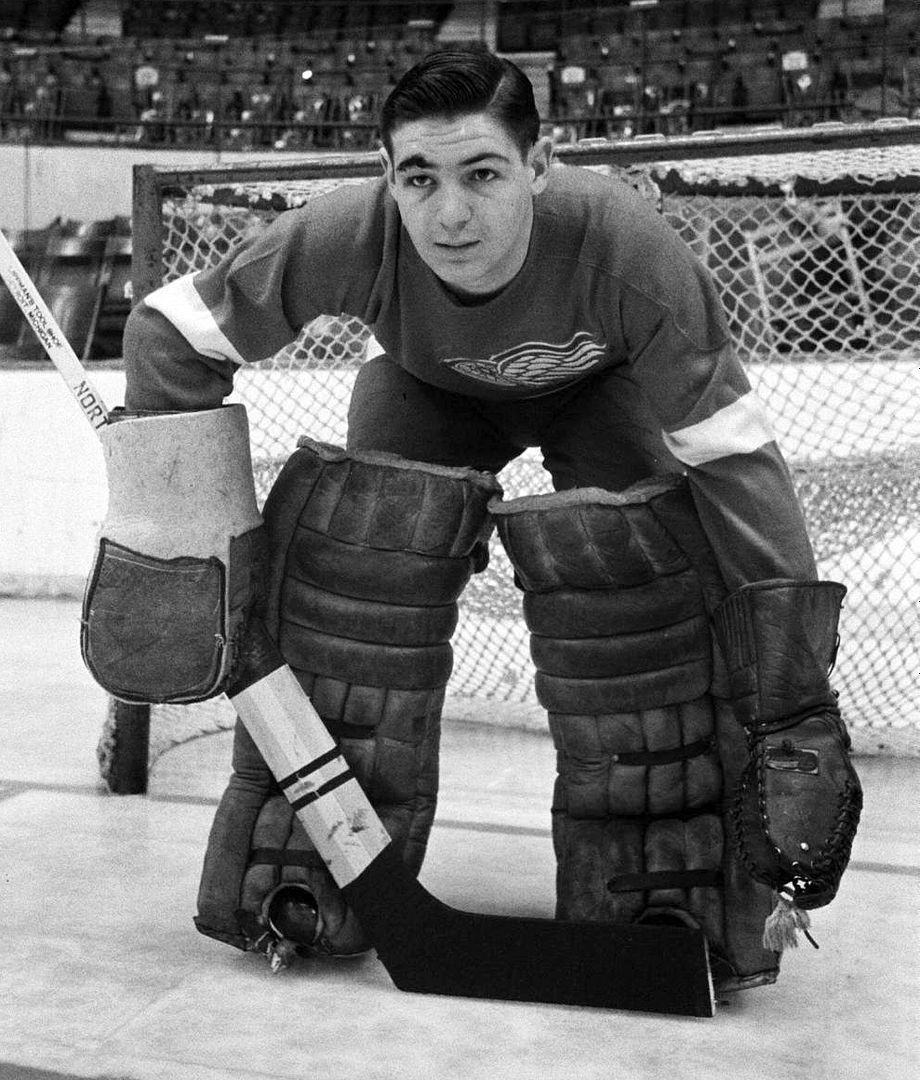
A young Terry Sawchuk in goal for Detroit

The Red Wings faith in Sawchuk would immediately pay off, as he would record a record of 44 wins, 13 losses and 13 ties with 11 shutouts and a goals against average (GAA) of 1.99 in his first full season, earning the Calder Trophy.

The 1951-52 season saw even more success, as he would again win 44 games, post 12 more shutouts and lower his goals against to 1.90, which would earn him his first Vezina Trophy. The Red Wings would advance through the playoffs and capture the Stanley Cup as NHL champions that season.
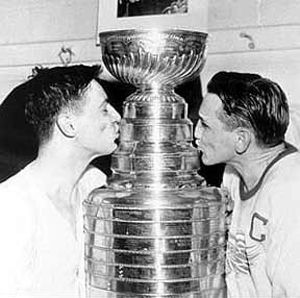
Terry Sawchuk and Red Wings captain Sid Abel
celebrate winning the 1952 Stanley Cup

Sawchuk would earn another Vezina Trophy in 1953, a second Stanley Cup championship in 1954, both the Vezina and another Stanley Cup in 1955, giving him three of each in just his first five seasons in the league.
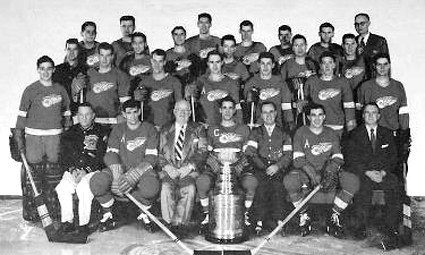
1953-54 Detroit Red Wings team
The 1953-54 Stanley Cup champion Detroit Red Wings

Feeling they had a new goaltender on the rise in Glenn Hall, the Red Wings would trade Sawchuk to the Boston Bruins prior to the 1955-56 season. He would record just 22 wins for Boston that season after having had a minimum of 32 during his time in Detroit. In his second season in Boston, Sawchuk was diagnosed with mononucleosis, but returned to the team just two weeks later. His play was poor, as he was weak from the illness and he announced his retirement from hockey early in 1957.

With Hall having fallen out of favor with the Red Wings, they traded Johnny Bucyk to Boston to reacquire Sawchuk for the start of the following season. He would play seven seasons for the Red Wings during his second stint in Detroit. While in Detroit, he would begin wearing a mask for the first time during the 1962-63 season after accumulating over 350 stitches up to that point in his career.
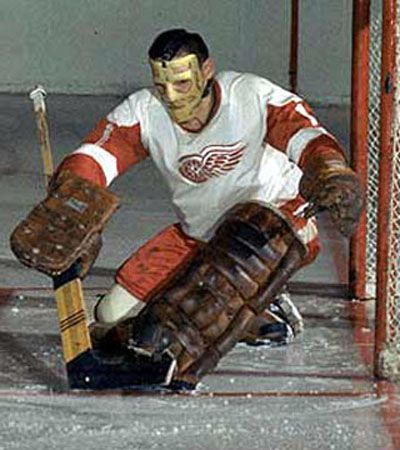
During his second tour of duty with Detroit, Sawchuk would
join the ranks of goaltenders now wearing protective masks

He would post between 22 and 29 wins in five of those seven seasons and add 23 more shutouts to his career total, with one of them coming on this date in 1964 after defeating the Montreal Canadiens 2-0 to pass legendary Canadiens goaltender George Hainsworth's career total of 94 set in 1936, a record that had stood for 28 years.

The Red Wings, feeling Sawchuk was expendable due to the promising Roger Crozier, left Sawchuk exposed in the waiver draft and was claimed by the Toronto Maple Leafs, where the 35-year-old would share goaltending duties with forty-year-old Johnny Bower.
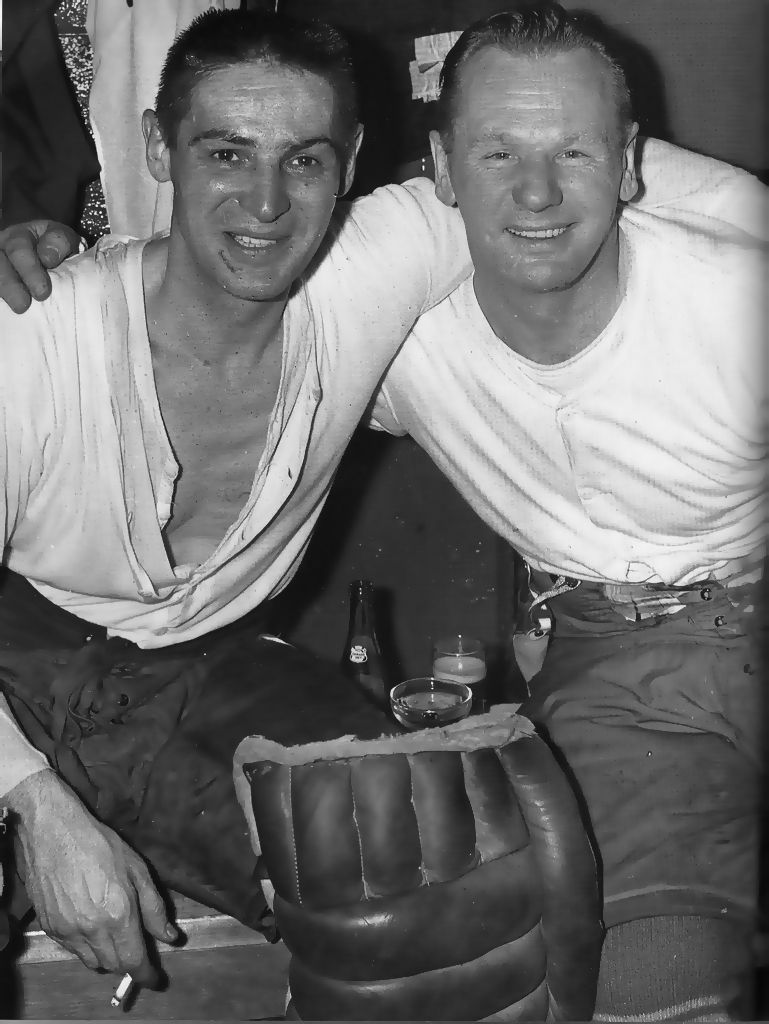
Sawchuk and Maple Leafs partner Bower

The pair responded by winning the Vezina Trophy in 1965, Sawchuk's fourth, perhaps in part to their decreased workload keeping them fresher on the days they did play, as they both went from 50+ games played down to the mid-30's that year. They were the first pair to share the Vezina, then awarded statistically to the goaltender for the team that gave up the least number of goals and not a vote for who is considered the best goaltender, as it is today.
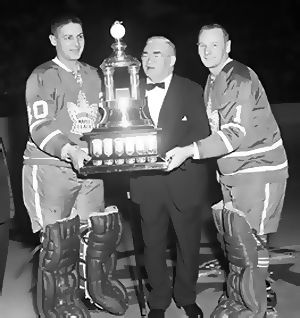
Sawchuk and Bower accepting the Vezina Trophy in 1965

Two seasons later, in 1966-67, the Maple Leafs would capture the most recent Stanley Cup in their history, and the fourth and final one of Sawchuk's career.
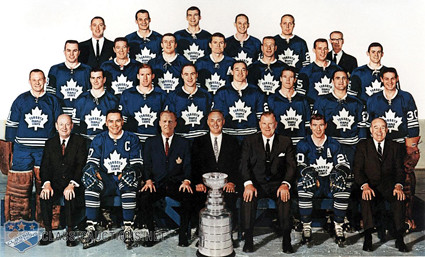
1966-67 Toronto Maple Leafs team
The 1966-67 Stanley Cup champion Toronto Maple Leafs

Once more, a championship season for Sawchuk was rewarded by being let go by his club, as he was left unprotected in the 1967 expansion draft and claimed by the Los Angeles Kings. He would play 36 games for the Kings in 1967-68, adding two more shutouts to his total. The Kings would trade Sawchuk to the Red Wings for the 1968-69 season. 
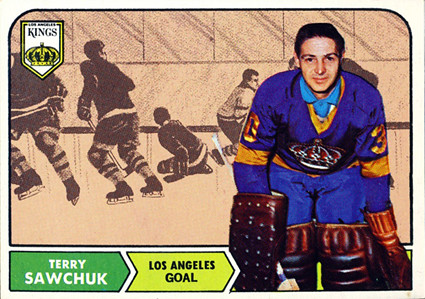
Sawchuk Kings
Sawchuk wearing the royal purple of the Kings

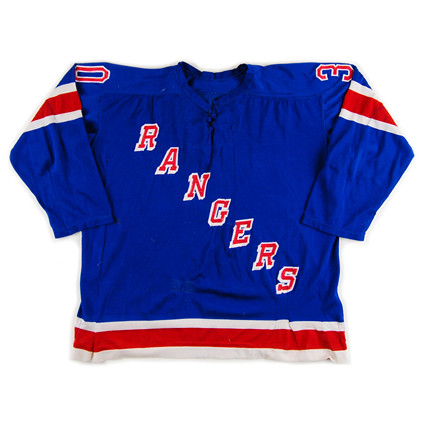
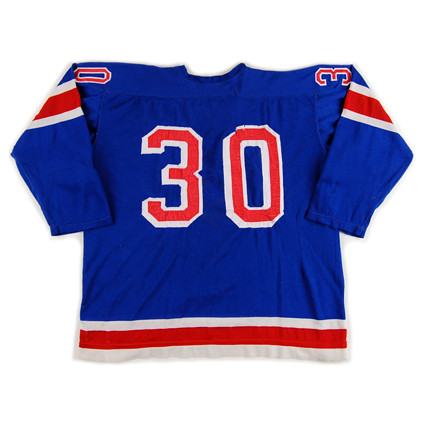
He would play the final season of his career with the New York Rangers, seeing action in eight games, which included recording the final shutout of his career, giving a league record of 103.
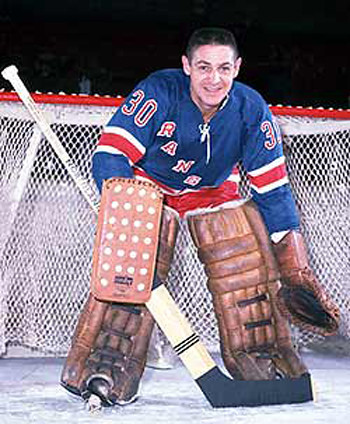
Sawchuk Rangers
Sawchuk's final 8 games came with the Rangers

His final NHL totals were 971 games over 21 seasons, an NHL record 447 wins, 330 losses and 172 ties (also an NHL record), with 23% of his wins coming via shutouts. In addition to his 103 regular season shutouts, he would also record 12 more in the playoffs.

Sawchuk would die at age 40 in 1970 just after the conclusion of the hockey season due to a pulmonary embolism as the result of an accidental injury suffered in a conflict with his Rangers teammate and housemate Ron Stewart.

In 1971 Sawchuk was named the winner of the Lester Patrick Award and inducted into the Hockey Hall of Fame. His #1 retired by the Red Wings in 1994.

Sawchuk's record for most wins lasted for 30 years until being broken by Patrick Roy on October 18, 2000 and his 103 shutouts stood as the record for 39 years until being surpassed by Martin Brodeur in December of 2009.

For further reading, several books have been written on the tumultuous life of Sawchuk.

Today's featured jersey is a 1963-64 Detroit Red Wings Terry Sawchuk jersey as worn the season he set the NHL record for most shutouts in a career. 

From 1932 to 1934, the Red Wings only wore red sweaters for both home and road games, with the white jersey not being introduced until the 1934-35 season. The next real change of note was the addition of red sleeves decorated with sleeve numbers for the first time in 1961, as seen on today's bonus jersey. Names would not appear until 1973 with only changes to fonts for the name and numbers since.

Detroit Red Wings 1957-58 jersey photo DetroitRedWings1957-58jersey.jpg
photo courtesy of Classic Auctions

Bonus jersey:
Today's bonus jersey is a 1950-51 Detroit Red Wings Terry Sawchuk jersey. 
The Red Wings jersey is a true classic in the NHL and has remained essentially unchanged since it was introduced back in 1932 when the club changed their name from the Falcons, as they had been known since 1930.


The original Detroit red sweaters used red numbers trimmed in white from 1932-33 until a change to single color white numbers in 1937-38, with the next change to the red jerseys being the addition of names in 1977-78.

This jersey was worn by Sawchuk during his rookie season of 1950-51 when he became the first NHL goaltender to ever win 40 games in a season and claim the Calder Trophy as NHL Rookie of the Year, and is an early example of a Red Wings jersey as evidenced by it's lack of sleeve numbers.
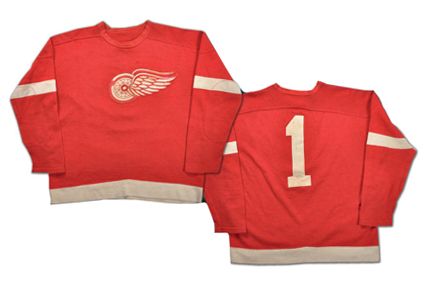

Detroit Red Wings 1954-55 jersey photo DetroitRedWings1954-55jersey.jpg
photo courtesy of Classic Auctions

Extra bonus jersey: Today's extra bonus jersey is a 1969-70 New York Rangers Terry Sawchuk jersey as worn by Sawchuk during his final win and 103rd and last shutout. This jersey was then recycled the following season when it was worn by Gilles Villemure, who won the Vezina Trophy that season, giving this jersey a highly unique pedigree!

New York Rangers 1969-70 F jersey
New York Rangers 1969-70 B jersey

This Legends of Hockey profile covers Sawchuk's career from the time of his youth through the end of his career and premature death at age 40.


Tuesday, March 15, 2016

1950-51 Detroit Red Wings Terry Sawchuk Jersey

Goaltender Terry Sawchuk idolized his older brother Mitch, who wanted to be a goaltender. Sadly, at just seventeen years of age, Mitch died of a heart attack. After inheriting his older brother's goalie equipment Terry began playing hockey in a local league and began to excel to the point that at age 14 a local scout for the Detroit Red Wings had Sawchuk work out for him and later signed Terry to an amateur contract to play for their junior team.

Sawchuk turned pro with Detroit during the later part of the 1949-50 season, filling in for the injured Harry Lumley, who would return in time to lead the Red Wings to the 1950 Stanley Cup championship. Despite winning the championship, Lumley was traded to the Chicago Black Hawks, promoting Sawchuk to the Red Wings goaltending job in time for the 1950-51 season despite having only seven games of NHL experience.


The Red Wings faith in Sawchuk would immediately pay off, as he would record the 10th shutout of his rookie season on this date in 1951 while becoming the first goalie in NHL history to win 40 games in one season as Detroit defeated the Boston Bruins 4-0.

At the conclusion of his rookie year, he would finish with a record of 44 wins, 13 losses and 13 ties with 11 shutouts and a goals against average (GAA) of 1.99 in his first full season, earning him the Calder Trophy as the NHL Rookie of the Year.

The 1951-52 season saw even more success, as he would again win 44 games, post 12 more shutouts and lower his goals against to 1.90, which would earn him his first Vezina Trophy. The Red Wings would advance through the playoffs and capture the Stanley Cup as NHL champions that season.

Terry Sawchuk and Red Wings captain Sid Abel celebrate winning the 1952 Stanley Cup

Sawchuk would earn another Vezina Trophy in 1953, a second Stanley Cup championship in 1954, both the Vezina and another Stanley Cup in 1955, giving him three of each in just his first five seasons in the league.

Feeling they had a new goaltender on the rise in Glenn Hall, the Red Wings would trade Sawchuk to the Boston Bruins prior to the 1955-56 season. He would record just 22 wins for Boston that season after having had a minimum of 32 during his time in Detroit. In his second season in Boston, Sawchuk was diagnosed with mononucleosis, but returned to the team just two weeks later. His play was poor, as he was weak from the illness and he announced his retirement from hockey early in 1957.

With Hall having fallen out of favor with the Red Wings, they traded Johnny Bucyk to Boston to reacquire Sawchuk for the start of the following season. He would play seven seasons for the Red Wings during his second stint in Detroit. While in Detroit, he would begin wearing a mask for the first time during the 1962-63 season after accumulating over 350 stitches up to that point in his career.


In 1964, Sawchuk would set the NHL record for the most career games by a goaltender, when he appeared in his 804th game, a 3-2 win over the Boston Bruins.

He would post between 22 and 29 wins in five of those seven seasons and add 23 more shutouts to his career total, eventually passing legendary Montreal Canadiens goaltender George Hainsworth's career total of 94 set in 1936, a record that had stood for 28 years.

The Red Wings, feeling Sawchuk was expendable due to the promising Roger Crozier, left Sawchuk exposed in the waiver draft and was claimed by the Toronto Maple Leafs, where the 35-year-old would share goaltending duties with forty-year-old Johnny Bower.


The pair responded by winning the Vezina Trophy in 1965, Sawchuk's fourth, perhaps in part to their decreased workload keeping them fresher on the days they did play, as they both went from 50+ games played down to the mid-30's that year. They were the first pair to share the Vezina, then awarded statistically to the goaltender for the team that gave up the least number of goals and not a vote for who is considered the best goaltender, as it is today.


Two seasons later, in 1966-67, the Maple Leafs would capture the most recent Stanley Cup in their history, and the fourth and final one of Sawchuk's career.

Once more a championship season for Sawchuk was rewarded by being let go by his club, as he was left unprotected in the 1967 expansion draft, and was claimed by the Los Angeles Kings. He would play 36 games for the Kings in 1967-68, adding two more shutouts to his total. The Kings would trade Sawchuk to the Red Wings for 1968-69 and he would play the final season of his career with the New York Rangers, where he played in eight games and recorded the final shutout of his career, giving him a final total of 103.

His final NHL totals were 971 games over 21 seasons, an NHL record 447 wins, 330 losses and 172 ties (also an NHL record), with 23% of his wins coming via shutouts. In addition to his 103 regular season shutouts, he would also record 12 more in the playoffs.

Sawchuk would die at age 40 in 1970 just after the conclusion of the hockey season due to a pulmonary embolism as the result of an accidental injury suffered in a conflict with his Rangers teammate and housemate Ron Stewart.

In 1971 he was named the winner of the Lester Patrick Award and inducted into the Hockey Hall of Fame and his #1 was retired by the Red Wing in 1994.

Sawchuk's record for most wins lasted for 30 years until being broken by Patrick Roy on October 18, 2000 and his 103 shutouts stood as the record for 39 years until being surpassed by Martin Brodeur in December of 2009.

For further reading, several books have been written on the tumultuous life of Terry Sawchuk.

Today's featured jersey is a 1950-51 Detroit Red Wings Terry Sawchuk jersey. The Red Wings jersey is a true classic in the NHL and has remained essentially unchanged since it was introduced back in 1932 when the club changed their name from the Falcons, as they had been known since 1930.

The original Detroit red sweaters used red numbers trimmed in white from 1932-33 until a change to single color white numbers in 1937-38, with the next change to the red jerseys being the addition of names in 1977-78.

This jersey was worn by Sawchuk during his rookie season of 1950-51 when he became the first NHL goaltender to ever win 40 games in a season and claim the Calder Trophy as NHL Rookie of the Year, and is an early example of a Red Wings jersey as evidenced by it's lack of sleeve numbers.


Detroit Red Wings 1954-55 jersey photo DetroitRedWings1954-55jersey.jpg

Bonus jersey: Today's bonus jersey is a 1961-62 Detroit Red Wings Terry Sawchuk jersey. From 1932 to 1934, the Red Wings only wore red sweaters for both home and road games, with the white jersey not being introduced until the 1934-35 season. The next real change of note was the addition of red sleeves decorated with sleeve numbers for the first time in 1961, as seen on today's bonus jersey. Names would not appear until 1973 with only changes to fonts for the name and numbers since.

Detroit Red Wings 1957-58 jersey photo DetroitRedWings1957-58jersey.jpg
photos courtesy of Classic Auctions

This Legends of Hockey profile covers Sawchuk's career from the time of his youth through the end of his career and premature death at age 40.


Tuesday, April 15, 2014

Detroit's Octopus Throwing Tradition

On this date in 1952, Metro Prystai scored two goals and an assist, while Terry Sawchuk held the Montreal Canadiens scoreless as the Detroit Red Wings captured the Stanley Cup, becoming the first team to ever go undefeated in the playoffs.

Photobucket

But more significant than being awarded a silver chalice as a trinket to note one's success, on this date in 1952 the tradition of hurling a celebratory cephalopod was born in The Motor City.

The brainchild of Pete and Jerry Cusimano, owners of a fish market in Detroit's Eastern Market, the brothers had the bright idea to hurl an octopus onto the ice during the series clinching game to symbolize the eight wins needed to achieve the Stanley Cup during the days of the Original Six - the same number of tentacles possessed by an octopus, making for the perfect synergy in seafood.

"It was a good luck omen," said Cusimano. "The octopus has eight legs and we were going for eight straight."

The bizarre ritual caught on, and Sports Illustrated reported in 1978 when writing about the Red Wings playoff series versus the Atlanta Flames,
"Making their first cup appearance in eight seasons, the Red Wings won their best-of-three preliminary series in two straight games over the favored Atlanta Flames. And as Detroit clinched the upset with a 3-2 victory Thursday night before a record Olympia throng of 16,671, fans hurled no fewer than a dozen live octopuses onto the ice.
As a result, maintenance crews kept scurrying around the rink with pails and shovels and more mannerly fans began to wonder whether there might not be a more seemly way of saluting Detroit's hockey revival.
When the teams moved to Detroit for Thursday's game, the passions of Motown hockey fans were at fever pitch. Scalpers commanded $60 for a pair of $11 tickets, and parking spaces near the Olympia were going for $8. Inside the building, fans bombarded the ice with all those octopuses, as well as two dead chickens, scores of apples and other comestibles. There were moments when the inside of the Olympia was almost as littered as the mean streets outside."

The tradition continues to this day and has made a celebrity of sorts out of Al Sobotka, the Zamboni driver at Joe Louis Arena and the man responsible for retrieving the hurled octopi, which he does with aplomb, twirling the projectile from the depths over his head, winding up the faithful in the process.

Photobucket

During the 1995 playoffs, three dozen octopi were flung onto the ice during the playoffs and the record for a single octopus belongs to Bob Dubisky and Larry Shotwell, who topped their record 38 pounder a year later with a 50 pound monster, which Sobotka proudly displayed on the hood of his Zamboni.

With Detroit's first home game in their quest for the cup scheduled for Sunday, here is a primer on how to get your shot at gooey glory.

After purchasing your Octopus, preferably at the Eastern Market, boil it for 20 minutes on high heat with a little lemon juice and white wine to mask the odor. Not only will this hide the stench of the creature, a boiled octopus will bounce and roll when it hits the ice, rather than landing with a sticky splat that will leave an inky stain on the ice, making for more work for the ice crew.

Another key is the purchase of a desirable aisle seat, allowing a quick response and plenty of elbow room immediately following a goal.

Speaking of a goal, one must know when it is appropriate to toss your octopus. Acceptable opportunities are following the national anthem, following a Red Wings goal or a final game victory, and for heaven's sake, don't aim for anything other than open ice. You don't want to hit any of the game's participants with a disgusting sea creature, or worse, actually hurt them with a launched projectile of between five and thirty pounds.

Photobucket

Cusimano's insights on the proper form for throwing your octopus recommends holding it around the middle of the tentacles with the head hanging down by your knees and then, while keeping your arm straight, swinging it over your head as if throwing a grenade. "That's the only way you're going to get any leverage. You try to throw it like a baseball and you're going to throw your shoulder out," he relates.

Photobucket

Don't grasp it too far down the tentacles however, as they will likely break off in your hand, causing the bulk of the creature to end up randomly deposited on an unsuspecting fan nearby.

Keep in mind, it is against the law to throw anything on the ice during a game, and while no octopus hurler has ever been prosecuted, the Red Wings do try to discourage fans from bringing them into the game. With that in mind, all manner of smuggling techniques have been developed by would-be hurlers. After encapsulating the creature in a zip-lock bag, it can be stuffed stuffed down your shirt or pants, wrapped to your body with plastic wrap or hidden under a hat if size allows.

Once the beast has been launched, getting the stench off your hands with wet-wipes and a slice of lemon will do the trick if gloves weren't worn to begin with.

The Red Wings organization has embraced the tradition, including creating a 35-foot-wide purple octopus which they hang from the rafters of Joe Louis Arena named Al the Octopus, in honor of Sobotka, the Zamboni driver and octopus retriever.

Photobucket

Today's featured jersey is a 1951-52 Detroit Red Wings Terry Sawchuk jersey. The Red Wings jersey is a true classic in the NHL and has remained essentially unchanged since it was introduced back in 1932 when the club changed their name from the Falcons, as they had been known since 1930. The original Detroit red sweaters used red numbers trimmed in white from 1932-33 until a change to single color white numbers in 1937-38, with the next change to the red jerseys being the addition of names forty years later in 1977-78.

In his Stanley Cup Finals debut, Sawchuk won four straight games, including a pair of shutouts in Games 3 and 4 to clinch the cup, bookending the pair of shutouts he had to open the tournament against the Toronto Maple Leafs on his way to an 8-0 record in that year's playoffs.

Detroit Red Wings 1954-55 jersey photo DetroitRedWings1954-55jersey.jpg
photo courtesy of Classic Auctions

Today's first video is a look at the Octopus tradition and what it means to Red Wings fans.


In this brief clip, Cody MeLeod of the Colorado Avalanche returns the octopus into the stands!


Finally, another look at the Octopus tradition through the lens of ESPN.


Friday, March 7, 2014

1954-55 Detroit Red Wings Terry Sawchuk Jersey

Goaltender Terry Sawchuk idolized his older brother Mitch, who wanted to be a goaltender. Sadly, at just seventeen years of age, Mitch died of a heart attack. After inheriting his older brother's goalie equipment Terry began playing hockey in a local league and began to excel to the point that at age 14 a local scout for the Detroit Red Wings had Sawchuk work out for him and later signed Terry to an amateur contract to play for their junior team.

Sawchuk turned pro with Detroit in 1950, filling in for the injured Harry Lumley, who would return in time to lead the Red Wings to the 1950 Stanley Cup championship. Despite winning the championship, Lumley was traded to the Chicago Black Hawks, promoting Sawchuk to the Red Wings goaltending job in time for the 1950-51 season despite having only seven games of NHL experience.


The Red Wings faith in Sawchuk would immediately pay off, as he would record a record of 44 wins, 13 losses and 13 ties with 11 shutouts and a goals against average (GAA) of 1.99 in his first full season, earning the Calder Trophy.

The 1951-52 season saw even more success, as he would again win 44 games, post 12 more shutouts and lower his goals against to 1.90, which would earn him his first Vezina Trophy. The Red Wings would advance through the playoffs and capture the Stanley Cup as NHL champions that season.

Terry Sawchuk and Red Wings captain Sid Abel celebrate winning the 1952 Stanley Cup

Sawchuk would earn another Vezina Trophy in 1953, a second Stanley Cup championship in 1954, both the Vezina and another Stanley Cup in 1955, giving him three of each in just his first five seasons in the league.

Feeling they had a new goaltender on the rise in Glenn Hall, the Red Wings would trade Sawchuk to the Boston Bruins prior to the 1955-56 season. He would record just 22 wins for Boston that season after having had a minimum of 32 during his time in Detroit. In his second season in Boston, Sawchuk was diagnosed with mononucleosis, but returned to the team just two weeks later. His play was poor, as he was weak from the illness and he announced his retirement from hockey early in 1957.

With Hall having fallen out of favor with the Red Wings, they traded Johnny Bucyk to Boston to reacquire Sawchuk for the start of the following season. He would play seven seasons for the Red Wings during his second stint in Detroit. While in Detroit, he would begin wearing a mask for the first time during the 1962-63 season after accumulating over 350 stitches up to that point in his career.


In 1964, Sawchuk would set the NHL record for the most career games by a goaltender, when he appeared in his 804th game, a 3-2 win over the Boston Bruins.

He would post between 22 and 29 wins in five of those seven seasons and add 23 more shutouts to his career total, eventually passing legendary Montreal Canadiens goaltender George Hainsworth's career total of 94 set in 1936, a record that had stood for 28 years.

The Red Wings, feeling Sawchuk was expendable due to the promising Roger Crozier, left Sawchuk exposed in the waiver draft and was claimed by the Toronto Maple Leafs, where the 35-year-old would share goaltending duties with forty-year-old Johnny Bower.


The pair responded by winning the Vezina Trophy in 1965, Sawchuk's fourth, perhaps in part to their decreased workload keeping them fresher on the days they did play, as they both went from 50+ games played down to the mid-30's that year. They were the first pair to share the Vezina, then awarded statistically to the goaltender for the team that gave up the least number of goals and not a vote for who is considered the best goaltender, as it is today.


Two seasons later, in 1966-67, the Maple Leafs would capture the most recent Stanley Cup in their history, and the fourth and final one of Sawchuk's career.

Once more a championship season for Sawchuk was rewarded by being let go by his club, as he was left unprotected in the 1967 expansion draft, and was claimed by the Los Angeles Kings. He would play 36 games for the Kings in 1967-68, adding two more shutouts to his total. The Kings would trade Sawchuk to the Red Wings for 1968-69 and he would play the final season of his career with the New York Rangers, where he played in eight games and recorded the final shutout of his career, giving him a final total of 103.

His final NHL totals were 971 games over 21 seasons, an NHL record 447 wins, 330 losses and 172 ties (also an NHL record), with 23% of his wins coming via shutouts. In addition to his 103 regular season shutouts, he would also record 12 more in the playoffs.

Sawchuk would die at age 40 in 1970 just after the conclusion of the hockey season due to a pulmonary embolism as the result of an accidental injury suffered in a conflict with his Rangers teammate and housemate Ron Stewart.

In 1971 he was named the winner of the Lester Patrick Award and inducted into the Hockey Hall of Fame and his #1 was retired by the Red Wings on this date in 1994.

Sawchuk's record for most wins lasted for 30 years until being broken by Patrick Roy on October 18, 2000 and his 103 shutouts stood as the record for 39 years until being surpassed by Martin Brodeur in December of 2009.

For further reading, several books have been written on the tumultuous life of Terry Sawchuk.

Today's featured jersey is a 1961-62 Detroit Red Wings Terry Sawchuk jersey. The Red Wings jersey is a true classic in the NHL and has remained essentially unchanged since it was introduced back in 1932 when the club changed their name from the Falcons, as they had been known since 1930. The original Detroit red sweaters used red numbers trimmed in white from 1932-33 until a change to single color white numbers in 1937-38, with the next change to the red jerseys being the addition of names in 1977-78.

This jersey was worn by Sawchuk during the 1954-55 season when Detroit won the third of Sawchuk's four Stanley Cups, and is an early example of a Red Wings jersey as evidenced by it's lack of sleeve numbers.

In addition to winning the Stanley Cup in 1955, Sawchuk would also play in the NHL All-Star Game and win his second Vezina Trophy that year.


Detroit Red Wings 1954-55 jersey photo DetroitRedWings1954-55jersey.jpg

Bonus jersey: Today's bonus jersey is a 1961-62 Detroit Red Wings Terry Sawchuk jersey. From 1932 to 1934, the Red Wings only wore red sweaters for both home and road games, with the white jersey not being introduced until the 1934-35 season. The next real change of note was the addition of red sleeves decorated with sleeve numbers for the first time in 1961, as seen on today's bonus jersey. Names would not appear until 1973 with only changes to fonts for the name and numbers since.

Detroit Red Wings 1957-58 jersey photo DetroitRedWings1957-58jersey.jpg
photos courtesy of Classic Auctions

This Legends of Hockey profile covers Sawchuk's career from the time of his youth through the end of his career and premature death at age 40.


Friday, February 8, 2013

1963-64 Detroit Red Wings Terry Sawchuk Jersey

Goaltender Terry Sawchuk idolized his older brother Mitch, who wanted to be a goaltender. Sadly, at just seventeen years of age, Mitch died of a heart attack. After inheriting his older brother's goalie equipment Terry began playing hockey in a local league and began to excel to the point that at age 14 a local scout for the Detroit Red Wings had Sawchuk work out for him and later signed Terry to an amateur contract to play for their junior team.

Sawchuk turned pro with Detroit in 1950, filling in for the injured Harry Lumley, who would return in time to lead the Red Wings to the 1950 Stanley Cup championship. Despite winning the championship, Lumley was traded to the Chicago Black Hawks, promoting Sawchuk to the Red Wings goaltending job in time for the 1950-51 season despite having only seven games of NHL experience.


The Red Wings faith in Sawchuk would immediately pay off, as he would record a record of 44 wins, 13 losses and 13 ties with 11 shutouts and a goals against average (GAA) of 1.99 in his first full season, earning the Calder Trophy.

The 1951-52 season saw even more success, as he would again win 44 games, post 12 more shutouts and lower his goals against to 1.90, which would earn him his first Vezina Trophy. The Red Wings would advance through the playoffs and capture the Stanley Cup as NHL champions that season.

Terry Sawchuk and Red Wings captain Sid Abel celebrate winning the 1952 Stanley Cup

Sawchuk would earn another Vezina Trophy in 1953, a second Stanley Cup championship in 1954, both the Vezina and another Stanley Cup in 1955, giving him three of each in just his first five seasons in the league.

Feeling they had a new goaltender on the rise in Glenn Hall, the Red Wings would trade Sawchuk to the Boston Bruins prior to the 1955-56 season. He would record just 22 wins for Boston that season after having had a minimum of 32 during his time in Detroit. In his second season in Boston, Sawchuk was diagnosed with mononucleosis, but returned to the team just two weeks later. His play was poor, as he was weak from the illness and he announced his retirement from hockey early in 1957.

With Hall having fallen out of favor with the Red Wings, they traded Johnny Bucyk to Boston to reacquire Sawchuk for the start of the following season. He would play seven seasons for the Red Wings during his second stint in Detroit. While in Detroit, he would begin wearing a mask for the first time during the 1962-63 season after accumulating over 350 stitches up to that point in his career.


On this date in 1964, Sawchuk would set the NHL record for the most career games by a goaltender, when he appeared in his 804th game, a 3-2 win over Boston on this date.

He would post between 22 and 29 wins in five of those seven seasons and add 23 more shutouts to his career total, eventually passing legendary Montreal Canadiens goaltender George Hainsworth's career total of 94 set in 1936, a record that had stood for 28 years.

The Red Wings, feeling Sawchuk was expendable due to the promising Roger Crozier, left Sawchuk exposed in the waiver draft and was claimed by the Toronto Maple Leafs, where the 35-year-old would share goaltending duties with forty-year-old Johnny Bower.


The pair responded by winning the Vezina Trophy in 1965, Sawchuk's fourth, perhaps in part to their decreased workload keeping them fresher on the days they did play, as they both went from 50+ games played down to the mid-30's that year. They were the first pair to share the Vezina, then awarded statistically to the goaltender for the team that gave up the least number of goals and not a vote for who is considered the best goaltender, as it is today.


Two seasons later, in 1966-67, the Maple Leafs would capture the most recent Stanley Cup in their history, and the fourth and final one of Sawchuk's career.

Once more a championship season for Sawchuk was rewarded by being let go by his club, as he was left unprotected in the 1967 expansion draft, and was claimed by the Los Angeles Kings. He would play 36 games for the Kings in 1967-68, adding two more shutouts to his total. The Kings would trade Sawchuk to the Red Wings for 1968-69 and he would play the final season of his career with the New York Rangers, where he played in eight games and recorded the final shutout of his career, giving him a final total of 103.

His final NHL totals were 971 games over 21 seasons, an NHL record 447 wins, 330 losses and 172 ties (also an NHL record), with 23% of his wins coming via shutouts. In addition to his 103 regular season shutouts, he would also record 12 more in the playoffs.

Sawchuk would die at age 40 in 1970 just after the conclusion of the hockey season due to a pulmonary embolism as the result of an accidental injury suffered in a conflict with his Rangers teammate and housemate Ron Stewart. In 1971 he was named the winner of the Lester Patrick Award and inducted into the Hockey Hall of Fame. His #1 retired by the Red Wings in 1994.

Sawchuk's record for most wins lasted for 30 years until being broken by Patrick Roy on October 18, 2000 and his 103 shutouts stood as the record for 39 years until being surpassed by Martin Brodeur in December of 2009.

For further reading, several books have been written on the tumultuous life of Terry Sawchuk.

Today's featured jersey is a 1963-64 Detroit Red Wings Terry Sawchuk Jersey as worn during the season in which Sawchuck set the all-time NHL record for the most shutouts and career games played.

The Red Wings jersey is a true classic in the NHL and has remained essentially unchanged since it was introduced back in 1932 when the club changed their name from the Falcons, as they had been known since 1930.

From 1932 to 1937, the jerseys had red numbers on the back trimmed in white before changing to the one color white numbers for 1937-38. The next real change of note was the addition of sleeve numbers in 1961.


This Legends of Hockey profile covers Sawchuk's career from the time of his youth through the end of his career and premature death at age 40.


hit counter for blogger