History of Jersey 83-93 Banner sm photo History of Jersey 83-93 Banner sm.jpg
Showing posts with label New York Islanders. Show all posts

Friday, April 15, 2022

1985-86 New York Islanders Mike Bossy Jersey

Mike Bossy had a prolific junior hockey career for the Laval National, with whom he played for five seasons, beginning with 4 appearances in 1972-73. Playing a full season in 1973-74, he reeled off a 70 goal, 118 point season in 68 games.

He kept his foot on the gas the following year, topping that with an impressive 84 goals and 149 points in 67 games, 2.22 points per games. In the post season, his torrid pace continued with 38 more points in 16 games. Over the next two seasons he would add 79 goals and 136 points followed by another 75 goals and 126 points to set the all-time QMJHL record with 309 career goals, a mark which still stands today and ranks 28 goals higher that the next closest pursuer.

Bossy Laval, Bossy Laval
Bossy with Laval

Thought of as being too timid by NHL scouts, Bossy was not chosen until 15th overall in the 1977 NHL Amateur Draft, which included being passed over by the New York Rangers and Toronto Maple Leafs not once, but twice.

Playing on a line with Bryan Trottier and Clark Gilles, Bossy would set the hockey world on fire when he scored 53 goals in his rookie season of 1977-78, the first rookie to ever reach 50, while winning the Calder Trophy in the process.

Gilles, Trottier and Bossy Islanders, Gilles, Trottier and Bossy Islanders
Gilles, Trottier and Bossy

The following season he would better that by becoming only the second player after Maurice Richard, and first in 36 years, to score 50 goals in 50 games. Bossy did it in dramatic style with two goals in the last five minutes of game number 50. He would finish the season with 69 goals to lead the league and 57 assists for 126 points, good for fourth overall.

Bossy Riachard 50 goals, Bossy Riachard 50 goals
Bossy poses with Maurice Richard to
commemorate their 50 goals in 50 games

1979-80 would see Bossy once more top the 50 mark with 51 goals in 75 games and the Islanders would capture their first of four consecutive Stanley Cup Championships as Bossy contributed 23 points in just 16 games.

While topping 50 goals the previous season, he did fail to reach 100 points during the regular season. Over the course of the next six seasons, he would blow past the 100 point level, never scoring less than 117, with a high of 147 in 1981-82.

Bossy Islanders, Bossy Islanders

During the 1980-81 season he would set a career high in goals with 68 to once again lead the NHL and pour in a remarkable 17 goals and 35 points in 18 playoff games as the Islanders would capture their second straight Stanley Cup.

Their third Stanley Cup Championship would see Bossy be recognized with the Conn Smythe Trophy as playoff MVP following 17 goals and 27 points in 19 games. This came on the heels of his 147 point regular season and his second consecutive 60 goal season when he tallied 64.

Bossy Islanders, Bossy Islanders

The Islanders dynasty was now in full force and Bossy once more reached 60 goals, this time on the nose with an even 60. His 118 point regular season continued his 100 point season streak and the playoffs would again see him get his now customary 17 goals (for the third year in a row and the only player to ever do so) and 26 points in 19 games. He would also be recognized for his style of play with the first of three Lady Byng Trophies following the season.

Boddy Lady Byng, Boddy Lady Byng
Bossy with the Lady Byng Trophy

1983-84 was another 118 point season with 51 goals scored. The Islanders would make it once more to the finals, but the dynasty would end as they were defeated by the up and coming Edmonton Oilers 4 games to 1. The Islanders 21 playoff games would see Bossy contribute 18 points. He was the recipient of his second Lady Byng Trophy after being whistled for just 8 penalty minutes for the entire season, the second lowest total of his career following just 6 during his rookie campaign.

His remarkable goal scoring consistency continued unabated, as 58 more would be added to his career total during a 117 point campaign in 1984-85. 10 more playoff games allowed Bossy to add another 11 points for the Islanders.

Bossy Islanders, Bossy Islanders

Showing no signs of slowing down, he would reach 61 goals, paired with 62 assists, giving him his highest point total in four seasons with 123, which included becoming just the 20th player in league history to score 1,000th career points, accomplished on January 24, 1986 in grand style, registering a goal and four assists in a 7-5 win over the Washington Capitals. He would also capture this third Lady Byng Trophy in the space of four seasons as well.

Bossy Islanders, Bossy Islanders

Now slowed by back injuries, his final season of 1986-87, Bossy appeared in 63 games and scored 38 goals and 75 points, still over a point per game, before retiring at the age of just 30.

His final career totals of 573 goals and 553 assists for 1,126 points in 752 games would give him a final career average of 1.50 points per game over his ten NHL seasons and his 160 career playoff points in 129 games were a 1.24 points per game clip. At the time of his retirement, he held the record for most goals by a rookie and most assists and points by a right wing in a single season. He still ranks third all time in hat tricks with 39. He also reached 100 goals faster than any player in history, doing so in just 129 games. He was also the quickest at one point to 300 and 500 career goals scored.

His goals per game average of .762 in the regular season is the highest in NHL history and his playoff goals per game average of .659 is second only to Mario Lemieux.

He also still holds the NHL record for the most consecutive 50 goal seasons with nine, and shares the record with Wayne Gretzky for the most 60 goal seasons with five, despite playing 10 years less than Gretzky.

Internationally, he was a member of Team Canada in the 1981 and 1984 Canada Cup tournaments, earning a gold medal in in 1984. Due to the Islanders consistent playoff history, he was never available for World Championships duty.

Bossy Canada, Bossy Canada
Bossy celebrates with Islanders teammate
John Tonelli during the Canada Cup in 1984

He was inducted into the Hockey Hall of Fame in 1991 and his jersey #22 was retired by the Islanders in 1992.

Today's featured jersey is a 1985-86 New York Islanders Mike Bossy jersey as worn during the season he scored his 1,000th point.

When Bossy joined the Islanders in 1977, they had just changed from a lace-up collar to a v-neck while wearing two color names and a bolder font for the numbers. In 1978 the stripes on the blue jerseys would be unified, now with a white stripe directly above a thicker orange stripe. This would be the jersey worn for their four stanley Cup championships, lasting through 1983-84.

In 1984-85, the names would change to one color and the font for the numbers would become narrower. This style would remain unchanged through 1995 when a change in ownership would result in the debacle that was the Islanders Fishsticks jerseys being born.

New York Islanders 85-86 jersey, New York Islanders 85-86 jersey

Bonus Jersey: Today's bonus jersey is a 1981 Team Canada Mike Bossy jersey. The minimalist style used by Canada for the Canada Cup tournaments is remarkable in it's stark simplicity, with it's single color crest and customization.

It features a bold half maple leaf on the front, which was based on the Canada Cup trophy awarded to the tournament champions. Canada would not use this style for any other international tournament, such as the World Championships, as those jerseys were subject to supplier contracts with jersey manufacturers like as Adidas, Tackla, Reebok and Nike, who supplied all the teams participating in IIHF tournaments beginning in the mid-1980's.

Canada 1981 jersey, Canada 1981 jersey
Photo courtesy of Classic Auctions

Here is a career retrospective of Mike Bossy, which includes his dramatic 50th goal in his 50th game in 1980.


Up next is a nice interview with Bossy as he looks back on his career and a variety of topics.


A recap of the 1980 Stanley Cup Finals is next up, showing the 1980 Lake Placid Olympics patch on the Islanders jerseys. The passion and excitement of the Islander and their fans is infectious and recommended viewing. A reminder of what it's all about.


We don't know about you, but all this writing has left us hungry. Ça, c'est du bon poulet!

Sunday, April 21, 2019

The Easter Epic - 1986-87 New York Islanders Pat LaFontaine Jersey

On April 18, 1987, the Washington Capitals hosted the New York Islanders in Game 7 of their opening round playoff series.

The game would not end until the early hours of the following day.

The series had opened in Washington with a split, with the Capitals taking Game 1 by a score of 4-3 and the Islanders evening the series by taking Game 2 by a 3-1 margin. Back on Long Island the Capitals took two, with a Game 3 shutout 2-0 and a 4-1 win in Game 4 to take a commanding 3-1 edge in games. The Islanders stayed alive with a 4-2 win back in Washington and forced a deciding Game 7 with a 5-4 win at home.

With viewers across North America tuned in on ESPN and the CBC, the puck dropped at 7:40 PM and the Capitals dominated early but it took nearly the entire period for Mike Gartner to eventually put Washington ahead 1-0 with 48 seconds left in the first.

Pat Flatley evened the score at 11:35 of the middle period before Grant Martin restored Washington's one goal lead at 18:45 by beating the Islanders goaltender Kelly Hrudey. The period ended at 2-1 for Washington, which held a 25-10 margin in shots.

There was no scoring in the third period until Bryan Trottier put a backhander between Captials goalie Bob Mason's legs at 14:37 to tie the game at 2-2. For the remainder of regulation both teams sought an advantage without success, and regulation came to a close without a winner.

In the first twenty minute overtime, the teams both recorded 11 shots on goal and the Capitals Greg Smith nearly won it with a slap shot that beat Hrudey but clanged off the right post with seconds remaining.

Washington did their best to end it in the second overtime by outshooting the Islanders 17-9, but could not solve Hrudey. Perhaps the best chance to end the game in the second OT was when Islander Randy Wood's shot that hit the pipe.

The game then advanced to a third overtime, the first in 16 years, and fatigue really began to take hold as Easter Sunday began. The Islanders got the better of the Capitals during the period, holding an 11-10 edge in shots on goal. Mason denied the Islanders better scoring chances and the second sixty minutes closed scoreless.

For the first time since 1951, a game would enter the fourth overtime and people really started to get punchy, ESPN's Bill Clement in particular, having taken off his shirt and converted his tie into a headband before doing some voice impressions prior to the start of the fourth overtime.

The game started to climb the list of the longest games in NHL history, entering the top five of all time after a 1:10 of play in the fourth overtime period. The Islanders moved ahead in shots four to one when Ken Leiter of the Islanders pinched in the keep the puck in the Washington end. He circled behind the goal and passed to Gord Dineen, whose shot was blocked in front of Mason. The puck deflected back to Pat LaFontaine, who fired a slapshot passed a screened Mason to finally end the game after 128:47 of play, winning not only the game, but eliminating the Capitals as the Islanders won the series 4 games to 3, despite the fact that the Capitals had not trailed in the series or the game until LaFontaine's goal.

LaFontaine's goal came at 1:58 AM, 6 hours and 18 minutes after the opening faceoff. Hrudey was credited with 73 saves, an NHL playoff record, while Mason's total was 54 in the game that would become known as the "Easter Epic".

LaFontain Mason Easter Epic photo LaFontainMasonEasterEpic.jpg
LaFontaine meets Mason in the handshake line following the Easter Epic

Today's featured jersey is a 1986-87 New York Islanders Pat LaFontaine jersey. Throughout his career, LaFontaine's name was spelled with a variety of all capital letters of equal size and other times when the "A" was in a smaller size as shown here.

Later LaFontaine Islanders jerseys would have the more traditional all caps of the same size, so it is essential for you to do your research for the exact specification of lettering style used for the particular year of any LaFontaine Islanders jersey you may want to add to your collection.

The smaller "A" can be found on early Islanders, 1996 USA and black Sabres jerseys.

Photobucket
Photobucket

Bonus jersey: Today's bonus jersey is a 1986-87 Washington Capitals Bob Mason jersey . The Capitals wore this style starting with their inaugural season of 1974-75 and continued to use it through the 1995-95 season before a radical overhaul of their branding saw them drop their red, white and blue color set in favor of a lighter shade of blue and black with bronze accents.

The team reverted to their classic red, white and blue colors for the 2007-08 season and reintroduced today's bonus jersey style for the 2011 Winter Classic, which proved so popular they made this their alternate jersey starting with the 2011-12 season through the 2014-15 campaign before switching to the red road version of this jersey.

 photo Washington Capitals 1985-86 F jersey.jpg

 photo Washington Capitals 1985-86 B jersey.jpg

Today's video section features highlights of the Easter Epic, which faced off on this date in 1987. First, from the CBC, featuring a more subdued Don Cherry than the much more voluminous one he has evolved into.


Next, Bill Clement loses his mind on national TV prior to the fourth overtime.


Finally, LaFontaine reflects on his memories of the game and the playoffs in general.

Post settings Labels Easter Epic, Lafontaine Pat, New York Islanders, Washington Capitals Published on 4/18/13, 5:00 AM Central Daylight Time Permalink Location Search Description Options

Wednesday, May 17, 2017

1981-82 New York Islanders Bob Bourne Jersey

On this date in 1983, the New York Islanders became the first team based in the United States to win four consecutive Stanley Cup championships with a 4-2 win to sweep the Edmonton Oilers in four games.

1982-83 New York Islanders

Having already won Stanley Cups the previous two seasons, the Islanders entered the 1981-82 season looking to make the jump from back-to-back champions into the realm of a dynasty.

The Islanders had finished first overall in the league in 1978-79, but were eliminated in the conference finals that season. That playoff run and eventual disappointment gave the Islanders valuable playoff experience that would serve them well the next season of 1979-80, as they only finished the regular season with the fourth best record, but defeated the higher ranked Boston Bruins and Buffalo Sabres on their way to knocking off the number one seeded Philadelphia Flyers to capture their first Stanley Cup championship.

Now full of confidence, the Islanders, led by Bryan Trottier, Denis Potvin, Mike Bossy, Clark Gilles and the goaltending duo of Billy Smith and Chico Resch, finished first overall and defended their title by sweeping the Toronto Maple Leafs, defeating the up and coming Edmonton Oilers in six, sweeping the rival New York Rangers and defending their title by knocking off the Cinderella Minnesota North Stars in five, which included a Butch Goring hat trick in Game 3 on this date in 1981, making him the first player to score a playoff hat trick with two different teams, the other coming with the Los Angeles Kings.

1981-82 was a repeat of the previous season, as the Islanders again led the league with 118 points, seven more than their next closest challengers. Bossy led the team in scoring with 64 goals and 147 points, second in the league in both categories. Additionally, Trottier was fifth with 129 and reached the 50 goal plateau for the only time in his career.

The Islanders opened their season by only losing once in their first 12 games. After a loss on the road to the Rangers, the Islanders finished the season strong. An NHL record fifteen game winning streak (all in regulation since there was no overtime rule then), began a run, with the club going 29-2-4 from January, 21st to April 3rd, which included two additional nine game unbeaten streaks.

Once in the playoffs, the Pittsburgh Penguins gave the champions a scare, forcing the Islanders to come from behind in the fifth and deciding game of the first round, won on a John Tonelli goal in overtime. The Rangers again fell to the Islanders in six before a sweep of the Quebec Nordiques put them back into the finals for the third consecutive season.

A hat trick by Bossy, completed in the final second of the first overtime of Game 1, put the Islanders up by a game. A 6-4 win at home sent them to Vancouver now up by two. Smith shut out the Canucks in Vancouver 3-0 to take a commanding 3-0 lead before a 3-1 win gave the Islanders their third consecutive championships with a series sweep.

New York Islanders celebration
The Islanders 1982 Stanley Cup Celebration

The Islanders tied for sixth overall in 1982-83, but their battle tested playoff cunning came through as they defeated the Washington Capitals 3-1 in the opening round best-of-five, their crosstown rivals the Rangers 4-2 and then Boston 4-2 to advance to face the up-and-coming Edmonton Oilers.

Islanders goaltender Smith earned the Conn Smythe Trophy as he held Edmonton to six goals in a four game sweep, including not allowing Wayne Gretzky a single goal, as the Islanders captured their fourth consecutive championship in 1983, earning the right to call themselves a dynasty and joining only the 1956-60 (5) and 1976-1979 (4) Montreal Canadiens as the only clubs to have won four consecutive Stanley Cups.

New York Islanders banners
The Islanders dynasty banners

Today's featured jersey is a 1981-82 New York Islanders Bob Bourne jersey. Bourne originally joined the Islanders in 1974 and played 12 seasons with the club. The speedy center scored 30 goals or more three times with his best offensive season being the 1980-81 season when he scored 35 goals and 41 assists for a career high 76 points.

A member of four consecutive Stanley Cup champions, Bourne was an integral part of the Islanders playoff success, averaging a point a game from 1980-1983, including 28 points in 20 games in 1983 to lead the Islanders in playoff scoring.

Bob Bourne
Bob Bourne

Bourne played the final two seasons of his career with the Los Angeles Kings and was named the winner of the Masterton Trophy in 1988.

The original Islanders jerseys had a lace-up collar, no names on the back and the lower part of the sleeves were white in color. In 1977-78 the collar was changed to a v-neck, the lower part of the sleeves become blue and two-color names appear on the jerseys for the first time. The following season the striping on the jersey was changed to add white above orange on the arms and the waist stripes are changed from orange above white to white above orange, making them consistent with the striping on the arms, as seen on today's featured jersey, the one in which they would win four straight Stanley Cups.

New York Islanders jersey

In our first video today, Bob Bourne talks about how to keep fit and prevent injuries now that he is in his 50's.


Here are brief highlights from Game 4 of the 1983 Stanley Cup Finals, played on this date in 1983, when the Islanders won their fourth consecutive championship.


Wednesday, April 26, 2017

The New York Islanders Come Back From a Three Game Deficit - 1974-75 New York Islanders Ed Westfall Jersey

Created in an effort to block the rival World Hockey Association from placing a team on Long Island, the New York Islanders were added to the National Hockey League for the 1972-73 season. As one would expect, the expansion Islanders were overmatched in their first season, going 12-60-6 and finishing dead last in the NHL by 18 points. They were led in scoring by Billy Harris with 28 goals and 50 points in 78 games. They were backstopped by the duo of Gerry Desjardins, claimed from the Chicago Black Hawks in the 1972 Expansion Draft, and Billy Smith, who was claimed in the same Expansion Draft from the Los Angeles Kings, who brought just 5 games of NHL experience and took his lumps with a 7-24-3 record. Desjardins had less to write home about thanks to his 5-35-3 record.

 photo Smith Islanders.jpg
Billy Smith

The Islanders parlayed their last place finish into Denis Potvin, the first overall selection in the 1973 NHL Amateur Draft, who would go on to patrol the ice for New York for the next 15 seasons and led the team in scoring with 17 goals and 54 points in 77 games on his way to being named the Calder Trophy winner as NHL Rookie of the Year.

 photo PotvinIslanders2.jpg
Denis Potvin

Despite the arrival of Potvin, the Islanders improved marginally in 1973-74 to a 19-41-18 record for 56 points, second worst in the NHL and ahead of only the California Golden Seals 36 points, as the Golden Seals roster was raided unmercifully by the upstart WHA.

Normally the Islanders would have selected second overall, but during the 1974 NHL Amateur Draft, the expansion clubs, the Washington Capitals and Kansas City Scouts, were granted the first two picks, pushing the Islanders down to fourth behind California. New York used its pick to select Clark Gillies, who would prove to be the only future Hall of Famer chosen in the first round of the draft. The Islanders second round pick was another home run, and another future Hall of Famer, Bryan Trottier.

 photo Gillies Islanders.jpg
Clark Gillies

While Trottier would spend another year in junior hockey, Gillies would make the Islanders 1974-75 roster out of training camp. Other new additions to the lineup for that seasons were undrafted free agent goalie Glen "Chico" Resch, who replaced Desjardins as Smith's partner after appearing in 2 games in 1973-74. Bob Bourne arrived via trade and would be a regular in the Islanders lineup for the next dozen years.

 photo Bourne Islanders.jpg
Bob Bourne

Also arriving during the season were veterans J. P. Parise and Jude Drouin in separate trades with the Minnesota North Stars.

Potvin again led the club in scoring, only now with 21 goals and 76 points. The improved roster saw Harris' point total climb to 25 goals and 62 points. Bob Nystrom also saw his point total climb to 27 goals and 55 points, up from 41 the year before, and veteran Ed Westfall also saw an increase from 42 to 55 points as well. After Garry Howatt's 48 points (an increase of 31!) was rookie Gillies with 25 goals and 47 points. Drouin and Parise, playing in just a half a season with the Islanders, had 32 and 30 points, a pace which would have had them among the top four had they played a full season.

 photo Harris Islanders.png
Billy Harris attacking the Penguins goal

Smith led the team with 58 games played and had his first winning season, with a 21-18-17 record and a 2.78 goals against, down from 4.16 two seasons earlier. Resch, meanwhile, also had a winning record at 12-7-5 and an even better 2.47 goals against.

 photo Resch Islanders.jpg
Chico Resch

All of this added up to a 33-25-22 record (22 ties!) to finish tied for second with the New York Rangers in the Patrick Division and their first ever playoff berth.

The Islanders were paired with the Rangers in the best-of-three Preliminary Round and won Game 1 in stunning fashion, scoring 3 third period goals to win 3-2. The Rangers hammered the Islanders 8-3 in Game 2, forcing a deciding Game 3. The Islanders scored once in the first (Gillies) and twice in the second (both coming from Potvin) only to have the Rangers score 3 in the third to force a winner-take-all overtime. The former North Stars wasted little time, as Drouin fed Parise in front of the Rangers goal for an easy tap in after just 11 seconds of overtime. Of note, the road team won all three games of the series.

The Islanders advanced to face the Pittsburgh Penguins, who finished the season with a record similar to New York at 37-28-15 for 89 points, one more than the Islanders. Pittsburgh advanced by sweeping the St. Louis Blues by scores of 4-3 and 5-3.

Game 1 was held in Pittsburgh and saw the Penguins streak out to a 3-0 lead after 12 minutes. New York scored one in the first and one in the second to close to within 3-2 only to have the Penguins score a shorthanded goal 36 seconds into the third and add an important insurance goal at 4:44, as Parise scored twice afterwards to make the final margin 5-4 for Pittsburgh with Smith taking the loss.

Game 2 was scoreless after one. The Penguins scored two in the second and a third at 14:51 of the third before a goal by Gillies 43 seconds later made the final score 3-1 for Pittsburgh, giving them a 2-0 series advantage.

Game 3, held on Long Island, saw the Penguins leading 3-0 just 3:25 into the second period. Westfall scored in the second followed by Drouin at 1:17 of the third. The Penguins restored a 2 goal lead with a goal at 10:31 for a 4-2 lead. The game was scoreless for the next seven minutes before all hell broke loose. Bert Marshall scored for the Islanders at 17:41, Syl Apps for Pittsburgh at 18:15, Drouin for New York at 19:08 and Lowell MacDonald sealed the game and a 3-0 series lead for Pittsburgh with an empty net goal at 19:48 - four goals in 2:07 to make the final score 6-4 for the Penguins.

The Islanders now had no margin for error or their first playoffs would come to an immediate end. Looking for a change in fortune, the Islanders changed from Smith to Resch in goal for Game 4 in New York. With the game tied at 1-1 after two periods, the Islanders got third period goals from Gillies and Parise 39 seconds apart and Resch made 27 saves for the win to keep the Islanders season alive for one more game.

 photo Inness Parise 1975.jpg
The Islanders J. P. Parise looking to score against Pittsburgh's Gary Inness

Game 5 back in Pittsburgh was 2-0 for New York after one period and the teams traded goals in the second for a 3-1 New York lead after two. With a shade under three minutes to play, MacDonald pulled the Penguins back to within 1 at 3-2, but Drouin scored an empty net goal with 30 seconds to play for a 4-2 win for the Islanders despite being outshot 36-19 as Resch won his second in a row.

Game 6 had the Islanders back at home in front of their own fans, who were restless after a scoreless first period. Ralph Stewart opened the scoring for New York at 4:07 of the second and Pierre Larouche countered just 49 seconds later for the Penguins. Howatt put the Islanders back on top at 15:16 and the game did not see another goal until Pittsburgh pulled Gary Inness and Westfall made it 3-1 with 26 seconds to play before Howatt made the final 4-1 with a second empty net goal with a second remaining, giving the Islanders fans one more reason to celebrate their upstarts winning a third straight game to force a Game 7 after being down 3 games to none.

Game 7 took place on this date in 1975 at The Igloo in Pittsburgh. Resch, with the three wins for New York, got the obvious call in goal for the Islanders, while Inness started all seven for the Penguins.

There was no scoring after the first period, but plenty of animosity, as Gillies and Bob Paradise fought at 2:44. Dave Lewis for New York and Dennis Owchar then dropped the gloves at 11:37. There were three other instances where matching minors were handed out.

The second period was even more tense as the game continued scoreless. The Penguins led in shots 14-5 after one and then had an 11-6 advantage in the second, but despite outshooting the Islanders 25-11 after two, could not solve Resch.

The third period saw Howatt take a penalty at 5:48, but New York was able to withstand the Penguins powerplay. Finally, at 14:42, Westfall, an original Islander, got the puck alone in the slot and fired a backhander past Inness for the go ahead goal.

The New York defense, led by Potvin, limited Pittsburgh to just five shots on goal for the third period as New York became the second team to come back from a 3-0 series deficit to win a seven game series and first since the 1942 Toronto Maple Leafs thanks to their 1-0 win in Game 7 on the road.

 photo Westfall Islanders.jpg
An elated Islanders captain Westfall in the
handshake line after New York eliminated the Penguins

Resch finished with 30 saves for the necessary shutout and his fourth consecutive win in goal. The shutout was the first Game 7 shutout on the road in NHL history.

 photo Resch Islanders 2.png
Resch won Game 7 for the Islanders with a shutout

That was not all for the dramatics though, as the Islanders lost to their next opponent the Philadelphia Flyers 4-0 in Game 1 of their Semifinal series, then were defeated 5-4 in overtime and shutout again 1-0 in Game 3. The Islanders stayed alive after a tense 4-3 overtime win in Game 4 at home, cruised to a 5-1 win in Game 5 and had all of the hockey world talking with a 2-1 win to once again come back from a 3-0 deficit to tie the series at 3-3!
Could New York pull off the virtually impossible twice in a row after it had only been done once in 57 years? It was not to be, as the Flyers led 3-1 after one period and Bernie Parent held the Islanders scoreless for the game's final 55 minutes to win 4-1 and end their first, but memorable playoff run.

With a taste of the playoffs, the Islanders made it to Round 3 in both 1976 and 1977, the second round in 1978 and the third round once more in 1979. By now the battle tested team had added additional talent, such as Trottier, scoring star Mike Bossy, John Tonelli, Butch Goring, and US Olympian Ken Morrow going into the 1980 playoffs. The Islanders would defeat those same Flyers to win what would be the first of their four consecutive Stanley Cup championships of their 1980s dynasty.

Today's featured jersey is a 1974-75 New York Islanders Ed Westfall jersey as worn during the Islanders Game 7 shutout of the Penguins to become the first team in 33 years to come from three games down to win a playoff series.

The Islanders debuted in 1972-73 with jerseys identical to today's featured jersey except with orange numbers with white outlines. For their second season, they reversed the colors of the numbers to now white with orange outlines on their road blue jerseys. These jerseys remained in use through the 1976-77 season until the lace up collar changed to a v-neck and the white sleeve ends disappeared.

 photo New York Islanders 1974-75 18 F jersey_1.jpg
 photo New York Islanders 1974-75 18 B jersey_1.jpg

Bonus jersey: Today's bonus jersey is a 1974-75 New York Islanders Clark Gillies jersey as worn during the Islanders Game 7 shutout of the Penguins to become the first team in 33 years to come from three games down to win a playoff series.

Note that the Islanders spelled the rookie Gillies name wrong on the back of the future Hall of Famer's jersey, leaving out the second "i"!

 photo New York Islanders 1974-75 9 F jersey.jpg
 photo New York Islanders 1974-75 9 B jersey.jpg

Extra bonus jersey: Today's extra bonus jersey is a 1974-75 New York Islanders Denis Potvin jersey as worn by the Islanders leading scorer during their wins in Game 4 and Game 6 as part of their historic comeback.

The Islanders debuted with this lace-up jersey and wore it through the 1976-77 season, with the only changes being a smaller font for the numbers after their first season of 1972-73 and the loss of the blue outline around the crest for the jersey's final season of 1976-77.

 photo New York Islanders 1974-75 F jersey.jpg
 photo New York Islanders 1974-75 B jersey.jpg

Extra extra bonus jersey: Today's extra extra bonus jersey is a 1977-78 Fort Worth Texans Yvon Vautour jersey. Why a Fort Worth Texans jersey from three years after the Islanders playoff victory? Back then, the Islanders recycled their jerseys, handing them down to their minor league affiliate. Names were removed and the crest was swapped to that used by the Texans, leaving game worn jerseys still crested with the Islanders logo from their early days rather scarce.

This particular #14 example was likely worn by Bourne when he was a part of the Islanders dramatic comeback during the 1975 playoffs.

And what of Vautour? He eventually played 17 games for the Islanders in 1979-80 and was claimed off waivers by the Colorado Rockies. He would play 204 NHL games with New York, Colorado, the New Jersey Devils and Quebec Nordiques.

 photo New York Islanders 1974-75 14 F jersey.jpg
 photo New York Islanders 1974-75 14 B jersey.jpg

In today's video section, a brief look at the Islanders dramatic come from behind playoff victory over the Penguins, which includes blink-and-you'll-miss-it footage of Westfall's Game 7 series winning goal.

Friday, March 31, 2017

1972-73 Los Angeles Kings Butch Goring Jersey

Drafted by the Los Angeles Kings in the 1969 NHL Amateur Draft, Butch Goring split his first two seasons between the Kings and their minor league affiliate, the Springfield Kings of the AHL. During his first season with Los Angeles Goring scored 13 goals and 36 points in 59 games and a whopping 8 penalty minutes, setting the tone for the remainder of his career.

In 1971-72, Goring became a full-time NHLer, playing 74 games exclusively with Los Angeles. He registered exactly 50 points that season and a mere 2 penalty minutes.

Goring Kings

He bettered his point totals in 1972-73 when he set new personal bests with 28 goals and 31 assists for 59 points and, on this date in 1973 in the Kings final game of the season, Goring scored a goal and an assist, but more notably, he was whistled for his only penalty of the entire season midway through the game!

1973-74 saw Goring better his point total by 2 with 61 and again received but one penalty the whole season, his third consecutive season with but a single penalty.

Over the course of the next five seasons Goring would remain a model of consistency, playing in 398 out of a possible 400 games while setting new personal highs in points three times, finally topping out at 87 in 1978-79, a season in which Goring would "goon it up" with a career high 16 penalty minutes, one of only three times in 17 seasons he would reach double digits in minutes served in the penalty box.

Prior to setting his career point and penalty minute highs in 1979, Goring established a career best mark with 37 goals scored in 1977-78, a season in which he would also win the Masterton Trophy as well as a long overdue Lady Byng Trophy for gentlemanly play after being bypassed his previous six full seasons by players who had as many as 18 minutes in a season. Goring equalled a then career low with just 2 penalty minutes, the fourth time to date he would be whistled for just a single penalty during a season in which he played a minimum of 67 games.

Goring would play 69 games of the 1979-80 season with the Kings before being traded to the New York Islanders in March. He competed in the final 12 regular season games for New York and was regarded as a key element which put the Islanders over the top, as the club had made it as far as the playoff semifinals four times in the previous five seasons without having ever made it to the Stanley Cup Finals.

With Goring on board, the Islanders not only qualified for the finals for the first time ever, they successfully defeated the Philadelphia Flyers 4 games to 2 to capture the first of four consecutive Stanley Cups of the Islanders dynasty. The 21 playoff games Goring played during the 1980 playoffs compared to the 30 Goring had appeared in during his previous 10 seasons in Los Angeles and his 19 points during that playoff season eclipsed the 18 he had in all his years in Los Angeles combined.

Goring Stanley Cup
Goring celebrating with the Stanley Cup

The Islanders success following the acquisition of Goring is perhaps the one trade which began the current tradition of contending clubs looking to add key pieces to their roster in preparation for the playoffs that created the frenzy which the NHL trade deadline has now become.

During the final 12 regular season contests for New York, Goring received one penalty, which brought his career total in xx seasons up to 68, one more than the NHL single game record of 67 set by former Kings' teammate Randy Holt one year earlier.

In 1980-81, Goring played 78 games for the Islanders, scoring 60 points and competing the season without a single penalty for the only time in his career. Shockingly, Goring was passed over for the Lady Byng Trophy once more.

During the postseason, Goring scored 10 goals and 10 assists for 20 points in 18 games. While he came in fourth in playoff scoring for the Islanders, 15 points behind team leader Mike Bossy, Goring's tireless efforts and stellar two-way play were recognized with the Conn Smythe Trophy as the Islanders repeated as Stanley Cup champions, perhaps making up for the injustice of not receiving his much deserved Lady Byng Trophy.

Goring Islanders

Goring's role would switch more towards the defensive side over the remainder of his time in the NHL, as his point totals would drop from the 60-80 point range to the 30-45 range, but he remained an integral part of the Islanders, as they still had two more Stanley Cups to capture in 1982 and 1983.

He would play one more full season with the Islanders in 1983-84, which included a fifth consecutive trip to the Stanley Cup Finals, only to see their dynasty come to and end with the rise of Wayne Gretzky and the Edmonton Oilers dynasty of their own.

Goring's final NHL season began with 29 games with New York before he was released by the Islanders and picked up by the Boston Bruins, with whom he was a very effective player, scoring 34 points in 39 games, an average he had not achieved since his first season on Long Island.

The following season Goring was named the Bruins head coach, a position he held for all of the 1985-86 season and 13 games of 1986-87 before being relieved of his duties. Unusually, after losing his position as the Bruins coach, Goring returned to the ice as a player with the Nova Scotia Oilers of the AHL!

His stint with the Oilers lasted ten games and brought an end to his playing days. His final NHL totals were 1,107 games played, 375 goals and 513 assists for 888 points and 102 total penalty minutes over 16 seasons, a number which compares to the single season record of 472 by Dave Schultz and Tiger Williams career record of 3,996.

Despite his notable lack of penalty minutes, Goring is best remembered for wearing the same Spaps brand helmet since he was 12 years old, famous for it's small size and lack of gloss while with the New York Islanders.

Goring Islanders helmet
Goring and his distinctive small helmet with the dull finish

Goring actually had a pair of the helmets, one for at home and one for the road. They went through several color alterations as Goring moved from the Kings to the Islanders and later the Bruins and eventually the Nova Scotia to close out his career.

When Goring was traded from the Kings to New York, the Islanders equipment man didn't have the right color blue paint available and had to improvise while on the road to get Goring in line with the rest of the team, as his road helmet was currently painted Kings' purple while the other was painted gold. The solution was to cover one of the helmets with blue tape, giving the headgear it's distinctive flat appearance, as if it had been flocked.
"It looked pretty good, you couldn't tell the difference." Goring said. "The tape was light enough so it was no big deal, it did the job."

"I didn't wear it for the protection. It was almost why do you wear gloves, why do you wear pads? For me, it was like I didn't know any other way to play hockey other than with my helmet. I grew up in an era where helmets were mandatory as a kid and it just didn't make any sense to take it off because it wasn't anything cumbersome that I needed to get rid of."
"Hockey players are like any other athletes, they get attached to certain things and they had good success and the helmet for me and I actually had a couple of items I kept for a long period of time but I think it is just a comfort zone more than anything else," Goring recalled.

Today's featured jersey is a 1972-73 Los Angeles Kings Butch Goring jersey as worn the season Goring received his only penalty of the year halfway through the final game of the season.

The Kings began play in 1967 with gold jerseys with single color purple numbers, which became two color numbers in 1969-70 with the addition of white outlines, which was also added to the front crest at the same time. Names on the back of the gold jerseys would arrive in 1970-71. The following season the purple stripe on the gold jerseys would move down to the very bottom of the jersey, which would eliminate the gold stripe which previously existed beneath it. The Kings jerseys would exist in this configuration until being replaced after the 1979-80 season.

Los Angeles Kings 72-73 jersey
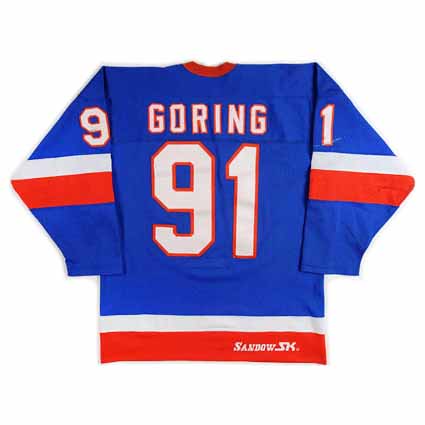
Bonus jersey: Today's bonus jersey is a 1981-82 New York Islanders Butch Goring jersey as worn the season Goring won his second of four Stanley Cups.

After starting life in the NHL in 1972-73 with very similar blue jerseys only with orange numbers and a lace-up collar, the Islanders reversed the colors of their numbers for the 1973-74 season, now white with a blue outline. For the 1977-78 season, the ends of the sleeves were no longer white and the collar style now became a v-neck. Finally, in 1978-79, the single orange arm stripe now had a narrower white one added directly above it and the waist stripes were finally changed to match the arms.

This style jersey would be the one worn for all of the Stanley Cup championships of their dynasty of the early 1980s and would remain in use through the 1994-95 season until it gave way to the ill-fated Fisherman jersey.


In 1998-99 the Islander brought their classic jerseys back, now modernized with a darker shade of blue and three color numbers, but still very much in the look of their beloved cup winning jerseys. These lasted through the 2006-07 season until their look was redone for the introduction of the Reebok Edge jerseys for 2007-08.

For the 2008-09 season, their 1973-74 jerseys were the inspiration for their new throwback alternate jersey, which then became the team's primary home jersey for the 2010-11 season, now paired with a white road version, and remain in use through today.

New York Islanders 1981-82 F jersey
New York Islanders 1981-82 B jersey

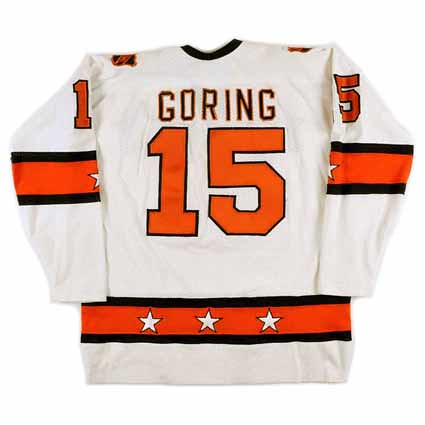
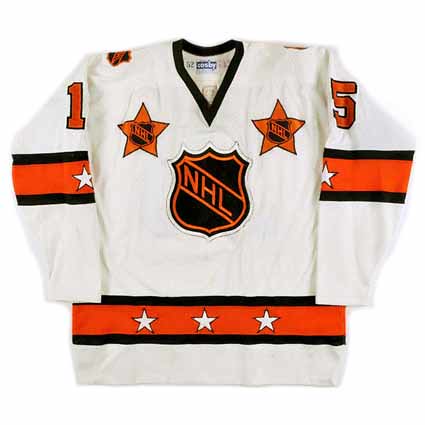
Extra bonus jersey: Today's extra bonus jersey is a 1980 NHL All-Star Butch Goring jersey as worn the season Goring won his first of four Stanley Cups.

The NHL first used this style of All-Star jersey back in 1973. It was used through the 1981 season with the exception of 1979 when a different style was worn for a two game series when the NHL All-Stars took on the Soviet Union National Team. The eight years of use for this style of jersey for the All-Star Game is a thing of the past, as no style since then has been used for more than four years and no style has been worn more than twice since 1998.

NHL All-Star 1980 F jersey
NHL All-Star 1980 B jersey

Today's video selection is the Islander celebrating their 1981 championship, which includes the presentation of the Conn Smythe Trophy to Butch Goring.


hit counter for blogger