Born on this date in Livonia, Michigan in 1970, Mike Modano opted to play Canadian junior hockey with the Prince Albert Raiders of the Western Hockey League beginning in the 1986-87 season. His impact was immediate, as he scored 32 goals and 62 points in 70 games. After following that up with a 47 goal, 127 point season in 1987-88, Modano became only the second American to be selected first overall in the NHL Entry Draft, after Brian Lawton, by the Minnesota North Stars who were also the club who took Lawton #1 in 1983.
He played one more season with Prince Albert, scoring 105 points, before joining the North Stars for the 1989-90 season during which he made a virtually seamless transition to the NHL with 75 points in 80 games, which instantly made him a fan favorite in Minnesota.
During his second season in Minnesota, the team went on a miraculous run through the playoffs, reaching the Stanley Cup Finals despite a 27-39-14 regular season record. Modano contributed 20 points in 23 playoff games for fifth on the team in playoff scoring.
After two seasons of knocking on the door, Modano had his first 30 goal season in 1991-92 with 33. He repeated his 33 goal total in 1992-93, while his 60 assists propelled him to a career high 93 points.
The North Stars franchise was moved to Dallas for the following season where Modano repeated his 93 points, only this time thanks to a career high 50 goals which no doubt helped sell the game of hockey to the fans in Texas thanks to his speed and flair.
Starting in 1995-96, Modano began a period of being a regular 30 goal scorer, hitting that mark in six of the next seven seasons and scoring in the 80's six of the next eight, a streak that coincided with him becoming an alternate team captain.
The Stars went a long playoff run in 1998 which served as a precursor for the 1998-99 season when the franchise won it's first Stanley Cup in over 30 years of trying. Modano contributed 23 points in 23 games to lead the team in playoff scoring.
The Stars again returned to the finals the following season as Modano again tallied 23 points in 23 playoff games, one behind the team lead.
The 2000-01 season saw him score his 1,000th NHL point and he surpassed the 1,000 game mark in 2002-03. Modano was named team captain for the 2003-04 and 2005-06 seasons, with the 2004-05 season being lost to the NHL lockout.
He would play four more seasons in Dallas which included his 500th NHL goal on March 13, 2007 and his 503rd goal to pass Joe Mullen for the record for most goals by an American-born player just four days later.
Modano celebrates his 500th NHL goal
Early in the following season Modano broke the record for most points by an American-born player when he passed Phil Housley with a shorthanded goal on November 7, 2007 for his 1,233rd point, a feat which was recognized by a phone call from the president!
At the conclusion of the 2009-10 season his 20 seasons with the Stars organization came to an end when it was announced he would not be re-signed. After much speculation concerning his possible retirement, Modano opted to sign with the Detroit Red Wings for the 2010-11 season but a deep cut from a skate severed a tendon in his hand, limiting him to just 40 games although he did return in time to participate in the playoffs.
Modano holds records for the Most Goals by an American-born player (561), Most Points by an American-born player (1,374), Most Playoff Points by an American-born player (146) and Most Games Played by an American-born player (1,499) as well as Dallas franchise regular season and playoff records for games, goals, assists and points.
Internationally, Modano played for the United States in the World Junior Championships in 1988 and 1989, the World Championships in 1990, 1993 and 2005, the 1991 Canada Cup, the World Cup of Hockey in 1996 and 2004, winning the championship in 1996, and the Olympics in 2002, winning a silver medal, and again in 2006. In all, he would play 71 games, scoring 24 goals and 61 points for the United States.
Modano's career achievements were recognized when he was inducted into the United States Hockey Hall of Fame in 2012, had his number 9 retired by the Dallas Stars in March of 2014 and was inducted into the Hockey Hall of Fame in November of 2014.
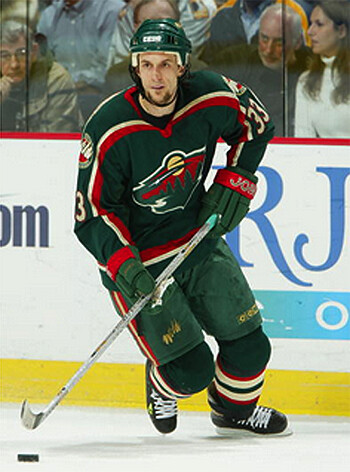
Today's featured jersey is a 1998-99 Dallas Stars Mike Modano jersey as worn during the only Stanley Cup championship of Modano's career which came after leading the team in playoff scoring.
This style Dallas Stars jersey was first worn as an alternate jersey during the 1997-98 season and mimicked the style worn in the 1994-1997 NHL All-Star Games. Even though it was an alternate jersey, Dallas opted to wear it during the playoffs and won the Stanley Cup while wearing this jersey.
Following their Stanley Cup championship, the Stars promoted this striking jersey to their primary road jersey and created a white version to be worn at home. This style remained in use through the 2005-06 season until being replaced by the new Reebok Edge jerseys. As great as a jersey as this jersey was, the ones that replaced it were among some of the worst of the new styles by far.
Bonus jersey: Today's bonus jersey is a 2005 United States National Team Mike Modano jersey as worn during the 2005 World Championships where Modano was the US team captain.
In 2005 Nike revised all the jerseys for the teams participating in the IIHF World Championships, and the United States were given an entirely new look, retiring the style which was worn at the 2002 Olympics and 2004 World Cup. This template was based on the 1997-98 St. Louis Blues alternate jersey, which was late promoted to their primary jersey and used through 2006-07.
A classic and effective look for the USA, this jersey sadly was only used for the 2005 Worlds as the new Nike Swift template, fabric and construction was introduced for the 2006 Olympics the following year, giving this style an all too short lifespan.
Our video section begins with a look at the career of Modano on the occasion of his jersey being retired by the Dallas Stars.
Here, Modano becomes the leading American scorer in the history of the NHL.
Finally, Modano's speech when he was inducted into the Hockey Hall of Fame.
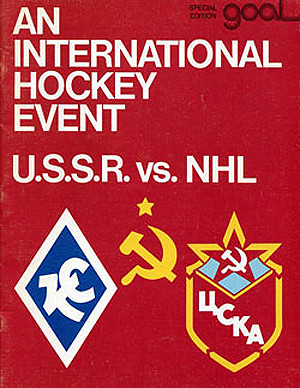
A new era in NHL history began in 1975 when HC CSKA Moscow, more popularly known as Central Red Army and the most dominant club in the history of the Soviet Championship League, and the Soviet Wings each played four exhibition games against NHL clubs in late December through mid January of 1976.
The program cover for the first Super Series in 1976
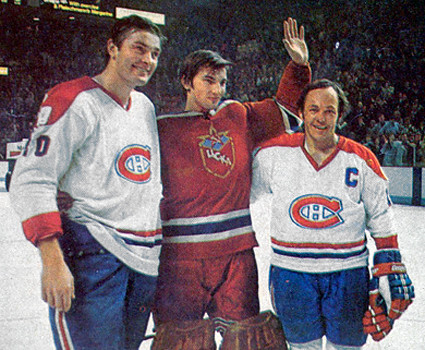
This series produced the memorable New Year's Eve game between the Red Army and the Montreal Canadiens, called by many the greatest game ever played, as well as the deplorable game when the Philadelphia Flyers tried to intimidate the Soviets into submission, which resulted in a temporary Red Army retreat to their dressing room in protest of the brutality of the Broad Street Bullies.
Pete Mahovlich, Vladislav Tretiak and Yvan Cournoyer, the three stars of
the game between the Red Army and the Montreal Canadiens
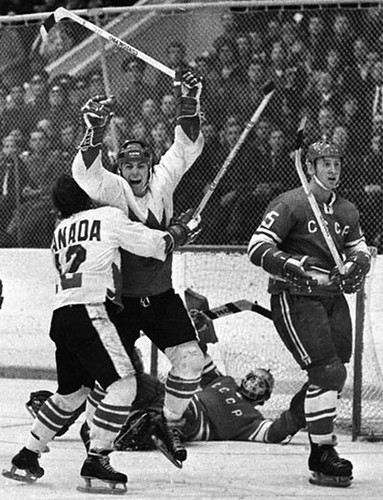
Prior
to this point, the Soviet National Team had competed against the Team
Canada in the Summit Series in 1972 and again in 1974 versus a team made
of WHA All-Stars.
The Super Series was an attempt to cash in on
the excitement of the 1972 Summit Series
Wanting
to further capitalize on the success of the Summit Series, and the
capital to be gained from the mystery and curiosity surrounding the
still exotic Soviets from behind the Iron Curtain, the Super Series '76
was scheduled. What set the Super Series '76 apart from the previous
competitions was this was the first time that club teams from the Soviet
Union would be facing teams from the NHL.
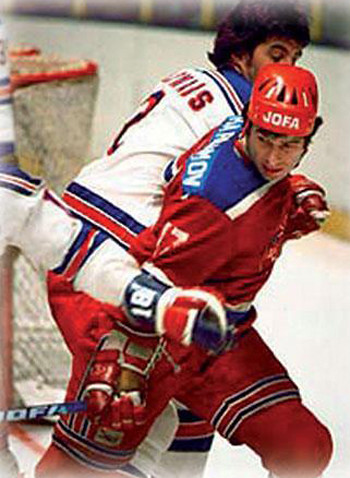
Carol Vadnais of the New York Rangers keeps an eye on
Valeri Kharlamov of the Central Red Army Club
The series was a success and two years later in 1978 Moscow Spartak arrived in North America for five games followed by the return of the Wings in 1979. The Soviets sent their best in 1980 when Dynamo Moscow and Red Army toured nine NHL cities. After a three year break, the Soviet National Team came to North America in 1983 to take on six NHL club teams. Another three year pause in the Super Series ended when both Red Army and Dynamo Moscow returned to challenge the NHL once more.
After that 1986 edition, another three year gap ensued before Red Army returned for the fourth time, only now joined by series debutante Dinamo Riga from the capital of Latvia.
Dinamo Riga was founded in 1946 as one of the original members of the Soviet league and finished fourth that season, the highest finishing club from outside of Moscow. They played their games outdoors until the 1960-61 season. The club started to fall on hard times as their original group of players began to retire in the mid-1950s and eventually fell to the third division.
They began to look beyond their local area for players during the 1960s and eventually returned to the top division. Then came their magical season of 1987-88, when Dinamo finished in second place after losing to the perennial champions CSKA Moscow in the final, as Red Army won their 13th of 14 straight championships thanks to the advantages of being able to draft the finest Soviet players into the Army and assign them to their virtual national all-star team.
Arturs Irbe helped Dinamo to a second place finish in 1988
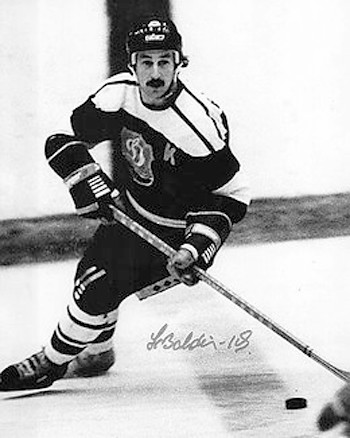
Dinamo's Helmut Balderis led the league in goals and points in 1977 on his way to being named the league's MVP and then repeated as scoring champion in 1983.
Latvian hockey legend Helmut Balderis
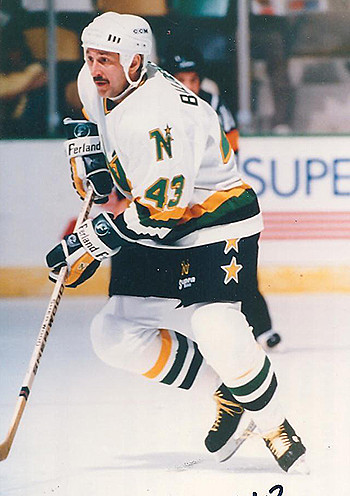
As the political landscape of the Soviet Union changed, Balderis was eventually able to play in the NHL for the Minnesota North Stars during the 1989-90 season.
Balderis played 26 NHL games with Minnesota
Other notable members of Dinamo to play in the NHL were Harijs Vitolinsh, Arturs Irbe, Sandis Ozolinsh, Sergei Zholtok, Grigorij Panteleev, Viktor Ignatjev and Aleksandrs Kercs.
Sergei Zholtok, the first Latvian to captain and NHL team
Among those, Ozolinsh would become the only Dinamo veteran to win the Stanley Cup, which he did in 1996 with the Colorado Avalanche during his 15 year NHL career. A defenseman, he leads all Dinamo alumni with 875 games played and 564 points, ahead of Zholtok's 588 games and 258 points.
Sandis Ozolinsh with the Stanley Cup in 996
Goaltender Irbe, just 21 years old at the time of the game in Minnesota, would eventually play in 568 NHL games, winning 218 with 33 shutouts and backstopped the Carolina Hurricanes to the Stanley Cup Finals in 2002.
Both Balderis and Irbe, World Champion in 1989 and 1990, would eventually be named to the IIHF Hall of Fame.
After the fall of the Soviet Union, which affected the funding of many formerly state sponsored clubs, Dinamo Riga would undergo a couple of name changes until ceasing operations after the 1994-95 season. A new organization would be formed in 2008 and revive the Dinamo Riga name, and currently plays in the KHL.
Dinamo's first game of the Super Series '89 was on December 27, 1988 against the Calgary Flames, a game that ended in a 2-2 tie. The next night the team traveled up Alberta Highway 2 to take on the Edmonton Oilers, who defeated their Soviet visitors 2-1. Remaining in Canada, two days later on December 30th, Riga was throttled by the Vancouver Canucks 6-1.
Dinamo now crossed the border for their New Year's Eve game against Wayne Gretzky and the Los Angeles Kings. Thanks to a 3 goal second period, Riga was able to hold off a third period comeback attempt by the Kings to win 5-3.
Things did not go as well on January 4th in Chicago when the Blackhawks scored 2 first period goals, and after allowing Dinamo 1 second period goal, pulled away with 2 more in the third to win 4-1. This was followed by a forgettable performance the next night when the St. Louis Blues shutout the Soviets 5-0 thanks to goals by five different Blues, led by Tony Hrkac's three point night.
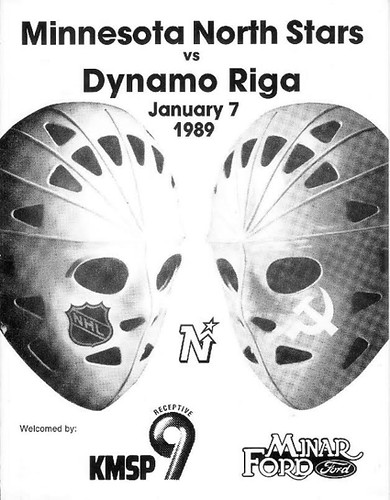
After a two day break, Dinamo remained in the Midwest to face the Minnesota North Stars at the Met Center in Bloomington, Minnesota in front of 5,106 fans who battled a heavy snow to make it to the game.
Minnesota had previously lost to the Wings 8-5 back in 1979 and 6-3 to the Soviet National Team in 1983. Red Army beat the North Stars 4-3 in 1986 prior to Riga arriving in 1989.
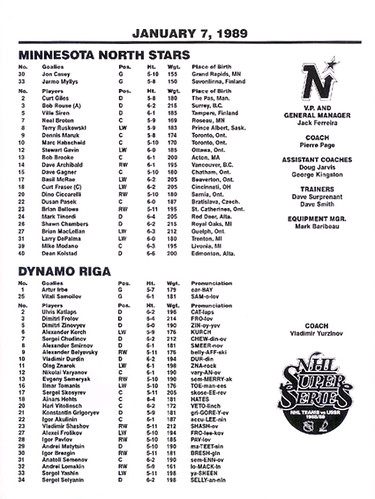
This was to be the seventh and final game for Riga on their tour and they arrived with 3 wins, 2 losses and their opening game tie against Calgary 12 days earlier. Starting in goal for Dinamo was Riga native and future NHLerIrbe, while Finland's Jarmo Myllys got the call for the North Stars.
Arturs Irbe got the start in goal for Dinamo
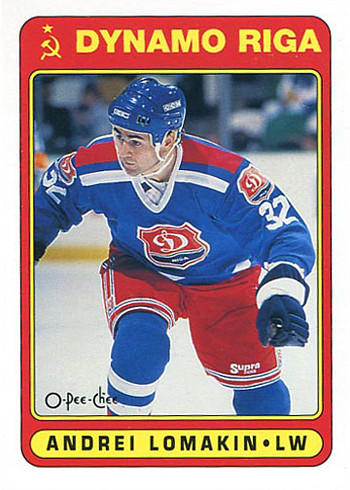
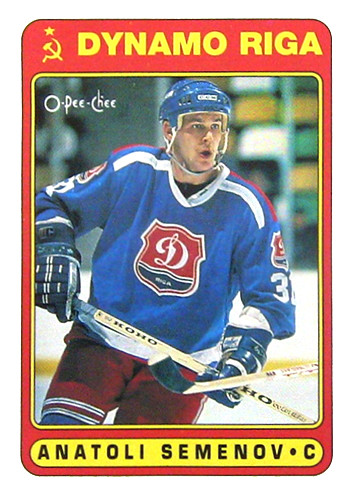
As was often the case with touring Soviet teams, Dynamo Moscow teammates and future NHLers Anatoli Semenov and Andrei Lomakin were loaned to Dinamo for their North American tour by their normal club team to boost the competitiveness of the Soviet sides and reward standout players with a trip to North America, where they were given the chance to indulge themselves with things such as consuming large amounts of fresh orange juice and taking the opportunity to purchase popular North American goods, such as Levi's jeans.
Future NHLer Andrei Lomakin
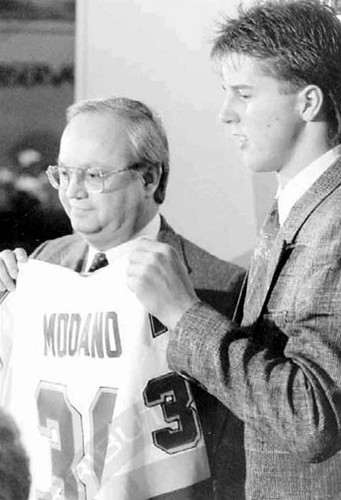
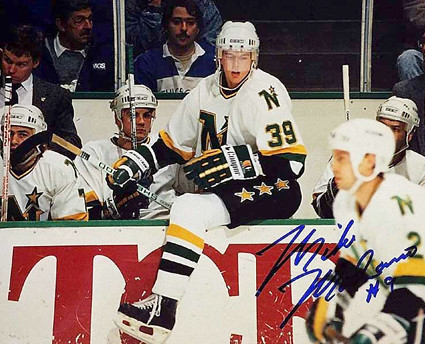
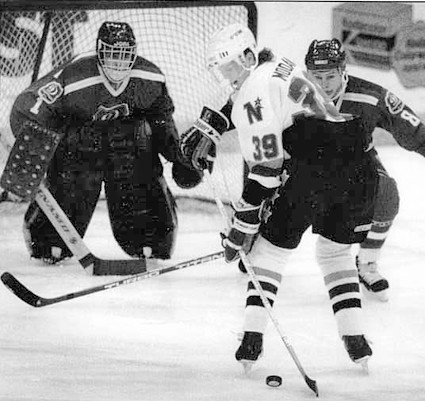
One addition to the Minnesota lineup of note was young Mike Modano,
who was called up to make his North Stars debut while he was still
playing junior hockey for the Prince Albert Raiders of the WHL. Modano
had been selected first overall by Minnesota at the 1988 NHL Entry
Draft. Thanks to the presence of #9 Dennis Maruk on the North Stars roster, Modano was given the #39 for the game.
North Stars General Manager Jack Ferrara introduces Modano to the press after he is called up to make his North Stars debut
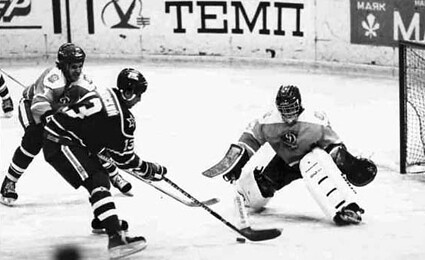
There was only one goal scored in a contentious first period, as both goaltenders swapped difficult saves including an Irbe save on a point blank slapshot by Dino Ciccarelli followed by a shorthanded Myllys save on Alexander Smirnov seconds later.
Finally, Igor Akulinin received one the patented Soviet drop passes from Alexander Kerch just inside the Minnesota blueline, circled the net with Dennis Maruk all over his back and swept a backhander past Myllys for a 1-0 Riga lead with a second assist to Alexander Belyavsky with just over a minute to play in the first period.
One humorous occurrence happened in the first period, when with 7:04 remaining, Stewart Gavin attempted a check in the Riga end and fell into the back of the net, knocking it over forwards. The risk to Irbe was the goal falling forward and hitting him in the back of the head or neck, but the diminutive Irbe, listed at 5' 7" and already in his crouch, saw the net fall forwards right over the top of him with room to spare! Minnesota outshot the Soviets 11-10 for the period, many of them difficult saves for the netminders. The closeness of the shots on goal was a surprise considering the nearly endless trek to the penalty box for the North Stars, but speaks to the typical Soviet style of less, but high percentage, shots on goal.
Anatoli Semenov would go on to play in the NHL
In the second period, Irbe continued to impress, denying Dave Archibald on another point blank blast after a terrific pass from Dave Gagner after he eluded three Dinamo players.
Dinamo went up 2-0 after Sergei Skosyrev broke into the North Stars zone on a 2-on-1 and elected to shoot rather than pass and beat Myllys on the short, glove side at 14:23. Alexei Frolikov was given the only assist on the goal which began when an errant Modano pass ended up on his stick.
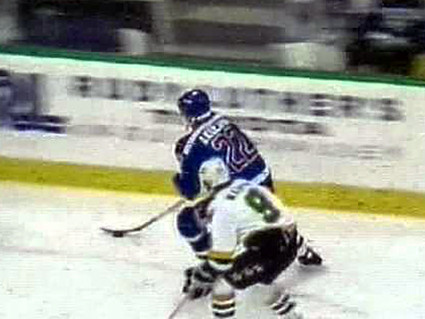
Skosyrev on his way to scoring the second Dinamo goal with Maruk in pursuit
Minnesota's best chance during the second period came on the power play with Lomakin in the penalty box for hauling down Ganger in the slot. After a blast from the point, Gagner got off a close angle shot which was stopped by Irbe, but the rebound when right back to Gagner, who fired again. Irbe caught a piece of it, but it trickled through him and toward the goal, but Vladimir Shashkov cleared the puck off the line to keep the North Stars off the board.
Shots on goal in the second period also favored Minnesota, this time 13-8, with both goalies again tested several times and each with some outstanding saves to their credit.
More than the arrival of the Soviet team, the talk in
Minnesota was all about the arrival of Modano
The North Stars would finally solve Irbe on a power play in the third period when Neal Broten fed a pass to Brian MacLellan in the right corner, who immediately sent the puck across the slot to Maruk, who fired the puck into the goal before Irbe could get across to cover the short side in time on as nice a tic-tac-toe passing play as you'll see with a little over nine minutes to play.
As much as Minnesota pressured the net, Irbe was up to the task for the remainder of the game as Riga held on for a 2-1 win to end their tour of North America at 4 wins, 2 losses and a tie.
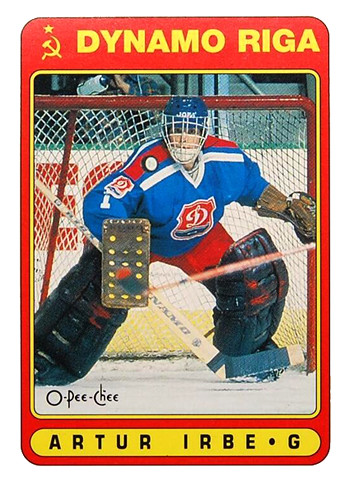
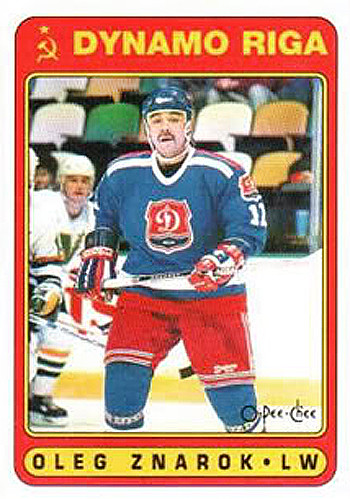
Of note, the O-Pee-Chee hockey cards created of Dinamo Riga were all photographed at the Met Center that night, which can be readily identified by its trademark random green, gold, black and white seats.
The unmistakable seats of the Met Center
Irbe's effort that night apparently attracted the attention of the North Stars staff because five months later he was selected 189th overall in the tenth round of the 1989 NHL Entry Draft by Minnesota in a draft coincidentally held at the very same Met Center.
Irbe would return to the Minneapolis/St. Paul area 23 months later on December 15, 1990 as Dinamo returned to the United States, only this time to take on several teams of the Western Collegiate Hockey Association. On that night, Irbe was in goal for a 4-4 tie against the University of Minnesota Golden Gophers at the original Mariucci Arena.
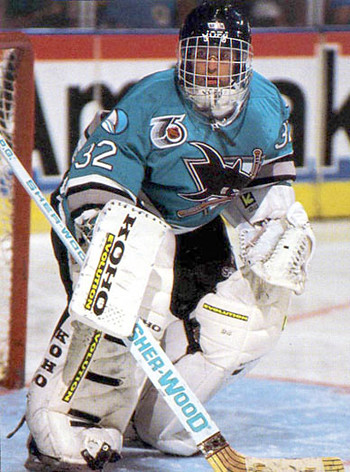
Irbe would never play for the North Stars in Minnesota however, as his rights were transferred to the expansion San Jose Sharks in a complicated deal that saw the North Stars owners George and Gordon Gund be awarded the San Jose franchise while new ownership took over the North Stars.
Irbe during his NHL rookie season with San Jose
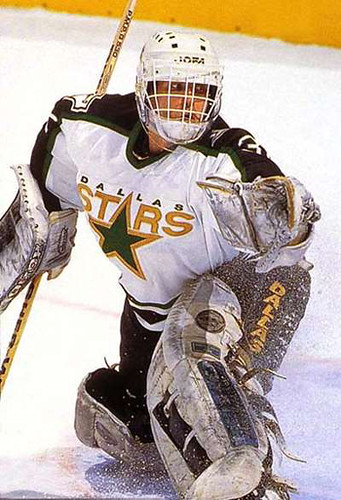
That ownership would eventually move the North Stars to Texas in 1993, where they became the Dallas Stars, who would sign Irbe for the 1996-97 season, which allowed him to finally play for the franchise which had originally drafted him back in 1989.
Irbe spent one season with the Stars,
the franchise that originally drafted him back in 1989
Modano was sent back to Prince Albert before playing in a regular season game for Minnesota, but was recalled at the end of the season for two of the North Stars playoff games that spring. He became a full time NHLer the next season, playing in 80 games as a rookie, scoring 29 goals and 75 points. He would lead the North Stars in scoring by his third season and go on to have the most career points by an American born player in NHL history.
Modano would play 20 seasons with the North Stars/Stars franchise followed by a final NHL season with his hometown Detroit Red Wings. He would win a Stanley Cup with Dallas in 1999, play in seven NHL All-Star Games, and set records for most goals, points and playoff points by an American born player. He would represent the United States in two World Juniors, three World Championships, the 1991 Canada Cup, two World Cups, winning the championship in 1996, and three Olympics, earning a silver medal in 2002.
His final career totals are 561 goals and 813 assists for 1,374 points. His number 9 was retired by the Dallas Stars in 2014, the same year he was inducted into the Hockey Hall of Fame after a career which began with an exhibition game on this date in 1989 against Dinamo Riga of the Soviet Union.
Modano during his Minnesota debut closing in on Irbe
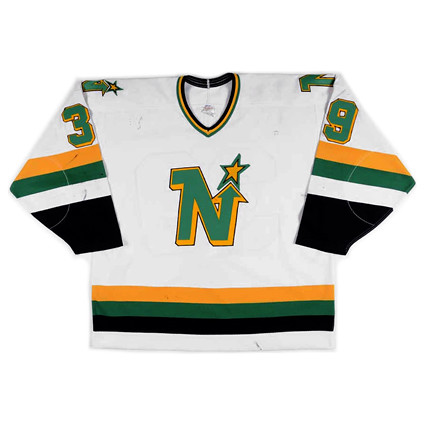
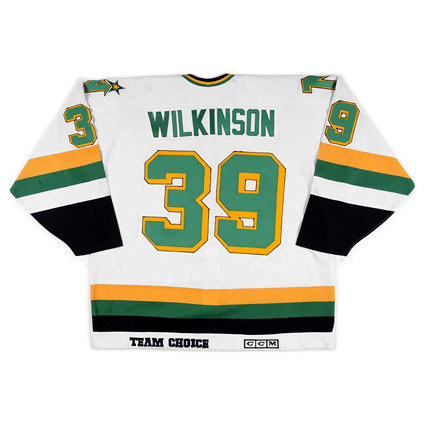
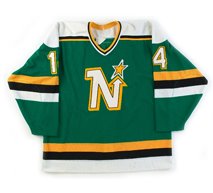
Today's first featured jersey is a 1988-89 Minnesota North Stars Mike Modano jersey. This jersey was given to Modano for the exhibition game against Dinamo Riga when he was first called up by Minnesota from the Prince Albert Raiders of the WHL. He was given #39 because the number 9 was already in use by the veteran Maruk.
After Modano was sent back to his junior club for the remainder of the regular season, the jersey was recycled. A new name plate was added for Neil Wilkinson, who wore the jersey the following 1989-90 season, as Modano was able to wear his preferred #9 that season.
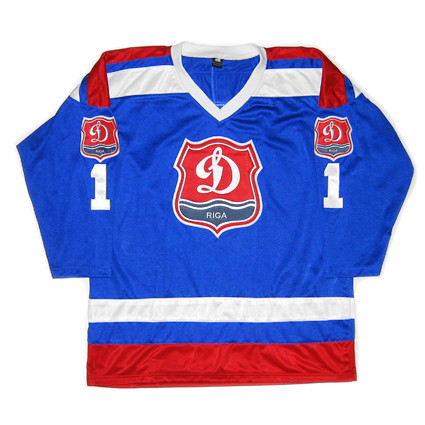
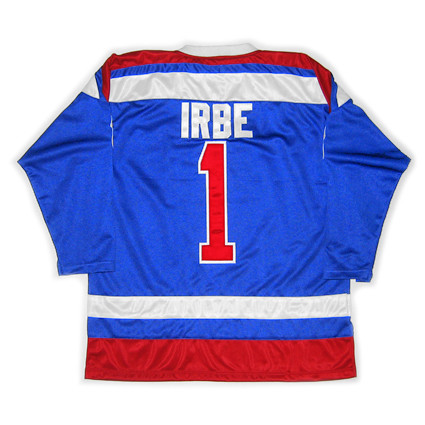
Today's second featured jersey is a 1988-89 Dinamo Riga Arturs Irbe jersey. In addition to the financial incentive for Soviet teams to play in the United States and Canada, teams were also frequently outfitted with state of the art CCM jerseys, pants and gloves to use during their trip through the NHL.
These were greatly appreciated with the teams and brought back to the Soviet Union for continued use once Cyrillic names were screened on the back for the home market, as the top best jerseys supplied to the teams of the Soviet Championship League were lightweight mesh jerseys with screen printing and often worn until faded, ripped and smelling absolutely horrid.
In today's video section, footage of Modano being drafted first overall by the North Stars in 1988, where he is presented with a green #9 North Stars jersey by Lou Nanne.
Next, a real treat for those of you with the time, the entire game between Dinamo Riga and the North Stars, minus the commercials and intermissions!
Opting to forego the American college hockey option, Michigan native Mike Modano choseto play Canadian junior hockey with the Prince Albert Raiders of the Western Hockey League beginning in the 1986-87 season. His impact was immediate, as he scored 32 goals and 62 points in 70 games. After following that up with a 47 goal, 127 point season in 1987-88, Modano became only the second American to be selected first overall in the NHL Entry Draft by the Minnesota North Stars, who were the club who made Brian Lawton the first American to be chosen #1 in 1983.
Modano played one more season with Prince Albert, scoring 105 points, before joining the North Stars for the 1989-90 season during which he made a virtually seamless transition to the NHL with 75 points in 80 games, instantly becoming a fan favorite in Minnesota.
During his second season in Minnesota, the team went on a miraculous run through the playoffs, reaching the Stanley Cup Finals despite a 27-39-14 regular season record. Modano contributed 20 points in 23 playoff games for fifth on the team in playoff scoring.
After two seasons of knocking on the door, Modano had his first 30 goal season in 1991-92 with 33. He repeated his 33 goal total in 1992-93, while his 60 assists propelled him to a career high 93 points.
The North Stars franchise was moved to Dallas for the following season where Modano repeated his 93 points, only this time thanks to a career high 50 goals which no doubt helped sell the game of hockey to the fans in Texas thanks to his speed and flair.
Starting in 1995-96, Modano began a period of being a regular 30 goal scorer, hitting that mark in six of the next seven seasons and scoring in the 80's six of the next eight, a streak that coincided with him becoming an alternate team captain.
The Stars went a long playoff run in 1998 which served as a precursor for the 1998-99 season when the franchise won it's first Stanley Cup in over 30 years of trying. Modano contributed 23 points in 23 games to lead the team in playoff scoring.
The Stars again returned to the finals the following season as Modano again tallied 23 points in 23 playoff games, one behind the team lead.
The 2000-01 season saw him score his 1,000th NHL point and he surpassed the 1,000 game mark in 2002-03, the same season he tied Neal Broten's franchise record for most games played with 992 on this date in 2003. Later in the same game he broke Broten's record for most assists in franchise history with the 594th of his career in a 4-2 Dallas win over the Columbus Blue Jackets.
Modano was named team captain for the 2003-04 and 2005-06 seasons, with the 2004-05 season being lost to the NHL lockout.
He would play four more seasons in Dallas which included scoring his 500th NHL goal on March 13, 2007 and his 503rd goal to pass Joe Mullen for the record for most goals by an American-born player just four days later.
Modano celebrates his 500th NHL goal
Early in the following season Modano broke the record for most points by an American-born player when he passed Phil Housley with a shorthanded goal on November 7, 2007 for his 1,233rd point, a feat which was recognized by a phone call from the president!
At the conclusion of the 2009-10 season his 20 seasons with the Stars organization came to an end when it was announced he would not be re-signed. After much speculation concerning his possible retirement, Modano opted to sign with the Detroit Red Wings for the 2010-11 season but a deep cut from a skate severed a tendon in his hand, limiting him to just 40 games although he did return in time to participate in the playoffs to bring an end to his stellar career.
Modano holds records for the Most Goals by an American-born player (561), Most Points by an American-born player (1,374), Most Playoff Points by an American-born player (145) and Most Games Played by an American-born player (1,499) as well as Dallas franchise regular season and playoff records for games, goals, assists and points.
Today's featured jersey is a 2002-03 Dallas Stars Mike Modano jersey as worn during the season Modano reached 1,000 career games and set Stars franchise records for games played and assists.
This Dallas Stars first wore the green version of this jersey as an alternate during the 1997-98 season, mimicking the style worn in the 1994-1997 NHL All-Star Games. Even though it was an alternate jersey, Dallas opted to wear it during the playoffs and won the Stanley Cup while wearing it.
Following their Stanley Cup championship, the Stars promoted the striking jersey to their primary road jersey and created this white version to be worn at home. This style remained in use through the 2005-06 season until being replaced by the new Reebok Edge jerseys. As great as this jersey was, the ones that replaced it were among some of the worst of the new styles by far.
Our video section begins with a look at the career of Modano with plenty of goals and commentary on his impact on hockey in the south and comments from Modano himself.
Here, Modano becomes the leading American scorer in the history of the NHL.
Born on this date in Livonia, Michigan in 1970, Mike Modano opted to play Canadian junior hockey with the Prince Albert Raiders of the Western Hockey League beginning in the 1986-87 season. His impact was immediate, as he scored 32 goals and 62 points in 70 games. After following that up with a 47 goal, 127 point season in 1987-88, Modano became only the second American to be selected first overall in the NHL Entry Draft, after Brian Lawton, by the Minnesota North Stars who were also the club who took Lawton #1 in 1983.
He played one more season with Prince Albert, scoring 105 points, before joining the North Stars for the 1989-90 season during which he made a virtually seamless transition to the NHL with 75 points in 80 games, which instantly made him a fan favorite in Minnesota.
During his second season in Minnesota, the team went on a miraculous run through the playoffs, reaching the Stanley Cup Finals despite a 27-39-14 regular season record. Modano contributed 20 points in 23 playoff games for fifth on the team in playoff scoring.
After two seasons of knocking on the door, Modano had his first 30 goal season in 1991-92 with 33. He repeated his 33 goal total in 1992-93, while his 60 assists propelled him to a career high 93 points.
The North Stars franchise was moved to Dallas for the following season where Modano repeated his 93 points, only this time thanks to a career high 50 goals which no doubt helped sell the game of hockey to the fans in Texas thanks to his speed and flair.
Starting in 1995-96, Modano began a period of being a regular 30 goal scorer, hitting that mark in six of the next seven seasons and scoring in the 80's six of the next eight, a streak that coincided with him becoming an alternate team captain.
The Stars went a long playoff run in 1998 which served as a precursor for the 1998-99 season when the franchise won it's first Stanley Cup in over 30 years of trying. Modano contributed 23 points in 23 games to lead the team in playoff scoring.
The Stars again returned to the finals the following season as Modano again tallied 23 points in 23 playoff games, one behind the team lead.
The 2000-01 season saw him score his 1,000th NHL point and he surpassed the 1,000 game mark in 2002-03. Modano was named team captain for the 2003-04 and 2005-06 seasons, with the 2004-05 season being lost to the NHL lockout.
He would play four more seasons in Dallas which included his 500th NHL goal on March 13, 2007 and his 503rd goal to pass Joe Mullen for the record for most goals by an American-born player just four days later.
Modano celebrates his 500th NHL goal
Early in the following season Modano broke the record for most points by an American-born player when he passed Phil Housley with a shorthanded goal on November 7, 2007 for his 1,233rd point, a feat which was recognized by a phone call from the president!
At the conclusion of the 2009-10 season his 20 seasons with the Stars organization came to an end when it was announced he would not be re-signed. After much speculation concerning his possible retirement, Modano opted to sign with the Detroit Red Wings for the 2010-11 season but a deep cut from a skate severed a tendon in his hand, limiting him to just 40 games although he did return in time to participate in the playoffs.
Modano holds records for the Most Goals by an American-born player (561), Most Points by an American-born player (1,374), Most Playoff Points by an American-born player (146) and Most Games Played by an American-born player (1,499) as well as Dallas franchise regular season and playoff records for games, goals, assists and points.
Internationally, Modano played for the United States in the World Junior Championships in 1988 and 1989, the World Championships in 1990, 1993 and 2005, the 1991 Canada Cup, the World Cup of Hockey in 1996 and 2004, winning the championship in 1996, and the Olympics in 2002, winning a silver medal, and again in 2006. In all, he would play 71 games, scoring 24 goals and 61 points for the United States.
Modano's career achievements were recognized when he was inducted into the United States Hockey Hall of Fame in 2012, had his number 9 retired by the Dallas Stars in March of 2014 and was inducted into the Hockey Hall of Fame in November of 2014.
Today's featured jersey is a 1998-99 Dallas Stars Mike Modano jersey as worn during the only Stanley Cup championship of Modano's career which came after leading the team in playoff scoring.
This style Dallas Stars jersey was first worn as an alternate jersey during the 1997-98 season and mimicked the style worn in the 1994-1997 NHL All-Star Games. Even though it was an alternate jersey, Dallas opted to wear it during the playoffs and won the Stanley Cup while wearing this jersey.
Following their Stanley Cup championship, the Stars promoted this striking jersey to their primary road jersey and created a white version to be worn at home. This style remained in use through the 2005-06 season until being replaced by the new Reebok Edge jerseys. As great as a jersey as this jersey was, the ones that replaced it were among some of the worst of the new styles by far.
Bonus jersey: Today's bonus jersey is a 2005 United States National Team Mike Modano jersey as worn during the 2005 World Championships where Modano was the US team captain.
In 2005 Nike revised all the jerseys for the teams participating in the IIHF World Championships, and the United States were given an entirely new look, retiring the style which was worn at the 2002 Olympics and 2004 World Cup. This template was based on the 1997-98 St. Louis Blues alternate jersey, which was late promoted to their primary jersey and used through 2006-07.
A classic and effective look for the USA, this jersey sadly was only used for the 2005 Worlds as the new Nike Swift template, fabric and construction was introduced for the 2006 Olympics the following year, giving this style an all too short lifespan.
Our video section begins with a look at the career of Modano on the occasion of his jersey being retired by the Dallas Stars.
Here, Modano becomes the leading American scorer in the history of the NHL.
Finally, Modano's speech when he was inducted into the Hockey Hall of Fame.
Third String Goalie - The Hockey Jersey of the Day Blog
"Sweater" for all my Canadian friends!
Welcome!
Welcome to our end of the rink.
Bienvenue sur notre bout de la patinoire.
So why "Third String Goalie"?
It's defined as "A fan who sits in the stands wearing a jersey."
If that's not us, we don't know what is...
Our aim is to feature a different jersey each day from a historical perspective. Stay tuned and hopefully you'll see some jerseys of interest or perhaps some that you haven't seen before and learn a bit of hockey history along the way.
In addition to our articles, be sure to scroll down this column and explore the other fun and informative features of this blog.
If you have any suggestions or comments, feel free to contact us at:
Looking to reach our loyal readers with your hockey related product or service? Of our hundreds of readers each day, 60% are located in the United States and 30% come from Canada. Our audience is your audience and you can target them now with our reasonable ad rates.
We've been linked to by SI.com, ESPN.com, Uni-Watch.com, NBCSports.com and the Yahoo! Sports Puck Daddy blog among others.
There is no limitation to what kind of hockey jersey it can be - replica, authentic or game worn jersey from the NHL, a national team, the minors, juniors, college, high school or even your pond hockey jersey.
Feel free to write a paragraph or two about the jersey telling us why you like the jersey, how you got it, what makes it special to you or even a full-blownThird String Goalie-style history lesson - whatever you feel like sharing.
Visting from outside North America? Just select your preferred language and Third String Goalie will be instantly converted to your language of choice!