History of Jersey 83-93 Banner sm photo History of Jersey 83-93 Banner sm.jpg
Showing posts with label Leetch Brian. Show all posts

Friday, March 3, 2017

1991-92 New York Rangers Brian Leetch Jersey

Although he was born in Texas on this date in 1968, defenseman Brian Leetch and his family moved to Connecticut when he was just three months old. He began to develop his hockey skills at the ice rink managed by his father Jack Leetch. Leetch, a multi-sport athlete in high school played both hockey and baseball, which included winning a state championship as a pitcher. His hockey prowess was also clearly evident when, in 1983-84, he scored 52 goals and 101 points in just 28 games for Cheshire High School. He next played for Avon Old Farms School, totaling 70 goals and 90 assists for 160 points in 54 games over two seasons.

His performance for Avon Old Farms led to his being named to the United States roster at the 1985 World Junior Championships, the first of a number of appearances for the US in international hockey. He returned to the World Juniors in 1986, scoring a goal and 4 assists in 7 games as the Americans won a bronze medal. Following his 84 point season for Avon in 1985-86, Leetch was selected by the New York Rangers in the 1986 NHL Entry Draft as the ninth overall pick in the first round.

Leetch played his only season of college hockey, scoring 9 goals and 47 points in 37 games for the Boston College Eagles in 1986-87, earning NCAA First Team All-American honors, was named both Hockey East Rookie of the Year and Player of the Year, was Hockey East Tournament MVP and was named a finalist for the Hobey Baker Award as the best college hockey player of the year.
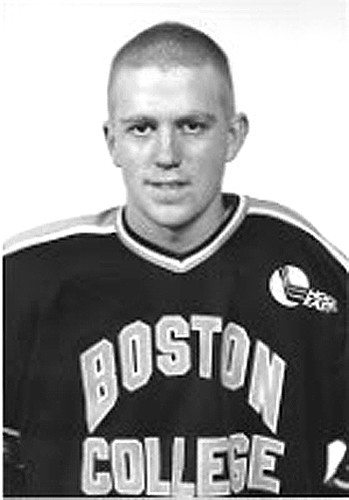
Leetch Boston College
Leetch had a stellar season for Boston College

During that season he played in his third consecutive World Juniors, where he was named to the tournament All-Star Team, and then after the conclusion of his college season, played for the United States again, only this time at the senior level World Championships, scoring 3 goals and 7 points as a 19 year old.

For the 1987-88 season, Leetch joined the United States National Team in preparation for the upcoming Olympics in Calgary, Alberta. During the Games, he scored a goal and 5 assists for 6 points in 6 games.

After the conclusion of the Olympics, Leetch made his NHL debut, playing in the remaining 17 games on the Rangers schedule in the spring of 1988, scoring 14 points.

The following season he became a full time NHL professional, seeing action in 68 games, making his presence known around the league by setting a rookie defenseman scoring record with 23 goals on his way to averaging more than a point per game with 71 (good for second in team scoring), all of which earned him the Calder Trophy as the NHL Rookie of the Year. After the conclusion of the season, Leetch appeared in his second and final World Championships for the US, scoring 7 points in 10 games, with 3 of those being goals.
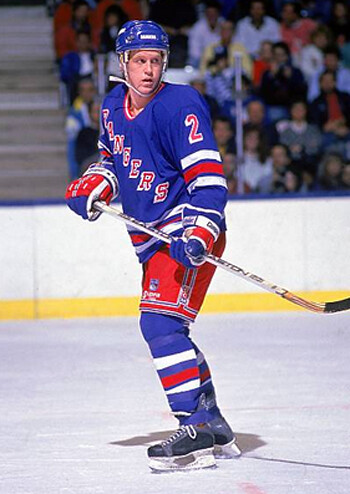
Leetch Young
Leetch won the Calder Trophy as the NHL's best rookie

He would play in his first of ten NHL All-Star Game in 1990 and then raised his personal best to a team leading 88 points in 1990-91 with 16 goals and 72 assists, five points better than forward Bernie Nicholls. That fall, Leetch would once again suit up for the United States, this time during the 1991 Canada Cup tournament.
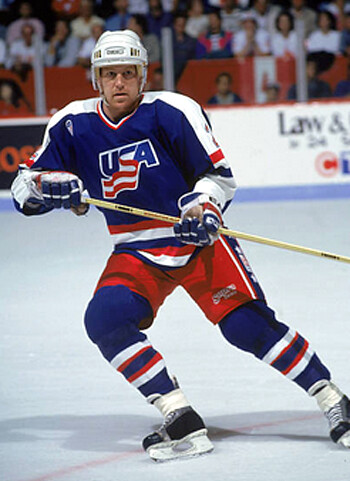
Leetch 1991 CC
Leetch during the 1991 Canada Cup

Leetch then set a career high in 1991-92 with 102 points from 22 goals and 80 assists, good for second on the Rangers, just five behind new arrival Mark Messier. His 100 point season was the first by an American defenseman and also the last 100 point season by a defenseman. His outstanding season was recognized when he was named the winner of the Norris Trophy as the league's Best Defenseman.
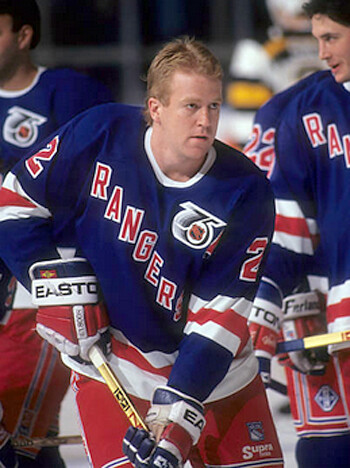
Leetch 1991-92 TBTC
Leetch wearing the Rangers 1991-92 Turn Back the Clock jersey

He was named an assistant captain for New York for the 1992-93 season, but was limited to just 36 games that season.
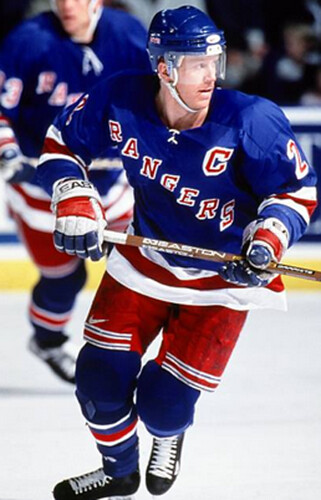
Leetch captaiin
Leetch wearing the captain's "C"

For the 1993-94 season, he returned to full health and played in all 84 of the Rangers games, which included equaling his career high with 23 goals on his way to 79 points. In the playoffs, the Rangers swept the New York Islanders in four, eliminated the Washington Capitals in five, outlasted the New Jersey Devils in a dramatic seven game series, which included three double overtime games. In Game 7, the Devils scored with just 7.7 seconds left to send the game to overtime before Stephane Matteau scored a memorable series winning goal after 84 minutes of play to send the Rangers to the Stanley Cup Finals.

The Rangers opponent was the Vancouver Canucks, who won Game 1 in overtime in New York. The Rangers then won the next three games, including two wins on the road in Vancouver. The Canucks rallied with a Game 5 win in New York and forced a Game 7 with a win back at home. Leetch opened the scoring at 11:02 of the first period followed by a goal from Adam Graves for a 2-0 New York lead after one. The teams traded goals in the second period and the Rangers held on for the final 15:10 after Trevor Linden's second goal for the Canucks made it 3-2.

The championship for New York was their first Stanley Cup since 1940, a span of 54 years. Leetch was named the winner of the Conn Smythe Trophy as the playoff MVP, thanks to his defensive skills as well as being the playoff's leading scorer with 11 goals and 34 points in 23 games.
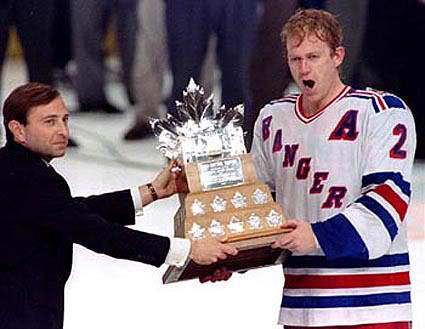
Leetch Smythe
Leetch accepts the Conn Smythe Trophy in 1994

With the NHL season shortened in 1994-95 by a labor dispute, Leetch was limited to 48 games, during which he scored 41 points. He averaged more than a point per game in 1995-96 with 85 points while playing in all 82 of the Rangers games.

Leetch was named as the captain of the United States team for the inaugural World Cup of Hockey in the fall of 1996. The US made their intentions clear during their opening game, a 5-3 win over Canada. They then defeated Russia 5-2 on familiar ice in New York and won the North American Pool with a 9-3 thumping of Slovakia to earn a bye into the Semifinals, where they again defeated Russia by the same 5-2 score to advance to a best of three final against Canada.

Game 1 in Philadelphia went to Canada 4-3 in overtime before the Americans fought back with a 5-2 win in Montreal to even the series followed by another 5-2, again in Montreal, to capture the first World Cup and the United States most significant victory since 1980. Leetch was fourth on the team and sixth in tournament scoring with 7 assists in 7 games played.
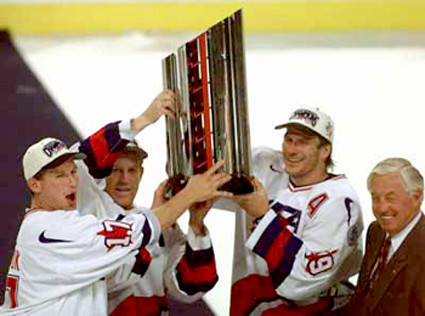
SPORT HOCKEY
Keith Tkachuk, Leetch and Joel Otto are presented
the World Cup by legend Jean Beliveau

The 1996-97 season saw Leetch score 78 points for the Rangers on his way to a second Norris Trophy after finishing the season a +31. The 1997-98 season saw Leetch named the Rangers team captain, a position he would hold for three seasons. During that season, the NHL would take the first break from its schedule to allow its players to participate in the Olympics, Leetch's second Games. As an assistant captain for the US, he would score a goal and 2 points in 4 games.
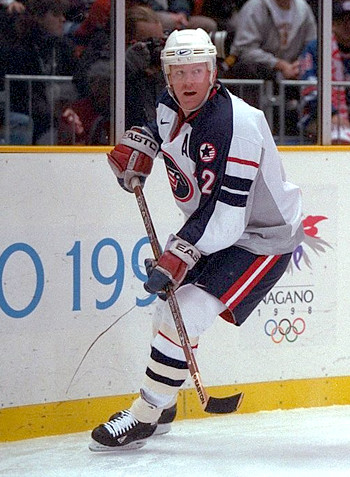
Leetch 1998
Leetch during the 1998 Olympics

Leetch would play six more seasons for New York, highlighted by a 21 goal, 79 point season in 2000-01, the season during which he also played in the 1,000th game of his career. Also during this time period, he would play in his third Olympics in 2002, earning a silver medal, again as an assistant captain, while contributing 5 assists in 6 games.
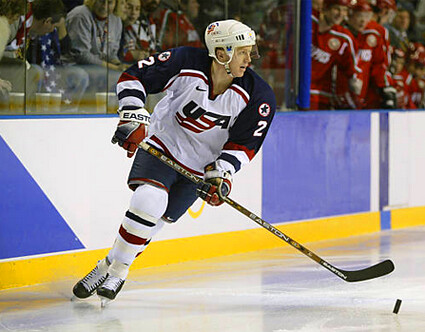
Leetch 2002
Leetch won an Olympic silver medal in 2002

With the Rangers having missed the playoffs for the previous six seasons and on their way to a 13th place finish in the Eastern Conference out of 15 teams in 2003-04, they began rebuilding by trading away veteran players, which saw Leetch dealt to the Toronto Maple Leafs for two prospects and a first and second round draft picks.
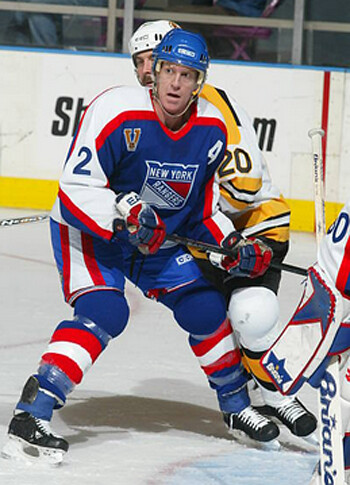
Leetch Vintage
Leetch wearing a 1970s Rangers vintage jersey
during his final season with the Rangers

He would eventually play just 15 games for Toronto plus 13 playoff games. In the fall of that year, Leetch played for the final time for the United States in the 2004 World Cup of Hockey. It would be his last hockey for a calendar year, as the upcoming season of 2004-05 was cancelled due to labor issues.
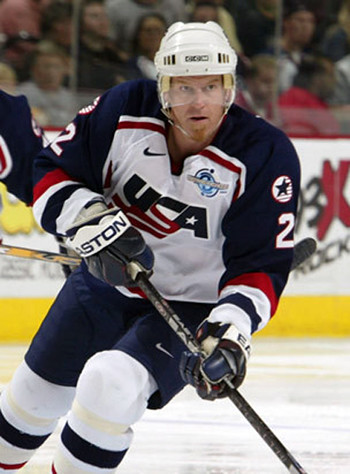
Leetch 2004 WCOH
His last of 11 appearances for the United States came in 2004

For the 2005-06 season, Leetch, now a free agent, signed with the Boston Bruins, for what proved to be the final season of his career. He played in 61 games that season, which included 5 goals and 27 assists for 32 points, which included the 1,000th point of his career on October 18, 2005.
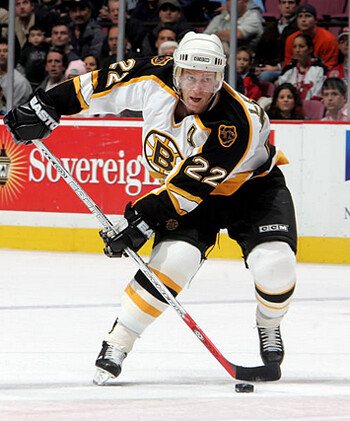
Leetch Bruins
Leetch finished his career with the Boston Bruins

His final totals were 1,205 games played, 247 goals and 781 assists fr 1,028 points. He won a Stanley Cup in 1994, the 1989 Calder Trophy, the Norris Trophy in 1992 and 1997, the 1994 Conn Smythe Trophy and played in ten NHL All-Star Games.
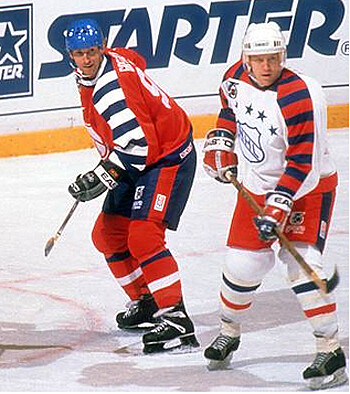
Gretzky Leetch 1992
Leetch guards Wayne Gretzky during the 1992 NHL All-Star Game

Internationally, he won a bronze medal at the 1986 World Juniors, a silver medal at the 2002 Olympics and the 1996 World Cup as team captain.

His jersey #2 retired by New York on February 24, 2008 and he was inducted into the United States Hockey Hall of Fame in 2008 and the Hockey Hall of Fame in 2009.
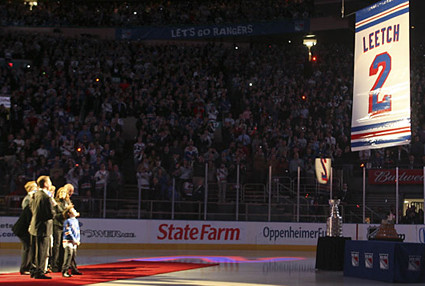
Leetch jersey retirement
Leetch's #2 raised to the rafters at Madison Square Garden

Today's featured jersey is a 1991-92 New York Rangers Brian Leetch jersey from his 102 point season, the first 100 point season ever by an American defenseman and the season he won his first Norris Trophy.

The Rangers have worn blue jerseys with RANGERS diagonally across the front of their jerseys since their inaugural season of 1926-27 with very few exceptions. They wore modernized jerseys with their shield crest for two seasons in the latter half of the 1970s and when the returned to their classic jersey styles for home and road, they wore NEW YORK on the front of the blue road jerseys from 1978-79 to 1986-87.

They reverted to having RANGERS on the front of their blue jerseys again for Leetch's rookie season of 1987-88 with the names straight across the back. The names became the classy vertically arched letters in 1990-91 and only a change to a lace up collar and a change to the waist striping in 1997-98 happening during his lengthy New York career.
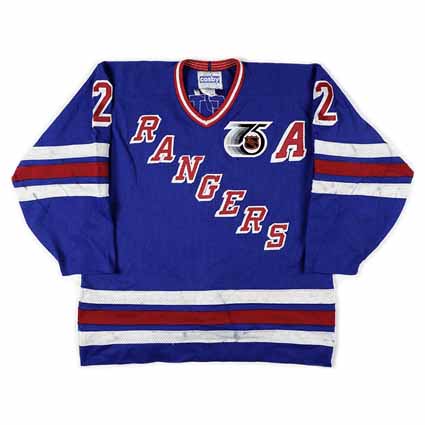
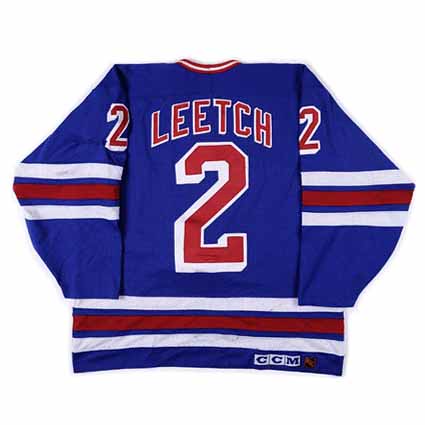
New York Rangers 1991-92 F jersey
New York Rangers 1991-92 B jersey

Bonus jersey: Today's bonus jersey is a 2001-02 New York Rangers Brian Leetch jersey worn only on October 7, 2001 against the Buffalo Sabres, who also wore special jerseys crested with "New York" diagonally across the front in the Rangers first home game following the terrorist attacks on September 11, 2001 in New York.
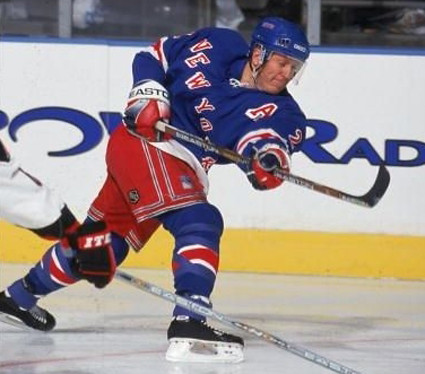
Leetch 911 jersey
Leetch in the one game only 9/11 Tribute jersey

The jerseys were then auctioned off to raise money for the Twin Towers Fund, with the jerseys of Leetch and goaltender Mike Richter raising $15,010, second only to team captain Messier's $20,010.
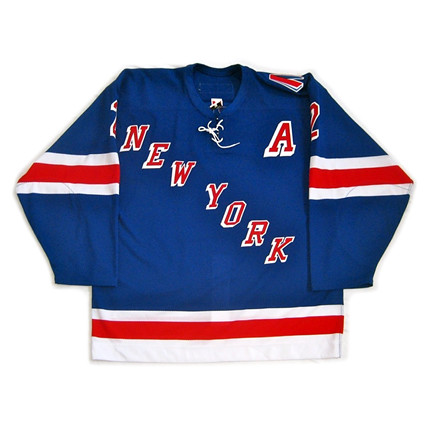
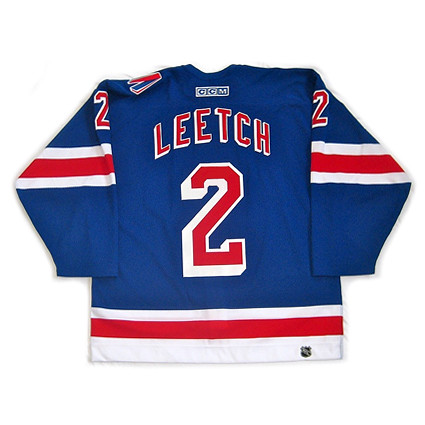
New York Rangers 2001-02 9-11 F jersey
New York Rangers 2001-02 9-11 B jersey

Extra bonus jersey: Today's extra bonus jersey is a 2003-04 New York Rangers Brian Leetch jersey. This highly attractive alternate jersey was worn by the Rangers from 1996-97 to 1997-98 and again from 1999-00 to 2006-07. The Rangers made a white version of this "Liberty" jersey, which replaced the navy blue version for only the 1998-99 season until bringing back the navy version for its second seven season run, which only came to an end when Reebok introduced their Edge jerseys in 2007-08 and all third jerseys were eliminated for that season.
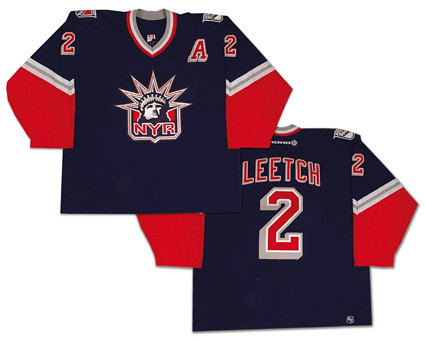
New York Rangers 2003-04 alt jersey
photo courtesy of Classic Auctions

Extra extra bonus jersey: Today's extra extra bonus jersey is a 1996 United States National Team Brian Leetch jersey as worn by the American captain.

Retail versions of his highly collectable style were sold only in the home white style in numbered sizes, such as 48 and 52, with sewn on USA cresting and customized with Leetch, Richter and Jeremy Roenick, who actually did not participate in the 1996 World Cup due to being between NHL contracts at the time and therefore not having insurance in case of a major injury, and did not have the World Cup tournament logo patch.

In addition to the retail jerseys not being sold with the World Cup patch, the Leetch jerseys did not come with the captain's "C" either. Both would need to be added separately for proper authenticity as is the case with today's extra extra bonus jersey.

Also of note, some uncustomized white jerseys were produced for retail sale and can be recognized by their letter sizing, such as L and XL, and sublimated USA cresting as opposed to the customized jerseys, which had sewn on twill logos and numbered sizing.

Blue road jerseys are even more scarce, having only been produced for use by the United States national teams in 1996 and 1997, and since they were intended to be worn by players, come in larger sizes such as 54, 56 and 60.

USA 1996 WCOH jersey photo USA 1996 WCOH 2 F.jpg
USA 1996 WCOH jersey photo USA 1996 WCOH 2 B.jpg 

In today's vdieo section, Leetch is welcomed back to Madison Square Garden for the first time, now as a member of the Bruins.


 Next, Leetch scores the first Rangers goal in Game 7 of the 1994 Stanley Cup Finals.


Next, a pair of tributes to Leetch, the first one on the occasion of his #2 being retired by the Rangers and the second after being named as one of the best 100 players in the first 100 years of the NHL.


Wednesday, September 14, 2016

1996 United States National Team Brett Hull Jersey

The 1996 World Cup of Hockey can trace it's roots to the 1972 Summit Series, which featured the Soviet National Team, whose vastly experienced players were considered amateurs and thus eligible for the Olympics, facing off against Team Canada, whose roster was made up of Canadian NHL professionals who were not allowed to participate in the Olympic Games at the time, clearing the path for Soviet domination of Olympic hockey.

1976 Soviet Union team, 1976 Soviet Union team
The Soviet Union won 8 of 10 Olympic gold medals from 1956 to 1992

The 1972 Summit Series concept of the best players each nation had to offer, regardless of amateur or professional stats, was expanded in 1976 with the creation of the first Canada Cup tournament, which saw teams from not only Canada and the Soviet Union, but the addition of teams representing Finland, Sweden, Czechoslovakia and the United States.

The United States saw mixed results in the Canada Cup tournaments, finishing 5th out of 6 in 1976. A 4th place in the round-robin portion in 1981 saw them qualify for the semi-finals, where they were easily defeated by the host Canadians by a 4-1 score.

Tony Esposito USA 1991 CC, Tony Esposito USA 1991 CC
Tony Esposito playing goal for the United States in 1981

A strong round-robin result had the USA finishing 2nd in 1984, including a 7-1 opening game defeat of Sweden, a 4-4 tie with Canada, a narrow 2-1 loss to the Soviet Union and a 6-4 win over West Germany for a 3-1-1 record. The United States would face off against Sweden in the semifinals and suffer a stunning 9-2 drubbing at the hands of the Swedes, who scored on their first four shots on goal, a team the USA had so easily defeated just 11 days earlier.

In the 1987 edition, the United States completed the round-robin portion of the tournament with a 2-3 record to finish 5th and fail to advance to the playoff round.

Things improved in 1991, with the Americans taking second in the round-robin portion with an impressive 4-1 record. They opened the tournament by defeating Sweden 6-3, then lost to Canada 6-3 before running off a series of victories against Czechoslovakia (4-2), the Soviet Union (2-1) and Finland (4-3). The semi-finals saw a confident US take care of Finland again by a 7-3 score and advance to the finals versus Canada, who would defeat the US by scores of 4-1 and 4-2 to win the best-of-three finals.

For 1996, the tournament was renamed the World Cup of Hockey as a result of various behind the scenes business developments involving Canada Cup founder Alan Eagleson's legal troubles as a result of his fraud and embezzlement scandal. Instead of being run for the financial benefit of Hockey Canada as the Canada Cup was, the newly organized World Cup was a joint venture between the NHL and it's players union, the NHL Players Association (NHLPA).

1996 World Cup logo, 1996 World Cup logo

Taking a more global perspective, the competition now included eight teams, partially as a result of the political upheaval during the fall of communism in Eastern Europe which saw Czechoslovakia split into the Czech Republic and Slovakia. There were now also games held in Europe for the first time.

The teams involved in the North American Pool included Canada Cup hold-overs Canada, Russia (no longer the Soviet Union) and the United States plus newcomer Slovakia. The games were held in Vancouver, Montreal, Philadelphia, Ottawa and New York.

The European Pool saw Sweden and Finland joined by the Czech Republic and Germany, which had participated in the Canada Cup once as West Germany in 1984. Stockholm, Sweden, Helsinki, Finland, Prague in the Czech Republic and Garmisch, located in Germany, would all host games in Europe, with the top three teams advancing to the playoffs held in North America.

The North American Pool saw the United States come out on top with a 3-0 record and earn a bye directly into the semifinals, while Sweden won the European Pool for its trip to North America and a place in the semifinals.

In the quarterfinals Germany would fall to Canada 4-1 in Montreal and Russia would overpower Finland 5-0 in their game played in Ottawa.

The semifinals would see Canada take down Sweden 3-2 in two overtimes in a game held not in Canada, but Philadelphia! Canada held a 2-0 lead after two periods, only to see Sweden come back to tie the game in the third. Theo Fleury would score the game winner with just 13 seconds remaining in the second overtime to send Canada into the best-of-three finals.

Meanwhile, the United States would oddly have to travel to Ottawa to defeat Russia 5-2. Just 26 seconds into the game, Pat Lafontaine would put the Americans ahead and Brett Hull then scored on the powerplay to give the US a 2-0 lead just before the end of the opening period. The United States would extend its lead by scoring a pair of goals in the second, after giving up one to the Russians, to take a commanding 4-1 lead into the third. Sergei Zubov would pull one back for Russia less than two minutes into the third, but the United States would counter that with a goal at 14 minutes to re-establish their three goal margin and advance to the finals versus Canada.

Game One of the finals was held in Philadelphia and was a close fought battle. Eric Lindros would put the Canadians up 1-0 after one period. Defenseman Derian Hatcher would score a pair of goals in the second to give the USA the lead, only to have Claude Lemieux tie the game during the final minutes of the second.

Fleury gave the Canadians the lead half way through the third. The lead held up through the remainder of the period until the USA pulled their goaltender Mike Richter. The resulting man advantage caused the Canadians to ice the puck repeatedly, and with less than 10 seconds remaining in the game, Joel Otto won the faceoff back to US captain Brian Leetch, who fired the puck at Canadian goaltender Curtis Joseph, who made the save only to have Eric Desjardins try to put the puck under his goalie Joseph and see it sneak through his legs and trickle over the goal line with 6.3 seconds showing on the clock.

Canada would dominate the resulting overtime, outshooting the US 6-1 before Steve Yzerman shot one past a screened Richter to give Canada the first game in the best-of-three finals.

Game Two in Montreal would see the United States come out on top with a 5-2 win. The teams would trade goals in the first period, but the United States would add a pair in the second from John LeClair, his second of the game, followed by a goal by Hull. Joe Sakic would cut the margin to one at 14:48 of the third, but the United States would put the game away with a pair of empty net goals in the last 1:08 of the contest, forcing a deciding Game Three, also to be held in Montreal on this date in 1996.

With Richter, playing at the top of his game, holding off the Canadian attack, the United States scored the first goal at 11:18 of the first on the power play as Hull would give the US a 1-0 lead after one. The lead would hold up almost the entire second period as Richter would continue his stellar play in goal for the US, making 21 saves in the second period before Lindros would even the score with just six seconds before the intermission. At this point, the Canadians had decisively outshot the Americans by a margin of 32-14.

Adam Foote would solve Richter at 12:50 of the third to give Canada their first lead in over 5 1/2 periods of hockey.

Hull would even the score when he deflected a high shot from the point by Leetch that would stand after a video review, tying the contest at 16:42.

Energized by the goal, the Americans continued to press and Tony Amonte gave them the lead with 2:35 remaining.


Amonte World Cup goal, Amonte World Cup goal
Amonte celebrates after scoring to give the Americans the lead 

Derian Hatcher put the game out of reach with an empty net goal at 19:19 and Adam Deadmarsh drilled a long slapshot past Joseph with just 14 seconds left to give the USA a final 5-2 margin in a game that was tied with just 3:18 remaining.

 Richter would be named the First Star of the game after making 35 saves on 37 shots.
 
USA Captains 1996 World Cup, USA Captains 1996 World Cup
Tkachuk, Leetch and Weight hoist the World Cup
along with presenter Jean Beliveau

Hull would finish the tournament with 7 goals and 4 assists for 11 points in 7 games to lead the tournament in scoring followed closely by teammate LeClair with 10 points from 6 goals and 4 assists. Doug Weight (7), Leetch (7) and Keith Tkachuk (6) would all finish in the top 10 in scoring for the Americans.

1996 Team USA World Cup, 1996 Team USA World Cup
The United States celebrates its greatest accomplishment since 1980

The tournament All-Star team would be made of of Forwards Mats Sundin (Sweden), Hull and LeClair of the USA, defensemen Calle Johansson of Sweden and Chris Chelios (USA) as well as goaltender Richter of the USA, who would also be named the tourament's Most Valuable Player thanks to finishing with a 5-1 record, with his only loss coming in overtime.

Richter MVP 1996 World Cup, Richter MVP 1996 World Cup
Richter accepting his reward as tournament MVP
 
Today's featured jersey is a 1996 United States National Team Brett Hull jersey as worn when the United States captured the inaugural World Cup of Hockey championship.

The jersey features the smaller 3" size World Cup of Hockey logo patch worn on the left shoulder by the Nike-clad teams in the tournament, which included not only the USA, but Russia, Slovakia, Finland and Germany.

The larger 4" size patch was worn by the teams that wore Bauer jerseys, which were the Czech Republic and Sweden, who also wore the patch on the left shoulder, and Canada, who wore the patch on their right chest.

This style of USA jersey features dye-sublimated "waving flag" stripes on the waist that contain subtle stars in the red areas, as well as in the white sleeve stripes. The 1996 United States jerseys are very sought after and command a lot of attention when they come up for sale.

Unlike the white jerseys available for retail sale, the blue road jerseys were not sold to the public and can only be found as game worn or team issued jerseys, which are complete with fight straps and command premium prices on the rare occasions they become available. Since they were intended for used by the actual players, they are also only found in larger sizes, such as 54, 56, 58 and 60.

USA 1996 WCOH jersey photo USA 1996 WCOH R F_1.jpg
USA 1996 WCOH jersey photo USA 1996 WCOH R B_1.jpg
USA 1996 WCOH jersey photo USA 1996 WCOH R P1_1.jpg

Bonus jersey: Today's bonus jersey is a 1996 United States National Team Mike Richter jersey as worn by the World Cup of Hockey tournament MVP.

As was Nike's practice at the time, jerseys sold customized with player names and numbers featured sewn twill crests and were tagged with numbered sizes, such as 48 and 52 (but no fight straps), while blank jerseys were sold as lettered sizes, such as L and XL, and with sublimated crests.

The blank examples are scarce, but do offer the collector the opportunity to have their jersey customized as a Hull, Tkachuk, Lafontaine, Amonte, LeClair or any other personal favorite from the victorious American roster.

The jerseys sold with player names from Nike were #35 Richter, #2 Leetch and #27 Jeremy Roenick. However, Roenick never actually played in the World Cup due to being a free agent and not being covered by health insurance at the time so those looking for authenticity should hold out for Richter or Leetch jerseys.

None of the retail jerseys were sold with the World Cup patch. Those would need to be added separately by their owners for proper authenticity as is the case with today's bonus jersey.

USA 1996 WCOH jersey photo USA 1996 WCOH 35 F.jpg
USA 1996 WCOH jersey photo USA 1996 WCOH 35 B.jpg
USA 1996 WCOH jersey photo USA 1996 WCOH 35 P.jpg

Extra bonus jersey: Today's extra bonus jersey is a 1996 United States National Team Brian Leetch jersey as worn by the World Cup of Hockey tournament MVP.

In addition to the retail jerseys not being sold with the World Cup patch, the Leetch jerseys did not come with the captain's "C" either. That would also need to be added separately for proper authenticity as is the case with today's extra bonus jersey.

USA 1996 WCOH jersey photo USA 1996 WCOH 2 F.jpg
USA 1996 WCOH jersey photo USA 1996 WCOH 2 B.jpg
USA 1996 WCOH jersey photo USA 1996 WCOH 2 P.jpg

First up is LeClair tying Game 1 with less than seven seconds to play.


Here are highlights of the thrilling finale of the 1996 World Cup of Hockey.


Friday, September 14, 2012

1996 United States National Team Brian Leetch Jersey

The 1996 World Cup of Hockey can trace it's roots to the 1972 Summit Series, which featured the Soviet National Team, whose vastly experienced players were considered amateurs and thus eligible for the Olympics, facing off against Team Canada, whose roster was made up of Canadian NHL professionals who were not allowed to participate in the Olympic Games at the time, clearing the path for Soviet domination of Olympic hockey.

1976 Soviet Union team, 1976 Soviet Union team
The Soviet Union won 8 of 10 gold medals from 1956 to 1992

The 1972 Summit Series concept of the best players each nation had to offer, regardless of amateur or professional stats, was expanded in 1976 with the creation of the first Canada Cup tournament, which saw teams from not only Canada and the Soviet Union, but the addition of teams representing Finland, Sweden, Czechoslovakia and the United States.

The United States saw mixed results in the Canada Cup tournaments, finishing 5th out of 6 in 1976. A 4th place in the round-robin portion in 1981 saw them qualify for the semi-finals, where they were easily defeated by the host Canadians by a 4-1 score.

A strong round-robin result had the USA finishing 2nd in 1984, including a 7-1 opening game defeat of Sweden, a 4-4 tie with Canada, a narrow 2-1 loss to the Soviet Union and a 6-4 win over West Germany for a 3-1-1 record. The United States would face off against Sweden in the semifinals and suffer a stunning 9-2 drubbing at the hands of the Swedes, who scored on their first four shots on goal, a team the USA had so easily defeated just 11 days earlier.

In the 1987 edition, the United States completed the round-robin portion of the tournament with a 2-3 record to finish 5th and fail to advance to the playoff round.

Things improved in 1991, with the Americans taking second in the round-robin portion with an impressive 4-1 record. They opened the tournament by defeating Sweden 6-3, then lost to Canada 6-3 before running off a series of victories against Czechoslovakia (4-2), the Soviet Union (2-1) and Finland (4-3). The semi-finals saw a confident US take care of Finland again by a 7-3 score and advance to the finals versus Canada, who would defeat the US by scores of 4-1 and 4-2 to win the best-of-three finals.

Tony Esposito USA 1991 CC, Tony Esposito USA 1991 CC
Tony Esposito playing goal for the United States in 1991

For 1996, the tournament was renamed the World Cup of Hockey as a result of various behind the scenes business developements involving Canada Cup founder Alan Eagleson's legal troubles as a result of his fraud and embezzlement scandal. Instead of being run for the financial benefit of Hockey Canada as the Canada Cup was, the newly organized World Cup was a joint venture between the NHL and it's players union, the NHL Players Association (NHLPA).

1996 World Cup logo, 1996 World Cup logo

Taking a more global perspective, the competition now included eight teams, partially as a result of the political upheaval during the fall of communism in Eastern Europe. There were now also games held in Europe for the first time ever.

The teams involved in the North American Pool included Canada Cup hold-overs Canada, Russia (no longer the Soviet Union) and the United States plus newcomer Slovakia, which was formerly part of Czechoslovakia. The games were held in Vancouver, Montreal, Philadelphia, Ottawa and New York.

The European Pool saw Sweden and Finland joined by the Czech Republic (also formerly part of Czechoslovakia) and Germany, which had participated in the Canada Cup once as West Germany in 1984. Stockholm, Sweden, Helsinki, Finland, Prague in the Czech Republic and Garmisch, located in Germany, would all host games in Europe, with the top three teams advancing to the playoffs held in North America.

The North American Pool saw the United States come out on top with a 3-0 record and earn a bye directly into the semifinals, while Sweden won the European Pool for its trip to North America and a place in the semifinals.

In the quarterfinals Germany would fall to Canada 4-1 in Montreal and Russia would overpower Finland 5-0 in their game played in Ottawa.

The semifinals would see Canada take down Sweden 3-2 in two overtimes in a game held not in Canada, but Philadelphia! Canada held a 2-0 lead after two periods, only to see Sweden come back to tie the game in the third. Theo Fleury would score the game winner with just 13 seconds remaining in the second overtime to send Canada into the best-of-three finals.

Meanwhile, the United States would oddly have to travel to Ottawa to defeat Russia 5-2. Just 26 seconds into the game, Pat Lafontaine would put the Americans ahead and Brett Hull then scored on the powerplay to give the US a 2-0 lead just before the end of the opening period. The United States would extend its lead by scoring a pair of goals in the second, after giving up one to the Russians, to take a commanding 4-1 lead into the third. Sergei Zubov would pull one back for Russia less than two minutes into the third, but the United States would counter that with a goal at 14 minutes to re-establish their three goal margin and advance to the finals versus Canada.

Game One of the finals was held in Philadelphia and was a close fought battle. Eric Lindros would put the Canadians up 1-0 after one period. Defenseman Derian Hatcher would score a pair of goals in the second to give the USA the lead, only to have Claude Lemieux tie the game during the final minutes of the second.

Fleury gave the Canadians the lead half way through the third. The lead held up through the remainder of the period until the USA pulled their goaltender Mike Richter. The resulting man advantage caused the Canadians to ice the puck repeatedly, and with less than 10 seconds remaining in the game, Joel Otto won the faceoff back to US captain Brian Leetch, who fired the puck at Canadian goaltender Curtis Joseph, who made the save only to have Eric Desjardins try to put the puck under his goalie Joseph and see it sneak through his legs and trickle over the goal line with 6.3 seconds showing on the clock.

Canada would dominate the resulting overtime, outshooting the US 6-1 before Steve Yzerman shot one past a screened Mike Richter to give Canada the first game in the best-of-three finals.

Game Two in Montreal would see the United States come out on top with a 5-2 win. The teams would trade goals in the first period, but the United States would add a pair in the second from John LeClair, his second of the game, followed by Brett Hull. Joe Sakic would cut the margin to one at 14:48 of the third, but the United States would put the game away with a pair of empty net goals in the last 1:08 of the contest, forcing a deciding Game Three, also to be held in Montreal.

With Richter, playing at the top of his game, holding off the Canadian attack, the United States scored the first goal at 11:18 of the first on the power play as Hull would give the US a 1-0 lead after one. The lead would hold up almost the entire second period as Richter would continue his stellar play in goal for the US, making 21 saves in the second period before Eric Lindros would even the score with just six seconds before the intermission. At this point, the Canadians had decisively outshot the Americans by a margin of 32-14.

Adam Foote would solve Richter at 12:50 of the third to give Canada their first lead in over 5 1/2 periods of hockey.

Hull would even the score when he deflected a high shot from the point by Brian Leetch that would stand after a video review, tying the contest at 16:42.

Energized by the goal, the Americans continued to press and Tony Amonte gave them the lead with 2:35 remaining.


Amonte World Cup goal, Amonte World Cup goal
Amonte celebrates after scoring to give the Americans the lead 

Derian Hatcher put the game out of reach with an empty net goal at 19:19 and Adam Deadmarsh drilled a long slapshot past Joseph with just 14 seconds left to give the USA a final 5-2 margin in a game that was tied with just 3:18 remaining. Richter would be named the First Star of the game after making 35 saves on 37 shots.
 
USA Captains 1996 World Cup, USA Captains 1996 World Cup

Hull would finish the tournament with 7 goals and 4 assists for 11 points in 7 games to lead the tournament in scoring followed closely by teammate John LeClair with 10 points from 6 goals and 4 assists. Doug Weight (7), Leetch (7) and Keith Tkachuk (6) would all finish in the top 10 in scoring for the Americans.

1996 Team USA World Cup, 1996 Team USA World Cup

The tournament All-Star team would be made of of Forwards Mats Sundin (Sweden), Hull and LeClair of the USA, defensemen Calle Johansson of Sweden and Chris Chelios (USA) as well as goaltender Richter of the USA, who would also be named the tourament's Most Valuable Player thanks to finishing with a 5-1 record, with his only loss coming in overtime.

Richter MVP 1996 World Cup, Richter MVP 1996 World Cup

Today's featured jersey is a 1996 United States National Team Brian Leetch jersey as worn when the United States captured the inaugural World Cup of Hockey championship.

The jersey features the smaller 3" size World Cup of Hockey logo patch worn on the left shoulder by the Nike-clad teams in the tournament, which included not only the USA, but Russia, Slovakia, Finland and Germany.

The larger 4" size patch was worn by the teams that wore Bauer jerseys, which were the Czech Republic and Sweden, who also wore the patch on the left shoulder, and Canada, who wore the patch on their right chest.

This style of USA jersey features dye-sublimated "waving flag" stripes on the waist that contain subtle stars in the red areas, as well as in the red sleeve stripes. These jerseys are very sought after and command a lot of attention when they come up for sale.

As was Nike's practice at the time, jerseys sold customized with player names and numbers featured sewn twill crests and were tagged with numbered sizes, such as 48 & 52 (but no fight straps), while blank jerseys were sold as Large and Extra Large using sublimated crests.

The jerseys sold with player names from Nike were #35 Richter, #2 Leetch and #27 Jeremy Roenick, who never actually played in the World Cup due to being a free agent and not having health insurance at the time. None of the jerseys were sold with the World Cup patch and the Leetch jerseys did not come with the captain's "C". Those would need to be added separately by their owners for proper authenticity as we have done with today's featured jersey.

The blue road jerseys were not available for retail sale and can only be found as game worn or team issued jerseys, which are complete with fight straps.

USA 1996 WCOH jersey photo USA 1996 WCOH 2 F.jpg
USA 1996 WCOH jersey photo USA 1996 WCOH 2 B.jpg
USA 1996 WCOH jersey photo USA 1996 WCOH 2 P.jpg

First up is LeClair tying Game 1 with less than seven seconds to play.


Here are highlights of the thrilling finale of the 1996 World Cup of Hockey.

Tuesday, June 14, 2011

1993-94 New York Rangers Brian Leetch Jersey

With a 3-2 victory on this date in 1994 the New York Rangers won one of the most memorable championships in NHL history. Ending a 54-year drought, something the New York Islanders fans were fond of pointing out with chants of "Nineteen-Forty! Nineteen-Forty!", the Rangers captured their fourth title in franchise history by defeating the Vancouver Canucks in Game 7 of the finals.

In a very momentous season, the Rangers hosted the NHL All-Star Game in January, won the President's Trophy for their regular season and went onto capture the Stanley Cup as well.

The Rangers were captained by Mark Messier and led in scoring by defenseman Sergei Zubov, with 89 points, while Adam Graves had the most goals with 52. The Rangers had many other contributors that season as well, including Brian Leetch, Steve Larmer, Alexi Kovalev, Esa Tikkanen, Sergei Nemchinov, Kevin Lowe and Jeff Beukeboom. Mike Richter and Glenn Healy shared the goaltending during the regular season, with Richter handling the vast majority of the playoff duties. Acquired during trades during the season, Stephane Matteau, Brian Noonan, Glenn Anderson and Craig MacTavish all played roles in the playoffs, with Matteau's goal in the second overtime of Game 7 of the Eastern Conference Finals being the most memorable.

The Canucks won Game 1 on the road in overtime to start the series and the Rangers came back to win Game 2 at home, as well as Games 3 & 4 in Vancouver to seemingly take control of the series with the next game back on home ice in New York. The Canucks had other plans however, taking the next two games to set up the dramatic seventh and deciding game at Madison Square Garden.

The Rangers got out to an early 2-0 lead before Trevor Linden scored short-handed early in the second. Messier scored for the Rangers only to have Linden pull one back for the Canucks early in the third. Vancouver hit the post with five minutes left in the game and the Rangers held on to win the Stanley Cup. Brian Leetch was not only named the first American-born player to win the Conn Smythe Trophy, but the first non-Canadian as well.

Photobucket

Today's jersey is a 1993-94 New York Rangers Brian Leetch jersey featuring the 1994 Stanley Cup Finals patch. This was the smallest size finals patch ever made, in deference to the Rangers needing to wear the patch on their shoulders due to the diagonal "Rangers" cresting across the front of the jersey taking up the space on the upper right chest where the patch is customarily worn. Aside from the first time the patch was worn in 1989, when it was located on the upper left sleeves, this is the only instance of the finals patch not being worn on the upper right chest.

1993-94 NHL New York Rangers Brian Leetch jersey

In a milestone side note, Zubov, Kovalev, Nemchinov and Alexander Karpovtsev became the first four Russian-trained players to have their names engraved on the Stanley Cup.


hit counter for blogger