Considered to be one of the greatest players the game has ever seen, Valeri Kharlamov of the Soviet Union was born on this date in 1948. He joined the Central Red Army club in the Soviet Elite League in 1967-68 and scored two goals in 15 games as a rookie.
Soviet hockey legend Valeri Kharlamov
Having got his feet wet the season before, Kharlamov made no secret of his prodigious talent the following season when he increased his goal scoring to 37 goals in 42 games of the shorter Soviet League season. Following the season he would make the first of his 11 consecutive World Championship appearances and contributed 13 points in ten games on his way to the first gold medal of his illustrious international career.
In the 1969-70 season Kharlamov averaged a goal per game while playing in 33 contests for Central Red Army in a season which concluded with the first of four consecutive Soviet League championships. He followed that with ten points in nine games on his way to another World Championship gold medal.
Kharlamov won the Soviet League goal scoring title in 1970-71 with a career highs with 40 goals and 52 points in 34 games. He earned his first World Championship All-Star selection when he tallied 17 points in ten games as he was awarded his third consecutive World Championship gold medal, the dominant Soviet Union's 9th in a row.
He one-upped himself by capturing the Soviet League points scoring title in 1971-72, albeit with a lower personal point total that the previous season, with 40 points and was named the Soviet League MVP for the first time. That was not the highlight of Kharlamov's season however, as he introduced himself to the world as he led the Soviet Union to the gold medal at the 1972 Olympic Games in Sapporo, Japan where his 15 points in just five games led all scorers by six points as the world got their first real glimpse of his superior skating and playmaking abilities. Later that spring he was again named to the World Championship All-Star team, but had to settle for the silver medal for the first time.
In case anyone missed his performance in the Olympics, Kharlamov became a true star of international hockey with his performance in the fabled 1972 Summit Series when the best that the Soviet Union had to offer took on an All-Star team of Canadian professionals for the first time ever. While many in Canada assumed that their professional players would easily win all eight games of the series, Kharlamov led the Soviets with two goals in their stunning Game 1 upset of Team Canada on home ice in Montreal. While Canada led by two six minutes in, the Soviets quickly turned the tide, evening the score before the period ended and began to pull away with Kharlamov's two goals in the second on their way to a 7-3 win.
First teamed together in 1968, the line of Boris Mikhailov, Vladimir Petrov and Valeri Kharlamov, dominated international hockey throughout the 1970's
After losing Game 2, Kharlamov contributed another goal in their 4-4 tie in Game 3. After the Soviets 5-3 win in Game 4 in Canada, the series shifted to Moscow in the Soviet Union. When the Soviets came from behind 4-1 to win Game 5, Bobby Clarke of Canada deliberately broke Kharlamov's ankle in Game 6 which enabled the Canadians to stage a comeback and eventually win the series in a dramatic Game 8.
A fourth Soviet League title came in 1972-73 as he scored 32 points in 27 games after recovering from his broken ankle. A return to World Championship gold was powered by an on-from Kharlamov as he racked up 23 points in ten games for the host Soviet Union.
The consecutive championship streak ended in the Soviet League in 1973-74 but the World Championship success continued with another gold in 1974.
Prior to the start of the next season, Kharlamov again participated for the Soviet Union in the 1974 Summit Series, where they took on a team of mainly Canadian professionals from the World Hockey Association, which the Soviets won with a 4-1-3 record. Kharlamov contributed seven points in the eight games.
The Soviet League title returned to Central Red Army in 1974-75 as Kharlamov had a great season with 39 points in 31 games and yet another World Championship gold on the heels of 16 points in 9 games.
Kharlamov on the attack
While his personal scoring level continued unchanged in 1975-76, Kharlamov had to unusually settle for silver in both the Soviet League and the World Championships. All was not lost however, as the Soviet Union dominated the 1976 Olympic Games in Innsbruck, Austria to win the second gold medal of Kharlamov's career. He would be one of four Soviet players to tie for the tournament scoring lead with ten points in five games, including his game winning goal in their final game against Czechoslovakia.
Of interest, it was during the Soviet League season that the Central Red Army club took a break from domestic competition and participated in the first Super Series of exhibition games in North America against teams from the NHL which included a win over the New York Rangers, the enthralling tie against Montreal on New Year's Eve, called by many the greatest game of hockey ever played, another win, this time over the Boston Bruins and the notorious game against the Philadelphia Flyers when Kharlamov was targeted with an elbow to the head from the blind side which caused the Soviet coach to pull his team off the ice when to penalty was called.
That spring he was seriously injured in a car accident, which put his hockey career in jeopardy and cost him a chance to compete in the 1976 Canada Cup.
While Kharlamov was limited to 21 games because of recovery time from his injuries, the 1976-77 saw Central Red Army begin an era of dominance unlike any ever seen before with the first of 13 consecutive titles but the national team would fall to third place and the bronze medal at the World Championships.
Kharlamov would have one of his best offensive seasons when he totaled 42 points in only 29 games during the 1977-78 domestic season and a new run of gold medals would begin at the 1978 World Championships, the first of five in a row for the Soviet Union.
He was in peak form in 1978-79, scoring 22 goals and 48 points in the Soviet League, his greatest number of points since 1971. He had another impressive tournament at the World Championships with 14 points in eight games as the Soviet Union won gold on home ice in Moscow. He also participated in the 1979 Challenge Cup for the Soviet Union in a three game series against a team of NHL All-Stars which took the place of the normal NHL All-Star Game that season, which the Soviets won two games to one with a decisive 6-0 victory on Game 3.
1979-80 was a memorable campaign for Kharlamov as he added 38 points in 42 games and another Soviet League title. In February of 1980, his chance at his third consecutive Olympic gold medal was derailed by the "Miracle on Ice" during which the Soviet Union was upset by the United States in an upset so great that the loss was ranked the #1 story of the century by the International Ice Hockey Federation (IIHF). The Soviet Union eventually was awarded the silver medal with a 7-1 record. Of note, there were no World Championships held in 1980 due to the Olympic games.
A final Soviet League title for Kharlamov came in 1980-81 when he scored 25 points in 30 games. During his Soviet League career, Kharlamov scored 293 goals and 214 assists for 504 points in 436 games.
Sadly, on August 17, 1981, Kharlamov was killed at the age of 33 due to injuries suffered in a car accident which also claimed the life of his wife Irina.
In 1998, Kharlamov was inducted into the IIHF Hall of Fame. 2005 saw him become only the second non-NHL player to be inducted into the Hockey Hall of Fame, joining fellow Soviet player and teammate, goaltender Vladislav Tretiak. In 2008 he was selected as just one of six players to be named to the IIHF Centennial All-Star Team, honoring the best players in the 100 year history of the IIHF.
The IIHF Centennial All-Star Team announcement honoring Kharlamov, Tretiak, Slava Fetisov, Borje Salming, Wayne Gretzky and Sergei Makarov.
Other tributes to Kharlamov include a division of the top Russian professional hockey league, the KHL, being named after him, the the award for the top Russian player in the NHL each season being named the Kharlamov Trophy and the championship team in the junior league in Russia for players aged 17-21, the Minor Hockey League, is awarded the Kharlamov Cup.
Additionally, Kharlamov's #17 has been retired by both the Central Red Army club and the Russia National Team.
Kharlamov looking to score against Sweden
In total, Kharlamov won 11 Soviet League titles, eight World Championship Gold medals and two Olympic gold medals as well as one Soviet League scoring title, seven Soviet League All-Star awards and two Soviet League MVP awards and is the all-time leading scorer in the Olympics for the Soviet Union with 35 points in 17 games.
Today's featured jersey is a 1972 Soviet Union National Team Valeri Kharlamov jersey as worn in the 1972 Summit Series between the Soviet Union and Team Canada in which Kharlamov suffered a broken ankle after a deliberate slash in an effort to neutralize him.
Soviet National Team jerseys were generally quite spartan in appearance, using simple red jerseys with generally minimal striping and one color white names and numbers.
There were occasional dashes of flair, such as 1956's chevron striping, their first use of red and white after debuting in blue and white(!) in 1954, 1987's dual triangle look and the diamond trim used on their jerseys in the late 70's and early 80's, such as those worn during the "Miracle on Ice". Just the addition of yellow trim in the late 1980's was a radical departure after 30 years of only red and white sweaters.
Bonus jersey: Today's bonus jersey is a 1976 Soviet Union National Team Valeri Kharlamov jersey. This simple jersey style severed the Soviets well for over a decade, having used it as far back as the 1964 Olympics, wearing it through the 1976 World Championships. By 1976 the numbers used on the back were quite bold and much more professionally executed than the thin, seemingly hand cut numbers in the quirky font used in the 1972 Summit Series.
Bonus jacket: Today's bonus jacket is a 1970's Soviet National Team Valeri Kharlamov jacket as worn during the 1970's. Unusually, Kharlamov's name appears above the CCCP, which seems odd considering the entire philosophy of the team above the individual of the Soviet hockey system. Still, the arched name over his number 17 and the CCCP makes for a striking look for this great piece of seldom seen team gear.
Today's video segment begins with this tribute to Kharlamov.
This next video is about the dedication of a monument to Kharlamov in Moscow and includes several interviews with former teammates who speak about their recollections of playing with him.
Here is one more very well put together tribute video to Kharlamov, followed by his induction into the Hockey Hall of Fame in 2005.
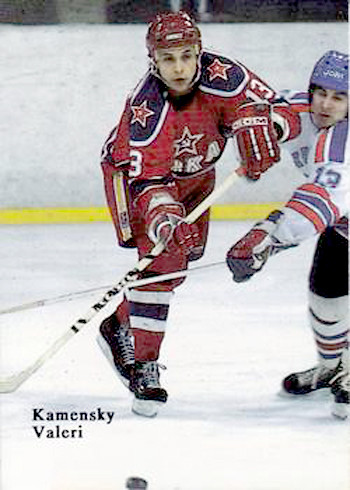
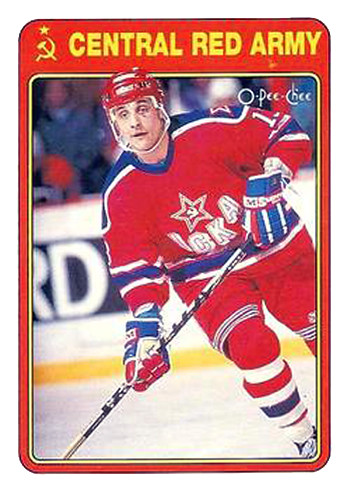
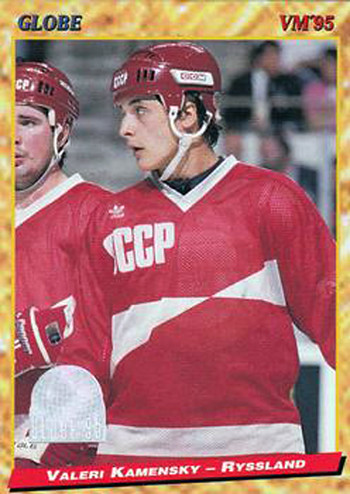
After beginning his career with three seasons with Khmik Voskresensk in the Soviet Championship League beginning with the 1982-83 season, Valeri Kamensky, like so many other top Soviet players, found himself drafted by the military and assigned duty as a hockey player for the dominant Central Sports Club of the Army, CSKA Moscow beginning with the 1985-86 season.
A young Kamensky with CSKA Moscow
During his first season with Red Army, Kamensky would immediately see his point total double from his best and final season with Khimik, as he scored 15 goals and 24 points in 40 games. Two seasons later he set a Soviet career highs with 26 goals and 46 points. Three seasons later he matched his 46 points from 20 goals and 26 assists. Kamensky's time with CSKA was the twilight of their incredible dynasty, and the club won the final four championships of their period of complete domination in 1986, 1987, 1988 and 1989. He was named the Soviet MVP following the 1990-91 season.
Kamensky was the Soviet MVP in 1991
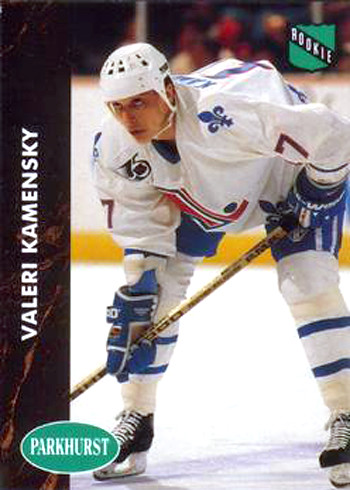
Kamensky's final two seasons with Red Army saw the club begin to be depleted, as their players were now being allowed to leave the Soviet Union to play in the NHL. Having been drafted by the Quebec Nordiques back in 1988, he now made the jump to North America for the 1991-92 season.
His first two seasons with Quebec were limited to just 23 and 32 games, but his potential was on display as he averaged over a point per game in those 55 contests. Finally playing a full season in 1993-94, Kamensky scored 28 goals and 65 points in 76 games.
Kamensky wore #17 as an NHL rookie in 1991-92
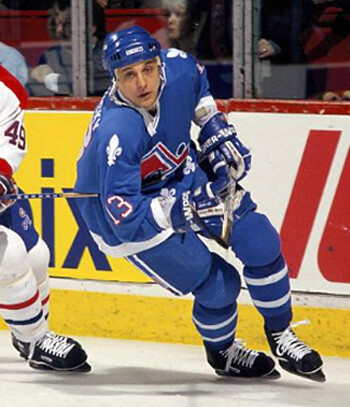
With the start of the 1994-95 NHL season delayed due to labor issues, Kamensky played in a dozen games with HC Ambri-Piotta in the Swiss National League A, scoring 13 goals and 19 points. When the NHL season finally began, Kamensky returned to the Nordiques, where he scored 10 goals and was credited with 20 assists for 30 points in 40 games.
After two seasons as #31, Kamensky finally got to wear his preferred #13 in 1994-95
The financial situation for the Nordiques was a dire one, having to do business in weaker Canadian dollars yet pay their players in American dollars while also having difficulties getting free agents to sign in French speaking Quebec City, which was also the smallest market in the NHL. All of this, plus their aging arena, Le Colisee, proved too much to overcome and the team was sold to new owners, who moved the team to Denver, where they were renamed the Colorado Avalanche.
Kamensky moved with the club to Denver and the change of scenery suited him well, as he had a career year with 38 goals and 47 assists for 85 points. Before the move, the Nordiques were a team on the rise, thanks to their many high draft picks due to how dismal the team and been for so long. With stars like Joe Sakic and Peter Forsberg and a solid supporting cast, things were looking bright for the Avalanche. That outlook grew even brighter two months into the season when, after a falling out with the Montreal Canadiens, Colorado was able to obtain the final key piece of the puzzle in goaltender Patrick Roy.
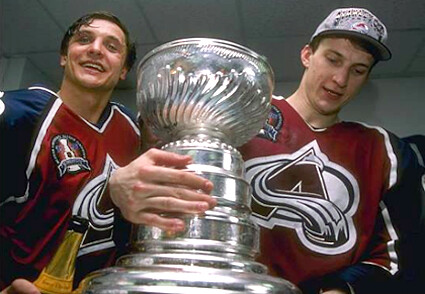
The team won the Pacific Division with the second most points in the regular season. In the playoffs, they defeated the Vancouver Canucks in six, eliminated the Chicago Blackhawks in six and advance to the Finals by beating the Detroit Red Wings in six. They then swept the overmatched Florida Panthers in four to win the 1996 Stanley Cup. Kamensky, after finishing third during the regular season behind only Sakic and Forsberg, was second in Avalanche playoff scoring with 10 goals and 12 assists for 22 points in 22 games played.
Kamensky and Sandis Ozolinsh celebrate with the Stanley Cup
Kamensky equaled his second highest goal total in 1996-97 when he scored 28 for the second time on his was to 66 points, also the second highest of his career while playing in only 68 games. He had a fine playoff season that year with another 22 points, this time in 17 games. He matched his point total from the previous season with 66 again in 1997-98 from 26 goals and 40 assists. He would play one more season in Colorado in 1998-99 with 44 points in 65 games.
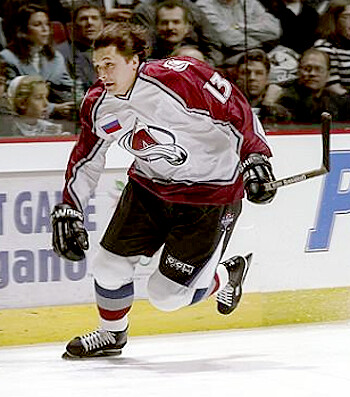
Kamensky at the 1998 NHL All-Star SuperSkills Competition
Note the Russian flag patch on his right chest, worn only during the event
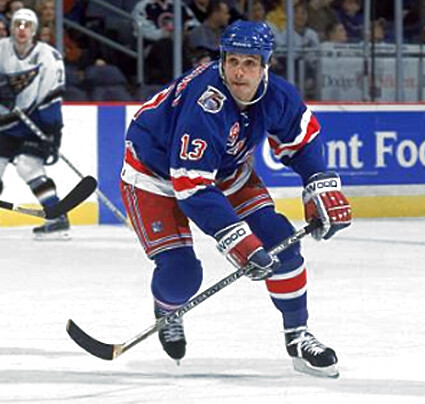
Despite the success he enjoyed with Colorado, Kamensky signed as a free agent with the New York Rangers for the 1999-00 season. Once again, his season was affected by injuries and he only played in 58 games for New York that season, which limited him to 13 goals and 32 points. His second season with the Rangers was a similar story, as Kamensky played in only 65 games with a similar scoreline of 14 goals and 34 points.
Kamensky played two seasons with the Rangers
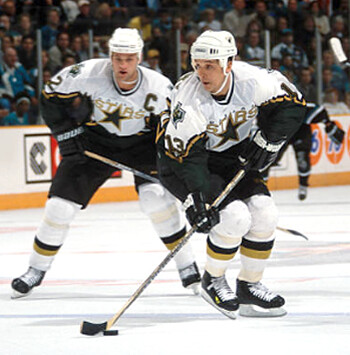
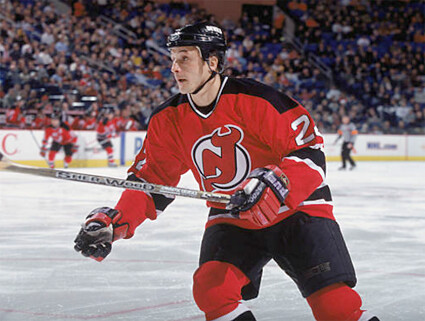
For the 2001-02 season, Kamensky signed as a free agent with the Dallas Stars, but after just 24 games and only 9 points, he was traded to the New Jersey Devils in January where he played the final 30 games of his NHL career with 4 goals and 12 points.
Kamensky played for both Dallas and New Jersey in 2001-02
After not playing during the 2002-03 season, Kamensky took to the ice once again for Khimik Voskresensk in the Russian Superleague. He played in 23 games that first season, with 5 goals and 14 points. He was back with Khimik for the 2003-04 season, where he closed out his career with a fine season, scoring 17 goals and 36 points in 57 games before announcing his retirement.
His final NHL totals were 637 games played with exactly 200 goals and 301 assists for 501 points. Thanks to his two great playoff seasons with the Avalanche, he also had 25 goals and 60 points in his playoff career.
Internationally, Kamensky made annual appearances for the Soviet Union during his time with CSKA Moscow. He first played in the World Junior Championships in 1985, earning a bronze medal. He had a memorable 1986 winning gold at the World Juniors, scoring 7 goals and 13 points in 7 games, and gold again at his first World Championships at the senior level four months later as he turned 20 during the tournament.
Kamensky wore the "double triangle" style early in his international career
Kamensky won silver at the 1987 Worlds and came in second at the 1987 Canada Cup later that fall. He won a gold medal at his first Olympics in 1988 in Calgary with 4 goals and 6 points in 8 games. His career for the Soviet Union concluded with gold medals at the 1989 and 1990 World Championships and a bronze in 1991.
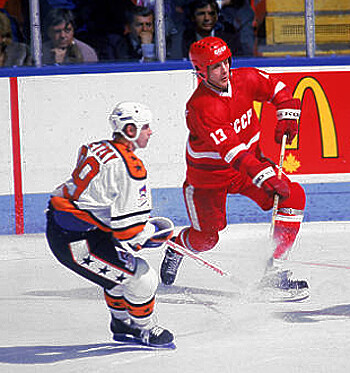
Kamensky was a member of the Soviet team at Rendez-vous '87,
the two game series held in place of the NHL All-Star Game
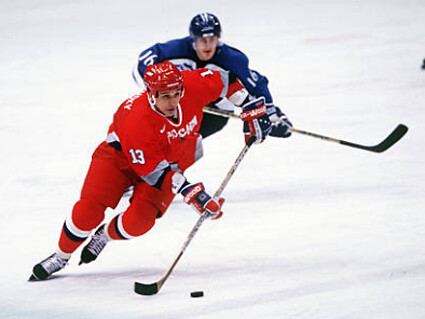
After the break up of the Soviet Union, he would not return to the international stage until the 1994 World Championships, where he suited up for Russia for the first time. He participated in his second Olympics in 1998 in Nagano, Japan, winning a silver medal. His international career concluded with the 2000 World Championships.
Kamensky now playing for Russia at the 1998 Olympics
In all, Kamensky won five gold medals (1 World Junior, 3 World Championship and 1 Olympic), two silver, (1 at the Worlds and 1 Olympic) and two bronze (1 World Junior and 1 at the Worlds). His Stanley Cup championship in 1996 made him just the fourth member of the exclusive Triple Gold Club to go with his World Championship and Olympic gold medals. To date, only 27 men are members of the Triple Gold Club and just six from Russia. In recognition of his outstanding international hockey career, Kamensky was inducted into the IIHF Hall of Fame in 2016.
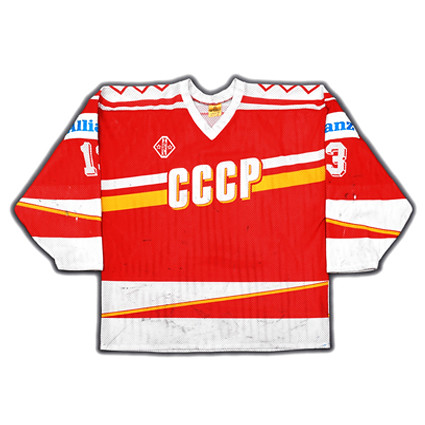
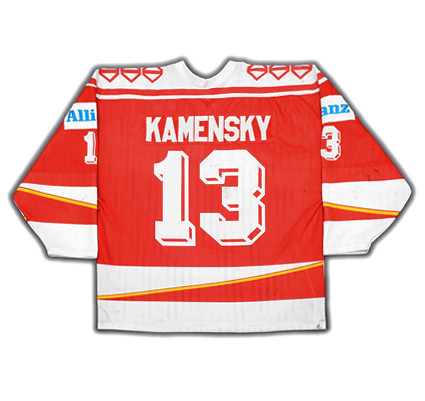
Today's first featured jersey is a 1990 Soviet Union Valeri Kamensky jersey as worn during the 1990 World Championships. Kamensky won his first World Championship gold medal in his first try in 1986 as a 20 year old, his first step on his way to becoming the first Russian to become a member of the Triple Gold Club. He would win additional gold medals with the Soviet Union in 1989 and 1990.
The Soviets wore this style from 1988 through the end of the Soviet Union in 1991 and beyond. This style was worn one last time at the 1992 Olympics when many of the former Soviet states competed as the Unified Team, only with the CCCP cresting removed from the jerseys.
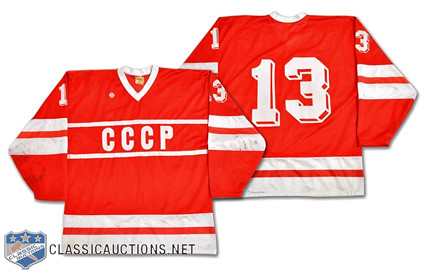
Today's second featured jersey is a 1988 Soviet Union Valeri Kamensky jersey as worn during the 1988 Olympics when Kamensky won a gold medal, his second step on the way to the Triple Gold Club. He would later win an Olympic silver medal with Russia in 1998.
This style of Tackla jersey was worn only during the 1988 Olympics, as evidenced by the tiny Tackla logo on the chest and the lack of colored shoulders. A similar style was worn during World and European Junior tournaments with contrasting colored shoulders adorned with the Tackla diamond logo from 1987 to 1989.
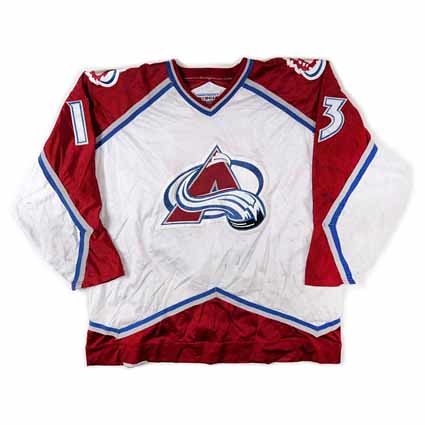
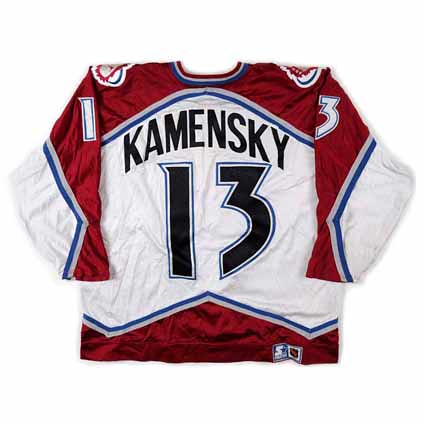
Today's third featured jersey is a 1995-96 Colorado Avalanche Valeri Kamensky jersey as worn during the club's first season in Denver when they completed their Cinderella season by winning the Stanley Cup in their first year in their new home, a championship which made Kamensky the first Russian, along with teammate Alexei Gusarov, to become a member of the Triple Gold Club, which requires a World Championship gold medal, an Olympic gold medal and a Stanley Cup.
After their amazing first season in their new jerseys, they remain unchanged until the 2007-08 season when the new Reebok Edge jerseys signal the end of the Avalanche cup winning jerseys.
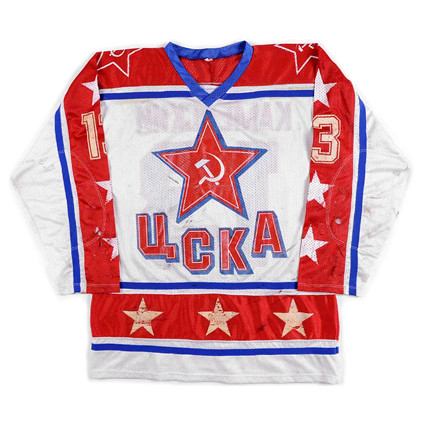
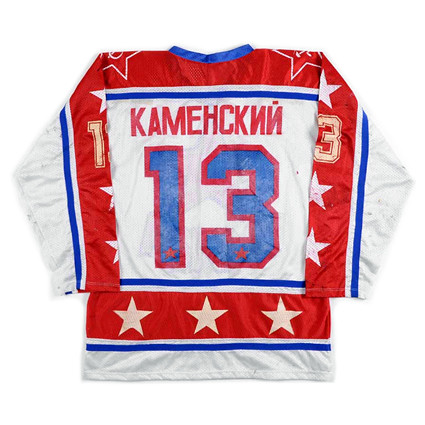
Bonus jersey: Today's bonus jersey is a 1988-89 Soviet Central Red Army Valeri Kamensky jersey as worn during the final season of CSKA's run of dominance over the Soviet Championship League when they won 13 consecutive Soviet championships from 1977 to 1989 and 13 European Champions Cups from 1978 to 1990 and the 1991 Spengler Cup.
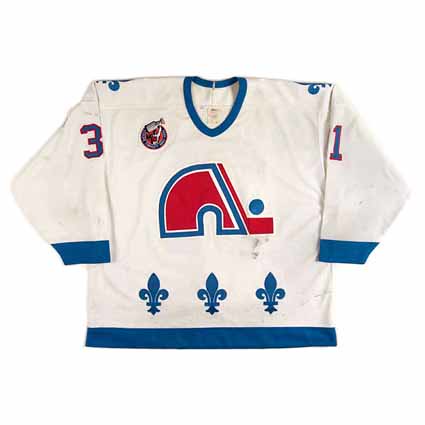
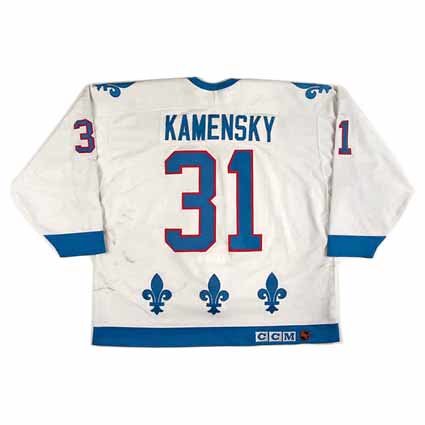
Extra bonus jersey: Today's extra bonus jersey is a 1992-93 Quebec Nordiques Valeri Kamensky jersey as worn during Kamensky's second season with the Nordiques when he wore #31.
During his first season with the club, Kamensky wore #17 as Mats Sundin was already wearing his preferred #13. In 1992-93, he changed to the reverse of #13, #31 as goaltender Stephane Fiset had changed from #31 worn the previous season to now #35. For 1994-95, Sundin had been traded to the Toronto Maple Leafs, finally freeing up #13 for Kamensky in his fourth season with the Nordiques.
Quebec wore this style dating back to 1975-76 when they were still members of the WHA. For the 1980-81 season they changed from a white version of their crest on the blue jerseys to the same red one worn on the home white jerseys. The final change came in 1991-92, Kamensky's first season in the NHL, when the one color numbers became two color, as they were now trimmed in red. They also became the last team to sew the names and numbers on their jerseys in tackle twill fabric, as up to that point they had been heat sealed numbers, which have shown to crack and peel with age, putting a premium on any game worn jersey worn before 1991-92 that has the names and numbers in good physical condition.
This jersey also features the Stanley Cup Centennial patch worn on all players jerseys for the 1992-93 season, with those worn by the Nordiques and Canadiens being a French variation, that read "Coupe Stanley" instead of the standard "Stanley Cup" worn by every other club.
Today's video section is a terrific collection of highlights of Kamensky from both the Soviet Union and the NHL.
Next, Kamensky scores the first goal in Colorado Avalanche history.
Here's a little bit of insanity for you. The Soviet Union versus the United States at the 1990 World Championships with the commentary in Japanese. We kid you not.
In this next highlight, Kamensky scores a goal which must be seen to be believed.
Here, Kamensky shows that despite being a European, you don't want to mess with him in this very brief but worthwhile highlight.
If you don't watch any of the above videos, you have to see this one. We've seen still photos of this, but we were thrilled to find video of it. Kamensky gets into a fight with New Jersey's Scott Niedermayer and manages to wrap Niedermayer's head up in the sleeve of his Rangers jersey! Niedermayer's reaction to the absurd fight is also something you've never seen before in this awesome highlight.
Born on this date in 1969, Alexander Mogliny, just 20 years old, made a choice that would affect the rest of his life. While in Stockholm, Sweden, having just completed winning a gold medal at the 1989 World Championships, Mogilny made the life changing decision to become the first Soviet player to defect, leaving behind his family but escaping the totalitarian rule of the communist system, and iron-fisted Soviet old school coach Viktor Tikhonov in particular, whom Mogilny felt would make his life not only at the rink, but outside of hockey, miserable for years to come due to his independent nature.
Mogilny while playing for the Soviet Union National Team
The story begins at the 1988 NHL Entry Draft when the Sabres, with one of their two picks in the fifth round, selected one of the most exciting young players in the world, Alexander Mogilny with the 89th overall pick. While many Soviet players had been chosen in the NHL draft before, it was generally in much later rounds when taking a flyer on a player unlikely to ever appear in an NHL game was worth the roll of the dice with an essentially meaningless pick.
Gerry Meehan, the Sabres general manager explains, "I would never have used the draft pick if I didn’t think he would be coming,” Meehan said. “The attitude then was, ‘There’s no way this guy is going to come out. He’s too big a young star.’ It was my view that it was inevitable that, sooner or later, the Russians were going to have to let their players come and play on a world stage other than the Olympics and the World Championship.”
Gerry Meehan
At the beginning of 1989, former Sabre Don Luce, the club's Director of Amateur Evaluation, traveled to Anchorage, Alaska to to 1989 World Junior Tournament. There, Pavel Bure and linemates Mogilny andSergei Fedorov, were finishing third (Bure) and tied for fourth (Mogliny and Fedorov) in tournament scoring while leading the Soviets to a 6-1 record and the gold medal. Luce met briefly with Mogilny in Anchorage and gave him a business card, cementing Mogilny's decision to defect at the first opportunity.
Alexander Mogilny and Sergei Fedorov
That opportunity arrived four months later when the Soviets were given two days in Stockholm after winning the 1989 World Championship. Luce, at home in North America, received a phone call on this date in 1989 from a man who claimed to be Mogilny's agent, Sergei Fomitchev. Unsure if he was really in contact with Mogilny, he asked Fomitchev to have Mogilny repeat what he had said to him in Anchorage. Told then that he had not played very well, Mogilny had stated "I show you next game", prior to scoring a hat trick against Canada to clinch the gold medal.
After Mogilny repeated the phrase, Luce and Meehan were on a plane to Sweden three hours later, arriving midday on May 3rd. While waiting for Fomitchev to return from shopping, the got an urgent call saying Mogilny's defection had to happen right away because it would be his best opportunity to get away.
They met at a mall and drove off. The next two days were spent moving from hotel to hotel to avoid being found while Meehan worked with the U. S. Embassy to arrange the necessary paperwork.
At one point Mogilny, from the far eastern part of Russia where few players have originated from, attempted to call home and midway through the conversation the call was disconnected, giving rise to Mogilny's fears that the call had been traced and the authorities knew where they were.
The day they left they abandoned their rental car and took a taxi to the airport, and once inside the security gates, their fears of the Soviet officials was over. With that, Mogliny had become the first Soviet athlete to defect in 45 years.
Meehan remembers, “He asked me in his broken English, ‘Am I free now?’ " And I said, ‘Yeah, you’re free.’ And he went over and had a beer. He couldn’t believe it. He said ‘free’, he didn’t say ‘safe’. He said ‘free’. I found that to be kind of poignant.”
Fedorov defected less than a year later at the 1990 Goodwill Games in Seattle and shortly afterwards, the Iron Curtain fell allowing Bure to join the NHL without having to defect.
During his rookie season in the NHL, wearing he number 89 presented to him by the Sabres owner Seymour H. Knox III in recognition of his place in the draft where Buffalo selected him and the year of his defection, Mogilny would play 65 games, scoring 15 goals and 43 points as he became acclimated to living in North America and learning a new language and culture. "It was a huge adjustment to come to the NHL. The language barrier was the toughest part. Lack of communication affected me both on and off the ice. It also took some time to get used to the airline travel. I had to deal with a fear of flying," Mogilny recalled.
Mogilny broke into the NHL with Buffalo
He would double his goal total the following season to reach 30 for the first time.
The arrival of Pat Lafontaine in Buffalo would give Mogilny a world class teammate to work with and his point totals took another jump upwards, finishing 1991-92 with 39 goals and 84 points and became the first Russian on an NHL All-Star Team. Given a year to work together and now fully integrated into life in the United States and the NHL, Mogilny had one of the greatest seasons in league history in 1992-93. He would score 127 points from 51 assists and a remarkable 76 goals in 77 games. His 76 goals remain tied for fifth all-time in a single season with Teemu Selanne and Phil Esposito.
With Lafontaine limited to just 38 games over the next two seasons, Mogilny was named team captain in his absence, the first European to ever captain an NHL club, but his production suffered as a result of the missing Lafontaine.
Mogilny as captain of the Sabres
He was then traded to the Vancouver Canucks and reunited with Bure for the 1995-96 season, in which he would score 55 goals and 107 points, the second highest of his career in both categories.
The Russian duo of Mogilny and Bure reunited in Vancouver
After five seasons of diminishing point totals in Vancouver, from 107 to 73, then 45 twice, he was dealt to the New Jersey Devils late in the 1999-00 season, having previously enjoyed the most minimal playoff success to that point in his career, having only escaped the first round once in ten seasons.
Prior to leaving the Soviet Union, Mogilny had already, just ten days after his 19th birthday, won a gold medal at the 1988 Olympics and then added he World Championship gold just days before his defection. Now with the Devils, Mogilny would see his first extended playoff run, which would eventually lead to a Stanley Cup championship. When he won the Stanley Cup with the New Jersey Devils, he became just the ninth player in history to join the Triple Gold Club.
Mogliny joined the Triple Gold Club in 2000
The move to New Jersey was a positive one for Mogilny, as he would regain his scoring touch and exceed 40 goals for only the third time in his career, with 43 goals during an 83 point season and another run to the Stanley Cup Finals in 2000-01.
He would sign with the Toronto Maple Leafs for the 2001-02 season, where he would play for three seasons, including winning the Lady Byng Trophy in 2003 and scoring his 1,000th point in 2003-04, before returning to the Devils for the final season of his career in 2005-06 before retiring with 473 goals and 1032 points in 990 games.
Mogilny had a 40 goal season while finishing his career with the Devils
Following his defection, Mogilny would never play for the Soviet Union again and he would eventually suit up for Russia just once in the 1996 World Cup of Hockey, cutting short what was destined to be a fine, if not outstanding, international career.
Mogilny's lone international appearance for Russia came during the 1996 World Cup of Hockey
When asked following his career about the reasons for his defection, Mogilny responded, “Why did I do it? I did it for freedom. If the bird can fly and the fish can swim, you have to be able to move around the world and be free and not watched constantly. If a human being doesn’t have freedom, that’s not life. It’s like living in a cage. To me, you might as well be dead.”
Today's jersey is a 1989-90 Buffalo Sabres Alexander Mogilny jersey. This jersey sports Mogilny's distinctive #89, which is based on the year of his defection from the Soviet Union and also features the Sabres 20th Anniversary patch worn in Mogilny's rookie season following his defection earlier that year.
The Sabres wore this style from their inaugural season of 1970-71 through the 1995-96 season when a complete makeover of their identity package saw them adopt new colors and a new logo for a decade until a return to their traditional blue and gold colors, which eventually included a return to a modernized version of this classic jersey in 2010-11 after having used this style as an alternate jersey in 2006-07 and again in 2008-09 to 2009-10.
Bonus jersey: Today's bonus jersey is a 1995-96 Vancouver Canucks Alexander Mogilny jersey during his first season in Vancouver when he scored 55 goals and 107 points, the second highest of his career. Vancouver introduced this white home jersey in 1989-90 after a decade of wearing gold jerseys at home. This style was worn through the 1996-97 season when the club got a complete makeover, with new colors and a new logo.
Extra bonus jersey: Today's extra bonus jersey is a 2003-04 Toronto Maple Leafs Alexander Mogilny jerseyfrom the season during which he scored his 1,000th NHL point.
The evolution of this Maple Leafs jersey began back in the 1992-93 season when Toronto adopted a brand new style jersey with a more traditional look based on a sweater first worn back in 1934-35, only now paired with their modern Maple Leafs crest. The jersey first evolved with the adoption of a modern name and number font in 1997-98. While the name remained unchanged, the curvy numbers were replaced in 2000-01 with a return to a more classic block font for the numbers, although now trimmed in blue and outlined in silver, the first time a third color had been used on a Maple Leafs jersey since World War II, when the lettering on the crest was red for a few seasons. The retro style maple leaf secondary logo was replaced by a new "TML" monogram at the same time the number font was changed in 2000-01.
Extra extra bonus jersey: Today's extra extra bonus jersey is a 1988-89 CSKA Moscow Alexander Mogilny jersey from Red Army's 13th consecutive Soviet Championship League title under Tikhonov just weeks prior to Mogilny defecting to the west.
Mogilny's departure in early May after that year's World Championships in Sweden, effectively marked the end of an era for Tikhnov and the supremacy of CSKA, as prior to the following season Slava Fetisov, Igor Larionov and Vladimir Krutov left the Soviet Union with permission of the authorities to play in the NHL, bringing to a close Red Army's unparalleled streak of championship dominance.
In today's video section, an interview with Mogliny from the 1989 World Junior Championships in January, a few months prior to his defection in April after the World Championships. He sticks to the party line quite well, giving little hint as to what was to follow, or at least that's what the interpreter tells us...
Here is a look at the some of the career highlights of Mogilny.
Here, Mogilny scores his 70th goal of the 1992-93 season, only the seventh player to reach 70 in NHL history.
Speaking of the remarkable 1992-93 season, here is a brief feature story on the partnership between Mogilny and Lafontaine.
Finally, an excellent documentary about Mogliny's defection narrated by Meehan that runs 23 minutes and is well worth your time.
Third String Goalie - The Hockey Jersey of the Day Blog
"Sweater" for all my Canadian friends!
Welcome!
Welcome to our end of the rink.
Bienvenue sur notre bout de la patinoire.
So why "Third String Goalie"?
It's defined as "A fan who sits in the stands wearing a jersey."
If that's not us, we don't know what is...
Our aim is to feature a different jersey each day from a historical perspective. Stay tuned and hopefully you'll see some jerseys of interest or perhaps some that you haven't seen before and learn a bit of hockey history along the way.
In addition to our articles, be sure to scroll down this column and explore the other fun and informative features of this blog.
If you have any suggestions or comments, feel free to contact us at:
Looking to reach our loyal readers with your hockey related product or service? Of our hundreds of readers each day, 60% are located in the United States and 30% come from Canada. Our audience is your audience and you can target them now with our reasonable ad rates.
We've been linked to by SI.com, ESPN.com, Uni-Watch.com, NBCSports.com and the Yahoo! Sports Puck Daddy blog among others.
There is no limitation to what kind of hockey jersey it can be - replica, authentic or game worn jersey from the NHL, a national team, the minors, juniors, college, high school or even your pond hockey jersey.
Feel free to write a paragraph or two about the jersey telling us why you like the jersey, how you got it, what makes it special to you or even a full-blownThird String Goalie-style history lesson - whatever you feel like sharing.
Visting from outside North America? Just select your preferred language and Third String Goalie will be instantly converted to your language of choice!