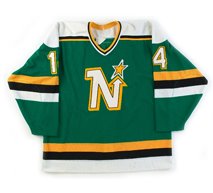
Born on this date in 1971, Dave "Moose" Morissette was a bruising left winger who amassed penalty minutes by the hundreds.
He played his junior hockey with the Shawnigan Cataractes and his toughness instantly earned earned him the role as one of the team's enforcers, as Morisette finished second on the team in penalty minutes as a rookie with 298, which was good for fifth in the QMJHL in 1989.
The following season he led the team in penalty minutes as he slugged his way to 269 PIMs, placing sixth overall. After seasons of 15 and 11 points, Morissette found his offensive game for the only time of his career when he netted 20 goals and 26 assists in addition to the expected 224 penalty minutes to again lead the team.
Following his final season of junior hockey, Morissette was drafted by the Washington Capitals in the 1991 NHL Entry Draft. He played the 1991-92 season with the Hampton Roads Admirals of the East Coast Hockey League, who went 42-20-0-2 and went on to win the Riley Cup as champions of the ECHL. Morissette of course led the Admirals with 293 penalty minutes, eighth in the league.
He returned to Hampton Roads the following season as the Admirals defended their title to capture their second consecutive ECHL championship. He improved upon is 16 points the previous season with 9 goals and 22 points, which would prove to be career highs as a professional. He would also surpass the 200 penalty minute mark once again with 226.
Morissette played for the ECHL's Roanoke Express in 1993-94, with his team leading 278 PIM's placing him in the top ten in the notoriously rugged ECHL.
For the 1994-95 season, "Moose" moved up to the International Hockey League, appropriately enough with the expansion Minnesota Moose and became an instant fan favorite thanks to his outgoing personality and rough and tumble style. After two seasons and 83 games with the Moose, he moved down south to join the Houston Aeros for two seasons, the second of which, 1997-98, had Morissette once again leading his team in penalty minutes with 254, the third highest of his professional career.
After seven minor league seasons, Morissette was rewarded with his first NHL action after signing as a free agent with the Montreal Canadiens for the 1998-99 season. He would play ten games for Montreal that season and manage to participate in six fights. While in the AHL that season, he saw action in 39 games with the Fredericton Canadiens as well as 12 playoff games.
While in the NHL, Morisette fought several renowned heavyweights, including the likes of Bob Probert
The Fredericton franchise was relocated and renamed for 1999-00, becoming the Quebec Citadelles, with whom Morissette played 47 games, amassing 231 penalty minutes to lead the Citadelles. He played in a single game for Montreal in the NHL, earning a major penalty for a fight.
His career wound down in 2000-01 with five games with the Lake Charles Ice Pirates of the Western Professional Hockey League and 13 games in England with the London Knights of the British Ice Hockey Super League. In just 13 games with the Knights, Morissette made his presence known with 117 penalty minutes but had his season cut short and his career ended by a concussion which knocked him out for 30 minutes.
Morissette while with the London Knights
His final combined totals were 673 games played, 69 goals and 104 assists for 173 points and 2,943 minutes in penalties, the equivalent of 49 complete games in the box!
Following his career, Morissette wrote a book in 2005 before the NHL even had a drug testing policy, Mémoires d'Un Dur à Cuire (Memories of an Enforcer). The book, written in French, detailed his steroid use throughout his career as a warning to others about the dangers of steroids and how he feels they shortened his career.
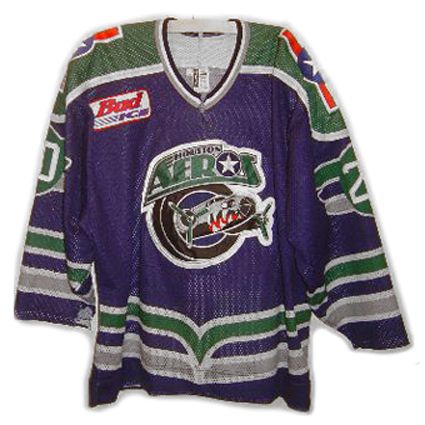
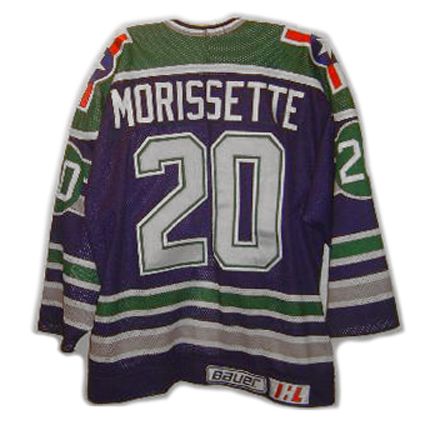
Today's featured jersey is a 1997-98 Houston Aeros Dave Morissette jersey.
This jersey is one of the most popular minor league jerseys of all
time, and when the club changed to a new modern fighter jet logo, the
outcry was so great that that the team restored the classic bomber logo
to their jerseys the following season.
Bonus jersey: Today's bonus jersey is a 1999-00 Quebec Citadelles Dave Morissette jersey as worn during his only season with the Citadelles with the typical North American sponsorship logo on the upper right chest.
This attractive jersey features the unusual choice of a goat head for the team's logo, which was the mascot of the Royal 22nd Regiment, which was stationed in the Citadel of Quebec. The team played in Quebec for just three seasons before relocating to Hamilton where they were renamed the Bulldogs.
A well traveled franchise, it began in 1969 in Montreal as the Voyageurs before moving to Nova Scotia, then Sherbrooke, Quebec and then Frederiction before relocating for the fourth time to Quebec.
Extra bonus jersey: Today's extra bonus jersey is a 1998-99 Montreal Canadiens Dave Morissette jersey as worn during the season Morissette got is first taste of NHL action.
The Moose is loose! Morissette takes on NHL veteran Al Secord, then with the Chicago Wolves and beats him into the ice in 1994-95. Then, Jason Simon of the Denver Grizzlies gets pounded by Morissette to give you a perfect example of his straight ahead style of taking a punch to give a punch which made him a fan favorite at each stop in his career.
Here, Morissette holds his own with Probert in his third NHL fight in October of 1998 as he tries to establish himself in the NHL.
In this slugfest, Ken Baugartner of the Bruins and Morissette really go at it for quite some time in Morissette's next fight nine days later.
In some AHL action, Morissette of the Fredericton Canadiens trades blows with Rocky Thompson of the Saint John Flames in the 1998-99 season. Note the theme from "Rocky" playing in the background, a nice touch by the in arena crew in Saint John.
In our final video today, while this interview mainly focuses on guest Scott Gomez, it's conducted by the bi-lingual Morissette and gives you some insight into his infectious personality which made him so popular.
Born on this date in 1975, EricFichaud played his junior hockey with the Chicoutimi Sagueneens of the Quebec Major Junior Hockey League beginning in the 1992-93 season. After posting a record of 18-15-1, he took the undisputed number one role in 1993-94, and in 63 starts, went 37-21-3. He backstopped the Sags to the QMJHL championship after winning 16 of 26 playoff games to earn the club a spot in the Memorial Cup.
Fichaud during his junior days with the Chicoutimi Sagueneens
Following the season Fichaud was drafted 16th overall by the Toronto Maple Leafs before returning to Chicoutimi for one final season during which he recorded his third consecutive winning season with a 21-19-4 mark.
The Maple Leafs traded Fichaud to the New York Islanders at the 1995 draft and he spilt the 1995-96 season between the Worcester Ice Cats of the AHL and the Islanders, who were in a decidedly down period at the time. Fichaud's rookie season ended with a 7-12-2 record, but a respectable 3.31 goals against average.
Fichaud in the Islanders controversial Fishsticks jersey
His second season on Long Island saw his games played increase from 24 to 34 as he complied a 9-14-4 record while lowering his goals against average to 3.10. Following the season he was selected to join Team Canada for the 1997 World Championships, but did not see any action.
Fichaud in the Islanders hybrid jersey, as the classic logo replaced the Fisherman cresting on the new jersey style
Fichaud saw limited playing time in 1997-98 thanks to a shoulder injury, playing 17 games with the Islanders, finishing with a 3-8-3 mark but lowering his GAA once more, down to 2.97, and a single game with the Utah Grizzlies of the IHL.
During the off season, he was dealt to the Edmonton Oilers in June, only to have the Oilers deal him to the Nashville Predators in early October. He once again saw little ice time, playing 8 games with Milwaukee (5-2-1) and a forgettable 9 games with the Predators, going 0-6-0 while competing for playing time with MikeDunham and TomasVokoun.
His next stop was with the Carolina Hurricanes, where once more ice time was at a premium. 9 games with Carolina ended with his release and he was claimed by the Montreal Canadiens who assigned him to the Quebec Citadelles of the AHL, where he performed well with a 4-1-1 mark.
Fichaud during his brief time with the Hurricanes,
which lasted less than 10 games
He finally got his first regular ice time in four seasons in 2000-01 with the Citadelles, seeing action in 42 games and finishing with a 19-19-2 record.
Fichaud while with the Quebec Citadelles of the AHL
For the 2001-02 season, Fichaud started the year with the Manitoba Moose, but was granted his release by the Moose after just 5 games in three months. He signed with the Krefeld Penguins of the German DEL and played in 9 regular season games as well as 3 playoff contests.
Back in North America for the 2002-03 season, Fichaud played with the Hamilton Bulldogs, the top affiliate of the Oilers. He had a good season with a strong Bulldogs club, splitting time with MathieuGaron and TyConklin on his way to 27 appearances and a 14-7-3 mark with 4 shutouts, his highest total since juniors. He also played in 8 playoff games with a 5-3 record as Hamilton made it to the Calder Cup Finals.
Back in North America, Fichaud had a solid season with Hamilton
He was back for a second season with the Bulldogs, only now part of the Canadiens organization, and in 31 games went 16-11-3.
Beginning with the 2004-05 season, Fichaud started a three year run with Quebec RadioX (named after a radio station owned by the team's owners) of he lower level Ligue Nord-Americaine de Hockey after it elevated itself from being an amateur league. The 2004-05 season was the missed NHL season due to the lockout, and with hundreds of pros looking for work in Europe and many younger NHLers keeping busy in the AHL, work was hard to come by for many, who saw the LNAH as an alternative. It paid off, as RadioX won the league championship in 2005 thanks in part to Fichaud's 8-0 record during the playoffs.
After two more seasons with Quebec, Fichaud played one final season in 2007-08 with the St. Georges CRS Express.
Today's featured jersey is a 1997-98 New York Islanders Eric Fichaud jersey.
The Islanders new ownership, in an effort to attract new, younger fans
to the downtrodden Islanders scrapped their traditional sweaters, which
only happened to have been worn not only since the club's inception in
1972, but also for the length of their Stanley Cup dynasty, and
introduced their new jerseys for the 1995-96 season.
As the team wallowed in the depths of the NHL standings and traded away fan favorite Pierre Turgeon for the disgruntled Kirk Muller,
the fan base immediately made the new jerseys, and specifically their
new fisherman logo, the focus of their growing unhappiness. The fate of
the jersey was not made any better when the rival New York Rangers fans
began to mock the new jerseys with chants of "We want fishsticks! We want fish sticks!" in reference to the new logo's resemblance to the Gorton's Fisherman logo.
The
Islanders adopted a hybrid jersey for 1996-97 with the original
Islanders logo placed on the "wave" style jersey as an alternate style.
For 1997-98, the fisherman was gone and the hybrid jersey was used full
time. In 1998-99, a modern version of the Islanders jersey debuted as
the wave style was scrapped permanently.
Bonus Jersey: Today's bonus jersey is a 1999-00 Quebec Citadelles Eric Fichaud jersey as worn during his first season with the Canadiens AHL affiliate.
This attractive jersey features the unusual choice of a goat head for the team's logo, which was the mascot of the Royal 22nd Regiment, which was stationed in the Citadel of Quebec. The team played in Quebec for just three seasons before relocating to Hamilton where they were renamed the Bulldogs.
A well travelled franchise, it began in 1969 in Montreal as the Voyageurs before moving to Nova Scotia, then Sherbrooke, Quebec and then Frederiction before relocating for the fourth time to Quebec.
Today's video selection is a slideshow of images from Fichaud's career, which documents many of the jerseys he wore during his career.
Next, Fichaud makes a stellar save for the Islanders against none other than Mario Lemieux.
Born on this date in 1975, EricFichaud played his junior hockey with the Chicoutimi Sagueneens of the Quebec Major Junior Hockey League beginning in the 1992-93 season. After posting a record of 18-15-1, he took the undisputed number one role in 1993-94, and in 63 starts, went 37-21-3. He backstopped the Sags to the QMJHL championship after winning 16 of 26 playoff games to earn the club a spot in the Memorial Cup.
Following the season Fichaud was drafted 16th overall by the Toronto Maple Leafs before returning to Chicoutimi for one final season during which he recorded his third consecutive winning season with a 21-19-4 mark.
The Maple Leafs traded Fichaud to the New York Islanders at the 1995 draft and he spilt the 1995-96 season between the Worcester Ice Cats of the AHL and the Islanders, who were in a decidedly down period at the time. Fichaud's rookie season ended with a 7-12-2 record, but a respectable 3.31 goals against average.
His second season on Long Island saw his games played increase from 24 to 34 as he complied a 9-14-4 record while lowering his goals against average to 3.10. Following the season he was selected to join Team Canada for the 1997 World Championships, but did not see any action.
Fichaud saw limited playing time in 1997-98 thanks to a shoulder injury, playing 17 games with the Islanders, finishing with a 3-8-3 mark but lowering his GAA once more, down to 2.97, and a single game with the Utah Grizzlies of the IHL.
During the off season, he was dealt to the Edmonton Oilers in June, only to have the Oilers deal him to the Nashville Predators in early October. He once again saw little ice time, playing 8 games with Milwaukee (5-2-1) and a forgettable 9 games with the Predators, going 0-6-0 while competing for playing time with MikeDunham and TomasVokoun.
His next stop was with the Carolina Hurricanes, where once more ice time was at a premium. 9 games with Carolina ended with his release and he was claimed by the Montreal Canadiens who assigned him to the Quebec Citadelles of the AHL, where he performed well with a 4-1-1 mark.
He finally got his first regular ice time in four seasons in 2000-01 with the Citadelles, seeing action in 42 games and finishing with a 19-19-2 record.
For the 2001-02 season, Fichaud started the year with the Manitoba Moose, but was granted his release by the Moose after just 5 games in three months. He signed with the Krefeld Penguins of the German DEL and played in 9 regular season games as well as 3 playoff contests.
Back in North America for the 2002-03 season, Fichaud played with the Hamilton Bulldogs, the top affiliate of the Oilers. He had a good season with a strong Bulldogs club, splitting time with MathieuGaron and TyConklin on his way to 27 appearances and a 14-7-3 mark with 4 shutouts, his highest total since juniors. He also played in 8 playoff games with a 5-3 record as Hamilton made it to the Calder Cup Finals.
He was back for a second season with the Bulldogs, only now part of the Canadiens organization, and in 31 games went 16-11-3.
Beginning with the 2004-05 season, Fichaud started a three year run with Quebec RadioX (named after a radio station owned by the team's owners) of he lower level Ligue Nord-Americaine de Hockey after it elevated itself from being an amateur league. The 2004-05 season was the missed NHL season due to the lockout, and with hundreds of pros looking for work in Europe and many younger NHLers keeping busy in the AHL, work was hard to come by for many, who saw the LNAH as an alternative. It paid off, as RadioX won the league championship in 2005 thanks in part to Fichaud's 8-0 record during the playoffs.
After two more seasons with Quebec, Fichaud played one final season in 2007-08 with the St. Georges CRS Express.
Today's featured jersey is a 1999-00 Quebec Citadelles Eric Fichaud jersey as worn during his first season with the Canadiens AHL affiliate.
This attractive jersey features the unusual choice of a goat head for the team's logo, which was the mascot of the Royal 22nd Regiment, which was stationed in the Citadel of Quebec. The team played in Quebec for just three seasons before relocating to Hamilton where they were renamed the Bulldogs.
A well travelled franchise, it began in 1969 in Montreal as the Voyageurs before moving to Nova Scotia, then Sherbrooke, Quebec and then Frederiction before relocating for the fourth time to Quebec.
Bonus Jersey: Today's bonus jersey is a 1997-98 New York Islanders Eric Fichaud jersey. The Islanders new ownership, in an effort to attract new, younger fans to the downtrodden Islanders scrapped their traditional sweaters, which only happened to have been worn not only since the club's inception in 1972, but also for the length of their Stanley Cup dynasty, and introduced their new jerseys for the 1995-96 season.
As the team wallowed in the depths of the NHL standings and traded away fan favorite Pierre Turgeon for the disgruntled Kirk Muller, the fan base immediately made the new jerseys, and specifically their new fisherman logo, the focus of their growing unhappiness. The fate of the jersey was not made any better when the rival New York Rangers fans began to mock the new jerseys with chants of "We want fishsticks! We want fish sticks!" in reference to the new logo's resemblance to the Gorton's Fisherman logo.
The Islanders adopted a hybrid jersey for 1996-97 with the original Islanders logo placed on the "wave" style jersey as an alternate style. For 1997-98, the fisherman was gone and the hybrid jersey was used full time. In 1998-99, a modern version of the Islanders jersey debuted as the wave style was scrapped permanently.
Today's video selection is a slideshow of images from Fichaud's career, which documents many of the jerseys he wore during his career.
Born on this date in 1971, Dave "Moose" Morissette was a bruising left winger who amassed penalty minutes by the hundreds.
He played his junior hockey with the Shawnigan Cataractes and his toughness instantly earned earned him the role as one of the team's enforcers, as Morisette finished second on the team in penalty minutes as a rookie with 298, which was good for fifth in the QMJHL in 1989.
The following season he led the team in penalty minutes as he slugged his way to 269 PIMs, placing sixth overall. After seasons of 15 and 11 points, Morissette found his offensive game for the only time of his career when he netted 20 goals and 26 assists in addition to the expected 224 penalty minutes to again lead the team.
Following his final season of junior hockey, Morissette was drafted by the Washington Capitals in the 1991 NHL Entry Draft. He played the 1991-92 season with the Hampton Roads Admirals of the East Coast Hockey League, who went 42-20-0-2 and went on to win the Riley Cup as champions of the ECHL. Morissette of course led the Admirals with 293 penalty minutes, eighth in the league.
He returned to Hampton Roads the following season as the Admirals defended their title to capture their second consecutive ECHL championship. He improved upon is 16 points the previous season with 9 goals and 22 points, which would prove to be career highs as a professional. He would also surpass the 200 penalty minute mark once again with 226.
Morissette played for the ECHL's Roanoke Express in 1993-94, with his team leading 278 PIM's placing him in the top ten in the notoriously rugged ECHL.
For the 1994-95 season, "Moose" moved up to the International Hockey League, appropriately enough with the expansion Minnesota Moose and became an instant fan favorite thanks to his outgoing personality and rough and tumble style. After two seasons and 83 games with the Moose, he moved down south to join the Houston Aeros for two seasons, the second of which, 1997-98, had Morissette once again leading his team in penalty minutes with 254, the third highest of his professional career.
After seven minor league seasons, Morissette was rewarded with his first NHL action after signing as a free agent with the Montreal Canadiens for the 1998-99 season. He would play ten games for Montreal that season and manage to participate in six fights. While in the AHL that season, he saw action in 39 games with the Fredericton Canadiens as well as 12 playoff games.
While in the NHL, Morisette fought several renowned heavyweights, including the likes of Bob Probert
The Fredericton franchise was relocated and renamed for 1999-00, becoming the Quebec Citadelles, with whom Morissette played 47 games, amassing 231 penalty minutes to lead the Citadelles. He played in a single game for Montreal in the NHL, earning a major penalty for a fight.
His career wound down in 2000-01 with five games with the Lake Charles Ice Pirates of the Western Professional Hockey League and 13 games in England with the London Knights of the British Ice Hockey Super League. In just 13 games with the Knights, Morissette made his presence known with 117 penalty minutes but had his season cut short and his career ended by a concussion which knocked him out for 30 minutes.
Morissette while with the London Knights
His final combined totals were 673 games played, 69 goals and 104 assists for 173 points and 2,943 minutes in penalties, the equivalent of 49 complete games in the box!
Following his career, Morissette wrote a book in 2005 before the NHL even had a drug testing policy, Mémoires d'Un Dur à Cuire (Memories of an Enforcer). The book, written in French, detailed his steroid use throughout his career as a warning to others about the dangers of steroids and how he feels they shortened his career.
Today's featured jersey is a 1999-00 Quebec Citadelles Dave Morissette jersey as worn during his only season with the Citadelles with the typical North American sponsorship logo on the upper right chest.
This attractive jersey features the unusual choice of a goat head for the team's logo, which was the mascot of the Royal 22nd Regiment, which was stationed in the Citadel of Quebec. The team played in Quebec for just three seasons before relocating to Hamilton where they were renamed the Bulldogs.
A well traveled franchise, it began in 1969 in Montreal as the Voyageurs before moving to Nova Scotia, then Sherbrooke, Quebec and then Frederiction before relocating for the fourth time to Quebec.
Bonus jersey: Today's bonus jersey is a 1998-99 Montreal Canadiens Dave Morissette jersey as worn during the season Morissette got is first taste of NHL action.
Extra bonus jersey: Today's extra bonus jersey is a 1997-98 Houston Aeros Dave Morissette jersey. This jersey is one of the most popular minor league jerseys of all time, and when the club changed to a new modern fighter jet logo, the outcry was so great that that the team restored the classic bomber logo to their jerseys the following season. Like the Citadelles jersey, it also has a sponsorship patch on the right chest.
The Moose is loose! Morissette takes on NHL veteran Al Secord, then with the Chicago Wolves and beats him into the ice in 1994-95. Then, Jason Simon of the Denver Grizzlies gets pounded by Morissette to give you a perfect example of his straight ahead style of taking a punch to give a punch which made him a fan favorite at each stop in his career.
Here, Morissette holds his own with Probert in his third NHL fight in October of 1998 as he tries to establish himself in the NHL.
In this slugfest, Ken Baugartner of the Bruins and Morissette really go at it for quite some time in Morissette's next fight nine days later.
In some AHL action, Morissette of the Fredericton Canadiens trades blows with Rocky Thompson of the Saint John Flames in the 1998-99 season. Note the theme from "Rocky" playing in the background, a nice touch by the in arena crew in Saint John.
In our final video today, while this interview mainly focuses on guest Scott Gomez, it's conducted by the bi-lingual Morissette and gives you some insight into his infectious personality which made him so popular.
Third String Goalie - The Hockey Jersey of the Day Blog
"Sweater" for all my Canadian friends!
Welcome!
Welcome to our end of the rink.
Bienvenue sur notre bout de la patinoire.
So why "Third String Goalie"?
It's defined as "A fan who sits in the stands wearing a jersey."
If that's not us, we don't know what is...
Our aim is to feature a different jersey each day from a historical perspective. Stay tuned and hopefully you'll see some jerseys of interest or perhaps some that you haven't seen before and learn a bit of hockey history along the way.
In addition to our articles, be sure to scroll down this column and explore the other fun and informative features of this blog.
If you have any suggestions or comments, feel free to contact us at:
Looking to reach our loyal readers with your hockey related product or service? Of our hundreds of readers each day, 60% are located in the United States and 30% come from Canada. Our audience is your audience and you can target them now with our reasonable ad rates.
We've been linked to by SI.com, ESPN.com, Uni-Watch.com, NBCSports.com and the Yahoo! Sports Puck Daddy blog among others.
There is no limitation to what kind of hockey jersey it can be - replica, authentic or game worn jersey from the NHL, a national team, the minors, juniors, college, high school or even your pond hockey jersey.
Feel free to write a paragraph or two about the jersey telling us why you like the jersey, how you got it, what makes it special to you or even a full-blownThird String Goalie-style history lesson - whatever you feel like sharing.
Visting from outside North America? Just select your preferred language and Third String Goalie will be instantly converted to your language of choice!