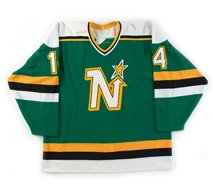
Drafted by the Los Angeles Kings in the 1969 NHL Amateur Draft, Butch Goring split his first two seasons between the Kings and their minor league affiliate, the Springfield Kings of the AHL. During his first season with Los Angeles Goring scored 13 goals and 36 points in 59 games and a whopping 8 penalty minutes, setting the tone for the remainder of his career.
In 1971-72, Goring became a full-time NHLer, playing 74 games exclusively with Los Angeles. He registered exactly 50 points that season and a mere 2 penalty minutes.
He bettered his point totals in 1972-73 when he set new personal bests with 28 goals and 31 assists for 59 points and, on this date in 1973 in the Kings final game of the season, Goring scored a goal and an assist, but more notably, he was whistled for his only penalty of the entire season midway through the game!
1973-74 saw Goring better his point total by 2 with 61 and again received but one penalty the whole season, his third consecutive season with but a single penalty.
Over the course of the next five seasons Goring would remain a model of consistency, playing in 398 out of a possible 400 games while setting new personal highs in points three times, finally topping out at 87 in 1978-79, a season in which Goring would "goon it up" with a career high 16 penalty minutes, one of only three times in 17 seasons he would reach double digits in minutes served in the penalty box.
Prior to setting his career point and penalty minute highs in 1979, Goring established a career best mark with 37 goals scored in 1977-78, a season in which he would also win the Masterton Trophy as well as a long overdue Lady Byng Trophy for gentlemanly play after being bypassed his previous six full seasons by players who had as many as 18 minutes in a season. Goring equalled a then career low with just 2 penalty minutes, the fourth time to date he would be whistled for just a single penalty during a season in which he played a minimum of 67 games.
Goring would play 69 games of the 1979-80 season with the Kings before being traded to the New York Islanders in March. He competed in the final 12 regular season games for New York and was regarded as a key element which put the Islanders over the top, as the club had made it as far as the playoff semifinals four times in the previous five seasons without having ever made it to the Stanley Cup Finals.
With Goring on board, the Islanders not only qualified for the finals for the first time ever, they successfully defeated the Philadelphia Flyers 4 games to 2 to capture the first of four consecutive Stanley Cups of the Islanders dynasty. The 21 playoff games Goring played during the 1980 playoffs compared to the 30 Goring had appeared in during his previous 10 seasons in Los Angeles and his 19 points during that playoff season eclipsed the 18 he had in all his years in Los Angeles combined.
Goring celebrating with the Stanley Cup
The Islanders success following the acquisition of Goring is perhaps the one trade which began the current tradition of contending clubs looking to add key pieces to their roster in preparation for the playoffs that created the frenzy which the NHL trade deadline has now become.
During the final 12 regular season contests for New York, Goring received one penalty, which brought his career total in xx seasons up to 68, one more than the NHL single game record of 67 set by former Kings' teammate Randy Holt one year earlier.
In 1980-81, Goring played 78 games for the Islanders, scoring 60 points and competing the season without a single penalty for the only time in his career. Shockingly, Goring was passed over for the Lady Byng Trophy once more.
During the postseason, Goring scored 10 goals and 10 assists for 20 points in 18 games. While he came in fourth in playoff scoring for the Islanders, 15 points behind team leader Mike Bossy, Goring's tireless efforts and stellar two-way play were recognized with the Conn Smythe Trophy as the Islanders repeated as Stanley Cup champions, perhaps making up for the injustice of not receiving his much deserved Lady Byng Trophy.
Goring's role would switch more towards the defensive side over the remainder of his time in the NHL, as his point totals would drop from the 60-80 point range to the 30-45 range, but he remained an integral part of the Islanders, as they still had two more Stanley Cups to capture in 1982 and 1983.
He would play one more full season with the Islanders in 1983-84, which included a fifth consecutive trip to the Stanley Cup Finals, only to see their dynasty come to and end with the rise of Wayne Gretzky and the Edmonton Oilers dynasty of their own.
Goring's final NHL season began with 29 games with New York before he was released by the Islanders and picked up by the Boston Bruins, with whom he was a very effective player, scoring 34 points in 39 games, an average he had not achieved since his first season on Long Island.
The following season Goring was named the Bruins head coach, a position he held for all of the 1985-86 season and 13 games of 1986-87 before being relieved of his duties. Unusually, after losing his position as the Bruins coach, Goring returned to the ice as a player with the Nova Scotia Oilers of the AHL!
His stint with the Oilers lasted ten games and brought an end to his playing days. His final NHL totals were 1,107 games played, 375 goals and 513 assists for 888 points and 102 total penalty minutes over 16 seasons, a number which compares to the single season record of 472 by Dave Schultz and Tiger Williams career record of 3,996.
Despite his notable lack of penalty minutes, Goring is best remembered for wearing the same Spaps brand helmet since he was 12 years old, famous for it's small size and lack of gloss while with the New York Islanders.
Goring and his distinctive small helmet with the dull finish
Goring actually had a pair of the helmets, one for at home and one for the road. They went through several color alterations as Goring moved from the Kings to the Islanders and later the Bruins and eventually the Nova Scotia to close out his career.
When Goring was traded from the Kings to New York, the Islanders equipment man didn't have the right color blue paint available and had to improvise while on the road to get Goring in line with the rest of the team, as his road helmet was currently painted Kings' purple while the other was painted gold. The solution was to cover one of the helmets with blue tape, giving the headgear it's distinctive flat appearance, as if it had been flocked.
"It looked pretty good, you couldn't tell the difference." Goring said. "The tape was light enough so it was no big deal, it did the job." "I didn't wear it for the protection. It was almost why do you wear gloves, why do you wear pads? For me, it was like I didn't know any other way to play hockey other than with my helmet. I grew up in an era where helmets were mandatory as a kid and it just didn't make any sense to take it off because it wasn't anything cumbersome that I needed to get rid of." "Hockey players are like any other athletes, they get attached to certain things and they had good success and the helmet for me and I actually had a couple of items I kept for a long period of time but I think it is just a comfort zone more than anything else," Goring recalled. Today's featured jersey is a 1972-73 Los Angeles Kings Butch Goring jersey as worn the season Goring received his only penalty of the year halfway through the final game of the season. The Kings began play in 1967 with gold jerseys with single color purple numbers, which became two color numbers in 1969-70 with the addition of white outlines, which was also added to the front crest at the same time. Names on the back of the gold jerseys would arrive in 1970-71. The following season the purple stripe on the gold jerseys would move down to the very bottom of the jersey, which would eliminate the gold stripe which previously existed beneath it. The Kings jerseys would exist in this configuration until being replaced after the 1979-80 season.
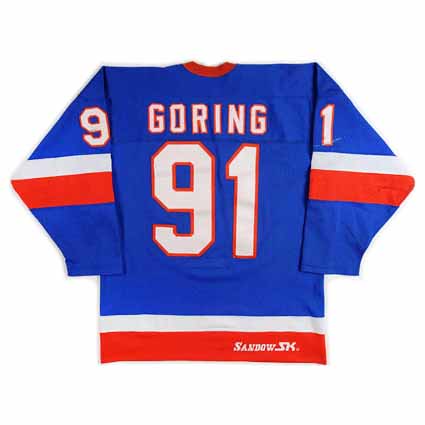
Bonus jersey: Today's bonus jersey is a 1981-82 New York Islanders Butch Goring jersey as worn the season Goring won his second of four Stanley Cups. After starting life in the NHL in 1972-73 with very similar blue jerseys only with orange numbers and a lace-up collar, the Islanders reversed the colors of their numbers for the 1973-74 season, now white with a blue outline. For the 1977-78 season, the ends of the sleeves were no longer white and the collar style now became a v-neck. Finally, in 1978-79, the single orange arm stripe now had a narrower white one added directly above it and the waist stripes were finally changed to match the arms. This style jersey would be the one worn for all of the Stanley Cup championships of their dynasty of the early 1980s and would remain in use through the 1994-95 season until it gave way to the ill-fated Fisherman jersey. In 1998-99 the Islander brought their classic jerseys back, now modernized with a darker shade of blue and three color numbers, but still very much in the look of their beloved cup winning jerseys. These lasted through the 2006-07 season until their look was redone for the introduction of the Reebok Edge jerseys for 2007-08. For the 2008-09 season, their 1973-74 jerseys were the inspiration for their new throwback alternate jersey, which then became the team's primary home jersey for the 2010-11 season, now paired with a white road version, and remain in use through today.
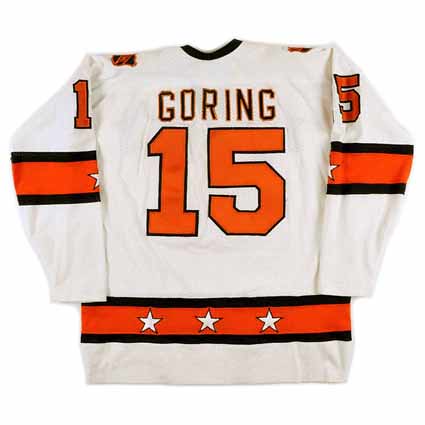
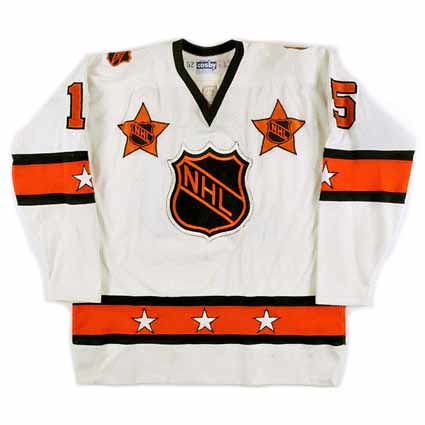
Extra bonus jersey: Today's extra bonus jersey is a 1980 NHL All-Star Butch Goring jersey as worn the season Goring won his first of four Stanley Cups. The NHL first used this style of All-Star jersey back in 1973. It was used through the 1981 season with the exception of 1979 when a different style was worn for a two game series when the NHL All-Stars took on the Soviet Union National Team. The eight years of use for this style of jersey for the All-Star Game is a thing of the past, as no style since then has been used for more than four years and no style has been worn more than twice since 1998.
Today's video selection is the Islander celebrating their 1981 championship, which includes the presentation of the Conn Smythe Trophy to Butch Goring.
Left winger Kevin Stevens began his road to the NHL when he was drafted out of high school during the 1983 NHL Entry Draft by the Los Angeles Kings. After being drafted, Stevens would hone his skills with the Boston College Eagles beginning with the 1983-84 season. He would play four seasons for the Eagles, highlighted by a 35 goal, 70 point season in 39 games during his senior season of 1986-87 while serving as team captain.
Following his graduation from BC, Stevens would suit up for the United States at the 1987 World Championships, scoring a goal and an assist in 8 games.
He then played a full schedule of games for the United States National Team in preparation for the 1988 Olympics in Calgary, Alberta. In the 44 games he played prior to the Olympics, Stevens scored at a point per game clip, scoring 22 goals and 45 points. During the six games of the Olympics, Stevens scored once and had four assists.
The 1988 United States Olympic hockey team
Once the Olympics concluded, Stevens made his NHL debut with the Pittsburgh Penguins, who had acquired his rights from the Kings a mere three months after they had drafted him back in 1983. He would play in 16 games that season, scoring 5 times.
Kevin Stevens made his NHL debut following the 1988 Olympics
He would begin the 1988-89 season developing his game with the Muskegon Lumberjacks of the International Hockey League, scoring 24 goals and 65 points with 113 penalty minutes in 45 games in the minors. Stevens was called up by Pittsburgh and saw action in 24 games with the parent club that season, scoring a dozen goals. He also got his first playoff experience that year, scoring 3 goals and 10 points in 11 games.
Now a full-time NHLer, he would play in 76 games in 1989-90, just missing out on the 30 goal plateau with 29. His 41 assists gave him 70 total points and was a physical presence on the ice, amassing 171 penalty minutes as well. With the Penguins missing out on the playoffs in 1990, Stevens played in his second World Championships for the United States, scoring 5 goals and 7 points in 10 games to lead the Americans in scoring.
His offensive numbers continued to rise, as he scored an even 40 goals in 1990-91 while adding 46 assists for 86 points while benefitting from playing with superstar center Mario Lemieux. The Penguins went on a long playoff run, defeating the New Jersey Devils in 7, the Washington Capitals in 5, the Boston Bruins in 6 and then finally capturing the franchise's first Stanley Cup in a six game series with the Minnesota North Stars. Stevens played in all 24 playoff games, scoring 17 goals and 33 points, which was third on the team behind Lemieux and Mark Recchi.
Stevens and the Penguins won the Stanley Cup in 1990-91
Full of confidence after his 40 goal season and Stanley Cup championship the previous season while playing with arguably the best player in the game during the 1991-92 season, as Lemieux would lead the NHL in scoring, Stevens raised his game to another level. He was named as an assistant captain for the Penguins and proceeded to score 54 goals and 69 assists for 123 points, which included becoming the first player in NHL history to score 50 goals and 200 penalty minutes in a single season on this date in 1992 when he scored his 50th goal of the season on the road against the Detroit Red Wings. He would finish with 254 penalty minutes and second in goals in the league and second overall in points to Lemieux - and notably ahead of Wayne Gretzky, something only two others had accomplished to that point.
His 123 points also set the record for the most points in a single season by an American-born player as well as the single season record for a left wing.
The Penguins would defend their Stanley Cup championship by outlasting the Washington Capitals in 7 games, defeating the New York Rangers in 6 and then marching through the Boston Bruins and Chicago Blackhawks with a pair of four game sweeps. In 21 games that postseason, Stevens scored 13 goals and 28 points.
Stevens won his second Stanley Cup in 1992
Stevens offensive output continued in 1992-93 as he set a career high with 55 goals, matching that with 56 assists for 111 points.
Stevens set a career high with 55 goals in 1992-93
In 1993-94, Stevens was hurt by the limited play of Lemieux, who only saw action in 22 games. Stevens still scored 41 goals, his fourth straight season of 40 or more, but his 88 points in 83 games were a decline from the lofty heights of the previous two seasons. Lemieux sat out the entire 1994-95 season while Stevens only played in 27 in a lockout shortened 48 game season, but it was at a point per game average when he was healthy.
That summer Stevens was traded to Boston with Shawn McEachern for Glenn Murray, Bryan Smolinski and a 3rd round draft pick. Stevens would score 10 goals and 23 points in 41 games for the Bruins only to be traded to the Kings just after the New Year for Rick Tocchet. He was limited to just 20 games for Los Angeles, scoring just 3 goals in 10 assists in 1995-96.
Stevens in the Kings short-lived "Burger King" alternate jersey
The highlight of his season was returning to the World Championships for the US, leading the team in scoring with 4 goals and 7 points in 10 games on his way to earning a bronze medal, the first medal for the Americans in 34 years.
He was back with the Kings for the 1996-97 season, but was unable to capture his previous scoring touch, with 14 goals and 34 points.
The Kings traded Stevens during the off season to the Rangers for Luc Robitaille. He had two 40 point seasons while playing in 80 in 1997-98 and 81 games in 1998-99, which included scoring 23 goals.
His career was derailed by personal problems in 1999-00 which cut his season off at 38 games and led to him entering the NHL Substance Abuse Program.
Stevens spent three years with the Rangers
Stevens was given a second chance by the Philadelphia Flyers, who signed him as a free agent for the 2000-01 season. He disappointed with just 2 goals and 7 assists in 23 games and was traded by the Flyers in January to his original club, the Penguins, the location of this greatest successes.
Over the remainder of the season, he played in 32 games, scoring 23 points and added another 6 in 17 playoff games. He returned to Pittsburgh for the 2001-02 season, but did not entirely into the Penguins game plan and was limited to 32 games, but scored just one goal and 5 points before he retired.
Stevens finished his career where it started in Pittsburgh
His final NHL totals are 874 games played with 329 goals and 397 assists for 726 points, NHL All-Star games in 1991, 1992 and 1993 and two Stanley Cups.
Unfortunately, Stevens off ice problems were not over, and in May of 2016 he was charged with possession with intent to distribute the drug oxycodone. In a statement by his lawyer, Stevens pleaded guilty in December of 2016 to put the charges behind him and move on with his life, adding Stevens has been battling addiction to painkillers for many years, dating back to his playing days which was made worse a serious concussion he sustained near the end of his career as well as injuries to his neck from a car accident following his career. He added that Stevens has been clean and sober for many months now and is committed to beating his addiction. His sentencing is scheduled for March 28th, four days from now.
Today's featured jersey is a 1991-92 Pittsburgh Penguins Kevin Stevens jersey as worn during the season he set a career high with 123 as he finished second overall in league scoring. Additionally, that season he became the first player in NHL history to score 50 goals while serving 200 penalty minutes. His 123 points that season also made him the highest scoring American-born player ever and as well as setting the single season record for left wingers.
The Penguins adopted their gold and black color scheme in the middle of the 1979-80 season, matching not only the colors of the flag of Pittsburgh, but also the Pittsburgh Steelers of the NFL and Pittsburgh Pirates of the MLB, both of which had recently won championships.
After starting out with a traditional pairing of white at home and black on the road, the Penguins added a yellow third jersey for 1981-82 and 1982-83. For the 1983-84 season, the white jersey was shelved for a season before being brought back for the 1984-85 season when the yellow jersey was dropped entirely.
This jersey style continued through their back-to-back championships in 1990-91 and 1991-92 until being replaced despite having been worn for two consecutive championships.
The Penguins 1991-92 jerseys are among a select group of NHL jerseys with three patches. The team began the season with the NHL 75th Anniversary patch on the upper right chest and the similarly styled Penguins 25th Anniversary patch on the upper right arm. During the season the team added a memorial patch for their former head coach "Badger" Bob Johnson to the upper left arm.
The jersey evolved when the Penguins made the Stanley Cup Finals, as the finals patch was added to the right chest, which was sewn to an oddly shaped piece of jersey fabric, which was then sewn over the NHL 75th Anniversary patch, which some would argue makes it a four patch jersey.
Finally, a jersey with either Lemieux's captain's "C" or Stevens or John Tonelli with an assistant captain's "A" on the left chest makes this the pinnacle of NHL jerseys. One look at it let's you know that this is a jersey with a story to tell, not unlike the heraldry of a medieval coat of arms.
Bonus jersey: Today's bonus jersey is a 1992-93 Pittsburgh Penguins Kevin Stevens jersey as worn during the season he set a career high with 55 goals.
After winning two Stanley Cups in their skating penguin logo jerseys, the Penguins inexplicably changed jerseys for the 1992-93 season. While the jerseys were striking, the timing was certainly questionable.
A new, modern penguin logo was created for the home white jersey and repeated again on the road black jersey as the secondary shoulder logos. The front cresting was the classic hockey diagonal lettering, previously worn on the Penguins original 1967-68 jerseys, a wonderful mix of retro and modern.
The white jersey lasted through the the 2001-02 season, outlasting the black jersey which gave way to the team's third jersey in 1997-98, which had been Pittsburgh's alternate since 1995-96.
Extra bonus jersey: Today's extra bonus jersey is a 1993 NHL All-Star Kevin Stevens jersey. The NHL first wore this attractive style in 1989 and continued to use it through the 1993 edition, save for 1992 when throwback jerseys were worn for the NHL's 75th Anniversary season.
There were some changes in customizing of these jerseys, as both the home white and road blacks were worn with orange numbers, trimmed in either white or black opposite the jersey color, for the first three years. When it was brought back in 1993, the colors of the numbers were changed to black on the white jerseys and white on the black jerseys with the numbers now trimmed in orange on both styles.
In today's video section, Stevens scores in overtime against Washington during the 1991 playoffs.
Next, Stevens lights up the Bruins for 4 goals during the 1992 playoffs.
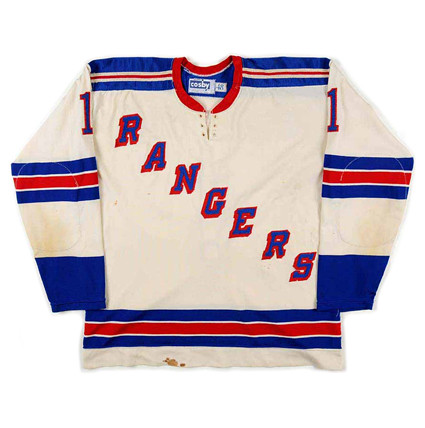
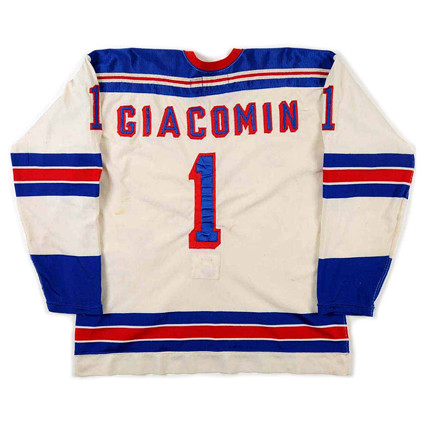
On this date in 1989, the New York Rangers retired sweater #1 in honor of goaltender Ed Giacomin.
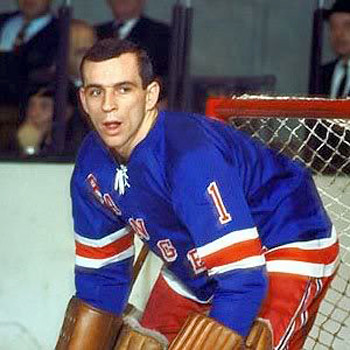
Giacomin, overcoming serious burns suffered in a kitchen accident as a teenager when a stove exploded, played five seasons for the Providence Reds of the American Hockey League to start his professional career.
Giacomin with the Providence Reds
He then made his NHL debut with the New York Rangers in 1965-66 and led the NHL in shutouts with nine during his second season, helping the Rangers make the playoffs for only the second time in nine seasons.
Giacomin led the NHL in shutouts in 1966-67
Once established as the Rangers starting goaltender, Giacomin would lead the league in games played for the next four seasons, seeing action in between 66 and 70 games while winning 30 games or more each of those four seasons with a high of 37 in 1968-69 and leading the NHL in shutouts again in 1967 with nine and 1968 with eight.
Giacomin had four consecutive seasons of over 30 wins
With the acceptance of goalies in the NHL sharing the duty now becoming the norm, Giacomin's games played would shrink to the mid 40's starting in 1970, but he would still lead the league in shutouts in 1971 with eight on his way to winning the Vezina Trophy along with partner Gilles Villemure.
The following season the Rangers would enjoy their greatest playoff success of Giacomin's career, making it to the Stanley Cup Finals.
Giacomin joined the legions of goalies now wearing
masks after starting his NHL career playing without one
Giacomin was limited by injuries in 1974-75, limiting him to just 37 games and 13 wins, his first time under 24 wins since becoming the starter in 1966-67. As a result, the Rangers, off to a bad start, began dumping their high priced veterans, which included waiving Giacomin, who was claimed by the Detroit Red Wings.
Giacomin was claimed by Detroit early in the 1975-76 season
Giacomin's return to New York was an emotional one, as the Rangers fans chanted "Ed-die! Ed-die!", drowning out even the national anthem, a game that was voted one of the Top 50 moments in Madison Square Garden history, not just Rangers history, but all events at MSG, which include Elvis Presley and other concerts, legendary boxing matches, NBA and college basketball, political conventions and an appearance by the Pope.
He would finish his career by playing two seasons plus an additional nine games in 1977-78 with the Red Wings before retiring in January of 1978 with 609 games and a record of 289-209-96 and 54 shutouts and a goals against average of 2.82.
Giacomin played in the NHL All-Star Game six times, was inducted into the Hockey Hall of Fame in 1987 and his sweater #1, retired on this date in 1989, was only the second number retired by the Rangers in their 64 year history.
Today's featured jersey is a 1968-69 New York Rangers Ed Giacomin jersey as worn during the season he recorded his highest NHL win total of 37 games.
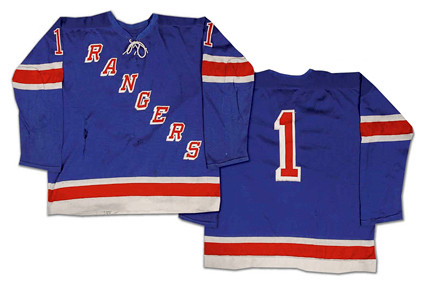
The Rangers diagonal crest dates back to their first season in the NHL in 1926-27 and changed to the current font in 1941 with the drop shadow first being added the following season. This particular style with the lace-up collar was first used in 1951 with sleeve numbers arriving in 1963.
After a radical change in style in 1976 and a return to a more traditional style which read "New York" on the front in 1978, the Rangers name returned to the blue jerseys in 1987 and this style with the lace up collar was reinstated in 1997 and remains in use today.
Bonus jersey: Today's bonus jersey is a 1970-71 New York Rangers Ed Giacomin jersey as worn during the season he won the Vezina Trophy.
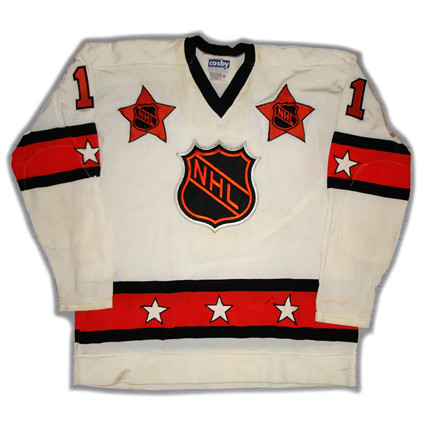
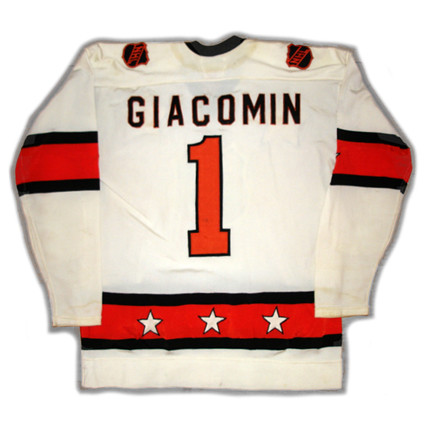
Extra bonus jersey: Today's extra bonus jersey is a 1973 NHL All-Star Game Ed Giacomin jersey as during the sixth and final NHL All-Star Game of Giacomin's career. This style had an extended run of use, having first been worn for the 1973 game and then continuing through the 1981 game, with the exception of 1979 when the traditional NHL All-Star Game was replaced by the 1979 Challenge Cup when a team of NHL All-Stars took on the Soviet National Team.
Today's video segment begins with the excellent Legends of Hockey profile on Giacomin which includes footage of his jersey retirement ceremony.
Here's evidence of the combative nature Giacomin possessed referred to by Stan Fischler in the previous video, as he goes after Garry Howatt of the Islanders. It's also an example of the "Ed-die! Ed-die!" chant that used to fill Madison Square Garden.
NHL All-Star Weekend continues with a look at the evolution of the event into an annual part of the NHL calendar, although perhaps not were you would normally expect it to be.
Following the first three benefit/memorial games held in the 1930's, there were no NHL All-Star games held until the Players Committee proposed it as an annual charity game to benefit the Players Emergency Fund as well as a players pension fund in 1947.
The first of the annual games was held in Toronto's Maple Leaf Gardens,which was upgraded to have glass on the boards instead of the usual fencing that was common at the time, on October 13, 1947. When it first began, the format called for the defending Stanley Cup Champions to take on an All-Star team made up of players from the other five Original 6 clubs, with the game to be played prior to the start of the regular season.
The inaugural 1947 NHL All-Star Game program
The scheduling of the game would remain during the pre-season (or at least very early in the season) through 1965. It was then shifted to a mid-season spot on the calendar for the 1966-67 season, which meant there was no game during the 1966 calendar year.
The practice of having the defending Stanley Cup champions take on the All-Stars lasted through 1968 before a change was made to have the Eastern Conference battle the Western Conference All-Stars for the first time. The only exception to this format was in 1951 and 1952, when the end of season First Team All-Stars played against the end of season Second Team All-Stars, with both games ending in ties.
During the era when the Stanley Cup champions would face an All-Star team, the All-Stars prevailed nine times, the cup champions seven and there were three ties.
Prior to the first NHL All-Star Game, the players attended a Canadian Football League game and were treated to a fine dinner. Gifts were given to all the players, with the defending champion Maple Leafs each receiving extra gifts, such as gold cufflinks, a lifetime pass to Maple Leaf Gardens, a coat, a hat and tie, a lighter and cigarette box, golf balls, a pocket knife, a team photo, a silver tea tray and and engraved gold watch with a silver chain.
The Maple Leafs earned their place in the first NHL All-Star Game
by winning the 1947 Stanley Cup championship
The game was played in front of 14,169 fans who saw the Maple Leafs leading at the conclusion of the first period by a score of 1-0 on a goal by Harry Watson at 12:29 of the first period with an assist from Bill Ezinicki.
The Maple Leafs extended their lead with a second goal just 1:03 into the second period by Ezinikci from team captain Syl Apps and Watson before the All-Stars got on the board at 4:39 when the Chicago Black Hawks Max Bentley scored from Ken Reardon of the Montreal Canadiens. The Maple Leafs responded just 22 seconds later to restore their two goal margin when Apps scored with an assist from Watson, his third point of the game at 5:01. The All-Stars scored their second of the period just before the halfway point of the game at 9:25 from Grant Warwick with assists going to Edgar Laprade (of the New York Rangers) and Reardon to make it 3-2 for Toronto after two periods.
The Canadiens Maurice Richard tied the game for the All-Stars with an unassisted goal just 28 seconds into the third period, followed by Doug Bentley's game winner less than a minute later from the Boston Bruins Milt Schmidt and Richard as the All-Stars would come from behind to win 4-3.
The reunion of the original 1947 All-Star Game players in 2000 at
the 50th NHL All-Star Game, also held in Toronto
The Maple Leafs wore their home white sweaters for the game and the referees wore dark blue sweaters.
The NHL All-Stars wore newly designed red sweaters adorned with the NHL logo and white stars arched over the logo on the chest and short white and blue stripes which repeated across the shoulders and down the length of the arms.
The 1947 NHL All-Star Team, the first to wear the new All-Star design
This style of All-Star jersey would remain in use through 1954 until a change in NHL policy saw the home teams now wearing their dark jerseys, which led to a revival of the white version of this sweater for the All-Stars first used in 1951 and 1952 when the format of the game was tweaked to feature the NHL First Team All-Stars facing the Second Team All-Stars with one team wearing the red version and the other the white.
The 1951 NHL Second All-Star Team, the first to wear the white version of the All-Star sweater
The white sweaters were then used from 1955 through 1959 until a new design was finally adopted in 1960. This style jersey was revived for the 1993 NHL All-Star Game in Philadelphia during the NHL's 75th Anniversary season.
Today's featured jersey is a 1947 NHL All-Star Maurice "Rocket" Richard jersey
as worn in the first of the annual NHL All-Star Games. This design was
created specifically for the first of the annual NHL All-Star Games and
would remain in use through 1959, although sometimes in a white version.
Bonus jersey: Today's bonus jersey is a 1947 NHL All-Star Emile "Butch" Bouchard jersey also worn in the first of the annual NHL All-Star Games by Richard's Canadiens teammate.
Extra bonus jersey: Today's extra bonus jersey is a 1947-48 Toronto Maple Leafs Ted "Teeder" Kennedy jersey as worn by the defending Stanley Cup champion Maple Leafs in the first of the annual NHL All-Star Games in 1947 just prior to the start of the season.
The Maple Leafs adopted this striping pattern for their white jerseys back in 1937-38 to match that worn on their blue jerseys since 1934-35. They added this redesigned crest for the 1938-39 season and these sweaters were then worn through the 1957-58 campaign until a redesign arrived for the following season.
In honor of All-Star Weekend, today we take a look at the four All-Star games held prior to the game becoming an annual event.
The first of four All-Star type games prior to it becoming an annual tradition took place way back on January 8, 1908 (nine years before the creation of the National Hockey League) as a benefit for the family of Hod Stuart, who died in a swimming accident when he dove onto obscured rocks in shallow water and died instantly of a broken neck just three months after he and the Wanderers won the Stanley Cup in 1907.
A newspaper account of Stuart's accident
In that first game, the Montreal Wanderers faced off against a team of All-Star players from the Eastern Canada Amateur Hockey Association in front of 3,800 fans, raising over $2,100 for his widow and two children.
Hod Stuart
The Wanderers led 7-1 after the first half of the contest, but the All-Stars, which consisted of players from the Ottawa Senators, Montreal Victorias, Montreal Amateur Athletic Association, Montreal Shamrocks and Quebec Bulldogs, fought back to make it a game, but the Wanderers prevailed by a final score of 10-7. There is no information available regarding what sweaters the All-Stars wore for the game, either their usual club sweaters or a special All-Star design especially for the game.
An ad for the first All-Star Game,
a fundraiser for the family of Hod Stuart
It would be nearly 26 years later before the first All-Star style game would take place featuring players of the National Hockey League. This game was again another benefit game as a result of Eddie Shore violently retaliating for a hard check by Red Horner of the Toronto Maple Leafs. The enraged Shore mistakenly hit the Maple Leafs Irvine "Ace" Bailey from behind, thinking he was Horner, causing Bailey to flip over and hit his head on the ice so hard it fractured his skull and sending him into convulsions. Bailey's injuries were so severe, it not only ended his playing career, but a priest in attendance administered the last rites. Bailey underwent several operations to save his life and eventually spent a month in the hospital before being able to return home to Toronto.
Ace Bailey
Two months later on February 14, 1934 a benefit game for Bailey and his family was held at Maple Leaf Gardens in Toronto when the Maple Leafs took on a squad made up of All-Stars from the eight other clubs in the NHL at the time, two from each team.
Toronto got out to a 2-0 lead before the All-Stars scored to make it 2-1 after the first period. Toronto scored first in the second period to go up 3-1, but two goals by the All-Stars pulled them even at 3-3 before a controversial ruling on an apparent shot off the post by Hap Day was ruled a goal for a 4-3 Toronto advantage after two. While the All-Stars took many shots in the third period, Maple Leafs goaltender George Hainsworth stood firm and Toronto added another early goal for a 5-3 lead. Eventually, All-Stars coach Lester Patrick put five forwards on the ice in an all-out attempt to score, but the move did not pay off as two late goals made for a final score of 7-3 for Bailey's former club the Maple Leafs, delighting the home fans in Toronto.
As part of the event, Bailey's #6 was retired by the Maple Leafs, the first number ever retired in NHL history.
The lasting image from the game is the cordial handshake which took place between Bailey and Shore to a resounding ovation from the crowd.
Bailey greets Shore to a rousing ovation prior to the game. Note Shore wearing his usual Bruins sweater rather than a special All-Star sweater for the event.
Prior to the game the All-Stars were introduced while wearing their NHL club sweaters, but after the introductions were concluded, Bailey, league President Frank Calder and New York Rangers owner Frank Patrick presented each player with his special NHL All-Star jersey.
The pregame photo with each All-Star
wearing their club team's jersey
The Maple Leafs also wore special jerseys for the occasion, emblazoned with "ACE" diagonally across the front with the team logo on the upper left chest.
A rare shot of the Maple Leafs wearing their Ace Bailey jerseys
A group shot of all the participants of the Ace Bailey Benefit Game with the NHL All-Stars now wearing their special All-Star sweaters for the contest
The game drew 14,074 fans and raised $20,909 for Bailey, who dropped the ceremonial first puck prior to the game, which was won by the Maple Leafs by a score of 7-3.
Bailey drops the ceremonial puck prior to the benefit game in his honor
Following the 1934 benefit game for Bailey, two more All-Star style games took place, the first being for the late Howie Morenz of the Montreal Canadiens, a participant in the Ace Bailey Benefit Game.
A ticket stub from the Howie Morenz Memorial Game
Morenz had died in the hospital in March, 1937, five weeks after breaking his leg in four places during a game. On November 3, 1937 a memorial game to raise money for Morenz's family was held at the Montreal Forum between a combined team of the Montreal Canadiens and Montreal Maroons versus a team comprised of the team of All-Stars from the six other NHL franchises of the day.
The combined team of Montreal Canadiens and Montreal Maroons
The game was attended by 8,683 fans and raised over $20,000. The combined Montreal squad scored first but the All-Stars finished the first period ahead by 2-1. The All-Stars extended their lead to 3-1 thanks to the only goal of the second period. After Montreal cut the lead to 3-2 at the 51 second mark of the third period, the All-Stars seemingly put the game away with two goals 43 second apart within the next two minutes followed later by a goal at the 15 minute mark for a 6-2 lead, but the Montreal clubs rallied for three goals in 3:02 to make it 6-5, but it was too little, too late as the final goal came with just 45 seconds left in the game as the All-Stars held on for the victory. Johnny Gagnon was the offensive standout with 2 goals and an assist for Montreal.
Both teams again wore special sweaters for the occasion, but with somewhat less sartorial success than those worn in the Ace Bailey Benefit Game, particularly the stark white sweaters worn by the NHL All-Stars.
The sweater worn by the combined Montreal Clubs in the 1937 Howie Morenz Memorial Game
The sweater worn by Mush March of the NHL All-Stars in the 1937 Howie Morenz Memorial Game
The rear view of the NHL All-Stars sweater, quite possibly the plainest, dare we say boring, sweater in hockey history
One last memorial game took place on October 29, 1939 to benefit the family of Babe Siebert, a 14 year NHL veteran who was named coach of the Montreal Canadiens upon his retirement as a player, who drowned in Lake Huron on August 25, 1939 before he was ever able to coach the Canadiens.
The program from the Babe Siebert Memorial Game
The game featured the NHL All-Stars against the Montreal Canadiens and was won by the All-Stars by a score of 5-2 in front of 6,000 fans and raised $15,000 for his family, which included Siebert's wife, who was paralyzed from the waist down.
The All-Stars led 2-0 after the first period on goals by Bobby Bauer and Shore, both assisted by Syl Apps, Sr. and Johnny Gottselig. Apps scored again early in the second period from Bauer before Montreal scored their first goal at 5:49. Two minutes later Gottselig responded from Apps and Art Coulter. Then, Earl Seibert (note the different spelling of the last name compared to Babe Siebert) gave the All-Stars a 5-1 lead at 11:21 and Montreal closed out the scoring with a goal with 45 seconds left in the second, making the final score 5-2 for the All-Stars, as no goals were scored during the third period. Apps was the star of the night as he finished the game with a goal and 3 assists.
While the Canadiens wore their normal game sweaters, the All-Stars were again given special sweaters for the game, which left no doubt as to which team the All-Stars were, thanks to it's bold star logo on the chest. This made for a much more pleasing result, especially with the addition of the black and orange trim, than the previous Morenz Game sweaters.
Ebbie Goodfellow's 1939 NHL All-Star jersey from the Babe Siebert Memorial Game
Today's featured jersey is a 1934 NHL All-Star Ace Bailey Benefit Game jersey as worn in the first All-Star contest in NHL history, a charity event to raise money for injured Toronto star Ace Bailey.
This jersey is the first special jersey worn by an NHL All-Star team and is currently on display in the Hockey Hall of Fame in Toronto.
Bonus Jersey: Today's bonus jersey is a 1934 Toronto Maple Leafs "ACE" jersey as worn by the Maple Leafs during the Ace Bailey benefit game, the precursor to the modern NHL All-Star Game. This particular sweater is a modern remake of the Maple Leafs original version.
Today's video section is a look at the 1934 Ace Bailey Benefit Game, held in Toronto's Maple Leaf Gardens.
Our next video is a brief recollection on the passing of Howie Morenz in 1937.
Third String Goalie - The Hockey Jersey of the Day Blog
"Sweater" for all my Canadian friends!
Welcome!
Welcome to our end of the rink.
Bienvenue sur notre bout de la patinoire.
So why "Third String Goalie"?
It's defined as "A fan who sits in the stands wearing a jersey."
If that's not us, we don't know what is...
Our aim is to feature a different jersey each day from a historical perspective. Stay tuned and hopefully you'll see some jerseys of interest or perhaps some that you haven't seen before and learn a bit of hockey history along the way.
In addition to our articles, be sure to scroll down this column and explore the other fun and informative features of this blog.
If you have any suggestions or comments, feel free to contact us at:
Looking to reach our loyal readers with your hockey related product or service? Of our hundreds of readers each day, 60% are located in the United States and 30% come from Canada. Our audience is your audience and you can target them now with our reasonable ad rates.
We've been linked to by SI.com, ESPN.com, Uni-Watch.com, NBCSports.com and the Yahoo! Sports Puck Daddy blog among others.
There is no limitation to what kind of hockey jersey it can be - replica, authentic or game worn jersey from the NHL, a national team, the minors, juniors, college, high school or even your pond hockey jersey.
Feel free to write a paragraph or two about the jersey telling us why you like the jersey, how you got it, what makes it special to you or even a full-blownThird String Goalie-style history lesson - whatever you feel like sharing.
Visting from outside North America? Just select your preferred language and Third String Goalie will be instantly converted to your language of choice!