History of Jersey 83-93 Banner sm photo History of Jersey 83-93 Banner sm.jpg
Showing posts with label Portage Lake Hockey Club. Show all posts

Tuesday, February 20, 2018

1903-04 Portage Lakes Hod Stuart Jersey

 William Hodgson "Hod" Stuart was born on this date in Ottawa, Ontario in 1879. His first senior level team was the Rat Portage Thistles in 1895-96. He joined the Ottawa Hockey Club (later known as the Silver Seven and then the Senators) of the Canadian Amateur Hockey League for the 1898-99 season for three games. A cover-point (later known as the more familiar term of a defenseman), Stuart played in 3 games, scoring one goal for Ottawa while his brother Bruce Stuart played in one game for the team.

1899 Ottawa Hockey Club team
The 1898-99 Ottawa Hockey Club

Stuart returned to Ottawa HC for the 1899-00 season and was named the team captain. He played in seven of the team's eight games, scoring 5 goals, as he was not afraid to join the offense from his defensive role.

As hockey was still a purely amateur sport in those days, Stuart moved to Quebec when he was able to land a job there though his father's business contacts. The change in location led to him joining the Quebec Bulldogs, also of the CAHL, for the 1900-01 season and his brother Bruce did the same. Again, he played in seven of the club's eight games, scoring twice.

He returned for a second season with the Bulldogs in 1901-02, scoring 5 times in 8 games.

As professionalism started to come into the game, Stuart was signed for the princely sum of $15-$20 per week for the 1902-03 season by the Pittsburgh Bankers of the Western Pennsylvania Hockey League in the United States, in addition to his income from his day job in Pittsburgh. In 13 games, Stuart scored 7 goals and 8 assists with 29 penalty minutes as the Bankers finished first in the four team league with a 10-3-1 record. Stuart was named the best cover-point in the league.

After one season in Pittsburgh, Stuart moved further west with his brother Bruce to join the professional Portage Lakes Hockey Club in Northern Michigan for the 1903-04 season. The club was not part of any league that season and played a schedule of 14 exhibition games, with Stuart scoring 13 goals while Bruce had an astonishing 44!
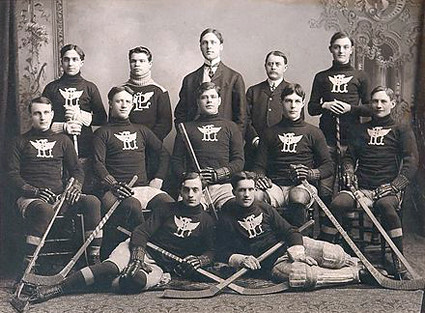
1903-04 Portage Lakes Hockey Club team
The 1903-04 Portage Lakes Hockey Club

For the 1905-06 season, the American Soo Indians and Canadian Sault were banned from competing in the amateur Ontario Hockey Association after having played against the professionals from Portage Lakes. The solution was the formation of a new, professional league, which consisted of five teams, which was dubbed the International Hockey League.

Stuart was given $1,800 to play for the Calumet Miners as well as manage their rink for the season. While Hod changed teams, Bruce remained with Portage Lakes for the next three seasons.

Stuart scored 18 goals in 22 games for the Miners, who won the league championship with a 18-5-1 record, as he was named the best cover-point in the league.
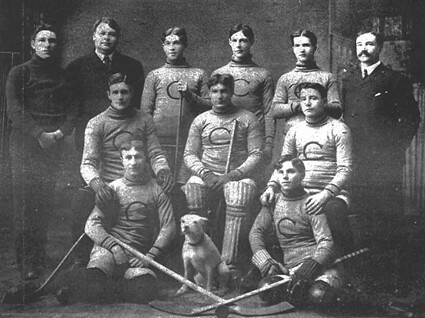
1904-05 Calumet-Laurium_Miners
The 1904-05 Calumet Miners Hockey Club

On December 11, 1905, Stuart was suspended from the league after other teams complained he had won too many championships and was too rough a player. He was reinstated on December 30th and joined the Pittsburgh Professionals for the remainder of their season, scoring 11 times in 20 games. After Pittsburgh completed their schedule, Stuart suited up for one additional game for Calumet.
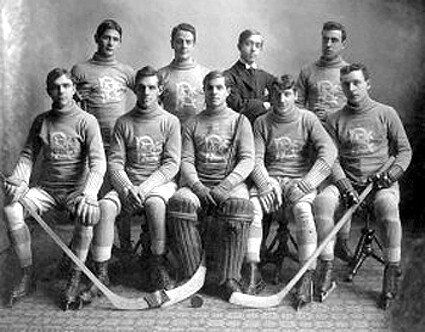
1905-06_Pittsburgh_Bankers
The 1905-06 Pittsburgh Professionals

Stuart began the 1906-07 season with Pittsburgh in the IPHL, but after 4 games with a goal and 3 assists, he grew increasingly frustrated with the violence and refereeing in the league and went so far as to have a letter critical of the league and its officiating. Shortly afterwards, the Pittsburgh players refused to play a game against the Michigan Soo due to the choice of referee. The club's management felt that Stuart was the instigator of the boycott and released him from the club.

Having heard earlier that the Montreal Wanderers of the Eastern Canada Amateur Hockey Association were not only interested in his services, but willing to make hm the highest paid player in hockey, signed with the Wanderers and made his debut on January 2, 1907 in front of 6,069 fans. He would eventually play in 8 of the Wanderers 10 regular season games, scoring 3 times and was one of only four professionals to play for the club that season. With Montreal, he was once again reunited with Bruce, who also played 3 regular season and 3 Stanley Cup games with the Wanderers that season.
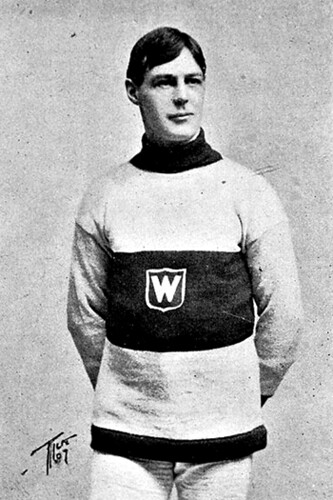
Stuart Montreal Wanderers
Stuart joined the Montreal Wanderers after his release from Pittsburgh

If Stuart was unhappy with the level of violence in the IPHL, he certainly was not pleased with the events of January 12th, when the Ottawa Senators repeatedly battered the Wanderers players with their sticks, with Charles Spittal's attack on Cecil Blanchford later being described at "attempting to split his skull", while the Senators Alf Smith hit Stuart "across the temple, laying him out like a corpse", while Harry Smith broke Ernie Johnson's face, breaking his nose. Reports of the game commended Stuart, stating that he neither flinched or retaliated, even after bearing most of the hits.

At a special league meeting, the Montreal Victorias proposed suspending Spittal and Alf Smith for the rest of the season, which was voted down and eventually led to the league president Fred McRobie resigning. When the Senators returned to Montreal, Spittal, Alf Smith and Harry Smith were all arrested, with Spittal and Alf Smith eventually paying $20 fines.

On January 17th and 21st, the Wanderers faced a challenge for the Stanley Cup they had won the previous March. Kenora, the 1906 Manitoba champions, pulled off an upset, wresting the cup away from the Wanderers by winning 4-2 and 8-6.

Afterwards, the Wanderers focused on their ECAHA schedule, and racked up win after win, eventually finishing the season as league champions after a perfect 10-0 undefeated season with Stuart contributing 3 goals in eight games.

That championship earned them the right to a rematch with Kenora, which took place on March 23rd and 25th in Winnipeg. Montreal dominated the first game 7-2, and even though the Thistles won Game 2 by a score of 6-5, the Wanderers large margin of victory in the first game gave them ta 12-8 win in the two game, total goals series, giving Stuart a Stanley Cup championship.
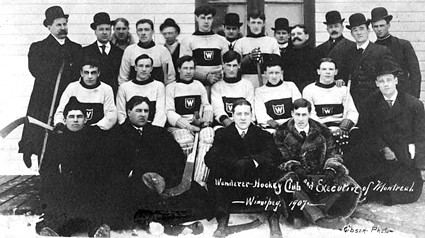
1907 Montreal Wanderers team
The 1906-07 Stanley Cup champion Montreal Wanderers

In celebration of their championship, the Wanderers engraved the names of their entire roster inside the bowl of the Stanley Cup, the first winning team to do so in what is now and annual tradition.
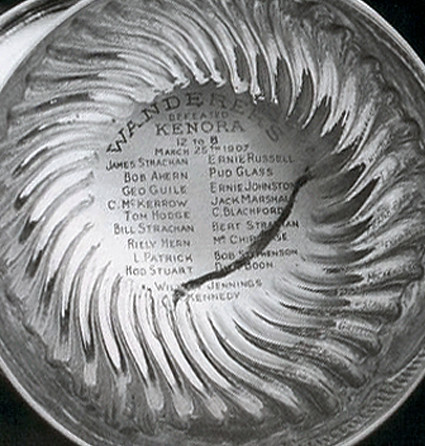
1907 Wanderers engraving
The Wanderers started a tradition when they
engraved their entire roster into the Stanley Cup

Tired of the violence in hockey, Stuart quit playing hockey after the Stanley Cup matches and joined his father in the construction business. As part of his duties, he was sent to Belleville, Ontario to oversee a construction project. On the afternoon of June 23, 1907, he went swimming with some friends and swam to a nearby lighthouse, climbed on a platform and dove onto some obscured rocks in the shallow water and died instantly of a broken neck at the age of 28 just three months after he and the Wanderers won the Stanley Cup in 1907.
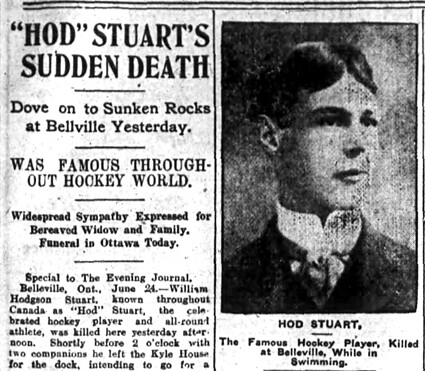
Hod Stuart Obit
A newspaper account of Stuart's accident

On January 2, 1908 (nine years before the creation of the National Hockey League) an all-star benefit game was held as a benefit for the family of  Stuart with the tickets sold out days in advance.
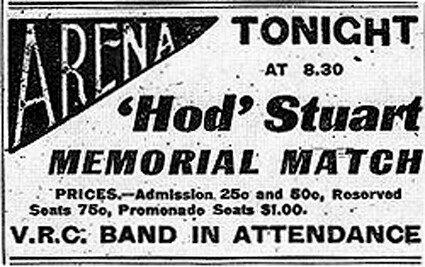
Stuart Memorial Game
An ad for the first All-Star Game,
a fundraiser for the family of Hod Stuart

In that first all-star game ever held in any sport, the Montreal Wanderers faced off against a team of players from the Eastern Canada Amateur Hockey Association with the game hosted at no charge by the Westmount Arena in front of 3,800 fans, raising over $2,100 for his widow and two children.

The Wanderers led 7-1 after the first half of the contest, but the All-Stars, which consisted of players from the Ottawa Senators, Montreal Victorias, Montreal Amateur Athletic Association, Montreal Shamrocks and Quebec Bulldogs, fought back to make it a game, but the Wanderers prevailed by a final score of 10-7.
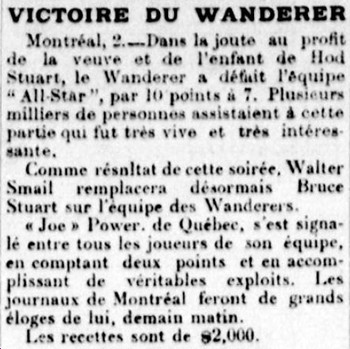
Hod Stuart Memorial Game article
A newspaper account of the Hod Stuart Memorial Game

Stuart was inducted into the Hockey Hall of Fame in 1945, one of the original nine honored members of the inaugural class along with Hobey Baker, Charlie Gardiner, Eddie Gerard, Frank McGee, Howie Morenz, Tommy Phillips, Harvey Pulford and Georges Vezina.
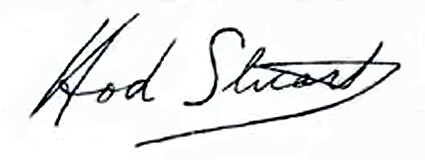
Hod Stuart autograph

Today's featured jersey is a 1903-04 Portage Lakes Hockey Club Hod Stuart jersey. The Portage Lakes Hockey Club was founded back in 1899 and began to pay its players in 1902. They introduced their winged logo for the 1902-03 season with sweaters that had white shoulders and turtleneck collar. For the following season they sweaters became a solid color and remained so through their final season of 1906-07 when the IPHL folded and the Portage Lakes club along with it. We have seen a single mention that the team's sweaters were green, but cannot be certain of this.

Noteworthy players enticed by the lure of being paid to play hockey who suited up for Portage Lakes at times included Hall of Famers "Bad" Joe Hall, Riley Hern, Bruce Stuart, Hod Stuart and Fred "Cyclone" Taylor.
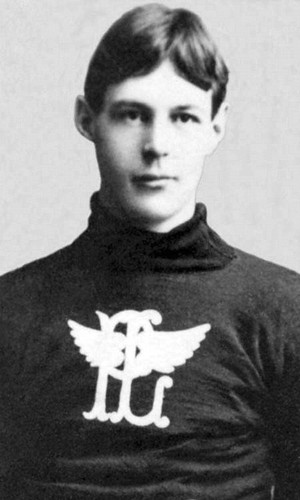
Stuart Portage Lakes

Friday, June 23, 2017

1905-06 Portage Lake Hockey Club Cyclone Taylor Jersey

Born on this date in 1884, Fred "Cyclone" Taylor was one of the first stars of the fledgling sport of hockey and one of the leading scorers of his day.

As was common in the early days of organized hockey, Taylor played for several teams in several leagues - depending on where the money was. He joined his is first professional club, thanks to a $3,000 salary offer, the Portage Lakes Hockey Club in Houghton, Michigan in the International Professional Hockey League. Taylor arrived in the latter part of the 1905-06 season in time to score 11 goals in 6 games and help the club win the league championship with a 19-5 record.

He returned for the 1906-07 season and scored 14 times in 23 games as Portage Lakes again won the championship, this time with a record of 16-8. With professional teams now starting up in Canada, many of the players preferred to play closer to home and the IPHL disbanded after before the start of the next season.

Taylor moved back east, joining the Ottawa Senators of the Eastern Canada Amateur Hockey Association for the 1907-08 season. In 1908, Taylor played the start of the season with Pittsburgh of the Western Pennsylvania Hockey League but returned to Ottawa in time for the start of the Senators next season. Once back, he scored 9 goals in 11 games as Ottawa won the league title with a 10-2 record. As champions of the league, Ottawa became the holders of the Stanley Cup, previously held by league members the Montreal Wanderers.

Taylor Ottawa 1909
Taylor of the Ottawa Senators

It was during this period that Canada's Governor General was so impressed with his incredible speed that he gave Taylor the nickname "Cyclone".

Fred Cyclone Taylor signature

After a falling out with management of Ottawa, Taylor accepted an offer to join the Renfrew Creamery Kings for the inaugural season of the National Hockey Association.

1911 C55 Taylor

There he was joined by future hall of famers Lester Patrick, his brother Frank Patrick as well as mid-season addition Newsy Lalonde. The paychecks handed out to the Renfew players earned the club the unofficial nickname of the Renfrew "Millionaires". Taylor's salary in particular was the highest ever for a Canadian athlete up to that time and remained so for many years.

Lalonde,F Patrick & Taylor 1912
Newsy Lalonde, Frank Patrick and Cyclone Taylor of Renfrew

Despite their high priced talent, Renfrew finished third in the league and reportedly lost $17,000 that season. Taylor returned for the 1910-11 season, only without the Patricks or Lalonde.

The club once again finished third in the standings and disbanded following the season, putting Taylor back on the open market. Sort of.

His rights were transferred to the Montreal Wanderers, but Taylor was quoted as saying he'd rather retire than join the Wanderers and ended up playing in a game for the Ottawa Senators. The Wanderers protested Taylor's appearance for Ottawa and won. The game was ordered replayed, Taylor and Ottawa were fined $100 each and Taylor was given an indefinite suspension, ending his 1911-12 season at one game.

In November of 1912, Taylor was lured to the Vancouver Millionaires by his former teammates the Patrick brothers, who had formed the Pacific Coast Hockey League.

Taylor Vancouver 1912-13
Taylor with the Vancouver Millionaires in 1912-13

There, he would find a permanent home, playing the next nine seasons of his career, which included five scoring titles, thanks in part to moving up to forward from defense, a career high of 32 goals in 18 games in 1917-18 and a Stanley Cup championship in 1915 thanks to a 3 games to none win over Taylor's former club, the Ottawa Senators which included Taylor scoring six times in the three games including twice in the cup clinching Game 3. The victory by the Millionaires remains the only Stanley Cup ever won by a team from Vancouver 95 years later.

1915 Vancouver Millionaires
1915 Stanley Cup champion Vancouver Millionaires

The Millionaires returned to the Stanley Cup Finals in 1918, and while they fell in seven games to the Toronto Arenas, Taylor led all playoff scorers with 9 goals in 7 games.

He stopped playing hockey after the 1920-21 season, but did return for a single game in the 1922-23 season with the club now renamed the Vancouver Maroons. He finished his career averaging more than a goal per game with 194 goals in 186 regular season games.

Following his playing career, he was elected to the Hockey Hall of Fame in 1947. His son Fred Jr. opened a chain of hockey equipment stores called Cyclone Taylor Sports in 1957 which remain in operation today. Since 1967 the playoff champions of the three British Columbia Junior B hockey leagues is awarded the Cyclone Taylor Cup.

In 1979, the Canucks renamed the club's annual MVP award the Cyclone Taylor Award. There are also arenas in Vancouver and his birthplace of Tara, Ontario named in his honor as well as Cyclone Taylor Boulevard, which is one of the four roads around the current Ottawa Senators arena, Scotia Bank Place in Ottawa.

Today's featured jersey is a 1905-06 Portage Lake Hockey Club Fred "Cyclone" Taylor jersey. Or in this case we should we say "sweater". This classic turn of the century hockey sweater features a wonderful "PL" monogram adorned with wings on either side. This heavy sweater certainly would have kept the players warm, as the IPHL played it's games in the winter on natural ice.

While the Portage Lake team only existed for a limited number years, playing exhibition games as early as 1900 and joining the IPHL in 1904 when they began to attract players of note from Canada with the salaries they were paying in the days of amateur hockey, the lineup of future hall of famers was quite impressive, including IPHL founder Jack Gibson in the Builders category, "Bad" Joe Hall, goaltender Riley Hern, team captain Bruce Stuart, his brother Hod Stuart and of course the legendary Cyclone Taylor.

Taylor Portage Lake 1905-06

Today's video is a treat, a look at Taylor's career which includes an interview with the man himself!


Monday, June 23, 2014

1905-06 Portage Lake Hockey Club Cyclone Taylor Jersey

Born on this date in 1884, Fred "Cyclone" Taylor was one of the first stars of the fledgling sport of hockey and one of the leading scorers of his day.

As was common in the early days of organized hockey, Taylor played for several teams in several leagues - depending on where the money was. He joined his is first professional club, thanks to a $3,000 salary offer, the Portage Lakes Hockey Club in Houghton, Michigan in the International Professional Hockey League. Taylor arrived in the latter part of the 1905-06 season in time to score 11 goals in 6 games and help the club win the league championship with a 19-5 record.

He returned for the 1906-07 season and scored 14 times in 23 games as Portage Lakes again won the championship, this time with a record of 16-8. With professional teams now starting up in Canada, many of the players preferred to play closer to home and the IPHL disbanded after before the start of the next season.

Taylor moved back east, joining the Ottawa Senators of the Eastern Canada Amateur Hockey Association for the 1907-08 season. In 1908, Taylor played the start of the season with Pittsburgh of the Western Pennsylvania Hockey League but returned to Ottawa in time for the start of the Senators next season. Once back, he scored 9 goals in 11 games as Ottawa won the league title with a 10-2 record. As champions of the league, Ottawa became the holders of the Stanley Cup, previously held by league members the Montreal Wanderers.

Taylor Ottawa 1909
Taylor of the Ottawa Senators

It was during this period that Canada's Governor General was so impressed with his incredible speed that he gave Taylor the nickname "Cyclone".

Fred Cyclone Taylor signature

After a falling out with management of Ottawa, Taylor accepted an offer to join the Renfrew Creamery Kings for the inaugural season of the National Hockey Association.

1911 C55 Taylor

There he was joined by future hall of famers Lester Patrick, his brother Frank Patrick as well as mid-season addition Newsy Lalonde. The paychecks handed out to the Renfew players earned the club the unofficial nickname of the Renfrew "Millionaires". Taylor's salary in particular was the highest ever for a Canadian athlete up to that time and remained so for many years.

Lalonde,F Patrick & Taylor 1912
Newsy Lalonde, Frank Patrick and Cyclone Taylor of Renfrew

Despite their high priced talent, Renfrew finished third in the league and reportedly lost $17,000 that season. Taylor returned for the 1910-11 season, only without the Patricks or Lalonde.

The club once again finished third in the standings and disbanded following the season, putting Taylor back on the open market. Sort of.

His rights were transferred to the Montreal Wanderers, but Taylor was quoted as saying he'd rather retire than join the Wanderers and ended up playing in a game for the Ottawa Senators. The Wanderers protested Taylor's appearance for Ottawa and won. The game was ordered replayed, Taylor and Ottawa were fined $100 each and Taylor was given an indefinite suspension, ending his 1911-12 season at one game.

In November of 1912, Taylor was lured to the Vancouver Millionaires by his former teammates the Patrick brothers, who had formed the Pacific Coast Hockey League.

Taylor Vancouver 1912-13
Taylor with the Vancouver Millionaires in 1912-13

There, he would find a permanent home, playing the next nine seasons of his career, which included five scoring titles, thanks in part to moving up to forward from defense, a career high of 32 goals in 18 games in 1917-18 and a Stanley Cup championship in 1915 thanks to a 3 games to none win over Taylor's former club, the Ottawa Senators which included Taylor scoring six times in the three games including twice in the cup clinching Game 3. The victory by the Millionaires remains the only Stanley Cup ever won by a team from Vancouver 95 years later.

1915 Vancouver Millionaires
1915 Stanley Cup champion Vancouver Millionaires

The Millionaires returned to the Stanley Cup Finals in 1918, and while they fell in seven games to the Toronto Arenas, Taylor led all playoff scorers with 9 goals in 7 games.

He stopped playing hockey after the 1920-21 season, but did return for a single game in the 1922-23 season with the club now renamed the Vancouver Maroons. He finished his career averaging more than a goal per game with 194 goals in 186 regular season games.

Following his playing career, he was elected to the Hockey Hall of Fame in 1947. His son Fred Jr. opened a chain of hockey equipment stores called Cyclone Taylor Sports in 1957 which remain in operation today. Since 1967 the playoff champions of the three British Columbia Junior B hockey leagues is awarded the Cyclone Taylor Cup.

In 1979, the Canucks renamed the club's annual MVP award the Cyclone Taylor Award. There are also arenas in Vancouver and his birthplace of Tara, Ontario named in his honor as well as Cyclone Taylor Boulevard, which is one of the four roads around the current Ottawa Senators arena, Scotia Bank Place in Ottawa.

Today's featured jersey is a 1905-06 Portage Lake Hockey Club Fred "Cyclone" Taylor jersey. Or in this case we should we say "sweater". This classic turn of the century hockey sweater features a wonderful "PL" monogram adorned with wings on either side. This heavy sweater certainly would have kept the players warm, as the IPHL played it's games in the winter on natural ice.

While the Portage Lake team only existed for a limited number years, playing exhibition games as early as 1900 and joining the IPHL in 1904 when they began to attract players of note from Canada with the salaries they were paying in the days of amateur hockey, the lineup of future hall of famers was quite impressive, including IPHL founder Jack Gibson in the Builders category, "Bad" Joe Hall, goaltender Riley Hern, team captain Bruce Stuart, his brother Hod Stuart and of course the legendary Cyclone Taylor.

Taylor Portage Lake 1905-06

Today's video is a treat, a look at Taylor's career which includes an interview with the man himself!

Wednesday, June 23, 2010

1905-06 Portage Lake Hockey Club Cyclone Taylor Jersey

Born on this date in 1884, Fred "Cyclone" Taylor was one of the first stars of the fledgling sport of hockey and one of the leading scorers of his day.

As was common in the early days of organized hockey, Taylor played for several teams in several leagues - depending on where the money was. He joined his is first professional club, thanks to a $3,000 salary offer, the Portage Lakes Hockey Club in Houghton, Michigan in the International Professional Hockey League. Taylor arrived in the latter part of the 1905-06 season in time to score 11 goals in 6 games and help the club win the league championship with a 19-5 record.

He returned for the 1906-07 season and scored 14 times in 23 games as Portage Lakes again won the championship, this time with a record of 16-8. With professional teams now starting up in Canada, many of the players preferred to play closer to home and the IPHL disbanded after before the start of the next season.

Taylor moved back east, joining the Ottawa Senators of the Eastern Canada Amateur Hockey Association for the 1907-08 season. In 1908, Taylor played the start of the season with Pittsburgh of the Western Pennsylvania Hockey League but returned to Ottawa in time for the start of the Senators next season. Once back, he scored 9 goals in 11 games as Ottawa won the league title with a 10-2 record. As champions of the league, Ottawa became the holders of the Stanley Cup, previously held by league members the Montreal Wanderers.

Taylor Ottawa 1909
Taylor of the Ottawa Senators

It was during this period that Canada's Governor General was so impressed with his incredible speed that he gave Taylor the nickname "Cyclone".

Fred Cyclone Taylor signature

After a falling out with management of Ottawa, Taylor accepted an offer to join the Renfrew Creamery Kings for the inaugural season of the National Hockey Association.

1911 C55 Taylor

There he was joined by future hall of famers Lester Patrick, his brother Frank Patrick as well as mid-season addition Newsy Lalonde. The paychecks handed out to the Renfew players earned the club the unofficial nickname of the Renfrew "Millionaires". Taylor's salary in particular was the highest ever for a Canadian athlete up to that time and remained so for many years.

Lalonde,F Patrick & Taylor 1912
Newsy Lalonde, Frank Patrick and Cyclone Taylor of Renfrew

Despite their high priced talent, Renfrew finished third in the league and reportedly lost $17,000 that season. Taylor returned for the 1910-11 season, only without the Patricks or Lalonde.

The club once again finished third in the standings and disbanded following the season, putting Taylor back on the open market. Sort of.

His rights were transferred to the Montreal Wanderers, but Taylor was quoted as saying he'd rather retire than join the Wanderers and ended up playing in a game for the Ottawa Senators. The Wanderers protested Taylor's appearance for Ottawa and won. The game was ordered replayed, Taylor and Ottawa were fined $100 each and Taylor was given an indefinite suspension, ending his 1911-12 season at one game.

In November of 1912, Taylor was lured to the Vancouver Millionaires by his former teammates the Patrick brothers, who had formed the Pacific Coast Hockey League.

Taylor Vancouver 1912-13
Taylor with the Vancouver Millionaires in 1912-13

There, he would find a permanent home, playing the next nine seasons of his career, which included five scoring titles, thanks in part to moving up to forward from defense, a career high of 32 goals in 18 games in 1917-18 and a Stanley Cup championship in 1915 thanks to a 3 games to none win over Taylor's former club, the Ottawa Senators which included Taylor scoring six times in the three games including twice in the cup clinching Game 3. The victory by the Millionaires remains the only Stanley Cup ever won by a team from Vancouver 95 years later.

1915 Vancouver Millionaires
1915 Stanley Cup champion Vancouver Millionaires

The Millionaires returned to the Stanley Cup Finals in 1918, and while they fell in seven games to the Toronto Arenas, Taylor led all playoff scorers with 9 goals in 7 games.

He stopped playing hockey after the 1920-21 season, but did return for a single game in the 1922-23 season with the club now renamed the Vancouver Maroons. He finished his career averaging more than a goal per game with 194 goals in 186 regular season games.

Following his playing career, he was elected to the Hockey Hall of Fame in 1947. His son Fred Jr. opened a chain of hockey equipment stores called Cyclone Taylor Sports in 1957 which remain in operation today. Since 1967 the playoff champions of the three British Columbia Junior B hockey leagues is awarded the Cyclone Taylor Cup.

In 1979, the Canucks renamed the club's annual MVP award the Cyclone Taylor Award. There are also arenas in Vancouver and his birthplace of Tara, Ontario named in his honor as well as Cyclone Taylor Boulevard, which is one of the four roads around the current Ottawa Senators arena, Scotia Bank Place in Ottawa.

Today's featured jersey is a 1905-06 Portage Lake Hockey Club Fred "Cyclone" Taylor jersey. Or in this case we should we say "sweater". This classic turn of the century hockey sweater features a wonderful "PL" monogram adorned with wings on either side. This heavy sweater certainly would have kept the players warm, as the IPHL played it's games in the winter on natural ice.

While the Portage Lake team only existed for a limited number years, playing exhibition games as early as 1900 and joining the IPHL in 1904 when they began to attract players of note from Canada with the salaries they were paying in the days of amateur hockey, the lineup of future hall of famers was quite impressive, including IPHL founder Jack Gibson in the Builders category, "Bad" Joe Hall, goaltender Riley Hern, team captain Bruce Stuart, his brother Hod Stuart and of course the legendary Cyclone Taylor.

Taylor Portage Lake 1905-06

Today's video is a look at the British Columbia Sports Hall of Fame, of which Cyclone Taylor is a member.


hit counter for blogger