History of Jersey 83-93 Banner sm photo History of Jersey 83-93 Banner sm.jpg
Showing posts with label Morenz Howie. Show all posts

Tuesday, March 7, 2017

1974-75 Montreal Canadiens Guy Lafleur Jersey

The Montreal Canadiens were founded in 1909 as members of the brand new National Hockey Association in order to provide the French fans of Montreal a team to rival the Anglophone Montreal Wanderers.

The first player to ever score a goal for the Canadiens was future Hall of Famer Newsy Lalonde, who would lead the club with 16 goals despite only appearing in 6 games before being traded to the Renfrew Creamery Kings (also known as the Millionaires). Lalonde would add another 22 goals for Renfrew in just five games to lead the NHA in scoring with 38 goals, as assists were not awarded back then. Lalonde would return to Montreal for the 1910-11 season and again led the club with 19 goals in 16 games.

Newsy Lalonde photo Newsy Lalonde 1909-10.png
The first goal scorer in Canadiens history, Newsy Lalonde,
picture here in the first ever Canadiens sweater

With Lalonde lured out west by the Vancouver Millionaires for the 1911-12 season, Didier Pitre became the first Canadiens player to reach the 20 point mark when he finished as the runner up in the NHA scoring race with 27 goals in an 18 game schedule.

In 1914-15, Pitre became the first Canadiens player to reach the 30 point mark when he totaled 34 points from 30 goals and 4 assists, which were now credited as of 1913-14. Pitre barely missed out being the first 40 point scorer in 1915-16 when his 24 goals and 15 assists, but his 39 points made him the first Canadien to lead the league in scoring.

Didier Pitre photo Didier Pitre.jpg
Pitre was the first Canadiens player with both 20 and 30 points

For the 1917-18 season, the NHA was disbanded and a new league rose to take it's place, the National Hockey League, of which the Canadiens were charter members. The brand new NHL was led in scoring by Joe Malone, who was on loan from the dormant Quebec Bulldogs. Malone was teamed with Lalonde and Pitre and the trio put on a scoring display unlike any ever seen before, as Malone became the first Canadiens player to top 40 points when he blitzed the league for 44 goals and 4 assists for 48 points in just 20 games. Malone's 44 goals in 1917-18 would stand as the league record for 46 years until 1943-44!

Joe Malone photo Joe Malone Montreal.jpg
Joe Malone's 44 goals stood as the NHL record for 46 years

Such was the dominance of Malone's season, it would take until the 1927-28 season for Howie Morenz to become the first for Montreal to reach the 50 point barrier when his 33 goals and 16 assists game him 51 points to not only lead the club, but the entire NHL.

Howie Morenz photo Howie Morenz Canadiens.jpg
Howie Morenz was the first to 50 points

While Toe Blake came oh-so-close to hitting 60 points in 1942-43 with 59, the honors went to teammate Elmer Lach the following season when he vaulted past the 60 point barrier on his way to 72! While it took 16 years for Lach to hit both 60 points and 70 for the first time in team history, it took him just 12 months to become the first member of the Canadiens with 80 when he scored 26 goals and 54 points for exactly 80 in 1944-45, leading a 1-2-3 Canadiens sweep of the NHL scoring race, as Lach's 80 led Maurice Richard's 73 and Blake with 67.

Elmer Lach photo Elmer Lach.jpg
Lach rewrote the Montreal record book in the 1940's,
as he was the first to 60, 70 and 80 points in two seasons

While Jean Beliveau came close with 88 points in 1955-59, it would be left winger Dickie Moore to first reach the 90 point plateau with 41 goals and 55 assists for 96 points, with Beliveau close behind at 91 to finish 1-2 in the league.

Dickie Moore photo Dickie Moore Canadiens.jpg
Dickie Moore pushed the mark to 90 points

While both Frank Mahovlich (96 in 1972) and Jacques Lemaire (95 in 1973) would take runs to become the first to reach the century mark, it would be Guy Lafleur who would take the honors as the first Canadien in the then 58 year history of the club to ever reach 100 points in a single season when he scored twice and added two assists on this date in 1975 in an 8-4 Montreal win over the Washington Capitals in Montreal.

Lafleur would go on to surpass 110 points later that season as he finished with 53 goals and 66 assists for a total of 119 points.

Just one season later, Lafleur eclipsed the 120 point mark with 125 from 56 goals and 69 points to win the NHL scoring race, a feat he repeated the very next season of 1976-77 as he amassed 136 points from 56 goals and 80 assists to set a team record which still stands to this day.

Guy Lafleur photo Guy Lafleur Canadiens.jpg
Guy Lafleur was the first to 100, as well as 110, 120 and
130 points in the span of just three seasons during the 1970's

To put Lafleur's 136 point season into perspective, Max Pacioretty led Montreal in scoring in the 2013-14 season with 60 points, less than half of Lafleur's record setting total.

Today's featured jersey is a 1974-75 Montreal Canadiens Guy Lafleur jersey as worn during the season Lafleur became the first player in franchise history to score 100 points in a single season.

While the first red Canadiens sweater with a blue band across the chest can be traced back to the 1912-13 season, it underwent a period of evolution, which included a "CA" crest before adopting to the "CH" logo in 1916, until arriving at the today's featured jersey for the 1966-67 season when the sleeve numbers were relocated inside the arm stripes. The 1974-75 season would be the final one for this variation with the lace up collar, which arrived back in 1941, as it would be replaced by a modern v-neck for 1975-76.

Montreal Canadiens 1974-75 jersey photo Montreal Canadiens 1974-75 jersey copy.jpg
photo courtesy of Classic Auctions

Today's video section is a career retrospective of Lafleur in his native French.

Saturday, January 28, 2017

1934 NHL All-Star Ace Bailey Benefit Game Jersey

In honor of All-Star Weekend, today we take a look at the four All-Star games held prior to the game becoming an annual event.

The first of four All-Star type games prior to it becoming an annual tradition took place way back on January 8, 1908 (nine years before the creation of the National Hockey League) as a benefit for the family of Hod Stuart, who died in a swimming accident when he dove onto obscured rocks in shallow water and died instantly of a broken neck just three months after he and the Wanderers won the Stanley Cup in 1907.

Hod Stuart Obit
A newspaper account of Stuart's accident

In that first game, the Montreal Wanderers faced off against a team of All-Star players from the Eastern Canada Amateur Hockey Association in front of 3,800 fans, raising over $2,100 for his widow and two children.

Stuart Montreal Wanderers
Hod Stuart

The Wanderers led 7-1 after the first half of the contest, but the All-Stars, which consisted of players from the Ottawa Senators, Montreal Victorias, Montreal Amateur Athletic Association, Montreal Shamrocks and Quebec Bulldogs, fought back to make it a game, but the Wanderers prevailed by a final score of 10-7. There is no information available regarding what sweaters the All-Stars wore for the game, either their usual club sweaters or a special All-Star design especially for the game.

Stuart Memorial Game
An ad for the first All-Star Game,
a fundraiser for the family of Hod Stuart

It would be nearly 26 years later before the first All-Star style game would take place featuring players of the National Hockey League. This game was again another benefit game as a result of Eddie Shore violently retaliating for a hard check by Red Horner of the Toronto Maple Leafs. The enraged Shore mistakenly hit the Maple Leafs Irvine "Ace" Bailey from behind, thinking he was Horner, causing Bailey to flip over and hit his head on the ice so hard it fractured his skull and sending him into convulsions. Bailey's injuries were so severe, it not only ended his playing career, but a priest in attendance administered the last rites. Bailey underwent several operations to save his life and eventually spent a month in the hospital before being able to return home to Toronto.

Ace Bailey Maple Leafs
Ace Bailey

Two months later on February 14, 1934 a benefit game for Bailey and his family was held at Maple Leaf Gardens in Toronto when the Maple Leafs took on a squad made up of All-Stars from the eight other clubs in the NHL at the time, two from each team.

Toronto got out to a 2-0 lead before the All-Stars scored to make it 2-1 after the first period. Toronto scored first in the second period to go up 3-1, but two goals by the All-Stars pulled them even at 3-3 before a controversial ruling on an apparent shot off the post by Hap Day was ruled a goal for a 4-3 Toronto advantage after two. While the All-Stars took many shots in the third period, Maple Leafs goaltender George Hainsworth stood firm and Toronto added another early goal for a 5-3 lead. Eventually, All-Stars coach Lester Patrick put five forwards on the ice in an all-out attempt to score, but the move did not pay off as two late goals made for a final score of 7-3 for Bailey's former club the Maple Leafs, delighting the home fans in Toronto.

As part of the event, Bailey's #6 was retired by the Maple Leafs, the first number ever retired in NHL history.

The lasting image from the game is the cordial handshake which took place between Bailey and Shore to a resounding ovation from the crowd.

Ace Bailey Eddie Shore handshake
Bailey greets Shore to a rousing ovation prior to the game.
Note Shore wearing his usual Bruins sweater rather than
a special All-Star sweater for the event.

Prior to the game the All-Stars were introduced while wearing their NHL club sweaters, but after the introductions were concluded, Bailey, league President Frank Calder and New York Rangers owner Frank Patrick presented each player with his special NHL All-Star jersey.

 Ace Bailey Tribute Game All-Stars
The pregame photo with each All-Star
wearing their club team's jersey 

The Maple Leafs also wore special jerseys for the occasion, emblazoned with "ACE" diagonally across the front with the team logo on the upper left chest.

1937 Toronto Maple Leafs Ace Bailey jersey team photo B&W small
A rare shot of the Maple Leafs wearing their Ace Bailey jerseys

1934 NHL All-Star Game
A group shot of all the participants of the Ace Bailey Benefit Game with
the NHL All-Stars now wearing their special All-Star sweaters for the contest

The game drew 14,074 fans and raised $20,909 for Bailey, who dropped the ceremonial first puck prior to the game, which was won by the Maple Leafs by a score of 7-3.

Bailey All-Star puck drop
Bailey drops the ceremonial puck prior to the benefit game in his honor

Following the 1934 benefit game for Bailey, two more All-Star style games took place, the first being for the late Howie Morenz of the Montreal Canadiens, a participant in the Ace Bailey Benefit Game.

Morenz Memorial Game ticket
A ticket stub from the Howie Morenz Memorial Game

Morenz had died in the hospital in March, 1937, five weeks after breaking his leg in four places during a game. On November 3, 1937 a memorial game to raise money for Morenz's family was held at the Montreal Forum between a combined team of the Montreal Canadiens and Montreal Maroons versus a team comprised of the team of All-Stars from the six other NHL franchises of the day.

Morenz Memorial Game Maroons & Candiens
The combined team of Montreal Canadiens and Montreal Maroons

The game was attended by 8,683 fans and raised over $20,000. The combined Montreal squad scored first but the All-Stars finished the first period ahead by 2-1. The All-Stars extended their lead to 3-1 thanks to the only goal of the second period. After Montreal cut the lead to 3-2 at the 51 second mark of the third period, the All-Stars seemingly put the game away with two goals 43 second apart within the next two minutes followed later by a goal at the 15 minute mark for a 6-2 lead, but the Montreal clubs rallied for three goals in 3:02 to make it 6-5, but it was too little, too late as the final goal came with just 45 seconds left in the game as the All-Stars held on for the victory. Johnny Gagnon was the offensive standout with 2 goals and an assist for Montreal.

Both teams again wore special sweaters for the occasion, but with somewhat less sartorial success than those worn in the Ace Bailey Benefit Game, particularly the stark white sweaters worn by the NHL All-Stars.

Howie Morenz Memorial Game Montreal team jersey
The sweater worn by the combined Montreal Clubs in the
1937 Howie Morenz Memorial Game
photo courtesy of Classic Auctions

Morenz Memorial Game All-Star Jersey
The sweater worn by Mush March of the NHL All-Stars in the
1937 Howie Morenz Memorial Game

Morenz Memorial Game All-Star Jersey
The rear view of the NHL All-Stars sweater, quite possibly the plainest,
dare we say boring, sweater in hockey history

One last memorial game took place on October 29, 1939 to benefit the family of Babe Siebert, a 14 year NHL veteran who was named coach of the Montreal Canadiens upon his retirement as a player, who drowned in Lake Huron on August 25, 1939 before he was ever able to coach the Canadiens.

Babe Siebert Memorial Game program
The program from the Babe Siebert Memorial Game

The game featured the NHL All-Stars against the Montreal Canadiens and was won by the All-Stars by a score of 5-2 in front of 6,000 fans and raised $15,000 for his family, which included Siebert's wife, who was paralyzed from the waist down.

The All-Stars led 2-0 after the first period on goals by Bobby Bauer and Shore, both assisted by Syl Apps, Sr. and Johnny Gottselig. Apps scored again early in the second period from Bauer before Montreal scored their first goal at 5:49. Two minutes later Gottselig responded from Apps and Art Coulter. Then, Earl Seibert (note the different spelling of the last name compared to Babe Siebert) gave the All-Stars a 5-1 lead at 11:21 and Montreal closed out the scoring with a goal with 45 seconds left in the second, making the final score 5-2 for the All-Stars, as no goals were scored during the third period. Apps was the star of the night as he finished the game with a goal and 3 assists.

While the Canadiens wore their normal game sweaters, the All-Stars were again given special sweaters for the game, which left no doubt as to which team the All-Stars were, thanks to it's bold star logo on the chest. This made for a much more pleasing result, especially with the addition of the black and orange trim, than the previous Morenz Game sweaters.

Siebert Memorial Game All-Star Jersey
Ebbie Goodfellow's 1939 NHL All-Star jersey from
the Babe Siebert Memorial Game

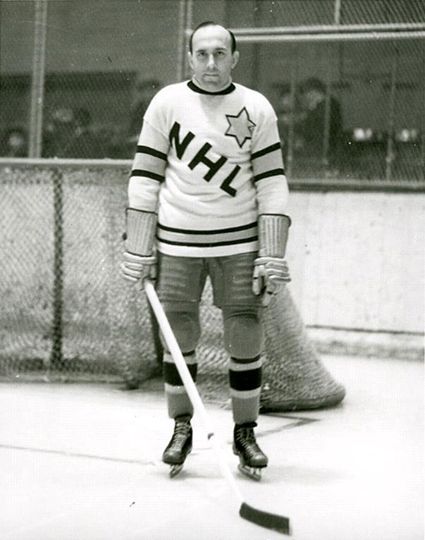
Today's featured jersey is a 1934 NHL All-Star Ace Bailey Benefit Game jersey as worn in the first All-Star contest in NHL history, a charity event to raise money for injured Toronto star Ace Bailey.

This jersey is the first special jersey worn by an NHL All-Star team and is currently on display in the Hockey Hall of Fame in Toronto.

1934 NHL ACE Bailey NHL All-Star Jersey

Bonus Jersey: Today's bonus jersey is a 1934 Toronto Maple Leafs "ACE" jersey as worn by the Maple Leafs during the Ace Bailey benefit game, the precursor to the modern NHL All-Star Game. This particular sweater is a modern remake of the Maple Leafs original version.

1934 Tornoto Maple Leafs ACE jersey

Today's video section is a look at the 1934 Ace Bailey Benefit Game, held in Toronto's Maple Leaf Gardens.


Our next video is a brief recollection on the passing of Howie Morenz in 1937.

Monday, January 25, 2016

1934 NHL All-Star Ace Bailey Benefit Game Jersey

Today begins All-Star Week here at Third String Goalie as we count down the days until Sunday's 61st NHL All-Star Game hosted by the Nashville Predators.

The first of four All-Star type games prior to it becoming an annual tradition took place way back on January 8, 1908 as a benefit for the family of Hod Stuart, who died in a drowning accident three months after the Wanderers won the Stanley Cup. In that first game, the Montreal Wanderers faced off against a team of All-Star players from the Eastern Canada Amateur Hockey Association

It would be nearly 26 years later before the first All-Star style game would take place featuring players of the National Hockey League. This game was again another benefit game as a result of Eddie Shore violently retaliating for a hard check by Red Horner of the Toronto Maple Leafs. The enraged Shore hit the Maple Leafs Irvine "Ace" Bailey from behind, which caused Bailey to flip over backwards and hit his head on the ice so hard it fractured his skull and sent him into convulsions. His injuries were so severe, it not only ended Bailey's playing career, a priest in attendance administered the last rites. Bailey underwent several operations to save his life and eventually spent a month in the hospital before being able to return home to Toronto.

Two months later a benefit game for Bailey and his family was held at Maple Leaf Gardens in Toronto when the Maple Leafs took on a squad made up of All-Stars from the eight other clubs in the NHL at the time, two from each team. As part of the event, Bailey's #6 was retired by the Maple Leafs, the first number ever retired in NHL history.

The lasting image from the game is the cordial handshake which took place between Bailey and Shore to a resounding ovation from the crowd.

Ace Bailey Eddie Shore handshake
Bailey greets Shore to a rousing ovation prior to the game. Note Shore wearing his usual Bruins sweater.

Prior to the game the All-Stars were introduced while wearing their NHL club sweaters, but after the introductions were concluded, Bailey, league President Frank Calder and New York Rangers owner Frank Patrick presented each player with his special NHL All-Star jersey. The Maple Leafs also wore special jerseys for the occasion, emblazoned with "ACE" diagonally across the front with the team logo on the upper left chest.

1934 NHL All-Star Game
A group shot of all the participants of the Ace Bailey Benefit Game with the NHL All-Stars now wearing their special All-Star sweaters for the contest

The game drew 14,074 fans and raised $20,909 for Bailey, who dropped the ceremonial first puck prior to the game, which was won by the Maple Leafs by a score of 7-3.

Bailey All-Star puck drop
Bailey drops the ceremonial puck prior to the benefit game in his honor

Following the 1934 benefit game for Ace Bailey, two more All-Star style games took place, the first being for the late Howie Morenz of the Montreal Canadiens, a participant in the Ace Bailey Benefit Game.

Morenz Memorial Game ticket
A ticket stub from the Howie Morenz Memorial Game

Morenz had died in the hospital in March, 1937, five weeks after breaking his leg in four places during a game. On November 3, 1937 a memorial game to raise money for Morenz's family was held at the Montreal Forum between a combined team of the Montreal Canadiens and Montreal Maroons versus a team comprised of the team of All-Stars from the six other NHL franchises of the day.

Morenz Memorial Game Maroons & Candiens
The combined team of Montreal Canadiens and Montreal Maroons

The game was won by the NHL All-Stars 6-5 and both teams again wore special sweaters for the occasion, but with somewhat less sartorial success than those worn in the Ace Bailey Benefit Game, particularly the stark white sweaters worn by the NHL All-Stars.

Morenz Memorial Game Canadiens Jersey
The sweater worn by the combined Montreal Clubs in the 1937 Howie Morenz Memorial Game

Morenz Memorial Game All-Star Jersey
The sweater worn by Mush March of the NHL All-Stars in the 1937 Howie Morenz Memorial Game

Morenz Memorial Game All-Star Jersey
The rear view of the NHL All-Stars sweater, quite possibly the plainest, dare we say boring, sweater in hockey history

One last memorial game took place on October 29, 1939 to benefit the family of Babe Siebert, a 14 year NHL veteran who was named coach of the Montreal Canadiens upon his retirement as a player, who drowned in Lake Huron on August 25, 1939 before he was ever able to coach the Canadiens.

The game featured the NHL All-Stars against the Montreal Canadiens and was won by the All-Stars by a score of 5-2 and raised $15,000 for his family, which included Siebert's wife, who was paralyzed from the waist down.

While the Canadiens wore their normal game sweaters, the All-Stars were again given special sweaters for the game, which left no doubt as to which team the All-Stars were, thanks to it's bold star logo on the chest. This made for a much more pleasing result, especially with the addition of the black and orange trim, than the previous Morenz Game sweaters.

Siebert Memorial Game All-Star Jersey
Ebbie Goodfellow's 1939 NHL All-Star jersey from the Babe Siebert Memorial Game

Today's featured jersey is a 1934 NHL All-Star Ace Bailey Benefit Game jersey as worn in the first All-Star contest in NHL history, a charity event to raise money for injured Toronto star Ace Bailey.

This jersey is the first special jersey worn by an NHL All-Star team and is currently on display in the Hockey Hall of Fame in Toronto.

1934 NHL ACE Bailey NHL All-Star Jersey

Bonus Jersey: Today's bonus jersey is a 1934 Toronto Maple Leafs "ACE" jersey as worn by the Maple Leafs during the Ace Bailey benefit game, the precursor to the modern NHL All-Star Game. This particular sweater is a modern remake of the Maple Leafs original version.

1934 Tornoto Maple Leafs ACE jersey

Today's video section is a look at the 1934 Ace Bailey Benefit Game, held in Toronto's Maple Leaf Gardens.


Our next video is a brief recollection on the passing of Howie Morenz in 1937.

Monday, April 6, 2015

The History of the NHL Single Season Scoring Record

The National Hockey League made it's debut in 1917 with a 22 game schedule. Joe Malone of the Montreal Canadiens (on loan from the dormant Quebec Bulldogs) set the standard by leading the league in scoring with 44 goals and 4 assists for 48 points, an average of two goals per game!

Joe Malone photo Joe Malone Canadiens 1917-18.jpg
Joe Malone set the first NHL scoring record in 1917-18

Two seasons later in 1919-20, Malone would raise the bar by a point following his 39 goal, 10 assist effort for 49 points in a now 24 game schedule while back with the revived Quebec franchise.

The NHL had changed dramatically by the 1927-28 season, expanding from four clubs to now ten with the additions of the Montreal Maroons, New York Americans, Boston Bruins, New York Rangers, Pittsburgh Pirates, Detroit Cougars and Chicago Black Hawks to the Canadiens, Ottawa Senators and Toronto Maple Leafs. This necessitated a now longer 44 game schedule and Howie Morenz of the Canadiens took over the league record for single season point scoring with 33 goals and 18 assists for 51 points, bettering Malone's eight year old mark of 49.

Howie Morenz photo Morenz Canadiens.jpg
Howie Morenz

Morenz's record would be obliterated two seasons later when rule changes allowed forward passing in the offensive zone and temporarily removed the offside rule. Players camping out in front of the opponents goal led to the rule being reinstated by mid-season. The Boston Bruins Cooney Weiland was the biggest beneficiary of the new offensive freedom and scored 43 goals and 30 assists in 44 games for a new league record of 73 points, 22 more than Morenz just two seasons earlier.

Cooney Weiland photo Weiland Bruins.jpg
Cooney Weiland brought the scorning record to the United States

Weiland's mark would remain the standard for over a decade. By the time World War II arrived, the NHL had contracted back to what is now known as the Original 6, while the season schedule had expanded to 50 games. Doug Bentley of the Chicago Black Hawks tied Weiland's record of 73 in 1942-43 with 33 goals and 40 assists.

Doug Bentley photo Doug Bentley Blackhawks.jpg
Doug Bentley equalled the scoring record in 1943

One season later, Herb Cain of the Bruins put together the season of his life with a 36 goal, 46 assist campaign for 82 total points after just 36 the season before and never exceeded 45 in the final two seasons of his career. Despite breaking Weiland's 14 year old record, Cain remains the only eligible former NHL scoring champion not inducted into the Hockey Hall of Fame.

Cain Bruins photo CainBruins3.jpg
Herb Cain

Cain's stellar season would remain the record for seven seasons until Gordie Howe of the Detroit Red Wings, playing in his fifth NHL season, raised the mark to 86 points with 43 goals and 43 assists in 1950-51 in what was now a 70 game schedule, finishing a clear 20 points ahead of second place Maurice Richard,

Howe equalled his 86 points the following year with 47 goals and 39 assists in 1951-52 before beating his own league record with a 49 goal, 46 assist season for 95 points, a dominant 24 points clear of Detroit teammate Ted Lindsay. Howe would lead the league in points again the next season for four consecutive scoring titles and once more in 1957 for five in seven years.

Gordie Howe photo Howe Red Wings.jpg
The legendary Gordie Howe raised the scoring record twice

Six seasons after Howe set the record at 95 points, Dickie Moore would return the league record to the Canadiens when his 41 goals and 55 assists in 1958-59 eclipsed Howe by a single point with 96 in what was still a 70 game schedule.

Dickie Moore photo Dickie Moore Canadiens_1.jpg
Dickie Moore was the last of three Canadiens to hold the record

Moore's record would stand the test of time for a decade until the game saw it's first 100 point scorer in 1968-69. While Bobby Hull of Chicago set a new goal scoring record with 58, it was Phil Esposito of the Bruins who destroyed the old mark with his record shattering 126 points from 49 goals and 77 assists in a 76 game schedule. Both Hull (107) and Howe (103) also surpassed the 100 point mark that season to usher in a new era of offense in the NHL.

Phil Esposito photo Esposito Bruins 1.jpg
Phil Esposito was the first man to reach 100 points in an NHL season

Esposito easily broke his own record in 1970-71 when he set new records for goals and points with 76 goals and 76 assists for 152 points in a 78 game schedule, 13 clear of teammate Bobby Orr, who took away the MVP honors despite Esposito's scoring record.

Phil Esposito photo Esposito Bruins 2.jpg
Esposito was the third Bruin to set the scoring record

It would be another 10 years before the arrival of The Great One, Wayne Gretzky, would seize the record, first with a 164 point season from 55 goals and 109 assists in his second season in the NHL, 1980-81, in an 80 game schedule. Gretzky's 109 assists broke Orr's record of 102 set back in 1970-71.

Wayne Gretzky photo Gretzky Oilers 1.jpg
Wayne Gretzky rewrote the record books

Gretzky broke his own record the following season of 1981-82. He announced his intentions of setting a new record when he scored 50 goals in just 39 games! He eventually finished the season by defeating Esposito's record of 76 goals with a new mark of 92 goals, which still stands to this day and remains the only 90 goal season in NHL history. Gretzky also blew away his record of 109 assists with 120 for a total of 212 points, shattering his own record for single season points by an amazing 47 points and becoming the first, and still only, player to ever reach 200 points.

Wayne Gretzky photo Gretzky Oilers 2.jpg
Gretzky led the Oilers to four Stanley Cups

After two more 200 point seasons, Gretzky then set the NHL record on this date in 1986 when the Oilers defeated the Vancouver Canucks 3-2 with Gretzky picking up an assist, his 163rd of the season to break his own single season assist record. He also added 52 goals for a combined 215 points, a single season points scoring record which remains unbeaten now 29 seasons later, as the wide open, firewagon hockey of the 1980's has given way to improved goaltending and defensive systems, which has resulted in no player leading the league with even 130 points since 1996 and as few as 94 points in a full 82 game season in 2003-04.

Wayne Gretzky photo Gretzky trophies.jpg
Gretzky with the Art Ross Trophy (left) as the scoring champion
along with the Stanley Cup and Hart Trophy as league MVP

**********

The Evolution of the NHL Single Season Scoring Record

Joe Malone - 1917-18 - 48 points
Joe Malone - 1919-20 - 49
Howie Morenz - 1927-28 - 51
Cooney Weiland - 1929-30 - 73
Doug Bentley - 1942-43 - 73
Herb Cain - 1943-44 - 82
Gordie Howe - 1950-51 - 86
Gordie Howe - 1951-52 - 86
Gordie Howe - 1952-53 - 95
Dickie Moore - 1958-59 - 96
Phil Esposito - 1968-69 - 126
Phil Esposito - 1970-71 - 152
Wayne Gretzky - 1980-81 - 165
Wayne Gretzky - 1981-82 - 212
Wayne Gretzky - 1985-86 - 215

Today's featured jersey is a 1985-86 Edmonton Oilers Wayne Gretzky jersey as worn the season Gretzky set the NHL single season scoring record, which has now stood the test of time for nearly 30 years.

The Oilers changed the colors of their crest to a higher contrast and much more pleasing blue letters on a white background, rather than the orange background of their final WHA jerseys, in 1979-80 when they entered the NHL. In 1981-82 the shade of blue became lighter and the jerseys remained unchanged through the 1995-96 season, which included the team's dynasty of five Stanley Cups in seven seasons.

 photo Edmonton Oilers 1985-86 jersey.jpg
 

hit counter for blogger