History of Jersey 83-93 Banner sm photo History of Jersey 83-93 Banner sm.jpg
Showing posts with label Koivu Saku. Show all posts

Monday, May 22, 2017

The 2017 IIHF Hall of Fame Induction Ceremony

Yesterday was the 2017 IIHF Hall of Fame Induction Ceremony, which saw six outstanding players inducted.

 photo 2017 IIHF HOF Class.png
The IIHF Hall of Fame Class of 2017

First, was Saku Koivu, who began his international career for Finland at the 1992 European U18 Junior Championships. In 1993 he played in both the World Junior Championships as well as making his senior level World Championships debut. 1994 saw Koivu again play in the World Juniors before earning his first international medal with a bronze medal at the 1994 Olympics in Lillehammer, Norway at the age of 19. Later that spring, he won another medal, this time a silver at the World Championships.

 photo koivu Finland.jpg
Saku Koivu won an Olympic bronze medal in 2010

He was named as one of Finland's assistant captains for the 1995 World Championships, where he finished second in scoring with 5 goals and 10 points in 8 games as Finland won their first ever gold medal at the World Championship.

In 1996, Koivu played in the first World Cup of Hockey before he captained Finland to a bronze medal at the 1998 Olympics in Nagano, Japan where tied for the team lead in points with 10 in six games. He earned another silver medal at the 1999 World Championships, again as Finland's team captain.

His next international competition would come at the 2003 World Championships after missing the 2002 Olympics while overcoming cancer. This was followed by a second place finish at the 2004 World Cup of Hockey, both again as team captain.

Koivu played in his third Olympics in 2006 in Torino, Italy, where he again tied for the team scoring lead with 11 points in 8 games while once again captain of Finland.

His final World Championships in 2008 saw him add another bronze to his collection before his final international appearance for Finland, this coming at the 2010 Olympics in Vancouver, Canada, where he captained Finland to a bronze medal.

In all, Koivu played in 20 games at the junior level in international competition, scoring 7 goals and 26 points. At the senior level, he played in 89 games, scoring 30 goals and 94 points. He played in one European U18 Championship, two World Juniors, seven World Championships, earning a bronze, two silver and a gold medal, one World Cup, with a second place finish, and four Olympics, winning three bronze and a silver. He was named Best Forward at the World Championships in 1995 and 1999, and led the 1998 and 2006 Olympics in scoring.

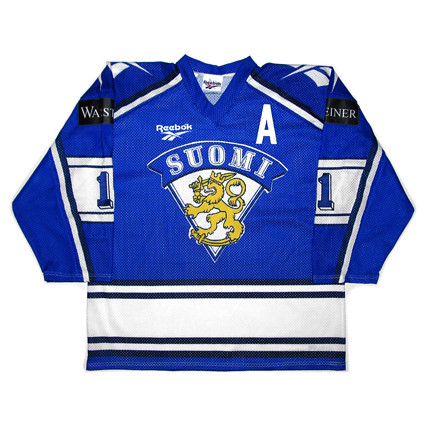
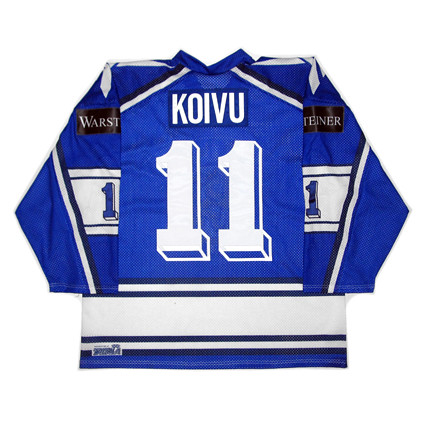
Today's featured Koivu jersey is a 1995 Finland National Team Saku Koivu jersey. This is the same style jersey used in the 1994 Olympic games and, while branded as a Reebok jersey, they were produced by Tackla using their mesh fabric and dye sublimation process. Visually, the only difference  between the Olympic jerseys and the World Championship version is the addition of the Warsteiner sponsorship patches to each arm.

Finland 1995 road jersey photo Finland 1995 R F.jpg
Finland 1995 road jersey photo Finland 1995 R B.jpg

The next player to be inducted into the IIHF Hall of Fame was German Uwe Krupp, whose international career began during the days of separate teams for East and West Germany, with Krupp first suiting up for the West Germans at the 1983 U18 European Junior Championships and the U20 World Junior Championships. He played in a second U20 World Juniors in 1985.

 photo Krupp.jpg
Uwe Krupp

Krupp, a defenseman, made his World Championship debut in 1986 with his second World Championships coming in 1990, his last for the West Germans.

By the time of the 1998 Olympics in Nagano, Japan, Germany had reunified and Krupp was able to make his Olympic debut thanks to the pros of the NHL now being allowed to compete.

Krupp, a defensive defenseman, scored 2 goals and 4 assists in his 21 international games. He also had a 15 year NHL career which included becoming the first German to win the Stanley Cup in 1996 followed by winning a second in 2002.

Following his playing career, Krupp returned to Germany and eventually became head coach of the German National Team from 2005 to 2011 at many levels, including the World Juniors, World Championships and Olympics, which included guiding the Germans to a semifinal appearance at the 2010 World Championships, their best result since 1976.

Today's featured Krupp jersey is a 1998 Germany National Team Uwe Krupp jersey. This style jersey was only worn at the 1998 Olympics with the heraldic eagle crest. Later in 1998 at the World Championships, the crest was changed to that of the German Ice Hockey Federation and worn through the 2000 World Championships.

Germany 1998 Olympic jersey photo Germany1998OLYF.jpg
Germany 1998 Olympic jersey photo Germany1998OLYB.jpg

 The third member of the Class of 2017 is Canadian Joe Sakic, whose international resume begins with the 1988 World Junior Championships, where Canada went 6-0-1 to win the gold medal.

 photo Sakic Canada.jpg
Sakic making his Olympic debut in 1998

Sakic appeared at his first World Championships in 1991, leading Canada with 6 goals and 11 points in 10 games on the way to a silver medal.

His next World Championships came in 1994 where Sakic was third in team scoring with 4 goals and 7 points in 8 games as Canada would go 8-0 to win their first gold medal in 33 years following a shootout in the final.

The next time Sakic would wear the maple leaf for Canada was at the 1996 World Cup of Hockey, where the Canadians would finish second.

Sakic's first Olympic Games came in 1998 followed by winning gold in his second Olympics in 2002 in Salt Lake City, Utah. After going 1-1-1 in group play, the Canadians would find their game with Final Round wins over Finland, Belarus and the host United States as Sakic was named the tournament's MVP.

Sakic's gold medal at the 2002 Olympics gained him entry into the exclusive Triple Gold Club for players who have won World Championship gold, Olympic gold and the Stanley Cup, which he accomplished with the Colorado Avalanche in 1996 and 2001.

He would add to his already impressive resume by winning the 2004 World Cup of Hockey, where he tied for second place in scoring with 4 goals and 6 points in 6 games.

After being an assistant captain for the 1998 and 2002 Canadian Olympic teams, Sakic was chosen to captain Canada for his final international tournament, the 2006 Olympics in Torino, Italy.

In all, Sakic played in 48 international games at the senior level, scoring 22 goals and 41 points.

While his World Championship opportunities were limited by the successful teams he was a part of during his 20 year NHL career, 17 of which were as captain of the Quebec Nordiques and Avalanche, he is record is a stellar one, with gold medals at the World Juniors, World Championships and Olympics along with a World Cup and two Stanley Cups.

Today's featured Sakic jersey is a 1994 Canada National Team Joe Sakic jersey as worn during the 1994 World Championships during which Canada ended their 33 year World Championship drought.

The jersey is a Finnish made by Tackla, but branded as a Reebok jersey The jersey was produced using the dye sublimation process, in which all the graphics are created by injecting ink into the fabric, which is then cured with heat. This jersey also sports a pair of Warsteiner Beer sponsorship logos, giving the jersey it's unique World Championships look, as jerseys worn during the Olympics are free from advertising.

This multi-striped style was a short-lived one and used only for the 1994 and 1995 World Championships, as Nike arrived on the scene with all new designs for the 1996 World Championships.

1994 Canadian National Team Joe Sakic Jersey

The fourth member of this year's IIHF Hall of Fame Class Koivu's fellow Finn, Teemu Selanne. The Finnish Flash made his international debut at the 1988 European U18 Junior Championships, where he led all players in scoring with a dominating 7 goals and 16 points in just six games as Finland won the silver medal.

 photo Selanne Finland.jpg
Selanne went out in style, winning a medal and being
named the tournament MVP at the 2014 Olympics

Selanne played in one U20 World Junior Championship in 1989, tying for the team lead with 10 points in 7 games.

He made his debut at the senior level at the 1991 World Championships, finishing one assist back of Jari Kurri for the team lead in points. Later that fall, Selanne was a member of the Finnish team at the 1991 Canada Cup.

Selanne made his Olympic debut at the 1992 Games in Albertville, France, coming in fourth in tournament scoring while leading the Finns with 7 goals and 11 points in 8 games.

In 1996, he returned to the World Championships, where he led Finland in scoring with 5 goals and 8 points in 8 games. Later that year, he played in the inaugural 1996 World Cup of Hockey as Finland's assistant captain.

He earned the second medal of his career at the 1998 Olympics, bringing back a bronze after leading all scorers with 4 goals and 10 points while playing in just 5 games compared to as many as 7 for other players.

Selanne came in second in scoring to Koivu at the 1999 World Championships with 3 goals and 11 points back of Koivu's 16, but it was Selanne who took home the tournament MVP honors while winning a silver medal.

In 2002, he played in the Olympic Games in Salt Lake City, scoring 3 goals in 4 games. He led Finland in scoring at the 2003 World Championships with 8 goals and 11 points in seven games as team captain for the Finns.

Selanne then took part in the 2004 World Cup of Hockey before returning to the Olympics in 2006, leading all players in goals, with 6, and points, with 11, as Finland finished with the silver medal and Selanne was named as the Top Forward.

He came home with a bronze medal at the 2008 World Championships after coming in second in scoring with 7 points in 9 games.

After playing at the 2010 Olympics in Vancouver, British Columbia and winning a bronze medal, Selanne participated internationally one final time, this coming at 2014 Olympic Games in Sochi, Russia, where he won a bronze medal as Finland's team captain. His 4 goals and 6 points were one point back of the team leader as the Finns would win their third consecutive Olympic medal, this time a bronze, the fourth Olympic medal of Selanne's illustrious national career as he set a record as the oldest player to ever win a medal in Olympic hockey at the age of 43. Selanne was then named the tournament's Most Valuable Player.

Selanne concluded his international career with 96 games played, scoring 54 goals and 102 points and holds the record for the most points in Olympic hockey competition with 24 goals and 43 points in 37 games.

Today's featured Selanne jersey is a 2014 Finland National Team Teemu Selanne jersey as worn during his final international tournament, the 2014 Olympics, his sixth Olympic Games.

This highly unusual full bleed flag style was worn only at the 2014 Olympic Games in Sochi, Russia. It was paired with a more conventional road blue jersey. For the subsequent World Championships later that spring, the Finns wore a white version of their blue road jersey, ending the use of this style after just one outing.

 photo Finland 2014 F.jpg
Finland 2014 Olympic jersey photo Finland 2014 B.jpg

The final player inducted into the IIHF Hall of Fame this year was American Angela Ruggiero, who played in ten IIHF Women's World Championships, winning four gold medals and six silver medals, including scoring the winning goal in a shootout in 2005 to give the United States its first gold medal.

Ruggiero also participated in four Olympic Games, winning gold in 1998 as the youngest member of the team at 17 years of age, and winning silver in 2002 and 2010 and a bronze in 2006.

In 2004, she won the Patty Kazmaier Award as the top player in US Women's College Hockey. She became the fourth woman to ever be inducted into the Hockey Hall of Fame in 2015 and the only inductee ever from California. She is also the all-time leader in games played for the United States, regardless of gender, with 256.

 photo Ruggiero USA.jpg
Angela Ruggiero

Dieter Kalt, Sr. of Austria was inducted into the Builders category. A star player in the Austrian league in the 1960's, he won five championships in six seasons with Klagenfurt with a career that spanned from 1957 to 1980. He played for Austria in eight World Championships and two Olympics, in 1964 and 1968, the second time as the team captain.

From 1996 to 2016, Kalt was the President of the Austrian Ice Hockey Federation and has been a long time member of the Austrian Olympic Committee.

 photo Dieter_Kalt.jpg
Dieter Kalt, Sr.

Finally, the winner of the Bibi Torriani Award for players who have had great international careers from nations outside of the top hockey nations was Tony Hand of Great Britain. Four times during his domestic career in the British Hockey League, Hand had seasons of over 200 points, with a high of 222 points from 72 goals and 150 assists in a 44 game season!

 photo Tony Hand.jpg
British scoring legend Tony Hand

In addition to his scoring exploits of 15 seasons of over 100 points, longevity was also a hallmark of Hand's career, as he played 32 seasons of British domestic hockey in a career that spanned from 1981-82 as a 14 year old to the 2014-15 season, when he retired at the age of 47. So impressive was Hand's abilities, that he was drafted by the Edmonton Oilers in 1986, the first British-trained player ever selected in the NHL Draft.

He played for Great Britain at the World Championships 10 times, the World Juniors 3 times and the European U18 Junior Championships 4 times. At the senior level, he played in 52 games, scoring 34 goals and 105 points.

In 2004, Hand became the first ice hockey player ever honored with the Member of the Order of the British Empire by Queen Elizabeth II.

Sunday, May 7, 2017

Finland Wins Their First World Championship - 1995 Finland National Team Ville Peltonen Jersey

On this date in 1995, Finland won the IIHF World Championship for the first time in their history. The script could hardly have gone any better for Finland, as they defeated arch rivals Sweden in Sweden.

Finland has a long history in the World Championships and Olympics, first appearing in 1939 and being regular participants since 1949, but did not earn their first medal until 1988 with a 2-1 win over the Soviet Union at the Olympics in Canada, a span of nearly 40 years. Their first World Championship success would come in 1992 with a silver medal in Czechoslovakia after a loss in the final game to Sweden.

They followed that with a disappointing 7th place at the World Championships in 1993, their lowest finish since 1983, before rebounding with another silver in 1994 in Italy, after losing in the final in a shootout to Canada, just three months after earning a bronze medal at the Olympics in Norway.

Now having arrived as serious contenders on the international stage, they entered the 1995 World Championships aiming for the top after their previous close calls. The Finns were led by a line known as "Tupu, Hupu and Lupu", Finnish for Huey, Dewey and Louie, the nephews of Disney cartoon character Donald Duck.

Tupu,Hupu and Lupu

Jere Lehtinen (Lupu), made his international debut at age 19 in the 1992 World Championships, Saku Koivu (Tupu) arrived in 1993, at age 19, in the World Championships and Ville Peltonen (Hupu) completed the line when they all played together in Pelotnen's international debut at the 1994 Olympics at age 20.

While Finland's past history was barren of medals and championships, "Tupu, Hupu and Lupu" entered the 1995 World Championships with Lehtonen (two silvers and a bronze in three years of international experience), Koivu (a silver and a bronze in two years) and Peltonen (a silver and a bronze after one year) as winners with high expectations.

Those expectations met with a rude awakening in the form of a 3-0 shutout loss to the Czech Republic in their opening game. They quickly got back on the right track with a decisive 6-3 win over rivals and tournament hosts, Sweden. They took care of business with expected wins over Norway (5-2) and Austria (7-2). They completed their First Round group play with a 4-4 tie with the United States, taking second place in the group.

Finland easily advanced in the quarterfinals with a 5-0 win over France and got revenge for their only loss of the tournament against the Czech Republic in the form of another 3-0 shutout, only this time in favor of Finland, setting up the gold medal final against hosts Sweden.

Peltonen was the star of the show, scoring the first goal to put Finland ahead in the first period after making a drop pass at the blueline and then putting the rebound of a teammate's blast into a wide open goal.

Peltonen goal #1 photo Peltonen Koivu celebrate 1995.jpg
Peltonen and Koivu celebrate the first Finnish goal

During the second period Peltonen got his second goal after receiving a pass from center ice at the blueline, he simply wound up and fired a slapshot past the Swedish goaltender, launching his water bottle like a celebratory firework into the air to put Finland up 2-0.

Peltonen then completed the natural hat trick after a beautiful play after Peltonen gained the Sweden zone on the right, made a drop pass back to Koivu who made a cross-ice pass to defenseman Mika Stromberg who was streaking in unguarded on the left. Stromberg blew around the flat footed Swedish defense, cut to the net, slammed on the brakes and tried to move the puck from his backhand to his forehand, but lost control of the puck, which slid right across the crease to Peltonen, now stationed on the right side of the goal, for another easy tap in with just four seconds remaining in the second period give Finland a three goal lead heading into the final period.

Peltonen goal #3 photo Finland Goal 1995.jpg
Stromberg and Koivu celebrate as Peltonen is elated
after completing his hat trick

Not quite finished yet, Peltonen assisted on the fourth Finnish goal when he fed the puck back to the blueline and defenseman Timo Jutila fired the puck through everyone for a back-breaking 4-0 lead and a goal celebration that took him the length of the ice.

Sweden was able to spoil the shutout to make the final score 4-1 after a fluky, high arching deflection was misplayed by Jarmo Myllys, who otherwise stood tall in goal, earning the victory for the new World Champions.

 photo Finland gold 1995.jpg
The party has only just begun as Finland poses
after winning their first world championship

Lehtonen, Koivu and Peltonen were all named to the tournament All-Star Team, with Koivu being named Best Forward. To rub their victory in, the coach of the Finnish team, Swede Curt Lindström, took his team to Sergels torg, the central public square in Stockholm, the site for public recognition of Swedish sporting success, and brought 15,000 wildly celebrating Finnish fans with to share in the joy, which they did by singing the official Swedish song of the 1995 World Championship, "Den Glider In"

Finland received a massive welcome home back in Tampere, Finland, with the celebrations being televised on live TV to a national audience.

Photobucket

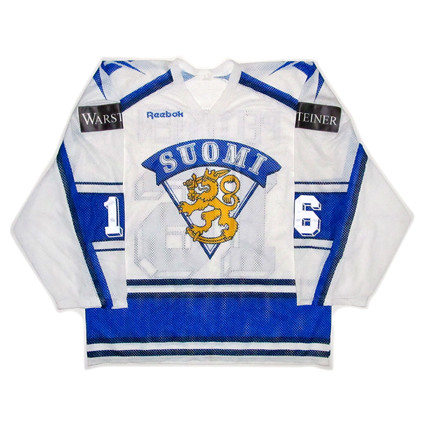
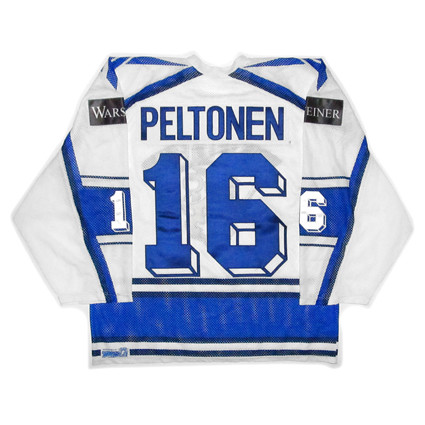
Today's featured jersey is a 1995 Finland National Team Ville Peltonen jersey. This is the home white version as worn during the 1995 World Championships, differentiated from the 1994 Olympics by the Warsteiner beer sponsorship patches on the upper arms.

Finland 1995 home jersey photo Finland 1995 H F.jpg
Finland 1995 home jersey photo Finland 1995 H B.jpg

Bonus jersey: Today's bonus jersey is a 1995 Finland National Team Saku Koivu jersey. This is the same style jersey used in the 1994 Olympic games and, while branded as a Reebok jersey, they were produced by Tackla using their mesh fabric and dye sublimation process. Visually, the only difference  between the Olympic jerseys and the World Championship versions are the additions of the Warsteiner sponsorship patches to each arm.

Finland 1995 road jersey photo Finland 1995 R F.jpg


Finland 1995 road jersey photo Finland 1995 R B.jpg

Here are the highlights from the 1995 World Championship gold medal final between victorious Finland and Sweden.


Here are scenes of the massive celebration on their return home to Finland, as they continue to adopt "Den Glider In" as their own. Don't miss the guy playing air guitar with the then World Championship trophy!

These scenes are proof that while the NHL might not take the World Championships nearly as seriously as they do the Olympics, it clearly still matters to Europeans.

Thursday, March 16, 2017

St. Urho's Day

While many anticipate tomorrow's celebration of Irish and Irish-American culture, St. Patrick's Day, who is said to have driven all the snakes out of Ireland, many are unaware that today is a similar celebration of Finnish culture, St. Urho's Day.

St Urho logo

In reality, St. Urho is a fictional saint of Finland, whose legend was the invention of Finnish-American Richard Mattson of Virginia, Minnesota in 1956. Mattson invented St. Urho when questioned by coworker Gene McCavic about the Finns lack of a saint similar to St. Patrick for the Irish.

Mattson and McCavic wrote an "Ode to St. Urho", in which he was to have supposedly cast the frogs out of Finland, similar to St. Patrick and the snakes of Ireland. The original St. Urho's Day was set to May 24th, but later changed to today, March 16th, the day before St. Patrick's Day, with credit to high school teacher Kenneth Brist and friends in an effort to have two days to celebrate, what with St. Patrick's Day being the very next day.

Not only did the date of St. Urho's Day change, but so did the legend under the influence of Dr. Sulo Havumaki, a professor at Bemidji State College in Bemidji, Minnesota, as the legend of St. Urho now credits the fictional saint with driving all the grasshoppers out of Finland, thus saving the Finnish grape crop, and therefore the country's supply of wine by chanting "Heinäsirkka, heinäsirkka, mene täältä hiiteen", which translates to "Grasshopper, grasshopper, go to hell!"

St. Urho's Grapes and Grasshopers
St. Urho is said to have saved the Finnish grape crop
by driving the Grasshoppers out of Finland

In addition to celebrating Finnish heritage and culture, as well as being an excuse to drink somewhat heavily, like the wearing of the green by the Irish, St. Urho's celebrants traditionally wear Royal Purple and Nile Green.

There has even been a book published on St. Urho, The Legend of St. Urho, which chronicles the origins and folklore of the man, the myth and the legend of St. Urho.

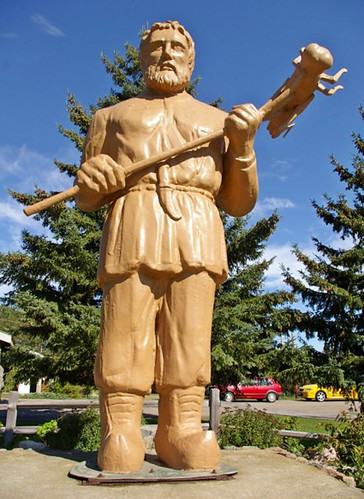
St Urho Menahga, MN
The statue of St. Urho in Menahga, Minnesota

The Finland National Team first appeared at the World Championships back in 1939. Their next appearance was not until 1949 when they became regulars at the World Championships. A perennial mid-pack team, it took them until 1992, a span of over 40 years, to earn their first medal of any kind. Once the floodgates opened, they captured silver in 1992 and 1994 before reaching the pinnacle with World Championship gold in 1995.

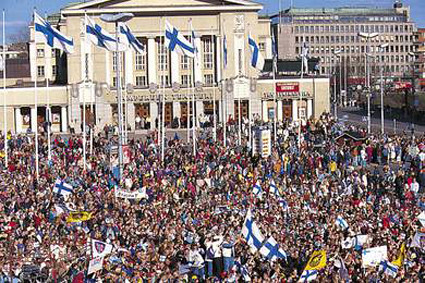
Finland 1995 Celebration
Finland celebrates their first World Championship after arriving back home

Two fifth places in 1996 and 1997 followed before a run of four medals in row with silver in 1998 and 1999, bronze in 2000 and silver once more in 2001. A bit of a slide saw then finish 4th, 5th, 6th then 7th from 2002 through 2005 before returning to the medal podium with bronze in 2006, silver in 2007 and bronze again in 2008. Finland won their second gold medal in 2011, captained by Mikko Koivu. Two more silver medals have since followed in 2014 and in 2016.

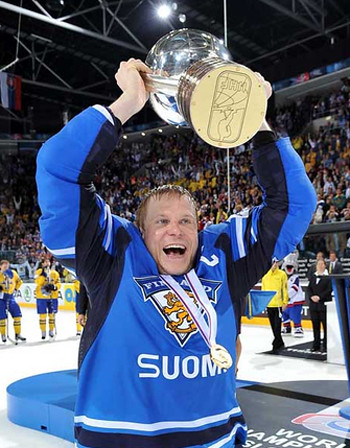
2011 IIHF World Championship
Finland's captain Mikko Koivu is thrilled to hoist
the World Championship trophy

Finland's hockey team first appeared at the Winter Olympics in 1952, and aside from 1956, has appeared in each Olympic hockey tournament since, becoming a regular medal contender in the mid 1970's, with a fourth places in 1978 and 1980. They won their first medal in 1988 with a silver and took bronze in both 1994 and 1998. In 2006 they again won silver followed by bronze medals in both 2010 and 2014 to give them medals in three consecutive Olympics for the first time.

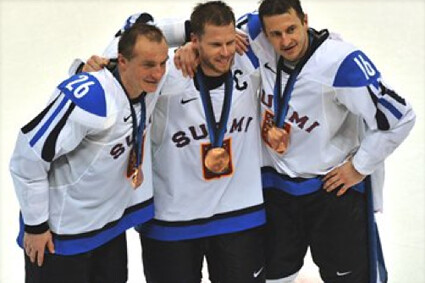
Lehtinen, Koivu and Peltonen 2010
Jere Lehtinen, Saku Koivu and Ville Peltonen enjoying their final success as
a trio at the 2010 Olympics in Vancouver where they won bronze medals

Finland has also participated in the Canada Cup and it's successor, the World Cup of Hockey, taking home the silver medal in the 2004 World Cup in the seven times it has competed.

The Finland National Team has now retired the numbers of #14 Raimo Helminen, #17 Jarri Kurri, #8 Teemu Selanne, #11 Saku Koivu, 26 Jere Lehtinen and #16 Ville Peltonen.

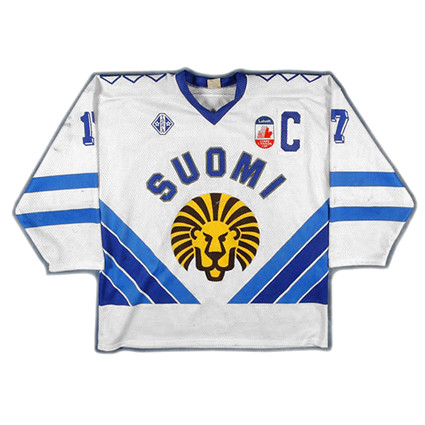
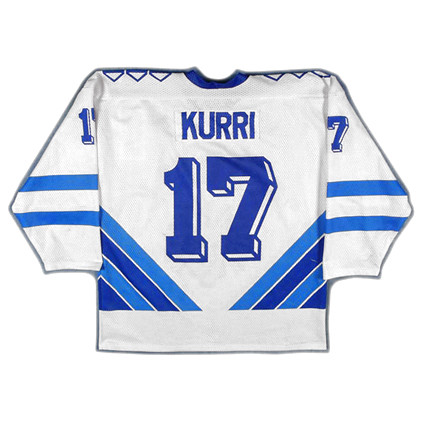
Today's first featured jersey is a 1991 Finland National Team Jari Kurri jersey as worn in the 1991 World Cup. This jersey was produced by Tackla out of Finland and features a short-lived cartoonish lion's head logo, which was actually the logo of a Finnish sponsoring bank, that was quickly replaced by a new shield-style logo which remains in use today.

Finland 1991 Kurri F
Finland 1991 Kurri B

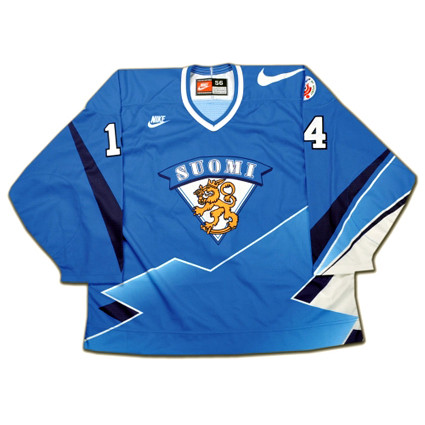
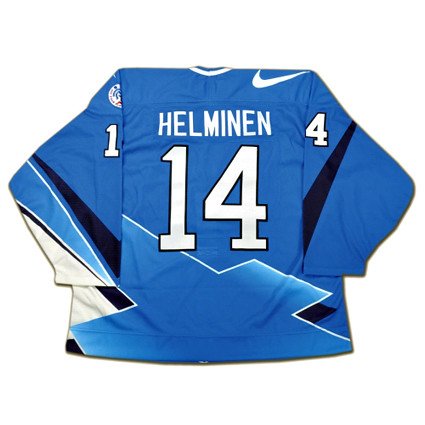
Today's second featured jersey is a 1996 Finland National Team Raimo Helminen jersey from the inaugural World Cup of Hockey. Note that this is a #14 jersey, not the #41 Finland retired for Helminen. This attractive "waving flag" style of jersey marked Nike's entry into being the jersey supplier for the IIHF, which continues to this day. This style was worn through the 1997 World Championships until new styles were debuted for the 1998 Olympics.

Finland 1996 F jersey copy
Finland 1996 B jersey copy
photo courtesy of Classic Auctions

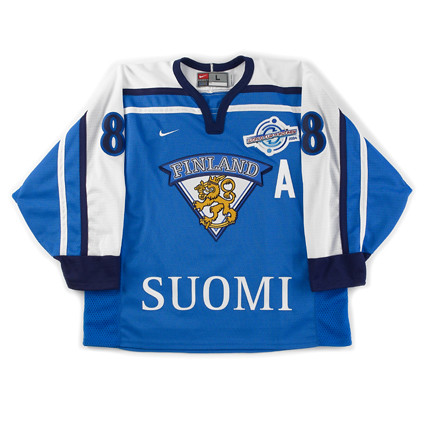
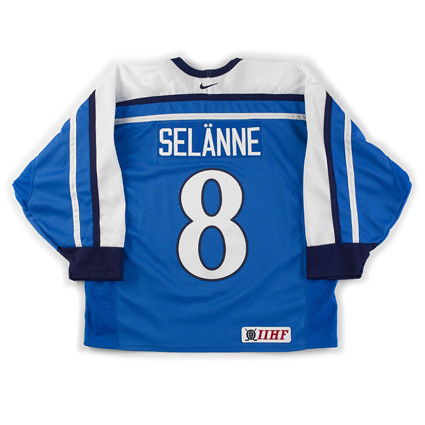
Today's third featured jersey is a 2004 Finland National Team Teemu Selanne jersey. Finland first wore this style for the 1998 Oympics in Nagano, Japan with the crest reading "Suomi". For the 2002 Olympics, the crest was altered to read "Finland" with Suomi now printed boldly across the waist. This would be the final appearance for this jersey, as Nike would introduce a new style for the 2005 World Championships.

2004 World Cup Team Finland  jersey
2004 World Cup Team Finland jersey

Today's fourth featured jersey is a 1995 Finland National Team Saku Koivu jersey. This is the same style jersey used in the 1994 Olympic games and, while branded as a Reebok jersey, they were produced by Tackla using their mesh fabric and dye sublimation process. Visually, the only difference between the Olympic jerseys and the World Championship versions are the additions of the Warsteiner sponsorship patches to each arm.

Finland 1995 R F
Finland 1995 R B

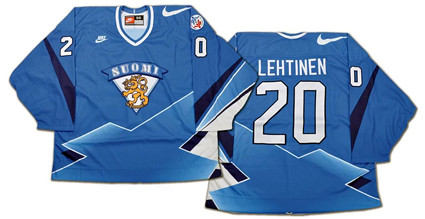
Today's fifth featured jersey is a 1996 Finland National Team Jere Lehtinen jersey. One year after Finland won the World Championship in a Reebok branded Tackla produced jersey, Nike became the official supplier to the IIHF for the World Championships and the Olympic Games. Following their debut at the 1996 World Championships in the spring, Nike also outfitted all of the teams at the inaugural World Cup of Hockey in the fall of 1996.

Their "waving flag" style of jerseys took Tackla's sublimation techniques to further extremes, as they introduced gradients to the international scene. These jerseys were also worn for the 1997 World Championships until being replaced by new styles for the 1998 Olympics in Nagano, Japan.

Finland 1996 WCOH jersey
photo courtesy of Classic Auctions

Today's sixth featured jersey is a 1995 Finland National Team Ville Peltonen jersey. This is the home white version of the blue road jersey shown above as worn during the 1995 World Championships, differentiated from the 1994 Olympics by the Warsteiner beer sponsorship patches on the upper arms.

Finland 1995 H F
Finland 1995 H B

In today's video section, Finland's finest moment in hockey, winning their first World Championship in 1995 against their rivals Sweden and in Sweden.


Here are highlights of Finland winning the 2011 World Championship.


Finally, a Finnish Nike commercial featuring Mikko Koivu, Ruutu, Selanne, Filppula and Peltonen.

Tuesday, December 6, 2016

Itsenäisyyspäivä - Finnish Independence Day

Itsenäisyyspäivä , or Finnish Independence Day, is celebrated with the customary public flag displays and decorations in the blue and white of the Finnish flag and most businesses remain closed for the day as people attend parades, concerts, festivals and street parties. There is also an annual military parade each year.

 photo Finland flag.jpg

The festivities begin with the traditional raising of the flag in Tähtitominmäki (Observatory Hill) in Helsinki, followed by a service at the Cathedral of Helsinki, where the President of Finland is present prior to hosting a televised banquet known as Linnan juhlat (The Party at the Castle) in the evening for around 2000 invited guests with war veterans in attendance as the guests of honor.

 photo Finland independence day.jpg

Some people still keep with the Finnish Independence Day tradition of putting two candles in the window at night, a sign in earlier days that invited friendly troops into that home for food and shelter and symbolize the light of freedom or one candle for home and the other for homeland.

 photo Finland two candles.jpg

The Finland National Team first appeared at the World Championships back in 1939. Their next appearance was not until 1949 when they became regulars at the World Championships. A perennial mid-pack team, it took them until 1992, a span of over 40 years, to earn their first medal of any kind. Once the floodgates opened, they captured silver in 1992 and 1994 before reaching the pinnacle with World Championship gold in 1995.

 photo Finlandcelebration.jpg
Finland celebrates their first World Championship after arriving back home

Two fifth places in 1996 and 1997 followed before a run of four medals in row with silver in 1998 and 1999, bronze in 2000 and silver once more in 2001. A bit of a slide saw then finish 4th, 5th, 6th then 7th from 2002 through 2005 before returning to the medal podium with bronze in 2006, silver in 2007 and bronze again in 2008. Finland won their second gold medal in 2011, captained by Mikko Koivu. Two more silver medals have since followed in 2014 and earlier this year in 2016.

Koivu Finland Trophy photo KoivuTrophy.jpg
Finland's captain Mikko Koivu is thrilled to hoist
the World Championship trophy

Finland's hockey team first appeared at the Winter Olympics in 1952, and aside from 1956, has appeared in each Olympic hockey tournament since, becoming a regular medal contender in the mid 1970's, with a fourth places in 1978 and 1980. They won their first medal in 1988 with a silver and took bronze in both 1994 and 1998. In 2006 they again won silver followed by bronze medals in both 2010 and 2014 to give them medals in three consecutive Olympics for the first time.

 photo Lentinen Koivu and Peltonen 2010.png
Jere Lehtinen, Saku Koivu and Ville Peltonen enjoying their final success as
a trio at the 2010 Olympics in Vancouver where they won bronze medals

Finland has also participated in the Canada Cup and it's successor, the World Cup of Hockey, taking home the silver medal in the 2004 World Cup in the seven times it has competed.

The Finland National Team has now retired the numbers of #14 Raimo Helminen, #17 Jarri Kurri, #8 Teemu Selanne, #11 Saku Koivu, 26 Jere Lehtinen and #16 Ville Peltonen.

Today's first featured jersey is a 1991 Finland National Team Jari Kurri jersey as worn in the 1991 World Cup. This jersey was produced by Tackla out of Finland and features a short-lived cartoonish lion's head logo which was quickly replaced by a new shield-style logo which remains in use today.

Finland 1991 Kurri jersey

Today's second featured jersey is a 1996 Finland National Team Raimo Helminen jersey from the inaugural World Cup of Hockey. Note that this is a #14 jersey, not the #41 Finland retired for Helminen. This attractive "waving flag" style of jersey marked Nike's entry into being the jersey supplier for the IIHF, which continues to this day. This style was worn through the 1997 World Championships until new styles were debuted for the 1998 Olympics.

Finland 1996 jersey photo Finland1996Fjerseycopy.jpg
Finland 1996 jersey photo Finland1996Bjerseycopy.jpg
photo courtesy of Classic Auctions

Today's third featured jersey is a 2004 Finland National Team Teemu Selanne jersey. Finland first wore this style for the 1998 Oympics in Nagano, Japan with the crest reading "Suomi". For the 2002 Olympics, the crest was altered to read "Finland" with Suomi now printed boldly across the waist. This would be the final appearance for this jersey, as Nike would introduce a new style for the 2005 World Championships.

Finland 2004 WCOH jersey photo Finland 2004 WCOH F.jpg
 Finland 2004 WCOH jersey photo Finland 2004 WCOH B.jpg

Today's fourth featured jersey is a 1995 Finland National Team Saku Koivu jersey. This is the same style jersey used in the 1994 Olympic games and, while branded as a Reebok jersey, they were produced by Tackla using their mesh fabric and dye sublimation process. Visually, the only difference between the Olympic jerseys and the World Championship versions are the additions of the Warsteiner sponsorship patches to each arm.

Finland 1995 road jersey photo Finland 1995 R F.jpg
Finland 1995 road jersey photo Finland 1995 R B.jpg

Today's fifth featured jersey is a 1996 Finland National Team Jere Lehtinen jersey. One year after Finland won the World Championship in a Reebok branded Tackla produced jersey, Nike became the official supplier to the IIHF for the World Championships and the Olympic Games. Following their debut at the 1996 World Championships in the spring, Nike also outfitted all of the teams at the inaugural World Cup of Hockey in the fall of 1996.

Their "waving flag" style of jerseys took Tackla's sublimation techniques to further extremes, as they introduced gradients to the international scene. These jerseys were also worn for the 1997 World Championships until being replaced by new styles for the 1998 Olympics in Nagano, Japan.

Finland 1996 WCOH jersey
photo courtesy of Classic Auctions

Today's sixth featured jersey is a 1995 Finland National Team Ville Peltonen jersey. This is the home white version of the blue road jersey shown above as worn during the 1995 World Championships, differentiated from the 1994 Olympics by the Warsteiner beer sponsorship patches on the upper arms.

Finland 1995 home jersey photo Finland 1995 H F.jpg
Finland 1995 home jersey photo Finland 1995 H B.jpg

Everyone loves a parade, and Finland is no exception, only their Independence Day happens during a slightly colder time of year than we are used to in North America. Check out the group at 6:09 of part 1. We can't tell if they are enjoying the parade, or just waiting to finally cross the street. We won't blame you if you skip ahead to part 2, which contains some cool military hardware.


Check this out, from Heinola, Finland - the World Sauna Championships!


Sauna Championships not exciting enough for you? Perhaps the World Wife Carrying Championships are more your style, where the winner receives his wife's weight in beer.


Next is Finland's finest moment in hockey, winning their first World Championships in 1995 against their rivals Sweden and in Sweden.


Here are highlights of Finland winning the 2011 World Championship.


Finally, a Finnish Nike commercial featuring Mikko Koivu, Ruutu, Selanne, Filppula and Peltonen.


hit counter for blogger