History of Jersey 83-93 Banner sm photo History of Jersey 83-93 Banner sm.jpg
Showing posts with label East Germany. Show all posts

Saturday, November 9, 2019

The Fall of the Berlin Wall

A momentous occasion occurred in Germany thirty years ago on this date in 1989, as the Berlin Wall fell.

After the conclusion of World War II, Berlin was divided into four sectors. The United States, the United Kingdom and France controlled what became West Berlin, while the Soviet Sector formed East Berlin.

 photo AmericanSector.jpg

The Soviets also controlled the area of Germany that surrounded Berlin as well, leaving the three Allied Sectors of Berlin deep inside Soviet controlled Germany, 100 miles from the nearest Allied controlled part of Germany.


Growing differences between the former allies against Nazi Germany led to the Soviets imposing the Berlin Blockade, cutting off road and train access to West Berlin on June 24, 1948. The Allies responded with the Berlin Airlift, bringing in 13,000 tons of food per day with over 200,000 flights lasting nearly a year until May 12, 1949.

On October 7, 1949 the Soviet controlled part of Germany became a separate country, the German Democratic Republic, or "East Germany", which was heavily influenced and controlled by Soviet authorities. Meanwhile, West Germany operated as a capitalist country with a democratic government and saw it's economy and standard of living growing and improving over time, which attracted many East Germans, who wished to relocate to the more prosperous and free West Germany, away from Soviet control.

The period from 1950-1952 saw 544,000 East Germans move to West Germany and in 1953 another 331,000 migrated to West Germany, fearing an even greater increase in Soviet control. Up until 1952, passing from West Berlin into East Berlin was relatively easy until a system of passes were introduced to restrict movement. At the same time, a declaration was made that the border between the countries of East and West Germany should be considered a dangerous border and a barbed-wire fence was erected between the two countries.

Meanwhile, the border between West and East Berlin still remained open, leaving West Berlin, deep in the heart of East Germany, attracting thousands of East Germans to West Berlin as a gateway to West Germany. By 1956, the East German authorities restricted virtually all travel to West Germany.

The next step in isolating East Germany was a new passport law that reduced the number of people leaving East Germany through the West German border, which increased the percentage of people leaving through West Berlin to over 90% by 1959 since there was no physical barrier in Berlin, such as the barbed wire fence that separated the two countries along their border 100 miles to the west. There was even subway service between East and West Berlin at the time.

This left West Berlin as a tiny island of freedom and a gateway to the West located right in the center of East Germany.

By 1961, approximately 20% of the entire East German population, 3.5 million people, had left East Germany. With the majority of the people leaving being young and well educated, the population of working age people decreased from over 70% to 61% and represented a loss of manpower estimated to be worth from $7 to $9 billion. Finally on August 12, 1961 orders were given to close the border between East Berlin and West Berlin and erect a barrier to prevent any further movement of East German citizens into West Berlin and out of East Germany.


Roads were torn up and barbed wire and fences were erected around the perimeter of West Berlin, stretching for 87 miles. In 1962 a second fence was erected approximately 100 yards further into East Germany, creating what was effectively a moat that offered no protection from armed East German guards, called The Death Strip.

In 1965 the wire fencing was replaced by a concrete wall which eventually grew to be 12 feet tall and nearly 4 feet thick.

During the wall's existence, there were around 5,000 successful escape attempts to West Berlin and the number of people killed trying has been placed between 136 to above 200. Various methods of escape were used, including tunnels, hot air balloons, sliding along overhead wires and ultralight aircraft as well as escaping through the sewer system. On occasion, wounded escapees were left to die in the Death Strip, as any potential rescuers feared being shot at by the East German border guards.

On June 12, 1987, Ronald Reagan challenged Mikhail Gorbachev of the Soviet Union to "Tear down this wall" as a sign of increasing freedoms in the Communist Eastern Europe.


On August 23, 1989, Hungary removed it's border defenses with Austria, allowing more than 13,000 East Germans in Hungary to escape into Austria. The remaining East Germans prevented from leaving flooded the West German embassy in Budapest and refused to return to East Germany. This set up a similar event in Czechoslovakia and mass demonstrations within East Germany. In October, longtime East German leader Erich Honecker resigned and on November 4 a million people gathered in the Alexanderplatz public square.

With Honecker's replacement Egon Krenz's new government tolerating the wave of East Germans leaving through Czechoslovakia, a plan was put into place on November 9, 1989 to allow people to simply leave directly through the checkpoints between East Germany and West Germany, including West Berlin.

Spokesperson Gunter Schabowski was given the assignment of announcing the new policy, however he had not been present at the meeting or fully updated on the details. Shortly before a press conference, he was handed a note that said East Berliners would only be allowed to cross the border with proper permission, but no further information on how to present the news. The new rules were to take effect the next day in order to be able to inform the border guards on the new policy, but no one had told Schabowski, who when asked on live TV when the new rules would take effect, assumed from the wording of the note that it would be the same day, replied "As far as I know effective immediately, without delay." After further questions, he confirmed that this included the border crossings into West Berlin.

Soon afterwards West German television announced that starting immediately, East German borders were open to everyone. Since East Germans had been waiting to hear this news for 28 years, thousands of East Germans went to the border crossings, demanding that the guards open the gates. Unaware of the new rules, the outnumbered and overwhelmed guards tried to call their superiors, but none of them dare give any orders to use lethal force and, without the authority to fire, the guards had no way to hold back the growing crowds and opened the gates. The wall had, in theory, come down.


Initially, the wall stayed intact, but new border crossings were added as previously severed roads were rejoined and various rules remained in effect, which included the need for visa applications in advance for West Berliners to visit the East. The guarding of the wall became more and more relaxed and more and more damage to the wall was tolerated.

Many celebrations were held in the days following, including David Hasselhoff rocking the wall on New Year's Eve 1989 wearing one amazing jacket. Note at the 3:22 mark someone almost drills him with a bottle rocket as he is leaning over!


Roger Waters performed the Pink Floyd album "The Wall" on July 21, 1990 near the Brandenberg Gate.


Finally in June of 1990, the dismantling of the wall officially began and Germany was officially reunified as one country on October 3, 1990.


As for how the separation of Germany after World War II into East Germany and West Germany affected their national hockey team, the East German National Team first competed in 1951 and participated in the World Championships from 1956 on to 1990. They had some success, reaching the highest level, the "A" Pool on a number of occasions, but often being relegated back to the "B" Pool within a year or two. Their highest finish at the World Championships was 5th place, which they managed in 1957, 1965, 1966 and 1970. They were the winners of the "B" Pool on six occasions, each time earning promotion back to the "A" Pool.

The East Germans also competed in the Olympics, first as The Unified Team of Germany, comprising athletes from both East and West Germany as a single team, in 1956, 1960 and 1964, finishing last in 1956 and 1960 and next to last in 1964. They competed as separate teams in 1968, with the East Germans finishing 8th out of 8 with a 0-7-0 record. From 1972 onward they did not compete in the Olympic hockey tournament.

The West Germans won a silver medal in 1953 in their first appearance at the World Championships but generally hovered between 5th and 7th place for the majority of it's existence with the occasional relegation to the "B" pool for a couple of years.

The Olympics were very much the same story, finishing at or near the bottom in 1952, as the Unified Team of Germany in 1956, 1960 and 1964, and as West Germany in 1968, 1972 and 1980. Some improvement was shown in the 1980's, with mid-pack finishes in 1984 and 1988, but 1976 was the highlight of the separate West German program, with a surprising 3rd place finish which earned them the bronze medal behind the dominant Soviet Union and Czechoslovakia.

West Germany began by defeating Switzerland 5-1 in a qualification match to move onto the main group, whose round robin schedule would determine the medal winners.

They opened Group play by defeating Poland 7-4. Losses to Finland (5-3), the Soviet Union (7-3) and Czechoslovakia (7-4) hurt their chances, but a 4-1 win over the United States left West Germany, Finland and the USA all tied with 4 points from two wins in the standings with West Germany winning the tie-breaker and being classified third to take home the bronze.

With the reunification of Germany in 1990, the German National Team once more represented the country as a whole. Their record in the World Championship generally sees them finishing between 7th and 11th, with the occasional relegation to the second level, followed by a quick return to the top division. Since reunification, their best showing was a fine 4th place in 2010 after making it all the way to the Bronze Medal Game and finishing higher than both Finland, Canada and the United States, no doubt inspired by playing in front of the home fans as hosts of the tournament.

Their Olympic record is very much the same, with finishes of each step from 6th to 11th on their record from 1992 to 2010. Shockingly, they did not qualify for the 2014 Games in Sochi, Russia after being upset in overtime by Italy and then being taken to overtime by Austria while hosting their Qualification Tournament, both of which cost them vital points in the standings.

They rebounded in spectacular fashion in 2018, finding an opportunity when the NHL chose to not allow its players to compete in Pyeongchang, South Korea, while the top European Leagues took a break from their schedules to allow their players the opportunity to participate. Ranked 13th in the IIHF World Rankings, Germany was again required to win a qualification tournament to even play in South Korea, and were not afforded the benefit of playing at home this time. They defeated Japan 5-0, exacted a measure of revenge on Austria with a 6-0 shutout and then outlasted hosts Latvia by a score of 3-2 when Tom Kuhnhackl scored with five minutes remaining in the decisive game to secure their spot in the Olympics.

In the Preliminary Round, Germany did not impress, finishing third behind Sweden and Finland, with only a shootout win over Norway to show for their efforts, which left them ranked 9th out of the 12 teams. They came alive in the Qualification Playoffs, defeating Switzerland 2-1 in overtime, with Yannic Seidenberg the hero, scoring 26 seconds into the extra period. This advanced Germany to the Quarterfinals, where they held a 2-0 lead over Sweden after the first period. Despite also scoring again in the third period, Sweden came from behind with three goals to send the game to another overtime tied at 3-3 before Patrick Reimer shocked the Swedes with a goal at 1:30 of the extra period.

Not content to know they would be playing for a medal, Germany got goals from Brooks Macek in the first period and Matthias Plachta and Frank Mauer before the game was even half over to streak out to a 3-0 lead over Canada. After giving up a goal to the Canadians, Germany responded with a goal by Patrick Hager at 12:31 of the second. The Germans then weathered the storm as Canada scored twice in the third period to close to within 4-3, but goaltender Danny aus den Birken held on for a tense final ten minutes, which included a 5 on 4 man advantage plus a full two minute 5 on 3 power play for Canada as the Canadians outshot Germany 15-1 in the third period, to send the Germans to a shocking place in the Gold Medal Final against the Olympic Athletes from Russia.

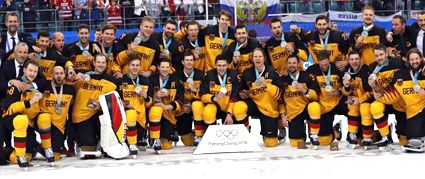
The Russians scored a heartbreaker with one second left in the first period, but the Germans countered with a goal of their own in the second. After Russia scored first in the third period, Germany then took a 3-2 lead with a pair of goals 3:13 apart with a little over three minutes to play, giving them hope of their own Miracle on Ice. It was not to be however, as the Russians scored the tying goal with 56 seconds remaining shorthanded, but with their goaltender having been pulled. The Olympic Athletes from Russia then won the gold after 9:40 of overtime while on a power play as the Germans took home a stunning silver medal after a tense journey through the tournament left them with a record of 1 win, 3 overtime wins, and overtime loss and two losses, both of which came in their first two games.

 photo Germany Silver 2018-2.jpg
The happiest group of silver medalists seen in a long time

Today's first featured jersey is a 1989 West German National Team Udo Keissling jersey from the World Championships held in Stockholm, Sweden. West Germany would finish the Round Robin portion with a 0-5-2 record, but avoid relegation by finishing with a 1-2-0 record and save themselves from the drop with a 2-0 defeat of Poland.

One of the best players in German hockey history, Udo Kiessling set a new record in 1992 with his 5th consecutive Olympic tournament appearance. Kiessling's record shows he played a single game in the NHL, in 1982 on a tryout after his German club team was an early exit from the playoffs, but returned home to play in the World Championships, never to return to the NHL again. But just because a player is not in the NHL, doesn't mean he doesn't exist, as Kiessling would go onto have a 24 year career, ending in 1996 at the age of 40.

He made his first appearance in the Olympics at Innsbruck in 1976, winning a Bronze Medal. In addition to his five Olympics, Kiessling also participated in 15 World Championships and the 1984 Canada Cup, as well as winning six national titles in Germany, where he was named the top player three times.

This beautiful jersey features the vibrant colors of the dye-sublimation process and the arresting graphics of the era with the colors of the tri-color German flag streaking across the chest, as well as the distinctive Tackla diamond logos on the shoulders and drop shadow block font for the numbers. Easily one of our favorite jerseys.

West Germany 1989 jersey photo Germany1989WCF.jpg
West Germany 1989 jersey photo Germany1989WCB.jpg

Today's second featured jersey is a 1989 East Germany Torsten Hanusch jersey as worn during the 1989 World Championships B Pool. This jersey was worn in the 1989 World Championships B Pool, Hanusch's only appearance for the East German National Team.

While the East Germans competed in the World Championships on a regular basis from 1956 to 1990, they discontinued their Olympic hockey program after 1968, choosing to take the approach of funding single athletes who could win multiple medals, such as a track and field athlete, swimmers and speed skaters, rather than funding an entire team who could only hope to win a single medal, such as water polo or in ice hockey, which frankly was a long shot when up against the likes of the Soviet Union, Czechoslovakia, Sweden and Canada.

This jersey has an extremely minimalist style, with only simple striping on the arms and waist and is devoid of any traditional main cresting, with only the Tackla branding on the upper right chest and the DDR initials and East German coat of arms on the left chest in the style of a soccer jersey, leaving the rest of the body devoid of any traditional main logo.

Also unusual is the East Germans choice of a primarily blue jersey, as the colors of the East German flag were black, gold and red. Additionally, many of the communist ruled nations favored primarily red sweaters, the Soviet Union and Czechoslovakia in particular.

East Germany 1989 jersey photo EastGermany19898F.jpg
East Germany 1989 jersey photo EastGermany19898B.jpg

Today's video selections have some footage of the West German National Team competing in the 1980 Olympics against Sweden and then the United States team, which would go on to pull off the Miracle on Ice against the Soviet Union.


Sunday, March 12, 2017

The Scandal of Geneva - West Germany Forfeits at the 1961 World Championships

Today is a story of controversy in 1961 when East Germany and West Germany were to meet during the 1961 World Championships in Switzerland by Martin Merk from IIHF.com.

*****

The fall of the Berlin Wall and the reunification of Germany in 1990 belong among  the most important and far-reaching moments in international history. Prior to that, East and West Germany had a fierce rivalry, a rivalry that sometimes manifested itself in ice hockey. It even led to a cancelled IIHF World Championship game in Geneva 50 years ago.

It was a flag, just a flag that created an uproar – and what later became known as “The scandal of Geneva” in Germany.

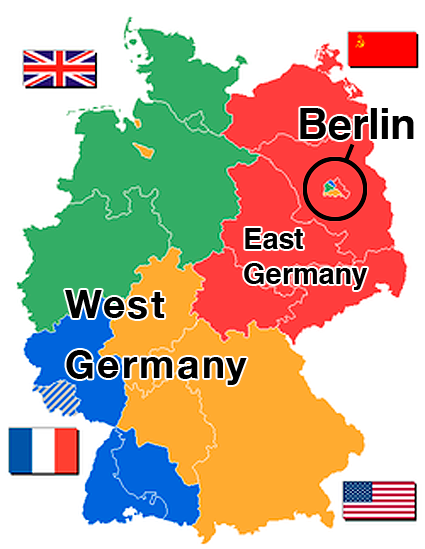
After World War II the west part of Germany (as well as a part of Berlin) was occupied by the Western Allies and became the Federal Republic of Germany (usually known as “West Germany”) in 1948. The Soviet-occupied east reacted with the founding of a socialist state, the German Democratic Republic (“East Germany”, or “DDR” in German).

West Germany, the green, blue and gold areas controlled by Great Britain, France and the United States, and East Germany, the red area, which was controlled by the Soviet Union

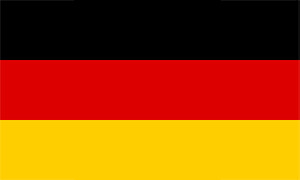
Both countries used the same flag as we know it today, the black, red and gold tricolour.

West Germany Flag
The German tricolor, originally used by both West and East Germany

In 1959, however, the GDR decided to change its flag by adding its coat of arms featuring a hammer and a compass surrounded by a garland of corn symbolizing the workers’ and farmers’ state.

 East Germany Flag photo EastGermanyFlag.png
The flag of the German Democratic Republic,
otherwise known as East Germany

The change of the flag became a touchy issue in the West. It was seen as an insult to the German people and as a clear attempt to permanently divide Germany. Consequently, West Germany banned the flag. It even became chargeable to display it within their territories.

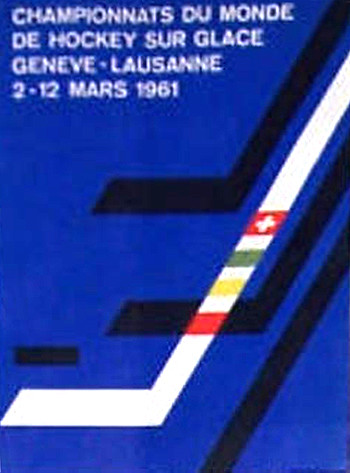
The flag war eventually affected the national teams of East and West Germany. The first time they were supposed to meet each other in an official ice hockey game after the East’s flag makeover was at the 1961 IIHF World Championship in Geneva and Lausanne, Switzerland.

1961 World Championships logo

It was an eight-team round-robin tournament in those days and the two German teams were set to face each other on the last day. Both teams were already out of the medal ranks with East Germany having a 1W-0T-5L record while West Germany stood at 0W-2T-4L.

More than 2,000 fans gathered in the Les Vernets rink to witness the fierce rivalry between the two Germanys, between West and East, capitalists and communists.

Former East German national team player Achim Ziesche recalls the event that unfolded while his team was preparing for the game.

“We were getting ready in the locker room, but we noticed that something was not okay,” he told Deutschlandfunk. “People were running around and they looked sort of helpless. We players didn’t understand what happened, but later we realized that we hadn’t seen anybody from the West German side.”

Some minutes later, the public announcer declared that West Germany refused to play and the game would count as a forfeit and a 5-0 victory for East Germany.

“We were surprised. They were the favourites and we assumed they wouldn’t do that,” Ziesche said. “Not as a team, not as a country and not towards the IIHF and the sporting world.”

The organizers put together a “Swiss selection” so that at least an exhibition game could be staged with East Germany.

The reason for West Germany’s refusal was an order from the government. The President of West Germany’s ice hockey association, Willi Daume, was demanding a guarantee that the East German flag wouldn’t be raised after that game. Otherwise his team would not be allowed to play.

Already in those days the post-game protocol saw the flag of the winning team to be raised, accompanied by the national anthem of the winners. Although the West German team was usually considered as the stronger of the two, Daume didn’t want to take any chances.

A loss to the GDR would be embarrassing, but then he would also lose face in front of his entire nation by hearing the East German anthem while also the outlawed flag were to be raised. So the hockey president drove to Geneva to negotiate with IIHF President, Bunny Ahearne, to change the ceremony protocol regardless of who wins: no anthem, no flags.

Ahearne said no. The ceremony was not be adjusted according to the wishes of some nations.

Daume told the team in the dressing room that they wouldn’t be allowed to play. His players left through the back entrance.

“Our officials were used as a political pawn,” West German national team player Ernst Trautwein recalls. “Thanks God it was the only time I can remember that politicians from our side intervened like this.”

The mix of sports and politics continued each time the teams would meet. East Germany was ahead in 1961 and most time of the ‘60s in ice hockey. This situation changed in the ‘70s when hockey became more professional in West Germany while the East German authorities decided to cut their top league to only two professional teams, Dynamo Berlin and Dynamo Weisswasser. These teams formed the world’s smallest hockey league from 1970 to 1990, and the situation didn’t help the national team.

Only once in the ‘60s did the West Germans display superiority over their brethren. At the 1963 IIHF World Championship in Stockholm, Sweden, the first time both teams were in the A-Pool after the Geneva scandal, the teams finally battled on and not off the ice.

West Germany v East Germany 1963
After the controversy in 1961, the two sides met in 1963, the only time the West Germans would defeat the East Germans at the World Championships during the 1960s

East Germany finished one place ahead of the West, but the West won the head-to-head German clash, 4-3. During the post-game ceremony, the East German players ostentatiously turned their backs towards the West German flag.

East Germany West Germany 1968 photo EastGermanyWestGermany1968.jpg
East Germany in their only Olympic meeting against West Germany in 1968

It took some decades of political division and rivalry until East Germany had its revolution and Germany became unified again in 1991.

*****

Today's first featured jersey is a 1989 East Germany Torsten Hanusch jersey as worn during the 1989 World Championships B Pool. This jersey was worn in the 1989 World Championships B Pool, Hanusch's only appearance for the East German National Team.

While the East Germans competed in the World Championships on a regular basis from 1956 to 1990, they discontinued their Olympic hockey program after 1968, choosing to take the approach of funding single athletes who could win multiple medals, such as a track and field athlete, swimmers and speed skaters, rather than funding an entire team who could only hope to win a single medal, such as water polo or in ice hockey, which frankly was a long shot when up against the likes of the Soviet Union, Czechoslovakia, Sweden and Canada.

This jersey has an extremely minimalist style, with only simple striping on the arms and waist and is devoid of any traditional main cresting, with only the Tackla branding on the upper right chest and the DDR initials and East German coat of arms on the left chest in the style of a soccer jersey, leaving the rest of the body devoid of any traditional main logo.

Also unusual is the East Germans choice of a primarily blue jersey, as the colors of the East German flag were black, gold and red. Additionally, many of the communist ruled nations favored primarily red sweaters, the Soviet Union and Czechoslovakia in particular.

East Germany 1989 jersey photo EastGermany19898F.jpg
East Germany 1989 jersey photo EastGermany19898B.jpg

Today's second featured jersey is a 1989 West German National Team Udo Keissling jersey from the World Championships held in Stockholm, Sweden. West Germany would finish the Round Robin portion with a 0-5-2 record, but avoid relegation by finishing with a 1-2-0 record and save themselves from the drop with a 2-0 defeat of Poland.

One of the best players in German hockey history, Udo Kiessling set a new record in 1992 with his 5th consecutive Olympic tournament appearance. Kiessling's record shows he played a single game in the NHL, in 1982 on a tryout after his German club team was an early exit from the playoffs, but returned home to play in the World Championships, never to return to the NHL again. But just because a player is not in the NHL, doesn't mean he doesn't exist, as Kiessling would go onto have a 24 year career, ending in 1996 at the age of 40.

He made his first appearance in the Olympics at Innsbruck in 1976, winning a Bronze Medal. In addition to his five Olympics, Kiessling also participated in 15 World Championships and the 1984 Canada Cup, as well as winning six national titles in Germany, where he was named the top player three times.

This beautiful jersey features the vibrant colors of the dye-sublimation process and the arresting graphics of the era with the colors of the tri-color German flag streaking across the chest, as well as the distinctive Tackla diamond logos on the shoulders and drop shadow block font for the numbers. Easily one of our favorite jerseys.

West Germany 1989 jersey photo Germany1989WCF.jpg
West Germany 1989 jersey photo Germany1989WCB.jpg

Today's video section is a look at the fall of the Berlin Wall.


Monday, October 3, 2016

1988 East Germany Andreas Ludwig Jersey

After the fall of the Berlin Wall on November 9, 1989, the German Democratic Republic (East Germany) and the Federal Republic of Germany (West Germany) once again became a single, united country for the first time since 1949 with their official reunification on October 3, 1990.

With the division of Germany in the aftermath of World War II into Soviet controlled East Germany and West Germany, which was supported by Great Britian, France and the United States, on October 7, 1949, it necessitated separate national hockey team programs.

East Germany Flag, East Germany Flag
The flag of the German Democratic Republic,
otherwise known as East Germany

The East Germans made their international debut on January 28, 1951 in a 8-3 loss to Poland. It would take them until 1956 to make their debut at the World Championships, which they did in style, winning the "B" Pool tournament to earn promotion to the Top Division their first time out.

The East Germans were also represented at the 1956 Olympics by the Unified Team of Germany, a single team of athletes which competed at the Summer and Winter Olympics in 1956. However, in the case of the Winter Olympic hockey tournament, the East German and West German teams were not combined into a single representative team, but instead the two sides faced off against each other prior to the Olympics to determine which one team would represent Germany as a whole, so rather than being a unified team, it served the opposite effect in the case of hockey, pitting the two sides against each other!

For 1956, the West Germans won 7-3, leaving the East Germans out of the Games.

In 1957, the World Championships were held in the Soviet Union for the first time, and due to the Soviets occupying Hungary at the time, the United States, Canada, Norway, West Germany, Switzerland and Italy all stayed home in protest. With the lack of several of the favorites, East Germany was able to finish 5th thanks to wins over Japan, Poland and Austria.

Despite their success in 1957, they did not participate in the 1958 World Championships, but returned in 1959 for a 9th place finish. After being drubbed by the Soviet Union, the United States and Norway in the First Round, being outscored 21-6, they held their own in the Consolation Round, beating Poland 5-1, Switzerland 8-0 and Italy 8-6, but lost to West Germany and Norway for a second time.

East Germany was again represented by the Unified Team of Germany at the 1960 Olympics, only as in 1956, the West Germans prevailed in the qualification matches by scores of 5-2 and 5-3 and won the right to represent Germany as a whole.

After not participating in 1961 or 1962, the East Germans became regulars at the World Championships from 1963 on. Facing the might of the hockey powers of the world, the East Germans finished 6th (with a win over Finland and a tie against the United States) in 1963.

East Germany vs Czechoslovakia 1963.jpg, East Germany vs Czechoslovakia 1963.jpg
East Germany vs Czechoslovakia in 1963

The following year was another Olympic year, and East Germany was again represented by the Unified Team of Germany, but for a third time it was the West Germans who won the right to participate following a 4-3 win in their second game after a 4-4 tie in the first game gave the East Germans hope of participating in the Olympics for the first time.

East Germany next placed 5th (With wins over the United States, Norway and Finland) in the 1965 World Championships, 5th (with wins over Sweden (despite giving up 74 shots on goal!), Poland and Finland) in 1966 and 7th (with a win over West Germany and a tie with the United States) in 1967.

East Germany Sweden 1965, East Germany Sweden 1965
East Germany scoring against Sweden in 1965

For the 1968 Olympics, both East and West Germany competed as separate nations for the first time since the division of Germany. While they had met several times during the World Championships, this would be the only time the two nations would face each other at the Olympics, with the West prevailing by a score of 4-2.

East Germany West Germany 1968, East Germany West Germany 1968
East Germany in their only Olympic meeting against West Germany in 1968

With that loss, the East Germans finished in last place with an 0-7-0 record at the Olympics (which also served as the World Championships in Olympic years) and were relegated to Group B for the 1969 World Championships.

East Germany Sweden 1968, East Germany Sweden 1968
East Germany, wearing red instead of their customary blue,
faces Sweden at the 1968 Olympics

It was at this point in 1969, following their failure at the Olympics, that the East German authorities examined their national sporting programs, with a focus on maximizing their greatest return on investment, with their main focus being winning medals at the Summer and Winter Olympics.

As a result of this scrutiny, it was determined that the country should focus on individual sports, as a single track and field athlete, swimmer or speed skater could produce multiple gold medals at the Olympics, while team sports like water polo or ice hockey required many players, special facilities (such as pools and skating rinks) and special equipment (much of which needed to be imported), all resulting in higher operating costs - and all for the sake of hoping to win just a single medal, which seemed unlikely for the hockey program in the face of dominant competition from the Soviet Union, Canada, Czechoslovakia and Sweden.

This thinking, called the Lestungssportbeschluss Directive, resulted in ice hockey being relegated to "Sport 2" status by the East German sports federation, which resulted in East Germany never appearing in another Olympic hockey tournament and the immediate reduction in funding for it's domestic hockey league, which was left with only two clubs, SC Dynamo Berlin and SG Dynamo Weisswasser, to produce top level players for the East German National Team from 1971 on, with those two clubs only being spared because the head of the East German secret police, the Stasi, being an avid hockey fan.

In the 1969 World Championships B Pool, East Germany dominated with a perfect 7-0 record, defeating Poland, Yugoslavia, West Germany, Norway, Romania, Austria and Italy, scoring 11 goals three times and 13 once on their way to a final 62-13 goal differential, which saw them promoted back to the "A" Pool for 1970.

Back in the A Pool in 1970, they found the going much tougher, as they went 2-7-1, managing wins over Finland and Poland as well as a tie with Poland in their other meeting.

For 1971, the East Germans declined to participate in Pool A, and instead competed in Pool B, where they finished 3rd with a competitive 5-2-0 record. In 1972, the World Championships began to be held every year, regardless of it being an Olympic year. Still in Pool B, the East Germans again placed 3rd from a 4-2-0 mark.

As a result of the decision to reduce ice hockey to Class 2 status, the East Germans declined to send a team to the 1972 Olympic games, and would never again compete in the Winter Olympic hockey tournament.

The 1973 World Championship tournament saw the East Germans rise to the challenge despite the lack of support from their own government, waltzing to a 7-0 record with wins over the United States, Yugoslavia, Romania, Austria, Japan, Switzerland and Italy. Almost in spite of themselves, they were again headed back to the A Pool!

Once more swimming with the sharks proved difficult, and East Germany went 1-8-1, defeating Poland 5-3 in their first meeting and playing to a 3-3 tie in their second game of the double round robin schedule. Unfortunately for the East Germans, Poland managed two ties, their other coming against Finland, and the Poles were awarded a 5-0 win over Sweden when Swedish player Ulf Nilsson tested positive for a banned substance after Sweden had won easily by a score of 4-1. The 2 points Poland received in the standings was enough to leap them over East Germany, despite not having beaten them on the ice, resulting in the East Germans being relegated back to Pool B for 1975.

East Germany Soviet Union 1974, East Germany Soviet Union 1974
East Germany facing the Soviet Union in 1974

This began a series of promotions and relegations for the East Germans, as they were in the no man's land of international hockey, too good for the B Pool and not strong enough to survive in Pool A. They won the B Pool in 1975 with a 6-1 record, scoring 41 and giving up just 18 in 7 games to gain promotion back to the A Pool for 1976, where they were relegated after a 2-7-1 mark after losing Consolation Round games to Poland and Finland along with a tie against West Germany.

Back in Pool B for 1977, they were once again the dominant side, breezing to a 8-0 record while outscoring the competition 57-16, which only set themselves up for relegation from the A Pool in 1978 when they again faltered in the Consolation Round with ties against West Germany and the Untied States and a loss to Finland sealing their fate yet again.

A new format of play in 1979 saw them win Group 1 easily with a 4-0 mark, but a one goal loss to the Netherlands saw them miss out on promotion back to Pool A for 1981, as the World Championships were not held in 1980 due to the Olympics, which did not count as the World Championships as they had from 1924-1968.

East Germany 1979, East Germany 1979
The East German National Team in 1979

A down performance in 1981 saw the East Germans place 4th with a 4-2-1 record but they were again on top of the B Pool in 1982, defeating Norway 10-1 and China 13-7 on their way to a 6-0-1 record to earn their sixth promotion to the A Pool.

Wins over Italy and Finland in the First Round and again in the Consolation Round were enough to ensure their survival in the A Pool for consecutive tournaments for the first time since 1966, again, this coming from a country whose top national league consisted of a mere two clubs to draw national team players from.

Their participation in Pool A for a second consecutive time would have to wait until 1985, as 1984 was an Olympic year.

The 1985 World Championships were the East Germans last hurrah, as they only managed a pair of ties against Finland and the United States, sending them back down to the B Pool, where they would play out the remainder of their days as a separate nation, with a 3rd place finish in 1986 and 5th place finishes in 1987, 1989 and 1990.

East Germany 1985 WC, East Germany 1985 WC
The East German National Team at the 1985 World Championships

With East and West Germany reunited in time for the 1991 World Championships, only two players from East Germany would be picked to represent the reunified German National Team, goaltender Rene Bielke and forward Mario Naster. No players from the former East Germany were members of the 1992 Olympic team, but two defensemen from the East, Torsten Kienass and Jorg Handrick would dress for Germany at the 1994 Olympics.

Today's featured jersey is a 1988 East Germany Andreas Ludwig jersey. While West Germany's jerseys were based on the red, black and yellow colors of the German flag, and unlike many of the communist teams who wore red jerseys (the Soviet Union, Czechoslovakia, Poland), the East Germans wore the surprising color combination of blue accented with red and white for most of their existence.

Today's featured jersey is one of the earliest examples of a jersey made by the Finnish company Tackla, as evidenced by the choice of font for the numbers, which would soon change to a block front with a 3-D drop shadow for the remainder of their time as supplier to the IIHF.

Of note, the "DDR" initials on the front of their jerseys stands for Deutsche Demokratische Republik, which translates to German Democratic Republic, often abbreviated as GDR in English.

 photo EastGermany1988jersey.jpg
photo courtesy of Classic Auctions

Bonus jersey: Today's bonus jersey is a 1989 East Germany Jens Feller jersey as worn during the 1989 World Championships B Pool. This jersey was worn in the 1989 World Championships B Pool, Feller's only appearance for the East German National Team.

This jersey has an extremely minimalist style, with only simple striping on the arms and waist and is devoid of any traditional main cresting, with only the Tackla branding on the upper right chest and the DDR initials and East German coat of arms on the left chest in the style of a soccer jersey, leaving the rest of the body devoid of any traditional main logo.

East Germany 1989 jersey, East Germany 1989 jersey

Today's video section contains footage from the 1985 World Championships, where the East Germans faced off against Czechoslovakia, with the East Germans wearing red for one of the few times in their history.


Sunday, November 9, 2014

The 25th Anniversary of the Fall of the Berlin Wall

A momentous occasion occurred in Germany twenty five years ago on this date in 1989, as the Berlin Wall fell.

After the conclusion of World War II, Berlin was divided into four sectors. The United States, the United Kingdom and France controlled what became West Berlin, while the Soviet Sector formed East Berlin.

 photo AmericanSector.jpg

The Soviets also controlled the area of Germany that surrounded Berlin as well, leaving the three Allied Sectors of Berlin deep inside Soviet controlled Germany, 100 miles from the nearest Allied controlled part of Germany.


Growing differences between the former allies against Nazi Germany led to the Soviets imposing the Berlin Blockade, cutting off road and train access to West Berlin on June 24, 1948. The Allies responded with the Berlin Airlift, bringing in 13,000 tons of food per day with over 200,000 flights lasting nearly a year until May 12, 1949.

On October 7, 1949 the Soviet controlled part of Germany became a separate country, the German Democratic Republic, or "East Germany", which was heavily influenced and controlled by Soviet authorities. Meanwhile, West Germany operated as a capitalist country with a democratic government and saw it's economy and standard of living growing and improving over time, which attracted many East Germans, who wished to relocate to the more prosperous and free West Germany, away from Soviet control.

The period from 1950-1952 saw 544,000 East Germans move to West Germany and in 1953 another 331,000 migrated to West Germany, fearing an even greater increase in Soviet control. Up until 1952, passing from West Berlin into East Berlin was relatively easy until a system of passes were introduced to restrict movement. At the same time, a declaration was made that the border between the countries of East and West Germany should be considered a dangerous border and a barbed-wire fence was erected between the two countries.

Meanwhile, the border between West and East Berlin still remained open, leaving West Berlin, deep in the heart of East Germany, attracting thousands of East Germans to West Berlin as a gateway to West Germany. By 1956, the East German authorities restricted virtually all travel to West Germany.

The next step in isolating East Germany was a new passport law that reduced the number of people leaving East Germany through the West German border, which increased the percentage of people leaving through West Berlin to over 90% by 1959 since there was no physical barrier in Berlin, such as the barbed wire fence that separated the two countries along their border 100 miles to the west. There was even subway service between East and West Berlin at the time.

This left West Berlin as a tiny island of freedom and a gateway to the West located right in the center of East Germany.

By 1961, approximately 20% of the entire East German population, 3.5 million people, had left East Germany. With the majority of the people leaving being young and well educated, the population of working age people decreased from over 70% to 61% and represented a loss of manpower estimated to be worth from $7 to $9 billion. Finally on August 12, 1961 orders were given to close the border between East Berlin and West Berlin and erect a barrier to prevent any further movement of East German citizens into West Berlin and out of East Germany.


Roads were torn up and barbed wire and fences were erected around the perimeter of West Berlin, stretching for 87 miles. In 1962 a second fence was erected approximately 100 yards further into East Germany, creating what was effectively a moat that offered no protection from armed East German guards, called The Death Strip.

In 1965 the wire fencing was replaced by a concrete wall which eventually grew to be 12 feet tall and nearly 4 feet thick.

During the wall's existence, there were around 5,000 successful escape attempts to West Berlin and the number of people killed trying has been placed between 136 to above 200. Various methods of escape were used, including tunnels, hot air balloons, sliding along overhead wires and ultralight aircraft as well as escaping through the sewer system. On occasion, wounded escapees were left to die in the Death Strip, as any potential rescuers feared being shot at by the East German border guards.

On June 12, 1987, Ronald Reagan challenged Mikhail Gorbachev of the Soviet Union to "Tear down this wall" as a sign of increasing freedoms in the Communist Eastern Europe.


On August 23, 1989, Hungary removed it's border defenses with Austria, allowing more than 13,000 East Germans in Hungary to escape into Austria. The remaining East Germans prevented from leaving flooded the West German embassy in Budapest and refused to return to East Germany. This set up a similar event in Czechoslovakia and mass demonstrations within East Germany. In October, longtime East German leader Erich Honecker resigned and on November 4 a million people gathered in the Alexanderplatz public square.

With Honecker's replacement Egon Krenz's new government tolerating the wave of East Germans leaving through Czechoslovakia, a plan was put into place on November 9, 1989 to allow people to simply leave directly through the checkpoints between East Germany and West Germany, including West Berlin.

Spokesperson Gunter Schabowski was given the assignment of announcing the new policy, however he had not been present at the meeting or fully updated on the details. Shortly before a press conference, he was handed a note that said East Berliners would only be allowed to cross the border with proper permission, but no further information on how to present the news. The new rules were to take effect the next day in order to be able to inform the border guards on the new policy, but no one had told Schabowski, who when asked on live TV when the new rules would take effect, assumed from the wording of the note that it would be the same day, replied "As far as I know effective immediately, without delay." After further questions, he confirmed that this included the border crossings into West Berlin.

Soon afterwards West German television announced that starting immediately, East German borders were open to everyone. Since East Germans had been waiting to hear this news for 28 years, thousands of East Germans went to the border crossings, demanding that the guards open the gates. Unaware of the new rules, the outnumbered and overwhelmed guards tried to call their superiors, but none of them dare give any orders to use lethal force and, without the authority to fire, the guards had no way to hold back the growing crowds and opened the gates. The wall had, in theory, come down.


Initially, the wall stayed intact, but new border crossings were added as previously severed roads were rejoined and various rules remained in effect, which included the need for visa applications in advance for West Berliners to visit the East. The guarding of the wall became more and more relaxed and more and more damage to the wall was tolerated.

Many celebrations were held in the days following, including David Hasselhoff rocking the wall on New Year's Eve 1989 wearing one amazing jacket. Note at the 3:22 mark someone almost drills him with a bottle rocket as he is leaning over!


Roger Waters performed the Pink Floyd album "The Wall" on July 21, 1990 near the Brandenberg Gate.


Finally in June of 1990, the dismantling of the wall officially began and Germany was officially reunified as one country on October 3, 1990.


As for how the separation of Germany after World War II into East Germany and West Germany affected their national hockey team, the East German National Team first competed in 1951 and participated in the World Championships from 1956 on to 1990. They had some success, reaching the highest level, the "A" Pool on a number of occasions, but often being relegated back to the "B" Pool within a year or two. Their highest finish at the World Championships was 5th place, which they managed in 1957, 1965, 1966 and 1970. They were the winners of the "B" Pool on six occasions, each time earning promotion back to the "A" Pool.

The East Germans also competed in the Olympics, first as The Unified Team of Germany, comprising athletes from both East and West Germany as a single team, in 1956, 1960 and 1964, finishing last in 1956 and 1960 and next to last in 1964. They competed as separate teams in 1968, with the East Germans finishing 8th out of 8 with a 0-7-0 record. From 1972 onward they did not compete in the Olympic hockey tournament.

The West Germans won a silver medal in 1953 in their first appearance at the World Championships but generally hovered between 5th and 7th place for the majority of it's existence with the occasional relegation to the "B" pool for a couple of years.

The Olympics were very much the same story, finishing at or near the bottom in 1952, as the Unified Team of Germany in 1956, 1960 and 1964, and as West Germany in 1968, 1972 and 1980. Some improvement was shown in the 1980's, with mid-pack finishes in 1984 and 1988, but 1976 was the highlight of the separate West German program, with a surprising 3rd place finish which earned them the bronze medal behind the dominant Soviet Union and Czechoslovakia.

West Germany began by defeating Switzerland 5-1 in a qualification match to move onto the main group, whose round robin schedule would determine the medal winners.

They opened Group play by defeating Poland 7-4. Losses to Finland (5-3), the Soviet Union (7-3) and Czechoslovakia (7-4) hurt their chances, but a 4-1 win over the United States left West Germany, Finland and the USA all tied with 4 points from two wins in the standings with West Germany winning the tie-breaker and being classified third to take home the bronze.

With the reunification of Germany in 1990, the German National Team once more represented the country as a whole. Their record in the World Championship generally sees them finishing between 7th and 11th, with the occasional relegation to the second level, followed by a quick return to the top division.

Their Olympic record is very much the same, with finishes of each step from 6th to 10th on their record over the last five Olympics.

Today's first featured jersey is a 1989 West German National Team Udo Keissling jersey from the World Championships held in Stockholm, Sweden. West Germany would finish the Round Robin portion with a 0-5-2 record, but avoid relegation by finishing with a 1-2-0 record and save themselves from the drop with a 2-0 defeat of Poland.

One of the best players in German hockey history, Udo Kiessling set a new record in 1992 with his 5th consecutive Olympic tournament appearance. Kiessling's record shows he played a single game in the NHL, in 1982 on a tryout after his German club team was an early exit from the playoffs, but returned home to play in the World Championships, never to return to the NHL again. But just because a player is not in the NHL, doesn't mean he doesn't exist, as Kiessling would go onto have a 24 year career, ending in 1996 at the age of 40.

He made his first appearance in the Olympics at Innsbruck in 1976, winning a Bronze Medal. In addition to his five Olympics, Kiessling also participated in 15 World Championships and the 1984 Canada Cup, as well as winning six national titles in Germany, where he was named the top player three times.

This beautiful jersey features the vibrant colors of the dye-sublimation process and the arresting graphics of the era with the colors of the tri-color German flag streaking across the chest, as well as the distinctive Tackla diamond logos on the shoulders and drop shadow block font for the numbers. Easily one of our favorite jerseys.

West Germany 1989 jersey photo Germany1989WCF.jpg
West Germany 1989 jersey photo Germany1989WCB.jpg

Today's second featured jersey is a 1989 East Germany Torsten Hanusch jersey as worn during the 1989 World Championships B Pool. This jersey was worn in the 1989 World Championships B Pool, Hanusch's only appearance for the East German National Team.

While the East Germans competed in the World Championships on a regular basis from 1956 to 1990, they discontinued their Olympic hockey program after 1968, choosing to take the approach of funding single athletes who could win multiple medals, such as a track and field athlete, swimmers and speed skaters, rather than funding an entire team who could only hope to win a single medal, such as water polo or in ice hockey, which frankly was a long shot when up against the likes of the Soviet Union, Czechoslovakia, Sweden and Canada.

This jersey has an extremely minimalist style, with only simple striping on the arms and waist and is devoid of any traditional main cresting, with only the Tackla branding on the upper right chest and the DDR initials and East German coat of arms on the left chest in the style of a soccer jersey, leaving the rest of the body devoid of any traditional main logo.

Also unusual is the East Germans choice of a primarily blue jersey, as the colors of the East German flag were black, gold and red. Additionally, many of the communist ruled nations favored primarily red sweaters, the Soviet Union and Czechoslovakia in particular.

East Germany 1989 jersey photo EastGermany19898F.jpg
East Germany 1989 jersey photo EastGermany19898B.jpg

Today's video selections have some footage of the West German National Team competing in the 1980 Olympics against Sweden and then the United States team, which would go on to pull off the Miracle on Ice against the Soviet Union.


 

hit counter for blogger