History of Jersey 83-93 Banner sm photo History of Jersey 83-93 Banner sm.jpg
Showing posts with label Goalie Mask. Show all posts

Saturday, October 31, 2020

Doug Favell's Halloween Pumpkin Mask - The First Painted Mask in NHL History

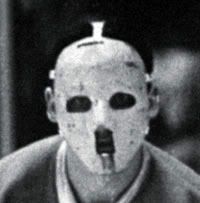
Jacques Plante ushered in a new era of goaltending back on November 1, 1959 when, after being struck in the face with a shot by the New York Rangers hard shooting Andy Bathgate, he was assisted off the ice, leaving behind a trail of blood.

"He had been struck in the face and it opened up a cut from the corner of his mouth all the way up through his nostril," related Red Fisher of the Montreal Gazette.

With no backup goaltenders on the roster in those days, there was a 21 minute delay while Plante was stitched up. When he finally returned to the bench, he told head coach Toe Blake, "I'm ready to go back in but I have to wear my mask." He was allowed to wear the mask, which he had been wearing in practice, and Montreal went on to win the game 3-1.

Jacques Plante mask photo Jacques Plante first mask.jpg
A bloodied Jacques Plante wearing his mask after being badly cut in 1959

Before the next game Blake did not want Plante to wear the mask, to which Plante replied, "If I don't wear the mask, I'm not playing." Having been a four time All-Star, four time Vezina Trophy winner and five time Stanley Cup champion at that point in his career - the mask stayed.

Others quickly followed Plante's lead and goalies who did not wear a mask soon became the exception to the rule, with the last in the NHL being Andy Brown in 1974.

Andy Brown photo Andy Brown.jpg
Andy Brown of the Penguins with his unprotected face down among the sticks

While Gerry Cheevers was the first to wear a decorated mask on November 8, 1967 in a game vs. the Rangers when he wore a mask with the first of his trademark stitches drawn on it with a marker, it is Doug Favell who is credited with having the first painted mask in the NHL, which debuted on this date, Halloween, in 1971.

Favell tells the story of how the first painted mask came to be, taken from the Marek vs. Wyshynski podcast from October 31, 2014:
"It just came from bantering in the morning because it was Halloween. We were all kidding around in the room and somebody said "If you're going to the party tonight, you have to dress up" and somebody was kidding me, and someone said. "Favey, why don't you show up tonight as a goaltender?" I said, "Maybe I'll do that," so the kidding started. 
As I was getting ready to leave, I said to Frank Lewis, who was our trainer. "Frank, with tonight being Halloween, why don't we put orange on the mask? Can you paint orange on the mask? We'll paint it orange like The Great Pumpkin," because back then Charlie Brown and The Great Pumpkin were a big thing. "Why don't we paint it like a pumpkin tonight for Halloween?" 
"Yea, I can do that," Lewis replied. So he took it home that afternoon and painted it orange and I came back that night and wore it. And the funny thing is, we're all so superstitious that if we hadn't won that night, we beat L. A. 4-1, I'd have probably just painted it white again. If we'd have lost, I'd have said "That's it. It's not good," but we won and got going, got on a little streak, and I said, "This is a pretty good thing." It was that simple. 
photo Favell Pumpkin mask 2.jpg 
Some players said it was a distraction because it was fairly bright. An ophthalmologist said, "Your eye will attract." I thought it was an advantage because your eye would naturally go to the brightest thing, so in that flash, they would look at my mask instead of looking at the net, so I thought it was an a distraction and I felt I needed whatever I could get to distract the shooters, so I went with it and next year we painted the starburst on it, which was a design and was even more of a distraction to the shooters.
While doing our research for this story we did uncover some contradictions and discrepancies in various versions of Favell's stories recounting the origins of his first painted mask. At times Favell has stated his mask debuted in 1970, and other times 1971. Favell's pumpkin mask would not have debuted against the Kings, as he recalled above, as Philadelphia played host the Montreal Canadiens in a game won 5-3 by Philadelphia on Halloween night in 1971. The Flyers did defeat the Kings 3-1 just before Halloween on October 29, 1970, so perhaps this is where some of the confusion comes from…

Additionally, the "little streak" story does not hold up well, as the Flyers lost their next three games and went  2-7-3 over November 1971. The club actually did not have a winning month until five months later in March. If the mask had debuted in 1970, the story is much the same, with Philadelphia going 4-6-1 in November of that year.

Favell's story on the end of the solid orange pumpkin mask, thanks to a late Buffalo Sabres goal on the final game of the season, took place on April 2, 1972 when Gerry Meehan won the game for the Sabres with just four seconds remaining, has been consistently told by Favell, and dates the orange mask to the 1971-72 season. reaffirming its debut as being on Halloween in 1971.

Favell debuted with the Flyers during the first year of league expansion of 1967-68. During his early days with Philadelphia, he wore a Terry Sawchuk style mask before changing to his Ernie Higgins produced mask for the 1971-72 season, the style which he would have famously painted orange on Halloween in 1971 after having the new, white mask for less than two months, which leaves photos of Favell in his plain white mask as a rarity.

Favell white mask photo Favell white mask.jpg
Favell's mask in its original plain white color

Following its humorous orange paint job on October 31, 1971, the Favell's mask would remain solid orange for the remainder of the season through the fateful last second goal against Buffalo to close out the 1971-72 season.

photo DougFavell.jpg

Taking the concept of painting his mask as a distraction to shooters farther for the next season, Favell would wear his new "starburst" design beginning in 1971-72 through the 1972-73 season, his last with the Flyers.

photo Favell starburst mask.jpg
Favell in his striking new design, which ushered in the era of bold graphics

A trade in the summer of 1973 sent Favell to the Toronto Maple Leafs, but before leaving for Toronto, Philadelphia trainer Lewis painted Favell's mask with a blue maple leaf on the forehead and surprised him with it when he came to collect his equipment from the Flyers according to Favell.

Favell Maple Leafs photo FavellMapleLeafs.jpg
Favell's mask with its fourth and final paint scheme, or so we thought...

Favell continued to wear the same mask, now sporting its fourth different paint scheme, counting its original plain white, until 1974 when he got a new, more protective mask by renowned mask maker Greg Harrison which featured a larger, more centered maple leaf design which covered his eyes, nose and mouth.

photo Favell Harrison mask.jpg
Favell's new Harrison mask, with its larger maple leaf paint scheme

Favell's original Higgins mask, the one first painted solid orange and now sporting a blue maple leaf, was then lent to the Hockey Hall of Fame in Toronto due to its place in hockey history as the first painted mask. This is where the story takes a turn for the bizarre

In 2011, game worn hockey equipment dealer Frank Servello noticed  the mask the hall had on display was not Favell's original mask, but a replica painted in the same manner. Favell was easily able to confirm the Maple Leaf mask on display was not his original due to details about the mask on display which did not match the one he had used, repaired and modified. 

It turns out, at some point, and no one knows when, Favell's original mask, painted with the maple leaf, was stolen from the hall, repainted twice, and then later anonymously returned to The Hall, looking very different from when it left.

Favell's original, but now repainted Higgins mask was then put on display by the hall with its red droplet shape on the forehead, red nose and red under the chin, which is generally referred to as the "clown mask", as a vintage mask, but in no way identified as being Favell's, as no one at the hall apparently knew.

It was then that a member of the Vintage Goalie Mask Discussion Page recognized the similarities between the clown mask and Favell's missing original in August of 2011 and posted his impression of the clown mask likely being Favell's missing mask.

Notified by Servello that his original mask, now repainted, was likely in the possession of The Hall of Fame, Favell met with the hall to first identify his original mask based on his modifications and repairs, and reclaim its possession 37 years after first loaning it to the hall for display.

The mask then underwent a restoration process, which revealed first flames over the right eye of the mask as well as a predominantly black paint scheme, which unfortunately adhered to the blue paint of the maple leaf design, rendering that design unsalvageable.

But once the black paint was removed, and the maple leaf design with it, the third version of the mask, the starburst pattern from 1972-73 was revealed, proving it was indeed Favell's original Higgins mask and the first painted mask in NHL history, complete with some of its previous orange paint from Halloween night in 1971 exposed to further document its place in NHL history.

Here are photos from GameUsedMasks.com showing the restoration of Favell's mask, the first painted mask in NHL history, taking it from its twice vandalized state down to its sunburst paint scheme of 1972-74.

favell_restoration_steps photo favell_restoration_steps.jpg

And here is the final restoration down to the sunburst mask (with some of the earlier brighter orange paint revealed on the forehead, showing the mask's history), the first mask with a painted design. This is where they chose to stop the painstaking process of removing the layers of paint which were added to the mask while it was out of the possession of the Hall of Fame.

favell_restoration_final photo favell_restoration_final.jpg

Here is an interview with Favell from 2011 discussing his original, now repainted mask now that it was back in his possession after being on loan to the Hall of Fame.


Here is another feature on Favell and his mask from Hockey Night in Canada.

Saturday, October 31, 2015

Doug Favell's Halloween Pumpkin Mask - The First Painted Mask in NHL History

Jacques Plante ushered in a new era of goaltending back on November 1, 1959 when, after being struck in the face with a shot by the New York Rangers hard shooting Andy Bathgate, he was assisted off the ice, leaving behind a trail of blood.

"He had been struck in the face and it opened up a cut from the corner of his mouth all the way up through his nostril," related Red Fisher of the Montreal Gazette.

With no backup goaltenders on the roster in those days, there was a 21 minute delay while Plante was stitched up. When he finally returned to the bench, he told head coach Toe Blake, "I'm ready to go back in but I have to wear my mask." He was allowed to wear the mask, which he had been wearing in practice, and Montreal went on to win the game 3-1.

Jacques Plante mask photo Jacques Plante first mask.jpg
A bloodied Jacques Plante wearing his mask after being badly cut in 1959

Before the next game Blake did not want Plante to wear the mask, to which Plante replied, "If I don't wear the mask, I'm not playing." Having been a four time All-Star, four time Vezina Trophy winner and five time Stanley Cup champion at that point in his career - the mask stayed.

Others quickly followed Plante's lead and goalies who did not wear a mask soon became the exception to the rule, with the last in the NHL being Andy Brown in 1974.

Andy Brown photo Andy Brown.jpg
Andy Brown of the Penguins with his unprotected face down among the sticks

While Gerry Cheevers was the first to wear a decorated mask on November 8, 1967 in a game vs. the Rangers when he wore a mask with the first of his trademark stitches drawn on it with a marker, it is Doug Favell who is credited with having the first painted mask in the NHL, which debuted on this date, Halloween, in 1971.

Favell tells the story of how the first painted mask came to be, taken from the Marek vs. Wyshynski podcast from October 31, 2014:
"It just came from bantering in the morning because it was Halloween. We were all kidding around in the room and somebody said "If you're going to the party tonight, you have to dress up" and somebody was kidding me, and someone said. "Favey, why don't you show up tonight as a goaltender?" I said, "Maybe I'll do that," so the kidding started. 
As I was getting ready to leave, I said to Frank Lewis, who was our trainer. "Frank, with tonight being Halloween, why don't we put orange on the mask? Can you paint orange on the mask? We'll paint it orange like The Great Pumpkin," because back then Charlie Brown and The Great Pumpkin were a big thing. "Why don't we paint it like a pumpkin tonight for Halloween?" 
"Yea, I can do that," Lewis replied. So he took it home that afternoon and painted it orange and I came back that night and wore it. And the funny thing is, we're all so superstitious that if we hadn't won that night, we beat L. A. 4-1, I'd have probably just painted it white again. If we'd have lost, I'd have said "That's it. It's not good," but we won and got going, got on a little streak, and I said, "This is a pretty good thing." It was that simple. 
photo Favell Pumpkin mask 2.jpg 
Some players said it was a distraction because it was fairly bright. An ophthalmologist said, "Your eye will attract." I thought it was an advantage because your eye would naturally go to the brightest thing, so in that flash, they would look at my mask instead of looking at the net, so I thought it was an a distraction and I felt I needed whatever I could get to distract the shooters, so I went with it and next year we painted the starburst on it, which was a design and was even more of a distraction to the shooters.
While doing our research for this story we did uncover some contradictions and discrepancies in various versions of Favell's stories recounting the origins of his first painted mask. At times Favell has stated his mask debuted in 1970, and other times 1971. Favell's pumpkin mask would not have debuted against the Kings, as he recalled above, as Philadelphia played host the Montreal Canadiens in a game won 5-3 by Philadelphia on Halloween night in 1971. The Flyers did defeat the Kings 3-1 just before Halloween on October 29, 1970, so perhaps this is where some of the confusion comes from…

Additionally, the "little streak" story does not hold up well, as the Flyers lost their next three games and went  2-7-3 over November 1971. The club actually did not have a winning month until five months later in March. If the mask had debuted in 1970, the story is much the same, with Philadelphia going 4-6-1 in November of that year.

Favell's story on the end of the solid orange pumpkin mask, thanks to a late Buffalo Sabres goal on the final game of the season, took place on April 2, 1972 when Gerry Meehan won the game for the Sabres with just four seconds remaining, has been consistently told by Favell, and dates the orange mask to the 1971-72 season. reaffirming its debut as being on Halloween in 1971.

Favell debuted with the Flyers during the first year of league expansion of 1967-68. During his early days with Philadelphia, he wore a Terry Sawchuk style mask before changing to his Ernie Higgins produced mask for the 1971-72 season, the style which he would have famously painted orange on Halloween in 1971 after having the new, white mask for less than two months, which leaves photos of Favell in his plain white mask as a rarity.

Favell white mask photo Favell white mask.jpg
Favell's mask in its original plain white color

Following its humorous orange paint job on October 31, 1971, the Favell's mask would remain solid orange for the remainder of the season through the fateful last second goal against Buffalo to close out the 1971-72 season.

photo DougFavell.jpg

Taking the concept of painting his mask as a distraction to shooters farther for the next season, Favell would wear his new "starburst" design beginning in 1971-72 through the 1972-73 season, his last with the Flyers.

photo Favell starburst mask.jpg
Favell in his striking new design, which ushered in the era of bold graphics

A trade in the summer of 1973 sent Favell to the Toronto Maple Leafs, but before leaving for Toronto, Philadelphia trainer Lewis painted Favell's mask with a blue maple leaf on the forehead and surprised him with it when he came to collect his equipment from the Flyers according to Favell.

Favell Maple Leafs photo FavellMapleLeafs.jpg
Favell's mask with its fourth and final paint scheme, or so we thought...

Favell continued to wear the same mask, now sporting its fourth different paint scheme, counting its original plain white, until 1974 when he got a new, more protective mask by renowned mask maker Greg Harrison which featured a larger, more centered maple leaf design which covered his eyes, nose and mouth.

photo Favell Harrison mask.jpg
Favell's new Harrison mask, with its larger maple leaf paint scheme

Favell's original Higgins mask, the one first painted solid orange and now sporting a blue maple leaf, was then lent to the Hockey Hall of Fame in Toronto due to its place in hockey history as the first painted mask. This is where the story takes a turn for the bizarre

In 2011, game worn hockey equipment dealer Frank Servello noticed  the mask the hall had on display was not Favell's original mask, but a replica painted in the same manner. Favell was easily able to confirm the Maple Leaf mask on display was not his original due to details about the mask on display which did not match the one he had used, repaired and modified. 

It turns out, at some point, and no one knows when, Favell's original mask, painted with the maple leaf, was stolen from the hall, repainted twice, and then later anonymously returned to The Hall, looking very different from when it left.


Favell's original, but now repainted Higgins mask was then put on display by the hall with its red droplet shape on the forehead, red nose and red under the chin, which is generally referred to as the "clown mask", as a vintage mask, but in no way identified as being Favell's, as no one at the hall apparently knew.

It was then that a member of the Vintage Goalie Mask Discussion Page recognized the similarities between the clown mask and Favell's missing original in August of 2011 and posted his impression of the clown mask likely being Favell's missing mask.

Notified by Servello that his original mask, now repainted, was likely in the possession of The Hall of Fame, Favell met with the hall to first identify his original mask based on his modifications and repairs, and reclaim its possession 37 years after first loaning it to the hall for display.


The mask then underwent a restoration process, which revealed first flames over the right eye of the mask as well as a predominantly black paint scheme, which unfortunately adhered to the blue paint of the maple leaf design, rendering that design unsalvageable.

But once the black paint was removed, and the maple leaf design with it, the third version of the mask, the starburst pattern from 1972-73 was revealed, proving it was indeed Favell's original Higgins mask and the first painted mask in NHL history, complete with some of its previous orange paint from Halloween night in 1971 exposed to further document its place in NHL history.

Here are photos from GameUsedMasks.com showing the restoration of Favell's mask, the first painted mask in NHL history, taking it from its twice vandalized state down to its sunburst paint scheme of 1972-74.

favell_restoration_steps photo favell_restoration_steps.jpg

And here is the final restoration down to the sunburst mask (with some of the earlier brighter orange paint revealed on the forehead, showing the mask's history), the first mask with a painted design. This is where they chose to stop the painstaking process of removing the layers of paint which were added to the mask while it was out of the possession of the Hall of Fame.

favell_restoration_final photo favell_restoration_final.jpg

Here is a Toronto radio interview with Favell from 2011 on the day he got his original, now repainted mask back from the Hall of Fame.


Here is another feature on Favell and his mask from Hockey Night in Canada.

Thursday, October 31, 2013

The Greatest Goalie Mask Ever

We are going to have a bit of a departure today and feature not a jersey, but a mask, which feels appropriate with today being Halloween.

Yes, tomorrow is the 50th Anniversary of Jacques Plante wearing the first full face goalie mask in an NHL game, so everyone on The Internets will be talking about his mask tomorrow, so we've decided to beat everyone to the punch by a day and talk about a different mask - worn by a very different individual.

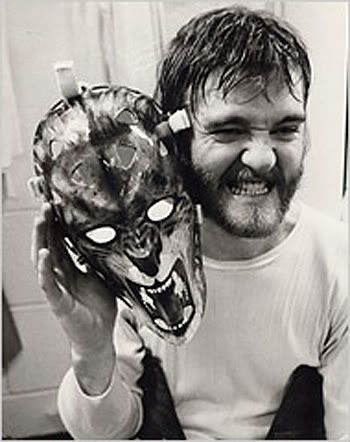
In our opinion, the Third String Goalie Award for The Greatest Goalie Mask Ever goes to Gilles Gratton's mask from 1976 when he was with the New York Rangers - The Lion.

Or is it a Tiger?

It depends on who you ask. The guy who created it, or the guy who wore it!

Gilles Gratton mask

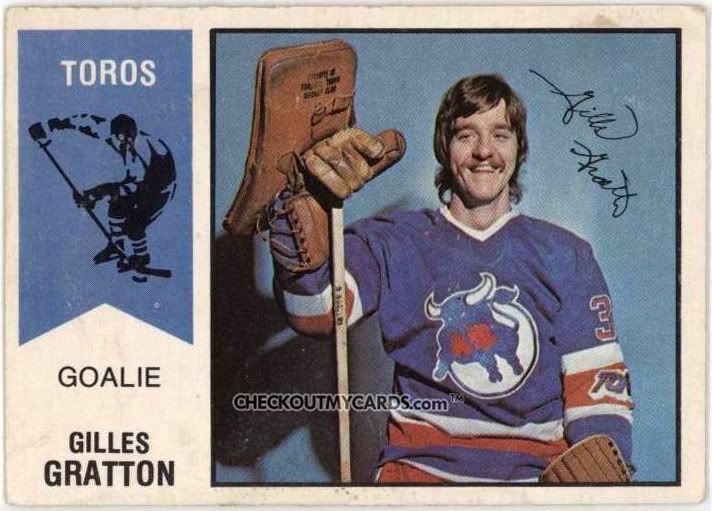
Drafted 69th overall by the Buffalo Sabres of the NHL, Gratton began his professional career with the Ottawa Nationals of the WHA in 1972 and finished with an above .500 record (25-22-3) for a team that finished below .500. He would move with the franchise when they relocated to Toronto, and renamed the Toros, and post a 56-44-4 record over the next two seasons. Gratton was a member of Team Canada in the 1974 Summit Series which pitted the WHA All-Stars against the Soviet National Team.

The 1975-76 season would see him make his NHL debut for the St. Louis Blues, but only appear in 6 games after he left the team and attempted to rejoin the Toros.

It was in 1976 that Gratton would unleash The Greatest Goalie Mask Ever while playing for the New York Rangers.

Gratton, known as "Gratoony the Loony" for such things as refusing to play when the moon was in the wrong part of the sky and another time claiming pain from an injury he suffered as a solider in a previous life! Among the past lives he's claimed to have lived include a 15th century Spanish conquistador and a Mayan priest. Released by the Rangers, he quit hockey at the age of 24 and spent three years in India and the next 20 or so moving around Europe.

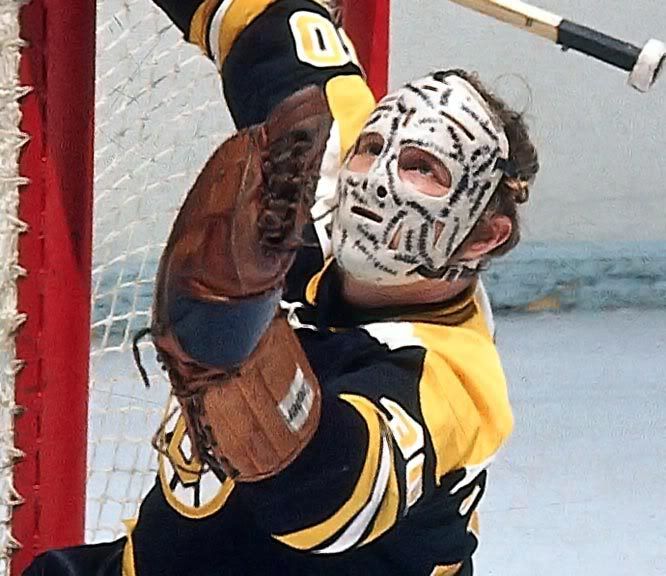
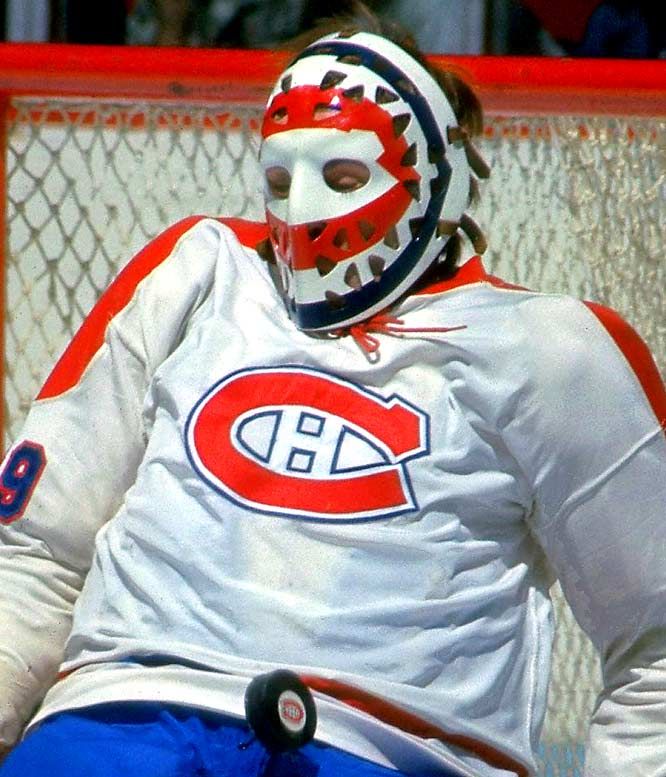
Gerry Cheevers is credited with starting mask decorating with his iconic "stitch marks" mask, but it was still essentially a plain white mask decorated with nothing more than a permanent marker. At the time Gratton came to the Rangers, masks were generally painted with simple designs, not usually more elaborate than stripes in team colors or designs based on elements of team logos.

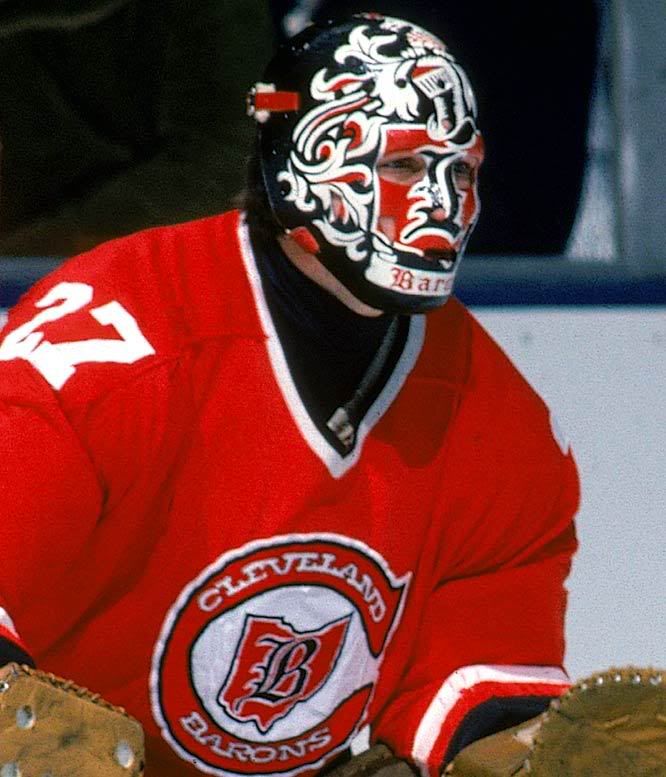
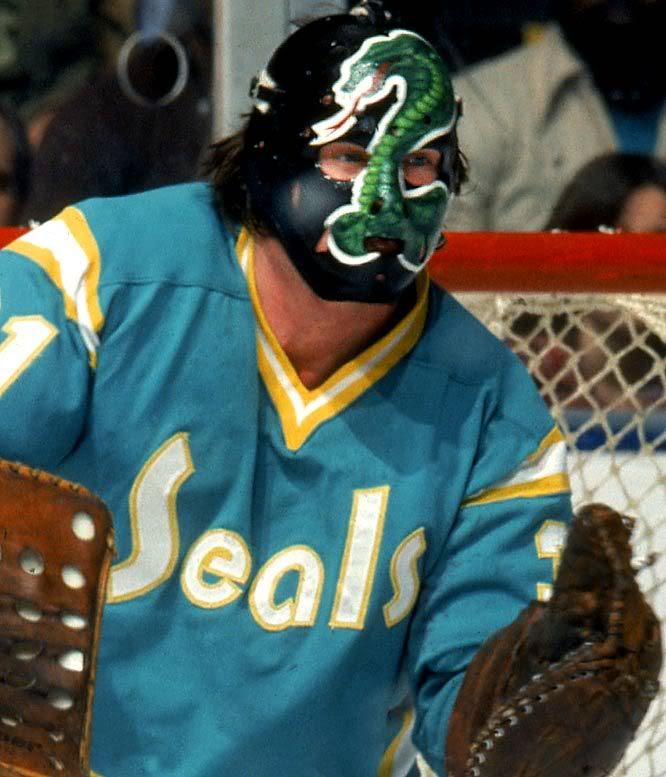
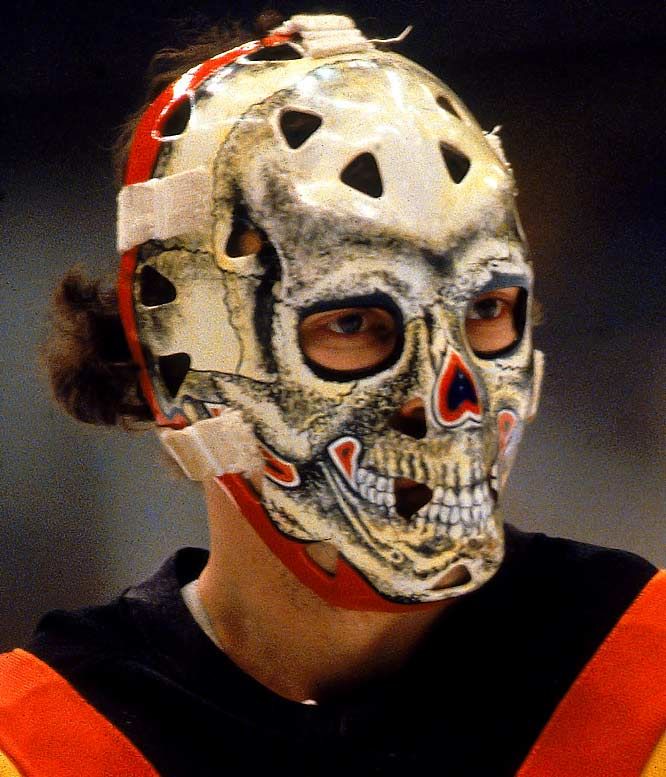
Artist Greg Harrison's design skills began to become more bold and ornate, as evidenced by Gilles Meloche's Cleveland Barons "Coat of Arms" mask, Gary Simmons "Cobra" mask and Gary Bromley's frightening "Skull" mask, but the peak of the goalie masks was reached with Harrison's mask for Gratton in 1976.

Photobucket

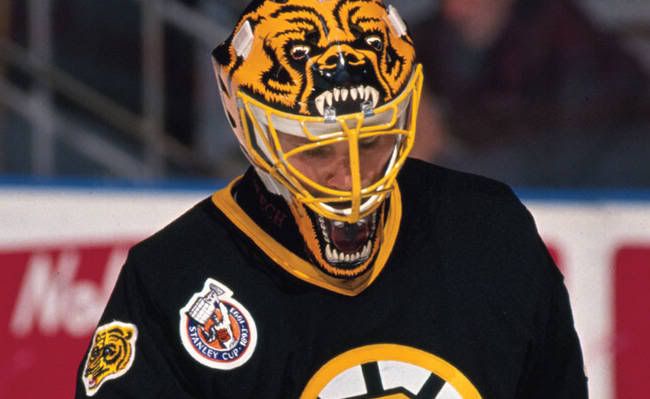
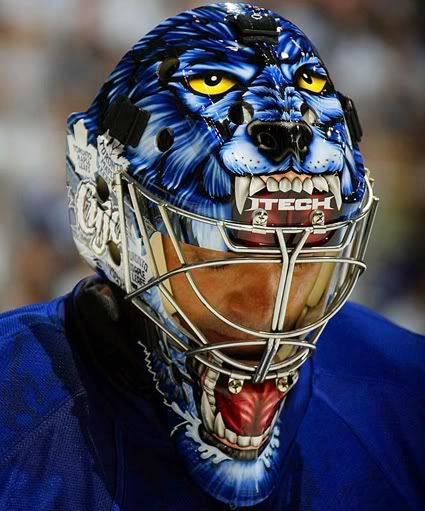
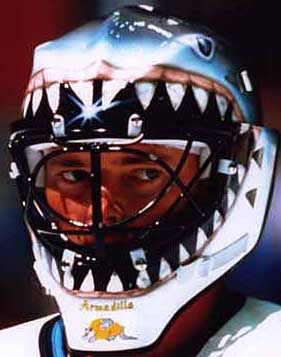
Some say the mask is of a lion, including Harrison who designed the mask, but Gratton insists that it is a tiger. Either way, it was years ahead of it's time for 1976 and influenced many subsequent mask designs, such as Andy Moog's Bruins "Bear" mask, Curtis Joseph's "Cujo" mask and Brian Hayward's "Shark" mask. It was so revolutionary, so striking and so unlike anything else that had come before in it's realism that it even made Time Magazine on it's debut.

It's also one of the last of it's kind, as in 1977 Dave Dryden came to Harrison with the idea for the hybrid mask, a mask with a large facial opening covered by the wires from a cage. The combo mask would be perfected by 1979 and quickly became the standard, altering the canvas for mask painting forever by forcing the artists to work around the now gaping hole in the center.

Photobucket

Here is a nice documentary video on players from the WHA, which begins with Gratton and goes on to discuss many other players of the WHA, including of course the players who were the inspiration of the Hanson Brothers of the movie Slap Shot.


Bonus Jersey: You just knew that somehow, someway we were going to find an excuse to post a jersey today.

Today's Bonus Jersey is a 1974 Team Canada Gilles Gratton jersey from the second Summit Series between the WHA All-Stars and the Soviet National Team.

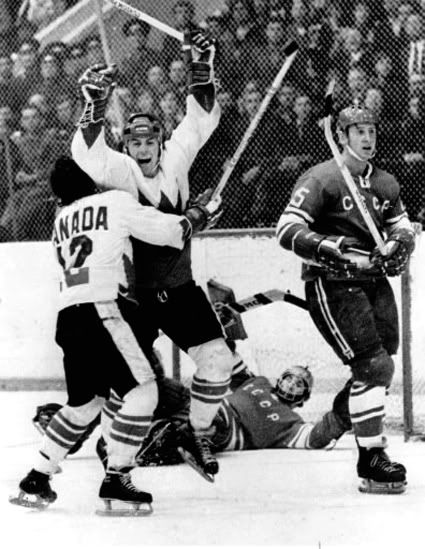
Similar to 1972 when Team Canada's jerseys all read "CANADA" on the back where you would normally find the player's name, in 1974, since players in the WHA were now being signed from Sweden and other European countries in addition to the Canadians and Americans, the jerseys for the WHA All-Stars in 1974 all had "INTERNATIONAL" across the back.

Photobucket

Saturday, October 31, 2009

The Greatest Goalie Mask Ever

We are going to have a bit of a departure today and feature not a jersey, but a mask, which feels appropriate with today being Halloween.

Yes, tomorrow is the 50th Anniversary of Jacques Plante wearing the first full face goalie mask in an NHL game, so everyone on The Internets will be talking about his mask tomorrow, so we've decided to beat everyone to the punch by a day and talk about a different mask - worn by a very different individual.

In our opinion, the Third String Goalie Award for The Greatest Goalie Mask Ever goes to Gilles Gratton's mask from 1976 when he was with the New York Rangers - The Lion.

Or is it a Tiger?

It depends on who you ask. The guy who created it, or the guy who wore it!

Gilles Gratton mask

Drafted 69th overall by the Buffalo Sabres of the NHL, Gratton began his professional career with the Ottawa Nationals of the WHA in 1972 and finished with an above .500 record (25-22-3) for a team that finished below .500. He would move with the franchise when they relocated to Toronto, and renamed the Toros, and post a 56-44-4 record over the next two seasons. Gratton was a member of Team Canada in the 1974 Summit Series which pitted the WHA All-Stars against the Soviet National Team.

The 1975-76 season would see him make his NHL debut for the St. Louis Blues, but only appear in 6 games after he left the team and attempted to rejoin the Toros.

It was in 1976 that Gratton would unleash The Greatest Goalie Mask Ever while playing for the New York Rangers.

Gratton, known as "Gratoony the Loony" for such things as refusing to play when the moon was in the wrong part of the sky and another time claiming pain from an injury he suffered as a solider in a previous life! Among the past lives he's claimed to have lived include a 15th century Spanish conquistador and a Mayan priest. Released by the Rangers, he quit hockey at the age of 24 and spent three years in India and the next 20 or so moving around Europe.

Gerry Cheevers is credited with starting mask decorating with his iconic "stitch marks" mask, but it was still essentially a plain white mask decorated with nothing more than a permanent marker. At the time Gratton came to the Rangers, masks were generally painted with simple designs, not usually more elaborate than stripes in team colors or designs based on elements of team logos.

Artist Greg Harrison's design skills began to become more bold and ornate, as evidenced by Gilles Meloche's Cleveland Barons "Coat of Arms" mask, Gary Simmons "Cobra" mask and Gary Bromley's frightening "Skull" mask, but the peak of the goalie masks was reached with Harrison's mask for Gratton in 1976.

Photobucket

Some say the mask is of a lion, including Harrison who designed the mask, but Gratton insists that it is a tiger. Either way, it was years ahead of it's time for 1976 and influenced many subsequent mask designs, such as Andy Moog's Bruins "Bear" mask, Curtis Joseph's "Cujo" mask and Brian Hayward's "Shark" mask. It was so revolutionary, so striking and so unlike anything else that had come before in it's realism that it even made Time Magazine on it's debut.

It's also one of the last of it's kind, as in 1977 Dave Dryden came to Harrison with the idea for the hybrid mask, a mask with a large facial opening covered by the wires from a cage. The combo mask would be perfected by 1979 and quickly became the standard, altering the canvas for mask painting forever by forcing the artists to work around the now gaping hole in the center.

Photobucket

Here is a nice documentary video on players from the WHA, which begins with Gratton and goes on to discuss many other players of the WHA, including of course the players who were the inspiration of the Hanson Brothers of the movie Slap Shot.


Bonus Jersey: You just knew that somehow, someway we were going to find an excuse to post a jersey today.

Today's Bonus Jersey is a 1974 Team Canada Gilles Gratton jersey from the second Summit Series between the WHA All-Stars and the Soviet National Team.

Similar to 1972 when Team Canada's jerseys all read "CANADA" on the back where you would normally find the player's name, in 1974, since players in the WHA were now being signed from Sweden and other European countries in addition to the Canadians and Americans, the jerseys for the WHA All-Stars in 1974 all had "INTERNATIONAL" across the back.

Photobucket


hit counter for blogger