History of Jersey 83-93 Banner sm photo History of Jersey 83-93 Banner sm.jpg

Saturday, May 14, 2011

1969-70 Minnesota North Stars Gump Worsley Jersey

Yea, we know this is supposed to be a hockey jersey blog, but with today being the birthday of Lorne "Gump" Worsley, we simply cannot let the occasion pass by without taking the opportunity to post our all-time favorite hockey card.

It's a Topps 1971-72 card #241, and it's a thing of beauty.


Photobucket

Photobucket

No, it's not glossy, it's not centered and it looks like it may have been cut out of the sheet of cards with a rusty scissors, but how can you look at that card and not smile? Even the curved font for team name seems to mimic his happy smile. We love this card so much we even printed it on a t-shirt.

Not all the cards in the 72-72 Topps set look quite this bad either. The
Penguins for example, made out good, getting a festive red background with yellow type for the team name, while the Blackhawks must have had a fan on the design team, walking away with a nice light blue with red type. But not the North Stars. Oh no...

Pink.

Tough, macho hockey pink. With garishly jarring green type. Yea, the Maple Leafs also got pink, but a darker, more menacing pink with a complimentary yellow team name. But when it came time for the North Stars, the designers looked at their color chart and realized they had crossed off all the other color combinations and what was left was baby girl pink paired with forest green. Bleah. How horrible is that?

Then, just check out the photo of the happy Gumper! Does that simply rock or what? You just want to buy that guy a beer. This man is feeling no pain and has life by the tail. Perhaps it was too many shots to the head, what with Gump being one of the last holdouts to actually not wear a mask while playing goal.

Yea, for you youngsters out there, read that again slowly to make sure you comprehend what you just heard. The man played goalie in the NHL against the likes of Bobby Hull without wearing a mask. For years. 24 years in total, winning the Calder Trophy as Rookie of the Year on a last place team, 2 Vezina Trophies as the League's Best Goaltender, 4 Stanley Cups and eventual election into the Hockey Hall of Fame.

Photobucket

But here's the funny part. This seemingly fearless man who faced some of the most wicked slapshots coming off the unregulated curved sticks of the time was afraid to fly. You'd think that if he was going to have a fear, it might be the obvious one coming at his face.

Photobucket

Gump Worsley tended goal for the North Stars during the first ever NHL game we attended as a kid back in early 70's in a game vs. the Los Angeles Kings, and for that reason alone he will always have a soft spot in our hearts, but being the subject matter of the greatest hockey card of all time doesn't hurt either. Not like a puck to the face.

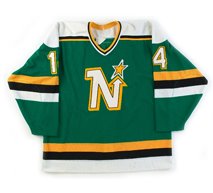
Today's featured jersey is a 1969-70 Minnesota North Stars Gump Worsley jersey. The North Stars started out with essentially this same jersey in 1967. After a false start saw them drop the lace up collar worn at the very start of their existence, the North Stars added the white shoulder yoke in 1968-69 and would continue to wear this style through the 1974-75 season, by which time Worsley had retired.

Minnesota North Stars 69-70 jersey

Today's video section is the wonderful Legends of Hockey profile of Gump Worsley.


Thursday, May 12, 2011

1985-86 Washington Capitals Dave Christian Jersey

Born into a legendary American hockey family on this date in 1959, Dave Christian, son and nephew of 1960 Olympic gold medalists and founders of the Christian Brothers hockey stick company Bill and Roger Christian, as well as nephew of 1956 Olympic silver medalist Gordon Christian, played his youth hockey for Warroad High School followed by college hockey at the University of North Dakota in 1977-78 and 1978-79.

He first donned a United States National Team sweater for the 1979 World Junior Tournament and was then a member of the United States National Team for the schedule of games they would play in 1979 in preparation for the 1980 Olympics in Lake Placid, New York. Coached by Herb Brooks, Christian and the rest of the 1980 United States Olympic Hockey Team would pull off the upset of the century, as the team of college age players would defeat the mighty Soviet Union National Team in "The Miracle on Ice" and go on to defeat Finland to capture the gold medal, adding to the family legacy of Olympic gold.

Christian USA

Following the Olympics, Christian turned professional with the Winnipeg Jets, who selected him in the second round of the 1979 NHL Entry Draft, the Jets first draft as a new member of the NHL after being founded in the WHA. He played 15 games with the Jets that season, scoring 18 points in 15 games which included his first goal on his first shot of his first shift, just seven seconds into his NHL career!

Christian Jets

Playing his first full season with the Jets, Christian proved himself right at home in the NHL, scoring 28 goals and 71 points to lead the team in scoring while playing in all 80 of the Jets games, setting the tone for a career noted for his dependability as well as his durability.

At the conclusion of the season Christian played for the United States once again, this time at the 1981 World Championships where he had a great tournament, scoring 8 goals and 11 points in 8 games. Before the next NHL season began, his country came calling once again, this time for the 1981 Canada Cup.

His second season with Winnipeg saw his point total increase to 76. His last season with the Jets was cut short by 25 games due to torn shoulder muscles, but over the course of the next nine seasons he would miss just 10 total games.

His rights were traded to the Washington Capitals in June of 1983. He made the transition to the Capitals with ease, scoring a point per game with 81 points in 80 games, which began a streak of three consecutive seasons without missing a game.

Christian Capitals

Before the 1984-85 NHL season, Christian added to his international resume by competing in his second Canada Cup for the United States. After a 69 point season in 1984-95, he had the best offensive season of his career when he scored 41 goals and 83 points to lead the club in scoring.

He would play three more seasons with the Capitals, extending his 20 goal, 50 point streak to six, as well as fitting in another World Championship appearance for the US in 1989, contributing 7 points in 6 games.

After 28 games of the 1989-90 season, Christian was acquired by the Boston Bruins for his offensive skills and veteran leadership. The move paid off for both sides as Christian and the Bruins made the longest postseason run of his career as Boston made it all the way to the Stanley Cup Finals.

Christian Bruins

He played one more season with the Bruins before being transferred to the St. Louis Blues as compensation for a pair of free agent signings by the Bruins of former Blues players. Prior to joining the Blues, Christian had the honor of competing for the United States in his third Canada Cup, this one in 1991.

Christian Blues

After one season with the Blues, Christian was claimed by the Chicago Blackhawks in the 1992 waiver draft. He played 60 games for Chicago in 1992-93 and 9 at the start of the 1993-94 season before being assigned to the Indianapolis Ice of the IHL for 40 games.

Christian Blackhawks

His final two seasons of pro hockey were spent with the brand new Minnesota Moose of the IHL, scoring 38 goals and 80 points in 81 games in 1994-95 and 46 points in 69 games of the 1995-96 season before retiring.

Christian Moose

He finished his NHL career with 1,009 games played, 340 goals and 433 assists for 773 points and an appearance in the 1991 NHL All-Star Game to go along with his gold medal won in 1980.

Today's featured jersey is a 1985-86 Washington Capitals Dave Christian jersey as worn during this finest NHL season when he set a career high with 83 points to lead the Capitals in scoring.

While many may assume the Capitals jerseys remained the same during this era, there were subtle detail changes, which included adding names to the back of the red road jerseys in 1977, changing to single color names beginning in 1979-80, dropping the number of stars on the arms to just four for 1983-84 and 1984-85, adding the fifth star on the arms back in 1985-86 and making the names two colors again in 1987-88 through the end of the lifespan of this classic jersey style until it was replaced with an entirely new set of jerseys, which sported an entirely new identity package consisting of a new logo and all new team colors in 1995-96.

Washington Capitals 85-86 jersey

Bonus Jersey: Today's bonus jersey is a 1980 United States Olympic Team Dave Christian jersey as worn in the gold medal clinching game against Finland on the final day of the 1980 Olympic tournament, the sixth time the United States had come from behind during their seven games.

The blue jerseys are the lesser known jerseys from the tournament, as it was the white ones they were wearing when they defeated the Soviet Union and the style which has been much more heavily marketed since then.

USA 1980 jersey photo USA 1980 23 R F.jpg
USA 1980 jersey photo USA 1980 23 R B.jpg

Today's video highlight is Christian scoring for the Minnesota Moose on a breakaway in what may very well be the quietest arena on planet Earth.


Wednesday, May 11, 2011

1943-44 New York Rangers Dutch Hiller Jersey

Born on this date in 1915, Wilbert "Dutch" Hiller played junior hockey with the Sudbury Wolves in 1933-34 and 1934-35. After playing senior hockey with both the Sudbury Miners and the cleverly named Falconbridge Falcons during the Allan Cup playoffs in 1935-36, he took the most unusual route of playing a season of hockey in England with the Harringay Greyhounds.

It was an important step for him on his way to the NHL, as it was by far the most games he had ever played in a season up to that point with 42, during which he scored 22 goals and 33 assists.

He returned to North America for the 1937-38 season to play primarily with the New York Rovers of the Eastern Hockey League. He played well enough with the Rovers, 26 goals and 56 points in 43 games, that he earned a call up to the New York Rangers to make his NHL debut. In eight games he scored his first NHL point with an assist, and also saw action in one playoff game.

Hiller Rangers

Beginning in 1938-39, Hiller, was a member of the "Roughneck" line playing along side of Phil Watson and Bryan Hextall. The Rangers public relations department wasn't fond of someone named Wilbert being a "Roughneck" and from that point on he became known as "Dutch" Hiller based on the Dutch population of his hometown of Berlin, Ontario, since renamed Kitchener after World War I, despite the fact he was not Dutch at all!

His first full season saw him finish with ten goals and 29 points, which increased to 13 goals and 31 points in 1939-40 as he developed a reputation for being one of the quickest players in the league. During the postseason, the Rangers defeated the Boston Bruins in six games before knocking off the Toronto Maple Leafs in six games, with Hiller assisting on the cup winning goal by Hextall, to capture the Stanley Cup.

New York Rangers 1939-40
The 1940 Stanley Cup Champion New York Rangers

After one more season with the Rangers, Hiller was claimed off of waivers by the Detroit Red Wings for the 1941-42 season. After only seven games, he was traded to the Boston Bruins for the rest of the year.

The same pattern repeated itself the next season as well, as Boston dealt Hiller to the Montreal Canadiens after just three games of the 1942-43 campaign. He found himself back with the Rangers for the 1943-44 season when he was loaned to New York, along with three other players, in exchange for the loan of Watson to the Canadiens.

Back on familiar territory with the Rangers, Hiller set a career high with 40 points from 18 goals and 22 assists in 50 games. Back with Montreal for the 1944-45 season, he had the only 20 goal season of his career on his way to a 36 point season.

Hiller Canadiens

While his production dropped in 1945-46, totaling just 18 points, he contributed six points in nine games in the postseason to get his name on the Stanley Cup for the second time in his career as Montreal defeated the Chicago Black Hawks followed by the Bruins.

Montreal Canadiens 1945-46
The Stanley Cup Champion 1945-46 Montreal Canadiens

Hiller was then traded once more, this time to Toronto, who placed Hiller with their AHL club the Pittsburgh Hornets for the 1946-47 season. There he had a good season, scoring 29 points in 64 games and made it to the Calder Cup Finals.

His final season of hockey was spent with the Kitchener Dutchmen playing senior hockey in the Ontario Hockey Association as his eyesight was beginning to fail.

His final NHL totals were 383 games played over nine seasons, 91 goals and 113 assists for 204 points and a pair of Stanley Cup championships.

During 2005, thanks to the NHL lockout, a special program took place where champions of the past were granted a day with the Stanley Cup, a tradition that began long after their playing days had ended. Hiller was one of the lucky men to be granted their day with the cup, some 65 years after having won it for the first time.

From the Hockey Hall of Fame website's "Stanley Cup Journal":

During his NHL career, Dutch Hiller was a member of four clubs — the New York Rangers, Detroit Red Wings, Boston Bruins and the Montreal Canadiens. As a result, he became a de facto member of the exclusive club comprised of Stanley Cup champions, winning with New York in 1939-40 and Montreal in 1945-46. But the club in which Dutch Hiller is most active is the ROMEO Club - Retired Old Men Eating Out. Virtually every morning for the past seven years, a group of approximately 10 gentlemen meet at the local Burger King in La Crescenta, California. There, over coffee, the guys solve the world's troubles and talk about other important topics — like health, women…and hockey. 
At 7:15 on the morning of Friday, September 9, the ROMEO Club convened at the Burger King as usual but this time, Dutch brought along a friend — the Stanley Cup! 
Sporting a Rangers' ballcap, Dutch had to gulp his coffee between autographs, while his fellow club members pored over scrapbooks Hiller compiled during his career. "I thought people had forgotten me," admitted the 90-year-old champion. "It's unbelievable!" Astonished patrons picking up a coffee and Croissan'wich strained their necks when they realized that the Stanley Cup was in their midst. 
At 11 o'clock, as the breakfast crowd had all but evaporated, the Stanley Cup was taken to Dutch's home in nearby Montrose, which borders Glendale to the south and west. There, daughters Pat and Rosemarie hosted as family and friends dropped by to visit Dutch and the Stanley Cup. Hiller regaled his friends and grandchildren with stories about being a goal judge for the Los Angeles Kings during their early years. 
"What brought you to L.A., Dutch?" asked a friend. "Well, after we won the Cup with the Canadiens in '46, I got traded to Toronto and played with Pittsburgh (the Leafs' AHL affiliate). Then, I went home for a year (and played with the senior Kitchener Dutchmen in 1947-48). I got a call to coach the Los Angeles Monarchs (of the Pacific Coast Hockey League) in '48-49 and '49-50. We finished in second that last year." Dutch shrugs. "I loved the area and stayed here after that." 
Reviewing the scrapbooks and being asked for autographs did Dutch Hiller a world of good. "It's good to be near the Cup again," he admits with a grin.
Hiller passed away just two months after his day with the cup at the age of 90.

Today's featured jersey is a 1943-44 New York Rangers Dutch Hiller jersey. The Rangers used block letters with no serifs or drop shadows from their inception in 1926 through the 1940-41 season. They then changed to the font still in use today with the italicized and serifed letters in 1941-42, adding the now familiar drop shadow the following season, by which time Hiller had moved on.

He did return to the Rangers for the 1943-44 season, during which he wore today's featured jersey style.

New York Rangers 39-40 jersey

Tuesday, May 10, 2011

1969-70 Boston Bruins Bobby Orr Jersey

Today, May 10th, proved to be a very remarkable day in the life of Bobby Orr, for on this date in 1968 Orr was named the winner of the Norris Trophy as the NHL's outstanding defenseman despite it being only Orr's second season in the NHL and the fact he was limited to just 46 games and 31 points by a knee injury!

Orr had already won the Calder Trophy as rookie of the year the season before and that season's Norris Trophy winner Harry Howell of the New York Rangers then commented he was glad to have won it when he did because "Orr will own this trophy from now on."

Orr proved Howell correct, winning the trophy eight consecutive seasons. After winning the Norris again in 1969, Orr had a season for the ages in 1969-70, winning not only the Norris, but also the Art Ross Trophy that goes to the league's leading scorer, the first and only defenseman to ever do so, the Hart Trophy as the league's Most Valuable Player for the first of three times, and the Conn Smythe Trophy as the Most Valuable Player in the Stanley Cup Playoffs, (becoming the first player to ever win four major NHL awards in one season) as he clinched the Boston Bruins first Stanley Cup championship in 29 years.

Orr did it in style by scoring one of the most memorable goals in hockey history as he scored the cup winning goal in overtime of Game 4 against the St. Louis Blues, also on this date, to give the Bruins their first championship since 1941. His immediate mid-air celebration after tripping over the stick of Blues goaltender Glenn Hall is perhaps the most famous photo in hockey history.

Bobby Orr 1970

So famous is Orr's goal, that a book has been published about it. Not about Orr's career or even his spectacular 1969-70 season, but an entire book dedicated to just that one goal.

One year later, again on today, May 10th, Orr was named the winner of not only his fourth consecutive Norris Trophy, but also his second consecutive Hart Trophy as he set a personal high with 139 points, the most ever by a defenseman and a record which still stands to this day.

Although his career was cut short by multiple knee surgeries, Orr would win four more Norris Trophies, another Art Ross Trophy, another Hart Trophy and another Conn Smythe Trophy while winning his second Stanley Cup. Orr was later inducted into the Hockey Hall of Fame in 1979, becoming the youngest person to ever receive that honor, sadly made possible by the shortness of his career.


Today's featured jersey is a 1969-70 Boston Bruins Bobby Orr jersey as worn while he was flying through the air like Superman after scoring the Stanley Cup winning goal in 1970.

When purchasing a Bobby Orr Bruins jersey, please be aware that Orr very rarely wore his name on the back of any Boston Bruins jersey during his entire career, with the only times being for national TV games, as was the practice back then. Quite often Orr jerseys are sold on ebay or other online stores with Orr's name incorrectly on the back of the jersey, as if his iconic #4 wasn't enough.

Even during Orr's first season in Chicago no names were used on the back, making just the final six games of his career with the Black Hawks in 1978-79, a sad and unfortunate end to a great career and not exactly worthy of recreating for your collection, one of the few times Orr regularly wore his name on the back of a jersey outside of NHL All-Star Games and the 1976 Canada Cup.

 photo BostonBruins69-70F.jpg
 photo BostonBruins69-70B.jpg

Today's video selection is the Legends of Hockey profile of Bobby Orr which includes footage of his famous Stanley Cup winning goal, scored on this day in 1970.


Monday, May 9, 2011

Third String Goalie's Second Anniversary

Today is the second anniversary of Third String Goalie. While we originally intended for this to be a way to share our hockey jersey collection with hockey fans in North America, we soon learned that there were many great stories from the world of hockey that we wanted to tell, but did not own jerseys to illustrate them.

Once we freed ourselves of the restriction of only posting jerseys that we own, it allowed us to bring you many stories we found fascinating, sad, hilarious, remarkable and inspirational.

Over the course of the last two years we were in for several surprises, one of which was certainly how many people from all over the globe have paid a visit to this blog, be it on purpose or surely by accident. As of today we have documented visitors from 150 different countries, a fact that shocks and amazes us to the point that we now have our flag counter as a regular feature of our right hand sidebar. We only wish we would have discovered this sooner so the visitor numbers would be accurate since the day be began, as it only accounts for half of our total pageviews.

Free counters!

We are genuinely pleased that so many of you from around the world have paid us a visit or two, and to hopefully make your visit easier, we also added a google translate feature above the flag counter which will convert Third String Goalie into the language of your choice.

Once we started to see visitors from Europe and around the world, seeing the numbers from traditional hockey playing countries were understandable, places such as Russia, Finland, Sweden, Germany and Switzerland, but that so many have come from Australia, France and especially Great Britain has truly been a surprise. Speaking of surprises, one can only wonder what the visitors from Nicaragua, Iran, Botswana, Afghanistan, Cambodia, Bangldesh and Iraq were looking for when they stumbled across us!

To date, over 200,000 visitors to Third String Goalie have viewed over 300,000 pages and our daily numbers continue to rise, much to our excitement.

Some other numbers to run by you include over 400 retweets of our posts on Twitter, over 750 tweets we have made on our twitter feed, which now has over 220 daily followers of quality (as we try to weed out the spammers as much as we can) and 172 people who like our Facebook page, which if you felt like "liking" we certainly encourage, and 765 total posts we have written, which range from the 1902-03 Rat Portage Thistles to yesterday's update on the 2011 IIHF World Championships, from 183 different teams from 27 different countries, ranging from Alaska in the west around the world to Japan in the east, from Iceland in the north to Miami, Florida in the south, all documented in our google map of Third String Goalie jersey locations, which can be viewed daily at the bottom of the main page.


To celebrate our second anniversary we are having a sale in our Third String Goalie Online Shop, where everything will be marked down to it's lowest price possible for the next week.

Photobucket

Thank you all so much for reading and supporting Third String Goalie, especially those of you who have taken the time to post comments, send in corrections and email us. It's greatly appreciated!

Now, on to our traditional annual post in honor of Steve Yzerman, who shares a birthday with Third String Goalie.

1989 Team Canada Steve Yzerman Jersey

Steve Yzerman, born on this date in 1965, began his international hockey career skating for Canada in the 1983 World Junior Championships wearing the unfamiliar number of 14. The tournament, played in what was then known as Leningrad, saw a Canadian lineup which featured future NHLers Dave Andreychuk, Mario Lemieux, Pat Verbeek and Mike Vernon. Yzerman finished 9th in team scoring with 2 goals and 3 assists in 7 games as Canada earned a bronze medal with a record of 4-2-1.

Yzerman Canada 1983
Yzerman in the 1983 World Juniors jersey

Following his rookie season in the NHL during which he scored 39 goals and 87 points, Yzerman would get his next opportunity to play for Team Canada in the 1984 Canada Cup, a prestigious honor for a 19-year-old considering the importance of the tournament to Canada and the stellar lineup of names they had to choose from. Yzerman, wearing #8, had an understandably smaller role with the squad, appearing in just four of the eight games and was held without a point. Still, it was a great experience to be on a team with the greatest players in Canada at the time.

Yzerman Canada 1984
Yzerman on the left, next to Michel Goulet and Randy Gregg during the 1984 Canada Cup

With Detroit at the end of the "Dead Wings" period, where they missed the playoffs 15 of the previous 18 seasons, Detroit did qualify for the 1985 Stanley Cup playoffs, but their quick first round exit freed Yzerman up to join Team Canada for the World Championships for the first time.

Now wearing his familiar #19, Yzerman scored 3 goals and 7 points in 10 games, 6th on the team, as Canada with an overall record of 6-3-1 and took home a silver medal.

Detroit began to show long-waited improvement and began to regularly qualify for the NHL playoffs, which delayed Yzerman's next appearance for Canada until the 1989 World Championships in Sweden. Now established as an NHL captain since 1986, was also named as one of three Canadian captains, along with Dale Hawerchuk and Kirk Muller. Yzerman was limited to just eight of Canada's ten games but still came second in scoring with 5 goals and 12 points. After a preliminary round record of 5-2 to advance to the final round, Canada beat Sweden, lost to Russia and then beat Czechoslovakia to earn another silver medal.

A setback in Detroit in 1989-90 meant the Red Wings missed the playoffs, which made Yzerman once again available for World Championship duties. Again named team captain, along with defenseman Paul Coffey, led Canada through the preliminary round undefeated with a record of 6-0-1. The Final Round saw a complete reversal of fortune, as Canada lost to the Czechs, the Soviets and the Swedes to fall flat and miss out on the medals. Yzerman led the team in scoring with 10 goals and 20 points in 10 games, an average of two points per game.

It would prove to be Yzerman's final World Championship, mainly due to the rise of the Red Wings, who qualified for the Stanley Cup playoffs in 1991, beginning a streak which would last for the remainder of his NHL career through 2006.

When the World Cup of Hockey debuted in 1996 prior to the start of the NHL regular season, Yzerman was free to participate, and scored a pair of goals and an assist in six of Canada's eight games.

Yzerman Canada 1996
Yzerman during the 1996 World Cup of Hockey

With the rules changed and the NHL now agreeing to suspend it's regular season to allow the best NHL players to participate in the Olympics, Yzerman's next Team Canada appearance came in Nagano, Japan in 1998. Canada went 3-0 in the Preliminary Round and defeated Kazakhstan before losing to both eventual champions the Czech Republic in a shootout and then Finland to finish just short of a medal. Yzerman finished with 2 points in 6 games.

Yzerman Canada 1988
Yzerman's first Olympic experience came in the 1998 games in Japan

The final international opportunity of Yzerman's career came with the 2002 Olympics in Salt Lake City. It all came right for Canada as they won their first Olympic gold medal in 50 years by defeating the United States 5-2 in the final. During the tournament Yzerman tied for second in Canadian scoring with 2 goals and 6 points, one back of Joe Sakic, which tied him for 5th in tournament scoring.

Yzerman Canada 2002
Yzerman in the gorgeous throwback jersey worn by Canada in their opening game against Sweden

When he announced in 2005 that he would not be going to participate in the 2006 games in Italy, Wayne Gretzky announced that no Canadian player would be allowed to wear Yzerman's #19, a roster which included regular wearers of #19 in the NHL Shane Doan (who wore #9 in Italy), Brad Richards (#39), Joe Sakic (#91), Jason Spezza (#10) and Joe Thornton (#97).

Yzerman himself, in his role as Executive Director of Team Canada for the 2010 Olympics, unretired #19 which was worn by Thornton.

With 57 games played, Yzerman's international carer concluded with 25 goals and 55 points, a bronze medal, two silvers and a pair of gold medals.

Today's featured jersey is a 1989 Team Canada Steve Yzerman jersey as worn in the 1989 World Championships when Canada won the silver medal. Yzerman also wore the same jersey in the 1990 World Championships when he led Canada with 20 points in 10 games.

Of note, Canada was also scheduled to wear this same style jersey made by Tackla in the 1988 Olympic games in Calgary but defied the contract the Olympic organizers had with Tackla to supply all the jerseys, opting to wear the same design produced by the Canadian manufacturer CCM instead, which earned them a $100,000 fine for their actions.

Canada 1989 #19 F
Canada 1989 #19 B

Today's video section is highlights of Yzerman and Team Canada winning the gold medal at the 2002 Olympics.


Saturday, May 7, 2011

2011 IIHF World Championships Update

The 2011 IIHF World Championships continue today in Bratislava and Kosice, Slovakia. Highlights of the Preliminary Round were the performances of Germany and Norway.

In Group A, Germany shocked everyone with their tournament opening shutout of Russia 2-0. They then took care of hosts Slovakia 4-3 and outlasted plucky Slovenia 3-2 in a shootout to earn 8 of a possible 9 points to win their group for the first time in their history. Also advancing to the Qualifying Round were Russia, who rebounded by defeating Slovakia and Slovenia, and Slovakia, whose opening day 3-1 win over Slovenia proved to all the points they would need.

Group B saw Canada take care of business with regulation wins over Belarus and France before requiring overtime to down Switzerland, who also defeated France, in overtime, and Belarus before gaining a point against Canada to also advance. The surprise of the group was 15th ranked France's overtime win over #10 Belarus 2-1 to avoid the Relegation Round and move on to the Qualifying Round.

In Group C, Sweden's easy win over the United States gave them the top spot in Group C with just 7 points, the lowest total by a group winner. The USA's two wins over Norway and Austria put them through as well. Norway gained the final place thanks to their first ever win over Sweden in a shootout, and an easy 5-0 win over Austria, who were badly outplayed in the first round, scoring just one goal while giving up 13, by far the worst goal differential of all.

The only team to go undefeated in regulation play and earn the maximum nine points was Group D winning Czech Republic. Finland started strong with a three point win over Denmark, but needed a shootout to get past Latvia before losing to the Czechs in a subpar round for the Finns. The most dramatic game of Group D was the final game with a Qualifying Round spot on the line when Denmark surprised with a shootout win over Latvia.

While Qualifying Round play continues today, the most tense games will be the two Relegation Round games between Slovenia and Belarus in addition to Latvia taking on Austria.

Belarus and Slovenia looked to be on their way to safety when Belarus dominated the Austrians 7-2 and #19 Slovenia pounded #12 Latvia 5-2. But then a funny thing happened and Austria, who had now been outscored 20-3, got up off the mat and defeated Slovenia 3-2 in regulation before the Latvians delighted their raucous fans by easily winning 6-3 over Belarus.

Those two unexpected results left everyone in the group tied with three points. Today's mission is simply win and you're safe, even a win that requires additional time will suffice to protect your place in next year's World Championships in Finland and Sweden.

Slovenia takes on the higher ranked Belarus at the same time Latvia squares off against a desperate Austria with today's losers dropping down to Division 1 for 2012.

Action also continues today with a pair of games, one each in Group E and Group F, to determine the pairings for the quarterfinals which begin on Wednesday. In Group E, Russia takes on the still undefeated Czechs. Four of the six teams in each group advance to the playoffs, with the Czech Republic, Finland, Germany and Russia all set to advance, with only the final order still at stake.

Group F has Sweden taking on Switzerland today. Sweden will be looking to tie Canada on top of the group while the Swiss need as many points as possible in their effort to supplant Norway as the final team to advance, as Norway finishes their schedule on Monday against winless France while Switzerland faces a stronger team in the United States.

While only Canada is a lock to advance, Sweden and the United States seem safe, and will officially become so if Switzerland loses in regulation today. Norway comes next with 5 points, two ahead of the Swiss at 3, who still have today's game in hand. France will not advance past this round based on their single point in four games.

The quarterfinal pairings will be determined after Monday's six games which involve all the remaining teams. After a day off on Tuesday, the top four finishers in each group will be paired in a crossover with the teams in the opposite group, with the first place teams facing the fourth place team from the other group, while the second place finishers take on the third place team from the other group.

Update: Scores from today show the Czech Republic staying perfect with their 3-2 win over Russia. The Czechs have now locked up the top spot in Group E and will play the fourth place team in Group F, likely Norway or possibly the United States.

In Group F, Sweden defeated Switzerland 2-0, locking in quarterfinal berths for both Sweden as well as the United States. Switzerland must now win on Monday to have a chance to advance to the quarterfinals, as they have 3 points with Norway at 5. Norway has a relatively easy matchup with France on Monday, and even a single point for reaching overtime would put them through, as they hold the tiebreaker over Switzerland thanks to their earlier 3-2 win over the Swiss last Thursday.

The only way Switzerland can advance is by winning in regulation combined with a French win in regulation over Norway.

In the Relegation Round, there was not much drama as Belarus dominated Slovenia 7-1, sending Slovenia down to Division 1 for next season.

Andrei Kostitsyn Belarus
Andrei Kostitsyn celebrates his goal today for Belarus

In the other game, Latvia cruised to a 4-1 win over demoted Austria. Those two relegated squads will be replaced by Italy and Kazakhstan for the 2012 World Championships in Finland and Sweden.

Roberts Bukarts Latvia
Roberts Bukarts scores for Latvia

1999-00 New Jersey Devils Brian Rafalski Jersey

Brian Rafalski's career began like many other future NHLers, as he enrolled at the University of Wisconsin for the 1991-92 season, after which he was named to the WCHA All-Rookie Team. That same season he also participated in the World Junior Tournament for the United States.

Rafalski Wisconsin

The 1992-93 season saw him continue at Wisconsin as well as make a return appearance at the World Juniors. As he gained experience and confidence, his point totals began to increase, up from 13 to 23 for 1993-94 and nearly doubling to 45 for 1994-95, a season during which Rafalski was named WCHA Defensive Player of the Year and WCHA First All-Star Team and helped Wisconsin win the WCHA playoff title. Following the completion of his college career, Rafalski once more skated for the United States, this time at the World Championships.

Despite his noteworthy resume, Rafalski, at 5' 10", was considered too small and went undrafted by the NHL. Still eager to continue his hockey career, he joined Brynas IF in Sweden.

After one season in Sweden, he moved to HPK in Finland. There, he had a solid offensive season for a defenseman with 35 points in 49 games and was given the Pekka Rautakallio Trophy as Best Defenseman in the SM-Liiga.

Establishing a knack for choosing the right situation throughout his career, Rafalski joined HIFK of Helsinki and promptly won the league championship in 1998. He once again was named Best Defenseman in the league for the 1998-99 season while still with HIFK, as he scored 53 points, an average of a point per game. In a vote of the players, he was also awarded the Golden Helmet as the best player overall.

Having proven himself as a capable player, including being named by The Sporting News as the best hockey player in the world not playing in the NHL, Rafalski realized his dream on this date in 1999, as he signed a free agent contract with the New Jersey Devils, with whom he finally began the delayed start to his NHL career as a now 26-year-old rookie.

With the Devils, Rafalski was paired with team captain Scott Stevens, whose strong defensive skills allowed Rafalski the opportunity to take more risks in an effort to score, resulting in 32 points by season's end.

Once more, his change in clubs paid immediate dividends, as the Devils captured the Stanley Cup at the end of Rafalski's first season in the NHL, which included being named to the NHL All-Rookie Team. He was at least four and as many as seven years older than any of the other five members of the rookie team.

Rafalski 2000 Devils

He would go on to play seven seasons with the Devils, which included another Stanley Cup championship in 2003 and an appearance in the NHL All-Star Game in in 2004 and a second one in 2007.

For the 2007-08, Rafalski signed with his hometown Detroit Red Wings in another change to a club that would, for the third time in Rafalski's career, end with a championship at the conclusion of his very first season with his new team. With the high powered Red Wings, Rafalski set a career high to date with 59 points in 2008-09 after back to back 55 point seasons.

Rafalski Red Wings

Internationally, Rafalski was named to Team USA for the 2004 World Cup of Hockey and has played in three Olympics for the Americans, in 2002, 2006 and 2010, earning silver medals in both 2002 and 2010 as well as being named Best Defenseman of the 2010 tournament.

Rafalski USA

He is now 11 years into his NHL career despite the late start as a result of his going undrafted and more than proven the scouts wrong who thought him too small, as in addition to his three Stanley Cups, Rafalski now has scored over 500 regular season and 100 points during the NHL playoffs over the course of his career.

Today's featured jersey is a 1999-00 New Jersey Devils Brian Rafalski jersey as worn during the Stanley Cup Finals of his rookie season in the NHL.

Of note, this jersey has the NHL 2000 patch, which all the players wore that season, plus the addition of the 2000 Stanley Cup Finals patch, which was added to the Devils and Dallas Stars jerseys for the finals.

Also worth noting is that this jersey is a ProPlayer brand, who supplied jerseys to NHL clubs for only that one season.

New Jersey Devils 99-00 jersey, New Jersey Devils 99-00 jersey

Today's video segment begins with an interview with Rafalski while still a member of HIFK just prior to the 1999 SM-Liiga Finals while knowing he had already signed with New Jersey. There is also some very artistic footage of him eating a McDonald's hamburger.


Nest is a compilation of goals scored by Rafalski while playing in Finland.


Finally an interview with Rafalski as he talks about his career, starting with Wisconsin and how he ended up playing in Europe. It then continues with the time he has spent with soldiers and veterans of the armed forces.


Friday, May 6, 2011

2005 Team Canada Martin Brodeur Jersey

Born on this date in 1972, Martin Brodeur followed in his father's footsteps and began his international hockey career at the 1996 World Championships, seeing action in three games and posting a record of 0-1-1 as Canada won the silver medal.

 photo DennisBrodeurCanada1956.jpg
Dennis Brodeur in goal for Canada during the 1956 Olympics

Later that same year he played for Canada in the inaugural World Cup of Hockey, playing in a pair of games with a record of 0-1-0.

Martin Brodeur Canada 1996 photo MartinBrodeurCanada1996WCOH.jpg
Brodeur wearing the unfamiliar #1 during the 1996 World Cup of Hockey due to Bill Ranford wearing #30

Internationally, Brodeur was a next member of the 1998 Canadian Olympic team in Nagano, Japan, but did not see any game action during the tournament.

Martin Brodeur Canada 1998 photo MartinBrodeurCanada1998.jpg
Brodeur wearing the 1998 Team Canada Olympic jersey

When the Olympics arrived again four years later in 2002, following an opening game loss for the Canadians, Brodeur became the starting goaltender for the Canadians as they beat Germany and tied the Czech Republic before getting on a roll in the Final Round, where they defeated Finland 2-1, destroyed Belarus 7-1 and captured the gold medal, Canada's first in fifty years, with a 5-2 defeat of the United States.

Brodeur Canada
Brodeur celebrates Canada's first gold medal in 50 years

Brodeur was again Canada's number one goaltender for the 2004 World Cup of Hockey, leading them to the championship with a 5-0 record and victories over the United States, Slovakia, Russia, Slovakia again and Finland in the championship final.

Martin Brodeur Canada 2004 WCOH photo MartinBrodeurCanada2004WCOH.jpg
Canada began the 2004 World Cup by wearing the 1920 Winnipeg Falcons throwbacks

Brodeur Canada
Brodeur lifts the 2004 World Cup trophy

Thanks to the 2004-05 NHL season being lost due to the lockout, Brodeur was available to play for Canada in the 2005 World Championships, an event he had not competed in for nine years due to his annual NHL playoff responsibilities with the New Jersey Devils. Brodeur put up a 5-2 record in 7 starts for Canada, defeating Latvia and the United States in Group B play, a loss to Sweden and a narrow 2-1 win over Ukraine in Group F before eliminating Slovakia in the quarterfinals and Russia in the semi-finals before losing 3-0 to the Czech Republic in the gold medal game, leaving Canada with the silver.

Martin Brodeur Canada 2005 WC photo MartinBrodeurCanada2005WC.jpg
Brodeur wearing the same jerseys as the 2004 World Cup, but with the addition of sponsorship patches on the shoulders, a regular feature of jerseys worn during the World Championships

Brodeur was once more back on Olympic ice, this time in 2006 in Torinio, Italy. Canada began the tournament in good form, defeating Italy 7-2 with Brodeur in goal before defeating Germany 5-1. Brodeur was back in net for the surprising 2-0 upset at the hands of Switzerland. Canada next lost a second consecutive game to Finland before Brodeur got Canada back on track with a 3-2 defeat of the Czech Republic to finish Group A in third place. Canada's tournament ended in the quarterfinals with Broduer in goal, as they lost to Russia 2-0. Brodeur finished his tournament with a 2-2 record in four starts, as Canada failed to score a single goal in both of Brodeur's losses.

Martin Brodeur Canada 2010 photo MartinBrodeurCanada2010.jpg
Brodeur wearing Nike's new Swift jersey at the 2006 Olympics

His most recent international experience came in the 2010 Olympics in Vancouver. Brodeur was in goal for Canada's 3-2 shootout win over Switzerland, avoiding a repeat of their 2006 upset at the hands of the Swiss. They then lost 5-3 in a scintillating game against the United States. Seeking a change after their lackluster group play, Canada went with Broduer's several time international backup Roberto Luongo (2004 World Cup of Hockey, 2005 World Championships and 2006 Olympics), who guided Canada to another Olympic gold medal, Brodeur's second.

Brodeur Canada
Brodeur and Luongo after receiving their gold medals in 2010

Brodeur's record in senior international games now stands at 29 games played, 17 wins, 7 losses and 2 tiesand a goals against average of 2.25, two World Championship silver medals, a World Cup championship and a pair of Olympic gold medals.

Today's featured jersey is a 2005 Team Canada Martin Brodeur jersey as worn by Brodeur in the 2005 World Championships which took place during the NHL lockout season of 2004-05. This style was first introduced for the 2002 Olympics and was worn through the 2005 World Championships.

Brodeur traditionally has been competing in the Stanley Cup playoffs since first breaking into the NHL, as the Devils have made the playoffs ever year of Brodeur's lengthy NHL career, save for 1995-96, the only other time he  was able to compete at the World Championships.

This jersey features the traditional sponsorship patches on the shoulders as seen during the World Championships.

Canada 2005 WC jersey photo Canada2005WCF.jpg
Canada 2005 WC jersey photo Canada2005WCB.jpg
Canada 2005 WC jersey photo Canada2005WCP1.jpg

Here, Broduer speaks during in advance of the 2010 Olympics in Vancouver.


hit counter for blogger