Politically, Swig and the Gunds were relying on Swig's political connections with San Francisco Mayor Joseph L. Alioto to get a new hockey arena built downtown. "Alioto was very helpful, " Gund remembered. "He had hoped to put the team where the Moscone Center is now. It was very close to public transportation."Regrettably for the Seals, Swig's timing was off. Alioto was leaving office and Swig supported the wrong man in the 1975 election. When George Moscone took office, the new arena died. "The new mayor put the building on hold." Len Shapiro said. "He ran an investigation into the report and then said the survey had to be resurveyed , so basically, it went nowhere. Then there were plans to remodel the Cow Palace but that never happened either." Once those two plans fell through, the Seals were finished in the Bay Area."After the new arena in San Francisco fell through, the league gave us the go-ahead to move the team." Gund remembered. "We looked at a lot of other places. We looked at Denver and Seattle-Tacoma. We ended up picking Cleveland because hockey was very popular there."Rumors that the Seals would leave the Bay Area were almost as old as the team itself. The owners were quietly but aggressively looking over other locations. The NHL had planned expansion franchises for both Seattle and Denver, which were supposed to begin play in 1976-77. The new entires, though, were experiencing problems so moving the Seals to those cities was still a possibility.Shapiro recalled when he first got an inkling the team might be leaving. "On February 1, 1976, I realized something might be up. I was in the office with Loretta Marcus [the team's secretary] and nobody else was there. I had no idea where anybody was. I looked at Munson Campbell's schedule and it said he was booked at the Cleveland Hilton. Then I knew something must be up."George and Gordon Gund owned the Richfield Coliseum in Richfield, Ohio, where the NBA's Cleveland Cavaliers played. It was halfway between Akron and Cleveland, a location that would cause the franchise more problems in the future. In typical Seals fashion, even it's exit was not smooth. The club participated in the July 1976 entry draft as the Seals and even started selling tickets for the upcoming season in Oakland.At the 1976 entry draft, the Seals made history by becoming the first NHL team to use its frist-round draft pick on a European player by drafting Swedish defenseman Bjorn Johansson. The team didn't make it's intention to move officially known until August 26, 1976. It was announced that the team would move to Cleveland and take the name of the AHL franchise that played there for so many years, the Barons. Because of the late move, the Barons had a mere six weeks to sell tickets in their new home. Once again, the franchise started its new life behind the proverbial eight ball.
Sunday, April 4, 2010
1974-75 California Golden Seals Gilles Meloche Jersey
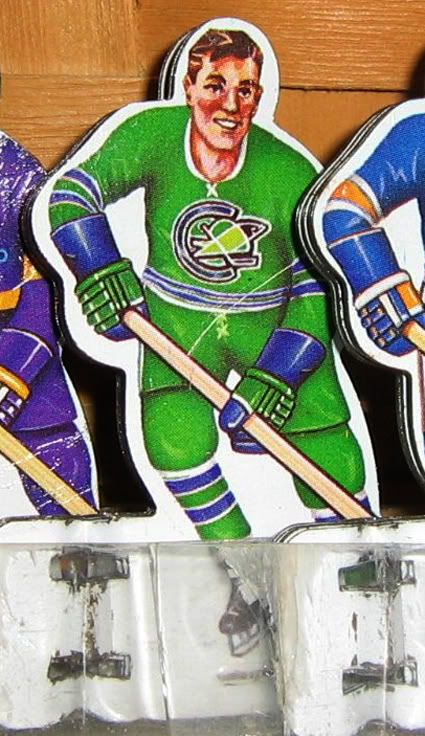
On this date in 1976, the California Golden Seals defeated the Los Angeles Kings 5-2 in their final game ever. The ever name changing California Seals were founded as part of the great NHL expansion of 1967-68. The San Francisco area was not considered a particularly lucrative market for hockey, but the terms of a new television agreement with CBS called for two of the six new expansion teams to be located in California, with the other club being the Kings in Los Angeles.
The Seals were supposed to have been located in San Francisco, but the planned arena was never built and instead, the team was based across the bay in Oakland. The club was originally called the "California Seals" to appeal to fans in San Francisco and address complaints from other NHL teams, who complained that Oakland was not a major league city, as it's only other professional sports team at the time was the Oakland Raiders of the American Football League. On November 6, 1967, after the franchise was just a mere dozen games old, owner Barry Van Gerbig announced that the team's name was being changed to the "Oakland Seals"!
Poor attendance led to threats by Van Gerbig to move the club and a poor record on the ice led to only seven of the original 20 players remaining on the team for it's second season. While the Seals finished with records below .500, they would qualify for the playoffs in each of the next two seasons, 1968-69 and 1969-70, the only times the club see postseason action in their nine seasons. In 1969 the Seals took the Kings to a full seven games before losing and in 1970 they were swept in four straight by the Pittsburgh Penguins.
Van Gerbig sold the team to a group called Trans National Communications in time for the 1969-70 season, but when the group filed for bankruptcy, ownership reverted to Van Gerbig, who put the club up for sale again.
The Oakland Seals were then purchased by Charlie O. Finley, owner of the Oakland Athletics baseball club, who had moved to the bay area in 1968. Never one to sit still, Finley renamed the team the "California Golden Seals" and altered the team's green and blue colors to green and gold, matching those worn by his baseball club, as well as having the team wear flashy white skates!
Unfortunately the the Golden Seals finished dead last in the NHL during their first season under Finley's ownership with just 45 points from 78 games. Even worse, their first overall pick in the 1971 NHL Entry Draft had already been traded to the Montreal Canadiens for their first round pick in 1970, used by he Golden Seals to take Chris Oddleifson, Ernie Hicke and the always needed cash. The Canadiens then used the draft choice obtained from the Golden Seals to select none other than future Hall of Famer Guy Lafleur.
The team improved by 15 points the following season, but suffered from the emergence of the World Hockey Association, as the frugal Finley refused to match the WHA's contract offers to his players resulting in five of the team's top ten scorers leaving for the rival league and the Golden Seals once again sank to the bottom of the standings with 48 points in 1972-73 and followed that up with just 36 points in 1973-74.
Matters were made worse, if that's even possible, by a divisional restructuring which somehow found the Golden Seals placed in the newly created Adams Division with the Boston Bruins, Buffalo Sabres and Toronto Maple Leafs, in an apparent effort by the league to kill off the franchise, as each of the other clubs were a minimum of 2,300 miles to the east!
Having grown tired of owning the hockey team, especially in direct comparison to his three-time world champion Athletics baseball team, Finley tried unsuccessfully to sell the Golden Seals, which was eventually eventually taken over by the NHL.
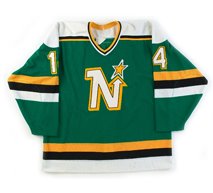
Melvin Swig then purchased the team in 1975 with plans to have the team play in a new arena in San Francisco. Those plans never came to pass following the election of a new mayor who was opposed to the plan, so after nine money-losing seasons, low attendance and few victories, minority owners George and Gordon Gund convinced Swig to relocate the team to their hometown of Cleveland, Ohio, making the club the first NHL team to relocate since 1934 and bringing to and end the Golden Seals ordeal in California, where the team had more names than playoff appearances.
Under the Gunds ownership, the Barons played in Ohio for two seasons, merged with the Minnesota North Stars, who were then sold to another group while the Gunds received an NHL expansion franchise, the San Jose Sharks, at the south end of San Francisco Bay, 40 miles from where it all started.
Today's featured jersey is a 1975-76 California Golden Seals Gilles Meloche jersey. After the departure of owner Charlie O. Finley, the Golden Seals colors were changed from his signature green and gold to the even less intimidating pastel shades of "Pacific Blue" (teal) and "California Gold" (yellow), quite probably the worst colors for an NHL team ever which were about as intimidating as Easter eggs. The change also gave the team more total color schemes than playoff appearances as well.
Not even the addition of goaltender Gary Simmons' black goalie mask with it's frightening green cobra was enough to offset the "only in California" colors of the Golden Seals final jersey set.
Aside from the unusual color scheme of the last incarnation of Golden Seals jerseys, another odd characteristic of this set was the decidedly "football jersey" style vertical stripes where the arms meet the body of the jersey, something that had never appeared on an NHL jersey before or since.
Here are some fantastic old videos of the Seals in action. Check out those rinkside seats for $5.50 and playoff tickets for $12. Sign us up!
We don't care how hard you punch, there's just no dignity in wearing those teal jerseys.
Labels:
California Golden Seals,
Meloche Gilles
Saturday, April 3, 2010
1994-95 Färjestad BK Håkan Loob Jersey
On this date in 1988, Håkan Loob became the first Swedish-born player in the NHL to score 50 goals, a record that still stands today. The previous high for a Swede was 49, set in 1981 by Loob's former Calgary Flames teammate Kent Nilsson, who had 40 or more three times. Nilsson was the first Swede to reach the 40 goal mark, which he did in 1980.
The only other Swedes to have registered 40 goal NHL seasons are the Ottawa Senators Daniel Alfredsson, who had 43 in 2005-06 and 40 in 2007-08, Markus Naslund, who did it on three occasions with a high of 48 in 2002-03 while with the Vancouver Canucks, Mats Naslund, who had back to back seasons of 42 and 43 while with the Montreal Canadiens in the mid 80's, Mats Sundin, who also accomplished it three times, with a high of 47 in 1992-93 while with the Quebec Nordiques and twice more with 41 while with the Toronto Maple Leafs.
The most recent Swede to join the group is Henrik Zetterberg of the Detroit Red Wings, who totaled 43 in 2007-08, but Loob still remains the only one to have reached 50 goals.
Loob played one season with Färjestads BK Karlstad before being drafted 181st overall by Calgary in the 1980 NHL Entry Draft. He would play three more seasons for Färjestads BK, including winning a championship in 1981 and setting the Elitserien scoring record with 42 goals and 76 points in just 36 games in 1982-83 and being named Swedish Player of the Year before joining the Flames in 1983-84.
In his first season in Calgary, Loob scored 30 goals, the first of three consecutive 30 goal seasons to begin his NHL career. After a down year in 1986-87 with just 18 goals, Loob would rebound with the best offensive season of his time in the NHL, with his record 50 goals plus 56 assists for 106 points.
Following the 1986-87 season, Loob would score nine points in eight games as Sweden captured gold at the World Championships in Vienna, Austria.
The 1988-89 was a magical one for the Flames. Loob would have 27 goals and 85 points during the regular season and add another 8 goals and 17 points in 22 playoff games as the Flames would capture the 1989 Stanley Cup for the only time in franchise history.
Håkan Loob skating in the 1989 Stanley Cup Finals
Winning the Stanley Cup was the last thing Loob would do in the NHL, as he returned to Färjestads BK the following season, where he would play the final seven seasons of his career, which included scoring the 250th goal of his Elitserien career.
Loob would finish his career with 262 goals and 499 points in 405 Elitserien games as well as 193 NHL goals and 429 points in 450 NHL games.
In 2005-06, on the Elitserien's 30th Anniversary, the league created the Håkan Loob Trophy, which is awarded to the leading goal scorer each season.
Internationally, Loob competed for Sweden in the World Junior Championships twice, the World Championships four times, winning gold in 1987 and 1991, the Canada Cup in 1985 and the Olympics twice, first in 1992 and then again in 1994 as Sweden won the gold medal, making Loob, along with teammates Tomas Jonsson and Mats Naslund, the first players to win World Championship gold, the Stanley Cup and Olympic Gold, in what is know known as The Triple Gold Club. To date, only 23 players have ever accomplished the feat.
Loob, Naslund and Jonsson celebrate their Olympic gold medals
Today's featured jersey is an 1994-95 Färjestad BK Håkan Loob jersey. This mesh jersey features the typical European sponsorship logos and distinctive Adidas triple stripes down each sleeve. This garish purple and gold jersey was worn during a season in which Loob had 38 points in 39 games, the next to last season of his career.
Bonus Jersey: Our Bonus Jersey today is a Sandow SK 1983-84 Calgary Flames Håkan Loob jersey that features the City of Calgary 100th Anniversary patch, the first patch ever worn by the franchise, including their time in Atlanta where they wore no additional patches. This jersey was worn by Loob during his rookie season in the NHL when he scored 30 goals and 25 assists for 55 points in 77 games and was named to the NHL All-Rookie Team.
Our first video today is a feature on the NHL career of Loob.
This next video is from the Elitserien playoffs in 1996 and shows Loob scoring a goal. We believe this to be Loob's final game, as he is shown waving as he leaves the ice after the loss.
Labels:
Calgary Flames,
Farjestads BK,
Loob Hakan,
Sweden
Friday, April 2, 2010
1999-00 Toronto Maple Leafs Tomas Kaberle Jersey
Born on this date in 1978, defenseman Tomas Kaberle first played pro hockey for Kladno in the Czech Republic from 1994-95 to 1997-98. At the start of 1997-98, he went to training camp with the Toronto Maple Leafs, who drafted him 204th overall in the 1996 NHL Entry Draft, and played a pair of games with the St. John's Maple Leafs of the AHL, the only games he has ever played in the minors. He would return to the Czech Republic to play the full season with Kladno that season, as well as representing the Czech Republic at the 1998 World Junior Championships.
The following season Kaberle made his NHL debut with Toronto, appearing in 57 games which included his first NHL goal as he got used to the North American game, extended length of the schedule and cultural changes. Now acclimated to North America, the next season his playing time would increase, as he was called on to take on more playing time due to the loss of Bryan Berard with an eye injury. Playing all 82 games, Kaberle reached the 40 point mark with 7 goals and 33 assists.
New established as an NHL regular and again playing in all 82 games, Kaberle surpassed his point total from the previous season with 45 points in 2000-01. He began the following season back with Kladno while waiting for a new contract with Toronto, which arrived after nine games in the Czech Republic. He returned to the NHL and scored ten goals for the first time on his way to 39 points in his abbreviated season and added another 10 points in 20 playoff games, as Toronto made it to the conference finals that season. Prior to the NHL playoffs, Kaberle would once again represent the Czech Republic, this time in the 2002 Olympics in Salt Lake City.
In 2002-03, Kaberle set a new career high with 47 points, including a new personal best 11 goals. After the next NHL season, Kaberle played for the Czech Republic at the 2004 World Cup of Hockey and then spent the lockout season of 2004-05 once more back with Kladno, scoring 39 points in 49 games and finished his season by capturing a gold medal in his first appearance at the World Championships for the Czech Republic.
His return to the NHL in 2005-06 saw him shatter his personal best scoring mark with 9 goals and a career high 58 assists for 67 points as well as winning a bronze medal in February at the 2006 Olympics in Torino, Italy and a silver medal at the World Championships following the conclusion of the NHL season. He followed that up with a strong 2006-07 season with 58 points.
His next NHL season he again topped 50 points for the third time with 53 and another appearance at the World Championships, his third. Kaberle's 2008-09 season saw injuries limit him to just 57 games, but has rebounded in 2009-10 with a full season as well as his third Olympic games in Vancouver.
Today's featured jersey is a 1999-00 Toronto Maple Leafs Tomas Kaberle jersey. This jersey features both the NHL 2000 patch worn by all players that season, but also the 2000 NHL All-Star Game patch.
Today's video section kicks off with a nice highlight reel of Kaberle, highlighting his offensive skills.
Here is Tomas Kaberle winning the Accuracy Shooting Competition at the 2008 NHL All-Star Game SuperSkills Competition.
What he heck?
Labels:
Kaberle Tomas,
Toronto Maple Leafs
Thursday, April 1, 2010
1994-95 Jokerit Helsinki Teemu Selanne Jersey
It only seems appropriate to feature a club on April Fool's Day named the "Jokers". Founded in 1967 in Helsinki, Finland when Aimo Mäkinen saw the opportunity to establish a semi-professional sports club following the demise of the Töölön Vesa sports club hockey team, Mäkinen paid half of Vesa's hockey related debts and received all the previous club's assets, including their junior players and a spot in the second highest Finnish league, the Suomi-sarja, for his new club which he named "Jokerit", which is Finnish for "Jokers" and whose name and logo were inspired by the joker from a deck of playing cards.
Two years after it's founding, Jokerit would earn promotion to the top level of Finnish hockey, the SM-sarja. Once accomplished, Mäkinen began aggressively adding star players to his roster. With rules changing allowing bodychecking in 1969, hockey in Finland underwent a change to a more physical style, which then coach Matti Lampainen felt was unsuitable for the roster he had at the time. He guided his club toward a more clever and tactical style which paid off with a championship in 1973.
The club would pass through several ownerships during the 1980's and an infusion of young talent at the end of the decade, such as defenseman Waltteri Immonen, who would captain the team from 1991-1999, Mika Strömberg, the club's all-time highest scoring defenseman, Ari Sulander, their main goaltender from 1993-1998 and Teemu Selänne, who would go on to set NHL rookie scoring records and eventually score 600 NHL goals, would return the club quickly to the top level, now called the SM-liiga, after having been relegated in 1987.
With their ownership now settled by 1991, the club became the wealthiest in Finland, which led to a dynasty that captured the Finnish championship in 1992, 1994, 1996 and 1997, as well as the European Cup in 1995 and 1996. In addition, they moved into their new home, the Hartwall Areena.
Kurri and Selänne hoist Immomen in celebration of the 1995 European Cup
When the Jokerit celebrated their 40th anniversary season in 2007-08 they retired the jersey of former star Jari Kurri, who originally played for the team from 1977-80 and again during the NHL lockout of 1994.
In addition to their six Finnish championships, Jokerit have finished second in 1971, 1983, 1995, 2000, 2005 and 2007 and won the Continental Cup in 2003.
Jokerit has also left it's mark on the NHL, with the only two Finns out of the nine players in NHL history to have scored 1,000 points, Kurri and Selänne, having started with Jokerit.
Other Jokerit players to have gone onto NHL careers include, Ossi Väänänen, Lehtonen, Sean Bergenheim and Valtteri Filppula.
Today's featured jersey is a Tackla 1994-95 Jokerit Helsinki Teemu Selänne jersey. Selänne returned to Jokerit during the NHL lockout, along with Jari Kurri, and was a part of the 1995 European Cup winning team.
This jersey has the Tackla diamond shapes on the shoulders and the usual European sponsorship logos. The original jerseys were all dye-sublimated, but this replica example was expertly customized with the same and numbers in twill as well as the impressive rendition of the Karjala sponsorship on the back with heat-sealed material to match the font used on the front sublimated logo. The Carrols patch on the front was one of our custom made patches that was then also sewn on to complete the look of this most distinctive jersey.
Our first video of today is footage of Jokerit during the 1992 SM-liiga Finals.
Our second video features rabid Jokerit supporters in footage from 2006.
Labels:
Jokerit Helsinki,
Selanne Teemu
Wednesday, March 31, 2010
1988-89 Calgary Flames Sergei Priakin Jersey
Sergei Pryakhin, or often spelled in North America "Priakin", was the first member of the Soviet National Team to ever allowed by the Soviet government to play in the NHL.
Pryakhin, a right wing, first played for Krylja Sovetov (Soviet Wings) in the Soviet League in 1981-82 and then seven full seasons afterwards, eventually being named team captain. Additionally, he played twice for the Soviet Union in the World Junior Championship, winning a gold medal in 1983. He later played for the Soviet National Team in 1987 in both the World Championship and later the Canada Cup, winning silver each time. He would earn gold as a member of the national team in the 1990 World Championships.
Following the 1988-89 Soviet League season, the 25-year-old was given permission to join the Calgary Flames, who had drafted him 252nd overall in 1988, and made history when he competed in his first game on this date in 1989.
One reason Pryakhin was the one chosen to be the first allowed to leave was that he was not a star player and considered replaceable on the national team. That fact factored into the Flames decision to select him in the first place, figuring that the chances of him actually being allowed to leave were better if he were not a star. Another factor in the change in philosophy by the Soviets was of course, money. While the Flames spent reportedly upwards of $500,000 on Pryakhin, the largest portion of that money went to the Soviet ice hockey federation.
Another factor in the choice of the above average Pryakhin being allowed to leave was because his professionalism would make him a good ambassador for Soviet hockey, plus, if he did play well, it would set a precedent in establishing a market for the future release of Soviet superstar players and motivate other Soviet players back home.
He was under pressure right from the start, dealing with the extreme change in culture and language, going from playing in front of 2,000 fans to 20,000 fans, plus the animosity he faced from North American players, who viewed his presence as taking a job away from a North American. Pryakhin tried to smartly avoid such discussions with responses such as, "I don't want to talk politics. I am here to play hockey. I think it is hockey that will benefit from having Soviets in the NHL."
His timing could not have been better, as the Flames would go on to capture their only Stanley Cup later that season. While Pryakhin only played in two regular season games and one playoff game, he was not eligible to have his name engraved on the Stanley Cup, he did receive a championship ring, the first Soviet trained player to do so.
Pryakhin played in 20 Flames games the following season, scoring a pair of goals and a pair of assists for four points. He was held scoreless in two playoff games.
1990-91 saw Pryakhin split time between the Salt Lake Golden Eagles, scoring 17 points in 18 games, and the Flames, where he got into 24 games and totaled seven points.
That would prove to be the end of his NHL career and he would return to Europe to continue his career, starting with a return to the Soviet Wings in 1992-93 before moving to Zurich of the Swiss National League A. The following season was also spent with Zurich as well. The next four seasons Pryakhin played for Espoo in Finland before a final season playing in Japan for the Oji Eagles.
So significant was Pryakhin's permission from the Soviets to play in the NHL, it was ranked as #76 in the Top 100 Stories of the Century by the International Ice Hockey Federation.
Today's featured jersey is a 1988-89 Calgary Flames Sergei Pryakhin jersey. Note the North Americianization of his last name on the back of the jersey.
While Pryakhin's time in the NHL was brief, it opened the door for the first wave of Soviets and eventually led to amazing plays like these occurring in North America, rather than Russia.
Labels:
Calgary Flames,
Priakin Sergei
Tuesday, March 30, 2010
1924-25 Victoria Cougars Jersey
The Victoria Cougars were formed in 1911 as the "Senators" as a member of the Pacific Coast Hockey Association (PCHA). Their first season in the three team PCHA saw them finish last with a 7-9 record behind the New Westminster Royals and the Vancouver Millionaires. They were led in scoring by Tommy Dunderdale's 24 goals in 16 games, good for third in the league.
The second season saw Victoria win the PCHA title with a 10-5 record. Dunderdale led both the club in scoring again but also the league this time with 24 goals and 29 points in 15 games. No other player had more than 14 goals, ten behind the prolific Dunderdale. Following the season the Senators defeated the National Hockey Association champion Quebec Bulldogs in an exhibition series
The 1911-12 Victoria Senators in their original barberpole sweaters
The second season saw Victoria win the PCHA title with a 10-5 record. Dunderdale led both the club in scoring again but also the league this time with 24 goals and 29 points in 15 games. No other player had more than 14 goals, ten behind the prolific Dunderdale. Following the season the Senators defeated the National Hockey Association champion Quebec Bulldogs in an exhibition series
The 1912-13 Victoria Senators Hockey Club
The club changed their name to the Aristocrats for the 1913-14 season and again won the PCHA title with an identical 10-5 record. They were led in scoring by Dubbie Kerr and his 20 goals and 31 points in 16 games followed by Dunderdale at 24 goals and 28 points. Now having established itself as a worthy league, the Aristocrats were able to travel to Toronto and challenge the Toronto Hockey Club (or Toronto Blueshirts) for the Stanley Cup, but came home without the cup.
After two more seasons as the Aristocrats, led in scoring by first Dunderdale and then Kerr, the club moved to Spokane, Washington where they were known as the Canaries for the 1916-17 season, but attendance was so poor that the team played their scheduled home games after mid February at the home rinks of their previously scheduled visitors!
The 1918-19 season saw the franchise back in Victoria as the Aristocrats once more and led in scoring by Eddie Oatman, who had come from the now defunct Portland Rosebuds, as had many of the Aristocrats that season.
1919-20 saw the 10-12 Aristocrats in third place with Dunderdale now returned to the fold and doing the bulk of the scoring with 26 goals and 33 points in the 22 game season to win the PCHA scoring title. Dunderdale had left Victoria following the 1914-15 season to play in Portland for three seasons, but was back with Victoria in 1918-19 when the Rosebuds player's contracts were transferred to the Aristocrats following the Rosebuds folding.
The Victoria Aristocrats during the 1914-15 season
After two more seasons as the Aristocrats, led in scoring by first Dunderdale and then Kerr, the club moved to Spokane, Washington where they were known as the Canaries for the 1916-17 season, but attendance was so poor that the team played their scheduled home games after mid February at the home rinks of their previously scheduled visitors!
The 1918-19 season saw the franchise back in Victoria as the Aristocrats once more and led in scoring by Eddie Oatman, who had come from the now defunct Portland Rosebuds, as had many of the Aristocrats that season.
1919-20 saw the 10-12 Aristocrats in third place with Dunderdale now returned to the fold and doing the bulk of the scoring with 26 goals and 33 points in the 22 game season to win the PCHA scoring title. Dunderdale had left Victoria following the 1914-15 season to play in Portland for three seasons, but was back with Victoria in 1918-19 when the Rosebuds player's contracts were transferred to the Aristocrats following the Rosebuds folding.
Another third place came in 1920-21 from a 10-13-1 mark. The Aristocrats' Frank Fredrickson led the PCHA in scoring with 20 goals and 12 assists for 32 points in 21 games.
The 1921-22 season saw the league standings decided by the narrowest of margins, with Seattle finishing first with a record of 12-11-1, the Millionares followed at 12-12-0 and the Aristocrats once more brought up the rear at 11-12-1. Fredrickson one more led the club with 25 points from 15 goals and 10 assists.
For the 1922-23 season, the franchise adopted the new moniker of the "Cougars" and it paid immediate dividends, as the club finally climbed out of last place for the first time. A 16-14-0 record was enough to beat the Metropolitans and qualify for the playoffs. Vancouver, newly renamed the Maroons, defeated the Cougars in a two-game total-goal series 3-0 and 2-3. Fredrickson again led the league in scoring with 39 goals and 55 points, 15 more than his next closest pursuer, in the 30 game schedule.
The final season for the PCHA saw the Cougars once more finish third with a record of 11-18-1. Fredrickson again led the club with 19 goals and 28 points in 30 games.
Changes were in store for the 1924-25 season, as the Cougars moved to the Western Canada Hockey League (WCHL), now in it's fourth season, along with the Vancouver Maroons. The Metropolitans had folded and the Cougars were awarded four players off their roster prior to the season and they selected goaltender Hap Holmes, Gordon Frasher, Jack Walker and Frank Foyston. While the Cougars finished third yet again, the WCHL was now a six team league, and the Cougars 32 points in the standings left them just behind the Calgary Tigers 34 and Saskatoon Sheiks 33. The prolific Fredrickson was the team leader in points for the fifth consecutive season with 22 goals and 30 points in 28 games.
The Cougars defeated the Shieks in their opening round two game series by a 6-4 total before upsetting the Tigers in the WCHL Finals in another two-game total-goal series by a combined score of 3-1 to earn the right to challenge the defending Stanley Cup winners and NHL champion Montreal Canadiens.
The finals were a best of five series and all games were played in British Columbia in keeping with the annual rotation of games between the east and the west. The Cougars took Game 1 with a score of 5-2 and put themselves in a position to capture the cup with a 3-1 win in Game 2 with Walker scoring a pair of goals in each game.
Montreal fought back with a 4-2 win on March 27th and the Cougars became the last team from outside the NHL to win the Stanley Cup with a dominant 6-1 win in Game 4 on this date in 1925, led by a pair of goals by Fredrickson to take the series 3 games to 1. The game winning goal was scored by Gizzy Hart and Walker led the Cougars with 4 goals in the series as the Cougars outscored Montreal 16-8.
Their roster included Hall of Famers Fredrickson (inducted 1958), Foyston (1958), Walker (1960) and goaltender Holmes (1972) and they were coached by the legendary Lester Patrick (1947), who also owned the club. Additionally, Fredrickson and defenseman Harold Halderson were previously members of the Winnipeg Falcons who won the first Olympic gold medal in ice hockey.
The following season the WCHL was renamed the Western Hockey League (WHL) and the defending champion Cougars finished in their traditional third place yet again with a 15-11-4 mark. Fredrickson dominated the scoring with 24 points in 30 games to lead the team fir the sixth consecutive season. The Cougars again won the league playoffs to earn the right to face the NHL champion Montreal Maroons for the right to defend the cup, which the Maroons won 3 games to 1.
That would be the end of the Cougars in Victoria though, as the WHL disbanded after the season, leaving the Cougars without a league. The rights to most of their players were purchased by the new Detroit NHL franchise, which used the Cougars name as a tribute to the former club of the majority of their roster. Eventually that team would rename itself the Falcons and later the Red Wings.
Today's featured jersey is a 1924-25 Victoria Cougars Frank Frederickson jersey. This original Cougars jersey can be seen in the Hockey Hall of Fame in Toronto and has it's own page in The Hockey News Greatest Jerseys of All-Time Collector's Edition.
Today's video section is behind the scenes footage of the Hockey News Greatest Jerseys of All-Time photo shoot, which includes today's featured Victoria Cougars jersey. The Greatest Jerseys of All Time collector's edition is a must-have for any jersey collector or hockey fan alike.
Labels:
Victoria Aristocrats,
Victoria Cougars
Monday, March 29, 2010
1998-99 New York Rangers Wayne Gretzky Jersey
As we research topics for Third String Goalie, we come across factiods relating to Wayne Gretzky on a near daily basis. Milestones reached, multiple point games, season records set, career records set, league records broken. At first it became an annoyance with our desire for a variety of topics for this website and we shunned them. Eventually, as the items relating to Gretzky continued to amount unabated we began to come around and appreciate the consistency and sheer volume of the incredible feats the man accomplished during his career.
Eventually we embraced them to the point that we decided to collect them, and created a repository for them, The Wayne Gretzky Fact of the Day Blog, which we hope you will take a moment to visit.
But as much as we have tried to avoid choosing Gretzky as a topic too frequently, today is one occasion where it's unavoidable and well deserved, for on today March 29th, the Gretzky facts just kept on coming.
It begins on this date in 1980, when during his first season in the NHL, Gretzky scored two goals and four assists for a six point night as the Edmonton Oilers beat the Toronto Maple Leafs 8-5.
One year to the day later, Gretzky made NHL history when he broke Phil Esposito's NHL record for Most Points in a Season of 152 when his three assists gave him 153 for the season on his way to setting the bar at 164 points.
Again on March 29th, this time in 1983, Gretkzy posted three assists to break his own NHL record for most assists in a season at 121. He would conclude that season with a new record total of 125.
Two years later, again on the 29th of March, Gretzky would break his own assist record with two assists to raise the mark to 127. His final total for the season and the new record amount would stand at 135.
The final milestone Gretzky would achieve on March 29th would be scoring the final goal of his NHL career. That goal was also his 1,072nd all-time goal, counting the NHL regular season and playoffs plus the WHA regular season and playoffs, which allowed him to surpass Gordie Howe's career total of 1071 all-time goals.
Gretzky poses with his record setting puck
In 6 WHA seasons Howe had 174 regular season goals and 28 playoff goals plus the 801 regular season and 68 playoff goals he scored in his 26 seasons in the NHL for a total of 1071.
Gretzky only played in the WHA for one season, scoring 46 regular season goals and 10 playoff goals. His record setting 894 regular season goals plus his 122 playoff goals, also the all-time record, pushed his career total past Howe by just a single one, the goal he scored on this date in 1999.
Gretzky celebrates his final goal, his 1072nd all-time
In addition to the All-Time Combined Goals record, Gretzky also holds many other goal scoring records including;
Career Records
- Most Career NHL Regular Season Goals - 894
- Most Career NHL Goals Including Playoffs - 1,016
- Most Career NHL Goals by a Center - 894
- Most 40-or-More Goal Seasons - 12
- Most Consecutive 40-or-More Goal Seasons - 12
- Most 50-or-More Goal Seasons - 9
- Most 60-or-More Goal Seasons - 5
- Most Consecutive 60-or-More Goal Seasons - 4
- Most Three-or-More Goal Games - 50
Single Season Records
- Most Goals in a Season - 92
- Most Goals in a Season Including Playoffs - 100
- Most Goals 50 Games From the Start of a Season - 61
- Most Goals by a Center in a Season - 92
- Most Three-or-More Goal Games in a Season - 10
- Highest Goals-Per-Game Average in a Season - 1.18
Single Game Record
- Most Goals in One Period - 4
Career Playoff Records
- Most Playoff Goals - 122
- Most Game-Winning Playoff Goals - 24
- Most Three-or-More Goal Games in Playoffs - 10
Single Season Playoff Record
- Most Shorthanded Goals - one Playoff Year - 3
Single Game Playoff Record
- Most Shorthanded Goals - one Playoff Game - 2
Today's featured jersey is a Starter 1998-99 New York Rangers Wayne Gretzky jersey as worn on the date he broke Howe's all time goal scoring record with his 1,072nd goal, the final goal of his storied career.
The Madison Square Garden scoreboard celebrates Gretzky passing Howe's total
A unique feature of this jersey is the "double-tagging" on the lower back of the jersey. Gretzky had a habit of tucking the right side of his jersey into his breezers, which had the effect of hiding the manufacturer logo customarily located on the back, bottom right of NHL jerseys since the first ones appeared in 1979-80 according to NHLUniforms.com.
Frustrated by having their logos obscured and missing out on the free publicity of being associated with Gretzky, manufacturers started placing their logo also on the left side of jerseys intended for Gretzky's use to ensure their visibility in association with "The Great One."
Today's video is a countdown of the Top 10 Wayne Gretzky moments.
Labels:
Gretzky,
New York Rangers
Subscribe to:
Posts (Atom)