History of Jersey 83-93 Banner sm photo History of Jersey 83-93 Banner sm.jpg

Tuesday, February 26, 2013

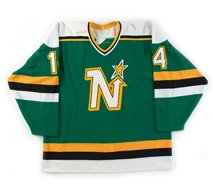
1980-81 Minnesota North Stars Steve Payne Jersey

Founded in 1967, the Minnesota North Stars still had never won a game in the Boston Garden fourteen years later. Going in to the contest on this date in 1981, the North Stars were 0-27-7 at The Garden, where they were routinely intimidated by the Big, Bad Bruins, who featured a lineup with noted tough guys Terry O'Reilly (223 penalty minutes that season), Mike Milbury (222), Stan Jonathan (192), Keith Crowder (172), Brad McCrimmon (148) and Brad Park (111).

From then North Stars coach Glen Sonmor's book "Old Time Hockey";
We started out playing some solid hockey that year and just kept getting stronger as the year went on. There was one game toward the latter part of the season, however, that really had an impact on the psyche of this team. It was against Boston on February 26, on the road at the Garden. We had never beaten Boston in that arena, ever, in the history of our franchise. We were something like 0-27-7 over the past 14 seasons. They had absolutely owned us, it was ridiculous. The bad blood had started several years earlier when one of their tough guys, John Wensink, had skated over to our bench during a game one time and challenged every guy on the team to come out and fight him. Well, nobody budged. 
Anyway, I was tired of those sonsofbitches intimidating us, so I decided that the "Curse of the Bruins" was going to come to an end right then and there. By that point I knew that we were going to wind up facing  them in the first round of the playoffs that year and I really wanted to make a statement. I wanted to instill a new attitude of toughness into our guys and really encourage them not to take any sh-- from those a-- holes. That is so important in hockey, not to be intimidated or disrespected by your opponents. I remember just before the game a reporter asked our enforcer, Jack Carlson about the "Wensink incident." He asked him what would happen if something like that happened again. Jack just smiled and said "I would jump over the boards in a hurry and go after the guy because I would hate to have my coach beat me to him!" 
As it turned out, we would wind up losing the game, 5-1, but I didn't care about the score at all. I wanted to send a message that we weren't going to be pushed around anymore. So, I told our guys before that game that we had to make a stand right there. I told them that we were never going to beat them until we stood up for ourselves. I even held up a Boston newspaper that had an article in it about how the Bruins had dominated us and that we were basically a bunch of pussies. I told them that they were questioning our manhood. I really tried to get them riled up and mad as hell. My instructions to them in the locker room just prior to the opening face-off were simple. I told them that not the second time, or the third time or even the fourth time, but on the first time that any Bruin tried to intimidate one of them, that they were to drop the gloves. I told them that we were going to war that night and that we were going to keep going to war until the game was over. Period. 
We had a ton of tough guys on tour team. In addition to Jack Carlson, who was probably the toughest heavyweight in all of pro hockey at the time, we had Brad Maxwell, Dave Richter, Al MacAdam and Gordie Roberts. So, I felt pretty good about matching up with the "Big-Bad Bruins." It wasn't those guys I was talking to about dropping the gloves though, it was everybody else. I wanted  everybody to get into the action and really let their emotions out. I wanted them to experience just how good it felt to stand up for yourself and stop being bullied. 
Well, sure as sh--, just seven seconds into the game our star player, Bobby Smith, who was anything but a fighter, dropped the gloves. Steve Kasper, one of their top agitators, had cracked him right under the chin with his stick during the opening face-off and that was just what the doctor ordered. As soon as Bobby dropped 'em, everybody else did too and we were off to the races. It was beautiful. That was how it was all night too. There was one fracas after another. I was never so proud to see at one point during the game, there were five fights going on and we were winning them all! I remember seeing Al MacAdam just beat the crap out of one of their toughest guys, Stan Johnathan. It was a blood bath. I mean there were over 340 penalty minutes in the first period alone, not to mention a total of 12 ejections. By the end of the game, there were 42 penalties, including seven game misconducts, and an NHL record 406 total penalty minutes. It just went on and on, it was really something. We only had about five guys apiece on the bench when it was over because so many guys had been thrown out of the game. 
In the end we wound up losing the game, but I could not have cared less. I was so proud of our guys, I could barely contain myself. Then after the game I got into a shouting match on the bench with their coach, Gerry Cheevers. The next thing I knew my players were holding me back from trying to go after him. Hell, I wanted a piece of him. Sure, why not? I took a few swings at him from sort of an odd angle where I was punching up towards him as he was leaning over the glass. 
Anyway, down in the locker room after the game we were all pretty fired up. I was a scene straight out of a war movie, like we had all just returned from battle. I was great. The reporters couldn't wait to talk to me and get some quotes about what the hell I was up to. So, I am out talking to them and one of the reporters reads me a quote from Cheevers, who basically said that I was behind it all and that I had no character. I just smiled and said to the reporter and said, "OK, I have a message that you can take back to Gerry. Tell him to meet me between the dressing rooms the next time we play each other and we'll settle this like men. We'll see whose got character then." And then I added "Oh, and by the way, tell him to bring a basket to carry his f---ing head home in!" 
I tell you what, we barely made it out of the Garden alive. Their fans came down and started rocking our bus, trying to bust the door down to have at us. It was scary, it really was. I thought we might have a riot on our hands, but luckily the cops showed up and escorted us out of there. It was a great flight home though. I remember looking at everybody with their fresh stitches, it was marvelous. We were victorious in my eyes because that just set the stage for our eventual meeting with them in the playoffs. The bad part of it all was that the league president called me into his office shortly thereafter and I caught hell from him. He asked me if I had incited my guys to play that way that night and I said "absolutely." I told him that we needed to make a stand and that I wasn't going to apologize for that. I got fined for it, but [North Stars general manager] Louie Nanne gladly paid it for me. He knew what I was up to and was behind me 100%. 
Back on the ice, we finished up the 1980-81 regular season and went on to meet Boston in the first round of the playoffs. Now, just before we hit the ice at the Garden, I did something that I had never done before. I put on my eye patch, just like the old pirates used to wear. It is a crazy story of how I decided to put it on too. You see, just before I left for the airport from my house in Hopkins, I got a letter from a fan that somehow caught my attention. I was in a hurry, but for some odd reason I took a second to open it up and read it. I was from a woman in White Bear Lake who said that she was a psychic. She said that she had a vision of me standing behind the bench in the Boston Garden with an eye patch on and that she saw us beating what she called the "Curse of the Garden." Her name was Amy Puckett, as in hockey puck, so I figured it had to be a good omen. Hell, I figured I could use all the good karma I could get at that point, so I ran back into the house and grabbed my eye patch [Sonmor had suffered a career ending eye injury as a player when hit by a slap shot and had a glass eye]. Anyhow, I put that patch on right before we hit the ice and I remember screaming out just like a general leading his troops into battle: "Boys, the curse ends tonight!" 
We walked out onto the ice and the atmosphere in there was just electric. We had still never on out there up until that point, but thankfully that all ended in Game One when Steve Payne score the game-winner at the 3:34 mark of overtime to give us a thrilling 5-4 victory. The curse had officially been lifted and we were on top of the world. We were expecting another blood bath, but they played us straight up and it ended up to be a hell of a series. We then followed that up with a 9-6 victory in Game Two, behind our backup goalie Donny Beaupre. From there, we came home to Bloomington for Game Three and it was just louder than hell in there. I mean the walls in the locker room were literally vibrating. It was insane. We were really confident in ourselves at that point and we went out there and finished them off by the final score of 6-3 to sweep the series. After the game legendary radio analyst Al Shaver said it was the biggest upset in Stars history. I would whole-heartedly agree, it was huge. More importantly, we had earned Boston's respect.

The first period of the game on February 25 took an hour and 31 minutes and saw 12 players ejected and 67 penalties called, including a North Stars team record 39 minutes for Steve Payne.

By the end of the game, each team was called for 42 penalties and they totaled an NHL record 406 minutes. The North Stars alone were penalized for 211 minutes from 18 minors, 13 majors, four ten-minute misconducts and seven game misconducts.

Today's featured jersey is a 1980-81 Minnesota North Stars Steve Payne jersey from the year of the North Stars infamous brawl with the Boston Bruins. Payne was drafted in the second round of the 1978 NHL draft after the North Stars had drafted his junior hockey linemate Bobby Smith with the first overall pick in the draft. The two would be teammates for five seasons before Smith was dealt to the Montreal Canadiens.

Payne would eventually play ten seasons, all with the North Stars, but his final three seasons would be severely curtailed by injury. He would finish his career with 613 games played, 228 goals and 238 assists for 466 points and 435 penalty minutes, 9% of which came in the one notorious game verus Boston! Payne's 39 minutes in that game on this date in 1981 were five minutes short of being half of his total for the entire season.


Here is footage of Wensink challenging the North Stars bench previous to the record setting penalty minute game. You can also see the brutality the Bruins dished out to the North Stars that had coach Sonmor so fed up.


Here is the mayhem from the record setting 406 penalty minute brawl game when the benches clear and the fighting spills into the off ice area in between the benches.


When Sonmor did the color commentary for the University of Minnesota Gophers he made no apologies for wearing his love of the Gophers on his sleeve. In this clip, Sonmor has had enough of the fans in Madison, Wisconsin booing Madison native Phil Kessel all game long for his decision to spurn the Badgers and choose to play for Minnesota and lets his feelings be known when Kessel has the last laugh by scoring a goal.


Here is a two part interview with the always entertaining Sonmor, a true Minnesota hockey legend, as he talks Gophers, Minnesota Fighting Saints hockey, including discovering the Carlson Brothers, who would star in the movie Slap Shot as the Hanson Brothers, and the Birmingham Bulls of the WHA.


Monday, February 25, 2013

2013-14 NHL Realignment

With the subject of NHL realignment coming up again, it's time to revisit what has proven to be a popular post we made earlier regarding our thoughts on NHL realignment necessitated by the relocation of the Atlanta Thrashers from the southeastern United States to central Canada where they became the Winnipeg Jets.

First, let's take a look at where things stand right now.

NHL 2011-12 NHL Division Map, NHL 2011-12 NHL Division Map
Current 2012-13 NHL Division Map

The things to note are the compactness of the Northeast and Atlantic Divisions, especially compared with the Northwest and Pacific Divisions in the Western Conference. Also of note are the distances from both Minnesota and Dallas, both located in the Central Time Zone, from all the other teams in their divisions, none of which are even located in the same time zone.

Obviously, with all the issued related to hammering out a new Collective Bargaining Agreement, the Winnipeg Jets were forced to remain in the Southeast Division this season, a situation that all agree needs to be rectified.

Absurdly, with teams only playing within their conferences during this shortened season, Minnesota and Winnipeg will not be playing each other, despite being only 385 miles apart, while the Wild will be making six trips out to the Pacific coast to face Vancouver, San Jose, Los Angeles and Anaheim, all 1,400 to 1,500 miles away, including one time they follow a game in Vancouver with one in Detroit and another where a game against the Kings sees them playing their next game in Columbus, Ohio!

As far as the new attempt at realignment after the previous proposal was tabled as a part of the labor negotiations, one often repeated is the fact Detroit wants to move east and has apparently been promised by the NHL that they will be moved when the first opportunity arrives, but Jeff Marek of Sportsnet in Canada mentioned last year that the late Chicago owner Bill Wirtz was also promised that Chicago would never be separated from Detroit, in direct conflict with any promises made to the Red Wings.

With that in mind, let's look at our proposal for 2013-14. To oversimplify, currently the continent west of the Mississippi River is essentially divided horizontally into a northern group (the Northwest Division) and a southern group (the Pacific Division). What we propose is to make the divisional alignments based on vertical divisions, rather than the current horizontal alignments. Additionally, we also would embrace the American Hockey League model, reducing the number of divisions to just four, which was some fairly radical thinking when we first proposed it in June of 2011.

Each conference would be made of one seven and one eight team division. Having fewer divisions of more teams would allow more clubs to be accommodated as far as their desires to be paired with traditional rivals and will pay off again when the playoffs are discussed.

The method we would use to place the teams in each of the four divisions begins in the northeast and places Montreal, Ottawa and Toronto together, adding in Buffalo. The Northeast Division is then completed with the three New York/New Jersey teams as well as traditional New York rival Boston, who stay grouped with their historic rival Montreal.

The remaining seven teams in the east are the two Pennsylvania clubs Philadelphia and Pittsburgh, as well as Washington, who belong in a division with nearby Philadelphia. The four remaining southern teams, Carolina, Nashville, Tampa Bay and Florida round out the Atlantic Division.

In the west, we simply group the eight teams which are the furthest west. The California clubs, San Jose, Los Angeles and Anaheim are grouped with nearby Phoenix and the three western-most Canadian teams, Vancouver, Edmonton and Calgary. Colorado is the final team to complete the West Division, as they inhabit the Mountain Time Zone along with Edmonton, Calgary and Phoenix.

The Central Division is based on grouping Winnipeg, Minnesota and Dallas together since they are located in a relative vertical line. Traditional rivals St. Louis, Chicago and Detroit are then added. Columbus is included due to it's proximity to Detroit.

Yes, we would keep Detroit in the west, refusing to separate long standing Original 6 rivals Detroit and Chicago, two cities who are in the same division in the three other professional sports leagues, the NBA, NFL and MLB.

NHL 2012-13 NHL Division Realignment Map Proposal, NHL 2012-13 NHL Division Realignment Map Proposal
Our 2012-13 NHL Realignment 4 Division Proposal

How clean and simple is that? While we would be open to some minor tweaks, such as letting Nashville and Columbus swap places, even though we'd prefer to keep Detroit and Columbus together, this is our preferred arrangement, thanks in part to our not having to comply with any promises made to the Red Wings to move east or the Flyers to remain in a division with the Rangers since we don't have to concern ourselves with any influence or power wielded by Mike Ilitch in Detroit or Ed Snyder in Philadelphia.

The proposal we've seen online the last few days shows Colorado in a conference with Chicago, Dallas, Minnesota, Nashville, St. Louis and Winnipeg, which would isolate Colorado in the Mountain time zone, while we would prefer to keep them with Phoenix, Edmonton and Calgary in the same time zone.

As for the proposed conferences in the east, the one we've seen has Carolina, Columbus, New Jersey, New York Islanders, New York Rangers, Philadelphia, Pittsburgh and Washington on one conference, which seems fine by itself, but then that leaves an awful looking mess with Montreal, Ottawa, Detroit, Toronto, Buffalo and Boston in the northeast grouped with the two Florida clubs, the Panthers and Lightning, which is just plain awful. Any plan that does not have Tampa Bay and Florida with Nashville and Carolina just seems completely wrong to us.

Our proposal, shown in the map above, groups the teams in a much more logical geographic manner, including keeping some very great rivals grouped together as well as balancing the east and west with 15 teams each.

Furthermore, with our plan, the playoffs would return to the system once used by the NHL, where the first two rounds of the playoffs would be played exclusively within your own division among the top four clubs in each division. The benefit of this system would be the increased number of times clubs would face the same teams during the playoffs as the years would go by, and if there's one thing we will scream from the top of our lungs, it's that rivalries are created during the playoffs. Playing the same teams over and over during the regular season makes for repetitious boredom, while playing to end your opponent's season creates an intensity and drama you just can't get anywhere else.

Two rounds of playoffs among the same seven teams in your division gives you a 1-in-3 chance of facing the same team as the previous year, when compared to a 1-in-7 chance of repeating an opponent from the previous season as it stands now within a 15 team conference. In reality, the odds of facing the same team as a previous season actually improves in the short term when you factor in successful teams making the playoffs more often while they are in periods of greater success.

The NHL would likely then have the division winners in each conference face each other to determine a conference champion, but we'd like to see the final four teams seeded by points regardless of conference. This would have several benefits, the first being that if two strong teams advanced from one conference and the lowest two from the other, as happened in 2002-03, this system would increase the chances of the most competitive Stanley Cup Finals possible as well as allowing for the possibility of an occasional Philadelphia vs. New York or Boston vs. Pittsburgh final not possible now with the East vs. West format. The TV networks should also appreciate the chance for two huge eastern population centers facing off for the Stanley Cup now and then.

The good news is that the NHL apparently has seen things our way, as the previously approved proposal prior to the CBA negotiations did away with the idea of "divisions" and treated the four groups as separate conferences, allowing for annual mixing and matching of the final four clubs without regard to the geography of east vs. west. This also shrewdly allows for some flexibility on their part should a team such as Phoenix suddenly relocate across the continent to Quebec City, which would normally throw off the East/West balance, which would no longer apply.

After implementing this alignment, we'd also adjust the schedule to include playing every team in the league at home every year in the manner of the NBA schedule.

The breakdown would be;

If you are in the seven team division;
  • You play the 15 teams in the other conference twice a year = 30 games
  • You play the 8 teams in the other division of your conference twice a year = 16 games
  • You play the other 6 teams in your division 6 times a year = 36 games
If you play in the eight team division;
  • You play the 15 teams in the other conference twice a year = 30 games
  • You play the 7 teams in the other division of your conference twice a year = 14 games
  • You play the other 7 teams in your division 5 times a year = 35 games
  • You play the remaining 3 games in your division among the other 7 teams on a rotating annual basis = 3 games
Again, the idea that each team would play every other team home and away seems to be a part of every proposal we have heard, something we are very thankful for.

Realignment is a topic for which there are naturally many, many solutions to and opinions on, so feel free to add yours in the comments below.

Sunday, February 24, 2013

Mike Eruzione Auction Results

To follow up on our story on Friday concerning the Miracle on Ice and our preview of the auction of Mike Eruzione's jerseys, stick and other equipment and clothing related to the 1980 Olympics, the sale took place in New York on Saturday evening and the results are in - with one huge surprise.

Mike Eruzione jerseys photo Eruzione-collection.jpg

We must frankly admit we were shocked to see the price that his white jersey worn when he scored the winning goal against the Soviet Union sold for only $550,000. With the buyer's premium added on, the final cost to the buyer does rise to $657,250, but it is still a far cry from the $1.27 million that Paul Henderson's Team Canada jersey worn when he scored a late goal in Game 8 of the 1972 Summit Series against the Soviet Union.

Perhaps the Canadians considered the Henderson jersey to be more of a national treasure and feared it falling into the wrong hands, such as those of one of the card companies who may have been tempted to cut it up into pieces and make trading cards out of it. Or perhaps there were simply two very well off people who really, really wanted Henderson's jersey and were willing to go to great lengths to acquire it. In the end, Henderson's jersey was secured by a benefactor, Mitchell Goldhar of Toronto, who obtained the jersey from it's American owner, and not only returned the jersey to Canada, but then sent the iconic jersey on a national tour of Great White North.

While there is no denying that Henderson's jersey is of the highest significance, arguably near to or even on par with Eruzione's jersey, there is no way we'd ever deem it to be worth twice that of Eruzione's. Case in point, the IIHF ranked the Miracle on Ice as the #1 story of the century and Game 8 of the 1972 Summit Series as #2, which you would think would put both jerseys on relatively even footing, value-wise.

Eruzione goal photo Eruzionegoal.jpg
Eruzione's life changed with this shot, as he
scored the winning goal in the Miracle on Ice

We also would have assumed that there would have been a larger demand for the USA jersey simply based on the size of the population of the United States vs. Canada and with the auction having a fair amount of advance publicity as well as taking place in New York, rather than being part of an hockey related auction located in Canada.

Among the other items in the auction, the results were as follows:

The stick used to score the winning goal in the Miracle on Ice - $262,900
His blue jersey worn in the gold medal clinching game vs. Finland - $286,800
His warmup suit worn during the medal ceremony - $26,290
The gloves he wore in the Miracle on Ice - $53,775
The pants he worn in the Miracle on Ice - $26,680

Many of the other items Eruzione offered up for sale do not conclude until later today, such as his cowboy hat and jacket and sweater from the opening ceremonies, parka, other sweaters, knit caps, hockey socks, gear bag, pads and Olympic Team watch.

While the blue jersey went for more than it's $200.000 estimate and the stick surprised by going for more than twice it's $100,000 pre-sale estimate, there clearly must be a certain level of disappointment on the part of Heritage Auctions and Eruzione and his his family when the white jersey failed to even approach the pre-sale estimate of a million dollars, particularly with Henderson's jersey as a yardstick for such a significant, high end jersey, particularly in light of just how rare the jerseys are (a 20 man roster) and how few of them have been offered for sale - Eruzione's being only the third white one and fifth overall (counting his blue one sold today) in 33 years.

eruzione jerseys photo Eruzionejerseys.jpg
Eruzione with his 1980 jerseys and the stick used to score his famous goal

It's hard to figure. When dealing with high end items such as this, it's difficult to blame "the economy", as the buyers for items such as this, the "super rich" always seem to have the wherewithal to spend on items like this. Additionally, the other significant items, the blue jersey and the stick, performed as good or better than expected, so it wasn't like all the lots across the board were down.

Honestly, as we stated in our preview article, we fully expected this jersey to surpass the Henderson jersey and would not have been surpassed to see it reach the $2 million mark and didn't think $3 million was out of the question if two or more determined buyers just had to have it, which is all you need at an auction to turn heads, something this auction apparently did not attract.

With Eruzione's jersey having now sold for "just" $657,250 and Ken Morrow's similar one selling for $104,328 one year ago, perhaps the Henderson jersey is the anomaly and not the benchmark after all.

It will be interesting to find out who the buyer was, for not only the white jersey but the blue one as well, and what their intentions are for the jerseys.

In the end, we feel the white jersey still went for less than it should have, and so does Heritage based on their pre-sale estimate, and that some day in the not-too-distant future, the buyer of the white jersey will be able to realize a healthy profit from their apparently well timed purchase. Consider that Wayne Gretzky and Bruce McNall paid $451,000 for a Honus Wagner T-206 baseball card in 1991 and the card sold in 2007 for $2.8 million.

That's assuming the buyer does not donate the white Eruizone jersey to a hall of fame or museum and it survives being cut into pieces by a card company…

Friday, February 22, 2013

1980 United States Olympic Team Mike Eruzione Jersey

The #1 rated event of the IIHF Top 100 Stories of the Century took place 33 years ago today, the "Miracle on Ice" game at the 1980 Olympics between the United States and the Soviet Union, who had won five of the previous six Olympics and 14 of the previous 17 World Championships. Clearly no one thought the United States had any chance to win.

The Soviet Union was able to ice a team made of highly experienced, veteran hockey players since they were able to exploit the existing rules on amateurism by classifying their players as soldiers in their military, who just happened to be assigned the duty of playing hockey without being paid to do so. This meant the Soviet roster consisted of ten players over the age of 25, five of which were 30 or older battle tested, highly skilled men who had captured enough gold medals and trophies to fill a museum twice over. In addition to their experience and much higher average age, the Soviet players trained 11 months out of the year, confined to a compound away from their families.

Meanwhile, the Americans, famously referred to as "college boys", had only been brought together the previous summer and had just two players as old as 25, Buzz Schneider (the only player with any previous Olympic experience) and team captain Mike Eruzione. The entire remainder of the roster was between the ages of 20 and 22, save for teenager Mike Ramsey, 19, who was 16 years younger than Soviet captain Boris Mikhailov.

Mike Ramsey USA photo MikeRamsey.jpg
Mike Ramsey, showing no respect for his elders, dumps Valeri Kharlamov

Aside from the accomplished Mikhailov, who had already won two Olympic and eight World Championship gold medals, the Soviet Union also boasted such names as the legendary Valeri Kharlamov (2 Olympic and 8 World Championship gold of his own), Sergei Makarov, Viacheslav Fetisov and, widely considered the best goaltender in the world, Vladislav Tretiak (2 Olympic and 7 World Championship gold prior to 1980), all of four of whom would be named to the six member IIHF Centennial All-Star Team.

IIHF Centennial All-Star Team photo IIHFCentennialAll-StarTeam.jpg
The Soviets dominated the IIHF Centennial All-Star team in the same way they dominated the Olympics

Let that sink in for a moment. Four of the best players in all of hockey anywhere at any time over the last 100 years, were on the same team at the same time - and they were facing a team of players who had a combined zero games of NHL experience. None.

And they lost.

This was essentially the same team which had defeated a team of NHL All-Stars 6-0 one year earlier and crushed the "college boys" 13 days earlier in a final exhibition game prior to the Olympics by a score of 10-3. Despite the Soviets taking an early 1-0 lead and going up 2-1 just 3 1/2 minutes after the United States evened the score at 1-1.

One of the key moments in the game came late in the first period when, with just seconds remaining, Mark Johnson of the United States, playing hard right to the finish of the period, split the Soviet defenders, who may have let up with time expiring, and pounced on a big rebound given up by Tretiak on a long shot by Dave Christian from the other side of the center ice line. Johnson picked up the puck, skated around Tretiak and buried the puck into the gaping net with one second left on the clock to send the Americans into the intermission on a high with the score even at 2-2.

Johnson scores 2-2 photo Johnsonscores2-2.jpg
Mark Johnson evens the score with one second left in the first period

Soviet coach Viktor Tikhinov was so incensed at Tretiak, he pulled him from the game for the ensuing face off to formally finish off the period, which took some time to complete, as the Soviets had left for their dressing room, convinced that the period had expired prior to the goal being scored.

While many thought that Vladimir Myshkin had just been sent out to kill off the final second of the period, as perhaps Tretiak had already taken off some of his gear, it was indeed Myshkin who took to the crease for the start of the second period, which caused U. S. head coach and master tactician and motivator/manipulator Herb Brooks to state, "Well, boys, you just put the best goaltender in the world on the bench."

It would not take the Soviets long to counter for their lapse, with Aleksander Matsev scoring a power play goal just 2:18 into the second period and Myshkin held the US off the board for the middle period, a feat made pretty simple considering the Soviets held the Americans to just two shots on goal for the period! This meant the Soviet Union was in the all-too-familiar position of heading into the third period with a lead.

The tables began to turn when Jim Craig in the US goal kept the Soviets from adding to their lead for not only the final 17 minutes of the second period, but the first six of the third, as giving up an early goal in the third period would have been deflating for the Americans.

Jim Craig USA photo JimCraig.jpg
Jim Craig holding off the Big Red Machine

At 6:47 Vladimir Krutov was sent off for high sticking and on the ensuing power play, Dave Silk send a soft puck into the slot, which somehow handcuffed Soviet defender Sergei Starikov, which allowed the opportunistic Johnson to scoop up the puck and quickly shoot it past Myshkin at 8:39, tying the game at 3-3 and electrifying the small, but packed 8,500 seat Olympic Center arena.

And then it happened. After a long dump in by Schneider, who then peeled off and left the ice, Myshkin turned the puck away into the corner. There, it was weakly sent up the ice along the boards by a Soviet defender who was being checked at the time. Roughly half way to the blueline, Mark Pavelich, while falling, managed to somehow intercept the puck and backhand it into the center of the zone, where it was corralled by Eruzione, who had come on for Schneider.

Eruzione then skated around the puck to move from his backhand to a forehand shooting position, and then using Soviet defender Vasili Pervukin as a screen, fired a wrist shot past Myshkin to give the United States their first lead of the game with exactly 10 minutes remaining.

Eruzione goal photo Eruzionegoal.jpg
Eruzione's life changed with this shot, as he gives the
United States a lead they would not lose

Half a period was far too much time to relax against the Soviets, but Brooks now had his team leading after 50 minutes and constantly reminded his young team to "play your game" and keep their shifts short.

Herb Brooks photo HerbBrooks.jpg
USA head coach Herb Brooks

Craig stood tall in the American goal, kicking out shot after shot as the Soviets pressed for the equalizer. Time kept slowly ticking down and Craig kept making clutch save after clutch save before time eventually ran out on the Soviets and the arena erupted in a euphoric, patriotic bedlam never before seen.


Euphoria reigns as the game ends

With the clock ticking down the final seconds, broadcaster Al Michaels summed it up with his now famous quote, "Do you believe in miracles? YES!" and this game, so unexpected, so stunning, so spectacular and unbelievable, now had it's everlasting nickname, "The Miracle on Ice".

As we are often reminded, the United States still had one game remaining against Finland, which they needed to win to secure the gold medal. In fact, it was actually still possible for the United States to finish fourth and come away without any medal! Still, with everything to lose, it would require a third period comeback for the US to secure their coveted gold medals.

While many players used their Olympic experience as a training ground and a stepping stone to their eventual NHL careers, Ken Morrow, Ramsey, Johnson, Neal Broten, Christian, Jack O'Callahan and Pavelich, Eruzione knew when to call it a career, having already played two seasons of minor league hockey and knowing nothing could top captaining that team and scoring the winning goal in the game against the Soviets, and he retired as a player following the Games and became, among other things, a successful motivational speaker, prompting Brooks to hilariously quip, "Eruzione never met a microphone he didn't like."

Fast forward to today, 33 years on, and to date only three jerseys from the Miracle on Ice team have made their way into the hands of the public. Some years back Mark Wells gave one of his jerseys to a friend, who had run into financial difficulties and asked Wells permission to sell the jersey. Wells, who was facing medical bills of his own due to issues with a rare genetic disease of the spinal cord, saw what the interest was in the blue jersey from the Finland game, agreed to sell his white jersey as well, which was on display at his brother's bar.

Wells also became the first player to part with his gold medal, selling it to help pay for the five surgeries he has endured on his back. While Wells received $40,000 for his medal, the buyer then sold it at auction for over $310,000...

In February of 2012, Morrow put his white Miracle on Ice jersey up for auction on Classic Auctions, the first one to be publicly auctioned off, as the Wells jerseys were sold through private sales. Morrow, who had displayed his jersey at various speaking engagements and charity events, had simply decided it was time to part with many of his saved items and "give people a chance to have a piece of history."

The auction, which ended a year ago today, brought $104,328. Just in case you were wondering, his blue jersey is currently on display at the Hockey Hall of Fame in Toronto.

The $104,000 is a rather impressive amount, but it was still less than the 191,200 paid for a game worn Bobby Orr rookie jersey and far behind the world record $1,270,000 paid in 2010 for Paul Henderson's Team Canada jersey from the 1972 Summit Series worn when he scored the dramatic series winning goal in the dying moments of the deciding Game 8. That jersey was purchased by Mitchell Goldhar, who sent the jersey on a tour of Canada so everyone would have a chance to share it.

Which brings us to today, as Eruzione has now decided to part with his his collection to to help out his three adult children after seeing what the Henderson jersey brought and the arrival of a new grandson got him thinking about the future - theirs, not his. "I though this would be a great little nest egg for them for their future with their kids," he stated.

eruzione jerseys photo Eruzionejerseys.jpg
Eruzione with his 1980 jerseys and the stick used to score his famous goal

He further explained that his gear had simply been sitting in his USA hockey bag in his attic ever since the Olympics! You would have expected that at least the white jersey would have been framed and on display either in his home or his office or that one of them would have found a home in a museum or hall of fame of some sort.

Before agreeing to sell his items, he talked to his Boston University college coach Jack Parker, who was supportive. He also talked with O'Callahan and teammate Robby McClanahan, as well as sending text messages to every guy on the team, none of whom objected. In fact, he stated that they are all curious to see what his sells for and thinks it might trigger a number of future sales on their part.

Despite parting with several precious items, he went on to state "As long as I'm alive, the gold medal won't be sold. The medal is what it's all about. That's what we played for."

Having turned down a lucrative offer of $100 for his white jersey from Mario Lemieux(!), Eruzione will be offering many items, his white Miracle on Ice jersey, his blue jersey from the Finland game (pre sale estimate of $200,000), the Northland stick he used to score his famous goal (estimated at $100,000), his gloves, shoulder pads, pants and socks, his gear bag, player credential, his cowboy hat from the opening ceremonies, several other Team USA clothing items, as well as the track suit he wore in the famous medal ceremony - all of which will be sold at auction live and online tomorrow, February 23rd, at Manhattan's Fletcher-Sinclair Mansion in New York City.

1980 Medal Ceremony photo 1980MedalCeremony.jpg
The medal ceremony when Eruzione called the entire team onto the podium intended for just himself

Also of note in the auction, being run by Heritage Auctions, are a game used and team signed stick used by Craig and the gold medal given to team member Steve Christoff, only the second one to ever be offered to the public, following the Wells medal. Estimates have the Christoff medal selling for $400,000, with some predicting as much as $1 million.

But the star of the show will be the Eruzione Miracle on Ice white jersey, unquestionably THE Holy Grail of hockey memorabilia. While it is expected to sell for "more than $1 million", it wouldn't surprise us in the least if this iconic jersey were to surpass the $2 million mark with ease. Heck, we don't even think $3 million would be out of the question.

When it's all said and done, we, the hockey community, fans of the game and memorabilia collectors alike, can only hope these items find their way into appreciative and deserving hands and they will be cared for and protected, perhaps even finding their way into something such as the Hockey Hall of Fame or the Smithsonian Institution, and they are kept far, far away from any of the card companies who would want to cut them to pieces for the purposes of making trading cards, destroying them forever.

To view the items being sold by Eruzione, click on the photo below of today's featured jerseys, the 1980 United States Olympic Team Mike Eruzione home and road jerseys, two of the most significant jerseys in the history the sport, with the white Miracle on Ice jersey being the likely the highest selling jersey in hockey history in 24 hours time.

Mike Eruzione jerseys photo Eruzione-collection.jpg

Today's featured jersey is a 1980 United States Olympic Team Mike Eruzione jersey. The original jerseys worn in 1980 in Lake Placid were manufactured by a firm from the northern Minneapolis suburb of Forest Lake called Norcon. Even a blank undersized Norcon jersey is a rarity and attracts much interest whenever one surfaces in the hobby.

Norcon tag photo Norconlabel.jpg

The white 1980 jerseys used in the Olympics feature contrasting nameplates of blue with white letters and USA arched across the front, rather than the diagonally lettered style worn during their pre-Olympic schedule of games played against a variety of college, minor league and NHL clubs. The blue jerseys were made with matching blue nameplates, however.

USA 1980 OLY jersey photo USA1980OLYF.jpg
USA 1980 OLY jersey photo USA1980OLYB.jpg

In today's video section, a promotional video from Heritage Auctions about the upcoming auction, which includes footage of the goal against the Soviet Union at the 1980 Olympics that made Eruzione (and his jersey) famous.


Thursday, February 21, 2013

1987-88 Buffalo Sabres Ray Sheppard Jersey

On this date in 1999, Ray Sheppard became the first player in NHL history to score 20 goals or more in a season for six different teams when he scored his 20th of the year for the Carolina Hurricanes in a 4-1 win over the visiting New York Islanders.

Sheppard was originally drafted by the Buffalo Sabres in the 1984 NHL Entry Draft and began his NHL career in 1987, scoring 65 points from 27 assists and 38 goals as a rookie, and surpassing the 20 goal mark for his first club. He would make the 20 goal mark again the next season with 22, but miss nearly the majority of the season due to an ankle injury and spend the end of the season with the Rochester Americans of the AHL.

In the offseason, Sheppard was dealt to the New York Rangers, who purchased his contract for one dollar. The Sabres were going to buy out Sheppard's contract, and Neil Smith picked up Sheppard to avoid having him hit the free agent market. If Sheppard played less than 60 games in New York, the Rangers would be paid $50,000 by the Sabres, which was less money than the $75,000 Buffalo was going to spend to buy out Sheppard's contract, and, if Sheppard scored 30 goals or more, Buffalo would receive a sixth-round draft pick in 1991.

In the 1990-91 season with the Rangers, Sheppard would score 24 goals, the second team for which he'd score at least 20, but his season was cut short by a knee injury which cost him a month before a separated collar bone and a broken shoulder blade suffered in a game against the New Jersey Devils ended his season for good.

During the season, Smith was at a card show and noticed a Ray Sheppard rookie card selling for $2, which caused Smith to say to the dealer, "I"m not spending more for the card than I did for the player."

Sheppard Rookie Card photo SheppardRookieCard.jpg
Sheppard's rookie card, apparently worth twice as much as he was!

Sheppard moved to the Detroit Red Wings for 1991-92 as a free agent where he would have four productive seasons, with 36 goals and then 32, before his career best season in 1993-94 when he would set career highs with 52 goals, 41 assists and 93 points, 27 more than he would score before or since.

 photo SheppardRedWings.jpg
Sheppard during his first season with the Red Wings

After another 30 goal season for Detroit, his third club with 20 or more, he was dealt to the San Jose Sharks, where he would add another club to the list with 27 goals in his only season with San Jose before the Sharks sent him to the Florida Panthers at the trading deadline in time for the Panthers unexpected run to the Stanley Cup Finals. Sheppard would score eight goals and 16 points in 21 playoff games.

 photo SheppardPanthers-1.jpg

In his first full season with the Panthers, 29 goals kept his perfect record intact, as he was now five for five in providing his teams with 20 goal seasons.

The 1997-98 season saw Sheppard play 61 games for Florida before being traded to the Carolina Hurricanes in late March.

It was on this date in 1999 that Sheppard scored his 20th goal for the Hurricanes, on his way to 25 that season, to become the first player in NHL history to record 20 goal seasons for six different clubs.

Sheppard Hurricanes photo SheppardHurricanes.jpg

He would conclude his NHL career by resigning with the Panthers as a free agent for the 1999-00 season and then spend one season in Europe with the SCL Tigers of the Swiss National League A.

Sheppard's final NHL totals were 817 games played, 357 goals and 300 assists for 657 points. Not bad for a guy who was once traded for $1.

Today's featured jersey is a 1987-88 Buffalo Sabres Ray Sheppard jersey as worn by Sheppard during his rookie season in Buffalo, a season in which he would score 20 or more goals for his first of six teams.

This classic Sabres jersey style would remain in use through the 1995-96 season until replaced by an all new look for Buffalo when the team's colors changed to red, black and white. It was brought back as an alternate jersey in 2006-07 and was the basis for a new, modernized alternate in 2008-09 before being promoted to the team's primary jersey in 2010-11, much to the delight of the fans.

Buffalo Sabres 87-88 jersey photo BuffaloSabres87-88jersey.jpg
photo courtesy of Classic Auctions

Bonus jersey: Today's bonus jersey is a 1993-94 Detroit Red Wings Ray Sheppard jersey from his finest season as a professional, when he topped 50 goals and 90 points for the only time, 16 goals and 27 points more than his next highest totals.

In all Sheppard wore 14 different jerseys during his time in the NHL, the home and road jerseys for each of the six clubs he would play for, with the addition of the Detroit Red Wings Turn Back the Clock Detroit Falcons jersey worn in the 1991-92 season and the Florida Panthers blue alternate jersey worn during his final NHL season in 1999-00.


Here Sheppard scores one of his 357 career goals for the Panthers on the power play against the Boston Bruins.


Wednesday, February 20, 2013

1968-69 Pittsburgh Penguins Joe Daley Jersey

Born on this date in 1943, Joe Daley's journey to the NHL began with the Johnstown Jets of the Eastern Hockey League in 1963-64 where he impressed with a 40-22-4 record in his first professional season, which earned him EHL Rookie of the Year honors. He returned to the Jets in 1964-65 and duplicated that feat with a 41 win season. His next stop was in the Central Hockey League with the Memphis Wings and another workhorse season with 68 appearances. Additionally, he played another eight games with the San Francisco Seals of the Western Hockey League.

1966-67 saw no decrease in his workload with a combined 66 games split between the Pittsburgh Hornets of the American Hockey League (16 games) and back to Memphis (50) for a combined 34 wins.

Daley Memphis
Daley with the Memphis Red Wings. Note the cotton boll inside the circle!

Having been previously shutout of the NHL when it was limited to just six clubs, the expansion of the league to 12 clubs for the 1967-68 season created many new opportunities, one of which was for Daley, who was claimed by the Pittsburgh Penguins in the 1967 Expansion Draft from the Detroit Red Wings, who held Daley's NHL rights. Daley did not play in the NHL that first season of expansion, having been assigned to the Penguins minor league affiliate the Baltimore Clippers of the AHL where he appeared in 56 games.

Finally, after five minor league seasons, Daley made his NHL debut with the Penguins in 1968-69. He played in 29 games that season, which included his first career shutout when he made 41 saves in a 3-0 shutout of the Boston Bruins in Pittsburgh.

Daley had a rough time with Pittsburgh in 1969-70 and only played in nine games before spending the majority of the season with Baltimore in the AHL.

With the NHL expanding once again, Daley was claimed by the Buffalo Sabres while on waivers by Pittsburgh. During his only season in Buffalo, Daley appeared in 38 games before he was dealt to Detroit for the 1971-72 season.

Daley Sabres
The maskless Daley while with Buffalo

Fortune smiled on Daley once more with the formation of the World Hockey Association in 1972. He was drafted by his hometown Winnipeg Jets, who made a splash by signing none other than NHL star Bobby Hull to be the face of the new league. It was a great opportunity for stability and playing time when compared to the unsettled career he was having in the NHL.

Daley Jets
A happy Daley while with the Winnipeg Jets

Daley was the Jets backup in year one, with 29 games of action, but took over as their number one starting in 1973-74. He saw his workload increase from 41 to 51 as the improving Jets added Swedish stars Anders Hedberg and Ulf Nilsson to form a dynamic line with Hull in 1974-75.

After playing 62 games and winning 41 in 1975-76, Daley went 10-1 in the playoffs as the Jets captured their first Avco World Trophy as WHA champions. Daley again carried the bulk of the workload the following season, playing in 65 games, his most since 1967, as the Jets returned to the WHA finals.

His playing time began to decrease in 1977-78 with 37 games and then 23 in 1978-79, but the Jets would win back to back championships as Daley closed out his career, as did the WHA, which ceased operations following the Jets championship.

After his playing days, he founded Joe Daley's Sportscards in his native Winnipeg.

Today's featured jersey is a 1968-69 PIttsburgh Penguins Joe Daley jersey. This style of jersey was adopted for the 1968-69 season, replacing their original sweaters which had "Pittsburgh" diagonally across the front. This new style with the circular logo was used for three seasons until the circle was dropped and the jersey was decorated with just the skating penguin logo until 1973 when the powder blue color was made darker.

Daley Penguins

Today's video selection is a look back at the Winnipeg Jets of the WHA, which includes a quotes from Joe Daley.


Tuesday, February 19, 2013

1972-73 Winnipeg Jets Bobby Hull Jersey

On this date in 1989, the Winnipeg Jets retired Bobby Hull's jersey #9.

Hull had been a member of the Chicago Black Hawks of the NHL for fifteen seasons when the upstart World Hockey Association came looking for a star player to jump start the league and attempt to buy instant credibility, and found their man in Hull.

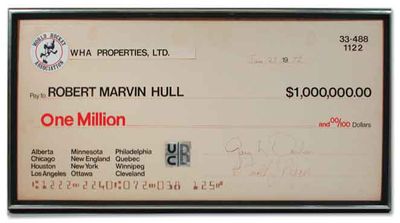
Coming off a 50 goal season with Chicago, when Hull jokingly told the WHA he'd jump for a million dollars, the WHA owners and league officials agreed to contribute to the cause and Hull was signed to a ten year, one million dollar contract. The WHA would not last the full ten years.


Once Hull was in the fold, other players soon followed, mainly in search of the higher paychecks offered by the new league, as Gerry Cheevers, Pat Stapleton, Ralph Backstrom, J. C. Tremblay and Rejean Houle also jumped leagues.

Despite an injunction filed by the Black Hawks which kept Hull out of the first 14 games of the 1972-73 season, the damage was done and eventually Hull became a full time Jet and the WHA was off and running.

Hull paid immediate dividends to the league and the Jets, raising the profile of the league and leading the Jets in scoring with 51 goals and 52 assists for 103 points, placing fourth in league scoring as the Jets finished atop the Western Division standings and leading Winnipeg to the Avco Cup Finals. Hull was also named the WHA Most Valuable Player in 1973, but it could be said that he had already earned that distinction by simply signing with the league in the first place!

For the next season, Hull was joined in the league by NHL legend Gordie Howe, who was lured out of retirement in order to play with his sons Mark and Marty in Houston with the Aeros. Hull would top his goal output with 53, but the Jets would drop in the standings and get bounced in the playoffs in four straight by Howe and the Aeros.

The Jets would respond by unleashing the most dynamic line in the history of the league the following season with the arrival of Ulf Nilsson and Anders Hedberg of Sweden.


The trio would light up scoreboards all over the league, with each player topping 100 points, led by Hull's record breaking 77 goals on his way to 142 points and being named the WHA MVP for the second time. His 77 goals were 23 more than his next closest pursuer and broke Phil Esposito's professional mark of 76 in 1970-71. Despite the offensive fireworks, the Jets would somehow fail to qualify for the WHA playoffs.

1975-76 would again see the trio of Hull (53 goals, 123 points), Nilsson (114 pts.) and Hedberg (105 pts.) all top 100 points and the Jets improve 25 points in the standings to capture the Canadian Division title. Once in the playoffs, the Jets would sweep the Edmonton Oilers in 4, oust the Calgary Cowboys in 5 and sweep the Aeros in 4 to capture their first WHA championship and the Avco World Trophy.

Hull was limited to just 34 games of the 1976-77 regular season, scoring 53 points in those games. Nilsson, Hedberg and the remainder of the Jets played well enough in Hull's absence to qualify for the playoffs, and Hull contributed 22 points in 20 games as the Jets returned to the finals to defend their title but lost in seven games to the Quebec Nordiques.

Hull would come roaring back the following season of 1977-78 with a 117 point campaign that included 46 goals as the Jets finished in first place during the regular season of the now failing WHA, which was down to one division of seven clubs after having 12 in the league in the previous season.

The Jets would defeat the Birmingham Bulls in five games to advance to the finals where they would demolish the New England Whalers in four straight games by outscoring the Whalers 24 goals to just 8 to capture their second championship.

Hull, Hedberg & Nilsson Winnipeg Jets, Hull, Hedberg & Nilsson Winnipeg Jets

Hull was limited to only four games in 1978-79 and played 18 games for the Jets in 1979-80 after their absorption into the NHL before being traded to the Hartford Whalers where he was teamed with Gordie Howe for the final nine games of his career.

Hull would finish his WHA career with 411 games played, 303 goals and 335 assists for 638 points (in essentially six full seasons) and two championships and second in league history for goals scored and third in points.

The Jets would play in the NHL from 1979 to 1996 before relocating to Phoenix, Arizona. Years later his son Brett would be signed by the Coyotes, who un-retired Bobby's #9 so Brett could wear his father's number. Coming after a year off following the NHL lockout season in 2004-05, Hull was no longer up to the task and retired after only playing five games, whereupon #9 was retired once more.


Today's featured jersey is a 1972-73 Winnipeg Jets Bobby Hull jersey as worn by Hull during the Jets inaugural WHA season. Their first set of jerseys were notable for both they short-lived original crest and their contrasting nameplates, the blue jerseys having white nameplates with red lettering and the white jerseys sporting red nameplates with white letters, both in an unusual, almost handwritten, font.

For the second season the Jets adopted their more familiar round logo, which survived not only the entire lifespan of the WHA, but also lasting until the 1989-90 NHL season before undergoing a very effective modernization.

Winnipeg Jets 72-73 jersey photo WinnipegJets72-73jersey.jpg
photo courtesy of Classic Auctions

Our first video is a real treat, highlights of a 1972-73 Winnipeg Jets game against the Chicago Cougars, in which Hull scores goals 50 and 51. Take note of the Jets first season uniforms with the original Jets wordmark, rather than the familiar round logo they would adopt in time for their second season, and the white nameplates with red lettering.


Fast forward to 1975 as Hull, now teamed with Hedberg and Nilsson, scores twice against the Aeros.


Finally, here is an interview with Hull on the occasion of the Jets retiring his jersey #9 in 1989.


Monday, February 18, 2013

1930-31 Ottawa Senators Alec Connell Jersey

After playing five seasons in the Ottawa City Hockey League, Alec Connell was signed by the Ottawa Senators of the NHL for the 1924-25 season. He would appear in 30 games his first season and post seven shutouts in all, including a his first coming in a scoreless duel with veteran Jake Forbes of the Hamilton Tigers, the first scoreless tie in NHL history.

Alex Connell rookie card photo AlexConnellrookiecard.jpg
Alec Connell's 1924-25 rookie card

The following season of 1925-26, Connell won 24 games in 36 stars, with 15 shutouts, a career high. In 1926-27, Connell won 30 games, 13 by shutout, in 44 appearances. The Senators would defeat the Montreal Canadiens and then defeat the Boston Bruins in their best-of-five series by the unusual line of 2 wins, no losses and a pair of ties earning Connell his first Stanley Cup.

Alex Connell Senators
Ottawa Senator Alec Connell

During the 1927-28 season, Connell set the NHL record for the longest shutout streak of 461:29 by recording six consecutive shutouts. The streak began on January 28th when he held the Montreal Canadiens to single goal in a 2-1 Senators win. The Toronto Maple Leafs then fell 4-0 to Connell and the Senators, who then prevailed 1-0 in overtime over the Montreal Maroons. The New York Rangers battled the Senators to a pair of scoreless ties on February 7th and 9th and the Senators offense again failed to support Connell on the 16th when they tied the Pittsburgh Pirates 0-0.

Finally, on this date in 1928, the Canadiens failed to solve Connell while the Senators managed to find the net for the first time in four games to secure a 1-0 win and Connell's sixth consecutive clean sheet.

The shutout streak ended when during Ottawa's 3-2 win over the Chicago Black Hawks on February 22nd. During the final five games of the six consecutive shutouts, the Senators only managed two goals themselves! Connell would finish the season by matching his career high of 15 shutouts.

At least he thought his season was finished. While watching Game 2 of the Stanley Cup Finals between the Maroons and the Rangers, Lorne Chabot of New York was injured and Rangers coach Lester Patrick wanted Connell to come out of the stands to replace Chabot. The Maroons coach Eddie Gerard refused to grant permission for Connell to play, forcing Patrick to famously man the crease himself.

Connell played three more seasons with the Senators prior to being loaned to the Detroit Falcons for the 1931-32 season, as the Senators franchise did not play that season due to financial difficulties. 

Alex Connell Falcons
Alec Connell during his one season with the Detroit Falcons

Connell rejoined the Senators for 1932-33 and was named team captain, but would only see action in 15 games compared to the 48 he played for the Falcons the previous season and he retired for the first time at the end of the year.

In 1933-34, the "retired" Connell did see action in a single game when he was loaned to the New York Americans as an injury replacement. He was given a new life for 1934-35 when he was traded to the Maroons and played in 48 games, winning 24, the second highest total of his career. The Maroons then defeated the Chicago Black Hawks one goal to none in their two-game, total-goal quarterfinal series. The Rangers then fell five goals to four to advance the Maroons to the Stanley Cup Finals. Connell and the Maroons then swept the Maple Leafs in three straight games to win the second Stanley Cup of Connell's career.

Connell Maroons photo ConnellMaroons.jpg
Stanley Cup champion Alec Connell of the Montreal Maroons

He retired again following the Maroons championship season and was out of hockey for a year but returned to the ice once again to play the 1936-37 season with the Maroons before finally retiring for good this time.

His final totals were 417 games played with a record of 193-156-67 with 81 shutouts and an impressive career goals against average of just 1.91.

Connell was elected to the Hockey Hall of Fame in 1958.

Today's featured jersey is a 1930-31 Ottawa Senators Alec Connell jersey. The Senators familiar barberpole style jerseys underwent a change in in 1929 with the addition of the "O" crest for the first time. The next season the shoulder yoke would be white for just the one season before the struggling Senators sat out the 1931-32 season. When they returned to the NHL, they reverted to the previous style where the stripes repeated all the way to the top of the jerseys for their final two seasons in Ottawa before relocating to St. Louis in 1934-35.

Alex Connell Senators

Sunday, February 17, 2013

2013 Hockey Day in America and the Hockey City Classic

Today is the sixth annual Hockey Day in America and there is plenty of hockey on tap today with events happening from Fairbanks, Alaska to Hartford, Connecticut to Oakland, California.

Hockey Day in America logo photo HDIA2013.jpg

The event is a part of Hockey Weekend Across America, which began Friday with "Wear Your Favorite Jersey Day", which we participated in by wearing our 1960 United States Olympic Team jersey from the silver medal winning squad from Squaw Valley.

Saturday was "Try Hockey Day" with approximately 200 rinks nationwide offering opportunities to both youth and adults to sample free clinics on the game.

The theme today is "Celebrate Local Hockey Heroes Day", during which local communities are encouraged to honor their area hockey heroes.

NBC's coverage of the NHL begins at noon Eastern Time will be based in New York's Central Park and will begin with a triple header of games, beginning with Sidney Crosby, Evgeni Malkin and the Pittsburgh Penguins traveling to face Ryan Miller, Thomas Vanek and the Buffalo Sabres, which should come as no surprise considering NBC does stand for Nothing But Crosby.

NHL on NBC photo NBC-NHL-logo.png

The second NHL game of the day sees the defending Stanley Cup champion Los Angeles Kings with Anze Kopitar and Jeff Carter visiting Johnathan Toews, Patrick Kane and the Chicago Blackhawks in the Windy City at 3:30, also on NBC.

CHI vs LA photo CHIvsLA.jpg

Coverage will then move to the NBC Sports Network for Game #3 of the tripleheader, which highlights Alexander Ovechkin and the Washington Capitals taking on the host New York Rangers and Henrik Lundqvist at 6 PM.

There's plenty of other games on the NHL schedule in addition to NBC's slate of games, the Ottawa Senators vs. the New Jersey Devils and the Philadelphia Flyers vs. the New York Islanders (both at 1 PM) the Detroit Red Wings vs. the Minnesota Wild, the Boston Bruins vs. the Winnipeg Jets and the Calgary Flames vs. the Dallas Stars (all at 6 PM), the St. Louis Blues vs. the Vancouver Canucks close out the day at 9 PM.

If you missed the fact the Winter Classic wasn't played this year or are a fan of college hockey, then the Hockey City Classic outdoors at the Chicago Bears' Soldier Field is the event for you. The #12 Notre Dame Fighting Irish will battle the #3 Miami University Redhawks, both of the CCHA, in the first game at 1 PM est in a game televised on Fox Sports Net, while the second game sees #18, the Wisconsin Badgers facing WCHA arch rivals and the #2 ranked University of Minnesota Golden Gophers on the Big Ten Network at 4:30 est.

Hockey City Classic logo photo 2013HockeyCityClassiclogo.jpg

All four teams have unveiled special new jerseys for the Hockey City Classic as well. Notre Dame will wear throwback jerseys in the style they originally wore from 1963 to 1968. They are simple, attractive and have stood the test of time extremely well. They are going to look great on the ice and will make for a sharp team photo.

Notre Dame Hockey City Classic jersey photo AndersLeeleftandSamCalabreseleftwearingthethrowbackjerseysthatNotreDamewillwearintheOfficeMaxHockeyCityClassiconFeb17atChicagosSoldierF.jpeg
Anders Lee and Sam Calabrese modeling the Notre Dame throwbacks

Miami University created a brand new jersey with a vintage feel, opting for tan instead of white and a lace-up collar. Unfortunately, they scuttled the entire project by opting for a three color version of their modern (and overly-beveled) current logo instead of reprising their classic block M logo of the past, which would have made a world of difference in the retro look of this jersey, which is really a shame.

One saving grace for this package is the silhouette of the state of Ohio for the captain's "C" in the style used by the NHL's Cleveland Barons for their sleeve numbers back in 1976-77.

Miami Hockey City Classic jersey photo StevenSpinellMiamiUniversity.jpg
Captain Steven Spinell in Miami's special jersey

Minnesota jerseys are based on those first worn in 1960-61, with "Gophers" diagonally down the front,  a lace-up collar. They also feature a two-color number on the upper left chest and back with the names in white using their current, serifed font, which ties in nicely with the cresting on the front. Overall, a nice looking effort that is faithful to the original style.

Minnesota Hockey City Classic jersey photo MinnesotaHockeyCityBudish.jpg
Gopher captain Zach Budish shows off Minnesota's 1960-61 jersey

Wisconsin, who will be participating in their third outdoor game, chose to replicate their simple, effective sweaters they wore back in the 1931-32 season. They have the multiple stripes popular in it's era and, yes, laces are once again present with "Wisconsin" arched in a simple font and one color numbers.

Details include the captain's "C" in a two color circle, the Bob Johnson quote "It's a Great Day for Hockey" inside the collar and a special logo commemorating the Hockey City Classic inside the rear hem and a shoulder patch commemorating the 50th anniversary of the modern era of the Badger program.

Of note, all four teams will wear a Hockey City Classic patch on their jerseys as well.

Wisconsin Hockey City Classic jersey photo BadgersHockeyCityRamage.jpg
John Ramage at Wisconsin's jersey unveiling

With two outdoor college games and the Blackhawks hosting the Kings, Chicago is the place to be today for Hockey Day in America, while fans at home have plenty of NHL and NCAA action to choose between, as their will be no less than five games broadcast nationally today.


hit counter for blogger