History of Jersey 83-93 Banner sm photo History of Jersey 83-93 Banner sm.jpg

Saturday, August 20, 2011

The United States Hockey Hall of Fame

Recently we made a pilgrimage to the United States Hockey Hall of Fame in Eveleth, Minnesota and wanted to share with you our visit to the hall and the jerseys on display in particular.

United States Hockey Hall of Fame Sign

Having arrived on the Iron Range after the 3 1/2 hour drive from Minneapolis/St. Paul, the US Hall of Fame is easy to find, located on a frontage road along highway 53 as you arrive in Eveleth.

USHHOF exterior
Our mite player Nick outside the US Hall of Fame

Upon entering the hall, visitors are greeted by a pair of jerseys in the lobby, one from Bobby Ryan of the Anaheim Ducks which he wore while setting the all-time fastest hat trick by an American player when he scored three goals in 2 minutes and 21 seconds on January 8, 2009 in Los Angeles.

Ryan Ducks jersey

Opposite the Bobby Ryan jersey is a Dallas Stars jersey which once belonged to the all-time leading American born player in NHL history, Mike Modano.

Modano Stars jersey

After viewing a film on the "Miracle on Ice" in the hall's theater, we made our way into the main gallery on the first floor, where you are greeted by a number of displays, including an early Zamboni, jerseys of notable American players, including Eveleth native and Stanley Cup champions Frank Brimsek, Pat Lafontaine and the legendary 1960 Olympic gold medalist John Mayasich. Additionally there is a display on the history of ice skates and of course the plaques of the inductees of the US Hockey Hall of Fame.


There is one other subject which dominates the main floor gallery, the coach of the 1980 "Miracle on Ice" United States Olympic hockey team, Herb Brooks. Aside from his role in the 1980 Olympics, Brooks involvement in the United States National Team dates back to his being the final cut from the eventual gold medal winning 1960 United States Olympic hockey team, his later participation in five World Championship and two Olympic teams for the United States and his coaching the 2002 edition of Team USA at the Olympic Games in Salt Lake City which resulted in a silver medal.


Hanging high above the main gallery are the 2011 championship jerseys, featuring the NHL champion Boston Bruins followed by those of the various NCAA men's and women's champions and the various classes of the Minnesota State High School League as well as a Wayne Gretzky New York Rangers farewell game jersey.


Moving up to the second floor a display case is dedicated to Minnesota's entry in the NHL, the Wild.

The NHL's Minnesota Wild

Once on the second floor, a gallery of hockey themed art work greets the visitor, with many of the works being themed around the Miracle on Ice, which naturally dominates much of the museum, and rightfully so, as it was named the Top Story of the Century by the International Ice Hockey Federation and the team featured a number of Minnesotans on the roster.

The US Hockey Hall of Fame's art gallery

The US Hockey Hall of Fame's art gallery

Also located in the art gallery is a reproduction of a 1950's John Mayasich University of Minnesota jersey, the only player to have his number retired by the Golden Gophers.

John Mayasich University of Minnesota jersey

Once through the art gallery, the main exhibit on the second floor begins with the timeline tunnel, which tells the story of the birth and evolution of ice hockey in the United States, with several displays of vintage memorabilia followed by a small sheet of artificial ice, which kept our mite entertained for quite some time as he shot pucks at the light up target as we slowly studied the various displays and took plenty of photos of not only the origins section, but the area dedicated to the United States Olympic hockey history which lies beyond and includes a broadcast of the Miracle on Ice, which plays continuously throughout the day.


After taking a break to watch some of the Miracle on Ice game, leaving the Olympic area brings you to a variety of jerseys on display.


While our youngster continued on to the puck speed shooting challenge, the video games and his personal favorite, the bubble hockey game, we ventured over to the high school jersey display, which naturally was focused on Minnesota schools, but also included one from North Dakota as well.


The former St. Paul Vulcans junior hockey club was featured, as were a number of United States college hockey programs with several nice jerseys on display.


Two real show stealers were the 1924 and 1927 jerseys from traditional collegiate rivals Wisconsin and Minnesota.

An amazing 1924 University of Wisconsin jersey

A 1927 University of Minnesota sweater
A 1927 University of Minnesota sweater and skates
worn by the great John Mariucci

American minor league hockey gets it's due, as well as a nod to international hockey outside of the Olympics, which includes the annual World Championships and prestigious World Junior Championships. A highlight for us was the plaques of team photos of the many US National Teams from 1981 to 2003, a great resource for researching the timeline of jersey styles worn by Team USA for over 20 years.


Of course, no trip to Eveleth would be complete without a trip downtown to see The World's Largest Hockey Stick, a 10,000 pound 110 foot long stick built using the identical process as a standard size hockey stick. Just the blade alone is 17 feet long. This stick, built in 2002, is actually the second such stick to reside in Eveleth, replacing the original stick which was on display from 1995 to 2001.

The accompanying puck is 5 feet across and nearly 2 feet thick, weighing 700 pounds, while across the street is a mural of a goaltender guarding a net, poised to stop the giant puck.

The Hockey Plaza is backed by a fence built to look like regulation hockey boards to complete the scene. Hockey Plaza is also located a few blocks from Eveleth's famous rink, the Eveleth Hippodrome, the oldest rink in Minnesota which dates back to 1922.

The hockey mural in downtown Eveleth
The mural across from Hockey Plaza

World's Largest Hockey Stick
The World's Largest Hockey Stick, measuring 110 feet long

Nick at the World's Largest Hockey Stick
Nick posing for scale next to the World's Largest Hockey Stick

We really enjoyed our visit to the United States Hockey Hall of Fame, spending 3 1/2 hours there. While that certainly was longer than the average visitor, much of that was due to our documenting our visit photographically and only made possible by the number of activities on site to keep our mite player entertained for that length of time.

In order to plan your visit to the United States Hockey Hall of Fame, visit their website at USHockeyHall.com and then see what the nearby Lake Superior port city of Duluth has to offer.

Here is a video tour of the US Hockey Hall of Fame, hosted by Doug Palazzari, executive director of the hall.


Here is a brief look at Eveleth and it's hockey history, the hall of fame and the World's Largest Hockey Stick.


Wednesday, August 17, 2011

Camp Shanny 2011

The NHL is holding it's "Research, Development and Orientation Camp", otherwise known as "Camp Shanny" in honor of NHL Senior Vice President of Player Safety and Hockey Operations Brendan Shanahan, today and tomorrow to test potential rules changes, with the goal being to gather as much information as it can before any rules changes are proposed.

Each of the two days have been divided into two sessions to test various proposals. Wednesday morning includes trying no-touch icing, no line changes for teams committing an offside, faceoff variations, no icing allowed by teams playing shorthanded and overtime and shootout variations.

The afternoon session deals with such things as faceoff location after an offside, delayed penalty variations, line changes, removing the trapezoid, allowing hand passes in all zones and more shootout variations.

Thursday's morning session tests hybrid icing, more offsides and faceoff variations, serving the entire length of a minor penalty, Brian Burke's "bear hug" concept and more overtime and shootout variations.

The afternoon session promises to be fun, as the players will try out new ideas to be incorporated into the annual All-Stars Skills competition.

Some of these proposals we are in favor of, some we don't care too much for and one that really gets us wound up in a bad way.

If there's one rule in the NHL that we cannot stand is the allowing of the hand pass in the defensive zone.

Hand Pass

To us, hockey has always been a game of speed and flow, with high tempo games featuring end-to-end rushes making for the best games. Personally, we’ve been very pleased with the brand of hockey played since the return of the NHL following the lockout and the rule changes adopted at that time, the majority of which were designed, as commissioner Gary Bettman prefers to say, “to increase scoring chances.”

But one arcane rule somehow survived the revamping of the game at the time of the Shanahan Summit - the rule which allows any team to make a hand-pass in it’s own defensive zone.

The first issue we have with allowing the defensive hand-pass is that it helps the defense decrease scoring chances. The second issue is that it’s legal at one end of the ice but not the other. If it’s deemed illegal on 2/3rds of the playing surface, why allow it on the rest?

The main problems we have with the defensive hand-pass is that it is the worst looking play in all of hockey. It’s an aesthetic nightmare to watch. Awkward at best, and ugly at it’s most common, the hand-pass is also contrary to the most basic, elemental point of the grand game of hockey, to advance the puck toward the other team’s goal with one’s stick.

We once brought this up with commissioner Bettman himself during his weekly radio show, The NHL Hour with commissioner Gary Bettman (12/11/08), and he stated “you’re absolutely right” and said it was something that had been discussed and probably would be on the agenda at the spring (2009) general manager’s meeting when they discussed rule changes. He went on to say it was not the first time this had been discussed as a suggested rule change and “that it was not as skilled a play as we like to see our game played” and “an excellent point.” and Co-host Bill Clement agreed. Obviously the rule was not overturned at that meeting or any subsequent ones.

Now the NHL is testing allowing it in all zones!

The reason the hand-pass was originally allowed in the defensive zone was due to teams on the penalty kill deliberately making hand-passes to get a whistle which would allow them to get a cheap line change and likely the thinking behind keeping the rule in place.

This caving in to deliberate rule breaking was where the league erred in the first place, as the solution then, as it is now, would be to call any hand-pass by a team while shorthanded in their defensive zone a delay of game penalty. Under our proposal, the offending team would also be required to keep all of it’s remaining players on the ice at the time of the penalty, removing any incentive to attempt the hand-pass to get a line change.

With a team already down a man, an additional man in the box under this proposal would lead to the desired “increased scoring chances” on the subsequent two-man advantage, which should please the league and it’s fans.

The defensive hand-pass doesn’t happen with great frequency, but when it does, it’s the visual equivalent of fingernails on a chalkboard and we really feel it’s a good idea to remove the worst looking play in hockey in order to maintain the integrity of one of the game’s most basic elements, advancing the puck with the stick, and stop capitulating to the deliberate rule breakers.

As Bill Clement said, “It’s an ugly play. Get rid of it.”

For the life of us, we cannot imagine why the NHL would consider allowing expanded use of the hand pass when it's so contrary to the basic fundamentals of the game and fear what the game would look like if the players were to take full advantage of the ability to shove, bat, toss or throw the puck at will.

Saturday, August 13, 2011

Submit Your Jersey to Third String Goalie!

As our Summer Hours schedule continues, we are pleased to announce a new opportunity for our readers here at Third String Goalie, the chance to submit your own jersey for others to see!

There is no limitation to what kind of hockey jersey it can be. It can be a replica, authentic or game worn jersey from the NHL, a national team, the minors, juniors, college, high school or even your pond hockey jersey.

Feel free to write a paragraph or two about the jersey telling us why you like the jersey, how you got it, what makes it special to you or even a full-blown Third String Goalie-style history lesson - whatever you feel like sharing.

When sending in pictures, they must be at least 425 pixels wide at a minimum, which is actually rather small. If you send in larger pictures, don't worry, we will be resize them to fit our format for you.

A photo of the front of the jersey is obviously needed and a picture of the back is certainly preferred, especially if it has been customized with a name and number. You can also include any relevant detail photos if needed to tell your story, especially of any additional patches.

Lay the jersey flat, as shown below, and shoot the photos from as straight overhead as possible with the arms of the jersey folded so they run straight down the sides of the jersey.

The simpler and more neutral the background is, the better. For example, beige carpet or perhaps wood flooring is preferred to dark colored tile with white grout. We recommend using an on camera flash to minimize any wrinkles, as light coming from just one side, such as that from a window, will rake across the jersey and accentuate any wrinkles.

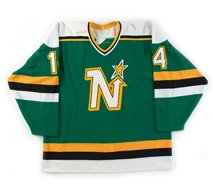
MN North Stars 89-90 F
MN North Stars 89-90 B

If you have a jersey in your collection that comes to mind and you'd like to share it with us and your fellow readers, please submit your pictures and a story to go with it, no matter how brief or detailed, to spyboy1@gmail.com and we look forward to seeing your favorites!


Saturday, August 6, 2011

The Hockey Art of Andy Warhol

Born on this date in 1928, Andy Warhol is not the first name that comes to mind when thinking of sports related art, as he is best known for his portraits, such as those of celebrities like Marilyn Monroe, Jackie Kennedy and Liz Taylor, and political icons, such as Mao Tse-Tung, Vladimir Lenin and Che Guevara.

He also gained fame for his pop art works of a Campbell's Soup can, Mickey Mouse and Elvis Presley.

In addition to his paintings, Warhol was a filmmaker and also created works in many other media. He also introduced the phrase "15 minutes of fame" to the English lexicon.

From a monetary standpoint, Warhol ranks among a very elite group of artists, Jackson Pollock, Willem de Kooning, Gustav Klimt, Vincent van Gogh, Pierre-Auguste Renoir, Pablo Picasso and Warhol, who have had an individual piece sell for $100 million.

Warhol did create a number of sports related pieces throughout his career though, almost exclusivley on a commission basis. His first photo-silkscreened painting was a baseball scene, done in back in 1962. It was the first and last time he chose sports as a subject on his own.

Warhol's first real entry into the world of sports related art, and his first hockey piece, was when he was commissioned fifteen years later to create a series of works for businessman Richard Weisman in 1977, known as the "Athlete Series", which featured Jack Nicklaus, Kareem Abdul-Jabbar, Willie Shoemaker, Dorothy Hamill, Chris Evert, Pele, Tom Seaver, O. J. Simpson, Muhammad Ali and hockey player Rod Gilbert.

Photobucket
Rod Gilbert by Andy Warhol

On September 2, 2009 the ten 40" square canvases were stolen from the Los Angeles home of Weisman, along with a portrait of Weisman done by Warhol. Anyone with information about the theft can call the Los Angeles Police Department at 231-485-2524.

The polaroid photos Warhol took for the Athlete Series have been displayed on their own, and include additional portraits of hockey players Ron Dugay and Wayne Gretzky taken at a later time than those used to produce the Athlete Series.

Warhol hockey polaroids
Polaroid photos taken by Warhol as the basis for future paintings

In 1978, Warhol revisited one of the subjects of the Athlete Series, Muhammad Ali. Four separate pieces were created at that time.

One of Warhol's better known works related to the world of sports was the occasion when he was commissioned by BMW to paint one of their M1 race cars as the fourth in a series of BMW Art Cars, which would later compete at the famed 24 Hours of Le Mans.

Photobucket

"I tried to portray speed pictorially. If a car is moving really quickly, all the lines and colors are blurred.", Warhol explained. Of note, the car finished second in it's class and sixth overall out of 55 starters in 1979, the only time it ever raced.


His next sports themed work was that of a speedskater, which was his contribution to "The Official Art Portfolio of the XIV Olympic Winter Games" in Sarajevo, Yugoslavia in 1983. He was one of 17 artists to contribute to the project.

In 1984, Warhol produced two separate pieces commissioned by long-time Canadian art gallery owner Frans Wynans featuring Gretzky. One was entitled "Wayne Gretzky 99" and produced in a limited edition of 300.

Andy_Warhol_Wayne_Gretzky_99

As was often the case with Warhol's silkscreened prints, a variety of color versions can be found of this work. The silkscreen prints were originally sold for $1,500 and now require between $15,000-$20,000 to obtain.

Andy_Warhol_Wayne_Gretzky_99_4 variations

The other piece was a series of six portraits of Gretzky holding a hockey stick. The portraits originally sold for $35,000 and now sell for more than ten times that much at $390,000.

Andy_Warhol_Wayne_Gretzky

Again, there were various versions of "Wayne Gretzky" produced despite the much more limited numbers produced.

Andy_Warhol_Wayne_Gretzky_4 variations

As a fundraiser for the Cincinnati Art Museum, Warhol created a poster featuring Cincinnati baseball icon Pete Rose, done in the style of a baseball card in 1985. Also that same year, he created a polo player for the cover of the 10th anniversary of Polo magazine.

One final hockey themed work of Warhol's was "Frölunda Hockey Player" in which he depicts a skater from the Swedish club Frölunda HC, Christer Kellgren, which was created in 1986. The piece was a commissioned project by the Art Now Gallery in Göteborg, Sweden, which is home to the Frölunda Indians.

Warhol Frolunda Hockey Player

Typical of the works of Warhol, several distinct variations of this piece were made in widely differing colors.

Photobucket Photobucket

There was also another group of the Frolunda Hockey Player made which featured two images of the player done in several variations.

Photobucket

Photobucket Photobucket

Warhol died the following year at the age of 58 from a sudden cardiac arrhythmia following a routine surgery.

Andy Warhol Signature

Today's video section will be unlike any other we've ever had, and it begins with Andy Warhol Eats a Hamburger.


Next, Andy appears in a commercial for Braniff Airlines with heavyweight boxing champion Sonny Liston. There's no way that's Andy's voice either.


Finally, "Andy Warhol" by David Bowie.


For more on Warhol, here is a link to the PBS American Masters series on Andy Warhol in 12 parts, which runs roughly two hours and contains absolutely no hockey whatsoever.

Sunday, July 31, 2011

2007-08 Cedar Rapids RoughRiders Erick Cinotti Jersey

July by the Numbers makes our first ever visit to Iowa for jersey #31.

The oldest hockey team from the Hawkeye State we can find records for is the 1951-52 Sioux City Sunhawks, a senior amateur club in the American Amateur Hockey League. The Sunhawks lasted but one season but had a rather successful one, finishing second. This league was a precursor to what would eventually become the United States Hockey League.

The Sunhawks would be followed in the AAHL by the Des Moines Ice Hawks (1958-1960) and the Des Moines Oak Leafs in 1961. After two seasons in the USHL, the Oak Leafs would join the International Hockey League beginning in 1963. They would make the playoff finals twice in their nine seasons in the IHL prior to changing their name to the Des Moines Capitols in 1972. In 1973-74, they would finish with the best regular season record and go on to defeat the Saginaw Gears to win the Turner Cup as IHL champions, but after one additional season, the club would fold, ending their 14 year run.

The Waterloo Black Hawks joined the league, now renamed USHL, in 1962 and won championships in five consecutive seasons from 1964 to 1968 and then another trio of titles in 1975, 1978 and 1979, the final season the USHL operated as a semi-professional league.

Waterloo Black Hawks

The Sioux City Musketeers arrived in the USHL in 1972 and remained in the league when it changed it's focus to an all junior league for the 1979-80 season and have continued to play in the league to this day, making them the longest running franchise in the state of Iowa, now at 40 seasons of play. The Musketeers have won the Clark Cup as USHL champions in 1982, 1986 and 2002 and also went on to win the Gold Cup as national junior champions in 1986 as well.

Sioux City Musketeers

The conversion of the USHL from a semi-pro to a junior league in 1979 opened up new opportunities which led to some changes and additions, as Waterloo relocated to Dubuque and were renamed the Dubuque Fighting Saints in 1980, where they remained for 21 seasons. The Fighting Saints won the Clark Cup in their very first season in Dubuque and added titles every other year for championships in 1981, 1983 and 1985.

Gary Suter Dubuque
Future NHL Rookie of the Year, Stanley Cup winner and US Olympian
Gary Suter captained the Fighting Saints to a Clark Cup title in 1983

Waterloo was not left without hockey though, as a Minnesota franchise immediately moved into the vacated Waterloo market and kept alive the traditional Black Hawks name. This new iteration of the Black Hawks has won the Clark Cup once, that coming in 2004.

After a five year absence, hockey returned to Des Moines when the Des Moines Buccaneers joined the USHL for the 1980-81 season and have proven to be a big success, having just completed their 31st season with USHL championships coming in 1992, 1995, 1999 and 2006 and national championships coming in 1992, 1995 and 2006.

Des Moines Buccaneers
The Des Moines Buccaneers playing in front of a packed house

Mason City became home to the North Iowa Huskies in 1983 and they would remain there through the 1998-99 season, 16 in all, before relocating and becoming the Cedar Rapids RoughRiders beginning with the 1999-00 season. The RoughRiders have now completed their 12th season with a Clark Cup championship in 2005.

While not technically based in Iowa, the history of hockey in the Quad Cities must be mentioned in any discussion of Iowa hockey, as the Quad Cities consist of Rock Island and Moline in Illinois and Bettendorf and Davenport on the Iowa side of the Mississippi River. The main arena serving the metro area is located in Moline and was home to the Quad City Mallards of the minor professional United Hockey League from 1995 to 2007, who drew fans from both states.

Quad Cities Map
Map of the Quad Cities

The Mallards were quite successful during their 12 seasons, winning the Colonial Cup in 1997, 1998 and 2001 as part of a run of success which included making the finals five consecutive years and six times out of seven. They also had the league's best regular season record four times from 1998 to 2002. The Mallards lasted until the end of the 2006-07 season.

Hockey made it's return to Dubuque in 2001 in the form of the Dubuque Thunderbirds as a member of the junior Tier III Central States Hockey League, two steps below the USHL. The Thunderbirds won the Hurster Cup in 2007, 2008 and 2009 and continued to play until 2010.

Also of note, the Omaha Lancers of the USHL, who were founded in 1986, played their home games at an arena across the Missouri River in Council Bluffs, Iowa from 2002-03 to 2008-09, including the first two while being known as the River City Lancers before changing their name back to Omaha and moving into a new home rink back in Nebraska.

After being without top level minor league hockey since 1975, the American Hockey League came to Iowa for the first time with the arrival of the Iowa Stars to Des Moines in 2005-06. The Stars played for three seasons as the top minor league affiliate of the Dallas Stars wearing some of the classiest jerseys in all of hockey.

Mike Smith Iowa Stars
Future NHL goaltender Mike Smith while with the Iowa Stars

Unfortunately, the Stars agreement with Dallas ended and the team signed an affiliation agreement with the Anaheim Ducks, which resulted in their being rebranded as the Iowa Chops, whose name and angry boar logo were among the worst to ever take to the ice. The Chops lasted just a single season until financial problems brought an end to the franchise and their dreadful identity.

Iowa Chops

That same season the Stars arrived in Des Moines, hockey also returned to Mason City with the arrival of the North Iowa Outlaws in the North American Hockey League, a Tier II junior hockey league, Iowa's first entry in the NAHL. Their time in Mason City lasted five seasons before relocating out of state.

The Calgary Flames decision to relocate their top AHL affiliate from Omaha to the Quad Cities brought and end to the first incarnation of the Mallards for the 2007-08 season. The relocated AHL team was named the Quad City Flames and played just two seasons without qualifying for the playoffs, despite a pair of winning records, before financial losses led to the team moving out of town to look for greener pastures.

It's unfortunate that the Iowa Stars/Chops and Quad City Flames could not have both survived, as their presence in the top level of professional minor league hockey should have developed into a fierce rivalry with both teams being in the same division of the AHL and located just 170 miles apart along Interstate I-80.

Also beginning play in 2007-08 were the Quad City Junior Flames, who are based in Davenport, Iowa. The Junior Flames were members of the CSHL at the same time as the Thunderbirds in Dubuque and will enter their fourth season in 2011-12 in the now renamed North American 3 Hockey League.

The loss of the AHL's Quad City Flames led to the revival of the Quad City Mallards for the 2009-10 season, only by now the UHL had been renamed the International Hockey League, which after just one season of play for the new Mallards, merged with the Central Hockey League and the combined leagues now operate as the CHL, of which the Mallards are still a part.

Quad Cities opening night
The Quad City Mallards playing to a full house on their return in 2009

The demise of the Thunderbirds was brought on by the return of the USHL to Dubuque when a new edition of the Dubuque Fighting Saints came on the scene for the 2010-11 season, which had a fairytale ending when they first year franchise captured the Clark Cup as league playoff champions in their first attempt, returning the cup to Iowa for the 13th time in 32 years and the first time since 2006.

Hockey is scheduled to return once more to Mason City for the 2011-12 season, as the North Iowa Bulls are scheduled to take to the ice as part of the NA3HL, meaning the lineup of teams scheduled to play in Iowa for the upcoming 2011-12 season are the Mason City Bulls and Quad City Junior Flames of the junior Tier III NA3HL, the Cedar Rapids RoughRiders, Des Moines Buccaneers, Dubuque Fighting Saints, Sioux City Musketeers and Waterloo Black Hawks of the Tier I USHL in junior hockey, and the Quad City Mallards of the CHL in minor professional hockey.

One final note concerning hockey in Iowa comes at the college level, as the Iowa State University Cyclones play in the Central States Collegiate Hockey League in Division 1 and the University of Iowa Hawkeyes compete in the Mid-American Collegiate Hockey Association of Division 2 of the American Collegiate Hockey Association, the body which organizes non-varsity college hockey in the United States outside of the top level administered by the NCAA.

As you can summarize from the lack of long term success of top level minor professional hockey in Iowa, especially when compared to the long term stability and success of the various Iowa based clubs in the USHL, Tier I junior hockey in Iowa is alive and well and has proven very popular with the fans of Iowa for decades now.

While the main goal of the USHL is to provide the opportunity for players to obtain college scholarships, many recognizable names have spent time in Iowa playing in the USHL on their way to reaching the NHL, including Justin Abdelkader (Cedar Rapids), Andrew Alberts, Jason Blake and Joe Pavelski (Waterloo), Erik Cole and Kyle Okposo (Des Moines), Ruslan Fedotenko and Rotislav Kesla (Sioux City) and Gary Suter (Dubuque),

Joe Pavelski Waterloo
Future San Jose Shark Joe Pavelski while captaining the Waterloo Black
Hawks to a championship in 2004 while being named Player of the Year

Today's featured jersey is a 2007-08 Cedar Rapids RoughRiders Erick Cinotti jersey. This jersey sticks to tradition with a colored shoulder yoke and simple stripes around the arms and waist. A shield shaped logo decorates the front with a perhaps too finely detailed logo, but it does avoid being too cartoonish.

The back features a two color name and three color numbers, the same as those used by the Vancouver Canucks as well as Nike for their international jerseys in the most recent Olympics in 2010 for teams such as the United States.

Cedar Rapids RoughRiders 07-08 jersey


hit counter for blogger