History of Jersey 83-93 Banner sm photo History of Jersey 83-93 Banner sm.jpg

Wednesday, March 30, 2011

1924-25 Victoria Cougars Jersey

The Victoria Cougars were formed in 1911 as the "Senators" as a member of the Pacific Coast Hockey Association (PCHA). Their first season in the three team PCHA saw them finish last with a 7-9 record behind the New Westminster Royals and the Vancouver Millionaires. They were led in scoring by Tommy Dunderdale's 24 goals in 16 games, good for third in the league.

1912-13 Victoria Senators photo 
1912-13VictoriaSenatorsteam.jpg
The 1911-12 Victoria Senators in their original barberpole sweaters

The second season saw Victoria win the PCHA title with a 10-5 record. Dunderdale led both the club in scoring again but also the league this time with 24 goals and 29 points in 15 games. No other player had more than 14 goals, ten behind the prolific Dunderdale. Following the season the Senators defeated the National Hockey Association champion Quebec Bulldogs in an exhibition series

 photo 1912-13 Victoria Senators-Aristocrats team.jpg
The 1912-13 Victoria Senators Hockey Club

The club changed their name to the Aristocrats for the 1913-14 season and again won the PCHA title with an identical 10-5 record. They were led in scoring by Dubbie Kerr and his 20 goals and 31 points in 16 games followed by Dunderdale at 24 goals and 28 points. Now having established itself as a worthy league, the Aristocrats were able to travel to Toronto and challenge the Toronto Hockey Club (or Toronto Blueshirts) for the Stanley Cup, but came home without the cup.

 1914–15 Victoria Aristocrats team photo 1914ndash15 Victoria Aristocrats team.jpg
The Victoria Aristocrats during the 1914-15 season

After two more seasons as the Aristocrats, led in scoring by first Dunderdale and then Kerr, the club moved to Spokane, Washington where they were known as the Canaries for the 1916-17 season, but attendance was so poor that the team played their scheduled home games after mid February at the home rinks of their previously scheduled visitors! 

The 1918-19 season saw the franchise back in Victoria as the Aristocrats once more and led in scoring by Eddie Oatman, who had come from the now defunct Portland Rosebuds, as had many of the Aristocrats that season.

1919-20 saw the 10-12 Aristocrats in third place with Dunderdale now returned to the fold and doing the bulk of the scoring with 26 goals  and 33 points in the 22 game season to win the PCHA scoring title. Dunderdale had left Victoria following the 1914-15 season to play in Portland for three seasons, but was back with Victoria in 1918-19 when the Rosebuds player's contracts were transferred to the Aristocrats following the Rosebuds folding.

Another third place came in 1920-21 from a 10-13-1 mark. The Aristocrats' Frank Fredrickson led the PCHA in scoring with 20 goals and 12 assists for 32 points in 21 games.

The 1921-22 season saw the league standings decided by the narrowest of margins, with Seattle finishing first with a record of 12-11-1, the Millionares followed at 12-12-0 and the Aristocrats once more brought up the rear at 11-12-1. Fredrickson one more led the club with 25 points from 15 goals and 10 assists.

For the 1922-23 season, the franchise adopted the new moniker of the "Cougars" and it paid immediate dividends, as the club finally climbed out of last place for the first time. A 16-14-0 record was enough to beat the Metropolitans and qualify for the playoffs. Vancouver, newly renamed the Maroons, defeated the Cougars in a two-game total-goal series 3-0 and 2-3. Fredrickson again led the league in scoring with 39 goals and 55 points, 15 more than his next closest pursuer, in the 30 game schedule.

The final season for the PCHA saw the Cougars once more finish third with a record of 11-18-1. Fredrickson again led the club with 19 goals and 28 points in 30 games.

Changes were in store for the 1924-25 season, as the Cougars moved to the Western Canada Hockey League (WCHL), now in it's fourth season, along with the Vancouver Maroons. The Metropolitans had folded and the Cougars were awarded four players off their roster prior to the season and they selected goaltender Hap Holmes, Gordon Frasher, Jack Walker and  Frank Foyston. While the Cougars finished third yet again, the WCHL was now a six team league, and the Cougars 32 points in the standings left them just behind the Calgary Tigers 34 and Saskatoon Sheiks 33. The prolific Fredrickson was the team leader in points for the fifth consecutive season with 22 goals and 30 points in 28 games.

Victoria Cougars team

The Cougars defeated the Shieks in their opening round two game series by a 6-4 total before upsetting the Tigers in the WCHL Finals in another two-game total-goal series by a combined score of 3-1 to earn the right to challenge the defending Stanley Cup winners and NHL champion Montreal Canadiens.

1925 Stanley Cup program

The finals were a best of five series and all games were played in British Columbia in keeping with the annual rotation of games between the east and the west. The Cougars took Game 1 with a score of 5-2 and put themselves in a position to capture the cup with a 3-1 win in Game 2 with Walker scoring a pair of goals in each game.

Montreal fought back with a 4-2 win on March 27th and the Cougars became the last team from outside the NHL to win the Stanley Cup with a dominant 6-1 win in Game 4 on this date in 1925, led by a pair of goals by Fredrickson to take the series 3 games to 1. The game winning goal was scored by Gizzy Hart and Walker led the Cougars with 4 goals in the series as the Cougars outscored Montreal 16-8.

Their roster included Hall of Famers Fredrickson (inducted 1958), Foyston (1958), Walker (1960) and goaltender Holmes (1972) and they were coached by the legendary Lester Patrick (1947), who also owned the club. Additionally, Fredrickson and defenseman Harold Halderson were previously members of the Winnipeg Falcons who won the first Olympic gold medal in ice hockey.

1925 Victoria Cougarsm

The following season the WCHL was renamed the Western Hockey League (WHL) and the defending champion Cougars finished in their traditional third place yet again with a 15-11-4 mark. Fredrickson dominated the scoring with 24 points in 30 games to lead the team fir the sixth consecutive season. The Cougars again won the league playoffs to earn the right to face the NHL champion Montreal Maroons for the right to defend the cup, which the Maroons won 3 games to 1.

That would be the end of the Cougars in Victoria though, as the WHL disbanded after the season, leaving the Cougars without a league. The rights to most of their players were purchased by the new Detroit NHL franchise, which used the Cougars name as a tribute to the former club of the majority of their roster. Eventually that team would rename itself the Falcons and later the Red Wings.

Today's featured jersey is a 1924-25 Victoria Cougars Frank Frederickson jersey. This original Cougars jersey can be seen in the Hockey Hall of Fame in Toronto and has it's own page in The Hockey News Greatest Jerseys of All-Time Collector's Edition.

1925 Victoria Cougars jersey

Today's video section is behind the scenes footage of the Hockey News Greatest Jerseys of All-Time photo shoot, which includes today's featured Victoria Cougars jersey. The Greatest Jerseys of All Time collector's edition is a must-have for any jersey collector or hockey fan alike.


Tuesday, March 29, 2011

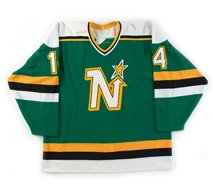
1987-88 Minnesota North Stars Jon Casey Jersey

Born on this date in Grand Rapids, Minnesota in 1962, goaltender Jon Casey played college hockey for the University of North Dakota Fighting Sioux from 1980-81 until 1983-84, which included an appearance at the World Junior Tournament in 1982 for the United States and two NCAA national championships in 1980 and 1982.

1981-82 UND Sioux
Casey, front left, celebrates the 1982 NCAA national championship

Following his college career, the undrafted Casey would sign a free agent contract with the Minnesota North Stars in time for him to see action in two games at the conclusion of the 1983-84 season, which included his first NHL victory.

He spent the following season honing his craft with the Baltimore Skipjacks of the AHL, going 30-11-4 in 46 games. The following season was split between the Springfield Indians (9 games) and North Stars (26 games), with whom he went 11-11-1.

1986-87 saw Casey again spend the entire season in the minors, with both the Indians and the Indianapolis Checkers, where he spent the majority of his time. While he made 14 appearances with Minnesota in 1987-88, most of his action came with the Kalamazoo Wings of the IHL with whom he went 24-13-5.

The departure of Don Beaupre to Washington opened up a roster spot for Casey in Minnesota in 1988-89, who assumed the starting role with 55 games played, a total which increased to 61 the following year during which he set a career high with 31 victories. Following the NHL season, Casey made his only appearance at the World Championships, going 4-2 in six games.

The 1990-91 season saw Casey finish the season with 55 appearances and a 21-20-11 record, but come to life with a 14-7 mark in the playoffs as the North Stars made an improbable run to the Stanley Cup Finals after a posting a losing 27-39-14 record as a team during the regular season.

Casey North Stars

After two more seasons in Minnesota, making 52 then 60 appearances as well as playing in the 1993 NHL All-Star Game, Casey was traded to the Boston Bruins for the 1993-94 season where he was once more the starting goaltender with 57 appearances.

Casey Bruins

After his only season with the Bruins, Casey returned to the midwest by signing a free agent deal with the St. Louis Blues for 1994-95 to back up incumbent Curtis Joseph. After appearing in 19 games for St. Louis that season, Casey was limited to just 9 games in 1995-96 as he spent the majority of his time with the Peoria Rivermen of the IHL playing in 43 games.

Casey Blues

His final NHL season saw him play 15 games for the Blues as well as 4 with the Worcester IceCats of the AHL. Casey would play one final season of professional hockey with the IHL's Kansas City Blades in 1997-98 prior to retiring in December of 1997 after 24 games with the Blades.

Casey's final NHL totals are 425 games played, 170 wins, 157 losses and 55 ties. He also posted 16 shutouts and a career goals against average of 3.21.

Today's featured jersey is a 1987-88 Minnesota North Stars Jon Casey jersey which features the "JM" patch worn in honor of John Mariucci, "The Godfather of American Hockey". Mariucci played for the University of Minnesota, five seasons for the Chicago Blackhawks, when American players in the NHL was a rarity, and then spent four more seasons playing in the various minor leagues of the day before retiring and entering the world of coaching.

Mariucci coached the University of Minnesota for 12 seasons with another spent as the coach of the US Olympic team, earning a silver medal in 1956. He would also coach Team USA at the 1976 and 1977 World Championships. The home of the Minnesota Golden Gophers, Mariucci Arena, is named for John and he is a member of the United States Hockey Hall of Fame and the Hockey Hall of Fame.

The North Stars adopted this style jersey for the 1978-79 season. This jersey would remain unchanged until 1988-89 with the addition of black to the striping pattern despite the white jerseys having black first added back in 1981, seven years earlier.

Minnesota North Stars 87-88 Casey jersey

Monday, March 28, 2011

1989-90 Winnipeg Jets Laurie Boschman Jersey

Following a stellar season with the Brandon Wheat Kings in which he scored 66 goals and 149 points as well as 215 penalty minutes, center Laurie Boschman was drafted 9th overall in the 1979 NHL Entry Draft by the Toronto Maple Leafs.

Boschman's first season in Toronto went well enough for an NHL rookie, as he played 80 games and scored 48 points, but year two was derailed by a bought of mononucleosis, from which he returned too quickly and lacked the necessary energy to compete at the NHL level as a result. Worse, he was criticized by the notoriously cantankerous Maple Leafs owner Harold Ballard for being too soft as a result of a religious conversion. Despite the "soft" accusations, Boschman racked up 178 penalty minutes in just 53 games that season.

Boschman Maple Leafs

A third abbreviated season in Toronto was cut short by a stomach ulcer before Boschman requested a trade and was dealt to the Edmonton Oilers in time for the final 11 games of the 1981-82 season, freeing him from Ballard's criticisms. After playing the majority of the 1982-83 season with the Oilers, Boschman was once again on the trading block due to the depth of the Oilers roster. He landed in Winnipeg with the Jets, a move which would fit him like a glove.

After playing four NHL seasons with a high of 48 points, his first full season with the Jets would see his production immediately increase to 74 points despite playing in just 61 games due to time missed with a separated shoulder. He would also total 234 penalty minutes, making him a true power forward.

Boschman Jets

The following season Boschman set a career high with 76 points, which included another career best of 32 goals, one of a record six Jets to score 30 or more goals. After scoring 69 points, along with a career high of 241 penalty minutes, Boschman's offensive production would decline somewhat as his season totals were in the 40's in 1987 and 1988 before 36 in 1989 and 27 in his final season in Winnipeg in 1989-90.

After eight stable years in Winnipeg, Boschman was sent to the New Jersey Devils where he would play for two seasons.

Boschman Devils

He was then left unprotected in the 1992 NHL Expansion Draft by the Devils, and was subsequently selected by the Ottawa Senators, who named him their first captain in team history. Boschman would play 70 games for the Senators that season, which would include his 1,000th NHL game on this date in 1993.

Boschman Senators

While the Senators would rarely win a game during their first season, going 10-70-4 for a meager 24 points, Boschman would appear in 70 games, his 12th consecutive season with 61 games or more. He would retire following his only season with the Senators, but would return for seven games, in which he scored 18 points, with the Fife Flyers of the British Hockey League in 1994-95 before retiring for good.

Today's featured jersey is a 1989-90 Winnipeg Jets Laurie Boschman jersey as worn during his final season in Winnipeg. This jersey has the Goals for Kids patch worn for the first time in 1988-89, although with the different design which incorporated the Jets logo.

This was the only season during which this style jersey, first introduced back in 1979 when the Jets entered the NHL after the demise of the WHA, with this style of Goals for Kids patch, as the following season would see an all new Jets jersey style that had not only a new Goals for Kids patch, but stripes around the arms rather than down the length of the arms.

Winnipeg Jets 89-80 jersey

Bonus Jersey: Today's bonus jersey is a 1992-93 Ottawa Senators Laurie Boschman jersey as worn during the Senators inaugural season in which they wore the Stanley Cup Centennial patch. Boschman was named the Senators original captain that season, one in which he played in his 1,000th NHL game.

Ottawa Senators 92-93 jersey

Today's video segment begins with Boschman having a good scrap with the Rangers Doug Weight.


Here is the most famous goal Boschman didn't score - a disallowed goal in the 1991 playoffs which would have completed a Devils comeback from three goals down while leading 3 games to 2. Pittsburgh went on to win the game and eventually the Stanley Cup.


Sunday, March 27, 2011

Big Time Jersey Flags

While looking for relevant products to link to at the bottom of a recent post we came across something which naturally caught our eyes.

Jersey flags for your home!

Big Time Jerseys

Obviously we here at Third String Goalie thought they were pretty darn cool and really well done with a very nice attention to detail. These were not just some rectangularly bodied pieces of fabric with arms that stuck straight out and a team logo slapped on the front, but accurately shaped and detailed Reebok Edge jersey designs, complete with the rounded shirt-tail silhouette.

Additionally, we were impressed with the detail of the lace up collars, printed texture for the mesh inserts and depictions of the separate fabric panels which make up a real jersey and the lace up collars where appropriate, as well as the accurate logos and colors.

Big Time Jerseys

Each NHL flag measures 64" wide and 44" high, nearly 5 feet wide and 4 feet tall, and includes a custom curved pole, to make sure the jersey hangs with the proper shape, and all the mounting hardware. To further ensure the jersey hangs with the correct shape, thumb screws hold the jersey in place on the pole to prevent it from bunching up on one end.

Big Time Jerseys box

The flags are made of a durable, weather resistant satin polyester material for indoor and outdoor use and are impressively two-sided! You might expect or assume that it would simply be the front of the jersey on both sides of the flag, which may have been the easy way out, but each flag has an accurate depiction of the back of the jersey on one side with accurate number fonts, such as the unique number fonts as the Anaheim Ducks, Colorado Avalanche and Minnesota Wild and precise lettering for the names, exemplified by the vertically arched lettering of the Avalanche and Detroit Red Wings.

NHL teams are available in three styles, home dark and road white with both the front and back depicted, or the home dark with the front of the jersey on both sides if you prefer.

Big Time Jerseys
Home Dark, Away Light or Double Front options

In addition to all 30 NHL clubs, Big Time Jersey offers flags for NBA jerseys, including some with star player names and numbers, a few popular colleges in both basketball and football with a variety of jersey numbers to pick from, Army, Air Force and Marines themed shirts, as well as a variety of high school options.

By following the links below, you can purchase your own Big Time Jersey flag direct from Big Time Jersey for $89.99 and pledge your allegiance to your favorite NHL team.

Saturday, March 26, 2011

1968-69 St. Louis Blues Barclay Plager Jersey

One of the most popular players in St. Louis Blues history, Barclay Plager was born on this date in 1941. Barclay was the oldest of the three Plager brother to play in the NHL, followed by Bill and Bob.

Barclay began his road to the NHL playing for the Peterborough Petes on the Ontario Hockey Association in 1957-58. During his four seasons playing for the Petes, Barclay established a himself as a rugged, tough defenseman, a reputation only enhanced by a fight he had with his brother Bob, who was playing for the Guelph Royals.

Barclay, accidentally he claimed, jammed his stick in Bob's mouth and Bob responded with his fists. "We went at it pretty good on the ice," Bob remembers, "but they broke it up. As we went into the penalty box he gave me a shove and we started fighting again. Then, after we were thrown out of the game, we continued to battle in the runway leading to the dressing rooms. But I got the best of him for the first time. Afterwards I met him in a restaurant across the street from the rink. I was sitting there eating when he walked in. We looked at each other and I didn't know what was going to happen. The whole Guelph team rushed into the place to see. Everyone figured we'd go at it again, but Barclay just looked me in the eye and said, 'Can you lend me five dollars?'"

Like many players of his era, Plager found himself mired in the minor leagues, unable to crack the exclusive ranks of the NHL, which was then only six member clubs which afforded approximately 30 jobs to defensemen league wide.

Plager began his travels through the minor leagues with a stop in Hull in 1961-62, Edmonton and Pittsburgh in 1962-63, Omaha in 1963-64, where he had an outstanding season with 75 points where he led the league in both assists and penalty minutes by wide margins as Omaha captured the CPHL's inaugural Adams Cup, and Springfield in 1964-65 and 1965-66 before splitting time between Springfield and Omaha in 1966-67.

Just when it looked as if Plager would toil in the minors for the remainder of his playing days, the NHL expansion of 1967-68 doubled the size of the league overnight, creating twice as many job opportunities than previously available.

Barclay Plager jersey

With his rights acquired by the St. Louis Blues from the New York Rangers, Plager embarked on a new phase of his career in the NHL. While the Blues finished third in the "Western" division, comprised of the six new expansion clubs, they outlasted both the Philadelphia Flyers and Minnesota North Stars to qualify for the Stanley Cup Finals in only their first season in the NHL. Although Plager only played in 49 of the Blues games due to spending 20 games with the Buffalo Bisons of the AHL, Plager's no nonsense approach to his game led to a league leading 153 penalty minutes. Barclay was also joined on the Blues blueline by his brother Bob who arrived via a trade with the Rangers.

In 1968-69, backed by veteran goaltenders Glenn Hall and Jacques Plante, Plager and the Blues defensive corps of Al Arbour, Jean-Guy Talbot, veteran Doug Harvey, Noel Picard, Jim Roberts, Bob Plager, Terry Crisp and Ron Schock shockingly allowed the least goals against by a country mile, 39 less than the New York Rangers and 68 less an any of their expansion cousins to win the Vezina Trophy for Hall and Plante.

"We did anything to protect the goaltender," recalled Bob Plager. "The greatest time for us was the year we won the Vezina Trophy. Glenn Hall and Jacques Plante were in goal and we only allowed 157 goals. That record will probably never be broken. Winning the Vezina was the finest reward anyone could get."

Of note, Bill Plager arrived in St. Louis for a pair of games, giving St. Louis all three brothers at the same time.

Plager Brothers
Barclay, Bill and Bob Plager lacing up their skates for the Blues

The Blues again returned to the Stanley Cup Finals after eliminating the Flyers and Los Angeles Kings.

The Blues were again stingy on defense, coming in second to Boston but 46 goals better than any other "Second 6" franchise and again made their annual trip to the finals, but once again they were swept by an Original 6 franchise. Barclay led the Blues in trips to the penalty box that season, besting his brother Bob 128 penalty minutes to 113.

Barclay Plager jersey

Barclay, Bob and Bill would play for the Blues during parts of three seasons, with the limiting factor being mainly Bill's number of games played, as he had 2 in 1968-69, 24 in 1969-70 and 36 during his final season with the Blues in 1970-71 before moving on to the Atlanta Flames and considerably more playing time.

For the next six seasons, Barclay would continue to provide his rock-steady defensive play and offensive output, as he would play no less than 54 games while scoring between 26 and 33 points, which was Plager's NHL career high. Additionally, he was named team captain in 1972, a position he would hold until 1976.

After one more season in St. Louis, Barclay would play just two final games for the Blues before being named as a player/coach for the Kansas City Blues in 19767-77. He remained an effective player and as well as a team leader, as coach Plager guided his team to the CHL finals, while Plager the player was named as the league's MVP.

He served the same dual roles in 1977-78 with the Salt Lake Golden Eagles, which would prove to be his final season as an active player.

He remained with the Blues organization as a scout and an assistant coach before being named the club's head coach for the 1978-79 season.

Barclay Plager jersey

His number 8 was retired by the Blues on March 24, 1981.

Plager's final NHL stats were 44 goals and 187 assists for 231 points along with 1,115 penalty minutes, which included leading the team on four separate occasions, and 15 broken noses, a testament to his bruising, shot blocking ways which earned him the hearts of the fans.

Today's featured jersey is a 1968-69 St. Louis Blues Barclay Plager jersey as worn by the Blues during their second ever season, one in which they would make it all the way to the Stanley Cup Finals.

This jersey style, introduced during the Blues first season of 1967-68, would remain in use through 1972-73 when the colors of the striping were reversed, with names arriving on the back in 1977-78. That similar style would survive through the 1978-79 season when additional trim was added to the shoulder yoke, keeping it in line with the striping on the shoulders of the white jerseys.

St Louis Blues 68-69 jersey

Bonus Jersey: Today's bonus jersey is a 1973 NHL All-Star Game Barclay Plager jersey. Plager played in the NHL All-Star Game on four occasions, 1970, 1971, 1973 and 1974. This particular jersey was worn by Barclay Plager during the 1973 edition held in New York's Madison Square Garden.

This was the first year for this brand new style of All-Star jersey and it would be worn for eight All-Star Games through 1981, skipping 1979 when a slightly different jersey was worn for the Challenge Cup against the Soviet Union instead of the normal all-star game format.

NHL All-Star 1973

Today's video selection features the Plager brothers, Barclay, Bob and Bill.


Thursday, March 24, 2011

1916-17 Seattle Metropolitans Bernie Morris Jersey

The Pacific Coast Hockey League was founded in 1911 by Frank and Lester Patrick. After three seasons the league expanded into the United States for the first time with the addition of the Portland Rosebuds, who were joined the following season by the Seattle Metropolitans.

Seattle Metropolitans

The Metropolitans finished third in the four team league with a 9-9 record. They were led in scoring by Bernie Morris, who scored 23 goals and 9 assists in the 18 game schedule while Harry "Hap" Holmes held down the goaltending duties.

During the Metropolitans second season, Morris again led the club in scoring with a stellar 37 goals and 17 assists for 54 points in 24 games to lead the league in scoring as Seattle edged the Vancouver Millionaires to the regular season title with a 16-8 record. Additionally, Holmes led all goalkeepers that season with a 3.3o goals against average, well over a goal better than his next closest competition.

Unlike the Eastern National Hockey Association, which held a post season playoff to determine the league champion, Seattle advanced to the Stanley Cup Final simply by virtue of finishing first.

1917 Stanley Cup Finals
The 1917 Stanley Cup finalists, the Seattle Metropolitans and the Montreal Canadiens

The Metropolitans hosted the defending cup holders, the Montreal Canadiens, in a best of five series at the Seattle Ice Arena. The Canadiens defeated Seattle 8-4 in Game 1 held under PCHA rules as Didier Pitre scored four times for Montreal.

Game 2, held under NHA rules, saw the Metropolitans even the series with a dominant 6-1 win. Alternating back to PCHA rules, Seattle and Holmes again held Montreal to a single goal while Seattle scored 4 to take a 2-1 series lead.

Held on this date in 1917, Game 3 was all Seattle. Morris alone outscored Montreal, and by a wide margin, as he scored 6 of the Metropolitans goals as they won going away by a score of 9-1 to become the first team based in the United States to win the Stanley Cup in it's 24 year history. During the series Morris would account for 14 of Seattle's 23 goals.

1916-17 Seattle Metropolitans

The following season the Metropolitans would finish first overall during the regular season with an 11-7 record, but would lose their hold on the Stanley Cup when they were defeated in the newly instituted PCHA playoffs.

They turned the tables in 1918-19 by defeating the Millionaires to advance to the 1919 finals. Tragically, after the series with the Canadiens was tied at 2-2-1, several of the players from Montreal fell ill with the Spanish Influenza, which caused the cancellation of the remainder of the series and would claim the life of Montreal's Joe Hall.

1919 Stanely Cup engraving
The 1919 Stanley Cup engraving

The 1919-20 PCHA season was extraordinarily tight, with the Metropolitans finishing first with a 12-10 record to the Millionaires 11-11 and the Victoria Aristocrats 10-12. Seattle again won the PCHA playoff and qualified for the Stanley Cup Finals for the third time in four years, but came up short in five games against the Ottawa Senators.

Seattle finished with a 12-11-1 record in 1920-21 and missed out on a chance to return to the Stanley Cup Finals with a loss in the PCHA playoff. Parity again reigned in 1921-22 as Seattle finished first at 12-11-1 over the Millionaires at 12-12 and Victoria just behind at 11-12-1.

With games against teams from the Western Canada Hockey League counting in the PCHA standings, the Metropolitans finished last in the league despite a .500 record of 15-15.

The same system was in place for the 1923-24 season, and with the WCHL teams having improved since the previous season, Seattle oddly finished with the first losing record in franchise history at 14-16, yet finished first overall in the PCHA, ahead of Vancouver's 13-16-1 mark.

Seattle lost the two-game, total-goals playoff with Vancouver 4-3, which would turn out to be the final game for the Metropolitans, as the Seattle Ice Arena owners did not renew the team's lease, which led to the club ceasing operations, which in turn brought a close to the PCHA.

During their nine year run, Frank Foyston would lead the club in scoring with 139 goals and 163 points, followed by Morris with 139 points. Holmes would lead the PCHA in goaltending five times in the six years he was a member of the Metropolitans, including four in a row from 1918-19 to 1921-22.

Today's featured jersey is a 1916-17 Seattle Metropolitans Bernie Morris jersey as worn when he scored six goals in the Metropolitans Stanley Cup clinching goal on this date in 1917.

The Metropolitans would wear a barberpole style jersey throughout their history with minor variations to their "S" crest until 1921, when the word "Seattle" diagonally across the chest.

Morris first played for a number of senior level teams prior to joining the Victoria Aristocrats of the PCHA in 1914-15. He then joined Seattle for eight years. In 1923-24 he was traded to the Calgary Tigers of the WCHL and played there for a season and a half before moving east to become a member of the brand new Boston Bruins of the NHL for six games. After being released by the Bruins, Morris returned to the WCHL and became a member of the Regina Capitals. He played the final five seasons of his hockey career with a variety of teams in a series of minor leagues.

Seattle Metropolitans 1916-17 jersey


1976-77 Boston Bruins Mike Milbury Jersey

After playing for three seasons for the Colgate Red Raiders of the ECAC, defenseman Mike Milbury was an undrafted free agent who signed with his hometown team, the Boston Bruins.

While with Colgate, Milbury played a total of 76 games and scored 6 goals and 55 assists while amassing 203 penalty minutes while leading Colgate in penalties in both 1973 and 1974.

The Bruins assigned Milbury to their top minor league affiliate, the Rochester Americans for the 1974-75 season. There he continued his rugged ways, only now free from the restraints of the rules of NCAA college hockey and allowed to drop the gloves at will. 246 penalty minutes later, Milbury led the Americans in penalty minutes while having the fourth most in the AHL.

During his second season in Rochester, this time with a somewhat more restrained 199 penalty minutes, Milbury made his NHL debut with three games with the Bruins prior to appearing in 11 playoff games for Boston.

The following season Milbury was now a full time Bruin. He scored his first NHL goal on his way to 6 that season, as well as a total of 24 points. It was on this date however, that Milbury broke a 50 year old Bruins record when he was whistled for a major and a misconduct, which gave him 166 penalty minutes for the season, breaking a record held by Eddie Shore since 1927.

Milbury Bruins

The 1977-78 season saw Milbury establish a career high in points with 8 goals and 30 assists for 38 points as well as 151 minutes in the penalty box. He would add another 9 points during the playoffs, also a career high, as the Bruins returned to the Stanley Cup Finals for the second year in a row.

The 1978-79 season was one of consistency, as Milbury posted nearly identical numbers as the year before, with 35 points and 149 penalty minutes. His season, if not his career, would be remembered for once incident however, as Milbury was captured by the TV cameras entering the stands at Madison Square Garden on December 23, 1979 after teammate Terry O'Reilly scaled the glass and entered the stands in pursuit of a New York Rangers fan, who had taken the Bruins' Stan Jonathan's stick and clouted him with it during a postgame scrum next to the glass, which was much lower those days than it is now.

Milbury, having already made his way back to the Bruins dressing room, heard of the fracas and rushed to the scene in the stands, where he saw none other than Peter McNab (who totaled just 4 penalty minutes the previous season!) fully engaged with a fan who had been hitting O'Reilly while O'Reilly was fighting with his brother.

O'Reilly into stands

Claiming the fan had kicked him, Milbury tore off the fan's shoe and proceeded to beat him with it, clearly taking the approach of "act first, ask questions later". Milbury was later fined $500 and suspended for six games for his part in the incident.

Mike Milbury in stands

Perhaps chagrined by the entire incident at Madison Square Garden, Milbury set a career high in goals with 10 in 1979-80 and was called for a mere 59 minutes in penalties, 90 minutes less than the year before and easily the lowest amount of his career. During the playoffs however, Milbury nearly equalled his season total with 50 minutes in just 10 games.

The Milbury of old returned in 1980-81 with a vengeance, as he set a career high with 222 minutes, one shy of O'Reilly's team leading 223.

Milbury Bruins

He was limited to just 51 games in 1981-82, ending a streak of seven professional seasons with 71 games or more. He was back to his usual 78 games played the following season, racking up 9 goals and 216 penalty minutes to easily lead the Bruins with more than double any of his teammates. The Bruins missed the playoffs that season for the only time in Milbury's 12 years with the Bruins.

He would play four more seasons with Boston before retiring, leading the Bruins in penalty minutes once more in 1983-84.

Milbury Bruins

His final NHL totals were 754 games played, 49 goals and 189 assists for 238 points. His final penalty minute total stands at 1,552, second all time behind only teammate O'Reilly.

Today's featured jersey is a 1976-77 Boston Bruins Mike Milbury jersey, as worn during Milbury's record breaking rookie season when he broke Eddie Shore's 50 year old mark.
The Bruins adopted this style jersey in 1974-75 when the removed the shoulder yoke from thier previous jerseys. In 1976-77, the bear head logos appeared on the shoulders for the first time and names on the back arrived permanently the following year. While there were some changes in the font used for the numbers over time, this style would remain in use all the way through the 1994-95 season.

Boston Bruins 76-77 jersey

In today's video segment, Milbury recounts his involvement in the fracas in Madison Square Garden in 1979 with the benefit of many years time to refine his story.


Wednesday, March 23, 2011

1997-98 Detroit Red Wings Brendan Shanahan Jersey

Brendan Shanahan played his junior hockey with the London Knights of the OHL in 1985-85 and 1986-87 prior to being drafted second overall by the New Jersey Devils in the 1987 NHL Entry Draft.

Shanahan Knights
Shanahan while captain of the London Knights in 1986-87. Note the Cooperalls!

He scored 7 goals during his first season and more than tripled that to 22 during his second. 1989-90 saw him reach the 30 goal mark for the first time, as well as recording 42 assists for 72 points in 73 games. During his final season with the Devils, Shanahan just missed the 30 goal mark with 29.


Shanahan Devils

He signed with the St. Louis Blues for the 1991-92 season as a free agent and once more reached the 30 goal mark with 33. Following the conclusion of his fifth season in the NHL, Shanahan was averaging 24 goals, 32 assists and 139 penalty minutes a season, making him a threat for a Gordie Howe Hat Trick each and every night with his goal scoring capabilities, playmaking skills and tough and rugged style.

His offensive game would reach another level during the 1992-93 season when Shanahan would become the 69th player in NHL history to record a 50 goal season when he totaled 51 goals. His 43 assists gave him a then career high of 94 points, all while topping his highest penalty minute total with 174.

Shanahan Blues

Shanahan would set career highs across the board in 1993-94 when he scored 52 goals and 50 assists for his only 100 point season with 102 to lead the Blues in scoring, which did not happen often with sniper Brett Hull on the roster. Additionally, he topped 200 penalty minutes in the process with 211 for the season, also a career high.

After briefly playing in Germany during the NHL lockout of 1994, Shanahan returned to St. Louis to score 41 points in 45 games to close out his time in St. Louis.

Shanahan was then dealt to the Hartford Whalers for the 1995-96 season, where he led the club in goals with 44 and points with 78 while serving as the team captain.

Shanahan Whalers

Unhappy with the situation in Hartford, Shanahan asked to be traded, a request which was granted two games into the 1996-97 season, which sent him to the Detroit Red Wings, a move which would pay immediate dividends.

The Red Wings had been a team on the rise with the arrival of head coach Scotty Bowman in 1993. The Red Wings kept adding vital pieces and solid role players and reached the Stanley Cup Finals first in 1995. After losing in the conference finals in 1996, Shananan's arrival early in the 1996-97 season had an immediate impact on the team, as he led the club in scoring with 46 goals and 87 points and provided another gritty player to a lineup filled with rough, hard hitting players. After besting rivals the Colorado Avalanche in the conference finals, the Red Wings easily swept the Philadelphia Flyers in four straight for Shanahan's first Stanley Cup championship as well as the Red Wings first since 1955.

Shanahan's point total decreased by 30 points the following season as the NHL entered a new, more defensive era, leaving the days of 150 point scorers in the rear view mirror. For the remainder of his career, Shanahan would only top 80 points once more and never again reach the 46 goals he scored in 1996-97. Still, he remained a consistent, tough as nails two way player who remained in the top for in scoring annually for Detroit.

Shanahan Red Wings

After scoring 28 goals in 1997-98, as the Red Wings repeated as Stanley Cup champions, Shanahan reeled of five consecutive 30 goal seasons, including a high of 41 in 1999-00. He led the Red Wings in scoring in both 2000-01 and 2001-02, which included his 500th career goal on this date in 2002, making him the 30th player in the history of the NHL to achieve that lofty status, which he did with the game winning goal in a 2-0 win over heated rivals the Avalanche and Hall of Fame Goaltender Patrick Roy in his 1,100th game.

Even better, Shanahan also recored his 1,00oth career point that season and Detroit capped off the campaign with their, and Shanahan's, third Stanley Cup championship in six seasons when they defeated the Carolina Hurricanes in five games.

Shanahan Red Wings

Following that championship, Shanahan would play three more seasons with Detroit, including a 40 goal, 81 point 2005-06 season, his final year in Detroit, prior to moving on to the New York Rangers as a free agent for two seasons.

Shanahan Rangers

He returned to where it all started when he signed with New Jersey for the second half of the 2008-09 season after sitting out the first three months of the season. During the second half of the season, he would play the final 34 games of his career before retiring just prior to the 2009-10 season.

His final career NHL totals are 1,524 games played with 656 goals and 698 assists for 1,354 points and 2,489 penalty minutes, three Stanley Cups and what is believed to be a record 17 Gordie Howe Hat Tricks.

Today's featured jersey is a 1997-98 Detroit Red Wings Brendan Shanahan jersey as worn during the Super Skills Competition at the 1998 NHL All-Star Game in Vancouver. The 1998 NHL All-Star Game was the first to feature the World vs. North America format to promote the participation of the best NHL players in the upcoming Olympics in Nagano, Japan.

For the Super Skills Competition, each player wore their regular club team jerseys only with the addition of a patch from each player's country of origin to tie into the theme of the World vs. North America format for the following day's All-Star Game.

While the World vs. North America format would continue for four more years, 1998 would be the only occasion that the flags would be added to the player's club team jerseys for the Super Skills Competition.

Shanahan, and teammates Slava Fetisov, Igor Larionov and Nicklas Lidstrom, who all wore white Red Wings jerseys for the World team, had the flags placed above the "Believe" patch worn in support of teammate Vladimir Konstantinov and team masseur Sergei Mnatsakanov who were seriously injured in a limousine crash in the days following their 1997 Stanley Cup championship.

During the competition, Shanahan would tie for the win in the Accuracy Shooting contest with Ray Bourque and Peter Forsberg hitting all four targets in six shots while wearing today's featured jersey.

Detroit Red WIngs 97-98 F
Detroit Red WIngs 97-98 B
Detroit Red WIngs 97-98 P1aaaDetroit Red WIngs 97-98 P2

Today's video section begins with a well done tribute to Shanahan, which highlights various eras and aspects of his game.


While he was a fearsome competitor on the ice, he had a great sense of humor off the ice, evidenced by the following.


Here footage of Shanahan's first NHL goal, scored while with the Devils.


Fast forward to goal #500, scored on this date in 2002.


For more on Shanahan, we recommend the following profile on Shananan from the MSG Network in four parts.


hit counter for blogger