History of Jersey 83-93 Banner sm photo History of Jersey 83-93 Banner sm.jpg

Thursday, March 16, 2017

St. Urho's Day

While many anticipate tomorrow's celebration of Irish and Irish-American culture, St. Patrick's Day, who is said to have driven all the snakes out of Ireland, many are unaware that today is a similar celebration of Finnish culture, St. Urho's Day.

St Urho logo

In reality, St. Urho is a fictional saint of Finland, whose legend was the invention of Finnish-American Richard Mattson of Virginia, Minnesota in 1956. Mattson invented St. Urho when questioned by coworker Gene McCavic about the Finns lack of a saint similar to St. Patrick for the Irish.

Mattson and McCavic wrote an "Ode to St. Urho", in which he was to have supposedly cast the frogs out of Finland, similar to St. Patrick and the snakes of Ireland. The original St. Urho's Day was set to May 24th, but later changed to today, March 16th, the day before St. Patrick's Day, with credit to high school teacher Kenneth Brist and friends in an effort to have two days to celebrate, what with St. Patrick's Day being the very next day.

Not only did the date of St. Urho's Day change, but so did the legend under the influence of Dr. Sulo Havumaki, a professor at Bemidji State College in Bemidji, Minnesota, as the legend of St. Urho now credits the fictional saint with driving all the grasshoppers out of Finland, thus saving the Finnish grape crop, and therefore the country's supply of wine by chanting "Heinäsirkka, heinäsirkka, mene täältä hiiteen", which translates to "Grasshopper, grasshopper, go to hell!"
St. Urho's Grapes and Grasshopers
St. Urho is said to have saved the Finnish grape crop
by driving the Grasshoppers out of Finland

In addition to celebrating Finnish heritage and culture, as well as being an excuse to drink somewhat heavily, like the wearing of the green by the Irish, St. Urho's celebrants traditionally wear Royal Purple and Nile Green.

There has even been a book published on St. Urho, The Legend of St. Urho, which chronicles the origins and folklore of the man, the myth and the legend of St. Urho.
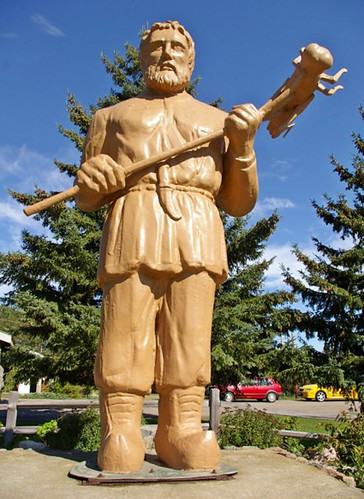
St Urho Menahga, MN
The statue of St. Urho in Menahga, Minnesota

The Finland National Team first appeared at the World Championships back in 1939. Their next appearance was not until 1949 when they became regulars at the World Championships. A perennial mid-pack team, it took them until 1992, a span of over 40 years, to earn their first medal of any kind. Once the floodgates opened, they captured silver in 1992 and 1994 before reaching the pinnacle with World Championship gold in 1995.
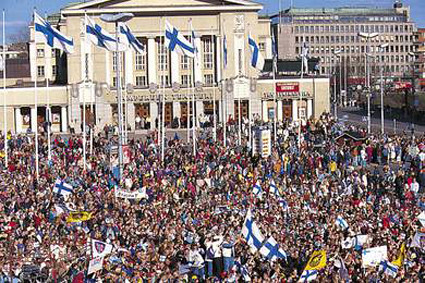
Finland 1995 Celebration
Finland celebrates their first World Championship after arriving back home

Two fifth places in 1996 and 1997 followed before a run of four medals in row with silver in 1998 and 1999, bronze in 2000 and silver once more in 2001. A bit of a slide saw then finish 4th, 5th, 6th then 7th from 2002 through 2005 before returning to the medal podium with bronze in 2006, silver in 2007 and bronze again in 2008. Finland won their second gold medal in 2011, captained by Mikko Koivu. Two more silver medals have since followed in 2014 and in 2016.
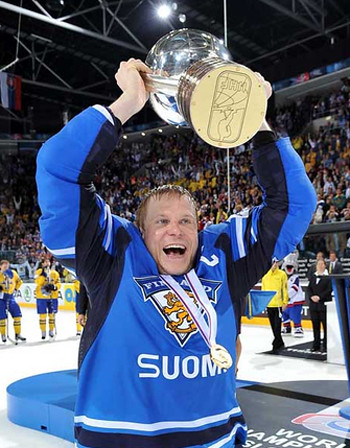
2011 IIHF World Championship
Finland's captain Mikko Koivu is thrilled to hoist
the World Championship trophy

Finland's hockey team first appeared at the Winter Olympics in 1952, and aside from 1956, has appeared in each Olympic hockey tournament since, becoming a regular medal contender in the mid 1970's, with a fourth places in 1978 and 1980. They won their first medal in 1988 with a silver and took bronze in both 1994 and 1998. In 2006 they again won silver followed by bronze medals in both 2010 and 2014 to give them medals in three consecutive Olympics for the first time.
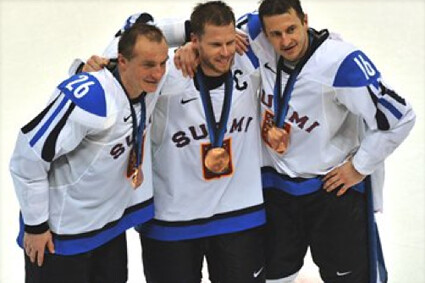
Lehtinen, Koivu and Peltonen 2010
Jere Lehtinen, Saku Koivu and Ville Peltonen enjoying their final success as
a trio at the 2010 Olympics in Vancouver where they won bronze medals

Finland has also participated in the Canada Cup and it's successor, the World Cup of Hockey, taking home the silver medal in the 2004 World Cup in the seven times it has competed.

The Finland National Team has now retired the numbers of #14 Raimo Helminen, #17 Jarri Kurri, #8 Teemu Selanne, #11 Saku Koivu, 26 Jere Lehtinen and #16 Ville Peltonen.

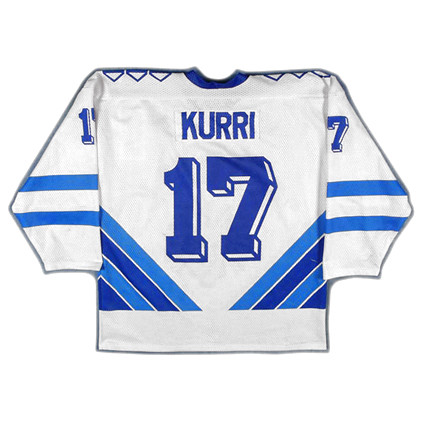
Today's first featured jersey is a 1991 Finland National Team Jari Kurri jersey as worn in the 1991 World Cup. This jersey was produced by Tackla out of Finland and features a short-lived cartoonish lion's head logo, which was actually the logo of a Finnish sponsoring bank, that was quickly replaced by a new shield-style logo which remains in use today.
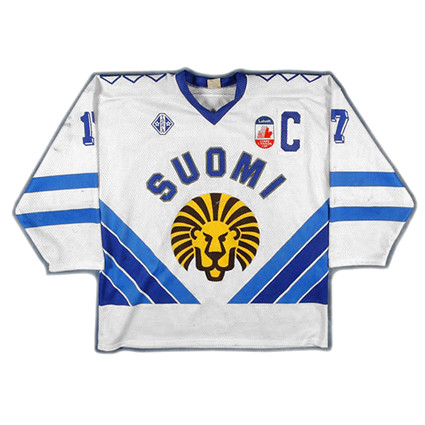
Finland 1991 Kurri F
Finland 1991 Kurri B

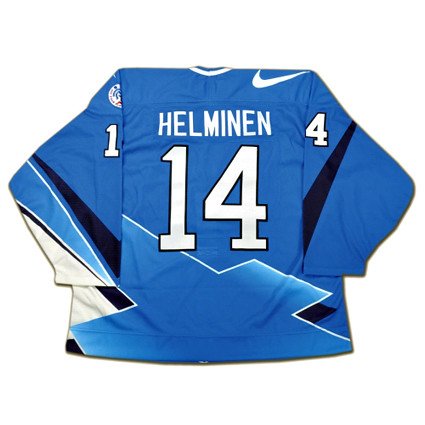
Today's second featured jersey is a 1996 Finland National Team Raimo Helminen jersey from the inaugural World Cup of Hockey. Note that this is a #14 jersey, not the #41 Finland retired for Helminen. This attractive "waving flag" style of jersey marked Nike's entry into being the jersey supplier for the IIHF, which continues to this day. This style was worn through the 1997 World Championships until new styles were debuted for the 1998 Olympics.
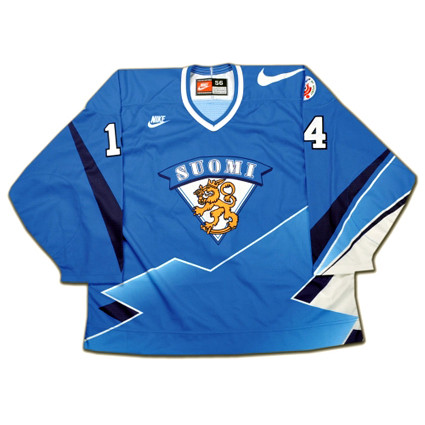
Finland 1996 F jersey copy
Finland 1996 B jersey copy
photo courtesy of Classic Auctions

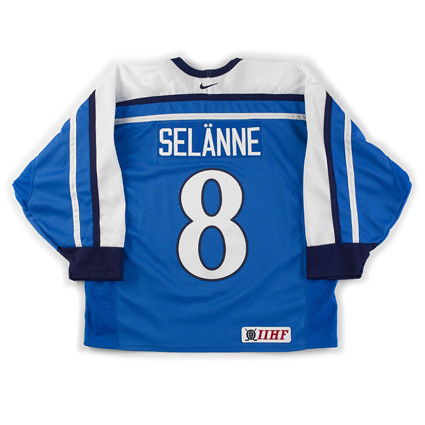
Today's third featured jersey is a 2004 Finland National Team Teemu Selanne jersey. Finland first wore this style for the 1998 Oympics in Nagano, Japan with the crest reading "Suomi". For the 2002 Olympics, the crest was altered to read "Finland" with Suomi now printed boldly across the waist. This would be the final appearance for this jersey, as Nike would introduce a new style for the 2005 World Championships.
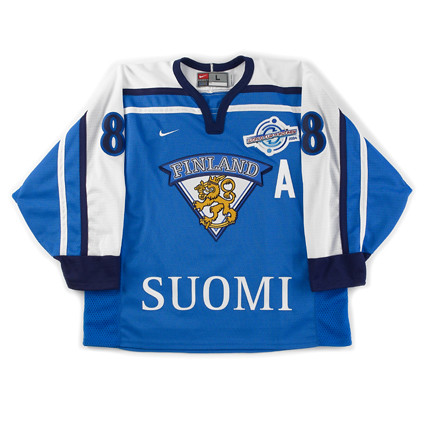
2004 World Cup Team Finland  jersey
2004 World Cup Team Finland jersey

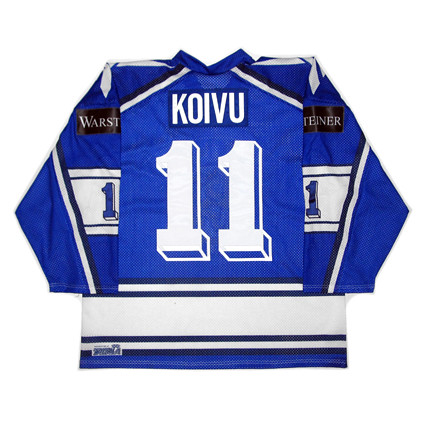
Today's fourth featured jersey is a 1995 Finland National Team Saku Koivu jersey. This is the same style jersey used in the 1994 Olympic games and, while branded as a Reebok jersey, they were produced by Tackla using their mesh fabric and dye sublimation process. Visually, the only difference between the Olympic jerseys and the World Championship versions are the additions of the Warsteiner sponsorship patches to each arm.
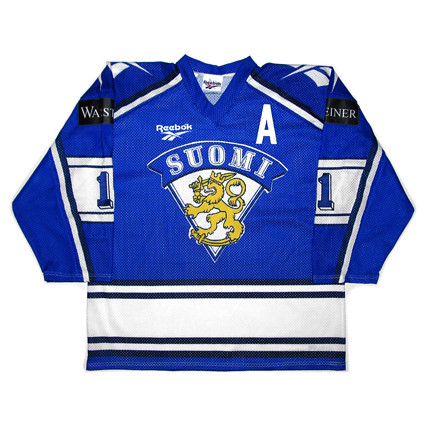
Finland 1995 R F
Finland 1995 R B

Today's fifth featured jersey is a 1996 Finland National Team Jere Lehtinen jersey. One year after Finland won the World Championship in a Reebok branded Tackla produced jersey, Nike became the official supplier to the IIHF for the World Championships and the Olympic Games. Following their debut at the 1996 World Championships in the spring, Nike also outfitted all of the teams at the inaugural World Cup of Hockey in the fall of 1996.

Their "waving flag" style of jerseys took Tackla's sublimation techniques to further extremes, as they introduced gradients to the international scene. These jerseys were also worn for the 1997 World Championships until being replaced by new styles for the 1998 Olympics in Nagano, Japan.
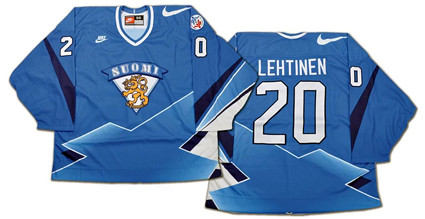
Finland 1996 WCOH jersey
photo courtesy of Classic Auctions

Today's sixth featured jersey is a 1995 Finland National Team Ville Peltonen jersey. This is the home white version of the blue road jersey shown above as worn during the 1995 World Championships, differentiated from the 1994 Olympics by the Warsteiner beer sponsorship patches on the upper arms.
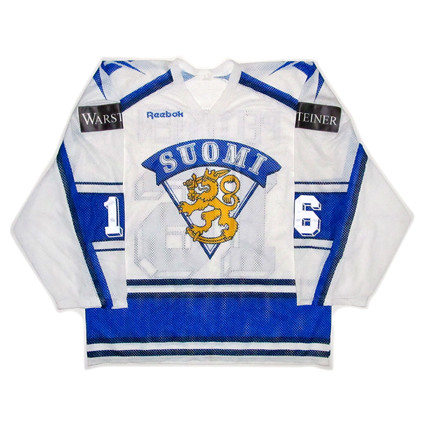
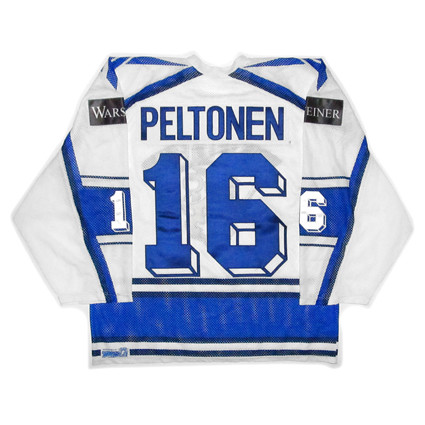
Finland 1995 H F
Finland 1995 H B

In today's video section, Finland's finest moment in hockey, winning their first World Championship in 1995 against their rivals Sweden and in Sweden.


Here are highlights of Finland winning the 2011 World Championship.


Finally, a Finnish Nike commercial featuring Mikko Koivu, Ruutu, Selanne, Filppula and Peltonen.

Wednesday, March 15, 2017

1968-69 New York Rangers Ed Giacomin Jersey

On this date in 1989, the New York Rangers retired sweater #1 in honor of goaltender Ed Giacomin.

Giacomin, overcoming serious burns suffered in a kitchen accident as a teenager when a stove exploded, played five seasons for the Providence Reds of the American Hockey League to start his professional career.

Giacomin Providence Reds photo GiacominProvidenceReds.jpg
Giacomin with the Providence Reds

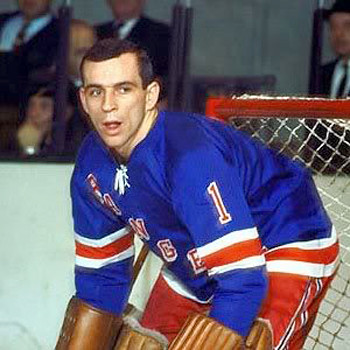
He then made his NHL debut with the New York Rangers in 1965-66 and led the NHL in shutouts with nine during his second season, helping the Rangers make the playoffs for only the second time in nine seasons.

Giacomin Rangers photo GiacominRangersnomask.jpg
Giacomin led the NHL in shutouts in 1966-67

Once established as the Rangers starting goaltender, Giacomin would lead the league in games played for the next four seasons, seeing action in between 66 and 70 games while winning 30 games or more each of those four seasons with a high of 37 in 1968-69 and leading the NHL in shutouts again in 1967 with nine and 1968 with eight.

Giacomin Rangers
Giacomin had four consecutive seasons of over 30 wins

With the acceptance of goalies in the NHL sharing the duty now becoming the norm, Giacomin's games played would shrink to the mid 40's starting in 1970, but he would still lead the league in shutouts in 1971 with eight on his way to winning the Vezina Trophy along with partner Gilles Villemure.

The following season the Rangers would enjoy their greatest playoff success of Giacomin's career, making it to the Stanley Cup Finals.

Giacomin Rangers photo GiacominRangers.jpg
Giacomin joined the legions of goalies now wearing
masks after starting his NHL career playing without one

Giacomin was limited by injuries in 1974-75, limiting him to just 37 games and 13 wins, his first time under 24 wins since becoming the starter in 1966-67. As a result, the Rangers, off to a bad start, began dumping their high priced veterans, which included waiving Giacomin, who was claimed by the Detroit Red Wings.

 photo GiacominRedWings.jpg
Giacomin was claimed by Detroit early in the 1975-76 season

Giacomin's return to New York was an emotional one, as the Rangers fans chanted "Ed-die! Ed-die!", drowning out even the national anthem, a game that was voted one of the Top 50 moments in Madison Square Garden history, not just Rangers history, but all events at MSG, which include Elvis Presley and other concerts, legendary boxing matches, NBA and college basketball, political conventions and an appearance by the Pope.

He would finish his career by playing two seasons plus an additional nine games in 1977-78 with the Red Wings before retiring in January of 1978 with 609 games and a record of 289-209-96 and 54 shutouts and a goals against average of 2.82.

Giacomin played in the NHL All-Star Game six times, was inducted into the Hockey Hall of Fame in 1987 and his sweater #1, retired on this date in 1989, was only the second number retired by the Rangers in their 64 year history.

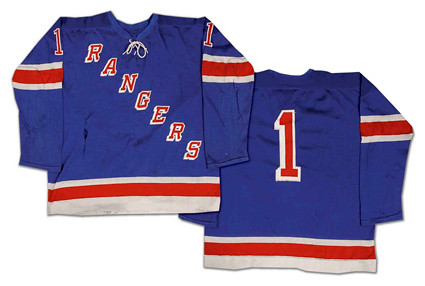
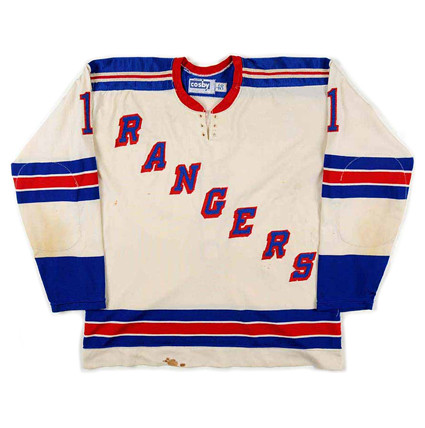
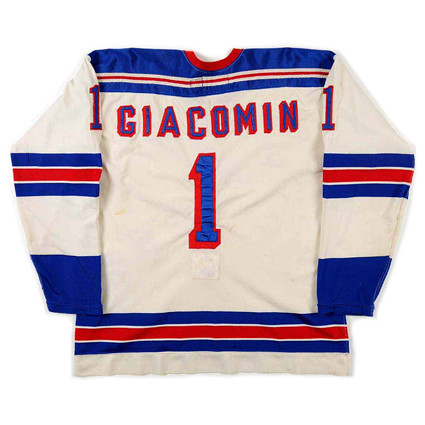
Today's featured jersey is a 1968-69 New York Rangers Ed Giacomin jersey as worn during the season he recorded his highest NHL win total of 37 games.

The Rangers diagonal crest dates back to their first season in the NHL in 1926-27 and changed to the current font in 1941 with the drop shadow first being added the following season. This particular style with the lace-up collar was first used in 1951 with sleeve numbers arriving in 1963.

After a radical change in style in 1976 and a return to a more traditional style which read "New York" on the front in 1978, the Rangers name returned to the blue jerseys in 1987 and this style with the lace up collar was reinstated in 1997 and remains in use today.

New York Rangers 1968-69 jersey
photo courtesy of Classic Auctions

Bonus jersey: Today's bonus jersey is a 1970-71 New York Rangers Ed Giacomin jersey as worn during the season he won the Vezina Trophy.

 New York Rangers 1974-75 F jersey
New York Rangers 1974-75 B jersey

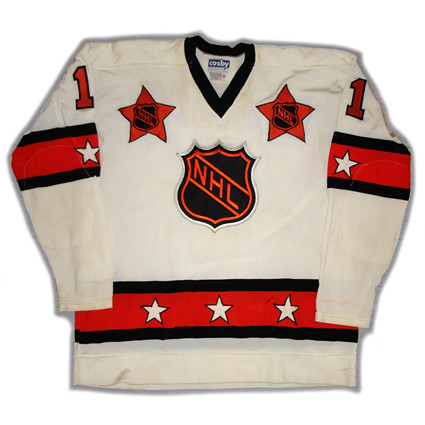
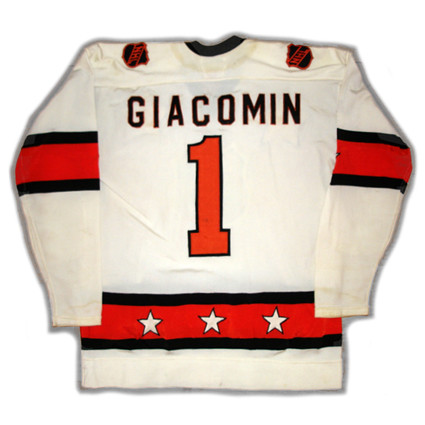
Extra bonus jersey: Today's extra bonus jersey is a 1973 NHL All-Star Game Ed Giacomin jersey as during the sixth and final NHL All-Star Game of Giacomin's career.

This style had an extended run of use, having first been worn for the 1973 game and then continuing through the 1981 game, with the exception of 1979 when the traditional NHL All-Star Game was replaced by the 1979 Challenge Cup when a team of NHL All-Stars took on the Soviet National Team.
 
 NHL All-Star 1973 F jersey
NHL All-Star 1973 B jersey

Today's video segment begins with the excellent Legends of Hockey profile on Giacomin which includes footage of his jersey retirement ceremony.


Here's evidence of the combative nature Giacomin possessed referred to by Stan Fischler in the previous video, as he goes after Garry Howatt of the Islanders. It's also an example of the "Ed-die! Ed-die!" chant that used to fill Madison Square Garden.


Tuesday, March 14, 2017

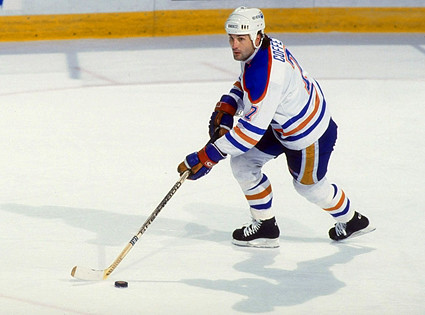
1985-86 Edmonton Oilers Paul Coffey Jersey

On this date in 1986, the Edmonton Oilers hosted the Detroit Red Wings at the Northlands Coliseum. Edmonton carried a league best 49-15-6 record into the game, while Detroit limped toward the finish of the season at a lowly 15-48-6.

Greg Stefan got the start in goal for Detroit, while Andy Moog was the starter for Edmonton.

Before the fans could even settle into their seats, the Red Wings Petr Klima stunned the Oilers with his 26th goal of the season just 34 seconds into the game.
Mark Messier tied the game at 1-1 just over two minutes later when he scored his 29th goal from Glenn Anderson at 2:37.

The game then settled down for a while until Anderson scored his 49th goal from Messier and defenseman Paul Coffey on a power play at 10:45 to give the Oilers the lead at 2-1 before Jari Kurri scored his 58th goal of the season at 13:42 from Wayne Gretzky and Coffey at even strength.

Coffey Oilers 2
Paul Coffey

Detroit attempted to stay close when the rugged Joey Kocur got his 9th goal of the season on a power play from Klima and John Ogrodnick at 15:17 to give the Red Wings hope at 3-2.

Coffey then extended the Oilers lead to two goals again with his 42nd goal from Mark Napier and Lee Fogolin less than a minute later at 16:15. Anderson then reached the 50 goal mark for the second time in his career from Messier and Finn Risto Jalo at 17:50 to make it a demoralizing 5-2 for Edmonton after just the first period.

Coffey Oilers 1
Coffey had a goal and two assists in the first period

In the second period, Finland's Esa Tikkanen kept the Oilers rolling with his 4th from Coffey and Kevin McClelland followed by fellow Finn Raimo Summanen's 18th goal from Gretzky and Coffey again at 14:31 which brought a merciful end to Stefan's night in goal for Detroit.

Finally, Coffey struck again at 19:20 with his 43rd goal of the season from Gretzky and Kurri at even strength to give the Oilers a commanding 8-2 lead at the end of the second period of play from 28 shots to Detroit's 21.

Coffey Oilers 3
Coffey had 2 goals and 4 assists after two periods

The third period was scoreless until Anderson completed a hat trick with 51st goal from Coffey and Messier at 12:44, the Oilers sixth consecutive goal. Warren Young then interrupted the Oilers scoring barrage with is 22nd goal for Detroit at 16:46 from Steve Richmond and goaltender Eddie Mio, who had replaced Red Wings starter Stefan.

The Oilers McCelland restored the Oilers 7 goal lead just 40 second later from Marty McSorley and Charlie Huddy at 17:26 as Edmonton had now reached double digits on the night.

As was often the case in those days of the NHL, the Red Wings frustrations overflowed and a melee broke out at 18:07 when Kocur and McSorely fought for the second time in the period while Harold Snepsts and McCelland joined them with fighting majors and game misconducts of their own.

With all the sticks and gloves picked up, play resumed and Gretzky then scored his only goal of the game, his 49th of the year, from Anderson at 19:03.

Finally, with just 15 seconds to play, Kurri scored his second goal of the game and 59th of the season from Coffey and Gretzky to make the score 12-3. Coffey's assist was his 6th of the game, and when combined with his 2 first period goals, gave him 8 points for the game, tying Tom Bladon's 1977 record for Most Points in a Game by a Defenseman. His 6 assists in a game also tied the record by a defenseman that he shares with four others.

Coffey became just the ninth player in NHL history with 8 points or more in a game, an exclusive club that still only numbers 13 to date.

Coffey Oilers 4
Andy Moog and Coffey

Having joined Edmonton in 1980-81, scoring a mere 9 goals and 32 points, Coffey played seven seasons with the Oilers, highlighted by his 1985-86 season, during which he scored and NHL record 48 goals and 90 assists for 138 points, including his record tying 8 point game on this date in 1986.

His 138 points were one short of Bobby Orr's 139 in 1970-71. Between the two of them, Coffey and Orr, hold every one of the top ten highest scoring seasons by a defenseman in NHL history, five for Orr and five for Coffey, and Coffey holds second place in career scoring among defensemen with 1,531, behind only Ray Bourque's 1,579.

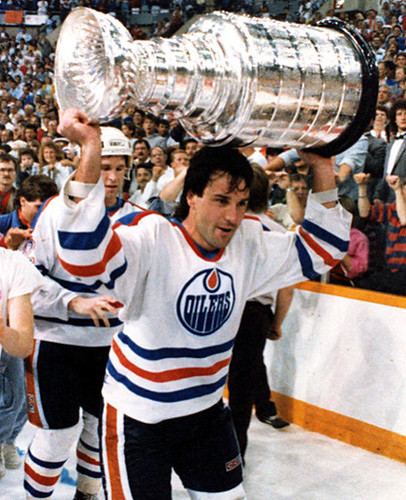
During his seven seasons with the Oilers, Coffey won two Norris Trophies and three Stanley Cups.

Coffey Oilers 5
Coffey won three Stanley Cups with the Oilers

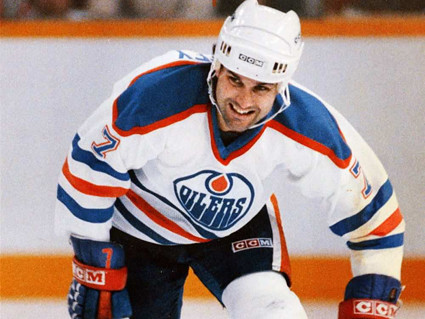
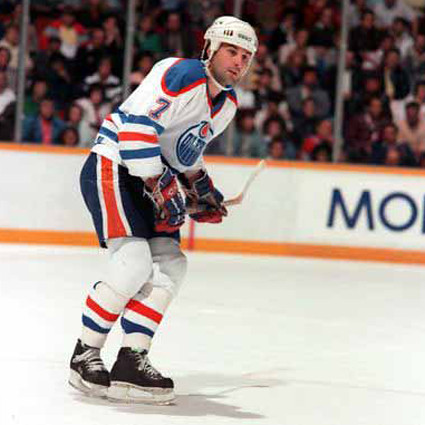
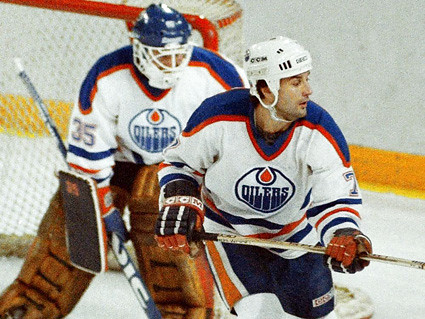
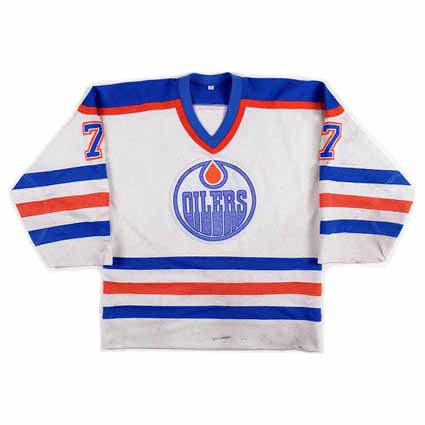
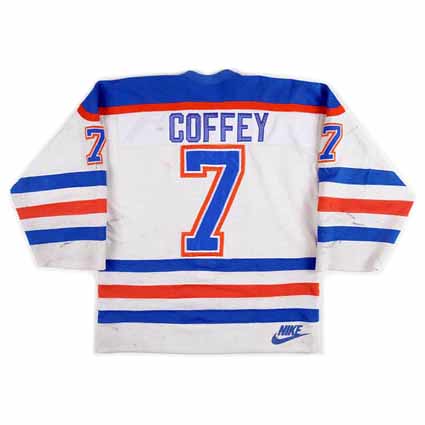
Today's featured jersey is a 1985-86 Edmonton Oilers Paul Coffey jersey as worn during his record setting game during which he scored 8 total points.

The Oilers reworked their jerseys from their final season in the World Hockey Association where they originated when they joined the NHL in 1979-80. Gone was the low contrast blue lettering against an orange background on their logo in favor of a cleaner, more professional looking and higher contrast blue against a white background, a long overdue change. The same can be said for their road blue jerseys, as the orange lettering on a white background was dropped in favor or the same blue on white coloring of the logo used on the home white jerseys.

Edmonton Oilers 1985-86 F jersey
Edmonton Oilers 1985-86 B jersey

In today's video section, Coffey ties and then breaks Orr's single season goal scoring record by a defenseman, also during the 1985-86 season.


Monday, March 13, 2017

1978-79 New England Whalers Blaine Stoughton Jersey

Blaine Stoughton, born on this date in 1953, began his road to the professional hockey ranks with four seasons with the Flin Flon Bombers of the WCHL, with the first being the 1969-70 season. His point totals his first two seasons were 39 and then 50, before a giant leap upward for the 1971-72 season when he scored more goals than he had points the previous season with 60 goals and 126 points to lead the WCHL in scoring. He also added an additional 121 penalty minutes to go along with his offensive output. The following season he came close to matching his previous year with 58 goals and 118 points.

Having been born at the right time, Stoughton was turning pro during the NHL vs WHA war for players, which led to an enormous increase in salaries for the players. Stoughton was thus drafted 14th overall by the Quebec Nordiques of the WHA and 7th overall by the NHL's Pittsburgh Penguins.

PIttsburgh won out for the rights to sign Stoughton and he was assigned to their minor league club in the AHL, the Hershey Bears, with whom he scored 40 points in 47 games before a call-up to the Penguins for 34 games.

Just prior to the start of the 1974-75 season, Stoughton was traded to the Toronto Maple Leafs in a deal which sent Rick Kehoe to Pittsburgh. In 78 games with Toronto, he scored 23 goals and 37 points. Despite the 20 goal season, he split time in 1975-76 between Toronto (43 games, 17 points) and the Oklahoma City Blazers of the Central Hockey League (30 games, 36 points).

Stoughton Maple Leafs photo StoughtonMapleLeafs.jpg

For the 1976-77 season, Stoughton jumped to the WHA's Cincinnati Stingers, who had obtained his rights from the Nordiques in the WHA expansion draft. The move to the free wheeling WHA was a revelation for Stoughton, who teamed with Rick Dudley and Rich Leduc to form the high powered "LSD Line".

Stoughton Stingers photo StoughtonStingers.jpg

Stoughton and Leduc each had 52 goals to finish fourth in the league, with Leduc's 107 points 7th overall and Stoughton's 102 good for 9th, while Dudley reached 88. Despite their success, the line would not stay together long, as 30 games into the 1977-78 season, Stoughton and Gilles Marotte were traded to the Indianapolis Racers after Stoughton did not fit into new head coach Jacques Demers system.

The change to Indianapolis was brief, as Stoughton finished out the season with the Racers, scoring just 13 goals in 47 games, and after playing the first 25 games of the 1978-79 season, the Racers , who were on the verge of folding, was sold to the New England Whalers where he finished out what would prove to be the final days of the WHA as well.

For the 1979-80 season, the Whalers were part of a complex deal which saw four surviving WHA clubs enter the NHL and Stoughton's rights revert back to Toronto, only to be claimed by the newly renamed Hartford Whalers in the subsequent Expansion Draft.

 photo StoughtonWhalers.jpg

Stoughton thrived during his first season back in the NHL, finishing eighth in scoring with 100 points while leading the league with 56 goals, becoming only the second player after Bobby Hull to score 50 goals in both the WHA and the NHL. The Whalers even made the NHL playoffs that season, only to have Stoughton break his leg during their opening game against the Montreal Canadiens. It would also be the last playoff game of his career, as the Whalers would not qualify for the playoffs for another six seasons.

He returned to play 71 games of the 1980-81 season after ending a contract holdout, scoring 43 goals and 73 points. He again reached the 50 goals mark in 1981-82 with 52, which placed him 6th in the league and allowed him to lead the team in scoring for the only time with 91 points. He also made his only NHL All-Star Game appearance that season.

After his fourth consecutive 40 goal season, scoring 45 in 1982-83, Stoughton played his final 54 games with the Whalers in 1983-84 prior to being traded to the New York Rangers as the Whalers then all-time franchise goals leader in late February of 1984.

Stoughton Whalers photo StoughtonWhalerslongpants.jpg
Stoughton during the 1982-83 season wearing
the controversial long hockey pants

His 5 goals for the Rangers in 14 games would be the last of his NHL career, as he spent the 1984-85 season with the New Haven Nighthawks of the American Hockey League when he did not make the Rangers roster in training camp and no other teams claimed him.

After two seasons away from pro hockey, Stoughton would play one final stint as a pro, with 15 games of the 1987-88 season with HC Asiago of the Italian Serie A.

Stoughton would play 526 NHL games, scoring 258 goals and 449 points, as well as an additional 89 goals and 179 points in the WHA for a total of 628 points.

Today's featured jersey is a 1978-79 New England Whalers Blaine Stoughton jersey as worn during the Whalers final season in the WHA prior to the league's demise and it's entry into the NHL for 1979-80 season.

After their first two seasons wearing green and white and a circular crest on their road jerseys, the Whalers added gold trim to their color scheme and simplified the crest on their jerseys to just the "W" bisected with a harpoon for the remainder of their time in the WHA, with only a subtle change to the waist striping for their last two WHA seasons, going from a wide white stripe with gold trim to a "Northwestern" pattern, meaning the gold trim was moved outward from the white waist stripe, allowing the green jersey color to separate the white from the gold.

 photo NewEnglandWhalers1978-79jersey.jpg
photo courtesy of Classic Auctions

Bonus jersey: Today's bonus jersey is a 1979-80 Hartford Whalers Blaine Stoughton jersey. When the club was forced to change it's name from "New England" to "Hartford" at the request of the Boston Bruins, the Whalers adopted a new whale tail logo, altered their color scheme from green and gold to green and blue and unveiled an entirely new set of modernized jerseys that they would wear for the next 13 seasons with only minor detail changes, although the "Pucky the Whale" patches were discontinued in 1985-86.

 photo HartfordWhalers1979-80Fjersey.jpg
Hartford Whalers 1979-80 jersey photo HartfordWhalers1979-80Bjersey.jpg

Extra bonus jersey: Today's extra bonus jersey is a 1976-77 Cincinnati Stingers Blaine Stoughton jersey. The Stingers wore essentially the same jerseys for their all-to-brief four year run. With the Stingers name lending itself to a multi-stripe theme, it's a wonder the Stingers jerseys were as reserved as they were.

The Stingers logo is a wonderful piece of graphic design and looks as modern today as it did when it was first conceived, and has always been a favorite of ours.

Cincinnati Stingers 1976-77 jersey photo CincinnatiStingers1976-77Fjersey.jpg
Cincinnati Stingers 1976-77 jersey photo CincinnatiStingers1976-77Bjersey.jpg

Today's video section begins with Stoughton discussing his time with the Whalers.


Next, a feature on the cocky and confident Stoughton showing him and his mustache in the Whalers training camp.

Sunday, March 12, 2017

The Scandal of Geneva - West Germany Forfeits at the 1961 World Championships

Today is a story of controversy in 1961 when East Germany and West Germany were to meet during the 1961 World Championships in Switzerland by Martin Merk from IIHF.com.

*****

The fall of the Berlin Wall and the reunification of Germany in 1990 belong among  the most important and far-reaching moments in international history. Prior to that, East and West Germany had a fierce rivalry, a rivalry that sometimes manifested itself in ice hockey. It even led to a cancelled IIHF World Championship game in Geneva 50 years ago.

It was a flag, just a flag that created an uproar – and what later became known as “The scandal of Geneva” in Germany.

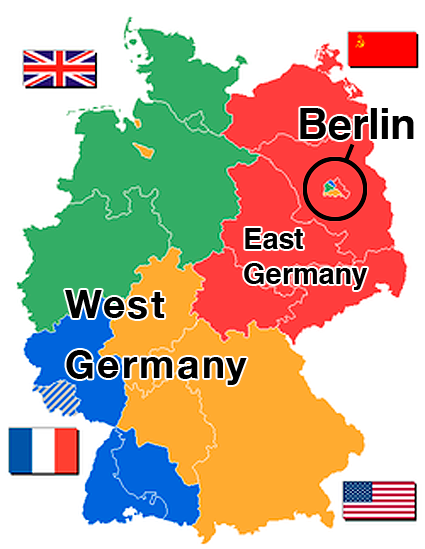
After World War II the west part of Germany (as well as a part of Berlin) was occupied by the Western Allies and became the Federal Republic of Germany (usually known as “West Germany”) in 1948. The Soviet-occupied east reacted with the founding of a socialist state, the German Democratic Republic (“East Germany”, or “DDR” in German).

West Germany, the green, blue and gold areas controlled by Great Britain, France and the United States, and East Germany, the red area, which was controlled by the Soviet Union

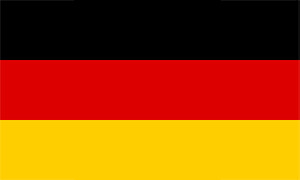
Both countries used the same flag as we know it today, the black, red and gold tricolour.

West Germany Flag
The German tricolor, originally used by both West and East Germany

In 1959, however, the GDR decided to change its flag by adding its coat of arms featuring a hammer and a compass surrounded by a garland of corn symbolizing the workers’ and farmers’ state.

 East Germany Flag photo EastGermanyFlag.png
The flag of the German Democratic Republic,
otherwise known as East Germany

The change of the flag became a touchy issue in the West. It was seen as an insult to the German people and as a clear attempt to permanently divide Germany. Consequently, West Germany banned the flag. It even became chargeable to display it within their territories.

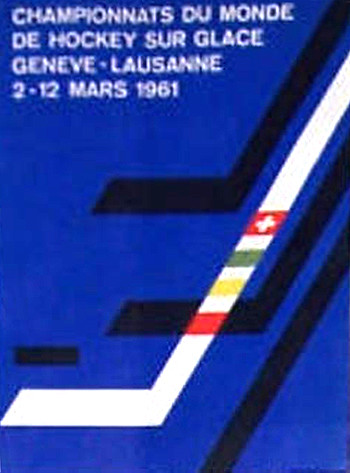
The flag war eventually affected the national teams of East and West Germany. The first time they were supposed to meet each other in an official ice hockey game after the East’s flag makeover was at the 1961 IIHF World Championship in Geneva and Lausanne, Switzerland.

1961 World Championships logo

It was an eight-team round-robin tournament in those days and the two German teams were set to face each other on the last day. Both teams were already out of the medal ranks with East Germany having a 1W-0T-5L record while West Germany stood at 0W-2T-4L.

More than 2,000 fans gathered in the Les Vernets rink to witness the fierce rivalry between the two Germanys, between West and East, capitalists and communists.

Former East German national team player Achim Ziesche recalls the event that unfolded while his team was preparing for the game.

“We were getting ready in the locker room, but we noticed that something was not okay,” he told Deutschlandfunk. “People were running around and they looked sort of helpless. We players didn’t understand what happened, but later we realized that we hadn’t seen anybody from the West German side.”

Some minutes later, the public announcer declared that West Germany refused to play and the game would count as a forfeit and a 5-0 victory for East Germany.

“We were surprised. They were the favourites and we assumed they wouldn’t do that,” Ziesche said. “Not as a team, not as a country and not towards the IIHF and the sporting world.”

The organizers put together a “Swiss selection” so that at least an exhibition game could be staged with East Germany.

The reason for West Germany’s refusal was an order from the government. The President of West Germany’s ice hockey association, Willi Daume, was demanding a guarantee that the East German flag wouldn’t be raised after that game. Otherwise his team would not be allowed to play.

Already in those days the post-game protocol saw the flag of the winning team to be raised, accompanied by the national anthem of the winners. Although the West German team was usually considered as the stronger of the two, Daume didn’t want to take any chances.

A loss to the GDR would be embarrassing, but then he would also lose face in front of his entire nation by hearing the East German anthem while also the outlawed flag were to be raised. So the hockey president drove to Geneva to negotiate with IIHF President, Bunny Ahearne, to change the ceremony protocol regardless of who wins: no anthem, no flags.

Ahearne said no. The ceremony was not be adjusted according to the wishes of some nations.

Daume told the team in the dressing room that they wouldn’t be allowed to play. His players left through the back entrance.

“Our officials were used as a political pawn,” West German national team player Ernst Trautwein recalls. “Thanks God it was the only time I can remember that politicians from our side intervened like this.”

The mix of sports and politics continued each time the teams would meet. East Germany was ahead in 1961 and most time of the ‘60s in ice hockey. This situation changed in the ‘70s when hockey became more professional in West Germany while the East German authorities decided to cut their top league to only two professional teams, Dynamo Berlin and Dynamo Weisswasser. These teams formed the world’s smallest hockey league from 1970 to 1990, and the situation didn’t help the national team.

Only once in the ‘60s did the West Germans display superiority over their brethren. At the 1963 IIHF World Championship in Stockholm, Sweden, the first time both teams were in the A-Pool after the Geneva scandal, the teams finally battled on and not off the ice.

West Germany v East Germany 1963
After the controversy in 1961, the two sides met in 1963, the only time the West Germans would defeat the East Germans at the World Championships during the 1960s

East Germany finished one place ahead of the West, but the West won the head-to-head German clash, 4-3. During the post-game ceremony, the East German players ostentatiously turned their backs towards the West German flag.

East Germany West Germany 1968 photo EastGermanyWestGermany1968.jpg
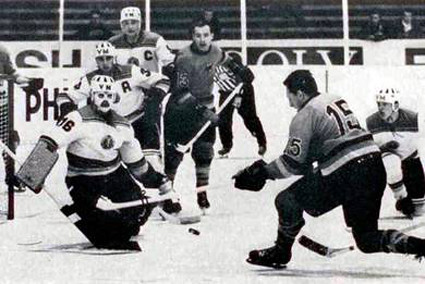
East Germany in their only Olympic meeting against West Germany in 1968

It took some decades of political division and rivalry until East Germany had its revolution and Germany became unified again in 1991.

*****

Today's first featured jersey is a 1989 East Germany Torsten Hanusch jersey as worn during the 1989 World Championships B Pool. This jersey was worn in the 1989 World Championships B Pool, Hanusch's only appearance for the East German National Team.

While the East Germans competed in the World Championships on a regular basis from 1956 to 1990, they discontinued their Olympic hockey program after 1968, choosing to take the approach of funding single athletes who could win multiple medals, such as a track and field athlete, swimmers and speed skaters, rather than funding an entire team who could only hope to win a single medal, such as water polo or in ice hockey, which frankly was a long shot when up against the likes of the Soviet Union, Czechoslovakia, Sweden and Canada.

This jersey has an extremely minimalist style, with only simple striping on the arms and waist and is devoid of any traditional main cresting, with only the Tackla branding on the upper right chest and the DDR initials and East German coat of arms on the left chest in the style of a soccer jersey, leaving the rest of the body devoid of any traditional main logo.

Also unusual is the East Germans choice of a primarily blue jersey, as the colors of the East German flag were black, gold and red. Additionally, many of the communist ruled nations favored primarily red sweaters, the Soviet Union and Czechoslovakia in particular.

East Germany 1989 jersey photo EastGermany19898F.jpg
East Germany 1989 jersey photo EastGermany19898B.jpg

Today's second featured jersey is a 1989 West German National Team Udo Keissling jersey from the World Championships held in Stockholm, Sweden. West Germany would finish the Round Robin portion with a 0-5-2 record, but avoid relegation by finishing with a 1-2-0 record and save themselves from the drop with a 2-0 defeat of Poland.

One of the best players in German hockey history, Udo Kiessling set a new record in 1992 with his 5th consecutive Olympic tournament appearance. Kiessling's record shows he played a single game in the NHL, in 1982 on a tryout after his German club team was an early exit from the playoffs, but returned home to play in the World Championships, never to return to the NHL again. But just because a player is not in the NHL, doesn't mean he doesn't exist, as Kiessling would go onto have a 24 year career, ending in 1996 at the age of 40.

He made his first appearance in the Olympics at Innsbruck in 1976, winning a Bronze Medal. In addition to his five Olympics, Kiessling also participated in 15 World Championships and the 1984 Canada Cup, as well as winning six national titles in Germany, where he was named the top player three times.

This beautiful jersey features the vibrant colors of the dye-sublimation process and the arresting graphics of the era with the colors of the tri-color German flag streaking across the chest, as well as the distinctive Tackla diamond logos on the shoulders and drop shadow block font for the numbers. Easily one of our favorite jerseys.

West Germany 1989 jersey photo Germany1989WCF.jpg
West Germany 1989 jersey photo Germany1989WCB.jpg

Today's video section is a look at the fall of the Berlin Wall.


hit counter for blogger