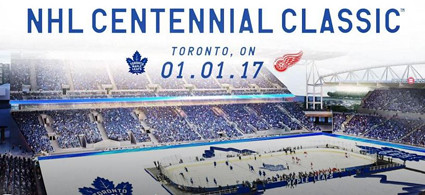
The NHL Centennial Classic between the Toronto Maple Leafs and the Detroit Red Wings will be held outdoors today at Exhibition Stadium in Toronto, Ontario, the first NHL outdoor game ever held in Toronto.
The game will serve as a celebration of the centennial season of the Maple Leafs and the beginning of the NHL's centennial year.
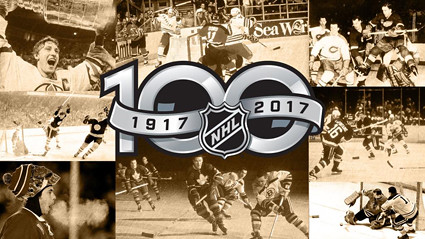
This will be the second of four outdoor NHL games this season, with the Heritage Classic having been played back in October between the Edmonton Oilers and Winnipeg Jets, the Winter Classic following tomorrow when the St. Louis Blues host the Chicago Blackhawks and a Stadium Series game in late February when the Philadelphia Flyers meet the Pittsburgh Penguins.
This will be the second time the Maple Leafs and the Red Wings have met outdoors, having previously met in the 2014 Winter Classic in Michigan, which was won by the Maple Leafs in a shootout 3-2 in front of an NHL record 105,491 fans at Michigan Stadium in Ann Arbor.
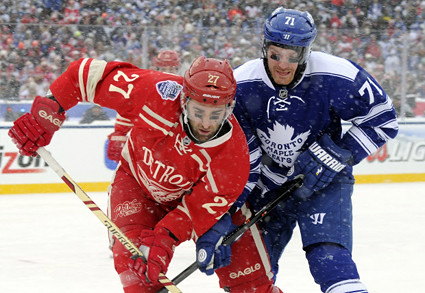
Detroit and Toronto met outdoors during the 2014 NHL Winter Classic
The Maple Leafs franchise originated in 1917 when the members of the National Hockey Association disbanded their league and reformed a week later as the National Hockey League in order to rid themselves of contentious fellow owner Eddie Livingstone.
The controversial Eddie Livingstone
Prior
to the 1915-16 season, Livingstone, who already owned the Toronto Shamrocks club, purchased the Toronto Blueshirts,
giving him both Toronto NHA franchises - and an unwelcome two votes in
league matters. When Frank Patrick and Lester Patrick, owners of the Pacific Coast Hockey League (PCHA)
Seattle Metropolitans raided the Blueshirts roster, Livingstone
transferred the Shamrocks players to the Blueshirts.
The league demanded that Livingstone sell the Shamrocks, not wanting one ownerhaving two votes on league matters. Due to the small size of the NHA, this gave Livingstone a substantial amount of power with 33% of the votes, a situation made worse by his poor relationships with his fellow
owners, primarily Sam Lichtenhein
of the Montreal Wanderers, with whom he often butted heads with. At one
point, Lichtenhein even offered Livingstone $3,000 to abandon his team
and walk away, but the cheeky Livingstone countered with a $5,000 offer
for Lichtenhein to do the same!
When there was nothing left of the Shamrocks for
Livingstone to sell, since the club no longer had any players,the league seized the
Shamrocks franchise from Livingstonea week later. It also angered the
other owners that they were now a five team league, forcing one club to
be idle each week and meaning road trips to Toronto would now be for just one game
against the Blueshirts instead of the more economical two games versus both the Blueshirts and the Shamrocks, as in the past.
In 1916-17, the 228th Battalion
of the Canadian Army formed a team, taking the
place of the Shamrocks, making the NHA a six team league once again. Unfortunately, the 228th received their orders
to head overseas to join the fighting in World War I and had to withdraw
from the league during the season. This gave the other four owners of
the Montreal Canadiens, Montreal Wanderers, Quebec Bulldogs and Ottawa
Senators the opening they needed. A meeting was held without
Livingstone and they voted to suspend his remaining Blueshirts franchise
with the excuse of wanting to keep the league with an even number of
teams.
A rare shot of the 228th Battalion Hockey Team
Livingstone field suit against the league as a result. The Blueshirts home rink, the Arena Gardens, were
then given three weeks to separate itself from Livingstone by the NHA
or the other owners would operate without a club in Toronto and thus the
arena would lose its tenant. The feisty Livingstone, of course, refused
to sell his club, and therefore, at their annual meeting in November,
the NHA announced it was suspending league operations due to the
difficulty of running a five team league and also blaming player
shortages due to World War I.
The Blueshirts home rink, the Arena Gardens
A
week later, all of the owners, minus Livingstone, announced
they had formed a brand new league, the National Hockey League (NHL). The "new" league consisted of the Montreal Canadiens, the Montreal Wanderers, the
Ottawa Senators and the Quebec Bulldogs. The new league also claimed to
have retained the contracts of the suspended Toronto Blueshirts players!
With
the Quebec Bulldogs suspending operations due to financial difficulties
before the new NHL could even begin the 1917-18 season, the Arena
Gardens were awarded a temporary NHL franchise, managed by Charlie Querrie,
making the fledgling NHL a four team league once again. The league also
assigned the Blueshirts players on a lease basis to the temporary
Toronto franchise. To further complicate matters, many of the players
had signed contracts with both Livingstone and the Arena.
The Canadiens would win the
first half of the inaugural 1917-18 NHL season to earn a spot in the postseason championship
playoff, while the Wanderers would cease operations following the fire
that burned down their home, the Montreal Arena.
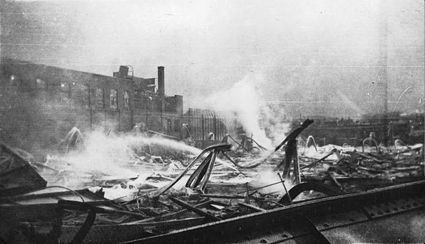
The Montreal Arena Fire aftermath
The
Toronto club had no official nickname, but the "Blueshirts" were
successful on the ice, winning the second half of the season schedule, earning the right to play the Canadiens for the championship. Toronto was
led by Reg Noble, who scored 30 goals and 10 assists in 20 games for 40 points, third overall in the league behind the prolific Joe Malone of the Canadiens who scored a spectacular 44 goals in just 20 games as part of his league leading point total. Corbett Denneny and Harry Cameron also were standouts for Toronto, with 29 and 27 points respectively, for fifth and sixth in league scoring. Toronto's Harry "Hap" Holmes came in second to Georges Vezina of Montreal in the goaltending department with a goals against average of 4.80 in 16 games.
Toronto defeated the Canadiens for the league championship in a two game, total goals series 10-7, capturing the O'Brien Cup.
Toronto then faced off against the Vancouver Millionaires of the PCHA
and won the Stanley Cup by 3 games to 2, causing Livingstone to again
head to court to file suit for the revenue earned by "his" championship
squad of players.
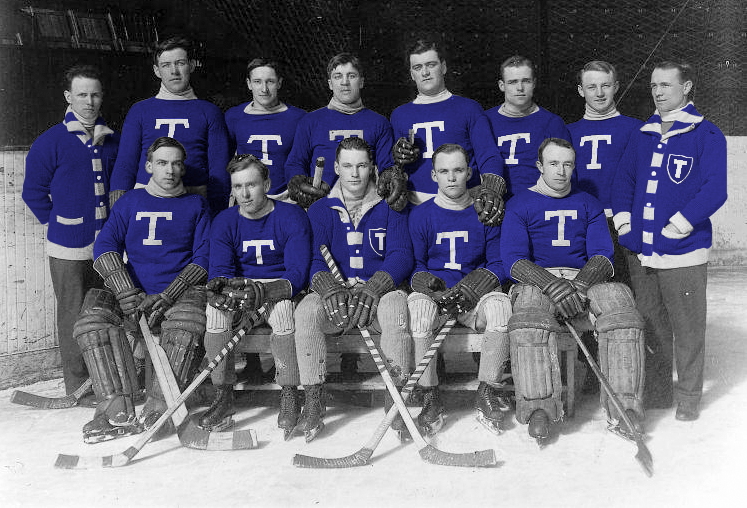
The 1917-18 Stanley Cup champion Toronto "Blueshirts"
As a result of this lawsuit, the Arena Gardens formed a new company, the Toronto Arena Hockey Club Company, to own and run a hockey team separate from the Arena Gardens business in order to protect the Arena business from Livingstone's lawsuits.
The NHL then awarded a "new" franchise to the Hockey Club Company. This club was officially named the Toronto Arenas and, not surprisingly, was stocked with the same players from the 1918 championship team. When his players were again not returned to him for the 1918-19 season, Livingstone sued the Arena Gardens.
Once more, the players were uncertain who would prevail in the courts and covered their bases by signing contracts with both the Toronto Arena Hockey Club Company and Livingstone.
Livingstone did prevail in the courts sometimes, but not always. Two rulings in his favor of $20,000 and later $100,000 sent the Arena Gardens into bankruptcy. Despite the company's legal wranglings at the time, the arena would continue to operate for 77 years until closing in 1989.
When the Toronto Arenas did take to the ice in the 1918-19 season as Stanley Cup Champions, they did not play like it. Forced to sell most of their star players due to mounting legal bills, the Arenas record for the season was 5 wins and 13 losses, attendance was low and several players left the team. Finally, the team wrote to the league requesting that the season be ended when each of the three clubs had reached 18 games played and then officially withdrew from the league.
Meanwhile, Livingstone was busy was attempting to overthrow the NHA management. He purchased the dormant Quebec Bulldogs franchise and began an unsuccessful attempt to start a rival league, the Canadian Hockey Association, and threatened to file an injunction to stop the NHL from operating. He also made unsuccessful attempts to start new leagues in 1920, 1924 and 1926, none of which ever played a single game.
Finally, in December of 1919, the Toronto Arenas franchise was sold to the St. Patricks Hockey Club of Toronto, who ran the successful senior amateur St. Patricks team in the Ontario Hockey League.Conveniently, the St. Patricks four-man ownership groupincluded Arenas team manager Querrie.
The new owners renamed the club the Toronto St. Patricks and changed the team's color from blue to green. The $5,000 sale price that was supposed to go to Livingstone to settle the purchase of his NHA club, for which he had once demanded $20,000 after they won the 1918 Stanley Cup. However, Livingstone never received the money, which many believe was kept by NHL president Frank Calder.
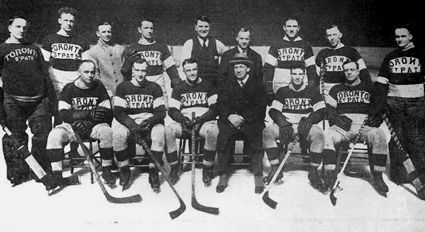
1921-22 Stanley Cup champion Toronto St. Pats
The Toronto St. Patricks won the Stanley Cup once in 1922 and were members of the NHL through the 1926-27 season, when Querrie, having been sued by none other than his old nemisis Livingstone, was forced to sell the St. Patricks. He reached an agreement in 1927 to sell the club to Conn Smythe, who renamed the club the Toronto Maple Leafs and constructed Maple Leaf Gardens in 1931. The club immediately won the Stanley Cup at the end of their very first season in their new home, defeating the New York Rangers in three straight.
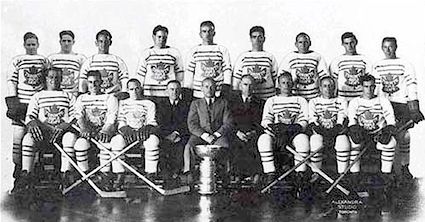
The 1932 Stanley Cup champion Toronto Maple Leafs
The Maple Leafs would win five NHL titles in the 1940s, 1942, 1945, 1947, 1948 and 1949. After winning again in 1951, they would have to wait a decade before reeling off three in a row in 1962, 1963 and 1964, with their 13th and most recent coming in 1967.
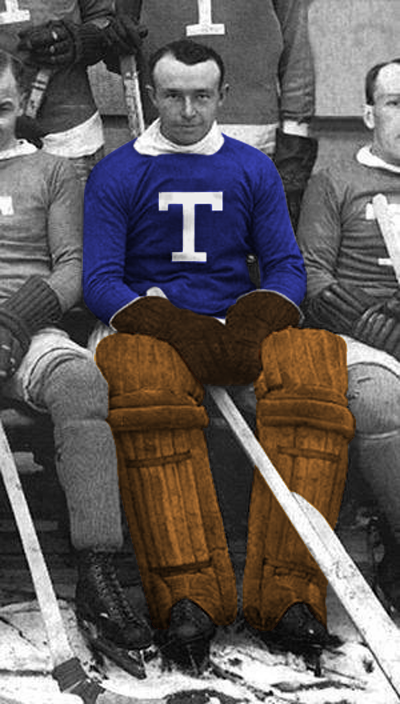
Today's featured jersey is a 1917-18 Toronto Blueshirts Hap Holmes jersey as worn during the inaugural season of the Toronto franchise of the NHL. Their jerseys would change for the second season with the addition of white stripes around the arms and the word "Arenas" across the front, bisected by the large T crest from the previous season.
Holmes would win the Stanley Cup four different times, and with four different teams. He first joined Livingstone's Toronto Blueshirts of the NHA in 1912, winning the cup with them in 1914. He joined the Seattle Metropolitans of the PCHA in 1915 and won a second cup with Seattle in 1917.
In his only season with the Toronto Blueshirts, he would win his third Stanley Cup before returning to Seattle the following season. After the Metropolitans folded four seasons later, Holmes would join the WCHL's Victoria Cougars in 1924 and go on to win his fourth Stanley Cup, the last cup won by a non-NHL team.
After one more season in Victoria, the entire WCHL folded and the Victoria Cougars players were sold to the new Detroit NHL franchise, which took the name the Cougars as a tribute to the Victoria club before eventually becoming the Red Wings. Holmes would play his final two seasons in Detroit and conclude his career with 408 games played, 198 wins, 40 of which were shutouts, 192 losses and 14 ties.
Holmes was inducted into the Hockey Hall of Fame in 1972 and the American Hockey League award for the top goaltender each season is named the Hap Holmes Memorial Award.
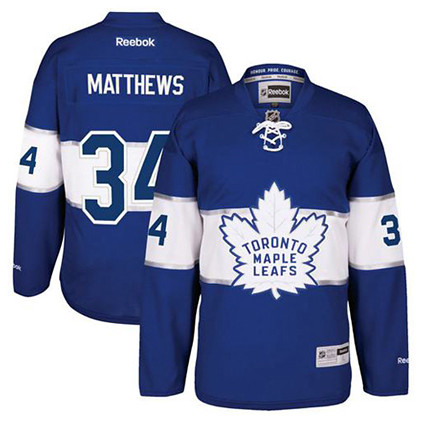
Bonus jerseys: Today's first bonus jersey is a Toronto Maple Leafs 2017 Centennial Classic Auston Matthews jersey. This jersey features the new Maple Leafs logo, which is a modern update of their logo used from 1938 until 1967.
The use of silver trim on the jersey is in recognition of both the team and the NHL's Centennial season, while the white band around the jersey was inspired by jerseys worn by the St. Patricks during the 1926-27 season.
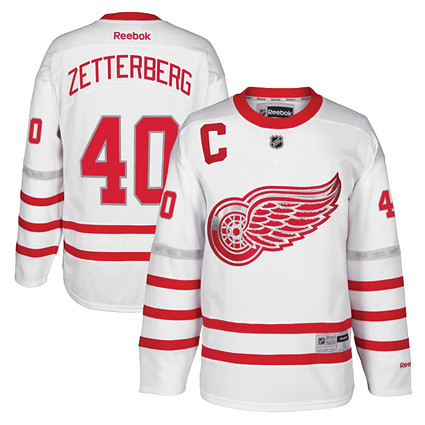
Today's secondbonus jersey is a Detroit Red Wings 2017 Centennial Classic Henrik Zetterbergjersey. Like Toronto, the Red Wings jerseys also use silver to commemorate the league's 100th Anniversary. The normally white areas of the winged wheel crest, the trim around the numbers and the top stripe of the sleeves, which contains the 11 years that Detroit has won the Stanley Cup.
The use of four sleeve stripes is in recognition of the original Detroit Cougars, which used striped sleeves during the 1928-29 season before the club changed their name to the Detroit Falcons in 1930 before becoming the Red Wings in 1932.
Today's video is about the 1932 Stanley Cup champion Toronto Maple Leafs, the first team to win the Stanely Cup after the franchise adopted the Maple Leafs name.
In addition to the ongoing World Junior Championship, this is also the time of year for the annual Spengler Cup tournament.
Founded in 1923 by Dr. Carl Spengler to promote teams from German-speaking portions of Europe who may have been ostracized in the aftermath of World War I, the Spengler Cup is hosted by HC Davos of Switzerland.
The tournament is an invitational tournament and the oldest such tournament in the world. The games are held between Boxing Day and New Year's Eve with all games being held at the 7,080 capacity Vaillant Arena in Davos.
The Vaillant Arena in Davos, home of the Spengler Cup
The invitees over the history of the tournament are a who's who of of powerful European clubs as well as an eclectic mix of unusual and unexpected teams. The original winners of the Spengler Cup in 1923 was the Oxford University Ice Hockey Club of England, which was made up of Canadian students. Berlin SC of Germany won the second edition in 1924 before Oxford University reclaimed the cup in 1925 and Berlin SC again in 1926.
The Oxford University Club, comprised of Canadian students
Hosts HC Davos took their first championship in 1927 and LTC Prague were the first Czechoslovakian winner in 1929 and again in 1930. Diavoli Rossoneri of Milan added Italy to the list of winners in 1934 and repeated in 1935.
HC Davos in the 1920's
An era of Swiss dominance arrived in 1938 when HC Davos took their 4th title. World War II kept the tournament from being played in 1939 and 1940, but Davos picked up where they left off by winning in 1941, 1942 and 1943. Zürcher SC continued the winning Swiss ways in 1944 and 1945, giving Switzerland six titles in a row and seven out of the previous eight.
HC Davos in 1940 during the Swiss run of dominance
LTC Prague reeled off three titles in a row from 1946 to 1948 and the tournament was not played in 1949. HC Milano Inter took back to back wins in 1953 and 1954, the last of five titles for Italian clubs. Rudá Hvēzda Brno of Czechoslovakia won in 1955 before the tournament was not held in 1956, the last time the Spengler Cup was not held and one of only four times since 1923 the cup has not been awarded in it's history. After HC Davos added two more titles in 1957 and 1958, ACBB (Athletic Club Boulogne-Billancourt) Paris won three consecutive cups to add France to the list of winners. Sparta Prague won in 1962 and 1963 followed by EV Füssen of Germany, who were the last western team to take home the cup for the next 20 years as the Czechoslovakian and Soviet teams would dominate the competition going forward. Dukla Jihlava would win in 1965, 1966, 1968, 1978 (when the tournament moved indoors for the first time) and again in 1982. HC Slovan Bratislava would win a trio of titles in 1972, 1973 and 1974 for Czechoslovakia along with the Czechoslovak Olympic Team in 1975.
Outdoor Spengler Cup action in 1975
Lokomotiv Moscow would become the first Soviet winner in 1967 and repeat again in 1969 followed by SKA Leningrad in 1970, 1971 and 1977. The USSR B team won in 1976, Krylya Sovetov Moscow (Soviet Wings) in 1979 followed by Spartak Moscow in both 1980 and 1981, with Dynamo Moscow's first title coming in 1983.
Dukla Jihlava, winners of the Spengler Cup in 1966
1984 saw the debut of Team Canada at the Spengler Cup, which resulted in their first of 14 titles to date. The team representing Canada at the Spengler Cup was originally comprised of the Canadian National Team, a roster which remained together for an entire season under the "Program of Excellence".The Program began in 1983 to represent Canada at such tournaments as the World Championships and the Spengler Cup as well as prepare for the Olympics with a full schedule of games, rather than the current format of All-Star teams who only come together just days before such competitions. The Canadian "Program of Excellence" lasted until 1998, when the NHL began shutting down to allow it's players into the Olympics every four years, at which point Team Canada at the Spengler Cup began to be comprised of Canadians playing professionally for club teams in Europe and occasionally North American minor leaugers, who were brought together as a squad to stand for Canada. Spartak Moscow downed Canada in 1985 and the Canadians defeated Soviet clubs in 1986 and 1987 to claim three titles in four years. The United States broke through for their only victory with a "USA Selects" squad in 1988. Spartak Moscow won the final two times for the Soviet Union in 1989 and 1990 before the political upheaval led to the breakup of the Soviet Union, which saw CSKA Moscow win under the flag of Russia in 1991. Although Swedish clubs had long participated in Davos, Färjestad BK's wins in 1993 and 1994 were Sweden's first titles following seven runner up finishes dating back to 1950. The Canadians reeled off four wins in a row from 1995 to 1998, which included the participation of the Rochester Americans of the AHL in 1996, the first North American professional club to take part in the competition. Kölner Haie (Cologne Sharks) then became the first German team to win since 1964 when they took home the title in 1999.
The Cologne Sharks show off their 1999 Spengler Cup
Hosts HC Davos delighted the home fans by winning the tournament for the first time since 1958, a span of 42 years, when they won in 2000 and repeated the feat in 2001. The Canadians returned to the top in 2002 and 2003 before Davos won again in 2004 before Metallurg Magnitogorsk became the first Russian club to win the tournament in 14 years with their championship in 2005.
Curtis Joseph celebrates Canada's 2007 championship
Since then, Davos in 2006, Team Canada in 2007 and Dynamo Moscow in 2008 preceded Dinamo Minsk becoming the first team from Belarus to capture the Spengler Cup in 2009, the 12th country represented with a championship.
Dinamo Minsk becomes the first club from Belarus to win the Spengler Cup
SKA Saint Petersburg won in 2010, the fourth for the team, as they won three times in the 1970's while known as SKA Leningrad.
SKA Saint Petersburg celebrate in 2010, the first year for the new version of the championship trophy
HC Davos defeated Dinamo Riga in 2011 to win their fifth title since 2000 after their long drought dating back to 1958.
HC Davos gathers after winning their 15th Spengler Cup in 2011
Canada regained the Spengler Cup in 2012 with a particularly loaded squad thanks to the availability of many players who would normally be occupied in the NHL if it were not for the ongoing lockout. Among the notable names on the Team Canada roster were goaltender JonathanBernier, forwards Matt Duchene, Jason Spezza, John Tavares, Jason Williams, Patrice Bergeron, Tyler Seguin and veteranRyanSmyth.
John Tavares battles with Patrick Kane during the 2012 Spengler Cup
Still, the other clubs also benefited from having locked out NHL players, as Davos had Joe Thornton, Patrick Kane and Loui Eriksson while Fribourg had goaltender Corey Schneider, Patric Hornqvist, Max TalbotandBruno Gervais on their roster.
Joe Thornton, wearing the flaming helmet to identify him as the leading scorer
The 2013 edition saw Genève-Servette HC defeat Russian club HC CSKA Moscow by a score of 5-3 in the final for their first ever title.
Genève-Servette celebrates after winning their first Spengler Cup in 2013
In 2014, Genève-Servette HC again defeated a Russian club, this time Salavat Yulaev Ufa by a score of 3-0 to finish the tournament undefeated at 4-0.
Genève-Servette celebrating after repeating as Spengler Cup winners in 2014
Last year Team Canada defeated HC Lugano in a close fought affairafter Lugano tied the game
five minutes into the final period but forward Matt D'Agostiniscored laterto wrap up the 13th championship for Team Canada.
Canada celebrates Matt D'Agostini's wining goal on the way to their 13th Spengler Cup
This year the participating clubs are, as always, hostsHC Davos, the traditional entry from Team Canada, 2009 Spengler Cup winners Dinamo Minsk of Belarus, second Swiss side and last year's runner up HC Lugano and Avtomobilist Yekaterinburg from central Russia and the KHL.
The sixth and final club this year is the little knownMountfield HK of the Czech Extraliga.The club used to be known as HC Ceske Budejovice prior to relocating to Hradec Kralove in 2013 as the result of a beer sponsorship conflict between the league and the sponsor agreement HC Ceske Budejovice already had in place with their home arena. Play in Group Torriani saw HC Lugano defeat Avtomobilist Yekaterinburg4-2.Avtomobilist then lost to Mountfield HK 4-3 after Yekaterinburg led 3-2 entering the third period. The game to decide the group winner and the automatic berth in the semifinals went to Lugano 4-3 after a third period, two goal rally by Mountfield fell short. Meanwhile, Group Cattini began with Dinamo Minsk hammering Team Canada 7-4 with 4 third period goals after the game was tied 3-3 after two. Team Canada rebounded the next day with a 4-3 win over hosts HC Davos. Minsk had a chance to win the group by getting to overtime against Davos, but fell one goal short as Davos got the win 5-4.
With each team tied with a win and a loss, the tiebreaking formula of goal differential, which went in favor of Minsk thanks to their opening night 3 goal margin of victory over Team Canada. Their one goal defeat by Davos saw them finish group play at +2. With a one goal loss followed by a one goal win, Davos was even and the Canadians could not overcome their three goal loss to Minsk after their narrow one goal win over Davos left them at -2. The Quarterfinals saw crossover matchups between the second and third place teams in both groups, with HC Davos advancing with a 3-1 win over Yekaterinburg, while Team Canadahad an easy time of it with a 5-1 victory over the Czech side Mountfield.
In the Semifinals, Canada broke out to a 2-0 lead over Dinamo, but Minsk got a goal before the second period was even two minutes old. Canada went back up by 2 when Chay Genoway scored at 2:29 of the third period. Minsk did get a power play goal with 4:44 left in the game, but NHLer Ben Scrivens held on for an eventual 3-2 Canadian win to avenge their opening day 7-4 defeat at the hands of Dinamo and move on to today's final. In the other Semifinal between the two Swiss sides, HC Lugano scored goals in each period to punch their ticket to today's final by shutting out hosts Davos4-0 to set up a rematch of last year's final won by Team Canada.
Today's
final between Team Canada and HC Lugano got off to a dramatic start with
Dario Burgler stealing one for Lugano just 31 seconds into the game. Genoway got the Canadians on the board at 6:03 to even the score and the entertaining, high tempo first period ended tied at 1-1 after the teams flew up and down the international sized ice sheet in front of theraucouschanting and clapping Swiss fans.
Canada turned the tables with a goal of their own within the first minute of the second period when Marc-Antoine Pouliot slammed in acrossing pass from Jacob Micflikier to put Canada up 2-1. Then, after a great saveby Canadian goaltender Zach Fucale while killing a penalty, CoreyEmerson went coast to coast to score a dazzling shorthanded goal to put the Canadians up by 2 at 3-1 before Andrew Ebbett crossing in front of the net redirected another great centering pass, this one from Mason Raymond, to extend their lead to 4-1 after two periods. Lugano was not going away easily though, and Burglar scored the first goal of the third period andhis second of the game from former NHLer James Wisniewski to keep the Swiss side withing striking distance but Fucale held off Lugano for the rest of the game as Lugano outshot Canada 16-11 for the third period. Nick Spaling made the final score 5-2 with an empty net goal with 17 seconds remaining to give Canada their second consecutive and 14th Spengler Cup, leaving them just one back of Davos all-time. Fucale finished with 40 saves.
2017 Spengler Cup champions Team Canada
Today's featured jersey is a 2012 Team Canada Jason Demers jersey as worn when Team Canada won the Spengler Cup when they defeated HC Davos 7-2. Canada's championship in 2012 was the 12th for the Canadians since they began their participation in 1984. Club teams often wear special jerseys just for the Spengler Cup tournament, resplendent with numerous advertisements of tournament sponsors not normally found on their domestic league jerseys.
Bovine jersey: Today's bovine jersey is a 2013 Spengler Cup Officials Jersey as worn by the referees and linesmen during the 2013 edition of the Spengler Cup. These same jerseys were worn again for the 2014 edition of the tournament as well, but have sadly been retired in favor of traditional stripes in 2015.
Taking the concept of sponsorship a step too far, the Swiss Milk sponsorship goes beyond anything previously seen in the world of ice hockey as the officials customary black and white stripes are replaced by a black and white Holstein cow pattern, compete with a picture of a cow on the front, at the cost of the officials dignity, which one would think would be paramount for them to retain the respect they deserve while officiating high level games of this magnitude.
Udderly bizarre.
Note the red armbands on the referee's jerseys,
as the four officials seem to be taking in all in stride
Today's video segment begins with highlights of HC Davos winning the Spengler Cup in 2000, ending their 38 year drought. Notice the previous version of the championship trophy with the glass globe on top which was used from 1956 to 2009, which is now on display at the Hockey Hall of Fame in Toronto.
Next, a linesman wearing one of the unfortunate cow uniforms while escorting a disqualified player off the ice.
Just three days after his dramatic return to the ice after a three and a half year layoff, Mario Lemieux and the Pittsburgh Penguins took to the ice against the Ottawa Senators at The Igloo in Pittsburgh, which was then known as Mellon Arena. When Lemieux retired following the 1996-97 season, he had appeared in eight NHL All-Star Games, had been named the winner of the Hart Trophy as league MVP three times, the Art Ross Trophy six times as league scoring champion, the Conn Smythe Trophy twice as playoff MVP, the Pearson Award four times, won the Calder Trophy as rookie of the year, the Bill Masterton Trophy, won two Stanley Cups, had his number retired, been inducted into the Hockey Hall of Fame and defeated cancer, which included scoring a goal and an assist on the day of his last radiation treatment, and then going on to win the 1992-93 scoring title by 12 points despite missing two months of the season and playing two dozen less games than the remainder of the players who finished in the top five in league scoring, Pat Lafontaine, Adam Oates, Steve Yzerman and Teemu Selanne. At the time of his 1997 retirement, Lemieux had appeared in 745 games with 613 goals and 881 assists for 1,494 points.
While Lemieux was in retirement, the Penguins fortunes took a nosedive, and the club was some $90 million in debt. The situation became so bad that the club declared bankruptcy and was in danger of relocating or folding altogether. With
Lemieux's deferred salary amounting to over $32 million, he was the
club's largest creditor and made the unusual proposal to convert
the debt the club owed him into equity in the franchise, a proposal
approved by the NHL Board of Governors on September 1, 1999. Two days
later a U. S. Bankruptcy Court approved the plan, making Lemieux the
Chairman of the Board, President and Chief Executive Officer of the
Penguins and the first former NHL player to become majority owner of his
former team.
Lemieux is introduced as the Penguins new owner
When
the 2000-01 season began, the Penguins were playing average hockey over
the course of the first two months of the season, but on December 9th,
Lemieux announced his intention to come out of retirement and return to
active play.
Several factors led the decision, as he young son Austin was too young to remember having seen him play when he first retired. Additionally, Lemieux was now fully recovered from the back injuries which had plagued his final few seasons when he last played. Also, there was the reality that Lemieux the player was Lemieux the owner's greatest asset.
18 days later, Pittsburgh's record was 15-14-6-1 as Lemieux
took to the ice for the first time since April 26, 1997, three years
and eight months prior.
During his first game back with the Penguins on December 27, 2000, Lemieux electrified the fans in Pittsburgh with an assist just 33 seconds into the game on a goal by Penguins captain Jaromir Jagr.
Jagr would return the favor, as he would assist on Lemieux's first goal of his comeback followed by Lemieux feeding Jan Hrdina, who converted on a nice play for Lemieux's second assist and third point of the night.
Lemieux acknowledges the fans after his dramatic return
His three point night upon his return would leave Lemieux at 1,497 career points, while teammate Jagr now stood at 999 points.
The game on this date in Pittsburgh had barely settled in when Peter Schastlivy scored for the Senators just 1:36 into the game when he beat Penguins goaltender Garth Snow.
At 5:36 of the period, Lemieux hammered a shot from a near impossible angle from the left wing corner. After it hit Senators goaltender Jani Hurme, it somehow squeezed through Hurme and the post and over the goal line, but not before referee Don Van Massenhoven blew the play dead, having lost sight of the puck as it burrowed its way through the Senators goalie, denying Lemieux another point.
Lemieux argues the quick whistle that cost him a goal
Robert Lang countered for Pittsburgh from Martin Straka and Lemieux on a power play at 10:15. Alexei Yashin put the Senators back on top from Shawn McEachern a little over two minutes later but Janne Laukkanen made sure the first period ended even at 2-2 when he put back a rebound just six seconds before the end of the period following a dazzling effort byStraka with the second assist toHans Jonsson.
Martin Havlatput the Senators back on top when he converted a power play opportunity just 3:49 into the second period from Karl Rachunek and Jamie Rivers.
Lemieux then centered the puck from the left side and Jagr fired the rebound past Senators goaltenderHurme for the 1,000th point of Jagr's career. The assist was Lemieux's second counted point of the night and put him at 1,499.
There was no more scoring in the second period and the game entered its final 20 minutes tied at 3-3.
1:28 into the third period, Lemieux fed Jagr again, who converted for his second goal of the night and Lemieux's milestone 1,500th career point.
Lemieux was not finished, however, as he completed the scoring with an empty net goal with just 12 seconds remaining for a final 5-3 margin with assists credited to linemates Jagr and Hrdina.
"That was something special for both of us," Lemieux said about the duo each reaching a career milestone on the same night. "Because
we've played so many years together, and accomplished so much."
His four point night gave Lemieux a head shaking seven points in his first two games back after his three and a half year layoff. The scary part for the rest of the NHL was, in spite of the apparent chemistry between Jagr and the returning Lemieux, he felt there was more to come. "I think we can get better," Lemieux said. "I think we're still, at
times, not sure, especially with [Hrdina]. I'm still not sure what he's
going to do. The more we play together, the more we practice ... I think
we can be a lot better. And the more conditioning I can get in the next couple of weeks, to
take my game to the next level, I think it will help the line a little
more."
To put the excellence of Lemieux into perspective, only 11 players in league history reached 1,000 points faster than Jagr's 763 games, while Lemieux only required 747 games to reach 1,500 points!
Lemieux would eventually play 43 games that season, scoring 35 goals and 41 assists for 76 points (1.77 points per game) while Jagr would win the Art Ross Trophy for the fourth consecutive season with 52 goals and 69 assists for 121 points in 81 games (1.49 ppg), one of only two players, along with Joe Sakic (118), to surpass 100 points that season.
Today's first featured jersey is a 2000-01 Pittsburgh Penguins Jaromir Jagr jersey as worn the night Jagr scored his 1,000th NHL point. In Lemieux's absence, Jagr became the Penguins captain and wore the "C" from 1998-99 to 2000-01.
Pittsburgh, in a classic case of messing with success, introduced a brand new pair of jerseys immediately after winning back-to-back Stanley Cups in 1991 and 1992. The "Robo Penguin" jerseys were never fully embraced by the Penguins fans, as the team failed to return to the Stanley Cup Finals while
wearing it.
Despite the fact it was not viewed as fondly as it's championship
winning predecessor, this style would be used for ten seasons through
the 2001-02 season.
After hearing the fans longing for a return to the classic "Skating Penguin" logo, the team introduced a new black alternate jersey for the 2000-01 season, only with an altered color palette, as a pale shade of gold rendered in shiny fabric replaced the classic shade of bright gold used by the Penguins as well as the Pittsburgh Steelers of the NFL and Pittsburgh Pirates of Major League Baseball. The new shade of gold was dubbed Las Vegas Gold.
After two seasons of use as the team's alternate third jersey, it was promoted to being the team's primary road jersey and a new white version became the home jersey. While the main crest was once again the classic Skating Penguin logo, the Robo Penguin remained as the secondary shoulder logos through the 2006-07 season when both jerseys were replaced as the league switched to the new Reebok Edge jerseys for the 2007-08 season.
Today's second featured jersey is a 2000-01 Pittsburgh Penguins Mario Lemieux jersey as worn during his second game back from his three and a half year retirement when he scored his 1,500th NHL point, making this the first time he had worn this new style Penguins alternate jersey.
This was one of the rare times a Lemieux jersey did not feature the
captain's "C" or at least the assistant captain's "A" once Lemieux was
named team captain back in 1987. Lemieux would return to the captaincy
for the 2001-02 season through the remainder of his career.
Today's great video are classic Lemieux moments, focused on his return to the ice in 2000, including highlights from the night he and Jagr both hit their milestone point totals.
Third String Goalie - The Hockey Jersey of the Day Blog
"Sweater" for all my Canadian friends!
Welcome!
Welcome to our end of the rink.
Bienvenue sur notre bout de la patinoire.
So why "Third String Goalie"?
It's defined as "A fan who sits in the stands wearing a jersey."
If that's not us, we don't know what is...
Our aim is to feature a different jersey each day from a historical perspective. Stay tuned and hopefully you'll see some jerseys of interest or perhaps some that you haven't seen before and learn a bit of hockey history along the way.
In addition to our articles, be sure to scroll down this column and explore the other fun and informative features of this blog.
If you have any suggestions or comments, feel free to contact us at:
Looking to reach our loyal readers with your hockey related product or service? Of our hundreds of readers each day, 60% are located in the United States and 30% come from Canada. Our audience is your audience and you can target them now with our reasonable ad rates.
We've been linked to by SI.com, ESPN.com, Uni-Watch.com, NBCSports.com and the Yahoo! Sports Puck Daddy blog among others.
There is no limitation to what kind of hockey jersey it can be - replica, authentic or game worn jersey from the NHL, a national team, the minors, juniors, college, high school or even your pond hockey jersey.
Feel free to write a paragraph or two about the jersey telling us why you like the jersey, how you got it, what makes it special to you or even a full-blownThird String Goalie-style history lesson - whatever you feel like sharing.
Visting from outside North America? Just select your preferred language and Third String Goalie will be instantly converted to your language of choice!