Tuesday, July 29, 2014
1995-96 Cincinnati Cyclones Jeff Greenlaw Jersey
July by the Numbers returns once again to Cincinnati for jersey #29.
When the owner of the ECHL's Cincinnati Cyclones was awarded a new International Hockey League franchise for the 1992-93 season, he retained the Cyclones identity for his new IHL franchise while moving his ECHL club to Birmingham, Alabama and renaming that club the Bulls.
The new IHL club missed the playoffs in year one, something that would never happen to them again.
Center Len Barrie arrived for the 1993-94 season and led the club with 116 points (second in the IHL) while Patrick Lebeau's 47 goals led the Cyclones in that category. The team made a great stride forward, leaping from 27 wins and 61 points to 49 wins and 107 points while Pokey Reddick went 31-12-6 in goal. Cincinnati then won their first ever playoff series by defeating the Kalamzoo Wings 4-1 before losing in the next round.
Pokey Reddick
They equalled their 49 wins in 1994-95, but raised their point total to 113, led by Dave Tomlinson's 110 points, which was also good for second in the IHL. The again won a playoff round by defeating cross-state Cleveland.
Ron Smith took over as head coach of the Cyclones for the 1995-96season and would be the only coach to ever command the club from that point forward. Tomlinson again led the club in scoring as they recorded their third consecutive 100 point season, this time reaching a franchise record 51 wins. The Cyclones then went on a nice playoff run, sweeping Atlanta in three games, eliminating Kalamazoo (now renamed Michigan) in a hard fought seven game series before falling in the semifinals to Orlando in seven games, concluding with a heartbreaking 1-0 loss at home.
While the Cyclones would not top 100 points again, they would remain consistently competitive, totaling between 92 and 97 points for the remainder of their five seasons in the IHL.
The 1997-98 season saw Todd Simon lead the club with 105 points as, he too, finished second in league scoring. It would not be until the 1999-00 season that they Cyclones would escape the second round of the playoffs when they were one of six teams to receive a bye in round one and then downed Orlando 4-2 in the second round before dropping a series to Grand Rapids.
Their final season of 2000-01 saw the Cyclones raise their point total to 97, their highest since 1996, but their season came to a quick end with a 4-1 defeat by Orlando.
Following the 2000-01 season, the IHL ceased operations and six of the 11 remaining clubs joined the American Hockey League, but the Cyclones were not one of them due to the presence of the Cincinnati Mighty Ducks, members of the AHL since 1997, just seven miles up the road.
Don Biggs ended up as the franchise's all-time leading scorer with 412 points, leading Gilbert Dionne's 336 and Paul Lawless' 304. The best known Cyclones to go on to NHL careers include Erik Cole, Bob Boughner, David Tanabe and Jan Bulis.
Don Biggs
The decline of the league brought an end to the nine year run of the Cyclones in the IHL, but not the Cyclones identity, which was sold to the owners of the ECHL's Miami Matadors, who moved their then dormant franchise to Cincinnati for the 2001-02 season, where they continue to play today.
Today's featured jersey is a 1995-96 Cincinnati Cyclones Jeff Greenlaw jersey. This shocking yellow jersey was the Cyclones alternate jersey, as their main dark jersey was black in color. For their first season of 1992-93, the Cyclones home jerseys were actually silver dazzle cloth before reverting to the traditional white in 1993-94. Their road jerseys also alternated between black and also red from season to season, with red also being used for alternate jerseys as well during their seemingly ever-changing looks.
In a moment straight out of the movie "Slap Shot", Cyclones coach Don Jackson scales the glass to get into a fight with the Atlanta Knights mascot!
Labels:
Cincinnati Cyclones,
IHL
Monday, July 28, 2014
1981 United States National Team Reed Larson Jersey
July by the Numbers jersey #28 sees a return to the Land of the Free and the Home of the Brave.

Even non-hockey fans know of the Miracle on Ice, the massive upset when the United States won the gold medal at the 1980 Olympics under the brilliant training and tactics of the late Herb Brooks, who took a team of college amateurs into battle against the dominant veterans of the Soviet Union.
What followed was not so memorable...
The 1981 World Championships resulted in a 5th place finish, followed by a Semifinal loss to Canada at the 1981 Canada Cup> That preceded the disaster that was the 1982 World Championships, where a 0-6-1 record saw them relegated to the B Pool for 1983. The Americans then won the B Pool in their first try, earning an immediate promotion back to the A Pool.
There were no World Championships in 1984, as that was an Olympic year, with the games contested in Sarajevo, Yugoslavia. Expectations for the Americans were certainly high going into the tournament coming off the previous Olympics in 1980, but reality set in quickly as the US lost it's opening game to Canada by a score of 4-2 followed by a lackluster 4-1 loss to Czechoslovakia two days later. Desperately needing a win, the best the Americans could muster was a 3-3 tie against tiny Norway after being outshot 37-27, leaving them with a single point from three games. The US rebounded with a 7-3 win over Austria, but, already eliminated from medal contention, they closed out their tournament with another tie, this one against Finland. The United States finished with a 1-2-2 record, scoring 16 goals while giving up 17 and wound up classified a disappointing 7th. Members of the team included future stars Chris Chelios, Al Iafrate, Pat Lafontaine and Ed Olczyk.
Chris Chelios joining Pat Lafontaine and their US teammates to celebrate a goal in 1984
Later that fall, the 1984 Canada Cup saw the United States get off to a strong beginning with a 3-1-1 record in the Round Robin portion, but Sweden ended their tournament with a resounding 9-2 decision during their first game of the elimination playoffs.
The 1984 US Canada Cup Team
The 1985 World Championships were a bright spot for the US, as they finished second in Group A with a 4-2-1 record to advance to the Final Round, but dropped all three games to Canada, Czechoslovakia and the Soviet Union to miss out on the medals with a final classification of 4th.
5 losses in 7 games sank the American hopes at the 1986 World Championships with consecutive defeats at the hands of Sweden, Czechoslovakia, Canada and the Soviet Union after starting the tournament an encouraging 2-1. An identical result followed in 1987, which included losses to Canada, Sweden, the Soviet Union and Finland in their first four games.
The 1987 Canada Cup was another disappointment, as the US lost 3 of 5 games, missing out on the Playoff Round entirely.
They hoped for better at the Olympics in 1988, as the games were in more familiar territory in North America in Calgary, Alberta. A more favorable schedule saw them begin with a confidence building 10-6 pounding of Austria to open their tournament, but once more the Czechoslovakians exposed the American defenses with a 7-5 win. There would not be another miracle in 1988, as the Soviet Union, in their first Olympic meeting since 1980, duplicated the Czechs with a 7-5 win. Norway fell 6-3 as expected, but any hope of advancing to the Final Round was dashed when the US fell flat against West Germany 4-1, to finish 2-3 and find themselves classified 7th once more. Members of this team included familiar names like Mike Richter, Brian Leetch and Kevin Stevens.
The 1988 US Olympic Team
The 1989 World Championships saw the US finish 6 out of 8 with a 2-4-1 record before they improved to a 5th place in 1990, winning 3 but losing 4.
In 1991, the United States gutted out a 4-1 win over Czechoslovakia following an opening 4-3 loss to Canada. They took a point away from their game with Sweden after a 4-4 tie, but the hammer of reality came down upon them with great vengeance and furious anger when the Soviet Union won 12-2. Still, more points arrived with a 4-2 defeat of Switzerland, a 4-4 tie against Germany and a 2-1 win over Finland to put the US into the Final Round. But once again could not compete with elite nations, losing to the Soviets 6-4, Sweden 8-4 and Canada 9-4 to again place out of the medals.
The Canada Cup returned in the fall, and the US started out with a 6-3 win over Sweden, followed by a 6-3 loss to Canada. Then a 4-2 win over Czechoslovakia and 2-1 defeat of the Soviet Union and a 4-3 win over Finland propelled them to a second place finish in the Round Robin portion. In the playoffs, Finland fell easily 7-3, but hosts Canada won the Canada Cup with 4-1 and 4-2 wins in the best-of-three final. Like the Stanley Cup playoffs, only the winner received a trophy and no medals were awarded.
Albertville, France was the location of the 1992 Olympics and the US found themselves in the weaker of the two groups, avoiding Canada, Czechoslovakia and the Unified Team, made up of former members of the Soviet Union. They took full advantage of their schedule, reeling off wins against Italy 6-3, the now reunited Germany 2-0, Finland 4-1 and Poland 3-0 before a final tie against Sweden 3-3. This gave the US first place in Group A and a favorable draw against France in the Quarterfinals. The US took care of business 4-1 but fell to the Unified Team 5-2, which sent them to the bronze medal game. There, the deflated Americans were soundly handled by Czechoslovakia 6-1 for a final classification of 4th following their initial run of success. Their roster boasted Bret Hedican, Shawn McEachern and Keith Tkachuk.
The 1992 US National Team
Later in the spring, the 1992 World Championships saw the US advance to the Quarterfinals, only to be slammed by the Czechs 8-1. 1993 was a repeat, advancing to the Quarterfinals before losing 5-2 to Sweden.
In order to get the Winter Olympics off of the same schedule as the Summer Olympics, the next Games were held just two years later in 1994 in Lillehammer, Norway. The first game for the United States set the tone for what was to follow, as the US came away disappointed following a 4-4 tie with France. Again, their game against Slovakia resulted in another deadlock, this one 3-3. While they would certainly have preferred a win, taking away a point from their 3-3 tie against Canada was somewhat less disappointing. A 6-3 defeat at the hands of Sweden put them in peril, but they US took full advantage of Italy to move on to the Final Round after a 7-1 win. Their medal hopes came to an abrupt end with a 6-1 hammering at the hands of Finland. Two additional losses to Czechoslovakia (5-3) and Germany (4-3) in the Classification Round saw the US classified as 8th. Well known names from the 1994 team were University of Maine teammates Mike Dunham and Garth Snow in goal, Peter Laviolette and Brian Rolston.
The 1994 US Olympic Team
1994's World Championships had the US advance to the Quarterfinals with a winning 3-2 record, followed by a stunning 3-1 win over Russia, but again, a 8-0 pounding by Finland ruined the joy created by their win over the Russians. With a bronze medal on the line, once again the US did not answer the bell, taking the shine off their tournament with a 7-2 loss to Sweden.
United States hockey was now on the upswing as a new generation of players were now on the scene, and Group 2 of the 1995 World Championships went to the Americans with a 3-0-2 record. Their reward? A matchup with Canada, who had stumbled in Group 1 (finishing behind Italy and France), but came alive in a 4-1 win over the US to end their tournament.
The 1996 World Championships began as expected, as the US defeated Austria, Germany and Slovakia, but lost to Russia and Canada. Still, it was enough to advance again to the Quarterfinals, where they surprised many with a 3-2 victory over Sweden.
While Czechoslovakia dominated them with a 5-0 win in the Semifinals, this time the United States regrouped and earned their first medal in international competition since the 1980 Olympics with a 4-3 win over Russia when 1994 Olympian Rolston scored at 4:48 of overtime.
In addition to being the first medal of any kind for the US in 26 years, it was their first medal at the World Championships in 34 years, all of which puts the medal won in 1980 into a greater perspective, as the Americans were not regular medalists either prior to, or after, the 1980 Olympics. In fact, the US was in Pool B of the World Championships as recently as 1974 before rising to their unexpected and truly memorable gold in 1980.
Today's featured jersey is a 1981 United States National Team Reed Larson jersey. This style was worn by the United States in the 1981 Canada Cup tournament and was very similar to the template worn by the Winnipeg Jets, and to some degree the Toronto Maple Leafs, with it's full length arm stripes in red trimmed with white, which is repeated to great effect along the waist.
Simple stars on the shoulders give it a touch of patriotism and the diagonal USA cresting is in the classic style of the New York Rangers, making for a simple, effective and attractive design has has stood the test of time with ease.
photo courtesy of Classic Auctions
Today's video section is rare footage of Rolston scoring his overtime goal in 1996 to earn the United States their first medal in international competition in 16 years.
Labels:
USA
Sunday, July 27, 2014
1982-83 Binghamton Whalers Dave McDonald Jersey
July by the Numbers makes it's way to New York state for jersey #27.
They were renamed the Binghamton Dusters for three seasons until another name change, this time to the Binghamton Whalers in recognition of their parent club, the Hartford Whalers of the NHL, and even used the Hartford club's Brass Bonanza as their goal celebration song.
During their second season as the Whalers, the club won the South Division and made a successful playoff run, defeating Hersey 3-2 in five games and Rochester 4-1 to reach the Calder Cup Finals, the first for the franchise since 1974 while still in Providence.
Another division title followed in 1984-85, when the team put together a stellar 52-20-8 record for a Whalers best 112 points, led by Paul Gardner's 51 goals and 79 assists for a whopping 130 points in 64 games to lead the AHL in all three categories. His 130 points were 37 more than the next closest challenger, who played 12 more games than Gardner, and proved to be the all-time Whalers record.
The Hartford Whalers were never one of the better teams in the NHL, and as a result did not supply Binghamton with the greatest talent, and often called up their better players in an effort to improve their dismal placings in the NHL. As a result, the Binghamton Whalers fortunes began to sink, dropping in wins from 47 to 38, then 28 to miss the playoffs and finally the worst record in the history of the AHL when they went 11-60-9 in their final season as the Whalers in 1989-90.
The following season their affiliation changed from Hartford to the New York Rangers which resulted in yet another name change for the franchise to the Binghamton Rangers, ending their 10 seasons as the Whalers. After seven seasons as the Rangers, the club was relocated yet again to Hartford, Connecticut to fill the void left by the departure of the Hartford Whalers to North Carolina, where they would become the Hurricanes. Now in Hartford, taking the place of their once parent club, they became yesterday's featured club and jersey #26 in our July by the Numbers travels, the Hartford Wolf Pack.
Better known Binghamton Whalers players include goaltender Richard Brodeur, Sylvain Cote, Ray Ferraro, Lou Franceschetti, Marty Howe, Doug Jarvis, Pete Peeters, Ulf Samuelsson, Peter Sidorkiewicz and Steve Weeks.
Today's featured jersey is a 1982-83 Binghamton Whalers Dave McDonald jersey. Another example of a minor league club which adopted the basic jersey of their parent club, the Whalers pulled of one of the most simple, effective and clever tricks when they simply rotated the Whalers "whale tail" logo, which formed the letters "H" and "W", ninety degrees counterclockwise to create a "B" logo for Binghamton. They did modify the inside negative space that originally formed the bottom of the "H" to a rounded shape to enhance the "B" shape but otherwise left the Whalers clever logo intact.
They were also clever enough to maintain the use of the classic Pucky the Whale shouder patches.
Today's video is a little minor league mayhem, as Dale Kushner of the Springfield Indians leaves his penalty box early to fight with Al Teur, who still resides in the penalty box! Notice the Whalers "B" logo jerseys in the clip.
Labels:
Binghamton Whalers
Saturday, July 26, 2014
1989-90 Kalamazoo Wings Kevin Schamehorn Jersey
July by the Numbers travels to the Great Lakes area for jersey #26.
Founded for the International Hockey League's 1974-75 season, the Kalamazoo Wings rose from 10th out of 11 teams in their first win to second out of nine by year three thanks in no small part to having the top two and three of the top five leaders in penalty minutes.
After two semifinal losses in 1976-77 and 1977-78, the Wings had a solid season with a 40-28-12 record for the fourth best record in the IHL. The Wings then went on a roll, sweeping their first two playoff series to advance to the finals, where they alternated wins at home with the Grand Rapids Owls until taking Game 7 on the road 5-2 to claim their first Turner Cup championship. Tom Ross led the team in scoring with 116 points which was second overall in IHL scoring.
Carrying the confidence of their championship into the 1979-80 season, Kalamazoo finished first overall in the IHL that season with a 45-26-9 record, led in scoring this time by Tom Milani at 49 goals and 111 points with Ross second at 103. The Wings repeated as Turner Cup champions after defeating the Fort Wayne Komets in six games in the finals.
The Wings simply blitzed the league in 1980-81 with a 52-20-10 record for a franchise best 114 points, but their bid for a hat trick of titles fell short with a loss in the finals.
Brent Jarrett became the first Wing to win the scoring title when he totaled 124 points in 1981-82 and Dave Michayluk led "the I" in goals with 66 in 1984-85.
After having been affiliated with the Detroit Red Wings since the beginning, and wearing red, white and blue, a new affiliation with the Minnesota North Stars saw the club change to the North Stars colors of green, gold and black. Their arrangement with the North Stars brought little in the way of notoriety however, although they did manage to make the playoffs in all but one season, including two seasons with over 100 points.
They retained their affiliation with the Stars organization when Minnesota relocated to Dallas for the 1993-94 season and immediately Rob Brown simply ran away and hid in the scoring race, amassing 155 points, 39 points clear of his next closest pursuer - and exactly one game with the Stars that season.
After one more season as the Kalamazoo Wings, the club changed it's name to the Michigan K-Wings for the 1995-96 season hoping to draw a wider audience to the club. That season saw Jamie Langenbrunner spend the season with the K-Wings and finish second in team scoring before beginning his long NHL career.
The 1998-99 season saw the arrival of goaltender Marty Turco from the University of Michigan, who immediately became the team's starter and seeing action in 54 games his first season and 60 his second, which would prove to be the final season for the franchise, as Dallas ended their affiliation agreement and the franchise requested inactive status from the IHL, a league that would only last one additional season itself.
Marty Turco
There is a franchise which currently uses the name Kalamazoo Wings as members of the ECHL, which began life in Madison, Wisconsin in the United Hockey League before relocating to Kalamazoo and obtaining the rights to use the name and logo of the original Wings.
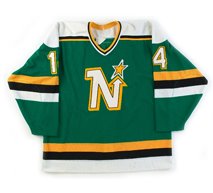
Today's featured jersey is a 1989-90 Kalamazoo Wings Kevin Schamehorn jersey from their days as a Minnesota North Stars affiliate when the club wore the green and gold of the North Stars.
Schamehorn had a long history with the Kalamazoo Wings, playing for the club during eight different seasons spread out over 14 years. After being drafted by the Red Wings in 1976, he played three seasons in Kalamazoo before moving on to other clubs and organizations. He returned to Kalamazoo in 1981 for four seasons prior to the change in affiliation to Minnesota. Again, Schamehorn moved on to other teams for four seasons, which included a year in France, before returning to Kalamazoo for his final season as a pro. During his absence, the Wings changed their affiliation from Detroit to Minnesota, which resulted in the change in team colors, allowing us to accurately date this green and gold Wings jersey to 1989-90.
This example illustrates the detective work involved in dating jerseys we enjoy so much when researching various jerseys, particularly minor league jerseys which lack comprehensive online visual databases that document each and every jersey style and years worn, unlike the NHL.
Labels:
IHL,
Kalamazoo Wings
Friday, July 25, 2014
1994-95 Minnesota Moose Stephane Morin Jersey
July by the Numbers reaches #25 as we head north to Minnesota.
Morin played junior hockey for the Shawinigan Cataractes and then the Chicoutimi Sagueneens. After splitting the 1987-88 season between the two clubs, Morin would get himself noticed with 77 goals and 109 assists for 186 points in just 77 games in 1988-89, which led to him being drafted 43rd overall in the 1989 NHL Entry Draft by the Quebec Nordiques.
While the Minnesota Moose only played two seasons in St. Paul, Minnesota after the departure of the NHL's North Stars for Dallas, they provided some exciting hockey, generally of the rougher kind typical of the International Hockey League in those days.
One of the highlights for the Moose during their first season in the old St. Paul Civic Center was undoubtedly the play of Stephane Morin.
Morin played junior hockey for the Shawinigan Cataractes and then the Chicoutimi Sagueneens. After splitting the 1987-88 season between the two clubs, Morin would get himself noticed with 77 goals and 109 assists for 186 points in just 77 games in 1988-89, which led to him being drafted 43rd overall in the 1989 NHL Entry Draft by the Quebec Nordiques.
He would spend the majority of the 1989-90 season with the Halifax Citadels of the American Hockey League, but would make his NHL debut with six games with the Nordiques, in which he would register his first NHL points with a pair of assists.
While he would split the next two seasons between Quebec and Halifax, he would see action in 48 NHL games, which included scoring his first NHL goal, in 1990-91, a season in which he would place fourth in scoring for the Nordiques with 13 goals and 40 points despite only competing in a total of just 48 games.
The 1991-92 season with Quebec as a disappointment, with just two goals and eight assists for ten points in 30 games.
Released by the Nordiques organization, Morin signed with the Vancouver Canucks in 1992. Assigned to the Hamilton Canucks of the AHL, Morin led the team in scoring with 31 goals and 85 points in 70 games. He did play a game in Vancouver, registering an assist, in his only NHL appearance that season.
The following season was very productive offensively for Morin, as he again led Hamilton in scoring with 109 points in 69 games, good for fourth overall in the AHL that season. He would also contribute a goal and an assist in five games with Vancouver.
With his time in Vancouver at an end, Morin signed on with the brand new Minnesota Moose of the International Hockey League, who came into being to fill some of the void left by the departure of the Minnesota North Stars. Morin led the Moose in scoring with 33 goals and 81 assists for 114 points, nearly double the next closest on the roster, to win the league scoring title to capture the Leo Lamoureux Memorial Trophy
His point total would decline the following season to 78, but he would still lead the Moose in scoring.
1996-97 saw Morin and the team move to Manitoba, but after only 12 games in Winnipeg he would find himself moving to the Long Beach Ice Dogs, still in the IHL. Long Beach was a strong team that season, winning the South Division and making it all the way to the Turner Cup Finals. Morin, making the first real playoff run of his professional career, responded with 19 points in 18 games.
Morin's next season with Long Beach was limited to just 27 games in which he scored 27 points. Another playoff run for Long Beach would see them win a pair of rounds before falling in the semifinals, but not before Morin would contribute 11 points in 13 games.
For the 1998-99 season, Morin relocated to Europe, signing with the Berlin Capitals of the DEL.
Morin during his brief time in Germany
Off to a good start in Germany, Morin scored a pair of goals plus six assists for eight points in his first handful of games, but then shockingly and tragically, after complaining of not feeling well during the first period of the seventh game of the season, Morin died of a heart attack at the age of 29 on October 6, 1998 after he collapsed at the bench early in the second period leaving behind a wife and newborn son.
Today's featured jersey is a 1994-95 Minnesota Moose Stéphane Morin jersey from the season Morin led the Moose and the IHL in scoring.
The Moose would only play two seasons in Minnesota and Morin would hold the team records for most assists and points in a season, as well as career goals, assists and points, as well as games played.
While the three color combination of the forest green trim and purple outline against the black was a questionable choice at best, as the separation of the green from the purple and black is nearly impossible to make out for even the larger numbers and really becomes a dark mass when reduced in size for the name on the back.
While the back of the jersey has it's flaws, the front of the jersey is a winner, with the IHL 50th Anniversary patch providing a shot of color and the very popular Moose logo, which was ranked #1 in a poll by The Hockey News and led all minor league teams in terms of merchandise sales, making for a very attractive jersey.
Here's some rare non-fighting clips of the Moose in action.
It's back to business as usual with the fisticuffs, but another rarity, the Moose in action at the St. Paul Civic center after the famous clear boards had finally been replaced due to age and the advent of dasherboard advertising rendering them ineffective.
For comparison, here's a WHA Fighting Saints highlight package with some road games with the usual boards and some home game action with the unmistakable clear boards.
Labels:
IHL,
Minnesota Moose,
Morin Stephane
Thursday, July 24, 2014
1999-00 Rockford IceHogs Sean McEachran Jersey
July by the Numbers stops in Northern Illinois for jersey #24.
A member of the United Hockey League, the Rockford IceHogs came into being when the Thunder Bay Thunder Cats were sold and relocated to Rockford for the 1999-00 season after eight years and three championships (as wellas three different names!) in Canada.
The name "IceHogs" was chosen after a "name the team" contest. Jason Firth led the team in scoring with 110 points and the club was a first round exit from the playoffs in year one. The IceHogs failed to make the playoffs in both 2000-01 and 2001-02 but a winning record in 2002-03 returned them to the playoffs but another first round exit awaited them.
A large step back in 2003-04 saw them drop 16 points in the standings and once again fail to qualify for the postseason. The IceHogs began to climb up the standings in 2004-05 when they were led in scoring by Jean-Francois Dufour's 79 points in 77 games. Rockford finished in second place in the Western Division with a 46-25-9 record for 101 points and followed that success by winning their first ever playoff series in Illinois with a 4 games to 2 win over the Kalamazoo Wings before falling to the Fort Wayne Komets in overtime of Game 7 in Round 2.
2005-06 saw the IceHogs improve to a 48-19-9 mark for 105 points and the Western Division title. Rockford bounced For Wayne in Round 1 in five games but were swept by Kalamazoo in the second round.
The IceHogs had another strong regular season in 2006-07, again reaching 48 wins on the way to 103 points and second place in the west. Rockford had an easy time ousting the Quad City Mallards in five games prior to doing the same to Fort Wayne in the second to advance to the finals.
The IceHogs opponents in the finals Kalamazoo required a full seven games in the previous round to advance, giving the IceHogs and additional four days rest, which may have paid off when Game 1 in Rockford required overtime before the IceHogs won 3-2. They cruised to an easy 6-1 win, also at home, in Game 2.
The Wings won games 3 and 4 on home ice 3-0 and 6-5 to send the series back to Rockford for Game 5, where Rockford again won by a score of 6-1 to reach the brink of a championship. Kalamazoo held serve at home in Game 6 with a 6-2 victory to set up a decisive Game 7 back in Rockford.
Rockford made it a clean sweep for the home teams when they captured the Colonial Cup with a 3-1 win in Game 7, which would prove to be the final game in franchise history.
Off the ice, the team's arena authority, who controls the Rockford MetroCentre, purchased both the dormant Cincinnati Mighty Ducks franchise of the American Hockey League, as well as the rights to the UHL's IceHogs identity as part of a 23 million dollar plan to extensively renovate the arena, brining to an end the seven year history of the UHL IceHogs.
The new version of the IceHogs would sign a 10 year agreement with the Chicago Blackhawks of the NHL and compete in the AHL as Chicago's top minor league affiliate, two levels higher up the minor league ladder than the UHL was considered, and take to the ice with the same logo and colors as their predecessors.
Today's featured jersey is a 1999-00 Rockford IceHogs Sean McEachran jersey from the IceHogs debut season in the UHL. Free of the pressures to create a jersey which must generate millions of dollars of income in merchandise sales at the NHL level, minor league jersey designers have the opportunity to take more risks when outfitting their teams.
While some may take the approach of simply putting their logo on the same template as their parent club, especially higher up in the minors when teams have an affiliation with specific NHL clubs, the IceHogs had the freedom to create an attractive new design with bold arm striping, bold numbers and an unusual choice of font for the names on the back, one seldom seen on a hockey jersey.
While the IceHogs logo is very cartoonish, as can often be the case in the low minors, the rest of the jersey is an effective and attractive package overall, and benefits from the solid black and red color combination, avoiding trendy colors which can quickly look dated as tastes change.
Today's video selection is the final two minutes of the UHL's IceHogs as they win the Colonial Cup on home ice.
Labels:
Rockford IceHogs
Wednesday, July 23, 2014
1992-93 SC Herisau Libor Dolana Jersey
July by the Numbers returns to Switzerland for jersey #23
Chances are if it's an odd and unusual jersey, it comes from Switzerland, and today's jersey fits that profile once more.
Based in the north eastern part of Switzerland, SC Herisau was founded in 1942 and play in the Sportzentrum Herisau arena, which has a capacity of 3,152.
The high point for the club came in 1996-97, when they won the Swiss National League B championship for the only time, earning a promotion to the top level of hockey in Switzerland, the Swiss National League A in a shocking underdog story. The club did include Canadians Claude Vilgrain, who had ten years of experience in the IHL, AHL and 89 games of NHL experience with the New Jersey Devils, and Devin Edgerton, who brought five seasons of IHL play and went on to play a dozen years in Europe. "It was one of the wonders that it is in sports," said Mark McGregor, the coach said.
Vilgrain while still a member of the Devils
Unfortunately, the Cinderella story ended there, as the club was unable to compete with the top level clubs and was relegated after just one season following a 9-29-2 record and a last place finish.
The team currently plays in the 1. Liga, the third level of Swiss hockey behind the NLA and NLB after having dropped down to the 2. Liga at one point.
The 2010-11 SC Herisau team
Other notable names to have played for SC Herisau include former Florida Panther Jesse Belanger and former Hartford Whaler Sylvain Turgeon, both in 1997-98.
Some of SC Herisau's passionate fans
Today's featured jersey is a 1992-93 SC Herisau Libor Dolana jersey. This most unique jersey features both the player name and back number rotated 45º !
Aside from the rotation of the name and numbers, this jersey is typical of a early 90's European jersey, as it is a lighter weight mesh jersey with sublimated graphics. As if the jagged, almost lightning bolt stripes running diagonally across the body and the arms weren't enough, it also features the trademark three stripes from Adidas running down each arm.
The odd thing about this jersey is, in contrast to the bold striping, large sponsor logos and unusual rotated customization, is the overly simple club name on the front, which one would expect to be bigger and in a more exciting font, if not some sort of graphic logo, in an effort to keep up with the volume of the rest of the jersey.
photo courtesy of Classic Auctions
In Today's video section, the fans if SC Herisau celebrate their club with a joyful racket, drums and all, which lasts a considerable amount of time!
Labels:
SC Herisau
Tuesday, July 22, 2014
1995-96 San Francisco Spiders Normand Rochefort Jersey
July by the Numbers visits the City by the Bay for jersey #22.
The San Francisco Spiders were granted an expansion franchise in the International Hockey League for the 1995-96 season in November of 1994 and announced their team name and logo in December.
Their home rink was the famed Cow Palace and their first game was a 5-1 loss to the Los Angeles Ice Dogs in front of 11,415 fans on September 29, 1995 with the first goal in team history being scored by Sandis Ozolinsh, who played a pair of games for the Spiders while holding out from the NHL's San Jose Sharks prior to being traded to the Colorado Avalanche.
Also of note to play for the Spiders was future Hall of Famer Rod Langway. Following his retirement from the NHL in 1993, Langway hit the ice once again as a player/coach for the Spiders, seeing action in 46 games in 1995-96.
Rod Langway
Eight former members of the Sharks, who also began life also calling the Cow Palace home in 1991-92, skated for the Spiders that season.
The club finished with a respectable winning record of 40-32-10, good for third place in the South division and a spot in the IHL's Turner Cup playoffs. Goaltender Stephane Beauregard was named the winner of the James Gatschene Memorial Trophy as the league's MVP following his 36-24-8 record with a 3.09 goals against average. John Purves was by far and away the team's leading scorer, with 56 goals and 49 assists for 105 points, 45 more than the next highest Spider. Purves placed second in the league goal scoring race and seventh in points. Despite than success, Purves would finish his career with a total of seven NHL games, all of which came prior to his season with San Francisco.
Stephane Beauregard
Game 1 against the Chicago Wolves went to the Spiders at home 4-2, but Chicago defeated San Francisco 4-1 and then swept them back at home in Chicago 3-1 and 2-1 in overtime to eliminate the Spiders from the playoffs in what would turn out to be the final Spiders game ever.
Difficulties with the aging arena and poor attendance plagued the club. Weekend attendance was around the 7,500 mark, but weekday games ruined the average attendance as the club struggled to draw over 2,500. Citing losses of over $6 million, the team filed for bankruptcy protection and ceased operations on June 24, 1996 after but one season on the ice, becoming a footnote in the history of minor league hockey.
Dave Maley, the Spiders team captain
Today's featured jersey is a 1995-96 San Francisco Spiders Normand Rochefort jersey. For the Spiders one and only season, every day was Halloween with these unusual jerseys donned by the Spiders, especially when compared to the current state of the art in the NHL at the time when these were designed.
The spider web pattern contained in the red striping was a very simple but highly effective addition which created a jersey that looked much busier than it really was.
Their logo added to the overall feeling of this being a complex jersey as the spider itself was rather detailed and the radical font chosen for the team and city name created a near vortex of lines due to the length of both names.
The radical nature of the jersey continued on the back and sleeves with the addition of the numbers done in the same font as the "Spiders" wordmark from the main crest. While the sleeve numbers are somewhat difficult to read based on their shape and location at one the busiest spot on the jersey, the back numbers are surprisingly bold and legible.
The simple block font for the names are unexpectedly simple and one can only imagine what suggestions for fonts the designer may have proposed that were passed over! A vertically arched block font like that used by the Detroit Red Wings, which would have followed the curvature of the top of the back numbers surely must have been considered at some point.
These jerseys unusual look, which was quite radical for the time, and their limited availability due to the incredibly brief short period of use have made these a favorite among the collecting hobby and very sought after.
Bonus jersey: Today's bonus jersey is a 1995-96 San Francisco Spiders tie dye jersey. If the standard Spiders jersey wasn't busy enough as it was, this special tie dyed jersey takes the vortex effect of the main logo to a whole new level!
And why the different font for the numbers? Surely it wasn't an effort to make the jersey "less busy" was it? The numbers certainly are an odd choice, as the treatment they received give them an almost metallic appearance, totally not keeping with the look and feel of the jersey or the team's identity. Perhaps they had something to do with radio station KFOG's visual identity, the sponsor of the game in which they jerseys were worn, and not that of the team.
Today's video section begins with some very rare footage of the Spiders tie-dyed jerseys in action.
In this next video, Tracey Engeland of the Los Angeles Ice Dogs has three different fights with members of the Spiders, giving you plenty of time to see how difficult the Spiders two-digit back numbers could be to read in action.
Labels:
IHL,
San Francisco Spiders
Monday, July 21, 2014
1997-98 Regina Pats Josh Holden Jersey
July by the Numbers jersey #21 takes us to the Canadian province of Saskatchewan.
The oldest major junior team in the world, the Regina Pats were formed in 1917 and t heir original name was the Regina Patricia, after the military unit, Princess Patricia's Canadian Light Infantry, which was named after Princess Patricia of Connaught, granddaughter of Queen Victoria, and whose regimental crest is still worn on the shoulder of the club's jerseys.
The Patricias competed for the very first Memorial Cup in 1919 and again in 1922. In 1923 the team named was shortened to the Pats and two seasons later they won their first championship in 1925 with a 2 games to none win over Toronto Aura Lee. The club won their second title in 1928 when they were briefly known as the Regina Monarchs after merging with the Regina Falcons, with a 2 games to 1 win over the Ottawa Gunners.
1927-28 Memorial Cup champion Regina Monarchs
Their third title in six seasons came in 1930, after having to returned to being called the Pats, with a two game sweep of the West Toronto Nationals. The club made one more trip to the finals in 1933 prior to folding following the 1934-35 season.
1929-30 Memorial Cup champion Regina Pats
It would not be until 1946 that the Regina Pats would be resurrected when two junior teams, the Abbotts and Commandos merged to form a new organization, which became a farm team of the Montreal Canadiens and members of the newly created Saskatchewan Junior Hockey League, as the provence's hockey leagues had previously been divided into separate northern and southern leagues.
Only two seasons later, the Pats would join the Western Canada Junior Hockey League. It would not take the club long to attain success in the WCJHL, as they made their first appearance in the Memorial Cup final in 1950 and again in 1952, 1955 and 1956 after dominating the WCJHL, but agonizingly coming up short each time for the national title.
The club would rejoin the SJHL for 1957-58 and immediately return to the Memorial Cup Final, only to once again come up short. A new WCJHL was formed in 1966 and once again the Pats were on the move to a new league, which then changed it's name to the Western Canada Hockey League. Then, following a dispute over the upper age limit for junior players, the Pats left the WCHL for the SJHL for two seasons before the disputes were resolved and the Pats returned to the WCHL in 1970-71, but not before the Pats made the Memorial Cup in 1969.
The Pats captured the WCHL title in 1973-74, led in scoring by Dennis Sobchuk's 146 points in 66 games, followed by Clark Gilles 112 on their way to a 43-14-11 record. They finished the Round Robin portion of the schedule with a 1-1 record and advanced to the final thanks to their superior goal differential and then defeated the Quebec Remparts 7-4 to capture the first Memorial Cup since the team's rebirth 28 years earlier.
1973-74 Memorial Cup champion Regina Pats
The Pats have again made the Memorial Cup as the now renamed Western Hockey League champions in 1980 behind Doug Wickenheiser's league leading 89 goals and 170 points in 72 games.
The Pats most recent Memorial Cup appearance came in 2001 as hosts, where they fell in overtime of the semifinals.
Since the inception of the NHL Draft in 1963, Larry Wright became the first Pats player selected in the first round, when he was taken 8th overall by the Philadelphia Flyers in 1971. In 1974, Greg Joly became the first Pat ever taken first overall when he was selected by the Washington Capitals followed by Gilles 4th overall. Wickenheiser was the next Regina player taken #1 by Montreal in 1980.
Other first round players selected after playing for the Pats have been Garth Butcher (1981-10th), Mike Sillinger (1989 - 11th overall), Jason Smith (1992-18th), Jeff Friesen (1998-11th), Derek Morris (1996-13th), Brad Stuart (1998-3rd), and Calder Cup winner Barret Jackman (1999-17th). Other notable Pats have included Dirk Graham and Stu Grimson.
The Pats have retired seven numbers in honor of eight players, #1 for goaltender Ed Staniowski, #8 for Brad Hornung, #9 for Gilles, #12 for Wickenheiser, #14 for Sobchuk, #16 for the franchise's all-time leading scorer Dale Derkatch and Sillinger and #17 for Bill Hicke.
Today's featured jersey is a 1997-98 Regina Pats Josh Holden jersey. After a long history of classic jerseys, this style, made by Starter, suffers from the design excesses of the era, making for a loud and garish jersey, which thankfully did not last very long until a return to a more traditional style.
Labels:
Regina Pats
Subscribe to:
Posts (Atom)