All of that adds up to today's featured jersey variation of completely blank shoulders only being used for just two seasons, 1974-75 and 1975-76, the season of Bucyk's 500th goal.
Wednesday, October 30, 2013
1975-76 Boston Bruins Johnny Bucyk Jersey
Johnny Bucyk ranks as one of the most successful yet overlooked hockey players in NHL history.
He began his road to the NHL in 1951 when he joined the Edmonton Oil Kings of the Western Canadian Junior Hockey League for a single playoff game. He returned to the Oil Kings for the next two seasons, scoring 67 points in 33 games in 1954 and went on to win the prestigious Memorial Cup, before moving up to the Edmonton Flyers of the Western Hockey League for the 1954-55 season, scoring 30 goals and 88 points in 70 games.
Buyck while with the Edmonton Oil Kings
That performance earned Bucyk his chance to debut in the NHL with the Detroit Red Wings in 1955. Life in the NHL was not the same, as Bucyk competed in 38 games and managed just a single goal and eight assists for nine points. In his second season in Detroit he fared better, scoring 10 goals in 66 games.
A rare shot of Bucyk in a Red Wings jersey
That would prove to be the end of Bucyk's time in Detroit however, as he was traded to the Boston Bruins when the Red Wings reacquired goaltender Terry Sawchuk, whom they had dealt to Boston just two years prior.
His arrival in Boston back in 1957 would begin an affiliation with the organization that continues today, more than 50 years later. While it looked at first that Bucyk had arrived in Boston at a good time, evidenced by going to the Stanley Cup Finals in his first season in Boston, things would quickly turn sour for the club following a first round elimination in the 1959 playoffs, as the Bruins would spend the majority of the 1960's out of the playoffs, missing the postseason eight consecutive years, five of which were as the league's doormat buried in last place waiting for the arrival of Bobby Orr and Phil Esposito.
An early Bucyk hockey card following his trade to Boston
Still, Bucyk's personal numbers were incredibly consistent throughout, as eight of his ten seasons were between 52 and 66 points. During that period, Bucyk, a big player for his era a 6', 215 lbs., led the Bruins in scoring in 1962, 1963, 1965 and 1967, a season in which he was team captain.
1966-67 was also the season that the Bruins would begin to climb out of the depths with the arrival of Orr, followed by Esposito the following season. Bucyk would never again lead the Bruins in scoring, but the arrival of Orr and Esposito would ignite a scoring revolution that would propel Bucyk to personal bests never before imagined.
In a hilarious photo, Johnny Bucyk poses with goaltender Eddie Johnston and Bobby Orr as they pose with pucks indicating their career goal totals, Bucyk having just reached 300, Johnston still stuck at zero and Orr at 78!
Esposito's first season with Boston saw Bucyk reach 30 goals for the first time ever and eclipse his personal best season total with 69 points as the Bruins returned to the playoffs for the first time since the 1950s. Two seasons later he would equal the 69 points, but raise his goal total to 31. During the postseason, 11 more goals would follow as Bucyk scored 19 points in 14 games as the Bruins won their first Stanley Cup in 29 years. As the Bruins had no captain from 1967 to 1973, Bucyk, as the assistant captain with the greatest seniority, was the first to hoist the cup during the championship celebration.
Bucyk raises the 1970 Stanley Cup
1970-71 was a memorable one for Bucyk, as he would join the exclusive ranks of the 50 goal scorers, as he became the only the fifth player to accomplish the feat, only to be overshadowed by teammate Esposito's record shattering 76 that same season. Bucyk added 65 assists to surpass the 100 point mark for the only time in his career with 116 as Bruins Esposito (152), Orr (139), Bucyk and Ken Hodge (105) finished 1-2-3-4 in league scoring! When it came time to hand out the hardware at the conclusion of the season, Bucyk was named the recipient of the Lady Byng Trophy thanks to his season total of a mere 8 penalty minutes in 78 games.
This card commemorates Bucyk's first Lady Byng Trophy
Although his personal point totals were all down somewhat, his 83 points were still his second best season to date, his 20 points in 15 playoff games were key to the Bruins capturing the second Stanley Cup of Bucyk's career in 1972.
His offensive numbers would rise once more in 1972-73 when Bucyk scored 40 goals for only the second time in his career and his 53 assists propelled him to a 93 point season, including scoring his 1,000th career point, only the seventh player to reach that illustrious total.
He was again named team captain of the Bruins in 1973, a position he would hold until 1977. Following his 116 point season in 1971, Bucyk was a very consistent, productive player, averaging 83 points per season, and never below 75. 1973-74 saw the Bruins again return to the Stanley Cup Finals and Bucyk collect the second Lady Byng Trophy of his career after again finishing with just 9 penalty minutes. Amazingly, Bucyk was not awarded the Lady Byng in 1972, a season in which he was penalized a total of just 4 minutes, a mark equalled by the winner Jean Ratelle.
"I played physical but clean hockey," said Bucyk. "Most people think that the only reason a player wins the Lady Byng is because he is gentlemanly, but I had the ability to play physical and not draw penalties. I contributed offensively and stayed out of the penalty box."
On this date in 1975, Bucyk would again join an exclusive club when he became only the seventh player to reach 500 career goals, a tribute to his longevity, as he reached the 500 goal plateau in his 1,370th game. Of the 41 players to date to reach 500 goals, only Ron Francis would anyone require more games than Bucyk with 1533. Bucyk scored 20 goals or more in 16 of his 23 seasons.
Bucyk celebrates his 500th goal
He would play two more seasons before retiring at the age of 42 due to chronic back problems as the Bruins all-time leader in goals (556), assists (813) and points (1,369) as well as career games with 1,540. He was also the fourth leading scorer of all-time as well as the leading scorer among left wings and third in games played at the of his retirement.
The Bruins retired his #9 in 1980 and he became a member of the Hockey Hall of Fame in 1981.
"Having my Number 9 retired at the Boston Garden in 1980 was outstanding. It’s very exciting to see your number hanging there along with all the other great players. It’s the greatest honour a player can get."
Today's featured jersey is a 1975-76 Boston Bruins Johnny Bucyk jersey, as worn the season Bucyk joined the 500 goal club.
What sets this Bruins jersey apart is the lack of not only the colored shoulders of the previous style, discontinued for the 1974-75 season, but also the lack of the bear head shoulder patches, which would arrive for the following 1976-77 campaign and would remain in place all the way through the 1994-95 season. Names on the back would not arrive until the 1977-78 season.
All of that adds up to today's featured jersey variation of completely blank shoulders only being used for just two seasons, 1974-75 and 1975-76, the season of Bucyk's 500th goal.
Today's video segment begins with Johnny Bucyk Night in Boston, when the celebrate his 50 years with the organization.
Here, Bucyk scores a goal on February 25, 1971, igniting a Bruins outburst that results in the three fastest goals in NHL history at just a lightning fast 20 seconds!
Finally, a profile of Bucyk from the excellent Legends of Hockey series.
Labels:
Boston Bruins,
Bucyk Johnny
Tuesday, October 29, 2013
1939 NHL All-Star Eddie Shore Jersey
Prior to the NHL All-Star Game being an annual affair, which began with the first annual game in 1947, three previous benefit games took place featuring a team of NHL All-Stars on one side of the contest.
The third and final of those benefit games took place on this date in 1939 in memory of Babe Siebert, a former NHL player who had recently been named head coach of the Montreal Canadiens who drowned in Lake Huron while swimming before he began his new job as coach.
Babe Siebert from his playing days with the Montreal Maroons
To benefit his family, a game was organized by the Montreal Canadiens and Montreal Maroons, both of whom Siebert had played for during his career.
Held in the Montreal Forum, 6,000 fans attended the game between the Montreal Canadiens and a team of NHL All-Stars, raising $15,000 for Siebert's family.
Syl Apps, of the Toronto Maple Leafs, scored four points, one goal and three assists, in a 5-2 win for the All-Stars over the defending Stanley Cup champion Canadiens.
Siebert as a Montreal Canadien
Held in the Montreal Forum, 6,000 fans attended the game between the Montreal Canadiens and a team of NHL All-Stars, raising $15,000 for Siebert's family.
The program from the Babe Siebert Memorial Game
Syl Apps, of the Toronto Maple Leafs, scored four points, one goal and three assists, in a 5-2 win for the All-Stars over the defending Stanley Cup champion Canadiens.
"Busher" Jackson and Eddie Shore were named to the All-Star team, the only two players to appear in all three of the Benefit Era games, as well as referee King Clancy, who had participated in the first two benefit games as a player.
The All-Stars got on the board first with a pair of goals in the first period, first by Bobby Bauer from Apps and Johnny Gottselig at 8:30 followed by Shore for the All-Stars at 10:07, also from Apps and Gottselig.
Apps got his goal at 2:05 of the second from Bauer before Montreal got on the board when Earl Robinson scored on an assist from George Mantha and Ray Getliffe at 5:49.
The All-Stars get that one back two minutes later when Gottselig scored at 7:49 from Apps and Art Coultier and widened their lead to 5-1 when Earl Seibert (note the different spelling from Siebert) scored an unassisted goal at 11:21. Louis Trudel closed out the scoring at 19:15 of the second period when he scored on the All-Stars Frank Brimsek from Polly Druin and Rod Lorrain, as there was no scoring in the third period. Wilf Cude took the loss in goal for the Canadiens. Gottselig would finish the game with a goal and two assits.
Today's featured jersey is a 1939 NHL All-Star Eddie Shore jersey as worn in the Siebert Memorial Game on this date in 1939. This wool sweater was used just the single time during the All-Star contest and has survived in immaculate condition. Shore left it behind in his locker in New York after retiring while a member of the New York Americans after spending the majority of his career with the Boston Bruins.
Bonus jersey: Today's bonus jersey is a 1937 Montreal All-Stars Babe Siebert jersey as worn in the 1937 Howie Morenz Memorial game just two years prior to the Babe Siebert Memorial Game.
The Morenz game featured a team of NHL All-Stars taking on a team comprised of All-Stars from the Montreal Canadiens and Montreal Maroons following Morenz's death following a severely broken leg suffered during a game and a subsequent heart attack while still hospitalized for the broken leg.
Labels:
NHL All-Star Game,
Shore Eddie,
Siebert Babe
Monday, October 28, 2013
2000-01 New Jersey Devils John Madden Jersey
On this date in 2000, the New Jersey Devils traveled to Pittsburgh to take on the Penguins. It was the Devils 9th game of the season and they brought a 5-2-1 record into the game as well as a three game winning streak. Pittsburgh, meanwhile, stood at 5-3-1 after starting their season with a pair of games in Tokyo, Japan, tied with the Devils with 11 points atop the Atlantic Division.
Turner Stevenson got the scoring started with with a goal from Sergei Nemchinov and John Madden at 2:02 of the first period to put the Devils up by one.
The same line struck again at 4:45, this time with Madden scoring from Nemchinov and Stevenson. Randy McKay put the Devils up by three when he scored on the power play at 12:32 from Bobby Holik and Colin White at 11:18. Before the period ended, McKay scored his second off a goal post from Ken Sutton and Holik at 19:30 to send the Devils into the locker room with a stout 4-0 lead.
The second period began with Garth Snow taking over in goal for Pittsburgh and he held the Devils off the scoreboard for half a period until Madden scored his second at 11:10 on Nemchinov's third assist. The rout was on when McKay completed his hat trick at 12:32 from Brian Rafalski. It was the third hat trick of his career.
McKay completes his hat trick
Five minutes would pass before McKay scored his fourth of the night on a rebound off the back boards on a shot from Patrik Elias with the second assist from Rafalski at 17:44 before Madden made good in his bid for his first career hat trick with assists from Stevenson and Sutton at 18:57, putting the Devils out of reach at the end of 40 minutes 8-0.
Clearly owning the hot hand, their teammates kept feeding McKay and Madden the puck in the third period and Madden converted from a bad angle with assists from Ed Ward and Jim McKenzie for his fourth goal of the night at 15:55 of the third period to tie New Jersey's largest margin of victory ever at 9, accomplished twice before.
When Madden scored his fourth goal, he and McKay became the first teammates to score four goals in a game since Odie and Sprague Cleghorn did it for the Montreal Canadiens way back on January 14, 1922, a gap of over 78 years.
Odie and Sprague Cleghorn during their final season in
Montreal wearing their 1924-25 World's Champions sweaters
Madden and MaKay's four goals in a game also tied a team record held by Pat Verbeek since February 28, 1988.
Lost in the offensive fireworks was Broduer's shutout on 21 saves and McKay nearly stole the spotlight from Madden when he hit the pipe in the third period, just missing his fifth goal of the night.
McKay was named as The First Star of the Game despite Madden having five points in the game. "Randy's goals were much more fashionable than mine, so I'm sure they gave it to him for that even though I had one more point than he did." Madden needled after the game.
McKay was the first star of the game despite
being outscored by Madden
"I was in the right spot in the right time tonight, and it seemed like every time I got in the open, someone got me the puck," McKay said. "It was one of those nights where every time I touched the puck, I felt I had a shot. The last one, it came back to me, flat as could be, right in my wheelhouse and I had an open net to shoot at. Every time I came back to the bench, Bobby Holik was shaking his head. He couldn't believe it."
Holik concurred, "That's because he didn't just get goals, he got pretty goals, three of them. I was like, 'whooooo'. They weren't just going in, the goalie had no chance on them. It was hard to believe."
The reason for the extra celebration and incredulous reaction was that McKay was not known as much of a goal scorer and generally was a member of the Devils "Crash Line" of checkers and grinders. In his nine previous season in New Jersey, he averaged 12 goals a season with a career high of 24. After his four goal outburst, McKay would score just 16 goals in the Devils 73 remaining games.
"I scored one, I was happy with one," Madden Said. "The puck was coming my way."
"I would like to say I'm sorry to the people who bought tickets," Penguins coach Ivan Hlinka said. "I would like to say thanks to the people who stayed to the finish. I believe we ware not a bad team like tonight. I hope we will show our face over the next game and the next week."
Penguins defenseman Bob Boughner went farther, saying, "Maybe we should all take money out of our next checks and pay all the fans who stayed to watch the rest of that game. It's a joke."
This game was played back in the era when the home team traditionally wore white jerseys, but with the increasing number of colored alternate jerseys now in use, the visiting teams often had to wear white on the road to accommodate the home teams wearing their third jerseys, as was the case in the game where Madden and McKay each scored four goals, as Pittsburgh had just reintroduced the skating penguin logo on their new alternate jerseys in 2000-01.
In order to eliminate the need for the road teams equipment managers to have to pack two sets of jerseys for road trips, the rule was changed for the 2003-04 season onwards, where the road team would nearly always wear white, regardless of the home team was wearing their dark home jersey or colored alternates. There are of course always exceptions to this rule, but in general it made life easier for the traveling equipment managers league wide.
Today's Bonus jersey is a 2000-01 New Jersey Devils Randy McKay jersey. The Devils jersey is on it's way to joining the Canadiens, Red Wings and Blackhawks as one of the longest tenured iconic jerseys in the NHL, as team president Lou Lamoriello steadfastly remains against any changes to the Devils jersey adopted in 1992, including the adoption of an alternate jersey for the Devils.
Today's video segment begins with a McKay overtime game winner in the 1995 playoffs, in what was until then a scoreless tie against the Boston Bruins.
In this next clip, Madden seals a win over Patrick Roy and the Colorado Avalanche in the 2001 Stanley Cup playoffs.
Labels:
Madden John,
McKay Randy,
New Jersey Devils
Friday, October 25, 2013
1998-99 Los Angeles Kings Doug Bodger Jersey
Doug Bodger played his junior hockey with the Kamloops Junior Oilers in the Western Hockey League. There, the defenseman caught the eye of the Pittsburgh Penguins after scoring 21 goals and 98 points from the blueline in 1983-84, prompting the Penguins to draft him 9th overall in the 1984 NHL Entry Draft.
He joined the Penguins later that year and played for Pittsburgh four seasons in which he averaged 40 points per season including a career high 14 goals in 1987-88. Early in the 1988-89 season, Bodger was traded to the Buffalo Sabres as part of a deal which brought goaltender Tom Barasso to the Penguins.
While with Pittsburgh, Bodger was chosen to play for Canada at the 1987 World Championships, the first time he would play for his country.
While the Penguins were in a down period while Bodger was with Pittsburgh, never qualifying for the playoffs, the season he joined the Sabres they made the playoffs for the first of seven consecutive seasons, including the 1992-93 season in which he set a career high with 54 points. Bodger proved to be a very reliable player while in Buffalo, regularly playing 70 games or more.
Bodger was then traded to the San Jose Sharks early in the 1995-96 campaign for two players and a pair of draft picks. While in San Jose, he added a veteran presence to the young Sharks blueline.
Following the season, Bodger completed for Canada at the World Championships once more, this time earning a silver medal.
He would again rack up the games the following season with the Sharks, appearing in 81 contests. After 28 games of the 1997-98 season, Bodger was dealt across the continent to the New Jersey Devils for the last 49 games of the schedule, followed by his first playoff appearance since 1995 with Buffalo.
The Devils then traded Bodger, sending him all the way back to California, this time with the Los Angeles Kings for the 1998-99 season, which would include his 1,000th NHL game on this date in 1998, a 3-2 win for the Kings over the Carolina Hurricanes. He would complete his season by making his third appearance for Canada at the World Championships in 1999.
For the 1999-00 season, Bodger signed with the Vancouver Canucks as a free agent, but would play just 13 games for the Canucks prior to retiring on December 14th of that season.
His final NHL stats are 1,071 games played, 106 goals and 422 assists for 528 points. He would also play in 47 playoff games, scoring 6 goals and 24 points.
In 2006, he was inducted into the British Columbia Hockey Hall of Fame after being the highest scoring defenseman from British Columbia.
Today's featured jersey is a 1998-99 Los Angeles Kings Doug Bodger jersey. This was the first year for this style Kings jersey and the only season it was made by Starter. This style replaced the black and silver "Gretzky era" jerseys.
One issue we had with this style jersey was the small details of the main coat of arms crest being too fine when viewed at any sort of a distance. Someone apparently agreed with us, as the Kings flipped the coat of arms crest on their home and road jersey with the bolder crown logo used on their purple alternate jersey for the 2002-03 season.
For collectors, this relatively unique situation means you must pay attention to details, as all three colors of Kings jerseys, the black, white and purple, have all been made in both the coat of arms and crown logo versions at different times.
Here's an easy way to get an assist, pass the puck to Mario Lemieux and let him do the rest.
Hallelujah, Hollywood, Bodger scores for the Penguins in 1986, with an assist to the flashy Ron Duguay.
Here is Bodger's second goal of the same game as above.
Labels:
Bodger Doug,
Los Angeles Kings
Thursday, October 24, 2013
1985-86 New York Islanders Mike Bossy Jersey
Mike Bossy had a prolific junior hockey career for the Laval National, with whom he played for five seasons, beginning with 4 appearances in 1972-73. Playing a full season in 1973-74, he reeled off a 70 goal, 118 point season in 68 games.
He kept his foot on the gas the following year, topping that with an impressive 84 goals and 149 points in 67 games, 2.22 points per games. In the post season, his torrid pace continued with 38 more points in 16 games. Over the next two seasons he would add 79 goals and 136 points followed by another 75 goals and 126 points to set the all-time QMJHL record with 309 career goals, a mark which still stands today and ranks 28 goals higher that the next closest pursuer.
Bossy with Laval
Thought of as being too timid by NHL scouts, Bossy was not chosen until 15th overall in the 1977 NHL Amateur Draft, which included being passed over by the New York Rangers and Toronto Maple Leafs not once, but twice.
Playing on a line with Bryan Trottier and Clark Gilles, Bossy would set the hockey world on fire when he scored 53 goals in his rookie season of 1977-78, the first rookie to ever reach 50, while winning the Calder Trophy in the process.
Gilles, Trottier and Bossy
The following season he would better that by becoming only the second player after Maurice Richard, and first in 36 years, to score 50 goals in 50 games. Bossy did it in dramatic style with two goals in the last five minutes of game number 50. He would finish the season with 69 goals to lead the league and 57 assists for 126 points, good for fourth overall.
Bossy poses with Maurice Richard to commemorate their 50 goals in 50 games
1979-80 would see Bossy once more top the 50 mark with 51 goals in 75 games and the Islanders would capture their first of four consecutive Stanley Cup Championships as Bossy contributed 23 points in just 16 games.
While topping 50 goals the previous season, he did fail to reach 100 points during the regular season. Over the course of the next six seasons, he would blow past the 100 point level, never scoring less than 117, with a high of 147 in 1981-82.
During the 1980-81 season he would set a career high in goals with 68, which included becoming the fastest player to ever reach 250 goals on this date in 1981. His 68 goals once again lead the NHL and he added a remarkable 17 goals and 35 points in 18 playoff games as the Islanders would capture their second straight Stanley Cup.
Their third Stanley Cup Championship would see Bossy be recognized with the Conn Smythe Trophy as playoff MVP following 17 goals and 27 points in 19 games. This came on the heels of his 147 point regular season and his second consecutive 60 goal season when he tallied 64.
The Islanders dynasty was now in full force and Bossy once more reached 60 goals, this time on the nose with an even 60. His 118 point regular season continued his 100 point season streak and the playoffs would again see him get his now customary 17 goals (for the third year in a row and the only player to ever do so) and 26 points in 19 games. He would also be recognized for his style of play with the first of three Lady Byng Trophies following the season.
Bossy with the Lady Byng Trophy
1983-84 was another 118 point season with 51 goals scored. The Islanders would make it once more to the finals, but the dynasty would end as they were defeated by the up and coming Edmonton Oilers 4 games to 1. The Islanders 21 playoff games would see Bossy contribute 18 points. He was the recipient of his second Lady Byng Trophy after being whistled for just 8 penalty minutes for the entire season, the second lowest total of his career following just 6 during his rookie campaign.
His remarkable goal scoring consistency continued unabated, as 58 more would be added to his career total during a 117 point campaign in 1984-85. 10 more playoff games allowed Bossy to add another 11 points for the Islanders.
Showing no signs of slowing down, he would reach 61 goals, paired with 62 assists, giving him his highest point total in four seasons with 123, which included becoming just the 20th player in league history to score 1,000th career points, which he did in grand style, registering a goal and four assists in a 7-5 win over the Washington Capitals. He would also capture this third Lady Byng Trophy in the space of four seasons as well.
Now slowed by back injuries, his final season of 1986-87, Bossy appeared in 63 games and scored 38 goals and 75 points, still over a point per game, before retiring at the age of just 30.
His final career totals of 573 goals and 553 assists for 1,126 points in 752 games would give him a final career average of 1.50 points per game over his ten NHL seasons and his 160 career playoff points in 129 games were a 1.24 points per game clip. At the time of his retirement, he held the record for most goals by a rookie and most assists and points by a right wing in a single season. He still ranks third all time in hat tricks with 39. He also reached 100 goals faster than any player in history, doing so in just 129 games. He was also the quickest at one point to 300 and 500 career goals scored.
His goals per game average of .762 in the regular season is the highest in NHL history and his playoff goals per game average of .659 is second only to Mario Lemieux.
He also still holds the NHL record for the most consecutive 50 goal seasons with nine, and shares the record with Wayne Gretzky for the most 60 goal seasons with five, despite playing 10 years less than Gretzky.
Internationally, he was a member of Team Canada in the 1981 and 1984 Canada Cup tournaments, earning a gold medal in in 1984. Due to the Islanders consistent playoff history, he was never available for World Championships duty.
Bossy celebrates with Islanders teammate John Tonelli during the Canada Cup in 1984
He was inducted into the Hockey Hall of Fame in 1991 and his jersey #22 was retired by the Islanders in 1992.
Today's featured jersey is a 1985-86 New York Islanders Mike Bossy jersey as worn during the season he scored his 1,000th point.
When Bossy joined the Islanders in 1977, they had just changed from a lace-up collar to a v-neck while wearing two color names and a bolder font for the numbers. In 1978 the stripes on the blue jerseys would be unified, now with a white stripe directly above a thicker orange stripe. This would be the jersey worn for their four stanley Cup championships, lasting through 1983-84.
In 1984-85, the names would change to one color and the font for the numbers would become narrower. This style would remain unchanged through 1995 when a change in ownership would result in the debacle that was the Islanders Fishsticks jerseys being born.
Bonus Jersey: Today's bonus jersey is a 1981 Team Canada Mike Bossy jersey. The minimalist style used by Canada for the Canada Cup tournaments is remarkable in it's stark simplicity, with it's single color crest and customization.
It features a bold half maple leaf on the front, which was based on the Canada Cup trophy awarded to the tournament champions. Canada would not use this style for any other international tournament, such as the World Championships, as those jerseys were subject to supplier contracts with jersey manufacturers like as Adidas, Tackla, Reebok and Nike, who supplied all the teams participating in IIHF tournaments beginning in the mid-1980's.
Here is a career retrospective of Mike Bossy, which includes his dramatic 50th goal in his 50th game in 1980.
Up next is a nice interview with Bossy as he looks back on his career and a variety of topics.
A recap of the 1980 Stanley Cup Finals is next up, showing the 1980 Lake Placid Olympics patch on the Islanders jerseys. The passion and excitement of the Islander and their fans is infectious and recommended viewing. A reminder of what it's all about.
We don't know about you, but all this writing has left us hungry. Ça, c'est du bon poulet!
Labels:
Bossy Mike,
New York Islanders
Tuesday, October 22, 2013
1961-62 Chicago Black Hawks Bobby Hull Jersey
One of the most dynamic and prolific scorers in NHL history, Bobby Hull scored his first NHL goal on this date in 1957 in a 2-1 win over the Boston Bruins.
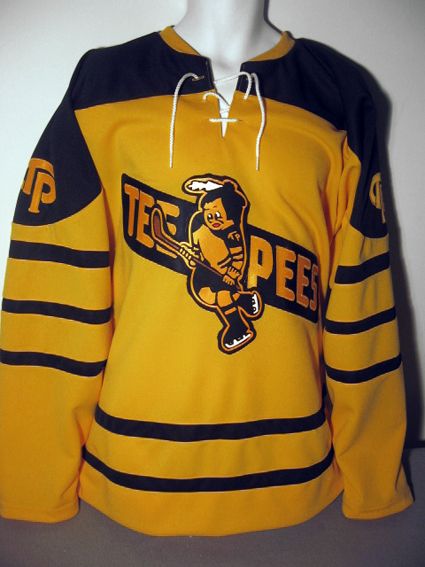
Hull played his junior hockey for the St. Catharines Teepees in the Ontario Hockey Association from 1954-55 to 1956-57, a season in which he scored 33 goals in 52 games, giving a glimpse into the future as to what was to follow.
He made his NHL debut with Chicago at the age of 18 and finished second in the rookie of the year voting following his 13 goal, 47 point season, which included the first of over 600 NHL goals (and over 900 professional when his days in the WHA are taken into account) scored on this date.
His second season was a repeat of the first, with his goals and points edging upwards to 18 and 50. His game really took flight in 1959-60 when he more than doubled his previous goal total to 39 along with 42 assists to lead the league in both categories and capture the first Art Ross Trophy of his career with 81 points.
Hull and the Black Hawks would achieve even greater heights in 1960-61. Although Hull would relinquish the scoring title, he would still top 30 goals with 31, but his 14 points in 12 playoff games would help the Black Hawks to their first Stanley Cup championship in 23 years.
Hull with the 1961 Stanley Cup
Individual honors would return to Hull's trophy case in 1961-62 when he again led the NHL in both goals and points when he became just the third player in NHL history to reach 50 goals in a single season on his way to 84 points. Hull again added 14 points in the playoffs as Chicago again reached the finals, but fell short in six games.
Hull celebrates goal #50 (wearing #7)
After a 31 goal season in 1962-63, Hull once more led the league in goals in 1963-64 with 43 and came in second to teammate Stan Mikita in the points chase 89-87.
The 1964-65 awards ceremony had more in store for Hull, as he took home the Hart Trophy as the league's Most Valuable Player as well as the only Lady Byng Trophy of his career. In the postseason, Hull led Chicago in playoff scoring with 10 goals and 17 points in 14 games as the Black Hawks took the Montreal Canadiens to the full seven games before succumbing.
He really turned on the jets beginning in 1965-66 when he led the league in goal scoring for the first of four consecutive seasons with his second 50 goal season when he netted an NHL record 54 goals as part of his league leading 97 points, which garnered Hull his third Art Ross Trophy and second Hart Trophy.
The next two seasons he again led the league in goals with 52 and then 44 before breaking his own NHL single season record with a career high 58 goals and his first 100 point season when he amassed 107 in 1968-69 as the NHL entered a new era in scoring, at which Hull was at the forefront. At the time, Hull owned four of the six 50 goal seasons in NHL history.
Limited to 61 games the following season, Hull still scored 38 goals and passed the 500 career goals mark, on the third player after Maurice Richard and Gordie Howe to reach that milestone. His final season with the Black Hawks in 1971-72 saw him surpass the 600 goal mark during yet another 50 goal season, his fifth, while only Phil Esposito had more than one to his credit with two.
It was then that the upstart World Hockey Association came calling with an offer too good to refuse, and Hull joined the Winnipeg Jets, becoming the centerpiece of the WHA and giving the league an instant shot of credibility.
Today's featured jersey is a 1961-62 Chicago Black Hawks Bobby Hull jersey. During Hull's first two seasons, the Black Hawks white jerseys had the crossed tomahawks secondary logo located over the sleeve stripes. In 1959 the logo was moved to the now customary position on the shoulders above the sleeve numbers.
This jersey would remain unchanged until 1963 when a third sleeve stripe was added to match the waist striping.
Hull originally broke into the NHL wearing the #16. He would later change to #7 before adopting his more familiar #9. Eventually, back in the NHL following the WHA's merger with the NHL, during the final season of his career he would join Gordie Howe on the roster of the Hartford Whalers and once more wear the #16 in deference to Howe.
photo courtesy of Classic Auctions
Today's first video is a trip down memory lane, with a look at Munro's Bobby Hull table hockey game from the early days of "sports marketing". Love the automatic puck dropping scoreboard with the flags. Rod hockey at it's finest. Check out the teams too, Chicago vs. Minnesota. Perfect, and a nice break from Montreal vs. Toronto.
Forgive the quality of the video taping of the TV screen on this video, but the historical nature of Hull scoring goal #600 makes it worth it.
In this next video, Hull wins the only Stanley Cup of his career in 1961.
Finally, a recent interview with Hull on the occasion of becoming a part of the Blackhawks organization once more after far too long of an absence.
Labels:
Chicago Blackhawks,
Hull Bobby
Saturday, October 19, 2013
A New Era Dawns in College Hockey
This is Terry Pegula, billionaire, hockey fan, owner of the Buffalo Sabres and, most importantly, a Penn State alumnus.
When introduced as the Sabres new owner, he cried being in the presence of Gilbert Perreault, so you really do have to appreciate the man's passion for hockey and his undeniable love for his Sabres, and we do not mean "his Sabres" in the sense that he now owns them, but "his Sabres" in the way he has cheered for them as a fan since forever.
As a man of means beyond what most of us can comprehend, he has also generously donated $102 million to Penn State, the largest private gift in school history, to construct a brand new arena and pay for both the men's and women's club hockey teams to be elevated to Division I status - an incredibly selfless gift that will affect the lives of hundreds future student athletes and arena employees as well as those who were employed in the construction of the new arena.
However…
There is also a man named Jim Delaney, who is president of the Big Ten Conference, and another man named Mark Silverman, who is the president of the Big Ten Network, a channel which is in need of more programming and always looking to add to it's $315 million in revenue it generated in 2012, a 30% increase in ad revenue from 2011 to 2012 and up 60% from 2010's $196 million. With each of the conference schools receiving $24.7 million from the network, and the conference itself seeing a payment of $11 million, Silverman wants to be able to send more of those kinds profits to Delaney.
While there had been discussions regarding the creation of a Big Ten conference for hockey for years, they never amounted to anything, but now with the move to Division I by Penn State, there are now six hockey programs among the Big Ten's current 12 members, a very critical number, as six is the minimum number of teams required for the NCAA to issue an automatic bid into the NCAA tournament for a conference champion and the minimum number of schools needed under Big Ten rules to allow for a conference championship to be recognized.
With that magic number of six schools now reached thanks to the addition of Penn State, and an eager television network looking to add programming, the formation of the Big Ten Hockey Conference was announced in March of 2011, which will begin play this season. The benefits for the six schools is the healthy increase in the amount prestige and publicity they can expect by being now affiliated with the "Big Ten" name, the exposure they will get from having a TV deal with the Big Ten Network and, of course, the money they will receive from the network while having to only divide it six ways by being members of a new, smaller conference.
Those six member schools are Michigan (with 9 national championships), Michigan State (3) and Ohio State, who are all leaving the Central Collegiate Hockey Association (CCHA), Minnesota (5) and Wisconsin (6), who both left the Western Collegiate Hockey Association (WCHA), and the previously mentioned startup program at Penn State, who are going to enjoy the benefits of being able to step right into the highest profile hockey conference in the country.
While the news of five major schools leaving the their two established conferences was in itself a blow to those conferences, they easily could have continued as is, but that was not to be the case.
Oh, no. Not by a long shot.
The stronger schools of the WCHA and CCHA quickly began talks to combine into a new conference of their own, as reported and announced in July of 2011. The new conference was named the National Collegiate Hockey Conference and combines Colorado College (2), Denver (7), Minnesota-Duluth (1), Nebraska-Omaha, North Dakota (7) and later St. Cloud State of the WCHA with Miami of Ohio and then Western Michigan of the CCHA.
This news left the remaining schools in both the WCHA and CCHA reeling, and the other schools being left behind began to look at what they could do to protect their own interests, as the CCHA was now looking at five of it's 11 members leaving, while the WCHA was facing being gutted by the loss of eight of it's 12 members!
The next domino to fall was when Northern Michigan (1) announced it was leaving the CCHA in order to return to it's former conference, the WCHA. The CCHA effectively died when Alaska-Fairbanks, Ferris State and Lake Superior State (3) followed Northern Michigan to the WCHA in August with Bowling Green (1) doing the same on October 4th, followed the very next day by the CCHA's Notre Dame accepting an invitation to join Hockey East in 2013.
The move by Notre Dame in turn led to Connecticut leaving the Atlantic Hockey Association to join Hockey East in 2014 in order to get Hockey East back to an even number of schools. This move will require UConn to make some major changes to it's program, as they currently do not offer scholarships and their home arena seats less than 2,000 fans.
Finally, mercy was shown to the independent program at the University of Alabama-Huntsville when the WCHA agreed to accept the Chargers as it's 10th program, saving the endangered program from extinction and certainly making scheduling easier with an even number of teams, but certainly not easing the now far-flung conference's travel demands any less.
The ramification of all this movement is that the CCHA ceased to exist at the end of the 2012-13 season after 42 years of play, dating back to 1971-72.
Meanwhile, the WCHA was gutted when it lost the likes of Colorado College, Denver, Minnesota, Minnesota-Duluth, Nebraska-Omaha, North Dakota, St. Cloud and Wisconsin (28 combined national titles in all), and will now be comprised of Alabama-Huntsville, Alaska-Anchorage, Alaska-Fairbanks, Bemidji State, Bowling Green, Ferris State, Lake Superior State, Michigan Tech, Minnesota State-Mankato and Northern Michigan (8 combined national titles), taking the WCHA from the most dominant conference in the history of US college hockey, with 36 national titles to it's credit and a conference which sent all four teams to the Frozen Four in 2005, to a collection of cast-offs abandoned by the Big Ten schools and not invited to join the NCHC all banded together for survival. The new WCHA will be virtually unrecognizable, as it will now have more teams in Michigan's upper peninsula than it will have in the states of Minnesota, Colorado, North Dakota, Nebraska and Wisconsin - combined!
In a situation no one wanted, both Alaska schools will now be in the same conference, undesirable to the other conference members due to the high cost of travel expenses involved when making the trip to Alaska, as well as the large time difference, as Alaska is four time zones from the five WCHA schools located in Michigan and Ohio. How remote is Alaska considered to the other schools? A provision in the league playoffs dictates that both Alaska schools will automatically be paired together in the first round of the league playoffs regardless of their conference standing in order to avoid anyone having to travel there!
About the only thing the "new" WCHA has going for it is that it will retain the MacNaughton Cup as it's championship trophy due to the retention of Michigan Tech in all the shuffling of schools.
The disappointments of this massive realignment are many, especially to those fans used to shorter road trips to away games due to conferences grouped geographically. For example, the western-most school in the new Big Ten, Minnesota, previously had eight conference rivals within 390 miles and now finds it's second closest opponent 650 miles to the east.
The other major disappointment is to the schools who worked hard to upgrade their programs from Division III to Division I, construct new buildings and sometimes wait years for acceptance into the WCHA, especially a school like Bemidji State, who spent 11 seasons in the catch-all College Hockey America conference before they were finally able to join fellow Minnesota schools Minnesota, Minnesota-Duluth, Minnesota State and St. Cloud State in 2010, only to now see all but Minnesota State bolt for the promise of greener pastures after just three seasons in the WCHA for the Beavers.
In addition, all of the smaller schools who benefitted from the larger profile Big Ten schools filling their buildings and providing their largest gates will certainly be affected by few, if any, visits from Michigan, Michigan State, Minnesota and Wisconsin. If you are Minnesota State, an hour or so down the road from Minneapolis, do you want Minnesota to fill your building twice a year, or do you want Bowling Green instead? If you are Ferris State, do you want Michigan filling your building, or Alaska-Anchorage coming to town?
Other rumors have hockey taking a back seat to basketball on the Big Ten Network, with the traditional Friday-Saturday series now becoming Thursday-Friday, Saturday-Monday or even Sunday-Monday series, which will garner no favors among the traditional hockey fans, as the whole Big Ten Hockey Conference is being perceived as a big cash grab by the conference and it's television network with no regard for the implications this will have for any of the other programs outside of the six Big Ten schools, particularly the smaller schools who will be greatly affected by the massive shuffling of conferences in the west.
All this sure seems like a lot of trouble to go to for a fledgling Penn State program, which would have fit in nicely geographically and competitively with the CCHA and fellow Big Ten schools Michigan, Michigan State and Ohio State, or even any of the east coast leagues, Hockey East or especially the Eastern Collegiate Athletic Conference (ECAC), regardless of where Penn State's football or basketball programs happen to play.
The other major disappointment will be the severing of so many grand and traditional rivalries, illustrated by the fact the six schools in Michigan will now be spread among three different conferences (5 of 6 were in the CCHA), and the five Minnesota schools (all previously in the WCHA) will also now be scatted among the same three conferences, the Big Ten, NCHC and WCHA, as geography will be thrown to the wind in the new version of Division I hockey. The Big Ten will run from Minnesota to Pennsylvania, the NCHC will span from Colorado to Ohio and the WCHA will stretch from the wilds of Alaska all the way to Ohio in the Eastern time zone and down to Alabama in the deep south!
Last night saw the first conference games in the new NCHC, as things kicked off with North Dakota (still without a nickname following the dropping of "Fighting Sioux") facing off against the top ranked team in the nation, the Miami University Redhawks, with #6 North Dakota coming out on top by a score of 4-2 in Oxford, Ohio despite being outshot 37-25 by the home team.
Later in the west, the Colorado College Tigers defeated the visiting #20 University of Minnesota Duluth Bulldogs 3-1.
The WCHA starts it's conference play on October 25th with Northern Michigan hosting Michigan Tech and Bemidji State making the trip down to Alabama-Huntsville as the two former College Hockey America schools renew acquaintances.
Big Ten conference play will not begin until Friday, November 29th when Ohio State travels to Michigan and Wisconsin visits Minnesota for a Friday-Saturday series, but as predicted, the Ohio State series against Michigan is a very non-traditional Friday-Monday series.
Today's featured jersey is a 2010-11 Miami University RedHawks Vincent LoVerde jersey. The RedHawks entered this weekend as the #1 ranked team in the USCHO.com poll. The school began it's varsity hockey program in 1978 as an independent school for two seasons before joining the CCHA for the 1980-81 season.
It's first NCAA playoff bid came in 1993 with a return in 1997, but only recently became a force in college hockey. After their third NCAA appearance in 2004, the RedHawks have been in the tournament every season since 2006, their consecutive appearance streak now currently at eight.
Miami won the CCHA regular season championship four times, 1993, 2006, 2009 and 2013, as well as winning the CCHA playoff championship in 2011, the same season Andy Miele became the program's first Hobey Baker Award winner as the top player in college hockey.
Their first #1 national ranking arrived in 2006 and set a team record for wins in 2008 with 33, a club led by future NHLers Ryan Jones and Alec Martinez.
2009 saw them reach their first Frozen Four, where they led the championship final 3-1 heading into the final minute of the game, only to eventually lose 4-3 in overtime, and returned to their second Frozen Four in 2010.
Other notable former Miami alumni include former Montreal Canadien Brian Savage, Randy Robitaille, veteran defenseman Dan Boyle of the San Jose Sharks and the New Jersey Devils Andy Greene.
When introduced as the Sabres new owner, he cried being in the presence of Gilbert Perreault, so you really do have to appreciate the man's passion for hockey and his undeniable love for his Sabres, and we do not mean "his Sabres" in the sense that he now owns them, but "his Sabres" in the way he has cheered for them as a fan since forever.
As a man of means beyond what most of us can comprehend, he has also generously donated $102 million to Penn State, the largest private gift in school history, to construct a brand new arena and pay for both the men's and women's club hockey teams to be elevated to Division I status - an incredibly selfless gift that will affect the lives of hundreds future student athletes and arena employees as well as those who were employed in the construction of the new arena.
However…
There is also a man named Jim Delaney, who is president of the Big Ten Conference, and another man named Mark Silverman, who is the president of the Big Ten Network, a channel which is in need of more programming and always looking to add to it's $315 million in revenue it generated in 2012, a 30% increase in ad revenue from 2011 to 2012 and up 60% from 2010's $196 million. With each of the conference schools receiving $24.7 million from the network, and the conference itself seeing a payment of $11 million, Silverman wants to be able to send more of those kinds profits to Delaney.
While there had been discussions regarding the creation of a Big Ten conference for hockey for years, they never amounted to anything, but now with the move to Division I by Penn State, there are now six hockey programs among the Big Ten's current 12 members, a very critical number, as six is the minimum number of teams required for the NCAA to issue an automatic bid into the NCAA tournament for a conference champion and the minimum number of schools needed under Big Ten rules to allow for a conference championship to be recognized.
With that magic number of six schools now reached thanks to the addition of Penn State, and an eager television network looking to add programming, the formation of the Big Ten Hockey Conference was announced in March of 2011, which will begin play this season. The benefits for the six schools is the healthy increase in the amount prestige and publicity they can expect by being now affiliated with the "Big Ten" name, the exposure they will get from having a TV deal with the Big Ten Network and, of course, the money they will receive from the network while having to only divide it six ways by being members of a new, smaller conference.
Those six member schools are Michigan (with 9 national championships), Michigan State (3) and Ohio State, who are all leaving the Central Collegiate Hockey Association (CCHA), Minnesota (5) and Wisconsin (6), who both left the Western Collegiate Hockey Association (WCHA), and the previously mentioned startup program at Penn State, who are going to enjoy the benefits of being able to step right into the highest profile hockey conference in the country.
While the news of five major schools leaving the their two established conferences was in itself a blow to those conferences, they easily could have continued as is, but that was not to be the case.
Oh, no. Not by a long shot.
The stronger schools of the WCHA and CCHA quickly began talks to combine into a new conference of their own, as reported and announced in July of 2011. The new conference was named the National Collegiate Hockey Conference and combines Colorado College (2), Denver (7), Minnesota-Duluth (1), Nebraska-Omaha, North Dakota (7) and later St. Cloud State of the WCHA with Miami of Ohio and then Western Michigan of the CCHA.
This news left the remaining schools in both the WCHA and CCHA reeling, and the other schools being left behind began to look at what they could do to protect their own interests, as the CCHA was now looking at five of it's 11 members leaving, while the WCHA was facing being gutted by the loss of eight of it's 12 members!
The next domino to fall was when Northern Michigan (1) announced it was leaving the CCHA in order to return to it's former conference, the WCHA. The CCHA effectively died when Alaska-Fairbanks, Ferris State and Lake Superior State (3) followed Northern Michigan to the WCHA in August with Bowling Green (1) doing the same on October 4th, followed the very next day by the CCHA's Notre Dame accepting an invitation to join Hockey East in 2013.
The move by Notre Dame in turn led to Connecticut leaving the Atlantic Hockey Association to join Hockey East in 2014 in order to get Hockey East back to an even number of schools. This move will require UConn to make some major changes to it's program, as they currently do not offer scholarships and their home arena seats less than 2,000 fans.
Finally, mercy was shown to the independent program at the University of Alabama-Huntsville when the WCHA agreed to accept the Chargers as it's 10th program, saving the endangered program from extinction and certainly making scheduling easier with an even number of teams, but certainly not easing the now far-flung conference's travel demands any less.
The ramification of all this movement is that the CCHA ceased to exist at the end of the 2012-13 season after 42 years of play, dating back to 1971-72.
Meanwhile, the WCHA was gutted when it lost the likes of Colorado College, Denver, Minnesota, Minnesota-Duluth, Nebraska-Omaha, North Dakota, St. Cloud and Wisconsin (28 combined national titles in all), and will now be comprised of Alabama-Huntsville, Alaska-Anchorage, Alaska-Fairbanks, Bemidji State, Bowling Green, Ferris State, Lake Superior State, Michigan Tech, Minnesota State-Mankato and Northern Michigan (8 combined national titles), taking the WCHA from the most dominant conference in the history of US college hockey, with 36 national titles to it's credit and a conference which sent all four teams to the Frozen Four in 2005, to a collection of cast-offs abandoned by the Big Ten schools and not invited to join the NCHC all banded together for survival. The new WCHA will be virtually unrecognizable, as it will now have more teams in Michigan's upper peninsula than it will have in the states of Minnesota, Colorado, North Dakota, Nebraska and Wisconsin - combined!
In a situation no one wanted, both Alaska schools will now be in the same conference, undesirable to the other conference members due to the high cost of travel expenses involved when making the trip to Alaska, as well as the large time difference, as Alaska is four time zones from the five WCHA schools located in Michigan and Ohio. How remote is Alaska considered to the other schools? A provision in the league playoffs dictates that both Alaska schools will automatically be paired together in the first round of the league playoffs regardless of their conference standing in order to avoid anyone having to travel there!
About the only thing the "new" WCHA has going for it is that it will retain the MacNaughton Cup as it's championship trophy due to the retention of Michigan Tech in all the shuffling of schools.
The MacNaughton Cup
The disappointments of this massive realignment are many, especially to those fans used to shorter road trips to away games due to conferences grouped geographically. For example, the western-most school in the new Big Ten, Minnesota, previously had eight conference rivals within 390 miles and now finds it's second closest opponent 650 miles to the east.
The other major disappointment is to the schools who worked hard to upgrade their programs from Division III to Division I, construct new buildings and sometimes wait years for acceptance into the WCHA, especially a school like Bemidji State, who spent 11 seasons in the catch-all College Hockey America conference before they were finally able to join fellow Minnesota schools Minnesota, Minnesota-Duluth, Minnesota State and St. Cloud State in 2010, only to now see all but Minnesota State bolt for the promise of greener pastures after just three seasons in the WCHA for the Beavers.
Bemidji State's new Sanford Center
In addition, all of the smaller schools who benefitted from the larger profile Big Ten schools filling their buildings and providing their largest gates will certainly be affected by few, if any, visits from Michigan, Michigan State, Minnesota and Wisconsin. If you are Minnesota State, an hour or so down the road from Minneapolis, do you want Minnesota to fill your building twice a year, or do you want Bowling Green instead? If you are Ferris State, do you want Michigan filling your building, or Alaska-Anchorage coming to town?
Other rumors have hockey taking a back seat to basketball on the Big Ten Network, with the traditional Friday-Saturday series now becoming Thursday-Friday, Saturday-Monday or even Sunday-Monday series, which will garner no favors among the traditional hockey fans, as the whole Big Ten Hockey Conference is being perceived as a big cash grab by the conference and it's television network with no regard for the implications this will have for any of the other programs outside of the six Big Ten schools, particularly the smaller schools who will be greatly affected by the massive shuffling of conferences in the west.
All this sure seems like a lot of trouble to go to for a fledgling Penn State program, which would have fit in nicely geographically and competitively with the CCHA and fellow Big Ten schools Michigan, Michigan State and Ohio State, or even any of the east coast leagues, Hockey East or especially the Eastern Collegiate Athletic Conference (ECAC), regardless of where Penn State's football or basketball programs happen to play.
The other major disappointment will be the severing of so many grand and traditional rivalries, illustrated by the fact the six schools in Michigan will now be spread among three different conferences (5 of 6 were in the CCHA), and the five Minnesota schools (all previously in the WCHA) will also now be scatted among the same three conferences, the Big Ten, NCHC and WCHA, as geography will be thrown to the wind in the new version of Division I hockey. The Big Ten will run from Minnesota to Pennsylvania, the NCHC will span from Colorado to Ohio and the WCHA will stretch from the wilds of Alaska all the way to Ohio in the Eastern time zone and down to Alabama in the deep south!
Last night saw the first conference games in the new NCHC, as things kicked off with North Dakota (still without a nickname following the dropping of "Fighting Sioux") facing off against the top ranked team in the nation, the Miami University Redhawks, with #6 North Dakota coming out on top by a score of 4-2 in Oxford, Ohio despite being outshot 37-25 by the home team.
Later in the west, the Colorado College Tigers defeated the visiting #20 University of Minnesota Duluth Bulldogs 3-1.
The WCHA starts it's conference play on October 25th with Northern Michigan hosting Michigan Tech and Bemidji State making the trip down to Alabama-Huntsville as the two former College Hockey America schools renew acquaintances.
Big Ten conference play will not begin until Friday, November 29th when Ohio State travels to Michigan and Wisconsin visits Minnesota for a Friday-Saturday series, but as predicted, the Ohio State series against Michigan is a very non-traditional Friday-Monday series.
Today's featured jersey is a 2010-11 Miami University RedHawks Vincent LoVerde jersey. The RedHawks entered this weekend as the #1 ranked team in the USCHO.com poll. The school began it's varsity hockey program in 1978 as an independent school for two seasons before joining the CCHA for the 1980-81 season.
It's first NCAA playoff bid came in 1993 with a return in 1997, but only recently became a force in college hockey. After their third NCAA appearance in 2004, the RedHawks have been in the tournament every season since 2006, their consecutive appearance streak now currently at eight.
Miami won the CCHA regular season championship four times, 1993, 2006, 2009 and 2013, as well as winning the CCHA playoff championship in 2011, the same season Andy Miele became the program's first Hobey Baker Award winner as the top player in college hockey.
Their first #1 national ranking arrived in 2006 and set a team record for wins in 2008 with 33, a club led by future NHLers Ryan Jones and Alec Martinez.
2009 saw them reach their first Frozen Four, where they led the championship final 3-1 heading into the final minute of the game, only to eventually lose 4-3 in overtime, and returned to their second Frozen Four in 2010.
Other notable former Miami alumni include former Montreal Canadien Brian Savage, Randy Robitaille, veteran defenseman Dan Boyle of the San Jose Sharks and the New Jersey Devils Andy Greene.
Labels:
Big Ten Hockey Conference,
CCHA,
Miami University,
NCHC,
WCHA
Subscribe to:
Posts (Atom)