History of Jersey 83-93 Banner sm photo History of Jersey 83-93 Banner sm.jpg

Thursday, June 16, 2011

2010-11 Boston Bruins Tim Thomas Jersey

Following the Boston Bruins 4-0 victory over the Vancouver Canucks last night to capture the first Stanley Cup for Boston in 39 years, Tim Thomas was named the winner of the Conn Smythe Trophy as the most valuable player during the playoffs. As the 40th different man to win the award, he also became only the second American to win the award as well as the oldest player to win the award at age 37.

Thomas Smythe
Thomas with the Smythe Trophy

Thomas, who had lost his job as the Bruins starting goaltender the previous year to Tukka Rask, was the subject of rampant trade rumors entering the 2010-11 season and opted to not have his mask decorated in Bruins specific colors in anticipation of being dealt to another club, and instead went with a stark white and grey mask.

Thomas Mask Comparison
2009-10aaaaaaaaaaaaaaaaaaaaaaaaaa2010-11

After going 36-11-7 with a .933 save percentage and a 2.10 goals against average in 2008-09, which earned him the coveted Vezina Trophy, Thomas saw his record plummet to 17-18-8, while his save percentage dipped to .915 and his goals against was up to 2.56 while starting just seven games after January.

Thomas Vezina
Thomas poses with the Vezina Trophy

Following the season Thomas had hip surgery in May and the effect was dramatic, as Thomas won his first seven starts in 2010-11, three by shutout, while giving up a ridiculous five goals. He quickly won back the starting job as a result and by the end of the season Thomas had appeared in 57 regular season games, winning 35 while losing just 11 with 7 overtime losses. He also set a new NHL record with a .938 save percentage and dropped his goals against average to 2.00, a NHL career low.

Once in the playoffs, the Bruins, who won the Northeast Division but only had the fifth best record in the conference, were taken to a Game 7 by their rivals, the Montreal Canadiens before advancing with a win in overtime. They dispatched the Philadelphia Flyers in four straight to earn some rest before the Tampa Bay Lightning also forced Boston to the maximum seven games. Thomas was brilliant in Game 7 against the Lightning, shutting them out 1-0, his second clean sheet of the round, which sent Boston to the finals as Eastern Conference champions.

Vancouver won two narrow victories at home, the first a 1-0 victory, with the lone goal coming with just 19 seconds left in the game, and the second requiring overtime. Back in Boston the Bruins utterly demolished Vancouver by scores of 8-1 and 4-0, as Thomas had now only allowed five goals in four games yet the series was tied at two games apiece.

The Bruins then returned to Vancouver, only to lose yet another 1-0 game on the road. What other goalie in the Stanley Cup Finals has given up just six goals in five games but found themselves behind in the series?

Boston again evened the series with a dominating 5-2 win in Game 6, leading 4-0 with less than half the first period completed, before clinching the cup back in Vancouver with last night's 4-0 victory on the road in only Thomas' seventh season in the league, as compared to Martin Broduer's 18 seasons, despite Thomas being just two years younger than Brodeur.

Thomas Stanley Cup

Thomas earned the Conn Smythe by setting records, including the Most Saves in a Playoff Year (798) and Most Saves in the Stanley Cup Finals (238). He also had a 1.98 goals against average and a .940 save percentage as well as four shutouts during the playoffs, including becoming the first goalie to earn a shutout in Game 7 of the finals on the road in NHL history. In the finals, his goals against average was just 1.15 and his save percentage was a stellar .967.

All this for a man whose route to the NHL was an unconventional journey from four years with the Vermont Catamounts of the NCAA from 1003-94 to 1996-97 to time in the ECHL in Birmingham, Alabama, to Houston, Texas of the AHL and overseas to HIFK in Finland where he won a championship, all during 1997-98.

Thomas HIFK
Thomas with HIFK

He signed with the Edmonton Oilers and played with their top minor league club, the Hamilton Bulldogs of the AHL before once again returning to HIFK. He spent the 1999-00 season with the Detroit Vipers of the IHL prior to spending the next two seasons with AIK in Sweden in 2000-01 and Karpat Oulu again in Finland for 2001-02, a far cry from the usual NCAA to AHL to NHL path taken by more elite prospects.

Signed as a free agent by the Bruins organization in August of 2002, Thomas was assigned to the Providence Bruins in the AHL. He also made his long-awaited NHL debut on October 19, 2002, one of four NHL games he would play that season.

His entire 2003-04 season was spent with Providence and the NHL lockout of 2004-05 saw Thomas return to the familiar territory of Finland, this time with Jokerit of Helsinki, where he had an outstanding season, going 34-7-13 and earn the league MVP and Golden Helmet awards.

Thomas Jokerit
Thomas with Jokerit during the 2004-05 NHL lockout

When play in the NHL resumed in 2005-06, Thomas was back in North America, where he split time with Providence (26 games) and Boston (38 games). Beginning in 2006-07, Thomas was now finally a full-time member of the NHL at the age of 31.

After a strong 2007-08 season in which he was 28-19-6 and lowered his goals against from 3.13 to 2.44 and raised his save percentage from .905 to .921 the year before winning the Vezina in 2008-09.

Today's featured jersey is a 2010-11 Boston Bruins Tim Thomas jersey as worn during the 2011 Stanley Cup Finals.

The Bruins adopted this style in 2006-07 when the new Reebok Edge jerseys were introduced, but they were loosely based on the Bruins traditional jerseys worn from 1968 to 1973, and were easily the best by far of the brand new designs introduced that season.

Boston Bruins 10-11 F
Boston Bruins 10-11 B

Today's video segment begins with Thomas accepting the Conn Smythe Trophy.


Next, the Top 10 Tim Thomas saves.


Finally, a detailed look at Thomas' white mask.


Wednesday, June 15, 2011

1986-87 Quebec Nordiques Mario Gosselin Jersey

Mario Gosselin, born on this date in 1963, played junior hockey for the Shawnigan Cataractes of the QMJHL from 1980-81 to 1982-83, including going 32-9-1 in his final season.

He was drafted 55th overall by the Quebec Nordiques in the 1982 NHL Entry Draft but spent the 1983-84 season playing with the Canadian National Team program prior to playing in the 1984 Olympics for Canada in Sarajevo, Yugoslavia. On his return from Europe, he made a memorable NHL debut with the Nordiques on February 26, 1984, shutting out the St. Louis Blues 5-0.

Mario Gosselin

The next season he would see action in 35 games while splitting playing time with Richard Sevigny (20 games) and Dan Bouchard (29). His 19-11-3 record gave him the most wins on the team. He would also see action in 17 playoff games, going 9-8 as the Nordiques would make it all the way to the Eastern Conference finals. Their legendary seven game series against their hated rivals, the Montreal Canadiens, would prove to be the high point of the Nordiques franchise in the NHL.

Gosselin again split time in goal in 1985-86, only this time with the newly arrived Clint Malarchuk. Gosselin's 31 appearances saw him post a 14-14-1 mark.

Malarchuk again got the bulk of the playing time in 1986-87, but the Nordiques fell down the standings, finishing 20 points lower that the year before. Gosselin's 13-11-1 mark gave him he only winning record among the Nordiques goaltenders that season. He also made 11 playoff starts, going 7-4.

With Malarchuk no longer in the picture, Gosselin played in 54 games in 1987-88, winning 20 of them, both career highs. The following season Gosselin led the Nordiques in appearances with 39, once more sharing time in the nets, but now with Ron Tugnutt (26 games) and Bob Mason (22). Gosselin led the last place club with 11 wins.

He signed with the Los Angeles Kings as a free agent for the 1989-90 season and posted a 7-11-1 mark in 26 appearances while backing up Kelly Hrudey.

Following his one season in Los Angeles, he signed a free agent contract with the Hartford Whalers, who assigned him to their minor league affiliate, the Phoenix Roadrunners of the IHL. In 46 games he posted a strong 24-15-4 record and went 7-4 in 11 playoff games.

He spent the entire 1991-92 season in the AHL, leading the Springfield Indians with a 28-11-5 record. He split time with Springfield and Hartford in 1992-93. In 16 games with Hartford, he went 5-9-1.

The 1993-94 season saw Gosselin play two games with Springfield before being recalled by Hartford for seven games, but would suffer a career-ending knee injury in November.

His final NHL totals show 241 games played and a 91-107-14 record.

In 1984, the ice arena in Thetford Mines, Quebec was renamed the Centre Mario Gosselin after the Thetford Mines native.

Today's jersey is a 1986-87 Quebec Nordiques Mario Gosselin jersey which features the Rendes-vouz '87 patch on the right sleeve.

Rendez-vous 87 was a two game series held in Quebec City that pitted a team of NHL All-Stars against the Soviet National Team rather than the traditional NHL All-Star Game that season.

This jersey is customized with the bold, single color white numbers used by the Nordiques from the time they adopted this jersey style in 1975, while then members of the World Hockey Association, until the conclusion of the 1990-91 season before going to two color numbers, white trimmed in red, for the 1991-92 season.

86-87 Quebec Nordiques

Today's first video is a tribute to the career of Mario Gosselin and features excellent quality video from throughout his entire NHL career.


Here is footage from the 1984 Olympics, where Gosselin makes a great save in goal for Canada against Sweden.


Our final video today is a look at the renovations at the Centre Mario Gosselin in his hometown of Thetford Mines.


Tuesday, June 14, 2011

1993-94 New York Rangers Brian Leetch Jersey

With a 3-2 victory on this date in 1994 the New York Rangers won one of the most memorable championships in NHL history. Ending a 54-year drought, something the New York Islanders fans were fond of pointing out with chants of "Nineteen-Forty! Nineteen-Forty!", the Rangers captured their fourth title in franchise history by defeating the Vancouver Canucks in Game 7 of the finals.

In a very momentous season, the Rangers hosted the NHL All-Star Game in January, won the President's Trophy for their regular season and went onto capture the Stanley Cup as well.

The Rangers were captained by Mark Messier and led in scoring by defenseman Sergei Zubov, with 89 points, while Adam Graves had the most goals with 52. The Rangers had many other contributors that season as well, including Brian Leetch, Steve Larmer, Alexi Kovalev, Esa Tikkanen, Sergei Nemchinov, Kevin Lowe and Jeff Beukeboom. Mike Richter and Glenn Healy shared the goaltending during the regular season, with Richter handling the vast majority of the playoff duties. Acquired during trades during the season, Stephane Matteau, Brian Noonan, Glenn Anderson and Craig MacTavish all played roles in the playoffs, with Matteau's goal in the second overtime of Game 7 of the Eastern Conference Finals being the most memorable.

The Canucks won Game 1 on the road in overtime to start the series and the Rangers came back to win Game 2 at home, as well as Games 3 & 4 in Vancouver to seemingly take control of the series with the next game back on home ice in New York. The Canucks had other plans however, taking the next two games to set up the dramatic seventh and deciding game at Madison Square Garden.

The Rangers got out to an early 2-0 lead before Trevor Linden scored short-handed early in the second. Messier scored for the Rangers only to have Linden pull one back for the Canucks early in the third. Vancouver hit the post with five minutes left in the game and the Rangers held on to win the Stanley Cup. Brian Leetch was not only named the first American-born player to win the Conn Smythe Trophy, but the first non-Canadian as well.

Photobucket

Today's jersey is a 1993-94 New York Rangers Brian Leetch jersey featuring the 1994 Stanley Cup Finals patch. This was the smallest size finals patch ever made, in deference to the Rangers needing to wear the patch on their shoulders due to the diagonal "Rangers" cresting across the front of the jersey taking up the space on the upper right chest where the patch is customarily worn. Aside from the first time the patch was worn in 1989, when it was located on the upper left sleeves, this is the only instance of the finals patch not being worn on the upper right chest.

1993-94 NHL New York Rangers Brian Leetch jersey

In a milestone side note, Zubov, Kovalev, Nemchinov and Alexander Karpovtsev became the first four Russian-trained players to have their names engraved on the Stanley Cup.


Sunday, June 12, 2011

Future NHL Realignment

With the Atlanta Thrashers moving from the southeastern United States to central Canada, the talk of NHL realignment has been a popular one as of late. It's a subject we have our own opinions and convictions about.

As a starting point, here is a map of the location of all the NHL teams for the just completed 2010-11 season.

2010-11 nhl map
2010-11 NHL Divisional Alignment

The things to note are the compactness of the Northeast and Atlantic Divisions, especially compared with the Northwest and Pacific Divisions in the Western Conference. Also of note are the distances from both Minnesota and Dallas, both located in the Central Time Zone, from all the other teams in their divisions, none of which are even located in the same time zone.

Now let's take a look at the 2011-12 NHL team locations, swapping Atlanta for Winnipeg, using a Jets icon for the time being.

NHL locations 11-12
NHL 2011-12 Team Locations

Keeping the current divisional alignment relatively intact, we propose adding Winnipeg to the Northwest Division, moving Minnesota to the Central and shifting Nashville to the Southeast.

This would reunite Minnesota with St. Louis, Chicago and Detroit from the days of the old Norris Division of the 1980's and place them in a division with teams from the same Central Time Zone. It would also reunite Winnipeg with Edmonton, Calgary and Vancouver of the Smythe Division of the same era. While Winnipeg would now find themselves in a somewhat similar position as Minnesota, being isolated in the Central Time Zone, it would be a better situation, as they would be in a division with three other Canadian teams, reducing the number of border crossings Minnesota had to endure.

While Nashville would be located farther from their closest rivals than they are now, someone needs to move east, and separating Detroit from Chicago and St. Louis is something we would never want to do. Moving Columbus into the Southeast instead of Nashville is a possibility, but looking at the map, the proximity of Columbus to Detroit, combined with the southern location of Nashville, makes this the preferred option in our minds.

nhl-map 11-12 6Div
2011-12 NHL 6 Division Proposal

We considered another possibility, moving two teams to the Southwest, both Nashville and Columbus, hoping to move Washington into the Atlantic division along with nearby Philadelphia and the three New York/New Jersey clubs. The fly in the ointment would be requiring one eastern team to move west, with Pittsburgh being the candidate to join Detroit, Chicago, St. Louis and Minnesota. Pittsburgh would never agree to being moved west to play the likes of San Jose, Vancouver and Los Angeles, and Toronto would not want to leave Ottawa and Montreal, so we see no hope for this plan. Washington seems permanently stuck in the Southeast due to the high concentration and high volume of teams in the Northeast.

Still, with our 6 Division proposal all sorted out, we still have one major flaw we just cannot tolerate, the Dallas Stars being isolated in the Pacific Division, 866 miles from their nearest neighbors in Phoenix. This is due to the poor idea of dividing the western half of the continent into north and south, placing Colorado with the four teams north of them and the three California teams with the two clubs, Phoenix and Dallas, which were located equally as far south, despite how far east Dallas and Minnesota were.

What we propose is to make the divisional alignments based on vertical divisions, rather than the current horizontal alignments. Additionally, we also would embrace the American Hockey League model, reducing the number of divisions to just four. Each conference would be made of one seven and one eight team division.

The method we would use to place the teams in each of the four divisions begins in the northeast and places Montreal, Ottawa and Toronto together, adding in Buffalo. The Division is then completed with the three New York/New Jersey teams and traditional New York rival Boston, who stay in the same division with their rivals Montreal.

The remaining seven teams in the east are the two Pennsylvania clubs Philadelphia and Pittsburgh, as well as Washington, who belong in a division with nearby Philadelphia. The four remaining southern teams, Carolina, Nashville, Tampa Bay and Florida round out the group.

In the west, we simply group the seven teams which are the furthest west, San Jose, Los Angeles and Anaheim are grouped with nearby Phoenix and the three western-most Canadian teams, Vancouver, Edmonton and Calgary.

The Central Division is based on grouping Winnipeg, Minnesota and Dallas together since they are located in a relative vertical line. Traditional rivals St. Louis, Chicago and Detroit are then added. Columbus is included due to its proximity to Detroit and the Division is rounded out with Colorado in order to lessen the isolation of Dallas.

nhl-map 11-12 4Div
2011-12 NHL 4 Division Proposal

Colorado could just as easily be shifted to the Western Division based on their preference, as placing them in the West Division would avoid a repeat of a club being in a division with no other members located in it's time zone.

nhl-map 11-12 4Div-2
2011-12 NHL 4 Division Proposal #2 with Colorado in the Western Division

In addition to grouping the teams in a more fair and logical way, even more importantly, the playoffs would return to the system once used by the NHL, where the first two rounds of the playoffs would be played exclusively within your own division among the top four in each division. The benefit of this development would be the increased number of times clubs would face the same teams during the playoffs as the years would go by, and if there's one thing we will scream from the top of our lungs until Gary Bettman believes it, is that rivalries are created during the playoffs. Playing the same teams over and over during the regular season makes for repetitious boredom, while playing to end your opponent's season creates intensity and drama.

Two rounds of playoffs among the same seven teams gives you a 1-in-3 chance of facing the same team as the previous season, when compared to a 1-in-7 chance of repeating an opponent from the previous season as it stands now. In reality, the odds of facing the same team improves in the short term when you factor in successful teams making the playoffs more often while they are in periods of greater success.

The NHL would likely then have the division winners in each conference face each other to determine a conference champion, but we'd like to see the final four teams seeded by points. This would have several benefits, the first being that if two strong teams advanced from one conference and the lowest two from the other, as happened in 2002-03., this system would increase the chances of the most competitive Stanley Cup Finals possible as well as allowing for the possibility of an occasional Philadelphia vs. New York or Boston vs. Washington final.

After implementing this alignment, we'd also adjust the schedule to include playing every team in the league at home every year in the manner of the NBA schedule.

The breakdown would be;

If you are in the seven team division;
  • You play the 15 teams in the other conference twice a year = 30 games
  • You play the 8 teams in the other division of your conference twice a year = 16 games
  • You play the other 6 teams in your division 6 times a year = 36 games

If you play in the eight team division;
  • You play the 15 teams in the other conference twice a year = 30 games
  • You play the 7 teams in the other division of your conference twice a year = 14 games
  • You play the other 7 teams in your division 5 times a year = 35 games
  • You play the remaining 3 games in your division among the 7 teams on a rotating annual basis = 3 games

It's a topic there are naturally many, many solutions to and opinions on, so feel free to add yours in the comments below.

Friday, June 10, 2011

1990-91 New York Islanders Brent Sutter Jersey

Louis and Grace Sutter's first son Gary was born first in 1954 and chose not to pursue a hockey career. Brian, the oldest of the six to make it to the NHL arrived in 1956 and was followed by Darryl in 1958 and Duane in 1960.

Brent Sutter was born on this date in 1962 and was followed by twin brothers Rich and Ron who arrived on the scene in 1963.

The Sutter family
Louis and Grace Sutter with their seven sons

While the six younger brothers all had lengthy NHL careers, putting tiny Viking, Alberta on the map, they remember Gary as being the best skater in the bunch. Brian played 12 seasons, all with the St. Louis Blues. Darryl spent eight seasons with the Chicago Black Hawks and had his career shortened by injuries and went into coaching and is currently the general manager of the Calgary Flames. Duane spent eight years with the New York Islanders and closed out his career with three seasons in Chicago.

Brent followed the familiar Sutter path, first playing for the Red Deer Rustlers of the Alberta Junior Hockey League, and scored an amazing 171 points in 59 games prior to being drafted 17th overall in the 1980 NHL Entry Draft by the New York Islanders, who had already drafted Duane the year before. He then continued the established Sutter path of moving up to the Lethbridge Broncos of the Western Hockey League as Brian, Darryl and Duane had done before him.

He made his NHL debut in the 1980-81 season with three games with the Islanders, scoring 2 goals and 2 assists. He began the 1981-82 season between Lethbridge, scoring 46 goals and 80 points in just 34 games before getting called up to play 43 regular season games with New York, averaging a point a game in addition to racking up 114 penalty minutes, as he established himself as an NHL regular while displaying the trademark Sutter toughness. Once in the playoffs, Sutter scored 8 points in 19 games as the Islander dynasty marched on to it's third consecutive Stanley Cup championship.

Sutter played in all 80 Islander games in 1982-83 and had 21 points in 20 playoff games to earn his second Stanley Cup in a row.

1983-84 saw Sutter raise his personal goal scoring high to 34. In the playoffs, the Islanders again reach the finals and Sutter registered another 14 points in 20 games.

By far the greatest offensive season of Sutter's career arrived in 1984-85, when he reached 40 goals for the only time in his career with 42, while adding 60 assists, remarkable because it was the only time in his career he would have more than 36. His 102 points were second on the club behind only Mike Bossy's 117 and good for 10th overall in the league. It would also be the highest scoring season for any of the Sutter brothers ever and the only one to top 100 points in a season.

While he would return to Earth with 55 points the following season, it would start a run of consistency in the four subsequent seasons when Brent would score between 24 and 29 goals and 60 and 68 points each year between 1987 and 1990. He was also named as the Islanders captain from 1987-88 to 1990-91.

Duane and Brent Islanders
Duane and Brent played together for the Islanders from 1980-81 to 1986-87 - note the one color name on Duane's jersey while Brent's was two colors!

After another season on Long Island, Sutter would be traded to the Chicago Blackhawks early in the 1991-92 season. His 50 points in Chicago, combined with his 10 scored in New York, gave him 60 for the fifth time in six years and he would return to the Stanley Cup Finals for the first time since 1984. After a 20 goal, 54 point season in 1992-93, in which he was coached by his older brother Darryl, a changed role with the Blackhawks saw him limited to 9 goals and 38 points, ending a streak of at least 20 goals and 40 or more points dating back 12 years to the beginning of his professional career.

Brent would finish his career with four more seasons in Chicago, concluding at the end of the 1997-98 campaign. Although he did not score as often as he once did, he was quoted as saying, "I might not score as often as I once did but other areas of my game are better than when I was younger."

His final NHL totals were 1111 games played, 363 goals, 466 assists and 829 points as well as 1054 penalty minutes. Additionally, he played in 144 playoff games, scoring 30 goals and 44 assists for 74 points, made four trips to the finals, winning two Stanley Cups.

Internationally, Brent skated for Team Canada in the 1984 Canada Cup, contributing 4 points in eight games as Canada won the gold medal. 1985 saw him help Canada to a silver medal in the World Championships with 11 points in 8 games. Two more gold medals would follow at both the 1987 and 1991 Canada Cup tournaments, giving Brent an impressive three golds and one silver in four tries.

Rich and Ron Sutter both debuted in the 1982-83 season and played together for the Philadelphia Flyers in 1983-84 through 1985-86 and again with the St. Louis Blues in 1991-92 and 1992-93. Rich would play 13 seasons until 1995, while Ron's career spanned 19 seasons, lasting until 2001. For five seasons all six brothers played in the league at the same time, four of them became team captains and Ron's final season of 2000-01 was the 25th consecutive season a Sutter brother played in the NHL.

The Sutter display @ HHOF
The Sutter family display at the Hockey Hall of Fame

Brent is currently the head coach of the Calgary Flames.

Today's featured jersey is a CCM 1990-91 New York Islanders Brent Sutter jersey. This jersey is from Brent's final full season as an Islander while he was serving as team captain. It lacks his first initial "B", as his brother Duane had moved on to the Blackhawks by this time.

1990-91 Islanders jersey

Bonus Jersey: Today's bonus jersey is a CCM 1991 Team Canada Brent Sutter jersey. as used in the 1991 Canada Cup tournament. While the name and number of this jersey are sewn on twill, the main crest and sleeve logos are screen on, which has resulted in the cracking and wear displayed here. The 1991 Canada Cup jerseys featured the Labatt Canada Cup patch, which is sewn on the upper right chest.

1991 Canada Cup Team Canada

Here is footage of the Islanders celebrating their Stanley Cup victory in 1982, the first of Brent's career.


Here is a four part story on the Sutter brothers.


We conclude with Brent, then coach of the Devils, in a light-hearted moment talking about his mother dancing with broadcaster Chico Resch.


Thursday, June 9, 2011

1976-77 Winnipeg Jets Dan Labraaten Jersey

Swedish left winger Dan Labraaten, born on this date in 1951, played in the Swedish second division for three seasons from 1966-67 to 1968-69.

He moved up to to the top level of Swedish hockey when he joined Leksands IF. During that time period he also skated for Sweden in the European Junior Championships in both 1968 (winning bronze), 1969 (silver) and 1970.

Labraaten continued to skate for the dominant Leksands IF over the course of the next six seasons, with his standout being the 1974-75 season in which he scored 24 goals and 38 points in 30 games while playing with future Minnesota North Stars Per-Olav Brasar and Roland Eriksson.

Labraaten Leksands IF

During Labraaten's time with the Leksands IF from 1970 to 1976, the team were playoff runners up in 1971 and 1972 and winners of the Le Mat Trophy as playoff champions in 1973, 1974 and 1975. Labraaten played for the Sweden National Team at the 1974 World Championships where he came away with a bronze medal.

He also added to his international resume with two more appearances in the World Championships, first in 1975 when he scored nine goals in ten games, and again in 1976 with eight points in ten games, coming home again with bronze medals both times. In September of 1976, Labraaten was a member of the Sweden National Team in the inaugural Canada Cup.

Following the success of Swedish imports Ulf Nilsson and Anders Hedberg, Labraaten joined the Swedish superstars as a member of the high flying Winnipeg Jets of the World Hockey Association for the 1976-77 season. While his 51 points were far and away his career high to date, thanks to a much longer season than in Sweden, it paled in comparison to to the 131 by Hedberg. The playoffs were another matter, as Labraaten was third in team scoring with 24 points in 20 games, just five back of Hedberg and three behind Nilsson but two ahead of the great Bobby Hull.

Labraaten Jets

His second season in Winnipeg proved to be less personally successful, as he was limited to just 47 games, which naturally lowered his final offensive numbers to 34 points, but the Jets would capture the Avco Cup as league champions at the end of the season.

He was not retained by the Jets and signed with the Detroit Red Wings of the NHL for the 1979-80 season. The going was a bit tougher in the NHL, as Detroit was going through the "Dead Wings" era, during which they missed the playoffs 15 of 17 seasons. Despite playing in 31 more games with Detroit, he only scored four more points than he did in with Winnipeg, a reflection of playing with a losing team in a less wide open league. With Detroit missing the playoffs yet again, Labraaten was available for World Championship duty for Sweden in 1979, which resulted in his fourth bronze medal in as many tries.

Labraaten Red Wings

Labraaten then had the best season of his career, setting career highs with 30 goals and 57 points in 1979-80. A poor first half in 1980-81 saw the Red Wings trade him to the Calgary Flames where he was strictly a role player over the next season and a half during which he played in just 70 games and scoring 38 points to close out the NHL portion of his career.

Labraaten returned to Sweden for the 1982-83 season and rejoined Leksands IF, with whom he would play the final six seasons of his professional career. Proving he had not lost his offensive touch, Labraaten had the finest season in Sweden during 1983-84 during which he score 23 goals and 44 points in 36 games to win the Elitserien scoring championship. He had one final 20 goal season in 1985-86.

He also made two more World Championship appearances, the first in 1985 and a final one in 1986 which earned Labraaten a long awaited silver medal to go with his four bronzes.

His combined totals across three leagues and his many international appearances are 786 games, 340 goals and 627 points as well as a fist full of World Championship medals.

Today's featured jersey is a 1976-77 Winnipeg Jets Dan Labraaten jersey as worn during his first season of hockey in North America.

The Jets adopted this style for their second WHA season of 1973-74 and used it throughout the remainder of their six seasons in the WHA. Upon entry into the NHL in 1979-80, they celebrated with a new set of sweaters, retiring their WHA era jerseys which had seen them through three championship seasons.

Winnipeg Jets 76-77 jersey, Winnipeg Jets 76-77 jersey

Bonus Jersey: Today's bonus jersey is a 1979 Sweden National Team Dan Labraaten jersey. This jersey is from a unique period of Swedish hockey in the late 1970's and early 80's when Sweden did not wear their famous three crowns logo which is most closely associated with Swedish hockey, but opted instead for a polar bear crest below the words "tre kronor", Swedish for "three crowns".

1979 Sweden jersey

Wednesday, June 8, 2011

1985-86 Minnesota North Stars Brian Lawton Jersey

Brian Lawton led Mount St. Charles Academy to the Rhode Island state high school championship in 1982 after scoring 45 goals and 88 points in just 26 games. In 1982-83 he not only repeated that feat with 40 goals and 83 points in 23 games and a second consecutive state championship, but he played for the United States at the 1983 World Junior Championships, held in Leningrad in the Soviet Union.

On this date in 1983 in Montreal, the Minnesota North Stars selected Lawton with the first overall pick in that year's NHL Entry Draft, giving him the distinction of being the first American ever taken first overall as well as the first, and to date only, United States high school player taken first overall.

Lawton made the jump straight to the NHL without the aid of any further seasoning in college (he had signed a letter of intent to play for Providence College), Canadian Juniors (Verdun of the QMJHL held his draft rights) the minors or even the Olympics unlike fellow American Pat Lafontaine, who was taken third overall in the same draft. The pressure on him to perform was high thanks to his lofty draft status, but it was made even higher with the unfortunate choice of jersey #98 in light of the stratospheric numbers being put up by #99 Wayne Gretzky at the time.

Lawton North Stars

The North Stars planned to bring Lawton along slowly, but a separated shoulder and stretched knee ligaments also contributed to his playing in just 58 games during his rookie year in which he scored 10 goals and 31 points.

Lawton North Stars

Before the start of the following season, Lawton was a member of the United States National Team for the 1984 Canada Cup, a prestigious assignment for a 19-year-old. He rose to the occasion, scoring five goals in six games.

Things went terribly wrong for Lawton with the North Stars in 1984-85, as he managed just five goals and six assists for 11 points in 40 games with Minnesota, which was 21st on the team in scoring and placed him behind even defenseman Randy Velischek's 13 points. He was sent to the Springfield Indians of the American Hockey League three separate times after failing to produce in Minnesota. The relationship between Lawton and the team was not helped when North Stars general manager Lou Nanne was quoted in Sports Illustrated as having said, "If I had to do it all over again, I'd take [Tom] Barasso. I'm not an idiot."

In an attempt to start over, Lawton ditched jersey #98 for the 1985-86 season and instead chose #8, which just happened to have belonged to the franchise's first big star, Bill Goldsworthy. With Minnesota for the entire season, Lawton scored 18 goals and 35 points.

Lawton North Stars

The pressure to perform on Lawton was now coming from a different place - comparison to those drafted immediately after him. #2 Sylvain Turgeon of the Hartford Whalers was coming off a 79 point season, the Islanders Lafontaine had 38 goals and 70 points in 1986-87, Steve Yzerman, chosen fourth, was already captain of the Detroit Red Wings and would score 90 points in 1986-87 and Buffalo Sabres goaltender Barasso took the league by storm when he won both the Calder and Vezina trophies as a rookie in 1984.

Lawton did show improvement offensively with the only 20 goal season of his career in 1986-87 with 21 as well as a career high 44 points. With the North Stars missing the playoffs, Lawton made his final appearance for the United States, this time at the 1987 World Championships.

The 1987-88 season Lawton once again change numbers, switching this time to #11 but in the end, the season was a stagnant one offensively as Lawton played in 74 games, scoring 17 times and totaling 41 points, which was offset by his +/- rating dropping from a +20 to a -10.

Lawton's relationship with the North Stars reached it's low point in the North Stars training camp in 1988 when the club wanted to assign him to Kalamazoo of the IHL to start the season. He refused to report and threatened to retire if the club did not trade him. He was suspended by the team and three days later he was traded to the New York Rangers.

 photo Lawton Rangers.jpg

That was the start of a meandering trip through the NHL, as Lawton was only a member of the Rangers for 30 games, during which he scored 17 points, prior to being dealt to the Hartford Whalers for the second half of the 1989-90 season.

Lawton Whalers

He began the following season with the Whalers, but after 13 games he was claimed off of waivers by the Quebec Nordiques in early December after 3 points in 13 games. His time with Quebec lasted 14 games before they released him despite his 11 points at the time. The Boston Bruins then signed him in early February and after eight games with no points he finished the season with five games for the Maine Mariners of the AHL.

Lawton Nordiques

The Los Angeles Kings singed Lawton for the 1990-91 season, but he never suited up for the Kings, instead spending the entire season with the Phoenix Roadrunners of the IHL where he finished second in team scoring with 26 goals and 66 points as well as 13 points in 11 playoff games.

Looking for all the scoring help they could get, the expansion San Jose Sharks inked Lawton to a contract for their inaugural season, but foot and knee injuries limited him to 59 games and 37 points, which was good for fourth place on the low scoring Sharks.

Lawton Sharks

The 1992-93 season, the tenth of Lawton's career, saw him play 21 games for the Sharks and nine for their top IHL affiliate the Kansas City Blades before leaving the club which resulted in a trade to the New Jersey Devils organization in late January that saw him finish out the season with the Cincinnati Cyclones in the IHL before he retired as a player.

His final NHL totals were 483 games played, 112 goals and 154 assists for 266 points. He remains the only player in NHL history to ever wear the number 98.

Since retiring as a player, Lawton has stayed active in hockey, first as a player agent and later became General Manager of the Tampa Bay Lightning.

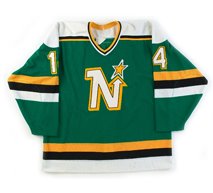
Today's featured jersey is a 1985-86 Minnesota North Stars Brian Lawton jersey. This style North Stars jersey was first worn in 1978-79, and while the white jerseys had the addition of black stripes and outlines in 1981-82, black did not arrive on the green jerseys until 1988-89, seven years later!

This was Lawton's first season wearing number 8 after changing away from the ill-advised #98 and the inevitable comparisons to Gretzky that it brought on top of the expectations of being the first American born player as well as the first US high school player ever taken first overall.

Minnesota North Stars 1985-86 jersey photo Minnesota North Stars 1985-86 F jersey.jpg
Minnesota North Stars 1985-86 jersey photo Minnesota North Stars 1985-86 B jersey.jpg

Bonus jersey: Today's bonus jersey is a 1987-88 Minnesota North Stars Brian Lawton jersey as worn during Lawton's final season in Minnesota. As stated above, the white North Stars jersey received the addition of the black trim back in 1981-82, while the green jerseys had to wait until 1988-89 for the same treatment.

Of note, the black trim on the crest and numbers is not a separate layer of twill, but simply black stitching with roughly double the normal density.

 photo Minnesota North Stars 1987-88 F jersey.png
Minnesota North Stars 1987-88 jersey photo Minnesota North Stars 1987-88 B jersey.png.jpeg

Today's video highlight is Lawton batting a puck baseball style past future NHL star Dominik Hasek of Czechoslovakia during the 1984 Canada Cup.

Tuesday, June 7, 2011

1998-99 Dallas Stars Mike Modano Jersey

Born on this date in Livonia, Michigan in 1970, Mike Modano opted to play Canadian junior hockey with the Prince Albert Raiders of the Western Hockey League beginning in the 1986-87 season. His impact was immediate, as he scored 32 goals and 62 points in 70 games. After following that up with a 47 goal, 127 point season in 1987-88, Modano became only the second American to be selected first overall in the NHL Entry Draft, after Brian Lawton, by the Minnesota North Stars who were also the club who took Lawton #1 in 1983.

Modano Drafted North Stars

He played one more season with Prince Albert, scoring 105 points, before joining the North Stars for the 1989-90 season during which he made a virtually seamless transition to the NHL with 75 points in 80 games, which instantly made him a fan favorite in Minnesota.

Modano North Stars

During his second season in Minnesota, the team went on a miraculous run through the playoffs, reaching the Stanley Cup Finals despite a 27-39-14 regular season record. Modano contributed 20 points in 23 playoff games for fifth on the team in playoff scoring.

Modano North Stars 2

After two seasons of knocking on the door, Modano had his first 30 goal season in 1991-92 with 33. He repeated his 33 goal total in 1992-93, while his 60 assists propelled him to a career high 93 points.

The North Stars franchise was moved to Dallas for the following season where Modano repeated his 93 points, only this time thanks to a career high 50 goals which no doubt helped sell the game of hockey to the fans in Texas thanks to his speed and flair.

Starting in 1995-96, Modano began a period of being a regular 30 goal scorer, hitting that mark in six of the next seven seasons and scoring in the 80's six of the next eight, a streak that coincided with him becoming an alternate team captain.

The Stars went a long playoff run in 1998 which served as a precursor for the 1998-99 season when the franchise won it's first Stanley Cup in over 30 years of trying. Modano contributed 23 points in 23 games to lead the team in playoff scoring.

Modano Stanley Cup

The Stars again returned to the finals the following season as Modano again tallied 23 points in 23 playoff games, one behind the team lead.

The 2000-01 season saw him score his 1,000th NHL point and he surpassed the 1,ooo game mark in 2002-03. Modano was named team captain for the 2003-04 and 2005-06 seasons, with the 2004-05 season being lost to the NHL lockout.

Modano Stars C

He would play four more seasons in Dallas which included scoring his 500th NHL goal on March 13, 2007 and his 503rd goal to pass Joe Mullen for the record for most goals by an American-born player just four days later.

Modano 500
Modano celebrates his 500th NHL goal

Early in the following season Modano broke the record for most points by an American-born player when he passed Phil Housley with a shorthanded goal on November 7, 2007 for his 1,233rd point, a feat which was recognized by a phone call from the president!

At the conclusion of the 2009-10 season his 20 seasons with the Stars organization came to an end when it was announced he would not be re-signed. After much speculation concerning his possible retirement, Modano opted to sign with the Detroit Red Wings for the 2010-11 season but a deep cut from a skate severed a tendon in his hand, limiting him to just 40 games although he did return in time to participate in the playoffs.

To date, Modano holds records for the Most Goals by an American-born player (561), Most Points by an American-born player (1,374), Most Playoff Points by an American-born player (145) and Most Games Played by an American-born player (1,499) as well as Dallas franchise regular season and playoff records for games, goals, assists and points.

Today's featured jersey is a 1998-99 Dallas Stars Mike Modano jersey as worn during the only Stanley Cup championship of Modano's career which came after leading the team in playoff scoring.

This style Dallas Stars jersey was first worn as an alternate jersey during the 1997-98 season and mimicked the style worn in the 1994-1997 NHL All-Star Games. Even though it was an alternate jersey, Dallas opted to wear it during the playoffs and won the Stanley Cup while wearing this jersey.

Following their Stanley Cup championship, the Stars promoted this striking jersey to their primary road jersey and created a white version to be worn at home. This style remained in use through the 2005-06 season until being replaced by the new Reebok Edge jerseys. As great as a jersey as this one was, the ones that replaced it were among some of the worst of the new styles by far.

1998-99 Dallas Stars jersey

Our video section begins with a look at the career of Mike Modano, which includes footage of his first NHL goal, his 500th and his record setting 503rd goals as well as commentary from Mike himself.


Here, Modano becomes the leading American scorer in the history of the NHL.


Monday, June 6, 2011

1973-74 Pittsburgh Penguins J. Bob "Battleship" Kelly Jersey

Born in what was then Fort William, Ontario, later renamed Thunder Bay, Bob "Battleship" Kelly was born on this date in 1946. Kelly was selected by the Toronto Maple Leafs with the 16th choice in the 1967 NHL Amateur Draft. Born John Robert Kelly, he was also referred to as J. Bob Kelly to differentiate him from former Philadelphia Flyer Bob "Hound Dog" Kelly who was active during the same time period.

His road to the NHL would take some time though, being first assigned to the Port Huron Flags of the IHL for the 1967-68 season. There, in 65 games, Kelly scored 11 goals and 26 assists but served notice of his toughness to go along with his 6' 2" 190 pound frame with 216 penalty minutes.

He divided the following season between Port Huron and the Columbus Checkers, but remarkably in 59 games he was only whistled for 55 penalty minutes. He spent the next two seasons with the AHL's Providence Reds, the first of which in 1969079 saw him only score but 2 goals and 7 points while his penalty minute total sank to just 28 minutes.

Halfway through his second season with Providence, Kelly became a member of the Des Moines Oak Leafs back in the IHL. Combined between the two teams that season, he scored 18 points while accumulating 89 penalty minutes.

Then a remarkable thing happened in 1971-72 when Battleship Kelly found his offensive game, He played three games with the Omaha Knights, scoring twice, and six games with the Oklahoma City Blazers, adding another goal before a return to Des Moines where his 26 goals in 55 games equalled his total from his entire career up to that season. He accomplished this while being a physical force, racking up 124 penalty minutes in his 55 games with the Oak Leafs.

He duplicated the feat the following season with 27 goals for the Rochester Americans under head coach Don Cherry, who certainly appreciated the element of toughness Kelly brought to the club. At season's end, Kelly's 62 points were second on the team while his 206 penalty minutes were tops for the Americans and second overall in the AHL.

That performance earned Kelly his first shot at the NHL when he became a member of the St. Louis Blues in 1973, making his NHL debut on October 10, 1973. After 37 games with the Blues, which included his first NHL goals with 9, Kelly was part of a six player trade at the 1974 NHL Amateur Draft, oddly held in January of 1974 in an effort to prevent the rival WHA from tampering with the NHL club's draft choices.

His destination was the Pittsburgh Penguins for the final 30 games of the season. There he equalled the 17 points he had scored in St. Louis while adding 78 penalty minutes to the 45 he accumulated earlier in the season.

Kelly Penguins

Kelly was a great fit for the Penguins, finishing second in the team in penalty minutes with 120 while his 27 goals were an NHL career high and fifth on the team and his +6 rating showed his value at both ends of the ice. He duplicated that effort again in 1975-76 with 25 goals, an NHL career best 55 points and 149 penalty minutes and a +4 rating.

Kelly Penguins

After one more season in Pittsburgh, where he led the club in penalty minutes with 115, Kelly was signed by the Chicago Black Hawks as a free agent where he played in 1977-78 and 1978-79 to bring his NHL career to a close.

Kelly Black Hawks

He finished his playing career with two games apiece with the Houston Apollos and Cincinnati Stingers, both of the CHL, in 1979-80 before retiring.

His final NHL totals were 425 games played, 87 goals and 109 assists for 196 points as well as both 687 penalty minutes and one of the best nicknames in league history.

Today's featured jersey is a 1973-74 Pittsburgh Penguins J. Bob "Battleship" Kelly jersey. This jersey was worn for only one season, as the Penguins darkened this jersey from it's original shade of powder blue to a medium blue for one season prior to changing to a all new, more modern striping template the following year.

One unique thing about the early Penguins jerseys were the fact their team logo was black, white and yellow, while the club's jerseys were powder blue and navy blue. It would take until 1980 before the teams jerseys would match the color of their logo and we cannot think of any other instance where the club's logo was an entirely different set of colors than their sweaters.

Pittsburgh Penguins 73-74 Jersey

Here is Kelly, regarded as one of the best fighters while in the NHL, slugging it out with the Bruins hair pulling villain Jonathan Wensink.


Here Kelly, while with the Penguins, takes on Hank Nowak. Check out how they go down yet get back up again to throw some more haymakers. They don't let them fight like that anymore in today's scripted fights which adhere so closely to "the code".

Sunday, June 5, 2011

Dr. Ian Taras's Los Angeles Kings "50/50" Jersey

While working on our 2011 Frozen Four Division 1 Project, in which we documented jerseys from every college we could possibly find at this year's NCAA finals in St. Paul, we came across one fan wearing the most unusual jersey of the literally thousands we saw over the course of the tournament.

Taras Kings Front
Taras Kings Back

The Puck Daddy blog, as part of their "jersey fouls" series, has dubbed this kind of creation "a Frankenstein jersey", in which two different jerseys are spilt down the middle with one half of each sewn back together to create a single new jersey with contrasting halves. We've seen various types of Frankenstein jerseys, in which a matched home and road jersey are put together to create a half white/half color jersey from a single team, two halves of jerseys from the same player who has played for two different teams, showing your admiration of say, Doug Gilmour, who used to be a Toronto Maple Leaf but was later a Montreal Canadien for example, or cases where a mother has two sons playing against each other in the Stanley Cup Finals and has taken half a jersey from each sibling and had them sewn together in order to support both without showing any favoritism, but we must say we thought it was somewhat odd to see two very different style jerseys from the same team joined down the middle, especially when it was bearing so many varied patches.

Knowing there must be a story behind his jersey we struck up a conversation with Dr. Ian Taras and asked him to explain the concept and origins of his creation. Here is his explanation:
I always followed the LA Kings since the early 70's and had the vintage purple & gold jersey. In 1988 when Wayne Gretzky came they changed their uniforms to the Silver & Black so I bought one of those. In 1998 when they changed their uniforms to the purple, black and silver. I was miffed at the prospect that I'd have to buy yet another jersey and that there was no jersey-stability! I looked at the silver & black jersey and in a rage ripped it down the midline. Then it came to me to do the same to my purple & gold jersey and have the opposite sides sewn together and that would be the jersey that I would henceforth wear to all hockey games. The patches were an after thought.

The # 16 was an homage to my favorite player, Marcel Dionne. In fact he is the only one to ever sign my jersey. When we were at the 2001 Colorado NHL ASG I had the opportunity for Gretzky to also sign it, but instead opted for him to sign my ticket.
As for the many patches which adorn the jersey, Dr. Taras has one basic rule: a patch qualifies for addition to the jersey if, and only if, the jersey was present at the commemorated event. Should he attend an event without the jersey, or if a well meaning friend brings him a patch back from an event they were at, it does not qualify to be added to the jersey.

Here is the complete inventory of the many patches on his jersey, which document his many travels.
Bottom Rung-
  1. 1981 LA NHL All-Star Game
  2. 1991 Chicago NHL All-Star Game
  3. 1993 LA vs. Montreal NHL Stanley Cup Championships
  4. 1997 San Jose NHL All-Star Game
  5. 1998 Vancouver NHL All-Star Game
  6. 1999 Tampa Bay NHL All-Star Game
  7. 2000 Toronto NHL All-Star Game
  8. 2001 Colorado NHL All-Star Game
  9. 2002 Salt Lake City Winter Olympics
  10. 2002 LA NHL All-Star Game
  11. 2003 Florida NHL All-Star Game
2nd Rung-
  1. 2003 Anaheim vs. New Jersey Stanley Cup Championships
  2. 2004 Minnesota NHL ASG
  3. 2004 Toronto World Cup of Hockey
  4. 2006 Milwaukee Frozen Four
  5. 2007 Dallas NHL ASG
  6. 2007 St. Louis Frozen Four
  7. 2007 Anaheim vs. Ottawa Stanley Cup Championships
  8. 2008 Atlanta NHL ASG
  9. 2008 Denver Frozen Four
  10. 2009 Montreal NHL ASG
3rd Rung-
  1. 2009 Washington D.C. Frozen Four
  2. 2010 Detroit Frozen Four
  3. 2011 Raleigh NHL ASG
  4. 2011 St. Paul Frozen Four
Several of the patches on the jersey have had to be created through various means, as the official event patches are not always sold to the public, the NCAA Frozen Four in particular. One method he has used to obtain a "patch" is to purchase a cap with the nicest embroidered logo possible and cut the logo out of the cap and affix that to the jersey to good effect.

So, next time you are at an NHL All-Star Game or NCAA Frozen Four, or perhaps a Stanley Cup Final game in California, keep an eye out for the most unusual Los Angeles Kings jersey decorated with more patches than any jersey you may have ever seen and introduce yourself to the personable Dr. Taras and have a look at a jersey with perhaps more miles travelled than any you will ever see.

If you have any photos of any other 50/50 or "Frankenstein" jerseys you would like to share with us for a future post, feel free to email them to us!


hit counter for blogger