Thursday, November 25, 2010
Hockey Thanksgiving
With today being the American Thanksgiving, we decided to forego the usual format and list The Top Ten Things We Are Thankful For - Third String Goalie style.
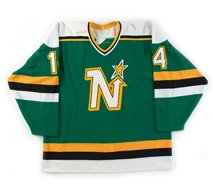
#10 - College and juniors jerseys - Simple, no frills jerseys with classic styling. You've got your team colors and your logo. What more do you need?
#9 - Where have you gone Marie-Pier? She talks 1,000 miles an hour, we can't understand a word of French anyway and she has't posted a new video since last spring, but Marie-Pier wears a referee's uniform better than anyone. Ever.
Revenez, Marie-Pier!
#8 - Minor league jerseys. Freed of the constraints of tradition and the fear of failure that limits NHL clubs who can't afford to guess wrong due to the huge amounts of retail sales their jerseys generate, at times minor league jerseys are allowed to experiment and stretch the limits of creativity, which can pay off with some terrific sweaters and even better number fonts.
#7 - Awesome alternate jerseys. As wrong as the bad ones are, the best ones are just so right. This is a prime example of the best of the best NHL alternates, a classy, unique new logo and great use of colors. Perfection on ice.
#6 - Throwback jerseys. Nothing gets us going like a throwback. It's one of the main reasons our collection centers around the 1991-92 season, that was the year that the Original 6 teams wore the first throwback jerseys in NHL history.
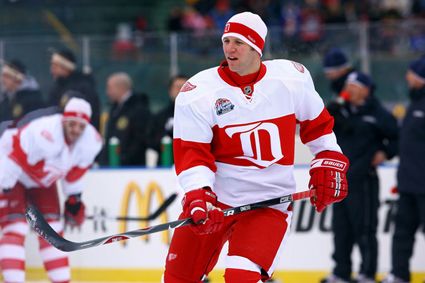
The recent addition of the Winter Classic, and the re-emergence of the Heritage Classic, has assured us of at least a couple of beauties every season, be they straight throwbacks or faux-backs, such as last year's Boston Bruins jerseys which borrowed elements from various Bruins jerseys of the past.
#5 - Awful alternate jerseys. The jerseys we love to hate, courtesy of The Class of '96. What would this blog be without The Burger King and the Wild Wing? Is it any coincidence the two worst jerseys in league history are both from California? We think not.
#4 - National team jerseys. Herb Brooks said it best, "You're looking for players whose name on the front of the sweater is more important than the one on the back." Nothing like suiting up for your home country in a short tournament where every game counts.
#3 - Patches. Nothings sets a jersey apart like a tournament, anniversary, memorial, event, Stanley Cup Finals or even sponsorship patch. That kind of attention to detail always scores points with us.
#2 - YouTube. Where to begin with this one? Incredible goals, comic moments, of course all the brawls plus the obscure, hilarious and unexpected. You just never know what YouTube has in store from one day to the next. The only thing that we dislike about it is when we embed a video from YouTube and it's taken down for whatever reason later on.
#1 - The Buffalo Sabres. Time and again, most of our favorite stories always seem to involve the Buffalo Sabres. Their first draft pick in history was awarded to them by a spin of a wheel, they once drafted an imaginary Japanese player, the city was paralyzed by a snowstorm for a week, causing 300 people to seek refuge in their arena and limiting the club to just 15 players for a road game in Montreal where the plucky warriors tied the defending Stanley Cup champions 3-3. They hosted the first Winter Classic, signed the first Russian to defect to the NHL and once played a playoff game in a thick fog in an arena haunted by bats. They haven't won the Stanley Cup, but they've won our hearts with their quirky and unique tales. God bless Punch Imlach.
Then there is the club's jersey history, which stretches from the sublime to the ridiculous having featured logos which depict a buffalo, a goat and a banana slug...
...with a few unexpected twists along the way.
We'd love to hear your favorites in the comments section below after you are done taking your post-turkey dinner nap today, and with tomorrow being "Black Friday", please consider visiting our advertisers in the column to the right when shopping for yourself or the hockey fan on your gift list.
Have a happy Thanksgiving a drive safely!
Wednesday, November 24, 2010
1902-03 Rat Portage Thistles Tom Hooper Jersey
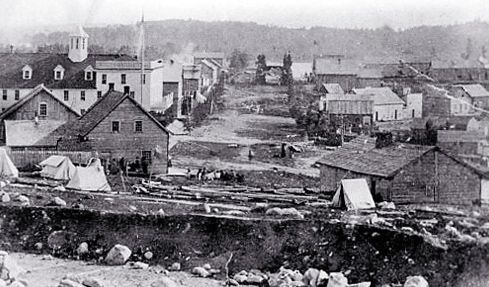
Born on this date in 1883 in Rat Portage, Ontario, Tom Hooper, known as a formidable checker and clever stickhandler, joined the Rat Portage Thistles of the Manitoba Senior Hockey League at the age of 18. The Thistles won the league championship in 1903, and emboldened by their local success, travelled east to challenge the Ottawa Silver Seven for their grip on the Stanley Cup in March of 1903.
1902-03 Rat Portage Thistles
Their series was a two-game, total-goal contest in which the Silver Seven took a dominant 6-2 win in Game 1, leaving Rat Portage a task they could not overcome. Game 2 also went the way of the Silver Seven 4-2, allowing them to retain their hold on the trophy.
Two seasons later following a 7-1 regular season record in which he scored a career high 9 goals, Hooper and the Thistles, now older and wiser than the teenagers of 1903, once more challenged mighty Ottawa for the rights to the Stanley Cup. This time around, the contest was a best-of-three format and the Thistles broke out on top with a 9-3 win in Game 1, which certainly must have had the Thistles faithful pining for a return to the two-game, total-goals format. The Senators welcomed back center Frank McGee for Game 2, and Ottawa responded with a 4-2 win to even the series. The decisive Game 3 once again went the way of Ottawa in a nail biting 5-4 win for the home Senators, sending the Thistles back to Rat Portage empty handed. Hooper finished the series with a pair of goals this time out.
The MAHA league champions and Stanley Cup challenging 1904-05 Rat Portage Thistles
In 1905 the town renamed itself Kenora while the hockey club continued to be known as the Thistles. The Thistles won the MAHA title in 1906, but circumstances out east did not allow time for an immediate challenge, so one was scheduled during the following 1906-07 season.
The 1905-06 Kenora Thistles pose with their Manitoba league championship trophy
In January of 1907, the time arrived for the Thistles challenge for the Stanley Cup and they traveled east once more, this time to face the Montreal Wanderers, who had wrestled away control of the cup from Ottawa during their league playoffs.
The Thistles, with future hall of famers Joe Hall, Tommy Phillips, Art Ross, Billy McGimsie, Roxy Beaudro and Hooper, defeated Montreal 4-2 in Game 1 on January 17 and won the coveted Stanley Cup on four days later with an 8-6 triumph to win the two-game, total goal series 12-8, with Hooper contributing 3 goals in the second game , making Kenora, population 4000, the smallest town to have ever won a major sports championship in North America.
The 1907 Stanley Cup holders the Kenora Thistles
Following the Thistles' Manitoba Professional Hockey League season, they defeated Brandon Wheat City 8-6 and 4-1 to win the league's playoff championship, which also allowed them to retain possession of the Stanley Cup. Five days later, on March 23, the Thistles took to the ice to defend their cup against the Wanderers, this time in Winnipeg but without Hooper who had fractured his collarbone. Montreal took Game 1 by a score of 7-2, and although Kenora won the second game 6-5, it was not enough to overcome Montreal's 5 goal margin from the first game, and the cup was again headed back east, ending tiny Kenora's reign as champions of all of Canada after just two months.
Gutted by player defections to professional clubs, the Thistles folded after just one game of the 1907-08 season and Hooper moved east to play one game with the Pembroke Lumber Kings prior to joining the Wanderers for two regular season games, as well as their defense of the Stanley Cup they had claimed back from Kenora a year earlier. The Wanderers easily fended off the challenge from the Ottawa Victorias 9-3 and 13-1 with Hooper having moved back to a defensive role with the Wanderers.
1908 Stanley Cup holders the Montreal Wanderers
Hooper then joined the Montreal Amateur Athletic Association club for the remaining seven games of the season in which he scored 9 goals and subsequently retired as a player, having played for seven seasons in 65 games and scoring 48 goals as well as winning the Stanley Cup twice. He was later elected to the Hockey Hall of Fame in 1962.
Today's featured jersey is a 1902-03 Rat Portage Thistles Tom Hooper jersey. The Thistles name was selected from a local name the team contest, with the winner, a local Scottish carpenter named Bill Dunsmore, who not only submitting the name "Thistles", but a drawing for the logo that would adorn the team's sweaters as well.
Most often the Thistles logo would appear centered on the teams sweaters, but as seen in the above team photo from the 1903-04 season, there was some inconsistency in 1902-03 and 1903-04 where some sweaters had what would become the standard centered logo, some had the logo over the left breast and some had no logo whatsoever.
Today's video segment is a look at the Kenora Thistles. While the original Thistle club disbanded in 1908, subsequent clubs in Kenora have adopted the Thistle name, which was the case for the club that interview subject Louis McKay played on in 1934.
For those of you interested in the Kenora Thistles, please check out the nice shirts and hoodies available from Team on Top Retro Sports.
Labels:
Hooper Tom,
Kenora Thistles,
Rat Portage Thistles
Tuesday, November 23, 2010
1974-75 Kansas City Scouts Simon Nolet Jersey
Born on this date in 1941, Simon Nolet played his junior hockey with the Quebec Citadelles of the QJHL. In 1961-62 he scored 52 points in 39 games and another 8 in 10 playoff games as the Citadelles qualified for the 1962 Memorial Cup, where Nolet added another 6 points in 9 games.
From there he moved to the Windsor Maple Leafs of the Nova Scotia Senior Hockey League for two seasons where he was a dominant force, averaging 120 points a year at a two point per game average including scoring 68 goals in 68 games in 1963-64. He sat out the following regular season, but joined the Sherbrooke Beavers for the playoffs and scored 21 goals and 35 points in 15 games to lead Sherbrooke to the 1965 Allan Cup championship.
He turned professional with the Quebec Aces of the American Hockey League the following season. After two seasons with the Aces, he made his NHL debut with the expansion Philadelphia Flyers for four games in the 1967-68 season, but played the majority of his games with the Aces for a third year.
Simon Nolet as a member of the Quebec Aces
Nolet spilt time with the Flyers and Aces in 1968-69, which included scoring his first NHL points with 4 goals and 10 assists in 35 games for the Flyers. He increased his games played the following season to 56 and topped the 20 goal mark for the first time with 22. He also played his final 22 games with the Aces, the fifth season as an Aces regular.
Starting with the 1970-71 season, Nolet played exclusively in the NHL, suiting up for 74 games, a career high. The next season Nolet pushed his high in goals up one to 23 and appeared in his first NHL All-Star Game. After two more seasons with the Flyers, which included winning a Stanley Cup in 1974.
1973-74 Stanley Cup champion Philadelphia Flyers
With the NHL expanding for the 1974-75 season, Nolet was left unprotected in the 1974 NHL Expansion Draft, and was claimed by the Kansas City Scouts. The change from Stanley Cup champions to expansion doormats was a mixed blessing for Nolet. While another championship was out of the question, the seven-year NHL veteran was named as the first ever team captain for the Scouts and was heavily relied upon by Kansas City. He did not disappoint, setting a career high in goals with 26, which included the first goal in Scouts history, assists with 32 and points with 58 to lead the team in scoring as well as being the Scouts representative at the NHL All-Star Game.
The first captain of the Scouts, Simon Nolet
He played the first half of the 1975-76 season with the Scouts prior to being traded to the Pittsburgh Penguins, where he would play the second half of the season. He was then transferred to the Colorado Rockies for the 1976-77 season as compensation for the Penguins signing goaltender Denis Herron. In actuality, the Rockies were the same Scouts franchise he had previously played for, only freshly relocated to Denver. Nolet was again named as team captain and retired at the conclusion of the season with 150 goals and 332 points in 10 seasons.
Today's featured jersey is a 1974-75 Kansas City Scouts Simon Nolet jersey as worn during the season in which Nolet made his second NHL All-Star Game appearance after being named the first captain in franchise history.
While the club retained the same color pattern after moving to Denver, the jerseys were thankfully simplified, as the Scouts striping pattern was far busier than needed thanks to the red pinstripes running inside the yellow stripes, making for a pattern which included nine different stripes, making for a quite busy pattern which was not easy on the eyes.
Bonus Jersey: Today's bonus jersey is a 1975 NHL All-Star Game Simon Nolet jersey as worn in the second NHL All-Star Game of Nolet's career which was held in Montreal. This style of All-Star jersey was first used in 1973 and lasted until 1981, a very long run by today's standards.
In this video clip, the Flyers and Nolet win the 1974 Stanley Cup and hold one heck of a parade.
Labels:
Kansas City Scouts,
Nolet Simon
Monday, November 22, 2010
1991-92 Detroit Red Wings Steve Yzerman Jersey
On this date in 1927, the Detroit Olympia hosted it's first NHL contest when the Detroit Cougars welcomed the Ottawa Senators in front of a standing room crowd of 14,000 fans as Johnny Sheppard of the Cougars scored the first goal in the history of the arena only to have the Senators come back for a 2-1 win.
The arena was built at a cost of $1.3 million with a seated capacity of 11,563 with room for another 5,000 standing room patrons. The Victoria Cougars of the WHL were purchased by Charles Hughes, a member of the Detroit Athletic Club and played their first season across the Detriot River in Windsor, Ontario prior to moving into the brand new Olympia for the 1927-28 season.
The Cougars would later change their name to first the Falcons in 1930 and then the Red Wings in 1932, but would remain tenants of the Olympia, nicknamed "The Old Red Barn", until December 15, 1979, a span of 52 years. While calling the Olympia home, the Red Wings would win the Stanley Cup seven times in 1936 and 1937, 1943 and, led by "The Production Line" of Sid Abel, Ted Lindsay and Gordie Howe, in 1950 and 1952. Alex Delvecchio replaced Abel in 1952 and the Red Wings would win two more Stanley Cups in 1954 and 1955.
Harry Lumley and Pete Babando celebrate Babando's Game 7 double overtime cup winning goal in 1950 at the Olympia
As defending champions, the Red Wings would host the NHL All-Star Game at the Olympia four times in 1950, 1952, 1954 and 1955.
In addition to the Red Wings, the Detroit Olympics played minor league hockey at the Olympia from 1927 to 1936, which included winning the Calder Cup as champions of the International Hockey League in 1935 and 1936. Despite winning the championship in 1936, the Olympics would move to Pittsburgh the very next season to become the Hornets.
A Detroit Olympics jersey, handed down from the Cougars
The NCAA college hockey Frozen Four was also held near the end of the Olympia's run in 1977 and 1979.
The Detroit Pistons of the NBA spent four seasons at the Olympia which included hosting the NBA All-Star game in 1959.
In addition to hockey and basketball, the Olympia was a major venue for boxing as well as wrestling, ice shows and concerts, which included The Beatles, Elvis Presley, The Rolling Stones and Frank Sanatra.
A ticket from The Beatles 1964 concert at the Olympia. Note the $5 price!
At the end of the Olympia's run as home of the Red Wings, it had become the smallest building in the NHL. Once the Red Wings moved to Joe Louis Arena, the final hockey game at the Olympia was a Red Wings old timers game on February 21, 1980 to commemorate the arena, which was torn down in July of 1986.
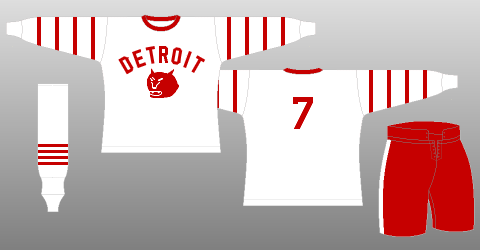
Today's featured jersey is a 1991-92 Detroit Red Wings Steve Yzerman jersey. To celebrate the NHL's 75th anniversary, the Original 6 clubs all wore throwback jerseys to mark the occasion, with the Red Wings wearing the jerseys worn by the 1927-28 Detroit Cougars.
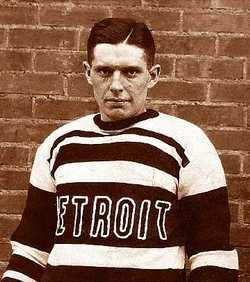
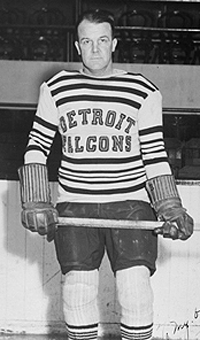
After wearing a jersey with an old English "D" on the front for their first season, which was revived for the 2009 Winter Classic, the Cougars changed to the original version of today's featured jersey for their inaugural season in the Olympia of 1927-28. This style lasted only one season before being replaced by a white jersey with a cougar head below the word "Detroit" for one season prior to a return to the 1927-28 template for 1929-30, only now with the word "Detroit" on the front in red outlined in white. The jerseys changed once again for 1930-31 to a similarly designed white jersey with multiple horizontal red stripes with "Detroit Falcons" in yellow outlined in red for two seasons, giving the club two names and five different jerseys in six seasons.
All that would change in 1932 when the team adopted the name "Red Wings" and wore a solid red jersey with simple white stripes around each arm and around the waist, which has remained essentially unchanged for nearly 80 years.
In today's video section, here are highlights of Game 7 of the 1950 Stanley Cup Finals played at the Olympia.
Once more the Stanley Cup Finals comes down to Game 7 at the Olympia, where the Red Wings again prevailed.
Our final video todays is a melodramatic photo tribute to the Detroit Olympia.
Labels:
Detroit Olympia,
Detroit Red Wings,
Yzerman Steve
Sunday, November 21, 2010
A now a word from our sponsors
With "Black Friday" on the horizon, which kicks off the holiday shopping season, we wanted to take a moment to mention the shopping opportunities we have chosen for this blog.

The next item of note is the Third String Goalie Online Book Store. We have created our own storefront inside of Amazon.com which has several departments within it. Readers of this blog will certainly enjoy many of the hockey books on our front page, as well as the "TSG Recommendations", which are books we personally own, enjoy and endorse. There is also a section of DVD's, video games and jerseys and apparel to be found inside our store.

Staying in the Amazon family, we have a search box for Amazon.com's bookstore, where we update the search parameters frequently to reflect that day's topic. You can also enter any topic you'd like, hockey or not, to see if there are any items of interest to you.
Below the Amazon search box, we have the first two of three Third String Goalie Marketplace sections, which link you to a number of online retailers, most of which we have personally done business with, and the rest chosen because they deal in products we feel are relevant to you, our readers. We have made every attempt to freshen these sections with new artwork and new links, so if it's been some time since you have clicked on those ads, please take a moment to see what they have to offer.


The third marketplace section, lower down below our favorite blogs and links, is dedicated to the Canadian clothing company Roots, who have outfitted not only Canada's Olympic athletes, but the United States Olympic Team as well. Rather than a single link to the Roots homepage, we have created direct links to the most relevant products they have to offer the hockey fan.


Finally, in case you ever venture all the way down to the bottom of our front page, hopefully to take a look at our infinitely fascinating Third String Goalie World Map of locations of the jerseys we have written about, there are some additional banner ads for the same fine folks who populate our Marketplace sections.
None of these are paid ads, but "affiliate programs", where we earn a commission on any purchases you might make, and we do not get paid per click, such as with a program like Google AdSense, which we removed from this web site due to content we could not control, as it often posted links to sellers of illegal Chinese knockoff jerseys and other various irrelevant websites, such as the one for women's thongs, which we could never understand how it related to "hockey jerseys".
Our apologies for being so commercial today, but blogging is a labor of love and we just wanted to point out the various modules and sections down the right side of the page, the differences in what they have to offer and relate how they have all been chosen with you, our readers, in mind in hopes that you might find something of interest to you and that someday, perhaps, all our efforts on this blog might amount to a free tank of gas now and then!
Speaking of hockey and shopping...
Here is a 70 year old grandma winning a $10,000 shopping spree in a between periods "shoot the puck from the far blueline through the microscopic hole" contest. We love her reaction.
Next, members of the Blackhawks are asked if they ever shop for their own stuff on ebay.
Finally, only in Canada, a hockey rink at the shopping mall. Actually, we take that "only in Canada" part back, because the St. Louis Blues also practice at a rink located in a shopping mall.
First, is the Third String Goalie Online Shop, where you can purchase all manner of goods -clothing, carry bags, home office items and mugs - which feature our patron saint Georges Vezina's confident image.
Labels:
Holiday Shopping Guide
Subscribe to:
Posts (Atom)